Switzerland has a stunningly high rate of gun ownership — here’s why it doesn’t have mass shootings

Business Insider

Switzerland has a stunningly high rate of gun ownership — here’s why it doesn’t have mass shootings

Hilary Brueck and Azmi Haroun – April 19, 2023

Switzerland has a stunningly high rate of gun ownership — here’s why it doesn’t have mass shootings
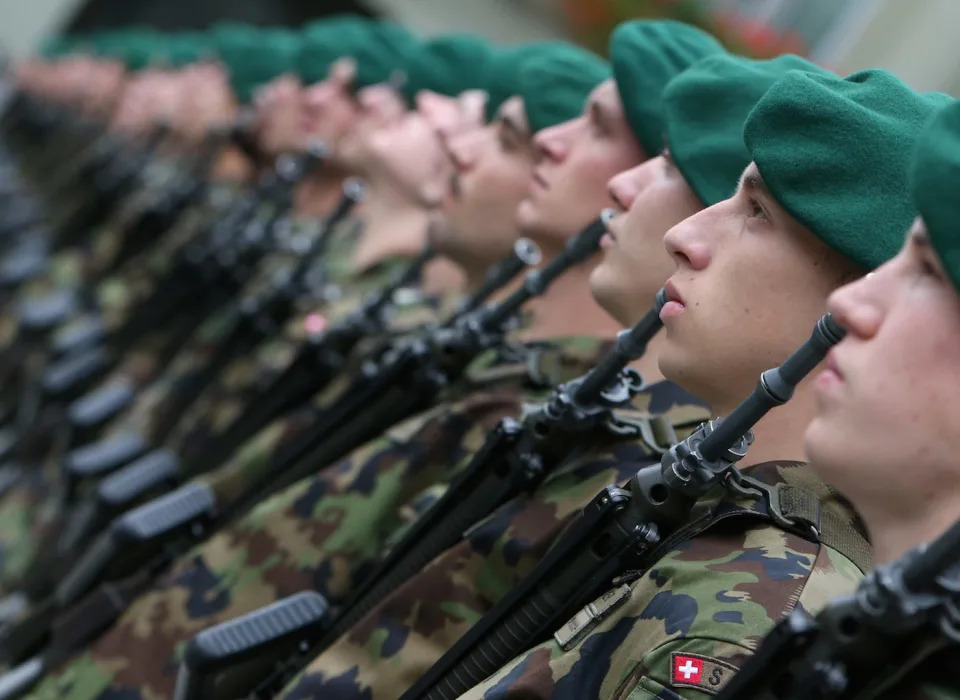
Switzerland Swiss army honor guard soldiers troops military
Members of the Swiss federal army’s honor guard in October 2012.REUTERS/Thomas Hodel

Switzerland hasn’t had a mass shooting since 2001, when a man stormed the local parliament in Zug, killing 14 people and then himself.

The country has about 2 million privately owned guns in a nation of 8.3 million people. In 2016, the country had 47 attempted homicides with firearms. The country’s overall murder rate is near zero.

The National Rifle Association often points to Switzerland to argue that more rules on gun ownership aren’t necessary. In 2016, the NRA said on its blog that the European country had one of the lowest murder rates in the world while still having millions of privately owned guns and a few hunting weapons that don’t even require a permit.

But the Swiss have some specific rules and regulations for gun use.

Insider took a look at the country’s past with guns to see why it has lower rates of gun violence than the US, where after a mass shooting that killed 6 at a school in Nashville, Tennessee, gun-death rates are now at their highest in more than 20 years, and the leading cause of death for children and adolescents.

Switzerland is obsessed with getting shooting right. Every year, it holds a shooting contest for kids aged 13 to 17.

Knabenschiessen swiss guns
Wikimedia Creative Commons

Zurich’s Knabenschiessen is a traditional annual festival that dates back to the 1600s.

Though the word roughly translates to “boys shooting” and the competition used to be only boys, teenage girls have been allowed in since 1991.

Kids in the country flock to the competition every September to compete in target shooting using Swiss army-service rifles. They’re proud to show off how well they can shoot.

The competition values accuracy above all else, and officials crown a Schutzenkonig — a king or queen of marksmen — based on results.

Having an armed citizenry helped keep the Swiss neutral for more than 200 years.

swiss herders
Alpine herdsmen in Toggenburg, Switzerland.Keystone/Getty Images

The Swiss stance is one of “armed neutrality.”

Switzerland hasn’t taken part in any international armed conflict since 1815, but some Swiss soldiers help with peacekeeping missions around the world.

Many Swiss see gun ownership as part of a patriotic duty to protect their homeland.

Most Swiss men are required to learn how to use a gun.
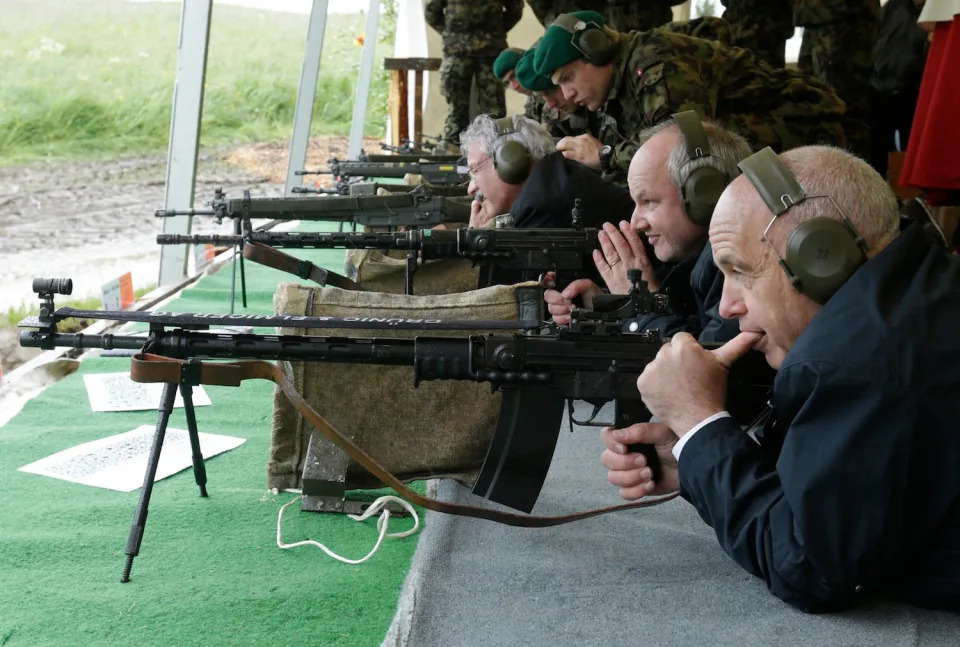
Swiss President Ueli Maurer shooting guns switzerland
Swiss President Ueli Maurer pauses during a shooting-skills exercise — a several-hundred-year-old tradition — with the Foreign Diplomatic Corps in Switzerland on May 31, 2013.REUTERS/Denis Balibouse

Unlike the US, Switzerland has mandatory military service for men.

The government gives all men between the ages of 18 and 34 deemed “fit for service” a pistol or a rifle and training on how to use them.

After they’ve finished their service, the men can typically buy and keep their service weapons, but they have to get a permit for them.

In recent years, the Swiss government has voted to reduce the size of the country’s armed forces.

Switzerland is a bit like a well-designed fort.
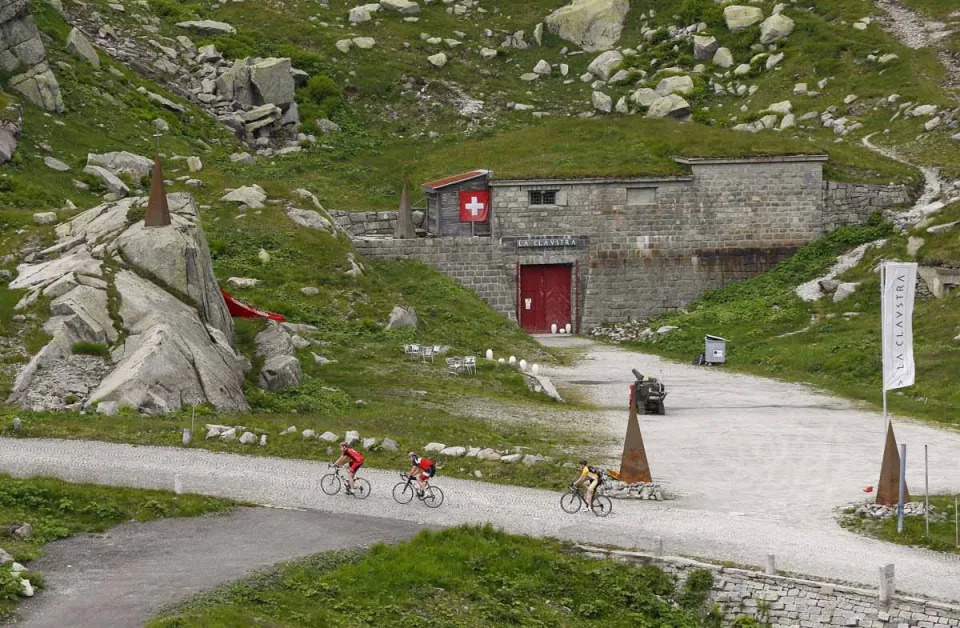
swiss bunkers
Arnd Wiegmann/Reuters

Switzerland’s borders are basically designed to blow up on command, with at least 3,000 demolition points on bridges, roads, rails, and tunnels around the landlocked European country.

John McPhee put it this way in his book “La Place de la Concorde Suisse”:

“Near the German border of Switzerland, every railroad and highway tunnel has been prepared to pinch shut explosively. Nearby mountains have been made so porous that whole divisions can fit inside them.”

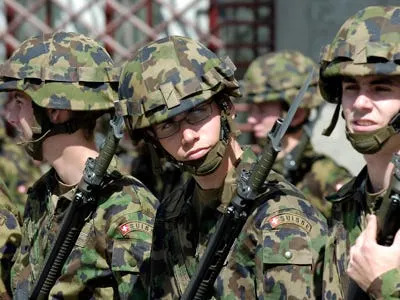
Roughly a quarter of the gun-toting Swiss use their weapons for military or police duty.
swiss-army
AP/Keyston, Lukas Lehmann

In 2000, more than 25% of Swiss gun owners said they kept their weapon for military or police duty, while less than 5% of Americans said the same.

In addition to the militia’s arms, the country has about 2 million privately owned guns — a figure that has been plummeting over the past decade.
swiss army
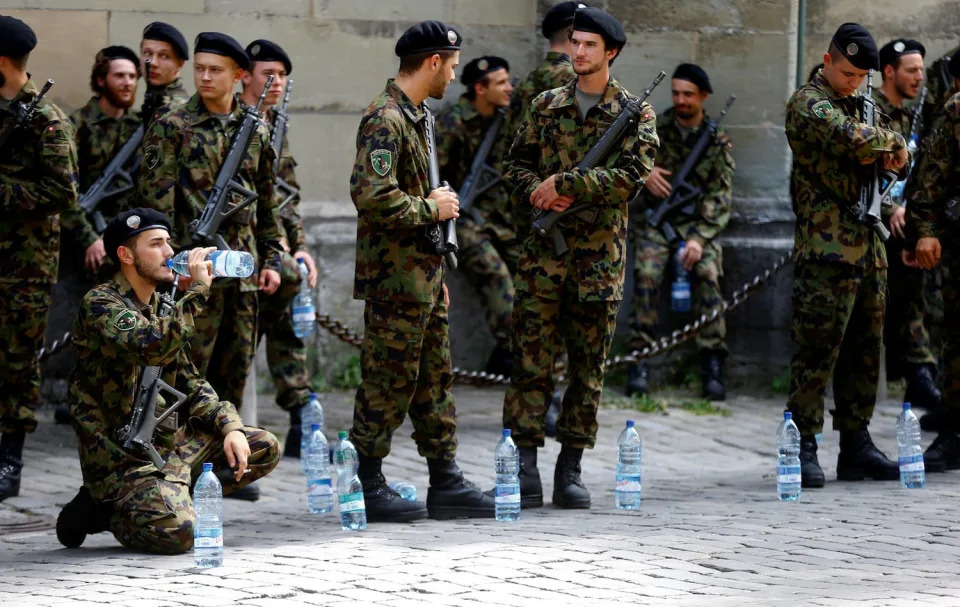
Members of an honor guard of the Swiss army.REUTERS/Arnd Wiegmann

The Swiss government has estimated that about half of the privately owned guns in the country are former service rifles. But there are signs the Swiss gun-to-human ratio is dwindling.

In 2007, the Small Arms Survey found that Switzerland had the third-highest ratio of civilian firearms per 100 residents (46), outdone by only the US (89) and Yemen (55).

But it seems that figure has dropped over the past decade. The University of Sydney now estimates that there’s about one civilian gun for every three Swiss people.

Gun sellers follow strict licensing procedures.
swiss gun shop
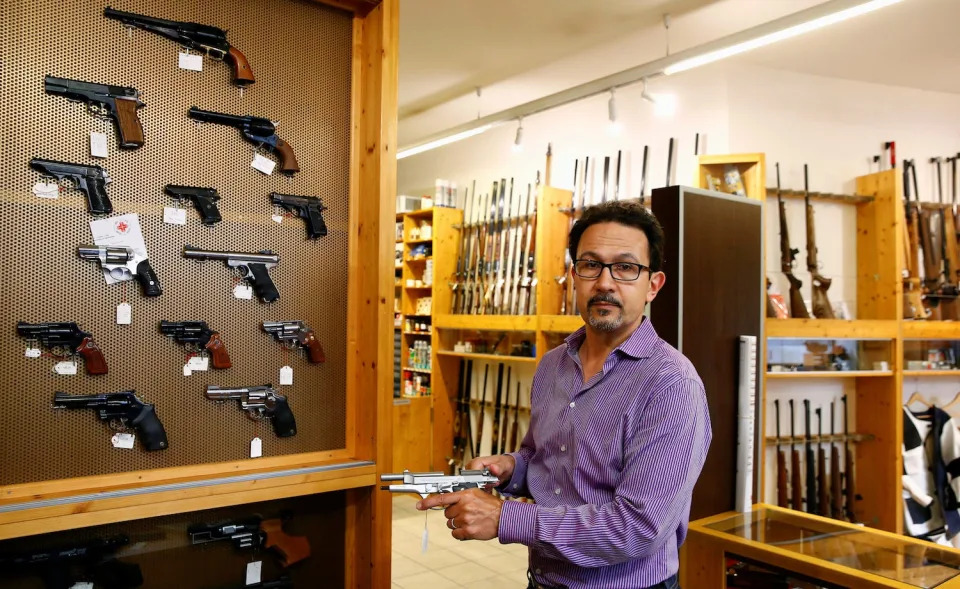
Daniel Wyss, the president of the Swiss weapons-dealers association, in a gun shop.REUTERS/Arnd Wiegmann

Swiss authorities decide on a local level whether to give people gun permits. They also keep a log of everyone who owns a gun in their region — known as a canton — though hunting rifles and some semiautomatic long arms are exempt from the permit requirement.

Cantonal police don’t take their duty doling out gun licenses lightly. They might consult a psychiatrist or talk with authorities in other cantons where a prospective gun buyer has lived to vet the person.

Swiss laws are designed to prevent anyone who’s violent or incompetent from owning a gun.
swiss nina christen rifle
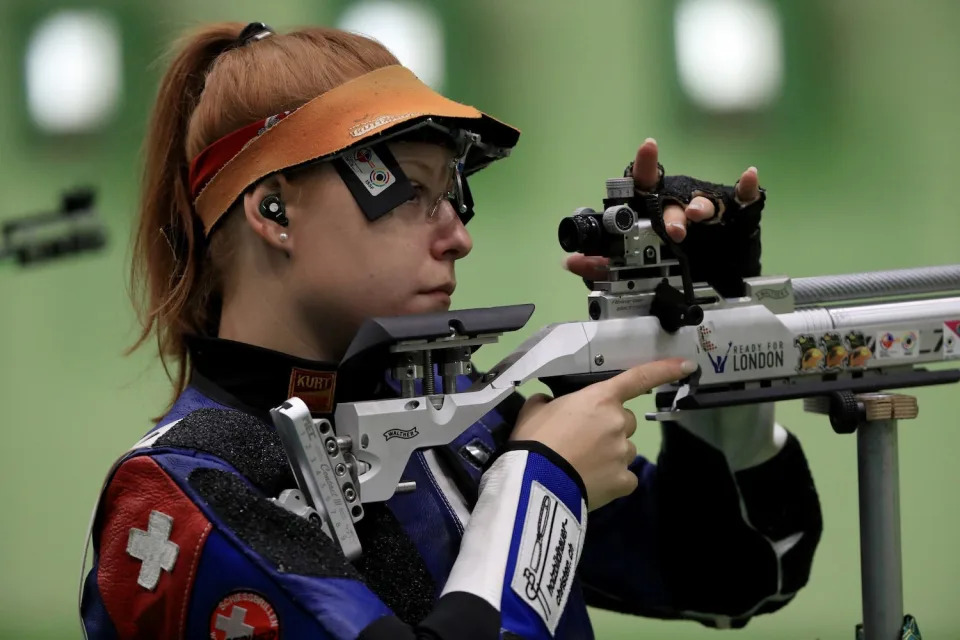
Nina Christen of Switzerland at the Olympic Games in Rio in August 2016.Sam Greenwood/Getty Images

People who’ve been convicted of a crime or have an alcohol or drug addiction aren’t allowed to buy guns in Switzerland.

The law also states that anyone who “expresses a violent or dangerous attitude” won’t be permitted to own a gun.

Gun owners who want to carry their weapon for “defensive purposes” also have to prove they can properly load, unload, and shoot their weapon and must pass a test to get a license.

Switzerland is also one of the richest, healthiest, and, by some measures, happiest countries in the world.
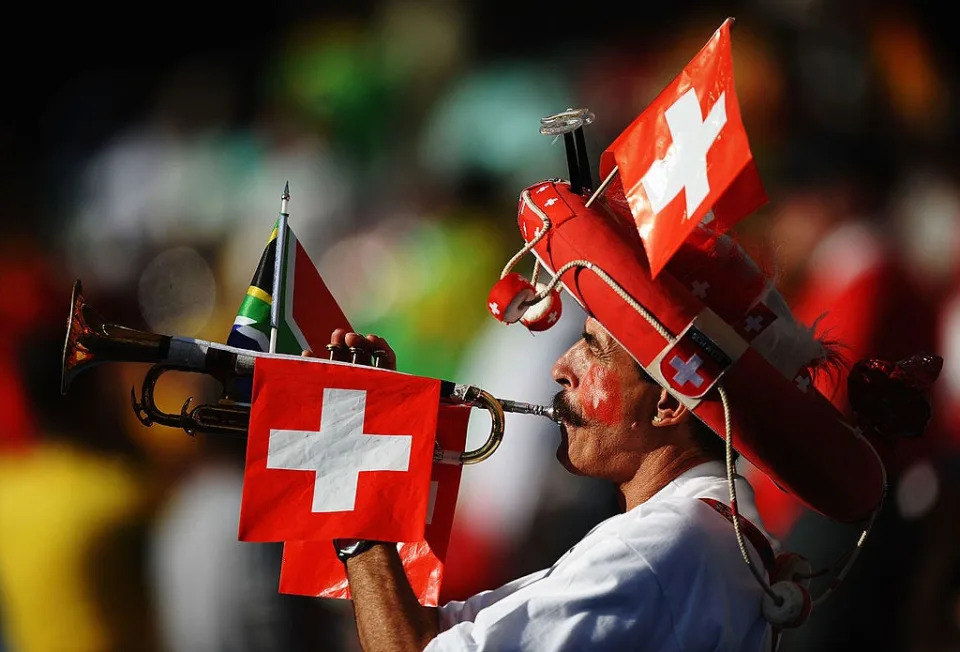
Swiss Switzerland flag fan trumpet
Laurence Griffiths/Getty Images

In their 2019 World Happiness Report, the UN ranked Switzerland sixth.

The Swiss have been consistently near the top of this list. In 2017, when the UN ranked Switzerland fourth overall among the world’s nations, the report authors noted that the country tends to do well on “all the main factors found to support happiness: caring, freedom, generosity, honesty, health, income, and good governance.”

Meanwhile, according to the report, happiness has taken a dive over the past decade in the US.

The report authors cite “declining social support and increased corruption,” as well as addiction and depression for the fall.

The Swiss aren’t perfect when it comes to guns.
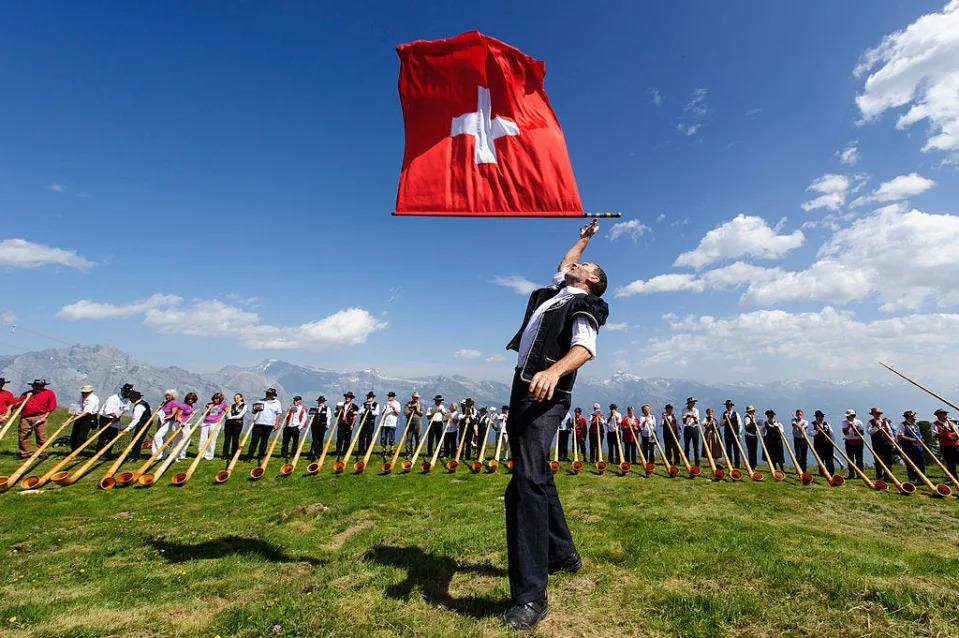
Swiss flag Switzerland
Harold Cunningham/Getty Images

Switzerland still has one of the highest rates of gun violence in Europe, and suicides account for most gun deaths in the country.

Around the world, stronger gun laws have been linked to fewer gun deaths. That has been the case in Switzerland, too.
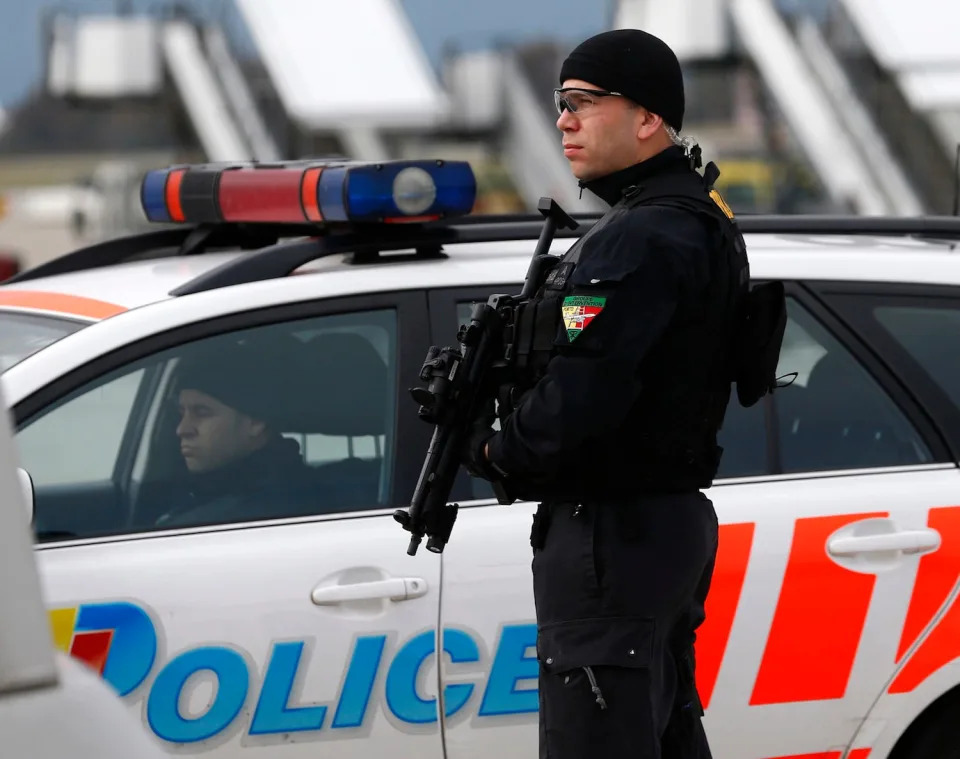
Geneva Swiss Switzerland Police Officer
A police officer at Geneva’s airport.REUTERS/Denis Balibouse

After hundreds of years of letting local cantons determine gun rules, Switzerland passed its first federal regulations on guns in 1999, after the country’s crime rate increased during the 1990s.

Since then, the government has added more provisions to keep the country on par with EU gun laws, and gun deaths — including suicides — have continued to drop.

As of 2015, the Swiss estimated that only about 11% of citizens kept their military-issued gun at home.

Most people aren’t allowed to carry their guns around in Switzerland.

swiss hunters
Hunters at a market in central Switzerland offer their fox furs.REUTERS

Concealed-carry permits are tough to get in Switzerland, and most people who aren’t security workers or police officers don’t have one.

“We have guns at home, but they are kept for peaceful purposes,” Martin Killias, a professor of criminology at Zurich University, told the BBC in 2013. “There is no point taking the gun out of your home in Switzerland because it is illegal to carry a gun in the street.”

That’s mostly true. Hunters and sports shooters are allowed to transport their guns only from their home to the firing range — they can’t just stop for coffee with their rifle.

Guns also cannot be loaded during transport to prevent them from accidentally firing in a place like Starbucks — something that has happened in the US at least twice.
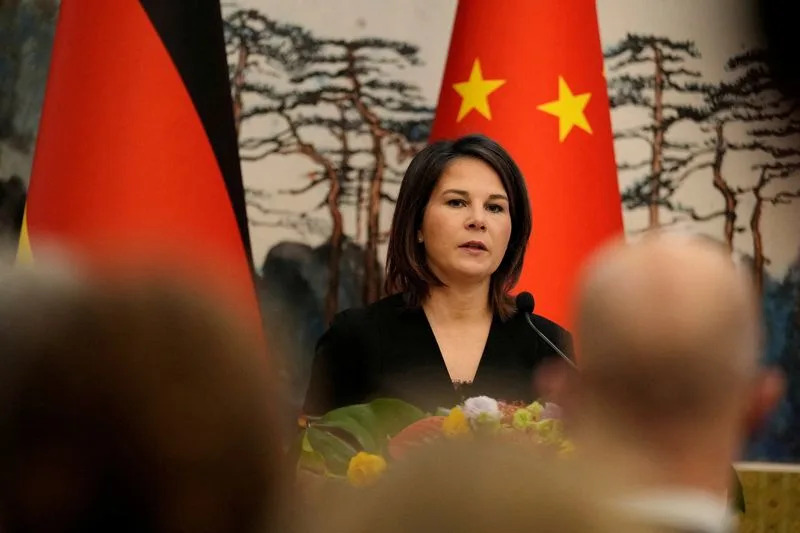
Germany’s foreign minister: Parts of China trip ‘more than shocking’

Reuters

Germany’s foreign minister: Parts of China trip ‘more than shocking’

Alexander Ratz – April 19, 2023

FILE PHOTO: German Foreign Minister Annalena Baerbock visits China
German Foreign Minister Annalena Baerbock visits China
FILE PHOTO: German Foreign Minister Annalena Baerbock visits China
German Foreign Minister Annalena Baerbock visits China

BERLIN (Reuters) – German Foreign Minister Annalena Baerbock on Wednesday described parts of her recent trip to China as “more than shocking” and said Beijing was increasingly becoming a systemic rival more than a trade partner and competitor.

The blunt remarks followed Baerbock’s visit to Beijing last week where she warned that any attempt by China to control Taiwan would be unacceptable.

Beijing claims democratically governed Taiwan as a Chinese province and has never ruled out the use of force to bring the island under its control.

Baerbock had also said China wanted to follow its own rules at the expense of the international rules-based order. Beijing in turn asked Germany to support Taiwan’s “reunification” and said China and Germany were not adversaries but partners.

Speaking to the German Bundestag (lower house of parliament) on Wednesday about her China trip, Baerbock said “some of it was really more than shocking”.

She did not elaborate on specifics, although her remark came after she said China was becoming more repressive internally as well as aggressive externally.

For Germany, she said, China is a partner, competitor and systemic rival, but her impression is now “that the systemic rivals aspect is increasing more and more”.

China is Germany’s largest trading partner, said Baerbock, but this did not mean Beijing was also Germany’s most important trading partner.

The German government wants to work with China but does not want to repeat past mistakes, for example the notion of “change through trade”, she said, that the West can achieve political shifts in authoritarian regimes through commerce.

Baerbock also said China had a responsibility to work towards peace in the world, in particular using its influence over Russia in the war in Ukraine.

She welcomed Beijing’s promise not to supply weapons to Russia, including dual use items, though added that Berlin would see how such a promise worked in practice.

In a departure from the policies of former chancellor Angela Merkel, Olaf Scholz’s government is developing a new China strategy to reduce dependence on Asia’s economic superpower, a vital export market for German goods.

(Writing by Matthias Williams; Editing by Mark Heinrich)

Putin’s Regime Is Descending Into Stalinism

Politico

Putin’s Regime Is Descending Into Stalinism

Leon Aron – April 18, 2023

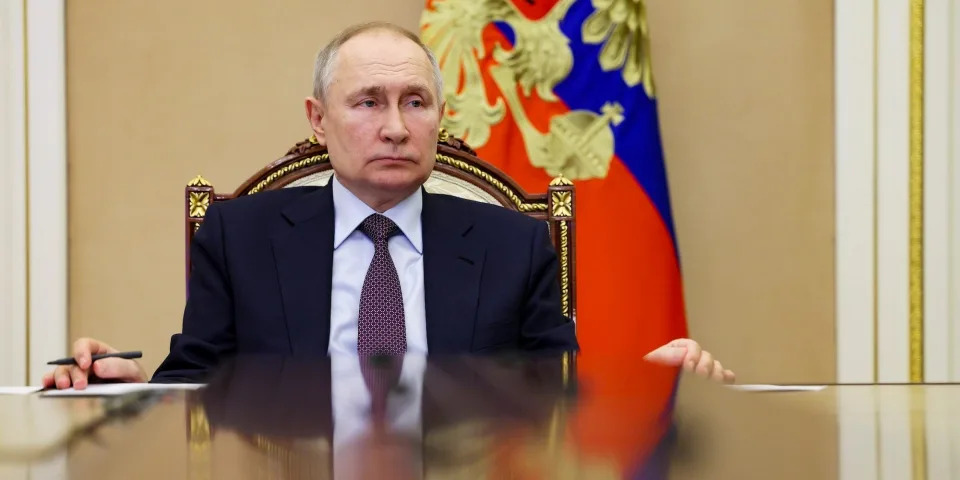
Alexander Zemlianichenko/AP Photo

Vladimir Kara-Murza is a pro-democracy opposition leader in Russia — and my friend. He was arrested in April of last year for
discrediting the armed forces” of Russia. His arrest was apparently triggered by a visit he made to Arizona the previous month during which he simply told the truth.

“The entire world sees what [Russian President Vladimir] Putin’s regime is doing to Ukraine,” Kara-Murza told members of Arizona’s state legislature. “It bombs civilian areas, hospitals and schools.”

In the months that followed his arrest, the Kremlin piled on. He was also charged with using the funds of an “undesirable organization” — the Washington, D.C. -based NGO “Free Russia Foundation” — to convene a conference in support of Russian political prisoners in Moscow in October 2021. Simultaneously, he was accused of “high treason” because he testified before the Helsinki Commission and the NATO Parliamentary assembly, and for allegedly “consulting foreign special services” for $30,000 a month.

On Monday, Kara-Murza was sentenced to 25 years in a “strict regime” prison colony. This is likely the longest sentence ever meted out for political activity in post-Soviet Russia, where the maximum term for murder is 15 years and the punishment for rape is the same. His sentence combines penalties for all these “crimes”: seven years for the first, three for the second, and 15 years (apparently “reduced” from eighteen) for the third.

This punishment is much harsher than the ones to which the regime’s vengeance has lately subjected members of the opposition. The two other leading opponents of the Kremlin, Alexei Navalny and Ilya Yashin, were sentenced to nine years and eight-and-a-half years respectively.

Heightened repression is always a sign of fear. Could Kara-Murza’s punishment have had something to do with the fact that Navalny was sentenced a year ago and Yashin last December, when the war in Ukraine may not have looked to the Kremlin as much of an endless bloody slog as it appears today? And also when its prosecution of the war, while dealing with harsh Western sanctions, was not as much fraught with the possibility of popular discontent over gradual impoverishment and casualties in the hundreds of thousands? It seems that the reason the sentence is so harsh is to scare civil society and preclude any chance of organized resistance.

Even in the post-Stalin Soviet Union, the authorities generally avoided charging dissidents with crimes like “high treason,” most often espionage. (The 1977 case of the Jewish refusenik Anatoly Sharansky was an exception.) As Kara-Murza, whom the Kremlin almost certainly tried to poison twice before, pointed out to the kangaroo court this week, his sentence harkens back not just to Soviet times but to the 1930s Stalinist purges of “enemies of the people.”

Kara-Murza is a Cambridge-trained historian, and he was right. Putin’s regime is descending into Stalinism. Sustained by indiscriminate ruthlessness, such regimes do not “evolve”— witness North Korea or Cuba. They can only be destroyed either by an invasion, like Pol Pot’s Cambodia or Saddam Hussein’s Iraq, or exploded from within by a miraculous leader like Mikhail Gorbachev.

Neither outcome is likely in Russia so long as Putin lives. And so the struggle is very personal now between the two Vladimirs, Putin and Kara-Murza, even biological: Only Putin’s death can free my friend Vladimir. Putin is 70, Kara-Murza is 41. But the effective age gap will narrow steadily as Kara-Murza’s jailers will undoubtedly begin grinding him down from day one.

Yet Kara-Murza was defiant and hopeful even as his sentence came down. “I know that the day will come when the darkness over our country will be gone,” he said in his final statement before the court. “When the war will be called a war, and the usurper [in the Kremlin] will be called a usurper; when those who have ignited this war will be called criminals instead of those who tried to stop it… And then our people will open their eyes and shudder at the sight of the horrific crimes committed in their names.”

And that is how Russia’s road back to the community of civilized states will commence, Kara-Murza told the court. Even as he sat in the steel cage in the courtroom, he said he believed that Russia would travel this road.

“Because,” he concluded, despite everything, “I love my country and I have trust in our people.”

‘Time doesn’t heal’: Ukraine’s war widows count the cost

AFP

‘Time doesn’t heal’: Ukraine’s war widows count the cost

Jonathan Brown and Elizabeth Striy, in Warsaw – April 17, 2023

Olga Slyshyk began to fear the worst in January this year when her husband, Mykhailo, a military engineer serving on the front line in eastern Ukraine, didn’t contact her on her birthday.

It wasn’t unusual for the 40-year-old trained lawyer to be offline for days at a time, but Slyshyk knew he would reach out — one way or another — on January 14 if he was alive and well.

“I was sure he would call or find some way to congratulate me. But I had had a very bad dream and I already knew something was wrong,” she told AFP in Kyiv wearing black and holding her two-year-old son Viktor.

“On January 15, I found out he had died.”

More than one year after Moscow invaded, Slyshyk is among a growing number of women widowed by Russian forces and left to count the cost of Ukraine’s determination to hold out and push Moscow’s invasion back.

Neither side has disclosed the exact figures of troops killed, though recently leaked US intelligence documents suggest as many as 17,500 Ukrainian servicemen have been lost.

Slyshyk said a social media group for war widows she joined had more than 300 members after her husband was killed defending Soledar in the eastern Donetsk region, but it had doubled in size since.

– ‘You learn to live with it’ –

President Volodymyr Zelensky last August hosted widows and their children at an honours ceremony to reassure next of kin their loved ones’ sacrifice had not been in vain.

“They will remain forever at battle. But they live on in the memory of their relatives,” he said, greeting mourning women and their children one by one.

Thirty-year-old Slyshyk, who was born in Mariupol — a port city besieged and captured by Russian forces last spring — said she often evokes the memory of her killed husband.

“All the time. Both in my head and aloud. I’ll be unable to open a tin can, weeping from frustration, and I cry out: ‘Misha, I’m not even able to do this’ and then suddenly, it opens.”

Daria Mazur, 41, said she learned of her husband’s death in 2014 from graphic pictures of his bloodied corpse published on Russian media after fierce fighting with Kremlin-backed separatists.

He was killed while withdrawing from Ilovaisk, an infamous and costly chapter of the conflict for Ukraine that saw hundreds killed that August as Kyiv troops pulled back in the face of advancing pro-Russian forces.

“Time does not heal. You just get used to it. You accept it. You learn to live with it. And that pain just becomes a part of you,” she told AFP in her kitchen in Kyiv, next to pictures showing her husband smiling with their child in his arms.

They met on a beach in2006, fell in love and married in 2010 in the southern region of Kherson, where Mazur fled from when Russia invaded last February. Her home town is currently occupied by Russian forces.

She said her final conversations with her husband, Pavlo, who was 30 when he was killed, betrayed a sense of foreboding. He knew the situation was precarious.

“He told me: ‘please promise me that no matter what happens to me, you will be happy,'” she recounted to AFP.

– ‘I need you by my side’ –

“These guys are giving their lives so we can live on,” she added, referring to Ukrainian servicemen fighting now.

It was precisely this need to go on that pushed Oksana Borkun, who also lost her husband to the Russian invasion, to create “We Have to Live,” an organisation that supports widows — the same group that Slyshyk joined.

Borkun said that while the government offers financial and psychological support, she wanted to go a step further.

“The girls face a huge amount of pain. You can say it’s possible to go crazy from it. Life is going on around you, and you want to talk to those who understand.”

The organisation gathers money for widows, offers logistical and moral support, too, but chiefly it provides a platform — mainly online — for already nearly one thousand widows country-wide to share.

For Slyshyk, her husband’s family has proven a stronger pillar of support than her own.

Her mother, who is also a widow of two years, lives in Donetsk, a pro-Russian stronghold city captured by separatists in 2014 and does not support Ukraine in the war.

The fact they have both lost their husbands has not brought them together, she said.

Months after Mykhailo’s death, Slyshyk is torn when weighing whether his sacrifice was worth it.

“He said he was going there for me and Viktor,” she recounted, explaining her husband believed Ukraine had no choice but to fight back and win.

“But if you want me to be safe, to be ok, I need you by my side, not somewhere else,” she added, swallowing back tears.

“For now, I’m emotionally conflicted”.

Ex-Navy Officer Reportedly Probed for Amplifying Pentagon Leak to Russian Channels

Daily Beast

Ex-Navy Officer Reportedly Probed for Amplifying Pentagon Leak to Russian Channels

Josh Fiallo – April 17, 2023

Dado Ruvic/Illustration/Reuters

The feds are reportedly probing a former U.S. Navy non-commissioned officer who’s accused of overseeing a prominent Russian propaganda account that made leaked documents from the Pentagon go viral this month.

Sarah Bils, 37, was unmasked this weekend as being behind the online persona “Donbass Devushka”—which roughly translates to “Donbass Girl”—despite her being a New Jersey native who lives in Washington state.

Two U.S. defense officials told United States Naval Institute News that Bils is now being probed for potentially sharing four classified docs—allegedly leaked initially by Massachusetts Air Guardsman Jack Teixeira, who was arrested last week—to Donbass Devushka’s 65,000-plus followers on Telegram.

Exact details on the probe—and potential charges for Bils—have not been released.

A Navy biography for Bils says she was an aviation electronics technician who worked out of Naval Air Station Whidbey Island in Washington state until November 2022. Speaking from her home, she admitted to The Wall Street Journal that she’s partially behind the Donbass Devushka network, which describes itself on its social media pages—including Twitter, Telegram and YouTube—as engaging in “Russian–style information warfare.”

But Bils told the paper she’s just one of 15 people “all over the world” with access to the propaganda accounts, maintaining that she wasn’t the administrator who posted the classified U.S. intel. Instead, she claims she was the admin who eventually deleted the posts.

The leaked docs quickly went viral in Russia after they were posted by Donbass Devushka on April 5, the Journal reported, with “several large Russian social-media accounts” picking up the documents and reposting. The channel’s posts with the classified documents remained online for days.

“Some very interesting potential intel,” the Telegram channel for Donbass Devushka posted with screenshots of the documents. “The authenticity cannot be confirmed but looks to be very damning nato information.”

It was the virality of this post that alerted U.S. authorities that classified intel was compromised. Previously, Teixeira, 21, had been posting other classified documents to a private Discord channel for months but the docs never went public, group members told The Washington Post.

Bils said she never used her position in the Navy to leak classified intel and that she didn’t work with Teixeira, telling the Journal, “I obviously know the gravity of top-secret classified materials. We didn’t leak them.”

The military and Justice Department have not made a public statement about Bils and her alleged role in amplifying the leak. Gen. Pat Ryder, a Pentagon spokesman, told the Journal that the military has ordered a review of intelligence access, accountability, and control procedures to nix future leakers.

Teixeira has been charged with unauthorized detention and transmission of national defense information and unauthorized removal of classified information and defense materials. The feds allege that he shared classified information on social media starting in December.

Members of Teixeira’s Discord channel told the Post that he shared screenshots of battlefield conditions in Ukraine, highly classified satellite images of the aftermath of Russian missile strikes, and vivid details on troop movements within Ukraine.

The Donbass Devushka network has basked in the aftermath of this month’s leaks—gaining thousands of new followers. Those new to its multiple social media pages were met with posts advertising pro-Russia merchandise and a promise that proceeds would go to the mercenary Wagner Group and the Russian military.

The Journal reported that Bils was honorably discharged from the military in November after a “significant demotion.” Bils told reporters that she’d left the Navy because she suffered from post-traumatic stress disorder, and that she has “some” Russian heritage.

On a podcast that shares the same name as her popular Telegram channel, Bils spoke with a “slight Russian accent,” the Journal reported—an accent other outlets have described as being “phony.” She also posed as being a woman from the Donbas region of Ukraine, one of the bloodiest areas of the Russo-Ukrainian conflict.

Bils told the Journal her old gig gave her clearance to view top-secret information but that she no longer has that access.

“I don’t even know the authenticity of the documents or what they say,” she told the Journal about the leaked intel shared on her page. “I am not very well versed in reading documents like that.”

One of the most prolific pro-Russia propaganda channels is run by a US Navy veteran living in Washington

Business Insider

One of the most prolific pro-Russia propaganda channels is run by a US Navy veteran living in Washington

 Hannah Getahun – April 16, 2023

rows of people's legs wearing boots and camouflage pants
US Navy sailors lining up on the USS Carl Vinson.Getty Images
  • A popular pro-Russia social-media account is run by a Navy veteran, per reports.
  • Donbass Devushka, whose real name is Sarah Bils, previously claimed to be from Eastern Europe.
  • The account helped to spread the leaked Pentagon documents that were posted on Discord.

A social-media account that spread misinformation about the war in Ukraine and pro-Russian war talking points was created by former US Navy non-commissioned officer, The Wall Street Journal confirmed in an exclusive interview.

Sarah Bils is a 37-year-old woman in Oak Harbor, Washington, who served at the US Naval Air Station on Whidbey Island until November of 2022, online Navy records show. Bils’ identity was first uncovered by users on Twitter and Reddit, and first reported by an advocacy site mainly posting about the war known as Malcontent News.

Online, however, Bils goes by the name Donbass Devushka, and her account sometimes posts graphic images of the fighting, praises the brutal wing of the Russian military known as the Wagner group, and sometimes celebrates the death of Ukrainian fighters.

Bils told the Journal that 15 other people help her run the account.

The persona has a YouTube channel, a Twitter, and a Spotify podcast with tens of thousands of followers. On the podcast, Bils, who in previous posts claimed to be from Eastern Europe, appears to put on a phony accent.

On the bio of her Telegram — from which she posts dozens of times a day — Bils says the account is “Russian-style information warfare” that’s “Bringing the multipolar world together.” The account, ironically, once posted a screenshot of the popular meme reading “I’ll serve crack before I serve this country” — meant to signify that someone would never join the US military.

The Telegram account was also recently associated with helping to spread four images of the dozens of leaked US intelligence documents that appeared on a Discord server called Thug Shaker Central. Many of these documents contained information on US intelligence gathering on the war in Ukraine. Jack Teixeira, a 21-year-old junior-ranking US National Guard airman, was arrested on Thursday and charged on Friday with possessing classified documents pertaining to national security, and possessing national defense materials.

Bils, who had secret security clearances while serving, told the Journal she did not help to leak the documents. The Journal also noted that the documents posted on her channel were altered versions of the Discord documents, but Bils denied that her team had altered them.

“I obviously know the gravity of top-secret classified materials,” she told the publication.

The documents are no longer on the account, but the Donbass Devushka Telegram channel shared a theory on April 13 that the leaks were actually an intentional effort from US intelligence officials and that Teixeira unknowingly carried out their plan.

Insider reached out to emails associated with Donbass Devushka and Bils but did not immediately receive a response.

The US Navy did not immediately respond to Insider’s request for comment.

Correction: April 17, 2023 — An earlier version of this story mischaracterized Bils’ position in the Navy. She was a noncommissioned officer, not a commissioned officer.

Ukrainian troops say Western military officers have been FaceTiming with them to teach them how to use weapons coming without instructions

Business Insider

Ukrainian troops say Western military officers have been FaceTiming with them to teach them how to use weapons coming without instructions

 Jake Epstein – April 17, 2023

A Ukrainian serviceman fires a rocket-propelled grenade (RPG) from a launcher during a training exercise in the Donetsk region on April 7, 2023.
A Ukrainian serviceman fires a rocket-propelled grenade (RPG) from a launcher during a training exercise in the Donetsk region on April 7, 2023.Photo by GENYA SAVILOV/AFP via Getty Images
  • Ukrainian soldiers have received billions of dollars in Western security assistance to fight Russia.
  • Sometimes, the weapons they’ve been given don’t come with instructions, or have other issues
  • Kyiv’s troops say they’ve FaceTimes with Western military officers for help, a new War on the Rocks report says.

Ukrainian soldiers fighting off invading Russian forces have enjoyed the delivery of loads of security assistance from NATO partners, but when this weaponry arrives in Ukraine, things aren’t always the way troops need them to be.

In some cases, the military aid comes in without instructions, so Western military officers have been hopping on FaceTime with Ukrainian troops to teach them how to use the weapons, according to a new report published Monday in War on the Rocks, a platform that covers national security.

Front-line units facing these issues have also been able to communicate with Western forces and NATO personnel through channels like secure messaging apps, the report’s authors said.

The authors wrote that Ukrainian soldiers told them that in one case, Western military officers used FaceTime to teach Kyiv’s troops how to use operate a rocket-propelled grenade that was delivered without instructions, and in another situation, soldiers had problems with aiming sights on guns.

“Most Ukrainian troops appreciate these informal solutions, but the United States and Europe could do a better job of ensuring future war materiel deliveries actually make sense for the Ukrainian military,” the authors said in the report.

It was not clear when these interactions took place, but Ukrainian troops finding issues in their weapons and needing a bit of customer service and tech support from partners is nothing new — they have previously been forced to reach out to Western partners over the phone and through video chats, sometimes even during active combat with the Russians.

A Ukrainian serviceman prepares to fire a rocket-propelled grenade (RPG) from a launcher during a training exercise in the Donetsk region on April 7, 2023
A Ukrainian serviceman prepares to fire a rocket-propelled grenade (RPG) from a launcher during a training exercise in the Donetsk region on April 7, 2023Photo by GENYA SAVILOV/AFP via Getty Images

Since NATO doesn’t have troops fighting alongside the Ukrainians, a maintenance team has worked remotely to provide telephone support to Kyiv’s troops as they deal with damaged artillery pieces, among the many other problems that have emerged in the intense fighting in eastern Ukraine.

The US has sent over $35.1 billion in security assistance to Ukraine since the beginning of Russia’s full-scale invasion of its neighbor in February 2022. According to a Defense Department fact sheet from this month, the long list of weaponry includes rockets, missiles, artillery pieces, infantry fighting vehicles, tanks, small arms, ammunition, and so much more.

“The United States will continue to work with its Allies and partners to provide Ukraine with capabilities to meet its immediate battlefield needs and longer-term security assistance requirements,” the Pentagon said in an April statement announcing a recent round of military hardware worth around $2.6 billion for Ukraine.

As Russia’s full-scale assault on Ukraine nears the 14-month-mark and the two countries continue to fight a grinding and brutal war of attrition along a relatively static front line, there are growing concerns about if Western countries will continue to maintain their military support for Ukraine, especially as continuous deliveries strain some partner arsenals and defense production.

Russia’s devastating war in Ukraine has so far taken a heavy toll, and both sides may have suffered upwards of 350,000 casualties, recently leaked Pentagon documents revealed, with the Russian death toll more than double the Ukrainian figures.

Moldova tells Moscow not to meddle after barring Russian governor from entry

Reuters

Moldova tells Moscow not to meddle after barring Russian governor from entry

April 17, 2023

St. Petersburg International Economic Forum (SPIEF)

CHISINAU (Reuters) – Moldova told Russian politicians not to meddle in its internal affairs on Monday after barring a Russian delegation from entering the country ahead of a regional election.

The delegation led by Rustam Minnikhanov, governor of Russia’s Tatarstan region, had been due to attend a forum in semi-autonomous Gagauzia region, which holds elections on April 30 to name the head of its government.

Moldova, which applied to join the European Union last year alongside its neighbour Ukraine, has repeatedly accused Russia of trying to destabilise the country, something Moscow denies.

Minnikhanov arrived in an official Tatarstan government plane but was not allowed off the aircraft. Police said in a statement his trip aimed to bolster support for a pro-Russian candidate standing at the elections.

“Supporting a candidate at local elections in Moldova is not a valid reason and the authorities ask Russian bureaucrats to refrain from interfering in the internal affairs of our country,” the border guard service said.

Minnikhanov posted a video on social media in which he said he and his delegation had been labelled undesirable, a move he described as regrettable. He said the people of Tatarstan and Gagauzia, both home to Turkic peoples, were “brothers”.

Gagauzia is an autonomous region home to a Turkic population that is pro-Russian and Orthodox Christian.

(Reporting by Alexander Tanas; writing by Tom Balmforth; editing by Angus MacSwan)

Russian oil products are heading to the crude-rich Persian Gulf as the UAE and Saudi Arabia take advantage of cheap barrels

Business Insider

Russian oil products are heading to the crude-rich Persian Gulf as the UAE and Saudi Arabia take advantage of cheap barrels

Phil Rosen – April 17, 2023

saudi arabia russia putin
Russian President Vladimir Putin with Saudi Arabia’s Ambassador to Russia Abdulrahman Al-Rassi.Reuters/Sergei Karpukhin
  • Gulf nations are snapping up cheap Russian oil products while exporting their own crude at market rates.
  • Saudia Arabia and the UAE have emerged as key storage and trading hubs for Russian products, the Wall Street Journal reported.
  • Russia is sending 100,000 barrels a day to Saudi Arabia, up from effectively zero pre-Ukraine war, Kpler data shows.

Petro-rich nations in the Persian Gulf are buying discounted Russian oil products as Moscow continues to seek willing buyers while the West shuns the warring nation.

The United Arab Emirates and Saudi Arabia are using those Russian barrels within their own borders for consumption and refining purposes, while exporting their own products at market rates, the Wall Street Journal reported.

Russian naphtha and diesel sell at discounts of $60 and $25 a ton, respectively, according to the report.

In addition, the two countries, particularly the UAE, have emerged as key trade and storage hubs for Russian oil and fuel. Trading firms import Russia energy to the UAE and re-export it to Pakistan, Sri Lanka or East Africa, the report said.

Kpler data shows Russian oil exports to the UAE more than tripled to 60 million barrels last year. Separate Argus Media data cited by the Journal show Russia now accounts for more than 10% of gas oil stored in Fujairah, the UAE’s main oil-storage center.

Meanwhile, Saudi Arabia is importing 100,000 barrels a day from Russia after seeing effectively zero before Russia war on Ukraine, translating to an annual pace of about 36 million barrels.

US officials have objected to the burgeoning relations between Russia and the Gulf nations. But with Russia’s Urals crude trading at more than a 30% discount to Brent crude, the international benchmark, the arbitrage is particularly attractive.

Moscow has proven capable of navigating Western sanctions and price caps well enough to push oil exports above levels reached before it invaded Ukraine. In the first quarter, Russia’s seaborne crude exports hit 3.5 million barrels a day, compared to the 3.35 million barrels reached in the year-ago quarter.

Meanwhile, Kpler data shows that China and India now account for roughly 90% of Russia’s oil, with each country taking in 1.5 million barrels a day — more than enough to absorb the volumes no longer heading to European nations.

Still, even with other countries plugging the gaps left by sanctions, Moscow hasn’t been able to maintain the same level of energy profits amid war. The International Energy Agency said Friday that the country’s export revenue is down 43% compared to the same time last year.

Russia’s economy is hurting – and a new wave of EU sanctions aimed at crippling its ‘war machine’ are coming.

Business Insider

Russia’s economy is hurting – and a new wave of EU sanctions aimed at crippling its ‘war machine’ are coming. Here are 6 key developments in the past week.

Zinya Salfiti – April 16, 2023

Russian President Vladimir Putin  in Moscow, Russia on March 30, 2023.
Russian President Vladimir Putin.Gavriil Grigorov/Sputnik, Kremlin Pool Photo via AP
  • Russia’s economy is hurting and a new wave of EU sanctions targeting its “war machine” are coming.
  • Growing links to China, an unstable currency and “cherry-picked” data are key developments.
  • Here are six key things to know about what’s going on in Russia over the past week.

Russia’s economy is reeling from the web of Western sanctions imposed on it after Vladimir Putin launched his war in Ukraine — and an official from the European Union recently said that Moscow will soon face a new wave of penalties coming from Europe.

The country’s finances have taken a massive hit. Russia’s private sector is shrinking, it has posted a $29 billion deficit in the first three months of 2023, and its main revenue sources – oil and gas exports – have plunged since a price cap was imposed by Western powers late last year.

Russia’s growing economic ties to China, its unstable currency, and rising doubts about the accuracy of official government data coming out of Moscow are just some the key developments over the past week.

Here are 6 key things to know about what’s going on in Russia as it grapples with the impact of sanctions on its economy:
1. It’s not clear how Russia’s economy is faring

The world’s top forecasters can’t seem to agree on whether Russia’s economy is expanding or contracting. That’s in part because of the questionable accuracy of the official data provided by Putin’s government since the war began.

Seven predictions from the likes of JPMorgan, Morgan Stanley, Goldman Sachs, the IMF, Bank of Russia and more, all have different – and conflicting – estimates of Russia’s real GDP in 2023.

2. “Cherry-picked” data

Economists around the world have cautioned against relying too much on economic forecasts and predictions that heavily depend on official data coming from Moscow’s government. They said official stats are trying to paint a rosy picture of a resilient economy that’s withstood the impact of sanctions – when in reality, the economy is in tatters.

“Since the Ukrainian invasion, our data has shown that the Kremlin’s economic releases have become increasingly cherry-picked, selectively tossing out unfavorable metrics while releasing only those that are more favorable,” two Yale researchers said. 

Alexei Bayer, an independent economist, echoed this view and said the situation is much worse than it seems.

“Russian economic statistics are a collection of lies and distortions,” Bayer said. “They are meant to convince people at home that their economy is chugging along despite the war, and people abroad that Western economic sanctions don’t work and therefore should be rescinded.”

3. There’s a massive hole in the Kremlin’s budget

Russia – the world’s second-larges oil and gas producer — lost over $15 billion in oil and gas revenue during the first quarter of 2023, thanks to the price cap aimed at crippling Moscow’s energy exports.

Russian President Vladimir Putin said he’s optimistic that the situation will improve in the next few months given rising oil prices. Still, some experts said the country has lost its largest export markets, and these shrinking markets for Russia’s resources will eventually push the Kremlin to cut spending on infrastructure and social programs.

4. Falling energy export revenue is shaking the ruble

The Russian ruble is coming off its worst week against the dollar since last year, cratering more than 5%. The falling currency comes as the country’s energy export revenue dipped, and evidence mounts that Russia’s recession in 2022 was way worse than initially thought.

5. Russia is becoming more economically linked to China

Russians purchased 41.9 billion rubles worth of China’s yuan currency in March, more than tripling the 11.6 billion rubles they bought the month before, according to reports from the country’s central bank.

While Putin rejected the idea that his country is becoming more economically dependent on China, and said it’s a notion that comes from “jealous people,” Chinese President Xi Jinping was able to secure sweeping trade agreements between the nations without offering up any concrete support in Ukraine.

“The main conduit of a deeper integration of China into Russia has been the Chinese yuan which is now perceived by the Russians as a much safer reserve currency to keep,” Kpler analyst Viktor Katona told Insider.

6. New EU sanctions are looming

The embattled Russian economy is set to face a fresh round of painful sanctions.

Mairead McGuinness, a top EU official, confirmed on Thursday that Europe has plans to roll out its 11th package of penalties against Russia.

She didn’t specify what the new sanctions would be aimed at. However, earlier rounds targeted Russia’s oil and gas exports, key technologies, access to its currency reserves, and both individuals and companies.