A Wagner ex-convict returned from war and a Russian village lived in fear. Then he killed again

Associated Press

A Wagner ex-convict returned from war and a Russian village lived in fear. Then he killed again

Dasha Litvinovau – June 27, 2023

FILE - In this image taken from video and released on Saturday, May 20, 2023, by the press service of Yevgeny Prigozhin, head of the Wagner private military contractor, his forces wave Russian and Wagner flags atop a damaged building in Bakhmut, Ukraine. Some convicts recruited by Wagner to fight in in Ukraine are coming home to Russia and committing new crimes. That has raised fears in communities where the now-freed convicts are returning, and reports of killings, robberies and sexual assaults by some of them are emerging in Russian media. (Prigozhin Press Service via AP, File)
In this image taken from video and released on Saturday, May 20, 2023, by the press service of Yevgeny Prigozhin, head of the Wagner private military contractor, his forces wave Russian and Wagner flags atop a damaged building in Bakhmut, Ukraine. Some convicts recruited by Wagner to fight in in Ukraine are coming home to Russia and committing new crimes. That has raised fears in communities where the now-freed convicts are returning, and reports of killings, robberies and sexual assaults by some of them are emerging in Russian media. (Prigozhin Press Service via AP, File)
FILE - In this image taken from video and released by the press service of Yevgeny Prigozhin, head of the Wagner private military contractor, on Saturday, May 20, 2023, he speaks while holding a Russian flag in front of his forces in Bakhmut, Ukraine. Some convicts recruited by Wagner to fight in Ukraine are coming home to Russia and committing new crimes. That has raised fears in communities where the now-freed convicts are returning, and reports of killings, robberies and sexual assaults by some of them are emerging in Russian media. (Prigozhin Press Service via AP, File)
In this image taken from video and released by the press service of Yevgeny Prigozhin, head of the Wagner private military contractor, on Saturday, May 20, 2023, he speaks while holding a Russian flag in front of his forces in Bakhmut, Ukraine. Some convicts recruited by Wagner to fight in Ukraine are coming home to Russia and committing new crimes. That has raised fears in communities where the now-freed convicts are returning, and reports of killings, robberies and sexual assaults by some of them are emerging in Russian media. (Prigozhin Press Service via AP, File)

TALLINN, Estonia (AP) — When Ivan Rossomakhin returned home from the war in Ukraine three months ago, his neighbors in the village east of Moscow were terrified.

Three years ago, he was convicted of murder and sentenced to a long prison term but was freed after volunteering to fight with the Wagner private military contractor.

Back in Novy Burets, Rossomakhin drunkenly wandered the streets of the hamlet 800 kilometers (about 500 miles) east of Moscow, carrying a pitchfork and threatening to kill everyone, residents said.

Despite police promises to keep an eye on the 28-year-old former inmate, he was arrested in a nearby town on charges of stabbing to death an elderly woman from whom he once rented a room. He reportedly confessed to committing the crime, less than 10 days after his return.

Rossomakhin’s case is not isolated. The Associated Press found at least seven other instances in recent months in which Wagner-recruited convicts were identified as being involved in violent crimes, either by Russian media reports or in interviews with relatives of victims in locations from Kaliningrad in the west to Siberia in the east.

Russia has gone to extraordinary lengths to replenish its troops in Ukraine, including deploying Wagner’s mercenaries there. That has had far-reaching consequences, as was evident this weekend when the group’s leader sent his private army to march on Moscow in a short-lived rebellion. Another has been the use of convicts in battle.

The British Defense Ministry warned of the fallout in March, saying “the sudden influx of often violent offenders with recent and often traumatic combat experience will likely present a significant challenge for Russia’s wartime society” as their service ends.

Wagner leader Yevgeny Prigozhin said he had recruited 50,000 convicts for Ukraine, an estimate also made by Olga Romanova, director of the prisoner rights group Russia Behind Bars. Western military officials say convicts formed the bulk of Wagner’s force there.

About 32,000 have returned from Ukraine, Prigozhin said last week, before his abortive rebellion against the Defense Ministry. Romanova estimated it to be about 15,000 as of early June.

Those prisoners agreeing to join Wagner were promised freedom after their service, and President Vladimir Putin recently confirmed that he was “signing pardon decrees” for convicts fighting in Ukraine. Those decrees have not been made public.

Putin recently said recidivism rates among those freed from prison through serving in Ukraine are much lower than those on average in Russia. But rights advocates say fears about those rates rising as more convicts return from war are not necessarily unfounded.

“People form a complete absence of a link between crime and punishment, an act and its consequences,” Romanova said. “And not just convicts see it. Free people see it, too -– that you can do something terrible, sign up for the war and come out as a hero.”

Rossomakhin wasn’t seen as valorous when he returned from fighting in Ukraine but rather as an “extremely restless, problematic person,” police said at a meeting with fearful Novy Burets residents that was filmed by a local broadcaster before 85-year-old Yulia Buyskikh was slain. At one point, he even was arrested for breaking into a car and held for five days before police released him March 27.

Two days later, Buyskikh was killed.

“She knew him and opened the door, when he came to kill her,” her granddaughter, Anna Pekareva, wrote on Facebook. “Every family in Russia must be afraid of such visitors.”

Other incidents included the robbery of a shop in which a man held a saleswoman at knifepoint; a car theft by three former convicts in which the owner of the vehicle was beaten and forced to sign it over to them; the sexual assault of two schoolgirls; and two other killings besides the one in Novy Burets.

In Kaliningrad, a man was arrested in the sexual assault of an 8-year-old girl after taking her from her mother, according to a local media report and one of the girl’s relatives.

The man had approached the mother and bragged about his prison time and his Wagner service in Ukraine, according to the relative, who spoke to AP on condition of anonymity out of safety concerns. The relative asked: “How many more of them will return soon?”

In its recruiting, Wagner usually offered convicts six-month contracts, according to media reports and rights groups. Then they can return home, unlike regular soldiers, who can’t terminate their contracts and leave service as long as Putin’s mobilization decree remains in effect. It wasn’t immediately clear, however, whether these terms will be honored after Prigozhin’s unsuccessful mutiny.

Prigozhin, himself a former convict, recently acknowledged that some repeat offenders were Wagner fighters -– including Rossomakhin in Novy Burets and a man arrested in Novosibirsk for sexually assaulting two girls.

Putin recently said the recidivism rate “is 10 times lower” among the convicts that went to Ukraine than for those in general. ”The negative consequences are minimal,” he added.

There isn’t enough data yet to assess the consequences, according to a Russian criminology expert who spoke on condition of anonymity out of safety concerns.

Incidents this year “fit the pattern of recidivist behavior,” and there’s a chance that those convicts would have committed crimes again upon release, even if they hadn’t been recruited by Wagner, the expert said. But there’s no reason to expect an explosive spike in crime because a significant number of the ex-convicts probably can refrain from breaking the law for some time, especially if they were well-paid by Wagner, the expert said.

He expects crime rates to rise after the war, but not necessarily due to the use of convicts. It’s something that usually happens following conflicts, he said.

The Soviet Union sent 1.2 million convicts to fight in World War II, according to a 2020 research paper by Russia’s state penitentiary service. It did not say how many returned, but the criminology expert told AP a “significant number” ended up behind bars again after committing new crimes for years afterward.

Romanova from Russia Behind Bars says there have been many troubling episodes involving convicts returning to civilian life after a stint in Ukraine.

Law enforcement and justice officials who spent time and resources to prosecute these criminals can feel humiliated by seeing many of them walk free without serving their sentences, she said.

“They see that their work is not needed,” Romanova added.

Some convicts who are caught committing crimes after returning home sometimes try to turn the tables on police by accusing them of discrediting those who fought in Ukraine — now a serious crime in Russia, she said.

Asked if that deters those in law enforcement, Romanova said: “You bet. A prosecutor doesn’t want to go to prison for 15 years.”

Yana Gelmel, lawyer and rights advocate who also works with convicts, said in an interview that those returning from Ukraine often act with bravado and bluster, demanding special treatment for having “defended the motherland.”

She paints a grim life in Russia’s prisons, with rampant and incessant violence, extreme isolation, constant submission to guards and a strict hierarchy among inmates. For prisoners in those conditions, “what would his mental state be?” Gelmel asked.

Add in the trauma of being thrown into battle — especially in places like Bakhmut in eastern Ukraine, the longest and bloodiest of the conflict, where Wagner forces died by the thousands,

“Imagine -– he went to war. If he survived … he witnessed so much there. In what state will he return?” she added.

Meanwhile, prison recruiting for duty in Ukraine apparently continues — just not by Wagner, rights groups say. The Defense Ministry is now seeking volunteers there instead and offering them contracts.

Romanova said the ministry had recruited nearly 15,000 convicts as of June, although officials there did not respond to a request for comment.

Unlike Wagner, the Defense Ministry soon will have legal grounds -– laws allowing for enlisting convicts into contractual service have been swiftly approved by the parliament and signed by Putin last week.

And unlike Wagner, the ministry is offering 18-month contracts, but many recruits haven’t been given anything to sign, ending up in a precarious position, Romanova said.

Enthusiasm among inmates to serve hasn’t waned, she said, even after thousands were killed on the battlefield.

“Russian roulette is our favorite game,” Romanova said, grimly. “National entertainment.”
The fragile truce that halted Prigozhin’s armed revolt against the Kremlin seems to be falling apart already

Business Insider

The fragile truce that halted Prigozhin’s armed revolt against the Kremlin seems to be falling apart already


Erin Snodgrass – June 26, 2023

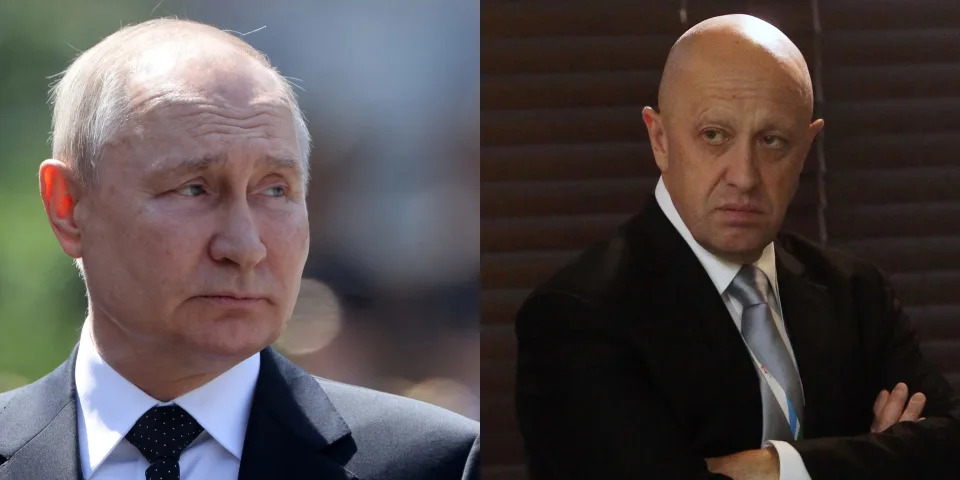
Vladimir Putin (left) and Yevgeny Prigozhin (right).
Vladimir Putin (left) has long relied on Yevgeny Prigozhin (right) for his Wagner Group of mercenaries to fight in the invasion of Ukraine.Getty Images
  • Wagner forces halted their revolt on Saturday after striking a deal with the Kremlin.
  • But that peace agreement appears increasingly uncertain as Prigozhin renews his rants against Russia’s military.
  • Putin, meanwhile, has offered conflicting comments on the coming consequences for those involved.

The Wagner revolt may be over, but the chaos in Russia has likely only begun.

In a brief and, at times, contradictory speech Monday night, Russian President Vladimir Putin cast doubt on the tenuous peace deal the Kremlin struck with Wagner Group founder Yevgeny Prigozhin on Saturday after the mercenary leader spearheaded a short-lived revolt against Russia’s defense ministry.

Prigozhin, a one-time ally to Putin, shocked Russian civilians and international onlookers alike as he led a cadre of troops-for-hire in a “march of justice” over the weekend after alleging the Russian defense ministry conducted a missile strike that killed several Wagner soldiers.

The uprising represents the most damning challenge to Putin’s regime in decades. It was only averted when Prigozhin turned his troops back a mere 120 miles outside of Moscow after the Kremlin said it would drop any criminal charges against the former chef, who agreed in turn to be exiled to neighboring Belarus.

But by Monday, that agreement appeared precarious as Prigozhin renewed his rants against the Russian defense ministry and Putin offered conflicting comments about the coming consequences for those involved in the mutiny.

After hours of conspicuous silence following the apparent peace deal, Prigozhin reappeared on Monday, posting an 11-minute audio clip to Telegram in which he offered further context for the reasons behind his weekend attack, while defiantly insisting that his troops would remain independent of Russia’s military.

Prior to the rebellion, Wagner forces, which helped capture the Ukrainian city of Bakhmut in a bloody battle earlier this year, had been ordered to join Russia’s forces by July 1 — a command that many of the army’s former convicts and mercenaries were not eager to obey, according to Prigozhin, prompting the group’s weekend march toward Moscow in an effort to avoid being absorbed by Russia’s official military.

“We were marching to demonstrate our protest, not to unseat the government,” Prigozhin said, according to a translation of his message.

Putin, meanwhile, addressed the Russian public for the first time since Wagner retreated in his Monday speech, which offered little clarity about how Russia plans to respond to the uprising.

The president praised Wagner troops for turning back and pledged to uphold his promise that those who did so can join the Russian military or seek amnesty in Belarus. But Putin also railed against the “organizers” of the revolt — never naming Prigozhin directly — as traitors who will be “brought to justice.” It seemed to be a reversal of the government’s vow to spare Prigozhin from criminal charges.

Russian state media reported that Prigozhin is in fact, still under investigation, adding even more uncertainty to the legitimacy of the Saturday deal.

Prigozhin’s whereabouts remain unknown, and neither Telegram post nor televised speech have offered any clarity on the future of Wagner’s 25,000 troops who remain armed.

Prigozhin still has thriving Wagner activities in Africa that are likely more appealing than a life of exile in Belarus. Several reports this week indicated that Wagner is still actively recruiting.

But even if Wagner troops were to rejoin their Russian comrades on the battlefield in Ukraine, tensions between the two armies, which were already high prior to the revolt, are likely to be intensified by the mercenary group’s attacks on Russia’s military over the weekend, which included the downing of several aircraft that reportedly left some Russian pilots dead.

US and European officials, meanwhile, are on the edge of their seats waiting to see how the dust settles in Russia.

US Secretary of State Antony Blinken noted “cracks in the facade of Putin’s leadership” on Saturday, praising the civil dispute as an opportunity for Ukraine to make gains while Russia dealt with its internal issues. 

The Biden administration and other Western allies, however, remain concerned that Prigozhin’s uprising has dealt a considerable blow to Russia’s stability, The Washington Post reported.

“We see cracks emerging,” Blinken said on Sunday. “I don’t want to speculate on it, but I don’t think we’ve seen the final act.”

Prigozhin Has Already Started Work on Brand New ‘Threat’

Daily Beast

Prigozhin Has Already Started Work on Brand New ‘Threat’

Shannon Vavra – June 26, 2023

REUTERS/Alexander Ermochenko

Field camps were under construction in Belarus on Monday for Wagner mercenaries fighting under Yevgeny Prigozhin, who was just exiled to the country following his attempted mutiny in Russia, according to independent Russian news outlet Verstka.

“We are working, we are already working today. Tomorrow, before lunch, the task is to [build],” one source told Vertska.

One relative of a Wagner fighter told the outlet they were told they would be sent to Belarus. The camps under design are reportedly preparing for 8,000 beds, will stretch 24,000 square meters (258,334 square feet), and will be about 120 miles from Belarus’ border with Ukraine.

In a recorded address to the nation late on Monday night in Russia, President Vladimir Putin confirmed that any Wagner fighters who did not “shed blood” could sign a contract to join the Russian military or go to Belarus.

Prigozhin Just Got Double-Crossed by Duplicitous Putin

Prigozhin ordered his troops to march on Moscow over the weekend, threatening to remove Russian Defense Minister Sergei Shoigu over the way Shoigu has handled the war in Ukraine. And although Prigozhin called off the rebellion after negotiating with Putin and Belarusian strongman Alexander Lukashenko to broker a deal that dropped criminal charges against Prigozhin and left him exiled to Belarus, the fate of Prigozhin and his Wagner mercenary group remains uncertain.

The Daily Beast has not been able to verify the reports of the construction in Belarus. But the report of new field camps comes days after the Kremlin hinted that Wagner could be dissolved moving forward, and could provide some clues as to the future of Prigozhin’s mercenary fighters.

Prigozhin had announced he had called his troops back to the field camps in Ukraine, where they have been working to stage attacks against Ukrainians. It was not immediately clear if all of the troops headed for Ukraine, however.

And with possible field camps in Belarus, Prigozhin may be able to continue operating Wagner after all, just days after they staged the largest challenge to Putin’s decades-long hold on power in Russia.

Belarus has been providing Russia a staging ground for their war in Ukraine since Russia’s invasion last year. Lukashenko, whose leadership of Belarus has devolved into serving as a puppet of Putin in recent years, has vowed to continue to allow Russia to use Belarusian territory.

Just how much of a threat Wagner and Prigozhin, a former close ally of Putin, will be able to pose to Putin’s grip on power remains to be seen. It’s not clear if potential Wagner camps in Belarus would be a threat to Russia.

Given the nature of Lukashenko’s relationship with Putin, it’s unlikely that Lukashenko will sanction Prigozhin-led activities in Belarus without Putin knowing about them, and approving of them, Kenneth Yalowitz, a former U.S. ambassador to Belarus, told The Daily Beast.

“Putin might have dictated the terms to Lukashanko. I kind of doubt that Lukashenko could have committed Putin to all these things… without Putin’s assent,” Yalowitz said.

Why Did Putin Let Prigozhin Walk Away?

Questions had already begun to bubble up over whether Prigozhin will be able to stage attacks from Belarus; Polish Prime Minister Mateusz Morawiecki said Poland is boosting defensive preparations on its borders with Belarus and “anticipating attacks.” It’s also unclear if Prigozhin will be able to stage attacks against Ukraine as well.

But with 25,000 Wagner troops, much of Prigozhin’s future still hangs in the balance.

Prigozhin at this point is a “wild card,” Yalowitz said, and could potentially pose a problem for Lukashenko too.

“If they’ve evacuated into Belarus, what’s their purpose? I mean, you know, they could be a threat to Lukashenko as well,” he said. “For Lukashenko, you would have, in effect, almost like Russian troops occupying Belarus, and that will not go down very well with his public.”

Some Wagner troops might be headed to work for the Russian Ministry of Defense. As part of the agreement that has exiled Prigozhin, Wagner troops that didn’t back the rebellion are to be offered contracts with the conventional Russian military.

It’s a stipulation that echoes earlier efforts by Russia’s Ministry of Defense to force Wagner fighters into the conventional military—efforts that Prigozhin himself had rebuffed and could have contributed to his motivation to stage the mutiny.

In the meantime, there are indications that Putin is still working to dampen Prigozhin and Wagner’s power. Russia is cracking down on private military companies (PMCs) like Wagner, according to Andrei Kartapolov, the head of the State Duma Defense Committee. Kartapolov said Monday he is working on drafting a bill that will regulate PMCs more.

But he predicted nothing would change before the autumn, according to state-owned media outlet TASS.

Authorities shut down Prigozhin’s social media page on Vkontakte, and several recruiting sites were shuttered as well, according to TASS.

African Officials Panic Following Prigozhin’s Mutiny

For now, Wagner is recruiting in Novosibirsk, according to TASS. And a Wagner staff member confirmed the group is working to operate normally, according to Fontanka SPB Online.

“Everything remains unchanged for us,” the staffer said. “We are working as usual.”

Recruits are being offered 240,000 rubles, or around $2,800, plus a bonus if they make it to Ukraine, according to Fontanka SPB Online.

Meanwhile, although Kremlin spokesperson Dmitry Peskov said Russia had dropped charges against Prigozhin for starting the mutiny, a criminal probe is ongoing, TASS reported. The FSB continues to investigate Prigozhin, according to Kommersant and other Russian outlets.

Signs emerged Monday that Prigozhin may be working to spin his mutiny as an act of defense, rather than a rebellion. In an audio recording, he claimed he staged the rebellion following an attack on his troops, to prevent Wagner from getting shut down.

“We started our march because of an injustice,” he said, according to an AP translation.

The goal was “not toppling the Russian authorities,” he said, according to the War Translated project.

And although the Kremlin said Prigozhin’s personal security is a “guarantee” of Putin’s, Prigozhin is not necessarily safe from Putin’s hitmen moving forward.

“There are just questions everywhere. Is Prigozhin a man who is going to be hunted down in Belarus?” Yalowitz said. “With 10,000 troops at his disposal, he’s not going to be a very easy target to take down.”

It’s unlikely Prigozhin will go belly-up for Lukashenko at this stage, Yalowitz predicted.

“Would he be loyal to Lukashanko? No. He’s not going to be loyal. He’ll be loyal to himself,” he said.

Prigozhin’s whereabouts were uncertain as of Monday. He was seen leaving Rostov-on-Don in southern Russia on Saturday after announcing he was calling off the rebellion. Unconfirmed reports circulated Monday suggesting he had been spotted in Minsk, the Belarussian capital.

Lukashenko’s press service said Monday it did not know if Prigozhin had arrived in Belarus.

Putin’s Beast That Would Now Devour Him

The New York Times

Putin’s Beast That Would Now Devour Him

Roger Cohen – June 25, 2023

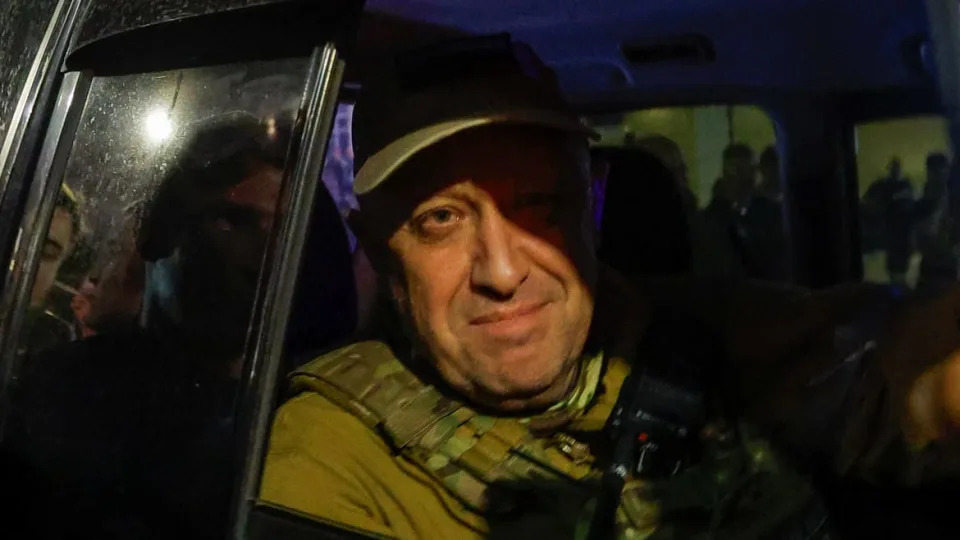
FILE – Yevgeny Prigozhin, the owner of the Wagner Group military company, arrives during a funeral ceremony at the Troyekurovskoye cemetery in Moscow, Russia, on April 8, 2023. On Friday, June 23, Prigozhin made his most direct challenge to the Kremlin yet, calling for an armed rebellion aimed at ousting Russia’s defense minister. The security services reacted immediately by calling for his arrest. (AP Photo/File) (ASSOCIATED PRESS)More

MOSCOW — Over the course of a month I spent in the Russian capital, the red-and-black billboards of Yevgeny Prigozhin’s Wagner paramilitary group multiplied. “Join the team of victors!” they said, beneath an image of menacing mercenaries in balaclavas and masks, only their eyes visible.

A possible implication was that the Russian forces on the other mushrooming Moscow billboards — regular soldiers recruited by the Ministry of Defense pictured above slogans like “Real Work!” or “Be a hero!” — were the losers of Russian President Vladimir Putin’s reckless gamble in Ukraine.

As heedless Muscovites headed for their offices and gyms, their Italian or Japanese restaurants, their bars and nightclubs, this military recruitment drive on two fronts offered the sole image in the capital of the Russian scramble to contain the fallout, and hide the full impact, of the invasion that began 16 months ago. Easier to order a latte than dwell on lost lives in Mariupol, Ukraine.

Now, with his blunt depiction of that invasion as a “racket” that “wasn’t needed to demilitarize or denazify Ukraine,” and his apparently short-lived armed uprising, Prigozhin has played on one of Putin’s worst fears: division and rebellion, with tanks on the streets, as in the mayhem of the 1990s from which Putin, a former KGB officer, abruptly emerged as the inscrutable president and Mr. Stability.

Since then, over 23 years, Putin has steadily consolidated his power, using his wars that began in Chechnya to cement nationalist sentiment, terrorizing the opposition to the point that dissent has become a crime, and shaping a wildly unequal economy around a coterie of hand-picked oligarchs. He has reverted Russia to type as an autocratic police state under an all-powerful latter-day czar after its brief but heady post-Communist flirtation with a freer society.

“The system Putin built is very stable,” a Western ambassador in Moscow told me this month. “But if I woke up one morning and saw tanks on the street, I would not be totally astonished.”

This surprising disclosure, uttered under customary diplomatic anonymity, is indicative of the close-knit secrecy of Putin’s inner circle that has made Kremlinology during the war in Ukraine as arduous as at the height of the Cold War. There are very few tea leaves to read. Russia, smothered in propaganda and fear, is opaque.

At the same time, even as the government has gone to great lengths, and expense, to maintain an illusion of business as usual, the placid surface Russia has until now presented during the war masks unease.

In muttered expressions across the country of bewilderment and anger, and not least in Prigozhin’s foul-mouthed diatribes against what he sees as the craven incompetence and half-measures of Russia’s generals, lay the seeds of those tanks in the ambassador’s prescient imaginings.

Russia tends not to evolve; it lurches, as in 1917 or 1991, and it circles about. Putin has perpetuated old habits in deploying double-think. He prefers to “forget whatever it was necessary to forget,” and then restore “memory again at the moment when it was needed,” as George Orwell put it.

Hence Putin’s invocation of 1917 in his brief speech Saturday, a time when internal fracture led to the nascent Soviet republic losing significant population and vast swaths of agricultural land in the Treaty of Brest-Litovsk the next year. Therefore, Putin vowed, he would resist the current “deadly threat” of “mutiny” through “brutal” actions.

Suddenly the glorious Soviet victory over Nazis and Fascists of “The Great Patriotic War” of 1941 to 1945, which has been the drumbeat of the quixotic Ukrainian assault, was set aside by Putin in favor of a crushing historical defeat.

He wields the past to his ends, even as he has very little to say about the future.

Nobody, for example, knows what Putin would define as victory in his “special military operation” in Ukraine. Other mysteries abound. The question, for many months now, has been how Prigozhin, a former convict who started in hot dogs in St. Petersburg and went on to provide catering for the Kremlin, has survived.

If the family of a Russian child drawing a picture of a Ukrainian flag risks prison in Putin’s Russia, how could this loudmouth in battle fatigues get away with suggesting that Sergei Shoigu, the defense minister, has enabled genocide, among a torrent of other accusations and insults?

I heard many answers across Russia. But perhaps the most fundamental lay in the recently dug grave of Boris Batsev, aged 42, a railroad worker who was killed six months ago near Bakhmut in eastern Ukraine, leaving a wife and two children.

Brightly colored plastic roses and carnations were piled high around his gravestone, beneath the red-and-gold Wagner flag, in Siberia, near the town of Talofka, thousands of miles from the Ukrainian front.

“Blood, honor, motherland, bravery,” a Wagner inscription said. A mild breeze blew across the Troetskoe cemetery as agents of the Federal Security Service, or FSB, looked on from a vehicle that had abruptly appeared nearby.

With Russian forces often bereft of essential equipment and sometimes operating as a human wave, Putin has needed flesh for the meat grinder. Prigozhin, recruiting in Russian prisons with offers of amnesty and big payouts, could provide that, from as far away as Siberia. He has been too effective and useful to toss aside.

In the long battle for the charred ruins of the eastern Ukrainian city of Bakhmut alone, Prigozhin has said Wagner lost 20,000 troops.

The use of Prigozhin, others suggested, was the apotheosis of Putin’s modus operandi of dividing his subordinates, shifting influence in recent years from Sergey Lavrov, the foreign minister, to Shoigu as the militarization of Russian society proceeded, only to undermine the defense minister through Prigozhin.

“Putin likes competition, he has liked putting pressure on Shoigu, and enjoyed the theater,” Dmitri Muratov, the Nobel Prize-winning editor of the shuttered independent newspaper Novaya Gazeta, told me in an interview. “Meanwhile, the elite around Putin don’t give a damn for their country, they’re just afraid for their lives.”

Prigozhin has been useful in other ways for Putin. Through Wagner, he has helped project a ruthless and lawless form of Russian power across several African countries, including Mali and the Central African Republic. He was also a way, in the midst of an utterly misjudged war, for the Russian leader to play the moderate, to suggest that if it was not for him, things could be even worse and become as unstable as Prigozhin’s temper.

Finally, Prigozhin became an increasingly popular mouthpiece for the widespread resentment of moneyed Russian elites, oblivious to the cost and suffering of the war in Ukraine. This was cathartic, given accumulated Russian frustrations, and perhaps useful to Putin in that sense.

But the paramilitary leader also developed, through adept use of social media and compelling rhetoric over the past nine months, into a true national figure, with a notoriety that has made him the object of much debate and speculation about a possible political future.

Putin has now awakened to this danger, even as Prigozhin may have overplayed his hand.

The Russian president has spoken of an “armed rebellion,” and a former commander of Russian troops in Ukraine has spoken of a “military coup,” but Prigozhin’s description of his actions as a “march for justice” will have resonated with some, perhaps many, Russians.

These sentiments will not disappear overnight, even if, according to Dmitry Peskov, the Kremlin spokesperson, Prigozhin has now ceased moving military convoys toward Moscow and agreed to go to Belarus in exchange for charges being dropped against him and his fighters.

To what degree the whole back-and-forth was orchestrated theater, and to what degree a genuine confrontation, seems unlikely to be clarified soon, if ever.

What is clear is that Putin has deep reserves of support. “The West told Russia that all it has the right to do is yield,” Petr Tolstoy, the deputy chair of the Duma, the lower house of the Federal Assembly of Russia, said in an interview. “Putin said ‘Enough!’ and that ensures him of popular backing.”

The president’s control of the country’s military, security and intelligence apparatus is such that the biggest direct challenge to his rule in more than two decades appears to have been repulsed in short order, even if Putin has suffered the acute embarrassment of allowing a man he called a traitor to get off scot free the day he made that accusation.

It had been a long time since Putin blinked in this way.

There will be reverberations. Very little since the Ukraine invasion on Feb. 24 of last year has gone according to plan for Putin. Hiding a war that has taken 100,000 Russian lives, according to U.S. diplomats in Moscow, has a cost. The exercise of not leveling with the Russian people contributed to Prigozhin’s fury, as was made clear in his repeated statements that the defense establishment was lying.

Prigozhin has styled himself as the man who delivers the hard truth. In the Belgorod region on Russia’s border with Ukraine, which I visited earlier this month, he was infuriated that Putin and his state media would prefer to forget the devastation through cross-border Ukrainian shelling of Shebekino, a Russian town of 40,000 people.

In the city of Belgorod, in a vast improvised dormitory for the displaced at an indoor cycle track, I met Aleksandr Petrianko, 62, half-paralyzed by a stroke.

“Could Mr. Prigozhin have saved Shebekino?” I asked him.

“I don’t know,” he said in a trembling voice. “I hope he is not killed before his time.”

Russia-Ukraine war latest: Kremlin reportedly threatened Wagner families as soldiers marched to Moscow

Yahoo! News

Russia-Ukraine war latest: Kremlin reportedly threatened Wagner families as soldiers marched to Moscow


Niamh Cavanagh, Reporter – June 26, 2023

The leader of the Kremlin’s shadowy private army, the Wagner Group, rebelled against top military officials over the weekend after a Russian rocket attack killed dozens of his soldiers.

In a dramatic show of force against his own government, Yevgeny Prigozhin led his soldiers toward Moscow on a “march for justice” to remove what he labeled as Russia’s incompetent and corrupt senior military leadership.

Servicemen in a tank with a flag of the Wagner Group military company in Rostov-on-Don, Russia.
Servicemen in a tank with a flag of the Wagner mercenary group in Rostov-on-Don, Russia. (AP)

Russian President Vladimir Putin criticized Prigozhin’s “armed mutiny,” accusing him of “treason.” Hours later Prigozhin, just 125 miles from the capital, announced he was going to turn around. “Russian blood will be spilled on one side, we are turning our convoy around and going back to our base camps, according to the plan,” he declared in an apparent deal to end the insurrection.

Here are the latest developments.

Russian intelligence threatened Wagner families, say U.K. security forces
A view of the Kremlin from behind a gate.
Security measures were taken in Moscow amid escalating tensions between the Kremlin and the Wagner Group on June 24. (Boris Alekseev/Anadolu Agency via Getty Images)

British security forces told the Telegraph on Monday that Russian intelligence services had threatened harm to the families of Wagner leaders who were participating in the mutiny. This new information could be a potential explanation as to why Prigozhin called off the march to Moscow.

Insights from British intelligence also claim that Putin is now looking to absorb Wagner soldiers into the country’s military and dismiss all top Wagner commanders. The report cited a British intelligence assessment that about 8,500 Wagner fighters were involved in the mutiny, contradicting public reports that the number was closer to 25,000.

Sergei Shoigu makes 1st public appearance since Wagner mutiny
A photo released on Monday shows Russian Defense Minister Sergei Shoigu at an advanced control post of Russian troops involved in the Russia-Ukraine conflict.
Russian Defense Minister Sergei Shoigu at an advanced control post of Russian troops involved in the Russia-Ukraine conflict. (Russian Defense Ministry/Handout via Reuters)

Russia’s defense minister, Sergei Shoigu, was seen for the first time since the weekend insurrection. The appearance is notable, as a key plank of Prigozhin’s uprising was the removal of Shoigu, the Associated Press reported.

The video, published to the Telegram social media platform, shows the military chief inspecting soldiers in Ukraine — clearly meant to suggest that Russia had moved past the Wagner conflict.

Following Shoigu’s public appearance, Prigozhin released a statement where he defended his 24-hour-long uprising. In the 11-minute long audio clip, the Wagner chief claimed the march was due to an “injustice” that was carried out – referring to Friday’s attack on a Wagner camp killing an estimated 30 soldiers.

Prigozhin to move to Belarus under deal to end mutiny
Wagner chief Yevgeny Prigozhin.
A screengrab from a video of Wagner chief Yevgeny Prigozhin speaking in Rostov-on-Don, Russia, on June 24. (Wagner/Anadolu Agency via Getty Images)

According to Reuters, Kremlin spokesman Dmitry Peskov told reporters that Prigozhin is to move to Belarus after its president, Alexander Lukashenko, brokered a deal between Putin and the mercenary chief. Lukashenko had offered to mediate the deal, with Putin’s approval, as he has known Prigozhin personally for two decades.

Peskov added that Prigozhin would receive amnesty despite orchestrating the armed mutiny and that the soldiers who had taken part would also not face any criminal action.

Russia’s political situation past tipping point,’ says Chinese commentator in deleted tweet
Hu Xijin, former editor in chief of Global Times.
Hu Xijin, former editor in chief of Global Times, commented on the Russian mutiny in a now-deleted tweet. (Gilles Sabrie/Bloomberg)

A well-known Chinese journalist stated that Russia would not be able to return to what it was before the armed mutiny, the Telegraph reported.

Hu Xijin, the former editor in chief of the Chinese-government-affiliated Global Times, had been commentating on Prigozhin’s insurrection and Russia’s political situation. In the now-deleted tweet, Hu wrote: “[Prigozhin’s] armed rebellion has made the Russian political situation cross the tipping point. Regardless of his outcome, Russia cannot return to the country it was before the rebellion anymore.”

Hu’s comments were a stark contrast to the Chinese government’s neutral stance on Russian politics. In what appeared to be a backtrack, Hu later posted: “Prigozhin quickly stopped and the rebellion was stopped without bloodshed, which obviously narrowed the impact on Putin’s authority, although not to zero.”

Russian mercenary group revolt against Moscow fizzles but exposes vulnerabilities

Associated Press

Russian mercenary group revolt against Moscow fizzles but exposes vulnerabilities

The Associated Press – June 24, 2023

The greatest challenge to Russian President Vladimir Putin in his more than two decades in power fizzled out after the rebellious mercenary commander who ordered his troops to march on Moscow abruptly reached a deal with the Kremlin to go into exile and sounded the retreat.

The brief revolt, though, exposed vulnerabilities among Russian government forces, with Wagner Group soldiers under the command of Yevgeny Prigozhin able to move unimpeded into the Russian city of Rostov-on-Don and advance hundreds of kilometers (miles) toward Moscow. The Russian military scrambled to defend Russia’s capital.

Under the deal announced Saturday by Kremlin spokesman Dmitry Peskov, Prigozhin will go to neighboring Belarus, which has supported Russia’s invasion of Ukraine. Charges against him of mounting an armed rebellion will be dropped.

The government also said it would not prosecute Wagner fighters who took part, while those who did not join in were to be offered contracts by the Defense Ministry. Prigozhin ordered his troops back to their field camps in Ukraine, where they have been fighting alongside Russian regular soldiers.

Putin had vowed earlier to punish those behind the armed uprising led by his onetime protege. In a televised speech to the nation, he called the rebellion a “betrayal” and “treason.”

In allowing Prigozhin and his forces to go free, Peskov said, Putin’s “highest goal” was “to avoid bloodshed and internal confrontation with unpredictable results.”

Some observers said Putin’s strongman image has taken a hit.

“Putin has been diminished for all time by this affair,” former U.S. Ambassador to Ukraine John Herbst said on CNN.

Moscow had braced for the arrival of the Wagner forces by erecting checkpoints with armored vehicles and troops on the city’s southern edge. About 3,000 Chechen soldiers were pulled from fighting in Ukraine and rushed there early Saturday, state television in Chechnya reported. Russian troops armed with machine guns put up checkpoints on Moscow’s southern outskirts. Crews dug up sections of highways to slow the march.

Wagner troops advanced to just 200 kilometers (120 miles) from Moscow, according to Prigozhin. But after the deal was struck, Prigozhin announced that he had decided to retreat to avoid “shedding Russian blood.”

Prigozhin had demanded the ouster of Defense Minister Sergei Shoigu, whom Prigohzhin has long criticized in withering terms for his conduct of the 16-month-long war in Ukraine. On Friday, he accused forces under Shoigu’s command of attacking Wagner camps and killing “a huge number of our comrades.”

If Putin were to agree to Shoigu’s ouster, it could be politically damaging for the president after he branded Prigozhin a backstabbing traitor.

The U.S. had intelligence that Prigozhin had been building up his forces near the border with Russia for some time. That conflicts with Prigozhin’s claim that his rebellion was a response to an attack on his camps in Ukraine on Friday by the Russian military.

In announcing the rebellion, Prigozhin accused Russian forces of attacking the Wagner camps in Ukraine with rockets, helicopter gunships and artillery. He alleged that Gen. Valery Gerasimov, chief of the General Staff, ordered the attacks following a meeting with Shoigu in which they decided to destroy the military contractor.

The Defense Ministry denied attacking the camps.

Congressional leaders were briefed on the Wagner buildup earlier last week, a person familiar with the matter said. The person was not authorized to speak publicly and spoke to The Associated Press on the condition of anonymity. The U.S. intelligence briefing was first reported by CNN.

Early Saturday, Prigozhin’s private army appeared to control the military headquarters in Rostov-on-Don, a city 660 miles (over 1,000 kilometers) south of Moscow, which runs Russian operations in Ukraine, Britain’s Ministry of Defense said.

Russian media reported that several helicopters and a military communications plane were downed by Wagner troops. Russia’s Defense Ministry has not commented.

After the agreement de-escalated tensions, video from Rostov-on-Don posted on Russian messaging app channels showed people cheering Wagner troops as they departed. Prigozhin was riding in an SUV followed by a large truck, and people greeted him and some ran to shake his hand. The regional governor later said that all of the troops had left the city.

Wagner troops and equipment also were in Lipetsk province, about 360 kilometers (225 miles) south of Moscow.

Moscow Mayor Sergei Sobyanin declared Monday a non-working day for most residents as part of the heightened security, a measure that remained in effect even after the retreat.

Ukrainians hoped the Russian infighting would create opportunities for their army to take back territory seized by Russian forces.

“These events will have been of great comfort to the Ukrainian government and the military,” said Ben Barry, senior fellow for land warfare at the International Institute for Strategic Studies. He said that even with a deal, Putin’s position has probably been weakened.

Ukrainian President Volodymyr Zelenskyy said late Saturday, shortly before Prigozhin announced his retreat, that the march exposed weakness in the Kremlin and “showed all Russian bandits, mercenaries, oligarchs” that it is easy to capture Russian cities “and, probably, arsenals.”

Wagner troops have played a crucial role in the Ukraine war, capturing the eastern city of Bakhmut, an area where the bloodiest and longest battles have taken place. But Prigozhin has increasingly criticized the military brass, accusing it of incompetence and of starving his troops of munitions.

The 62-year-old Prigozhin, a former convict, has longstanding ties to Putin and won lucrative Kremlin catering contracts that earned him the nickname “Putin’s chef.”

He and a dozen other Russian nationals were charged in the United States with operating a covert social media campaign aimed at fomenting discord ahead of Donald Trump’s 2016 presidential election victory. Wagner has sent military contractors to Libya, Syria, several African countries and eventually Ukraine.

Associated Press writers Danica Kirka in London, and Nomaan Merchant in Washington, contributed.

Russia Sought to Kill Defector in Florida

The New York Times

Russia Sought to Kill Defector in Florida

Ronen Bergman, Adam Goldman and Julian E. Barnes – June 19, 2023

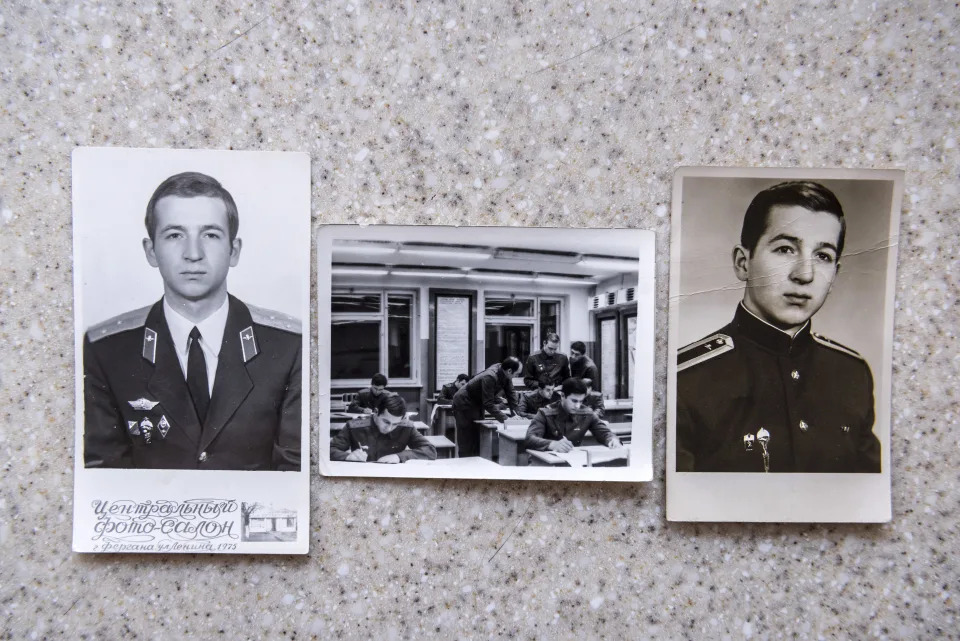
Photographs of Sergei Skripal, a former colonel in Russia’s military intelligence service who was convicted in 2006 for selling secrets to British intelligence, in Moscow, Aug. 28, 2018. (Sergey Ponomarev/The New York Times)

As President Vladimir Putin of Russia has pursued enemies abroad, his intelligence operatives now appear prepared to cross a line that they previously avoided: trying to kill a valuable informant for the U.S. government on American soil.

The clandestine operation, seeking to eliminate a CIA informant in Miami who had been a high-ranking Russian intelligence official more than a decade earlier, represented a brazen expansion of Putin’s campaign of targeted assassinations. It also signaled a dangerous low point even between intelligence services that have long had a strained history.

“The red lines are long gone for Putin,” said Marc Polymeropoulos, a former CIA officer who oversaw operations in Europe and Russia. “He wants all these guys dead.”

The assassination failed, but the aftermath in part spiraled into tit-for-tat retaliation by the United States and Russia, according to three former senior U.S. officials who spoke on the condition of anonymity to discuss aspects of a plot meant to be secret and its consequences. Sanctions and expulsions, including of top intelligence officials in Moscow and Washington, followed.

The target was Aleksandr Poteyev, a former Russian intelligence officer who disclosed information that led to a yearslong FBI investigation that in 2010 ensnared 11 spies living under deep cover in suburbs and cities along the East Coast. They had assumed false names and worked ordinary jobs as part of an ambitious attempt by the SVR, Russia’s foreign intelligence agency, to gather information and recruit more agents.

In keeping with an Obama administration effort to reset relations, a deal was reached that sought to ease tensions: Ten of the 11 spies were arrested and expelled to Russia. In exchange, Moscow released four Russian prisoners, including Sergei Skripal, a former colonel in the military intelligence service who was convicted in 2006 for selling secrets to Britain.

The bid to assassinate Poteyev is revealed in the British edition of the book “Spies: The Epic Intelligence War Between East and West,” to be published by an imprint of Little, Brown on June 29. The book is by Calder Walton, a scholar of national security and intelligence at Harvard. The New York Times independently confirmed his work and is reporting for the first time on the bitter fallout from the operation, including the retaliatory measures that ensued once it came to light.

According to Walton’s book, a Kremlin official asserted that a hit man, or a Mercader, would almost certainly hunt down Poteyev. Ramón Mercader, an agent of Josef Stalin’s, slipped into Leon Trotsky’s study in Mexico City in 1940 and sank an ice ax into his head. Based on interviews with two U.S. intelligence officials, Walton concluded the operation was the beginning of “a modern-day Mercader” sent to assassinate Poteyev.

The Russians have long used assassins to silence perceived enemies. One of the most celebrated at SVR headquarters in Moscow is Col. Grigory Mairanovsky, a biochemist who experimented with lethal poisons, according to a former intelligence official.

Putin, a former KGB officer, has made no secret of his deep disdain for defectors among the intelligence ranks, particularly those who aid the West. The poisoning of Skripal at the hands of Russian operatives in Salisbury, Britain, in 2018 signaled an escalation in Moscow’s tactics and intensified fears that it would not hesitate to do the same on American shores.

The attack, which used a nerve agent to sicken Skripal and his daughter, prompted a wave of diplomatic expulsions across the world as Britain marshaled the support of its allies in a bid to issue a robust response.

The incident set off alarm bells inside the CIA, where officials worried that former spies who had relocated to the United States, like Poteyev, would soon be targets.

Putin had long vowed to punish Poteyev. But before he could be arrested, Poteyev fled to the United States, where the CIA resettled him under a highly secretive program meant to protect former spies. In 2011, a Moscow court sentenced him in absentia to decades in prison.

Poteyev had seemed to vanish, but at one point, Russian intelligence sent operatives to the United States to find him, though its intentions remained unclear. In 2016, the Russian news media reported that he was dead, which some intelligence experts believed might be a ploy to flush him out. Indeed, Poteyev was very much alive, living in the Miami area.

That year, he obtained a fishing license and registered as a Republican so he could vote, all under his real name, according to state records. In 2018, a news outlet reported Poteyev’s whereabouts.

The CIA’s concerns were not unwarranted. In 2019, the Russians undertook an elaborate operation to find Poteyev, forcing a scientist from Oaxaca, Mexico, to help.

The scientist, Hector Alejandro Cabrera Fuentes, was an unlikely spy. He studied microbiology in Kazan, Russia, and later earned a doctorate in the subject from the University of Giessen in Germany. He was a source of pride for his family, with a history of charitable work and no criminal past.

But the Russians used Fuentes’ partner as leverage. He had two wives: a Russian living in Germany and another in Mexico. In 2019, the Russian wife and her two daughters were not allowed to leave Russia as they tried to return to Germany, court documents say.

That May, when Fuentes traveled to visit them, a Russian official contacted him and asked to see him in Moscow. At one meeting, the official reminded Fuentes that his family was stuck in Russia and that maybe, according to court documents, “we can help each other.”

A few months later, the Russian official asked Fuentes to secure a condo just north of Miami Beach, where Poteyev lived. Instructed not to rent the apartment in his name, Fuentes gave an associate $20,000 to do so.

In February 2020, Fuentes traveled to Moscow, where he again met with the Russian official, who provided a description of Poteyev’s vehicle. Fuentes, the Russian said, should find the car, obtain its license plate number and take note of its physical location. He advised Fuentes to refrain from taking pictures, presumably to eliminate any incriminating evidence.

But Fuentes botched the operation. Driving into the complex, he tried to bypass its entry gate by tailgating another vehicle, attracting the attention of security. When he was questioned, his wife walked away to photograph Poteyev’s license plate.

Fuentes and his wife were told to leave, but security cameras captured the incident. Two days later, he tried to fly to Mexico, but U.S. Customs and Border Protection officers stopped him and searched his phone, discovering the picture of Poteyev’s vehicle.

After he was arrested, Fuentes provided details of the plan to American investigators. He believed the Russian official he had been meeting worked for the FSB, Russia’s internal security service. But covert operations overseas are usually run by the SVR, which succeeded the KGB, or the GRU, Russia’s military intelligence agency.

One of the former officials said Fuentes, unaware of the target’s significance, was merely gathering information for the Russians to use later.

Fuentes’ lawyer, Ronald Gainor, declined to comment.

The plot, along with other Russian activities, elicited a harsh response from the U.S. government. In April 2021, the United States imposed sanctions and expelled 10 Russian diplomats, including the chief of station for the SVR, who was based in Washington and had two years left on his tour, two former U.S. officials said. Throwing out the chief of station can be incredibly disruptive to intelligence operations, and agency officials suspected that Russia was likely to seek reprisal on its American counterpart in Moscow, who had only weeks left in that role, the officials said.

“We cannot allow a foreign power to interfere in our democratic process with impunity,” President Joe Biden said at the White House in announcing the penalties. He made no mention of the plot involving Fuentes.

Sure enough, Russia banished 10 American diplomats, including the CIA’s chief of station in Moscow.

Putin ponders: Should Russia try to take Kyiv again?

Reuters

Putin ponders: Should Russia try to take Kyiv again?

Guy Faulconbridge and Vladimir Soldatkin – June 13, 2023

Russian President Vladimir Putin meets with participants of the Eurasian Intergovernmental Council and the Council of CIS Heads of Government meetings, in Sochi

MOSCOW (Reuters) -President Vladimir Putin said on Tuesday that any further mobilisation would depend on what Russia wanted to achieve in the war in Ukraine, adding that he faced a question only he could answer – should Russia try to take Kyiv again?

More than 15 months since Putin sent troops into Ukraine, Russian and Ukrainian forces are still battling with artillery, tanks and drones along a 1,000-km (600-mile) front line, though well away from the capital Kyiv.

Using the word “war” several times, Putin offered a barrage of warnings to the West, suggesting Russia may have to impose a “sanitary zone” in Ukraine to prevent it attacking Russia and saying Moscow was considering ditching the Black Sea grain deal.

Russia, he said, had no need for nationwide martial law and would keep responding to breaches of its red lines. Many in the United States, Putin said, did not want World War Three, though Washington gave the impression it was unafraid of escalation.

But his most puzzling remark was about Kyiv, which Russian forces tried – and failed – to capture just hours after Putin ordered troops into Ukraine on February 24 last year.

“Should we return there or not? Why am I asking such a rhetorical question?” Putin told 18 Russian war correspondents and bloggers in the Kremlin.

“Only I can answer this myself,” Putin said. His comments on Kyiv – during several hours of answering questions – were shown on Russian state television.

Russian troops were beaten back from Kyiv and eventually withdrew to a swathe of land in Ukraine’s east and south which Putin has declared is now part of Russia. Ukraine says it will never rest until every Russian soldier is ejected from its land.

Putin last September announced what he said was a “partial mobilisation” of 300,000 reservists, triggering an exodus of at least as many Russian men who sought to dodge the draft by leaving for republics of the former Soviet Union.

Asked about another call-up by state TV war correspondent Alexander Sladkov, Putin said: “There is no such need today.”

MOBILISATION?

Russia’s paramount leader, though, was less than definitive on the topic, saying it depended on what Moscow wanted to achieve and pointing out that some public figures thought Russia needed 1 million or even 2 million additional men in uniform.

“It depends on what we want,” Putin said.

Though Russia now controls about 18% of Ukraine’s territory, the war has underscored the fault lines of the once mighty Russian armed forces and the vast human cost of fighting urban battles such as in Bakhmut, a small eastern city one twentieth the area of Kyiv.

Putin said the conflict had shown Russia had a lack of high-precision munitions and complex communications equipment.

He said Russia had established control over “almost all” of what he casts as “Novorossiya” (New Russia), a Tsarist-era imperial term for a swathe of southern Ukraine which is now used by Russian nationalists.

At times using Russian slang, Putin said Russia was not going to change course in Ukraine.

Russia’s future plans in Ukraine, he said, would be decided once the Ukrainian counteroffensive, which he said began on June 4, was over.

Ukraine’s offensive has not been successful in any area, Putin said, adding that Ukrainian human losses were 10 times greater than Russia’s.

Ukraine had lost over 160 of its tanks and 25-30% of the vehicles supplied from abroad, he said, while Russia had lost 54 tanks. Ukraine said it has made gains in the counteroffensive.

Reuters could not independently verify statements from either side about the battlefield.

Putin further said Ukraine had deliberately hit the Kakhovka hydro-electric dam on June 6 with U.S.-supplied HIMARS rockets, a step he said had also hindered Kyiv’s counteroffensive efforts. Ukraine says Russia blew up the dam, which Russian forces captured early in the war.

Putin said Russia needed to fight enemy agents and improve its defences against attacks deep inside its own territory, but that there was no need to follow Ukraine’s example and declare martial law.

“There is no reason to introduce some kind of special regime or martial law in the country. There is no need for such a thing today.”

(Reporting by Reuters; editing by Andrew Osborn, Gareth Jones and Mark Heinrich)

Zelenskiy says counteroffensive actions “taking place” in Ukraine

Reuters

Zelenskiy says counteroffensive actions “taking place” in Ukraine

Tom Balmforth – June 10, 2023

Ukraine’s President Zelenskiy speaks during a joint press conference with Canadian Prime Minister Trudeau in Kyiv

KYIV (Reuters) -President Volodymyr Zelenskiy acknowledged on Saturday that his military was engaged in “counter-offensive and defensive operations” a day after Kremlin leader Vladimir Putin said Kyiv’s long-vaunted drive to retake territory was well under way.

But the Ukrainian leader disclosed no details, telling reporters to pass on to Putin that his generals were optimistic.

Sporting his trademark khaki fatigues, Zelenskiy shrugged at a press conference when asked about Putin’s comments on Friday that Kyiv had begun its counter-offensive but made no progress.

“Counter-offensive and defensive actions are taking place in Ukraine, but I will not say in detail what stage they are at,” Zelenskiy said, listing Ukraine’s top military brass by name.

“They (the generals) are all in a positive mood. Pass that on to Putin,” he said with a smile, standing alongside visiting Canadian Prime Minister Justin Trudeau.

He said Putin’s comments on the counter-offensive were “interesting…It is important that Russia always feels this: That they do not have long left, in my opinion.”

Russia’s Defence Ministry on Saturday said Ukrainian forces had in the past 24 hours made “unsuccessful” attempts to attack in the southern Donetsk and Zaporizhzhia regions — two areas subject to heavy fighting.

The ministry also mentioned Bakhmut, the eastern town Moscow says it captured last month after 10 months of fierce battles.

Reuters was not able to independently verify the situation on the battlefield.

In his nightly video address, Zelenskiy again provided few details while urging troops to keep fighting.

“Thank you to all those who holds their positions and those who advance,” he said, citing the eastern and southern fronts, where fighting is heaviest.

Ukraine’s general staff said its forces had repelled enemy attacks around Bakhmut and the long besieged town of Maryinka. Russian forces, it said, “continue to suffer heavy losses which they are trying to conceal”.

General Oleksander Syrskyi, commander of ground forces who is in operational control of the counteroffensive, posted a picture on social media of an explosion that he said was a group of Russian soldiers being destroyed near Bakhmut.

Ukrainian military spokesman Serhiy Cherevatyi reported new gains near Bakhmut.

“We’re trying…to conduct strikes on the enemy, we are counter-attacking. We’ve managed to advance up to 1,400 metres (0.87 mile) on various sections of the front,” Cherevatyi said.

Ukraine has said for months it plans a major counter-offensive. But it had denied the main operation has begun.

With scant independent reporting from the front lines, it has been difficult to assess the state of the fighting.

Britain’s Ministry of Defence said Ukraine had conducted “significant” operations in several eastern and southern parts in the last 48 hours, with Russian defences breached in places.

SOME PROGRESS: BRITISH MINISTRY

“In some areas, Ukrainian forces have likely made good progress and penetrated the first line of Russian defences. In others, Ukrainian progress has been slower,” it said, also characterising the Russian military’s performance as mixed.

“Some (Russian) units are likely conducting credible manoeuvre defence operations while others have pulled back in some disorder, amid increased reports of Russian casualties as they withdraw through their own minefields.”

Ukraine’s counter-offensive is expected to use thousands of troops that have been trained and equipped by the West, but Russia has built huge fortifications in occupied territory to prepare, while Kyiv also lacks air supremacy.

The south is seen as a key strategic priority for a Ukrainian push that could aim to recapture Europe’s biggest nuclear plant and cut the Russian land bridge to the occupied Black Sea peninsula of Crimea, dividing Russian forces.

Ukrainian military analyst Oleksiy Hetman told NV Radio the events of recent days were only initial steps.

“What is happening now could be called ‘reconnaissance in battle’ – the first stage of the offensive,” Hetman said. “It was impossible to make progress in depth. The goal was to check the enemy’s defences. Let’s wait a few days and see.”

(Reporting by Tom Balmforth and Felix Hoske; Editing by Alex Richardson, Andrew Cawthorne, Mike Harrison, Ron Popeski and Cynthia Osterman)

Putin asserts Ukrainian counteroffensive has begun, while drones strike within Russia

Associated Press

Putin asserts Ukrainian counteroffensive has begun, while drones strike within Russia

Jamey Keaten and Joanna Kozlowska – June 9, 2023

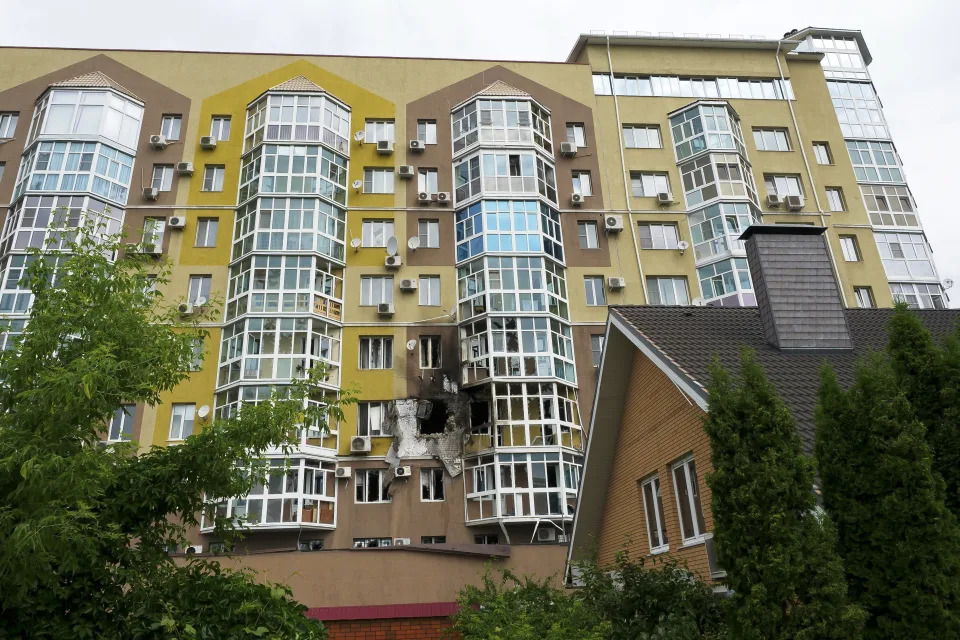
Broken windows and traces of fire are seen after a drone fell at a residential building in Voronezh, Russia, Friday, June 9, 2023. A Russian regional governor says three people were lightly wounded after a drone crashed into a residential building in central Voronezh, a city in southwestern Russia near the border with Ukraine. (Ara Kilanyants/Kommersant Publishing House via AP)
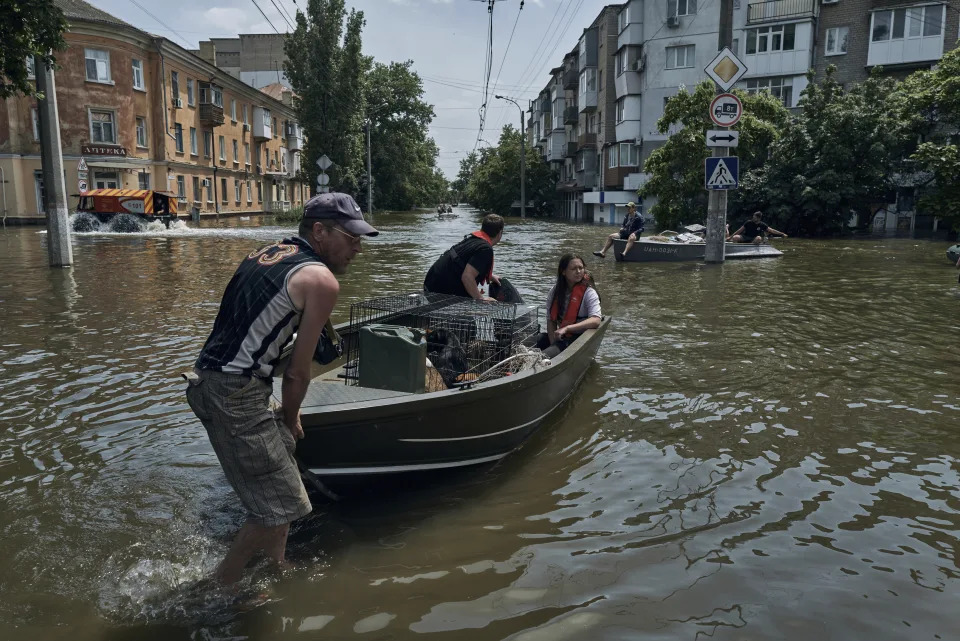
People with pets are evacuated on a boat from a flooded neighbourhood in Kherson, Ukraine, Thursday, June 8, 2023. Floodwaters from a collapsed dam kept rising in southern Ukraine on Thursday, forcing hundreds of people to flee their homes in a major emergency operation that brought a dramatic new dimension to the war with Russia, now in its 16th month. (AP Photo/Libkos)
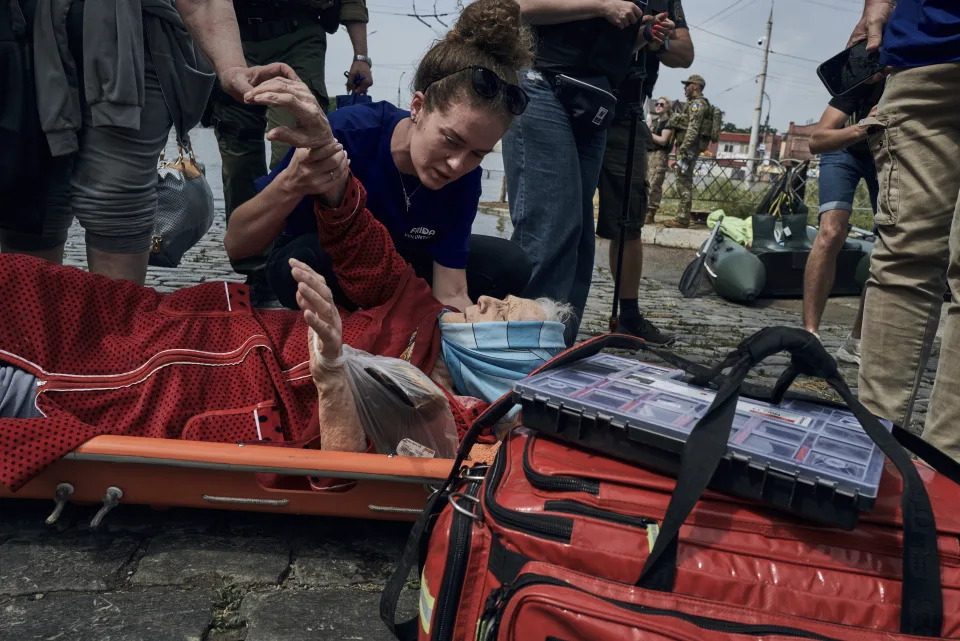
Emergency workers evacuate an elderly resident from a flooded neighbourhood in Kherson, Ukraine, Thursday, June 8, 2023. Floodwaters from a collapsed dam kept rising in southern Ukraine on Thursday, forcing hundreds of people to flee their homes in a major emergency operation that brought a dramatic new dimension to the war with Russia, now in its 16th month. (AP Photo/Libkos)

KYIV, Ukraine (AP) — Russian President Vladimir Putin asserted Friday that Ukrainian troops have started a long-expected counteroffensive and were suffering “significant” losses. His comments came just hours after a string of drone strikes inside Russian territory.

It was Putin’s latest effort to shape the gut-wrenching narrative of the invasion he ordered more than 15 months ago, sparking widespread international condemnation and reviving Cold War-style tensions.

The conflict entered a complex new phase this week with the rupture of a Dnieper River dam that sent floodwaters gushing through a large swath of the front in southern Ukraine. Tens of thousands of civilians already facing the misery of regular shelling fled for higher ground on both sides of the swollen and sprawling waterway.

Kyiv has played down talk of a counteroffensive, reasoning that the less said about its military moves the better. Speaking after he visited flood zones on Thursday, Ukrainian President Volodymyr Zelenskyy said he was in touch with Ukrainian forces “in all the hottest areas” and praised an unspecified ”result” from their efforts.

Putin said Russian forces have the upper hand.

“We can clearly say the offensive has started, as indicated by the Ukrainian army’s use of strategic reserves,” Putin told reporters in Sochi, where he was meeting with heads of other states in the Eurasian Economic Union. “But the Ukrainian troops haven’t achieved their stated tasks in a single area of fighting.”

Kyiv has not specified whether reservists have been mobilized to the front, but its Western allies have poured firepower, defensive systems, and other military assets and advice into Ukraine, raising the stakes for the expected counteroffensive.

“We are seeing that the Ukrainian regime’s troops are suffering significant losses,” Putin said, without providing details. “It’s known that the offensive side suffers losses of 3 to 1 — it’s sort of classic — but in this case, the losses significantly exceed that classic level.”

On Friday, Ukrainian Deputy Defense Minister Hanna Maliar said Russia was on the defensive in the southeastern Zaporizhzhia province, though the epicenter of fighting remained in the east, particularly in the Donetsk region. She described “heavy battles” in Lyman, Bakhmut, Avdiivka and Marinka.

Valerii Shershen, a spokesperson for Ukraine’s armed forces in Zaporizhzhia, told Radio Liberty that they were searching for weaknesses in Russia’s defense, which Moscow was trying to strengthen by deploying mines, constructing fortifications and regrouping.

Earlier, regional authorities in southwest Russia near the Ukrainian border reported the latest flurry of drone strikes. The strikes have exposed the vulnerabilities of Moscow’s air defense systems.

The regional governor of Voronezh, Alexander Gusev, said on the Telegram app that a drone crashed into a high-rise apartment building in the city of the same name, injuring three residents who were hit by shards of glass. Russian state media published photos of windows blown out and damage to the facade.

Gusev said the drone was targeting a nearby airbase but veered off course after its signal was jammed. The city lies some 250 kilometers (155 miles) north of Ukraine’s Luhansk region, most of which is occupied by Russia.

Separately, Gov. Vyacheslav Gladkov of the neighboring Belgorod region, which also borders Ukraine, said air defenses had shot down two unspecified targets overnight. An apartment building and private homes were damaged, he said, without saying by what. He also said a drone fell on the roof of an office building in the city of Belgorod. It failed to detonate but caught fire on impact, causing “insignificant damage,” he wrote.

The leader of a third region of Russia, Kursk Gov. Roman Starovoit, said a drone crashed to the ground outside an oil depot and near water reservoirs in the local capital, causing no casualties or damage.

Ukrainian authorities have generally denied any role in attacks inside Russia. Such drone strikes — there was even one near the Kremlin — along with cross-border raids into southwestern Russia have brought the war home to Russians.

In Ukraine, the governor of the Kherson region, Oleksandr Prokudin, said Friday that water levels had decreased by about 20 centimeters (8 inches) overnight on the western bank of the Dnieper, which was inundated starting Tuesday after the breach of the Nova Kakhovka dam upstream.

Officials on both sides indicated that about 20 people have died in the flooding. The United Nations’ humanitarian coordinator in Ukraine, Denise Brown, visited the flood-hit town of Bilozerka on Friday, U.N. spokesman Stephane Dujarric said.

“Ms. Brown said that although initial estimates indicate that 17,000 people are being impacted in the areas controlled by Ukraine alone, it is important to understand that the crisis has not stopped and continues to evolve rapidly,” Dujarric said.

Kyiv accused Russia of blowing up the dam and its hydropower plant, which Russian forces controlled, while Moscow said Ukraine bombarded it.

The Norwegian earthquake center NORSAR said Friday that a seismological station in neighboring Romania recorded tremors in the vicinity of the dam at 2:54 a.m. Tuesday, around the time Zelenskyy said the breach occurred.

“What we can see from our data is that there was an explosion in the area of the dam as the same time as the dam broke,” NORSAR head of research Volker Oye told The Associated Press.

The Norwegian center is part of a global monitoring system that helps verify compliance with the Comprehensive Nuclear Test Ban Treaty.

Experts predicted the consequences of the dam’s collapse would last for months. Continued fighting in the region was bound to slow recovery efforts.

Viktor Vitovetskyi, a representative of Ukraine’s Emergency Service, said 46 municipalities in the Kherson region have flooded, 14 of them along the Russian-occupied eastern bank of the river.

Even as efforts were underway to rescue civilians and supply them with fresh water and other services, he said Russian shelling over the last day killed two civilians and injured 17 in the region.

Kozlowska reported from London. Jon Gambrell in Kyiv; Hanna Arhirova in Warsaw, Poland; Edit M. Lederer at the United Nations; and David Keyton in Stockholm, Sweden, contributed to this report.