The country’s economic woes have multiplied since its invasion of Ukraine early last year. The conflict has triggered a wave of sanctions from the Western world. Some have even blamed Russian President Vladimir Putin for inflicting so much pain on the nation, with Yale researchers saying he’s “cannibalizing” Russia’s economy in his urge to conquer Ukraine.
“The lion’s share of the economy is controlled by the state, the energy and financial sectors, and Putin is taking from the seed capital of those businesses to use as a cookie jar for his war chest,” researchers Jeffrey Sonnenfeld and Steven Tian said.
Russians are buying fewer cars
Russia’s car industry is one part of the economy that’s being squeezed.
Insider’s Phil Rosen reported that car sales in Moscow have tanked by nearly 75% since the Ukraine war broke out. The decline has been fueled by a mix of three factors: soaring prices, decreasing supply, and deteriorating consumer sentiment.
“Russians are just buying less cars, period,” Tian said. “That speaks to the weakness of the consumer in Russia. This is as close to a proxy to deteriorating consumer sentiment as there is, and the story it tells is profoundly distressing. Russians just aren’t spending money.”
At the same time, the number of Russians buying foreign-branded cars – typically viewed as luxury purchases – has neared a standstill. Instead, consumers are buying locally sourced cars, many of which are riddled with mechanical issues.
Moscow’s central bank posted a 93% year-on-year drop in its current-account surplus for the April-June quarter. it fell from a record $76.7 billion to $5.4 billion.
The rough financials show how badly Western sanctions are biting the country, particularly its key energy sector where its oil-and-gas exports have taken a huge hit after price caps and bans were imposed.
Energy export revenue
Moscow garners a big chunk of its revenue from sales of oil and gas products, but Western penalties have eroded that income stream.
In June, Russia’s Finance Ministry said that revenue from oil-and-gas taxes fell 36% compared to a year ago to about 571 billion rubles, and that profits from crude and petroleum products tumbled 31% to 426 billion rubles.
Ruble in freefall
Adding to Russia’s troubles is a tumbling ruble. The country’s currency slumped to a 15-month low of 94.48 against the dollar earlier in July, triggered by capital flight, shrinking tax revenues, and declining central-bank reserves.
“The ruble doesn’t have anywhere to go but down,” Konstantin Sonin, a University of Chicago economist, said in a tweet.
Concerns about the currency’s volatility have prompted a wave of domestic withdrawals from the country’s central bank, amounting to over $1 billion. The bank run was mainly fueled by the recent Wagner revolt.
Russia’s weakening currency has forced the country to take desperate measures. Recently, Russia’s foreign minister urged Southeast Asian countries to dump the dollar and use local currencies to conduct trade.
Putin says Russia has stockpiled cluster bombs and will use them in Ukraine if it has to
Reuters – July 16, 2023
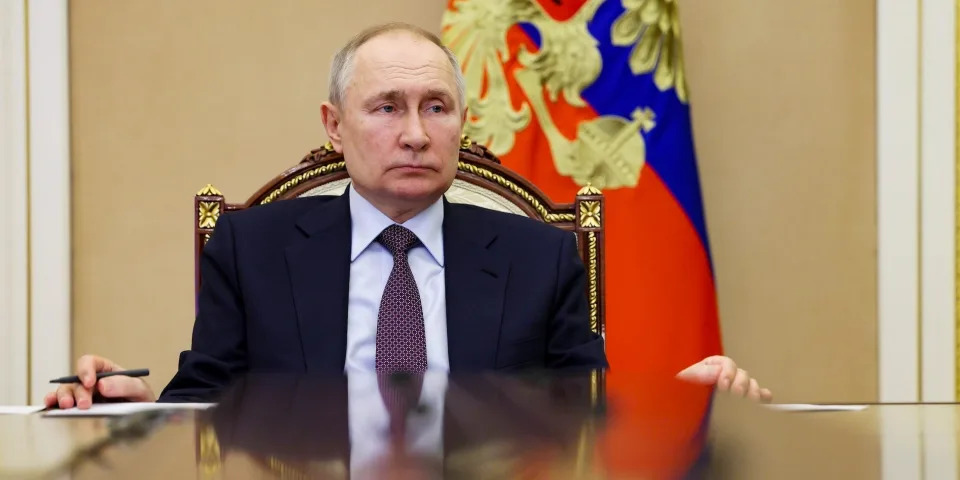
Russian President Vladimir Putin chairs a meeting with members of the Security Council in Moscow
MOSCOW (Reuters) – President Vladimir Putin said Russia had a “sufficient stockpile” of cluster bombs and reserved the right to use them if such munitions, the use of which he said he regarded as a crime, were deployed against Russian forces in Ukraine.
Ukraine said on Thursday it had received cluster bombs from the United States, its biggest military backer, which says the munitions are needed to compensate for shell shortages faced by Kyiv’s forces at a time when they are mounting a counteroffensive.
Cluster munitions are banned in more than 100 countries because they typically release large numbers of smaller bomblets that can kill indiscriminately over a wide area. Some of them inevitably fail to explode and can pose a danger for decades, particularly to children.
Kyiv has said it will use cluster bombs to dislodge concentrations of enemy soldiers when trying to take back its own territory, but will not use them on Russian territory.
Putin told state TV Moscow would respond in kind if necessary.
“I want to note that in the Russian Federation there is a sufficient stockpile of different kinds of cluster bombs. We have not used them yet. But of course if they are used against us, we reserve the right to take reciprocal action.”
Putin said he regarded the use of cluster bombs as a crime and that Russia had so far not needed to use them itself despite having suffered its own ammunition issues in the past.
Human Rights Watch says both Moscow and Kyiv have used cluster munitions. Russia, Ukraine and the U.S. have not signed up to the Convention on Cluster Munitions, which bans the production, stockpiling, use and transfer of the weapons.
Putin also told state TV he saw nothing wrong in Russian specialists examining captured Western military equipment and missiles, such as the Storm Shadow missiles Britain supplied to Ukraine, in order to see if there was anything useful that could be used in Russia’s own military hardware.
Tucker Carlson Turns a Christian Presidential Forum Into a Putin Showcase
Jonathan Weisman – July 15, 2023
FILE – Tucker Carlson, host of “Tucker Carlson Tonight,” poses for photos in a Fox News Channel studio, March 2, 2017, in New York. A former Donald Trump supporter who became the center of a conspiracy theory about Jan. 6, 2021, filed a defamation lawsuit against Fox News on Wednesday, July 12, 2023, saying the network made him a scapegoat for the Capitol insurrection. Although the lawsuit mentions Fox’s Laura Ingraham and Will Cain, former Fox host Carlson was cited as the leader in promoting the theory. (AP Photo/Richard Drew, File) (ASSOCIATED PRESS)More
DES MOINES, Iowa — Bob Vander Plaats, the conservative evangelical kingmaker in Iowa politics, now knows what happens when you turn over your Republican presidential showcase to Tucker Carlson.
Jesus is out. Vladimir Putin is in.
Carlson was given the task of interviewing six Republican presidential hopefuls at the Family Leadership conference in Des Moines on Friday. Consequently, Russia’s invasion of Ukraine became the dominant issue of debate, on a day when Gov. Kim Reynolds of Iowa used the event to sign a near-total abortion ban into law.
In the hands of Carlson, the former Fox News host who was recently fired, Ukraine became the bad actor in the conflict, not Russia.
The most heated exchange came when Carlson interviewed former Vice President Mike Pence before a packed auditorium in Des Moines’ convention center. Pence was berating the Biden administration for being too slow to provide advanced weaponry to Ukraine.
“We promised them 33 Abrams tanks in January. I heard again two weeks ago in Ukraine, they still don’t have them,” Pence said. “We’ve been telling them we’ll train their F-16 pilots, but now they’re saying maybe January.”
Carlson interjected, to the delight of much of the audience. “Wait, I know you’re running for president, but you are distressed that Ukrainians don’t have enough American tanks?” he asked, in his trademark confrontational style.
For good measure, Carlson called Ukraine an American “client state,” accused Ukraine’s Jewish leader, Volodymyr Zelenskyy, of persecuting Christians and strongly indicated Pence had been conned, despite evidence to the contrary.
Pence was not alone. Sen. Tim Scott, R-S.C., argued that by degrading Russia’s military, U.S. aid to Ukraine was making the United States stronger and more secure.
Carlson responded with a signature dismissive response.
“The total body count from Russia in the United States is right around zero; I don’t know anyone who’s been killed by Russia,” Carlson said. “I know people personally who have been killed by Mexico,” he said, adding, “Why is Mexico less of a threat than Russia?”
It didn’t go any better for his first target, Gov. Asa Hutchinson of Arkansas, who led border security under former President George W. Bush. He found himself making the case to Carlson that bombing Mexican drug cartels might be problematic since it would be an act of war against a friendly neighboring state.
The divide in the Republican Party between traditional conservatives who favor the projection of American military might and a new, more isolationist wing that leans toward Russia is nothing new. But the Family Leadership Summit was supposed to be a showcase of Christian values, where social issues like abortion and transgender rights were expected to be center stage.
But by making Carlson something of a master of ceremonies, Vander Plaats, the president of The Family Leader, which hosted the summit, dealt the crowd a wild card. By the time the spotlight turned to Nikki Haley, the former governor of South Carolina, Eric Teetsel, vice president of government relations at the Heritage Foundation, praised her as “still willing to come up onstage” after the preceding appearances.
Pence had his laments after his appearance. “I regret that we didn’t have very much time during my time onstage to talk about the progress for life or issues impacting the family,” he said, before adding, “I’m really never surprised by Tucker Carlson.”
GOP’s Far Right Seeks to Use Defense Bill to Defund Ukraine War Effort
Karoun Demirjian – July 13, 2023
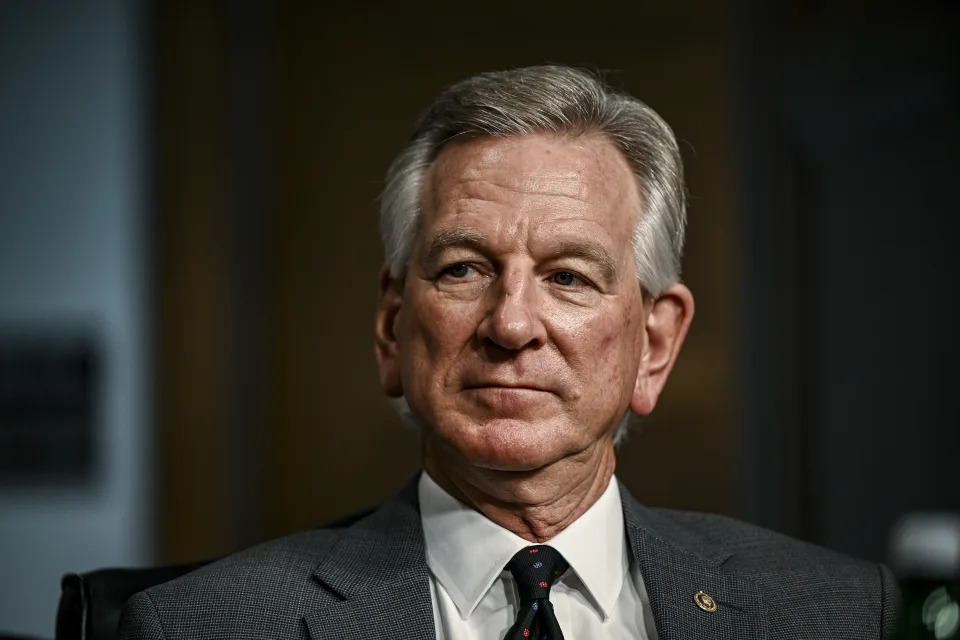
Sen. Tommy Tuberville (R-Ala.) participates in a hearing regarding Air Force General Charles Q. Brown’s nomination to serve as chairman of the Joint Chiefs of Staff, on Capitol Hill in Washington on Tuesday, July 11, 2023. (Kenny Holston/The New York Times)
WASHINGTON — A group of right-wing House Republicans pushing to load up the annual defense bill with socially conservative policies on abortion, race and gender have another demand: severe restrictions on U.S. military support for Ukraine.
The pressure raises the prospect of a divisive floor fight over America’s backing for the war effort just as President Joe Biden tries to rally European allies to support Kyiv in its conflict with Russia.
The group’s proposals on military aid stand no chance of passing the House, where there continues to be strong bipartisan support for backing Ukraine’s war effort, or going anywhere in the Senate. But the far right’s insistence on casting votes on the matter anyway has further imperiled the defense legislation and transformed what is ordinarily a broadly supported measure that provides the annual pay raise to U.S. military personnel and sets Pentagon policy into a partisan battleground that has placed Republican divisions on display.
The House on Wednesday began debating the $886 billion measure, sidestepping the rifts as Republican leaders toiled behind the scenes to placate ultraconservative lawmakers who are demanding votes to scale back Ukraine aid and add social policy dictates. But those disputes will eventually have to be resolved to pass the bill, which had been expected to receive approval Friday — a timetable that is now in doubt as the hard right threatens to hold up the process.
The right-wing lawmakers are seeking votes on a series of proposals that would hamstring U.S. support for Ukraine, including one to curtail all funding for Kyiv until there is a diplomatic solution to the conflict and another that would end a $300 million program to train and equip Ukrainian soldiers that has been in place for nearly a decade.
“Congress should not authorize another penny for Ukraine and push the Biden administration to pursue peace,” Rep. Marjorie Taylor Greene, R-Ga., argued to lawmakers on the House Rules Committee this week, appealing to them to allow votes on several proposals she has written on the topic. “Ukraine is not the 51st state of the United States of America.”
Rep. Scott Perry, R-Pa., chair of the conservative House Freedom Caucus, said votes to curtail support for Ukraine were every bit as important to the members of his group as votes to restrict abortion access and services for transgender soldiers. Asked whether some might seek to block the bill without such votes, he replied: “They might.”
Because Speaker Kevin McCarthy holds only a slim margin of control in the House, any rebellion by the right wing could stop the defense measure in its tracks, denying him the votes he would need from his side to advance it to final passage. But if he bows to the demands for votes on Ukraine, it would put divisions in Congress over the war on display at a critical junction in Ukraine’s counteroffensive, and just after Biden has appealed to allies this week during a NATO summit to remain united in support.
“We can see from what’s taken place at the NATO summit, the significance and importance of us all speaking with one voice and making sure that we’re giving the Ukrainians what they need to win this war,” Rep. Gregory Meeks of New York, the top Democrat on the Foreign Affairs Committee, said in an interview Wednesday. “It will be absolutely the worst thing to do to have a show of division — that’s playing right into Putin’s hands,” he said, referring to Russian President Vladimir Putin.
Some mainstream Republicans say they relish the fight, seeing it as a potential opportunity to put the rebellious right wing of the party in its place.
“It’s going to fail big time,” Rep. Mike D. Rogers, R-Ala., said of the hard right’s bid to scrap American support for Ukraine. “So I hope they make it in order — I think you’ll see it go down overwhelmingly.”
The defense bill is the latest forum right-wing lawmakers have been using to challenge McCarthy’s leadership. Their protest, which began during January’s protracted speaker fight, resumed last month, when 11 far-right lawmakers brought the House floor to a standstill to express their fury at McCarthy’s debt ceiling deal with Biden. They have threatened similar tactics in the future if he fails to bow to their demands.
McCarthy had been bracing for a difficult fight over Ukraine funding in the coming months, when the Biden administration is expected to request billions of dollars to keep Kyiv’s war machine humming.
Hoping to head off a revolt from the right wing, the speaker publicly declared he was opposed to any additional funding for Ukraine beyond the limits of the debt ceiling deal, despite having publicly proclaimed just weeks before: “I vote for aid for Ukraine; I support aid for Ukraine.”
But with the defense bill, the ultraconservative faction is trying to force the issue now.
Greene, who has become one of McCarthy’s closest allies, demurred Wednesday when asked whether she would help other right-wing members block progress on the bill if leaders denied her a vote to curtail Ukraine funding. Despite being one of the most outspoken hard-right members of the House, Greene has routinely taken McCarthy’s side in disputes with his rank and file, and has refused to lend any support to the efforts to undermine his leadership. But her involvement is an indicator of how deeply a vote on Ukraine might split House Republicans.
Ukraine assistance is a tricky issue for the GOP politically. Both of the front-runners for the 2024 Republican presidential nomination, former President Donald Trump and Gov. Ron DeSantis of Florida, have said they would like to limit U.S. assistance to Ukraine. According to a recent poll by the Ronald Reagan Presidential Foundation and Institute, while more than 70% of Republicans want to see Ukraine win the war, only half support sending U.S. military aid to help the country defeat Russia.
Last year, 57 House Republicans voted against a measure to provide $40 billion in military and humanitarian assistance for Ukraine. Congress approved a total of more than $113 billion in Ukraine aid last year.
House GOP leaders expressed confidence Wednesday that they could defeat any proposal to strip funding for Ukraine, thus preserving the integrity of the underlying defense bill. But they worried aloud about the social policy measures, which they noted would alienate Democrats whose votes would be needed to pass the bill.
Ultraconservatives are pushing for votes on proposals that would undo a Pentagon policy offering time off and travel reimbursement to service members traveling out of state to obtain an abortion, to end diversity training in the military, and to ensure that medical services for transgender troops are limited.
“Those I think are actually dicier,” said Rep. Tom Cole, R-Okla., chair of the Rules Committee. “You’re not going to get any Democrats that way.”
GOP leaders appealed to their colleagues Wednesday to support the bill as is, highlighting provisions already included that would ban drag shows at military installations and the teaching of critical race theory.
“This bill goes after the woke, failed, far-left policies that far-left Democrats have wrongfully forced onto the Department of Defense and our men and women in uniform,” Rep. Elise Stefanik of New York, the No. 4 Republican, told reporters.
Putin’s Panicked Purge May Signal a New Mutiny on the Horizon
Allison Quinn – July 13, 2023
AFP via Getty
Three weeks after the Kremlin’s private mercenary army ditched Ukraine to go to war against the country’s own regular military, cracks in Vladimir Putin’s war machine are turning into massive fractures.
A top general has been dismissed after picking up where mutiny mastermind Yevgeny Prigozhin left off, even as the Kremlin is reportedly trying to purge disloyal military officers who could threaten further rebellion.
Major General Ivan Popov, the commander of the 58th Combined Arms Army, said he was dismissed from duty after “harshly” telling military leaders on the “very highest level” about failings on the battlefield that were leading to “mass deaths” of Russian troops.
Echoing Prigozhin in the run-up to his armed uprising, he accused military brass of betraying their own troops by distorting the reality on the frontline: “The Ukrainian army could not break through our ranks at the front but our senior chief hit us from the rear, viciously beheading the army at the most difficult and intense moment,” he said.
Among other things, he complained of a lack of proper counter artillery systems and reconnaissance of Ukrainian artillery.
“It was necessary to either remain silent and be a coward, saying what they wanted to hear, or call a spade a spade,” he said, adding that he “could not lie.”
As a result, he said, “The senior chiefs apparently sensed some kind of danger from me and quickly concocted an order from the defense minister in just one day and got rid of me.”
His comments, made in an audio message to subordinates that was subsequently shared by a federal lawmaker late Wednesday, resonated with many pro-war Russian military bloggers and propagandists, with even Kremlin mouthpiece Vladimir Solovyov suggesting he’d spoken the “truth.”
Lawmakers, too, jumped in to defend the sidelined general, with United Russia Secretary General Andrei Turchak writing on Telegram that the “motherland” can “be proud” of Popov. (Turchak did, however, take issue with fellow lawmaker Andrei Gurulyov publicizing Popov’s complaints, accusing him of putting on a “political show” by airing the military’s dirty laundry.)
With Prigozhin’s shadowy past, the Kremlin propaganda machine has apparently had a relatively easy time portraying him as a rogue madman with his own agenda following his short-lived mutiny. But Popov, who is well-respected within the military establishment, may prove a more formidable critic.
“The problems Popov spoke of are actually very important. And Prigozhin spoke of the very same problems. How else is there to get these problems across to the leadership?” pro-Kremlin political analyst Sergei Markov wrote of the scandal.
Neither the Defense Ministry, nor the Kremlin, have commented on the matter.
But a new report suggests the net is widening behind the scenes. Russia’s security services scooped up dozens of high-ranking military officers in the wake of Wagner Group founder Prigozhin’s violent uprising last month, according to The Wall Street Journal.
Sources cited by the Journal on Thursday confirmed numerous reports that General Sergei Surovikin, the deputy commander of Russia’s military operations in Ukraine, was among those detained for questioning, reportedly after word got out that he knew about the mutiny in advance.
But the scope of the fallout is apparently much greater than previously reported. At least 13 high-ranking officers were hauled in for questioning, some of whom have since been released, and 15 were suspended or fired altogether, according to the report.
“The detentions are about cleaning the ranks of those who are believed can’t be trusted anymore,” one source was quoted saying.
Russian Military Hit by Uncertainty as One General Is Killed and Another Remains Absent
Paul Sonne – July 12, 2023
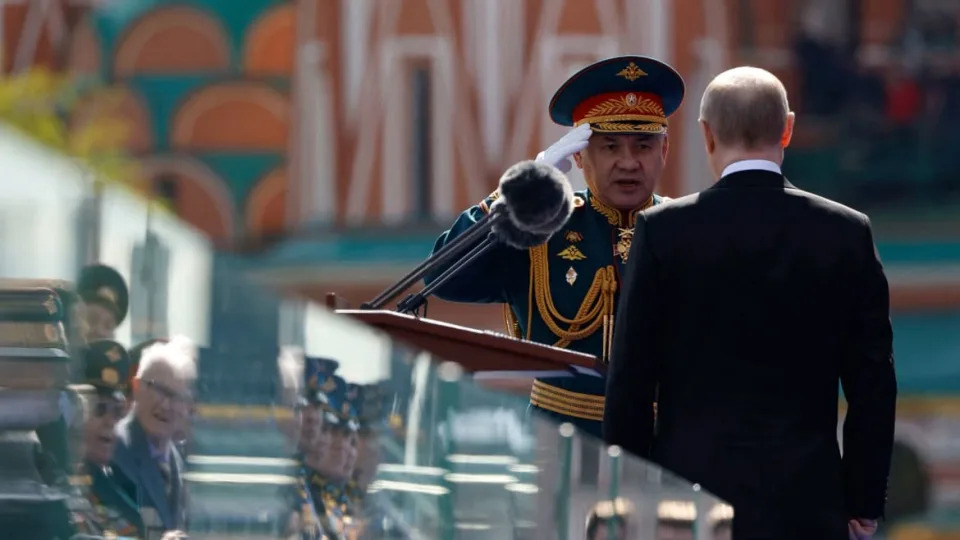
Russian President Vladimir Putin and Gen. Sergei Surovikin. (Reuters)
One top commander has disappeared since a mutiny. Another was killed in an airstrike in Ukraine. Another accused his leadership of treachery after being fired. And a fourth former commander was gunned down while out on a jog in what may have been an organized hit.
The ranks of the Russian military have continued to be roiled by instability in the days since a short-lived insurrection by Wagner mercenaries three weeks ago, as pressures from Moscow’s nearly 17-month war reverberate across the armed forces.
On Wednesday, mystery deepened over the fate of Gen. Sergei Surovikin, the country’s former top commander in Ukraine, who has been dubbed “General Armageddon” for his ruthless tactics, and who has not been seen since the Wagner rebellion.
One of the country’s top lawmakers said, when pressed by a reporter, that the general was “taking a rest.”
“He is unavailable right now,” the lawmaker, Andrei Kartapolov, the head of the Russian Duma’s defense committee, added in a video posted on the Telegram messaging app before hurrying away from the reporter.
Surovikin was considered to be an ally of Yevgeny Prigozhin, the leader of the Wagner mercenary company, whose forces mounted the brief insurrection in late June aimed at toppling Russia’s military leadership before standing down in a deal with the Kremlin.
The New York Times reported that U.S. officials believe Surovikin had advance knowledge of the mutiny but do not know whether he participated. In the hours after the rebellion began, Russian authorities quickly released a video of the general calling on the Wagner fighters to stand down.
The lawmaker’s enigmatic comment about Surovikin came two days after Russian authorities released the first footage of the country’s top military officer, Gen. Valery Gerasimov, since the insurrection.
In the video, Gerasimov was receiving a report from the Russian Aerospace Forces, which are run by Surovikin. But the person giving the update in the footage was Surovikin’s deputy, Col. Gen. Viktor Afzalov.
Surovikin’s location is just one of the many mysteries that have arisen since the mutiny. Despite a deal announced by the Kremlin, under which Prigozhin would depart Russia for Belarus and avoid prosecution, the mercenary tycoon appears to have remained in Russia.
The Kremlin disclosed this week that Prigozhin and his top commanders met with President Vladimir Putin five days after the mutiny, raising many questions about what sort of deal had been struck with the former insurrectionists. On Wednesday, the Ministry of Defense said that Russian armed forces had been collecting Wagner’s weapons, ammunition, and military equipment.
The matériel is expected to be restored for further use. So far, the mercenary group has handed over thousands of small arms and heavy weapons, the ministry said, including rocket launch and mortar systems, anti-tank guns and multipurpose armored tractors.
Russia, meanwhile, received another blow to its top military ranks. Lt. Gen. Oleg Tsokov, the deputy commander of Russia’s Southern Military District, was killed in Ukraine during a Monday night missile strike on the occupied city of Berdiansk, one of the highest-level losses for Russia during the course of the war, Ukrainian authorities announced.
A Russian lawmaker and retired general, Andrei Gurulyov, confirmed Tsokov’s death in an appearance on state television Wednesday, saying he “died heroically.” The death recalled the early days of the war, when Ukrainian officials said they had killed about 12 generals on the front lines.
Gurulyov also released a recording late Wednesday of the commander of Russia’s 58th Combined Arms Army, Maj. Gen. Ivan Popov, explaining to his troops why he was relieved from commanding the unit, which is fighting on the front in Ukraine near Zaporizhzhia.
Popov described a “difficult situation with the senior leadership,” which led to him being relieved after he brought up problems on the battlefield, including the lack of counter battery fire and artillery reconnaissance stations, as well as deaths and injuries the force is suffering from enemy artillery fire.
Popov appeared to take aim at Gerasimov without naming him, saying that while Ukrainian forces couldn’t break through his army unit from the front, “our senior commander hit us from the rear, treacherously and vilely decapitating” the army unit “at the most difficult and tense moment.”
Russian authorities also arrested a Ukrainian man Wednesday on suspicion of gunning down a former Russian submarine commander, Capt. 2nd Rank Stanislav Rzhitsky, this week in the southern city of Krasnodar, where he had been serving as the deputy director of the city’s mobilization office.
Russian news outlets reported that Rzhitsky, who posted his running routes publicly on the exercise service Strava, was shot to death while jogging in a Krasnodar park.
On Tuesday, the day after the body was found, Ukrainian military intelligence said on its official Telegram account that Rzhitsky had commanded a submarine that was involved in missile attacks on Ukraine. Friends and relatives, however, told Russian news outlets that he had left active-duty military service before the February 2022 invasion.
The state news agency RIA Novosti, citing an anonymous source in Russian law enforcement, reported that the man arrested Wednesday had admitted under questioning to being recruited by Ukrainian intelligence to carry out the killing.
Rzhitsky’s name had been entered in the online database Myrotvorets, which posts photographs, social media accounts and telephone numbers of people considered to have committed crimes against Ukraine.
A red stamp was added over his photograph on the database reading, “Liquidated.”
Andrey Rublev: I do not deserve support of Wimbledon crowd because I am Russian
Molly McElwee – July 11, 2023
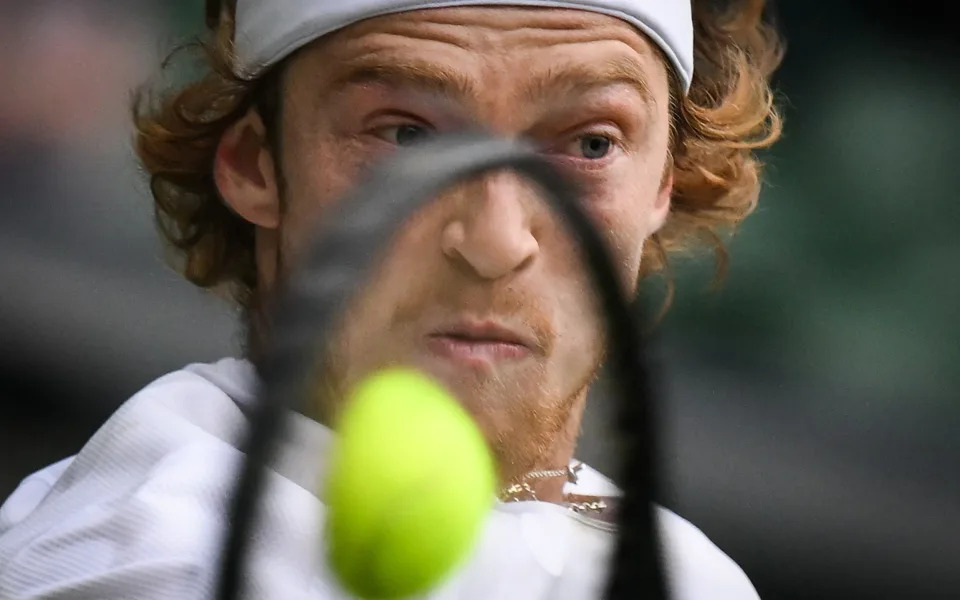
Andrey Rublev was cheered on by the Centre Court crowd against Novak Djokovic – Shutterstock/Tolga Akmen
Andrey Rublev admitted he felt like he “does not deserve” the support of the Wimbledon crowd, due to being Russian.
Rublev, 25, missed last year’s tournament along with his compatriots and all Belarusian players, due to Wimbledon imposing a ban in response to Russia’s invasion of Ukraine.
Upon his return this year he reached the quarter-finals, and on Tuesday had the Centre Court crowd on their feet on more than one occasion as they tried to will him on against Novak Djokovic.
After bowing out in four sets, Rublev said he felt “grateful” that the British public had got behind him, especially considering where he is from.
”I felt really great support during all these two weeks. Today, as well. To be from the country where I am, to have this support, it’s special. I don’t know, I feel sometimes I don’t deserve it or something like that. To have it, I don’t know… I don’t know what you need to do to have this support. I’m really grateful for this.”
Ever since the war broke out, Rublev has been a leading Russian voice in opposition to the conflict. In fact, the night before the invasion began in February 2022, he made headlines around the world for writing “no war please” on a camera lens after his match in Dubai.
Asked whether he felt guilty to hail from Russia, Rublev said he did not: “No. I don’t know what to say. I made so many statements. I think my opinion is very clear, so it’s not guilty. It’s more just the situation is terrible. Of course, you don’t wish this on anyone. You want these terrible things to be able to finish as fast as possible for all the people in the world just to have a chance to have a good life.”
Rublev played some brilliant tennis on his way to the last-eight – AFP/Daniel Leal
Rublev’s comments followed a weekend of high tensions at Wimbledon, where the war in Ukraine played a central role.
On Sunday Belarus’s Victoria Azarenka was booed off court after losing to Ukraine’s Elina Svitolina, the crowd seemingly unaware that it was Svitolina who had opted out of their handshake.
While other players from last year’s banned list have had unpleasant moments with the crowd, Rublev only had good feedback.
On the eve of Wimbledon, he told Telegraph Sport that he was glad the tournament was giving extra support to Ukrainian players competing here and also said he had received support from fans ahead of arriving at the Championships.
”Being here this year, I felt grateful,” Rublev said on Tuesday. “I’m happy that I was able to have a really, really good two weeks of my tennis. I’m happy that I was able, I think for the first time, to give my best in a quarter-final so far compared to all the other quarters that I have been in. This one I feel proud of myself for the first time.”
Dirty Socks and Rotting Bodies: What Russians Left Behind in the Trenches
Andrew E. Kramer – July 11, 2023
Ukrainian soldiers making their way through Novodarivka, a village formerly occupied by Russian forces. (NYT)
NOVODARIVKA, Ukraine — A bottle of syrup made from Siberian berries, legions of dirty socks and a military-issued tea bag stamped with “For Victory!”
For Ukrainian soldiers, one advantage of achieving at least creeping advances in the now month-old counteroffensive in southern Ukraine is appropriating ready-made fortifications from the retreating Russians, who in months of preparations dug deep, well-protected trenches.
For the Ukrainians, eerily enough, it also means living and fighting in positions long held by the Russians — with a huge sprawl of military debris and personal items of Russian soldiers scattered about.
“It’s not very pleasant,” said Pvt. Maksim, a soldier with Ukraine’s 36th Marine Brigade, who has collected a number of curiosities, including what he thinks was a talisman: several bullets covered in sparkles and attached to a key ring.
“It’s our land but it’s not very comfortable to be here,” said the private, who like the other soldiers gave only his first name and rank for security reasons. “It doesn’t feel like home.”
In early June, Ukrainian troops, including thousands of soldiers trained and equipped by the United States and other Western allies, began a counteroffensive aimed at driving a wedge through Russian-occupied southern Ukraine. Lying in wait were thousands of Russian troops stationed in miles of trenches and other fortifications amid tank traps and thousands upon thousands of mines.
The Ukrainian forces are attacking in at least three locations on the Russian defensive front. At their farthest point of advance, they have pushed south to form a bulge about 5 miles into the defensive lines.
Ukrainian commanders want to reach the Sea of Azov, about 55 miles away across open plains that offer little cover. If they succeed, they will divide the Russian occupied south into two zones, cutting the land bridge from Russia to the occupied Crimean Peninsula and greatly compromising Russia’s ability to resupply its forces farther west.
As they have advanced, the Ukrainians have seized Russian trench lines, bunkers and firing positions in abandoned buildings, but under continual artillery bombardment they have had little time to clear the refuse and abandoned clothing, body armor, ponchos, bedding and leftover military rations of their enemy.
Take, for example, the village of Novodarivka, on the plains of the Zaporizhzhia region in southern Ukraine, south of the city of Orikhiv. A month after soldiers with Ukraine’s 110th Territorial Defense Brigade and other units reclaimed it, the village is still littered with the detritus of the occupying forces.
In the baking sun on a recent day, the village appeared deserted, with the occasional military vehicle rumbling along the single dirt road between destroyed, abandoned houses, kicking up dust.
Amid the boom of artillery shelling, Ukrainian soldiers hunkered down in the captured Russian trenches. On the village’s main road lay an incinerated Russian tank; in a field nearby, two blown-up American-provided mine-resistant vehicles called MaxxPros.
One grim task has been retrieving the remains of Ukrainian soldiers who died defending the village in the first months of the war as the Russian forces were advancing rapidly.
Seven bodies had been lying in the vicinity since April 2022, said one of the soldiers, Lt. Volodymyr.
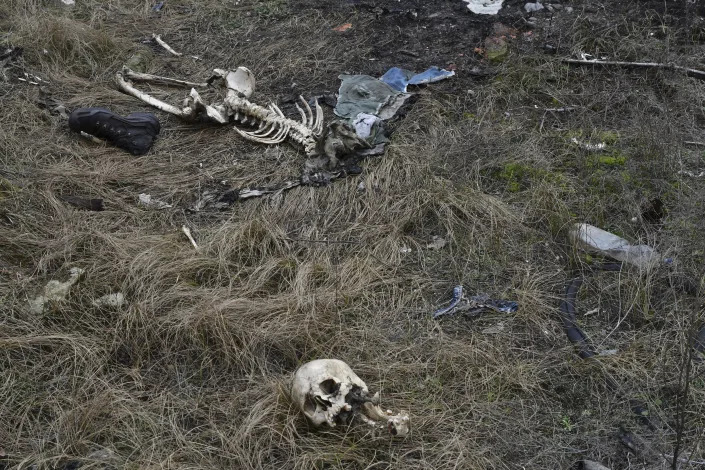
The Ukrainians had occasionally flown drones over the village while it was occupied, to make sure the Russians had not moved the bodies. On Wednesday, they finally had the chance to retrieve them. “They were just skeletons” that would have to be identified by their DNA, Volodymyr said.
As for the Russian dead, he added, the Ukrainians retrieved those that could be removed without risk and are covering others in heaps of dirt, to try to control the foul odor. Nevertheless, an awful stench wafted about the trenches, and swarms of flies buzzed everywhere.
In an abandoned house, Russian soldiers had scraped into the plaster walls the names of their hometowns or regions: Vladikavkaz, a city in southern Russia, and Primorye, a region on the Pacific coast, near Japan.
Maksim, interviewed in the trenches, had collected a small pile of curiosities left behind, including the cowberry syrup made in Yakutia, a region in northern Siberia. Gesturing to the “For Victory!” brand of Russian tea, he said of its former Russian owner, “he didn’t have time to drink it.”
Speaking of the back-and-forth nature of the fighting, Maksim said, “We push them back, they push us back, we push them, they push us, and so on,” adding: “They had a lot of time to dig.”
Soldiers said in interviews that the slow progress was to be expected, given the minefields, trenches and open countryside.
The 110th Territorial Defense Brigade, in contrast to the newly trained and equipped units deployed specifically for the counteroffensive, has been fighting in southern Ukraine for more than a year.
One soldier with the 110th, who identified himself as Sgt. Igor, said his unit has been crawling forward to the relative safety of tree lines between fields to assault Russian trenches, moving in small bursts of a few dozen or hundred yards at a time. Such slow advances were preferable to all-out assaults, he said.
“We need to creep forward bit by bit, with infantry, and break them in this way,” Igor said. “Crawl forward, fight them, then dig in again.”
Time must pass, he said, for the advancing Ukrainian soldiers trained by Kyiv’s Western allies to become skilled at fighting in the open farmland.
Soldiers deployed in the area develop a finely tuned ear for the whistles and booms of outgoing and incoming artillery, he said, adding, “You hear it and should understand in a second whether to fall down or not.”
Soldiers must steel themselves to maneuver in the trenches and fire their guns at enemy troops approaching in an assault, even if bullets are zipping overhead, he said.
“Training abroad is not the same as real combat,” he said. “They are gaining combat experience now,” he added, and as they do, the pace of the advance could pick up. American officials have said the Ukrainian commanders are reassessing tactics after the offensive’s slow start and soldiers’ harrowing forays into minefields.
Green recruits are demoralized when fellow soldiers are wounded or killed, Igor said. “Their morale is affected quickly,” he said.
“The soldiers will learn,” he added. “It’s complicated. And yes, it’s going slowly. But importantly, it’s going.”
How many Russians have died in Ukraine? Data shows what Moscow hides
Erika Kinetz – July 10, 2023
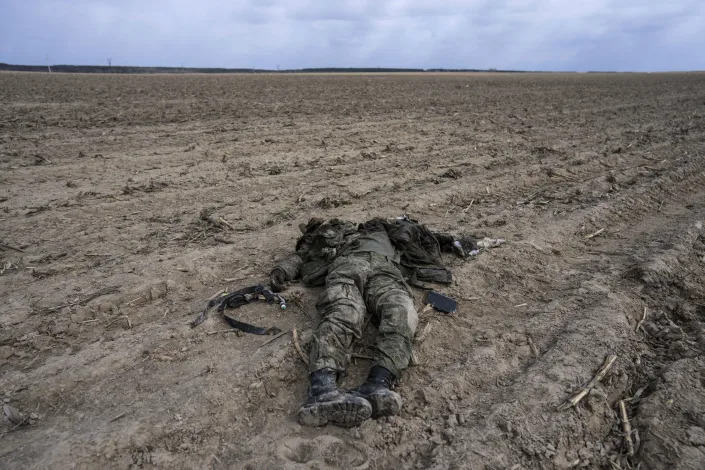
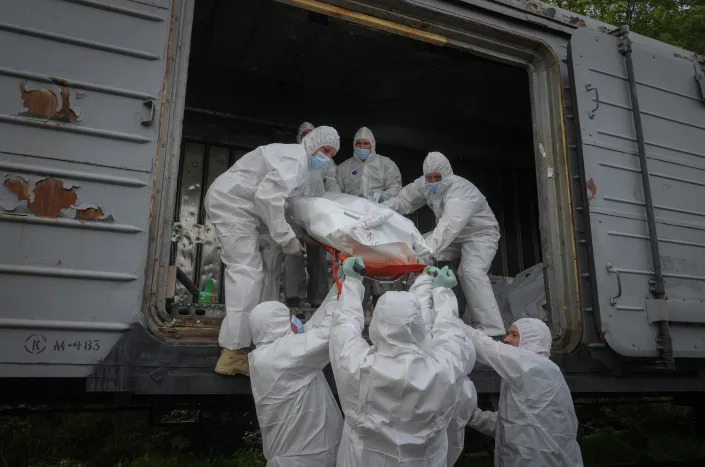
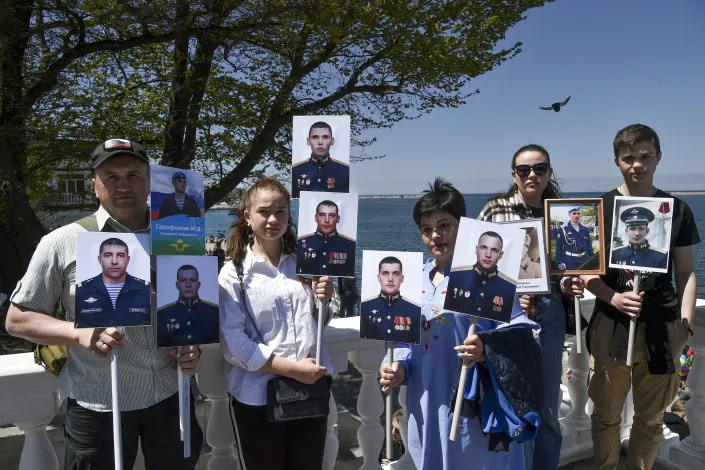
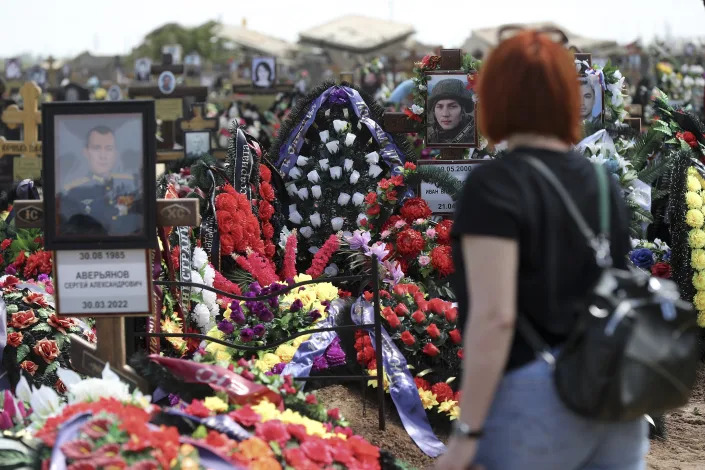
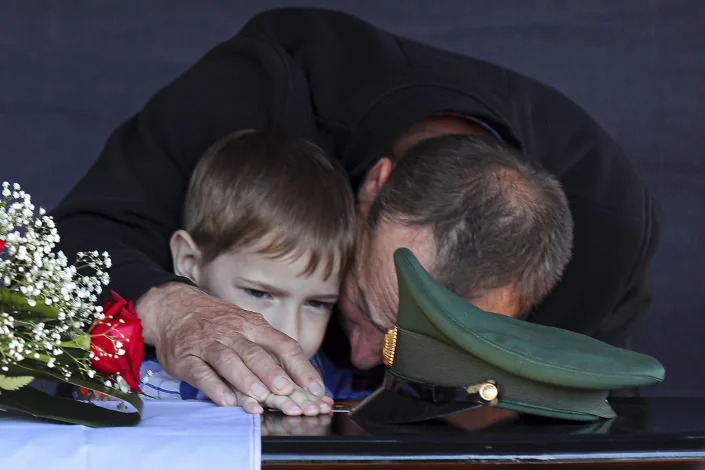
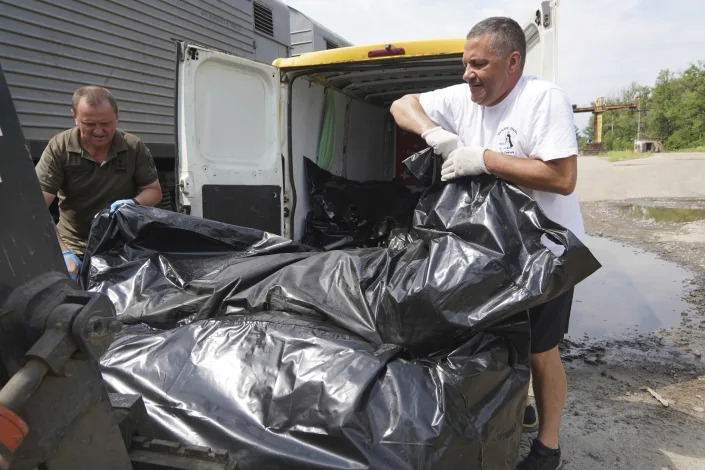
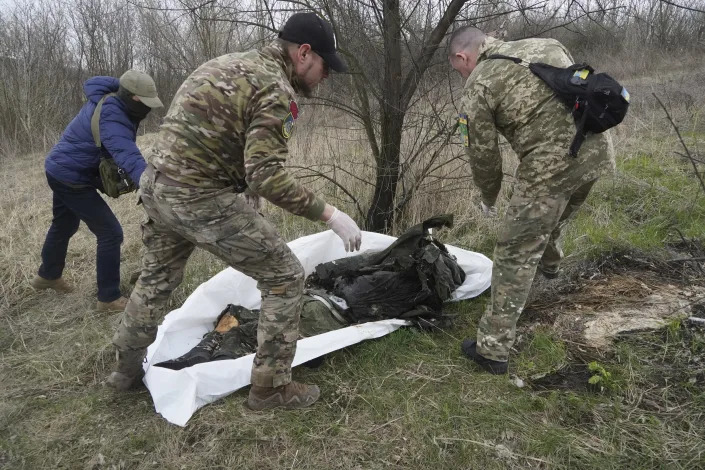
A Russian soldier killed during combats against Ukrainian army lies on a corn field in Sytnyaky, on the outskirts of Kyiv, Ukraine, Sunday, March 27, 2022. Nearly 50,000 Russian soldiers have died in the war in Ukraine, according to a new statistical analysis. (AP Photo/Rodrigo Abd, File)Ukrainian servicemen load bodies of Russian soldiers in to a railway refrigerator carriage in Kyiv, Ukraine, Friday, May 13, 2022. Nearly 50,000 Russian soldiers have died in the war in Ukraine, according to a new statistical analysis. (AP Photo/Efrem Lukatsky, File) Relatives of servicemen who died during the Russian Special military operation in Donbas pose for a photo holding portraits of Russian soldiers killed during a fighting in Ukraine, after attending the Immortal Regiment march through a street marking the 77th anniversary of the end of World War II, in Sevastopol, Crimea, May 9, 2022. Nearly 50,000 Russian soldiers have died in the war in Ukraine, according to a new statistical analysis. (AP Photo, File)A woman at a cemetery in Volzhsky, outside Volgograd, Russia, on May 26, 2022, looks at the graves of Russian soldiers killed in the war in Ukraine. Some experts say that Europe’s largest conflict since World War II could drag on for years. Nearly 50,000 Russian soldiers have died in the war in Ukraine, according to a new statistical analysis. (AP Photo, File)The father and son of Russian army Sgt. Daniil Dumenko, 35, who was killed in Ukraine, mourn his death at a ceremony in Volzhsky, outside Volgograd, Russia, on May 26, 2022. Nearly 50,000 Russian soldiers have died in the war in Ukraine, according to a new statistical analysis. (AP Photo, File)Ukraine’s military official workers move bodies of killed Russian soldiers into a refrigerator in Kharkiv, Ukraine, Saturday, June 18, 2022. Nearly 50,000 Russian soldiers have died in the war in Ukraine, according to a new statistical analysis. (AP Photo/Andrii Marienko, File)The remains of one of the Russian soldiers killed in battles and abandoned by the Russian troops in Sviatohirsk, Donetsk region, Ukraine, Wednesday, Dec. 21, 2022. Volunteers of a Ukrainian search group look for the remains of Ukrainian and Russian servicemen to identify them. Nearly 50,000 Russian soldiers have died in the war in Ukraine, according to the first independent statistical analysis of Russia’s war dead. (AP Photo/Andriy Andriyenko, FileUkrainian servicemen pack the dead body of a Russian soldier, killed in a recent battle in the Kharkiv region, Ukraine, Saturday, April 8, 2023. Nearly 50,000 Russian soldiers have died in the war in Ukraine, according to the first independent statistical analysis of Russia’s war dead. (AP Photo/Andrii Marienko, File)A grave of a Russian serviceman who died during the Russian-Ukrainian war at the cemetery in the village of Dinskaya, Krasnodar region, southern Russia, on Saturday, April 1, 2023. Nearly 50,000 Russian soldiers have died in the war in Ukraine, according to the first independent statistical analysis of Russia’s war dead. (AP Photo, File)
BRUSSELS (AP) — Nearly 50,000 Russian men have died in the war in Ukraine, according to the first independent statistical analysis of Russia’s war dead.
Two independent Russian media outlets, Mediazona and Meduza, working with a data scientist from Germany’s Tübingen University, used Russian government data to shed light on one of Moscow’s closest-held secrets — the true human cost of its invasion of Ukraine.
To do so, they relied on a statistical concept popularized during the COVID-19 pandemic called excess mortality. Drawing on inheritance records and official mortality data, they estimated how many more men under age 50 died between February 2022 and May 2023 than normal.
Neither Moscow nor Kyiv gives timely data on military losses, and each is at pains to amplify the other side’s casualties. Russia has publicly acknowledged the deaths of just over 6,000 soldiers. Reports about military losses have been repressed in Russian media, activists and independent journalists say. Documenting the dead has become an act of defiance; those who do so face harassment and potential criminal charges.
Despite such challenges, Mediazona and the BBC’s Russian Service, working with a network of volunteers, have used social media postings and photographs of cemeteries across Russia to build a database of confirmed war deaths. As of July 7, they had identified 27,423 dead Russian soldiers.
“These are only soldiers who we know by name, and their deaths in each case are verified by multiple sources,” said Dmitry Treshchanin, an editor at Mediazona who helped oversee the investigation. “The estimate we did with Meduza allows us to see the ‘hidden’ deaths, deaths the Russian government is so obsessively and unsuccessfully trying to hide.”
To come up with a more comprehensive tally, journalists from Mediazona and Meduza obtained records of inheritance cases filed with the Russian authorities. Their data from the National Probate Registry contained information about more than 11 million people who died between 2014 and May 2023.
According to their analysis, 25,000 more inheritance cases were opened in 2022 for males aged 15 to 49 than expected. By May 27, 2023, the number of excess cases had shot up to 47,000.
That surge is roughly in line with a May assessment by the White House that more than 20,000 Russians had been killed in Ukraine since December, though lower than U.S. and U.K. intelligence assessments of overall Russian deaths.
In February, the U.K. Ministry of Defense said approximately 40,000 to 60,000 Russians had likely been killed in the war. A leaked assessment from the U.S. Defense Intelligence Agency put the number of Russians killed in action in the first year of the war at 35,000 to 43,000.
“Their figures might be accurate, or they might not be,” Treshchanin, the Mediazona editor, said in an email. “Even if they have sources in the Russian Ministry of Defense, its own data could be incomplete. It’s extremely difficult to pull together all of the casualties from the army, Rosgvardia, Akhmat battalion, various private military companies, of which Wagner is the largest, but not the only one. Casualties among inmates, first recruited by Wagner and now by the MoD, are also a very hazy subject, with a lot of potential for manipulation. Statistics could actually give better results.”
Many Russian fatalities – as well as amputations – could have been prevented with better front-line first aid, the U.K. Ministry of Defense said in an intelligence assessment published Monday. Russia has suffered an average of around 400 casualties a day for 17 months, creating a “crisis” in combat medical care that is likely undermining medical services for civilians in border regions near Ukraine, the ministry said.
Independently, Dmitry Kobak, a data scientist from Germany’s Tübingen University who has published work on excess COVID-19 deaths in Russia, obtained mortality data broken down by age and sex for 2022 from Rosstat, Russia’s official statistics agency.
He found that 24,000 more men under age 50 died in 2022 than expected, a figure that aligns with the analysis of inheritance data.
The COVID-19 pandemic made it harder to figure out how many men would have died in Russia since February 2022 if there hadn’t been a war. Both analyses corrected for the lingering effects of COVID on mortality by indexing male death rates against female deaths.
Sergei Scherbov, a scholar at the International Institute for Applied Systems Analysis in Austria, cautioned that “differences in the number of deaths between males and females can vary significantly due to randomness alone.”
“I am not saying that there couldn’t be an excess number of male deaths, but rather that statistically speaking, this difference in deaths could be a mere outcome of chance,” he said.
Russians who are missing but not officially recognized as dead, as well as citizens of Ukraine fighting in units of the self-proclaimed Donetsk and Luhansk republics, are not included in these counts.
Kobak acknowledged that some uncertainties remain, especially for deaths of older men. Moreover, it’s hard to know how many missing Russian soldiers are actually dead. But he said neither factor is likely to have a huge impact.
“That uncertainty is in the thousands,” he said. “The results are plausible overall.”
Asked by the Associated Press on Monday about the Meduza and Mediazona study, Kremlin spokesman Dmitry Peskov said during a conference call with reporters he wasn’t aware of it as the Kremlin had “stopped monitoring” Meduza. Peskov also refused to comment on the number of deaths mentioned in the study, saying only that “the Defense Ministry gives the numbers, and they’re the only ones who have that prerogative.”
Meduza is an independent Russian media outlet that has been operating in exile for eight years, with headquarters in Riga, Latvia. In April 2021, Russian authorities designated Meduza a “foreign agent,” making it harder to generate advertising income, and in January 2023, the Kremlin banned Meduza as an illegal “undesirable organization.”
Moscow has also labeled independent outlet Mediazona as a “foreign agent” and blocked its website after Russia’s full-scale invasion of Ukraine.
Dasha Litvinova contributed to this report from Tallinn, Estonia.
Exclusive-Wagner fighters neared Russian nuclear base during revolt
July 10, 2023
Exclusive-Wagner fighters neared Russian nuclear base during revolt
(Reuters) – As rebellious Wagner forces drove north toward Moscow on June 24, a contingent of military vehicles diverted east on a highway in the direction of a fortified Russian army base that holds nuclear weapons, according to videos posted online and interviews with local residents.
Once the Wagner fighters reach more rural regions, the surveillance trail goes cold – about 100 km from the nuclear base, Voronezh-45. Reuters could not confirm what happened next, and Western officials have repeatedly said that Russia’s nuclear stockpile was never in danger during the uprising, which ended quickly and mysteriously later that day.
But in an exclusive interview, Ukraine’s head of military intelligence, Kyrylo Budanov, said that the Wagner fighters went far further. He said that they reached the nuclear base and that their intention was to acquire small Soviet-era nuclear devices in order to “raise the stakes” in their mutiny. “Because if you are prepared to fight until the last man standing, this is one of the facilities that significantly raises the stakes,” Budanov said.
The only barrier between the Wagner fighters and nuclear weapons, Budanov said, were the doors to the nuclear storage facility. “The doors of the storage were closed and they didn’t get into the technical section,” he said.
Reuters was not able to independently determine if Wagner fighters made it to Voronezh-45. Budanov did not provide evidence for his assertion and he declined to say what discussions, if any, had taken place with the United States and other allies about the incident. He also didn’t say why the fighters subsequently withdrew.
A source close to the Kremlin with military ties corroborated parts of Budanov’s account. A Wagner contingent “managed to get into a zone of special interest, as a result of which the Americans got agitated because nuclear munitions are stored there,” this person said, without elaborating further.
A source in Russian occupied east Ukraine, with knowledge of the matter, said this caused concern in the Kremlin and provided impetus for a hastily negotiated end to the rebellion on the evening of June 24, brokered by Belarusian President Alexander Lukashenko.
U.S. officials expressed doubts about this account. In response to a query about whether Wagner forces reached the base and sought to acquire nuclear weapons, White House National Security Council spokesman Adam Hodge said, “We are not able to corroborate this report. We had no indication at any point that nuclear weapons or materials were at risk.”
The Kremlin and Wagner commander Yevgeny Prigozhin did not respond to questions for this article.
Matt Korda, a Senior Research Associate and Project Manager for the Nuclear Information Project at the Federation of American Scientists, said it would be “virtually impossible for a non-state actor” to breach Russian nuclear security. Wagner may have had thousands of troops at its disposal, he said, but it’s unlikely any of them knew how to detonate a bomb.
“If you had a malicious actor who was able to get their hands on a nuclear weapon, they would find the weapons stored in a state of incomplete assembly,” he said. “They would need to be completed by installing specialised equipment and then unlocking permissive action links, and in order to do that they would need the cooperation of someone from the 12th Directorate” responsible for protecting Russia’s nuclear arsenal.
Budanov is the first official to suggest Wagner fighters came close to acquiring nuclear weapons and further escalating an armed mutiny that has been widely interpreted as the biggest challenge to Russian President Vladimir Putin’s power. U.S. officials have long feared the nightmare possibility that strife in Russia might lead to nuclear devices falling into rogue hands.
Wagner fighters drove in the direction of Voronezh-45 after peeling away from a larger convoy of heavy weaponry that was advancing along the M4 highway that runs north from Rostov, where the rebellion began. This smaller group headed east, and engaged Russian forces in a firefight at the first village it reached, according to residents and social media posts. But then it appears to have passed without hindrance for 90 km, including driving unchallenged through the centre of a town that houses a military base.
Reuters followed the group’s progress to the town of Talovaya, about 100 km from the base, which dates back to the Soviet era. It is one of Russia’s 12 “national-level storage facilities” for nuclear weapons, according to a report by U.N. scientists. At Talovaya, Russian forces attacked the column, according to local people who spoke to Reuters. A Russian helicopter was shot down, killing the two crew.
Reuters interviewed Budanov in his Kyiv office, which Russia targeted with strikes as recently as May. Dressed in military fatigues with a black pistol tucked into his waistband, Budanov spoke in front of a painting that depicts an owl, a symbol of Ukraine’s spy bureau, clutching a bat, symbol of Russia’s military intelligence agency. He said Voronezh-45 houses small nuclear devices that can be carried in a backpack. “This was one of the key storage facilities for these backpacks,” he said, without providing evidence for this assertion. Reuters was unable to establish if the backpack-sized nuclear charges, referred to by Budanov, are kept at Voronezh-45.
Such small nuclear bombs – light enough to be carried by a single person – are Cold War relics. American troops trained to parachute from planes with nuclear weapons strapped to their bodies and Soviet troops trained to deploy them behind enemy lines on foot. But by the early 1990s, both nations agreed to remove them from their arsenals as tensions eased, and did so, though Russia kept some to mine harbours, said Hans Kristensen, who leads the Nuclear Information Project at the Federation of American Scientists, based in Washington.
Several former U.S. nuclear nonproliferation officials cautioned that it’s difficult to know for sure whether the Russians kept their promise to destroy their backpack-style nuclear weapons. “I don’t believe the Russians still have them, but I wouldn’t bet my life on it,” said David Jonas, former general counsel to the U.S. National Nuclear Security Administration, which tracks atomic weapons and radioactive material worldwide.
Amy Woolf, a nuclear weapons specialist for U.S. lawmakers at the Library of Congress from 1988 to 2022, raised doubts about the potency of such weapons if they do still exist. “It’s possible there’s still some old crap stuck in storage somewhere,” she said. “But is it operational? Almost certainly not.”
Jonas, who advised top Pentagon officials on nonproliferation, agreed, noting that such portable weapons need to be maintained and updated, and degrade over time. He said Russia has struggled to maintain its conventional forces, let alone its atomic stockpile.
A FALLING OUT
Wagner was founded by Prigozhin and Dmitry Utkin, a former special forces officer in Russia’s GRU military intelligence. Cast as a private army, Wagner enabled Russia to dabble in wars in countries including Syria, Libya and Mali with full deniability. U.S. officials also say Prigozhin’s business operated a social media troll factory that interfered with the 2016 American presidential election. In recent days, Putin confirmed the Russian state financed Wagner. State television reported that Prigozhin’s operations had received more than 1.7 trillion roubles ($19 billion) from the Russian budget.
Prigozhin fired the opening salvo of his mutiny on June 23 when he accused the Russian military of launching a missile strike on a Wagner camp in Russian-occupied east Ukraine. Russia denied any such operation.
At least half a dozen sources inside and outside Russia say the conflict had been brewing for some time and that money and tensions between rival clans lay at its heart. For months, Prigozhin had been openly insulting Putin’s most senior military men, casting Defence Minister Sergei Shoigu and Chief of the General Staff Valery Gerasimov as corrupt and incompetent and blaming them for reversals in Russia’s war in Ukraine.
The insults went unanswered in public for a long time. Then Shoigu hit back. On June 10, he ordered Wagner fighters to sign contracts with his ministry agreeing to become part of the regular army by month’s end. Prigozhin refused. On June 13, Putin publicly sided with Shoigu. The state was moving to cut Wagner’s funding and this, the sources inside and outside Russia told Reuters, was the trigger for the mutiny.
In the early hours of June 24, Wagner forces arrived in the southern city of Rostov, an important command centre for Russia’s operations in Ukraine. Wagner took charge of the base there and within hours video emerged of Prigozhin chatting with Russian commanders. Around the same time, other contingents of Wagner forces struck out north, heading in the direction of Moscow along the M-4 highway.
Wagner fighters encountered little resistance.
Some Russian units that stood in their path or were instructed to intercept them did nothing, according to five sources: a Russian security source, three people close to the Kremlin, and a person close to the Russian-installed leadership in eastern Ukraine. The security source said two Russian military formations around the south-west of the country received orders to resist Wagner but they did not act on the command.
Some Russian units did nothing because they were taken by surprise and were outgunned, the sources said, while others stood by because they assumed, until Putin went on television at 10:00 a.m. Moscow time to denounce Prigozhin, that Wagner was acting on the Kremlin’s orders. The sources said some officers were reluctant to move against Wagner because they felt solidarity with the private army and shared Prigozhin’s disillusionment with the way the Defence Ministry top brass was running the war.
At the Bugayevka crossing between Ukraine and Russia, images posted by a Wagner-affiliated Telegram channel on the morning of June 24 showed dozens of Russian troops standing in line, unarmed. The caption said they had laid down their weapons.
Oleksiy Danilov, Secretary of Ukraine’s National Security and Defence Council, told Reuters that many in the Russian military sided with Prigozhin. “There are so many commanders who sympathise with Wagner and don’t want to follow Putin,” he said, adding that he knew of 14 Russian generals who supported Prigozhin. Reuters was not able to independently verify his account about the generals.
One branch of the Wagner force headed north along the M-4 highway, in the direction of Moscow. Their route took them right past Boguchar, a garrison town where a Russian unit is stationed. Three local residents who spoke to Reuters said that the military there did nothing to resist, and that a significant number of people in the town, including people serving in the military, felt sympathy with the Wagner force.
One woman said of Prigozhin: “Who else should we support? At least there’s one dignified person who was not frightened.” Another female resident also said Wagner had widespread support in the town, and that many Wagner fighters are from Boguchar. “They’re all friends,” she said.
A NUCLEAR DETOUR
As the main Wagner column advanced northwards towards Moscow, a group of military vehicles, and some civilian pickups and vans, turned eastwards. The moment is captured on a video posted on a Voronezh region news site. Reuters geo-located the video to a junction near the town of Pavlovsk. The breakaway contingent rumbled through villages and along a road that cut through patches of forest and flat farmland, skirting gulleys carved out by tributaries of the Don River.
A video posted on a local online bulletin board shows a field in the dawn light near the village of Elizavetovka on June 24. In the distance there is an explosion and gunfire, and panicked cries from a male voice: “Has a war started?”
Then a fresh round of automatic gunfire, closer this time.
Reuters spoke to the man’s neighbour, who said the Russian military had attacked the Wagner force. At 08:24 am, a user on the same online bulletin board, Anna Sandrakova, wrote: “Shells are flying, low-flying helicopters, we could hear explosions, automatic gunfire.” Maxim Yantsov, the local government chief for Pavlovsk district, wrote on his Telegram channel that 19 households were damaged as a result of shooting around Elizavetovka.
A few hours later, the convoy passed through another village, Vorontsovka, still moving in the direction of the nuclear facility. Two videos posted to Telegram show more than a dozen vehicles, including armoured personnel carriers, tanks and trucks mounted with machine guns or carrying artillery.
Next on the route, the convoy reached Buturlinovka, according to posts on the town’s online bulletin board and a video that Reuters identified as being recorded in the town. Buturlinovka, closer still to the nuclear facility, is the location of a military air base.
By Saturday evening, users on a VKontakte online forum started reporting the presence of a military column at the town of Talovaya, 110 km from the military base. A video shared by a local resident with Reuters shows a column of military vehicles moving through the outskirts of the town. A second video, provided by another resident, showed at least 75 vehicles in a convoy on the edge of the town, including 5 armoured personnel carriers, two ambulances, and an artillery gun towed behind a truck. A third resident said local people offered food and water to the Wagner troops. The situation was calm, he said, until a Russian helicopter fired at the column. It fired back and the helicopter fell to the ground, followed by explosions and a cloud of smoke.
Russian state media later broadcast video of a wooden cross erected at the site in Talovaya district where the helicopter, a Ka-52 attack aircraft, crashed. Pskov region governor Mikhail Vedernikov said the two crewmen who were killed were stationed at a military base in his region, in north-west Russia. “True to their oath, they did everything to protect our country,” he said in a video address posted on his Telegram channel.
Reuters couldn’t determine what the column did next. A resident of Talovaya said that as far as he was aware, it did not move any further and the following day – after the truce was announced – the column turned around and went back the way it came.
Budanov said in his interview that an unspecified number of fighters did in fact press on to Voronezh-45 with the intention of seizing portable, Soviet-era nuclear weapons stored at the facility.
The nuclear facility at Voronezh-45 is operated and guarded by military unit no. 14254, part of the defence ministry’s 12th Main Directorate responsible for protecting Russia’s arsenal of nuclear weapons, according to the Russian Defence Ministry’s website and publicly available records. What is stored there is a closely guarded secret. Russia does not publicly acknowledge even keeping nuclear weapons there; that information has emerged from the reports of foreign scientists.
Reuters was unable to establish if the backpack-sized nuclear charges referred to by Budanov are kept at the facility. But there is evidence that such devices were developed by the Soviet Union. In testimony to the U.S. Congress, in 1997 Alexei Yablokov, a former Russian presidential science advisor, said Soviet scientists in the 1970s created suitcase-sized nuclear munitions for use by secret agents.
Kristensen, the Federation of American Scientists researcher who said that Russia and the United States discarded thousands of suitcase-sized nukes in the 1990s, said that he doubts any remain stored Voronezh-45. He said he believes – but cannot be certain – that other nuclear weapons are stored at Voronezh-45, which satellite images show to be well-maintained.
Given the 12th Main Directorate’s control over the facility, the movement of weapons would take time and likely be detected by U.S. satellites, he added.
Further north, there is evidence that the Russian military undertook drastic measures to block off another potential access route to Voronezh-45. The E-38 road branches off the M-4 highway at a settlement called Rogachevka. This road also leads to Voronezh-45. On the evening of June 24, local residents reported hearing explosions. A video posted on a Telegram channel captured the sound of an aircraft followed by an explosion. A motorist driving along the E-38 posted a video that shows the road covered in debris near a bridge over the river Bityug. In one lane is a deep crater.
A DEAL IS STRUCK
On the evening of June 24 there was an unexpected announcement by Belarusian state media. The country’s president, Alexsandr Lukashenko, had negotiated Prigozhin’s agreement to halt his forces’ advances. Prigozhin said in an audio message that his forces had come within 125 miles of Moscow and were “turning around” to head back to their training camps. Under the deal, Russia would not prosecute the rebels and Wagner fighters would either withdraw to Belarus or join Russia’s regular army.
A European intelligence source said Prigozhin was persuaded to abandon his revolt after realising he didn’t have sufficient support amongst the military.
Prigozhin’s whereabouts and future plans are unclear.
Kremlin spokesman Dmitry Peskov said on Monday that Putin held talks with the Wagner leader on June 29 and “gave his assessment of the events” of June 24.
One of Prigozhin’s private jets has made multiple trips between Belarus and Russia in the days since the rebellion, according to flight tracking data.
When Belarusian president Lukashenko hosted a group of journalists in Minsk on July 6, he said Wagner’s fighters had yet to arrive at their new Belarusian base. “As for Yevgeny Prigozhin, he’s in St Petersburg. Or perhaps this morning he flew to Moscow. Or perhaps he’s somewhere else. But he’s not in Belarus,” Lukashenko said.
(Reporting by Mari Saito, Tom Balmforth, Sergiy Karazy and Anna Dabrowska in Kyiv, John Shiffman and Phil Stewart in Washington, Polina Nikolskaya in London, Maria Tsvetkova in New York, Anton Zverev, Christian Lowe in Paris, David Gauthier-Villars in Istanbul, Stephen Grey, Reade Levinson and Eleanor Whalley in London, Milan Pavicic and Daria Shamonova in Gdansk; edited by Janet McBride)