The rouble has fallen by 40pc since November, when it became clear what Russia was up against: an unbroken Ukraine able to pack a military punch; a West that was refusing to fracture; and an oil price cap that the Kremlin never thought would happen.
The pace of devaluation has quickened since the Prigozhin mutiny. Over the last week, the rouble has broken its mooring, briefly blowing through the psychological line of 100 to the dollar. The central bank raised interest rates to 12pc in an emergency move on Tuesday but this has so far failed to restore confidence.
Russia now faces a drastic tightening of financial conditions and a currency slide at the same time.
Vladimir Putin can no longer maintain his line that the exchange rate slide is a calibrated and deliberate move in budget management. He touted rouble strength all last year as proof of Russia’s economic invulnerability.
“They are talking about it in every kitchen in Russia,” said financial journalist Orlon Skim.
Tim Ash from Chatham House said the devaluation is an internal propaganda disaster and “the clearest signal yet that the oil price cap and sanctions are working”.
Russia is running out of usable hard currency, to the point where Aeroflot has been landing at least nine of its Boeing and Airbus passenger jets with their brakes switched off because the airline is struggling to obtain parts at viable cost, and can no longer service its fleet in the West.
Pilots have to rely on reverse-thrust alone. A leaked memo obtained by Aviatorschina warned them of the risk of “overrunning the runway” in wet weather. This is a country in dire straits. Only in the magical world of Russian statistics did the economy grow 4.9pc in the second quarter, year-on-year.
Russia can of course buy anything it really needs on the global black market, mostly funnelled through Turkey, Dubai, or central Asia. German exports to Kazakhstan are up 105pc over the last year. Mirabile dictu.
Russia has switched to Chinese semiconductors – as well as cannibalising dishwashers and fridges – but these are mostly workhouse chips, too low-tech for advanced warfare. It would take years to configure Chinese circuits for Russia’s existing industrial system, and so far Chinese companies have been strikingly reluctant to do so.
The weapons captured or shot down in Ukraine overwhelmingly contain US chips acquired before the war. Russia has an elaborate smuggling network to obtain replacements but this costs hard currency. That is what Putin no longer has.
Russia enjoyed a revenue bonanza last year from booming energy, metal, and grain prices. Commodity revenues pushed the current account surplus to 20pc of GDP, allowing Putin to finance the war and uphold the social welfare contract at the same time.
That surplus has largely evaporated. Mr Ash said Russian energy sales to Europe have dropped to €2bn (£1.7bn) a month from €12bn a month last year. Gazprom has essentially lost its €60bn annual gas market in Europe forever. The gas pipelines from the west Siberian fields cannot be switched to China without vast investment.
Putin is still selling near record volumes of oil, as intended under the sanctions regime. The point of the $60 oil cap is to keep the world economy well-supplied with crude, while depriving the Kremlin of a slice of the earnings.
Either Putin ships his oil though the western-controlled nexus of tankers and insurance, and accepts the price cap; or he ships it in his own shadow fleet with complex and costly refuelling off Gibraltar or the Greek islands. He loses $8 to $10 a barrel sending the oil halfway around the world to Asia. The Indians and the Chinese know he is a distressed seller and are driving a hard bargain.
The International Energy Agency says the discount on Russian Urals crude has narrowed. The price averaged $64 in July but that is still significantly lower than Brent near $80 at that time. How much of that reaches Russia after transport costs and fees for middlemen is an open question.
To the extent that we can believe any Russian data at this stage, Kremlin revenues collapsed by 47pc in the first half of the year. The budget deficit is running at an annualised pace of $50bn even on the official figures. The Kremlin cannot borrow abroad and lacks a deep and liquid bond market at home.
The Kremlin is now raiding private companies, forcing them to pay “voluntary” contributions to the war effort. The founders of Yandex, Russia’s “Google”, the telecom company Vimpelcom, and the digital bank Tinkoff have all been driven into exile, effectively expropriated or coerced into selling cheaply.
Covering the budget shortfall by this sort of scavenging has reached its limits. The falling rouble flatters the fiscal deficit because it raises the nominal rouble revenues from oil exports, but that effect is quickly overwhelmed by the inflationary sting in the tail.
The treasury has had to dip into the national welfare fund, down $16bn since May to $146bn, and not all of that is liquid. The Kremlin has suspended the budget rule requiring that a share of energy revenues is salted away in foreign assets. This move failed to stabilise the rouble.
Russia is now caught in a classic emerging market crisis. The more that Putin’s circle tries to scapegoat central bank chief Elvira Nabiullina, the technocrat holding Russia’s finances together, the greater the likelihood of igniting an inflation-devaluation spiral, with no possibility of an IMF bail-out when it all goes wrong.
This may not yet be the final chapter for Putin but the rouble crisis rebuts the widely-repeated claim that time works to his advantage in Ukraine. He is running out of plunder to buy off the hard-bitten business interests and private militias that underpin his regime.
A reader of this newsletter suggested that the West should lift all sanctions against Russian oligarchs instead of hounding them, except for those actively aiding the war. They should be encouraged to bring as much money as possible to Zurich, London, or New York, safe in the knowledge that it will not be frozen.
I agree. The imperative is to split the Russian elite and quicken capital flight. A run on the rouble is the financial equivalent of Storm Shadow missiles.
The ruble has plunged to its lowest level against the dollar since war in Ukraine began as Putin’s economy sputters
Jennifer Sor – August 8, 2023
The ruble has plunged to its lowest level against the dollar since war in Ukraine began as Putin’s economy sputters. REUTERS/Ueslei Marcelino
Russia’s currency in recent days has plunged to its lowest level against the greenback since the war in Ukraine began.
The ruble traded around 96 against the US dollar on Tuesday, a 30% decline from January.
Russia’s economy is struggling in the face of western sanctions and war in Ukraine, experts say.
Russia’s currency just plunged to its lowest level against the dollar since the beginning of its war in Ukraine — another sign that the nation’s economy is sputtering as the conflict drags on and its economy is burdened with Western sanctions.
The ruble has traded around 96 against the dollar since last Friday. It’s the cheapest Russia’s currency has been since Putin began his invasion of Ukraine in February last year, which caused the ruble to briefly plummet to 120 against the dollar.
Economists have been sounding the alarms for Russia’s economy for the past year, as the nation has been slammed by sanctions and soaring military spending. Restrictions on oil and natural gas trade led Russia’s energy revenue to tumble 45% in first three months of the year. Meanwhile, government spending surged 34%, leading Russia to post a $29 billion budget deficit over the first quarter– a 107% decline from last year’s $14 billion budget surplus.
There’s a very distinct possibility we could trigger our own extinction or, at the very least, greatly reduce our population while completely altering the way we currently live. Little things like going outside during daylight hours or growing food in the dirt could become relics of the past, along with birds, insects, whales and many other species. War, famine, pestilence and death — that dreaded equine quartet — threaten to topple our dominance on this planet. We are destroying our own home, sawing off the very branch we rest on.
Those who refute this reality, or climate change deniers, misinterpret the same sets of data showing a clear anthropological cause as being part of the “natural” cycle of the planet. Things are warming, they argue, and that is normal. Only, it really isn’t normal.
Climatologists and scientists have been sounding the alarm for decades: Global temperatures and planetary homeostasis are spiraling out of control, and we’re to blame. The climate crisis is no longer a hypothetical future. It’s the tangible present, and the evidence is clear in every grueling heatwave, not-so-uncommon “freak” storm and raging wildfire.
On the opposite extreme is a vocal minority, the accelerationists and nihilists who accept that humanity is overwhelmingly destructive to nature, but argue our extinction would be a welcome relief. I received many such comments on social media after interviewing Peter Ward, a paleontologist and professor at the University of Washington, about his “Medea hypothesis,” a theory that life is not a benevolent force and often causes its own extermination. Many species in Earth’s history became so successful that they wiped themselves out — and we could do the same.
In response to that article, many readers said something such as, “Humans are a virus and should be eradicated.” Obviously, inducing human extinction is an outcome for which only a very cynical personality would advocate. But what about the first part of that statement? Are humans really like a virus, a pathogen, a cancer?
Dr. Warren Hern, a Colorado-based physician and author of the new book “Homo Ecophagus: A Deep Diagnosis to Save the Earth,” argues that human civilization indeed has many similarities with cancer. This isn’t a metaphor, but rather a literal diagnosis — and it can be addressed in the same way that an actual cancer diagnosis can be the first step to treatment.
Salon recently spoke with Hern about his new book, which acts partially as a memoir, textbook, dire diagnosis and poetic ode to a disintegrating planet, discussing the implications for such an urgent prognosis, a new name for the human species that reflects our true nature and how we can still fix this crisis.
This interview has been condensed and lightly edited for clarity.
My opinion is that humans are part of nature — we are not separate from it. After I came across your book, I began asking myself, “Are humans really a cancer on the planet?” I thought, “Aren’t we part of this whole ecosystem?” I initially set out to disprove what you’re saying, but the argument you make is so extremely convincing. I know from your writing that when you were first conceptualizing the notion that humans are a cancer on the planet, it was very unpopular. But now it seems like this idea has earned some mainstream acceptance. Is that true?
This is a fundamental scientific and philosophical question. And, first of all, I agree with you that we are part of nature. We evolved in a natural ecosystem, and we have obviously very intimate close ties with other species, other animals. Humans are unique in that they have culture, although we’re learning that other animals have certain levels of culture also, like whales. So, we are really not unique in that sense, but we have a different and higher level of culture that allows us to dominate other species and ecosystems.
These are cultural adaptations that allow us to survive, but they have become malignant maladaptations because they are now threatening our survival and millions of other species. We have essentially made a decision at this point as a species to go extinct. That’s what we’re doing — we’re eliminating our biosphere and our planetary support system. Consciously or not, and I think mostly unconsciously.
When I first came onto this in the late ’60s, I was horrified. It’s not an analogy; nobody ever died from an analogy. It’s a diagnosis, and that’s different. The diagnosis is the same as the hypothesis. The guy comes into the emergency room with a sore belly, and he has right lower quadrant pain. Your diagnosis is appendicitis until proven otherwise. But that’s a hypothesis because he might have some other disease, or if it’s a woman, they might have an ovarian cyst.
I work with the idea from Karl Popper that science is not advanced by proving anything, but by disproving false hypotheses. The purpose of a hypothesis is to explain reality and predict events. This hypothesis [humans as a cancer] explains what we see going on in reality around us — and has for a long time — and it predicts what is going to happen. And that means the prognosis, in medical terms, for cancer is death. The cancer continues until the host organism dies.
The difference between us and a cancer — the only difference — is we can think, and we can decide not to be a cancer. If the diagnosis is correct, things will continue until we are extinct. The biosphere can’t go extinct; it can’t die, but we can alter it to the point that we can no longer survive. And that will take out millions of other organisms. Clearly, plenty of organisms are going to survive that process. They might even be more intelligent than us. I don’t know.
That’s sort of the general picture. And whether people accept this or want to even listen to it is another thing. For example, in the book, I talk about the guy who took over the anthropology section at AAAS [American Association for the Advancement of Science] back in the early ’90s. He didn’t like this idea, and he wanted them to drop it from the schedule because his wife had cancer and he was very offended by it. I told him, “Well, I’m really sorry that your wife has cancer, and I certainly hope she recovers. This doesn’t have anything to do with your wife’s cancer.”
I hope people can see that because it’s such a good diagnosis. I mean, it really does fit the bill. You look at maps of cities and tumors, and you can see how they kind of grow similarly. But the similarities don’t end there.
The basic premise is that humans have the capacity of developing culture, and that has millions of manifestations, everything from language and speech and mathematics to constructing shelters, building weapons and having medical care to keep us alive. These adaptations have allowed us to go from a few separate species of skinny primates wandering around in Africa a couple of million years ago to being the dominant ecological force on the planet to the point we’re changing the entire global ecosystem.
These cultural adaptations have now become maladaptive. They do not have survival value. And they are, in fact, malignant maladaptations because they’re increasing in a way that cancer increases. So, this means that the human species now has all of the major characteristics of a malignant process. When I was in medical school, we had four of them that were identified: rapid, uncontrolled growth; invasion and destruction of adjacent normal tissues — in this case, ecosystems; metastasis, which means distant colonization; and dedifferentiation, which you see very well in the patterns of cities.
That’s only one example. We now have 10 or 15 other new characteristics of cancer, and the human species fits all of them. And so the disturbing thing about this? If you have any two of the first four characteristics of cancer, it’s cancer until proven otherwise. And cancer does not stop until the host organism has ceased to function, which for our purposes is the biosphere.
Now, I have given the book the name “Homo Ecophagus.” That is my new name for the human species, which currently has the scientific name of Homo sapiens sapiens, or wise, wise man, which makes us the most misnamed species on the planet. Homo ecophagus means the man who devours the ecosystem — and that’s what we are doing.
We are in the process of converting all plant, animal, organic and inorganic material on the planet into human biomass and its adaptive adjuncts or support systems. The evidence for that is all around us.
So, that’s the basic idea in a nutshell, and then the rest of the book is simply manifestations of this malignancy and an explanation of the analysis. And so, the next question is: Can we do anything about this? Should we do something about this? It’s very hard under the circumstances, for example, to think about Vladimir Putin sitting down with Zelensky if they can fix the ecosystem in Ukraine.
Right, it’s a very, very difficult problem. It’s the biggest problem our society faces right now. Literally, nothing else matters if we don’t address this problem.
That’s the point: It’s an existential crisis. Yes.
I have to say that it seems like we’re not going to solve this problem. I don’t want to be negative and despair that we’re all simply going to die from climate change. I recently made a move across the country from California to Illinois. Everywhere you go, you get that dedifferentiation that you speak of, where everything looks the same. Every freeway has the same strip malls. You see all these people in these giant pickup and semi trucks and all this overconsumption. I just don’t see people giving it up. I just don’t see it happening. Not fast enough, at least.
This is what I call the “ecophasic imperative.” Robert Ardrey, a brilliant anthropologist, about 40 or 50 years ago wrote a number of outstanding books. One is called “The Territorial Imperative,” which is about how humans have an imperative need to have and expand their territories.
One of the most lurid manifestations of what we have right now is Donald Trump. Another one is Putin and the war on Ukraine, but humans have been doing this forever. And now our malignant melanoma patients have been put in a position where we are devouring the Earth. We are devouring the ecosystem. We have an imperative to do that. Look at the open pit mines that we have of various kinds. The whole alternative energy programs depend on destroying certain ecosystems to get the rare metals that we need to do that stuff.
I do not want to be negative, either. I’m basically an optimistic and positive person. I’ve been my whole life. The Intergovernmental Panel on Climate Change gives us a list of horribles, and it gets more horrible every year. But what’s the underlying dynamic? I say this is a malignant process going on for hundreds of thousands of years.
This is not new. When the Australian Aborigines arrived on the continent of Australia, they started changing the ecosystem in very dramatic ways, and a lot of species went extinct. My colleague here at the University of Colorado, Giff Miller, has been one of the people showing that it happened in North America. It happened in the Pacific Islands. It happens every place. Humans have made other species extinct wherever they show up.
Of course, it takes individual actions. The obvious side to that is people can make changes in their lives. I’m in Boulder, Colo, for example, where they have a lot of recycling going on, and people are very conscious of that. But, at the same time, you have China putting in a coal-fired power generation plant every week. So, it’s very hard to see how all these individual actions can really have that effect that we want.
Do you have hope for the future, or maybe feel despair about everything? I often get a little bit paralyzed and feel like there’s no point to anything, like we’re all just going to go off the cliff. I’m hoping something will change, that something will shift on a major level, that we’ll all kind of come together on this issue. But I feel like I’ve been waiting for that moment for years.
It’s hard to know how to answer your question when you ask me, “Is there hope?” One of my main answers — which is true — is that young people like you give me hope, people who are looking at this stuff and thinking about it and figuring out what to do. When I look at the current political scene in the United States, it’s very hard to be optimistic because we have a violent fascist movement that occupies the attention of at least a third, if not more, of the population, supporting a man who is a sociopathic criminal.
I think that we make the decisions about these situations — the environment and our survival — through our political process. I want to be optimistic. Let me just share a little example of something with you. A week ago, I went to New Mexico to attend a special memorial service for Dave Foreman.
The meeting was held in a campground outside of Los Alamos, and we were a scruffy-looking bunch of backpackers and tree huggers. I felt right at home with these wonderful people, who were some of the hardcore environmentalists of this country, and people who really, really were dedicated, spent their lives working on protecting the environment. We’ve been talking about people with advanced degrees, with PhDs in ecology and biology, wolf conservation, I don’t know what else.
They were an impressive bunch of people. I enjoyed meeting them, and I participated in this meeting. I admire Dave, who was a friend of mine. And I have his books, and they’re worth reading. OK, this is a highly energetic, wonderful, dedicated, altruistic group in this country. What’s been happening since they started Earth First!? Things are a lot worse than they were.
And it’s very hard to see how that has really influenced the broad scale of things, even though they’ve had a lot of very specific local victories. More people need to understand that we are in an impending extinction crisis for ourselves and for the rest of the ecosystem and other species. We are destroying the planet as we speak — as rapidly as possible — and that must stop. We must find ways to do things differently, and that’s going to make big changes in our lives.
The Kremlin has pumped so much money into the economy that it’s creating a boom — but this house of cards could topple anytime soon
Huileng Tan – August 1, 2023
The Kremlin has pumped so much money into the economy that it’s creating a boom — but this house of cards could topple anytime soon. The Russian economy has been doing far better than expected even amid sweeping sanctions, but most analysts do not expect this to last.(AP Photo/Alexander Zemlianichenko)
Russia’s wartime economy is thriving, the New York Times reported Monday.
The Kremlin implemented measures to boost military equipment output, benefits, and mortgage subsidies.
These measures have boosted the demand — and prices — for a range of goods and services in Russia.
Nearly 18 months after the Ukraine war started, Russia’s economy appears to be humming along — baffling economists who predicted catastrophic outcomes following sweeping sanctions against Moscow’s invasion of Ukraine.
While some economists have questioned the quality and veracity of Russian data releases, a New York Times report on Monday offered a nuanced picture of the country’s wartime economy and how it’s helping drum up popular support for Vladimir Putin.
Soldiers fighting the war are also earning far higher salaries than average earnings in poorer regions of Russia, the Times reported. For instance, Russia was offering a minimum of 160,000 rubles, or about $1,740, in monthly wages for contract soldiers last September — three times the national average, Reuters reported at the time.
Large payouts for those who died in the war — for example, a 5 million rubles payout for families of Wagner Group fighters who died in the war — are circulating in the economy.
These measures have boosted the demand — and prices — for a range of products and services in Russia, the Times reported.
Corporate loans have increased 19% in the year to June as investments grew, the Times said, citing the Russian central bank’s figures. Meanwhile, the value of mortgages taken out from Russia’s top 20 banks surged 63% in the first half of the year from a year ago, the Times reported, citing the state-run lender Dom.RF, and the real estate research firm Frank Media.
“As an economist, I don’t know how this bubble can be deflated,” Alexandra Prokopenko, a researcher with the Carnegie Russia Eurasia Center and a former advisor at the Russian central bank, told The Times.
“One day it could all crash like a house of cards,” he added.
Economy experts, however, are not optimistic about Russia’s economic outlook even as they acknowledge the current robustness of its economy.
In April last year, the Russian central bank’s governor Elvira Nabiullina said the country’s reserves wouldn’t last infinitely. In December, she also expressed concerns about inflation and the tight labor market due to Putin’s military draft. She repeated her concerns about price rises and the labor shortage in her July rate hike announcement.
Ariel Chernyy, an economist at Italian bank UniCredit, forecasts Russia’s GDP to grow by 1% this year — reversing a 2.1% contraction last year, according to a July 6 note seen by Insider.
Chernyy said the country’s economic resilience is due to government spending and the implementation of import-substitution projects that are boosting the domestic industry.
But it “does not mean a higher GDP growth rate that can be sustained in the long term” due to a shrinking labor pool and other issues like inferior import substitutes, he added.
US intelligence report says China likely supplying tech for Russian military
Kanishka Singh and Michael Martina – July 27,2023
The flags of the United States and China fly in Boston
WASHINGTON (Reuters) – China is helping Russia evade Western sanctions and likely providing Moscow with military and dual-use technology for use in Ukraine, according to an unclassified U.S. intelligence report released on Thursday.
The assessment by the Office of the Director of National Intelligence (ODNI) was published by the U.S. House of Representatives Permanent Select Committee on Intelligence.
China has repeatedly denied sending military equipment to Russia since Moscow’s all-out invasion of Ukraine in February 2022.
“The PRC is providing some dual-use technology that Moscow’s military uses to continue the war in Ukraine, despite an international cordon of sanctions and export controls,” the ODNI report said.
“The customs records show PRC state-owned defense companies shipping navigation equipment, jamming technology, and fighter jet parts to sanctioned Russian Government-owned defense companies,” the report said.
It also said China has become “an even more critical partner” of Russia after Moscow invaded Ukraine last year.
ODNI said China and Russia had increased the share of bilateral trade settled in China’s yuan currency, and both countries’ financial institutions are expanding their use of domestic payment systems.
China has increased it importation of Russia energy exports, including oil and gas rerouted from Europe, the report said.
ODNI cited much of the information to media reports. It added: “The Intelligence Community lacks sufficient reporting to assess whether Beijing is deliberately inhibiting United States Government export control end-use checks, including interviews and investigations, in the PRC.”
Earlier this month, French President Emmanuel Macron’s top diplomatic adviser Emmanuel Bonne said China was delivering items that could be used as military equipment to Russia, although not on a massive scale.
U.S. officials have previously raised concern about transfers of “dual-use equipment” from China to Russia. However, they have repeatedly said they have yet to see evidence of the transfer of lethal assistance for Russia’s use on the battlefield.
(Reporting by Kanishka Singh and Michael Martina in Washington; Editing by Caitlin Webber and Daniel Wallis)
China defends trade with Russia after the US says equipment used in Ukraine might have been exported
July 28, 2023
FILE – Chinese Foreign Ministry spokesperson Mao Ning gestures during a press conference at the Ministry of Foreign Affairs in Beijing, on July 26, 2023. The Chinese government defended its dealings with Russia as “normal economic and trade cooperation” Friday, July 28, after a United States intelligence report said Beijing possibly provided equipment used in Ukraine that might have military applications. (AP Photo/Ng Han Guan, File) (ASSOCIATED PRESS)More
BEIJING (AP) — The Chinese government defended its dealings with Russia as “normal economic and trade cooperation” Friday after a United States intelligence report said Beijing possibly provided equipment used in Ukraine that might have military applications.
The Biden administration has warned Chinese leader Xi Jinping’s government of unspecified consequences if it supports the Kremlin’s war effort. The latest report cited Russian customs data that showed Chinese state-owned military contractors supplied navigation equipment, fighter jet parts, drones and other goods, but didn’t say whether that might trigger U.S. retaliation.
“China has been carrying out normal economic and trade cooperation with countries around the world, including Russia,” said Foreign Ministry spokesperson Mao Ning. She said Chinese-Russian cooperation “neither targets a third party nor is it subject to interference and coercion by a third party.”
Xi and Russian President Vladimir Putin declared before the February 2022 invasion that their governments had a “no-limits” friendship. Beijing says it is neutral in the war, but it has blocked efforts to censure Moscow in the United Nations and has repeated Russian justifications for the attack.
China is an “increasingly important buttress” for Russia, “probably supplying Moscow with key technology and dual-use equipment used in Ukraine,” said the report by the Office of the Director of National Intelligence, referring to equipment that can have both civilian and military applications.
China has stepped up purchases of Russian oil and gas, which helps Putin’s government offset lost sales after the United States, Europe and Japan cut off most purchases of Russian energy. Beijing can do that without triggering Western sanctions on its own companies, but Washington and its allies are frustrated that it undercuts economic pressure on Moscow.
China rejects Western trade and financial sanctions on Russia because they weren’t authorized by the U.N. Security Council, where Beijing and Moscow have veto power. However, China has appeared to avoid directly defying those sanctions.
“We have also consistently opposed unilateral sanctions and long-arm jurisdiction that have no basis in international law and have not been authorized by the Security Council,” said Mao.
Hundreds of thousands of people fled Russia after it invaded Ukraine — and now the countries that took them in are seeing a boost in their economies
Huileng Tan – July 24, 2023
Russians were seen attempting to leave their country for Georgia to avoid a military call-up on September 28.Davit Kachkachishvili/Anadolu Agency/Getty Images
Scores of Russians fled their homeland following the outbreak of the Ukraine war.
Many resettled in neighboring countries such as Armenia, Georgia, and Kyrgyzstan.
The growth of such countries surged in 2022 after the arrival of these Russians, a new report found.
Hundreds of thousands of Russians who fled their homeland following the country’s invasion of Ukraine have resettled in neighboring countries — and are boosting their economies.
By October, about 700,000 Russians had left the country, Reuters reported, citing Russian media — but the Kremlin rejected those numbers, saying it didn’t have this data.
Many of these Russians landed in neighboring countries, setting up new lives and businesses, and ended up boosting the economies of these nations, the independent Russian media outlet Novaya Gazeta reported Friday.
The GDP of the South Caucasus — a region comprising Armenia, Azerbaijan, and Georgia — grew by an outsize 7% in 2022, the World Bank found. This far outpaced the 5.6% growth that World Bank economists had predicted.
Armenia — once known as the Silicon Valley of the Soviet Union — saw its 2022 growth spike to 12.6%, the World Bank found. The institution’s economists had forecast last year 7% growth for the country.
Suren Parsyan, a lecturer at the Armenian State University of Economics, told Novaya Gazeta that Armenia’s growth last year was thanks to the newly arrived Russians, particularly those working in IT.
Russians transferred about $1.75 billion to Armenia in 2022, Martin Galstyan, the country’s central-bank governor, said in January, Armenia’s News.am reported.
Meanwhile, Georgia’s GDP jumped by 10.1% in 2022, the World Bank said, beating an 8.8% growth forecast. Money transfers from Russia rose fivefold, from $411 million in 2021 to $2.1 billion in 2022, according to data from Georgia’s central bank.
Even Kyrgyzstan’s economy grew by 7% in 2022, outpacing a 4% forecast, the World Bank said.
Oleg Itskhoki, an economics professor at the University of California, Los Angeles, told Novaya Gazeta that the GDP performance in such countries demonstrated that the newly arrived Russians had savings and were wealthier than the local residents.
To be sure, immigration hasn’t had only a positive influence on the economies. The influx of Russians also contributed to a rise in inflation, such as a jump in hotel rates and rents in Kazakhstan and Georgia, Bloomberg reported in September.
Russia preparing to attack cargo ships in Black Sea, Britain and America warn
James Kilner – July 20, 2023
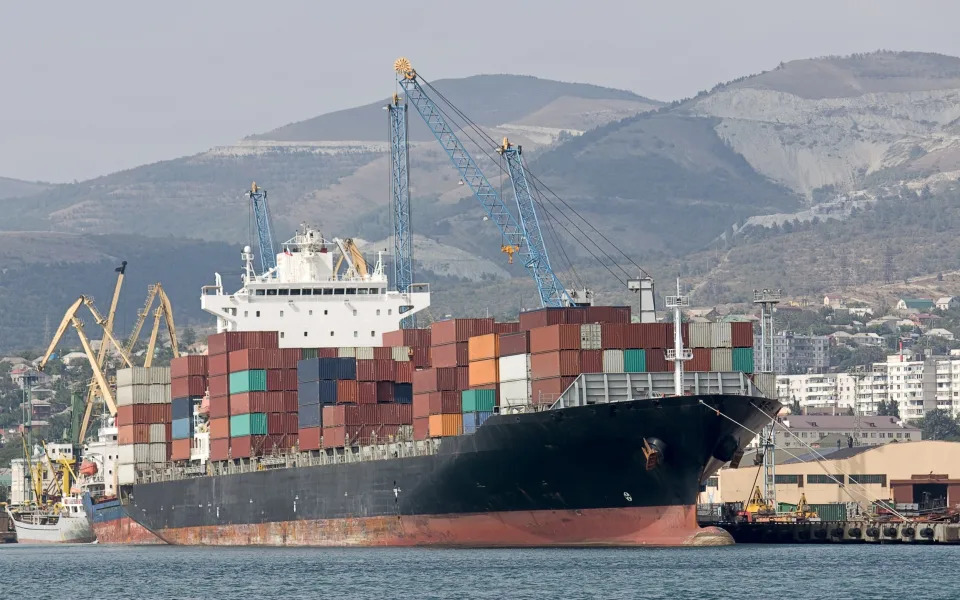
A cargo ship is loaded at the port of Novorossiysk, Russia – Zhannaprokopeva/iStockphoto
Ukraine will attack all Russian cargo ships travelling in the north-eastern sector of the Black Sea, its military has said, in retaliation to a similar warning from the Kremlin.
It issued the warning after Russia pulled out of a grain export deal and said that it would now regard all ships heading to Ukraine as smuggling weapons.
”The Kremlin has turned the Black Sea into a danger zone,” Ukraine’s military said in a statement. “The fate of the Moskva cruiser proves that Ukraine’s defence forces have the necessary means to repel Russian aggression.
A Russian missile destroyed the ‘Moskva’, the flagship of Russia’s Black Sea Fleet, in April 2022.
Ukraine’s military said that it too would now regard all cargo ships bound for Russia as carrying weapons.
At least one person was killed in Odesa and seven more were injured – Libkos/AP
Tension has soared in the Black Sea since Monday when the Kremlin pulled out of a deal that allowed Ukraine to export grain.
The Black Sea is an important trade shipping route. As well as carrying cargo from ports in Russia and Ukraine ships also transport goods between Georgia, Turkey and the EU.
The British Ministry of Defence said on Thursday that Russia would now attack or intercept all cargo ships heading to Ukraine.
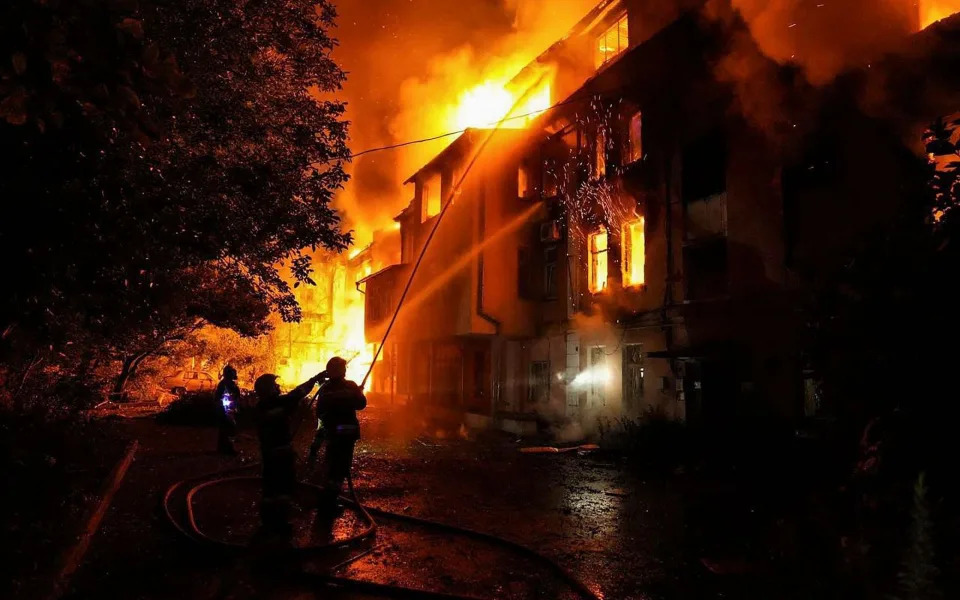
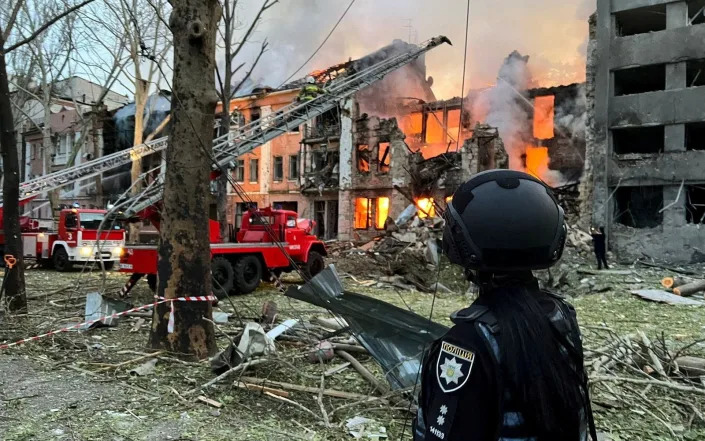
Ukrainian firefighters battle a blaze at a building which was struck by a rocket in the port city of Mykolaiv – EPA-EFE/Shutterstock
“The Russian Black Sea Fleet will likely now take a more active role in disrupting any trade which continues,” it said.
Russia has laid additional sea mines in the approaches to Ukrainian ports, White House National Security Council spokesman Adam Hodge said.
“We believe that this is a coordinated effort to justify any attacks against civilian ships in the Black Sea and lay blame on Ukraine for these attacks.”
The warnings come as Russian missiles hit Odesa and Mykoliav, Ukraine’s largest ports, for the third consecutive night.
Odesa has suffered three nights of Russian strikes – Igor Tkachenko/EPA-EFE/Shutterstock
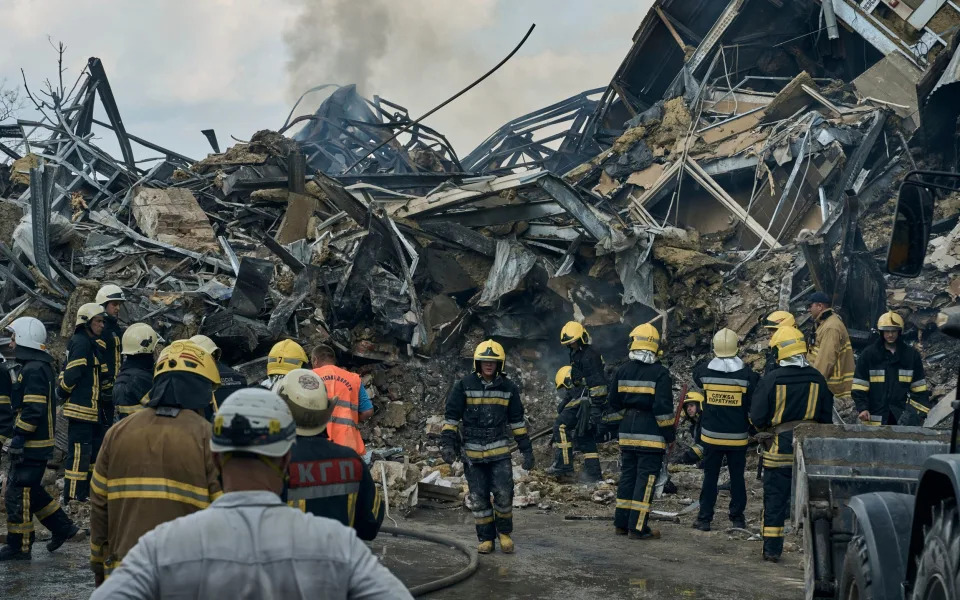
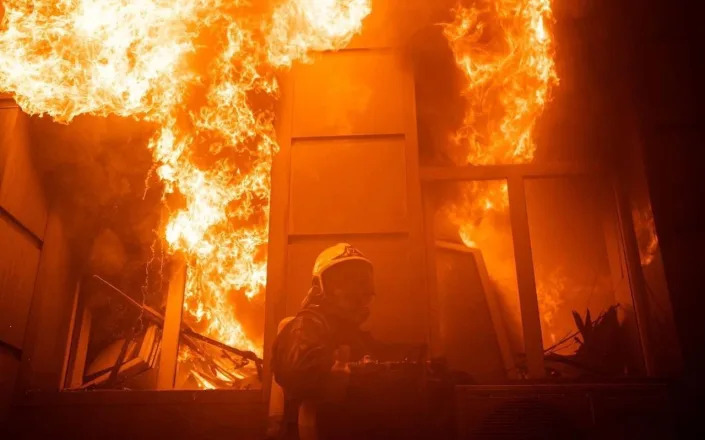
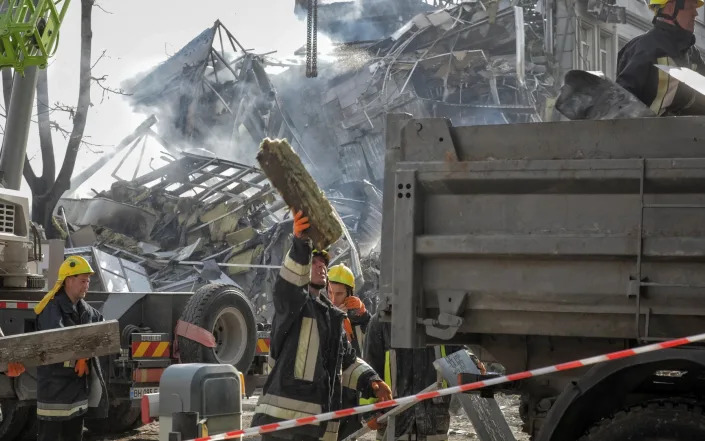
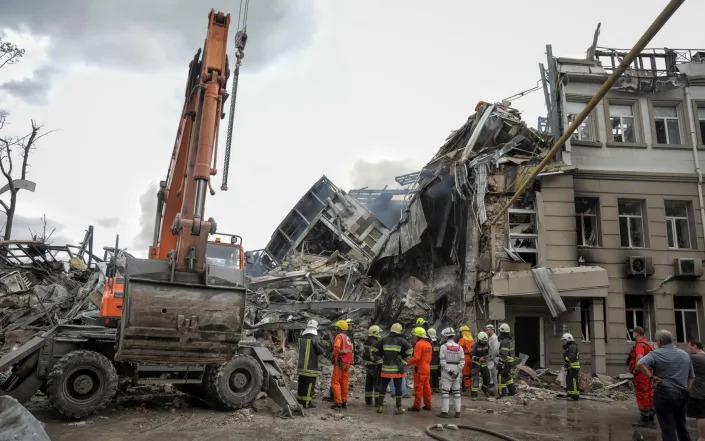
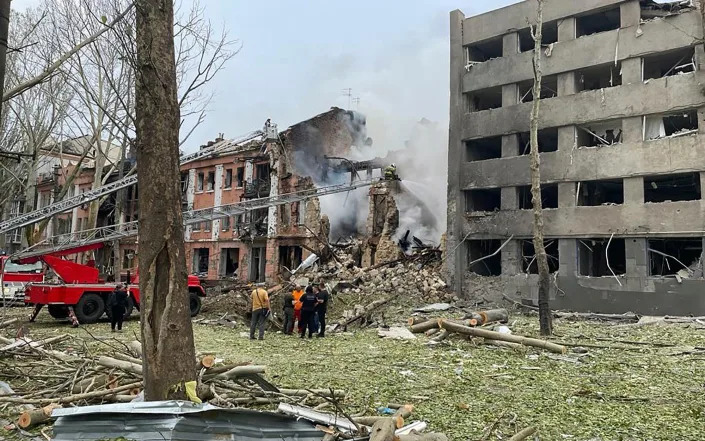
Videos from the missile strikes on the ports show flames pouring out of destroyed buildings. At least one person was killed in Odesa and seven more were injured. In Mykolaiv, 20 people were injured.
“Russians hit the city centre. A garage and a three-storey residential building are on fire,” said Vitaliy Kim, the Mykolaiv governor.
The Kremlin has said that it is retaliating against an alleged Ukrainian strike on the 12-mile bridge that connects occupied Crimea to the Russian mainland, but Volodymyr Zelensky, the Ukrainian president, linked the attacks to Russia’s withdrawal from the grain deal.
“The target is not only Ukraine,” he said. “Everybody in the world is being affected by this Russian terror.”
A destroyed building in Odesa – Libkos/AP
He said the Kremlin had destroyed a silo in Odesa that was storing 60,000 tonnes of grain bound for China, one of Russia’s key allies.
Under the UN-negotiated deal, Russia had approved Ukrainian cargo ships to dock at the ports to pick up grain after it had inspected them for weapons.
Vladimir Putin, the Russian president, has said that he will return to the grain deal if Ukraine reopens an ammonia pipeline that runs from central Russia.
Ukraine is one of the world’s biggest grain exporters. Global leaders have warned that grain prices will now surge and people in Africa, the Middle East and South Asia will go hungry.
“It worsens the food security outlook and risks adding to global food inflation, especially for low-income countries,” the International Monetary Fund said.
The Kremlin has been courting African leaders and they are due in St Petersburg for meetings with Putin next week.
Ukraine-Russia war: Ukraine launches first cluster bomb attack on Russian troops
Maighna Nanu – July 20, 2023
Ukraine has launched its first cluster bomb attack against Russian forces in southeastern Ukraine, according to reports.
The Washington Post reported that the controversial weapons were fired at Russian trenches slowing down Ukraine’s advance, citing Ukrainian officials familiar with the matter.
It is the first report of the weapons use since the US started sending them to Kyiv this month.
Cluster bombs are also expected to be used near Bakhmut. The weapons spray “bomblets” across an area three times the size of a football pitch.
03:09 PM BST
Today’s liveblog is now closed
Thanks for following today’s Ukraine liveblog.
We will be back tomorrow with all the latest updates on Ukraine.
02:59 PM BST
Belarus Red Cross chief admits illegally taking Ukrainian children out of the country
The Belarus Red Cross has sparked international outrage after its chief told Belarusian state television that the organisation is actively involved in bringing Ukrainian children from Russian-occupied areas to Belarus.
Both Ukraine and the Belarusian opposition have decried the transfer as unlawful deportations, and there have been calls for international war crimes charges for Alexander Lukashenko, the authoritarian Belarus leader, similar to the charges against Russian president Vladimir Putin.
The actions of the Belarus Red Cross drew stern criticism from the International Federation of Red Cross and Red Crescent Societies.
Moscow slaps domestic travel restrictions on UK diplomats in Russia
Moscow has announced that British diplomats working in Russia will need to notify authorities in advance about their movements around the country.
Russia’s foreign ministry said it summoned Britain’s charge d’affaires Tom Dodd to inform him of a “notification procedure for the movement of employees of British diplomatic missions”.
Moscow said it was introduced in response to the “hostile actions” of London, a key ally of Ukraine. The measures will not apply to the British ambassador and several other diplomats.
02:21 PM BST
Kyiv condemns Russian warning against ships travelling to Ukraine
Ukraine’s foreign ministry has condemned a warning by Russia that any ships travelling to Ukrainian Black Sea ports will be seen as possibly carrying military cargoes.
“The Ministry of Foreign Affairs of Ukraine strongly condemns any threats to use force against civilian ships, regardless of their flag,” it said.
Russia’s Defence Ministry said on Wednesday it would deem all ships travelling to Ukraine to be potentially carrying military cargo and “the flag countries of such ships will be considered parties to the Ukrainian conflict”.
Ukraine’s foreign ministry said: “The intention to consider foreign ships as military targets grossly violates Russia’s obligations under international law not only to Ukraine but also to all countries engaged in peaceful shipping in the Black Sea.”
It added that Russia’s statement had no legitimate military purpose, but was aimed at intimidating Ukraine and neutral states.
02:21 PM BST
Wagner in military exercises near Polish border
Wagner fighters will conduct military exercises near the Polish border in Belarus, the Belarusian defence ministry has said.
The militia will train Belarussian special forces at a firing range near Brest, triggering concern from Nato-member Poland.
It comes as Wagner chief Yevgeny Prigozhin was shown in a video on Wednesday welcoming his fighters to Belarus, telling them they would take no further part in the Ukraine war for now but ordering them to gather their strength for Africa.
Poland said earlier this month it would send 500 police to shore up security at its border with Belarus to deal with potential threats after Wagner mercenaries as well as rising numbers of migrants crossing.
A deal was struck for the mercenaries to move to Belarus after Wagner’s failed June 23-24 mutiny.
01:45 PM BST
UK sanctions people, businesses ‘linked’ to Wagner’s Africa ops
Britain announced sanctions against 13 individuals and businesses it said have links to the Russian mercenary group Wagner in Africa, accusing them of crimes there including killings and torture.
The people and entities targeted – which will no longer be able to deal with UK citizens, companies and banks, and have any UK assets frozen – are allegedly involved in Wagner’s activities in Mali, Central African Republic (CAR) and Sudan.
They include the purported head of Wagner in Mali, Ivan Aleksandrovitch Maslov, its chief in CAR, Vitalii Viktorovitch Perfilev, and the group’s operations head there Konstantin Aleksandrovitch Pikalov.
London noted Pikalov is known as the “right hand man” of Wagner founder Yevgeny Prigozhin, who has already been sanctioned by Britain alongside several of his key commanders who have participated in Russia’s war in Ukraine.
01:44 PM BST
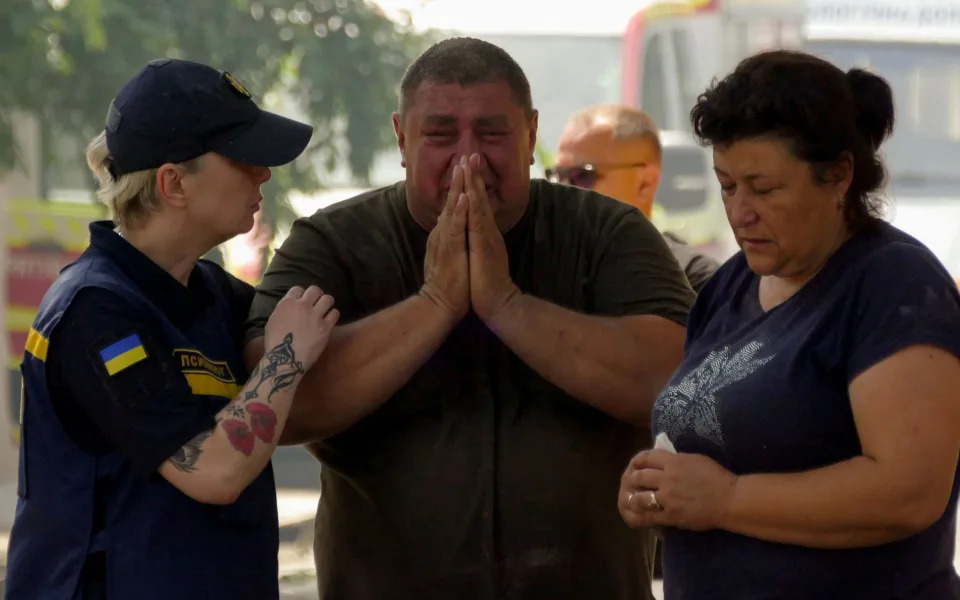
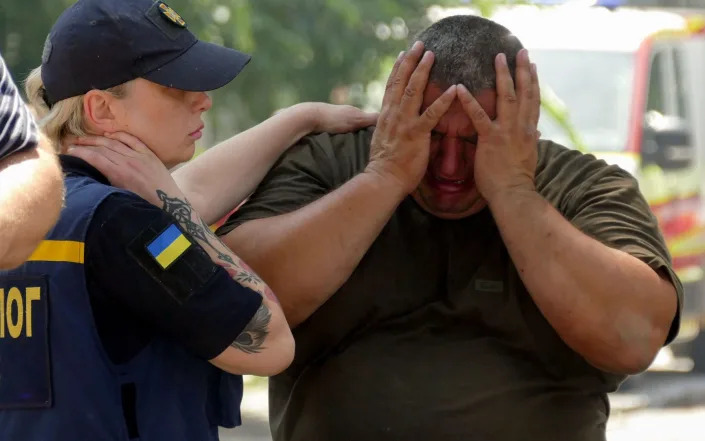
Pictured: A man reacts at the scene of a rocket strike on an administrative building in the southern Ukrainian city of Odesa
A man reacts at the scene of a rocket strike on an administrative building in the southern Ukrainian city of Odesa – IGOR TKACHENKO/EPA-EFE/Shutterstock/Shutterstock
12:45 PM BST
‘A third hellish night’
Russian missiles and drones hit the Ukrainian port of Odesa for a third “hellish” night in a row, Sergiy Kruk, head of the Ukrainian State Emergency Service has said.
In Odesa, a man was found dead “under the rubble”, regional governor Oleg Kiper said. The body of another man was found in Mykolaiv, officials said.
A number of residential buildings as well as stores, cafes and banks in the city were damaged, while some continued to burn in the hours after the strikes.
Rescue teams were searching through the debris under pouring rain to find survivors after the Russians struck the city center.
12:21 PM BST
Ukraine urges restoration of Black Sea grain initiative
Ukrainian Foreign Minister Dmytro Kuleba has called for the restoration of the Black Sea grain initiative to meet the challenge of global food insecurity.
Mr Kuleba is visiting Islamabad on a two-day trip.
His counterpart in Pakistan Bilawal Bhutto Zardari endorsed his comments, saying he planned to take the issue up with the secretary general of the United Nations.
The Black Sea grain deal expired on Monday after Russia quit it.
“We had to find the way to export our grain to the global market,” said Kuleba, adding, “land corridors cannot export the full amount of cereals available for export, this is the issue, which means prices will go up because of shortages of delivery.”
12:03 PM BST
Children are not the only ones being abducted by Russia
Elderly and vulnerable Ukrainians were taken into Russian territory, stripped of their citizenship, forced to give blood and left in agony from botched medical procedures, a Telegraph investigation has found.
The senior citizens were placed in the Russian care system after Vladimir Putin’s forces occupied their hometowns and villages in the early stages of the war.
Those who managed to escape back to Ukraine have told how they were “treated with disdain” and abused.
Zelensky: We will make it through this terrible time
11:08 AM BST
Death toll rises to two in Odesa strikes
At least two people were killed in the Odesa attacks, its governor has said.
Oleh Kiper, the governor of Odesa, said the two people who died in Odesa were a 21-year-old security guard and another person who was found dead under rubble during a search and rescue operation.
In Mykolaiv, another southern city close to the Black Sea, at least 19 people were injured overnight, the region’s Governor Vitalii Kim said in a statement on Telegram.
10:47 AM BST
Odesa and Mykolaiv in pictures:
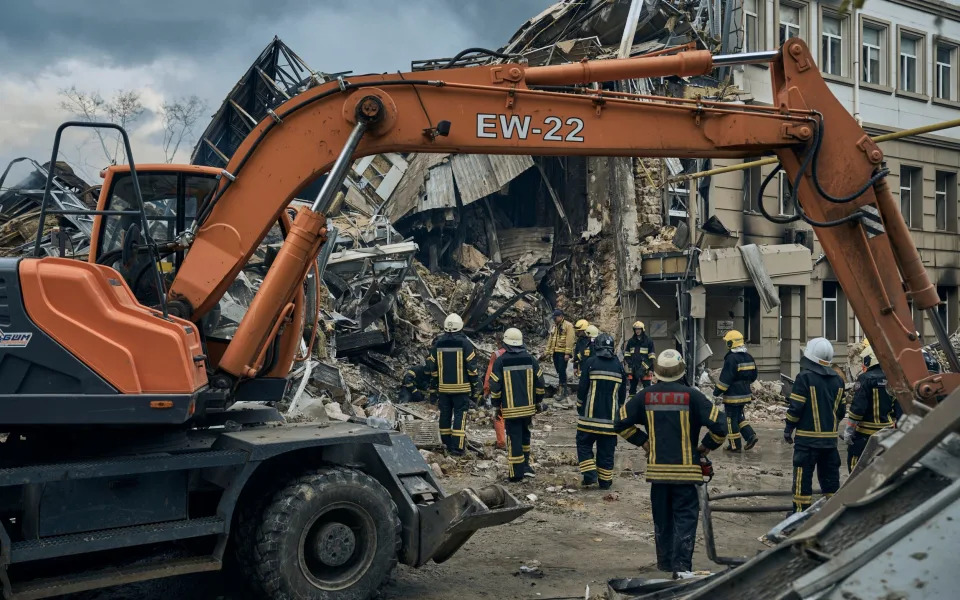
Firefighters extinguish fire at damaged house after attacks in Odesa – Anadolu Agency/AnadoluEmergency services personnel work at the site of a building that was damaged by a Russian missile strike – NATIONAL POLICE OF UKRAINE/via REUTERS
10:16 AM BST
One killed in Russian attack on Ukrainian port cities
One person was killed and 27 wounded after Russian strikes hit Odesa and Mykolaiv for a third consecutive night after Moscow pulled out of a grain export deal, officials said.
In Mykolaiv, fire fighters tackled a huge blaze overnight. A three-storey residential building was left without its top floor and a line of adjacent buildings was left charred and gutted by fire.
Kyiv’s air force said the military shot down five cruise missiles and 13 attack drones launched by Russian forces overnight at the southern Mykolaiv and Odesa regions.
A previous round of overnight strikes on Odesa destroyed 60,000 tonnes of grain meant for export, Kyiv said on Wednesday, with president Volodymyr Zelensky accusing Moscow of “deliberately” targeting the supplies.
One person was also killed in Russian shelling in the northeastern region of Kharkiv, regional authorities said.
09:46 AM BST
Poland ‘monitoring situation’ on Belarus border
Poland’s defence ministry is monitoring the situation on the border with Belarus and is prepared for various scenarios, it said, after Belarus said mercenaries from Russia’s Wagner Group would take part in military exercises near the border.
“Poland’s borders are secure, we are monitoring the situation on our eastern border on an ongoing basis and we are prepared for various scenarios as the situation develops,” the defence ministry said in an emailed statement.
Wagner chief Yevgeny Prigozhin was shown in a video on Wednesday welcoming his fighters to Belarus, telling them they would take no further part in the Ukraine war for now but ordering them to gather their strength for Africa.
09:31 AM BST
21 injured in overnight strikes in southern Ukraine
A third night of Russian air attacks targeted Ukraine’s southern cities and wounded at least 21 people, Ukrainian officials said.
At least 19 people were injured in Mykolaiv, a southern city close to the Black Sea, the region’s Governor Vitalii Kim said in a statement on Telegram.
Russian strikes destroyed several floors of a three-story building and caused a fire that affected an area of 450 square meters and burned for hours.
Kim said two people were hospitalized, including a child.
In the port city of Odesa, at least two were injured following a Russian air attack that damaged buildings in the city centre and caused a fire affecting an area of 300 square meters (3200 square feet), said Odesa Governor Oleh Kiper.
09:22 AM BST
Ukrainian grain ‘cannot be left to rot in silos,’ says German foreign minister
Germany is working with allies to ensure that Ukrainian grain is not left to rot in silos after Russia pulled out of an export deal, and will intensify work on getting the grain out by rail, Foreign Minister Annalena Baerbock has said.
Speaking on the sidelines of a meeting of European Union foreign ministers in Brussels, Ms Baerbock accused Russia of blackmail and trying to use the grain as a weapon at the expense of the world’s poorest.
Russian President Vladimir Putin has accused Western countries of “perverting” the grain deal, brokered by the United Nations and Turkey.
“Hundreds of thousands of people, not to say millions, urgently need the grain from Ukraine, which is why we are working with all our international partners so that the grain in Ukraine does not rot in silos in the next few weeks, but reaches the people of the world who urgently need it,”Ms Baerbock said.
08:50 AM BST
Russia ‘causing global food crisis’ with grain deal withdrawal, says EU official
Russia is responsible for a major global food supply crisis, the European Union’s foreign policy chief, Josep Borrell has said, some days after the Kremlin announced it would suspend an agreement for Ukrainian grain exports through the Black Sea.
“What we already know is that this is going to create a big and huge food crisis in the world..”, Mr Borrell told journalists before heading into a EU foreign ministers’ meeting.
Mr Borrell also accused Russia of deliberately attacking grain storage facilities in the southern port city of Odesa, which he said would further deepen the food crisis.
08:30 AM BST
Aftermath of Odesa attack in pictures:
Rescuers work at a site of a building heavily damaged by a Russian missile attack in Odesa – STRINGER/REUTERSRescuers work at a site of a building heavily damaged by a Russian missile attack in central Odesa – STRINGER/REUTERS
08:27 AM BST
Wagner fighters and Belarus hold military exercises near Poland’s border
Mercenaries from Russia’s Wagner group will help train Belarusian special forces during exercises at a military range near the border with Nato member Poland, the Belarusian defence ministry has said.
Wagner chief Yevgeny Prigozhin was shown in a video on Wednesday welcoming his fighters to Belarus, telling them they would take no further part in the Ukraine war for now but ordering them to gather their strength for Africa.
“The armed forces of Belarus continue joint training with the fighters of the Wagner PMC (Private Military Company),” the Belarusian defence ministry said.
“During the week, special operations forces units together with representatives of the Company will work out combat training tasks at the Brest military range.”
08:24 AM BST
Latest MoD update: Russia ‘likely’ made the decision to leave grain deal some time ago
08:05 AM BST
Putin threats to Ukraine ships sends wheat prices soaring
Wheat prices have soared further after the Kremlin threatened to attack ships carrying grain to Ukrainian ports.
US wheat futures rocketed by 8.5 per cent on Wednesday, their biggest daily rise since just after Russia’s invasion of Ukraine.
Russia’s Ministry of Defense warned that all vessels in the Black Sea heading to Ukrainian ports would be considered potential carriers of military cargo starting Thursday.
08:03 AM BST
Explosions in Odesa for third night in a row
08:02 AM BST
Majority of Britons believe UK should support Ukraine for ‘as long as it takes’
A majority of Britons believe the UK should provide assistance to Ukraine for as long as it takes, new polling has found.
A survey of more than 2,158 people found 53 per cent of Britons are in favour of helping Ukraine for as long as it takes.
Only 6 per cent thought the UK should immediately withdraw support from Ukraine.
According to the survey from the British Foreign Policy Group by JL Partners, which polled 2,158 people, the majority of Britons support all forms of aid being offered to Ukraine, including:
Providing humanitarian assistance (85 per cent)
Imposing economic sanctions on Russia (75 per cent)
Accepting Ukrainian refugees (70 per cent)
Providing military aid (68 per cent)
Providing F-16 fighter jets (56 per cent)
07:44 AM BST
‘Welcome to hell’: Russia’s Wagner chief welcomes fighters to Belarus in first sighting since mutiny
18 wounded in Russian strike says Mykolaiv governor
At least 18 people were wounded by a Russian strike on the Ukrainian port city of Mykolaiv, regional governor Vitaliy Kim said.
“Russians hit the city centre. A garage and a 3-story residential building are on fire,” Mykolaiv governor Vitaliy Kim wrote on Telegram.
Members of emergency services work at a building destroyed by a Russian attack in Mykolaiv, Ukraine – National Police of Ukraine/AP
Eighteen people had been wounded and nine of them had been hospitalised, including five children, he added, without specifying their condition or if they had been in the residential building.
He did not give details on the strike.
07:33 AM BST
Ukraine ‘shot down 13 drones’ launched by Russia overnight
Ukraine’s military shot down five cruise missiles and 13 attack drones launched by Russian forces overnight at the southern Mykolaiv and Odesa regions, Kyiv’s air force has said.
It said Russia fired 19 cruise missiles and 19 drones in total, but did not specify exactly where the others struck.
07:32 AM BST
Good Morning
Good morning and welcome to today’s Ukraine liveblog.
We will be guiding you through all the latest updates on Ukraine.
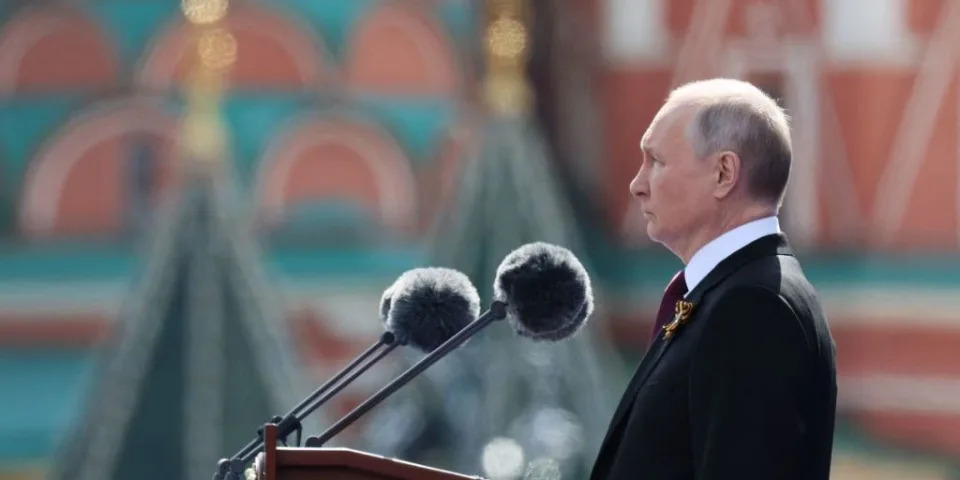
Russian President Vladimir Putin gives a speech during the Victory Day military parade at Red Square in central Moscow on May 9, 2023.GAVRIIL GRIGOROV/SPUTNIK/AFP via Getty Images
Russia’s economy has deteriorated since Vladimir Putin ordered the invasion of Ukraine in February 2022.
Its current-account balance has crashed, the ruble is weakening, and it’s status as an energy superpower has crumbled.
At the same time, Russia’s domestic consumption and production are low.
Russia’s economy is a shadow of what it was 16 months ago.
Before Vladimir Putin ordered the invasion of Ukraine in February 2022 and prior to the onset of historic sanctions, Moscow commanded the world’s 11th largest economy and played a key role as a reliable, wide-reaching energy exporter.
Now however, from a weakening currency to tepid trade, all signs point to a sharp deterioration with no end in sight.
“Russia might collapse into multiple pieces, like the Soviet Union, and that might not be a bad thing for the world,” Volodymyr Lugovskyy, an economics professor at Indiana University, told Insider this week. “It’s resembling an empire right now, with a central power. Extreme events are highly possible.”
These five statistics illustrate how war has reshaped the Russian economy for the worse.
During the failed mutiny in June by the Wagner Group, the currency tumbled to a 15-month low against the dollar as panicked citizens swapped for alternative currencies.
Over the last month, the ruble has weakened more than 6.8%, and it’s down more than 35% in the last year.
Current-account balance drops 93%
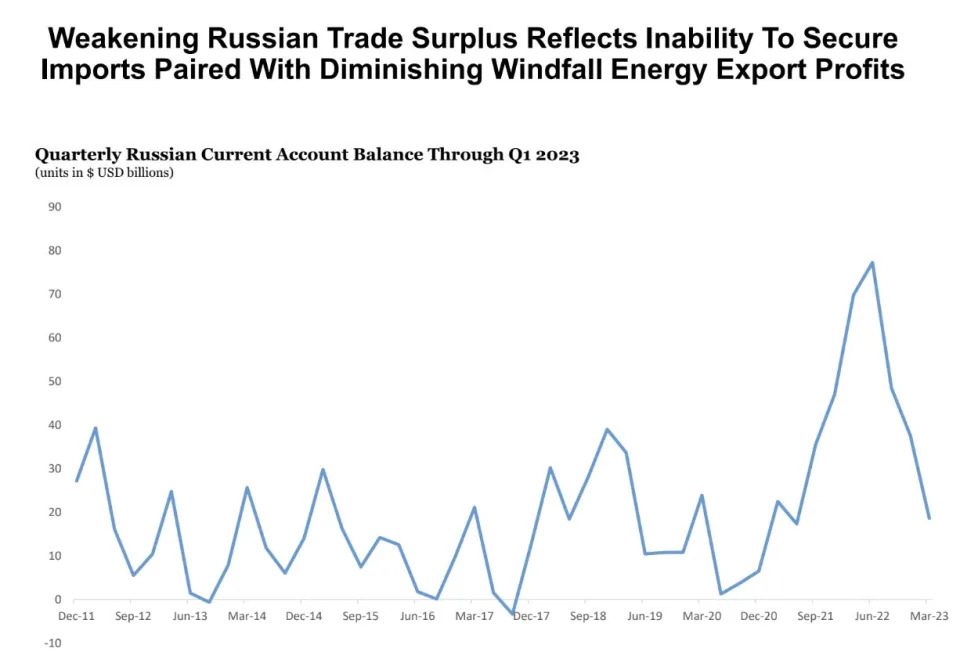
For the April to June quarter, the country posted a current-account surplus of $5.4 billion, marking a 93% plunge from a record $76.7 billion during the same stretch last year, according to the Russian central bank.
The fading current account surplus shows that Moscow has been unable to secure imports, and that its profits from energy exports are failing to prop up the economy like they did before.
Weakening Russian trade surplus illustrates inability to secure imports, and diminishing profits from windfall energy exports.Yale Chief Executive Leadership Institute
“The decline in the surplus of the balance of the external trade in goods in January – June 2023 compared to the comparable period of 2022 was caused by a decrease in both the physical volumes of export deliveries and the deterioration in the price situation for the basic Russian export commodities, energy commodities made the most significant contribution to the decline in the value of exports,” the Bank of Russia said in a statement.
Energy revenue crash
Russia’s Finance Ministry said in June that revenue from oil and gas taxes dropped 36% compared to a year ago, while profits from crude and petroleum products fell 31%.
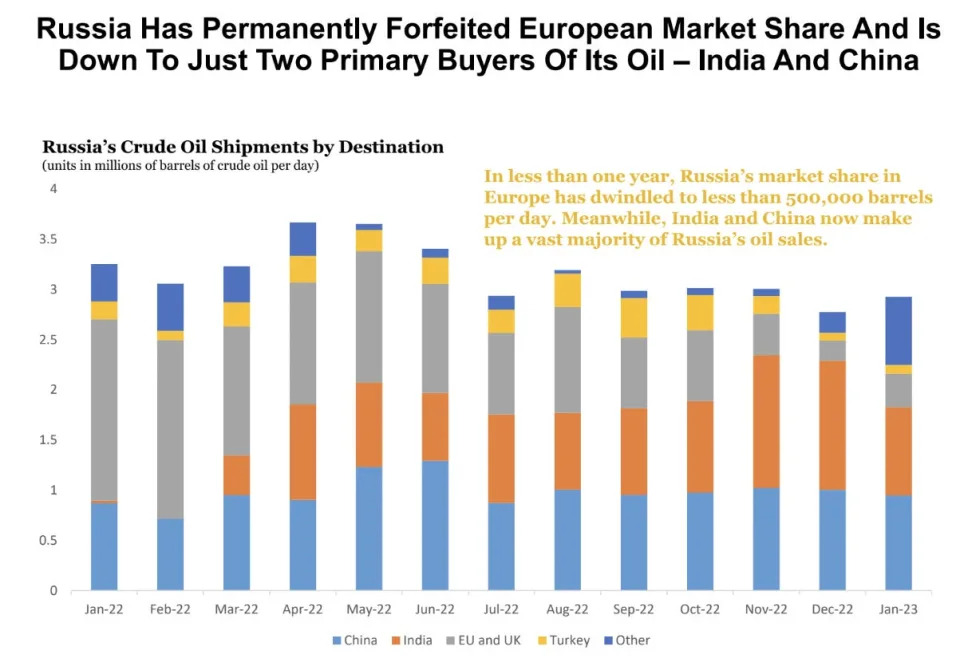
Before the war, Russia was responsible for almost 40% of the European Union’s natural gas imports, and a quarter of the bloc’s crude oil.
Those numbers have gone to almost zero since then, and even though Putin has turned to China and India as alternative buyers, Moscow has had to sell energy at steep discounts.
Russia’s energy exports now go mostly to China and India.Yale Chief Executive Leadership Institute
Russian car sales have tumbled
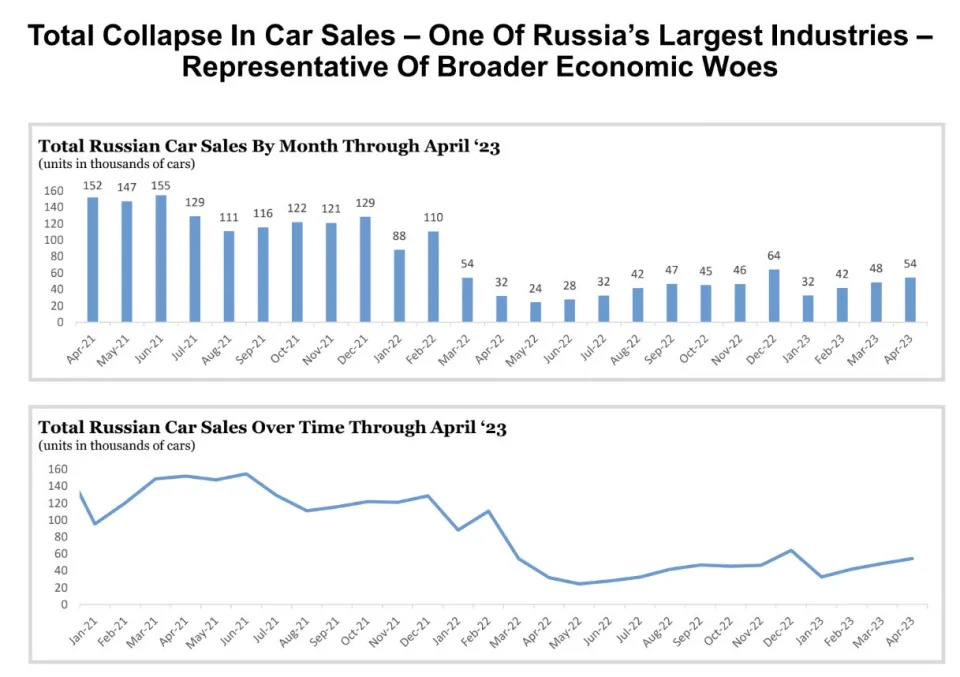
Before the invasion of Ukraine, roughly 100,000 vehicles were sold every single month across Russia, according to Yale research data shared with Insider.
Those sales have collapsed to about a quarter of that level, driven not only by soaring prices and sinking consumer sentiment, but also due to a lack of supply.
Russia has seen a total collapse in car sales over the last year and a half.Yale Chief Executive Leadership Institute
Brain drain and emigration
Millions of Russians have emigrated since the start of the war in Ukraine, according to Yale data, with Uzbekistan alone taking in more than 400,000 fleeing citizens.
The flight of capital and talent out of Russia is illustrated in the surge of money transfers to neighboring countries that aren’t normally seen as financial hubs, according to Yale, such as Armenia, Georgia, and Kyrgyzstan.
“While there is no concrete measure of how much capital flight has taken place, proxy measures, such as the explosion of non-resident deposits in UAE bank accounts, suggests that Russians of means are taking their productive capital out of Russia at a dramatic clip,” Yale researcher Jeffrey Sonnenfeld said.