Americans among dozens held hostage by Indigenous group in Amazon
CBSNews – November 4, 2022
A photo posted online by Angela Ramirez on November 3, 2022, shows a group of tourists, including Ramirez, being held on a boat in Peru’s Amazon region by an Indigenous group protesting what they say is the government’s failure to help after an oil spill. / Credit: Angela Ramirez/Facebook
A group of Indigenous people in Peru’s Amazon region has taken dozens of foreign and Peruvian tourists hostage as they made their way through the area on river tour boat. The Indigenous group says it took the action to protest the lack of government aid following an oil spill in the area, according to local media and members of the tour group.
“(We want) to call the government’s attention with this action, there are foreigners and Peruvians, there are about 70 people,” Watson Trujillo Acosta, the leader of the Cuninico community, told the country’s national RPP radio network.
The tourists include citizens from the United States, Spain, France, the U.K. and Switzerland.
Lon Haldeman, one of the Americans held captive, said in a statement shared with CBS News on Friday by his wife that the group had been held “for the past 26 hours.”
He said that the hostage-takers were demanding “medical help and clean water and food” after an oil spill in the area “contaminated the wells and river.”
“The villagers are peaceful toward us but they did take over the boat with spears and clubs,” Haldeman said in the statement. “No one had guns. We were parked near an island last night and the villagers took the battery from the boat motor. The captain and drivers are being held in a village jail. The village wants to keep the big boat for ransom. We might get some small rescue boats. There is new action every hour.”
Angela Ramirez, a Peruvian national who said she was among the hostages, said in a Facebook post on Thursday afternoon that there were children, pregnant women and disabled people among those seized on the boat.
Ramirez also said the Indigenous community was treating them with kindness and respect, adding that holding the tourists was “the only way they have found to look for solutions for their community” after oil spills that allegedly led to the deaths of two children and one woman.https://www.facebook.com/plugins/post.php?href=https%3A%2F%2Fwww.facebook.com%2Fpermalink.php%3Fstory_fbid%3Dpfbid02yScfATG6Qmr29TXQNkKMV8bBK6EV45qzSrrcmG8d2GrJkjjmJ791JQDJNJMqzR6Wl%26id%3D100005041500479&show_text=true&width=500
“The sooner they are heard, the sooner they will let us go,” said Ramirez in the online post. “Help me help them be heard.”
Acosta said his group had taken the “radical measure” in an effort to put pressure on the government to send a delegation to assess the environmental damage from a September 16 incident that spilled 2,500 tons of crude oil into the Cuninico River. He said the detainees would spend the night inside the vessel while awaiting a resolution to the situation.
Susan Notorangelo, Haldeman’s wife, told CBS News her husband had been sending sporadic updates to let her know he was OK, but not responding to many questions, which she suspected was an effort to conserve battery power on his iPad. Notorangelo said she had been told the U.S. State Department was sending a boat with food and water, but didn’t believe it had yet arrived at the remote location.
Haldeman is a tour guide, but was not running the tour that was detained. Notorangelo said her husband and the other tourists were supposed to have ended their boat ride at noon on Thursday and then ridden bikes to the nearby town of Iquitos. She said her husband has an airline ticket to leave Peru on Tuesday, and hopes he and the other hostages will be released in time for him to make the flight.
Ramirez told RPP that the Cuninico community had said it was prepared to hold the hostages for six to eight days, until it receives a response from the government.
She said they were “physically fine,” but in a new post on Friday morning she said the sun was strong, babies were crying and they were almost out of water.
Local media indicated no public comment from the Peruvian government or police on the incident, which took place on a tributary of the Maranon River.
Environmental activists protest outside the headquarters of the Peruvian Petroleum Company (Petroperu) in Lima, Peru, August 22, 2016. / Credit: Getty
Indigenous communities had already been blocking the transit of all vessels on the river in protest against the spill, which was caused by a rupture in the Norperuano oil pipeline.
On September 27, the government declared a 90-day state of emergency in the impacted region, which is home to about 2,500 members of the Cuninico and Urarinas communities.
The roughly 500-mile-long Norperuano pipeline, owned by the state-run Petroperu, was built four decades ago to transport crude oil from the Amazon region to the ports of Piura, on the coast.
According to Petroperu, the spill was the result of an eight-inch cut made deliberately in the pipeline, which the company said had suffered over a dozen similar attacks in the past.
CBS News’ Maddie Richards and April Alexander contributed to this report.
About 150 tourists are reportedly being held hostage in Peru. Locals are demanding a response to oil spills that have polluted their river.
Paola Rosa-Aquino, Natalie Musumeci – November 4, 2022
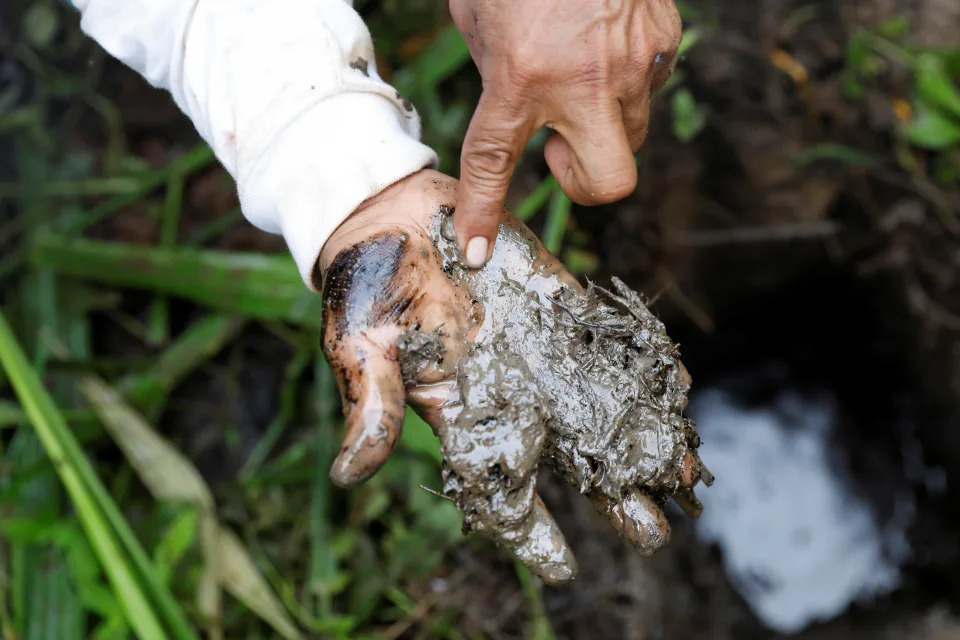
A man shows oil contamination inside Block 192, a dormant Amazon oil field in Peru.Reuters
Locals from a Peruvian area of the Amazon rainforest have reportedly taken up to 150 tourists hostage.
Those detained reportedly include citizens from the US, UK, Spain, France, and Switzerland.
Locals took the hostages in protest of repeated oil spills plaguing the region, RPP Noticias reported.
Locals from an Indigenous tribe in a Peruvian area of the Amazon rainforest have taken up to 150 tourists, including Americans, hostage in protest of repeated oil spills plaguing the region, according to a local report.
Ángela Ramírez, who was among those taken hostage on Thursday while traveling by boat near Cuninico in the Loreto province of Peru, told local media that those taken captive include elderly people, pregnant women, and a one-month-old baby.
“They told us that it was because they wanted attention from the state, in search of a solution for oil spills that have happened 46 times, which led to the death of two children and a woman,” Ramírez told RPP Noticias.
The people being held include Peruvian nationals as well as citizens from the United States, the United Kingdom, Spain, France, and Switzerland, Ramírez told the news outlet.
The woman said that it has been indicated that the hostages could be held for up to eight days. No one had been harmed.
Ramírez’s mother, Araceli Alva, told RPP Noticias that her daughter had been traveling with cyclists through the Peruvian jungle last week. Ramírez decided to leave by boat via the river on Thursday and was taken, Alva said.
Ramírez issued a plea on her Facebook story, saying, “The sooner they’re heard, the sooner they’ll let us go. Help me share, we are well physically. Help me help them be heard,” according to the news outlet.
Watson Trujillo Acosta, the leader of the Cuninico community behind the action, told RPP Noticias that the tourists were taken hostage “in a radical and indefinite manner” in order “to be able to attract the attention of the government.”
“They are in a safe place on the banks of the Marañón River gorge in front of the native community of Cuninico,” said Acosta, who claimed 70 tourists and nationals were taken, according to the news outlet.
Acosta said that his community is seeking “a state of emergency [to] be declared due to the constant [oil] spills that have been taking place in our territory.”
He also wants the Peruvian government to lead an investigation into the matter.
The US Department of State and Peru’s Ministry of Foreign Affairs did not immediately respond to requests for comment about the situation by Insider on Friday.
It’s an outrage that Saudis use Arizona’s water for free. I’ll work to stop it
Kris Mayes – November 4, 2022
Arizona should not be giving its water away to the Saudi Arabians, or anyone else for that matter. Yet, for the past seven years, the attorney general and governor have allowed a Saudi company to pump out more than $38 million worth of groundwater from La Paz County for free.
That’s right. Arizona is giving away its groundwater for nothing to one of the richest nations on Earth – and to the severe detriment of Arizonans.
It is an outrage and a scandal at a time when the Saudi government is deliberately raising the price of gasoline for U.S. citizens by cutting back OPEC oil supplies.
As attorney general, I will work to put an end to these sweetheart Saudi deals.
Below-market leases short Arizona schools
As first disclosed in The Arizona Republic last June, the State Land Department has leased state trust land to the Saudi-owned Fondomonte corporation for $25 per acre, so that the Saudi company could grow alfalfa and send it back to Saudi Arabia to feed that country’s cows.
More unbelievably, the state is allowing this company to pump groundwater for free. The $25/acre land lease is well below market rates, and the water being given away comes from the Butler Valley Basin and Vicksburg – areas that Arizona cities may very well need to rely on for their water needs in the near future.
To comply with the Gift Clause, a government expenditure must (1) serve a public purpose, and (2) the consideration the public has paid must not far exceed the value received.
As stated by the Arizona Supreme Court 38 years ago, the deal between the government and the private entity cannot be “so inequitable and unreasonable” that it amounts to providing a subsidy to the private party.
Giving away more than $38 million of groundwater for free is both inequitable and unreasonable. Agreeing to lease state land to a Saudi company for only one-sixth of the market price for similar land is probably inequitable and unreasonable as well. Pursuant to the Arizona Constitution, money that is generated from state trust land leases must go to benefit Arizona K-12 schools.
Wells are going dry, complaints unanswered
Ground water is used to irrigate an alfalfa field, April 7, 2022, at Fondomonte’s Butler Valley Ranch near Bouse.
Four months ago, the La Paz County supervisors filed a complaint with Attorney General Mark Brnovich concerning the below-market Fondomonte lease and the groundwater giveaway. To date, Brnovich has done nothing, not even respond to the county supervisors.
Moreover, several years ago, more than 500 La Paz County residents signed a petition that they hand-delivered to Gov. Doug Ducey’s advisers, voicing their outrage about the free groundwater giveaway.
Recently, I traveled to Vicksburg and met with La Paz County Supervisor Holly Irwin, who showed me the Fondomonte farm in that western Arizona community. Alfalfa fields stretch for miles, and commercial wells can be seen from the road gushing the state’s precious and irreplaceable water at thousands of gallons per minute.
Irwin also took me to a nearby Baptist church whose well has been dewatered. She told me that many of her constituents living around the Fondomonte farms have had their wells sucked dry by the Saudi-owned farms.
Records at the Department of Water Resources show that the Saudis are drilling deeper and deeper wells, which will likely cause residential wells to go dry.
During my first week as attorney general, I will request an auditor general’s audit of all industrial-scale leases of state trust land where water is being pumped to determine if the rates are below market and how much school funding has been lost as a result.
If such abuses have occurred, I will work to ensure that the companies are required to restore the proper funding to the state and our schools.
I will also proactively advise the Arizona State Land Department on an ongoing basis that leasing water at rates that are significantly below market rates could represent a violation of the state’s Gift Clause and that the leaseholders could face efforts to recover undercharges in the future.
Arizona’s water supplies have never been more threatened.
Lakes Mead and Powell are less than 150 feet from “dead pool” status and hydrologists believe they will hit dead pool sometime in 2023. It is time for Arizona’s leaders to act like they care about Arizona more than a country thousands of miles away that is trying to harm America.
I will do that as Arizona’s next attorney general.
Kris Mayes is the Democratic candidate for Arizona attorney general. She served two terms on the Arizona Corporation Commission.
U.N. report warns of climate change ‘adaption gap’ that threatens the developing world
Ben Adler, Senior Editor – November 3, 2022
Secretary-General António Guterres addresses the 77th Session of the United Nations General Assembly in New York City, Sept. 20. (Brendan McDermid/Reuters)
The measures being undertaken by world governments to adapt to climate change are not keeping up with increasingly severe damage caused by rising temperatures and should be dramatically increased, a new report from the United Nations Environment Programme (UNEP) has found.
“Today’s UNEP Adaptation Gap report makes clear that the world is failing to protect people from the here-and-now impacts of the climate crisis,” U.N. Secretary-General António Guterres said in a statement referencing the report. “Those on the frontlines of the climate crisis are at the back of the line for support.”
“Climate change is landing blow after blow upon humanity, as we saw time and again throughout 2022,” the report states. Many of the world’s poorest countries are being hardest hit by the changing climate. One-third of Pakistan was submerged in floods in late July, causing $10 billion in estimated damages. In East Africa, a drought intensified by global warming is contributing to widespread food insecurity and a potential famine affecting the lives of millions of people. Hurricanes made more powerful by warmer ocean waters have swept across developing island nations from the Philippines to the Dominican Republic.- ADVERTISEMENT -https://s.yimg.com/rq/darla/4-10-1/html/r-sf-flx.html
“We’re nowhere near where we need to be in solving and addressing the climate crisis, and with each passing day of inaction, we’re getting further and further away from being on a pathway to limit global warming to 1.5 [degrees Celsius] and prevent the worst impacts of the climate crisis,” said a senior U.N. official during a background press briefing on Wednesday. “And with every fraction of warming, climate disasters are getting worse and they’re wrecking lives and livelihoods and decimating economies like never before.”
Many countries have begun planning adaptation measures, such as moving residents from vulnerable areas and fortifying infrastructure. But the richer nations that are primarily responsible for the greenhouse gas emissions causing climate change have not provided enough money to pay for them.
“More than eight out of ten countries have at least one national adaptation planning instrument,” the report’s press release states. “However, financing to turn these plans into action isn’t following. International adaptation finance flows to developing countries are 5-10 times below estimated needs and the gap continues to widen.”
A refugee camp in Sehwan, Pakistan. (Akhtar Soomro/Reuters)
The report comes on the eve of the COP27, the upcoming U.N. Climate Change Conference in Sharm el-Sheikh, Egypt. Guterres argued that developed nations should respond with new commitments to fund climate adaptation in developing countries at the conference.
In the 2009 Copenhagen Accord, a precursor to the 2021 Glasgow Climate Pact, developed countries pledged to mobilize $100 billion per year by 2020 for climate change assistance to developing countries. Half of that money was slated to be used for adaption measures, while the other half would go toward helping developing countries reduce their own greenhouse gas emissions. However, that funding has lagged, especially on adaptation. In 2020, $83 billion went to developing countries, of which only $29 billion was for adaptation projects. That $29 billion, however, represented an increase of 4% from 2019.
“Last year, developed countries agreed to double support for adaptation to $40 billion a year by 2025,” Guterres said. “At COP27, they must present a credible road map with clear milestones on how this will be delivered — preferably as grants, not loans.”
The cost of dealing with climate change continues spiraling upwards. The UNEP report estimates that adaptation needs will reach between $160 billion and $340 billion by 2030 and $315 billion to $565 billion by 2050.
A woman removes rubble from her destroyed house in the aftermath of Hurricane Fiona, in El Seibo, Dominican Republic, Sept. 20. (Ricardo Rojas/Reuters)
The report argues that adaptation actions thus far have been too focused on the short-term and are insufficient in their ability to provide adequate protection from conditions like higher temperatures and higher sea levels later in this century. Future projects must be planned in a more comprehensive and inclusive way, the report warns, and must offer some general recommendations for democratizing and improving the process.
Richer countries have their own climate change adaptation needs, as can be seen from the effects of heat waves, drought and the resulting wildfires in Europe and the United States this summer.
But the warmer countries south of the U.S. and Europe — sometimes referred to as “the Global South” — are suffering more extreme consequences of climate change. They also tend to be the poorest and least equipped to handle disasters.
“As the [Intergovernmental Panel on Climate Change] confirmed earlier this year, if you’re living in one of the global hot spots of the climate crisis — namely Africa, South Asia, Central or South America or on a small island developing state — you’re 15 times more likely to die from a climate impact,” said the U.N. official.
Embracing one of the report’s recommendations, Guterres announced the creation of an “Adaptation Pipeline Accelerator” — a project of the U.N. and related agencies like the Green Climate Fund that will help funders and developing nations partner on adaptation programs.
“This will be a central litmus test for success at COP27,” Guterres warned. “The world must step up and protect people and communities from the immediate and ever-growing risks of the climate emergency. We have no time to lose.”
Big agriculture warns farming must change or risk ‘destroying the planet’
Dominic Rushe – November 2, 2022
Photograph: Jeff McIntosh/AP
Food companies and governments must come together immediately to change the world’s agricultural practices or risk “destroying the planet”, according to the sponsors of a report by some of the largest food and farming businesses released on Thursday.
The report, from a taskforce within the Sustainable Markets Initiative (SMI), a network of global CEOs focused on climate issues established by King Charles III, is being released days before the start of the United Nation’s Cop27 climate summit in Egypt.
Many of the world’s largest food and agricultural businesses have championed sustainable agricultural practices in recent years. Regenerative farming practices, which prioritize cutting greenhouse gas emissions, soil health and water conservation, now cover 15% of croplands.- ADVERTISEMENT -https://s.yimg.com/rq/darla/4-10-1/html/r-sf-flx.html
But the pace of change has been “far too slow”, the report finds, and must triple by 2030 for the world to have any chance of keeping temperature rises under 1.5C, a level that if breached, scientists argue, will unleash even more devastating climate change on the planet.
The report is signed by Bayer, Mars, McCain Foods, McDonald’s, Mondēlez, Olam, PepsiCo, Waitrose and others. They represent a potent political and corporate force, affecting the food supply chain around the world. They are also, according to critics, some of those most responsible for climate mismanagement with one calling the report “smoke and mirrors” and unlikely to address the real crisis.
Food production is responsible for a third of all planet-heating gases emitted by human activity and a number of the signatories have been accused of environmental misdeeds and “greenwashing”. Activist Greta Thunberg is boycotting Cop this year having called the global summit a PR stunt “for leaders and people in power to get attention”.
“We are at a critical tipping point where something must be done,” said the taskforce chair and outgoing Mars CEO, Grant Reid. “The interconnection between human health and planetary health is more evident than ever before.” Big food companies and agriculture must play a big part in changing that, said Reid. “It won’t be easy but we have got to make it work,” he said.
Agriculture is the world’s largest industry. Pasture and cropland occupy around 50% of the planet’s habitable land and uses about 70% of fresh water supplies. The climate crisis is challenging the industry across the world but the group’s call for change comes as the industry – which employs 1 billion people – is facing supply chain issues in the wake of the coronavirus pandemic and soaring inflation. It also comes amid mounting skepticism about promises to change from companies that have contributed to climate change.
These current issues must not detract from the need for change, the report argues. “With the inflationary environment and widespread supply chain disruption, it would be easy to reduce our focus on the longer-term challenge of scaling regenerative farming. But we believe it’s vital we maintain a sense of urgency. We must take action now to avoid more acute crises in the future,” its authors write.
Sunny George Verghese, chief executive of Olam, one of the world’s largest suppliers of cocoa beans, coffee, cotton and rice, said: “We cannot continue to produce and consume food and feed and fiber in the way we are doing today unless we don’t mind destroying the planet.
“The only way out for us is how we transition to a more resilient food system that will allow us to meet the needs of a growing population without the resource intensity we have today.”
The report studied three food crops, potatoes, rice and wheat, and has made policy recommendations it will present at Cop27.
The taskforce’s members are working to make the short-term economic case for change more attractive to farmers. “It’s just not compelling enough for the average farmer,” said Reid. More widely the report argues industry and government must also work harder to address the knowledge gap and make sure farmers are following best practices. Third, all parties involved in the agriculture industry from farmers to food producers to government, banks and insurers need to align behind encouraging a shift to more sustainable practices.
“It involves change for all the players including the government, private, public companies and others. No one player can do this on their own, this has to be a collaboration of the willing. What needs to happen now is action and delivery,” said Reid.
Over the next six months, the group will assess how they can spread the taskforce’s work with the aim of establishing a common set of metrics for measuring environmental outcomes, establishing a credible system of payments for farmers for environmental outcomes, easing the cost of farmers transitioning to sustainable practices, ensuring government policy rewards farmers for greening their business and encouraging the sourcing of crops from particular areas converting to regenerative farming.
Devlin Kuyek, a researcher at Grain, a non-profit organization that works to support small farmers, said it was increasingly difficult for big agricultural and food companies to ignore climate change. “But I don’t think any of these companies – say a McDonald’s – has any commitment to curtail the sales of highly polluting products. I don’t think PepsiCo is going to say the world doesn’t need Pepsi.”
Kuyek pointed out that Yara, another signatory to the report, is the world’s largest supplier of nitrogen-based fertilizers, “which are responsible for one out of every 40 tonnes of greenhouse gas emitted annually”.
“It’s pretty disingenuous,” said Kuyek. “Small, local food systems still feed most of the people on the planet and the real threat is that the industrial system is expanding at the expense of the truly sustainable system. Corporations are creating a bit of smoke and mirrors here, suggesting they are part of the solution when inevitably they are part of the problem.”
Considering the controversial histories of some of the companies involved in the report, Verghese said he expected criticism and scrutiny. “All companies have to stand up to the scrutiny of being attacked if there is real greenwashing. There is no place to hide,” he said. “As far as Olam is concerned we are very clear on our targets, we have had the confidence to make these targets public. All of us have progressed along the sustainable journey. It is not that we have not made mistakes in the past but as we have become better at this we are willing to be subject to scrutiny.”
Both Reid and Verghese said the scale of the issues the world’s food supply is facing cannot be underplayed but that more governments and companies were becoming convinced of the need for urgent change. “I believe change can be made,” said Verghese. “I am optimistic. The fact that these kinds of coalitions are emerging is very positive. We are all otherwise very strong rivals and competitors. We hate each other’s guts, we don’t come together on anything unless there is a huge crisis. Everyone is recognizing there is a huge crisis. We need to come together.”
He was accused of stealing huge amounts of water over 23 years. Here’s why no one noticed
Dale Kasler, Ryan Sabalow – November 1, 2022
JOHN WALKER / jwalker@fresnobee.com
California’s water police struggle to track where water is flowing and whether someone is taking more than they’re supposed to.
A criminal case unfolding in the San Joaquin Valley underscores how the federal government seems to have similar problems.
Prosecutors say they uncovered a massive water theft that went on for 23 years without anyone noticing.
Earlier this year a federal grand jury indicted Dennis Falaschi, the former general manager of the Panoche Water District in the western San Joaquin Valley, on charges of conspiracy, theft of government property and filing false tax returns.
Falaschi’s alleged crime stemmed from the federal government’s operation of the Central Valley Project, the system of reservoirs and canals that dates to President Franklin Roosevelt’s administration.
According to prosecutors, Falaschi engineered a brazen scheme to steal $25 million worth of water from the U.S. Bureau of Reclamation, operator of the Central Valley Project. More specifically, Falaschi stands accused of having his underlings siphon water from the Delta-Mendota Canal, the main conduit for delivering federal water to farms along the west side of the San Joaquin Valley and part of Silicon Valley.
He then billed Panoche customers for this stolen water and used the proceeds to pay “himself and other co-conspirators exorbitant salaries, fringe benefits and personal expense reimbursements,” the indictment says.
How Panoche Water District legal trouble started
Falaschi’s legal troubles began in 2017, when the state controller’s office released an audit showing that the financial controls at Panoche were too lax. Among other things, staffers were allowed to use district credit cards to buy Oakland A’s and Raiders season passes, and tickets to a Katy Perry concert.
A month later, Falaschi left Panoche. Then in 2018 the state attorney general’s office charged him and three other former district employees with embezzling $100,000 from Panoche and illegally burying toxic chemicals on district property. Prosecutors said Falaschi allegedly used the embezzled funds to buy a pair of slot machines and some kitchen appliances, among other things. That case is still pending.
The latest indictment covers a scheme that, according to prosecutors, began in 1992 and wasn’t discovered until April 2015 when a canal maintenance worker saw a whirlpool above the equipment that prosecutors say Falaschi had hidden in the canal to siphon off the water.
The theft lasted long enough to enable Falaschi to grab a total of 130,000 acre-feet of water — enough to fill about 13% of Folsom Lake, prosecutors said.
Last year district officials made a civil settlement over the missing water, agreeing to pay $7.5 million to the federal government and another $1 million to an umbrella agency, the San Luis & Delta-Mendota Water Authority, which buys water from the feds.
The indictment came months after the civil settlement. The grand jury says Falaschi had several of his employees install a valve mechanism in the canal — submerged below the water line — near the district’s headquarters in Firebaugh.
Falaschi, who now lives in Aptos, could receive up to 24 years in prison if convicted.
He has pleaded innocent to the criminal charges. In a statement, his Fresno lawyer Marc Days blasted the feds for prosecuting Falaschi “over a leak from the government’s rotted pipe which the government failed to repair,” and for relying on the statements of “unreliable and incompetent witnesses motivated by their own self-interest.”
Days said the amount of water the federal government accuses Falaschi of taking pales in comparison to some of the other leaks from the same canal.
He said area farm districts receive “massive amounts of unmetered water,” including one leak that Days alleges siphons off 200 cubic feet a second, an amount that in a year would surpass the water prosecutors allege Falaschi stole over those two decades. The federal government, Days claims, has known about the problems but fails to do anything to prevent them.
Mary Lee Knecht, a spokeswoman for the Bureau of Reclamation, declined comment because of the pending case.
Why missing water goes undetected
Falaschi’s successor at Panoche, Ara Azhderian, said it’s no secret that water goes missing throughout the Delta-Mendota system. Evaporation alone takes a significant toll, he said.
In fact, Azhderian said Falaschi’s alleged scheme likely went unnoticed for so long due to the sheer size of the Delta-Mendota Canal and the volume of water it delivers.
Two million acre-feet of water moves through the canal in a typical year, and the canal is nearly 117 miles long.
“When you think about the system and how long it is, how big it is,” he said, “… it was such a small amount in the scheme of things as to be undetectable.”
Others say the problems along the canal — whether through massive leaks or by alleged thefts — highlight just how difficult it is to keep tabs on the state’s most precious resource.
“We really don’t know where our water is going,” said Jeffrey Mount, a water expert at the Public Policy Institute of California. “Where it really breaks down for us now is in this ever-tightening water world where we’re having to deal with less. Major chunks of it, we don’t know where it goes and who’s using how much.”
Lula Defeats Bolsonaro in Brazil, a Crucial Win for the Amazon Rainforest
By: Paige Bennett, Edited by Chris McDermott –October 31, 2022
Luiz Inácio Lula da Silva attends a celebration event in Sāo Paulo, Brazil, on Oct. 30, 2022. Rahel Patrasso / Xinhua via Getty Images
A tense presidential election runoff in Brazil has led to a victory for left-wing candidate and former president Luiz Inácio “Lula” da Silva against the far-right incumbent, President Jair Bolsonaro. But as of Monday, October 31, Bolsonaro has not conceded. Lula is scheduled to be inaugurated on January 1, 2023.
In the initial election, Lula earned 48.4% of votes, and Bolsonaro received 43.2%. With neither party taking more than 50%, the election went into a runoff scheduled for October 30. In the runoff election, Lula won 50.9% of the votes, while Bolsonaro received 49.1% of votes. Bolsonaro is the first incumbent president of Brazil to not win re-election.
Bolsonaro has not yet conceded at the time of writing and has previously made statements regarding voting fraud, leaving some concern on the transition of power.
“So far, Bolsonaro has not called me to recognize my victory, and I don’t know if he will call or if he will recognize my victory,” Lula told his supporters on Paulista Avenue in São Paulo.
During voting, truckers believed to be Bolsonaro supporters blocked highways. Nasdaq reported that in one online video, a person said truckers were planning to block highways and were calling for a military coup to prevent Lula from becoming president. According to Time, analysts say it is unlikely for military leaders to allow Bolsonaro to attempt a coup. The Guardian reported that a close ally to Bolsonaro, evangelical preacher Damares Alves, tweeted that “Bolsonaro will leave the presidency in January with his head held high.”
Lula’s win is especially crucial for the Amazon rainforest. He hopes to designate 193,000 square miles of the rainforest with protected status, decrease deforestation and offer subsidizing for sustainable farms. He also hopes to form an alliance for rainforest protection among Brazil, Democratic Republic of Congo and Indonesia. During his presidency in 2003 to 2010, Amazon rainforest deforestation decreased. Comparatively, over 13,000 square miles of Amazon rainforest were deforested during Bolsonaro’s four years as president.
“The socio-environmental and climate agenda is one of the places where Lula will need to act fast and firmly,” the Observatório do Clima said in a statement. “Stopping the slaughter of indigenous peoples and the devastation of the Amazon will require countering powerful gangs and, very often, the interests of allies and supporters in local governments and the Parliament. Expelling criminals from indigenous lands and reversing runaway deforestation are urgent measures, and necessary to for recover the Brazilian government’s credibility before its own people and the international community.”
Based in Los Angeles, Paige is a writer who is passionate about sustainability. She earned her Bachelor’s degree in Journalism from Ohio University and holds a certificate in Women’s, Gender and Sexuality Studies. She also specialized in sustainable agriculture while pursuing her undergraduate degree.
Will DeSantis run for president? The candidate I saw during the Florida debate is worrisome.
Carli Pierson, USA TODAY – October 30, 2022
If there were a recipe to make another Florida Gov. Ron DeSantis it might go something like this: Grab some playground bully off the shelf with a heaping teaspoon of science denial, a swig of race-baiting and a lump of LGBTQ bigotry for good measure.
If it sounds nasty, that’s because it is (recipe and politics).
As a former Floridian who visits as often as possible, and because I have close family that still lives there, I care deeply about what goes on in the Sunshine State and worry about where DeSantis is heading politically.
Not everyone agrees with me. During the first and only gubernatorial debate with former Republican Gov. and now Democratic Congressman Charlie Crist on Monday night in Fort Pierce, DeSantis got a concerning amount of applause for his hateful, misleading and divisive comments. Before the debate, DeSantis was also leading in the polls and has proved to be popular in Florida.
After the debate, he went back to being favored to be a GOP candidate running against former President Donald Trump (should he run) in the 2024 presidential election. It’s with that in mind that I’m writing about the debate. What kind of candidate would DeSantis be for the 2024 campaign? And, God forbid, what kind of president?
The debate was a good window into that.
Crist and DeSantis at gubernatorial debate
What DeSantis said during the debate
I didn’t ever imagine myself saying this because I am an atheist, but as I watched Monday night’s debate, I found myself praying Crist becomes governor again. No matter how much I dislike millionaires getting into politics, DeSantis’ far right ideology makes me nervous. But how will more centric and independent voters feel about his rhetoric?
DeSantis made some really troubling comments during the debate. He also has a record of troubling, bigoted leadership that has no place in 2022 America, or 2024:
►When asked by local news anchor Liz Quirantes about his “Stop WOKE” Act and his Florida Parental Rights in Education Act – which critics have called the “Don’t Say Gay” law because it bans classroom instruction on sexual orientation and gender identity for students in kindergarten through third grade – DeSantis went on a tangent dog-whistling about keeping Florida free. He also stooped to his habitual race baiting saying, “I don’t want to teach kids to hate our country,” and claimed that it was false that the United States was built on “stolen lands.”
DeSantis isn’t mature enough to be governor or president
DeSantis, like others in his party, seems to be unable to realize that he is (and would be if elected) the governor of all Floridians, not just the ones who agree with him. But his radical positions send progressives, moderate Democrats and even independents running in the opposite direction.
That won’t stop if he decides to run for president.
DeSantis’ inability to answer Crist’s question about whether he would serve the full term, if elected, made it painfully clear that he doesn’t care about being governor – he wants to be president. Rather than answering the question honestly, he mumbled something and then reverted to his inner playground bully by calling Crist a “worn-out old donkey.” A “yo mamma” joke would probably have had the same effect: Rally the base; make everyone else cringe.
DeSantis doesn’t really want to be governor for much longer and he doesn’t want to listen to American voters – he wants to be president so he can push his radical agenda from the White House.
Carli Pierson, a New York licensed attorney, is an opinion writer and a member of the USA TODAY Editorial Board.
EPA closed a refinery that rained oil. Now it’s a ‘ticking time bomb.’
Maxine Joselow, The Washington Post – October 28, 2022
WASHINGTON – An oil refinery in the U.S. Virgin Islands that the Environmental Protection Agency shut down in spring 2021 now poses the risk of a fire, explosion or other “catastrophic” releases of “extremely hazardous substances,” the agency found in a report released this week.
The idled plant on St. Croix, formerly known as the Limetree Bay refinery, experienced a series of accidents over the course of last year that spewed noxious fumes and showered oil droplets onto nearby homes, sending some residents to emergency rooms. Now deteriorating conditions at the massive facility, which was sold in a bankruptcy auction in December, pose a major test of the Biden administration’s commitment to environmental justice.
In September, the EPA conducted an inspection of the refinery and observed “significant corrosion” of equipment including valves, pipes and pressure relief devices, the agency said in a letter sent to the owners’ lawyers Oct. 13 and made public this week.
“These conditions demonstrate a risk of imminent release of extremely hazardous substances,” the EPA said in an inspection report. “Because of this degree of corrosion, the vessels, piping, and/or valves may fail, resulting in a catastrophic release.”
Local residents question why federal officials have not done more to protect the health of this Caribbean island’s largely Black and Brown population.
“This report is equally alarming and affirming to those of us in the civic sector who have been sounding the bullhorn about the dangers posed by this refinery for years,” Deanna James, president of the St. Croix Foundation, said in an email. “Since 2019, St. Croix Foundation and our nonprofit partners have been on a lonely advocacy journey trying to compel policymakers to consider alternatives to this ‘ticking time bomb’ on our shores – to no avail.”
Elías Rodríguez, a spokesman for EPA Region 2 – which oversees New Jersey, New York, Puerto Rico, the U.S. Virgin Islands and eight Native American tribes – said the agency is “continuing its vigilant oversight” of the refinery.
“EPA takes very seriously our duty to ensure that the facility complies with federal environmental rules designed to protect people,” Rodríguez said in an email. “EPA will use its authorities to protect the protect the health and safety of the facility workers and those who live in nearby communities.”
The refinery, which received approval to operate during the Trump administration, has come under closer scrutiny since Biden took office. The EPA shut down the facility in May 2021 after residents across the island reported feeling nauseous and ill from the release of gaseous fumes.
In particular, EPA inspectors voiced concern about equipment containing ammonia and liquefied petroleum gas. Exposure to high levels of ammonia can cause a burning sensation in the eyes, nose and throat and can result in lung damage or death, according to the Centers for Disease Control and Prevention.
After the facility’s previous owners filed for bankruptcy in July 2021, a bankruptcy judge approved the plant’s sale for $62 million in December to West Indies Petroleum and Port Hamilton Refining and Transportation.
Reached by phone on Thursday, Fermin Rodriguez, vice president and refinery manager for Port Hamilton Refining, said the company is “working with EPA and we’re providing all of the information that they requested. And we’re going to have independent inspectors here this week to validate what they indicate in the report.”
In a news release issued Wednesday, the company sought to reassure local residents and indicated that it plans to restart the refinery when it is safe to do so.
“[D]espite recent reports of concerns about the safety of the facility, the company continues maintaining the facility it purchased in January of this year in preparation for a safe start-up,” the company said. “. . . As we have stated before, the safety of our refinery employees and the safety of the community is our number one priority.”
In June, West Indies Petroleum denied its ownership interest in the facility, despite having won the bankruptcy auction. Representatives for the firm could not be reached for comment.
Judith Enck, who was tapped by President Barack Obama to lead EPA Region 2, expressed alarm that the agency waited nearly three weeks after the inspection to send the letter to the plant’s attorneys.
“This is not a situation where you politely exchange letters between lawyers,” said Enck, who now heads the Beyond Plastics advocacy organization. “This is a serious situation that needs the attention of the highest levels of EPA.”
Enck called on EPA Administrator Michael Regan to “cancel his weekend plans” and immediately board a flight to St. Croix, where she said the agency must inform residents of the imminent threats to their health. A recent survey found that roughly 20,000 people live downwind of the refinery, while in an earlier 2019 analysis, the EPA noted that 75 percent of residents of adjoining neighborhoods are people of color and 27 percent live below the poverty line.
Rodríguez, the EPA spokesman, said the agency took three weeks to send the letter because “time was required, especially with a facility of this size and complexity of the issues involved.”
Jennifer Valiulis, executive director of the St. Croix Environmental Association, lives about two miles from the plant and questioned whether the federal government would act with more urgency if the situation were unfolding in the contiguous United States.
“Not only are the surrounding communities primarily Black and Brown, but also as a territory, we have a different status in that we don’t vote for the president,” Valiulis said. “We don’t have a voting member of Congress. And so we have less ability to advocate for ourselves.”
Oil giants sell thousands of California wells, raising worries about future liability
Mark Olalde, Co-published with ProPublica – October 27, 2022
Aera Energy wells in Ventura. The joint venture between Shell and Exxon has announced plans to sell thousands of California gas and oil wells to the German assett management group IKAV. (Myung J. Chun / Los Angeles Times)
The price of oil produced in California this year reached its highest level in a decade. President Biden is releasing millions of barrels of oil from the Strategic Petroleum Reserve to keep prices in check. And fossil fuel companies’ earnings are so high that Gov. Gavin Newsom has called for a windfall tax on their profits.
It might seem like a lucrative time to drill for oil in the Golden State. Yet, some of the world’s largest oil companies, several of which have done business in the state for more than a century, are selling assets and beginning to pull out of California.
Even with strong cash flow in the short term, producers have more to gain from offloading wells and the associated liability — chiefly expensive environmental cleanup — than from pumping more oil and gas, experts say.
“This is the kind of deal you see when an industry is in its twilight,” said Andrew Logan, senior director for oil and gas at Ceres, a nonprofit focused on sustainability in companies and markets.
Some industry experts, lawmakers and environmentalists are concerned about the recent deals, noting that the sales shift environmental liability from corporate powerhouses to less-capitalized firms, increasing the risk that aging wells will be left orphaned, unplugged and leaking oil, brine and climate-warming methane. They see a threat that the state’s oil industry could repeat a pattern seen in other extractive industries like coal mining and lead to taxpayers bearing cleanup costs.
California Assemblymember Steve Bennett, a Democrat who has long worked on oil policy, has seen oil companies in his Ventura district walk away from environmental liability. “It gets passed on to a smaller company and to a smaller company until someone declares bankruptcy and the public is stuck with the cleanup bill,” he said.
IKAV enters the fray
Supermajors Shell and ExxonMobil recently agreed to sell more than 23,000 wells in California, which they owned through a joint venture called Aera Energy, to German asset management group IKAV for an estimated $4 billion. Aera accounts for about a quarter of California’s oil and gas production, largely from pumping in Kern and Ventura counties.
Shell and ExxonMobil say the deal will strengthen their businesses.
But Greg Rogers, an attorney and accountant who researches the oil and gas industry, said the deal allows the sellers to shed decommissioning costs. “You got bad assets with big liabilities, and you can get rid of both at the same time. That’s a win for Exxon and Shell,” he said.
IKAV will inherit a portfolio littered with wells past their prime. Nearly 9,000 Aera wells were idle as of early October, meaning about 38% of the company’s unplugged inventory isn’t producing oil or gas, according to state data.
In an email, Aera spokesperson Kimberly Ellis-Thompson said the company is capable of managing its large portfolio of idle wells. “Since 2019, when new idle well management program regulations were published, we have met or exceeded the requirements for retiring idle wells,” she said. The company has decommissioned and plugged nearly 1,000 wells on average every year since then, she said.
IKAV, Aera’s soon-to-be new owner, manages about $2.5 billion in energy-focused assets. News releases on the Aera sale quoted Constantin von Wasserschleben, IKAV’s chairman, as saying, “We advocate a co-existence between renewable and conventional energy for decades to come.”
As the world increasingly shifts to cheaper renewable energy to address climate change, IKAV has been snapping up oil and gas wells from supermajors exiting the market. The firm, which once focused exclusively on renewable energy, began expanding into oil and gas in 2020 when it purchased BP’s gas assets in the San Juan Basin, spanning New Mexico and Colorado. The deal was part of BP’s push to divest $10 billion in assets, including aging American gas fields.
BP declined to comment.
If it’s not profitable to return wells to production, they need to be plugged. But if a company doesn’t plug its wells before walking away, wells are orphaned and the cleanup costs ultimately fall to taxpayers and current operators through fees.
For example, the Greka group of companies left more than 750 wells for California to plug when its wealthy owner began pushing his businesses into bankruptcy in 2016 and retired to his Santa Maria winery. And a subsidiary of one of the country’s largest mining companies, Freeport-McMoRan, left dozens of likely orphaned wells, state records show, even though the company brought in nearly $23 billion in revenue last year.
Greka’s CEO didn’t respond to a request for comment, and a Freeport spokesperson said the company is working with the state to verify details about its orphaned wells.
To minimize the government’s exposure if wells are orphaned, producers must put up a bond, typically held as cash or a surety policy. The bonds act like a security deposit: The company gets its bond back if it cleans up its mess, but the government keeps the money if the company orphans its wells.
Newsom has called for an end to all oil extraction in the state by 2045, but his administration has yet to use another tool to hold producers responsible for cleanup.
California has the authority to ask for an additional $30 million in financial security from a single operator but only requires Aera to hold a $3-million bond. As a result, Aera’s bonds cover less than half a percent of the $1.1 billion that ProPublica estimates it would cost the state to plug the wells based on the average cost to California for past well plugging. (That estimate does not include the additional cost of full surface remediation.)
California Oil and Gas supervisor Uduak-Joe Ntuk said in a statement that his agency reviews bonds for all oil companies in the state but did not say whether the amount of Aera’s financial security would be increased through the sale.
Aera, Shell and ExxonMobil did not respond to a question about the gap between their bonds and the estimated cost to plug their wells. IKAV did not respond to requests for comment. In an email, ExxonMobil spokesperson Meghan Macdonald said that “when we make divestments, we always try to work with partners like Aera and IKAV who are also committed to a lower-emissions future.”
Costs vary widely, but states have paid $100,000 or more to plug wells — and the same to clean up surface pollution — meaning there’s a significant gap between what’s needed and what California has available in bonds.
“If they don’t have the financial resources when it comes time to plug those wells, there’s a possibility that the public will be left holding the bag and paying those costs even though it’s the company that made the profit from selling the oil,” said Hollin Kretzmann, an attorney with the Center for Biological Diversity.
Who will be liable?
More than 240,000 wells have pierced the state since the late 1800s, when Southern California’s first producing well spouted oil near where Dodger Stadium now stands. Of those, more than 5,300 are “orphan, deserted, and potentially deserted wells,” according to data the California Geologic Energy Management Division published in September.
Many on that list belong to individuals who died long ago or companies that dissolved in the shuffling of corporate paperwork. However, some responsible parties are still around but are no longer legally liable after offloading their wells through sales and bankruptcies.
So who will be responsible for cleanup?
California is unique because state law allows regulators to call on former operators such as Shell and ExxonMobil to help pay for plugging onshore oil wells if they are later orphaned, even by a different owner. But companies have escaped responsibility under this stronger legal standard by exploiting loopholes such as a porous bankruptcy code.
Some experts question whether Shell and ExxonMobil would be required to pay if the wells they are selling to IKAV are ultimately orphaned, saying their ownership of the wells through a separate company, Aera, might shield them from liability.
“Exxon and Shell do not directly operate those wells. There’s corporate structuring going on in between,” Rogers said. And IKAV now adds another layer of corporate paperwork, holding the wells it acquired in New Mexico, Colorado and California through companies that were registered in Delaware shortly before the sales.
Alongside Aera, two other companies — California Resources Corp. and Chevron — account for the vast majority of California’s oil and gas production, and they too are shrinking their positions in the state. California Resources, which has been in and out of Chapter 11 bankruptcy in recent years, sold most of its Ventura Basin operations in November 2021. Chevron recently sold its California headquarters and plans to consolidate some of its unused Bakersfield office space as it shifts employees to Texas. Reuters reported in early October that Berry Corp., another large oil company that for many years has operated in California and Utah, was considering selling.
Berry did not respond to a request for comment.
Shell acknowledged its California wells were overvalued, suggesting the wells are even nearer to the end of their economic life than previously predicted. The company is wiping as much as $400 million off its books through the sale via an impairment charge.
Shell has been shedding assets in part to hand off associated greenhouse gas emissions. A 2021 Dutch court ruling ordered it to significantly reduce emissions, although the company has appealed the ruling. Zoe Yujnovich, the company’s upstream director, said in a news release about the sale of Aera that Shell will instead be “focusing on positions with high growth potential.”
For its part, ExxonMobil plans to focus on oil and natural gas that costs less to extract, Liam Mallon, president of ExxonMobil Upstream Co., said in a news release announcing the sale to IKAV.
Large public companies are handing off oil and gas assets around the country. Between 2017 and 2021, more than a quarter of oil and gas mergers and acquisitions took public companies private, with private equity often involved, according to a study conducted by the Environmental Defense Fund. The report voiced concern that private companies are less transparent and have less incentive to protect the environment.
California is just the beginning
With more than 2 million unplugged oil wells believed to be scattered across the U.S., California is the tip of the iceberg.
A massive boom in American oil and gas production over the past 15 years spurred by technological advances in hydraulic fracturing and horizontal drilling unlocked previously inaccessible geologic formations. But the shale revolution and current market highs buoyed by Russia’s invasion of Ukraine won’t last forever.
Longtime petroleum reservoir engineer Dwayne Purvis laid out the reality at a recent conference. This shale revolution revitalized only some oil fields, and more than 90% of the country’s unplugged wells are either idle or minimally producing and unlikely to make a major comeback, according to his research.
“The bulk of the wells are producing from plays where there is no hope of another deus ex machina,” Purvis said, referencing nearly depleted oil fields.
The oil industry also faces an impending decline in demand from the shift to renewable energy and the trend toward banning the sale of new internal-combustion engine cars, as well as plans to phase out drilling in metro areas.
“The overall industry is being assaulted right now through policy changes at the state and federal level. That’s the story writ large,” Rogers said. “The industry is dying.”
Olalde reports for ProPublica.ProPublica is a nonprofit newsroom that investigates abuses of power.