U.S. Officials Had a Secret Oil Deal With the Saudis. Or So They Thought.

The New York Times

U.S. Officials Had a Secret Oil Deal With the Saudis. Or So They Thought.

Mark Mazzetti, Edward Wong and Adam Entous – October 26, 2022

President Joe Biden, center, is greeted by dignitaries as he arrives at King Abdulaziz International Airport in Jeddah, Saudi Arabia, on Friday, July, 15, 2022. (Doug Mills/The New York Times)

WASHINGTON — As President Joe Biden was planning a politically risky trip to Saudi Arabia this summer, his top aides thought they had struck a secret deal to boost oil production through the end of the year — an arrangement that could have helped justify breaking a campaign pledge to shun the kingdom and its crown prince.

It didn’t work out that way.

Biden went through with the trip. But earlier this month, Saudi Arabia and Russia steered a group of oil-producing countries in voting to slash oil production by 2 million barrels per day, the opposite of the outcome the administration thought it had secured as the Democratic Party struggles to deal with inflation and high gas prices heading into the November elections.

The move led angry Biden administration officials to reassess America’s relationship with the kingdom and produced a flurry of accusatory statements between the two governments — including a charge by the White House that Saudi Arabia was helping Russia in its war in Ukraine.

Lawmakers who had been told about the trip’s benefits in classified briefings and other conversations that included details of the oil deal — which has not been previously disclosed and was supposed to lead to a surge in production between September and December — have been left fuming that Crown Prince Mohammed bin Salman duped the administration.

This account is based on interviews with American officials and officials from Gulf Arab nations, as well as Middle East experts with knowledge of discussions between the two nations.

What happened over the last half-year is a story of handshake agreements, wishful thinking, missed signals and finger-pointing over broken promises. Far from rebuilding a relationship with a leader Biden had once pledged to treat as a “pariah” after the murder of journalist Jamal Khashoggi, the outcome has been another low point in America’s tumultuous ties with Saudi Arabia.

The episode is also a revealing example of how Saudi Arabia, under the leadership of its ambitious and often ruthless crown prince, appears eager to shed some of its longtime reliance on the United States, with Crown Prince Mohammed trying to position Saudi Arabia as a powerhouse of its own.

American officials said that, even days before the OPEC+ decision, they had received assurances from the crown prince there would be no production cuts — and when they learned of the Saudi reversal, they made a futile last-ditch push to change minds in the royal court.

The Saudi Energy Ministry said in a statement that “the kingdom rejects these allegations and stresses that such mischaracterizations made by anonymous sources are entirely false.”

The ministry added, “The decisions of OPEC Plus are reached by the consensus of all members and determined solely by market fundamentals, not politics.”

White House officials admit they were angered and surprised by what they said was a Saudi about-face, but insist their overall strategy to lower energy costs is working.

At the same time, U.S. officials are bracing for another potential price surge in December, if a European embargo on Russian oil goes into effect and the Saudis refuse to increase oil production to make up for the anticipated reduction in supply. The officials say that would be a sure sign that the Saudis were helping the Russians by undermining the American and European-led plan.

“While we clearly disagreed with the OPEC Plus decision in early October, we recognize the importance of continuing to work and communicate with Saudi Arabia and other producers to ensure a stable and fair global energy market,” said Amos Hochstein, Biden’s energy envoy.

Even some of the president’s staunchest supporters have called the episode an example of the administration sacrificing principles for political expediency — and having little to show for it.

“There’s now a level of embarrassment as the Saudis merrily go on their way,” said Rep. Gerald E. Connolly, D-Va., a member of the House Foreign Affairs Committee.

Biden administration officials began planning in the spring for the president to make a summit stop in Saudi Arabia while also visiting Israel over the summer. They knew such a trip would bring criticism.

But some of the president’s aides saw both short- and long-term benefits for the trip and had quietly tried to repair the relationship. They said it was important to work with the kingdom on the Yemen war and Iran, and to expand Israel’s acceptance in the region. More immediately, they believed, the trip could shore up a Saudi commitment to convince OPEC to increase oil production as Russia’s war in Ukraine had led to surging global fuel prices.

Leading proponents of the visit, including Hochstein and Brett McGurk, the top National Security Council official for Middle East policy, met during the spring with Crown Prince Mohammed and his advisers. American officials said that in May, they reached a private oil deal with the Saudis that had two parts.

First, the Saudis would accelerate an OPEC+ production increase of 400,000 barrels per day already planned for September, moving it to July and August. Then the Saudis would get the cartel to announce a further production increase of 200,000 barrels per day for each month from September to December of this year.

On June 2, OPEC+ announced they would move up the production increase scheduled for September — fulfilling the first part of the secret deal.

That same day, the White House announced Biden would soon make a trip to Saudi Arabia.

The price of oil was slowly dropping by the time Biden arrived in Jeddah, Saudi Arabia, on July 15 for his meeting with Crown Prince Mohammed and other Arab leaders. The image of the American president bumping fists with the Saudi crown prince he once vilified endures from the trip, but behind the scenes, White House officials believed they had at least shored up Saudi commitments on a number of fronts.

Saudis officials seemed eager to demonstrate to the Americans that they had delivered on their commitments — during the summit, they gave members of Biden’s delegation a chart showing oil prices had fallen to $101 per barrel, down from more than $120 per barrel after the war in Ukraine began.

The Americans came away from the summit with the belief that the agreement was on track and that Crown Prince Mohammed was satisfied. But in Riyadh, top Saudi officials were privately telling others that they had no plans for further meaningful oil production increases.

American officials say they believe that Crown Prince Mohammed was particularly influenced by a high-level Sept. 27 meeting in which Prince Abdulaziz, the energy minister, argued that cuts were needed to keep prices from plummeting. The U.S. officials said they learned Prince Abdulaziz asserted that the Saudi government would lack the resources to fund economic diversification projects at the heart of Prince Mohammed’s domestic agenda.

Some U.S. officials believe that the Russians influenced the Saudi about-face, pointing to Prince Abdulaziz’s strong working ties with top Russian officials close to Putin.

Saudi officials vehemently denied marching in lock step with Russia and said they have viewed themselves as a neutral mediator in Russia’s war with Ukraine. Some American officials said that an answer to whether Riyadh has truly cast its lot with Moscow will come on Dec. 4, when OPEC+ is scheduled to meet again.

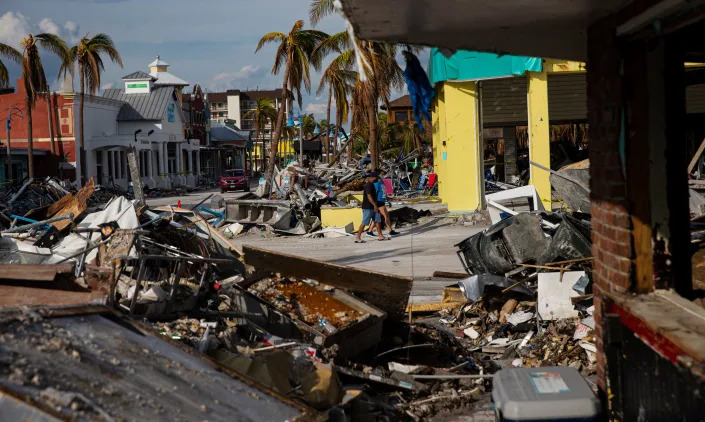
‘Wonderful’ news: Fort Myers Beach rapidly restoring water service, whatever it takes

The News – Press

‘Wonderful’ news: Fort Myers Beach rapidly restoring water service, whatever it takes

Phil Fernandez, Fort Myers News-Press – October 26, 2022

Fort Myers Beach Utilities Director Utilities Director Christy Cory and fellow departments heads, workers and leaders bore the brunt of frustration and anger last week from many of the nearly 200 at the Town Council’s first gathering since Hurricane Ian’s battering.

On Tuesday night, many of those same residents cheered Cory as she brought a surprising update to the council meeting on the rapid return of water service to Estero Island.

‘Water is our right’: Tears, frustration, anger at first Fort Myers Beach meeting since Hurricane Ian

Path of recovery: Federal help continues to grow for Ian survivors and their SWFL businesses

“As of today at close of business — and my guys are actually still out there —  we had 62 side streets on. We had 51.2% of the island turned on,” Cory said.

“Say that again?” a voice blurted out.

“Your numbers are outstanding,” council member Jim Atterholt said, after the applause and whistling had subsided, and then occurred a half-dozen more times sprinkled with prolonged clapping, hurrahs and amens during a six-minute spurt as Cory spoke. “Your news is wonderful.”

That’s a dramatic surge from zero Friday morning on side streets.

“There’s two to three valves per side street. The debris is causing a little bit of a problem for us. I try to get the machines down there (to) get it out of the way so we can turn on a valve to a side street. Once we do that, then we immediately break up (to) individual” houses, Cory said. “I’m out there, my office staff is out there. We’re hitting each house individually because we’re watching (for) water coming out of the houses.”

Cory concedes that some of what they’re doing is unorthodox, but the circumstances of following one of the most violent hurricane strikes in history calls for it.

“A case in point. We went to Bay Beach Lane today to get Bay Beach Lane turned on. It was a hot mess, for a lack of a better term. There was debris everywhere,” Cory said. “We are also repairing on the residents’ side just to try to get people’s water back to them. We’re just not repairing our side. We’re actually going onto property and helping people.”

That led to yet another eruption of cheers among the 150 or so at the makeshift setup inside the former SkipOne Seafood restaurant, 17650 San Carlos Blvd.

“We’re doing absolutely the best we can to get everyone water,” Cory said. “We’re out there at 5:45 (a.m.) with every one of my crew members. We start at daylight and we work until the sun goes down every single day. And we’ll continue to do that until every single resident on this island has water.”

With the previous complaints about the lack of service and too much caution and inspection as repairs continued, Mayor Ray Murphy and town council members had implored more creativity from Town Manager Roger T. Hernstadt and his team.

“If we feel that it’s safe, and we’re out there, and someone is home and we feel that it’s safe to turn on their water, we are doing so. Let me say that Roger has given me permission to do that,” Cory said. “If there’s a policy in place, I want to make it clear I didn’t go against that policy. Roger authorized me if I feel it’s safe as the director to turn on their water, I can do that.”

What’s in Florida’s future? ‘Old Florida is gone’ but what will new Southwest Florida look like post-Ian?

Signs of the time: SWFL residents finding ribbons, markings on damaged homes in Ian aftermath

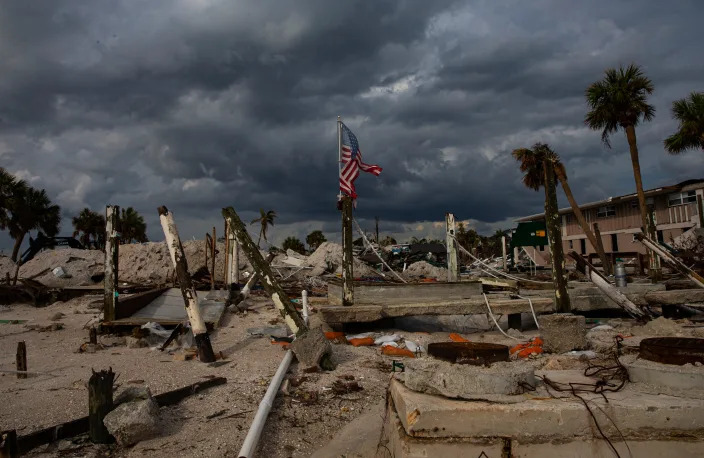
Times Square  on Fort Myers Beach was destroyed  in Hurricane Ian.
Times Square on Fort Myers Beach was destroyed in Hurricane Ian.

‘Literally, the street rose up’

But there are hazards.

“We went to Primo (Drive) to turn on that water, and the whole street, I mean, literally the street rose up, and we immediately shut it down,” Cory said. “I don’t want to devastate an area that’s devastated already. When it comes to a street like that, I want to keep moving but bring back my contractors to repair that, which they did today and that water’s turned on.

“So it’s just a matter of when we get to a street, then we have something like a main break. We had a valve blow up once the other day that basically comes out of the street.”

And then there’s the riskiness of residents turning on their own meters, Hernstadt said.

“We’ve had cases where people’s properties got flooded, and they’ll call us up, ‘My house is flooded.’ We don’t recommend you do that,” he said. “It’s wiser to turn on the meter when we’re there.”

Fort Myers Beach was destroyed by Hurricane Ian on Sept. 28, 2022. This is the Times Square area on October 14, 2022.

Cory said she understands inhabitants trying to get their lives closer to normal in any way they can.

“Previously, I would have told you not to touch that meter. Now, I’m just going to say, ‘If you want to turn on your water, you can go right ahead,'” Cory said. “If you could do that between sunrise and sunset, that would be amazing because the 1 a.m. (calls), phew.”

But while there’s some victory with water, it’s not like most residents who still have a standing structure could go home Tuesday night and repeatedly turn their lights on and off in celebration. A total of 177 buildings have been energized, according to FPL. The company continues to work with town officials on the more challenging mission of extending power, among the concerns raised Tuesday night by about a dozen speakers.

“There’s a big difference between electricity and water,” Cory said.

But Hernstadt said he’s working with staff to find ways to shorten the restoration process. It’s just a matter again of being careful on an island landscape covered in potential dangers after a storm that officially killed 118 Floridians, based on new state data Tuesday night. Lee County’s 57 leads, and Collier, Charlotte and Sarasota counties all lost eight lives each, second most.

The Cottage Bar at Shuckers on Fort Myers Beach was destroyed in Hurricane Ian. An American flag was placed on one of the pilings that remains.

Threats remain: Leaking propane tanks

Threats to life continue a month after Ian’s Sept. 28 savagery of 15-foot storm surges and 155 mph winds that obliterated a majority of beachside dwellings and businesses.

“We are getting calls about underground propane tanks that are leaking, as people are cleaning up debris,” said Scott Wirth, Fort Myers Beach district chief of operations. “We have a hazmat team on the island that’s working with us in response so they’re there to help secure propane tanks that are leaking.”

Sinkholes and other obstacles also are in play.

“As you’re driving down the roads, you’ll see any kind of wash out,” Wirth said. “In some places that you see some of the road washed out, anticipate that there’s pockets of void spaces underneath the road. So if you see a washed out area, try to avoid it and go as far around it as you can, to avoid collapsing the road any further.”

The pier on Fort Myers Beach was destroyed in Hurricane Ian.

And residents are taking chances from a “life safety perspective” in some of their rebuild efforts.

“Unstable buildings — the work is continuing in these,” Wirth said, noting red or yellow placards. “These placards were put up by fire inspectors from around the state who came in and helped us inspect. (A) red placard means that there was something about your building that made it hazardous to be in, to the point where a certificate of occupancy provided for a commercial building has been revoked.”

Yellow’s a tad better.

“The yellow placard means your certificate of occupancy has been downgraded to a temporary certificate of occupancy. This building is safer to be in than one that is placarded in red,” Wirth said. “You’re working in that structure at your own risk. Those activities should be the types of things that would have to happen to get the building fixed until it can reach normal certificate of occupancy.

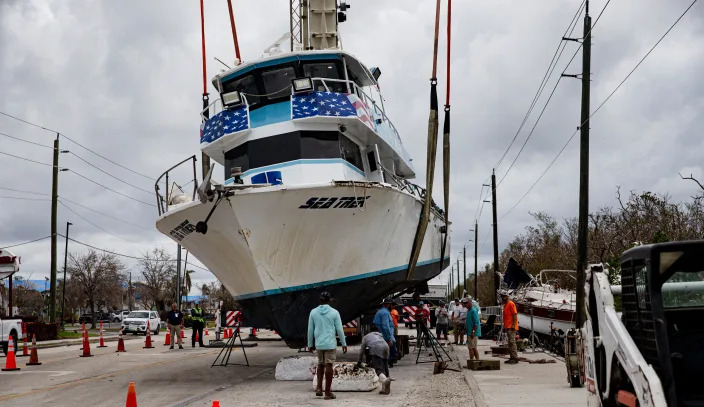
Crews using a crane removed the Sea Trek from the mangroves along San Carlos Boulevard on Tuesday, Oct. 18, 2022. A captain and a member of the crew were trying to save the boat during Hurricane Ian. As the storm surge from the storm rushed in, they ended up floating over the roadway and deposited in the mangroves. The hope is to repair the boat and return it to the water for working trips.

Other Beach updates from the town

• Inspections: Once electricity is restored in residential areas, residents need to get an inspection from a Florida licensed structural engineer and an electrician to get power. Both inspection reports need to be sent to buildingpermits@fmbgov.com, noting the address and the contractors’ Florida license number. In October, the town had processed 598 permits as of Tuesday. FPL is replacing meters on homes.

• Water service: Homes with potable water are under a mandatory boil notice, which will continue until samples show a return to safe drinking levels. All water used for consumption, cooking, making ice, washing dishes or brushing teeth must be brought to a rolling boil for at least one minute.

• Community Resource Centers: After being relocated from temporary town hall, there are two sites with hot meals from 11 a.m. to 5 p.m. daily and most other services 24 hours a day. Santini Marina Plaza, 7205 Estero Blvd., also features water, showers, laundry and restrooms. Diesel and regular unleaded fuel are available from 9 a.m. to 5 p.m. daily through Saturday. Fuel limits are 10 gallons per car and 15 per truck or SUV.

Beach Baptist Church, 130 Connecticut St., also provides access to ice, water, showers, laundry and restrooms as well as federal, state, local and non-profit partners, who are there from 9 a.m. to 5 p.m. daily. This includes FEMA Disaster Recovery Assistance Teams, Florida Department of Children and Families, and local and national non-profits.

• Mail pickup: Residents can pick up correspondence at the Fort Myers Processing & Distribution Center, 14080 Jetport Loop. For customers arriving by car, there is signage directing to a parking lot, where a mobile retail unit has been set up to assist in mailing and shipping needs, stamp and money order purchases and change of address requests. Hours: Monday through Saturday from 9 a.m. to 4:30 p.m.

• Early voting: Residents can vote at any of 12 sites in Lee County through Nov. 8 Election Day. Nearest to the beach include Wa-Ke Hatchee Park Recreation Center, 16760 Bass Road, Fort Myers; and Bonita Springs office for Lee County Elections office, 25987 S. Tamiami Trail, No. 105.

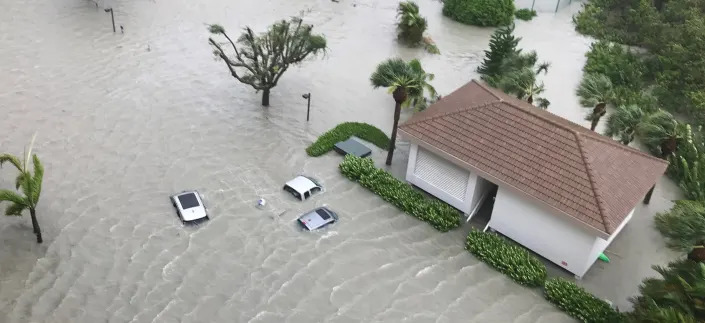
This parking lot near Naples Park flooded late Wednesday but by Thursday morning, the water had drained, leaving behind mud and debris.

• Damage assessments:  In conjunction with the Army Corps of Engineers infrastructure assessment team and experts on design and construction, town building are conducting building assessments. The intent is to assess the habitability of a structure and recommend a rating of safe to enter, restricted use, or not safe to enter.

• Debris: Coordinating with Lee County, 168,397 cubic yards of debris had been collected as of Tuesday, or equal to more than 50 Olympic-sized swimming pools. It’s being deposited on the Bay Oaks recreational campus and Lovers Key. Some streets or homes may have been skipped due to obstruction from debris or parked vehicles in the right of way. As much as possible, debris should be pushed curbside.

• Fire inspection and permit fees suspended: The Board of Fire Commissioners and Fire Chief Ronald L. Martin have suspended fees into January.

• Roof permits: Access, complete and submit roof permits on the town’s website at www.fmbgov.com. Send questions to buildingpermits@fmbgov.com.

• Contractors: Use only licensed and registered contractors. A list of registered contractors of all types, including electrical, is on the Building Services page of the town’s website at www.fmbgov.com/building. Also available: the state’s database of licensed contractors at https://dcnonline.org/

Road leading to Vanderbilt Beach, Delnor Wiggins State Park and other Collier County venues remained closed Friday afternoon Oct. 14, 2022 in Hurricane Ian's aftermath. Donations are being accepted at delnorwiggins.org to help pay for the wrecked Wiggins' restoration, which officials say will take one to two years.
Road leading to Vanderbilt Beach, Delnor Wiggins State Park and other Collier County venues remained closed Friday afternoon Oct. 14, 2022 in Hurricane Ian’s aftermath. Donations are being accepted at delnorwiggins.org to help pay for the wrecked Wiggins’ restoration, which officials say will take one to two years.

Where to find more help

At least three SBA Recovery Centers have been opened in Southwest Florida:

► The Naples Players, 701 Fifth Ave. S., Naples. Opens at 9 a.m. every day and closes at 4:30 p.m. Mondays and 5 p.m. Tuesday through Sunday.

► The Hub at SWFL Inc., 25071 Chamber of Commerce Drive, Bonita Springs. Hours are 9 a.m. to 5 p.m. Monday through Sunday.

► Kiwanis Club of Cape Coral, 360 Santa Barbara Blvd. S., Cape Coral. Times are 8 a.m. to 6 p.m. Monday through Thursday and closed on other days.

♦ President Biden has authorized Southwest Florida enterprises and private nonprofit organizations of any size to borrow up to $2 million to repair or replace damaged or destroyed real estate, machinery and equipment, inventory and other assets. Go to https://disasterloanassistance.sba.gov/

Obstacles to overcome: ‘Challenging infrastructure’ tests Fort Myers Beach recovery, redevelopment

Two weeks after Ian:On long road to recovery, lots of bumps, but clearing ahead

Plus: Amid Hurricane Ian’s devastation on Fort Myers Beach, hope persists to rebuild

♦ SBA Economic Injury Disaster Loans help small endeavors and most private nonprofit organizations meet working capital needs caused by the disaster. Go to https://www.sba.gov/funding-programs/disaster-assistance/economic-injury-disaster-loans

♦ Disaster loans up to $200,000 are available to homeowners to repair or replace damaged or destroyed real estate through FEMA or other agencies. Homeowners and renters are eligible for up to $40,000 to repair or replace damaged or destroyed personal property.

♦ The Florida Small Business Emergency Bridge Loan program provides short-term, zero-interest working capital loans to “bridge the gap” between the time a disaster impacts a business and when it can secure longer-term recovery funding, such as federally or commercially available loans. On Google, search “rebuild Florida business loan fund.”

Help on the way: Biden brings rebuilding help to hurricane-ravaged Southwest Florida

A’It’s been a catastrophic event’: Devastation from Hurricane Ian worse than Charley, Sanibel police chief says

Plus: Amid rising death toll, more glimmers of light in Ian aftermath for SWFL

♦ Disaster unemployment assistance is available to Florida businesses and residents. It’s for weeks of unemployment from Sept. 25 to April 1. For assistance call 1-800-385-3920, go to a local CareerSource Career Center or online to floridajobs.org.

Based at the Naples Daily News, Columnist Phil Fernandez (pfernandez@gannett.com) writes In the Know as part of the USA TODAY NETWORK. Support Democracy and subscribe to the paper.

Drought in the Great Plains and Midwest is getting more intense, federal report shows

Yahoo! News

Drought in the Great Plains and Midwest is getting more intense, federal report shows

Ben Adler, Senior Editor – October 26, 2022

A drought in the Great Plains and the Midwest has quickly grown in its size and severity in the last month, according to an update released Wednesday by the National Integrated Drought Information System (NIDIS). Currently, 60% of the North Central U.S. is in “moderate to exceptional drought” with 30% in “severe drought or worse” according to NIDIS, a division of the National Oceanic and Atmospheric Administration.

The worst-hit areas include Kansas, where 30% of the state is in exceptional drought, and Nebraska, which is 12% in exceptional drought. Smaller parts of Colorado, Missouri and South Dakota are as badly affected.

Colorado Parks and Wildlife ordered an emergency public fish salvage for Queens Reservoir in Kiowa County due to declining water levels related to drought conditions on July 21, 2022 in Eads, Colorado. (RJ Sangosti/MediaNews Group/The Denver Post via Getty Images)
Drought conditions in July forced the state of Colorado to order an emergency public fish salvage for Queens Reservoir. (RJ Sangosti/MediaNews Group/Denver Post via Getty Images)

While the entire Midwest has been in a worsening drought for months, the western portions of the region — the Missouri River Basin and the Great Plains — have been hit the hardest. Water has dropped to “record low levels” on the Mississippi, Missouri and Ohio rivers, NIDIS reported, which has impeded boats and shipping. In total, 86% of the North Central U.S. is “abnormally dry” or worse.

“Over the last four weeks, many areas, particularly across the Midwest, have worsened by at least one drought category on the U.S. Drought Monitor and in some areas by two to three categories,” NIDIS reported in its update. “Drought has intensified most rapidly across southern Missouri, Kentucky, southern Illinois, southern Indiana, and northern Iowa.”

The water scarcity is causing dried-out soil — a major problem for the famously agricultural region, sometimes called “America’s breadbasket.” Last Saturday, Agence-France Presse reported that farmers in Kansas and Nebraska are “seeing crop yields in freefall, with some fields too damaged to harvest.” The Department of Agriculture recently lowered its projected yields of wheat, corn and soybeans.

“[Farmers] who are in their 70s and 80s are saying, you know, they haven’t even experienced anything like this in their lifetime,” Marc Ramsey, whose family has farmed in western Kansas for a century, told AFP. “So it’s pretty bad.”

A farmer harvests soybeans near Wyatt, Mo.
A farmer harvests soybeans near Wyatt, Mo. (Scott Olson/Getty Images)

Droughts are increasingly common and more severe because of climate change, as warmer air causes greater evaporation and precipitation is affected by extremes of drought and heavy rain. The Midwestern drought has become worse in the last month due to light rainfall. Most of the region has received only between 5% and 50% of its normal precipitation.

“While the recent rapid intensification of drought has been most prominent across the Midwest, severe drought has persisted for up to two years across portions of the Missouri River Basin/Great Plains,” NIDIS noted.

The Midwest is not the only region in the country experiencing long-running drought. Much of the West is in the grip of a 22-year drought that is causing water levels in reservoirs on the Colorado River to drop to what the United Nations Environment Programme described in August as “dangerously low levels.”

Even typically wet regions such as the Northeast experienced drought this summer, which featured record-breaking heat waves, wildfires and droughts across the Northern Hemisphere. Dropping water levels in lakes and rivers due to droughts have also exposed long-buried secrets from bodies in Lake Mead in Nevada to dinosaur prints in Texas, Nazi warships in Serbia and ancient Buddhist statues in China.

Doctors say ‘fossil fuel addiction’ kills, starves millions

Associated Press

Doctors say ‘fossil fuel addiction’ kills, starves millions

Seth Borenstein – October 25, 2022

FILE - The sun sets behind a coal-fired power plant in Gelsenkirchen, Germany, Oct. 22, 2022. A new report from doctors and other health experts says the world's fossil fuel addiction is making the world sicker and is killing people. (AP Photo/Michael Sohn, File)
The sun sets behind a coal-fired power plant in Gelsenkirchen, Germany, Oct. 22, 2022. A new report from doctors and other health experts says the world’s fossil fuel addiction is making the world sicker and is killing people. (AP Photo/Michael Sohn, File)
FILE - A child is weighed at a camp for displaced people amid drought on the outskirts of Dollow, Somalia, Sept. 19, 2022. Extreme weather from climate change triggered hunger in vulnerable populations worldwide as the world’s “fossil fuel addiction” degrades public health each year, doctors reported in a new study. (AP Photo/Jerome Delay, File)
A child is weighed at a camp for displaced people amid drought on the outskirts of Dollow, Somalia, Sept. 19, 2022. Extreme weather from climate change triggered hunger in vulnerable populations worldwide as the world’s “fossil fuel addiction” degrades public health each year, doctors reported in a new study. (AP Photo/Jerome Delay, File)
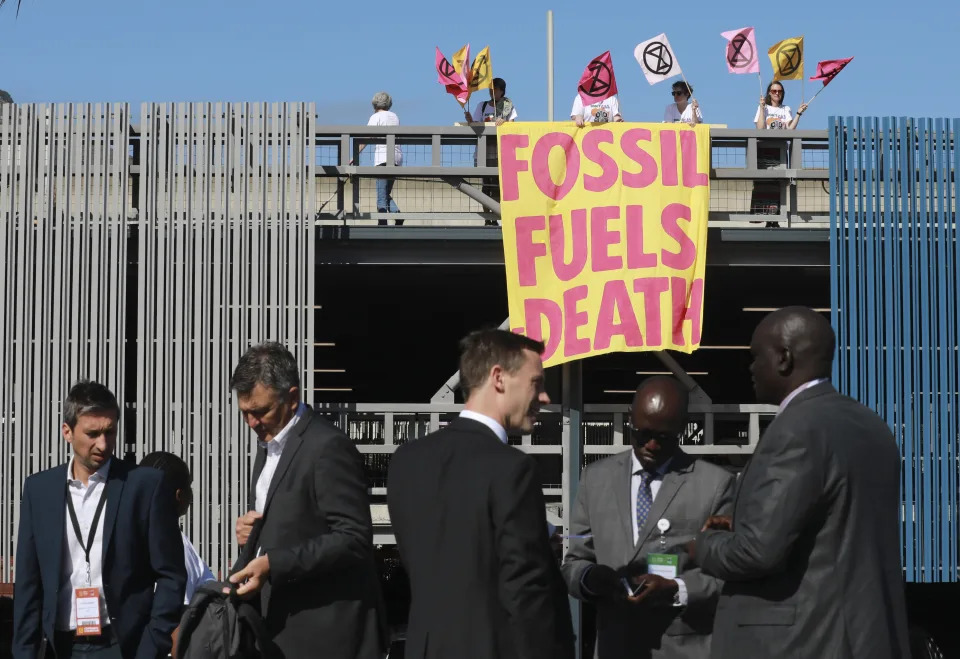
FILE - Climate activists from Extinction Rebellion hold a placard as they protest at the Africa Energy Week conference, foreground, in Cape Town, South Africa, Oct. 20, 2022. A new report from doctors and other health experts says the world's fossil fuel addiction is making the world sicker and is killing people. (AP Photo/Nardus Engelbrecht, File)
Climate activists from Extinction Rebellion hold a placard as they protest at the Africa Energy Week conference, foreground, in Cape Town, South Africa, Oct. 20, 2022. A new report from doctors and other health experts says the world’s fossil fuel addiction is making the world sicker and is killing people. (AP Photo/Nardus Engelbrecht, File)

Extreme weather from climate change triggered hunger in nearly 100 million people and increased heat deaths by 68% in vulnerable populations worldwide as the world’s “fossil fuel addiction” degrades public health each year, doctors reported in a new study.

Worldwide the burning of coal, oil, natural gas and biomass forms air pollution that kills 1.2 million people a year, including 11,800 in the United States, according to a report Tuesday in the prestigious medical journal Lancet.

“Our health is at the mercy of fossil fuels,” said University College of London health and climate researcher Marina Romanello, executive director of the Lancet Countdown. “We’re seeing a persistent addiction to fossil fuels that is not only amplifying the health impacts of climate change, but which is also now at this point compounding with other concurrent crises that we’re globally facing, including the ongoing COVID-19 pandemic, the cost-of-living crisis, energy crisis and food crisis that were triggered after the war in Ukraine.”

In the annual Lancet Countdown, which looks at climate change and health, nearly 100 researchers across the globe highlighted 43 indicators where climate change is making people sicker or weaker, with a new look at hunger added this year.

“And the health impacts of climate change are rapidly increasing,” Romanello said.

In praising the report, United Nations Secretary-General Antonio Guterres put it even more bluntly than the doctors: “The climate crisis is killing us.”

New analysis in the report blamed 98 million more cases of self-reported hunger around the world in 2020, compared to 1981-2010, on “days of extreme heat increasing in frequency and intensity due to climate change.”

Researchers looked at 103 countries and found that 26.4% of the population experienced what scientists call “food insecurity” and in a simulated world without climate change’s effects that would have only been 22.7%, Romanello said.

“Can I say that every bit of food insecurity is due to climate change? Of course not. But we think that in this complex web of causes, it is a very significant contributor and it’s only going to get worse,” said pediatrician Dr. Anthony Costello, Lancet Countdown co-chair and head of the University College of London’s Global Health Institute.

Computerized epidemiology models also show an increase in annual heat related deaths from 187,000 a year from 2000 to 2004 to an annual average of 312,000 a year the last five years, Romanello said.

When there’s a heat wave, like the record-shattering 2020 one in the Pacific Northwest or this summer’s English heat wave, emergency room doctors know when they go to the hospital “we’re in for a challenging shift,” said study co-author Dr. Renee Salas, a Boston emergency room physician and professor at the Harvard School of Public Health.

The air pollution from burning coal, oil and gas also pollutes the air, causing about 1.2 million deaths a year worldwide from small particles in the air, the scientists and report said. The 1.2 million figure is based on “immense scientific evidence,” Harvard’s Salas said.

“Burning gas in cars or coal in electricity plants have been found to cause asthma in children and cause heart problems,” Salas said.

“Prescribing an inhaler isn’t going to fix the cause of an asthma attack for a young boy living next to a highway where cars are producing dangerous pollutants and climate change is driving increases in wildfire smoke, pollen and ozone pollution,” Salas said.

Both air pollution and heat deaths are bigger problems for the elderly and the very young and especially the poor, said University of Louisville environmental health professor Natasha DeJarnett, a study co-author.

Sacoby Wilson, a professor of environmental health at the University of Maryland who wasn’t part of the report, said the Lancet study makes sense and frames climate change’s effects on health in a powerful way.

“People are dying now as we speak. Droughts, desertification, not having food, flooding, tsunamis,” Wilson said. “We’re seeing what happened in Pakistan. What you see happening in Nigeria. ”

Both Wilson and emergency room physician and professor of medicine at the University of Calgary Dr. Courtney Howard, who wasn’t part of the study, said report authors are correct to call the problem an addiction to fossil fuels, similar to being addicted to harmful drugs.

The Lancet report shows the increasing deaths from air pollution and heat yet people are “continuing in habitual behavior despite known harms,” which is the definition of addiction, Howard said. “Thus far our treatment of our fossil fuel addiction has been ineffective.”

“This isn’t a rare cancer that we don’t have a treatment for,” Salas said. “We know the treatment we need. We just need the willpower from all of us and our leaders to make it happen.”

Most in US want more action on climate change: AP-NORC poll

Associated Press

Most in US want more action on climate change: AP-NORC poll

Daly and Nuha Dolby – October 24, 2022

WASHINGTON (AP) — Nearly two-thirds of Americans think the federal government is not doing enough to fight climate change, according to a new poll that shows limited public awareness about a sweeping new law that commits the U.S. to its largest ever investment to combat global warming.

Democrats in Congress approved the Inflation Reduction Act in August, handing President Joe Biden a hard-fought triumph on priorities that his party hopes will bolster prospects for keeping their House and Senate majorities in November’s elections.

Biden and Democratic lawmakers have touted the new law as a milestone achievement leading into the midterm elections, and environmental groups have spent millions to boost the measure in battleground states. Yet the poll by The Associated Press-NORC Center for Public Affairs Research finds that 61% of U.S. adults say they know little to nothing about it.

While the law was widely heralded as the largest investment in climate spending in history, 49% of Americans say it won’t make much of a difference on climate change, 33% say it will help and 14% think it will do more to hurt it.

The measure, which passed without a single Republican vote in either chamber, offers nearly $375 billion in incentives to accelerate expansion of clean energy such as wind and solar power, speeding the transition away from fossil fuels such as oil, coal and natural gas that largely cause climate change.

Combined with spending by states and the private sector, the law could help shrink U.S. carbon emissions by about two-fifths by 2030 and chop emissions from electricity by as much as 80%, advocates say.

Michael Katz, 84, of Temple, New Hampshire, said he thinks Biden has “done an amazing amount of work” as president. “I’m sort of in awe of what he’s done,” said Katz, a Democrat and retired photographer. Still, asked his opinion of the Inflation Reduction Act, Katz said, “I’m not acquainted with” it.

After learning about the law’s provisions, Katz said he supports increased spending for wind and solar power, along with incentives to purchase electric vehicles.

Katz said he supports even stronger measures — such as restrictions on rebuilding in coastal areas damaged by Hurricane Ian or other storms — but doubts they will ever be approved.

“People want their dreams to come true: to live near the ocean in a big house,” he said.

Leah Stokes, an environmental policy professor at the University of California, Santa Barbara, said she was not surprised the climate law is so little known, despite massive media coverage when it was debated in Congress, approved and signed by Biden.

The law was passed during the summer, when people traditionally pay less attention to news, “and it takes time to explain it,” especially since many of the law’s provisions have not yet kicked in, Stokes said.

Biden and congressional Democrats “delivered in a big way on climate,” she said, but now must focus on helping the public understand the law and “winning the win.”

Meredith McGroarty, a waitress from Pontiac, Michigan, said she knew little about the new law but supports increased climate action. “I have children I’m leaving behind to this world,” she said.

McGroarty, 40, a Democrat, urged Biden and other leaders to talk more about the climate law’s “effects on normal, everyday people. Let us know what’s going on a little more.”

Americans are generally more likely to support than oppose many of the government actions on climate change included in the law, the poll shows. That includes incentives for electric vehicles and solar panels, though relatively few say they are inclined to pursue either in the next three years.

About half of Americans think government action that targets companies with restrictions is very important, the poll shows, while about a third say that about restrictions on individuals. A majority of Americans, 62%, say companies’ refusal to reduce energy use is a major problem for efforts to reduce climate change, while just about half say people not willing to reduce their energy use is a major problem.

Slightly more than half also say it’s a major problem that the energy industry is not doing enough to supply power from renewable sources such as wind and solar, and about half say the government is not investing enough in renewable energy.

Overall, 62% of U.S. adults say the government is doing too little to reduce climate change, while 19% say it’s doing too much and 18% think it’s doing the right amount.

Democrats are more likely than others to think the federal government is doing too little on climate: 79% say that, compared to 67% of independents and 39% of Republicans. About three-quarters of Black and Hispanic Americans think there’s too little action, compared to about half of white Americans.

And about three-quarters of adults under 45 think there’s too little action on climate, significantly higher than the roughly half of those older who think that.

Robert Stavins, a professor of energy and economic development at the Harvard Kennedy School, said it makes sense for the government to step in to promote renewable energy on a large scale.

“Individual action is not going to be sufficient in 10 or even 20 years,” he said. “You need government policies to create incentives for industry and individuals to move in a carbon-friendly direction.”

Americans want to own a car, “and they are not going to buy one that’s expensive,” Stavins said, so government needs to lower costs for electric vehicles and encourage automakers to produce more EVs, including widespread availability of charging stations. Biden has set a goal to install 500,000 charging stations across America as part of the 2021 infrastructure law.

On renewable energy, nearly two-thirds of U.S. adults say offshore wind farms should be expanded, and about 6 in 10 say solar panel farms should be expanded. Biden has moved to expand offshore wind and solar power as president.

Americans are divided on offshore drilling for oil and natural gas. Around a third say such drilling should be expanded, while about as many say it should be reduced; another third say neither.

Republicans were more likely than Democrats to be in favor of expanding offshore drilling, 54% to 20%.

The poll of 1,003 adults was conducted Sep. 9-12 using a sample drawn from NORC’s probability-based AmeriSpeak Panel, which is designed to be representative of the U.S. population. The margin of sampling error for all respondents is plus or minus 4.0 percentage points.

US military to begin draining Pearl Harbor pipelines

Associated Press

US military to begin draining Pearl Harbor pipelines

Audrey McAvoy – October 24, 2022

JOINT BASE PEARL HARBOR-HICKAM, Hawaii (AP) — The U.S. military said Monday it’s ready to begin draining 1 million gallons (3.79 million liters) of fuel from three pipelines as part of an initial step toward closing a World War II-era fuel storage facility that leaked petroleum into Pearl Harbor’s tap water last year.

The pipelines run about 3 miles (4.83 kilometers) from the Red Hill Bulk Fuel Storage Facility in the mountains above Pearl Harbor down to the military base.

Starting Tuesday, the military will spend six days draining the pipelines one by one. Fuel is expected to move through the pipes for a total of 12 hours during the six days.

The fuel has been sitting in the pipes since the military suspended use of the Red Hill facility last year after it leaked petroleum into a drinking water well serving 93,000 people in and around Joint Base Pearl Harbor-Hickam.

Nearly 6,000 people, mostly military personnel and their families, sought medical attention for rashes, sores, nausea and other ailments after drinking and bathing with the contaminated water.

Shortly after, the state Department of Health ordered the military to drain fuel from Red Hill and shut the facility down. The military says 104 million gallons remain in the tanks themselves. It aims to remove this fuel by July 2024 after it makes necessary repairs to be able to drain the tanks safely.

Navy Rear Adm. John Wade, the commander of Joint Task Force Red Hill, said the state Department of Health and the U.S. Environmental Protection Agency reviewed and approved the military’s plan to drain the pipelines. A third-party contractor also checked the plans, he said.

The most dangerous aspect of draining the pipelines is the potential for fuel to spill and enter the aquifer, Wade told reporters as a news conference.

“So everything that we’ve done, every focus of effort for the planning and the rehearsals has been focused on mitigating any chance of a spill,” he said.

The Red Hill facility sits just 100 feet (30 meters) above one of Honolulu’s most important drinking water aquifers.

Hawaii officials are concerned that last year’s spill contaminated the aquifer and are worried that any future spills would also pollute the aquifer, which normally supplies more than 20% of the water consumed in Honolulu.

Wade said representatives from the Department of Health and the EPA will be on hand while military drains the pipelines.

Task force members trained individually and as groups on how to respond if fuel spills while the pipelines are being drained, he said.

A Navy investigation found a series of mistakes over the course of six months caused last year’s spill.

It found operator error caused a pipe to rupture on May 6, 2021 when fuel was being transferred between tanks. This caused 21,000 gallons (80,000 liters) of fuel to spill. Most of it flowed into a fire suppression line and sat there for six months, causing the line to sag.

Then on Nov. 20, a cart rammed into the sagging line, releasing 20,000 gallons (75,700 liters) of fuel. A team thought they recovered all of this fuel, but they missed about 5,000 gallons (19,000 liters). Fuel they missed flowed into a French drain and from there into the drinking water well.

Fuel from the three pipelines will go to above-ground storage tanks and fuel barges which will then supply Air Force jets and Navy ships at the base, officials said.

Exposure to environmental toxins may be root of rise in neurological disorders

The Guardian

Exposure to environmental toxins may be root of rise in neurological disorders

Nina Lakhani in New York – October 23, 2022

The mystery behind the astronomical rise in neurological disorders like Parkinson’s disease and Alzheimer’s could be caused by exposure to environmental toxins that are omnipresent yet poorly understood, leading doctors warn.

At a conference on Sunday, the country’s leading neurologists and neuroscientists will highlight recent research efforts to fill the gaping scientific hole in understanding of the role environmental toxins – air pollution, pesticides, microplastics, forever chemicals and more – play in increasingly common diseases like dementias and childhood developmental disorders.

Related: Human neurons transplanted into rats to help study brain disorders

Humans may encounter a staggering 80,000 or more toxic chemicals as they work, play, sleep and learn – so many that it is almost impossible to determine their individual effects on a person, let alone how they may interact or the cumulative impacts on the nervous system over a lifespan.

Some contact with environmental toxins is inevitable given the proliferation of plastics and chemical pollutants, as well as America’s hands off regulatory approach, but exposure is unequal.

In the US, communities of color, Indigenous people and low income families are far more likely to be exposed to a myriad of pollutants through unsafe housing and water, manufacturing and agricultural jobs, and proximity to roads and polluting industrial plants, among other hazards.

It’s likely genetic makeup plays a role in how susceptible people are to the pathological effects of different chemicals, but research has shown higher rates of cancers and respiratory disease in environmentally burdened communities.

Very little is known about impact on brain and nervous system disorder, but there is growing consensus that genetics and ageing do not fully account for the sharp rise in previously rare diseases like Alzheimer’s, Parkinson’s and ALS (amyotrophic lateral sclerosis) – a degenerative disease more likely in army veterans and neighborhoods with heavy industry.

Neurologists and their surgical counterparts, neurosurgeons, will spotlight the research gap at the American Neurological Association (ANA) annual meeting in Chicago.

“Neurology is about 15 years behind cancer so we need to sound the alarm on this and get more people doing research because the EPA [Environmental Protection Agency] is absolutely not protecting us,” said Frances Jensen, the ANA president and chair of the Department of Neurology at the University of Pennsylvania.

Scores of well-known dangerous toxins such as asbestos, glyphosates, and formaldehyde continue to be used widely in agriculture, construction, pharmaceuticals and cosmetics in the US, despite being banned elsewhere. Earlier this week, the Guardian reported on corporate efforts to influence the EPA and conceal a possible link between the popular weed killer Paraquat and Parkinson’s.

Jensen added: “It’s like dark matter, there are so many unknowns … it’s truly going to be an epic exploration using the most cutting edge science we have.”

Neurology is the branch of medicine focused on disorders of the nervous system – the brain, spinal cord and sensory neural elements like the ears, eyes and skin. Neurologists treat stroke, multiple sclerosis, migraines, Parkinson’s, epilepsy, and Alzheimer’s, as well as children with neurodevelopmental disorders like ADHD, autism and learning disabilities.

The brain is the most complex and important organ in the body – and likely the most sensitive to environmental toxins, but was largely inaccessible to researchers until sophisticated imaging, genetic and molecular techniques were developed in the past 20 years.

Going forward, research could help explain why people living in neighborhoods with high levels of air pollution have a higher risk of stroke, as well as examine links between fetal exposure and neurodevelopmental disorders.

Rick Woychik, director of the National Institute of Environmental Health Sciences, said: “It’s not just about pesticides. PFAS chemicals are ubiquitous in the environment, as are nanoplastics. And there are trillions of dollars’ worth of demand for nanomaterials, but it’s sobering how little we know about their toxicology.”

Climate change is on the ballot in the midterm elections: Here’s what’s at stake.

USA Today

Climate change is on the ballot in the midterm elections: Here’s what’s at stake.

Elizabeth Weise – October 22, 2022

With half of registered voters saying climate change is one of the most important issues in the upcoming midterm elections, could the results on Nov. 8 mean changes for U.S. policy regarding global warming?

A significant shift in the makeup of Congress would mostly involve delays rather than major legislation being rescinded. But time is of the essence as scientists continue to warn that without immediate and deep emission reductions across all sectors, limiting global warming to 1.5 degrees Celsius will soon be “beyond reach.”

Democrats have set up several major climate change initiatives at the national level that Republicans would like to roll back. To do so, they will need a landslide victory — and even then hitting the undo button will be a challenge.

Five major climate initiatives are at stake as voters decide who controls the House and Senate, along with governor’s races and ballot initiatives across the nation.

Related video: Biden says he’ll use executive powers to fight climate change

 Ad: 0:18 0:30 https://s.yimg.com/rx/martini/builds/51382509/executor.htmlScroll back up to restore default view.

Here’s a look at what the midterms mean for the climate:

‘Undo’ of Inflation Reduction Act still possible

Coming just 85 days after the most consequential piece of climate legislation ever passed in the United States, the outcome of the midterm elections are unlikely to erase key provisions of the Inflation Reduction Act unless Republicans gain a two-thirds majority in both the House and Senate.

INFLATION REDUCTION ACT: Answering your common questions about the legislation

INFRASTRUCTURE ACT: The massive 2021 infrastructure act aimed to fight climate change. Is it living up to Biden’s pledge?

The sweeping legislation includes record spending on clean energy initiatives. It also has measures to reduce prescription drug prices and to ensure large corporations pay income taxes.

The law was approved by the Senate on Aug. 7 in a party-line vote. To dismantle it would require passage of a new law to either repeal or replace it, a virtually impossible task given current political realities.

To overcome a veto by President Joe Biden, Republicans would have to gain a two-thirds majority in both houses of Congress, which is seen as unlikely.

The other truth in politics is that once a major bill such as the IRA is passed, the longer it is in effect, the less likely it is to be overturned.

“It’s hard to do big things and it’s hard to undo big things,” said Tiernan Sittenfeld, senior vice president for governmental affairs with the League of Conservation Voters.

‘Shouting distance’: That’s how close the Inflation Reduction Act would get US to its climate goals

Critical water rights decisions hang in the balance amid megadrought

Two governors’ races could affect the 40 million Americans who get their water under the century-old Colorado River compact.

A megadrought that’s lasted for 22 years has pushed the mighty Colorado River well beyond its limits. Scientists estimate about 40% of the drought is attributable to human-caused climate trends.

To deal with the extreme lack of water, the Department of the Interior took an unprecedented step earlier this year, demanding governors of the seven states that get water from the river come up with an emergency plan to drastically reduce use.

Interior was clear: If the governors of Wyoming, Colorado, Nevada, New Mexico, Utah, Arizona, and California didn’t come up with a proposal, the agency’s Bureau of Reclamation would do it for them.

WATCH: Low water levels on Mississippi River reveal early 20th century shipwreck in Louisiana

VIDEO: Climate change made drought 20 times more likely

There’s been no deal and things are now on hold as all of the states but Utah have governors’ races on November 8.

How things play out in two of those states, Arizona and Nevada, could delay a state-run plan, causing the Department of the Interior to step in.

In both states, Republicans with unorthodox water plans are polling well and could end up calling the shots.

In Arizona, Republican candidate Kari Lake wants to prioritize finding additional water supplies rather than conservation. Her major proposals to deal with the state’s water shortages are building a pipeline to bring water from the Missouri and Mississippi rivers or constructing seawater desalination plants.

But desalinization would raise costs significantly and a pipeline is likely politically unworkable.

Conservation is really the only option, said Eric Kuhn, former general manager of the Colorado River District.

“The water’s just not there,” he said.

In Nevada, Republican candidate and political firebrand Joe Lombardo says California gets too much water under current rules and the entire Colorado River Compact should be renegotiated.

WATCH: Mississippi River’s low water level reveals shipwreck

VIDEO: Millions of Americans still drink unsafe tap water. Here’s why.

That seems unlikely to happen. The Compact was ratified in 1922. To create a new one would require the approval of Congress, state legislatures and governors.

Whatever humans do, in the end Mother Nature calls the shots, said Kuhn, the co-author of “Science Be Dammed: How Ignoring Inconvenient Science Drained the Colorado River.”

“You can’t deliver more water than you have.”

Plan to make companies disclose climate data not finalized

In the financial world, a historic climate change rule that could significantly change what investors are told about companies’ risk is set to be finalized next year. A shift in the composition of Congress could throw up roadblocks, though might not derail it.

The Securities and Exchange Commission proposed the rule in March. It would require public companies to disclose the risks they face from global warming as well as disclosing their greenhouse gas emissions. The rule doesn’t require companies to change what they’re doing, only to make it known to potential investors.

Already at least 16 Republican state attorneys general have contested the proposed rule and it’s anticipated that multiple lawsuits will be brought against it.

Others believe it will survive opposition.

“This rule was built to survive legal challenges,” said Elizabeth Small, head of policy for CDP, a nonprofit that runs a voluntary climate disclosure system for companies.

Two states propose landmark climate initiatives

While several states and numerous counties and cities have various climate initiatives, two stand out because of the size and economic importance of the states contemplating them.

In California, Proposition 30 would increase by 1.75% the tax on people who make more than $2 million. The resulting money – as much as $5 billion per year by state estimates – would go toward building electric and hydrogen vehicle charging stations and wildfire suppression and prevention programs.

If California were a country, it would have the world’s fifth-largest economy, so what the state does matters. If it passes, the initiative could spur the adoption of zero-carbon vehicles and construction of infrastructure to support them, both electric and hydrogen, not just in California but across the United States.

Across the country in New York state, Proposal 1 would allow the state to issue $4.2 billion in bonds for environmental, natural resources, water infrastructure, and climate change mitigation projects.

The Clean Water, Clean Air, and Green Jobs Environmental Bond Act would pay for environmental improvements across the state, including $1.5 billion for climate change mitigation, $1.1 billion to restoration and flood risk reduction, $650 million to conserve open spaces and $650 million for water quality in resiliency infrastructure.

If the historically large measure results in the jobs and cleaner, healthier environment supporters say it will, it could encourage other states to take similar steps.

Agriculture at the center of another, bigger fight ahead

How these climate issues play out could set the stage for an even bigger fight expected to begin in earnest after the midterms.

Every five years since 1933, Congress passes a piece of legislation that touches almost every aspect of America’s agriculture and nutrition policy: the farm bill. Formally known as the Agriculture Improvement Act, in 2018 it cost $428 billion and is an enormous driver of what American grows and eats.

Agriculture accounts for 11% of total U.S. greenhouse gas emissions, according to the Environmental Protection Agency. Conservation and sustainability are expected to be big issues as the details of the next farm bill are hashed out.

“It could be a huge opportunity for advancing climate solutions,” said Sittenfeld. “There’s no overstating the potential for the farm bill as we have very ambitious goals for cutting climate emissions.”

Hurricane Ian was lethal for elderly, those with chronic health conditions

Tampa Bay Times, St. Petersburg, Fla.

Hurricane Ian was lethal for elderly, those with chronic health conditions

Christopher O’Donnell, Tampa Bay Times – October 21, 2022

Douglas R. Clifford/Tampa Bay Times/TNS

Thomas Billings Jr. and his wife, Sarah, decided to ride out Hurricane Ian in the family room of their Naples ranch homeclose to Edgewater Beach.

About two hours after the storm’s landfall, Billings was returning from fetching something from a bedroom when he found his wife lying facedown, according to a Naples Police Department report.

As floodwaters seeped into the home, he moved Sarah, 73, to the bedroom. But the 79-year-old man did not have the strength to lift her onto the bed, the report states. The man was only able to escape the rising waters by floating his wife and himself to the back lanai.

He survived but Sarah drowned, a death that the county medical examiner concluded was complicated by a heart attack.

Florida has strict laws requiring nursing homes and assisted living facilities to plan for disasters like hurricanes. But few rules exist to protect an increasing number of elderly people with chronic health conditions who live at home, including some who rely on electric-powered medical equipment like dialysis and oxygen machines.

Hurricane Ian provided a brutal lesson in how vulnerable that population is to the harsh conditions during and after a major storm.

Medical examiners in Florida have so far linked 112 deaths to Hurricane Ian. Almost 60% of those were people age 65 or older. Chronic medical conditions like heart attacks and respiratory illnesses were contributing factors in one-third of reported deaths, records show.

The average age of those who died was 67.

“There is no one who is required to make sure they evacuate or that their home environment will keep them safe,” said Lindsay Peterson, an assistant professor who conducts disaster preparedness research at the University of South Florida’s School of Aging Studies. “They are much more vulnerable, and we see that in these statistics.

The reports suggest many would still be alive had they evacuated.

Nine people died because power outages meant they could not operate oxygen or dialysis equipment, including a 70-year-old diabetic in Charlotte County who went a week without dialysis.

Delays in 911 responders reaching patients because of the storm were cited as contributing factors in another five deaths. One was a 79-year-old woman in Orange County whose operation for a fractured hip was delayed because the hospital she was taken to had no running water.

Even some who survived the worst of the storm later succumbed to its aftermath.

Four residents suffered heart attacks and died while they were trying to clear up storm debris, reports show. A 58-year-old man with existing heart problems collapsed and died after walking up seven stories of a Naples condo tower where he and his wife were sheltering. The elevator had stopped working after the lobby flooded.

Trends suggest the number of seniors receiving medical treatment at home will continue to rise. The Centers for Medicare & Medicaid Services estimates that home care expenditures will reach $201 billion by 2028, a 73% increase from 2020.

More needs to be done at state, local and federal levels to protect that population as hurricanes increase in intensity, Peterson said. Home health centers and dialysis centers are required to have post-storm operation plans, she said.

Other states, including Ohio, have gone further with laws that require home health visitors to check in with their clients before a disaster and offer assistance and advice.

Those with health conditions can turn to special-needs shelters, which include generators to power medical equipment and are staffed with nurses.

But it’s not always easy to convince people and their caregivers to commit to staying in a shelter, Peterson said. Elderly people with dementia may feel distressed in a busy shelter where there is always light and noise.

“People associate home with their safety, especially older adults,” she said. “How do we convince them this is not safe for you anymore?”

Both Hillsborough and Pinellas counties maintain a registry of those who have special medical needs and might struggle during an emergency like a hurricane.

Pinellas counts 2,643 people on the registry, which includes information on their evacuation zones and whether they have their own transportation. About 4,000 people are on Hillsborough’s registry, with more than 1,600 listed as needing transportation to evacuate.

Both counties operated special shelters during Ian, with roughly 400 people and 110 caregivers staying at three shelters in Pinellas. Hillsborough housed about 400 people and 40 caregivers across five shelters, officials said.

The shelters are intended as a last resort for people without the resources or time to travel to a hotel or stay with friends or relatives, said Ryan Pedigo, director of public health preparedness in Hillsborough. But he acknowledged that some — including those with medical needs — won’t take advantage of the free facilities, and that many people wait until it’s too late to evacuate.

“You can’t wait until eight hours before landfall to make that happen. People need to take the initiative to leave earlier and evacuate,” he said. “I don’t know if it’s complacency or people flat-out don’t want to go to a shelter.”

Joy Weidinger’s husband of 58 years, Douglas Weidinger Sr., was listed among Hurricane Ian’s dead.

The 79-year-old Punta Gorda man, who suffered from chronic obstructive pulmonary disease and asbestosis, relied on an oxygen concentrator, a device that provides oxygen-rich air.

When power stopped working, he switched to portable oxygen canisters the couple had ordered for the storm.

But his health deteriorated, his wife said, in part because he was so stressed about the hurricane. He died Sept. 29, one day after the storm made landfall.

The medical examiner in Charlotte County cited the interruption of power as a contributing factor in his death.

“We hooked him up to the concentrator, but by the time we did it, it was too late,” she said. “We all have a time to go.”

How unhealthy is red meat? And how beneficial is it to eat vegetables? A new rating system could help you cut through the health guidelines

The Conversation

How unhealthy is red meat? And how beneficial is it to eat vegetables? A new rating system could help you cut through the health guidelines

Aleksandr Aravkin, Associate Professor of Applied Mathematics, University of Washington, Jeffrey Stanaway, Assistant Professor of Global Health and Health Metrics Sciences, University of Washington, and Christian Razo, Postdoctoral Fellow at the Institute for Health Metrics and Evaluation, University of Washington – October 21, 2022

The new rating system shows that eating the right amount of vegetables can lower your risk of heart disease by nearly 20%. <a href=
The new rating system shows that eating the right amount of vegetables can lower your risk of heart disease by nearly 20%. Westend61/Getty Images

The Research Brief is a short take about interesting academic work.

The big idea

We developed a new method for assessing health risks that our research suggests should make it a lot easier for people to determine which health advice to follow – and which to ignore. The approach, recently published in the journal Nature Medicine, offers a straightforward way for both policymakers and the general public to assess the strength of evidence for a given health risk – like consuming red meat – and the corresponding outcome – ischemic heart disease – using a rating system of one to five stars.

The system we developed is based on several systematic reviews of studies regarding risk factors like smoking and health outcomes such as lung cancer. Well-established relationships between risks and outcomes score between three and five stars, whereas cases in which research evidence is lacking or contradictory garner one to two stars.

In our analysis, only eight of the 180 pairs that we analyzed received the top rating of five stars, indicating very strong evidence of association. The relationship between smoking and lung cancer, as well as the relationship between high systolic blood pressure – the higher of the two numbers in a blood pressure reading – and ischemic heart disease were among those eight five-star pairs.

This rating system enables consumers to easily identify how harmful or protective a behavior may be and how strong the evidence is for each risk-outcome pair. For instance, a consumer seeing a low star rating can use that knowledge to decide whether to shift a health habit or choice.

In addition, we created an online, publicly available visualization tool that displays 50 risk-outcome pairs that we discussed in five recently published papers in Nature Medicine.

While the visualization tool provides a nuanced understanding of risk across the range of blood pressures, the five-star rating signals that the overall evidence is very strong. As a result, this means that clear guidelines can be given on the importance of controlling blood pressure.

Why it matters

Clear messages and evidence-based guidance regarding healthy behaviors are crucial. Yet health guidance is often contradictory and difficult to understand.

Currently, most epidemiological analyses make strong assumptions about relationships between risks and health outcomes, and study results often disagree as to the strength of risk-outcome relationships. It can be confusing for experts and nonexperts alike to parse through conflicting studies of varying strength of results and determine if a lifestyle change is needed.

This is where our method comes in: The star-based rating system can offer decision-makers and consumers alike much-needed context before headline-grabbing health guidance is dispensed and adopted.

For example, the average risk of ischemic heart disease with a blood pressure of 165 mmHG – or millimeters of mercury, the basic unit used for measuring pressure – is 4.5 times the risk of the disease with blood pressure of 100 mmHG; but this is just a single estimate. The relative risk of ischemic heart disease increases by more than four times across the blood pressure range, and there is inherent uncertainty in the estimate based on available data. The rating of five stars incorporates all of this information, and in this case means that relative risk of ischemic heart disease across the entire range of exposures increases by at least 85%.

On the other hand, take the example of red meat consumption. Consuming 100 grams of red meat per day – as opposed to none – results in a very modest (12%) increase in risk for ischemic heart disease. That’s why it scores a rating of just two stars, consistent with only a weak association.

People should be well aware of their levels of exposure to risks classified with three to five stars, such as systolic blood pressure. By monitoring and keeping one’s blood pressure as low as possible, a person can substantially reduce the risk of developing ischemic heart disease.

What’s next

Our hope is that decision-makers will be able to use our star rating system to create informed policy recommendations that will have the greatest benefits for human health. We also hope the public can use the ratings and the visualization tool as a way to more clearly understand the current level of knowledge for different pairs of health risks and outcomes.

This article is republished from The Conversation, an independent nonprofit news site dedicated to sharing ideas from academic experts. It was written by: Aleksandr AravkinUniversity of WashingtonChristian RazoUniversity of Washington, and Jeffrey StanawayUniversity of Washington.

Read more:

Jeffrey Stanaway receives funding from the Bill and Melinda Gates Foundation.

Aleksandr Aravkin and Christian Razo do not work for, consult, own shares in or receive funding from any company or organization that would benefit from this article, and have disclosed no relevant affiliations beyond their academic appointment.