Mexico releases ‘ambitious’ renewable energy targets to fight climate change
Ben Adler, Senior Editor – November 14, 2022
U.S. climate envoy John Kerry and Mexican Foreign Minister Marcelo Ebrard hold a press conference at the COP27 climate conference in the Egyptian Red Sea resort of Sharm el-Sheikh. (Ahmad Gharabli/AFP via Getty Images)
Mexico announced Monday that it plans to dramatically increase the amount of power it generates from renewable sources of energy, deploying more than 30 additional gigawatts of annual electricity generation from wind, solar, geothermal and hydropower by 2030.
The new clean energy targets were made public at a news conference at the United Nations climate change conference, known as COP27, in Sharm el-Sheikh, Egypt. By the end of the decade, Mexico aims to generate more than 40 gigawatts of power from wind and solar alone.
As of 2019, Mexico had 80 gigawatts of installed electricity generation capacity, according to the U.S. Energy Information Administration. The majority of that comes from natural gas, while renewables account for 10% and hydropower 7%, so the new target would represent a major shift toward a largely renewable energy portfolio if the country succeeds in meeting its new target.
John Kerry, the U.S. special presidential envoy for climate change, joined Mexican Foreign Secretary Marcelo Ebrard at Monday’s news conference.
U.S. Special Presidential Envoy for Climate John Kerry speaks at the COP27 climate conference in Sharm el-Sheikh, Egypt. (Sean Gallup/Getty Images)
“Secretary Kerry indicated his support for Mexico’s new renewable goal, and the United States intends to work closely with Mexico to achieve these ambitious goals, including through U.S. efforts to mobilize financial support and joint efforts to catalyze and incentivize investments into new Mexican renewable energy deployment and transmission,” the U.S. Embassy in Mexico reported.
Mexico is the 13th-largest global emitter of greenhouse gases. It is one of the few countries that updated its plan to reduce emissions at COP27, pledging to reduce emissions by 35% from business-as-usual levels by 2030. The renewable energy targets are intended to help it meet that goal. Mexico also said it plans to double its spending on clean energy by 2030, protect more of its forests, increase electric vehicle usage and cut down on methane emissions from its oil and gas drilling sectors.
“This is a huge, significant shift from where Mexico was last year in Glasgow,” Kerry told reporters on Saturday, in response to Mexico’s new emissions reduction promise and in reference to the last climate change conference, COP26, in Glasgow, Scotland. Kerry added that he had negotiated extensively with his Mexican counterparts and said Mexico has “extraordinary availability of sun, extraordinary availability of wind power.”
Earlier on Monday the U.S. and China achieved a diplomatic breakthrough when President Joe Biden and Chinese President Xi Jinping agreed to restart stalled climate change negotiations.
The sun sets behind the sign showing the logo of the COP27 climate conference at the Sharm el-Sheikh resort. (Ahmad Gharabli/AFP via Getty Images)
Kerry has been working to persuade large developing countries to take new actions to decarbonize their economies and offering assistance to do so. Last week, France, Germany, the United Kingdom, the United States and the European Union countries committed to jointly mobilizing $8.5 billion to finance South Africa’s deployment of electric vehicles and clean energy and a new low-carbon source of energy called ‘green hydrogen.'” On Monday, Indonesia announced the planned retirement of a coal-fired power plant with assistance from the Asian Development Bank, and it is expected to announce on Tuesday a similar plan to South Africa’s.
Still, COP27 is not expected to produce significant changes in the global emissions trajectory, as the biggest emitters, such as the United States and China, have not lowered their planned emissions in this decade. But on Monday, in what climate change activists consider a sign of potential progress, President Biden and Chinese President Xi Jinping announced that the two countries will put aside their differences over tense issues such as the fate of Taiwan and try to work together on climate change.
Farmland Values Hit Record Highs, Pricing Out Farmers
Linda Qiu – November 13, 2022
Farmland outside of Clark, S.D., on Oct. 26, 2022. (Tim Gruber/The New York Times)
Joel Gindo thought he could finally own and operate the farm of his dreams when a neighbor put up 160 acres of cropland for sale in Brookings County, South Dakota, two years ago. Five thousand or six thousand dollars an acre should do the trick, Gindo estimated.
But at auction, Gindo watched helplessly as the price continued to climb until it hit $11,000 an acre, double what he had budgeted for.
“I just couldn’t compete with how much people are paying, with people paying 10 grand,” he said. “And for someone like me who doesn’t have an inheritance somewhere sitting around, a lump sum of money sitting around, everything has to be financed.”
What is happening in South Dakota is playing out in farming communities across the nation as the value of farmland soars, hitting record highs this year and often pricing out small or beginning farmers. In the state, farmland values surged by 18.7% from 2021 to 2022, one of the highest increases in the country, according to the most recent figures from the Agriculture Department. Nationwide, values increased by 12.4% and reached $3,800 an acre, the highest on record since 1970, with cropland at $5,050 an acre and pastureland at $1,650 an acre.
A series of economic forces — high prices for commodity crops like corn, soybeans and wheat; a robust housing market; low interest rates until recently; and a slew of government subsidies — have converged to create a “perfect storm” for farmland values, said Jason Henderson, a dean at the College of Agriculture at Purdue University and a former official at the Federal Reserve Bank of Kansas City, Missouri.
As a result, small farmers like Gindo are now going up against deep-pocketed investors, including private equity firms and real estate developers, prompting some experts to warn of far-reaching consequences for the farming sector.
Young farmers named finding affordable land for purchase the top challenge in 2022 in a September survey by the National Young Farmers Coalition, a nonprofit group.
Already, the supply of land is limited. About 40% of farmland in the United States is rented, most of it owned by landlords who are not actively involved in farming. And the amount of land available for purchase is extremely scant, with less than 1% of farmland sold on the open market annually.
The booming housing market, among a number of factors, has bolstered the value of farmland, particularly in areas close to growing city centers.
“What we have seen over the past year or two was, when housing starts to go up with new building construction, that puts pressure on farmland, especially on those urban fringes,” Henderson said. “And that leads to a cascading ripple effect into land values even farther and farther away.”
Government subsidies to farmers have also soared in recent years, amounting to nearly 39% of net farm income in 2020. On top of traditional programs like crop insurance payments, the Agriculture Department distributed $23 billion to farmers hurt by President Donald Trump’s trade war from 2018 to 2020 and $45.3 billion in pandemic-related assistance in 2020 and 2021. (The government’s contribution to farm income decreased to 20% in 2021 and is forecast to be about 8% in 2022.)
Those payments, or even the very promise of additional assistance, increase farmland values as they create a safety net and signal that agricultural land is a safe bet, research shows.
“There’s an expectation in the market that the government’s going to play a role when farm incomes drop, so that definitely affects investment behavior,” said Jennifer Ifft, a professor of agricultural economics at Kansas State University.
Eager investors are increasingly turning to farmland in the face of volatility in the stock and real estate markets. Bill Gates, the Microsoft co-founder and billionaire, is the biggest private farmland owner in the country and recently won approval to buy 2,100 acres in North Dakota for $13.5 million.
The number of private equity funds seeking to buy stakes in farmland has ticked higher, said Tim Koch, a vice president at an agricultural financial cooperative in the Midwest, Farm Credit Services of America. Pension funds also consider farmland a stable investment, Ifft said.
Farmers, too, have witnessed an influx of outside interest. Nathaniel Bankhead, who runs a farm and garden consulting business in Chattanooga, Tennessee, has banded with a group of other agricultural workers to save up to $500,000 to buy about 60 acres of land. For months, the collective has been repeatedly outbid by real estate developers, investors looking to diversify their portfolios and urban transplants with “delusional agrarian dreams,” he said.
“Places that I have looked at as potential farmland are being bought up in cash before I can even go through the process that a working-class person has to do to access land,” he said. “And the ironic thing is, those are my clients — like I get hired by them to do as a hobby what I’m trying to do as a livelihood. So it’s tough to watch.”
Bankhead characterized the current landscape as a form of “digital feudalism” for aspiring working farmers. Wealthy landowners drive up land prices, contract with agricultural designers like himself to enact their vision and then hire a caretaker to work the land — pricing out those very employees from becoming owners themselves.
“They kind of lock that person to this new flavor of serfdom where it’s, you might be decently paid, you’ve got access to it, but it will never be yours,” he said.
Unable to afford land in her native Florida, Tasha Trujillo recently moved her flower farm to South Carolina. Trujillo had grown cut flowers and kept bees on a parcel of her brother-in-law’s 5-acre plant nursery in Redland, a historically agricultural region in the Miami area, about 20 miles south of downtown.
When she sought to expand her farm and buy her own land, she quickly found that prices were out of reach, with real estate developers driving up land values and pushing out agriculture producers.
A 5-acre property in the Redlands now costs $500,000 to $700,000, Trujillo said. “So I essentially didn’t have a choice but to leave Miami and Florida as a whole.”
“Farming is a very stressful profession,” she added. “When you throw in land insecurity, it makes it 20 times worse. So there were many, many times where I thought, oh, my God, I’m not going to be able to do this. This isn’t feasible.”
As small and beginning farmers are shut out — the latest agricultural census said that the average age of farmers inched up to 57.5 — the prohibitively high land values may have ripple effects on the sector at large.
Brian Philpot, CEO of AgAmerica, an agricultural lending institution, said his firm’s average loan size had increased as farms consolidated, squeezing out family farms. This, he argued, could lead to a farm crisis.
“Do we have the skills and the next generation of people to farm it? And two, if the answer is going to be, we’re going to have passive owners own this land and lease it out, is that very sustainable?” he said.
Henderson also warned that current farmers may face increased financial risk as they seek to leverage their high farmland values, essentially betting the farm to expand it.
“They’ll buy more land, but they’ll use debt to do it,” he said. “They’ll stretch themselves out.”
Economists and lenders said farmland values appear to have plateaued in recent months, as the Federal Reserve raised interest rates and the cost of fertilizer and diesel soared. But with high commodity prices forecast for next year, some believe values will remain high.
A native of Tanzania who moved to South Dakota about a decade ago, Gindo bought 7 acres of land to raise livestock in 2019 and currently rents an additional 40 acres to grow corn and soybeans — all the while working full time as a comptroller to make ends meet.
For now, he has cooled off his search for a farm of his own even as he dreams of passing on that land to his son. The more immediate concern, he said, was whether his landlord would raise his rent. So far, the landlord has refrained because Gindo helps him out around the farm.
“He really doesn’t have to lend me his land,” Gindo said. “He can make double that with someone else.”
In Florida, Trujillo said, the owner of the land where her brother-in-law’s nursery sits has spoken of selling the plot while prices remain high, so he too has begun looking for his own property.
“That’s a big fear for a lot of these farmers and nursery owners who are renting land, because you just never know when the owner’s just going to say, ‘You know what, this year, I’m selling, and you’ve got to go,’” she said.
In Tennessee, Bankhead said he considered giving up on owning a farm “multiple times a day” as friends who have been longtime farmers leave the profession.
But so far, he remains committed to staying in the field and doing “the work of trying to keep land in families’ hands and showing there’s more to do with this land than to sell it to real estate developers,” he said. “But the pain of not having my own garden and not being able to have my animals where I live, it never stings any less.”
As world population hits 8 billion, China frets over too few babies
November 13, 2022
FILE PHOTO: People walk and ride vehicles along a street, amid the coronavirus disease pandemic, in Shanghai
BEIJING/HONG KONG (Reuters) – Chinese software developer Tang Huajun loves playing with his two-year-old in their apartment on the outskirts of Beijing but he said he is unlikely to have another child.
Such decisions by countless people like Tang will determine the course not only of China’s population but that of the world, which the United Nations says is projected to reach 8 billion on Tuesday.
Tang, 39, said many of his married friends have only one child and, like him, they are not planning any more. Younger people aren’t even interested in getting married let alone having babies, he said.
The high cost of childcare is a major deterrent to having children in China, with many families in an increasingly mobile society unable to rely for help on grandparents who might live far away.
“Another reason is that many of us get married very late and its hard to get pregnant,” Tang said. “I think getting married late will definitely have an impact on births.”
China was for decades preoccupied with the prospect of runaway population growth and imposed a strict one-child policy from 1980 to 2015 to keep numbers in check.
But now the United Nations expects China’s population will start shrinking from next year, when India will likely become the world’s most populous country.
China’s fertility rate of 1.16 in 2021 was below the 2.1 OECD standard for a stable population and among the lowest in the world.
The anguish of the coronavirus pandemic and China’s strict measures to stamp it out may also have had a profound impact on the desire of many people to have children, demographers say.
New births in China are set to fall to record lows this year, demographers say, dropping below 10 million from last year’s 10.6 million – which was already 11.5% lower than in 2020.
Beijing last year began allowing couples to have up to three children and the government has said it is working towards achieving an “appropriate” birth rate.
OLD PEOPLE, NEW PROBLEMS
For planners, a shrinking population poses a whole new set of problems.
“We expect the aging population to increase very rapidly. This is a very important situation facing China, different to 20 years ago,” said Shen Jianfa, a professor at the Chinese University of Hong Kong.
The proportion of the population over the age of 65 is now about 13% but is set to rise sharply. A declining labour force faces an increasing burden of looking after the rising numbers of old folk.
“It will be very high for some years,” Shen said of the proportion of elderly in the population. “That’s why the country has to prepare for the coming aging.”
Alarmed by the prospect of an ageing society, China has been trying to encourage couples to have more children with tax breaks and cash handouts, as well as more generous maternity leave, medical insurance and housing subsidies.
But demographers say the measures are not enough. They cite high education costs, low wages and notoriously long working hours, along with frustration over COVID curbs and the overall state of the economy.
A key factor is job prospects for young people, said Stuart Gietel Basten, professor at Hong Kong’s University of Science and Technology.
“Why would you have more babies when the people you have cannot even get jobs?”
(Reporting by Thomas Suen and Farah Master; Editing by Robert Birsel)
Climate change: Dimming Earth, mustard shortages and other odd side-effects
Victoria Gill and Ella Hambly – BBC News – November 12, 2022
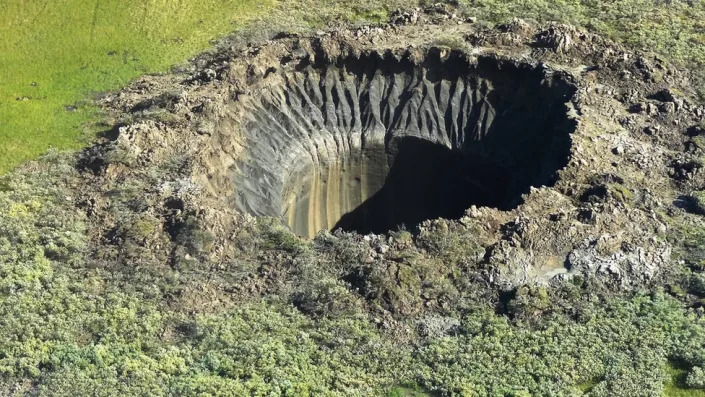
Scientists believe warmer ground temperatures have caused underground pockets of gas to spontaneously explode beneath permafrost
Birdsong, snowdrops, blossom and midge bites – these are not things you associate with November in the north of England.
But these are just some of the milder side effects of a warming world.
As well as fuelling deadly floods and drought, rising temperatures are cited as a cause of spontaneous explosions of Siberian permafrost, mustard shortages and the planet becoming dimmer.
Many of the impacts of climate change are devastating. Some are weird.
Exploding tundra and ‘earthshine’
Giant craters in thawing Siberian permafrost have been attributed by some Russian scientists to warmer ground temperatures causing underground pockets of gas to spontaneously explode. Permafrost is defined as land that has been frozen continuously for more than two years.
It’s only one hypothesis to explain the formation of giant craters in the Arctic landscape.
As this BBC Future article highlighted, they are a “disquieting sign” that this cold, largely unpopulated landscape at the north of our planet is undergoing some radical changes.
Crescent moon with the dark part of the Moon slightly illuminated by “earthshine”
And as well as blasting holes in Earth’s wilderness, climate change could also be dimming the planet’s “shine”, according to scientists at Big Bear Solar Observatory in New Jersey.
By measuring the sunlight reflected from Earth to the dark part of the moon at night, scientists measured what they call “earthshine” or albedo – basically Earth’s reflectiveness.
The studies suggested that the amount of low cloud cover over the eastern Pacific Ocean is reducing due to warming ocean temperatures.
Since these clouds act like a mirror, reflecting light from the Sun back into space, without them that reflected light diminishes. So, according to these scientists, we might actually be taking the shine off our little blue dot.
Sex-changing reptiles
While we might be causing global warming, we’re not the only species experiencing it. Some creatures are affected in truly surprising ways.
In some reptiles, the sex of offspring is partly determined by the temperature at which the eggs are incubated. Genetically male central bearded dragons – a species of lizard found in Australia – will actually change from male to female when they are incubated over a certain temperature. So scientists are concerned that males could become increasingly rare as the world warms – putting the species at risk of extinction.
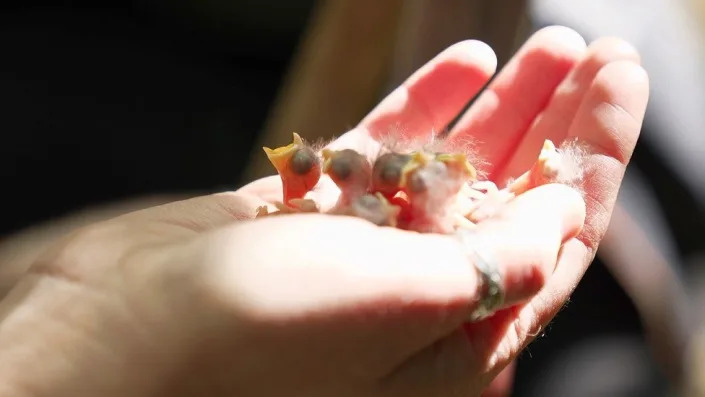
Day-old great tit nestlings in the palm of a scientist’s hand
Climate change is also measurably messing up seasonal synchrony. In Wytham Wood this April – the UK’s most scientifically studied woodland – great tit hatchlings emerged from their eggs up to three weeks earlier than they would have done in the 1940s.
The entire spring food chain has shifted with warming – the caterpillars the birds eat, the oak tree leaves the caterpillars eat – all reach their peak weeks earlier than they did before we warmed up the world.
While the seasons shift, many birds are adjusting – or just moving. This year, bee-eater chicks hatched in a Norfolk quarry – they are usually found in the southern Mediterranean and northern Africa.
Extreme weather is also making it harder to grow food. Staples like wheat, corn and coffee are already being affected. And this year, there have been some notable condiment shortages.
In April, Huy Fong Foods, a California-based company that produces around 20 million bottles of Sriracha chilli sauce every year, sent a letter to customers warning of a “severe shortage” of chillies.
In summer, supermarkets in France started to run out of Dijon mustard – a problem that could be traced to bad weather in the Canadian Prairies, where most of world’s mustard seeds are grown.
And the reality of climate change is even hampering efforts to go carbon-free. In August, the energy company EDF had to cut output from nuclear power stations situation in France, because there wasn’t enough cool water in French rivers.
Finding safe haven in the climate change future: The Midwest
David Knowles, Senior Editor – November 12, 2022
This Yahoo News series analyzes different regions around the country in terms of climate change risks that they face now and will experience in the years to come.
As the negative consequences of rising global temperatures due to mankind’s relentless burning of fossil fuels become more and more apparent in communities across the United States, anxiety over finding a place to live safe from the ravages of climate change has also been on the rise.
“Millions and likely tens of millions of Americans” will move because of climate through the end of the century, Jesse Keenan, an associate professor of real estate in Tulane University’s School of Architecture, told Yahoo News.“People move because of school districts, affordability, job opportunities. There are a lot of drivers and I think it’s probably best to think about this as ‘Climate is now one of those drivers.’”
A building is surrounded by floodwater in 2019 in Atchison, Kan. (Scott Olson/Getty Images)
In late October, a report by the United Nations concluded that average global temperatures are on track to warm by 2.1 to 2.9 degrees Celsius by the year 2100. As a result, the world can expect a dramatic rise in chaotic, extreme weather events. In fact, that increase is already happening. In the 1980s, the U.S. was hit with a weather disaster totaling $1 billion in damages once every four months, on average. Thanks to steadily rising temperatures, they now occur every three weeks, according to a draft report of the latest National Climate Assessment, and they aren’t limited to any particular geographic region.
To be sure, calculating climate risk depends on a dizzying number of factors, including luck, latitude, elevation, the upkeep of infrastructure, long-term climate patterns, the predictable behavior of the jet stream and how warming ocean waters will impact the frequency of El Niño/La Niña cycles.
“No place is immune from climate change impacts, certainly in the continental United States, and throughout the U.S. those impacts will be quite severe,” Keenan said. “They will be more severe in some places and less severe in other places. Certain places will be more moderate in terms of temperature and some places will be more extreme, but we all share the risk of the increase of extreme events.”
In this installment, we look at a region that is already used to weather extremes and where, thanks to climate change, even more are coming into view.
The Midwest
Made up of eight states — Ohio, Michigan, Indiana, Illinois, Missouri, Iowa, Minnesota and Wisconsin — the Midwest has found itself over recent centuries at the intersection of warm, moist air from the Gulf of Mexico and frigid polar vortexes that dip south from Canada. As with other regions of the country, climate change is already upending weather patterns in the Midwest and will, in the years to come, alter precipitation trends, food production, humidity and overall heat in profound ways.
Of the top 10 counties rated safest to live in the Midwest when it comes to climate change risks, six — Menominee, Vilas, Winnebago, Shawano, Portage and Polk — are located in Wisconsin, according to a 2020 analysis by the New York Times and ProPublica based on findings provided by the Rhodium Group, a data analytics firm. The remaining four in the top 10 Midwestern counties — Keweenaw, Luce, Crawford and Alger — are found in Michigan.
Many other counties in those two states and in Minnesota also ranked highly based on a cumulative scale that examined six major categories — heat stress, humidity (“wet bulb”), wildfires, crop loss, sea level rise and overall economic damages — and two emissions scenarios, high and moderate.
While northern counties in the Midwest offer relative protection from climate change risks, those further south, such as Missouri’s Camden, Hickory, Wayne, Bollinger, Dunklin, Maries, Phelps and Ripley counties as well as Illinois’s Alexander and Pulaski counties, all ranked lowest in the region, in large part due to poor scores on farm crop yields, heat and wet-bulb effect.
The bones of a fish washed ashore lie in a field of destroyed soybeans next to the Missouri River near Omaha in 2019. (Johannes Eisele/AFP via Getty Images)
While many Americans may not yet be familiar with the term “wet bulb,” they certainly will in parts of the Midwest before long. It refers to a potentially fatal combination of hot temperatures and high humidity that conspire to prevent the body from being able to cool itself down through the evaporation of sweat. That dynamic explains why even excessive “dry heat” feels less oppressive than less severe temperatures coupled with high humidity.
NASA predicts that Midwestern states like Missouri and Iowa will “hit the critical wet-bulb limit” in the next 50 years, leading to higher rates of weather-related deaths.
On average, the Midwest can expect dramatic shifts in temperatures if emissions continue at their current pace that will have a wide range of negative effects on human health.
“Compared to other regions where worsening heat is also expected to occur, the Midwest is projected to have the largest increase in extreme temperature-related premature deaths under the higher scenario,” the Centers for Disease Control and Prevention states on its website. “Northern midwestern communities and vulnerable populations that historically have not experienced high temperatures may be at risk for heat-related disease and death.”
As temperatures continue to rise, the Midwest will also find itself dealing with poor air quality, a risk category not included in the New York Times/ProPublica rankings.
“Increases in ground-level ozone and particulate matter are associated with the prevalence of various lung and cardiovascular diseases, which can lead to missed school days, hospitalization, and premature death,” the CDC states. “In the absence of mitigation, ground-level ozone concentrations are projected to increase across most of the Midwest, resulting in an additional 200 to 550 premature deaths in the region per year by 2050.”
An American flag remains standing after a tornado tore through rural Kentucky. (Jeremy Hogan/SOPA Images/LightRocket via Getty Images)
The CDC also warns that some of the climate change consequences forecast to hit the Midwest, such as drought, severe flash flooding and diminished air quality, can cause mental health problems like anxiety. Kristi White, a clinical health psychologist in Minneapolis, has already been treating young adults for anxiety born of climate change.
“Some of the things in the patients that I work with are things like asthma exacerbation due to poor air quality from wildfires [and] concerns around the risk for heat-related illnesses during extreme heat waves,” White told Yahoo News earlier this year.
While the climate change risks to the Midwest and other regions of the country have long been predicted by climate scientists using computer modeling, there’s still a large element of surprise when it comes to pinpointing which parts of the region can expect to see extreme weather events and exactly how bad they will be.
Indeed, this summer it seemed as though 1-in-1,000-year rain events traveled in threes.
One increasingly glaring problem with rating extreme rainfall events in terms of their historical likelihood is that the changing climate has rendered such scales woefully out of date.
“If you build a statistical model based on a climate that no longer exists, it’s not going to be too surprising that it fails,” UCLA climate scientist Daniel Swain, who also consults for ClimateCheck, a company that provides climate change risk assessments on real estate nationwide, told Yahoo News. Most “hydrologic models and the Army Corps of Engineers” do not factor in the Clausius-Clapeyron equation, which describes the increase in atmospheric moisture that results from every degree of temperature rise, into their modeling, Swain added.
Simply put, more atmospheric moisture can result in more rainfall. Overall, the Environmental Protection Agency has found that rainfall across the Midwest has risen by 5 to 10% in the past 50 years on average. Though average annual rainfall won’t rise at an equal pace across the region, the trend line based on current greenhouse gas projections is clear.
A street is flooded after water from the Tittabawassee River breached a nearby dam in 2020 in Sanford, Mich. (Gregory Shamus/Getty Images)
“Precipitation in the Midwest is expected to become more intense, leading to increased flood damage, strained drainage systems, and reduced drinking water availability,” the EPA says on its website.
But the other major aspect of the Clausius-Clapeyron equation is that warmer temperatures dramatically speed up evaporation rates so that even when a region sees an uptick in the amount of annual precipitation, it remains susceptible to drought. In 2021, for instance, 27% of the Midwest experienced a drought, according to the National Oceanic and Atmospheric Administration, including 70% of Michigan and 57% of Iowa.
In 2022, despite record-setting rains in some states, large portions of Iowa, Missouri and Minnesota now find themselves in severe or extreme drought, according to the U.S. Drought Monitor.
To be sure, while the Upper Midwest — including northern Minnesota and Wisconsin and Michigan’s Upper Peninsula — offers cooler average temperatures than other parts of the region, it has also been warming fastest in the region in recent years. Ice on the Great Lakes continues to melt away earlier and wintertime average temperatures across the region have risen significantly. For a little while, that might all seem like good news, sparing residents from the unrelenting winters of past decades. But should emissions continue at their current levels, the changes to the Midwest will be jarring.
Ice forms along the shore of Lake Michigan as temperatures hang in the single digits on Jan. 26 in Chicago. (Scott Olson/Getty Images)
For Hoosiers, that will mean an increase from seven days per year of temperatures exceeding 95°F at present to between 50 and 89 of them by the end of the century. That heat will, in turn, further decrease crop yields for corn and soybeans, potentially upending a way of life.
In some ways, the Midwest epitomizes the folly of trying to outrun climate change. For every global warming advantage that is offered in places like northern Michigan and Wisconsin, other hazards are poised to present themselves. In its entry on the Midwest, the U.S. Climate Resilience Toolkit highlights those emerging risks.
“Climate change is expected to worsen existing health conditions and introduce new health threats by increasing the frequency and intensity of poor air quality days, extreme high temperature events, and heavy rainfalls; extending pollen seasons; and modifying the distribution of disease-carrying pests and insects,” the website states.
Ukraine war’s environmental toll to take years to clean up
Sam Mednick – November 11, 2022
A view of a fuel depot hit by Russian missile in the town of Kalynivka, about 30 kilometers (18 miles) southwest of Kyiv, Ukraine, Thursday, Oct. 27, 2022. Environmental damage caused by Ukraine’s war is mounting in the 8-month-old conflict, and experts warn of long-term health consequences for the population. (AP Photo/Andrew Kravchenko)Workers inspect a fuel depot hit by Russian missile in the town of Kalynivka, about 30 kilometers (18 miles) southwest of Kyiv, Ukraine, Thursday, Oct. 27, 2022. Environmental damage caused by Ukraine’s war is mounting in the 8-month-old conflict, and experts warn of long-term health consequences for the population. (AP Photo/Andrew Kravchenko)
DEMYDIV, Ukraine (AP) — Olga Lehan’s home near the Irpin River was flooded when Ukraine destroyed a dam to prevent Russian forces from storming the capital of Kyiv just days into the wa r. Weeks later, the water from her tap turned brown from pollution.
“It was not safe to drink,” she said of the tap water in her village of Demydiv, about 40 kilometers (24 miles) north of Kyiv on the tributary of the Dnieper River.
Visibly upset as she walked through her house, the 71-year-old pointed to where the high water in March had made her kitchen moldy, seeped into her well and ruined her garden.
Environmental damage from the 8-month-old war with Russia is mounting in more of the country, with experts warning of long-term consequences. Moscow’s attacks on fuel depots have released toxins into the air and groundwater, threatening biodiversity, climate stability and the health of the population.
Because of the war, more than 6 million Ukrainians have limited or no access to clean water, and more than 280,000 hectares (nearly 692,000 acres) of forests have been destroyed or felled, according to the World Wildlife Fund. It has caused more than $37 billion in environmental damage, according to the Audit Chamber, a nongovernmental group in the country.
“This pollution caused by the war will not go away. It will have to be solved by our descendants, to plant forests, or to clean the polluted rivers,” said Dmytro Averin, an environmental expert with Zoi Environment Network, a non-profit organization based in Switzerland.
While the hardest-hit areas are in the more industrial eastern regions of Donetsk and Luhansk, where fighting between government troops and pro-Russian separatists has been going on since 2014, he said, the damage has spread elsewhere.
“In addition to combat casualties, war is also hell on people’s health, physically and mentally,” said Rick Steiner, a U.S. environmental scientist who advised Lebanon’s government on environmental issues stemming from a monthlong war in 2006 between that country and Israel.
The health impact from contaminated water and exposure to toxins unleashed by conflict “may take years to manifest,” he said.
Ukrainian authorities then began bringing in fresh water, but the shipments stopped in October when the tanker truck broke down, forcing residents to again drink the dirty water, they said.
“We don’t have another option. We don’t have money to buy bottles,” Iryna Stetcenko told The Associated Press. Her family has diarrhea and she’s concerned about the health of her two teenagers, she said.
In May, the government took samples of the water, but the results have not been released, said Vyacheslav Muga, the former acting head of the local government’s water service. The Food Safety and Consumer Protection agency in Kyiv has not yet responded to an AP request for the results.
Reports by other environmental groups, however, have shown the effects of the war.
In recent weeks, Russia has targeted key infrastructure like power plants and waterworks. But even in July, the U.N.’s environmental authority already was warning of significant damage to water infrastructure including pumping stations, purification plants and sewage facilities.
A soon-to-be-published paper by the Conflict and Environment Observatory, a British charity, and the Zoi Environment Network, found evidence of pollution at a pond after a Russian missile hit a fuel depot in the town of Kalynivka, about 30 kilometers (about 18 miles) southwest of Kyiv.
The pond, used for recreation as well as a fish farm, showed a high concentration of fuel oil and dead fish on the surface — apparently from oil that had seeped into the water, A copy of the report was seen by the AP.
Nitrogen dioxide, which is released by burning fossil fuels, increased in areas west and southwest of Kyiv, according to an April report from REACH, a humanitarian research initiative that tracks information in areas affected by crisis, disaster and displacement. Direct exposure can cause skin irritation and burns, while chronic exposure can cause respiratory illness and harm vegetation, the report said.
Ukraine’s agriculture sector, a key part of its economy, also has been affected. Fires have damaged crops and livestock, burned thousands of hectares of forest and prevented farmers from completing the harvest, said Serhiy Zibtsev, forestry professor at Ukraine’s National University of Life and Environmental Sciences.
“The fires are so massive,” he said, adding that farmers “lost everything they were harvesting for winter.”
The government in Kyiv is providing assistance when it can.
In Demydiv and surrounding villages, flood victims were given the equivalent of $540 each, said Liliia Kalashnikova, deputy head of the nearby town of Dymer. She said the government would do everything it could to prevent long-term environmental effects, but she didn’t specify how.
Governments have an obligation to minimize environmental risks for the population, especially during war, said Doug Weir, research and policy director for the Conflict and Environment Observatory, a U.K.—based monitoring organization.
Some Ukrainians have already lost hope.
“I feel depressed — there’s water all around and under my house,” said Demydiv resident Tatiana Samoilenko. “I don’t see much changing in the future.”
A Core Question at COP27: Who Will Pay for Climate Change?
Elena Shao – November 7, 2022
French President Emmanuel Macron delivers a speech at the COP27 climate summit in Sharm el-Sheikh, Egypt, Monday, Nov. 7, 2022. Nearly 50 heads of states or governments on Monday will take the stage in the first day of “high-level” international climate talks in Egypt with more to come in the following days. (Ludovic Marin, Pool via AP) (ASSOCIATED PRESS)
When world leaders gather in Sharm el Sheikh this week for the annual United Nations climate summit, the debate over who bears financial responsibility for climate change will be center stage.
Poor nations, which have contributed the least to climate change but are among the most vulnerable to its effects today, are seeking more financial commitments from rich countries, many of which have grown their economies by burning fossil fuels.
The consequences of global warming are already unfolding, with developing countries often on the front lines of the devastation.
Pakistan experienced catastrophic floods this summer, which scientists said were made worse by climate change.
One-third of the country was left under water, leaving 1,700 people dead and causing at least $40 billion in economic losses.
Extreme flooding also submerged parts of Nigeria this month, and elsewhere in Africa, record drought has brought millions to the brink of starvation.
At this year’s climate conference, known as COP27, developing countries are expected to press wealthy nations — historically the world’s biggest emitters — to fulfill earlier promises of financial support and push them ever further.
Current Commitments Falling Short
More than a decade ago, the world’s rich, industrialized countries — including the United States, Canada, Australia, Britain and Japan — committed to giving $100 billion a year by 2020 (and through 2025) to poor nations for climate adaptation and mitigation projects.
But wealthy countries have failed to meet that goal.
Nations will need to agree on another financing goal of at least $100 billion a year before 2025, so negotiations at this year’s summit will begin shaping that goal. Most estimates have suggested that $100 billion is not nearly enough to help poor countries stave off the worst effects of climate change, let alone shift away from burning oil, gas and coal.
“All of the evidence suggests that we need trillions, not billions,” said Baysa Naran, a manager at Climate Policy Initiative, a research center.
The money has funded mitigation projects, which help developing countries transition away from fossil fuels, like building a zero-emissions transit system in Pakistan. Money has also gone toward adaptation projects, which help countries build resilience against climate risks, like restoring mangrove habitats in Guinea-Bissau to protect from rising seas.
Critics point out that funding has often come in the form of loans rather than grants. That has increased many poor countries’ already unsustainable burden of debt, said Alina Averchenkova, a climate policy fellow at the London School of Economics.
Some countries may also count certain types of projects toward their contributions that others do not, which can lead to inflated figures, said Sarah Colenbrander, director of the climate program at the Overseas Development Institute.
The $100 billion goal was “carefully crafted” to be deliberately vague — a result of highly politicized negotiations at COP15 in Copenhagen, said Preety Bhandari, a senior adviser at the World Resources Institute.
As a result, there’s no requirement that specific countries contribute a certain proportion of the funds. Multiple analyses have calculated that the United States, which contributed less than $3 billion of the $83.3 billion in 2020, is underdelivering by tens of billions of dollars when considering its relative emissions, population size and wealth.
In addition, mitigation projects have generally received twice as much funding as those focused on adaptation, although many experts and representatives from vulnerable nations say that the two should be more balanced. While mitigation addresses the root of the climate problem by curbing emissions, it doesn’t help communities adapt to current or future risks.
An agreement reached at the end of last year’s climate negotiations in Glasgow urged rich countries to “at least double” finance for adaptation by 2025 to $40 billion.
A Separate Fund for ‘Loss and Damage’
More recently, some of the world’s most vulnerable nations have intensified calls for new funds from the world’s wealthiest economies to compensate for damages caused by climate change.
The issue is known in climate negotiations as “loss and damage” and proponents have described it as a form of climate reparations to pay for irreversible losses of income, culture, biodiversity and lives.
Wealthy countries have historically resisted calls for a loss and damage fund, largely out of fear that it could open them up to legal liability. In Glasgow last year, the United States opposed language that would set up such a fund.
This year, as Egypt has vowed to put loss and damage on the formal COP27 agenda, representatives from the United States and European countries have indicated that they might be open to discussing it.
A group of small island states first raised the issue of loss and damage in 1991, pointing to the irreparable destruction they faced from sea level rise. Since then, those countries have attempted to quantify the crushing costs. V20, or the Vulnerable Twenty group composed of finance ministers from 58 nations, estimated that its member states have lost $525 billion, or about one-fifth of their wealth, over the past two decades because of climate change.
“Countries are already paying for climate change now, and the burning question is: Can we let this go on?,” said Sara Jane Ahmed, a financial adviser to V20. “And the answer is: No, we can’t.”
Gates Foundation gives $1.4 billion climate help to smallholder farmers
Simon Jessop and Virginia Furness – November 7, 2022
FILE PHOTO: Paris hosts a global gender equality conference
SHARM EL-SHEIKH, Egypt (Reuters) – The Bill & Melinda Gates Foundation has pledged $1.4 billion to help smallholder farmers cope with the impacts of climate change, part of efforts at global climate talks in Egypt to scale up supply of so-called adaptation finance.
The world is currently not doing enough to help poorer nations withstand the effects of global warming, the United Nations said last week. By 2030, the annual financing need will be $340 billion, it added.
The Gates Foundation’s commitment, announced at the COP27 conference in Sharm el-Sheikh, will help smallholder farmers in sub-Saharan Africa and South Asia build resilience into their work practices and improve food security.
More than 2 billion people depend on smallholder farms for food and income, yet currently less than 2% of global climate-related finance is devoted to helping them adapt to climate change, the foundation said.
“The climate crisis is causing enormous harm every day as it jeopardizes entire regions of people and economies,” Bill Gates, co-chair of the Bill & Melinda Gates Foundation, said in a statement.
“More funding is necessary to ensure agricultural and technological innovations are widely available to vulnerable communities, helping them to adapt to climate change, save lives and increase economic growth.”
The foundation said its funding would go towards climate smart agriculture projects, new applications of digital technologies and other innovations, and to support women farmers.
Women account for 43% of the agricultural workforce in developing countries, but they tend to have far less access to finance, legal rights and education than men as a result of entrenched gender inequality.
“Women in rural Africa are the backbone of their food systems, but they have never had equal access to the resources they need to reach their full potential or build resilience to looming climate threats,” said foundation co-chair Melinda French Gates.
(Reporting by Virginia Furness; Editing by Mark Potter)
How climate change, rising sea levels are transforming coastlines around the world
Julia Jacobo, Daniel Manzo and Ginger Zee – November 7, 2022
Communities have gravitated toward the shore for thousands of years, building their lives in proximity to major waterways for easy access to trade, seafood and recreation.
But those who reside near coastlines will need to learn to adjust as climate change continues to create conditions that chip away at these malleable geological structures, according to experts.
One of the recurring topics of the 2022 United Nations Climate Change Conference taking place in Cairo, Egypt, is how climate change is currently affecting people around the world. As coastlines change and become battered by an increase in the number of severe weather events, homes — and, in some cases, entire communities — are being condemned as they become inundated with seawater the more the natural barriers are broken down.
PHOTO: A composite image shows the Rockaway boardwalk area after Hurricane Sandy, Oct. 31, 2012 (top) and a year later (bottom) in the Rockaway neighborhood of the Queens borough of New York, Oct. 20, 2013. (Spencer Platt/Getty Images, FILE)
The transformation of coastlines is constant. Coastal erosion is a natural part of the Earth’s cycle as strong waves continually crash against the shore. But as global temperatures warm and sea levels rise, the damage to the coast’s natural barriers is being exacerbated with each subsequent monster storm with tropical force winds or higher — which typically causes the most damaging events of erosion, scientists say.
As melting glaciers and ice sheets cause sea levels to rise, the ocean waves around the coast become more intense, Raphael Crowley, associate professor at the University of North Florida’s Engineering School of Sustainable Infrastructure and Environment, told ABC News.
In addition, gradual effects from day-to-day erosion reaching farther inland, such as land that was previously above sea level being underwater more, will weaken the structure of the coastlines even more — allowing for strong storms to do more damage when they pass through, Ronadh Cox, a professor of geology and mineralogy at Williams College in Williamstown, Massachusetts, told ABC News. Each high tide that reaches previously dry land has a cumulative effect on shoreline retreat and the associated erosion.
“So, everything from nuisance flooding associated with tides rising higher, to storm surges penetrating farther inland, all contribute to these effects of the coast,” Cox said.
PHOTO: A composite image shows the boardwalk washed away during Hurricane Sandy in the Rockaway neighborhood of the Queens borough of New York, Nov. 10, 2012 (top) and cars parked on the street in the Rockaway neighborhood, Oct. 19, 2013 (bottom). (Spencer Platt/Getty Images, FILE)
The types of natural infrastructures that can be destroyed are sand dunes, cliffs and even living shorelines, such as plants, marshes and oyster reefs — all of which can act as barriers to an influx of ocean water. A marsh measuring 15 feet deep can absorb about 50% of incoming wave energy, but these living barriers continue to dwindle, as well.
The deterioration of coastlines can also be impacted by the human tendency to develop right on top of them, according to experts.
As populations increase and more housing is built near the coast, oftentimes the coastal wetlands are drained to make room for development, Cox said.
PHOTO: (top) A man walks along the heavily damaged Rockaway beach, Nov. 2, 2012 (bottom) People walk down the beach in Rockaway neighborhood of the Queens borough of New York City, Oct. 23, 2013. (Spencer Platt/Getty Images, FILE)
When the barriers along the coastlines fail to keep ocean water out, it wreaks havoc on communities, Crowley said. Roads become impassable. Homes become at risk of being destroyed or even swept away in some cases of extreme storm surge — like what happened in parts of southwest Florida due to Hurricane Ian.
“The combined effect of all of these things, of course, is increased erosion, land loss and infrastructure loss,” Cox said.
Coastal erosion is already tallying up to about $500 million annually in property damage, according to the U.S. Climate Resiliency Toolkit, an online resource that compiles data from the U.S. federal government.
“The problem with coastal engineering is that coasts are constantly evolving,” Crowley said.
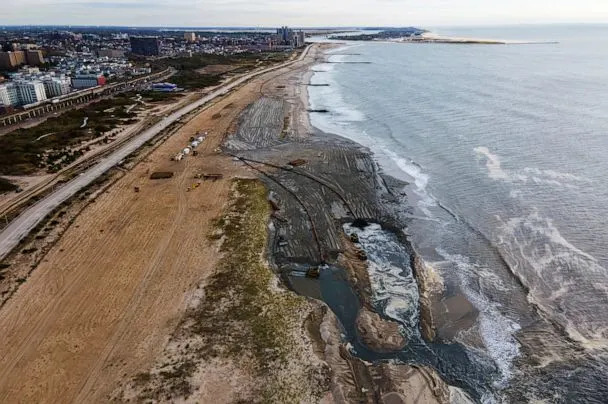
PHOTO: Contractors for the U.S. Army Corps of Engineers pump sand from the ocean floor onto the beach in the Rockaway Peninsula in New York City, Oct. 18, 2022. (Ted Shaffrey/AP, FILE)
If people want to live near the ocean, protection measures such as ensuring a high enough elevation and that there is a barrier between the structure and the water — such as a sand dune — should be implemented, Crowley said.
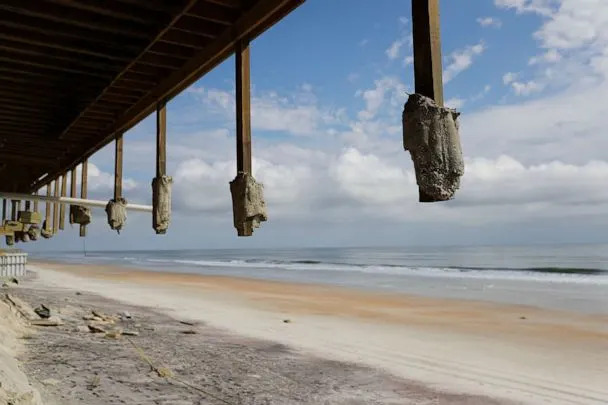
Severe storms can remove wide beaches in a single event. Following the passing of Hurricane Irma in 2017, Crowley witnessed what was previously a sand dune in north Florida’s Vilano Beach transformed into “a 40-foot cliff with a house hanging off of it,” he said. That structure was one of several dozen that Crowley knew would never be livable again, he said.
PHOTO: Support beams for a home’s deck are exposed after the sand below was eroded from Hurricane Irma in Vilano Beach, Fla., Friday, Sept. 15, 2017. (David Goldman/AP)
The research is suggesting that what was previously considered a once-in-a-generation storm, such as Ian, could start to occur more frequently, Crowley said.
In addition, Cox has witnessed famed coastal towns such as Nantucket and Martha’s Vineyard, both in Massachusetts, lose measurable levels of cliff retreat of several meters per year in some places, she said.
In Pinellas County, Florida, a half-foot of sea level rise in the past 50 years has led to the loss of 120 feet of beach, John Bishop, coastal management coordinator for the Pinellas County Government, told ABC News.
Sea levels have been rising about 3.5 millimeters per year since the early 1900s, Crowley said.
“It doesn’t sound like a lot, but then if you add that up over 100 years — that’s quite a bit of rise,” he said, adding that the rate of rise has since accelerated.
PHOTO: Contractors for the U.S. Army Corps of Engineers pump sand from the ocean floor onto the beach in the Rockaway Peninsula in New York City, Oct. 18, 2022. (Ted Shaffrey/AP, FILE)
In the next 30 years, sea level along the U.S. coastline is projected to rise, on average, 10 to 12 inches — the same amount it rose in the past century, according to a new report by the National Oceanic and Atmospheric Administration’s 2022 Sea Level Rise Technical Report. Experts believe the drastic rise will continue to exacerbate coastal erosion and the problems people living near the ocean will face.
About 2 feet of sea level rise along the U.S. coastline is increasingly likely between 2020 and 2100 because of emissions to date, according to the NOAA report. An additional 1.5 to 5 feet of sea level rise is possible by the end of the century should countries around the world fail to curb emissions, the report predicted.
Rate of sea level rise ‘has doubled since 1993’ thanks to climate change, report finds
Ben Adler, SeniorEditor – November 7, 2022
The rate of global sea level rise is speeding up dramatically as temperatures continue to rise due to climate change, a new report finds, and now poses “a major threat to many millions” of people living on ocean coastlines.
Sea levels have risen by an average of 10 millimeters since January 2020, reaching a new record high this year, according to the World Meteorological Organization (WMO), which issued a stark warning in its provisional State of the Global Climate in 2022 report, released Sunday. The WMO, a division of the United Nations, found a number of striking facts about climate change and its effects, including that “the past eight years are on track to be the eight warmest on record.”
But the most alarming findings may be those related to sea level rise, as the encroaching ocean threatens major coastal population centers with stronger storms, higher storm surges and flooding. “The rate of sea level rise has doubled since 1993,” the WMO noted. “The past two and a half years alone account for 10 percent of the overall rise in sea level since satellite measurements started nearly 30 years ago.”
Meltwater flows from the Greenland ice sheet into the Baffin Bay in July. (Kerem Yucel/AFP via Getty Images)
One of the main causes of the accelerating pace of sea level rise is melting glaciers. According to the WMO, “2022 took an exceptionally heavy toll on glaciers in the European Alps, with initial indications of record-shattering melt. The Greenland ice sheet lost mass for the 26th consecutive year and it rained (rather than snowed) there for the first time in September.”
Last week, the United Nations Educational, Scientific and Cultural Organization (UNESCO) issued a report on endangered glaciers finding that one-third of the glaciers in UNESCO World Heritage sites are expected to disappear by 2050. The remaining two-thirds can be saved if greenhouse gas emissions are cut quickly and deeply enough to limit global warming to 1.5 degrees Celsius above preindustrial levels, the report concluded.
The devastating effects of melting glaciers is already being witnessed in Pakistan, where an unusually warm spring caused glacial melt that contributed to the floods that have submerged one-third of the country, displacing millions of residents.
The report’s release coincided with the opening of the U.N. Climate Change Conference in Sharm-el Sheik, Egypt, also known as COP27, with the intent of bolstering support for more aggressive action to curb emissions. Political developments, however, have diminished hopes that major new commitments of reducing greenhouse gases will be announced during COP27.
People wade across a flooded street after heavy monsoon rainfall in Karachi, Pakistan, in July. (Asif Hassan /AFP via Getty Images)
“The greater the warming, the worse the impacts,” WMO Secretary-General Petteri Taalas said in a statement. “We have such high levels of carbon dioxide in the atmosphere now that the lower 1.5°C of the Paris Agreement is barely within reach. It’s already too late for many glaciers, and the melting will continue for hundreds if not thousands of years. … Although we still measure this in terms of millimeters per year, it adds up to half to 1 meter per century, and that is a long-term and a major threat to many millions of coastal dwellers and low-lying states.”
As the oceans rise from melting glaciers and polar ice caps, they also are getting warmer as they absorb more heat, causing their volume to expand further. Ocean temperatures reached record levels in 2021 (the latest year for which data was available). Hotter oceans lead to an array of effects on the ecosystem, including coral bleaching and declining fish populations. It also powers stronger storms like Hurricane Fiona, which recently devastated Puerto Rico with 30 inches of rain, causing landslides and overflowing rivers and widespread power outages.
In 2022, the average global temperature is estimated to be about 1.15 °C above the 1850-1900 average. This actually could have been worse. For the first time in a century, La Niña, a weather pattern that causes cool water to rise to the surface in the Pacific Ocean — leading to cooler-than-usual weather — occurred for the third year in a row. The WMO estimates that this means 2022 will be the fifth- or sixth-hottest year on record, rather than the hottest ever. But the trend toward ever-higher temperatures remains clear.
U.N. Secretary-General António Guterres at the COP27 climate conference in Sharm el-Sheikh, Egypt, on Monday. (Fayez Nureldine/AFP via Getty Images)
“The latest State of the Global Climate report is a chronicle of climate chaos,” said U.N. Secretary-General António Guterres in response to the report’s release. “As the World Meteorological Organization shows so clearly, change is happening with catastrophic speed, devastating lives and livelihoods on every continent. Glacier melt records are themselves melting away, jeopardizing water security for whole continents. We must answer the planet’s distress signal with action — ambitious, credible climate action. COP27 must be the place, and now must be the time.”