Greta Thunberg’s Response To Andrew Tate Getting Arrested Is One For The History Books
December 30, 2022
Twitter has been pretty fun for the past 24 hours all thanks to Greta Thunberg.
Christopher Furlong / Getty Images
It all started with misogynistic internet personality, Andrew Tate, making a random swipe at Greta.
Karwai Tang / WireImage / Getty Images
In case you didn’t know, Andrew Tate was banned from Twitter in 2017 for hate speech.
Karwai Tang / WireImage / Getty Images
He was recently allowed back on the platform because of the new changes Elon Musk made.
– / Twitter account of Elon Musk/AFP via Getty Images
He took this opportunity to tweet at climate activist Greta Thunberg about owning 33 cars:
Hello Greta Thurnberg: I have 33 cars. My Bugatti has a w16 8.0L quad turbo. My TWO Ferrari 812 competizione have 6.5L v12s. This is just the start. Please provide your email address so I can send a complete list of my car collection and their respective enormous emissions.
Greta responded:
yes, please do enlighten me. email me at smalldickenergy@getalife.com
Andrew Tate:
HelloGreta Thunberg: I have 33 cars. My Bugatti has a w16 8.0L quad turbo. My TWO Ferrari 812 competizione have 6.5L v12s. This is just the start. Please provide your email address so I can send a complete list of my car collection and their respective enormous emissions.
People on Twitter collectively lost their minds over her reply:
George Conway Replying to Greta Thunberg:
“this may well be the greatest tweet of all time”
And then Andrew tweeted this cigar smoking rant:
Thank you for confirming via your email address that you have a small penis @GretaThunberg
I think this tweet from George Takei sums it up best:
So…Elon Musk let Andrew Tate back on Twitter, and Tate promptly used it to reveal his whereabouts to authorities in Romania who then arrested him. All because Greta Thunberg owned him so hard his little wee-wee fell off. Do I have that right? Please say I have that right.
A Town-by-Town Battle to Sell Americans on Renewable Energy
David Gelles – December 30, 2022
Brendan Burton of Ospur, Ill., an ironworker and farmer, welcomes the wind farm and the jobs it would bring to the area. (Mustafa Hussain/The New York Times)
MONTICELLO, Ill. — Depressed property values. Flickering shadows. Falling ice. One by one, a real estate appraiser rattled off what he said were the deleterious effects of wind farms as a crowd in an agricultural community in central Illinois hung on his every word.
It was the 10th night of hearings by the Piatt County zoning board, as a tiny town debated the merits of a proposed industrial wind farm that would see dozens of enormous turbines rise from the nearby soybean and corn fields. There were nine more hearings scheduled.
“It’s painful,” said Kayla Gallagher, a cattle farmer who lives nearby and opposes the project. “Nobody wants to be here.”
In the fight against global warming, the federal government is pumping a record $370 billion into clean energy, President Joe Biden wants the nation’s electricity to be 100% carbon-free by 2035, and many states and utilities plan to ramp up wind and solar power.
But while policymakers may set lofty goals, the future of the American power grid is, in fact, being determined in town halls, county courthouses and community buildings across the country.
The only way Biden’s ambitious goals will be met is if rural communities, which have large tracts of land necessary for commercial wind and solar farms, can be persuaded to embrace renewable energy projects. Lots of them.
According to an analysis by the National Renewable Energy Laboratory, the United States would need to construct more than 6,000 projects like the Monticello one in order to run the economy on solar, wind, nuclear or other forms of nonpolluting energy.
In Piatt County, population 16,000, the project at issue is Goose Creek Wind, which has been proposed by Apex Clean Energy, a developer of wind and solar farms based in Virginia. Apex spent years negotiating leases with 151 local landowners and trying to win over the community, donating to the 4-H Club and a mental health center.
Now, it was making its case to the zoning board, which will send a recommendation to the county board that will make a final call on whether Apex can proceed. If completed, the turbines, each of them 610 feet tall, would march across 34,000 acres of farmland.
The $500 million project is expected to generate 300 megawatts, enough to power about 100,000 homes. The renewable, carbon-free electricity would help power a grid that is fed by a mix of nuclear, natural gas, coal and some existing wind turbines.
But with more and more renewable-energy projects under construction around the country, resistance is growing, especially in rural communities in the Great Plains and Midwest.
“To meet any kind of clean energy goals which brings consumer benefits and energy independence, you’re going to see an increase in projects,” said JC Sandberg, interim CEO of the American Clean Power Association. “And with those increases in projects, we are facing more of these challenges.”
On Election Day last month, Apex saw its development efforts for a wind farm in Ohio die when voters in Crawford County overwhelmingly voted to uphold a ban on such projects. On the same day, voters in Michigan rejected ordinances that would have allowed construction of another Apex wind project. This month, local officials in Monroe County, Michigan, extended a temporary moratorium on industrial solar projects, delaying plans by Apex to develop a solar farm in the area.
“Projects have been getting more contentious,” said Sarah Banas Mills, a lecturer at the school for environment and sustainability at the University of Michigan who has studied renewable development in the Midwest. “The low-hanging-fruit places have been taken.”
In Piatt County, the zoning board decided to conduct a mock trial of sorts. During the first nine hearings, Apex and its witnesses made the case that property values would not decline and that other concerns about wind farms — that they are ugly, that they kill birds or that the low frequency noise they emit can adversely affect human health — were not major issues.
They won some converts. Meg Miner, 61, a resident who was on the fence about the project, decided to support Apex after considering how the project would help fight climate change.
But others were worried about all the issues that the real estate appraiser mentioned, and more. “I moved here for nature, for trees, for crops,” said Sandy Coyle, who lives nearby and opposed the project. “I’m not interested in living near an industrial wind farm.”
Much of that skepticism appeared to be earnest concern from community members who weren’t sold on the project’s overall merits. On the fringe of the debate, however, was a digital misinformation campaign designed to distort the facts about wind energy.
The website of a group called Save Piatt County!, which opposes the project, is rife with fallacies about renewable energy and inaccuracies about climate science. On Facebook pages, residents opposed to the project shared negative stories about wind power, following a playbook that has been honed in recent years by anti-wind activists, some of whom have ties to the fossil fuel industry. The organizers of the website and Facebook groups did not reply to requests for comment.
As part of the Goose Creek Wind project, Apex has secured a commitment from Rivian, an upstart electric truck company, to buy power from the project, a development that drew skeptical replies in one Facebook group. “Scam artists in it together to fleece middle class taxpayers,” wrote one local resident in response to a news story about the deal. “Wake up.”
That milieu of misinformation appeared to sway some residents.
“These things are intrusive,” said Kelly Vetter, a retiree who opposed the project and disputed the overwhelming scientific consensus that carbon dioxide emitted from the burning of fossil fuels is dangerously warming the planet. “The company’s never going to have the community’s interest at heart.”
Apex declined to comment.
‘We All Want What’s Good for Society’
Smack in the middle of the area where Apex wants to erect its turbines sits the Bragg family’s farm, a roughly 1,500-acre plot that on a cold December afternoon was little more than an expanse of mud after the fall harvest and a week of rain.
Braxton Bragg, 40, who grew up on the land and returned after stints in the Peace Corps that took him to Mali and Mongolia, supports the project. He is concerned about climate change and said he already sees its effects. The rain is harder when it comes, the cold sets in later than it used to and, overall, the growing season is less predictable than it was when his grandfather worked the same land.
But his support for wind comes down to economics. Bragg has agreed to let Apex site one of its turbines on his property, and he expects to earn about $50,000 a year if it is built.
“It’s not going to save the farm or allow me to retire,” he said. “But just having that steady income every year, you know what you’re going to get.”
A few miles down the road is Gallagher Farms, another multigenerational operation. Like Bragg, Gallagher, 34, believes in climate change. She has invested in cover crops, which absorb carbon and lock it away in the soil, and other regenerative agriculture practices.
But Gallagher is opposed to the project. The aerial seeding of cover crops will cost more with wind turbines nearby and make it harder for her to sustainably farm. The use of heavy equipment to install turbines can disrupt drainage patterns in agricultural land, and Gallagher believes her farm will suffer.
Adding to her frustration is the fact that about 70% of the landowners who have agreed to let Apex put turbines on their property live outside Piatt County.
“They don’t live here, so they’re not impacted,” Gallagher said as she tended to her cattle before heading to yet another hearing.
More than anything else, Gallagher fears that the wind turbines, which she would see from her front porch, would disrupt the bucolic land she loves. In the predawn hours, she walks outside and listens to the crickets, which she worries will be drowned out by the low thrum of the turbines. At night, she watches the sun set over a grain silo in the west and doesn’t want the view marred by spinning turbines and flashing lights.
“We all want what’s good for society,” she said. “But it seems to be coming at the expense of our day-to-day lives.”
Bragg was sympathetic. “The only real argument that is valid, in my opinion, is that it’s going to change people’s sunsets and the beauty of living out in the country,” he said.
Still, he said, this was working farmland, and it was his right to put it to productive use.
“If you put your nice country house in the middle of my business, I’m sorry, there’s not much I can do about that,” Bragg said. “I think they probably would do the same thing if they were in my boat. The economics takes precedence over everything.”
Landowners such as the Braggs would receive about $210 million in lease payments over the project’s 30-year life, Apex said. And there would be other economic benefits, including $90 million in local taxes. And if the project is built, the company said it would create eight permanent jobs and employ nearly 600 people during construction, including men such as Brendan Burton.
Burton, an ironworker who has helped build several nearby wind farms, said the jobs would help fill the void created by factories that have closed or moved overseas.
“We’re not building things here like we used to,” he said. “We need the jobs.”
Burton added that he wanted to see his community contribute clean energy to the grid as well.
“We can’t keep burning coal or natural gas,” he said.
‘We’re Going to Make People Angry’
The debate in Piatt County has been remarkably civil. Similar hearings elsewhere have descended into shouting matches. In some cases, activists with ties to organizations that shield their donors have turned communities against proposed wind and solar projects.
That was the case in Michigan’s Monroe County, where local officials recently extended a moratorium that is blocking Apex from developing a solar project.
The opposition in Monroe County includes local residents, but also anti-wind activists with ties to groups backed by Koch Industries, which owns oil refineries, petrochemical plants, and thousands of miles of oil and gas pipelines. On Facebook, those skeptical of the Apex project shared negative stories about solar power, and opponents of the project went door to door distributing misinformation.
On another cold night in December, as the 11th hearing on the Goose Creek Wind project began at the Monticello community building, Phil Luetkehans, a lawyer hired by opponents of the project, called more witnesses, including an audiologist, who discussed what he said were the adverse health effects of wind turbines. A lawyer representing Apex cross-examined him, and the hearing stretched for more than four hours.
“Both sides are getting a full opportunity to portray their position and to put forth the facts, and the people who we elect will make those final decisions,” Luetkehans said. “Some communities end up saying, ‘No, we don’t want an industrial scale wind at this proximity to homes.’ Others say, ‘Yeah, we want the money.’”
Among those in the audience was Michael Beem, a newly elected member of the Piatt County board, which will ultimately decide whether Apex can build its wind farm. From the back of the room, Beem was bracing himself to make a choice that will undoubtedly leave this rural community divided.
“No matter what decision we make,” he said, “we’re going to make people angry.”
EPA finalizes water rule that repeals Trump-era changes
Jim Salter and Michael Phillis – December 30, 2022
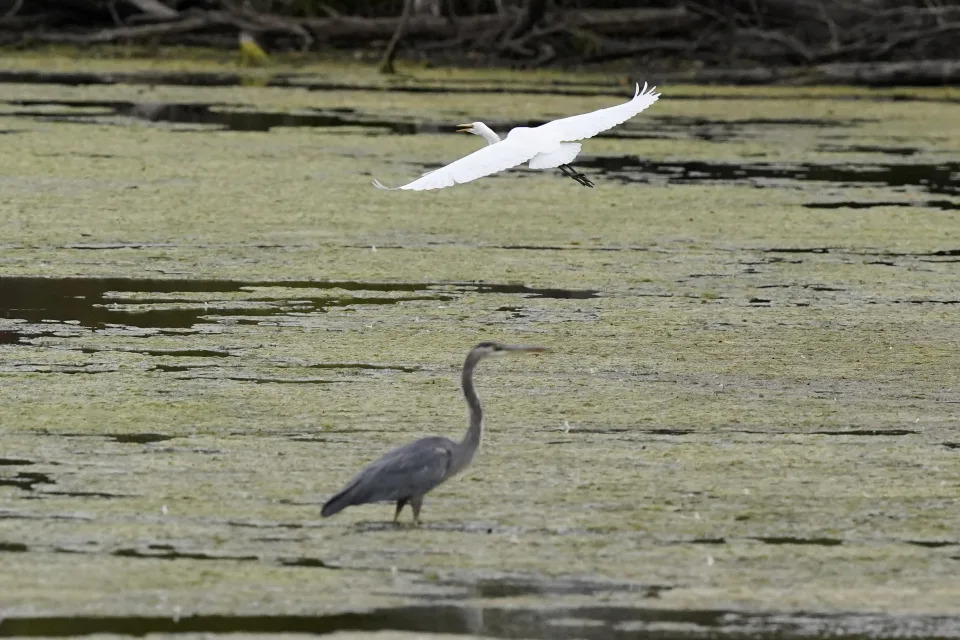
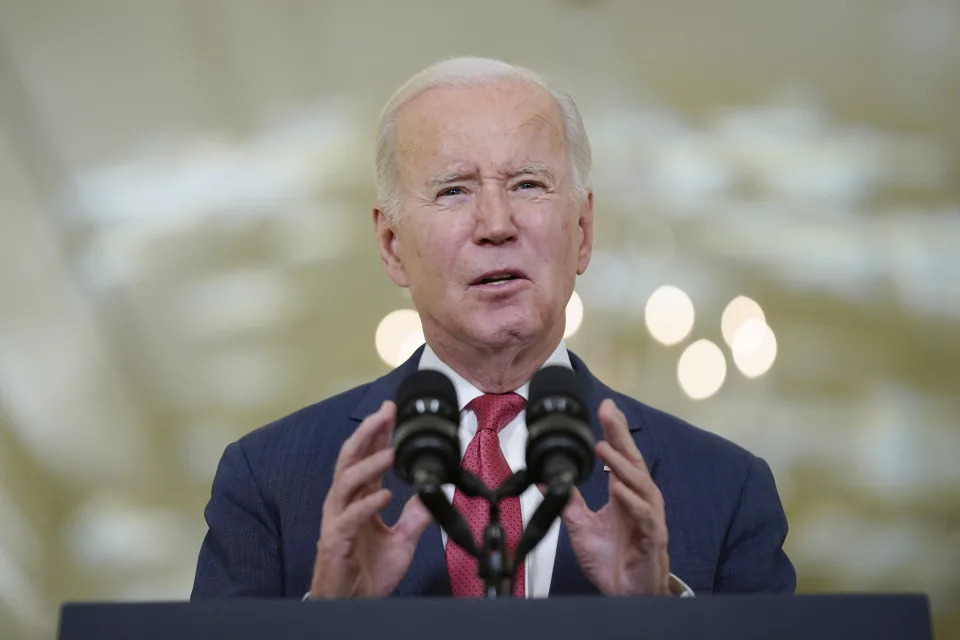
A great egret flies above a great blue heron in a wetland inside the Detroit River International Wildlife Refuge in Trenton, Mich., on Oct. 7, 2022. President Joe Biden’s administration on Friday, Dec. 30, announced a finalized rule for federal protection of hundreds of thousands of small streams, wetlands and other waterways, rolling back a Trump-era rule that environmentalists said left waterways vulnerable to pollution. (AP Photo/Carlos Osorio, File) President Joe Biden speaks in the East Room of the White House ahead of the holidays on Dec. 22, 2022, in Washington. Biden’s administration on Friday, Dec. 30, announced a finalized rule for federal protection of hundreds of thousands of small streams, wetlands and other waterways, rolling back a Trump-era rule that environmentalists said left waterways vulnerable to pollution. (AP Photo/Patrick Semansky, File)
ST. LOUIS (AP) — President Joe Biden’s administration on Friday finalized regulations that protect hundreds of thousands of small streams, wetlands and other waterways, repealing a Trump-era rule that federal courts had thrown out and that environmentalists said left waterways vulnerable to pollution.
The rule defines which “waters of the United States” are protected by the Clean Water Act. For decades, the term has been a flashpoint between environmental groups that want to broaden limits on pollution entering the nation’s waters and farmers, builders and industry groups that say extending regulations too far is onerous for business.
The Environmental Protection Agency and the Department of the Army said the reworked rule is based on definitions that were in place prior to 2015. Federal officials said they wrote a “durable definition” of waterways to reduce uncertainty.
In recent years, however, there has been a lot of uncertainty. After the Obama administration sought to expand federal protections, the Trump administration rolled them back as part of its unwinding of hundreds of environmental and public health regulations. A federal judge rejected that effort. And a separate case is currently being considered by the Supreme Court that could yet upend the finalized rule.https://s.yimg.com/rq/darla/4-10-1/html/r-sf-flx.html
“We have put forward a rule that’s clear, it’s durable, and it balances that protecting of our water resources with the needs of all water users, whether it’s farmers, ranchers, industry, watershed organizations,” EPA Assistant Administrator for Water Radhika Fox told The Associated Press.
The new rule is built on a pre-2015 definition, but is more streamlined and includes updates to reflect court opinions, scientific understanding and decades of experience, Fox said. The final rule will modestly increase protections for some streams, wetlands, lakes and ponds, she said.
The Trump-era rule, finalized in 2020, was long sought by builders, oil and gas developers, farmers and others who complained about federal overreach that they said stretched into gullies, creeks and ravines on farmland and other private property.
Environmental groups and public health advocates countered that the Trump rule allowed businesses to dump pollutants into unprotected waterways and fill in some wetlands, threatening public water supplies downstream and harming wildlife and habitat.
“Today, the Biden administration restored needed clean water protections so that our nation’s waters are guarded against pollution for fishing, swimming, and as sources of drinking water,” Kelly Moser, senior attorney for the Southern Environmental Law Center’s Clean Water Defense Initiative, said in a statement.
Jon Devine, director of federal water policy for the Natural Resources Defense Council, called repealing the Trump-era rule a “smart move” that “comes at a time when we’re seeing unprecedented attacks on federal clean water protections by polluters and their allies.”
But Republican Sen. Shelley Moore Capito called the rule “regulatory overreach” that will “unfairly burden America’s farmers, ranchers, miners, infrastructure builders, and landowners.”
Jerry Konter, chairman of the National Association of Home Builders, struck a similar note, saying the new rule makes it unclear if the federal government will regulate water in places such as roadside ditches and isolated ponds.
A 2021 review by the Biden administration found that the Trump rule allowed more than 300 projects to proceed without the federal permits required under the Obama-era rule, and that the Trump rule significantly curtailed clean water protections in states such as New Mexico and Arizona.
In August 2021, a federal judge threw out the Trump-era rule and put back in place a 1986 standard that was broader in scope than the Trump rule but narrower than Obama’s. U.S. District Court Judge Rosemary Marquez in Arizona, an Obama appointee, said the Trump-era EPA had ignored its own findings that small waterways can affect the well-being of the larger waterways they flow into.
Meanwhile, Supreme Court justices are considering arguments from an Idaho couple in their business-backed push to curtail the Clean Water Act. Chantell and Michael Sackett wanted to build a home near a lake, but the EPA stopped their work in 2007, finding wetlands on their property were federally regulated. The agency said the Sacketts needed a permit.
The case was heard in October and tests part of the rule the Biden administration carried over into its finalized version. Now-retired Justice Anthony Kennedy wrote in 2006 that if wetlands “significantly affect the chemical, physical, and biological integrity” of nearby navigable waters like rivers, the Clean Water Act’s protections apply. The EPA’s rule includes this test. Four conservative justices in the 2006 case, however, said that federal regulation only applied if there was a continuous surface connection between wetlands and an obviously regulated body of water like a river.
Charles Yates, attorney for the libertarian group Pacific Legal Foundation, said the new rule shows the importance of the Supreme Court case since the definition for WOTUS “shifts with each new presidential administration.”
“Absent definitive guidance from the Supreme Court, a lawful, workable, and durable definition of ‘navigable waters’ will remain elusive,” Yates said in a statement.
The Biden rule applies federal protections to wetlands, tributaries and other waters that have a significant connection to navigable waters or if wetlands are “relatively permanent.” The rule sets no specific distance for when adjacent wetlands are protected, stating that several factors can determine if the wetland and the waterway can impact water quality and quantity on each other. It states that the impact “depends on regional variations in climate, landscape, and geomorphology.”
For example, the rule notes that in the West, which typically gets less rain and has higher rates of evaporation, wetlands may need to be close to a waterway to be considered adjacent. In places where the waterway is wide and the topography flat, “wetlands are likely to be determined to be reasonably close where they are a few hundred feet from the tributary …,” the rule states.
Fox said the rule wasn’t written to stop development or prevent farming.
“It is about making sure we have development happening, that we’re growing food and fuel for our country but doing it in a way that also protects our nation’s water,” she said.
The Associated Press receives support from the Walton Family Foundation for coverage of water and environmental policy. The AP is solely responsible for all content. For all of AP’s environmental coverage, visit https://apnews.com/hub/climate-and-environment
Brazil’s haunting graveyard of ships risks environmental disaster, warns activist group
Pilar Olivares – December 29, 2022
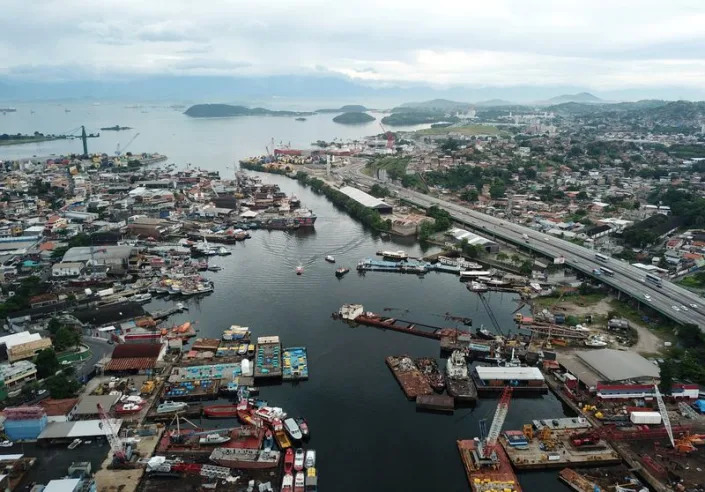
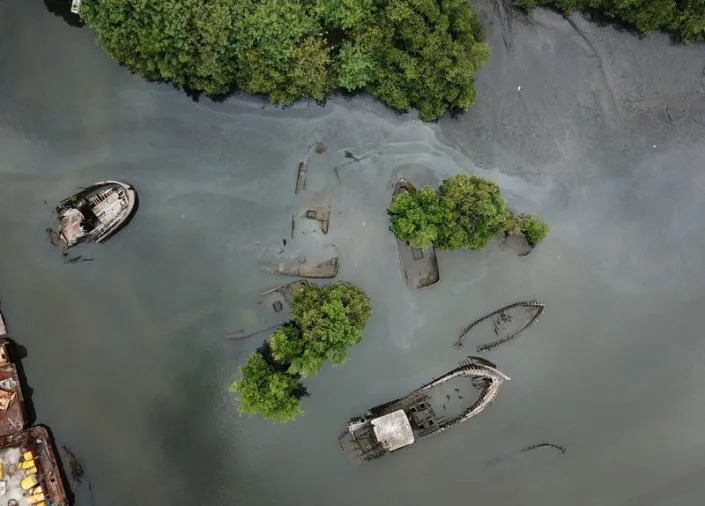
Abandoned ships on the shores of Guanabara Bay in Niteroi, Rio de Janeiro state
GUANABARA BAY (Reuters) – On a stormy evening in mid-November, a huge, abandoned cargo ship broke free of its moorings and slowly floated into the massive concrete bridge that carries cars across Brazil’s Guanabara Bay to Rio de Janeiro.
Brazil’s navy said the 200-meter-long (660-ft.) Sao Luiz, a rust-spattered bulk carrier built in 1994, had been anchored in the bay for more than six years awaiting legal proceedings before it crashed into Latin America’s longest over-water bridge. The navy said it was investigating.
“The Sao Luiz is still in the Port of Rio today, with 50 tonnes of fuel oil in it,” Sergio Ricardo, co-founder of socio-environmental group Movimento Baia Viva (Living Bay Movement) told Reuters, also pointing to high levels of corrosion.
“The ship is unsafe and can cause an environmental disaster,” he said.
Worldwide, financial and legal problems are common reasons for owners abandoning ships.
The Sao Luiz is one of dozens of ships left to rust on the iconic but heavily polluted bay, once home to vast mangroves and thriving marine life.
The mangroves are now much reduced and pollution exacerbated by the graveyard of ships is threatening local sea-horses, green turtles and Guiana dolphins, a symbol of Rio de Janeiro.
A survey by the Rio de Janeiro State University found this year that just 34 Guiana dolphins remained in the bay, down from around 800 in the 1990s.
Besides the ships’ effect on marine life and passing vessels, which must navigate an obstacle course of half-floating hulks, pollution in the bay imposes a financial cost of some tens of billions of reais a year with its pollution, Ricardo estimated.
Fernando Pinto Lima, a 62-year-old former fisherman in the bay, told Reuters he used to be able to quickly catch 50 to 100 kilograms of fish. “Now to catch fifty kilograms, it’ll take you a week or a month,” he said.
Following the Sao Luiz crash, local media reported that authorities were studying how to remove the ghost ships. But the derelict vessels continue to molder on and under its muddy waters.
($1 = 5.2186 reais)
(Reporting by Pilar Olivares; Writing by Sarah Morland; Editing by Bradley Perrett)
These lies about climate change just wouldn’t die in 2022
Elizabeth Weise, USA TODAY – December 29, 2022
There was a time – a recent time – when concern about the environment was relatively bipartisan, not a cultural flashpoint.
A Republican, President Richard Nixon, established the Environmental Protection Agency in 1970. In the 1980s and 1990s, bipartisan majorities voted to strengthen the Clean Air Act and the Clean Water Act, led by a Republican – Rhode Island’s Sen. John Chafee.
Those days are gone, and today a wide range of misleading statements and outright lies about the reality of human-caused climate change circulate widely.
The sheer volume of misinformation can distort perceptions of how many people don’t believe the science that shows the Earth’s climate is changing because of human activity, said Katharine Hayhoe, an atmospheric scientist and professor at Texas Tech University.
“I call them ‘zombie arguments’ because you can explain that they’re not true but they still go stumbling around because they’re not about facts but excuses,” she said.
In truth, a small number of people actually believe these lies, she said. Surveys by the Yale Program on Climate Change Communication in Connecticut have found 8% to 9% of Americans are totally dismissive of climate change, believing it is either not happening, not human-caused or not a threat. Many of these people also endorse conspiracy theories about global warming.
“They’re just 8% of the population. A loud 8%, and very present online, but only 8%. So I would rather answer from the perspective of everybody else,” said Hayhoe, who is also an evangelical Christian whose most recent book is “Saving Us: A Climate Scientist’s Case for Hope and Healing in a Divided World.”
Here are some of the most common climate myths and lies experts say have been circulating this year:
Wrong: Summer heat waves show renewables can’t work
Power grids in Texas, California and the Pacific Northwest all faced extreme heat events this summer. Each power system was pushed to the brink by the draw on electricity for air conditioning. And yet none broke.
Nonetheless, a false narrative circulated saying that solar and wind energy had made those power grids – and especially California’s – fragile and unable to cope with high demands.
In fact, the opposite is the case. While renewable energy does present challenges, especially during heat waves, this year proved that careful planning and green innovations can successfully meet those challenges.
In California, battery storage and conservation allowed the state to avoid power outages during a 10-day September heatwave. In the Northwest, battery storage and voluntary programs that rewarded customers for reducing demand kept the system running.
In Texas in July, a heat wave caused the Electric Reliability Council of Texas to take emergency measures, including urging residents to restrict their use and paying power operators as much as $5,000 per megawatt hour to keep generators running. ERCOT said two factors affected its ability to meet soaring demand: low wind power generation and outages at coal- and natural gas-fed power plants.
Blaming renewable energy as the cause of power crunches is unfair, said David Doniger, senior strategic director in the Natural Resources Defense Council’s climate and clean energy program.
“Their answer is always ‘Stick with fossil fuel because renewables and efficiency can’t fill the need.’ This is the lie; those are the problem and not the solutions,” he said.
“Some of the biggest lies these days are focused on slowing the transition from fossil energy to cleaner alternatives by saying problems or shortcomings for renewables make it impossible.”
Energy experts say the percentage of U.S. power that comes from renewables can go much higher than today’s relatively low numbers without causing severe stress on electrical systems. In April, records were set when 28% of U.S. electricity came from renewable resources.
They do acknowledge that decarbonizing the final 10% of the electric grid will be tricky but say that’s not a reason to avoid decarbonizing the first 90%.
Grace Suzanna Mashensic, 16, of Columbus, Ohio, cheers for Jane Fonda as she speaks during “Fire drill Fridays,” a climate change rally, Friday, Dec. 2, 2022, in Washington.
Wrong: Using ESG criteria is ‘woke’ capitalism
Making investment decisions with environmental, social and governance factors in mind has been around for decades.
But recently it has been decried as “woke capitalism,” and a concerted effort has been waged to stop companies from taking all three, known as ESG, into consideration when they make investments. That’s especially true when it comes to taking environmental risk management.
In the past year, 18 states have either proposed or adopted rules limiting the ability of the state government and public retirement plans to do business with entities found to “discriminate” against certain industries based on environmental, social and governance criteria, according to JD Supra, a legal news source. For example, Arizona’s State Board of Investment said in August that ESG considerations could not be considered in the investment management of its assets.
“It’s a sinister lie that’s deeply counterproductive, not just to the climate but also to people’s pocketbooks and pensions,” said Alicia Seiger, who teaches sustainability and energy finance at Stanford University’s law and graduate schools of business in California.
Telling companies they can’t consider all available information to make solid long-term investments “is insanity,” she said. “That should be determined by the investor, not the political system.”
Wrong: Believing in climate change is only for the far left
Experts have noted an effort by some to lump in climate change with other liberal and progressive causes, such as racial justice. The implication is that those who believe global warming is an issue to be dealt with must also support a host of other objectives that are considered “far left.”
“Conspiracy theorists connect climate change to other lightning-rod issues to generate emotional, irrational responses that drive online engagement,” said David Di Martino, co-founder of triplecheck, a nonprofit that works to combat the spread of misinformation, including climate misinformation.
Wrong: There’s no hope for fixing climate change, so why try?
An increasingly frequent message centers around “doomerism,” the lie that it’s totally impossible to reduce greenhouse gas emissions to near-zero without devastating the economy and significantly reducing our standard of living, so there’s no point in even trying.
This is wrong because the technology to decarbonize much of the electrical grid already exists. Meanwhile, wind and solar, along with battery storage, are increasingly cheaper than coal and natural gas. Decarbonizing more hard-to-reach areas, such as steel and cement production and aviation fuel, will take longer but are in the works.
An Oxford University study released in September found a fast transition to decarbonized energy systems is cheaper than a slow one or not transitioning at all. Achieving zero-carbon energy systems is “possible and profitable” and will save the world at least $12 trillion compared with continuing current levels of fossil fuel use, it found.
A long-term lie has been that climate change isn’t real, but as shifting climate patterns have made that argument harder to make, it has moved to one that says there are either no good alternatives to fossil fuels or the alternatives themselves cause problems and are too expensive.
“In other words, we are stuck with fossil fuels and there are no good alternatives, so burn baby burn,” said Jason Smerdon, a professor of climate physics at Columbia University in New York.
These arguments are mostly in aid of fossil fuel producers who want to keep making money as long as they can.
“Climate disinformation has always been about delaying any action on global warming,” Smerdon said. “They simply perpetuate the false assumption that we have no choice but the same old reliance on fossil fuels.”
If fact, the business community is jumping in with both feet because they see solid opportunities, said Julio Friedmann, chief scientist at Carbon Direct, a carbon management firm and former professor at Columbia University.
“We have the technology we need and we have a lot of the market-aligning policies we need,” he said.
It’s no longer a question of “Is this even possible?” but instead “How quickly can we do it?”
“It’s a fundamentally different mindset,” Friedmann said. “That’s why I’m bullish on our ability to round these corners and get the job done.”
Think those bags are recyclable? California says think again
Don Thompson – December 29, 2022
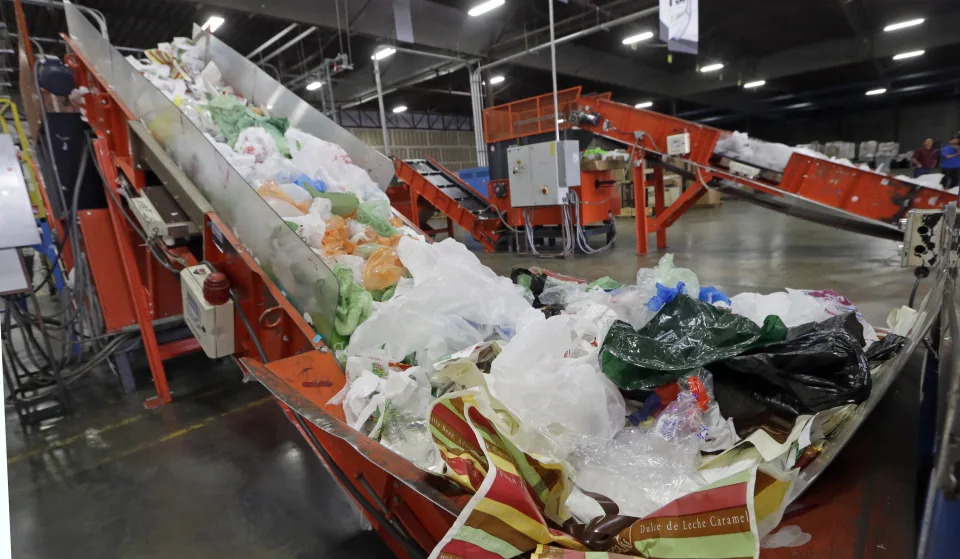
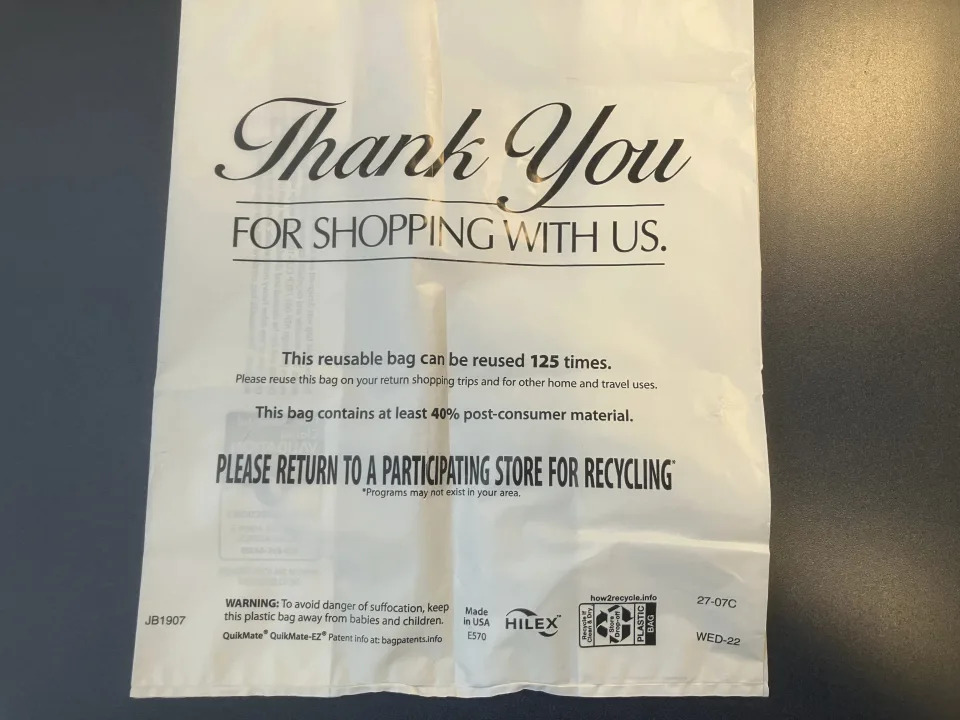
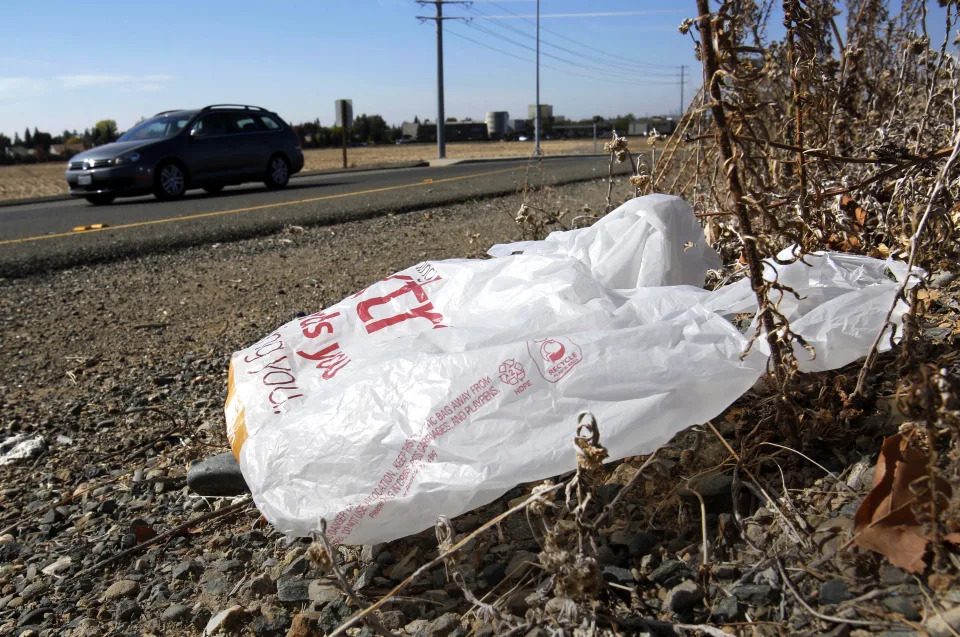
FILE-This Friday, Jan. 24, 2014 file photo conveyors carry mixed plastic into a device that will shred recycle them at a plastics recycling plant in Vernon, Calif. California in 2014 enacted the nation’s first ban on single-use plastic shopping bags. But in 2022, state Attorney General Rob Bonta says consumers who think they’re helping the environment with reusable plastic bags had better think again. He says manufacturers can’t back up their claim that the thicker, more durable bags are recyclable in California. (AP Photo/Reed Saxon, File)This undated photo shows a plastic bag, in Los Angeles. California in 2014 enacted the nation’s first ban on single-use plastic shopping bags. But state Attorney General Rob Bonta says the thicker, reusable plastic bags that many retailers now use may not be recyclable as required by law. (AP Photo/John Antczak)In this Oct. 25, 2013, file photo, a plastic bag sits along a roadside in Sacramento, Calif. California in 2014 enacted the nation’s first ban on single-use plastic shopping bags. But in 2022, state Attorney General Rob Bonta says consumers who think they’re helping the environment with reusable plastic bags had better think again. He says manufacturers can’t back up their claim that the thicker, more durable bags are recyclable in California. (AP Photo/Rich Pedroncelli, File)
SACRAMENTO, Calif. (AP) — Since California adopted the nation’s first ban on single-use plastic shopping bags tin 2014, most grocery stores have turned to thicker, reusable plastic bags that are supposed to be recyclable.
But Attorney General Rob Bonta is now investigating whether the bags are truly recyclable as required by law.
“We’ve all been to the store and forgotten to bring our reusable bags,” Bonta said recently. “At least the plastic bags we buy at the register for 10 cents have those ‘chasing arrows’ that say they are 100% recyclable, right? Perhaps wrong.”
He asked six bag manufacturers to back up their claims that the bags can be recycled and threatened legal action that could include banning the bags temporarily or issuing multimillion-dollar fines.
His office declined to say last week how many of the companies responded, citing an ongoing investigation. The American Chemistry Council, a plastics industry group, said that manufacturers disagree with Bonta’s characterization.
Other states, including New York, New Jersey and Oregon, have followed California in banning single-use plastic bags. Beyond California, only a handful of states require that stores take back plastic bags for recycling, with Maine first adopting such a law in 1991, according to the National Conference of State Legislatures.
Policy experts and advocates estimate that just 6% of plastics are recycled in the United States, with the remaining burned, trashed or littered. More plastic bags ended up in California landfills in 2021 compared with 2018, according to data from the state’s recycling department.
Californians Against Waste Executive Director Mark Murray in part blames pandemic policies.
Consumers are supposed to be able to return their plastic bags to grocery stores and other retailers. But many removed their bag recycling bins during the early days of the pandemic, fearing contamination.
For the system to work, retailers must collect the bags and sell them back to manufacturers for use in making new bags that must include 40% recycled content and be reusable at least 125 times. Murray suspects that most are reused once.
“That’s not meeting the standard and it may be time to phase these bags out,” he said.
The California Retailers Association declined comment because it said each retailer has its own policy, and the California Grocers Association did not respond to a request for comment.
As of now, makers of the bags get to self-certify to the state that their bags can be recycled. But Bonta said that requires a comprehensive system to collect, process and sell the used bags, none of which exist. Putting the bags in most curbside recycling bins interferes with recycling other products by clogging equipment and increasing the risk of worker injury, he said.
Plastic bags and similar products are “a top form of contamination in curbside recycling bins,” California’s Statewide Commission on Recycling Markets and Curbside Recycling wrote in a 2021 report.
Bonta asked six manufacturers — Novolex, Revolution, Inteplast, Advance Polybag, Metro Polybag and Papier-Mettler — to prove their bags can be recycled in California. His office hasn’t said if they all responded, citing an “active and ongoing investigation.”
Revolution Chief Executive Sean Whiteley said the company has been recycling more than 300 million pounds of plastic material annually for decades and is “confident in our own sustainability and compliance record.”
He noted lawmakers publicly introduced the single-use bag ban legislation in 2014 at one of the company’s Southern California subsidiaries.
“At our core, we are an environmental recycling company that also makes sustainable plastic solutions,” he said in a statement.
Novolex said it is “committed to complying with all state laws and regulations.” The company responded to Bonta’s request but declined to share its full response with The Associated Press, a spokesman said.
Novolex’s bags have been certified as eligible for recycling by an independent laboratory and, therefore, must be marked that way, the company said in a statement.
The other four companies did not respond to multiple emailed requests.
Manufacturers are “aggressively working so that all plastic packaging that is manufactured is remade into new plastics,” said Joshua Baca, vice president of plastics at the American Chemistry Council.
It’s not Bonta’s first plastics-related clash with industry. Earlier this year he subpoenaed ExxonMobil as part of what he called a first-of-its-kind broader investigation into the petroleum industry and the proliferation of plastic waste.
Thompson recently retired from The Associated Press.
What’s going on with the Greenland ice sheet? It’s losing ice faster than forecast and now irreversibly committed to at least 10 inches of sea level rise
Alun Hubbard, Arctic Five Chair, University of Tromsø – December 28, 2022
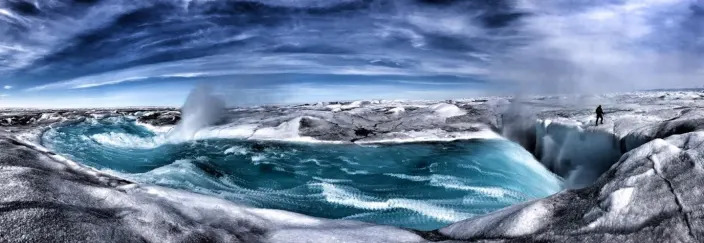
A turbulent melt-river pours a million tons of water a day into a moulin, where it flows down through the ice to ultimately reach the ocean. Ted Giffords
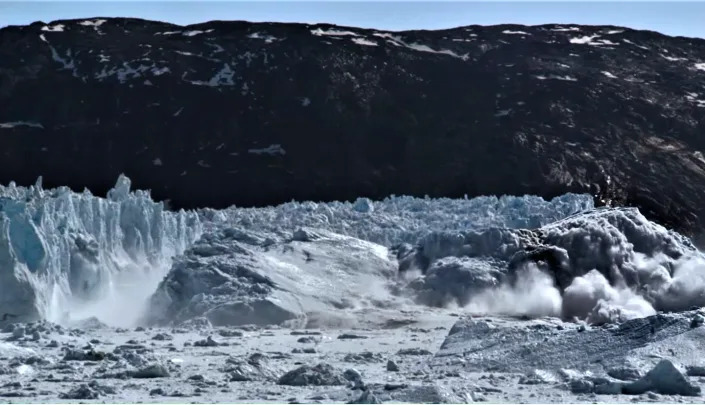
I’m standing at the edge of the Greenland ice sheet, mesmerized by a mind-blowing scene of natural destruction. A milewide section of glacier front has fractured and is collapsing into the ocean, calving an immense iceberg.
Seracs, giant columns of ice the height of three-story houses, are being tossed around like dice. And the previously submerged portion of this immense block of glacier ice just breached the ocean – a frothing maelstrom flinging ice cubes of several tons high into the air. The resulting tsunami inundates all in its path as it radiates from the glacier’s calving front.
A fast-flowing outlet glacier calves a ‘megaberg’ into Greenland’s Uummannaq Fjord. Alun Hubbard
Despite the spectacle, I’m keenly aware that this spells yet more unwelcome news for the world’s low-lying coastlines.
As a field glaciologist, I’ve worked on ice sheets for more than 30 years. In that time, I have witnessed some gobsmacking changes. The past few years in particular have been unnerving for the sheer rate and magnitude of change underway. My revered textbooks taught me that ice sheets respond over millennial time scales, but that’s not what we’re seeing today.
A study published Aug. 29, 2022, demonstrates – for the first time – that Greenland’s ice sheet is now so out of balance with prevailing Arctic climate that it no longer can sustain its current size. It is irreversibly committed to retreat by at least 59,000 square kilometers (22,780 square miles), an area considerably larger than Denmark, Greenland’s protectorate state.
Even if all the greenhouse gas emissions driving global warming ceased today, we find that Greenland’s ice loss under current temperatures will raise global sea level by at least 10.8 inches (27.4 centimeters). That’s more than current models forecast, and it’s a highly conservative estimate. If every year were like 2012, when Greenland experienced a heat wave, that irreversible commitment to sea level rise would triple. That’s an ominous portent given that these are climate conditions we have already seen, not a hypothetical future scenario.
Our study takes a completely new approach – it is based on observations and glaciological theory rather than sophisticated numerical models. The current generation of coupled climate and ice sheet models used to forecast future sea level rise fail to capture the emerging processes that we see amplifying Greenland’s ice loss.
How Greenland got to this point
The Greenland ice sheet is a massive, frozen reservoir that resembles an inverted pudding bowl. The ice is in constant flux, flowing from the interior – where it is over 1.9 miles (3 kilometers) thick, cold and snowy – to its edges, where the ice melts or calves bergs.
In all, the ice sheet locks up enough fresh water to raise global sea level by 24 feet (7.4 meters).
We are currently enjoying an interglacial period – the Holocene. For the past 6,000 years Greenland, like the rest of the planet, has benefited from a mild and stable climate with an ice sheet in equilibrium – until recently. Since 1990, as the atmosphere and ocean have warmed under rapidly increasing greenhouse gas emissions, Greenland’s mass balance has gone into the red. Ice losses due to enhanced melt, rain, ice flow and calving now far exceed the net gain from snow accumulation.
What does the future hold?
The critical questions are, how fast is Greenland losing its ice, and what does it mean for future sea level rise?
This net loss is split between surface melt and dynamic processes that accelerate outlet glacier flow and are greatly exacerbated by atmospheric and oceanic warming, respectively. Though complex in its manifestation, the concept is simple: Ice sheets don’t like warm weather or baths, and the heat is on.
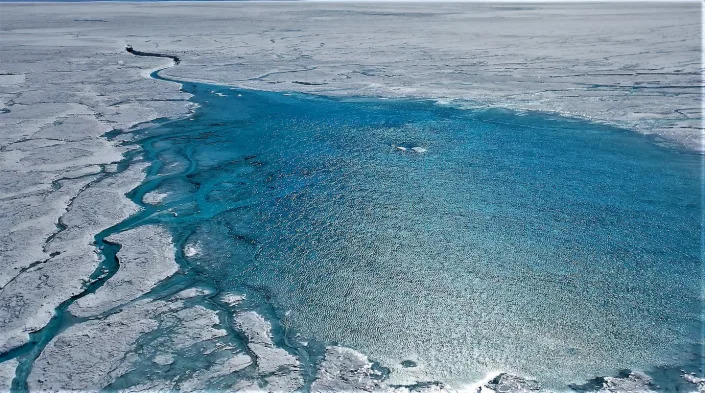
Meltwater lakes feed rivers that snake across the ice sheet – until they encounter a moulin. Alun Hubbard
According to our findings, Greenland will lose at least 3.3% of its ice, over 100 trillion metric tons. This loss is already committed – ice that must melt and calve icebergs to reestablish Greenland’s balance with prevailing climate.
We’re observing many emerging processes that the models don’t account for that increase the ice sheet’s vulnerability. For example:
In August 2021, rain fell at the Greenland ice sheet summit for the first time on record. Weather stations across Greenland captured rapid ice melt. European Space Agency
Part of the problem is that the models used for forecasting are mathematical abstractions that include only processes that are fully understood, quantifiable and deemed important.
Models reduce reality to a set of equations that are solved repeatedly on banks of very fast computers. Anyone into cutting-edge engineering – including me – knows the intrinsic value of models for experimentation and testing of ideas. But they are no substitute for reality and observation. It is apparent that current model forecasts of global sea level rise underestimate its actual threat over the 21st century. Developers are making constant improvements, but it’s tricky, and there’s a dawning realization that the complex models used for long-term sea level forecasting are not fit for purpose.
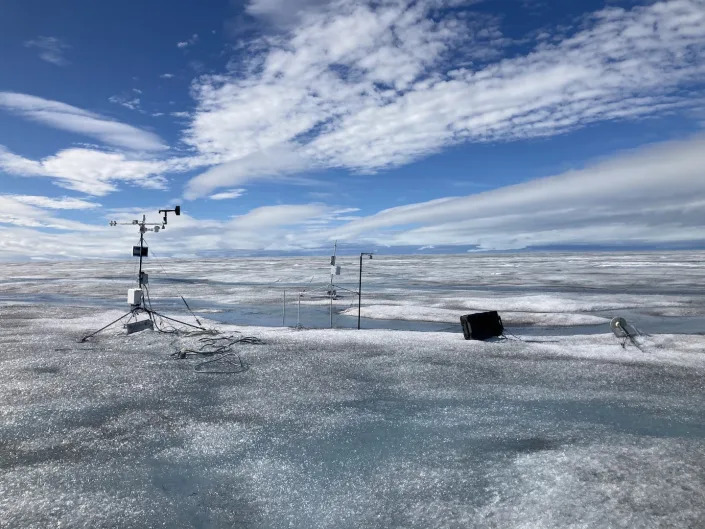
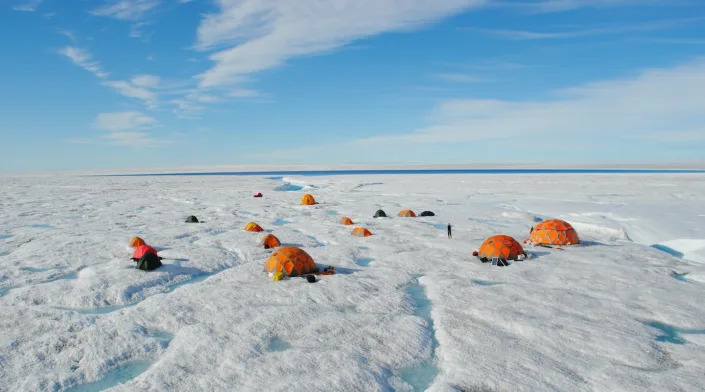
Author Alun Hubbard’s science camp in the melt zone of the Greenland ice sheet. Alun Hubbard
There are also “unknown unknowns” – those processes and feedbacks that we don’t yet realize and that models can never anticipate. They can be understood only by direct observations and literally drilling into the ice.
That’s why, rather than using models, we base our study on proven glaciological theory constrained by two decades of actual measurements from weather stations, satellites and ice geophysics.
It’s not too late
It’s an understatement that the societal stakes are high, and the risk is tragically real going forward. The consequences of catastrophic coastal flooding as sea level rises are still unimaginable to the majority of the billion or so people who live in low-lying coastal zones of the planet.
A large tabular iceberg that calved off Store Glacier within Uummannaq Fjord. Alun Hubbard
Personally, I remain hopeful that we can get on track. I don’t believe we’ve passed any doom-laden tipping point that irreversibly floods the planet’s coastlines. Of what I understand of the ice sheet and the insight our new study brings, it’s not too late to act.
But fossil fuels and emissions must be curtailed now, because time is short and the water rises – faster than forecast.
Fears of extremist campaign after attack on US power substations
December 27, 2022
Vandalism at four power substations in the western US state of Washington over the weekend added to concerns of a possible nationwide campaign by right-wing extremists to stir fears and spark civil conflict.
Local police on Tuesday gave no information on who they suspected was behind the vandalism, which knocked out power on Christmas Day for some 14,000 in Tacoma, a port city area south of Seattle.
Tacoma Public Utilities, which owned two of the facilities targeted on Sunday, said in a statement that it was alerted by federal law enforcement in early December about threats to their grid.
The Pierce County Sheriff’s office said Sunday it was investigating but had made no arrests and did not know if it was a coordinated attack.
They said in a statement that they were aware of similar incidents elsewhere in Washington, in Oregon, and in North Carolina.
“It could be any number of reasons at this point… We have to investigate and not just jump to conclusions,” they said.
But it follows warnings by US officials that neo-Nazis who say they want to spark a race war are targeting electricity infrastructure.
Violent extremists “have developed credible, specific plans to attack electricity infrastructure since at least 2020, identifying the electric grid as a particularly attractive target given its interdependency with other infrastructure sectors,” the Department of Homeland Security said in a January intelligence memo, according to US media.
In early December, 45,000 homes and businesses in Moore County, North Carolina were out of power after someone used a high-powered rifle to damage two electricity substations.
In February three men with neo-Nazi ties pleaded guilty in Columbus, Ohio to plotting to use rifles and explosives to damage power infrastructure in various locations.
They pursued “a disturbing plot, in furtherance of white supremacist ideology, to attack energy facilities in order to damage the economy and stoke division in our country,” said Assistant Attorney General Matthew Olsen at the time.
And last year five men who allegedly belonged to white supremacist and neo-Nazi online discussion groups were charged in North Carolina with planning attacks on power infrastructure.
They planned the attack to create “general chaos” as part of their “goal of creating a white ethno-state,” the indictment said.
Jon Wellinghoff, the former chairman of the Federal Energy Regulatory Commission, said on CNN in early December that the Moore County attack resembled one on an electricity network substation near San Jose, California in 2013.
In that case, which has never been solved, one or more people fired close to 100 rounds at the substation, damaging 17 high voltage transformers at a cost of $15 million.
The Washington Post said after the Moore County incident that law enforcement was investigating eight incidents in four states.
An earlier version of this story referred to the objects vandalized as power stations. They are in fact power substations.
“It is virtually certain that human activities have increased atmospheric levels of carbon dioxide and other greenhouse gases,” a national panel of experts concluded in a draft of the 5th National Climate Assessment released in November. They see high confidence in forecasts for longer droughts, higher temperatures and increased flooding.
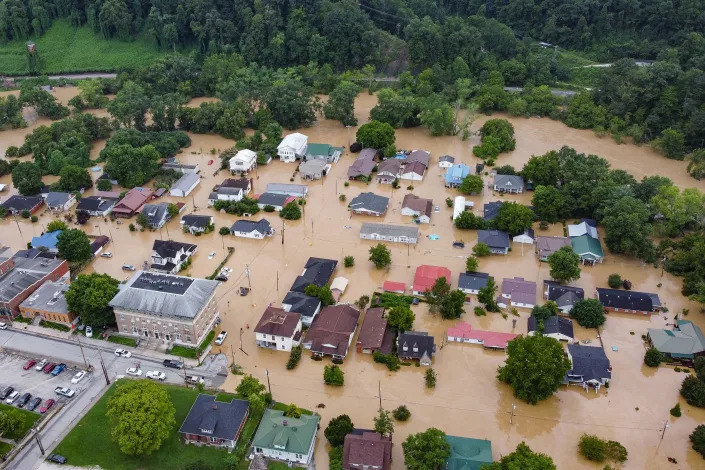
JULY 28, 2022: Aerial view of homes submerged under flood waters from the North Fork of the Kentucky River in Jackson, Kentucky. Flash flooding caused by torrential rains has killed at least eight people in eastern Kentucky and left some residents stranded on rooftops and in trees, the governor of the south-central US state said.
Warming sea surface temperatures around the globe provide more fuel for tropical storms and exacerbate the melting of glaciers and ice sheets.
Why is climate change important?
“Every part of the U.S. is feeling the effects of climate change in some way,” said Allison Crimmins, director of that 5th National Climate Assessment. Representing the latest in climate research by a broad array of scientists, the final version of the assessment is expected in late 2023.
Disaster costs are rising, and scientists warn the window to further curtail fossil fuel emissions and put a lid on rising temperatures is closing rapidly.
Many scientists and officials worldwide agree: Yes. By the end of this century, projections show global average surface temperatures compared to pre-industrial times could increase by as much as 5.4 degrees.
Merriam-Webster defines “crisis” as a time of intense difficulty, trouble, or danger. A mix of warmer temperatures, extreme rainfall and rising sea levels often make naturally occurring disasters worse, while droughts become more intense and heat waves occur more often.
“The climate crisis is not a future threat, but something we must address today,” Richard Spinrad, administrator of National Oceanic and Atmospheric Administration, said in August 2022.
The term “climate crisis” has been used to describe these worsening impacts since at least 1986. Since the United Nations’ Intergovernmental Panel on Climate Change was organized in 1988, its reports steadily have grown more dire.
The Fourth National Climate Assessment, released during the Trump administration, warned natural, built and social systems were “increasingly vulnerable to cascading impacts that are often difficult to predict, threatening essential services.”
“Every increased amount of warming will increase the risk of severe impacts, and so the more (rapidly) we can take strong action to reduce greenhouse gas emissions, the less severe the impacts will be,” Cornell University professor Rachel Bezner Kerr said after the release of one recent IPCC report.
Warmer climates put animals on the move and increases the risk they’ll spread pathogens to other animals and to humans. A group of University of Hawaii researchers looked at how 376 human diseases and allergens such as malaria and asthma are affected by climate-related weather hazards and found nearly 60% have been aggravated by hazards, such as heat and floods.
The Summer 2024 Olympics are scheduled to kick off in July in France, where the country’s meteorological officials expect 2022 to be its hottest year since records began in 1900. Meanwhile, the International Olympic Committee has delayed choosing the location for the 2030 winter games, in part over climate concerns.
Even fly fisherman see changes all around them. “Everyone knows if this keeps up, the places we can fish for trout are going to be limited,” said Tom Rosenbauer of Vermont, whose job title at sporting goods retailer Orvis is chief enthusiast.
How does climate change affect animals?
Warmer temperatures are forcing some animal species to move beyond their typical home ranges, increasing the risk that infectious viruses they carry could be transmitted to other species they haven’t encountered before. That poses a threat to human and animal health around the world.
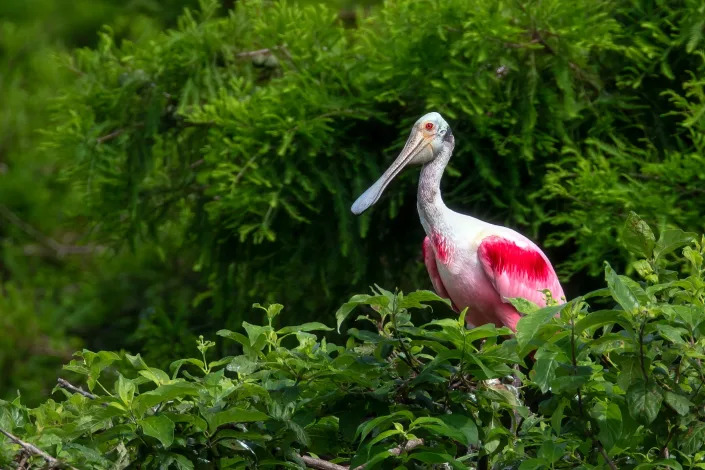
A roseate spoonbill stands bright against the green of a southeast Arkansas swamp. Jami Linder, an Arkansas photographer, documented the first spoonbill nest in the state in 2020.
In the U.S., roseate spoonbills, a brilliant pink wading bird, are moving north as temperatures warm and they’re pushed out of native coastal habitats by rising sea levels.
Thousands Will Live Here One Day (as Long as They Can Find Water)
Keith Schneider – December 27, 2022
A golf cart on a path at Verrado, an 8,800-acre planned community, in Buckeye, Ariz., Dec. 19, 2022. (Adriana Zehbrauskas/The New York Times)
BUCKEYE, Ariz. — Surrounded by miles of creosote and ocotillo in the Sonoran Desert, state officials and business leaders gathered in October against the backdrop of the ragged peaks of the White Tank Mountains to applaud a plan to turn 37,000 acres of arid land west of Phoenix into the largest planned community ever proposed in Arizona.
The development, Teravalis, is expected to have 100,000 homes and 55 million square feet of commercial space. But to make it happen, the project’s developer, the Howard Hughes Corp., will need to gain access to enough water for its projected 300,000 residents and 450,000 workers.
Teravalis is seen by local and state leaders as a crowning achievement in a booming real estate market, but it also represents the intensifying challenge in Arizona and other fast-growing Southwestern states: to build huge mixed-use projects in an era of water scarcity.
“You can’t grow and grow on these far-flung lands and put industries anywhere you want,” said Kathleen Ferris, former director of the Arizona Department of Water Resources and a senior research fellow at the Kyl Center for Water Policy at Arizona State University. “You have to be smarter about where and how we grow.”
Persistent dry conditions are driving up the cost of water and prompting more resistance to new development. But the scarcity of water is also pushing developers to innovate with design and install expensive infrastructure to save fresh water and recycle more wastewater.
A deep drought has settled on the Southwest since 2000, exacerbated by climate change. Water flow has dropped precipitously in the Colorado River and other surface water supplies that serve Arizona and its neighboring states. That is putting more pressure to supply homes and businesses from finite water reserves held in aquifers.
The consequences are being felt across the West. A proposal for a new water pipeline to supply St. George, Utah, has become the focus of public opposition. Communities in Colorado and Utah have declared moratoriums on new developments. And water supply is one reason that rural residents are fighting a proposal to increase the density of homes in Washoe County, Nevada.
In Arizona, groundwater levels are falling so fast that thousands of residential wells all over the state are going dry. In 2021, the Arizona Department of Water Resources halted new-home construction in Pinal County, south of Phoenix, because groundwater pumping exceeded the supply.
In New Mexico, two proposals for big planned communities outside Albuquerque have languished because of concerns over water. At one project, Campbell Farming Corp. proposed building 4,000 homes, a commercial and retail center and two golf courses on 8,000 acres in the mountains east of the city more than two decades ago, according to planning documents, but it faced objections to groundwater use, which would total about 400 million to 500 million gallons annually. The Office of the State Engineer found that Campbell Ranch would not meet a New Mexico requirement for developers to demonstrate that their projects have a 70-year supply of water.
“It’s fundamental; you’re not doing that development without water,” said Kathy Freas, a co-founder of East Mountain Protection Action Coalition, a citizens’ group that opposed the plan.
Similar concerns are buffeting Santolina, a 13,700-acre planned development proposed in 2014 and still not under construction. Located between Albuquerque and the Rio Grande, Santolina is the focus of active public opposition because it would need 7.3 billion gallons of water a year to serve its projected 90,000 residents.
County officials may require Santolina’s developer, Western Albuquerque Land Holdings, to install expensive wastewater treatment and recycling infrastructure to reduce water use and waste. The company has submitted a plan that would convert hundreds of acres from housing to solar energy development, a change that would significantly reduce water consumption but could potentially require it to restart the planning process.
“In the West, water has always been an issue, right? People are just much more alert now,” said Enrico Gradi, deputy county manager for Bernalillo County, who is overseeing the review of the Santolina project.
Water scarcity is also changing the design of the Southwest’s planned communities, which no longer feature big lakes, irrigated lawns, golf courses or open drainage canals.
One example is Sterling Ranch near Littleton, Colorado, a development with roads and parks that are designed to collect and store stormwater for reuse. The 3,400-acre project will have a $350 million closed-loop water supply system that collects, treats and recycles wastewater for more than 12,500 residences, as well as commercial and retail spaces. The developers are also studying how to most efficiently collect and use rainwater from rooftops.
“Until there’s scarcity, most developers aren’t incentivized to conserve water,” said Brock Smethills, president of the site’s developer. “For us, the incentives were aligned on Day 1 to use less water and conserve as much as possible.”
Another example is Verrado, an 8,800-acre planned community in Buckeye, Arizona, that houses 16,000 residents. Along with 30,000 trees for shade and to slow evaporation, Verrado features a water recycling system that collects all of the wastewater from homes and businesses and directs it to a treatment plant capable of recycling 1.5 million gallons a day that is stored and used to irrigate two golf courses.
“Every responsible developer in Arizona knows water is a constraint,” said Dan T. Kelly, chief operating officer and general manager for DMB Associates, the company behind Verrado. “It’s the first question you deal with.”
The intensifying attention to water supply is especially relevant to the Teravalis project. Hughes Corp. paid $600 million to purchase the property from its previous owners, who had proposed to use 3,000 acres for a planned community that would rely on the Hassayampa Basin, an aquifer beneath the project, to supply water. In 2006, the Arizona Department of Water Resources issued two certificates to supply and build 7,000 homes.
Those certificates are still valid, but Hughes Corp. does not have access to supply water to the remaining 34,000 acres — more than 90% of its property. The Department of Water Resources has put the Hassayampa Basin off limits to new development while it studies how much water the underground reserve actually holds.
Water supply options for Teravalis include tapping another aquifer and delivering water by pipeline. It could also lease water from one of Arizona’s Native American tribes that have extensive water rights.
Developers also could buy rights to Colorado River water. Queen Creek, a Phoenix suburb, secured state permission and is preparing to spend $27 million to draw from the river nearly 750 million gallons for its 66,000 residents.
The adage in the West that “water runs uphill to money” applies. This year, Arizona lawmakers approved a $1 billion, three-year appropriation, essentially a down payment to secure stable water supplies.
“We’re at the very start of a new era of innovation and investment,” said Greg Vogel, founder and CEO of Land Advisors Organization, a national brokerage and development consultancy in Scottsdale, Arizona. “Teravalis will be in the making for 50 years, maybe 70 years, until build-out. They’ll have enough water.”
By no means, though, is that a consensus view.
The city of Buckeye, where Teravalis is, uses nearly 3.5 billion gallons annually for its 115,000 residents. Water consumption by Teravalis’ 300,000 residents could amount to three times as much.
In 1980, Arizona enacted a groundwater conservation law that requires developers in the Phoenix metropolitan region to assure buyers that their homes and businesses have a 100-year water supply. The law also requires developers to replenish aquifers with the same amount of water that they withdraw.
Bruce Babbitt, a former governor of Arizona who signed the 1980 groundwater law while in office, said that Teravalis would not meet either requirement. “My conclusion, based on a lot of analysis, is the project is not viable on the scale they are talking about,” he said.