In Arizona, Colorado River crisis stokes worry over growth and groundwater depletion

Los Angeles Times

In Arizona, Colorado River crisis stokes worry over growth and groundwater depletion

Ian James – December 26, 2022

The Central Arizona Project Canal running through the desert in Arizona.
The Central Arizona Project Canal running through the desert in Arizona. (Albert Brave Tiger Lee / Los Angeles Times)

Kathleen Ferris stared across a desert valley dotted with creosote bushes, wondering where the water will come from to supply tens of thousands of new homes. In the distance, a construction truck rumbled along a dirt road, spewing dust.

This tract of open desert west of Phoenix is slated to be transformed into a sprawling development with up to 100,000 homes — a 37,000-acre property that the developers say will become Arizona’s largest master-planned community.

“It’s mind-boggling,” Ferris said. “I don’t think there is enough water here for all the growth that is planned.”

Water supplies are shrinking throughout the Southwest, from the Rocky Mountains to California, with the flow of the Colorado River declining and groundwater levels dropping in many areas. The mounting strains on the region’s water supplies are bringing new questions about the unrestrained growth of sprawling suburbs.

Ferris, a researcher at Arizona State University’s Kyl Center for Water Policy, is convinced that growth is surpassing the water limits in parts of Arizona, and she worries that the development boom is on a collision course with the aridification of the Southwest and the finite supply of groundwater that can be pumped from desert aquifers.

For decades, Arizona’s cities and suburbs have been among the fastest growing in the country. In most areas, water scarcity has yet to substantially slow the march of development.

But as drought, climate change and the chronic overuse of water drain the Colorado River’s reservoirs, federal authorities are demanding the largest reduction ever in water diversions in an effort to avoid “dead pool” — the point at which reservoir levels fall so low that water stops flowing downriver.

Already, Arizona is being forced to take 21% less water from the Colorado River, and larger cuts will be needed as the crisis deepens.

To deal with those reductions and access other supplies to serve growth, the state is turning more heavily to its underground aquifers. As new subdivisions continue to spring up, workers are busy drilling new wells.

Ferris and others warn, however, that allowing development reliant solely on groundwater is unsustainable, and that the solution should be to curb growth in areas without sufficient water.

“What we’re going to see is more and more pressure on groundwater,” Ferris said. “And what will happen to our groundwater then?”

Construction workers erect new homes in a dry landscape
Construction workers erect new homes in a residential development called Sun City Festival in Buckeye. Dwindling Colorado River water is delivered to central Arizona, one of the fastest growing metropolitan areas in the U.S., via the Central Arizona Project Canal. (Luis Sinco / Los Angeles Times)

One of the fastest-growing cities in the Phoenix area is Buckeye, which has plans to nearly triple its population by 2030. According to its 2020 water resources plan, 27 master-planned communities are proposed in Buckeye, which depends primarily on groundwater. If all the proposed developments are fully built, the city’s population, now 110,000, would skyrocket to about 872,000.

In the area Ferris visited, construction has begun on the giant development called Teravalis, where the developers plan to build the equivalent of a new city, complete with more than 1,200 acres of commercial development.

State water regulators have granted approvals to allow an initial portion of the project to move forward. But in other nearby areas of Buckeye, state officials have sent letters to builders putting some approvals on hold while they study whether there is enough groundwater for all the long-term demands.

sun sets behind cactuses
The sun sets on the vast desert landscape along Sun Valley Parkway in Buckeye, Ariz. (Luis Sinco/Los Angeles Times)

“It’s hard for me to imagine wall-to-wall homes out here,” Ferris said, standing on the gravel shoulder of the Sun Valley Parkway, which runs across miles of undeveloped land. “This is the epitome of irresponsible growth. It is growing on desert lands, raw desert lands, where there’s no other water supply except groundwater.”

Nearby, the Central Arizona Project snakes through the desert, filled with Colorado River water. The CAP Canal was built between 1973 and 1993, bringing water that has enabled growth. But its supply came with low-priority water rights that made it vulnerable to cuts in a shortage.

The Phoenix metropolitan area’s population has more than doubled since 1990, expanding from 2.2 million to about 4.9 million people. Subdivisions have been built on former farmlands as development has expanded across the Salt River Valley, also called the Valley of the Sun.

Ferris, a lawyer and former director of the Arizona Department of Water Resources, helped draft the state’s 1980 Groundwater Management Act, which was intended to address overpumping and has since regulated groundwater use in urban areas.

Water from the CAP Canal has enabled cities to pump less from wells. For years, they have banked some of the imported Colorado River water underground by routing it to basins where it percolates down to aquifers.
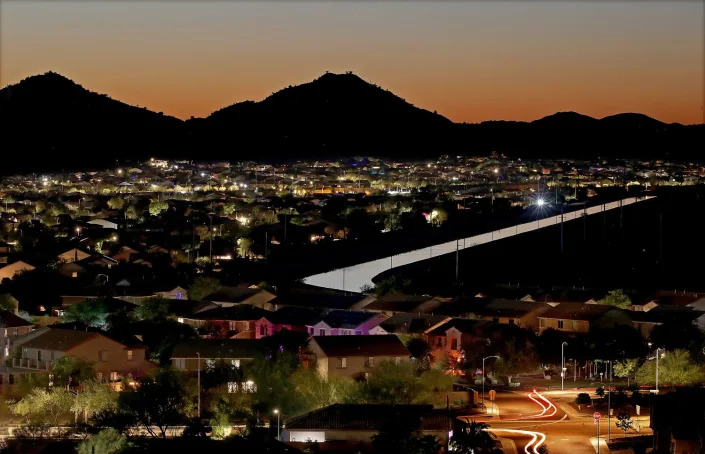
The Central Arizona Project Canal runs beside a community in the suburbs of North Phoenix.
The Central Arizona Project Canal runs beside a community in the suburbs of North Phoenix. Development projects envisioning thousands of new homes around Phoenix now are in question because of lack of water. (Luis Sinco / Los Angeles Times)

The state requires that new developments around Phoenix and other urban areas have a 100-year “assured water supply,” based on a calculation that allows for groundwater to be pumped down to a level 1,000 feet underground. Changes by the Legislature and regulators in the 1990s cleared the way for subdivisions to rely on groundwater as an assured water supply.

Since then, a groundwater replenishment district has been charged with securing water and using it to recharge aquifers, creating an accounting system. The problem with this system, Ferris said, is that groundwater has been overallocated, allowing for excessive pumping in some areas.

Ferris said she thinks the current rules are no longer adequate, especially with much less imported water available to recharge groundwater.

“We’ve got to learn to live within our means. Groundwater was always supposed to be a savings account, to be used only in times of shortages. Well, now those shortages look permanent,” Ferris said. “We ought to be saying, ‘How much growth can we really sustain?’ And put limits on how much water we’re going to use.”

The desert aquifers contain “fossil” water that has been underground for thousands of years.

“That water is not replenished. And so once it’s pumped, it’s pretty much gone,” Ferris said.

In recent years, Arizona has received about 36% of its water from the Colorado River. The river has long been severely overallocated, and its flows have shrunk dramatically during 23 years of megadrought intensified by global warming.

Overhead view of a green golf course surrounded by suburbs
One of a growing number of developments in Buckeye, Ariz., that depend on groundwater. (Albert Brave Tiger Lee / Los Angeles Times)

The river’s largest reservoirs, Lake Mead and Lake Powell, now sit nearly three-fourths empty. Federal officials have warned there is a real danger the reservoirs could drop so low by 2025 that water would no longer flow past Hoover Dam to Arizona, California and Mexico.

Ferris said Arizona now needs to plan for years with little or no Colorado River water. She said she feels sad and angry that federal and state water managers, despite warnings by scientists, failed to act sooner to address the shortage.

“The Colorado River is dying,” Ferris said. “It is dying from overallocation, overuse, aridification, mismanagement.”

In the same way that tough decisions about the Colorado River were neglected for years, she said, “we’re not managing our groundwater well.”

“Either we do something about this now or we pay the consequences later. And we’re paying the consequences now with the Colorado River, because we didn’t deal with those problems soon enough,” Ferris said. “If we fail to plan for the idea that our groundwater will no longer be sufficient, then shame on us.”

Alongside the river’s decline, the Southwest is undergoing a parallel crisis of groundwater depletion. Scientists found in a 2014 study, using measurements from NASA satellites, that pumping depleted more than 40 million acre-feet of groundwater in the Colorado River Basin over nine years, about 1.5 times the maximum capacity of Lake Mead.
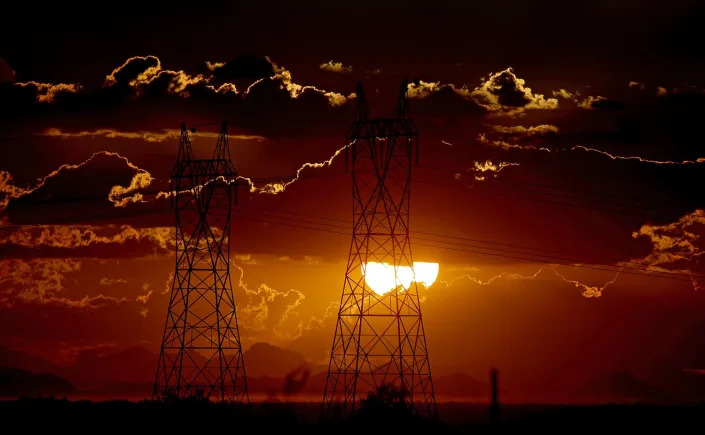
A sun setting behind power lines
The sun sets on the vast desert landscape along Sun Valley Parkway in Buckeye, Ariz. (Luis Sinco / Los Angeles Times)

“Our research has shown that the groundwater in the lower basin has been disappearing nearly seven times faster than the combined water losses from Lakes Powell and Mead,” said Jay Famiglietti, a hydrology professor and executive director of the University of Saskatchewan’s Global Institute for Water Security. “Groundwater losses of that magnitude are literally an existential threat to desert cities like Phoenix and Tucson.”

Next year, Arizona’s allocation of Colorado River water delivered through the CAP Canal will be cut by more than a third. Some Arizona farmers are losing their CAP supplies, while irrigation districts are drilling new state-funded wells.

Arizona’s cities have yet to see major reductions. But that could soon change.

Ferris said she thinks growth should happen in areas where sufficient water is available, and from multiple sources.
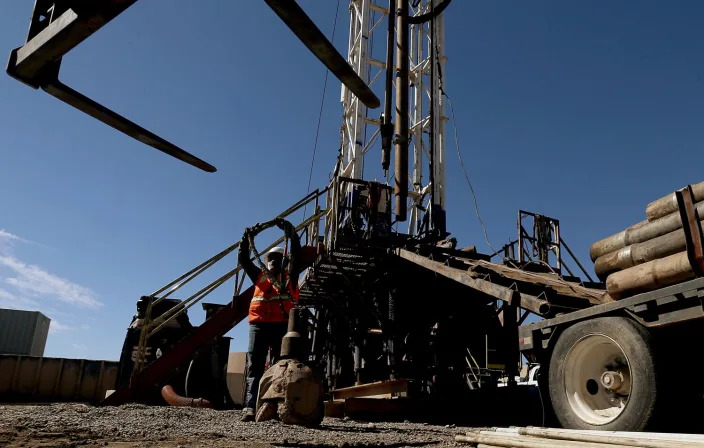
A workman prepares a rig to drill for water in the suburbs of Phoenix.
A workman prepares a rig to drill for water in the suburbs of Phoenix. Colorado River flows are at historic lows due to warmer and drier conditions caused by climate change. (Luis Sinco / Los Angeles Times)

The city of Peoria, northwest of Phoenix, is one example of an area with a variety of sources, including the Colorado River, the Salt and Verde rivers and recycled wastewater. Since 1996, the city has been banking water underground, storing treated wastewater effluent and a portion of its Colorado River water.

The city is now drilling wells to pump out some of those supplies.

“Even if the Colorado River went away completely, we expect to have enough water banked underground to last us for years,” said Cape Powers, Peoria’s water services director. “We’ll continue to prepare for whatever comes our way.”

Nearby, a drilling crew was preparing to bore one of eight new wells for the city.

“Every drill rig that my company has is spoken for until May or June of next year,” said Ralph Anderson, the owner of Arizona Beeman Drilling. “The business in the next 3 to 5 years is going to just go through the roof.”

Some cities are maneuvering in other ways, reaching outside the Phoenix area to secure water.

The growing Phoenix suburb of Queen Creek recently won approval for a controversial $22-million deal to buy water rights from an investment company that will leave farmland dry in the community of Cibola, next to the Colorado River.

Queen Creek has also signed a 100-year contract to pay landowners $30 million to leave farmland fallow in the rural Harquahala Valley west of Phoenix, allowing them to pump groundwater and ship it to the suburbs.

Other cities are also looking to pump groundwater in the Harquahala Valley and other areas where they would be allowed to transport the water by canal.
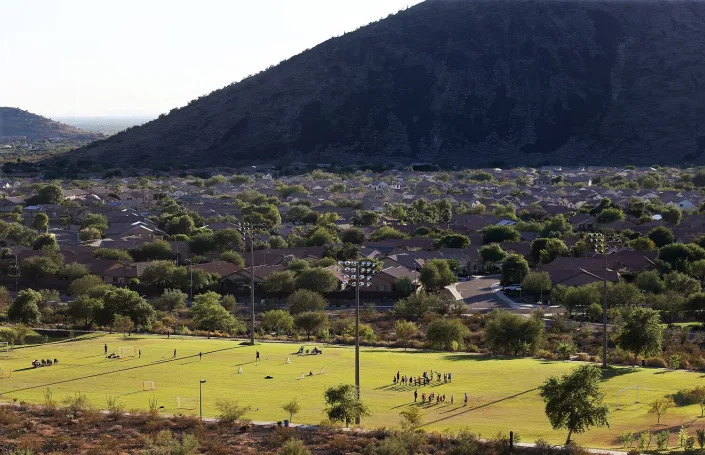
Overhead shot of a green outdoor athletic field surrounded by suburbs
Landscaped yards and green grassy playing fields typify the suburbs of North Phoenix. (Luis Sinco / Los Angeles Times)

Meanwhile, groundwater remains unregulated in most rural areas of Arizona, and large farming operations have been pumping heavily, drawing down water levels and leaving homeowners with dry wells. Around Kingman in western Arizona, where large new plantings of pistachio orchards have raised concerns among local officials, the state’s water regulators announced this month that they will limit the amount of land that may be irrigated in the Hualapai Valley.

Buckeye has a substantial amount of groundwater locally and plans to seek additional water that could be brought in from other areas, said Terry Lowe, the city’s director of water resources.

“It’s a hot market, the Phoenix metro area in general, and we’ve got to be able to have that water to meet that demand,” Lowe said. “And so we’re looking at working with others outside to find sources.”

For the planned 37,000-acre community Teravalis, the developers have two existing water approvals, called certificates of assured water supply, to build about 7,000 homes, and plan to seek additional approvals to build more. The developers plan to pump groundwater from the aquifer beneath the property, which lies in the Hassayampa River watershed.

“It’s one of the most plentiful aquifer basins in the state of Arizona. So we feel pretty good about that,” said Heath Melton, regional president for The Howard Hughes Corp. “We feel like we’re in a really good place.”

Melton said the community will conserve water by having low-water-use plants and fixtures, and will use recycled wastewater for outdoor irrigation and to recharge the aquifer.

Developers are also supporting the state government’s efforts to secure additional water from new sources.

a canal surrounded by shrubs runs into a basin
Colorado River water flows into the Agua Fria groundwater recharge basins (or groundwater recharge facilities) in Peoria, Ariz. (Albert Brave Tiger Lee / Los Angeles Times)

Legislation signed this year by Gov. Doug Ducey established a new Water Infrastructure Finance Authority that will have about $1.4 billion for conservation projects and to secure additional supplies, including possibly bringing in water from outside the state. Arizona officials have been looking into a possible deal with Mexico to desalinate seawater at the Sea of Cortez and exchange that water for some of Mexico’s Colorado River water.

In the Hassayampa watershed in Buckeye, state water regulators have been working on an updated analysis of the groundwater basin. In letters to some other developers in the area, they have warned that although their report is not yet complete, they have “information indicating that the proposed subdivision’s estimated groundwater demand for 100 years is likely not met when considered with other existing uses and approved demands in the area.”

The Arizona Department of Water Resources similarly announced in 2019 that projections showed insufficient groundwater available for all the planned developments in Pinal County, between Phoenix and Tucson.

“The amount of groundwater we can allocate for these purposes is finite,” said Tom Buschatzke, the department’s director. He said in the Hassayampa basin, all the proposed developments won’t be able to grow on groundwater alone.

“They’ve got to find a different way to do business than what they’ve historically done,” he said. “They’ve got to find different pathways, more likely more expensive pathways.”

Buschatzke said the area still has options, such as bringing in water from other areas or using recycled water.

Even as the supply of Colorado River water shrinks, some researchers are optimistic about the state’s ability to adapt.

“The whole state is at an inflection point where we have to take some definite actions toward making sure of water supplies to serve the populations that are here now and into the future,” said Sarah Porter, director of ASU’s Kyl Center for Water Policy. “Arizona has a long history of meeting these water challenges, and I think Arizona will do that again.”

Ferris said she feels more pessimistic.
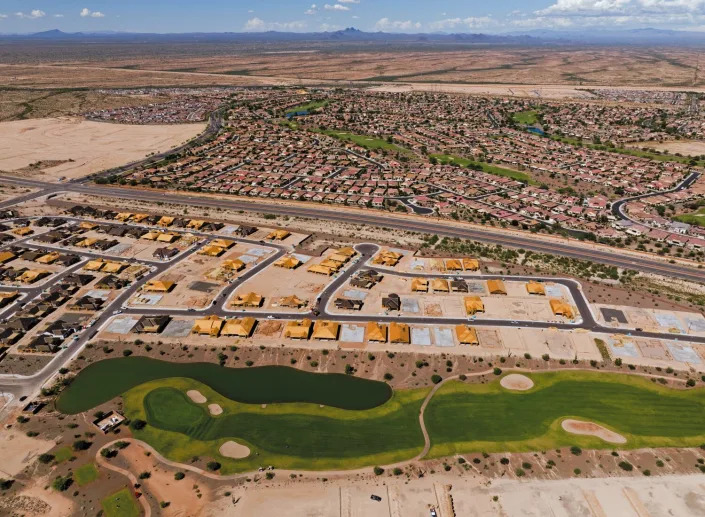
Overhead view of homes being build around a green golf course
Homes are being built in a new community in Buckeye, Ariz. (Albert Brave Tiger Lee / Los Angeles Times)

Visiting a new development in Buckeye, Ferris drove past an entrance with flowing fountains. She watched workers building homes beside a golf course with ponds.

Nearby, new homes stood beside the open desert. On empty lots, flattened patches of dirt lay ready for the foundations to be poured.

“We have to stop growing these giant developments on groundwater. It is unsustainable,” Ferris said. “We need to limit the growth.”
No more Band-Aids: How to make the Colorado River sustainable for the long term

AZ Central – The Arizona Republic

No more Band-Aids: How to make the Colorado River sustainable for the long term

Margaret Garcia and Elizabeth Koebele – December 26, 2022

The Colorado River Basin is in the midst of a sustainability crisis.

Climate change and severe drought, coupled with historic overallocation of the river, have caused water users to rapidly drain the system’s major reservoirs to their lowest levels since construction.

Prior water management actions, such as urban water conservationinfrastructure efficiency investments, and water delivery reductions, have bought Colorado River water users time. But that time is now running out. Some water users are already experiencing dire effects of this crisis, while others prepare for cuts looming on the horizon.

Colorado River Basin policymakers stand at a critical juncture. They have an opportunity to avert more severe impacts of the crisis by implementing policy and management changes that go beyond the relatively incremental steps taken thus far.

How do we find long-term sustainability?

However, negotiating such major changes is extremely challenging, especially given the basin’s complex legal structure of water rights, its users’ diverse demands and uncertainty around how much water will be available in the future.

This raises the question: How can basin policymakers create transformational change that advances the long-term sustainability of the Colorado River amid this crisis?

What lurks in Lake Mead?Bodies and boats surface as water levels decline

Drawing on our experience studying water management transitions through the lenses of water resource engineering and collaborative policymaking, we offer three substantive and procedural suggestions that can help Colorado River Basin policymakers realize transformational change.

1. Move away from a fixed quantity of water
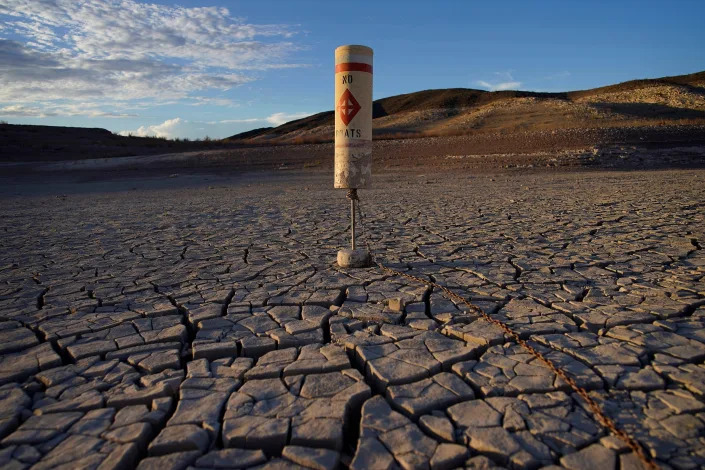
A buoy sits high and dry on cracked earth previously under the waters of Lake Mead at the Lake Mead National Recreation Area near Boulder City, Nev., on June 28, 2022. Living with less water in the U.S. Southwest is the focus for a conference starting Wednesday, Dec. 14, 2022, in Las Vegas, about the drought-stricken and overpromised Colorado River.

First, policymakers must stabilize the Colorado River system, meaning that water use does not exceed water availability. However, because streamflow is expected to continue to decline as temperatures rise, any stabilization solution must be adaptable to changes in water availability as they occur.

One way to achieve this is to change the indicators of system-wide water availability that trigger water management actions. Basin managers currently use slow-responding reservoir levels (which may also be muddled by complex water accounting) for this purpose. A more responsive indicator, such as a 5-year rolling average of inflow, could be used in the short term to minimize reliance on dwindling storage.

In the longer term, Basin managers could also consider an adaptive approach used in other areas of the West that converts fixed-quantity water rights to shares of the total quantity of available water, with the allocation of shares tailored to account for the existing water rights priority structure. The total quantity of available water could be adjusted to slowly refill reservoirs, serving to mitigate large water cuts in dry years. This additional step would help the system move beyond stabilization and into longer-term recovery.

2. Prioritize ideas to reduce uncertainty

Moving to the type of management regime described above will likely mean painful cuts for water users throughout the Colorado River Basin in the coming years. However, it could create more predictability and reliability in the long term – values that Basin managers have previously signaled agreement around.

Managing for a smaller known quantity of water is often easier than managing for the unknown. Achieving this, however, requires that all water users, including historically marginalized tribes and environmental groups, have an equitable seat at the negotiating table in order to reduce uncertainty about future water uses and needs.

3. Think beyond ‘how to share water cuts’

Finally, policymakers must expand their conception of “water sustainability” in the Colorado River Basin. For thriving communities and economies, water is a means, not an end. Beyond water use directly for human, public and ecological health, water enables food production and energy generation.

Broadening our thinking from “how to share water reductions” to “how to maintain regional food and energy security” opens new opportunities for negotiation and collaboration beyond the traditional “zero-sum” mentality.

These could include investing recently allocated federal funds for drought mitigation in improving agricultural water use efficiency, supporting the clean energy transition and conserving ecosystems to achieve more holistic sustainability goals, rather than temporarily buying more time through short-term conservation measures.

Transforming Colorado River Basin management to mitigate the current water crisis and realize long-term water sustainability requires changing not only policies but also the way we think about water use and needs.

The three suggestions presented above can help policymakers to meet this moment of historic challenge and historic opportunity by moving beyond incremental change and fostering a new era of solutions for the Colorado River.

Margaret Garcia, Ph.D, is an assistant professor in the School of Sustainable Engineering and the Built Environment at Arizona State University. Elizabeth A. Koebele, Ph.D., is an associate professor of political science at the University of Nevada, Reno, where she researches the use and implications of collaborative approaches to governing water resources.

Arizona’s water crisis is manageable – if we actually do these 3 things

AZ Central – The Arizona Republic

Arizona’s water crisis is manageable – if we actually do these 3 things

Grady Gammage, Jr. – December 22, 2022

Those of us who talk about Arizona’s water situation often point out that the challenge we face is less daunting than other dilemmas of climate change like sea level rise or an increasing frequency of hurricanes. A dramatic decline in water resources, we say, is manageable, and Arizona has a strong history of water management.

But there’s a catch: We have to actually manage it.

There are a lot of seemingly disconnected ideas floating around. It is important to fit these ideas into a context, and to give Arizonans a way to talk about how we will manage our way through.

Here are some thoughts on such a framework.

Conservation is a small yet critical need

We cannot conserve our way out of the looming shortages. Reducing turf, limiting lot sizes and increasing use of effluent are all good and important things. The reality is we could shut off all municipal use and not solve the problem.

Conservation is an important piece of reminding everyone how critical water is, and of making a statement that we are serious and we are all in this together. Conservation would involve some mandates (like prohibiting winter overseeding); incentives (paying to remove turf) and a lot of education.

As the Colorado River shrinks:Arizona looks at water recycling, desalination

The best way to achieve conservation is to create targets for municipal reductions in per-capita consumption. The best way of reaching those targets is to carefully raise water prices on amounts beyond a minimum quantity per household.

This represents action we can take immediately.

Shift water from agriculture to urban use
Arizona must incentivize farmers to increase efficiency and be more flexible in crop choices.

The biggest water use in Arizona by far is irrigated agriculture. Encouraging farming was the goal of public policy to settle the West. That worked, but today the policy should be to first preserve western economies and urban growth.

Agriculture does not need to disappear. But it needs to dramatically curtail use when there is not enough water to go around.

We must compensate farmers for such changes, and incentivize them to increase efficiency and be more flexible in crop choices. Farmers in Yuma have offered such a proposal, which can become the basis for negotiation. This should be the primary use of state dollars through the newly enhanced Water Infrastructure Financing Authority (WIFA). The Legislature put a billion dollars into WIFA in 2022. A good start, but there needs to be an ongoing revenue stream for these purposes.

Just as an example, a $500 surcharge per acre foot of municipal water use in Maricopa County would raise about half a billion dollars every year. That amounts to $.0015 per gallon. Carefully shifting water from farming to urban use can get us through the next 30-40 years.

Invest in new, long-term water sources

It is important to start working now on solutions in the distant horizon. This likely means ocean desalinization, but there may be other alternatives. What is important is that a plan for 50-plus years into the future begins to unfold.

The price tag will be high. The recent Build Back Better bill has about $4 billion earmarked for Western water projects. This is great, and we should thank our congressional delegation.

Federal participation in dealing with the cost of natural disasters is a bedrock purpose of the national government. It is a way of spreading the risk of hurricanes, floods and fires over a larger revenue base. It is also a way of protecting interstate commerce. New York City alone got $4 billion in federal money after “Superstorm” Sandy.

The federal government has averaged more than $30 billion per year in hurricane relief since 2000. Drought and aridification in the West are the same sort of challenge.

The Colorado River basin states should band together to make this point in Washington. Federal reclamation policy settled the West. That policy is now needed to sustain what reclamation built.

Confronting the challenge of a drying climate at different scales and in different time frames will help Arizona reassert its storied history of leadership in water management.

Grady Gammage, Jr. is a practicing lawyer and author. 

Thousands trapped on Pine Ridge burn clothes for warmth in wake of storm

Argus Leader

Thousands trapped on Pine Ridge burn clothes for warmth in wake of storm

Darsha Dodge – December 22, 2022

With a twinge of cold in her toes and a tone of concern tinted by exhaustion, Anna Halverson relayed the message: “We’re in a really extreme emergency down here.

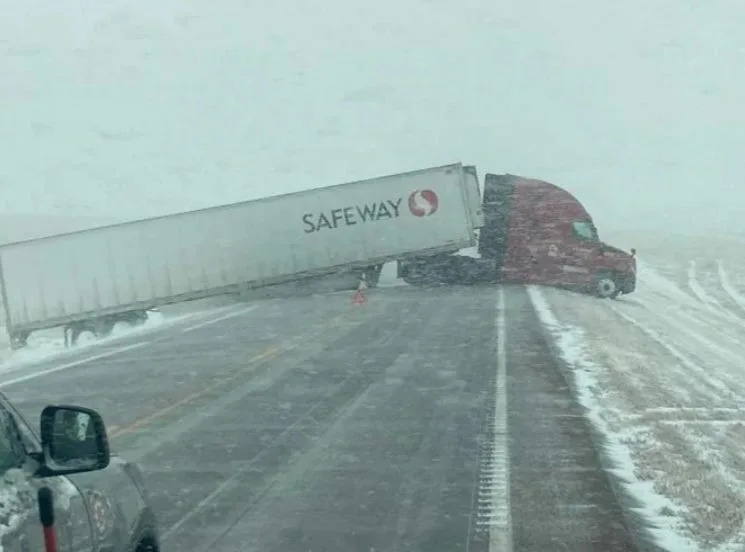
Winter Storm Diaz blanketed the Pine Ridge Reservation in more than 30 inches of snow – incredible enough on its own – but it was amplified by intense winds that brought the area to a standstill under drifts of snow several feet high.

A semi truck and trailer blocking a major highway on the Pine Ridge Reservation during Winter Storm Diaz.

Halverson, who represents the Pass Creek District on the Pine Ridge Reservation, described their harrowing situation to the Journal on Thursday.

“It’s been really tough,” she said. “We don’t have the proper equipment here to handle what’s been going on. We have drifts as high as some houses that stretch 60, 70 yards at a time.”

More than 10 days since the storm began, Diaz has moved on and the skies have started to clear, but the recovery process is just beginning. Halverson didn’t get dug out of her house until eight days after the storm. Others are still trapped, reachable only by snowmobile.

It seems like every time we open the road, the snow just drifts it back over,” she said.

More: Gov. Kristi Noem declares ‘winter storm emergency’ for South Dakota; activates National Guard

It’s an incredibly scary situation, she explained, as many of those snowed-in are missing dialysis treatments or dealing with other medical emergencies. One family ran out of infant formula, and spent four days drifted in before attempting to leave, Halverson said.

“We even talked about using drone drops to get the baby some Enfamil, because the baby was starving,” she said.

But Mother Nature wasn’t done yet.

If being trapped by formidable walls of ice and snow wasn’t enough, subzero temperatures, brought down by an Arctic front, took an already struggling region by the neck. Temperatures dropped into the negative teens and 20s this week, and the unkind Midwest wind shredded those figures with wind chills in the negative 40s and negative 50s.

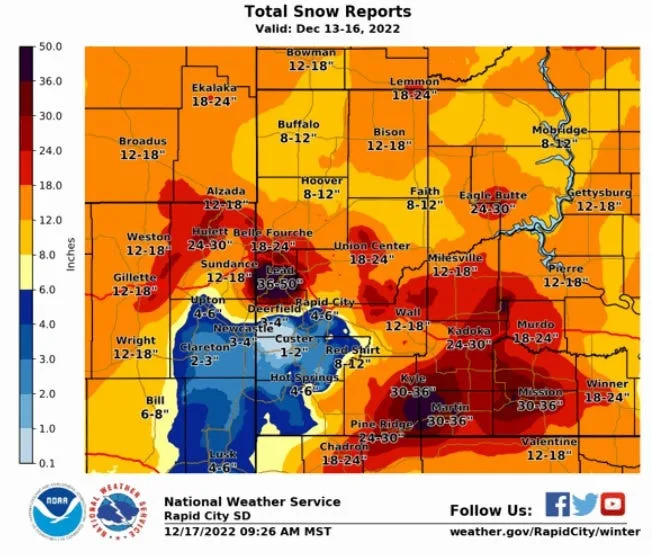
Total snow reports from Dec. 13 - 16 in Western South Dakota
Total snow reports from Dec. 13 – 16 in Western South Dakota

Cold like that is deadly, just another blow to a reservation already crippled by conditions, Halverson said.

“Most of our members use wood stoves,” she said. “We’re not able to get them with deliveries because of the roads. A lot of our members across the reservation have no propane, because the propane companies can’t reach their tanks to fill. Even right now in my district, we haven’t had anybody able to deliver out to these members that have no propane since the storm started.”

Oglala-based service organization Re-Member provides firewood to families on all corners of the reservation, but the drifts of snow have rendered their wood stockpile inaccessible still – and it’ll be that way for the foreseeable future.

“Our wood pile remains inaccessible,” read a Facebook post on Dec. 20. “Our skid steer and plow are out-of-service. Given the conditions, it would be near impossible to operate our equipment and unsafe for our staff to work in the conditions we are facing. We appreciate the efforts being made by many to keep the Oyate safe during these challenging times.”

Those that can try to use electric heaters, which Halverson said isn’t keeping houses warm. Even her own furnace went out, blowing cold air in an already frigid atmosphere. She was able to travel to her mother’s house to keep her family warm.

Power went out in some places, once for 18 hours, she said. People with cars tried to use them to stay warm.

Reservation residents are resorting to last-ditch efforts to ward off the unimaginable cold.

More:Sioux Falls Regional Airport will close through much of Friday due to blizzard

“I’ve seen across the reservation some members were burning clothes in their wood stove because they couldn’t get access to wood,” Halverson said.

The conditions got so bad so quickly that Oglala Sioux Tribe President Frank Star Comes Out penned a proclamation declaring a state of emergency.

“These current blizzard conditions have caused closure of all BIA and tribal secondary roads on the reservation due to falling snow, high winds and snow drifts,” Star Comes Out wrote. “Such blizzard conditions pose an imminent threat to tribal government operations, to public safety and the health of tribal members who currently do not have access to medical care, such as dialysis, ambulance service for crisis intervention medical care such as heart attacks and delivering babies, and private transportation to secure food and other necessities of life.”

Halverson praised his efforts in trying to get help for the people of Pine Ridge. The exhaustion in her voice dissipated – for a brief second – calling her people “survivors.”

“We don’t live on our reservation,” she said. “We survive on our reservation. We’re in serious need of some help.”

What’s the coldest spot on Earth? NASA has pinpointed it — and the nights are deadly

Miami Herald

What’s the coldest spot on Earth? NASA has pinpointed it — and the nights are deadly

Mark Price – December 19, 2022

NASA image

If you think a little cold air and snow might bolster your holiday spirits, NASA says it knows the perfect destination for frigid Christmas and New Year’s celebrations.

“Looking for the coldest place to spend the holiday season?” the space agency asked in a Facebook post.

“You won’t find anyone else there, but the coldest place we’ve found on Earth (with the help of NASA Earth satellites) is a high ridge on the East Antarctic Plateau.”

Just be sure to bundle up. Temperatures on the ridge “can drop to 135 degrees (Fahrenheit) below zero” on winter nights, NASA says.

At that point, even gasoline freezes

NASA first reported finding the planet’s coldest spot in 2013, and the plateau has continued to hold the dubious honor every year since.

The National Snow and Ice Data Center concluded the East Antarctic Plateau was the coldest place in the world after analyzing 32 years of data from several satellites, NASA says. The hollows on the plateau are considered the coldest spots.

“Near a high ridge that runs from Dome Arugs to Dome Fuji, the scientists found clusters of pockets that have plummeted to record low temperatures dozens of times,” officials reported. “The lowest temperature the satellites detected – minus 136° F (minus 93.2° C), on Aug. 10, 2010.”

Scientists attribute the plateau’s dangerous temperatures to a combination of air that is “stationary for extended periods, while continuing to radiate more heat away into space.”

However, the plateau is not “the coldest permanently inhabited place on Earth,” experts say. That’s located in northeast Siberia, “where temperatures dropped to a bone-chilling 90 degrees below zero F (minus 67.8° C) in the towns of Verkhoyansk (in 1892) and Oimekon (in 1933).”

NASA first reported finding the planet’s coldest spot in 2013, and the plateau has continued to hold the dubious honor every year since.

The National Snow and Ice Data Center concluded the East Antarctic Plateau was the coldest place in the world after analyzing 32 years of data from several satellites, NASA says. The hollows on the plateau are considered the coldest spots.

“Near a high ridge that runs from Dome Arugs to Dome Fuji, the scientists found clusters of pockets that have plummeted to record low temperatures dozens of times,” officials reported. “The lowest temperature the satellites detected – minus 136° F (minus 93.2° C), on Aug. 10, 2010.”

Scientists attribute the plateau’s dangerous temperatures to a combination of air that is “stationary for extended periods, while continuing to radiate more heat away into space.”

However, the plateau is not “the coldest permanently inhabited place on Earth,” experts say. That’s located in northeast Siberia, “where temperatures dropped to a bone-chilling 90 degrees below zero F (minus 67.8° C) in the towns of Verkhoyansk (in 1892) and Oimekon (in 1933).”

It could happen tomorrow’: Experts know disaster upon disaster looms for West Coast

USA Today

‘It could happen tomorrow’: Experts know disaster upon disaster looms for West Coast

Joel Shannon, USA TODAY – December 19, 2022

It’s the elevators that worry earthquake engineering expert Keith Porter the most.

Scientists say a massive quake could strike the San Francisco Bay Area at any moment. And when it does, the city can expect to be slammed with a force equal to hundreds of atomic bombs.

Porter said the shaking will quickly cut off power in many areas. That means unsuspecting people will be trapped between floors in elevators without backup power. At peak commute times, the number of those trapped could be in the thousands.

To escape, the survivors of the initial quake will need the help of firefighters with specialized training and tools.

But their rescuers won’t come – at least not right away. Firefighters will be battling infernos that could outnumber the region’s fire engines.

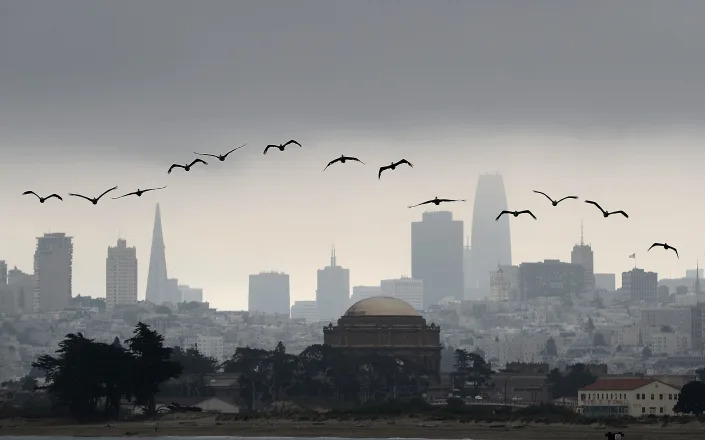
Brown pelicans fly in front of the San Francisco skyline Aug 17, 2018.

Running water will be in short supply. Cellphone service may not work at all. The aftershocks will keep coming.

And the electricity could remain off for weeks.

“That means people are dead in those elevators,” Porter said.

‘Problems on the horizon’

The situation Porter described comes from his work on the HayWired Scenario, a detailed look at the cascading calamities that will occur when a major earthquake strikes the Bay Area’s Hayward Fault, including the possibility of widespread power outages that will strand elevators.

The disaster remains theoretical for now. But the United States Geological Survey estimates a 51% chance that a quake as big as the one described in HayWired will occur in the region within three decades.

It’s one of several West Coast disasters so likely that researchers have prepared painstakingly detailed scenarios in an attempt to ready themselves.

‘SUPERIONIC’: Scientists discover the Earth’s inner core isn’t solid or liquid

The experts who worked on the projects are highly confident the West Coast could at any moment face disasters with the destructive power to kill hundreds or thousands of people and forever change the lives of millions more. They also say there’s more that can be done to keep individuals – and society – safer.

“We’re trying to have an earthquake without having one,” Anne Wein told USA TODAY. Wein is a USGS researcher who co-leads the HayWired earthquake scenario and has worked on several other similar projects.

Such disaster scenarios are massive undertakings that bring together experts from various fields who otherwise would have little reason to work together – seismologists, engineers, emergency responders and social scientists.

That’s important because “it’s difficult to make new relationships in a crisis,” Wein said.

Similar projects aimed at simulating a future disaster have turned out to be hauntingly accurate.

The Hurricane Pam scenario foretold many of the devastating consequences of a major hurricane striking New Orleans well before Hurricane Katrina hit the city.

More recently, in 2017, the authors of “The SPARS Pandemic” called their disaster scenario “futuristic.” But now the project now reads like a prophecy of COVID-19. Johns Hopkins University even issued a statement saying the 89-page document was not intended as a prediction of COVID-19.

“The SPARS Pandemic” imagined a future where a deadly novel coronavirus spread around the world, often without symptoms, as disinformation and vaccine hesitancy constantly confounded experts’ efforts to keep people safe.

The “SPARS scenario, which is fiction, was meant to give public health communicators a leg up … Think through problems on the horizon,” author Monica Schoch-Spana told USA TODAY.

At the time that SPARS was written, a global pandemic was thought of in much the same way experts currently describe the HayWired earthquake: an imminent catastrophe that could arrive at any time.

‘It could happen tomorrow’

Disaster scenario researchers each have their own way of describing how likely the apocalyptic futures they foresee are.

“The probability (of) this earthquake is 100%, if you give me enough time,” seismologist Lucy Jones will often say.

Earthquakes occurring along major faults are a certainty, but scientists can’t predict exactly when earthquakes will happen – the underground forces that create them are too random and chaotic. But researchers know a lot about what will happen once the earth begins to shake.

Earthquakes like HayWired are “worth planning for,” Porter said. Because “it could happen tomorrow.”

“We don’t know when,” Porter said. But “it will happen.”

Wein says we’re “overdue for preparedness.” You might say we’re also overdue for a major West Coast disaster.

The kind of earthquake described in HayWired historically occurs every 100-220 years. And it’s been more than 153 years since the last one.

Farther south in California, it’s difficult to pin down exactly how at risk Los Angeles is for The Big One – the infamous theoretical earthquake along the San Andreas fault that will devastate the city. But a massive magnitude 7.5 earthquake has about a 1 in 3 chance of striking the Los Angeles area in the next 30 years, the United States Geological Survey estimates.

A 2008 scenario said a magnitude 7.8 quake could cause nearly 2,000 deaths and more than $200 billion in economic losses. Big quakes in Los Angeles are particularly devastating because the soil holding up the city will turn into a “bowl of jelly,” according to a post published by catastrophe modeling company Temblor.

Another scenario warns that a stretch of coast in Oregon and Washington state is capable of producing an earthquake much more powerful than the ones California is bracing for. Parts of coastline would suddenly drop 6 feet, shattering critical bridges, destroying undersea communication cables and producing a tsunami.

Thousands are expected to die, but local leaders are considering projects that could give coastal residents a better chance at survival.

It too “could happen at any time,” the scenario says.

Earthquake scenarios often focus on major coastal cities, but West Coast residents farther inland also have yet another disaster to brace for.

Megastorms are California’s other Big One,” the ARkStorm scenario says. It warns of a statewide flood that will cause more than a million evacuations and devastate California’s agriculture.

Massive storms that dump rain on California for weeks on end historically happen every few hundred years. The last one hit around the time of the Civil War, when weeks of rain turned portions of the state “into an inland sea.”

‘Decades to rebuild’

Whether the next disaster to strike the West Coast is a flood, an earthquake or something else, scenario experts warn that the impacts will reverberate for years or longer.

“It takes decades to rebuild,” Wein said. “You have to think about a decade at least.”

A major West Coast earthquake isn’t just damaged buildings and cracked roads.

It’s weeks or months without running water in areas with millions of people. It’s mass migrations away from ruined communities. It’s thousands of uninhabitable homes.

Depending on the scenario, thousands of people are expected to die. Hundreds of thousands more could be left without shelter. And those impacts will be a disproportionately felt.

‘DYING ON THE STREETS’: Homelessness crisis is top issue in Los Angeles mayoral race

‘SURREAL’: Wildfire burning near iconic California coastal highway prompts evacuations

California already has a housing and homelessness crisis, and Nnenia Campbell said the next disaster is set to magnify inequalities. Campbell is the deputy director of the William Averette Anderson Fund, which works to mitigate disasters for minority communities.

Campbell doesn’t talk about “natural disasters” because there’s nothing natural about the way a major earthquake will harm vulnerable communities more than wealthy ones.

Human decisions such as redlining have led to many of the inequities in our society, she said. But humans can make decisions that will help make the response to the next disaster more equitable.

Many of those choices need to be made by local leaders and emergency management planners. Investing in infrastructure programs that will make homes in minority communities less vulnerable to earthquakes. Understanding how important a library is to unhoused people. Making sure all schools are built to withstand a disaster. Keeping public spaces open, even during an emergency.

But individuals can make a difference as well, Campbell said. You can complete training that will prepare you to help your community in the event of an emergency. Or you can join a mutual aid network, a group where community members work together to help each other.

Community support is a common theme among disaster experts: One of the best ways to prepare is to know and care about your neighbors.

If everyone only looks out for themselves in the next disaster, “we are going to have social breakdown,” Jones said.

What you can do

Experts acknowledge you’ll want to make sure you and your family are safe before being able to help others. Fortunately, many disaster preparedness precautions are inexpensive and will help in a wide range of emergency situations.

Be prepared to have your access to electricity or water cut off for days or weeks.

For electricity, you’ll at least want a flashlight and a way to charge your phone.

While cell service will be jammed immediately after a major earthquake, communications will likely slowly come back online faster than other services, Wein said. (And when trying to use your phone, text – don’t call. In a disaster, text messages are more reliable and strain cell networks less.)

To power your phone, you can cheaply buy a combination weather radio, flashlight and hand-crank charger to keep your cell running even without power for days.

A cash reserve is good to have, too, Jones said. You’ll want to be able to buy things, even if your credit card doesn’t work for a time.

Preparing for earthquakes specifically is important along the West Coast, too, experts said. Simple things like securing bookshelves can save lives. Downloading an early warning app can give you precious moments to protect yourself in the event of a big quake. Buying earthquake insurance can protect homeowners. And taking part in a yearly drill can help remind you about other easy steps you can take to prepare.

There’s even more you could do to ready yourself for a catastrophe, but many disaster experts are hesitant to rely on individuals’ ability to prepare themselves.

Just as health experts have begged Americans to use masks and vaccines to help keep others safe during the pandemic, disaster scenario experts believe community members will need to look out for one another when the next disaster strikes.

Telling people to prepare as if “nobody is coming to help you” is a self-fulfilling prophesy, Jones said.

For now, policymakers hold the real power in how prepared society will be for the next disaster. And there are many problems to fix, according to Porter, including upgrading city plumbing, because many aging and brittle water pipes will shatter in a major earthquake, cutting off water to communities for weeks or months.

“Shake it, and it breaks,” Porter said.

Getting ready for the next big earthquake means mundane improvements like even stricter building codesemergency water supply systems for firefighters and retrofitting elevators with emergency power.

The elevator change could prevent thousands of people from being trapped when the big San Francisco earthquake comes.

“A lot of that suffering can be avoided,” Porter said.

Animals Are Running Out of Places to Live

The New York Times

Animals Are Running Out of Places to Live

Catrin Einhorn and Lauren Leatherby – December 16, 2022

Animals Are Running Out of Places to Live

Wildlife is disappearing around the world, in the oceans and on land. The main cause on land is perhaps the most straightforward: Humans are taking over too much of the planet, erasing what was there before. Climate change and other pressures make survival harder.

This week and next, nations are meeting in Montreal to negotiate a new agreement to address staggering declines in biodiversity. The future of many species hangs in the balance.

“If the forest disappears, they will disappear,” said Walter Jetz, a professor of biodiversity science at Yale University who leads Map of Life, a platform that combines satellite imaging with ecological data to determine how species ranges are changing around the world. Map of Life shared data with The New York Times.

Biodiversity — or all the variety of life on the planet, including plants, invertebrates and ocean species — is declining at rates unprecedented in human history, according to the leading intergovernmental scientific panel on the subject. The group’s projections suggest that 1 million species are threatened with extinction, many within decades.

The meeting in Montreal is intended to chart a different path. Delayed two years because of the pandemic, delegations are working to land a new, 10-year agreement to tackle biodiversity loss under a United Nations treaty called the Convention on Biological Diversity.

“With our bottomless appetite for unchecked and unequal economic growth, humanity has become a weapon of mass extinction,” U.N. Secretary-General António Guterres said in his opening remarks last week in Montreal.

The last global biodiversity agreement failed to meet a single target at the global level, according to the Convention on Biological Diversity itself, and wildlife populations continue to plummet.

Take the Honduran white bat.

At first glance, they resemble a cluster of cotton balls stuck under a leaf. But each tiny mound of fluff possesses an even tinier yellow snout and ears. Honduran white bats work together to fashion leaves into tent homes and are known to nurse one another’s young. At night, they fly out in search of a specific species of fig, dispersing its seeds in return.

These bats offer potential benefits to people. Their cuteness makes them an ecotourism draw, and they have an ability that’s rare in mammals to store carotenoids in their skin, which could hold promise for unlocking treatment for conditions such as macular degeneration.

But in the past 20 years, Honduran white bats have lost about half their range in Central America as people clear rainforest for pasture, crops and homes. Not yet considered endangered, they are nevertheless in steep decline, one of countless examples in this worsening global crisis.

It’s not only wildlife that will suffer as a result. Biodiversity loss can trigger ecosystem collapse, scientists say, threatening humanity’s food and water supplies. Alarm is growing that the threat is comparable in significance to the climate crisis.

“Climate change presents a nearer-term threat to the future of human civilization,” said Katharine Hayhoe, a prominent climate change researcher who also focuses on biodiversity as chief scientist at the Nature Conservancy. “The biodiversity crisis presents a longer-term threat to the viability of the human species.”

Scientists emphasize that one can’t be solved without the other because they are interconnected.

What Is Driving the Loss

The human population has doubled since 1970. Although the rate of population growth is slowing, the sheer number of people continues to rise. Consumption levels in different parts of the world mean some people put more pressure on nature. In the United States, for example, each person uses the equivalent of 8 global hectares on average, according to the Global Footprint Network, a nonprofit research group. In Nigeria, it’s about 1 hectare per person.

All that is related to the causes of biodiversity loss, which scientists have ranked. First are changes in land and sea use. Then comes the direct taking of species via, for example, hunting, fishing and wildlife trafficking. Climate change is next, followed by pollution and invasive species. Unfortunately for wildlife, these pressures build on one another.

In the future, scientists expect climate change to become the main driver of biodiversity loss as changes in temperature, rainfall and other conditions continue to transform ecosystems. That shift is expected “some decades down the road,” Jetz said. “But we might already be looking at a much-reduced set of species at that point.”

For the best chance at adapting to climate change, plants and animals need robust populations and room to migrate. Instead, they are depleted and hemmed in.

Why are people taking over so much land? Mostly for agriculture. In many parts of the world, that means exports driven by booming global trade. In recent decades, for example, Southeast Asia has become a major supplier of coffee, timber, rice, palm oil, rubber and fish to the rest of the world.

“All of that economic expansion has come at the cost of biodiverse habitat,” said Pamela McElwee, an environmental anthropologist at Rutgers University who studies the region.

Some momentum is building for companies to ensure that their products are deforestation-free. Reducing meat consumption and food waste are key to freeing up land for other species, McElwee said.

In many places, poverty, powerful interests and a lack of law enforcement make habitat loss especially hard to address.

In Central America, illegal cattle ranching drives deforestation on protected state and Indigenous lands, said Jeremy Radachowsky, director for Mesoamerica and the Caribbean at the Wildlife Conservation Society. Wealthy individuals, often affiliated with drug cartels, grab land, sometimes through illegal payments. They raise beef, some of which ends up in the United States, he said.

Elsewhere in the region and beyond, desperation sometimes pushes people to find remote areas with little government presence where they can simply take land to make a living.

“They need land in order to feed their families,” said David López-Carr, a professor of geography at the University of California Santa Barbara who studies how people interact with tropical forests in Latin America.

Rainforest countries such as Brazil and Congo are known for widespread deforestation. But the species that have lost the largest portions of their habitats tend to be concentrated in places that are geographically isolated in some way, such as the isthmus of Central America and Madagascar. Because animals there often have smaller ranges to begin with, habitat loss hits them especially hard.

For example, 98% of lemurs, primates that only exist in Madagascar, are threatened. Almost one-third are on the brink of extinction. “I don’t want to lose my hope,” said Jonah Ratsimbazafy, a primatologist who leads a nonprofit group on the island that seeks to save lemurs while helping people. Madagascar is among the poorest countries in the world.

Recognition is growing that stanching biodiversity loss requires addressing the needs of local communities.

“There needs to be a way that the people that live close to the forests benefit from the intact forests, rather than clearing the forest for short term gain,” said Julia Patricia Gordon Jones, a professor of conservation science at Bangor University in Wales. “That’s the ultimate challenge of forest conservation globally.”

The High Cost of Inaction

While countries in the global south are experiencing the most dramatic biodiversity losses right now, Europe and the United States went through their own severe declines hundreds of years ago.

“We lost pretty much 100% of primary forest in most parts of Europe,” Jetz said.

Now, with negotiations underway in Montreal, countries that are poor economically but rich in biodiversity argue that they need help from wealthier countries if they’re going to take a different route.

Overall, the financial need is daunting: hundreds of billions per year to help poorer countries develop and implement national biodiversity plans, which would include actions such as creating protected areas; restoring degraded lands; reforming harmful agricultural, fishing and forestry practices; managing invasive species; and improving urban water quality.

On the other hand, failing to address biodiversity loss carries enormous financial risk. A report by the World Economic Forum found that $44 trillion of economic value generation is “moderately or highly dependent on nature and its services and is therefore exposed to nature loss.”

A vast source of funding could come from redirecting subsidies that presently support fossil fuels and harmful agricultural practices, said David Cooper, deputy executive secretary of the Convention on Biological Diversity.

“Currently, most governments spend far more on subsidies that actually are destroying nature than they do on financing conservation,” Cooper said. “So, certainly a change in that will be critical.”

The United States is the only country besides the Holy See that isn’t a party to the convention, so although the United States will attend the meeting, it will be participating from the sidelines.

“We can play a very constructive role from the outside,” said Monica Medina, an assistant secretary of state who is also special envoy for biodiversity and water resources. But she acknowledged that being a member would be better. “I hope that someday we will be,” she said.

Of the many targets being negotiated, the one that has gotten the most attention seeks to address habitat loss head on. Known as 30×30, it’s a plan to safeguard at least 30% of the planet’s land and oceans by 2030. More than 100 countries back the proposal. Although some Indigenous groups fear it will lead to their displacement, others support the plan as a means to secure stronger land rights.

But experts emphasize that action will have to go further than lines on a map.

“You can set up a protected area, but you’ve not dealt with the fact that the whole reason you had habitat loss in the first place is because of demand for land,” McElwee said. “You have to tackle the underlying drivers. Otherwise, you’re only dealing with like half the problem.”

Methodology

All estimates on habitat loss come from Map of Life and its Species Habitat Index. Habitat loss estimates since 2001 run through 2021 and are approximations, based on models of geographic range that incorporate remote sensing and expert research. Map of Life shared data for terrestrial vertebrate species for which the group’s methods can confidently ascertain habitat loss. The researchers estimate many more species are experiencing significant habitat loss than are in the group’s data.

Common names for species used in this article come from Map of Life. Data used in the accompanying graphics showing habitat loss also comes from Map of Life.

Map of Life is led by Walter Jetz, professor of ecology at Yale University and scientific chair at the E.O. Wilson Biodiversity Foundation. Other Map of Life contributors to the research shown in this story include Kalkidan Fekadu Chefira, John Wilshire, Ajay Ranipeta, Yanina Sica and Rohan Simkin.

‘It could happen tomorrow’: Experts know disaster upon disaster looms for West Coast

USA Today

‘It could happen tomorrow’: Experts know disaster upon disaster looms for West Coast

Joel Shannon, USA TODAY – December 16, 2022

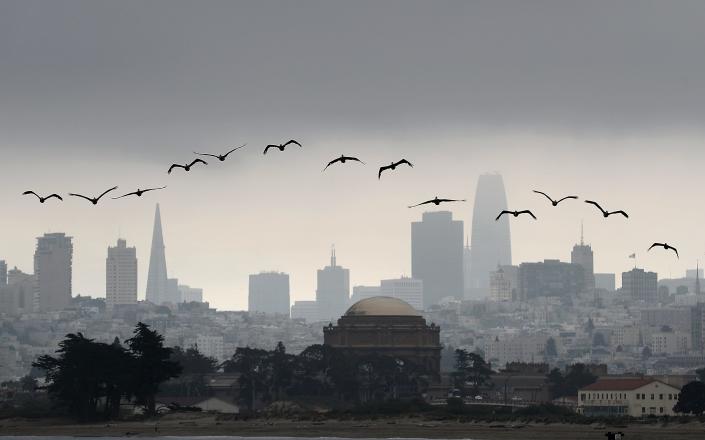
Brown pelicans fly in front of the San Francisco skyline Aug 17, 2018.

It’s the elevators that worry earthquake engineering expert Keith Porter the most.

Scientists say a massive quake could strike the San Francisco Bay Area at any moment. And when it does, the city can expect to be slammed with a force equal to hundreds of atomic bombs.

Porter said the shaking will quickly cut off power in many areas. That means unsuspecting people will be trapped between floors in elevators without backup power. At peak commute times, the number of those trapped could be in the thousands.

To escape, the survivors of the initial quake will need the help of firefighters with specialized training and tools.

But their rescuers won’t come – at least not right away. Firefighters will be battling infernos that could outnumber the region’s fire engines.

Running water will be in short supply. Cellphone service may not work at all. The aftershocks will keep coming.

And the electricity could remain off for weeks.

“That means people are dead in those elevators,” Porter said.

‘Problems on the horizon’

The situation Porter described comes from his work on the HayWired Scenario, a detailed look at the cascading calamities that will occur when a major earthquake strikes the Bay Area’s Hayward Fault, including the possibility of widespread power outages that will strand elevators.

The disaster remains theoretical for now. But the United States Geological Survey estimates a 51% chance that a quake as big as the one described in HayWired will occur in the region within three decades.

It’s one of several West Coast disasters so likely that researchers have prepared painstakingly detailed scenarios in an attempt to ready themselves.

‘SUPERIONIC’: Scientists discover the Earth’s inner core isn’t solid or liquid

The experts who worked on the projects are highly confident the West Coast could at any moment face disasters with the destructive power to kill hundreds or thousands of people and forever change the lives of millions more. They also say there’s more that can be done to keep individuals – and society – safer.

“We’re trying to have an earthquake without having one,” Anne Wein told USA TODAY. Wein is a USGS researcher who co-leads the HayWired earthquake scenario and has worked on several other similar projects.

Such disaster scenarios are massive undertakings that bring together experts from various fields who otherwise would have little reason to work together – seismologists, engineers, emergency responders and social scientists.

That’s important because “it’s difficult to make new relationships in a crisis,” Wein said.

Similar projects aimed at simulating a future disaster have turned out to be hauntingly accurate.

The Hurricane Pam scenario foretold many of the devastating consequences of a major hurricane striking New Orleans well before Hurricane Katrina hit the city.

More recently, in 2017, the authors of “The SPARS Pandemic” called their disaster scenario “futuristic.” But now the project now reads like a prophecy of COVID-19. Johns Hopkins University even issued a statement saying the 89-page document was not intended as a prediction of COVID-19.

“The SPARS Pandemic” imagined a future where a deadly novel coronavirus spread around the world, often without symptoms, as disinformation and vaccine hesitancy constantly confounded experts’ efforts to keep people safe.

The “SPARS scenario, which is fiction, was meant to give public health communicators a leg up … Think through problems on the horizon,” author Monica Schoch-Spana told USA TODAY.

At the time that SPARS was written, a global pandemic was thought of in much the same way experts currently describe the HayWired earthquake: an imminent catastrophe that could arrive at any time.

‘It could happen tomorrow’

Disaster scenario researchers each have their own way of describing how likely the apocalyptic futures they foresee are.

“The probability (of) this earthquake is 100%, if you give me enough time,” seismologist Lucy Jones will often say.

Earthquakes occurring along major faults are a certainty, but scientists can’t predict exactly when earthquakes will happen – the underground forces that create them are too random and chaotic. But researchers know a lot about what will happen once the earth begins to shake.

Earthquakes like HayWired are “worth planning for,” Porter said. Because “it could happen tomorrow.”

“We don’t know when,” Porter said. But “it will happen.”

Wein says we’re “overdue for preparedness.” You might say we’re also overdue for a major West Coast disaster.

The kind of earthquake described in HayWired historically occurs every 100-220 years. And it’s been more than 153 years since the last one.

Farther south in California, it’s difficult to pin down exactly how at risk Los Angeles is for The Big One – the infamous theoretical earthquake along the San Andreas fault that will devastate the city. But a massive magnitude 7.5 earthquake has about a 1 in 3 chance of striking the Los Angeles area in the next 30 years, the United States Geological Survey estimates.

A 2008 scenario said a magnitude 7.8 quake could cause nearly 2,000 deaths and more than $200 billion in economic losses. Big quakes in Los Angeles are particularly devastating because the soil holding up the city will turn into a “bowl of jelly,” according to a post published by catastrophe modeling company Temblor.

Another scenario warns that a stretch of coast in Oregon and Washington state is capable of producing an earthquake much more powerful than the ones California is bracing for. Parts of coastline would suddenly drop 6 feet, shattering critical bridges, destroying undersea communication cables and producing a tsunami.

Thousands are expected to die, but local leaders are considering projects that could give coastal residents a better chance at survival.

It too “could happen at any time,” the scenario says.

Earthquake scenarios often focus on major coastal cities, but West Coast residents farther inland also have yet another disaster to brace for.

Megastorms are California’s other Big One,” the ARkStorm scenario says. It warns of a statewide flood that will cause more than a million evacuations and devastate California’s agriculture.

Massive storms that dump rain on California for weeks on end historically happen every few hundred years. The last one hit around the time of the Civil War, when weeks of rain turned portions of the state “into an inland sea.”

‘Decades to rebuild’

Whether the next disaster to strike the West Coast is a flood, an earthquake or something else, scenario experts warn that the impacts will reverberate for years or longer.

“It takes decades to rebuild,” Wein said. “You have to think about a decade at least.”

A major West Coast earthquake isn’t just damaged buildings and cracked roads.

It’s weeks or months without running water in areas with millions of people. It’s mass migrations away from ruined communities. It’s thousands of uninhabitable homes.

Depending on the scenario, thousands of people are expected to die. Hundreds of thousands more could be left without shelter. And those impacts will be a disproportionately felt.

‘DYING ON THE STREETS’: Homelessness crisis is top issue in Los Angeles mayoral race

‘SURREAL’: Wildfire burning near iconic California coastal highway prompts evacuations

California already has a housing and homelessness crisis, and Nnenia Campbell said the next disaster is set to magnify inequalities. Campbell is the deputy director of the William Averette Anderson Fund, which works to mitigate disasters for minority communities.

Campbell doesn’t talk about “natural disasters” because there’s nothing natural about the way a major earthquake will harm vulnerable communities more than wealthy ones.

Human decisions such as redlining have led to many of the inequities in our society, she said. But humans can make decisions that will help make the response to the next disaster more equitable.

Many of those choices need to be made by local leaders and emergency management planners. Investing in infrastructure programs that will make homes in minority communities less vulnerable to earthquakes. Understanding how important a library is to unhoused people. Making sure all schools are built to withstand a disaster. Keeping public spaces open, even during an emergency.

But individuals can make a difference as well, Campbell said. You can complete training that will prepare you to help your community in the event of an emergency. Or you can join a mutual aid network, a group where community members work together to help each other.

Community support is a common theme among disaster experts: One of the best ways to prepare is to know and care about your neighbors.

If everyone only looks out for themselves in the next disaster, “we are going to have social breakdown,” Jones said.

What you can do

Experts acknowledge you’ll want to make sure you and your family are safe before being able to help others. Fortunately, many disaster preparedness precautions are inexpensive and will help in a wide range of emergency situations.

Be prepared to have your access to electricity or water cut off for days or weeks.

For electricity, you’ll at least want a flashlight and a way to charge your phone.

While cell service will be jammed immediately after a major earthquake, communications will likely slowly come back online faster than other services, Wein said. (And when trying to use your phone, text – don’t call. In a disaster, text messages are more reliable and strain cell networks less.)

To power your phone, you can cheaply buy a combination weather radio, flashlight and hand-crank charger to keep your cell running even without power for days.

A cash reserve is good to have, too, Jones said. You’ll want to be able to buy things, even if your credit card doesn’t work for a time.

Preparing for earthquakes specifically is important along the West Coast, too, experts said. Simple things like securing bookshelves can save lives. Downloading an early warning app can give you precious moments to protect yourself in the event of a big quake. Buying earthquake insurance can protect homeowners. And taking part in a yearly drill can help remind you about other easy steps you can take to prepare.

There’s even more you could do to ready yourself for a catastrophe, but many disaster experts are hesitant to rely on individuals’ ability to prepare themselves.

Just as health experts have begged Americans to use masks and vaccines to help keep others safe during the pandemic, disaster scenario experts believe community members will need to look out for one another when the next disaster strikes.

Telling people to prepare as if “nobody is coming to help you” is a self-fulfilling prophesy, Jones said.

For now, policymakers hold the real power in how prepared society will be for the next disaster. And there are many problems to fix, according to Porter, including upgrading city plumbing, because many aging and brittle water pipes will shatter in a major earthquake, cutting off water to communities for weeks or months.

“Shake it, and it breaks,” Porter said.

Getting ready for the next big earthquake means mundane improvements like even stricter building codesemergency water supply systems for firefighters and retrofitting elevators with emergency power.

The elevator change could prevent thousands of people from being trapped when the big San Francisco earthquake comes.

“A lot of that suffering can be avoided,” Porter said.

Drought emergency declared for all Southern California

Los Angeles Times

Drought emergency declared for all Southern California

Hayley Smith, Ian James – December 14, 2022

A woman waters her garden in Los Angeles on August 18, 2022. - Residents and businesses in Los Angeles County, and surrounding San Bernardino and Ventura Counties, have had to limit outdoor water usage since June 1 to one or two days a week due to ongoing drought water restrictions. (Photo by Frederic J. BROWN / AFP) (Photo by FREDERIC J. BROWN/AFP via Getty Images)
A woman waters her garden in Los Angeles in August. (Frederic J. Brown / AFP via Getty Images)

As California faces the prospect of a fourth consecutive dry year, officials with the Metropolitan Water District of Southern California have declared a regional drought emergency and called on water agencies to immediately reduce their use of all imported supplies.

The decision from the MWD’s board came about eight months after officials declared a similar emergency for 7 million people who are dependent on supplies from the State Water Project, a vast network of reservoirs, canals and dams that convey water from Northern California. Residents reliant on California’s other major supply — the Colorado River — had not been included in that emergency declaration.

“Conditions on the Colorado River are growing increasingly dire,” MWD Chairwoman Gloria Gray said in a statement. “We simply cannot continue turning to that source to make up the difference in our limited state supplies. In addition, three years of California drought are drawing down our local storage.”

Officials said the call for conservation in Colorado River-dependent areas could become mandatory if drought conditions persist in the coming months, which some experts say is likely. By April, the MWD will consider allocating supplies to all of its 26 member agencies, requiring them to either cut their use of imported water or face steep additional fees. The agencies together serve about 19 million people.

“Since this drought began, we have been steadily increasing our call for conservation. If we don’t have an extremely wet winter, we will need to elevate to our highest level — a water supply allocation for all of Southern California,” said MWD General Manager Adel Hagekhalil. “Substantial and immediate conservation now and in the coming months will help lessen the potential severity of such an allocation.”

MWD member agencies, which include the Los Angeles Department of Water and Power, the Municipal Water District of Orange County and the Inland Empire Utilities Agency, will implement voluntary and mandatory conservation measures at the local level based on their particular circumstances, officials said. Those with local supplies or other alternative options may be able to rely on them in the interim.

The DWP, which imports state and federal water as well as water from the Owens Valley via the Los Angeles Aqueduct, has been under Level 3 of its water shortage contingency plan since June, including two-day-a-week outdoor watering limitations.

During a board meeting Tuesday, DWP senior assistant general manager Anselmo Collins said MWD’s decision was “setting the stage” for the entire region to see similar rules should the Colorado order become mandatory.

“We already have a budget that’s been given to us, so to us [in Los Angeles] it’s probably not going to be any different,” he told the board. “It is going to be for the other 20 member agencies that are currently not under a water supply allocation. … They would too be put on some kind of volumetric budget, or one-day-a-week requirement.”

About half of the MWD’s imported water comes from the State Water Project and half from the Colorado River — both of which have become “extraordinarily stressed by prolonged drought exacerbated by climate change,” the agency said.

The Colorado River has fallen to such historic lows that Lake Mead and Lake Powell — the nation’s two largest reservoirs — could reach “dead pool”, or the point at which water no longer passes downstream from a dam. California and six other states that rely on the river have been under pressure from the federal government to drastically reduce their use.

In October, some California water agencies, including the MWD, pledged usage reductions of up to 400,000 acre-feet per year, or about 9% of the state’s total 4.4 million water allotment from the river, through 2026. Still, other states are demanding that California do more to cut usage.

The drought emergency declaration came as representatives of the MWD and other water districts gathered in Las Vegas with officials from all seven states, the federal government and tribes for the annual conference of the Colorado River Water Users Assn. Attendees are discussing various issues about how the river is managed, including measures to address the severe shortage.

“It’s a good step for sure,” conference attendee Daryl Vigil, water administrator of the Jicarilla Apache Nation in New Mexico, said of the MWD’s declaration.

The willingness of the district’s officials to “take part in mitigating the risk in terms of reduction in use is really big coming from California,” Vigil said. “And hopefully others will follow suit.”

Scott Houston, vice president of the West Basin Municipal Water District, a wholesale supplier for nearly 1 million people in 17 cities and unincorporated areas in Los Angeles County, said the move is necessary.

“We are in a critical time with the Colorado River,” Houston said. “This is a very serious situation, as we’ve seen the conditions escalate over the last few months. This is an all-hands-on-deck moment.”

The State Water Project has been under similar strain. The driest three water years on record in California resulted in record-low deliveries to Southern California, and earlier this month, state officials said they may allocate only 5% of requested supplies next year if drought conditions do not significantly improve.

Madelyn Glickfeld, co-director of the UCLA Water Resources Group, said the MWD’s decision was a “warning shot” for what could lie ahead — and a reminder of how important it is for communities to invest in alternative supplies such as recycled water and, in some cases, groundwater and desalination.

“We’ve been working hard toward this, but I don’t think anyone expected — or they didn’t look carefully enough — to expect that this was going to happen right now,” she said. “There were a lot of places where people could have taken the warning before now, but they have not.”

The MWD underscored that it has been making big investments in sustainable local supplies for the region, including the development of what could be one of the world’s largest recycled water facilities, Pure Water Southern California.

But many such projects are years if not decades away, and action is critical now, Glickfeld said. For the time being, conservation and “a complete transition in the way we do landscaping” are among the region’s best bets.

Indeed, many agencies, including the DWP and the West Basin Municipal District, have been offering rebates for residents to replace their grass with drought-resilient landscaping.

“One of the biggest areas where we use water is outdoor irrigation,” Houston said. “That’s really one of the best tools in our toolbox right now to reduce the need for some of that imported water.”

As officials continue to weigh their options for the Colorado River, the mandatory measures in State Water Project-dependent areas will continue through at least June and possibly longer, the MWD said.

“Some Southern Californians may have felt somewhat protected from these extreme conditions over the past few years,” Gray said. “They shouldn’t anymore. We are all affected.”

Nation’s largest water supplier declares drought emergency

Associated Press

Nation’s largest water supplier declares drought emergency

December 14, 2022

FILE – A sprinkler waters the lawn of a home on Wednesday, May 18, 2016, in Santa Ana, Calif. T On Tuesday, Dec. 13, 2022, the Metropolitan Water District declared a regional drought emergency for all of Southern California. (AP Photo/Jae C. Hong, File) (ASSOCIATED PRESS)

LOS ANGELES (AP) — The nation’s largest water supplier has declared a drought emergency for all of Southern California, clearing the way for potential mandatory water restrictions early next year that could impact 19 million people.

The Metropolitan Water District of Southern California provides water to 26 different agencies that supply major population centers like Los Angeles and San Diego counties.

It doesn’t rain much in Southern California, so the district imports about half of its water from the Colorado River and the northern Sierra Nevada via the State Water Project — a complex system of dams, canals and reservoirs that provides drinking water for much of the state.

It’s been so dry the past three years that those water deliveries have hit record lows. Earlier this year, the district declared a drought emergency for the agencies that mostly depend on the State Water Project, which covers about 7 million people.

On Tuesday, the board voted to extended that declaration to cover all Southern California water agencies. They called on agencies to immediately reduce how much water they import. By April, the board will decide whether to make those cuts mandatory if the drought continues.

“Some Southern Californians may have felt somewhat protected from these extreme conditions over the past few years. They shouldn’t anymore. We are all affected,” said Gloria D. Gray, chair of the Metropolitan Water District’s Board.

State officials recently announced that water agencies like Metropolitan will only get 5% of their requested supplies for the start of 2023 due to lower reservoir levels. Some agencies may get a little bit more if its necessary for drinking, sanitation or other health and safety concerns.

The drought declaration comes as Colorado River water managers are meeting in Las Vegas to discuss growing concerns about the river’s future after more than two decades of drought. Scientists say climate change has contributed to sustained warmer and drier weather in the West, threatening water supplies. The river’s two largest reservoirs — Lake Mead on the Nevada-Arizona state line and Lake Powell on the Arizona-Utah border — are each about one-quarter full.

In California, despite a recent run of storms that have dumped heavy rain and snow in the Sierra Nevada and Central Valley, reservoirs are all well below average for this time of year.

“I think Metropolitan is being very proactive in doing this,” said Dave Eggerton, executive director of the Association of California Water Agencies. “It’s really the right thing to do.”

Up to 75% of all water used in Southern California is for irrigating yards and gardens. Water agencies dependent upon imported water from the state have had restrictions for much of the year, including limiting outdoor watering to just one day per week.

Last year, California Gov. Gavin Newsom called for residents and businesses to cut their water use by 15%. But since then, residents have reduced water use by just 5.2%, according to the State Water Resources Control Board.

Meanwhile, the Metropolitan Water District is investing in what could become the world’s largest water recycling system. Known as Pure Water, the initiative would recycle wastewater instead of sending it out into the ocean.