How Climate Change Is Making Tampons (and Lots of Other Stuff) More Expensive

The New York Times

How Climate Change Is Making Tampons (and Lots of Other Stuff) More Expensive

Coral Davenport – February 18, 2023
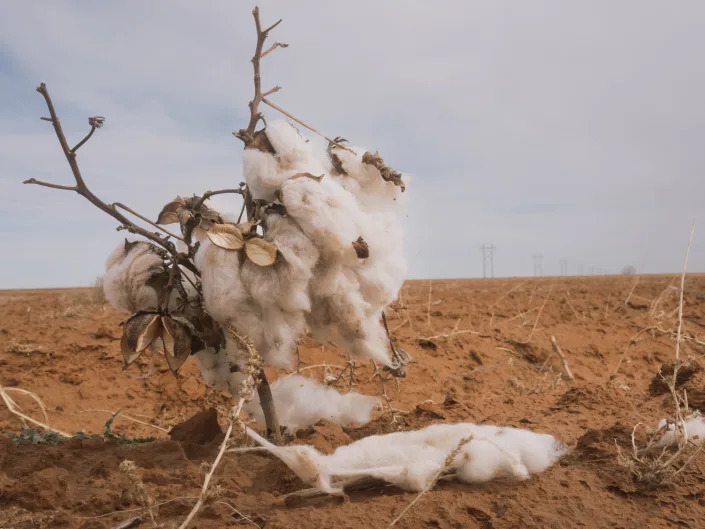
Cotton left over after the harvest in Meadow, Texas, Jan. 19, 2023. (Jordan Vonderaar/The New York Times)

When the Agriculture Department finished its calculations last month, the findings were startling: 2022 was a disaster for upland cotton in Texas, the state where the coarse fiber is primarily grown and then sold around the globe in the form of tampons, cloth diapers, gauze pads and other products.

In the biggest loss on record, Texas farmers abandoned 74% of their planted crops — nearly 6 million acres — because of heat and parched soil, hallmarks of a megadrought made worse by climate change.

That crash has helped to push up the price of tampons in the United States 13% over the past year. The price of cloth diapers spiked 21%. Cotton balls climbed 9%, and gauze bandages increased by 8%. All of that was well above the country’s overall inflation rate of 6.5% in 2022, according to data provided by the market research firms NielsonIQ and The NPD Group.

It’s an example of how climate change is reshaping the cost of daily life in ways that consumers might not realize.

West Texas is the main source of upland cotton in the United States, which in turn is the world’s third-biggest producer and largest exporter of the fiber. That means the collapse of the upland cotton crop in West Texas will spread beyond the United States, economists say, onto store shelves around the world.

“Climate change is a secret driver of inflation,” said Nicole Corbett, a vice president at NielsonIQ. “As extreme weather continues to impact crops and production capacity, the cost of necessities will continue to rise.”

Halfway around the world in Pakistan, the world’s sixth-largest producer of upland cotton, severe flooding, made worse by climate change, destroyed half that country’s cotton crop.

There have been other drags on the global cotton supply. In 2021, the United States banned imports of cotton from the Xinjiang region of China, a major cotton-producing area, out of concerns about the use of forced labor.

But experts say that the impact of the warming planet on cotton is expanding across the planet with consequences that may be felt for decades to come.

By 2040, half of the regions around the globe where cotton is grown will face a “high or very high climate risk” from drought, floods and wildfires, according to the nonprofit group Forum for the Future.

Texas cotton offers a peek into the future. Scientists project that heat and drought exacerbated by climate change will continue to shrink yields in the Southwest — further driving up the prices of many essential items. A 2020 study found that heat and drought worsened by climate change have already lowered the production of upland cotton in Arizona and projected that future yields of cotton in the region could drop by 40% between 2036 and 2065.

Cotton is “a bellwether crop,” said Natalie Simpson, an expert in supply chain logistics at the University at Buffalo. “When weather destabilizes it, you see changes almost immediately,” Simpson said. “This is true anywhere it’s grown. And the future supply that everyone depends on is going to look very different from how it does now. The trend is already there.”

Return of the Dust Bowl

For decades, the Southwestern cotton crop has depended on water pumped from the Ogallala Aquifer, which stretches underneath eight western states from Wyoming to Texas.

But the Ogallala is declining, in part because of climate change, according to the 2018 National Climate Assessment, a report issued by 13 federal agencies. “Major portions of the Ogallala Aquifer should now be considered a nonrenewable resource,” it said.

That is the same region that was abandoned by more than 2 million people during the Dust Bowl of the 1930s, caused by severe drought and poor farming practices. John Steinbeck famously chronicled the trauma in his epic “The Grapes of Wrath,” about a family of cotton farmers driven from their Oklahoma home. Lately, the novel has been weighing on the mind of Mark Brusberg, a meteorologist at the Agriculture Department.

“The last time this happened, there was a mass migration of producers from where they couldn’t survive any longer to a place where they were going to give it a shot,” Brusberg said. “But we have to figure out how to keep that from happening again.”

In the years since, the farmland over the Ogallala once again flourished as farmers drew from the aquifer to irrigate their fields. But now, with the rise in heat and drought and the decline of the aquifer, those dust storms are returning, the National Climate Assessment found. Climate change is projected to increase the duration and intensity of drought over much of the Ogallala region in the next 50 years, the report said.

Barry Evans, a fourth-generation cotton farmer near Lubbock, Texas, doesn’t need a scientific report to tell him that. Last spring, he planted 2400 acres of cotton. He harvested 500 acres.

“This is one of the worst years of farming I’ve ever seen,” he said. “We’ve lost a lot of the Ogallala Aquifer, and it’s not coming back.”

When Evans began farming cotton in 1992, he said, he was able to irrigate about 90% of his fields with water from the Ogallala. Now that’s down to 5% and declining, he said. He has been growing cotton in rotation with other crops and using new technologies to maximize the precious little moisture that does arrive from the skies. But he sees farmers around him giving up.

“The decline of the Ogallala has had a strong impact on people saying it’s time to retire and stop doing this,” he said.

Kody Bessent, the CEO of Plains Cotton Growers Inc., which represents farmers who grow cotton across 4 million acres in Texas, said that land would produce 4 or 5 million bales of cotton in a typical year. Production for 2022 is projected at 1.5 million bales — a cost to the regional economy of roughly $2 billion to $3 billion, he said.

“It’s a huge loss,” he said. “It’s been a tragic year.”

From Cotton Fields to Walmart Shelves

Upland cotton is shorter and coarser than its more famous cousin, Pima cotton. It is also far more widely grown and is the staple ingredient in cheap clothes and basic household and hygiene products.

In the United States, most cotton grown is upland cotton, and the crop is concentrated in Texas. That’s unusual for a major commodity crop. While other crops such as corn, wheat and soybeans are affected by extreme weather, they are spread out geographically so that a major event afflicting some of the crop may spare the rest, said Lance Honig, an economist at the Agriculture Department.

“That’s why cotton really stands out, with this drought having such a big impact on the national crop,” Honig said.

Sam Clay of Toyo Cotton Co., a Dallas trader that buys upland cotton from farmers and sells it to mills, said the collapse of the crop had sent him scrambling. “Prices have gone sky-high, and all this is getting passed on to consumers,” he said.

Clay said he is experiencing the impacts himself. “I bought six pairs of Wranglers a year and a half ago for $35 a pair. I’m paying $58 a pair now.”

At least 50% of the denim in every pair of Wrangler and of Lee jeans is woven from U.S.-grown cotton, and the cost of that cotton can represent more than half the price tag, said Jeff Frye, the vice president of sustainability for Kontoor Brands, which owns both labels.

Frye and others who deal in denim did point out, however, that other factors have driven up price, including the ban on imports of Xinjiang cotton, high fuel costs and the complicated logistics of moving materials.

Among the cotton products most sensitive to the price of raw materials are personal care items like tampons and gauze bandages, since they require very little labor or processing like dying, spinning or weaving, said Jon Devine, an economist at Cotton Inc., a research and marketing company.

The price of Tampax, the tampon giant that sells 4.5 billion boxes globally each year, started climbing fast last year.

In an earnings call in January, Andre Schulten, chief financial officer for Procter & Gamble, which makes Tampax, said the costs of raw materials “are still a significant headwind” for the company across several products, forcing the company to raise prices.

On a recent Sunday at a Walmart in Alexandria, Virginia, several shoppers said they had noticed rising prices.

“The price of a regular box of Tampax has gone up from $9 to $11,” said Vanessa Skelton, a consultant and the mother of a 3-year-old. “That’s a regular monthly expense.”

Make Way for Polyester

Cotton farmers say that Washington can help by increasing aid in the farm bill, legislation that Congress is renewing this year.

Taxpayers have sent Texas cotton farmers an average of $1 billion annually over the past five years in crop insurance subsidies, according to Daniel Sumner, an agricultural economist at the University of California, Davis.

Farmers say they’d like expanded funding for disaster relief programs to cover the impact of increasingly severe drought and to pay farmers for planting cover crops that help retain soil moisture. They also say they hope that advances in genetically modified seeds and other technologies can help sustain Texas cotton.

But some economists say it may not make sense to continue support a crop that will no longer be viable in some regions as the planet continues to warm.

“Since the 1930s, government programs have been fundamental to growing cotton,” Sumner said. “But there’s not a particular economic argument to grow cotton in West Texas as the climate changes. Does it make any economic sense for a farm bill in Washington, D.C., to say, ‘West Texas is tied to cotton?’ No, it doesn’t.”

In the long run, it could just mean that cotton is no longer the main ingredient in everything from tampons to textiles, said Sumner, “and we’re all going to use polyester.”
Turkey earthquake: 2 men rescued from rubble 261 hours later, official says

Good Morning America

Turkey earthquake: 2 men rescued from rubble 261 hours later, official says

Morgan Winsor – February 17, 2023

Nearly 11 days after a massive earthquake and powerful aftershocks rocked southeastern Turkey, two men trapped beneath the rubble have been rescued as the odds of finding survivors diminish by the hour.

Turkish Health Minister Fahrettin Koca posted about the rescues on Twitter, saying both men were pulled alive from the ruins of a collapsed building in hard-hit Hatay province on Thursday evening, 261 hours after the quake.

MORE: Turkey-Syria earthquake updates

Mustafa Avci, 33, was rescued first, according to Koca. After initial treatment at a field hospital, Avci was allowed to call a relative whose telephone number he remembered. The health minister tweeted video of the emotional exchange, in which Avci is seen wearing a neck brace and lying on a stretcher as he speaks into a mobile phone held by a rescuer. Avci can be heard asking about his mother and the rest of their family as the man on the other end cries in disbelief. Avci then kisses the hand of the rescuer holding the phone and thanks him.

Mehmet Ali Sakiroglu, 26, was rescued soon after, according to Koca. Sakiroglu was assessed at the field hospital before being transported to the Mustafa Kemal University Hospital in Antakya, where he remains for treatment, Koca said. The health minister tweeted a photo of first responders bringing Sakiroglu into the hospital on a stretcher.

The 7.8 magnitude earthquake struck the region before dawn on Feb. 6 and was followed by hundreds of aftershocks. The quake’s epicenter was in Turkey’s southeastern Kahramanmaras province, not far from the border with Syria. Thousands of buildings were toppled on both sides, according to Turkish and Syrian officials.

MORE: How people survive for days under earthquake rubble as survivors are found in Turkey, Syria

The death toll in Turkey and Syria has continued to rise in the days since, reaching 42,000 on Thursday, according to combined figures from both countries.

Although most rescues happen within the first 24 hours after a natural disaster, experts told ABC News that people can survive for up to a week or more while trapped under fallen debris depending on several factors, including weather conditions, the extent of their injuries and whether they have access to air and water.

ABC News’ Kerem Inal and Ellie Kaufman contributed to this report.

As the Colorado River shrinks, federal officials consider overhauling Glen Canyon Dam

Los Angeles Times

As the Colorado River shrinks, federal officials consider overhauling Glen Canyon Dam

Ian James – February 18, 2023

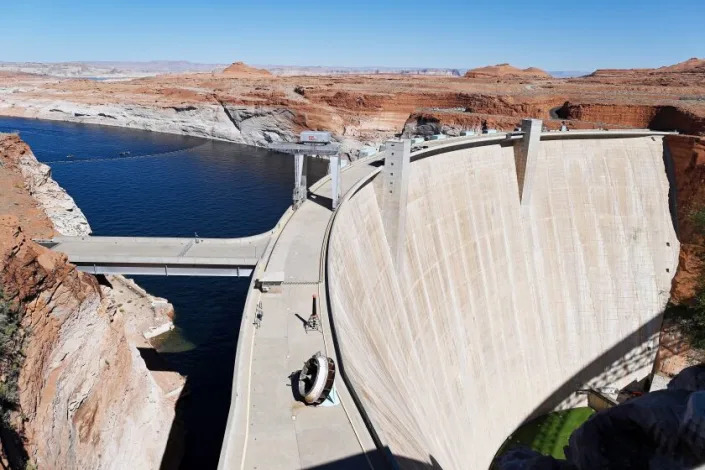
PAGE, AZ - OCTOBER 14: The Glen Canyon Dam sits above Lake Powell and the Colorado River on October 14, 2022 in Page, Arizona. The water in Lake Powell and the Colorado River has been receding due to recent droughts leaving parts of the lake and river parched. The federal government are moving forward with plans to reduce water allocations from the Colorado River Basin to Arizona and is asking millions of residents to reduce their water consumption as the drought get worse. (Photo by Joshua Lott/The Washington Post via Getty Images)
The Colorado River’s decline threatens hydropower at Glen Canyon Dam. Now, officials are looking at retooling the dam to deal with low water levels. (Joshua Lott / Washington Post)

The desiccation of the Colorado River has left Lake Powell, the country’s second-largest reservoir, at just 23% of capacity, its lowest level since it was filled in the 1960s.

With the reservoir now just 32 feet away from “minimum power pool” — the point at which Glen Canyon Dam would no longer generate power for six states — federal officials are studying the possibility of overhauling the dam so that it can continue to generate electricity and release water at critically low levels.

A preliminary analysis of potential modifications to the dam emerged during a virtual meeting held by the federal Bureau of Reclamation, which is also reviewing options for averting a collapse of the water supply along the river. These new discussions about retooling the dam reflect growing concerns among federal officials about how climate change is contributing to the Colorado River’s reduced flows, and how declining reservoirs could force major changes in dam management for years to come.

Among the immediate concerns is the threat of the reservoir dropping below the dam’s power-generating threshold. If that were to occur, water would only flow through four 8-foot-wide bypass tubes, called the outlet works, which would create a chokepoint with reduced water-releasing capacity.

“There is now an acknowledgment, unlike any other time ever before, that the dam is not going to be suited to 21st century hydrology,” said Kyle Roerink, executive director of the environmental group Great Basin Water Network, who listened to the meeting. “They’re not sugarcoating that things have to change there, and they have to change pretty quickly.”

Those who participated in the Feb. 7 meeting included dozens of water mangers, representatives of electric utilities, state officials and others. They discussed proposals such as penetrating through the dam’s concrete to make new lower-level intakes, installing a new or reconfigured power plant, and tunneling a shaft around either side of the dam to a power plant, among other options.

The Interior Department declined a request for an interview, but spokesperson Tyler Cherry said in email that the briefing was part of broader conversations with state officials, tribal leaders, water managers and others “to inform our work to improve and protect the short-term sustainability of the Colorado River System and the resilience of the American West to a changing climate.”

Roerink and two other people who listened to the webinar told The Times that cost estimates for several alternatives ranged from $500 million to $3 billion. The agency will need congressional approval and will have to conduct an environmental review to analyze options.

The Bureau of Reclamation’s presentation, given by regional power manager Nick Williams, included some additional alternatives that wouldn’t require major structural modifications of the dam. Those options included adjusting operations to maximize power generation at low reservoir levels, studying ways of using the existing intakes at lower water levels, and making up for the loss of hydroelectric power by investing in solar or wind energy.

Glen Canyon Dam stands 710 feet tall, anchored to the canyon’s reddish sandstone walls in northern Arizona, about 320 miles upstream from Lake Mead, the nation’s largest reservoir. The dam has been controversial since its inception, with environmental activists and others arguing the reservoir was unnecessary and destroyed the canyon’s pristine ecosystem.

Lake Powell and Lake Mead have declined over the last 23 years during the most severe drought in centuries. Federal officials have sought to boost Powell’s levels in recent months by reducing the amount of water they release downstream until the spring runoff arrives. They’ve said they may need to further cut water releases.

A central concern is that if the water drops below minimum power pool — 3,490 feet above sea level under the current operating rules — the main intakes would need to be shut down and water would instead flow through the dam’s lower bypass tubes. Because of those tubes’ reduced capacity, that could lead to less water passing downstream, shrinking the river’s flow in the Grand Canyon and accelerating the decline of Lake Mead toward “dead pool” — the point at which water would no longer pass through Hoover Dam to Arizona, California and Mexico.

Federal officials prepared the initial studies of alternatives for Glen Canyon Dam using $2 million that the Bureau of Reclamation secured as part of $200 million for drought response efforts.

According to a slide presentation shown at the meeting, officials see potential hazards in some of the six alternatives. Piercing the dam’s concrete to create new low-level or mid-level intakes, for example, would entail “increased risk from penetration through dam,” the presentation says.

They also describe risks due to possible “vortex formation,” or the creation of whirlpools above horizontal intakes as the water level declines. Their formation could cause damage if air is pulled into the system. The presentation says one alternative would involve lowering the minimum power pool limit and possibly installing structures on the intakes to suppress whirlpools, but it said this still would not allow for the water level to go much lower.

One of the possible fixes includes installing a new power plant that would generate electricity with water flowing from the bypass tubes, or taking a similar approach using existing infrastructure. Another would involve excavating a tunnel to the left or right side of the dam, and installing a power plant underground or in the riverbed.

Other options include changing operations at both Glen Canyon and Hoover dams “to maximize power generation under low flow conditions using existing infrastructure.”

“Any of the options are going to be very expensive and they’re going to be very time-consuming,” said Leslie James, executive director of the Colorado River Energy Distributors Assn., who participated in the meeting.

James praised the Bureau of Reclamation for “starting the processes to look at structural options like this.”

“I see what they’re doing here as getting an early start and at least evaluating everything that they can to look and see what may be feasible,” James said. She said she hopes Congress will provide the necessary funding to ensure continued electricity flowing from Glen Canyon Dam, given “how important hydropower is to entire communities.”

Her association represents nonprofit electric utilities that buy power produced by Glen Canyon Dam and other dams that are part of the Colorado River Storage Project. The association includes members in Arizona, Colorado, Nevada, Utah, New Mexico and Wyoming. The utilities supply power in cities, rural areas, irrigation districts and tribal communities.

Power from the dam has long been a vital energy source, though its output has decreased dramatically in recent years as Lake Powell has declined. During the 2022 fiscal year, Glen Canyon Dam generated 2,591 gigawatt-hours of electricity, enough to power more than 240,000 average homes for a year.

James said electric utilities across the region have had to make up for the reduced hydropower by turning to other costlier sources.

“It’s a real challenging time,” James said. “And it is the people in these communities that are ultimately being impacted with higher electricity bills.”

Lake Powell’s level is projected to rise this spring with runoff from the above-average snowpack in the Rocky Mountains. But that boost in water levels is expected to have a limited effect on the deep water deficit that has accumulated over more than two decades.

And in the long term, scientific research indicates warming and drying will continue to take a major toll on the river.

Scientists have found that roughly half the decline in the river’s flow since 2000 has been caused by higher temperatures, that climate change is driving the aridification of the Southwest, and that for each additional 1 degree Celsius (1.8 degrees Fahrenheit) of warming, the river’s average flow will probably decrease about 9%.

Environmental activists have for years urged the federal government to consider draining Lake Powell, decommissioning the dam and storing the water downstream in Lake Mead.

Activists who listened to the Bureau of Reclamation’s presentation said they welcome the agency’s examination of the issues at Glen Canyon Dam but would prefer to see a broader analysis that evaluates other options, including draining the reservoir.

In a report last year, Roerink’s Great Basin Water Network and two other groups warned that the “antiquated plumbing system inside Glen Canyon Dam represents a liability to Colorado River Basin water users who may quickly find themselves in legal jeopardy and water supply shortfalls.”

“The bureau is admitting that the dam is a liability,” Roerink said. “From my perspective, that’s a good first step.”

Beyond the current focus on trying to prop up hydropower generation, Roerink said, “I think we need an option that is just a bypass option without a power plant at the end of it.”

Roerink said he expects there will be a lot of debate about issues such as evaporation from the reservoir and the high costs of modifications to the dam.

“Is it all worth it? Are the taxpayer dollars going to be worth it for those electrons?” Roerink said. “How long will it be until this just proves itself to be a futile exercise?”

John Weisheit, an activist who has advocated for removing the dam, said he was delighted to hear federal officials openly discussing these options for the first time.

“I’m glad we’re having this conversation. It’s long overdue,” said Weisheit, who is co-founder of the group Living Rivers.

Weisheit said he also thinks the agency’s alternatives aren’t broad enough, and leave unanswered questions about the dam’s life span.

“I think it’s imperative that we know exactly what the life span of this dam is,” Weisheit said. “There is so much more that needs to be discussed.”

Weisheit said one major concern should be the accumulation of sediments in the bottom of the reservoir, which, according to a recent federal survey, has lost nearly 6.8% of its water-storing capacity.

Another issue with the agency’s current alternatives, he said, is that they wouldn’t solve problems of intakes or bypass tubes sucking in air at low water levels, “just like everybody’s bathtub does,” potentially causing cavitation that would pit and tear into metal, damaging the infrastructure.

Weisheit said he also was concerned about potential threats to endangered fish in the Grand Canyon.

Overall, the modifications to the dam that the federal government is considering would be “too much investment for very little return,” Weisheit said. “And it’s going to take a long, long time.”

Weisheit said he favors the option of investing in solar and wind energy. Instead of spending up to $3 billion trying to squeeze a shrinking amount of power from the dam, he said, “you can build a lot of solar cells and turbines,” including nearby on the Navajo Nation, which needs electricity.

Weisheit said he thinks the situation shows Glen Canyon Dam isn’t needed.

“Take the dam out,” he said, “because it’s not the right dam for climate change.”

Water crisis in West: Massive reservoir Lake Powell hits historic low water level

USA Today

Water crisis in West: Massive reservoir Lake Powell hits historic low water level

 Colorado River Basin water levels drop to historic low, states mandated to cut use More water is being taken from the river than it can provide. 

Elizabeth Weise, USA TODAY – February 18, 2023

Lake Powell, the nation’s second-largest reservoir and one that provides water and power to millions of people in southern California, has reached its lowest levels since its first filling in the 1960s.

Its companion reservoir, Lake Mead, is at levels almost as low.

Together, these reservoirs, fed by the mighty Colorado River, provide the water 40 million Americans depend on. Despite the storms that brought heavy rain and snow to California and other Western states in January, experts say it would take years of such weather to replenish the West’s water resources.

“In the year 2000, the two reservoirs were 95% full. They’re roughly 25% full now,” said Brad Udall, a water and climate scientist at Colorado State University. “It’s hard to overstate how important the Colorado River is to the entire American southwest.”

What to know about the West’s ongoing water crisis:

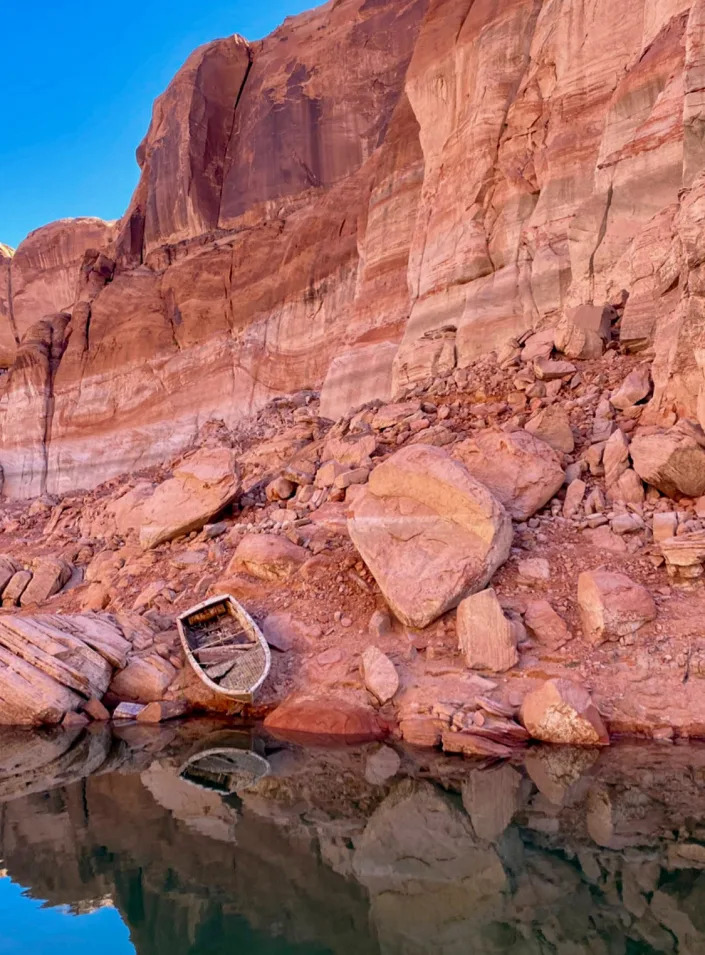
An abandoned and once-sunken boat sits along the shoreline of Lake Powell in this May 2022 file photo. The white ring above shows how high the water level was when the lake was full.
What is Lake Powell?

Lake Powell is the nation’s second-largest reservoir. It was created by blocking the Colorado River at Glen Canyon in southern Utah and northern Arizona.

It stores water as part of the Colorado River Compact and produces electricity through the hydroelectric turbines in Glen Canyon dam.

Work on the dam that created Lake Powell began in 1956 and was finished in 1966. It took 16 years for it to fill. At its highest, in 1983, the lake was 3,708 feet above sea level.

Today it stands at 3,522 feet.

What happens if the water level goes lower?

Lake Powell hasn’t been this low since June of 1965, just two years after it began to fill with water.

  • The biggest worry: If the lake’s level falls much lower, it won’t be possible to get water out of it.
  • Why? Tubes that run water through its out of the lake and into eight hydroelectric turbines could soon be above the water. There are bypass tubes available below that point, but they weren’t designed for continuous use, so it’s not clear how they would fare.
  • Important quote: “If you can’t get water out of the dam, it means everyone downstream doesn’t get water,” said Udall. “That includes agriculture, cities like Los Angeles, San Diego and Phoenix.”
  • Will water stop flowing? “That’s a doomsday scenario,” said Bill Hasencamp, Colorado River resources manager for the Metropolitan Water District of Southern California. Before things get to that point the Department of the Interior will require reductions in use.
  • How long until water stops flowing downstream? If the lake falls another 32 feet – about the amount it fell in the past year – power generation concerns become more urgent, Udall said. Snowmelt this spring is forecast to bring levels up somewhat.
Why is the water level so low?

The water in Lake Powell is low because the amount of water in the Colorado River has been falling for decades. At the same time, demand has risen due to increased population growth in the West.

Overall, the river’s flow is down 20% in this century relative to the 20th century.

BACKGROUND: Western water crisis looms as California complicates critical water deal

More than four scientific studies have pinned a large part of the decline on human climate change. It’s partly that there’s less rain and snow, partly that as temperatures rise, plants use more water and more water evaporates out of the soil which would otherwise have ended up in the river. In addition, the river itself experiences more evaporation.

“It’s unfortunate that the largely natural occurrence of a drought has coincided with this increasing warming due to greenhouse gases,” said Flavio Lehner, a professor of atmospheric sciences at Cornell University. “That has brought everything to a head much earlier than people thought it would.”

What about Lake Mead and the Hoover Dam?

Lake Mead is the nation’s largest reservoir, a companion to Lake Powell. Mead was created when the Hoover Dam was completed in 1935. It supplies water and power to Arizona, California, New Mexico and Mexico.

Lake Mead’s level is 1,047 feet above sea level.  You would have to go back to April of 1937, also two years into its initial filling, to find levels that low. It is forecast to have a new record low next summer, said Hasencamp.

The lake isn’t low enough yet to cause concerns about getting water out, but any hope of it refilling is years away, if ever, due to lowered rain and snow and increasing evaporation.

Some of America’s largest cities depend on the water from Lake Mead. “It’s 90% of the water supply to Las Vegas, 50% to Phoenix, effectively 100% to Tucson and 25% to Los Angeles,” said Udall.

What will happen if water levels keep dropping?

The Department of the Interior had asked the seven states of the Colorado River Compact to come up with a plan to cut between 2 and 4 million acre-feet of water by January. They weren’t able to come up with an agreement.

Because of that, it’s expected that the Department of the Interior’s Bureau of Reclamation, which oversees water management, will mandate one sometime next year.

“This is apparently a decent (water) year, but still, if it turns dry again there are some pretty big reductions on tap and every state could be affected,” said Hasencamp.

It will be painful but it doesn’t mean the area can’t thrive.

“The West might look different,” said Hasencamp. “You might not see the lush lawns of today and endless fields of alfalfa, but you will see thriving communities and agricultural regions.”

Dig deeper on climate change:

Feral cows to be gunned down by shooters in helicopters in US national forest

Good Morning America

Feral cows to be gunned down by shooters in helicopters in US national forest

Jon Haworth – February 17, 2023

Feral cows roaming wild around southwest New Mexico will be gunned down by shooters in helicopters beginning next week, according to a plan approved by U.S. officials.

About 150 feral cattle, which authorities say “are not domesticated animals and pose a significant threat to public safety and natural resources,” will be hunted by “aerial shooting” and will take place over four days beginning Thursday, Feb. 23 at the Gila National Forest, according to the U.S. Forest Service.

MORE: Herd of cows stampede through Los Angeles after breaking free from slaughterhouse

A closure order has been issued in the area of operations of the 3.3 million acre reserve in southwest New Mexico and the public has been asked to avoid the area completely while the culling takes place.

“This has been a difficult decision, but the lethal removal of feral cattle from the Gila Wilderness is necessary to protect public safety, threatened and endangered species habitats, water quality, and the natural character of the Gila Wilderness,” said Camille Howes, Gila National Forest Supervisor. “The feral cattle in the Gila Wilderness have been aggressive towards wilderness visitors, graze year-round, and trample stream banks and springs, causing erosion and sedimentation. This action will help restore the wilderness character of the Gila Wilderness enjoyed by visitors from across the country.”

MORE: Charging cows in England trample man to death in second such attack in 10 days

Authorities say that this is the most “efficient and humane way” to deal with the animals and that Gila National Forest officials are working closely together with the USDA Animal and and Plant Health Inspection Service (APHIS) on this operation.

“All dispatched cattle will be left onsite to naturally decompose,” read a statement detailing the confirmation of the cattle removal from the U.S. Forest Service. “Forest Service staff will ensure no carcasses are adjacent to or in any waterbody or spring, designated hiking trail, or known culturally sensitive area. A wilderness minimum requirements decision guide has been completed and approved before using any methods otherwise prohibited under the Wilderness Act.”

PHOTO: Stock image of Gila National Forest where feral cows roaming wild around southwest New Mexico will be gunned down by shooters in helicopters beginning Feb. 23, 2023, according to a plan approved by U.S. officials. (U.S. Forest Service)

Forest officials say that some cattle growers have expressed concern to them that non-feral branded cattle could have strayed into the Gila National Forest due to fences and water gaps that were damaged during an unusually strong monsoon season over the past several months.

“The Forest Service is committed to continued efforts toward collaborative solutions and will continue to coordinate with permittees in their efforts to locate, gather, and remove their branded cattle from areas where they are not authorized,” officials said.

The issue regarding the feral cattle has been ongoing since the 1990s, according to the official decision memorandum released on Thursday, and several hundred cattle were destroyed between 1996 and 1998 in an effort to control the growing population.

In fact, in the past 25 years, the forest has issued a total of nine contracts that have resulted in the removal of 211 cattle, with the last order coming a year ago in Feb. 2022 when 65 feral cattle were lethally removed. Authorities estimate that around 150 will be eliminated during the cull set to take place next week.

MORE: Pack of dogs attacks and kills young boy, injures mother

If branded cattle are lethally removed during gathering or aerial operations, U.S. Forest Service officials say the owner may request compensation by contacting the U.S. Forest Service, Southwestern Region or the Gila National Forest.

For the First Time, Genetically Modified Trees Have Been Planted in a U.S. Forest

The New York Times

For the First Time, Genetically Modified Trees Have Been Planted in a U.S. Forest

Gabriel Popkin – February 17, 2023

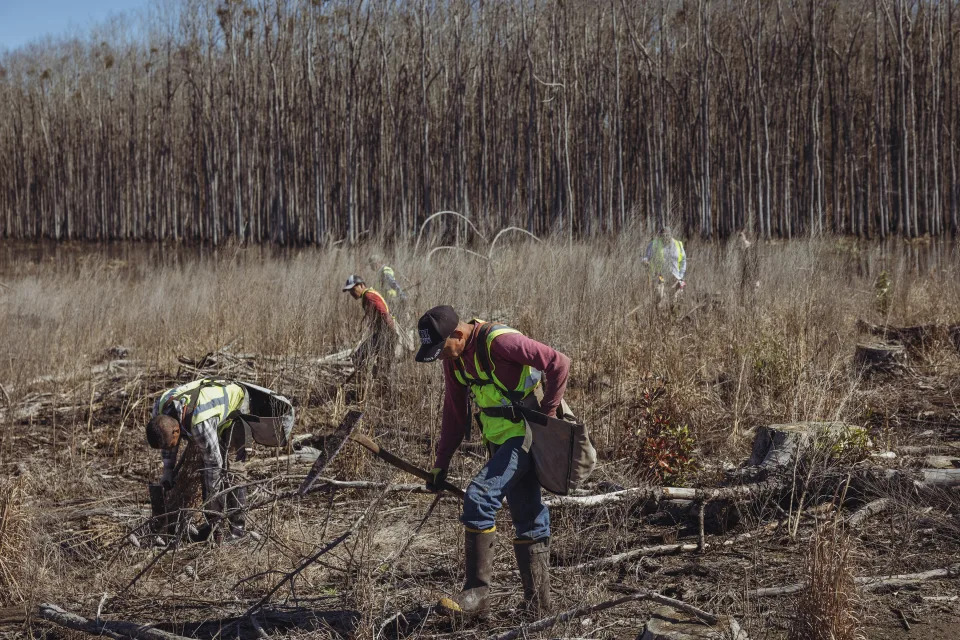
A hand-planting crew plants poplar trees in Vidalia, Ga., Feb. 13, 2023. (Audra Melton/The New York Times)

On Monday, in a low-lying tract of southern Georgia’s pine belt, a half-dozen workers planted row upon row of twig-like poplar trees.

These weren’t just any trees, though: Some of the seedlings being nestled into the soggy soil had been genetically engineered to grow wood at turbocharged rates while slurping up carbon dioxide from the air.

The poplars may be the first genetically modified trees planted in the United States outside of a research trial or a commercial fruit orchard. Just as the introduction of the Flavr Savr tomato in 1994 introduced a new industry of genetically modified food crops, the tree planters Monday hope to transform forestry.

Living Carbon, a San Francisco-based biotechnology company that produced the poplars, intends for its trees to be a large-scale solution to climate change.

“We’ve had people tell us it’s impossible,” Maddie Hall, the company’s co-founder and CEO, said of her dream to deploy genetic engineering on behalf of the climate. But she and her colleagues have also found believers — enough to invest $36 million in the 4-year-old company.

The company has also attracted critics. The Global Justice Ecology Project, an environmental group, has called the company’s trees “growing threats” to forests and expressed alarm that the federal government allowed them to evade regulation, opening the door to commercial plantings much sooner than is typical for engineered plants.

Living Carbon has yet to publish peer-reviewed papers; its only publicly reported results come from a greenhouse trial that lasted just a few months. These data have some experts intrigued but stopping well short of a full endorsement.

“They have some encouraging results,” said Donald Ort, a University of Illinois geneticist whose plant experiments helped inspire Living Carbon’s technology. But he added that the notion that greenhouse results will translate to success in the real world is “not a slam dunk.”

🌳🌳

Living Carbon’s poplars start their lives in a lab in Hayward, California. There, biologists tinker with how the trees conduct photosynthesis, the series of chemical reactions plants use to weave sunlight, water and carbon dioxide into sugars and starches. In doing so, they follow a precedent set by evolution: Several times over Earth’s long history, improvements in photosynthesis have enabled plants to ingest enough carbon dioxide to cool the planet substantially.

While photosynthesis has profound impacts on the Earth, as a chemical process it is far from perfect. Numerous inefficiencies prevent plants from capturing and storing more than a small fraction of the solar energy that falls onto their leaves. Those inefficiencies, among other factors, limit how fast trees and other plants grow, and how much carbon dioxide they soak up.

Scientists have spent decades trying to take over where evolution left off. In 2019, Ort and his colleagues announced that they had genetically hacked tobacco plants to photosynthesize more efficiently. Normally, photosynthesis produces a toxic byproduct that a plant must dispose of, wasting energy. The Illinois researchers added genes from pumpkins and green algae to induce tobacco seedlings to instead recycle the toxins into more sugars, producing plants that grew nearly 40% larger.

That same year, Hall, who had been working for Silicon Valley ventures like OpenAI (which was responsible for the language model ChatGPT), met her future co-founder Patrick Mellor at a climate tech conference. Mellor was researching whether trees could be engineered to produce decay-resistant wood.

With money raised from venture capital firms and Hall’s tech-world contacts, including OpenAI CEO Sam Altman, she and Mellor started Living Carbon in a bid to juice up trees to fight climate change. “There were so few companies that were looking at large-scale carbon removal in a way that married frontier science and large-scale commercial deployment,” Hall said.

They recruited Yumin Tao, a synthetic biologist who had previously worked at the chemical company DuPont. He and others retooled Ort’s genetic hack for poplar trees. Living Carbon then produced engineered poplar clones and grew them in pots. Last year, the company reported in a paper that has yet to be peer reviewed that its tweaked poplars grew more than 50% faster than non-modified ones over five months in the greenhouse.

The company’s researchers created the greenhouse-tested trees using a bacterium that splices foreign DNA into another organism’s genome. But for the trees they planted in Georgia, they turned to an older and cruder technique known as the gene gun method, which essentially blasts foreign genes into the trees’ chromosomes.

In a field accustomed to glacial progress and heavy regulation, Living Carbon has moved fast and freely. The gene gun-modified poplars avoided a set of federal regulations of genetically modified organisms that can stall biotech projects for years. (Those regulations have since been revised.) By contrast, a team of scientists who genetically engineered a blight-resistant chestnut tree using the same bacterium method employed earlier by Living Carbon have been awaiting a decision since 2020. An engineered apple grown on a small scale in Washington state took several years to be approved.

“You could say the old rule was sort of leaky,” said Bill Doley, a consultant who helped manage the Agriculture Department’s genetically modified organism regulation process until 2022.

On Monday, on the land of Vince Stanley, a seventh-generation farmer who manages more than 25,000 forested acres in Georgia’s pine belt, mattock-swinging workers carrying backpacks of seedlings planted nearly 5,000 modified poplars. The tweaked poplars had names like Kookaburra and Baboon, which indicated which “parent” tree they were cloned from, and were interspersed with a roughly equal number of unmodified trees. By the end of the unseasonably warm day, the workers were drenched in sweat and the planting plots were dotted with pencil-thin seedlings and colored marker flags poking from the mud.

In contrast to fast-growing pines, hardwoods that grow in bottomlands like these produce wood so slowly that a landowner might get only one harvest in a lifetime, Stanley said. He hopes Living Carbon’s “elite seedlings” will allow him to grow bottomland trees and make money faster. “We’re taking a timber rotation of 50 to 60 years and we’re cutting that in half,” he said. “It’s totally a win-win.”

Forest geneticists were less sanguine about Living Carbon’s trees. Researchers typically assess trees in confined field trials before moving to large-scale plantings, said Andrew Newhouse, who directs the engineered chestnut project at SUNY College of Environmental Science and Forestry. “Their claims seem bold based on very limited real-world data,” he said.

Steve Strauss, a geneticist at Oregon State University, agreed with the need to see field data. “My experience over the years is that the greenhouse means almost nothing” about the outdoor prospects of trees whose physiology has been modified, he said. “Venture capitalists may not know that.”

Strauss, who previously served on Living Carbon’s advisory board, has grown some of the company’s seedlings since last year as part of a field trial funded by the company. He said the trees were growing well, but it was still too early to tell whether they were outpacing unmodified trees.

Even if they do, Living Carbon will face other challenges unrelated to biology. While outright destruction of genetically engineered trees has dwindled thanks in part to tougher enforcement of laws against acts of ecoterrorism, the trees still prompt unease in the forestry and environmental worlds. Major organizations that certify sustainable forests ban engineered trees from forests that get their approval; some also prohibit member companies from planting engineered trees anywhere. To date, the only country where large numbers of genetically engineered trees are known to have been planted is China.

The U.S. Forest Service, which plants large numbers of trees every year, has said little about whether it would use engineered trees. To be considered for planting in national forests, which make up nearly one-fifth of U.S. forestland, Living Carbon’s trees would need to align with existing management plans that typically prioritize forest health and diversity over reducing the amount of atmospheric carbon, said Dana Nelson, a geneticist with the service. “I find it hard to imagine that it would be a good fit on a national forest,” Nelson said.

Living Carbon is focusing for now on private land, where it will face fewer hurdles. Later this spring it will plant poplars on abandoned coal mines in Pennsylvania. By next year Hall and Mellor hope to be putting millions of trees in the ground.

🌳🌳🌳

To produce an income stream not reliant on venture capital, the company has started marketing credits based on carbon its trees will soak up. But carbon credits have come under fire lately and the future of that industry is in doubt.

And to head off environmental concerns, Living Carbon’s modified poplar trees are all female, so they won’t produce pollen. While they could be pollinated by wild trees and produce seeds, Mellor says they’re unlikely to spread into the wild because they don’t breed with the most common poplar species in the Southeast.

They’re also being planted alongside native trees like sweet gum, tulip trees and bald cypress, to avoid genetically identical stands of trees known as monocultures; non-engineered poplars are being planted as experimental controls. Hall and Mellor describe their plantings as both pilot projects and research trials. Company scientists will monitor tree growth and survival.

Such measures are unlikely to assuage opponents of genetically modified organisms. Last spring, the Global Justice Ecology Project argued that Living Carbon’s trees could harm the climate by “interfering with efforts to protect and regenerate forests.”

“I’m very shocked that they’re moving so fast” to plant large numbers of modified trees in the wild, said Anne Petermann, the organization’s executive director. The potential risks to the greater ecosystem needed to be better understood, she said.

Ort of the University of Illinois dismissed such environmental concerns. But he said investors were taking a big chance on a tree that might not meet its creators’ expectations.

“It’s not unexciting,” he said. “I just think it’s uber high risk.”

The war in Ukraine hasn’t left Europe freezing in the dark, but it has caused energy crises in unexpected places

The Conversation

The war in Ukraine hasn’t left Europe freezing in the dark, but it has caused energy crises in unexpected places

Amy Myers Jaffe, Director, Energy, Climate Justice, and Sustainability Lab, and Research Professor, New York University – February 17, 2023

People protest in Dhaka, Bangladesh, over daily power cuts, July 27, 2022. <a href=
People protest in Dhaka, Bangladesh, over daily power cuts, July 27, 2022. Sony Ramany/NurPhoto via Getty Images

Through a year of war in Ukraine, the U.S. and most European nations have worked to help counter Russia, in supporting Ukraine both with armaments and in world energy markets. Russia was Europe’s main energy supplier when it invaded Ukraine, and President Vladimir Putin threatened to leave Europeans to freeze “like a wolf’s tail” – a reference to a famous Russian fairy tale – if they imposed sanctions on his country.

But thanks to a combination of preparation and luck, Europe has avoided blackouts and power cutoffs. Instead, less wealthy nations like Pakistan and India have contended with electricity outages on the back of unaffordably high global natural gas prices. As a global energy policy analyst, I see this as the latest evidence that less wealthy nations often suffer the most from globalized oil and gas crises.

I believe more volatility is possible. Russia has said that it will cut its crude oil production starting on March 1, 2023, by 500,000 barrels per day in response to Western energy sanctions. This amount is about 5% of its current crude oil production, or 0.5% of world oil supply. Many analysts expected the move, but it raises concerns about whether more reductions could come in the future.

How Europe has kept the lights on

As Russia’s intent toward Ukraine became clear in late 2021 and early 2022, many governments and energy experts feared one result would be an energy crisis in Europe. But one factor that Putin couldn’t control was the weather. Mild temperatures in Europe in recent months, along with proactive conservation policies, have reduced natural gas consumption in key European markets such as Germany, the Netherlands and Belgium by 25%.

With less need for electricity and natural gas, European governments were able to delay drawing on natural gas inventories that they built up over the summer and autumn of 2022. At this point, a continental energy crisis is much less likely than many forecasts predicted.

European natural gas stockpiles are around 67% full, and they will probably still be 50% full at the end of this winter. This will help the continent position itself for next winter as well.

The situation is similar for coal. European utilities stockpiled coal and reactivated 26 coal-fired power plants in 2022, anticipating a possible winter energy crisis. But so far, the continent’s coal use has risen only 7%, and the reactivated coal plants are averaging just 18% of their operating capacity

The U.S. role

Record-high U.S. energy exports in the summer and fall of 2022 also buoyed European energy security. The U.S. exported close to 10 million cubic meters per month of liquefied natural gas in 2022, up 137% from 2021, providing roughly half of all of Europe’s imported LNG.

Although domestic U.S. natural gas production surged to record levels, some producers had the opportunity to export into high-priced global markets. As a result, surpluses of summer natural gas didn’t emerge inside the U.S. market, as might otherwise have happened. Combined with unusually hot summer temperatures, which drove up energy demand for cooling, the export surge socked U.S. consumers with the highest natural gas prices they had experienced since 2008.

Prices also soared at U.S. gas pumps, reaching or exceeding US$5 per gallon in the early summer of 2022 – the highest average ever recorded by the American Automobile Association. The U.S. exported close to 1 million barrels per day of gasoline, mainly to Mexico and Central America, plus some to France, and consolidated its position as a net oil exporter – that is, it exports more oil than it imports.

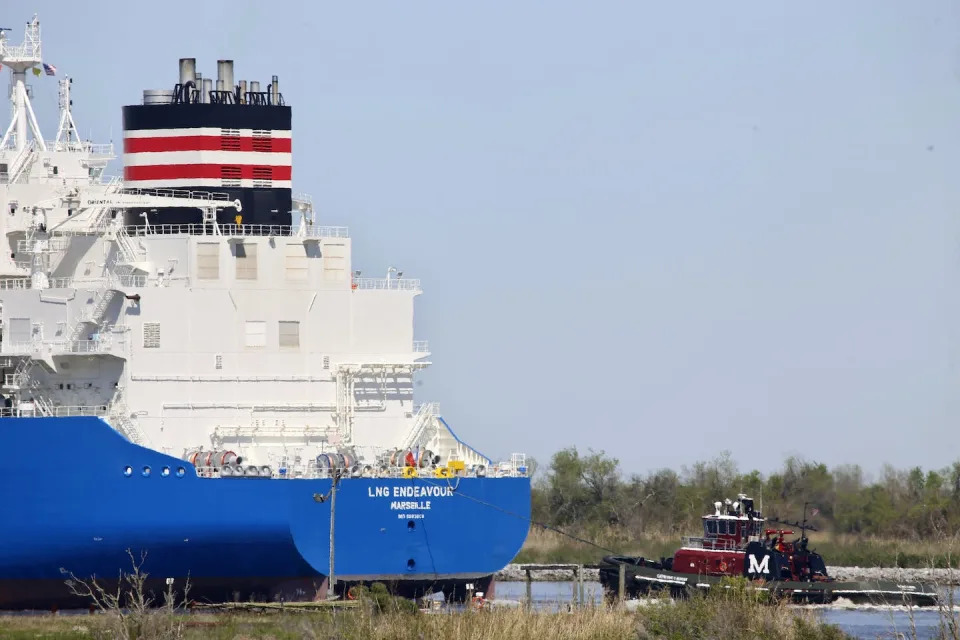
A tugboat helps guide the LNG Endeavor, a French liquefied natural gas tanker, through Calcasieu Lake near Hackberry, La., March 31, 2022. U.S. LNG exports to Europe reached record levels in 2022 as the continent prepared to sever energy ties with Russia. <a href=
A tugboat helps guide the LNG Endeavor, a French liquefied natural gas tanker, through Calcasieu Lake near Hackberry, La., March 31, 2022. U.S. LNG exports to Europe reached record levels in 2022 as the continent prepared to sever energy ties with Russia. AP Photo/Martha Irvine

Much like Europeans, U.S. consumers had to pay high prices to outbid other global consumers for oil and natural gas amid global supply disruptions and competition for available cargoes. High gasoline prices were a political headache for the Biden administration through the spring and summer of 2022.

However, these high prices belied the fact that U.S. domestic gasoline use has stopped growing. Forecasts suggest that it will decline further in 2023 and beyond as the fuel economy of U.S. cars continues to improve and the number of electric vehicles on the road expands.

While energy prices were a burden, especially to lower-income households, European and American consumers have been able to ride out price surges driven by the war in Ukraine and have so far avoided actual outages and the worst recessionary fears. And their governments are offering big economic incentives to switch to clean energy technologies intended to reduce their nations’ need for fossil fuels.

Developing nations priced out

The same can’t be said for consumers in developing nations like Pakistan, Bangladesh and India, who have experienced the energy cutoffs that were feared but didn’t occur in Europe. Notably, Europe’s intensive energy stockpiling in the summer of 2022 caused a huge jump in global prices for liquefied natural gas. In response, many utilities in less developed nations cut their natural gas purchases, creating price-related electricity outages in some regions.

Faced with continuing high global energy prices, countries in the global south – Africa, Asia and Latin America – have had to reevaluate their dependence on foreign importsIncreased use of coal has made headlines, but renewable energy is starting to offer greater advantages, both because it is more affordable and because governments can frame it as more secure and a source of domestic jobs.

India, for example, is doubling down on renewable energy, unveiling plans to produce hydrogen fuel for heavy industry using renewable energy and moving away from imported LNG. Several African countries, such as Ethiopia, are fast-tracking development of hydropower.

Energy prices and climate justice

The energy challenge that the Russia-Ukraine crisis has bred in developing countries has intensified global discussions about climate justice. One less examined impact of giant clean tech stimulus plans enacted in wealthy nations, such as the United States’ Inflation Reduction Act, is that they keep much of the available funding for climate finance at home. As a result, some developing country leaders worry that a clean energy technology knowledge gap will widen, not shrink, as the energy transition gains momentum.

Worsening the problem, members of the G-7 forum of wealthy nations have tightened their monetary policies to control war-driven inflation. This drives up the cost of debt and makes it harder for developing countries to borrow money to invest in clean energy.

The U.S. is supporting a new approach called Just Energy Transition Partnerships, in which wealthy nations provide funding to help developing countries shift away from coal-fired power plants, retrain workers and recruit private-sector investors to help finance decarbonization projects. But these solutions are negotiated bilaterally between individual countries, and the pace is slow.

When nations gather in the United Arab Emirates in late 2023 for the next round of global climate talks, wealthy nations – including Middle East oil producers – will face demands for new ways of financing energy security improvements in less wealthy countries. The world’s rich nations pledged in 2009 to direct $100 billion yearly to less wealthy nations by 2020 to help them adapt to climate change and decarbonize their economies, but are far behind on fulfilling this promise.

U.N. Secretary-General Antonio Guterres has called on developed nations to tax fossil fuel companies, which reported record profits in 2022, and use the money to fund climate adaptation in low-income countries. New solutions are needed, because without some kind of major progress, wealthy nations will continue outbidding developing nations for the energy resources that the world’s most vulnerable people desperately need.

Is the air in East Palestine safe to breathe? Here’s what experts and officials say.

The Columbus Dispatch

Is the air in East Palestine safe to breathe? Here’s what experts and officials say.

Monroe Trombly, The Columbus Dispatch – February 15, 2023

In the week since officials conducted what they called a “controlled release” of vinyl chloride from five derailed train cars in East Palestine near the Ohio-Pennsylvania border, concern has grown among some over the quality of the air in and around the village of nearly 5,000 people.

The decision to conduct the release of the carcinogen was made after officials said they noticed a drastic temperature change inside the cars. Fearing an explosion with potential shrapnel, the vinyl chloride was released in liquid form into an area surrounded by a barrier and ignited, sending a giant column of flames and black smoke into the winter sky.

Here’s what we know about the air quality in East Palestine and the surrounding area:

Is the air in East Palestine safe to breathe?

Some East Palestine residents who have since returned to their homes after being evacuated have reported experiencing headaches and nausea. Others say the air has a foul odor to it.

Bruce Vanderhoff, director of Ohio’s health department, said during a news conference Tuesday that most of the chemicals on the Norfolk Southern train that derailed Feb. 3 are volatile organic compounds (VOCs).

VOCs are emitted during everyday activities like pumping gas, burning wood or natural gas, he said.

More:Ohio train derailment: What’s still unknown after chemical disaster forced evacuations?

Low levels of VOCs can be smelled and sometimes cause headaches and irritation, said Vanderhoff, who noted that most people can be around VOCs at low levels without feeling ill. High levels can result in longer-term health effects, he said.

Vanderhoff said recent testing shows the air in East Palestine was just like it was prior to the train derailment.

“We have taken every step possible to ensure people’s safety was first and foremost,” Vanderhoff said.

What does the EPA say?

When burned, vinyl chloride gives off hydrogen chloride and the toxic gas phosgene.

The Environmental Protection Agency said Tuesday that it had stopped monitoring the air in East Palestine for phosgene and hydrogen chloride the day before.

“Since the fire went out on Feb. 8, EPA air monitoring has not detected any levels of health concern in the community that are attributed to the train derailment,” EPA Region 5 Administrator Debra Shore said in a statement on the agency’s website. “Air monitoring data was provided to state health agencies on Feb. 8 for review prior to the state’s decision to lift the evacuation.

Shore also said in her statement that vinyl chloride has not been detected in any of the nearly 400 homes that the EPA had screened under a voluntary program as of Tuesday morning. Sixty-five additional homes were scheduled to be screened that afternoon, she said.

What is acid rain?

Acid rain, as defined by the EPA, is a broad term that includes any form of precipitation with acidic components, such as sulfuric or nitric acid that fall to the ground from the atmosphere in wet or dry forms.  This can include rain, snow, fog, hail or even dust that is acidic.

Acid rain results when sulfur dioxide (SO2) and nitrogen oxides (NOX) are emitted into the atmosphere and transported by wind and air currents, the EPA says on its website. The SO2 and NOX react with water, oxygen and other chemicals to form sulfuric and nitric acids. These then mix with water and other materials before falling to the ground.

Coal-burning power plants are responsible for most of the nation’s sulfur dioxide pollution and a significant portion of nitrogen oxide emissions. Sulfur dioxide emissions have decreased substantially over the years.

Coal has historically been the largest electricity source in the Ohio. However, in 2019, it was overtaken by natural gas.

Could acid rain have formed after controlled release?

Acid rain could have formed after the controlled release and burn of chemicals on Feb. 6, Kevin Crist, professor of chemical and biomolecular engineering and the director of the Air Quality Center at Ohio University, said. If it did form and fall, it would have most likely occurred downwind of East Palestine.

When burned, vinyl chloride gives off hydrogen chloride and the toxic gas phosphene, which was used as a weapon during World War I. Vinyl chloride in the atmosphere breaks down into hydrochloric acid, a component of acid rain.

“There would maybe be localized problems, but once that plume is gone, it’s gone. Unless it’s sticking to a residue,” Crist said.

A black plume rises over East Palestine, Ohio, as a result of a controlled detonation of a portion of the derailed Norfolk Southern trains Monday, Feb. 6, 2023.

East Palestine residents may want to wipe down surfaces in homes for possible residual material, he added.

“We’ll just have to listen to what Ohio EPA has to say about what their estimates about how much chemicals were spilled and how they are planning to monitor its movement,” Crist said. “And everybody should pay attention to where they’re getting their own water. If they have municipal supply, what they say about the level of risk.”

Monroe Trombly covers the workplace and environmental issues for The Dispatch.

The Water Crisis No One In America Is Fixing

Time

The Water Crisis No One In America Is Fixing

Bryn Nelson – February 16, 2023

drone photograph showing the continuing cleanup of portions of a Norfolk Southern freight train that derailed Friday night in East Palestine, Ohio

This photo taken with a drone shows the continuing cleanup of portions of a Norfolk Southern freight train that derailed Friday night in East Palestine, Ohio, on Feb. 9, 2023. Credit – Gene J. Puskar—AP

On Feb. 3, 2022, a train loaded with toxic chemicals derailed in East Palestine, Ohio, igniting a fire and forcing the controlled release and burn of vinyl chloride, a known cancer-causing compound, to avert a disastrous explosion. The environmental catastrophe killed thousands of fish in nearby streams and has triggered growing concerns over the impact on residents’ health and on the village’s surface, ground, and well water.

East Palestine joins a long list of other places in the United States facing major threats to clean water. In October 2022, a campaign called “Imagine a Day Without Water” asked Americans to stand with those who lack adequate drinking water, sanitation, or both. In one of the richest countries on Earth, the tally of those who live even without basic indoor plumbing might surprise you: more than 2 million.

The acronym WASH, which stands for “water, sanitation, and hygiene,” is often associated with nonprofits like the World Toilet Organization, working in developing parts of the globe. But the lack of access to clean drinking water, sanitary bathrooms, and treated wastewater is an ongoing emergency for many parts of the U.S. as well. In rural and urban communities throughout the country, water tainted by pollutants, woefully inadequate sewage treatment, and a lack of restrooms (or plumbing at all) have laid bare the legacy of neglect.

This photo provided by the Ohio National Guard, ONG 52nd Civil Support Team members prepare to enter an incident area to assess remaining hazards with a lightweight inflatable decontamination system (LIDS) in East Palestine, Ohio, on Feb. 7, 2023.<span class="copyright">Ohio National Guard/AP</span>
This photo provided by the Ohio National Guard, ONG 52nd Civil Support Team members prepare to enter an incident area to assess remaining hazards with a lightweight inflatable decontamination system (LIDS) in East Palestine, Ohio, on Feb. 7, 2023.Ohio National Guard/AP

In her book Waste: One Woman’s Fight Against America’s Dirty Secret, author Catherine Coleman Flowers describes how rural residents in Lowndes County, Ala., often have no means of wastewater treatment. They lack what most of us take for granted, “because septic systems cost more than most people earn in a year and tend to fail anyway in the impervious clay soil,” Flowers writes. “Families cope the best they can, mainly by jerry-rigging PVC pipe to drain sewage from houses and into cesspools outside.” With her assistance, researchers found that more than one-third of 55 stool samples collected from county residents tested positive for hookworms—intestinal parasites often associated with poor sanitation in developing countries.

To the west, historic flooding incapacitated an aging water treatment plant in Mississippi’s capital of Jackson in September 2022, leaving residents of the predominantly Black city without safe drinking water for weeks. When students returned from their holiday break in January 2023, more than half of the city’s public schools lacked water and had to hold virtual classes after cold weather again damaged the system. The majority-Black Michigan cities of Flint and Benton Harbor faced severe lead contamination in their own drinking water, a consequence of aging lead pipes leaching the toxic contaminant into the water supply. And in West Baltimore, E. coli bacteria contaminated the water, a crisis again blamed on aging water treatment infrastructure.

A 2021 analysis, “The widespread and unjust drinking water and clean water crisis in the United States,” found that nearly half a million U.S. households lacked complete plumbing, while many more were living in communities with unclean water. Surveys suggest that the former problem is a disproportionately rural issue while the latter is disproportionately urban. “As it currently stands, counties with elevated levels of incomplete plumbing and poor water quality in America—which are variously likely to be more indigenous, less educated, older, and poorer—are continuing to slip through the cracks,” the authors of the study concluded.

Without urgent action, those cracks will only continue to widen. The 2021 Report Card for America’s Infrastructure, released by the American Society of Civil Engineering, gave a dismal D+ grade to the country’s more than 16,000 wastewater treatment plants, a significant fraction of which have reached or exceeded their design capacities. The U.S. drinking water infrastructure earned only a marginally better rating, with a C-grade.

Read more: We’re in a Water Crisis. We Need to Act Like It

As local and state investment in vital infrastructure has faltered, so too has federal action. Amid decades of chronic underfunding, the U.S. government’s share of capital costs on water infrastructure fell from more than 60% in 1977 to less than 10% 40 years later. A 2020 report by the American Society of Civil Engineering spelled out the growing investment gap in stark terms. But the costs of failing to update the country’s aging and deteriorating drinking water and wastewater infrastructure could be far greater, with trillions lost in preventable diseases, higher medical costs, lost productivity, and environmental pollution.

That inattention couldn’t come at a worse time. A 2021 study by Just Security, based at the NYU School of Law, explained how extreme weather events—exacerbated by global warming—are leading to even more failures of inadequate and poorly maintained infrastructure. Undoing the harm will require sustained attention, especially in what environmental justice pioneer Robert Bullard at Texas Southern University describes as the “invisible” communities of color that have disproportionately shouldered the burden of environmental racism.

Effecting change will require a major investment in urban and rural systems. Nearly $800 million in federal funds have been earmarked for water projects in Jackson. And in 2022, the U.S. Environmental Protection Agency and Department of Agriculture launched the Closing America’s Wastewater Access Gap Community Initiative, to be piloted in Lowndes County and ten other underserved communities where residents lack basic wastewater management. The federal Inflation Reduction Act provided another $550 million for water systems in disadvantaged communities—not nearly enough but a start in reversing the decades of damage.

Well-considered projects could make a big impact by not only improving public and environmental health, but also redistributing wealth back to those same communities. More wastewater treatment plants are becoming resource recovery facilities, preventing pollution from the treated liquid waste and extracting valuable resources. Biogas and electricity, pure water, charcoal-like biochar, nutrients like nitrogen and phosphorus, and soil amendments can all be recovered, creating new sources of local wealth.

At the grass-roots level, organizations like PHLUSH (Public Hygiene Lets Us Stay Human) are pushing for equitable access to toilets and sanitation systems. PHLUSH has positioned public restrooms as critical elements of the U.S. infrastructure, rightfully arguing that they are “as essential to community well-being as sidewalks, traffic signals and street lighting.” For people experiencing homelessness, a lack of access to sanitary toilets can be dehumanizing, dangerous, and disease-causing. The public health crisis for that segment of the population is growing throughout America, with a recent report calling for more stigma-free access to WASH facilities in rural areas.

In rural communities from Puerto Rico to Hawaii, advocates are introducing advanced biofilters and composting or incineration toilets as more affordable, sustainable, and sanitary alternatives to leaking, broken, or altogether lacking septic systems. Installing these systems in large enough numbers to make a difference will require revisions to outdated or punitive local codes and a rethinking of what might be recouped through long-term investments in our communities.

The Center for Rural Enterprise and Environmental Justice, founded by Flowers, is working to “eliminate the health, economic and environmental disparities suffocating rural and marginalized communities.” Doing so will be easier with renewed local, state, and federal backing, bolstered by public awareness and the recognition that reinvesting in neglected communities helps us and our environment. Most of all, it will require a reaffirmation that access to water and sanitation are fundamental human rights—no matter where you live.

Snowpack continues to grow in California, Colorado River Basin

The Hill

Snowpack continues to grow in California, Colorado River Basin

Sharon Udasin – February 16, 2023

Deep snowpack has continued to accumulate and expand in California, the Great Basin and the Colorado River Basin, federal meteorologists reported on Thursday.

Following a series of severe storms that drenched the region earlier this winter, moderate systems with less moisture have yielded smaller but persistent gains, according to an update from the National Integrated Drought Information System (NIDIS).

Total “snow water equivalent” — the amount of water stored in snowpack — at a subset of monitoring stations in California, Nevada, Utah, Colorado, Wyoming and Arizona has reached the highest or second highest levels to date, NIDIS reported.

Such accumulation is now 150 percent above the mid-February average at many of these stations, according to the agency.

Snow water equivalent levels at many of the long-term snow courses in California’s central and southern Sierra Nevada have achieved record highs not seen in 60 to 90 years, the meteorologists added.

While NIDIS reported good news for snowpack in much of the West, the agency warned that much of Oregon, Washington and Idaho experienced very little growth over the past 30 days.

Most of these areas are not yet considered to be experiencing “snow drought,” but a relatively dry January has left open the possibility that such conditions could develop in the coming months, according to NIDIS.

Another location of concern cited by NIDIS is the Sangre de Cristo Mountains in southern Colorado and northern New Mexico — including the headwaters region for the Rio Grande and Arkansas rivers.

Across this region, snow water equivalent sits at about 45 to 60 percent of quantities typical for the date, the agency reported.