Jo Wood on gardening: ‘A surprise diagnosis opened my eyes to all the chemicals in food’
Ria Higgins – February 23, 2023
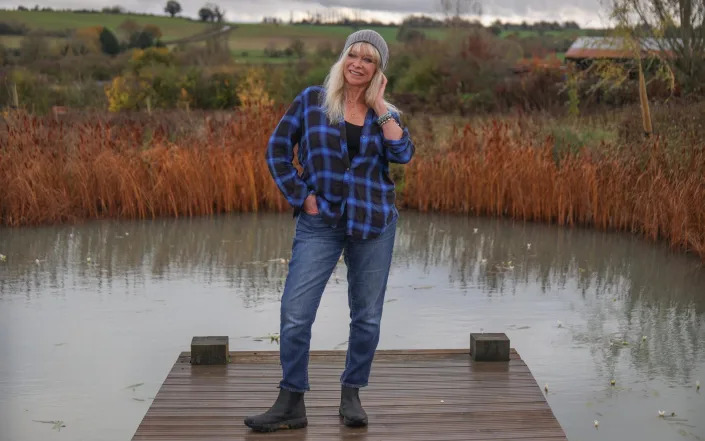
‘I loved the idea of being self-sufficient, not only growing my own food, but having my own heat, electricity and water supply’ – John Lawrence
The entrepreneur and ex-wife of Rolling Stones rocker Ronnie Wood on the joy of going off-grid and being in touch with nature.
Where do you live?
I live in Northamptonshire, near Silverstone, in a place I saw online four years ago. The property was being sold as an off-grid farmhouse and I’d dreamed of going off-grid. I loved the idea of being self-sufficient, not only growing my own food, but having my own heat, electricity and water supply. This was it! It came with six acres, old sheds and barns ripe for conversion. The land was barren and there was no garden, but it meant I could do things my way. After my divorce from Ronnie in 2011, I’d been living in central London, so it was a huge change.
What did you have to do to get the house and garden up and running?
I moved into the house in November 2019, and in those first few weeks, the water ran out, the solar panels didn’t work, the electrics were dodgy, and the generator for heat and light broke down. I sat in the kitchen and said to myself: “I’ve made such a terrible mistake.” But slowly, I found the right people to help me turn things around. A modern generator was installed, new solar panels fitted and, after locating an underground water supply, an engineer drilled a hole nearly 300ft down to provide me with my own water. It was expensive, but from then on, I’d have no more bills.
What were your plans for the garden?
One of the first things I did was to plant 70 trees, including willow, oak and apple. But my priority that first spring was to build raised beds for growing organic fruit and veg. Of course, four months after I moved in, the country went into lockdown; but with my son Tyrone and my daughter Leah and her family, we were all in the same bubble, so I got cracking and they helped me. Within no time, we’d sown everything from potatoes to pumpkins, with nasturtiums and calendula for colour. The house itself was already covered with climbing roses, so I planted lavender, rosemary and other scented herbs and flowers beneath.
‘One thing my kids were excited about was creating a wild swimming pond,’ says Jo Wood – John Lawrence
Why did you become so passionate about growing organic food?
I met Ronnie in 1977, when I was just 22. At that point, I had my son Jamie and he had his son Jesse. We had Leah and Tyrone together and got married in 1985. Then in 1990, I got ill and was diagnosed with Crohn’s disease. I was on steroids; I was miserable. Then someone who’d read about my illness told me to cut out processed foods and go organic – veg, fruit, meat, the lot. With nothing to lose, I did. Four months later, I felt fantastic. But I got ill again. This time, I found out I didn’t have Crohn’s, I had a perforated appendix. Doctors were amazed I was still alive. I recovered, but my eyes were opened to all the chemicals in food, so I became even more obsessed with organic.
How did your family react to your organic obsession?
Ronnie thought I was mad and the family banned me from using the word “organic”. But I was on a mission. The only thing I didn’t have was a garden big enough to grow my own food. It was when we went to stay at Ronnie’s house in Kildare, in Ireland, that I got my first taste of growing organic veg. I loved it. In fact, one year we had such a huge crop of potatoes, I put a load in a suitcase, took them to a Stones gig in Paris and asked their chef if he’d cook them. Keith Richards turned to me and said: “The trouble with you, darling, is that you’re addicted to organic.” Actually, Keith’s wife, Patti, has a veg garden in Connecticut. She gets it!
What other projects have you focused on in your new home?
One thing my kids were excited about was creating a wild swimming pond. It was part of my plan to rewild a huge section of the land that I’d already scattered with native wildflower seeds, such as red clover, cowslip, ragged robin and oxeye daisy. Tyrone took charge. He had the pond dug out and lined with local clay, and once we’d filled it with water, Leah, who now lives with her family up the road, helped me get started with aquatic plants such as water hawthorn, spearwort, lilies and yellow flag iris. By the second year, they all went mad. Glorious! It came alive with wildlife and watching birds fly in and out was magical.
Wood plans to have a whole field of lavender eventually – John Lawrence
Did you have a garden as a child?
Mum was from South Africa. She met Dad, who was from Devon, on a train. He was an architectural model maker and, after the war, he worked for Essex council on the model for a new town called Basildon. When it was completed, the council gave him a new council house and as soon as we moved in, Mum wanted chickens and an avocado tree – no one ate avocados back then. She also grew medicinal herbs; she was a huge believer in feverfew, an old remedy for fevers, and mullein, which is great for coughs. She’s inspired me to create a medicinal herb garden here. I might even grow avocados!
Do you think gardening is good for your mind as well as the body?
More and more, I find it’s so important to be outside, to soak up natural light, be in touch with nature, to feel the earth on my skin. In the summer, I often go around barefoot. Other times, there’s nothing like the simplicity of sitting under a tree and just soaking it all in. Trees are such amazing things. In 2016, I bought a little house with two acres in the hills of Murcia, in Spain, and filled it with fruit trees – pomegranate, fig, orange, lemon and olive. It’s my little getaway.
What’s your next project in the garden?
I have so many plans and one of them is to have a whole field of lavender. It would be so beautiful and I could get someone to harvest it. And now that we’ve got wildflowers, I also want to make my own honey. The bees will have a feast. Jamie’s also been studying the health benefits of supplements made from mushrooms and wants to start growing them, while Tyrone has converted old sheds into a bar and a play area for the kids. I’ve now got 10 grandchildren, so they have the best time here.
What have been the biggest challenges to going off-grid?
In the early days, I’d often have to stick on my wellies and go out in the rain in the middle of the night because the lights hadn’t come on or the hot water was like ice. Now, I’ve replaced everything and there’s an app on my phone that tells me if the generator’s on and how much heat I’m getting from my solar panels. It’s other things that give me grief. Rabbits. One morning, I came out to all these holes and half-eaten muddy carrots. The audacity! But mud or no mud, I haven’t given up my glamorous life altogether. I still swap my wellies and woolly hat for heels and sequins sometimes. I’ve got the best of both worlds.
Jo Wood’s organic product range is available to shop at jowoodorganics.com.
Pritzker Will Do What It Takes to Keep Both DeSantis and Trump Out of the White House
Laura Davison and Shruti Date Singh – February 23, 2023
Pritzker Will Do What It Takes to Keep Both DeSantis and Trump Out of the White House
(Bloomberg) — Illinois Governor J.B. Pritzker said he’s willing to spend what it takes in the next election to help President Joe Biden keep his job — and keep Republicans like Ron DeSantis and Donald Trump out of the White House.
“It’s very important to me that we elect a Democratic president and that we make sure to keep DeSantis, Trump and the retrograde views that they carry out of the White House,” Pritzker, a longtime Democratic donor, said in an interview Thursday with Bloomberg News in Chicago. “I’ll continue to support Democrats in the best way I can to help them get elected.”
Pritzker, 58, is a member of one of the world’s wealthiest families, with a net worth of $3.7 billion, according to the Bloomberg Billionaires Index. The Democrat has been in the middle of recent spats with DeSantis, Florida’s Republican governor, and is a long-running nemesis of Citadel founder and GOP mega-donor Ken Griffin, who has said he’d back a DeSantis bid for president in 2024.
DeSantis, who visited Illinois this week, has criticized Chicago’s crime under Pritzker’s watch. Pritzker shot back, saying that DeSantis is trying to lower public education standards by banning the teaching of racial history.
Pritzker also said Griffin moved his financial empire headquarters to Miami from Chicago last year out of “embarrassment” after spending $50 million trying to defeat him in the gubernatorial race by backing Richard Irvin, the mayor of Aurora, Illinois.
“That person lost badly in the Republican primary,” Pritzker said in an interview Thursday with Bloomberg TV.
National Attention
Trading barbs with prominent Republicans sets up Pritzker for national political attention.
Pritzker, who was re-elected as Illinois governor in 2022, said he has been approached about potentially running for president, but declined to give any details about those discussions. He said he’s happy as governor, intends to serve the rest of his term and will back Biden this cycle.
Still, he’s raised his national profile by visiting New Hampshire and Florida, and has taken stances on expanding abortion access and banning assault weapons, stoking speculation that he has lofty ambitions beyond the Illinois statehouse in Springfield.
Regardless, the billionaire’s wealth promises to play a role in the 2024 race.
He poured more than $300 million of his own money into his two successful bids for governor. He spent about $51 million for a failed campaign to change Illinois’s flat income-tax structure to one that increases taxes on the rich.
Outside of Illinois, Pritzker and his wife have donated more than $39 million since 2011, according to campaign finance disclosures. Topping the list of recipients is Priorities USA Action, the super-PAC that’s supported Democratic presidential nominees since it was launched in 2011.
The Pritzkers have also given $2 million to support Hillary Clinton’s 2016 general election campaign and $1.4 million to back Biden in 2020.
Judge rules New Mexico feral cattle can be shot from helicopters
Clark Mindock – February 22, 2023
A cow that has gotten loose from its pen stands in the middle of Hwy 10 in Winnie, Texas
(Reuters) -The U.S. Forest Service can go ahead with a plan to shoot dozens of feral cattle from helicopters in New Mexico’s Gila Wilderness after a federal judge on Wednesday refused a request by ranchers for an emergency order to stop the cull.
Cattle ranchers and local business owners told U.S. District Judge James Browning earlier on Wednesday at a hearing in Albuquerque the four-day hunt of about 150 stray or unbranded cows, due to start on Thursday, would violate federal laws and Forest Service regulations and likely kill cows they own.
In denying the plaintiffs’ bid for the emergency order, Browning said they were unlikely to succeed on the merits of their case and that of the approximately 300 cattle removed or killed over the last several decades “only one has been branded, and it was removed rather than killed.”
Jessica Blome, an attorney for the ranchers, said they are “deeply disappointed that the court green lit” the plan.
The Forest Service did not immediately respond to a request for comment.
The Forest Service announced the hunt last week, the second in as many years, saying feral cows were damaging habitats and menacing hikers who visit the vast Southwestern national monument known for its mountain ranges and plunging, rock-walled canyons.
U.S. Department of Justice attorney Andrew Smith, representing the Forest Service, argued on Wednesday that blocking the cull would allow feral cow populations to “rebound, and last year’s efforts would be wasted.”
Aerial hunting of feral hogs and predators like coyotes is a common practice in the American West but efforts to gun down cattle from above have been met with protest.
The New Mexico Cattle Growers Association (NMCGA), which had filed a lawsuit on Tuesday alongside other ranching, farming and business interests, said aerial shooting puts at risk privately owned cattle that may have strayed through broken fences or to find water. That loss harms an industry already hard-hit by climate change and rising costs, it said.
Ranchers also said helicopter hunting is inefficient and inhumane, causing cattle to run and forcing shooters to pepper cows with multiple rounds before they are left to die, sometimes days later.
NMCGA sued the Forest Service over its last cull, resulting in an out-of-court settlement. The ranchers said that agreement requires the government to give the public 75 days’ notice before it shoots feral cows from helicopters. The government provided just seven days’ notice this year, they said.
(Reporting by Clark Mindock in New York; Editing by Alexia Garamfalvi, Matthew Lewis and Tom Hogue)
ALBUQUERQUE, N.M. (AP) — A U.S. district judge on Wednesday cleared the way for federal officials to move ahead with plans to take to the air and shoot dozens of wild cattle in a rugged area of southwestern New Mexico.
Ranchers had sought a delay, arguing that the potential mass slaughter of as many as 150 “unauthorized” cows on public land was a violation of federal regulations and amounted to animal cruelty.
After listening to arguments that stretched throughout the day, Judge James Browning denied the request, saying the ranchers failed to make their case. He also said the U.S. Forest Service is charged with managing the wilderness for the benefit of the public, and the operation would further that aim.
“No one disputes that the Gila cattle need to be removed and are doing significant damage to the Gila Wilderness,” Browning wrote. “The court does not see a legal prohibition on the operation. It would be contrary to the public interest to stop the operation from proceeding.”
Plans by the Forest Service call for shooting the cattle with a high-powered rifle from a helicopter and leaving the carcasses in the Gila Wilderness. It was estimated by attorneys for the ranchers that 65 tons of dead animals would be left in the forest for months until they decompose or are eaten by scavengers.
Officials closed a large swath of the forest Monday and were scheduled to begin the shooting operation Thursday.
The New Mexico Cattle Growers’ Association, individual ranchers and the Humane Farming Association filed a complaint in federal court Tuesday, alleging that agency officials were violating their own regulations and overstepping their authority.
The complaint stated that court intervention was necessary to put an immediate stop to “this unlawful, cruel, and environmentally harmful action, both now and in the future.”
The ranchers had argued that the case could set a precedent for how federal officials handle unbranded livestock on vacant allotments or deal with other land management conflicts across the West.
“There’s a severe danger here, not just in this particular case and the horrific results that it will actually bare if this is allowed to go forward. But it also has long-term ramifications for the power of federal agencies to disregard their regulations that they themselves passed,” Daniel McGuire, an attorney for the ranchers, told the judge.
The Gila National Forest issued its final decision to gun down the wayward cattle last week amid pressure from environmental groups that have raised concerns that cattle are compromising water quality and habitat for other species as they trample stream banks in sensitive areas.
Much of the debate during Wednesday’s hearing centered on whether the animals were unauthorized livestock or feral cows, as the Forest Service has been referring to them.
Ranchers said the cattle in question were the descendants of cows that legally grazed the area in the 1970s before the owner went out of business. They pointed to DNA and genetic markers, saying the temperament of the animals doesn’t mean they cease to be domesticated livestock.
As defined in Forest Service regulations, unauthorized livestock refers to any cattle, sheep, goats or hogs that are not authorized by permit to be grazing on national forest land. The regulations calls for an impoundment order to be issued and the livestock rounded up, with lethal action being a final step for those that aren’t captured.
Despite issuing such an order earlier this month, the agency argued it wasn’t required to follow the removal procedures outlined by the regulations because the cattle don’t fit the definition of livestock since they aren’t domesticated or being kept or raised by any individual.
Government attorney Andrew Smith said the cows have no pedigree.
“So it does make a difference what these cows are. They’re multigenerations of wildness going on,” he said.
The judge agreed.
Smith also argued that Congress has charged the Forest Service with protecting national forest land and that eradicating the cattle would put an end to decades of damage. He said previous gathering efforts over the decades only put a dent in the population but that an aerial shooting operation in 2022 was able to take out 65 cows in two days.
Had the project been delayed, Smith suggested that the population would rebound and last year’s effort would be wasted.
McGuire countered that Congress conferred authority on the Forest Service to make rules and regulations to protect and preserve the forest, not a license for the agency to do anything it wants.
Donald Trump, who rolled back rail safety regulations and slashed environmental protections, donates Trump-branded water to East Palestine residents
Erin Snodgrass – February 22, 2023
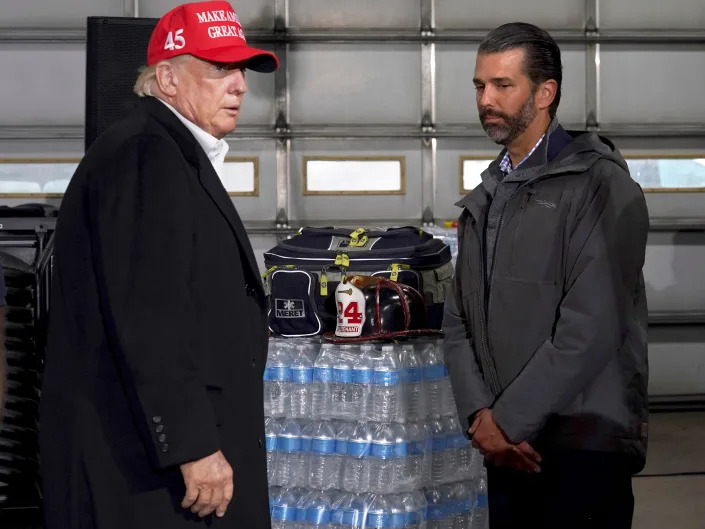
Former President Donald Trump heads out of the East Palestine Fire Department next to his son, Donald Trump, Jr., as he visits the area in the aftermath of the Norfolk Southern train derailment Feb. 3 in East Palestine, Ohio, Wednesday, Feb. 22, 2023. In the background is a pallet of personalized Trump water he donated.AP Photo/Matt Freed
Donald Trump visited East Palestine, Ohio, on Wednesday, following a disastrous train derailment.
The 2024 Republican candidate donated pallets of Trump-branded water to residents.
Trump’s visit raised questions about his administration’s rollback of rail safety regulations.
The former president’s visit to the northeastern village preempted Transportation Secretary Pete Buttigieg’s arrival by one day, and Trump relished every opportunity to castigate his Democratic successors, saying Buttigieg “should have already been here,” and commanding President Joe Biden to “get over here,” according to local reports.
While assuring East Palestine residents that they had “not been forgotten,” Trump managed to tout his own presence in the besieged community and brush off questions about his administration’s noted history of rolling back regulations on both rail safety and hazardous chemicals.
Trump started his day by briefly visiting with local leaders, according to WKBN-27, before conducting a small press conference at a fire station, where, donning his signature “Make America Great Again” hat, he handed out a flurry of red baseball caps to attendees.
During his speech, Trump pledged to donate thousands of bottles of cleaning supplies, as well as pallets of Trump-branded water bottles to members of the community, many of whom have expressed continued concern over the safety of the town’s water supply following the derailment.
“You wanna get those Trump bottles, I think, more than anybody else,” Trump said, while flanked by state and local leaders, including Republican Sen. JD Vance.
The former president dismissed questions about his administration’s rollback of Obama-era rail safety regulations saying he “had nothing to do with it.”
The Department of Transportation under Trump justified the rollback with a 2018 analysis arguing the cost of requiring such brakes would be “significantly higher” than the expected benefits of the update.
A spokesperson for Trump did not immediately respond to Insider’s request for comment.
Following his Wednesday news conference, Trump visited a local Ohio McDonald’s where he handed out more MAGA hats and bought meals for firefighters.
San Francisco holds its breath to find out how much it will cost to protect its waterfront from sea level rise
David Knowles, Senior Editor – February 22, 2023
San Francisco’s waterfront. (Getty Images)
SAN FRANCISCO — On a brisk February morning, a portable orange traffic sign set up near the intersection of Mission Street and Embarcadero shuddered in the wind, blinking a warning to passing drivers: “Caution: King tides.”
Waves from San Francisco Bay now regularly breach the pier and spill into the streets at this spot during tidal surges and helped convince city officials that sea level rise caused by climate change is no longer a problem that can be ignored.
“It was into my second year that I realized that my whole job and the organization was going to do this work,” Port of San Francisco executive director Elaine Forbes, who was appointed to her position in 2016 by then-Mayor Ed Lee, said beneath the Ferry Building’s broken clock tower, its hands fixed to either high noon or midnight as it undergoes repairs. “You’re on the line of defense.”
A semi-independent entity, the port oversees 7.5 miles of the city’s coastal facilities along the bay, leasing out a wide array of properties, including landmarks like Fisherman’s Wharf, Pier 39, the Ferry Building, a cruise ship terminal and Oracle Park, where the Giants play baseball. Its revenues are crucial to the city’s bottom line, and in 2018 Forbes mobilized her office to help ensure the passage of Prop A, a voter initiative that raised $425 million in taxpayer funds to begin addressing repairs and seismic upgrades to a 3-mile section of the city’s crumbling, more-than-100-year-old sea wall in anticipation of sea level rise.
“We said at the time, this is really a down payment for the problem,” Forbes recounted.
Since then, projections for how bad that problem will get have only become more dire. In 2020, the Legislative Analyst’s Office, the nonpartisan fiscal and policy adviser to the California Legislature, issued a report stating that under a scenario of continued high greenhouse gas emissions, San Francisco could see as much as 7 feet of sea level rise by 2100.
A graphic from a 2020 report by California’s Legislative Analyst’s Office.
In response to that grim new estimate, Forbes and the port’s commissioners announced last fall that they were partnering with the U.S. Army Corps of Engineers to conduct a comprehensive yearlong study examining how best to protect the vulnerable waterfront. Doing nothing, everyone seemed to agree, was not an option.
“The increased frequency of flooding that you’ll see as the bay comes up and you have more frequent tidal flooding, the numbers are in the billions in terms of the damages that will accumulate from that,” Brian Harper, a director of planning with the Army Corps, told Yahoo News.
But just as significant increases in sea level will result in monumental damages, adequately protecting communities from the additional rise will also become much more expensive. Complicating San Francisco’s efforts, the pandemic has badly diminished revenues from tourism and financial district foot traffic, forcing port officials to go hat-in-hand to city, state and federal entities in search of money to use to harden the coastline against rising waters.
“We’re not even at a scale to pretend to be able to pay for this project,” Forbes said. “We have a $114 million balance sheet, maybe a little higher. If we’re lucky, we have a $25 million capital budget that we squeeze out of our net revenues.”
While noting that any estimate on how much a fix will cost depends on what the Army Corps recommends in its report, Forbes speculates that the range could end up between $10 billion and $30 billion. Other experts, however, believe that guess could be too low.
Pier 14 in the Embarcadero district of San Francisco. (Getty Images)
“Projects like this have never, ever been built for the initial cost estimate,” said Peter Gleick, a climate scientist and the founder of Oakland’s Pacific Institute, which in 1990 conducted California’s first-ever report on how sea level rise would impact the Bay Area. “It’s not just sea level rise. It’s the big storm in addition to sea level rise that’s the issue. Seven feet of sea level rise is devastating, and then on top of that you have the extreme storm and then the king tides on top of 7 feet. That’s when the real damages are felt, and they’re felt long before they reach 7 feet.”
While many Americans still doubt the existence of climate change or whether climate change represents a threat serious enough to spend billions to address, coastal communities across the country have already begun heeding the wake-up call issued by scientists. San Francisco is just one of several U.S. cities to seek help from the Army Corps of Engineers in recent years. Others include Charleston, S.C., Miami and Boston. As the reality of the situation and the costs associated with it continue to sink in, more and more cash-strapped communities will no doubt seek federal assistance.
“Our standard cost sharing for flooding coastal projects is 65% federal, 35% local,” Harper said.
But federal money for projects designed and proposed by the Army Corps is by no means guaranteed.
A king tide washes up along the Embarcadero in San Francisco on Jan. 3, 2022. (Brontë Wittpenn/The San Francisco Chronicle via Getty Images)
“Each step of the way, we need an authorization from Congress and we need appropriation of funding to move to the next step,” Harper said. “Our steps are: Study it, design it, construct it and then operate it. So in each of those stages we would be going back to the Congress with an updated status of where we are and request for appropriation to move to the next stage.”
With the GOP back in the majority in the House of Representatives, it’s unclear how future requests for climate adaptability from the Corps will be received. Not a single Republican, after all, voted in favor of the Inflation Reduction Act, and many lawmakers who abhor large federal outlays have already begun looking for ways to kill its climate provisions. Yet much of the funding for hardening ports and waterfronts was allocated in the bipartisan Infrastructure Investment and Jobs Act, and Harper notes that the Corps continues to get approval for large projects.
“The administration incorporated authorization for all federal infrastructure agencies to specifically address climate resilience across the country, but [also] in urban settings like San Francisco and other large cities,” Harper said. “Some of this is still evolving and developing as federal agencies and their local and state counterparts figure out how to make those partnerships come together. The climate resilience aspect is continually evolving.”
Seeing the future
Kevin Costner in the 1995 movie “Waterworld.” (Ben Glass/Universal/Kobal/Shutterstock)
Of all the consequences of climate change, sea level rise has so far remained something of an abstraction for many in the general public. While the oceans have indeed risen by an average of 8 to 9 inches since the 1880s, that difference can seem laughable when compared with Hollywood’s dystopian portrayal of what the future will look like. “Waterworld,” set in the year 2500, envisioned a world in which the polar ice caps and glaciers have completely melted away and sea levels have risen by 24,000 feet.
Since the 1995 debut of that film, the U.S. Geological Survey has released its own estimate of what an ice-free world would mean, concluding that “global sea level would rise approximately 70 meters (approximately 230 feet), flooding every coastal city on the planet.”
Given the swift transition to renewable sources of energy over the past few years, that outcome may also turn out to be too pessimistic. But until we dramatically slow the burning of fossil fuels, the planet will almost certainly continue to warm, causing the seas to keep rising. Though today’s 8 to 9 inches of sea level rise may not seem headline-worthy, almost half of the amount (3.8 inches) has occurred since 1990, according to the National Oceanic and Atmospheric Administration (NOAA). The pace of that rise, scientists predict, is poised to increase dramatically in the coming decades.
To better understand what multiple feet of additional sea level rise will mean for the nation’s coastlines, NOAA created its Sea Level Rise Viewer tool. When one toggles up to 7 feet of rise in San Francisco, Pier 39, Fisherman’s Wharf, Oracle Park and the $1.4 billion Chase Center, where the Golden State Warriors play basketball, are all shaded light blue, meaning they will be submerged in water. Forbes’s office on Pier 1, the Ferry Building next door and a good chunk of the financial district would also be permanently flooded, with access to multiple underground BART and Muni stations needing to be sealed off.
A screengrab from NOAA’s Sea Level Rise Viewer tool showing the San Francisco area with 10 feet of sea level rise.
But how seriously should people take the Legislative Analyst’s Office upper-end prediction?
“It’s based on very sophisticated model assumptions,” Gleick said. “There’s a range of estimates. We don’t know how fast the big ice masses on Greenland and Antarctica are going to destabilize, but 1 to 2 meters by 2100 is not out of the bounds of reality and what we can expect.”
The same year San Francisco voters passed Prop A with 82.7% of the vote in order to “protect $100 billion of assets and economic activity,” a poll from the University of California, Santa Barbara, found that 84% of area residents said they believed global temperatures were rising and would continue to do so, the highest number of any community in the U.S.
“It does help when they’re able to see the change. With flooding during a king tide they say, ‘Hey, this is different,’” Harper acknowledged. “But that doesn’t really capture the severity of what they’re going to see over a longer time frame.”
Like NOAA, the Army Corps has turned to visual aids to help residents understand what they will be up against, posting its own sea level rise viewer that overlays flooding depictions onto photos of urban areas.
“Here’s your downtown area. Here are buildings you should recognize because they’re in your community, and here’s what that future tidal event is going to look like,” Harper said.
If “Waterworld” was too fantastical, another sci-fi film, “Blade Runner 2049,” offered viewers a glimpse of something less abstract in scenes that featured a massive sea wall that shields Los Angeles from the encroaching ocean. That kind of utility-over-aesthetics approach has, despite the obvious drawbacks, been suggested in San Francisco to replace and dwarf the existing sea wall.
“We don’t just want to build a vertical wall. We could do that and just solve it, but that’s not good for anybody,” saidKevin Conger, president and founding partner of CMG Landscape Architecture, a San Francisco firm the port has hired to begin drawing up ideas for what a fortified sea wall would look like. “In order to adapt and hold the water back we need to elevate portions of the waterfront, but that causes another problem, which is inland flooding, because all the stormwater that’s running down by gravity is no longer going to be able to run out to the coast because you’ve elevated that edge.”
An aerial view of the Port of San Francisco shrouded in fog. (Getty Images)
Conger, Forbes and Harper all agree that whatever the final plan that emerges following the release of the Army Corps report, it should prioritize community access to the waterfront while preparing it for what’s ahead. To address the varying needs and limitations of the waterfront, the designs will include a mixture of solutions, including reinforcing and raising the existing sea wall; creating new parks that will help channel floodwaters; adding pumping stations; upgrading stormwater systems; elevating roadways, light rail tracks and even some buildings, and floodproofing the lower floors of many others; and, quite possibly, retreating from some areas altogether.
“Fundamentally, it’s looking at maintaining the line of defense, managing water, adapting with water or allowing water,” Forbes said. “There’s various alternatives that will work best in different locations along the waterfront.”
Despite the immense scale of the project, Conger stresses the long view.
“We get so sort of locked into a fear of change. But we’re always tinkering with our cities and changing things. For us to work on these projects, it’s not like we build them and walk away and we’re done, especially as landscape architects,” he said. “Our designs change constantly.”
In November, the Army Corps will present its draft to the public, inviting comments from a range of stakeholders before incorporating that feedback. Assuming congressional authorization follows suit, Harper said, the budgeting for design could come as soon as 2026.
“Depending on what the project is, design can be two to five years. Construction, again, can be two to five years. It will depend on what the specific project recommendation is coming out of the report, and it’s all subject to congressional action and administration support,” Harper said.
Calculating the final costs could itself be a years-long project. In surveys conducted by the port, for instance, San Francisco residents have prioritized elevating the 1898 Ferry Building to keep it above the rising waters. But lifting a three-story building that contains more than 200,000 square feet of office and commercial space and a 15-story clock tower won’t be cheap. Nor will be addressing possible groundwater contamination at Hunters Point Naval Shipyard, now an 866-acre federal Superfund site. Last June, a civil grand jury released a report that stated, “As the sea level rises, shallow groundwater near the shore rises with it, and can cause flooding, damage infrastructure, and mobilize any contaminants in the soil.” While the cleanup of buried radioactive soils is being overseen by the Environmental Protection Agency and state officials, the city is “poorly prepared,” the report said, for how sea level rise could cause the problem to spread into nearby lower-income neighborhoods.
San Francisco’s Ferry Building. (Getty Images)
All the coastal challenges facing San Francisco could become much more difficult depending on the precarious fate of the Thwaites Glacier in Antarctica. In 2021, a study was published that concluded that the Florida-size glacier was at risk of collapse in the following five years. Already, Thwaites accounts for roughly 4% of global sea level rise annually, and its collapse would, in the short term, translate into 2 more feet of rise. Because Thwaites helps hold other glaciers in place, however, its destruction would result in a cascading catastrophe resulting in an additional 10 feet of sea level rise.
Of course, the contiguous 7.5-mile stretch operated by the Port of San Francisco is just one small part of the Bay Area coastline that will be impacted by sea level rise.
“You’re going to have to build sea walls around the Oakland airport, the San Francisco airport, and sea walls around San Jose,” Gleick said. “When we did our study there were 29 wastewater treatment plants that were vulnerable to a meter of sea level rise.”
Though Gleick notes that San Francisco has plenty of options when it comes to combating rising seas, many poorer and less well-situated places aren’t as lucky.
“I guess the whole point is, this is just a little hint of the huge costs that are going to be associated with climate change in general and sea level rise in particular if we don’t slow these [temperature] changes,” he added.
As tractors became more sophisticated over the past two decades, the big manufacturers allowed farmers fewer options for repairs. Rather than hiring independent repair shops, farmers have increasingly had to wait for company-authorized dealers to arrive. Getting repairs could take days, often leading to lost time and high costs.
A new memorandum of understanding between the country’s largest farm equipment maker, John Deere Corp., and the American Farm Bureau Federation is now raising hopes that U.S. farmers will finally regain the right to repair more of their own equipment.
However, supporters of right-to-repair laws suspect a more sinister purpose: to slow the momentum of efforts to secure right-to-repair laws around the country.
Under the agreement, John Deere promises to give farmers and independent repair shops access to manuals, diagnostics and parts. But there’s a catch – the agreement isn’t legally binding, and, as part of the deal, the influential Farm Bureau promised not to support any federal or state right-to-repair legislation.
You can listen to more articles from The Conversation narrated by Noa.
The right-to-repair movement has become the leading edge of a pushback against growing corporate power. Intellectual property protections, whether patents on farm equipment, crops, computers or cellphones, have become more intense in recent decades and cover more territory, giving companies more control over what farmers and other consumers can do with the products they buy.
For farmers, few examples of those corporate constraints are more frustrating than repair restrictions and patent rights that prevent them from saving seeds from their own crops for future planting.
How a few companies became so powerful
The United States’ market economy requires competition to function properly, which is why U.S. antitrust policies were strictly enforced in the post-World War II era.
During the 1970s and 1980s, however, political leaders began following the advice of a group of economists at the University of Chicago and relaxed enforcement of federal antitrust policies. That led to a concentration of economic power in many sectors.
This concentration has become especially pronounced in agriculture, with a few companies consolidating market share in numerous areas, including seeds, pesticides and machinery, as well as commodity processing and meatpacking. One study in 2014 estimated that Monsanto, now owned by Bayer, was responsible for approximately 80% of the corn and 90% of the soybeans grown in the U.S. In farm machinery, John Deere and Kubota account for about a third of the market.
Market power often translates into political power, which means that those large companies can influence regulatory oversight, legal decisions, and legislation that furthers their economic interests – including securing more expansive and stricter intellectual property policies.
Whether the product is an automobile, smartphone or seed, companies can extract more profits if they can force consumers to purchase the company’s replacement parts or use the company’s exclusive dealership to repair the product.
One of the first cases that challenged the right to repair equipment was in 1939, when a company that was reselling refurbished spark plugs was sued by the Champion Spark Plug Co. for violating its patent rights. The Supreme Court agreed that Champion’s trademark had been violated, but it allowed resale of the refurbished spark plugs if “used” or “repaired” was stamped on the product.
Although courts have often sided with the end users in right-to-repair cases, large companies have vast legal and lobbying resources to argue for stricter patent protections. Consumer advocates contend that these protections prevent people from repairing and modifying the products they rightfully purchased.
The ostensible justification for patents, whether for equipment or seeds, is that they provide an incentive for companies to invest time and money in developing products because they know that they will have exclusive rights to sell their inventions once patented.
However, some scholars claim that recent legal and legislative changes to patents are instead limiting innovation and social benefits.
The problem with seed patents
The extension of utility patents to agricultural seeds illustrates how intellectual property policies have expanded and become more restrictive.
Patents have been around since the founding of the U.S., but agricultural crops were initially considered natural processes that couldn’t be patented. That changed in 1980 with the U.S. Supreme Court decision Diamond v. Chakrabarty. The case involved genetically engineered bacteria that could break down crude oil. The court’s ruling allowed inventors to secure patents on living organisms.
Half a decade later, the U.S. Patent Office extended patents to agricultural crops generated through transgenic breeding techniques, which inserts a gene from one species into the genome of another. One prominent example is the insertion of a gene into corn and cotton that enables the plant to produce its own pesticide. In 2001, the Supreme Court included conventionally bred crops in the category eligible for patenting.
Genetically modified seeds, and even conventionally bred crops, can be patented. Sean Gallup/Getty Images
Historically, farmers would save seeds that their crops generated and replant them the following season. They could also sell those seeds to other farmers. They lost the right to sell their seeds in 1970, when Congress passed the Plant Variety Protection Act. Utility patents, which grant an inventor exclusive right to produce a new or improved product, are even more restrictive.
Under a utility patent, farmers can no longer save seed for replanting on their own farms. University scientists even face restrictions on the kind of research they can perform on patented crops.
Because of the clear changes in intellectual property protections on agricultural crops over the years, researchers are able to evaluate whether those changes correlate with crop innovations – the primary justification used for patents. The short answer is that they do not.
One study revealed that companies have used intellectual property to enhance their market power more than to enhance innovations. In fact, some vegetable crops with few patent protections had more varietal innovations than crops with more patent protections.
How much does this cost farmers?
It can be difficult to estimate how much patented crops cost farmers. For example, farmers might pay more for the seeds but save money on pesticides or labor, and they might have higher yields. If market prices for the crop are high one year, the farmer might come out ahead, but if prices are low, the farmer might lose money. Crop breeders, meanwhile, envision substantial profits.
Similarly, it is difficult to calculate the costs farmers face from not having a right to repair their machinery. A machine breakdown that takes weeks to repair during harvest time could be catastrophic.
The nonprofit U.S. Public Interest Research Group calculated that U.S. consumers could save US$40 billion per year if they could repair electronics and appliances – about $330 per family.
The memorandum of understanding between John Deere and the Farm Bureau may be a step in the right direction, but it is not a substitute for right-to-repair legislation or the enforcement of antitrust policies.
Leland Glenna does not work for, consult, own shares in or receive funding from any company or organization that would benefit from this article, and has disclosed no relevant affiliations beyond their academic appointment.
Climate change is making disasters like hurricanes more devastating and frequent, and Floridians are already being forced to flee.Getty; Marianne Ayala/Insider
The state’s climate exodus has already begun
As many residents will be proud to tell you, the thousand-odd islands that make up the Florida Keys are one of a kind: there is no other place in the world that boasts the same combination of geological, ecological, and sociological characteristics. The islands have a special, addictive quality about it, an air of freedom that leads people to turn their backs on mainland life.
The Keys are also the first flock of canaries in the coal mine of climate change. Over the past few years, the residents of these islands have been forced to confront a phenomenon that will affect millions of Americans before the end of the century. Their present calamity offers a glimpse of our national future.
Nature is changing. Today’s hurricanes tend to be stronger, wetter, and less predictable than those of the last century. They hold more moisture, speed up more quickly, and stay together longer. It’s difficult to tell for certain what role climate change plays in any individual storm, but in the case of Hurricane Irma — which slammed the Keys in September 2017 — there is little doubt that the warmth of the Caribbean Sea made the storm more powerful, allowing the vortex to regain strength overnight as it barreled toward the islands. As global warming continues to ratchet up the temperature of our oceans, we can expect more storms like Irma. The danger to the Keys doesn’t end with hurricane season, either: a slow but definite rise in average sea levels over the past decade has contributed to an increase in tidal flooding, leaving some roads and neighborhoods inundated with salt water for months at a time.
In the five years since Irma, the bill has come due. The hurricane made undeniable what previous floods had only suggested: that climate change will someday make life in the archipelago impossible to sustain. The storm was the first episode in a long and turbulent process of collapse, one that will expand over time to include market contraction, government disinvestment, and eventually a wholesale retreat toward the mainland. Irma may not have destroyed the Keys in one stroke, but the storm ran down the clock on life on the islands, pushing conches (the Keys’ unique name for residents) into a future that once seemed remote. The impulse to stay, which once bespoke a conch’s devotion to his or her adopted home, now looks a little more like denial. The decision to leave, on the other hand, which once signified surrender, now looks more like acceptance of the inevitable.
Florida’s Great Displacement
The term “climate migration” is an attempt to explain why people leave one place in favor of another; it assigns motivation to movements that may be voluntary or involuntary, temporary or permanent. Yet even if the primary cause for migration is clear, there are still countless other factors that influence when, where, and how someone moves in response to a disaster. It’s this messiness that is reflected in the word “displacement”: the migratory shifts caused by climate change are as chaotic as the weather events that cause them.
For some families the decision to depart the Keys was easy. The storm was a traumatic event, more than enough to convince many people that life on the islands was too dangerous to accept. They came back home, fixed up their houses, and got out. That was the case for Connie and Glenn Faast, who left the island city of Marathon for the mountains of North Carolina after spending almost 50 years in the Keys. “It was pretty much immediate,” Connie told me. “It’s just too hard to start over when you get older. We couldn’t risk it.”
The Faasts had lived the kind of life you can only live in the Keys: Connie worked on commercial fishing boats and in a local aquarium, while Glenn owned a boat maintenance company and raced Jet Skis in his spare time. They had stuck it out in the Keys through several major storms, including 2005’s Hurricane Wilma, which brought five feet of water to their little island and totaled three of their cars; Connie still shudders when she remembers the image of her husband wading through the water around their house with snakes climbing all over him, clinging to him for shelter from the flood. The Faasts had second thoughts after that storm, but the Keys were paradise, and besides, they didn’t know where else they would go.
When Irma came 12 years later, though, the choice was much easier. During the evacuation, it took the Faasts a week to find a decaying hotel in Orlando where they could wait out the storm. As the hurricane passed over the center of the state, it knocked out their power, leaving them and their pets to spend the night in 100-degree heat without air conditioning. “That was it for us,” she said. They had to get out — not just out of the Keys, but out of Florida altogether.
When they returned to Marathon, they discovered that their home was the only one in the neighborhood with an intact roof. They put the house on the market as soon as they could, but it took a year for the place to sell, in part because property values had risen so steeply that most people in the area couldn’t afford to buy.
The storm had scared many people off, but it had also destroyed a quarter of the Keys’s housing stock, which drove up prices for the homes that survived. In the meantime, the Faasts saw their friends start to leave as well: one moved to Sarasota, another to Orlando, and a third friend, who had been the first-ever mayor of Marathon, talked about moving to central Florida.
“We thought it would be devastating when we left,” Connie said, “because we love the Keys. But when we pulled out of there, we were so, so relieved.”
No more housing
Hundreds of people like the Faasts left the Keys of their own volition in the years after Irma, deciding one way or another that the risks of staying there outweighed the benefits. But perhaps the more turbulent phenomenon after the storm was the involuntary displacement caused by the shortage of affordable housing on the islands. The storm destroyed not only the massive mobile home parks on islands like Big Pine, but also hundreds of so-called downstairs enclosures, small apartment-style units that sat beneath elevated homes.
It also wiped out dozens if not hundreds of liveaboard boats and older apartment complexes in island cities like Marathon. These trailer parks and apartment complexes had been havens for resort waiters, boat buffers, and bartenders, allowing them to get a foothold in an archipelago that had long ago become unaffordable for anyone who wasn’t rich. Now all that housing was gone, and FEMA’s 50% rule — which prohibits improvements to structures that cost more than 50% of its market value — prohibited most trailers and downstairs enclosures from being rebuilt.
Many of those who had been lucky enough to own small homes or campers hadn’t been able to afford insurance, which meant they missed out on the payouts that went to wealthy homeowners and part-time vacationers. To make matters worse, the government of the Keys couldn’t build enough new homes to fill the gap created by the storm: the state had long ago imposed a de facto cap on the number of building permits Monroe county — which encompasses the islands — could issue, an attempt to make sure the population did not grow too large to evacuate the islands in a single day. Thus it was impossible for most residents either to rebuild their old homes or to buy new ones.
Some of those who lost their homes were able to crash with friends and family, and others got by living in tents or trailers, but others resorted to a forest homeless encampment. The lack of housing made the storm survivors feel as though they were stuck in a permanent limbo: life on the islands became a game of musical chairs, in which only the highest bidders could end up with a seat.
Delaying the inevitable
Debra Maconaughey, the rector at St. Columba Episcopal Church in Marathon, spent the years after Irma trying to forestall this involuntary displacement. When the storm hit, Maconaughey and much of her congregation were in Ireland, retracing the steps of the original St. Columba, and by the time they returned to the Keys it was clear that housing would be the defining challenge of the next few years. “Everybody’s house was destroyed. That’s what people would need the most.”
We were speaking in the church’s open-air pavilion, where Maconaughey had been delivering outdoor sermons even before the coronavirus pandemic. Irma had weakened the timbers that supported the roof of the central chapel, forcing the church to move worship outside.
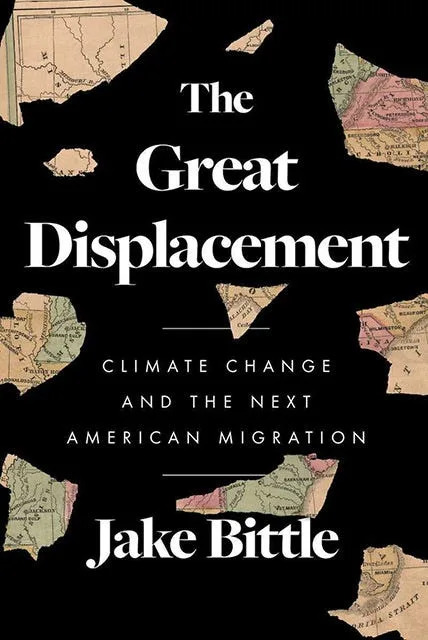
The Great Displacement: Climate Change and the Next American Migration by Jake BittleSimon & Schuster
In the first week Maconaughey was back, she helped transform St. Columba’s campus into a massive shelter for boaters who had lost their homes in the storm, cramming two dozen air mattresses into a loft that had previously been used for an after-school program. The next week, Maconaughey and her congregation installed approximately two dozen trailers around Marathon, giving the boaters a long-term place to stay.
Maconaughey knew there was no chance the county government would restore all the housing that had been lost in the storm, but after a year went by, she found herself shocked at how little had been rebuilt. A nonprofit land trust had erected only a handful of new cottages and a $50 million state program called Rebuild Florida had repaired only two homes, a pittance compared to the thousands of dwellings that had been swept away.
So Maconaughey called up the nonprofits who were funding St. Columba’s relief efforts and made an unconventional proposal: the church, she proposed, would buy some derelict housing and fix it up. She had her eyes set on a leaky, mold-filled apartment complex in Marathon that had been condemned for sewage issues a few years earlier. The apartment complex finally opened in the summer of 2020, providing cut-rate housing to 16 families who had been staying on couches or in trailers since the day the storm hit.
Never coming back
But for every person who found permanent shelter, there were more who could not afford to wait for the islands to recover. This wasn’t only because people didn’t want to return, but also because there were no homes to which they could return. Maconaughey told me with distaste that in several places along Marathon’s beachfront, developers have built single large mansions on lots that once contained three or four small homes each.
The lack of affordable housing in turn created a labor shortage: fire and police departments couldn’t find enough officers to fill their shifts, boat maintenance companies struggled to locate buffers and repairmen, and many hotels went shorthanded through the on-season rush. When employers exhausted their hiring options on the islands, Maconaughey said, they started to hire workers from the mainland towns of Homestead and Florida City, who take a two-hour bus ride in either direction to work for minimum wage.
“I think people are really struggling, and it’s just below the surface,” she said. “We’re a tourist area, so it’s in our best interests to make it look nice from the highway, but there’s hidden pain.”
Maconaughey told me about the church sexton, Mike, who was driven out of the Keys by Irma. Mike showed up after the recession in a homeless shelter in Marathon. He was blind, and when he first arrived at the shelter he couldn’t take a shower or put on clothes without assistance. After a year in the shelter, Mike started attending services at St. Columba, and soon displayed a great talent for weaving wooden canes and chairs, a craft he often practiced on the church pavilion after sermons. He also taught the kids in the after-school program how to play chess.
Mike was on the Keys as the storm approached, not with the congregation in Ireland. He first sought refuge in the massive Miami hurricane shelter, but by the time he got there, that shelter was full. As shelters in Florida all reached capacity, emergency officials herded evacuees from the Keys up toward Georgia, North Carolina, and Virginia, offering them bus transportation as far as they were willing to go. Mike was unsure when he would be able to return to the Keys, so he asked for a ticket to Minnesota, where he grew up. He was never able to get back.
“We kind of lost him,” Maconaughey said. “He got on a bus to evacuate and now he’s gone. He was a huge part of our community … You have to ask yourself, do you ever recover from something like this?”
Jake Bittle is a climate reporter and staff writer for Grist.
Column: Shrinking water supply will mean more fallow fields in the San Joaquin Valley
George Skelton – February 20, 2023
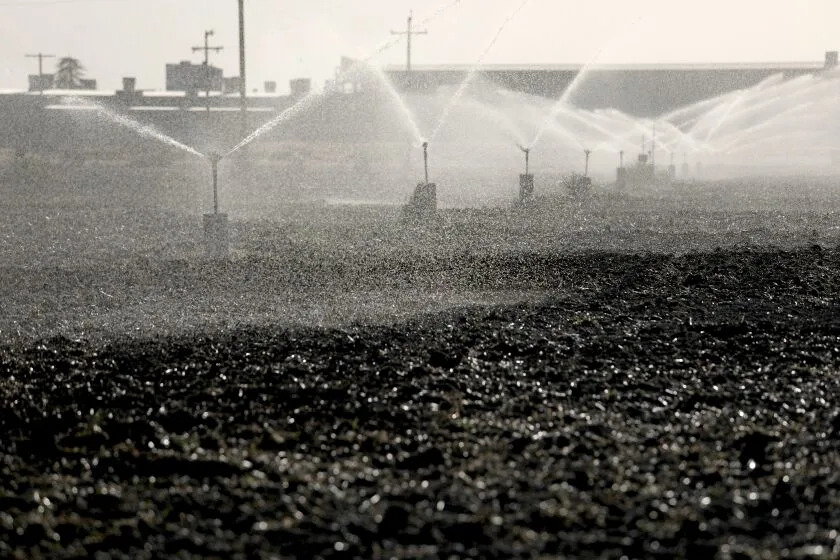
Irrigation in Kingsburg, Calif., in 2021. A deepening drought and new regulations are causing serious challenges for some California growers. (Gary Coronado / Los Angeles Times)
Downpours or drought, California’s farm belt will need to tighten up in the next two decades and grow fewer crops.
There simply won’t be enough water to sustain present irrigation in the San Joaquin Valley.
Groundwater is dangerously depleted. Wells are drying up and the land is sinking in many places, cracking canals. Surface water supplies have been cut back because of drought, and future deliveries are uncertain due to climate change and environmental regulations.
We’ve known all this for years, but long-term projections have become even more grim, according to a new study by the Public Policy Institute of California.
“We found that annual water supplies could decline by 20% by 2040,” PPIC experts wrote. That would mean around 3.2 million acre-feet — almost the amount giant Oroville Dam can hold in California’ second-largest reservoir.
For many generations, Californians have taken pride in the state’s bountiful harvests of fruits, vegetables, nuts and wine grapes. We’re envied by the nation for our production of varied foods — from avocados to almonds, from peaches to pistachios, from okra to oranges.
But by the end of this century, will agriculture still be robust?
Agriculture is water intensive. And water is becoming increasingly worrisome in the West, particularly with overuse of the Colorado River. There’s plenty of water off our coast, but we’ve only begun to dip our toe into desalination.
PPIC researchers offered a glimmer of hope for the San Joaquin Valley. With government teamwork — local, state and federal — and agriculture itself, the financial blow could be lightened, they said.
That would mean loosening the rules on farmers selling their entitled water to other growers. There’d also need to be investments in infrastructure to import additional water supplies.
But realistically all that seems iffy given California’s historic water wars. Selling water means taking it from one crop and pouring it on another. And most new supplies would come from other interests — such as farmers to the north or the coastal salmon fishing industry.
Compromising probably would require money — perhaps tax money — to pay farmers to fallow their land and governments to build new canals and repair old ones.
Growers and local irrigation districts would need to write checks.
“Locals need to have skin in the game. Everybody’s always happy to have someone else pay for their crops,” says Ellen Hanak, vice president and director of the PPIC Water Policy Center.
The PPIC found that at least 500,000 acres of San Joaquin Valley cropland will need to be fallowed in the next 20 years. The institute initially calculated that figure four years ago. But now it’s considered a best-case scenario, requiring an additional 1 million acre-feet of water.
“Needless to say, this would be a very heavy lift,” the researchers wrote.
A more likely scenario, the PPIC says, would be to expand water supplies by 500,000 acre-feet annually and wind up being forced to fallow about 650,000 acres.
But even half a million more acre-feet of water seems wishful.
The worst-case scenario would be losing 3.2 million acre-feet of water and fallowing nearly 900,000 acres, one-fifth of currently irrigated land.
Plan on it. Prepare to plant solar panels.
The biggest reason farmers face a severe water shortage is that for decades they’ve over-pumped aquifers. And government didn’t have the guts to stop them.
Finally in 2014, California became the last Western state to begin regulating groundwater use — but very slowly. By law, groundwater usage doesn’t have to become sustainable for 20 years.
Meanwhile, farmers have been drilling deeper and faster to extract water — not necessarily even their own — before they’re restricted by law.
“The real promise of the groundwater act is making sure people are not using groundwater they shouldn’t,” Hanak says. “If you use someone else’s surface water you’re going to court. But with groundwater, no one has been minding the shop.”
Gov. Gavin Newsom and water officials everywhere talk optimistically about recharging aquifers. Great idea. But first you need to find the water for recharging.
That can come from rare mega-storms, as we had in January. But there need to be facilities for moving the rampaging water and rules that permit it.
The water can be pumped onto barren land — storm or not — and allowed to sink into the ground. But a landowner must agree.
Here’s an idea: Turn barren, fallowed cropland into wetlands that recharge aquifers. Nurture wildlife. California lost 95% of its wetlands in the last century.
Climate change may also reduce available surface water.
Hotter, drier air may cause snowpacks to evaporate or soak into the mountaintops before the water can flow down into reservoirs. Or Sierra snow may melt quickly and descend in torrents so fast it can’t be captured in the Sacramento-San Joaquin River Delta.
It’s all guesswork now.
PPIC researchers also predicted increased environmental restrictions on water in an effort to protect salmon and other fish.
I wouldn’t bet on that. Farm interests tend to outmuscle fish interests.
Newsom, for example, is trying to waive environmental rules aimed at keeping juvenile salmon alive in the delta. He wants more water to be stored for farmers.
Some footnotes:
The San Joaquin Valley produces more than half of California’s agriculture. The wetter Sacramento Valley produces nearly one-fourth. Together they make up the Central Valley.
Agriculture uses 80% of California’s developed water. The rest goes to domestic use — business and residential.
But agriculture generates only about 2% of the state’s gross product, down from 5% 60 years ago. It’s 14% of the San Joaquin Valley’s gross domestic product.
Three of my solutions:
Plant fewer thirsty crops, such as almonds that have proliferated.
Expedite groundwater regulations and aquifer recharging.
Rebecca Fuoco, David Rosner and Gerald Markowitz – February 19, 2023
Ms. Fuoco is the director of science communications at the Green Science Policy Institute. Dr. Rosner is a professor of sociomedical sciences and history at Columbia. Dr. Markowitz is a history professor at John Jay College of Criminal Justice.
A black plume and flames rise over East Palestine, Ohio, from a controlled burn of chemicals carried by a derailed train.Credit…Gene J. Puskar/Associated Press
Like a scene out of some postapocalyptic movie, Gov. Mike DeWine of Ohio convened a news conference on Feb. 5 to deliver a stark warning. “We are ordering them to leave,” he said of residents of the small rural community of East Palestine, Ohio, and a neighboring part of Pennsylvania. “This is a matter of life and death.” To emphasize the point, he added: “Those in the red area are facing grave danger of death if they are still in that area.”
In this case, the “grave danger of death” was not a zombie fungus or lethal bacteria but chemicals. The red area was an area one mile by two miles surrounding the town, on the Ohio-Pennsylvania border about 40 miles northwest of Pittsburgh.
Two days earlier, it was the site of a fiery derailment of train cars carrying the gas vinyl chloride and other chemicals. Freight trains typically transport more than two million carloads of hazardous materials each year, including many chemicals. Vinyl chloride is particularly dangerous and increasingly common, used primarily to make polyvinyl chloride, better known as PVC, a hard plastic resin used to produce pipes, wire, cable coatings and packaging. We should begin phasing out the use of this chemical.
It was a particular concern in East Palestine after the derailment. Because vinyl chloride is so flammable, it created a risk of an explosion that could launch deadly shrapnel as far as a mile. To avoid such a catastrophe, railroad officials vented the vinyl chloride and burned it off.
But shrapnel wasn’t the only risk. Inhaling vinyl chloride fumes can be deadly. Even people in neighboring towns were at risk. On Feb. 10, seven days after the crash, the Environmental Protection Agency said that chemicals were “known to have been and continue to be” released to the air, surface soil and surface waters.
Residents complained last week of rashes, headaches and a lingering odor. Thousands of dead fish turned up in streams near the crash site.
Vinyl chloride is not just suspected of causing cancer. The International Agency for Research on Cancer considers it a Group 1 carcinogen known to cause liver cancer in highly exposed industrial workers. It has also been associated with brain and lung cancers, lymphoma and leukemia.
We need to stop producing and using vinyl chloride and its most important end product, PVC plastics. Increasingly, major businesses are phasing it out. Many European communities have banned or restricted its use, even as the PVC plastics industry is expanding.
The United States should begin eliminating PVC by categories of use. Legislation has been floated in California to prohibit PVC in food packaging — a ban that could be expanded to other nonessential needs. Though PVC is inexpensive, it is replaceable in most cases. Alternatives include glass, ceramics, linoleum, polyesters and more.
Also, discarded PVC should be labeled a hazardous waste. The designation would put the burden on users for its safe storage, transportation and disposal, creating an incentive to accelerate its elimination. The E.P.A. tentatively rejected such an action in January but is still accepting public comment on the proposal.
You might wonder why such a hazardous chemical, among others, is being transported along American railways and through our communities. It’s because vinyl chloride is one of the most produced petrochemicals in the world. Tens of millions of tons of it are manufactured annually. (It was used as an aerosol propellant in household consumer products like hair spray until it was banned in aerosols by the Consumer Product Safety Commission in 1974.)
Vinyl chloride manufacturers laid the groundwork for the chemical’s proliferation decades ago with cover-ups and disinformation campaigns. Their own research showed that exposure led to deadly cancers in rodents. Numerous studies have found that workers regularly exposed to the chemical during the 1970s developed malignant liver cancers at very high rates. Chemical companies knew early on they were unleashing a dangerous substance into the world.
The extraordinary efforts of the chemical industry to continue selling products it knew were harmful were recounted by two of us in our 2002 book “Deceit and Denial.”
In addition to the manufacturing and transportation risks of vinyl chloride, PVC plastics can release endocrine-disrupting phthalates, used to soften PVC, and cancer-causing dioxins into air and water during much of their life cycle.
Many of the vinyl chloride and PVC production facilities are clustered with other petrochemical facilities along an 85-mile stretch of the Mississippi River in Louisiana between Baton Rouge and New Orleans known as Cancer Alley. People in one town in the area, most of whom are Black, are about 50 times as likely to develop cancer as the average American. They face the constant threat of chemical accidents.
The PVC plastics industry is expanding in other parts of the country. Growing plastics hubs in Ohio, Pennsylvania and West Virginia could become new cancer alleys.
As long as PVC production continues, the risk of vinyl chloride spills will persist. Worse, more workers and communities will be exposed to the ticking time bombs of cancer and other severe health harms.