Red tide brings 3.5 tons of dead fish to Bradenton beaches. What to expect this weekend
Ryan Ballogg – March 10, 2023
Red tide’s presence remains strong this week on the Southwest Florida coast, including around Anna Maria Island and Manatee County.
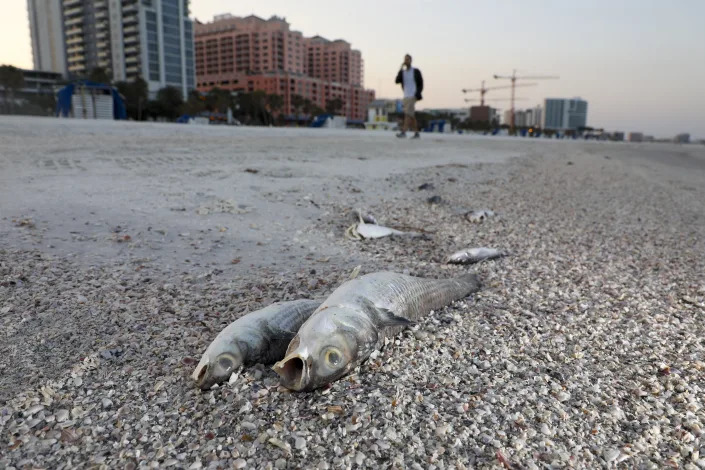
On Tuesday, dead fish littered the waterline at Bradenton Beach, and frequent coughs could be heard from visitors who braved the sands.
The harmful algae bloom has persisted in area waters since fall, but it intensified in recent weeks with increased reports of respiratory irritation and dead fish from Pinellas County south to Monroe County.
Karenia brevis, the organism that causes red tide, was detected in 123 water samples along Florida’s west coast over the past week, the Florida Fish and Wildlife Conservation Commission said in a mid-week update.
Eight of those samples were collected in Manatee County waters, where red tide levels ranged from low to high.
Medium levels of K. brevis were detected at five points on and around Anna Maria Island on Monday. At levels of medium and above, red tide is more likely to cause fish kills and breathing irritation.
Dead fish by the ton
County staff who clean beaches and waterways for red tide debris have seen a major increase in dead fish washing ashore over the past two weeks, according to Manatee County Parks operations manager Carmine DeMilio.
“It started getting intense,” said DeMilio, who leads the county’s red tide cleanup efforts.
The county began responding to the red tide bloom in November; between that time and mid-February, about a ton of dead fish were collected from area beaches.
Over the past two weeks alone, around 3.5 tons were collected, DeMilio estimates.
The county cleans beaches daily with beach rake tractors, and skimmer boats collect dead fish from the water.
“We start at 5 in the morning and go til around 11:30,” DeMilio said. “By that time, the beachgoers are on the beach and it’s hard to maneuver.”
DeMilio said a strong west wind began pushing more dead marine life ashore last weekend. The fallout has mostly been bait fish, he said, but some larger species like grouper and snook were mixed in.
“That was our battle — trying to keep the accumulation of fish coming to shore under control,” DeMilio said. “So when our visitors show up to our beaches, it’s clean and safe for them. That’s our goal daily.”
So far, DeMilio said this year’s bloom is mild compared to the extreme red tide that hit Southwest Florida in 2018. During the peak of that event, crews worked for 64 straight days to remove over 200 tons of dead fish.
“If we can handle that and we were successful with that, handling a smaller version is much easier,” DeMilio said. “It’s just like any maintenance that you do at your house. If you stay on it, it’s not going to accumulate.”
County staff said that conditions were beginning to improve on Wednesday as winds shifted.
Local red tide conditions
Tampa Bay area: Red tide conditions remained intense along Pinellas County’s shoreline this week, where medium and high concentrations were detected at multiple beaches from Honeymoon Island south to Mullet Key. Dead fish and respiratory irritation were reported along the coast.
Manatee County and Anna Maria Island: Medium levels of K. brevis were detected around Anna Maria Island in state water samples collected on Monday — an increase from last week. Dead fish and respiratory irritation were reported at all major public beaches.
Sarasota County: Along Sarasota County’s coast, red tide levels ranged from low to high this week, with the strongest concentrations around Longboat Key and Lido Key. Dead fish and respiratory irritation were reported at public beaches.
Southwest Florida: Red tide algae was also found at high levels offshore of Charlotte, Lee and Collier counties this week, as well as medium levels off of Monroe County.
Red tide forecast
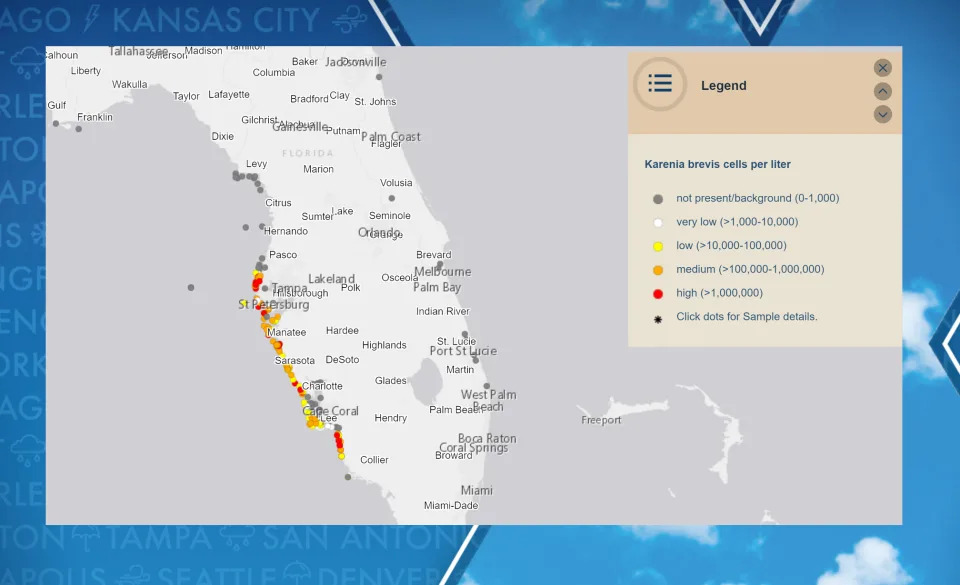
University of South Florida’s short-term red tide forecast predicts that red tide’s presence on the coast will continue over the weekend. Very low to high levels are predicted for the entire coast line, including areas of intensity in Pinellas, Manatee, Sarasota, Charlotte, Lee and Collier counties.
NOAA warns of a moderate to high risk of respiratory irritation over the next 36 hours in Pinellas, Manatee, Sarasota, Charlotte, Lee and Collier. Chances increase when wind is blowing on or along the shore.
A map shows a short-term red tide forecast for Southwest Florida from the University of South Florida College of Marine Science’s Ocean Circulation Lab.
Red tide safety tips
The Florida Department of Health offers the following safety tips for when red tide is present:
Look for informational signage posted at most beaches.
Stay away from the water.
Do not swim in waters with dead fish.
Those with chronic respiratory problems should be especially cautious and stay away from these locations as red tide can affect your breathing.
Do not harvest or eat mollusk and shellfish or distressed or dead fish from these locations. If caught live and healthy, finfish are safe to eat as long as they are filleted and the guts are discarded. Rinse fillets with tap or bottled water.
Wash your skin and clothing with soap and fresh water if you have had recent contact with red tide.
Keep pets and livestock away and out of the water, sea foam and dead sea life. If your pet swims in waters with red tide, wash your pet as soon as possible.
Residents living in beach areas are advised to close windows and run the air conditioner, making sure that the A/C filter is maintained according to manufacturer’s specifications.
If outdoors near an affected location, residents may choose to wear masks, especially if onshore winds are blowing.
They bought their dream homes from the ‘King of Coconut Grove.’ They still can’t move in
Linda Robertson – March 12, 2023
Twelve new townhouses line a block of Coconut Avenue. Lushly landscaped, outfitted with high-end appliances and spacious closets, they’re in move-in condition. Yet the Coconut City Villas are empty, as empty as their backyard swimming pools and unsullied trash bins sitting in unoccupied driveways.
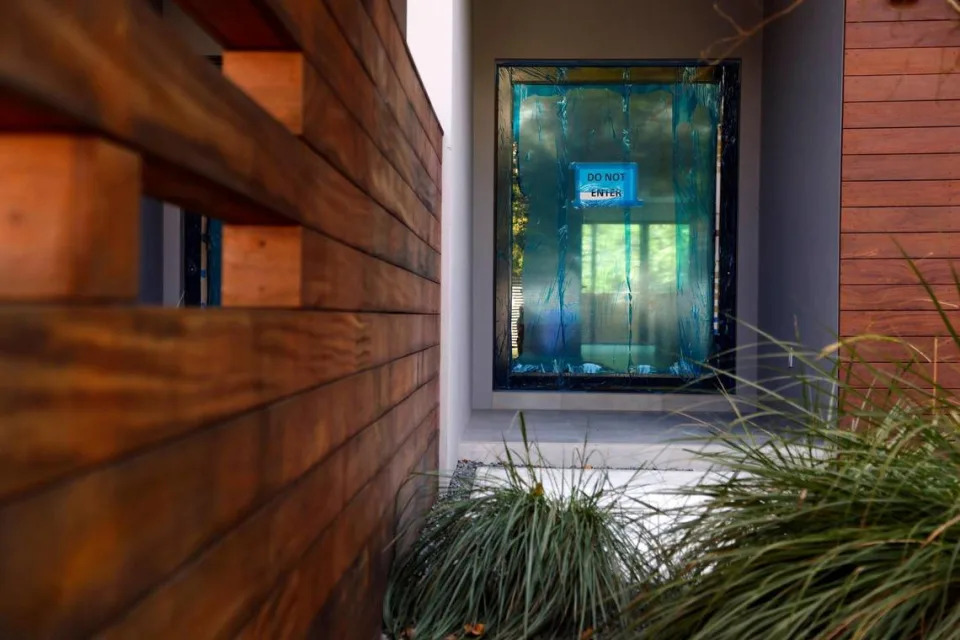
Instead of “For Sale” signs, house hunters see “No Trespassing” notices posted along the street and “Do Not Enter” decals stuck to the front doors, a curious contrast in Coconut Grove, one of the most hotly desired neighborhoods in the country, where housing prices have nearly doubled over the past three years.
The lack of residents can’t be explained by lack of demand. The 4,000-square-foot townhouses, originally priced from $1.2 million to $1.8 million, are under contract to buyers who put down as much as $500,000 starting as far back as 2018. They were told by developer Doug Cox their homes would be ready in 45 to 90 days, or at the latest six months.
They’ve been waiting ever since. Their plans have been perpetually postponed by Cox, owner of Drive Development, who has not closed a house sale in four years despite a booming market. His completion dates teased buyers as the houses beckoned. But their dreams of a dream home have gone bust.
They have been locked out and led into a dead end darkened by threats, lawsuits, non-disclosure agreements and unsavory lenders, buyers say.
The delays have turned buyers and their families into nomads — moving from one expensive rental to another, cramming in with relatives while living out of suitcases — draining their finances and testing their marriages. When they go past their houses they are tantalized by memories not made — cooking in the kitchen, playing in the pool, celebrating birthdays, hosting block parties.
“We’ve spent three Christmases in limbo,” said Alan Lombardi, who signed a contract three years ago with the assurance that he, his husband and their newborn twin daughters would move in by summer 2020. The twins are now age 3. “The developer has kept us hanging on his hook, ruining people’s lives by deceiving us with false promises, just like Bernie Madoff.”
Lombardi has asked the FBI to investigate Cox for running a Ponzi scheme.
The buyers can’t move in because Cox has failed to complete inspections and get certificates of occupancy from city of Miami building department officials, whose lack of oversight enabled Cox to ignore expired permits and a Stop Work order and avoid applying finishing touches on houses for years. The city, which has ceased responding to buyers’ calls and emails, says it can’t intervene in a private dispute.
The buyers got caught in the fallout from Miami’s COVID-driven housing gold rush. Some are transplants from New York, Chicago and California who were eager to sign purchase agreements for new homes that looked — outside and inside — like they were ready to sleep in, missing only a mirror, some paint, a fence. They want their plight to serve as a warning: Don’t make one-sided deals with developers.
A Coconut Avenue townhouse built by Drive Development. Buyers who have paid hundreds of thousands in deposits for these houses have been waiting to move in for two, three and more than four years. They’ve been stymied by the Coconut developer, Doug Cox, who has continually stalled the closings on the properties.
Cox is deliberately stalling to frustrate them into canceling their contracts so he can flip each house for an additional $1 million or more, buyers allege. They feel trapped: As time passed, the market skyrocketed, and in 2023 they will never find comparable homes in the neighborhood for the price they planned to pay and the mortgage rate they had secured.
On Wednesday, Drive Realty listed 2986 Coconut Ave. for $2.495 million. Original sales price in July 2020 was $1.385 million, a difference of $1.11 million. One catch: It doesn’t have a certificate of occupancy so anyone who buys it can’t move in.
“Seems like a shell game,” said Andy Parrish, a longtime Miami developer who lives in Coconut Grove. “He’s put these people through hell by stonewalling them with excuses.”
One weary buyer confided in Parrish, cried on his shoulder.
“She said, ‘I can’t believe people lie to other people like this,’ ” Parrish said. “I told her, ‘Welcome to Miami! A sunny place for shady people.’ ”
Cox, 52, initially agreed to an interview with the Miami Herald, then changed his mind and asked for emailed questions. He didn’t respond to questions sent twice or attempts to talk to him over the past two weeks.
Nicole Pearl, 37, who is Cox’s business partner and mother of their three children, declined to talk to the Herald. Her law firm, Pearl & Associates, is the registered agent of companies connected to the properties, Florida corporate records show. She is a licensed real estate agent who lists homes for Drive Realty.
The Herald spoke to 16 buyers — many did not want their names published, fearing retaliation by Cox — and examined lawsuits, mortgages, purchase agreements, property records and Miami building department reports, which substantiated buyers’ chorus of complaints.
Several of the 12 townhouses in the 2900 block of Coconut Avenue in Coconut Grove on Wednesday, Feb. 15, 2023. Buyers who have put down deposits as much as $500,000 dating back to 2018 say they haven’t been able to move into the homes due to perpetual delays by their developer, Doug Cox of Drive Development.
No sales closed since 2019
Cox calls himself the “King of Coconut Grove.” His clients call him less flattering nicknames. What his gambit is no one can say for certain because he has not sold a home since August 2019 when he and Pearl closed on a Bridgeport Avenue townhouse for $1.15 million. Closing on the new homes should be a mutual goal but there are no signs of progress. He offers clients refunds of their deposits and says he’s got a line of backup buyers.
“It’s a strange way to run a real estate development company,” Lombardi said. “It’s really an anti-development company. Why doesn’t he want to deliver? How can he afford to operate?”
Cox has told buyers he wants to get them into their special houses, but he’s been delayed by factors beyond his control: the pandemic, supply-chain problems, manpower shortages, rising construction costs, subcontractor snafus and now bureaucratic red tape in the building department tangling his efforts to finish inspections.
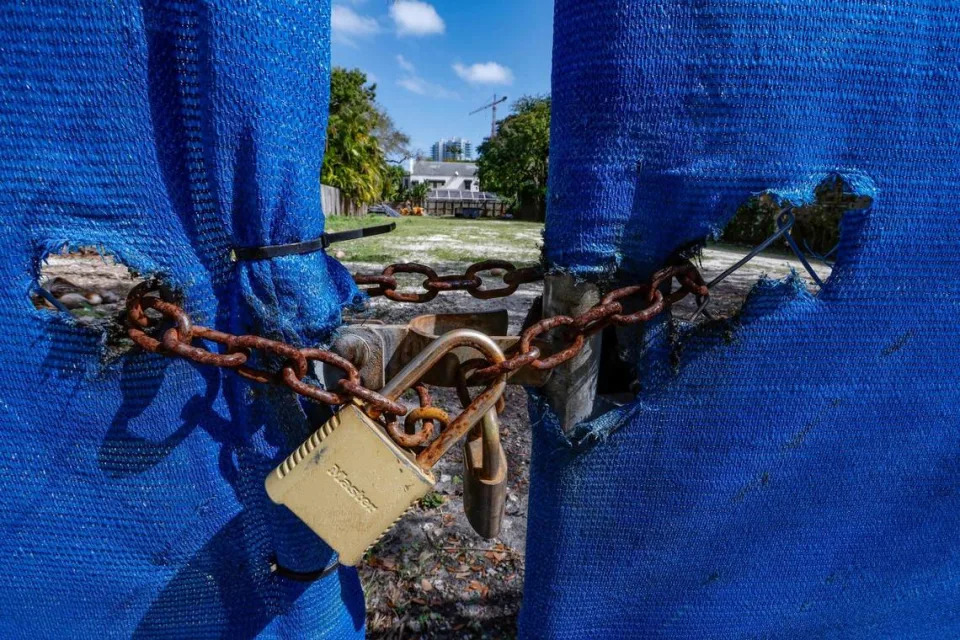
A padlock and chain link fence greet passersby at 3159 Virginia St. in Coconut Grove on Thursday, Feb. 9, 2023. The property is owned by Send Enterprises LLC, one of the limited liability companies connected to Doug Cox and Nicole Pearl.
Double contracts on homes
Is Cox playing musical chairs? At least three of the townhouses have double contracts on them. The legal descriptions correspond to 2955, 2960 and 2990 Coconut Ave.
Some buyers discovered through Miami-Dade Clerk of Court records that near the end of 2022 Cox signed a “memorandum of contract” on their houses with Chris Paciello, the former South Beach nightclub impresario, and his business partner, Mio Danilovic. Before he became famous for hosting parties at Liquid and dating Madonna, Sofia Vergara and Jennifer Lopez, Paciello was a Mafia henchman and thief in New York City.
Once Paciello’s past caught up with him in 2000, he became an FBI informant, pleaded guilty to racketeering and served six years in prison for robbing $300,000 from a New York bank and driving the getaway car in a home invasion during which a Staten Island housewife was shot in the face and killed.
Paciello, the owner of four Anatomy Fitness deluxe gyms in South Florida, has ventured into real estate investment since the pandemic and flipped houses for $9 million and $14 million in Miami Beach. It’s unclear how much of a deposit Paciello and Danilovic put down in their backup contract deal with Cox. Backup contracts are not illegal.
When contacted by the Herald, Paciello, 51, declined to comment.
Ingrid Casares and Chris Paciello at Liquid, the South Beach nightclub, on Nov. 16, 1995. Casares and Madonna were lovers; Casares and Paciello were partners in Liquid. Paciello and his business partner have backup contracts on three of the Coconut Avenue townhouses.
In another complication that has alarmed buyers, Cox took out a $350,000 loan in December from DC Fund based in Sunny Isles Beach, whose associates include men who were sued for racketeering in an alleged loansharking scheme that disguised “criminally usurious loans” as cash advances that had to be repaid with 430 percent interest, according to a lawsuit filed in Brooklyn. Cox put up eight properties as collateral. If he defaults on the loan, he could lose them.
Buyers have observed Cox showing their houses to prospective buyers on multiple occasions. He says he is merely displaying his handiwork, and not offering those particular houses for sale. But contract holders have heard from acquaintances whose names are on a list of backup buyers Cox has compiled. One is upset he’s only No. 3 on the list.
A finished kitchen in one of the Coconut Avenue townhouses built by Doug Cox of Drive Development.
If Cox is flipping the townhouses, for how much? Miami real estate agent Randi Connell, who identifies herself as a Drive Development sales associate, recently texted a prospective buyer about two off-market Coconut Avenue houses available for $2.7 million and $3 million, which is $1.5 million and $1.2 million more than the original sales prices.
Homebuyers who signed purchase agreements and put down deposits on townhouses along Coconut Avenue in Coconut Grove have been waiting for several years to move into their dream home. The developer, Doug Cox of Drive Development, keeps stalling, the buyers allege. Photo was taken in 2021 by a buyer.
Pearl listed 2986 Coconut Ave. for sale for $2.495 million on Wednesday morning. The house first went under contract for $1.385 million on July 8, 2020, to Jonathan Schonfeld and Aviva Auslander, with a completion date of Sept. 1, 2020, or at the latest, March 1, 2021. They waited two years. Disgusted, they gave up.
If Cox and Pearl land a buyer for 2986, they could collect at least a $500,000 deposit and “utilize” it as they please, according to two Send Enterprises contracts the Herald reviewed. Contrary to realty ethics rules, Pearl did not disclose in the listing that the house doesn’t have a certificate of occupancy, and its building permit expired Feb. 15.
“If the delays are indeed outside their control, how can they list a property if they don’t know when or if they can close?” Lombardi asked.
South Florida real estate lawyer Dennis Eisinger said home buyers can get “boxed in” by contracts that typically favor the developer and waive buyers’ rights.
“It appears this developer is bullying the buyers to get the financial advantage,” he said. “We saw this situation before the recession in 2003-2006 when defiant and unscrupulous developers tried to get buyers to rescind contracts so they could resell at higher prices.”
Lawsuits, ‘worst decision of my life’
At least three buyers, including Schonfeld and Auslander, sued Send Enterprises, alleging fraud and breach of contract. The cases were assigned to mediation, as required in the contracts; buyers cannot seek a jury trial. They had to sign non-disclosure agreements. At least four others have taken Cox up on his offer to refund their deposits and walk away; they also signed NDAs.
Catherine and Andrew Prescott of Miami Beach signed a $1.82 million purchase agreement on May 25, 2021, and paid a $455,000 deposit for 2960 Coconut Ave. The contract stipulated a completion date of Aug. 1, 2021, and an “outside” closing date within six months.
The Prescotts sued Send Enterprises in January 2022 for its alleged failure to achieve specific performance of its obligations, fraudulent inducement, unfair trade practices, negligent misrepresentation and unjust enrichment.
In their lawsuit, which also named Cox, Schonfeld and Auslander asserted that Cox “repeatedly lied” about “fabricated dates.” The Prescotts said the developer made promises “without any intention of performing, or with the positive intention to not perform” to entice them to sign and pay a deposit. The cases went to mediation and everyone signed NDAs.
Three months after the Prescotts sued, a real estate agent who works with Cox offered the house for $2.4 million, about $600,000 more than the original sales price.
Other buyers are determined to stick it out. They can’t afford to hire a lawyer. They’re not ready to abandon the houses they’ve invested in, emotionally and financially. And they don’t want to let Cox win.
“If I could rewind time — this was the worst decision of my life,” said Kevin Ware, who owns an insurance brokerage firm. He moved his family from Chicago in March of 2021, walked through a Coconut Avenue townhouse that was weeks from completion and fell in love with it. They’ve lived in three rentals since. “We cannot let Doug keep scamming more people. We don’t want anyone else to get caught in this predicament. Buyer beware.”
Strung along by Cox, buyers acquired mortgages with 2 percent rates that have since tripled.
“It must be exhausting to be Doug Cox. He lives in 15-minute increments. Think of all the lies he has to keep track of,” Ware said. “We have paid a high price for dealing with him. From the sheer expense of living in short-term housing to the financial damage of losing our mortgage rate locks to the strain on our relationships and mental health, Doug has constantly and cruelly put his greed above our well-being.”
Kevin Ware moved his family from Chicago in March of 2021, walked through a Coconut Avenue townhouse that was weeks from completion and fell in love with it. They’ve lived in three rentals since, unable to move into their home.
‘Cautionary tale for other home buyers’
For Lombardi and his family, it’s been a three-year ordeal, first sharing his mother’s small Hollywood condo with his partner and infant twins, now in a $5,000-per-month Midtown apartment.
“We thought it would be a three-month wait because the house was 80 percent done, so we sold our Brickell condo, put everything, including baby equipment, in a sealed storage pod, packed four suitcases and moved in with my mom — for two years,” said Lombardi, a real estate agent.
The twins never had the nursery Lombardi envisioned.
One buyer described himself and his wife as “40-year-old couch surfers.” They’ve lived in seven different places.
New York transplants Michael Coyne and his wife, Oksana, have 1-year-old twin daughters and a 3-year-old son, and expected to share 2978 Coconut Ave. with her parents, who fled Ukraine after Russia attacked. Among the six places they have lived since their closing date evaporated was a one-bedroom apartment.
Coyne said they moved to a rental in Rhode Island to wait it out because they couldn’t afford “insane” rents in Miami. Fueled by inflation that’s made housing unaffordable for many and the influx of remote workers and newcomers moving to a no-income tax state, Miami has become the most competitive rental market in the country with prices 76 percent higher than the national median, a Zillow study showed.
Coyne, an investment banker, wanted to open an office with two of his business associates in Miami but he’s told them not to come. Oksana, a registered nurse, was scheduled to do her clinical work to become a nurse practitioner; she’s postponed her career plans. The chaos has been difficult for the children and Oksana’s Ukrainian parents, who speak limited English.
“Doug and Nicole either lie to you or ignore you,” Coyne said. “You work really hard for your family to buy the most important asset of your life and you get caught in a calculated, malicious, exploitative scheme by a flimflam developer.
“I’m not letting him get away with it. Let this be a cautionary tale for other homebuyers.”
New York transplants Michael Coyne and his wife, Oksana, have 1-year-old twin daughters and a 3-year-old son, and expected to share 2978 Coconut Ave. with her parents, who fled Ukraine after Russia attacked.
One family has suffered the longest. They chose a four-bedroom model four and a half years ago so their 12-year-old daughter would have her own room and so her grandmother, recovering from cancer, could live with them. Now, the daughter is a high school senior heading to college in the fall. The grandmother never got to move in with her family.
City of Miami should be ‘embarrassed’
Cox brags about his chummy connections to the city’s building department and Miami Mayor Francis Suarez.
Cox’s customers recount the exact same comments he’s made to all of them — that he can remove any obstacle by “having a cafecito” with officials. Drive Development contributed $50,000 to Suarez’s re-election campaign in 2020 and $100,000 to Suarez’s 2018 initiative to create a strong mayor position (voters rejected it), campaign finance records show.
Buyers who have sought relief from the city have gotten nowhere: Emails, phone calls and meetings have prompted no corrective action.
Buyers acknowledge they signed contracts that gave lots of leeway to the developer but decided to sign because they were shown nearly completed houses by a persuasive seller who had previously built fine houses. What could go wrong?
The Herald asked to speak to three City of Miami building department officials about inspection delays and an audit of Drive Development plans. The city’s reply: “The Building Department takes this matter seriously and is tasked with enforcement of the building code and other technical standards, as well as City ordinances. The Building Department has no authority over the pace of construction, nor any contractual matters between the buyers and the developer.”
The city does have authority over permitting and inspections, but wouldn’t explain why it has taken years for Cox to receive city approvals and certificates of occupancy. Nor would officials answer questions about penalties for permit violations or prolonging the inspection process.
“The city should be embarrassed,” Lombardi said.
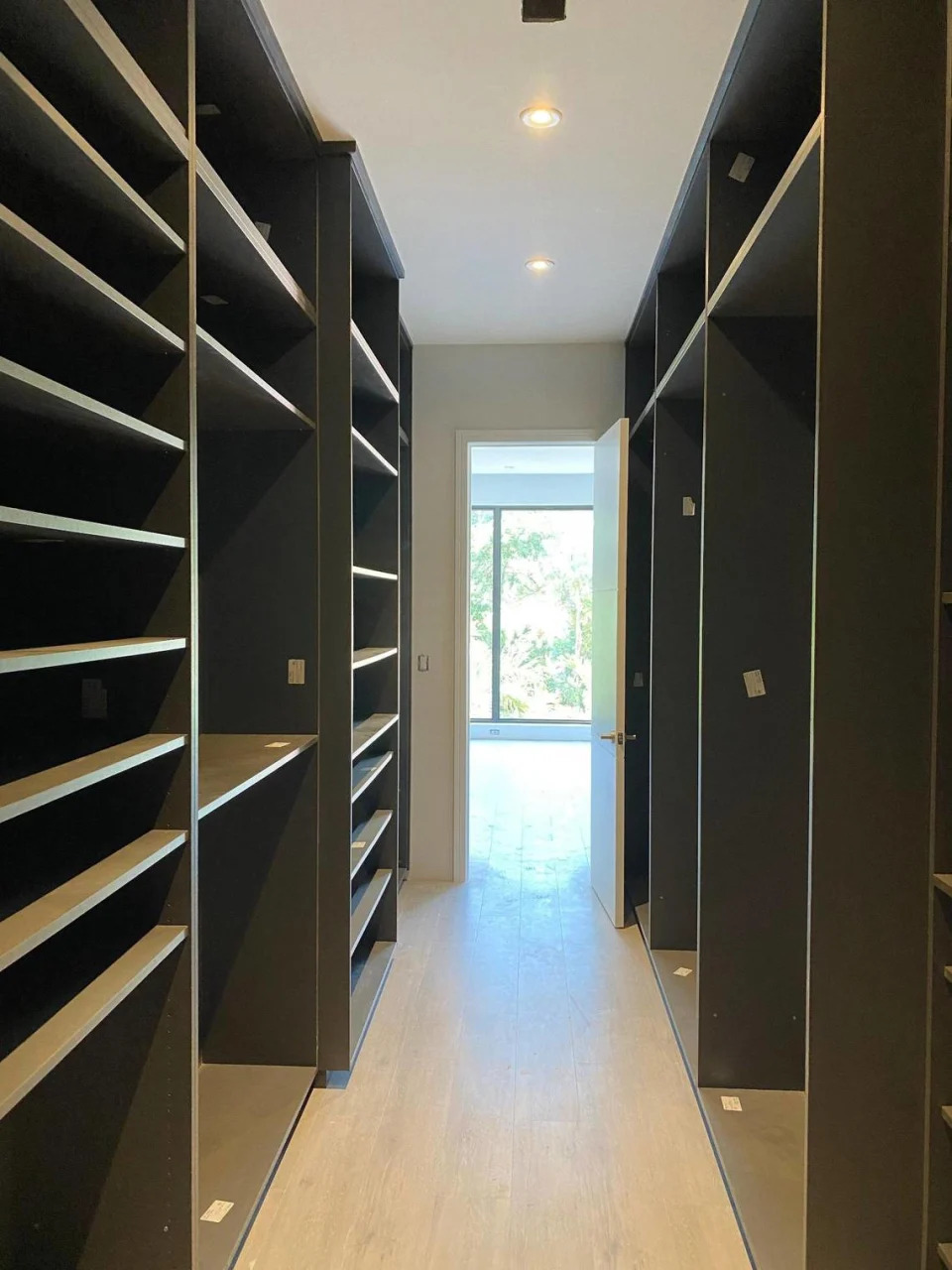
A walk-in closet at one of the 12 luxury townhouses on Coconut Avenue in Coconut Grove that developer Doug Cox of Drive Development built. The photo was taken in 2021 by a buyer.
When the Coynes asked Pearl for an update three weeks ago, she told them inspectors can’t work during an audit. The city said that’s not true; inspectors are allowed to carry on.
Developers like Cox can hire “private providers” to conduct inspections and submit the results to the city. Cox hired MEP Consulting Engineers of Coral Gables. He’s told buyers he blames MEP for bungling reports. MEP blames Cox for not giving inspectors the information they need to finish the job.
MEP President Katrina Meneses said that the city’s audit is done and in the hands of Cox.
“What we’re waiting on is paperwork from the owner, our client,” she said. “We love to finish projects so we can move on to the next one. Anything that takes over a year, it’s difficult to continue and slows us down. Yes, if I was a customer, I’d feel upset.”
The city is notorious for its lack of transparency and accountability, said Parrish, the Miami developer who lives in the Grove.
“We’re in a pro-development city, county and state where everything is driven by developers and their money. Florida is a creation of developers,” he said. “Developers control elections, elections control politicians and politicians control building and zoning. The city of Miami is one of the worst examples of how the gravy train works. It’s an absolute mess.”
Buyers have asked for help from the city, ex-Miami commissioner Ken Russell, Mayor Suarez, the Miami-Dade State Attorney’s Office, the state’s Department of Business and Professional Regulation and the FBI. The response: If Cox isn’t doing anything illegal, we can’t get involved.
Ware’s experiences illustrate the relationship between Cox and the city.
Cox was allowed to work through a Stop Work order for more than a year. The city issued the order because Cox failed to submit plans for the five three-story townhouses he was building on Coconut Avenue; he only submitted plans for the two-story units. His reason: Plans were proprietary and he didn’t want his design stolen.
Ware discovered there was a Stop Work order and expired permit on his house when he checked the city website iBuild in summer 2021.
Kevin Ware moved his family from Chicago in 2021 and has been waiting to move into their Coconut Avenue home in Coconut Grove.
According to Ware, Cox told him not to worry, the order wasn’t being enforced and he’d have a cafecito with officials to smooth things over. Five months later, after repeated requests for an update, Cox told Ware he had submitted a substantial number of reports to the city after giving MEP engineers a $50,000 bonus each to expedite inspections, and promised Ware “we’re almost there.”
A month later, Ware met with city inspector Perla Mutter. She told him Cox had submitted nothing, and that because of the expired permit, nothing could be submitted until Cox and his contractor Eric Myers met with the building department.
A month after that, on April 26, 2022, Ware went to the meeting at city offices expecting to talk to Cox, Myers and Miami building department assistant director Luis Torres. But Cox met with Torres privately first. And there was no sign of Myers.
“Doug comes out of the office and admits he met with Torres early so that, ‘Everything would be taken care of,’ ” Ware said. ”The following week Doug paid a $100 fine and reopened his permit.
“The city can try to cleanse its hands but it is enabling this developer to abuse the system,’’ Ware said.
The permits for 2984 and 2986 Coconut Ave. expired last month. Cox must sign onto iBuild and pay $100 to re-activate the permits for six months. It’s part of a years-long pattern: His permits expire, he reactivates them months later, then doesn’t enter documentation in time for the city to complete reviews before they expire again, records show.
Permits for the other townhouses on Coconut Avenue are scheduled to expire March 12, April 30 and July 4. Buyers check iBuild and see a vicious cycle: Submit, Pending, Review, Deny, repeat.
To fix the slow and complicated permitting process that has stranded buyers, they advocate new laws with strict 120-day deadlines for the review and approval of applications and harsh penalties for breaking them.
There’s a cost to the city as well. Cox has been paying property taxes of $10,000 per lot, or $60,000 per year on the Coconut Avenue townhouses. Homeowners would pay about $20,000 per unit, or a total of $240,000 per year.
‘House of Rumors’
Then there’s the seven-year saga of 4010 Park Ave.
The two-story South Grove house still has plywood for a front door and a Porta Potty in the front yard.
On realtor.com, it’s listed as a 5-bedroom, 6-bathroom home “active with contract” for $2.95 million.
In 2019, Steven Salm bought the home for $2.55 million. He sued Send Enterprises in November 2020; the lawsuit went to mediation and NDAs were signed. The house was re-listed in February 2021 for $2.95 million.
Marcos Junges has lived next door for 27 years. He said the building of 4010 Park began back in 2016.
“Goes in fits and starts, with long hiatus periods,” he said.
A home under construction at 4010 Park Ave. in Coconut Grove on Feb 15, 2023. A neighbor who lives next door said the home has been under construction since 2016. Neighbors call it the ‘House of Rumors.’ The property is owned by Send Enterprises LLC.
He and his neighbors — who paused to chat during one of their evening walks — call it the “House of Rumors.” They’ve heard it’s been under contract for five years with a succession of buyers. Junges said Cox bought the modest house that used to be there from his elderly neighbor’s family when she died.
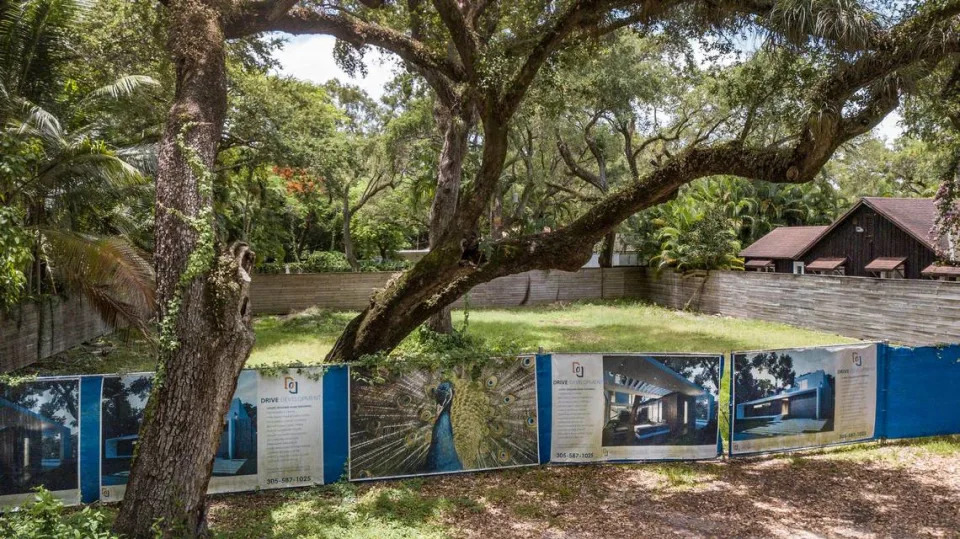
At 2050 Secoffee St., majestic oak trees shade a vacant lot. Secoffee is a quintessential Grove street in the rapidly transforming North Grove, where developers capitalize on the neighborhood’s expansive lots by tearing down old houses and the jungle that surrounds them and building new ones with much larger footprints. Price-per-square-foot in the Grove’s 33133 ZIP code rose to a record $874 last year.
Drive Development’s website shows a gorgeous rendering of a 5,302-square-foot house with atrium, listed for $4.85 million in July 2021, then removed in January 2022. A description currently on movoto.com includes three different wishful details: Under construction! Expected completion Q3 2022 and Year built 2021.
No ground has been broken.
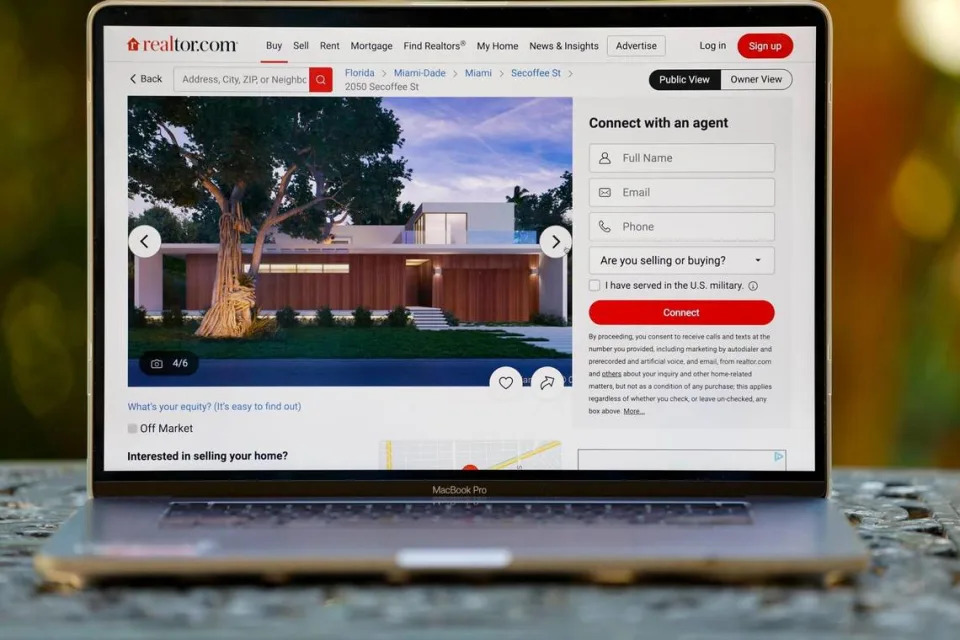
The image on the real estate website movoto.com shows a rendering of a house at 2050 Secoffee St. in Coconut Grove, on Feb. 25, 2023. The description includes three different wishful details: Under construction! expected completion Q3 2022 and Year built 2021.Drive Development advertises a luxury designer home along a fence in front of a lot at 2050 Secoffee St. in Coconut Grove. The lot is vacant.
Cox tells buyers he’s finishing his own dream townhouse at 3167 Shipping Ave. in central Coconut Grove. The adjacent one is under contract with a buyer from New York City who is growing more impatient. Both look ready for move in. Around the corner on Gifford Lane, a buyer from southern California awaits a townhouse that was supposed to be done in November. Other than grass growing, nothing’s happening on the lot.
Newly constructed homes along the 3100 block of Shipping Avenue in Coconut Grove on Wednesday, Feb. 15, 2023. Cox tells buyers he’s finishing his own dream townhouse at 3167 Shipping Ave. in central Coconut Grove. The adjacent one is under contract with a buyer from New York City who is getting impatient.
The loans
Cox’s companies have taken out at least $59 million in loans, for which he put up 20 properties as collateral, according to public records.
But it’s his most recent loan that has buyers concerned about the fate of their houses. Cox borrowed $350,000 from DC Fund on Dec. 30, 2022, soon after three buyers decided to cancel and get their deposits back. Around the same time, Pearl signed the double contracts with Paciello and Danilovic. And now Cox and Pearl have listed a house for which they could pocket $500,000 or more in deposit money.
Cox put up eight properties as collateral on the DC Fund loan. If he defaults, lenders get first dibs.
DC Fund’s registered agent is Ariel Peretz, principal of Diverse Capital, a lender that advertises “we say yes when others say no” and urges customers to get in touch “if you’re in search of desperately-needed money.”
Peretz and DC Fund members run firms in the merchant cash advance business, mostly based in Brooklyn, which attempt to skirt state usury laws by saying they are not lending quick money at exorbitant rates but are buying the future earnings of their borrowers.
Peretz and DC Fund associates Yoel Getter and Jonathan Allayev and their companies were sued in 2021 by a Texas businessman who accused them of collaborating in a “criminal enterprise that profits by making and collecting on illegal loans.”
The businessman took out a $150,000 loan for which he agreed to repay $224,850 at 215 percent interest via $3,748 daily debits from his bank account. Two weeks later, the businessman borrowed $350,000 — in part to repay the first one — at 430 percent interest, for which he owed $524,650 via $17,488 daily debits.
The businessman dropped the case.
Peretz didn’t return messages left by the Herald.
“We are very worried,” Coyne said. “If Doug gets in trouble with these high-risk loans and debts, we may be left with nothing.”
Cox boasts to buyers that he and Pearl are independently wealthy with $70 million in savings, but if his cash flow has dried up, they fear he can’t pay off mortgages, can’t obtain the clean title necessary to close and could declare bankruptcy.
“He may have thought, ‘I sold these too cheap and I can make more money if I resell,’ but that makes less sense every day because the market is cooling,” Parrish said. “Maybe he got in too deep and has problems paying lenders. He can’t close so he’s kicking the can down the road.”
The two sides of Doug Cox
Cox can be a charming salesman.
Or a belligerent bully.
Michael Coyne has seen both sides. But as a U.S. Army combat veteran, he is not intimidated.
“The last time I saw him he ran up to my car, leans in and says he’s hired a former CIA operative to tail me because my wife made disparaging comments on social media,” Coyne said. “Another time he told me, ‘Bring it!’ I deal with plenty of nasty lawyers on Wall Street and none of them have ever challenged me to a street fight.”
Lombardi has felt Cox’s wrath. Cox terminated Lombardi’s 3-year-old contract last month, accusing him of trespassing at his house at 2984 Coconut Ave. and making derogatory comments. Cox prohibits buyers from going on their properties and has installed surveillance cameras. But he allowed Lombardi to go inside last May with his family.
Eight months later, when Cox heard Lombardi called the FBI, Lombardi said, Cox canceled his contract. They are in mediation. Lombardi wants his deposit back, and believes Cox wants him out so he can list 2984 at a higher price and collect another $500,000 deposit.
Buyers are also wary of Cox because they’ve read a graphic police report from Sept. 6, 2020, when Cox and Pearl got into an argument.
Pearl, who describes Cox in the report as her “live-in boyfriend,” told police Cox began texting her with insulting names from the master bedroom where he was with their daughter as she put their 3-year-old son to bed in his room. Cox stormed in and hit her, choked her, pulled her hair and spit on her as their son watched, “terrified and screaming.” She wrote this description for police:
“He has a pattern of domestic violence and extreme childhood abuse and trauma which has left him with deep unresolved issues and anger problems. This has culminated into a cycle of violence with me since 2014. … He has repeatedly threatened that if I report it, it will destroy his life and in turn he will destroy mine and that of my family.”
Pearl also checked boxes asserting he has “threatened to conceal, kidnap or harm” their children and “intentionally injured or killed a family pet.”
Cox was charged with battery and domestic violence by strangulation and spent the night in jail, Miami-Dade Corrections records show. He was given a restraining order. Pearl dropped the charges.
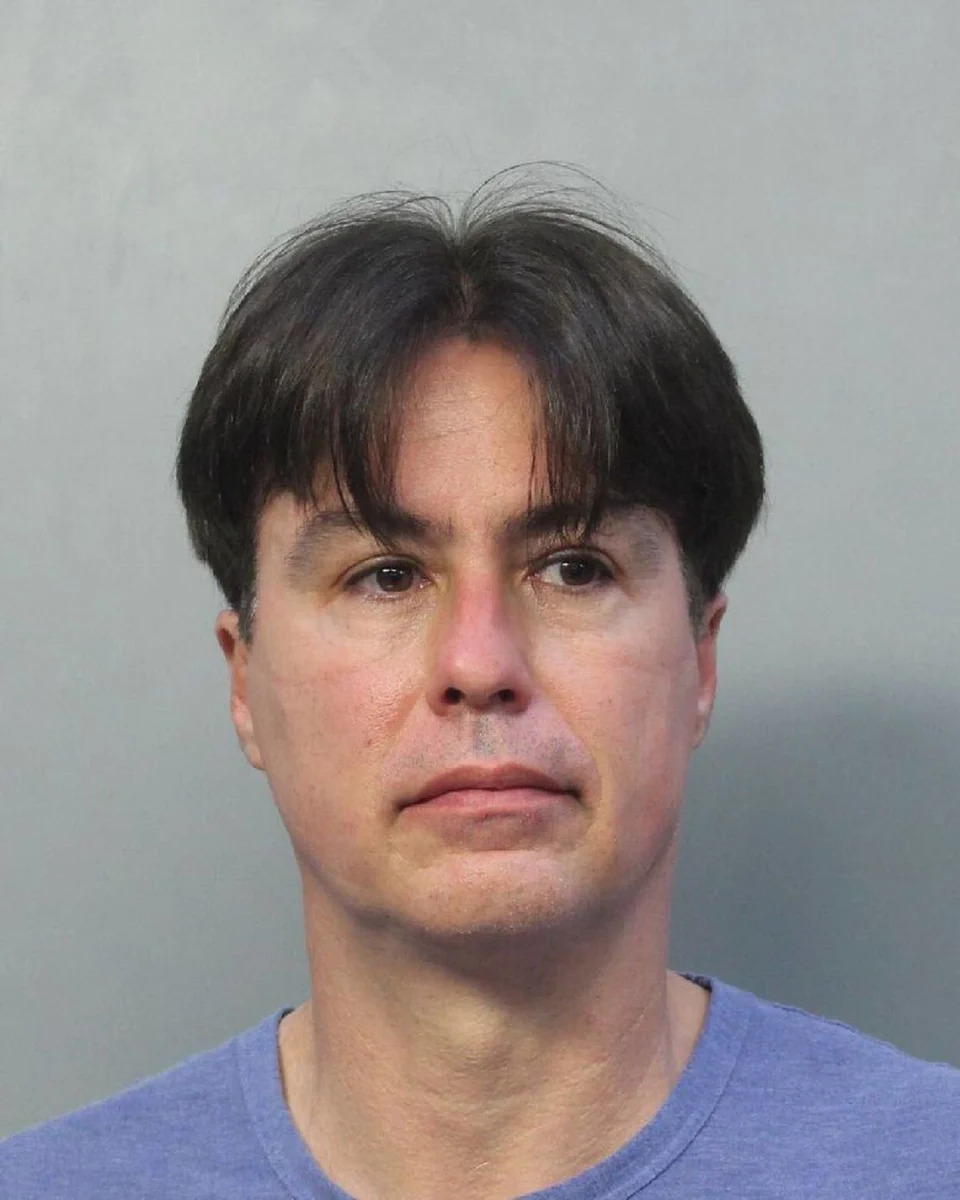
Booking mug when Doug Cox was arrested and charged with battery and domestic violence by strangulation in 2020.
Cox has perfected the art of evasion.
“I call it the Doug Cox two-step,” Coyne said.
When buyers are able to chase him down on the phone — he avoids putting anything in writing — he swears he’s pushing against the forces obstructing him. He wants them living in their dream homes as ardently as they do.
A vacant lot on Woodridge, a sweet little street in the South Grove next to Merrie Christmas Park and its towering banyan trees, has been overtaken by vegetation. As people in Miami clamor for more housing, this spot where a cottage once stood has grown wild. Vines climb the trees instead of children. The scraping racket of a bulldozer echoes down the block.
On this patch, owned by the King of Coconut Grove, all is still. The ripe land, taking revenge, has reclaimed itself.
A ‘Do Not Enter’ sign is affixed to the front door of one of the 12 luxury townhouses on Coconut Avenue in Coconut Grove that have been built by Doug Cox of Drive Development. Buyers of the homes have been waiting years to move in.
Miami Herald Director of Research Monika Leal contributed to this report.
Florida prepares for influx of manatees suffering from red tide
Andrew Wulfeck – March 8, 2023
Video:Dozen manatees returned to the wild in Florida https://s.yimg.com/rx/martini/builds/54607967/executor.html
TAMPA – A massive bloom of harmful algae that has been intensifying off the west coast of Florida is now believed to be impacting the manatee population at a crucial time when biologists were cautiously optimistic that the species was on the path of rounding the corner from record die-offs.
The red tide was initially observed in the days after Hurricane Ian impacted areas around Fort Myers and has grown throughout the winter.
The Florida Fish and Wild Conservation Commission reports that levels of the organism, Karenia brevis, have reached concentrations of over 100,000 cells per liter – an amount that is ten times higher than the minimum level needed to impact wildlife and humans significantly.
Florida red tide count 3/8/2023
The U.S. Fish and Wildlife Service said it knows at least three recent cases of manatees being transported to SeaWorld’s recovery center in Orlando from West Florida.
“Those are fairly easy to care for once they are rescued. However, they do take up a bit of the rehab capacity because even though we can get the neurotoxin out of their system fairly quickly in just a matter of a few days, they may take up an entire pool while that’s happening,” said Terri Calleson, the Florida manatee recovery lead for the USFWS.
Several rescue centers around the state were already operating with the potential to quickly increase capacity due to an ongoing Unusual Mortality Event along the state’s east coast due to an increase in malnourished sea cows needing treatment over the past two years.
Over the last several months, additive-containing pools have mainly gone unused due to the apparent tailing of amounts of ill animals, but biologists stand at the ready in case figures start to rise again.
“We can’t put them back to the wild until the red tide cell counts subside for an extended period of time. So that’s going to strap us a little bit on rehab capacity, and we’re going to make some moves to try to address it,” said Calleson.
So far this year, the FWC reports 140 manatees have died – a figure below the pace of the last two record years.
The agency estimates there are only around 7,500 manatees left in Sunshine State, and if boaters see an animal in distress, they should inform the agency about the sighting by calling 888-404-3922.
Burning eyes, dead fish; red tide flares up on Florida coast
March 11, 2023
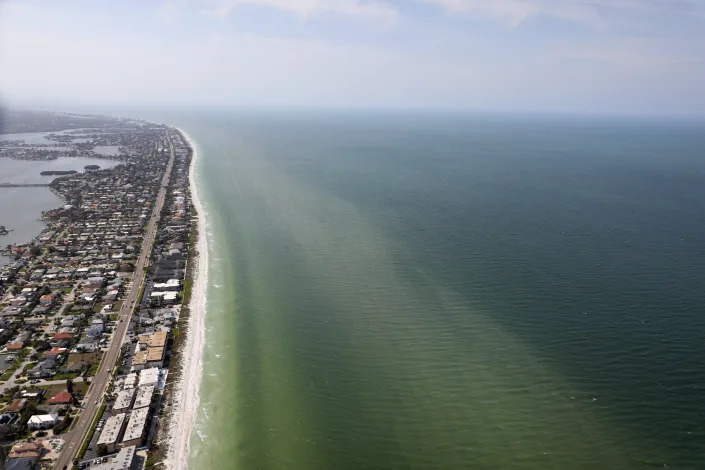
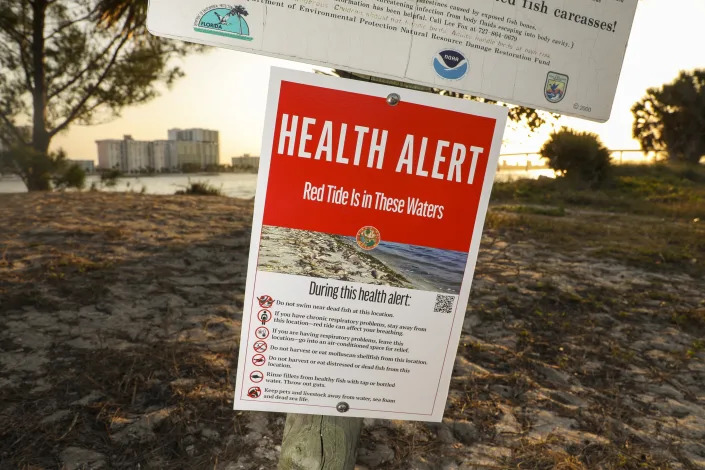
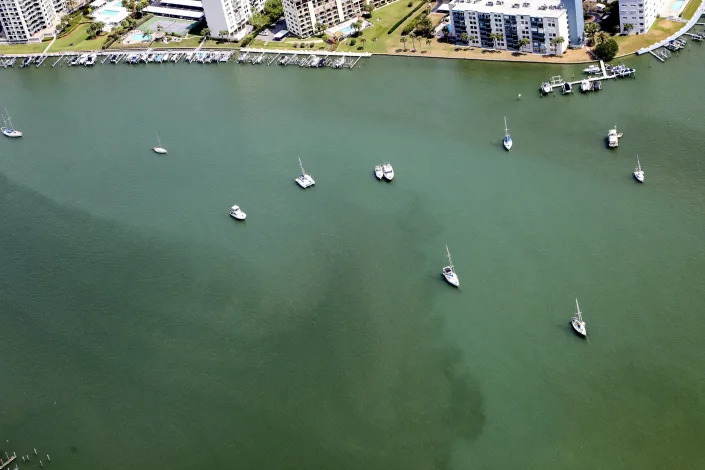
Red tide is observed near Pinellas County beaches off Redington Beach, Fla., during a flight with SouthWings volunteers on Friday, March 10, 2023. Florida’s southwest coast experienced a flare-up of the toxic red tide algae this week, setting off concerns that it could continue to stick around for a while. The current bloom started in October. (Douglas R. Clifford/Tampa Bay Times via AP)A health alert sign warns visitors to Sand Key Park of the presence of Red Tide in the surrounding water on Thursday, March 9, 2023, in Pinellas County, Fla. Florida’s southwest coast experienced a flare-up of the toxic red tide algae this week, setting off concerns that it could continue to stick around for a while. The current bloom started in October. (Douglas R. Clifford/Tampa Bay Times via AP)Red tide is observed at Clearwater Beach, Fla., during a flight with SouthWings volunteers on Friday, March 10, 2023. Florida’s southwest coast experienced a flare-up of the toxic red tide algae this week, setting off concerns that it could continue to stick around for a while. The current bloom started in October. (Douglas R. Clifford/Tampa Bay Times via AP)Dead fish lay at the high tide line on Clearwater Beach on Thursday, March 9, 2023, in Pinellas County, Fla. Florida’s southwest coast experienced a flare-up of the toxic red tide algae this week, setting off concerns that it could continue to stick around for a while. The current bloom started in October. (Douglas R. Clifford/Tampa Bay Times via AP)Red tide is observed at Clearwater Beach, Fla., during a flight with SouthWings volunteers on Friday, March 10, 2023. Florida’s southwest coast experienced a flare-up of the toxic red tide algae this week, setting off concerns that it could continue to stick around for a while. The current bloom started in October. (Douglas R. Clifford/Tampa Bay Times via AP)
SARASOTA, Fla. (AP) — Residents are complaining about burning eyes and breathing problems. Dead fish have washed up on beaches. A beachside festival has been canceled, even though it wasn’t scheduled for another month.
Florida’s southwest coast experienced a flare-up of the toxic red tide algae this week, setting off concerns that it could continue to stick around for a while. The current bloom started in October.
The annual BeachFest in Indian Rocks Beach, Florida, sponsored by a homeowners’ association, was canceled after it determined, with help from the city and the Pinellas County Health Department, that red tide likely would continue through the middle of next month when the festival was scheduled.
“Red Tide is currently present on the beach and is forecasted to remain in the area in the weeks to come,” the Indian Rocks Beach Homeowners Association said in a letter to the public. “It is unfortunate that it had to be canceled but it is the best decision in the interest of public health.”
Nearly two tons of debris, mainly dead fish, were cleared from Pinellas County beaches and brought to the landfill, county spokesperson Tony Fabrizio told the Tampa Bay Times. About 1,000 pounds (454 kilograms) of fish have been cleared from beaches in St. Pete Beach since the start of the month, Mandy Edmunds, a parks supervisor with the city, told the newspaper.
Red tide, a toxic algae bloom that occurs naturally in the Gulf of Mexico, is worsened by the presence of nutrients such as nitrogen in the water. The Florida Fish and Wildlife Conservation Commission warns people to not swim in or around red tide waters over the possibility of skin irritation, rashes and burning and sore eyes. People with asthma or lung disease should avoid beaches affected by the toxic algae.
The Florida Fish and Wildlife Conservation Commission on Friday reported that it had found red tide in 157 samples along Florida’s Gulf Coast, with the strongest concentrations along Pinellas and Sarasota counties.
As California gets drenched, officials opening Oroville Dam spillway for first time in 4 years
Michael McGough – March 10, 2023
California water officials opened the main spillway at the Oroville Dam on Friday afternoon, doing so for flood control purposes for the first time since 2019.
Ted Craddock, deputy director of the State Water Project, said the water elevation at Lake Oroville has risen by close to 180 feet since Dec. 1 after a parade of storms this winter, now standing at about 840 feet — 60 feet shy of its maximum.
State water officials began to increase releases from Lake Oroville, which is operated by the state Department of Water Resources, on Wednesday for flood control purposes, Craddock said during a virtual news briefing ahead of the successful spillway opening at noon.
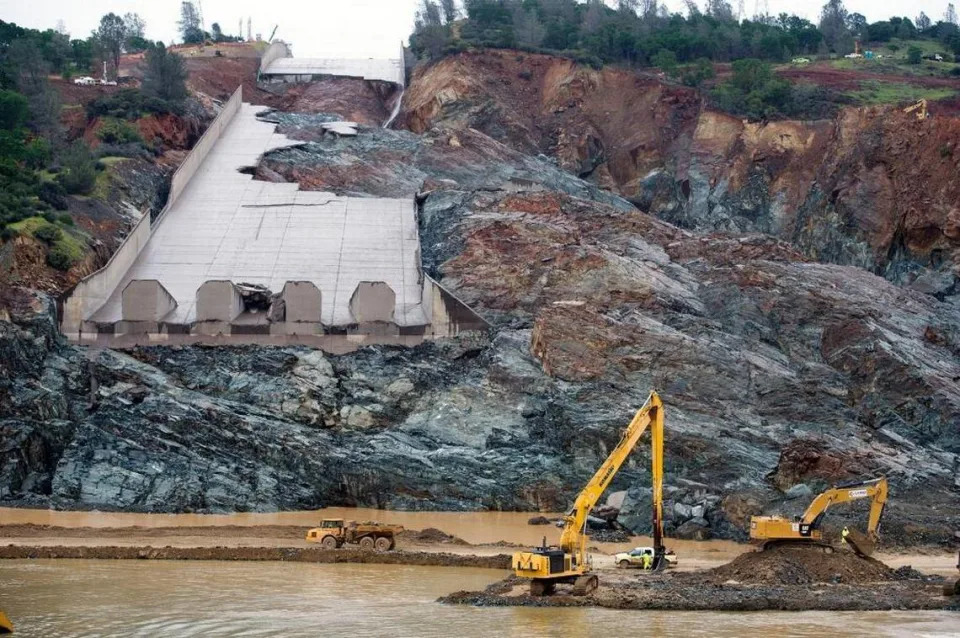
The dam was the center of a 2017 crisis. Torrential rainfall that February damaged the Oroville Dam’s main spillway. When rerouted water threatened failure on the dam’s emergency spillway, more than 180,000 residents downstream of the dam in Butte, Sutter and Yuba counties were ordered to evacuate.
Extensive repairs followed, and state water officials let water flow down the newly rebuilt spillway for the first time on April 2, 2019.
“As part of the reconstruction effort, we installed instrumentation throughout the structure,” Craddock said. “So we can monitor the pressure, drainage and also movement of the spillway as well.”
Spillway flow Friday began at 15,000 cubic feet per second, which Craddock called a “relatively small release.” The spillway is capable of releasing up to 270,000 cubic feet per second.
“As we look further into the upcoming storms, it’s possible we will be making adjustments to our releases,” he said. Releases during the rebuilt spillway’s only prior use, in 2019, peaked at 25,000 cubic feet per second.
Craddock said that due to near-record level snowpack in the Sierra this winter, water officials are confident that snowmelt will help to replenish Lake Oroville following flood releases and the end of the rainy season.
Water releases are also underway at the Folsom Dam, which is operated by the U.S. Bureau of Reclamation.
Water flows down the new spillway at Oroville Dam on Tuesday, April 2, 2019 in Oroville.
What is the Oroville Dam?
The Oroville Dam opened in 1968 and is the tallest dam in the U.S. at 770 feet. Located just northeast of Oroville city limits, water from the dam’s main spillway flows into the Feather River.
The main spillway failed catastrophically in February 2017, when a large and cratering fracture formed amid weeks of heavy rain, leading operators to curtail water flow onto the emergency spillway.
The wreckage of the main spillway at Oroville Dam in February 2017 left tons of concrete and other debris piled up in the Feather River below. The state plans to open the rebuilt spillway Tuesday.
The emergency spillway is a concrete lip along a hillside. When water began to spill over the lip, the hillside began to erode, and dam officials feared the emergency spillway would fail and release a “wall of water” downstream. Emergency authorities on Feb. 13, 2017, ordered some 188,000 residents of the Feather River Basin to evacuate.
Dam operators then ramped up water releases on the main spillway, easing lake levels and pressure on the emergency spillway. The emergency spillway held, and evacuation orders were reduced to warnings the following day.
The Department of Water Resources says repairs and improvements made during 2017 and 2018 have brought the dam up to “state-of-the-art” standards, Craddock said Friday.
To keep the emergency spillway from crumbling, DWR dramatically ramped up water releases on the battered main spillway, bringing lake levels down and effectively ending the crisis. Water continued pounding the main spillway for days afterward, carving a giant crevice
The algae, which is known formally as the single-cell Karenia brevis, has concentrated near Tampa and neighboring communities.
Scientists have found the algae at rates ranging from 10,000 cells per liter to more than 1 million cells per liter – levels that result in fish kills and breathing difficulties in exposed humans, according to the Florida Fish and Wildlife Conservation Commission.
The agency said red tide becomes harmful to people at 10,000 cells per liter.
Red tides produce a toxin called brevetoxin that can make humans ill if they breathe the toxin in through sea spray or get wet with contaminated water.
The illness can cause a range of symptoms, according to the Centers for Disease Control and Prevention, including:
Coughing and sneezing
Shortness of breath
Eye, skin, and throat irritation
Asthma attacks
The FWC it had received multiple reports of dead fish respiratory irritation at communities through the Southwest Florida. One community, Indian Rocks Beach, decided to cancel a beach festival slated for next month amid red tide concerns.
Red tides are a naturally occurring phenomenon that have been observed in the Gulf of Mexico since the 1800s. Nascent studies have connected nutrient-laden runoff from farms and developments to increased levels of red tide along the coast.They begin to form on the coast beginning in the fall, and typically clear up by Spring.
What will Miami look like with more sea rise? This high-tech car helps us picture it
Alex Harris – March 8, 2023
Hurricane Ian’s destructive storm surge last fall shocked many Floridians, even some who’d weathered severe hurricanes before. In some places, the waters were so high that survivors had to scramble to the second story or their roof for safety.
Experts say it’s tough for people to visualize what those record-breaking levels of surge would look like until they arrive.
But FloodVision, a new tool from nonprofit climate advocacy group Climate Central, could change that, with help from a high-tech car they’ve nicknamed the “flood rover.”
The vehicle isn’t anything special (it’s actually a rental), but the cameras and sensors strapped onto it are. They form a mobile scanning system that acts a lot like a souped-up Google Maps car, except the finished product is a simulation of a future flooded street.
Benjamin Strauss, CEO and chief scientist of Climate Central, calls it a “visual, visceral, powerful” way to explain the risks of hurricanes — and rising seas — to communities most at risk.
“We know the images are more powerful than any map we can make, or any graphic we can show you,” he said.
Strauss’ team has already done some scanning in Miami, Miami Beach, Fort Lauderdale and Tampa, and they debuted the car and the new system at the Aspen Ideas: Climate conference in Miami Beach this week.
This is a simulation of what a Miami street could look like in 2070 with no interventions to slow down sea level rise. It was produced with FloodVision, a new technology from Climate Central.
In one example in Miami, researchers at Climate Central captured a picture of a neighborhood with the car cameras, then superimposed the two or so feet of sea rise the region is projected to see by 2070 under NOAA’s intermediate high standard.
The result: enough water to come halfway up a tree and soak through the doors of parked cars. It’s a familiar sight to residents of flood-prone neighborhoods like Brickell, which can reach the same levels of flooding after an intense rainstorm.
Strauss plans to use the technology to simulate images of what sea rise or intense storm surge could look like to educate communities about the risks they face from climate change. One potential hurdle is that the technology does not account for protections that local governments may have already installed, like elevated roads or higher sea walls and stronger stormwater pumps.
Without that, the picture of what could likely happen is skewed in places like Miami Beach, which has spent millions installing new protections against rising seas. But despite the growing body of scientific evidence showing the need for coastal cities to adapt to sea level rise, the execution of these projects has been controversial in the places that need them most.
Strauss hopes that his team’s work can be used to help cut through the noise and visually show residents the benefit of investing in flood protection.
“It’s expensive to build flood protections, and it’s also disruptive,” he said. “This technology can be used, essentially, to show what you’re preventing.”
California Readers Share Photos of Their Winter Wonderland
By Soumya Karlamangla – March 8, 2023
The Owens River Gorge in eastern California. Credit…Stephen Cunha
So much snow has transformed the landscape across the state.
Winter weather in the Golden State, of all places, continues to draw national attention this year.
First, atmospheric rivers flooded towns and swallowed cars. Then, snow fell in Silicon Valley, Santa Cruz, Oakland and a whole host of places unaccustomed to it. Graupel, an ice-snow combo, dusted the Hollywood sign. Yosemite National Park closed indefinitely after record snowfall buried cabins and blanketed roads.
And starting Thursday, another set of heavy storms is expected to hit much of the state, which could bring more flooding and rain damage. I don’t need to tell you — it’s been a wild winter.
Late last month I was driving in Paso Robles, a city on the Central Coast known for its wineries and olive groves, when I noticed the tops of the gently sloping green hills sprinkled with snow. I’d never seen anything like it.
The small town of Shandon in San Luis Obispo County last month. Credit…Soumya Karlamangla/The New York Times
Twenty miles east in Shandon, a small community also in San Luis Obispo County, the skies were mostly blue — but the roofs of cars, small homes and wooden barns were all blanketed in snow. I watched as a father and daughter, bundled in scarves and jackets, assembled a wobbly snowman from what had fallen on a grassy field in the city’s park.
Today we’re sharing photos you emailed us of what this winter has looked like in your neck of the woods. Leslie Bates, a reader who lives in Gualala on the Mendocino Coast, said that she had been sending snow pictures to her brother who lives in the Catskills in New York: “The world turned upside down!”
Craig Whichard’s cabin in Arnold. Credit…Craig Whichard
Sandra Sincek, who lives in Julian, a small mountain town northeast of San Diego, described her child’s first sled run of the year.
“Occasionally we will get a few inches of snow, but this was a glorious winter event,” she wrote. “When the clouds finally parted, our son carried his wooden snow sled to the top of the hill, carefully positioned it, climbed in, and let go.”
Craig Whichard wrote to us from his cabin in Arnold, on the western side of the Sierra Nevada and about 70 miles east of Stockton. He said that the five feet of snow that fell late last month was more than he’d seen in his 14 years there.
More on California
Struggling to Recover: Weeks after a brutal set of atmospheric rivers unleashed a disaster, the residents of Planada in Merced County are only beginning to rebuild.
Exploring Los Angeles: Walking down Rosecrans Avenue is not necessarily a pleasure. But it does offer a 27-mile canvas of the city’s vastness and its diverse communities coexisting.
A Bridge Goes Dark: A light installation across part of San Francisco’s Bay Bridge, had to be turned off because of the region’s harsh weather. They hope to raise $11 million to refurbish it.
In Cloverdale in Sonoma County. Credit…Star CarpenterA geodesic dome in the Santa Cruz mountains. Credit…Karrie GaylordThe view from Hollister in San Benito County. Credit…Susan HeckSnow-capped San Gabriel Mountains, seen from Glassell Park in Los Angeles. Credit…Emily Zuzik HolmesSnow-covered mountains behind the Hollywood sign. Credit…Patrick T. Fallon/Agence France-Presse — Getty Images
Fighting chronic Lyme disease, healthcare policies in Indiana
Jayde Leary – March 6, 2023
Editor’s Note: The following is part of a class project originally initiated in the classroom of Ball State University professor Adam Kuban in fall 2021. Kuban continued the project this spring semester, challenging his students to find sustainability efforts in the Muncie area and pitch their ideas to Deanna Watson, editor of The Star Press, Journal & Courier and Pal-Item. Several such stories are being featured this spring.
MUNCIE, Ind. − Chronic Lyme disease patients in the state of Indiana and all over the United States have been struggling to find affordable treatment due to the disease itself not being covered by insurance past the 30-day treatment that is provided.
According to the Centers for Disease Control and Prevention, Lyme disease is transmitted to humans through being bit by infected blacklegged ticks. Patients who experience symptoms of pain, fatigue or difficulty thinking more than six months after they finish treatment have a condition called Post-Treatment Lyme Disease Syndrome, also known as chronic Lyme disease.
Most cases of Lyme disease can be treated successfully with a two-to-four-week course of antibiotics. According to an article by Medical Bill Gurus, insurance companies are not required to cover treatment per the Infectious Disease Society of America guidelines. Therefore, insurance companies do not recognize chronic Lyme disease and use these guidelines to deny coverage for long-term treatment.
A majority of all Lyme Literate Medical Doctors are not in-network with any major insurance companies, and this leaves those patients who still experience symptoms after the provided few weeks of antibiotics with slim options.
Lyme disease patients who continue to have symptoms after that four-week mark may not be able to get the treatment they need due to the lack of financial help. According to a 2022 study by Samantha S. Ficon published in “Nursing Continuing Professional Development”, the disease can be harmful and deadly if it is not treated effectively early on, and 10% to 20% of patients previously treated for Lyme disease still experience symptoms for more than six months after finishing antibiotic treatment.
Kimberly Sharp, director of pain management for Community Health Network, has worked in the field of chronic pain management for over 20 years.
“There is currently no evidence supporting the long-term use of antibiotics, and the CDC does not officially recognize chronic Lyme. There are limited dollars for care, so insurance companies must draw the line somewhere on what is covered,” Sharp said.
Many insurance companies are not covering what chronic Lyme patients need.
Riley Sims, senior art major, working on her schoolwork in the L.A. Pittenger Student Center at Ball State University. According to Tick Check, there were 2,013 cases of Lyme disease confirmed in the state of Indiana from 2000 to 2020.
Riley Sims, senior at Ball State University, was diagnosed with Lyme disease in May 2020 and struggles with the chronic illness daily. She said she has to work twice as hard to keep up with her schoolwork and day-to-day tasks, and she has no choice but to seek treatment. Sims looks to her mother and father for financial help in order to cover her chronic Lyme expenses. Due to being a busy college student, she does not have enough money at this point in time to cover the costs of treatment and appointments.
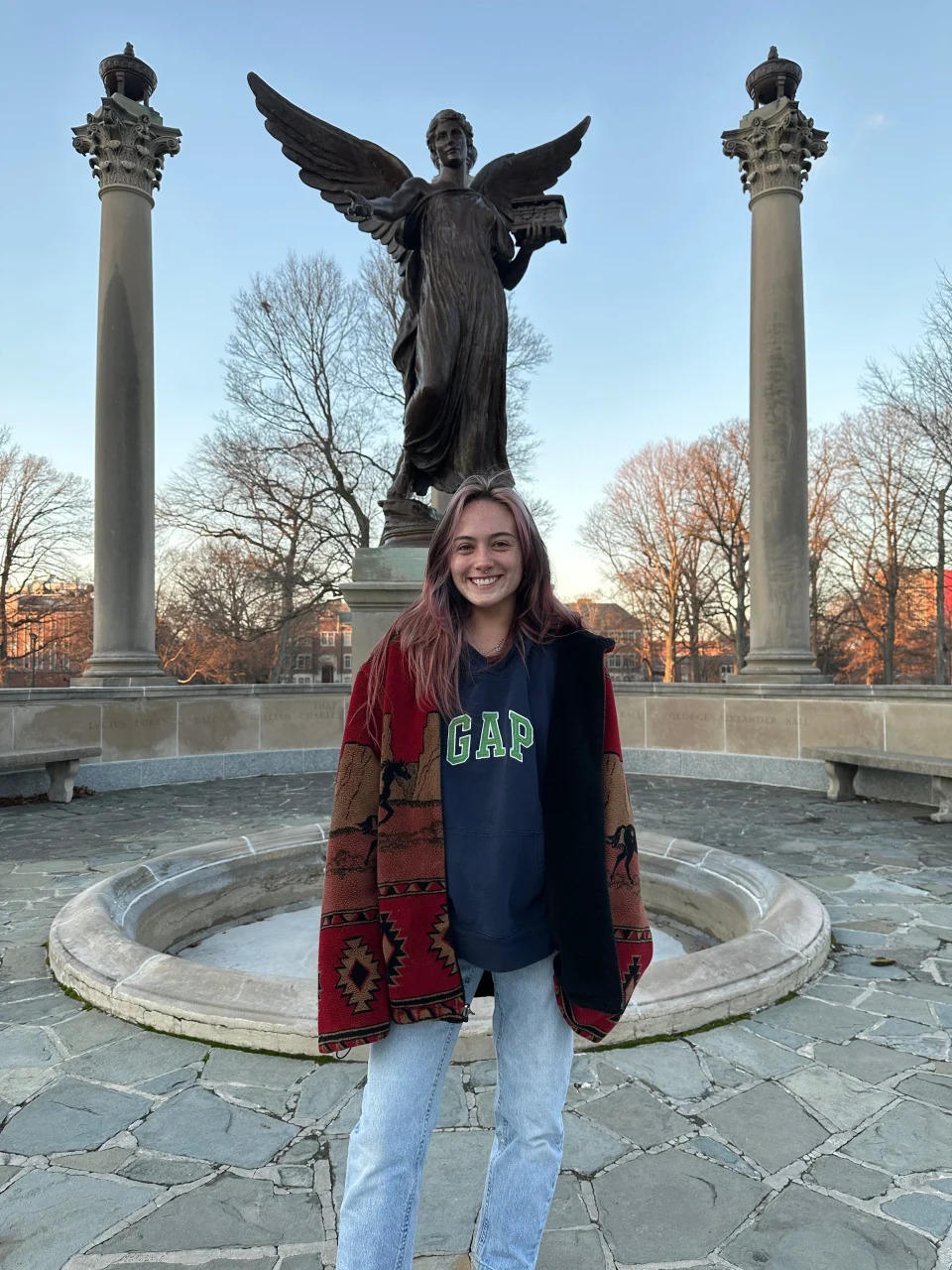
[Insert photo of Riley Sims in front of Beneficence]
“I take supplements for my chronic Lyme disease that are suggested by my doctor, and I also have to get many blood tests, but none of it is covered by insurance, not even my doctor appointments,” Sims said.
According to Global Lyme Alliance, patients can suffer for years not only from the symptoms of chronic Lyme, but from the financial impact as well. Patients end up paying out-of-pocket costs and hope for reimbursement. This leaves patients who become too sick to work with large financial struggles.
Mitchell Goldman, MD, senior associate dean for Graduate Medical Education and professor of medicine for the Department of Medicine/Infectious Diseases at the University of Missouri School of Medicine, previously worked at the Indiana University Medical Center and has experience with Lyme disease patients.
“Insurance companies often require an approval process to provide therapies beyond usual guidelines, and this requires a physician or other provider to plead the case to the insurance company that may accept or deny a therapy beyond usual time,” Goldman said.
According to the Centers for Disease Control and Prevention, there were 34,945 reported cases of Lyme disease in the United States in 2019. Compared to other tickborne illnesses, this number is high. There were 5,655 Anaplasmosis cases, 5,207 Spotted Fever Rickettsiosis cases, 2,420 Babesiosis cases and 2,093 cases of Ehrlichia chaffeensis ehrlichiosis. Many patients suffer daily from chronic Lyme disease with no help from their insurance providers, and some of them may even be forced to quit treatment due to financial challenges.
[Insert picture of Riley Sims working on schoolwork]
Sims said the Lyme Treatment Foundation has helped her tremendously and that other patients seeking financial help should look more into other non-profit organizations like this.
“Lyme disease is like a rollercoaster. I just wish we had more help riding it,” Sims said.
Hazards of Gas Stoves Were Flagged by the Industry—and Hidden—50 Years Ago
Kate Yoder, Grist – March 6, 2023
Photo: Scott Olson (Getty Images)
Newly uncovered documents reveal that the gas industry understood that its stoves were polluting the air inside homes 50 years ago — and then moved to conceal that information. It stands in stark contrast to the industry’s denial of the health dangers posed by gas stoves today.
In a draft report on natural gas and the environment in January 1972, the American Gas Association included a section on “Indoor Air Quality Control” that detailed its concerns with pollution from gas appliances like carbon monoxide and nitrogen oxides. The document showed that the trade group was in the process of researching solutions “for the purposes of limiting the levels of carbon monoxide and nitrogen oxides in household air.” But all that information disappeared from the final text, according to reporting by the climate accountability site DeSmog on Thursday.
That draft report was sent to the National Industrial Pollution Control Council, what was then a government advisory council made up of 200 business executives representing industrial heavyweights, including utilities. When the council’s final report was published in August 1972, those utilities had removed the section on air pollution concerns, according to the DeSmog article. Arguing that the fuel should replace the coal used for power, heating, and cooking in homes, the report spotlighted the pollution problems of burning coal while downplaying the dangers of natural gas.
In response to DeSmog’s investigation, Karen Harbert, the CEO of the American Gas Association, pointed to “a 1982 review of the available research that found no causative link between gas stoves and asthma, a conclusion shared by regulatory agencies.”
The concerns about indoor air quality in the report’s deleted section foreshadowed those held by health experts today. In recent months, studies have found that gas-burning stoves are responsible for nearly 13 percent of childhood asthma cases in the United States, and that they leak methane, a potent greenhouse gas, and benzene, a cancer-causing chemical, even when they’re shut off. Earlier this week, the federal Consumer Product Safety Commission made a formal request for information on the hazards of gas stoves. This is often the first step toward creating a regulation — although the commission has said it doesn’t plan on banning gas stoves entirely, after the mention of it sparked heated backlash.
The gas industry has pushed back against the peer-reviewed research showing that gas stoves increase the risk of childhood asthma. In January, the American Gas Association argued that the findings were “not substantiated by sound science” and that even discussing the asthma allegations would be “reckless.”
But the newly unveiled documents show that the gas industry itself was once concerned about the pollution coming from gas stoves — which the National Industrial Pollution Control Council called “the NOx problem” in 1970, referring to nitrogen oxides, a family of poisonous gases. Gas companies were even aware of the problem decades before, with the president of the Natural Gas Association warning of the dangers of emissions from gas stoves as far back as the early 1900s.