Fish kills and breathing issues in humans can start when levels reach 10,000 cells per liter, according to the FWC.
Fish kills have been problematic in waters near Collier County, home of Naples, in recent weeks.
On the eastern coast of the state, water taken from the Juno Beach Pier on Feb. 15 tested positive for background amounts of red tide, but the amount was so miniscule it was not expected to have any detrimental health effects, and it was gone when a follow-up test was taken Feb. 22.
When the toxin from red tide is inhaled, it can cause respiratory symptoms in people, such as coughing, wheezing and sore throats.
In marine life, it’s a killer that affects the nervous system and can cause paralysis.
What exactly is red tide?
It is a sea-faring toxic algae, formally known as the single-cell Karenia brevis.
It produces a toxin as a defense mechanism.
What is the main cause of red tide and how long does it last?
Red tides are naturally occurring. They have been observed in the Gulf of Mexico since the 1800s.
They can grow far offshore in the Gulf and pile up near the coast in the fall and winter as wind patterns blow cold fronts into Florida.
Red tide is often gone by spring, but in some years, the infection has lingered.
Palm Beach lifeguard George Klein wears a mask at Midtown Beach in Palm Beach that remains closed due to red tide warnings, Sunday, September 30, 2018. (Melanie Bell / The Palm Beach Post)
Is red tide present in Florida right now?
Yes. Samples on Florida’s west coast from Venice to Naples tested at high levels of toxicity.
Fish kills have been problematic in Collier County waters in recent weeks. Rhonda Watkins, a pollution control environmental supervisor for Collier County, said reports of dead fish are widespread.
Medium levels have been found in the Florida Keys.
It’s possible a stronger dose of red tide could find its way to Florida’s east coast beaches, according to James Sullivan, executive director of Florida Atlantic University’s Harbor Branch Oceanographic Institute.
Red tide hit Florida beaches hard in 2018
A persistent red tide bloom lasted through the summer and into fall of 2018.
Tons of marine life died on the west coast of the state, triggering daily “fish kill clean-up” reports on Sanibel Island where dump trucks full of dead fish were removed.
In October 2018, Palm Beach County ocean rescue Captain Rick Welch, left, and lifeguard Russ Gehweiler, right, install newly printed signs warning visitors of the red tide outbreak along A1A, south of Indiantown Road in Jupiter. (Richard Graulich / The Palm Beach Post)
Manatee, Goliath grouper, shorebirds and sea turtles all perished in droves that year in areas from Sarasota through Naples.
Can red tide on Florida’s west coast reach the state’s east coast?
Yes. A west coast bloom can reach the east coast if it gets caught in the Gulf of Mexico’s loop current and travels through the Florida Straits into the Gulf Stream – a north-moving river of warm water that skims the Palm Beach County coastline.
Once in the Gulf Stream, waves can force the toxin produced to be dispersed in the air, which can be carried by east winds to the beaches.
Since 1972 when the transport of red tide from the west coast to the east was first identified, seven more instances had been documented prior to 2018, according to the Florida Fish and Wildlife Conservation Commission. Those include in 1990, 1997, 1999 and 2006. In 2007, a red-tide bloom near Jacksonville traveled south with a near-shore current.
DeSantis, GOP lawmakers ready for Culture Wars 2.0 as Florida Legislature convenes
Lawrence Mower – March 5, 2023
Daniel A. Varela/dvarela@miamiherald.com
When Florida lawmakers met for their annual legislative session last year, they championed bills that led to months of headlines for Gov. Ron DeSantis about sexual orientation,abortion, immigration, voting and the teaching of the nation’s racial history.
For this year’s legislative session, which begins Tuesday, DeSantis has a preview: “You ain’t seen nothing yet.”
Emboldened by an overwhelming reelection victory margin and the most compliant Legislature in recent memory, DeSantis is pushing lawmakers to pass the legislation conservatives have been wanting for years.
Lawmakers are preparing to advance bills sought by DeSantis that would require private companies to check their employees’ immigration status. They’re eyeing sweeping changes to limit lawsuits against businesses. They could do away with requiring permits to carry a concealed weapon. More abortion restrictions might be on tap, too, when the 60-day legislative session officially kicks off.
It’s an agenda that’s expected to give DeSantis months of headlines — and springboard his anticipated 2024 presidential run. Some of the bills could help shore up his conservative bona fides against fellow Floridian Donald Trump, who has already announced he’s running to take back the White House, and to further endear him to deep-pocketed donors.
“I’ve never seen a governor in my lifetime with this much absolute control of the agenda in Tallahassee as Ron DeSantis,” said lobbyist Brian Ballard, who has been involved in Florida’s legislative sessions since 1986 and supports the governor.
DeSantis is coy about his presidential ambitions, but legislative leaders are prepared to pass a bill allowing him to run without having to resign. Political observers believe he’ll enter the race after the session ends in May.
Already, DeSantis is promising “the most productive session we’ve had,” aided by his 19-point reelection victory.
And the Republican super-majority Legislature has signaled that it’s along for the ride. Lawmakers in his own party have appeared reluctant to challenge him.
The goal over the next two months, according to House and Senate leaders: Get DeSantis’ priorities “across the finish line.”
The legislation — which included the Parental Rights in Education bill that critics called “don’t say gay” — led to months of headlines in conservative and mainstream media that helped cast DeSantis as the most viable alternative to Trump in a presidential GOP primary.
This year, DeSantis and lawmakers are looking to continue the trend — and check off several bills that failed to get traction in previous years.
The governor and lawmakers are also looking to limit liberal influences in schools and state government. A bill has been filed to end university diversity programs and courses, and lawmakers are preparing bills to prevent state pension investments that are “woke.” Legislators are also considering laws governing gender-affirming care for minors.
And when lawmakers craft their budget for the next fiscal year, it’s likely to include DeSantis’ requests for $12 million more to continue the program that sent migrants from Texas to Martha’s Vineyard in Massachusetts. DeSantis also wants a tripling of the size of his Office of Election Crimes and Security, from 15 to 42 positions. And in a dig at President Joe Biden after an official in his administration suggested a ban on gas stoves, DeSantis wants to adopt a permanent tax break for anyone who buys one.
Perhaps his most ambitious proposal is another attempt to make good on his 2018 campaign promise requiring private employers to use the federal online system E-Verify to check that employees have entered the country legally.
In 2020, DeSantis caved after resistance from the business community and legislative leaders; he quietly signed a watered-down version of the bill into law. Late last month, he announced he would try again.
That’s one of several items on some Florida Republicans’ wish lists. Others include:
▪ An expansion of school vouchers to all school-aged children in the state, the culmination of two decades of education reforms;
▪ A measure allowing Floridians to carry concealed weapons without first seeking a permit and receiving training;
▪ Tort reform legislation long sought by the state’s business associations;
▪ A bill making it easier to sue media outlets for defamation, an idea DeSantis’ office pitched last year but that no lawmakers sponsored.
“Now we have super majorities in the Legislature,” DeSantis said. “We have, I think, a strong mandate to be able to implement the policies that we ran on.”
A changed Legislature under DeSantis
If DeSantis has a chance to pass those bills, it’s during this legislative session.
The culture in Tallahassee is far different than it was when Republicans took control more than 20 years ago. Gone are the days when Republicans publicly debated ideas. Today, floor debate among House members is time-limited, and bills are often released in their finished form following backroom deals with Republican leaders. Committee chairpersons could block leadership bills they didn’t like. Today, they’re expected to play along.
In years past, lawmakers would push back hard against the governor, such as in 2013, when they refused to carry out then-Gov. Rick Scott’s plan to expand Medicaid coverage to more than 1 million Floridians.
Today is a different story.
Much as DeSantis has exerted control over schools, school boards, Disney, high school athletics, universities and the state police, DeSantis has thrown his weight around with the Legislature over the last four years.
He’s called them into special legislative sessions six times in 20 months. Once was to pass DeSantis’ new congressional redistricting maps after he vetoed maps proposed by legislators. It was the first time in recent memory that a governor proposed his own maps.
He endorsed Republican Senate candidates during contested primary races last year, something past governors considered an intrusion into the business of legislative leaders. In one race, he supported the opponent of incoming Senate President Kathleen Passidomo, R-Naples. The move was considered to undermine only the third woman to be Senate president in the state’s history.
He’s also shown little regard for the priorities of past House speakers and Senate presidents. In June, he vetoed the top priorities of the then-House speaker and Senate president, joking about the cuts while both men flanked him on stage.
DeSantis is aware of his influence over state lawmakers, according to his book “The Courage to be Free,” released last week. In one part, he writes that his ability to veto specific projects in the state budget gave him “a source of leverage … to wield against the Legislature.”
Legislative leaders say they’re aligned
The state’s legislative leaders in 2023, Passidomo and House Speaker Paul Renner, R-Palm Coast, consider themselves ideologically aligned with the governor.
“We have a very, very similar philosophical view of things on really every issue,” Renner said in November.
Republicans have two-thirds super-majorities in the Legislature, an advantage that allows them to further limit Democratic opposition on bills. The last two Republican legislators willing to publicly criticize their leaders’ agendas left office last year. Multiple moderate House Republicans decided not to run again last year.
DeSantis’ sway over the Legislature has not gone unnoticed.
When Luis Valdes, the Florida director for Gun Owners of America, spoke to lawmakers last month, he was upset that legislators weren’t allowing gun owners to openly carry firearms. He concluded that it must be because DeSantis didn’t want it.
“If he tells the Legislature to jump, they ask, ‘How high?’ ” he said.
Former lawmakers and observers have noticed the shift in Tallahassee.
Former Republican lawmaker Mike Fasano laments that legislators don’t exercise the power they used to have. But Fasano, who supports DeSantis, said the governor’s popularity makes it risky to go against him.
“A Republican in the Legislature, I’m sure, is aware of that,” Fasano said.
The Democrats’ lament
Senate Minority Leader Lauren Book, D-Plantation, who grew up in the legislative process thanks to her father, a big-time Tallahassee lobbyist, said the changes in the Legislature are obvious.
“This is not the same Florida Senate, Florida House, as it was when the titans were here,” Book said.
DeSantis’ culture wars have overshadowed more practical problems in Florida, such as the high costs of rent and auto and homeowners insurance, said House Minority Leader Fentrice Driskell, D-Tampa.
Passidomo has proposed broad legislation to create more affordable housing, but the governor has not endorsed the bill.
Driskell said Floridians want a pragmatist, not a populist, as governor.
“This governor has never seemed to care to know the difference.”
Tampa Bay Times political editor Emily L. Mahoney contributed to this report.
Norfolk Southern train derails in Springfield, Ohio
Faris Tanyos – March 4, 2023
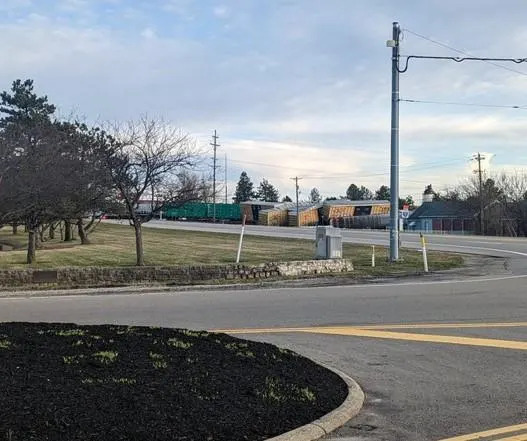
Nearby residents have been asked to shelter in place after a Norfolk Southern train derailed near a highway in the Springfield, Ohio, area on Saturday.
Norfolk Southern confirmed in a statement to CBS News that 20 cars of a 212-car train derailed. The railway company said there were no hazardous materials aboard the train, and there were no reported injuries.
Residents within 1,000 feet of the derailment were asked to shelter-in-place out of an “abundance of caution,” the Clark County Emergency Management Agency reported. The derailment occurred near State Route 41.
A Norfolk Southern train which derailed in Springfield, Ohio. March 4, 2023. / Credit: Jon Shawhan/Twitter
On Feb. 3, a Norfolk Southern train carrying hazardous materials derailed in a fiery crash in East Palestine, Ohio. Of the 38 cars that derailed, about 10 contained hazardous materials. Hundreds of residents were evacuated, and crews later conducted a controlled release of toxic chemicals, including vinyl chloride, because of the risk that the derailment could cause an explosion.
State and federal officials have faced significant criticism over their response to the East Palestine incident, with local residents concerned that the contamination to the area could pose significant long-term health risks.
The Environmental Protection Agency has so far said that air quality levels remain at safe levels. However, on Thursday the EPA said that it had ordered Norfolk Southern to conduct dioxin tests at the site of the derailment, and if those dioxin levels were found to be at unsafe levels, it would order an immediate cleanup.
Transportation Secretary Pete Buttigieg, who was also criticized for not visiting East Palestine until three weeks after the derailment, tweeted Saturday night that he had been briefed by Federal Railroad Administration staff about the Springfield derailment and had also spoken to Ohio Gov. Mike DeWine on the incident.
“No hazardous material release has been reported, but we will continue to monitor closely and FRA personnel are en route,” Buttigieg said.
Springfield is located about 200 miles southwest of East Palestine.
Warm atmospheric rivers in California forecast could spell trouble for massive snowpack
The risk of flooding could rise dramatically with the arrival of warm rains later this month.
David Knowles, Senior Editor – March 2, 2023
A series of atmospheric river storms brought heavy snowfall to the region around Mammoth Lakes, Calif., Jan. 22. (Mario Tama/Getty Images)
Californians are bracing for the arrival of more atmospheric rivers over the coming weeks that could dump rain on the state’s massive snowpack and dramatically increase the risk of flooding.
“I would suggest that literally anyone who lives in the flood plains of these rivers, which is millions of people, pay attention to what’s going on and be prepared for floods,” Peter Gleick, climate scientist and founder of the Pacific Institute, told Yahoo News.
With snowpack levels already near all-time highs, cold temperatures in the state have begun moderating in recent days, and there is a roughly 20% chance of warmer atmospheric river rains later this month.
“The really big worry for flooding when you have a lot of snow in the mountains, your reservoirs are relatively full and you get a really warm, massive storm that dumps a lot of rain and melts a lot of snow, is that you overwhelm the reservoirs,” Gleick said.
On the bright side, this year’s rain and snow amounts have helped erase or ease California’s long-term drought crisis.
But the impressive snowpack coupled with warmer air and rain poses other risks.
“This is a good pattern for drought relief,” UCLA climate scientist Daniel Swain told Yahoo News about the rain and snowpack. “We’ve got to think about what happens when that all comes downstream in the late spring and early summer. There’s almost guaranteed to be at least minor snowmelt flooding this year. The question is whether we’re lucky and it’s nice and gradual and it doesn’t cause any big problems. Do we get some huge early season heat waves? That would be big uh-oh.”
Swain and Gleick both stress that human beings are not good at predicting weather more than a few days in advance. But the arrival of one or more warm atmospheric rivers in California over the coming weeks could be bad news for those living downstream from the snowpack.
“There’s no way to know. It depends on where that storm comes,” Gleick said. “Probably the most vulnerable area, generically speaking, is Sacramento on the American River. The main reservoir that protects Sacramento from flooding is Folsom, which is on the American River. Folsom, I think everyone would acknowledge, is undersized for the level of protection that Sacramento really needs.”
So far this year, in terms of historical averages for March 2, Folsom is at 114% of average capacity, a little more than half-full overall. But multiple additional atmospheric river rain events could be problematic.
Imposing snowbanks in Mammoth Lakes, Calif. (Mario Tama/Getty Images)
“We have the classic dilemma in California, which is that we want to keep our reservoirs relatively empty in the winter for flood protection, and we want them as full as possible at the end of the rainy season in April,” Gleick said. “The biggest demand for water is during the dry season, April through September, the growing season. So reservoir operators have to balance those two things. They don’t want to fill the reservoirs too soon if there’s a risk of flooding, and it’s bad if they don’t capture as much water as they can for the dry part of the year.”
While Republicans like House Speaker Kevin McCarthy of California often criticizes Democratic Gov. Gavin Newsom for not diverting runoff water during the rainy season into reservoirs, Gleick explained that reservoir managers have a difficult task this year due to the above-average rain and snowfall.
“They look at how much water is in the mountains stored as snow and they look at what’s in the reservoirs. They have models that tell them, Well, you can add this much water, you can let this much out. That’s the way they operate the system,” Gleick said. “The problem of course is that historical data are just averages, they’re not perfect and you can be surprised. The other problem, of course, is that climate change is telling us that all of the historical data are no longer a guide to the future.”
For now, the Sierra Nevada continued to receive multiple feet of snow this week.
“If we were to get heavy rain with a warm system and a lot of tropical moisture feeding into it, that would melt all of the snow that just fell in the mountains,” David Sweet, a meteorologist with the National Weather Service in Oxnard, told the Los Angeles Times, adding, “We need to stick that in the back of our mind and think, ‘Boy, I sure hope that doesn’t happen.’”
California’s snow-stranded residents need food, plows, help
Ben Finley and Amy Taxin – March 2, 2023
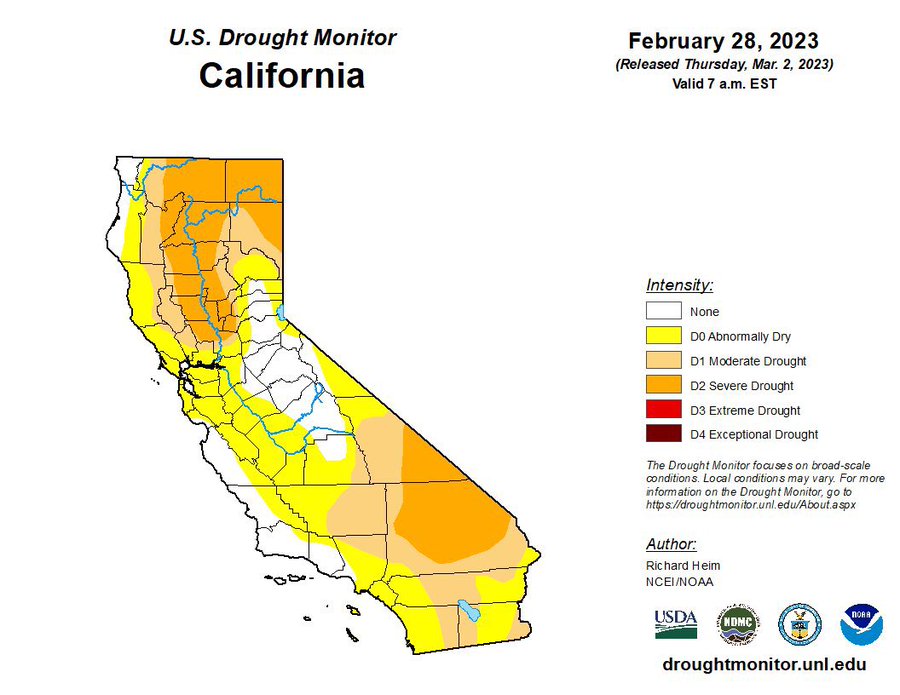
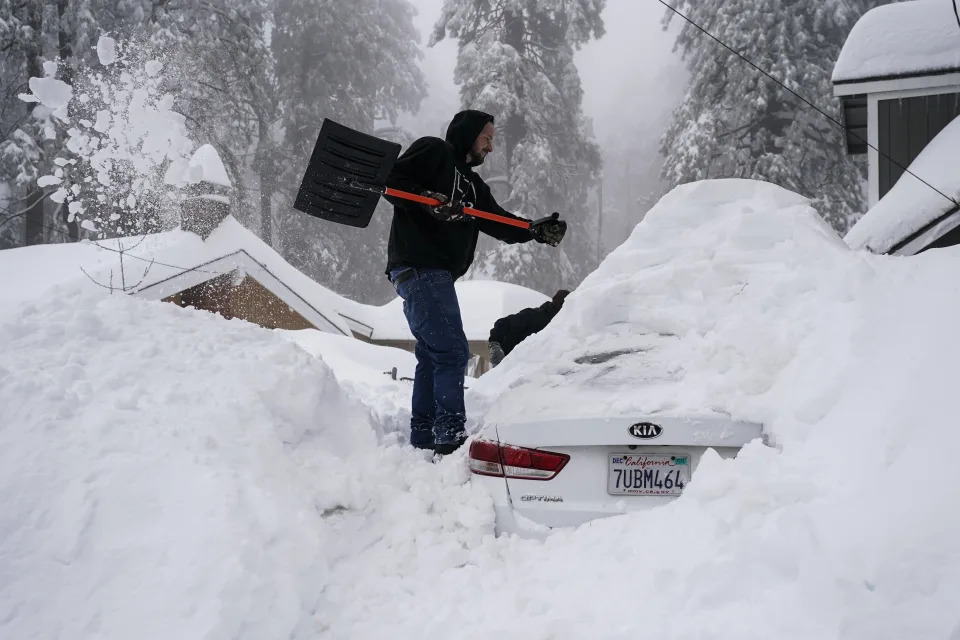
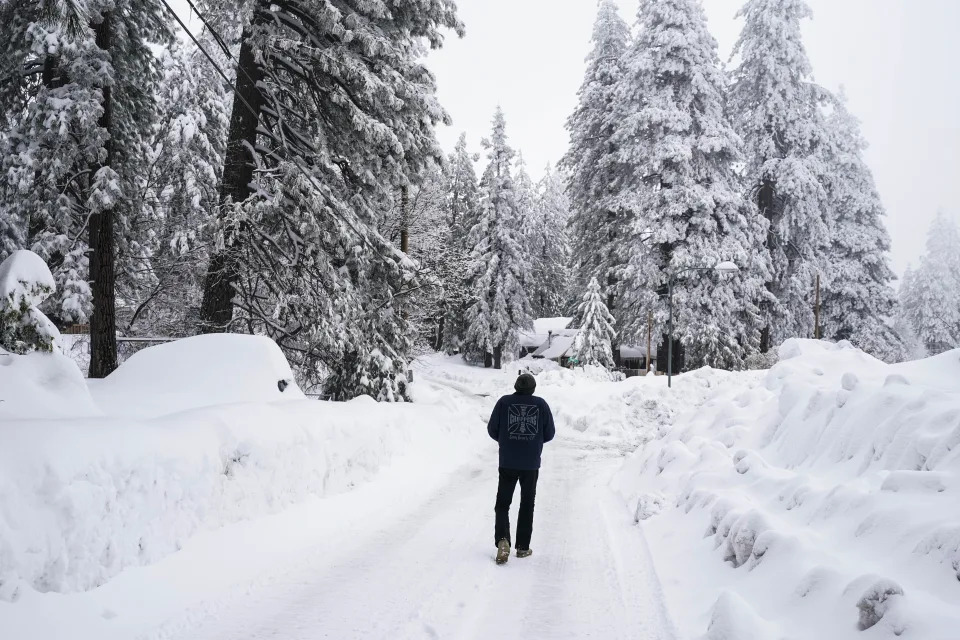
Kenny Rybak, 31, shovels snow around his car in Running Springs, Calif., Tuesday, Feb. 28, 2023. Beleaguered Californians got hit again Tuesday as a new winter storm moved into the already drenched and snow-plastered state, with blizzard warnings blanketing the Sierra Nevada and forecasters warning residents that any travel was dangerous. (AP Photo/Jae C. Hong)A local resident who declined to give his name walks to his home in Running Springs, Calif., Tuesday, Feb. 28, 2023. Tremendous rains and snowfall since late last year have freed half of California from drought, but low groundwater levels remain a persistent problem, U.S. Drought Monitor data showed Thursday, March 2. (AP Photo/Jae C. Hong)
LOS ANGELES (AP) — Olivia Duke said she’s been trapped in her home in the snow-plastered mountains east of Los Angeles for so long that by Thursday the only food she had left was oatmeal.
Snow plows have created a wall of ice between her driveway and the road in the San Bernardino Mountains, and there are at least 5 feet (1.5 meters) of snow weighing on her roof. While her power has been restored, she only has half a gallon of gas left for her generator in case it goes out again.
“California is not used to this. We don’t have this kind of snow,” said Duke, a corporate recruiter who lives in the community of Cedarpines Park. “I thought I was prepared. But not for this kind of Godzilla bomb of snow. This is something you couldn’t possibly really have prepared for.”
With Southern California’s mountain communities under a snow emergency, residents are grappling with power outages, roof collapses and lack of baby formula and medicine. Many have been trapped in their homes for a week, their cars buried in snow. County workers fielded more than 500 calls for assistance Wednesday while firefighters tackled possible storm-related explosions and evacuated the most vulnerable with snowcats.
Californians are usually elated to see snow-covered mountains from Los Angeles and drive a couple of hours up to sled, ski and snowboard. But what started out as a beautiful sight has become a hazardous nightmare for those renting vacation homes in the scenic, tree-lined communities or who live there year-round. Back-to-back-snowstorms have blanketed the region repeatedly, giving people no time to even shovel out.
Some resort communities received as much as 10 feet (3 meters) of snow over the past week, according to the National Weather Service. So much snow fell that ski resorts had to close and roads became impassable. No snow was falling Thursday, and authorities said they hoped to clear as much as possible from the roads while the weather was benign.
California Gov. Gavin Newsom declared an emergency in 13 counties late Wednesday and called up the National Guard to assist.
In the northern part of the state, mountain communities are grappling with similar conditions, though the population is smaller and residents are more accustomed to significant snowfall, said Brian Ferguson, a spokesperson for the governor’s Office of Emergency Services.
“These are just areas that don’t typically get that much snow,” he said of Southern California’s mountain communities. “It exceeded the public’s perception of what the risk is.”
James Norton, 39, said he and his girlfriend have been stranded in Crestline for nearly a week after their SUV got trapped in the snow. They’ve been racking up credit card debt to pay for a hotel while buying TV dinners from a nearby convenience store.
Norton, who lives about 45 minutes away in San Bernardino, said he is worried about losing his job at an Amazon packaging facility because he’s missing shifts. He said they made the trip to dog sit for a friend on Friday and thought they were prepared because he installed chains on the tires of the SUV.
“We knew there was going to be a snowstorm,” Norton said. “We didn’t know it was going to be a disaster.”
Firefighters have been evacuating residents who are medically vulnerable and have no heat or damaged homes to a Red Cross shelter set up at a local high school. They’ve also been responding to reports of gas leaks and storm-related fires with hydrants buried in deep snow, said Mike McClintock, San Bernardino County Fire Battalion Chief.
Two homes reported explosions that are under investigation but atypical for the area and likely storm-related, he said.
More than 1,000 customers lacked power as of Wednesday night, he said. Many roads were closed and emergency escorts provided to motorists earlier in the week to access the area were suspended as the region received a fresh 2 feet feet (60 centimeters) of snow.
About 80,000 people live in the San Bernardino Mountain communities either part- or full-time. The county has fielded more than 500 calls on a hotline set up for the emergency, many from people seeking plow assistance, baby formula and medicine, said Dawn Rowe, chair of the county board of supervisors.
Community members also have been helping each other through the Rim Guardian Angels Facebook group. They responded to requests to get an elderly man with high blood pressure to a hospital after he ran out of medication, to provide bandages to someone who suffered a deep laceration and food to people who were trapped in a rented house.
Andrew Braggins, 43, said the ceiling in his kitchen in Crestline began to bow from the weight of all the snow, prompting him to shovel his roof. The snow on it was 5 feet (1.5 meters) deep.
But Braggins, who is one of the administrators for the Facebook group, considers himself one of the luckier ones.
“I’ve got friends just a few roads away, and they’ve been without power for days,” said Braggins, who works as a wedding and event planner. “You can stock up for a storm. But this storm kind of kept coming.”
State officials are urging people to stay off mountain roads this weekend to keep them clear for first responders.
No snow is forecast for Southern California’s mountains for several days, but the National Weather Service said Northern California mountains can expect heavy snow on Saturday with a winter storm watch in effect for communities east of Sacramento to South Lake Tahoe on the Nevada border.
Letters to the Editor: Gavin Newsom’s very presidential blunder on water
March 2, 2023
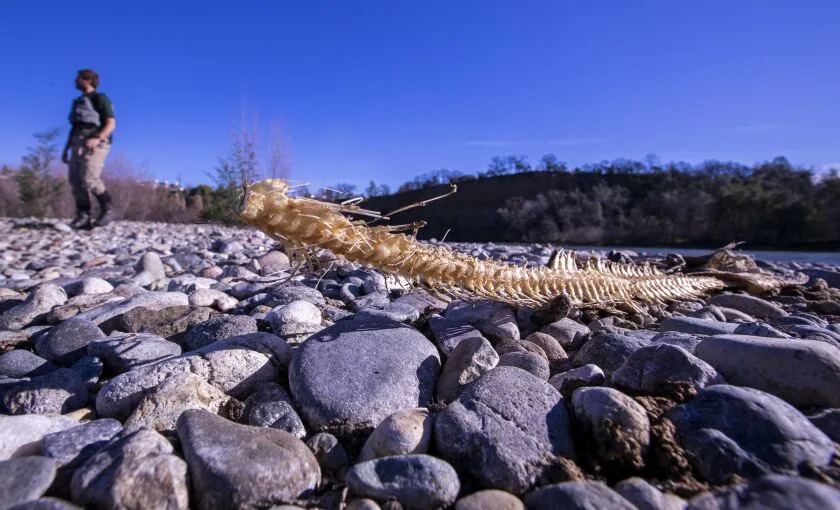
A biologist stands beside the bones of a dead Chinook salmon on the banks of the Sacramento River in Redding on Jan. 20. (Allen J. Schaben / Los Angeles Times)
Salmon don’t vote, make political contributions or confer with business interests nationally. They depend on our state leaders to protect them.
Newsom’s decision to cut river flows in favor of storage even after recent storms is a disappointing prioritization of profits for a few over the long-term needs of a declining natural resource that feeds Californians healthy protein.
Think about this as the next drought restrictions for Angelenos are imposed by the Colorado River negotiations, and remember that water is the other word for politics in our beloved state.
Carrie Chassin, Encino
..
To the editor: Thanks to Skelton for his continued coverage of our water shortage, or what Newsom calls the “drought.”
The signs in the Central Valley that declared “food grows where water flows” became annoying when I realized they were talking about overseas almond lovers’ food. It was enough to make a guy become an “America firster.”
Having lived in California almost 60 years, and having driven north many times each year, I’ve watched the way agriculture has changed. The first few years after the 5 Freeway opened, one drove through desert in the San Joaquin Valley. Available water changed that.
But for me, the most remarkable change was the miles and miles of almond trees I increasingly began to pass. I’ve come to believe using so much water for nonessential cash crops is wasteful, and the salmon that depend on river flows aren’t the only creatures suffering.
Robert Von Bargen, Santa Monica
..
To the editor: On behalf of the Southern California Water Coalition, I applaud Newsom’s swift action to keep more water in reservoirs by suspending a 1999 regulation temporarily.
We see this as a common-sense, prudent action to allow California to adapt in the face of changed climate conditions and severe pressure on the state’s other main source of supply, the Colorado River. Let’s hold on to this water now in case drier times are ahead.
That 1999 regulation, a fairly rigid rule tied to water-year type, was correctly suspended this February and March. It is incumbent on us all to support balanced, beneficial uses and time the release of water supplies to ensure we have the water that is needed for health and safety water for our urban communities, to sustain our economy and farms, and to protect our ecosystems and natural habitats.
Charles Wilson, Corona
The writer is executive director of the Southern California Water Coalition.
Soils of war: The toxic legacy for Ukraine’s breadbasket
Rod Nickel – March 1, 2023
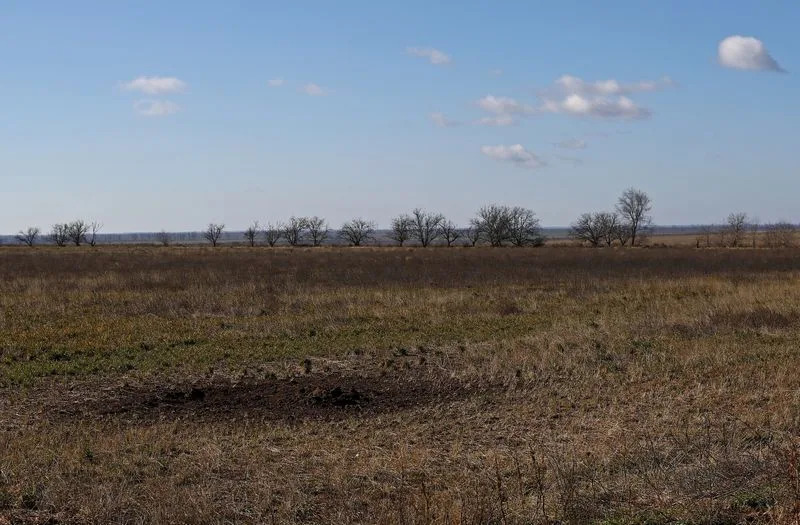
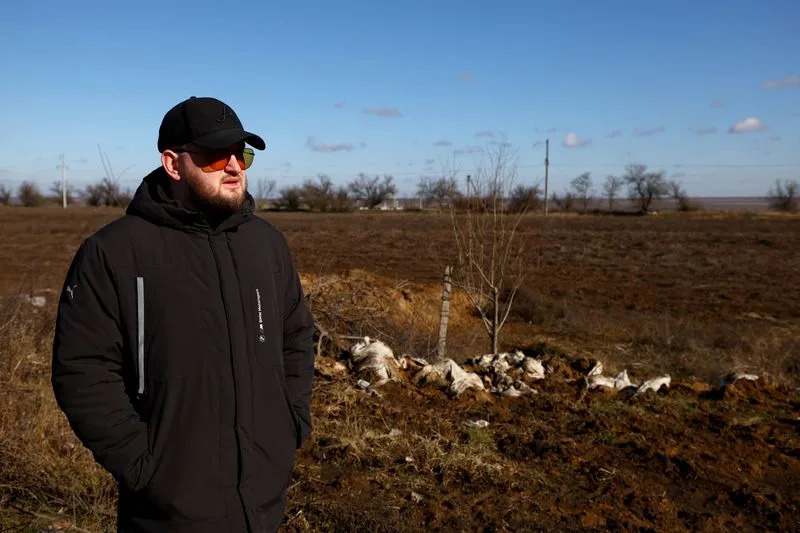
A view of the depression from shelling in field of grain farmer Andrii Povod that has been damaged by shelling and trenches, in BilozerkaGrain farmer Andrii Povod stands beside his field that has been damaged by shelling and trenches, amid Russia’s invasion of Ukraine, in BilozerkaA trench is seen near a field of grain farmer Andrii Povod, amid Russia’s invasion of Ukraine, in Bilozerka
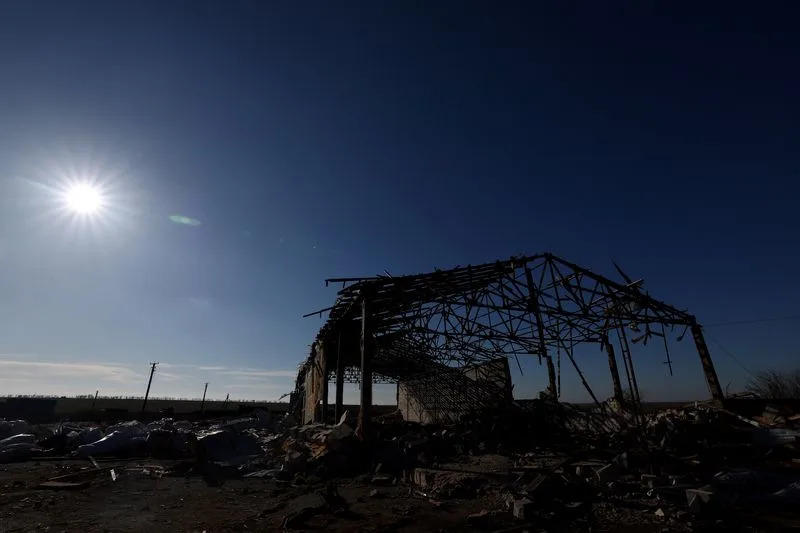
BILOZERKA, Ukraine (Reuters) – When Ukraine recaptured Kherson in November, Andrii Povod returned to find his grain farm in ruins. Two tractors were missing, most of the wheat was gone and all 11 buildings used to store crops and machinery had been bombed and burned.
The farm bears the scars of Russian shelling and unexploded ordnance riddles the fields but it’s the less visible damage to Ukraine’s famously fertile soil after a year of war that could be the hardest to repair.
Scientists looking at soil samples taken from the recaptured Kharkiv region in northeastern Ukraine found that high concentrations of toxins such as mercury and arsenic from munitions and fuel are polluting the ground.
Using the samples and satellite imagery, scientists at Ukraine’s Institute for Soil Science and Agrochemistry Research estimated that the war has degraded at least 10.5 million hectares of agricultural land across Ukraine so far, according to the research shared with Reuters.
That’s a quarter of the agricultural land, including territory still occupied by Russian forces, in a country described as the breadbasket of Europe.
“For our region, it’s a very big problem. This good soil, we cannot reproduce it,” said Povod, 27, walking around his farm near Bilozerka in southeast Ukraine, about 10 km (6 miles) from the Dnipro River that is one of the war’s front lines.
Two dozen experts who spoke with Reuters, including soil scientists, farmers, grain companies and analysts, said it would take decades to fix the damage to Europe’s breadbasket – including contamination, mines and destroyed infrastructure – and that global food supplies could suffer for years to come.
Shelling has also upset the delicate ecosystems of microorganisms that turn soil materials into crop nutrients such as nitrogen while tanks have compressed the earth, making it harder for roots to flourish, the scientists say.
Some areas are so mined and physically transformed by craters and trenches that, like some World War One battlefields, they may never return to farm production, some experts say.
LOSS OF FERTILITY
Before the war, Ukraine was the world’s fourth-largest corn exporter and fifth-biggest wheat seller, and a key supplier to poor countries in Africa and the Middle East that depend on grain imports.
After Russia’s invasion a year ago, global grain prices climbed as the Black Sea ports that usually ship Ukraine’s harvest closed, exacerbating inflation rates around the world.
The war damage could cut Ukraine’s potential grain harvest by 10 to 20 million tonnes a year, or up to a third based on its pre-war output of 60 to 89 million tonnes, the Soil Institute’s director, Sviatoslav Baliuk told Reuters.
Other factors are also important for production levels, such as the area of land farmers plant, climate change, the use of fertilisers and adoption of new farming technology.
Ukraine’s agriculture ministry declined to comment about soil contamination and long-term harm to the industry.
Besides the damage to the soil, Ukrainian farmers are struggling with unexploded shells in many fields, as well as the destruction of irrigation canals, crop silos and port terminals.
Andriy Vadaturskyi, chief executive of Nibulon, one of Ukraine’s biggest grain producers, expects demining alone to take 30 years and said urgent financial help was needed to keep Ukrainian farmers in business.
“Today, there is a problem of high prices but the food is available,” Vadaturskyi said in an interview. “But tomorrow, in one year’s time, it could be the situation if there is no solution, that it will be a shortage of food.”
Ukraine’s most fertile soil – called chernozem – has suffered the most, the institute found. Chernozem is richer than other soils in nutrients such as humus, phosphorus and nitrogen and extends deep into the ground, as much as 1.5 metres.
The institute’s Baliuk said the war damage could lead to an alarming loss of fertility.
Increased toxicity and reduced diversity of microorganisms, for example, have already reduced the energy corn seeds can generate to sprout by an estimated 26%, resulting in lower yields, he said, citing the Institute’s research.
ECHOES OF WORLD WAR ONE
A working group of soil scientists created by the Ukrainian government estimates it would cost $15 billion to remove all mines and restore Ukraine’s soil to its former health.
That restoration can take as little as three years, or more than 200, depending on the type of degradation, Baliuk said.
If studies of damage to land during World War One are anything to go by, some areas will never recover.
U.S. academics Joseph Hupy and Randall Schaetzl, coined the term “bombturbation” in 2006 to describe war’s impact on soil. Among the unseen damage, bomb breaches in bedrock or soil layers can change the water table’s depth, depriving vegetation of a shallow water source, they wrote.
At a former World War One battlefield near Verdun, France, some pre-war grain fields and pastures have gone unfarmed for more than a century due to craters and unexploded shells, a 2008 paper by Remi de Matos-Machado and Hupy said.
Hupy told Reuters that some arable land in Ukraine, too, may never return to crop production due to its contamination and topographic alteration. Many other fields will require significant earth-moving to relevel the ground, along with demining on a massive scale, Hupy said.
Naomi Rintoul-Hynes, senior lecturer in soil science and environmental management at Canterbury Christ Church University, studied soil contamination from World War One and fears the conflict in Ukraine is doing similar, irreversible damage.
“It is of utmost importance that we understand how bad the situation is as it stands,” she said.
Lead, for example, has a half-life of 700 years or more, meaning it may take that long for its concentration in the soil to decrease by half. Such toxins can accumulate so much in plants growing there that human health may become affected, Rintoul-Hynes said.
To be sure, World War One lasted four years, and the war in Ukraine only one year so far, but lead remains a key component of many modern munitions, Rintoul-Hynes said.
DEMINING CHALLENGE
Removing mines and other unexploded ordnance, which cover 26% of Ukraine’s land according to the government, will likely take decades, said Michael Tirre, Europe program manager for the U.S. State Department’s Office of Weapons Removal.
Andrii Pastushenko’s dairy farm in southeastern Ukraine, where he grows cattle feed and sunflowers, is pockmarked with craters and former Russian bunkers.
Though Ukraine recaptured the area in November, Russian forces shell his farm regularly from across the Dnipro River, blowing new holes in his fields and scattering unexploded ordnance, he said.
“We need many months to clear everything and continue to work, maybe years,” said Pastushenko, 39. “There is no help because we are on the first line of fire. No one will help while this is a war zone.”
There is currently no work underway on demining farms in the Kherson region because of a limited number of specialists, said Oleksandr Tolokonnikov, a spokesperson for the Kherson Regional Military Administration.
With so little help available, grain company Nibulon has created a small division dedicated to demining its land in southern Ukraine, a process expected to last decades, Mykhailo Rizak, Nibulon’s deputy director told Reuters.
“This is a very serious problem for Nibulon,” Rizak said.
There’s another long-term problem for Ukraine’s agricultural sector, which accounted for 10% of its gross domestic product before the war. That’s the damage to roads, railways and other infrastructure estimated at $35.3 billion and counting, the Kyiv School of Economics said in October.
“People think as soon as peace is achieved, the food crisis will be solved,” said Caitlin Welsh, director of global food security at the Center for Strategic & International Studies in Washington. “With Ukraine, just repairing the infrastructure is going to take a really long time.”
Farmers’ finances are also in a desperate state, said Dmitry Skornyakov, chief executive of HarvEast, a major Ukrainian farming company.
Many farmers can survive this year, living off the income of a bumper year just before the war, said Skornyakov, but he predicts up to half will have severe financial problems if the conflict drags into 2024.
“The future is from grey to dark at the moment.”
(Reporting by Rod Nickel in Bilozerka; Additional reporting by Pavel Polityuk in Kyiv; Editing by David Clarke)
Republicans seize on train derailment to go after Buttigieg
Yasmeen Abutaleb, Ian Duncan and Justine McDaniel – March 1, 2023
Transportation Secretary Pete Buttigieg and other federal officials examine a burned Norfolk Southern rail car in East Palestine, Ohio. (Allie Vugrincic/AP)
Republicans are seizing on the train derailment in East Palestine, Ohio, to ramp up their attacks against Transportation Secretary Pete Buttigieg, saying he is promoting his own agenda at the expense of families who are grappling with a toxic chemical accident in their backyard.
The Transportation Department does not have primary responsibility for the cleanup, and Buttigieg and his supporters are firing back, suggesting the GOP has other motives for its focus on him. The secretary, who sought the presidency in 2020, has taken the unusual step of responding directly to some of his critics, including Sen. Marco Rubio (R-Fla.), former president Donald Trump and Senate Minority Leader Mitch McConnell (R-Ky.).
The result is an unusually personal and, on occasion, vitriolic back-and-forth involving a transportation secretary who is also a rising star in his party, potential candidate for higher office and prominent gay official – far from the usual technocratic and logistical debates that surround the Transportation Department.
“I’ve never heard this level of criticism against another secretary, ever, and I’ve been following this a long time,” said Ray LaHood, a former Republican congressman who served as transportation secretary under President Barack Obama. “I’ve never seen it like this before. This is pure politics.”
Buttigieg has faced GOP criticism before, notably during supply chain disruptions early in Biden’s presidency and the failure of a federal aviation safety system in January. But people close to the transportation secretary say the attacks on him since the derailment have risen to a new level, noting that the Environmental Protection Agency, which is in charge of the response to the derailment, has taken far less heat.
Though part of a broader GOP criticism of the administration’s response to the derailment, the attacks on Buttigieg have in some cases been strikingly personal. Rubio tweeted that Buttigieg is “an incompetent who is focused solely on his fantasies about his political future & needs to be fired.” McConnell said on the Senate floor that Buttigieg is “more interested in pursuing press coverage for woke initiatives and climate nonsense than in attending to the basic elements of his day job.”
Some critics suggest Buttigieg should have been on the scene earlier – he visited East Palestine on Feb. 23, almost three weeks after the accident – but many of the accusations lack specificity, instead taking the secretary to task largely for his broader positions on issues such as the climate.
Buttigieg is one of the Biden administration’s most visible messengers, a deft debater who, unlike many Democrats, is often willing to appear on Fox News and other conservative outlets to advocate the White House’s priorities. A surprise star of the 2020 Democratic primaries, he moved last year from deep-red Indiana to the bluer state of Michigan, fueling speculation about further political ambitions.
Jeffrey Shane, a senior Transportation Department official during the presidency of George W. Bush, said that is one reason Buttigieg is receiving this level of attention. “Because his last act was running for president, Secretary Buttigieg is an unusually high-profile person to have the DOT job,” Shane said. “That visibility, together with genuine challenges in transportation and a toxic atmosphere in Washington, have combined to make this a difficult time.”
The White House argues that the administration implemented a by-the-book response to the train derailment, quickly dispatching federal experts from numerous agencies. The derailment itself did not harm or kill anyone, but some of the rail cars were carrying hazardous chemicals that leaked and burned in a massive fire.
Three days after the crash, officials decided to release vinyl chloride from five rail cars to prevent them from exploding, a controversial decision that spewed more chemicals into the air and yielded photos of an ominous-looking black plume looming over East Palestine.
The Transportation Department, while concerned with the conditions leading to the crash, did not have a central role in the response. The department did send experts to help the National Transportation Safety Board investigate, and the head of the Federal Railroad Administration, part of the Transportation Department, has also visited the scene.
Buttigieg has conceded that he should have spoken out sooner to convey his concern about the accident and the people in the area. “That’s a lesson learned for me,” he told CBS News.
While the Transportation Department is weighing new safety rules in the accident’s aftermath, it is the EPA that is the lead federal agency on the ground, monitoring toxins and overseeing the cleanup effort by Norfolk Southern, the company that operated the train. Still, Republicans have not gone after EPA Administrator Michael Regan or other federal officials in the same way they have targeted Buttigieg.
Some conservatives have tried making a broader argument – that Biden and his team do not care about East Palestine because it is a Republican, rural, largely White town. “Is it because these are not their voters?” Fox News host Tucker Carlson asked Sen. J.D. Vance (R-Ohio), who agreed.
Others have taken it further, taking the opportunity to wrap Buttigieg’s sexual orientation into their criticism. Donald Trump Jr., the former president’s son, said late last month that Buttigieg got his job solely because Democrats wanted to give a role to “the gay guy.” Long before the derailment, some Republicans mocked Buttigieg’s decision to take paternity leave after his twins were born and to bring his husband, Chasten, with him on a military jet.
That has led to allegations that the post-derailment criticism stems in part from homophobia.
“Whether it’s sickening attacks on his family or disrespecting a community’s pain with failed attempts at exploitation as a political prop, nothing saps credibility like following debunked smears with even more debunked smears,” deputy White House press secretary Andrew Bates said in a statement.
In East Palestine last month, former New York mayor Rudy Giuliani cited Buttigieg’s paternity leave as he criticized him for purportedly taking too long to visit the town. Giuliani, a Trump ally, referred to his own experience leading New York at the time of the Sept. 11, 2001, terrorist attacks.
“One of the main rules in investigating a murder is: Every day you miss is one more day inactive,” Giuliani said in an interview. “It’s quite obvious that this mayor, who accomplished nothing as the mayor of a tiny town not much bigger than a New York City apartment building, seems to have no expertise.” Buttigieg was mayor of South Bend, Ind., when he launched his presidential bid in 2019.
Buttigieg has hit back directly against many of the attacks, an unusual approach for top officials, who often seek to remain above the fray. He has coupled that with invitations to his critics to help craft new rail safety guidelines, arguing that Republicans are at fault for blocking previous safety rules related to railways and chemical spills.
He accused Rubio of sending out a letter two years ago that was drafted by railway lobbyists. The senator responded that Buttigieg was “m.i.a. on the derailment” and was lying about the letter.
Buttigieg retorted: “The facts don’t lie. The 2021 letter you signed was obviously drafted by railroad industry lobbyists. It supports waivers that would reduce visual track inspections. Now: will you vote to help us toughen rail safety accountability and fines, or not?”
After McConnell’s floor speech accusing Buttigieg of pursuing “woke initiatives” and “climate nonsense,” Buttigieg cited a bridge in Kentucky that had benefited from the bipartisan infrastructure law, which the Transportation Department is helping implement.
“Respectfully, the Brent Spence Bridge we’re funding in Kentucky is hardly a ‘woke initiative.’ Fighting climate change isn’t ‘nonsense,'” Buttigieg tweeted. “And Leader McConnell could be enormously helpful by joining us in standing up to the railroad industry lobby to make hazardous trains safer.”
Republicans on the House Oversight Committee, meanwhile, said they were opening an investigation of the derailment and sent a letter seeking records from Buttigieg. “You ignored the catastrophe for over a week,” the letter said, accusing Transportation Department leadership of “apathy in the face of this emergency.”
Rep. Jamie B. Raskin (D-Md.) and other Democrats fired back that the letter “failed to ask a single legitimate question” about the cause of the derailment.
“If Committee Republicans are serious about uncovering the truth, it must do so by conducting thorough, fact-based oversight, which includes seeking answers from Norfolk Southern about its potentially harmful policies and ongoing efforts to influence federal railroad safety measures,” they wrote.
Biden administration officials note that the United States experiences about 1,000 derailments a year. They say they responded almost instantly to this one.
EPA personnel arrived at the crash site in the middle of the night on Feb. 4, a few hours after the train derailed, and began monitoring the air and water. The next morning, the NTSB, an independent agency, announced its investigation and was set to meet with local officials; the agency held two news briefings in East Palestine in the first three days of the crisis.
Ohio Gov. Mike DeWine, a Republican, has praised the administration’s response, telling reporters on Feb. 14 that Biden had offered federal help but that he had not taken the president up on it because the situation was under control.
As media attention on the derailment exploded that week, DeWine moved to secure more aid, and the administration sent teams from the Centers for Disease Control and Prevention, the Department of Health and Human Services and the Federal Emergency Management Agency.
In the past, transportation secretaries have sometimes visited disaster scenes, most often after incidents involving fatalities. In those cases, they have often waited several days to avoid causing a distraction and impeding the on-the-ground response.
Federico Peña, transportation secretary under President Bill Clinton, said he went to several accident scenes, adding that seeing the trauma firsthand enabled him to better push for improved safety measures.
Both Peña and LaHood also used disasters as springboards for efforts to overhaul transportation safety regulations, a playbook Buttigieg now seems to be using. Some Republicans, despite their criticism of his performance, have signaled a willingness to take part in such a push.
On Wednesday, Vance and Rubio sponsored bipartisan legislation that would advance many of the rail safety initiatives supported by the Transportation Department.
The Washington Post’s Meryl Kornfield contributed to this report.
A sunken boat reemerges in September 2022 in Lake Mead National Recreation Area, Nevada, after unprecedented drought. (David McNew/Getty Images)
Much of the Northern Hemisphere is struggling with drought or the threat of drought, as Europe experiences an unusually warm, precipitation-free winter and swaths of the American West remain mired in an epic megadrought.
But it’s not just those pockets feeling the pain in the U.S. Most of the Western United States is in some form of drought, with areas of extreme drought concentrated in the Great Plains and Texas. A 23-year megadrought has left the Southwest at the driest it is estimated to have ever been in 1,200 years, based on tree-ring data.
That’s very bad news for Texas cotton farmers. The New York Times recently reported that “2022 was a disaster for upland cotton in Texas,” leading to short supplies and high prices of tampons and cloth diapers, among other products. “In the biggest loss on record, Texas farmers abandoned 74 percent of their planted crops — nearly six million acres — because of heat and parched soil, hallmarks of a megadrought made worse by climate change,” the Times noted.
Even recent heavy storms in California haven’t brought the state out of drought, because the precipitation deficit is so big.
A car drives through a flooded road in Gilroy, Calif., in January. (Michael Ho Wai Lee/SOPA Images/LightRocket via Getty Images)
“I want to be clear that these storms — and the likely rain and snow we may get over the next few weeks — did not, nor will they fully, end the drought, at least not yet,” Yana Garcia, secretary of the California Environmental Protection Agency, said last Wednesday. “We’re in better shape than we were two months ago, but we’re not out of the woods.”
Just days earlier, Lake Powell, the second-largest U.S. reservoir, dropped to a new record low. Powell is created by a Colorado River dam along the Arizona-Utah border, and if the reservoir goes much lower, experts warn, water won’t be able to pass through it. Millions of people who rely on the Colorado would then lose access to their water supply.
“If you can’t get water out of the dam, it means everyone downstream doesn’t get water,” Brad Udall, a water and climate scientist at Colorado State University, told USA Today. “That includes agriculture, cities like Los Angeles, San Diego and Phoenix.” The hydroelectric power plant for which the dam was constructed would also cease to function.
When the current 23-year megadrought plaguing the American West began, Lake Powell and Lake Mead — the largest U.S. reservoir, also on the Colorado — were 95% full. Now, they’re one-quarter full, according to Udall.
Logs and driftwood on Sept. 8, 2022, near Hite, Utah, remain where they settled when Lake Powell was at its highest-ever water level. (David McNew/Getty Images)
In order to prevent what one California official calls “a doomsday scenario,” the Department of the Interior will have to impose reductions in water allotments for downriver users.
Scientists say that the underlying conditions — growing demand for water and naturally occurring periodic drought — are being exacerbated by climate change. Warmer temperatures cause more water to evaporate, making both droughts and heavy precipitation more extreme. Climate change makes droughts “more frequent, longer, and more severe,” according to the U.S. Geological Survey.
“It’s unfortunate that the largely natural occurrence of a drought has coincided with this increasing warming due to greenhouse gases,” Flavio Lehner, a professor of atmospheric sciences at Cornell University, said. “That has brought everything to a head much earlier than people thought it would.”
In Europe, an unusually warm, dry winter has forced ski resorts in the Alps to close for lack of snow, and left the canals of Venice running dry in Italy. Some of the city’s iconic gondolas are stuck in the mud. Europe experienced its third-warmest January on record, France has seen a record dry spell of 31 days without rain, and the Alps have received less than half their normal snowfall so far this winter.
Last Wednesday, Britain’s National Drought Group warned that one hot, dry spell would return England to the severe drought conditions it endured last summer.
Low water levels at Baitings Reservoir on Aug. 12, 2022, reveal an ancient packhorse bridge amid a heatwave in the U.K. at Ripponden, West Yorkshire. (Christopher Furlong/Getty Images)
The threat goes beyond tourism: A study published last month by researchers from Graz University of Technology in Austria warned that Europe’s drinking water supply has become “very precarious.” Much of Europe has been in a drought since 2018, and a review of satellite data of groundwater confirmed acute shortages in parts of France, Italy and Germany.
“A few years ago, I would never have imagined that water would be a problem here in Europe,” Torsten Mayer-Gürr, one of the researchers, said.
This development follows a summer of record-breaking heat waves and droughts that left thousands dead across the continent, as well as the worst wildfire season on record. Europe’s hot, dry summer coincided with acute droughts in the U.S. — even in normally wet regions like the Northeast — and in Asia. The dropping water levels revealed buried artifacts, including the wreckage of a German World War II warship in Serbia, dead bodies in Lake Mead and ancient Buddhist statues in China’s Yangtze River.
Last summer’s drought across the Northern Hemisphere was made 20 times more likely by climate change, according to an October 2022 study by World Weather Attribution, a group of international scientists who explore the link between global warming and the increasingly frequent and severe extreme weather events it causes.
An emaciated cow stands at the bottom of a water pan that has been dried up for 4 months, in Iresteno, a town bordering Ethiopia, on Sept. 1, 2022. (Yasuyoshi Chiba/AFP via Getty Images)
The worst impacts of ongoing drought are being felt in the Horn of Africa, where millions of residents in Ethiopia, Kenya and Somalia are contending with food insecurity due to poor harvests. The region faces a forecast of a sixth consecutive low rainy season this spring.
Meanwhile, it’s summer in the Southern Hemisphere, and crop yields are being diminished by drought there as well. Argentina is a leading exporter of soy and corn, but its production is being drastically reduced this year as extremely high temperatures exacerbate a drought.
Climate scientists say that adaptation to climate change-related droughts is essential, including reducing water usage and building new infrastructure, like aquifers, to better manage water resources.
As climate change alters Michigan forests, some work to see if and how the woods can adapt
Keith Matheny, Detroit Free Press – February 27, 2023
It’s as integral a part of Michigan’s fabric as its lakes and rivers: more than 20 million acres of forest land − the hickory and oak trees of southern Michigan giving way to forests of sugar maple, birch and evergreens that surround northbound travelers.
But a warming climate is harming and transforming the woods, with further, even more dramatic impacts projected by near the end of the century.
Michigan has perhaps the most exceptional forest makeup in North America, as boundaries of multiple forest types converge here: The vast boreal forest, its cold-hardy conifer trees stretching far into Canada, dips into the Upper Peninsula and northern Michigan. A diverse mixed zone then gives way to the great Eastern Broadleaf Forest across the central and southern Lower Peninsula, dominated by beech, maple, oak and hickory trees. Even the grassland prairies of the Plains states extend into far southwest Michigan.
It’s the changes happening first at these border zones that give Michigan a front-row seat to climate change impacts on the forest the rest of the 21st century.
Climate change carries a host of stresses for the woods. Milder winters are leading to earlier, longer growing seasons, often better news for invasive, undesirable shrubs and weeds than for desired tree species. Less-frigid winters also improve invasive insects’ survival, fueling a northward migration of problems such as emerald ash borer, hemlock wooly adelgid and beech bark disease, which is caused by an interaction between an insect and fungus. And the hotter, drier conditions many scientists predict in coming decades will leave the tree species dominating the far north struggling to adapt.
“We expect to see species range shifts − species at the southern edge of their ranges, those boreal-associated species like black spruce, quaking aspen and white birch, may lose suitable habitat in the state,” said Ryan Toot, a watershed forestry specialist with the U.S. Forest Service based in St. Paul, Minnesota.
That’s messing with one of Michigan’s most golden of gooses. The forest products industry provides 96,000 jobs and contributes $20 billion annually to Michigan’s economy, according to the Michigan Department of Natural Resources. The north woods are a vital part of hunting, fishing and other tourism that brings in more than $20 billion more.
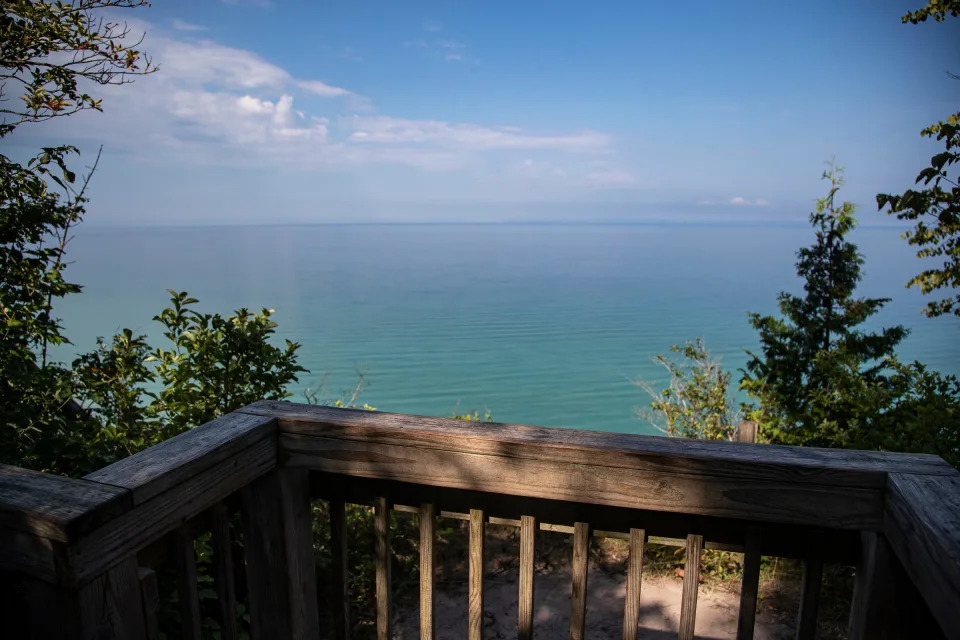
A view of Lake Michigan at the Clay Cliffs Natural Area in Leland on Wednesday, Aug. 24, 2022. (Photo: Junfu Han, Detroit Free Press)
University of Michigan forestry ecologist Peter Reich this month published the findings of a five-year study exposing seedling trees of the boreal and mixed hardwoods forest in northeastern Minnesota to increased temperatures and decreased summer rainfall — mimicking the projected warming and conditions under two different scenarios, one where considerable effort is made to reduce greenhouse gas emissions driving climate change; another with more business-as-usual emissions. They found even the more modest emissions scenarios had a devastating effect on the young trees.
“The prognosis for the forest is not great,” said Reich, director of the University of Michigan’s Institute for Global Change Biology.
“It may be we are at a tipping point beyond which these northern species just can’t hack it. Nature is really resilient, but we are pushing it really far, maybe up to its boundaries.”
Reich has been experimenting in the boreal forest in northeastern Minnesota for 14 years, trying to better understand how oncoming climate change is going to influence the forest in the transition zone where colder and more temperate tree species converge.
“We see that many of these spruce and fir forests are doing poorly,” he said. “But temperature is changing, precipitation is changing, fire regimes are changing. There are more insects, we’ve changed management, there is rising CO2, there is changing ozone pollution — it’s hard to know which one of those is driving the change when you just observe forests.”
So Reich and his research team set out to control particular variables. They installed heat lamps and underground warming cables in outdoor plots, exposing nine species of seedlings to increased temperatures over the ambient weather: boreal species, including white spruce, balsam fir, jack pine and paper birch; and more temperate species, including white pine, red oak, burr oak, sugar maple and red maple.
Two levels of potential 21st-century climate warming were used: roughly 1.6 degrees Celsius (about 2.9 degrees Fahrenheit) and roughly 3.1 C (about 5.6 F) above ambient temperatures.
“Unfortunately, you’re going to get to either one (of those temperature increases) in any scenario that’s realistic,” Reich said.
“You can think of it as what we are going to get to in 40 or 50 years if we slow down climate change, versus if we don’t.”
On some seedling plots, the researchers also captured some of the summer rains, preventing the water from reaching the young trees’ roots, to simulate drier conditions that could be coming with later-century warming. Control plots were also planted, allowing seedlings of the same tree species to experience natural conditions.
The findings surprised Reich and his team. Even the more modest levels of warming had a big impact.
“Even the spruce and fir, which are the most boreal of the species, we thought they would do a little bit more poorly with 1.5 degrees Celsius warming — maybe 5% or 10% slower growth and 5% or 10% more mortality,” he said. “But fir in particular had 30% to 40% poorer growth and survival. Quite a dramatic change with what’s not really a very big temperature change.”
While more southerly tree species might one day expand their ranges northward to exploit where boreal species are failing, that’s not likely to be an orderly transition.
“What’s going to fill the gap are shrubs — either native shrubs or invasive shrubs, the buckthorns and honeysuckles of the world, expanding north,” Reich said.
“You might end up with a forest zone that for the next 50, 100, 150 years is kind of trashy — is neither economically nor ecologically what we want.
“You’re not going to get any two-by-fours out of buckthorn.”
The ‘climate change help desk’ for foresters
The U.S. Forest Service has been thinking about climate change’s impacts on the woods longer than most. It founded the Northern Institute of Applied Climate Science in 2009, a collaborative effort among the service, universities, conservation organizations, the forest industry and landowners to develop adaptation strategies for the changing landscape.
“NIACS is like the climate change help desk, or a climate change phone-a-friend service, for land managers of all kinds, all across the Midwest and Northeast,” said Stephen Handler, a climate change specialist for NIACS based at the Forest Service’s Northern Research Station in Houghton.
“When we started at NIACS with this interest of educating people about climate change impacts and thinking about how to adapt, we were in front of a lot of critical audiences. And now, more often, it’s more like folks are drawing us in. Saying ‘We are ready to talk about this. We recognize things are shifting and we need to be agile and keep up with the change.’ “
The group provides the best, most recent available science to whoever asks: the timber industry, state natural resources agencies, parks managers, private landowners. It includes regional evaluations of which tree species are expected to adapt poorly to climate change, which are expected to do better and perhaps expand their ranges, and those in the middle. Through checklists, interested parties can conduct their own vulnerability assessments.
“They are making the choices for themselves, which we think is the appropriate way to go,” he said. “Because every land manager is going to have a different appetite for risk and a different set of values.”
Family and small private landowners account for about 54% of forest land ownership in Michigan. How climate change’s impacts on the woods are responded to is largely in the hands of individuals, families, companies and communities.
“You’re going to have a pretty diverse set of choices being made across the landscape − preservation in some areas, encouraging change in other areas, a lot of places in the middle,” Handler said. “That could be a strength.”
Is assisted migration part of the answer?
A great debate among those who care about the climate-changed forest is how much attention and effort should be spent on trying to maintain what exists in an area now and how much should be devoted to preparation for what may better fit future conditions.
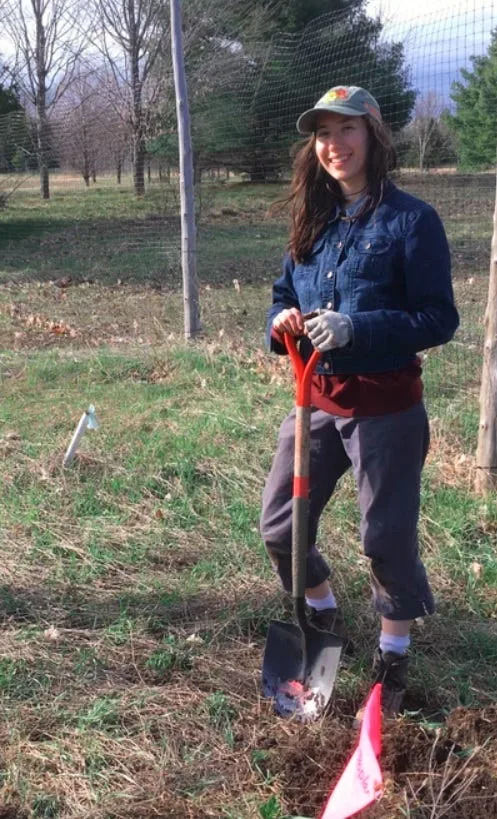
NIACS climate adaptation specialist Madeline Baroli, founder of the Assisted Tree Range Expansion Project, pauses during planting in northwest Lower Michigan in the spring of 2020.
Madeline Baroli has her boots on the ground and her hands dirty, conducting a big experiment across northwest Lower Michigan to help clarify the answer. Baroli, a NIACS climate adaptation specialist, also founded the Assisted Tree Range Expansion Project, a community science experiment that started in 2020 from her postgraduate work with the Leelanau, Grand Traverse and Benzie county conservation districts.
“Really, it’s all about supporting the resilience of our forests by planting and monitoring certain select tree species that are projected to have future suitable habitat in this region,” she said.
The nuances can get controversial. In some parts of the country, transplants introducing new tree types generated backlash. Others are experimenting with the concept of assisted population migration — taking existing tree species in northern Michigan, such as white pine, but introducing the genetics of trees of that species grown in, say, Ohio or Kentucky, trees more adapted to a warmer climate.
Baroli’s focus, instead, is on what scientists call assisted range expansion, taking trees already in Michigan but whose range stops only partway up the Lower Peninsula, and planting them farther north.
“So we’re really just expanding that bubble, that range a little farther, to match what the projections from the U.S. Forest Service Climate Change Tree Atlas have modeled,” she said.
The six trees selected for the initial plantings were selected using those models and through conversations with local professional foresters and other natural resources professionals, she said. The first trees chosen for the project were shagbark hickory, tulip trees, sassafras, black tupelo, hackberry and swamp white oak.
Baroli noted that the trees already have some presence Up North, and would potentially be more established there were it not for the fragmentation of their range by highways and agriculture in the southern and mid-Lower Peninsula.
“That’s where I feel we really sort of owe it to the forest to lend a helping hand − because we’ve also altered the landscape in such a way that it limits natural range expansion,” she said.
The first plantings were in the spring of 2020 − just as COVID-19 began to disrupt life.
“We were doing our tree sale, selling the seedlings and trying to get the word out there,” she said. “Luckily, everybody was migrating online, and looking for socially distant things to do. So we really had a pretty successful first two seasons.”
Over 2020 and 2021, more than 2,000 trees were planted by individuals, community groups and families. Baroli did not yet have figures for plantings from this spring.
People are asked to report over time how the trees’ growth progresses.
“What I hope, what’s really important, is just keeping forests as forests,” Baroli said. “At the end of the day, we aren’t really in control of exactly what a forest is going to look like or be − we can’t be. The idea is to reduce that fragmentation … ensure the forests themselves have a chance to adapt, on their own with our help.”
Deer, disease amplifying tree threats
Visitors to the Leelanau Conservancy’s Palmer Woods, a natural area of more than 1,000 acres, have seen something different in recent years: Young trees with protective tubes around their trunks and a large, 35-acre portion of the preserve surrounded by a large wire fence.
It’s all efforts to curb what’s one of the biggest killers of young trees in the region: deer munching on them.
“A lot of the seedlings don’t really have the chance to get to the adult stage,” said Becky Hill, director of natural areas and preserves for the conservancy. “In some of the forests where we have heavy (deer) browsing, you see a lot of adult trees and a lot of seedlings, but not a lot of in-between trees.”
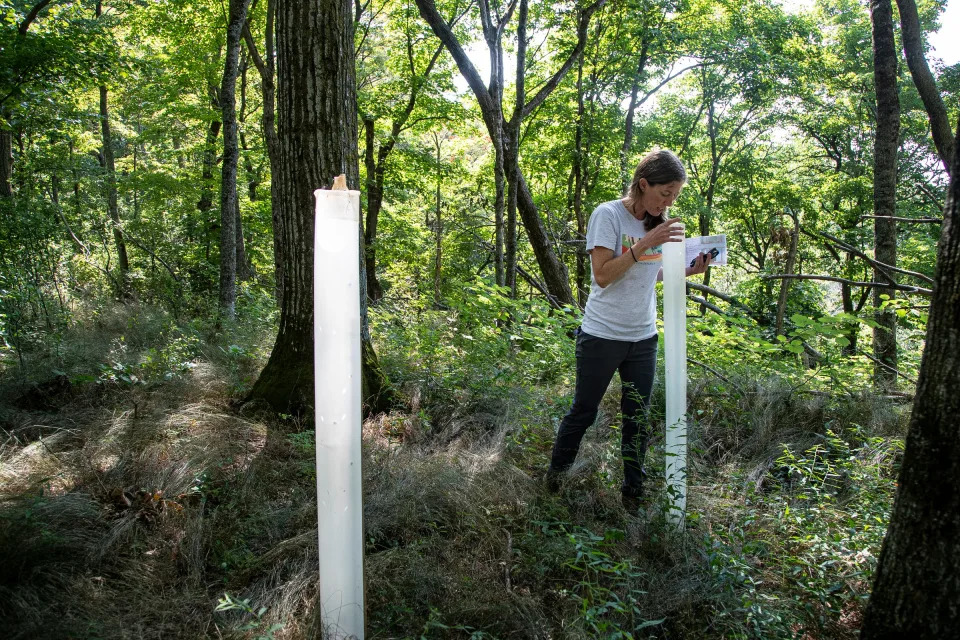
Becky Hill, Leelanau Conservancy’s Director of Natural Areas and Preserves checks on the growth of a sassafras tree in a protective tube at the Whaleback Natural Area in Leland on Wednesday, August 24, 2022. The Conservancy planted around 200 trees this past spring.
It’s a problem expected to worsen as the region further warms. Milder winters will allow more deer to survive, breed and then feed on the young trees.
“Foresters have a really keen eye on how that next generation of trees is coming in,” Baroli said. “Young trees are more sensitive to things than older trees. First off, the deer love them; they are great deer food. And we have a huge deer population.
“If they are eating those young trees, those young trees aren’t growing up into a future forest. And then if you just have older trees dying off, it’s a problem.”
Beech trees might be nearly doomed
Another pest devastating trees in the region is beech bark disease. A tiny insect called a scale wounds the tree by piercing its bark with sharp mouth parts and sucking out sap. A type of fungus can then enter and infect the tree, weakening it over years until mature trees, almost hollowed out, snap dead.
Milder winters predicted in future warming scenarios will allow more of the insects to survive and infect trees.
“It’s pretty much devasted the population of beech; we are expecting 99% (beech tree) die-off,” Baroli said.
A dead beech tree in the center at the Clay Cliffs Natural Area in Leland on Wednesday, August 24, 2022.White fuzzy scale insects on the trunk of a beech tree at the Clay Cliffs Natural Area in Leland on Wednesday, August 24, 2022.
Emerald ash borer is similarly killing millions of ash trees across Michigan.
The Leelanau Conservancy is using the unfortunate circumstance to adopt some of the NIACS’s recommended population migration trees prepared for a warmer climate.
“When we have a die-off where a lot of beech and ash have died, suddenly in our forest we might have a sunny opening,” Hill said. “There are certain species that really need more sunshine to get established − cherries, oaks, other types of species that thrive in those conditions. If we can help get them established, that succession of growth will happen over time.”
The conservancy also hopes to use new tree planting to combat the invasive autumn olive, a shrub “that just takes over fields to the point where you see these autumn olive forests,” she said.
“We’re hoping to get some species growing in there, to get established and maybe help shade out some of the invasive shrubs while creating good wildlife habitat.”
The changing climate is bringing ecological changes “so rapidly,” Hill said.
“It just feels like it’s harder,” she said. “You see the decline of bird species, insects, they are having a hard time keeping up with all of these drastic changes.”
The Michigan forest of 2100 − what will it look like?
Reich envisions a significantly transformed northern Michigan woods by century’s end.
“My hunch is by 2100, we’ll lose most of the spruce and fir,” he said. “We might lose some of the white cedar. The forests will be scrubbier and more open. They may still have a mix of species but will be less diverse … a few areas that are sandier and drier may even convert to grasslands.”
Those changes will have unpredictable impacts on animal habitat, the state’s timber industry and how people can use the forests for recreation.
And it may become a negative feedback loop, accelerating and worsening climate change. Forests take carbon out of the atmosphere and store it in soils and roots and their wood.
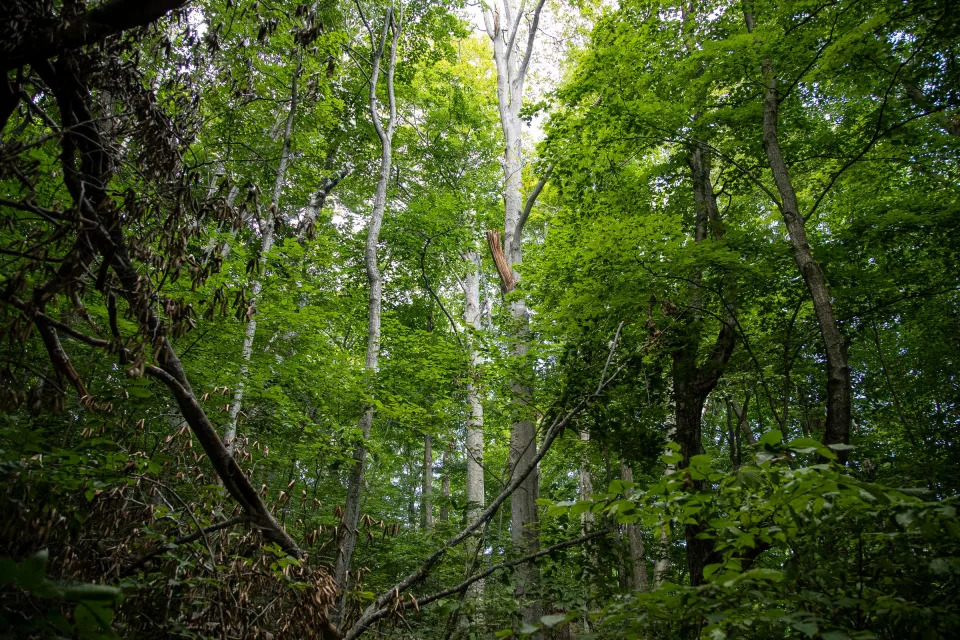
Leelanau Conservancy’s Palmer Woods Forest Reserve in Maple City on Wednesday, Aug. 24, 2022.
Peat forests, the wet fens prevalent in the Upper Peninsula, make up only 3% of the globe’s forest land but store 30% of soil carbon. A square meter of U.P. or Canadian peatland holds five times the carbon as a square meter of Amazon rainforest.
In a 2020 U.S. Forest Service study similar to Reich’s, peatlands were exposed to controlled, increased temperatures. The results showed the warming causes peatlands to release carbon faster than anticipated, converting them from carbon-storers to carbon-emitters.
“It could be a double-whammy; instead of helping slow climate change, they would be accelerating it,” Reich said.
Tree planting and assisted migration approaches can have some local benefits. But those are ultimately just Band-Aids, he said.
“In order to maintain the economic value of our forests, we do need to manage them to try to make them as resilient as possible in the face of these changes,” he said. “But there are real limits to how much we can do. There are vast forests out there — we don’t have the personnel or the money to try to thin all of the forests and replant them.
“We really need to work at the root cause of this problem, which is climate change.”