It’s mid-March and the Great Lakes are virtually ice-free. That’s a problem.

Akron Beacon Journal

It’s mid-March and the Great Lakes are virtually ice-free. That’s a problem.

Caitlin Looby, Akron Beacon Journal – March 19, 2023

Trumpeter swans find some open water along the Lake Erie shore last month. The ice in Ottawa County has melted since then as temperatures have been unseasonably warm.

It’s the middle of March and the Great Lakes are virtually ice-free.

Ice has been far below average this year, with only 7% of the lakes covered as of last Monday — and no ice at all on Lake Erie. Lake Erie’s average ice coverage for this time of year is 40%, based on measurements over the past half-century. The lake typically freezes over the quickest and has the most ice cover because it’s the shallowest of the five Great Lakes.

But communities along Ohio’s north coast, including Cleveland, Sandusky and Port Clinton, have seen considerably less ice forming on Lake Erie in recent years.

According to the National Oceanic and Atmospheric Administration’s Great Lakes Environmental Research Laboratory, Lake Erie’s ice coverage peaked in early February at 40%, a nearly 20% decrease from the historical average.

No ice isn’t a good thing for the lakes’ ecosystem. It can even stir up dangerous waves and lake-effect snowstorms.

So, what happens when the lakes are ice-free? What does it mean for the lakes’ food web? Is climate change to blame?

Little ice cover can be disastrous

This winter has already proved how dangerous lake-effect snow can be.

At the end of November, more than 6 feet of snow fell on Buffalo, New York, which sits on the shores of Lake Erie. A few weeks later on Dec. 23, more than 4 feet of snow covered the city and surrounding areas once again. The storm resulted in 44 deaths in Erie and Niagara counties, which sit on Lakes Erie and Ontario, respectively.

December 2022 storm:Winter storm leads to more than 1,300 crashes, multiple fatalities on Ohio roads

Cleveland and Sandusky reside on the shores of Lake Erie as well. The 2022 storm that swept the region on Dec. 23 dropped relatively little snow, only about 2-4 inches, but created dangerous conditions nonetheless.

In some places in Northeast Ohio, temperatures dropped from nearly 40 degrees to zero and below. Wind chills fueled by hurricane-force winds dragged the temperature even lower to minus 30 or even 35 below zero. This storm was the first time in almost a decade that the Cleveland Weather Forecast Office issued a blizzard warning.

A 46-vehicle pileup on the Ohio Turnpike near Sandusky claimed four lives.
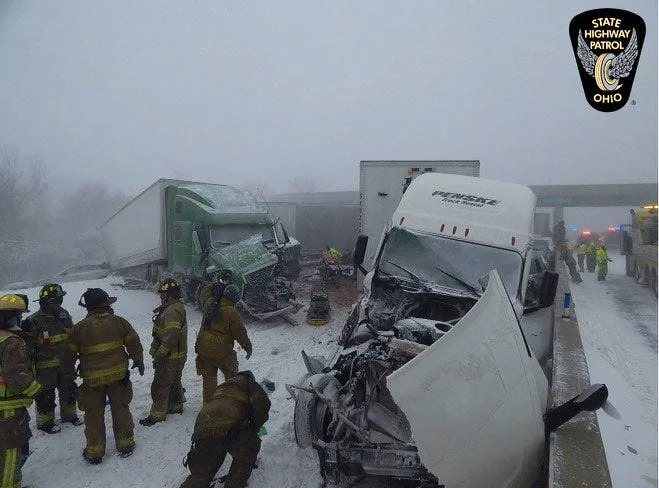
A 46-vehicle pileup killed four people injured many others on the Ohio Turnpike during a winter storm with whiteout conditions Dec. 23.

During stormy winter months, ice cover tempers waves. When there is low ice cover, waves can be much larger, leading to lakeshore flooding and erosion. That happened in January 2020 along Lake Michigan’s southwestern shoreline. Record high lake levels mixed with winds whipped up 15-foot waves that flooded shorelines, leading Gov. Tony Evers to declare a state of emergency for Milwaukee, Racine and Kenosha counties.

And while less ice may seem like a good thing for the lakes’ shipping industry, those waves can create dangerous conditions.

The Great Lakes are losing ice with climate change

The Great Lakes have been losing ice for the past five decades, a trend that scientists say will likely continue.

Of the last 25 years, 64% had below-average ice, said Michael Notaro, the director of the Center on Climatic Research at the University of Wisconsin-Madison. The steepest declines have been in the north, including Lake Superior, northern Lake Michigan and Huron, and in nearshore areas.

Record high temperatures:Another weather record broken in Greater Akron; third record high set this month

More: What’s the state of the Great Lakes? Successful cleanups tempered by new threats from climate change

But this also comes with a lot of ups and downs, largely because warming is causing the jet stream to “meander,” said Ayumi Fujisaki Manome, a scientist at the Cooperative Institute for Great Lakes Research at the University of Michigan who models ice cover and hazardous weather across the lakes.

There is a lot of year-to-year variability with ice cover spiking in years like 2014, 2015 and 2019 where the lakes were almost completely iced over.
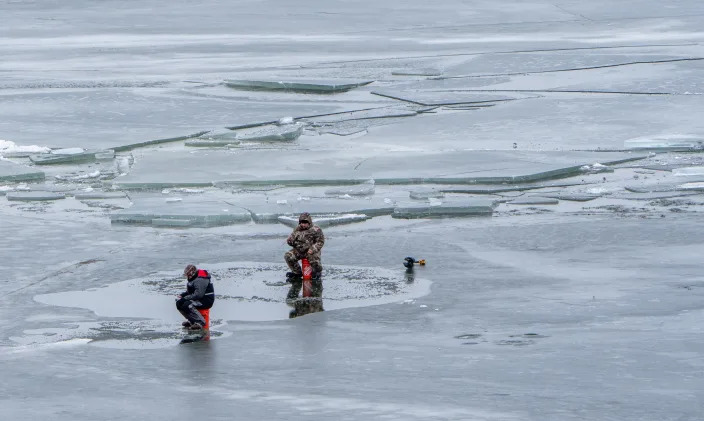
Ice fishermen stay close to shore off of Bay Shore Park in New Franken, Wisconsin, in January, which saw relatively little ice cover on the Great Lakes.
No ice makes waves in the lakes’ ecosystems

A downturn in ice coverage due to climate change will likely have cascading effects on the lakes’ ecosystems.

Lake whitefish, a mainstay in the lakes’ fishing industry and an important food source for other fish like walleye, are one of the many Great Lakes fish that will be affected, said Ed Rutherford, a fishery biologist who also works at the Great Lakes Environmental Research Laboratory.

Lake whitefish spawn in the fall in nearshore areas, leaving the eggs to incubate over the winter months. When ice isn’t there, strong winds and waves can stir up the sediment, reducing the number of fish that are hatched in the spring, Rutherford said.
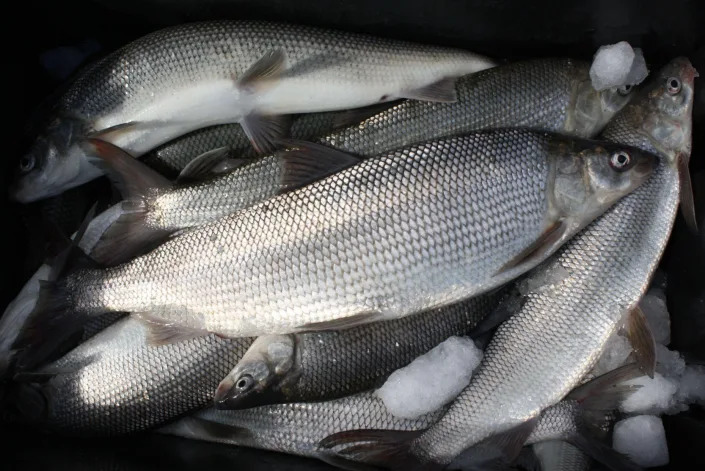
Whitefish haul from the Great Lakes.

Walleye and yellow perch also need extended winters, he said. If they don’t get enough time to overwinter in cold water, their eggs will be a lot smaller, making it harder for them to survive.

Even so, the Ohio Department of Natural Resources Division of Wildlife released a report stating that Lake Erie’s 2022 walleye and yellow perch populations in the central and western basins are above average. Yellow perch hatches in the central basin are below average, however.

Declining ice cover on the lakes is also delaying the southward migration of dabbling ducks, a group of ducks that include mallards, out of the Great Lakes in the fall and winter, Notaro said. And if the ducks spend more time in the region it will increase the foraging pressure on inland wetlands.

Warming lakes and a loss of ice cover over time also will be coupled with more extreme rainfall, likely inciting more harmful algae blooms, said Notaro. These blooms largely form from agricultural runoff, creating thick, green mats on the lake surface that can be toxic to humans and pets.
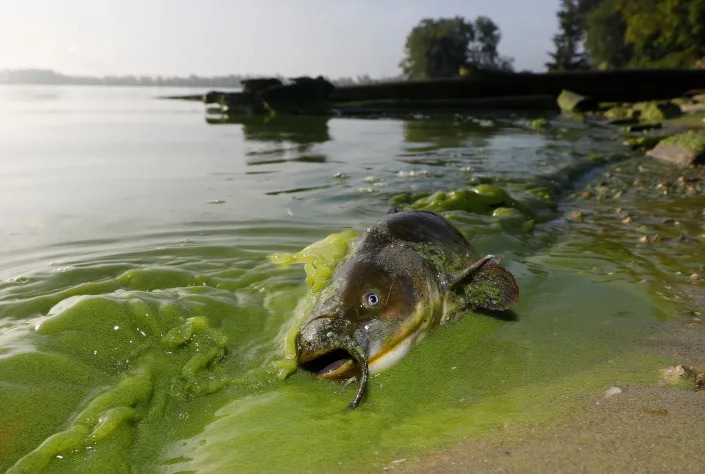
In this 2017 photo, a catfish appears on the shoreline in the algae-filled waters of Lake Erie in Toledo.

Lakes Erie and Michigan are plagued with these blooms every summer. And now, blooms cropping up in Lake Superior for the first time are raising alarm.

“Even deep, cold Lake Superior has been experiencing significant algae blooms since 2018, which is quite atypical,” Notaro said.

More: Blue-green algae blooms, once unheard of in Lake Superior, are a sign that ‘things are changing’ experts say

There is still a big question mark on the extent of the changes that will happen to the lakes’ ecosystem and food web as ice cover continues to decline. That’s because scientists can’t get out and sample the lakes in the harsh winter months.

“Unless we can keep climate change in check … it will have changes that we anticipate and others that we don’t know about yet,” Rutherford said.

Caitlin Looby is a Report for America corps member who writes about the environment and the Great Lakes. Beacon Journal reporter Derek Kreider contributed to this article.


Trump deregulated railways and banks. He blames Biden for the fallout

The Guardian

Trump deregulated railways and banks. He blames Biden for the fallout

David Smith in Washington – March 18, 2023

<span>Photograph: Scott Olson/Getty Images</span>
Photograph: Scott Olson/Getty Images

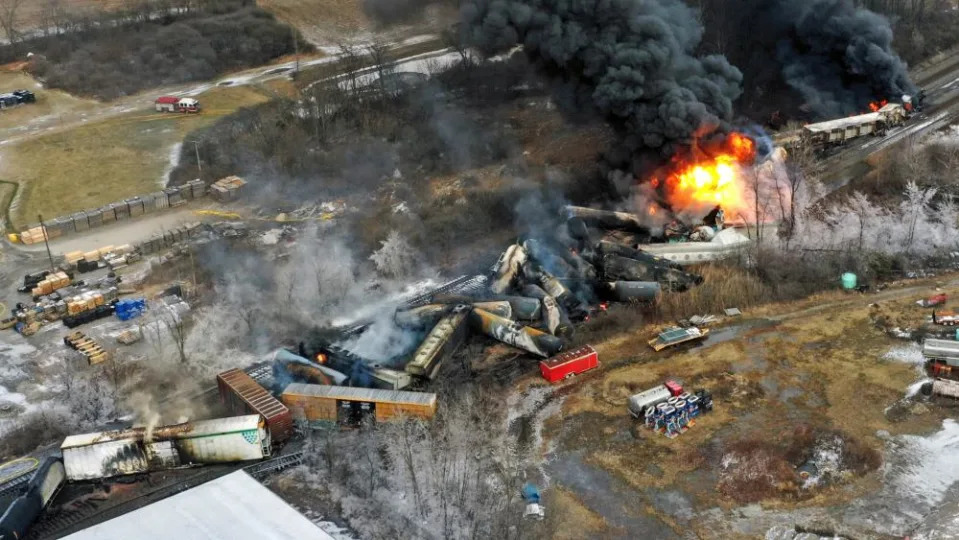
When a fiery train derailment took place on the Ohio-Pennsylvania border last month, Donald Trump saw an opportunity. The former US president visited East Palestine, accused Joe Biden of ignoring the community – “Get over here!” – and distributed self-branded water before dropping in at a local McDonald’s.

Related: Levels of carcinogenic chemical near Ohio derailment site far above safe limit

Then, when the Silicon Valley Bank last week became the second biggest bank to fail in US history, Trump again lost no time in making political capital. He predicted that Biden would go down as “the Herbert Hoover of the modrrn [sic] age” and predicted a worse economic crash than the Great Depression.

Yet it was Trump himself who, as US president, rolled back regulations intended to make railways safer and banks more secure. Critics said his attacks on the Biden administration offered a preview of a disingenuous presidential election campaign to come and, not for the first time in Trump’s career, displayed a shameless double standard.

“Hypocrisy, thy name is Donald Trump and he sets new standards in a whole bunch of regrettable ways,” said Larry Sabato, director of the Center for Politics at the University of Virginia. “For his true believers, they’re going to take Trump’s word for it and, even if they don’t, it doesn’t affect their support of him.”

The collapse of Silicon Valley Bank on 10 March and of New York’s Signature Bank two days later sent shockwaves through the global banking industry and revived bitter memories of the financial crisis that plunged the US into recession about 15 years ago.

Fearing contagion in the banking sector, the government moved to protect all the banks’ deposits, even those that exceeded the Federal Deposit Insurance Corporation $250,000 limit for each individual account. The cost ran into hundreds of billions of dollars.

Trump with crates of Trump water in East Palestine after a train derailed in Ohio.
Trump with crates of Trump water in East Palestine after a train derailed in Ohio. Photograph: Alan Freed/Reuters

The drama reverberated in Washington, where Trump’s criticism was followed by that of Republicans and conservative media, seeking to blame Biden-driven inflation or, improbably, to Silicon Valley Bank’s socially aware “woke” agenda. Opponents saw this as a crude attempt to deflect from the bank’s risky investments in the bond market and more systemic problems in the sector.

The 2008 financial crisis, triggered by reckless lending in the housing market, led to tough bank regulations during Barack Obama’s presidency. The 2010 Dodd-Frank Act aimed to ensure that Americans’ money was safe, in part by setting up annual “stress tests” that examine how banks would perform under future economic downturns.

But when Trump won election in 2016, the writing was on the wall. Biden, then outgoing vice-president, warned against efforts to undo banking regulations, telling an audience at Georgetown University: “We can’t go back to the days when financial companies take massive risks with the knowledge that a taxpayer bailout is around the corner when they fail.”

But in 2018, with Trump in the White House, Congress slashed some of those protections. Republicans – and some Democrats – voted to raise the minimum threshold for banks subject to the stress tests: those with less than $250bn in assets were no longer required to take part. Many big lenders, including Silicon Valley Bank, were freed from the tightest regulatory scrutiny.

Sabato commented: “The worst example is the bank situation because that is directly tied to Trump and his administration and changes made in bank regulations in 2018. Yes, some Democrats voted for it, but it was overwhelmingly supported by Republicans and by Trump who heralded it as the real solution to future bank woes.

The minority of Democrats who supported the 2018 law have denied that it can be directly tied to this month’s bank failures, although Bernie Sanders, an independent senator from Vermont, was adamant: “Let’s be clear. The failure of Silicon Valley Bank is a direct result of an absurd 2018 bank deregulation bill signed by Donald Trump that I strongly opposed.”

You do need government to regulate finance … but that point cannot be made if you’ve got Donald Trump inventing reality

Larry Jacobs

Sherrod Brown, a Democratic senator for Ohio who introduced bipartisan legislation to improve rail safety protocols, drew a parallel between the banks’ collapse to rail industry deregulation lobbying that contributed to the East Palestine train disaster. “We see aggressive lobbying like this from banks as well,” he said.

Trump repealed several Barack Obama-era US Department of Transportation rules meant to improve rail safety, including one that required high-hazard cargo trains to use electronically controlled pneumatic brake technology by 2023. This rule would not have applied to the Norfolk Southern train in East Palestine – where roughly 5,000 residents had to evacuate for days – as it was not classified as a high-hazard cargo train.

But the debate around the railway accident and bank failures points to a perennial divide between Democrats, who insist that some regulation is vital to a functioning capitalism, and Republicans, who have long claimed to believe in small government. Steve Bannon, an influential far-right podcaster and former White House chief strategist, framed the Trump agenda as “the deconstruction of the administrative state”.

Antjuan Seawright, a Democratic strategist, said: “The Republican party has gotten by for many years on this idea that less is better. However, we’re now learning in this country that, as America continues to mature, in some cases more is better, and more has to be how we get to better. Otherwise the mistakes can spin out of control and cause generations of people long-term damage.”

A Norfolk Southern freight train that derailed in East Palestine, Ohio, on fire on 4 February 2023.
A Norfolk Southern freight train that derailed in East Palestine, Ohio, on fire on 4 February 2023. Photograph: Gene J Puskar/AP

Biden called on Congress to allow regulators to impose tougher penalties on the executives of failed banks while Warren and other Democrats introduced legislation to undo the 2018 law and restore the Dodd-Frank regulations. It is likely to meet stiff opposition from the Republican-controlled House of Representatives and even some moderate Democrats.

Biden has also insisted that no taxpayer money will be used to resolve the current crisis, keen to avoid any perception that average Americans are “bailing out” the two banks in a way similar to the unpopular bailouts of the biggest financial firms in 2008.

But Republicans running for the 2024 presidential nomination are already contending that customers will ultimately bear the costs of the government’s actions even if taxpayer funds were not directly used. Nikki Haley, the former governor of South Carolina, said: “Joe Biden is pretending this isn’t a bailout. It is.”

Another potential 2024 contender, Senator Tim Scott, the top Republican on the Senate banking committee, also criticised what he called a “culture of government intervention”, arguing that it incentivises banks to continue risky behavior if they know federal agencies will ultimately rescue them.

Larry Jacobs, director of the Center for the Study of Politics and Governance at the University of Minnesota, said: “This is familiar ideological territory. The battle lines between liberalism and a fake conservatism appear to be playing out here. But the tragedy of the situation is that the liberals are right.

It’s not new that the Republicans will deregulate an industry and then it collapses … look at American political and economic history of the last 50 years

Wendy Schiller

“You do need government to regulate finance and, when you don’t, you get mischief making and bank failures but that point cannot be made if you’ve got Donald Trump inventing reality. He’s demonstrated that facts and position taking don’t matter. It’s an extraordinary political strategy but it’s even more devastating to our whole political system and our media that this could be allowed.”

This poses a huge messaging challenge for Democrats, who after the 2008 financial crisis came up against the Tea Party, a populist movement feeding off economic and racial resentments. Long and winding explanations about the negative impacts of Trump era deregulation are a hard sell compared to the former president’s sloganeering in East Palestine.

Wendy Schiller, a political science professor at Brown University in Providence, Rhode Island, said: “Once again we see that Trump is taking advantage of the Achilles’ heel of the Democratic party by telling voters that the Democrats like big government because it bails out industries and it never provides a bailout for the little guy.”

Democrats’ efforts to point out that Trump was responsible for deregulation are unlikely to cut through, Schiller added.

“Any time it takes more than 10 seconds to explain something, you’re done in politics. This is why Trump has catchy phrases, sound bytes. He understands that all voters see is that rich people made a bad investment and then more rich people are making sure that their money’s available to them within three days, coming off the heels of all the closures during Covid, lost business, lost income, people struggling, inflation.

“Democrats don’t want to call it a bailout but it is a bailout. The high visibility of this bailout smothers anything else the Democrats are doing for the average voter. It’s a perfect issue for the Republicans. It’s not new that the Republicans will deregulate an industry and then it collapses and the Democrats have to save it. Look at American political and economic history of the last 50 years: this is exactly what happens.

U.S. grapples with forces unleashed by Iraq invasion 20 years later

Reuters

U.S. grapples with forces unleashed by Iraq invasion 20 years later

Arshad Mohammed and Jonathan Landay – March 16, 2023

U.S. grapples with forces unleashed by Iraq invasion 20 years later

WASHINGTON (Reuters) – From an empowered Iran and eroded U.S. influence to the cost of keeping U.S. troops in Iraq and Syria to combat Islamic State fighters, the United States still contends with the consequences of invading Iraq 20 years ago, current and former officials say.

Then-U.S. President George W. Bush’s 2003 decision to oust Saddam Hussein by force, the way limited U.S. troop numbers enabled ethnic strife and the eventual 2011 U.S. pullout have all greatly complicated U.S. policy in the Middle East, they said.

The end of Saddam’s minority Sunni rule and replacement with a Shi’ite majority government in Iraq freed Iran to deepen its influence across the Levant, especially in Syria, where Iranian forces and Shi’ite militias helped Bashar al-Assad crush a Sunni uprising and stay in power.

The 2011 withdrawal of the U.S. troops from Iraq left a vacuum that Islamic State (ISIS) militants filled, seizing roughly a third of Iraq and Syria and fanning fears among Gulf Arab states that they could not rely on the United States.

Having withdrawn, former U.S. President Barack Obama in 2014 sent troops back to Iraq, where about 2,500 remain, and in 2015 he deployed to Syria, where about 900 troops are on the ground. U.S. forces in both countries combat Islamic State militants, who are also active from North Africa to Afghanistan.

“Our inability, unwillingness, to put the hammer down in terms of security in the country allowed chaos to ensue, which gave rise to ISIS,” said former deputy secretary of state Richard Armitage, faulting the U.S. failure to secure Iraq.

Armitage, who served under Republican Bush when the United States invaded Iraq, said the U.S. invasion “might be as big a strategic error” as Hitler’s invasion of the Soviet Union in 1941, which helped bring about Germany’s World War Two defeat.

MASSIVE COSTS

The costs of U.S. involvement in Iraq and Syria are massive.

According to estimates published this week by the “Costs of War” project at Brown University, the U.S. price tag to date for the wars in Iraq and Syria comes to $1.79 trillion, including Pentagon and State Department spending, veterans’ care and the interest on debt financing the conflicts. Including projected veterans’ care through 2050, this rises to $2.89 trillion.

The project puts U.S. military deaths in Iraq and Syria over the past 20 years at 4,599 and estimates total deaths, including Iraqi and Syrian civilians, military, police, opposition fighters, media and others at 550,000 to 584,000. This includes only those killed as a direct result of war but not estimated indirect deaths from disease, displacement or starvation.

U.S. credibility also suffered from Bush’s decision to invade based on bogus, exaggerated and ultimately erroneous intelligence about Iraqi weapons of mass destruction (WMD).

John Bolton, a war advocate who served under Bush, said even though Washington made mistakes – by failing to deploy enough troops and administering Iraq instead of quickly handing over to Iraqis – he believed removing Saddam justified the costs.

“It was worth it because the decision was not simply: ‘Does Saddam pose a WMD threat in 2003?'” he said. “Another question was: ‘Would he pose a WMD threat five years later?’ To which I think the answer clearly was ‘yes.'”

“The worst mistake made after the overthrow of Saddam … was withdrawing in 2011,” he added, saying he believed Obama wanted to pull out and used the inability to get guarantees of immunity for U.S. forces from Iraq’s parliament “as an excuse.”

‘ALARM BELLS RINGING … IN THE GULF’

Ryan Crocker, who served as U.S. ambassador in Iraq, said the 2003 invasion did not immediately undermine U.S. influence in the Gulf but the 2011 withdrawal helped push Arab states to start hedging their bets.

In the latest example of waning U.S. influence, Iran and Saudi Arabia agreed on Friday to re-establish relations after years of hostility in a deal brokered by China.

“We just decided we didn’t want to do this stuff anymore,” Crocker said, referring to the U.S. unwillingness to keep spending blood and treasure securing Iraq. “That began … with President Obama declaring … he was going to pull all forces out.”

“These were U.S. decisions not forced by a collapsing economy, not forced by demonstrators in the street,” he said. “Our leadership just decided we didn’t want to do it any more. And that started the alarm bells ringing … in the Gulf.”

Jim Steinberg, a deputy secretary of state under Obama, said the war raised deep questions about Washington’s willingness to act unilaterally and its steadfastness as a partner.

“The net result … has been bad for U.S. leverage, bad for U.S. influence, bad for our ability to partner with countries in the region,” he said.

A debate still rages among former officials over Obama’s decision to withdraw, tracking a timeline laid out by the Bush administration and reflecting a U.S. inability to secure immunities for U.S. troops backed by the Iraqi parliament.

Bolton’s belief that removing Saddam was worth the eventual cost is not held by many current and former officials.

Asked the first word that came to mind about the invasion and its aftermath, Armitage replied “FUBAR,” a military acronym which, politely, stands for “Fouled up beyond all recognition.”

“Disaster,” said Larry Wilkerson, former Secretary of State Colin Powell’s chief of staff.

“Unnecessary,” said Steinberg.

(This story has been refiled to fix the spelling of former U.S. President Barack Obama’s name in paragraph 5)

(Reporting By Arshad Mohammed and Jonathan Landay; Additional reporting by Idrees Ali; Editing by William Maclean)

Arctic sea ice thins in 2 big jumps, and now more vulnerable

Associated Press

Arctic sea ice thins in 2 big jumps, and now more vulnerable

Seth Borenstein – March 15, 2023

FILE – The midnight sun shines across sea ice along the Northwest Passage in the Canadian Arctic Archipelago, July 23, 2017. A new study Wednesday, March 15, 2023, says the thickness of sea ice dropped sharply in two sudden events about 15 years ago. (AP Photo/David Goldman, File) (ASSOCIATED PRESS)

Climate change attacked crucial Arctic sea ice thickness in two sudden big gobbles instead of steady nibbling, a new study says.

A little more than 15 years ago, sea ice quickly lost more than half its thickness, becoming weaker, more prone to melting and less likely to recover, according to the study that emphasizes the importance of two big “regime shifts” that changed the complexion of the Arctic.

Those big bites came in 2005 and 2007. Before then, Arctic sea ice was older and misshapen in a way that made it difficult to move out of the region. That helped the polar area act as the globe’s air conditioner even in warmer summers. But now the ice is thinner, younger and easier to push out of the Arctic, putting that crucial cooling system at more risk, the study’s lead author said.

Before 2007, 19% of the sea ice in the Arctic was at least 13 feet thick (4 meters) — taller than most elephants — but now only about 9.3% of ice is at least that thick. And the age of the ice has dropped by more than a third, from an average of 4.3 years to 2.7 years, according to the study in Wednesday’s journal Nature.

It cited “the long-lasting impact of climate change on the Arctic sea ice.”

“Ice is much more vulnerable than before because it’s thinner, it can easily melt,” said study lead author Hiroshi Sumata, a sea ice scientist at the Norwegian Polar Institute. Thicker sea ice is crucial to all sorts of life in the Arctic, he said.

The study shows “how the Arctic sea ice environment has undergone a fundamental shift,” said Walt Meier, a scientist at the National Snow and Ice Data Center, who wasn’t part of the research. “This paper helps explain why the sea ice has not recovered from those big drops.”

Past studies concentrated more on the extent of Arctic sea ice, or how widespread it is, because that’s easily measured by satellites, which don’t observe volume well. But 90% of the sea ice eventually is pushed out of the Arctic through the Fram Strait by Greenland, so Sumata overcame the challenges of measuring from space by focusing his observations on that ground-based choke point.

He found that first ice was getting younger, which made it thinner and more uniform, and easier to push out through the Fram Strait. Thicker ice has all sorts of edges and weird shapes that make it harder to force out of the Arctic because of aerodynamics, but that’s not the case for sleeker, younger ice, Sumata said.

Scientists had known before that sea ice was shrinking in extent and getting thinner, but this “flushing” is key, said Mark Serreze, director of the National Snow and Ice Data Center, who wasn’t part of the study.

“Such flushing episodes have reduced the residence time of ice in the Arctic Ocean by more than a year so there’s less time for it to thicken and it’s the thick ice that’s resistant to melting out,” Serreze said in an email. “But since the Arctic is quickly warming up, we’re probably past the point of hoping the Arctic Ocean can recover.”

What likely happened in 2005 and 2007 were periods with warm, large, ice-free open water in the Arctic that exceeded periods of previous summers, Sumata said. White ice reflects the sun’s rays, but the dark ocean absorbs it and warms up — something called ice albedo feedback. This cycle of warmer water made it harder for ice to form, survive and get thicker, he said.

Once the ocean has accumulated that heat, it can’t go back easily. So in the future more big warmer shifts can happen to make ice thinner and weaker, but don’t count on sudden, healing cooling changes, scientists said.

Sumata and Serreze think those sudden warm jumps will happen soon and are surprised they haven’t quite happened yet. Recent projections predict the Arctic ocean will be ice free in parts of summer in 20 to 30 years.

Sea ice thickness and overall Arctic health is crucial even to areas thousands of miles away that don’t freeze up, Sumata said.

“It will affect the entire Earth because the north and south pole is something like a radiator of the Earth, the air conditioning system of the Earth,” Sumata said. “And the situation we observed indicates the air conditioner is not working well.”

Big, stinky blob of algae takes aim at Florida beaches. What’s causing it? Is it climate change?

USA Today

Big, stinky blob of algae takes aim at Florida beaches. What’s causing it? Is it climate change?

Dinah Voyles Pulver, USA TODAY – March 15, 2023

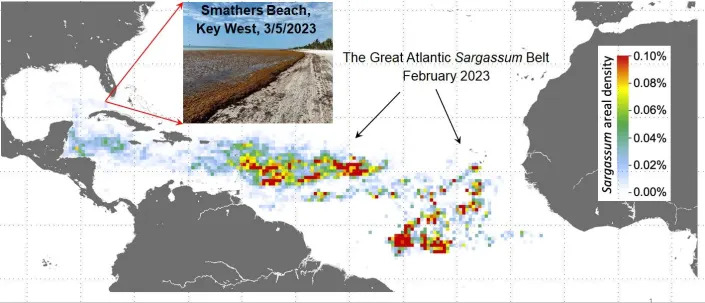
Beachgoers in Florida and the Caribbean could be greeted by heavy blankets of smelly seaweed in the weeks ahead as a 5,000-mile swath of sargassum drifts westward and piles onto white sandy beaches.

Sargassum, a naturally occurring type of macroalgae, has grown at an alarming rate this winter. The belt stretches across the Atlantic Ocean from Africa to Florida and the Yucatan Peninsula and is as much as 200 to 300 miles wide.

“This year could be the biggest year yet,” even bigger than previous growths, said Brian Lapointe, an algae specialist and research professor at Florida Atlantic University’s Harbor Branch Oceanographic Institute.

The belt is already beginning to wash up in the Florida Keys and Barbados and elsewhere in the region, but researchers don’t know where the bulk of it could wind up.

READ MORELatest climate change news from USA TODAY

The monstrous seaweed bloom is just one more example of a growing global invasion of macro and microscopic algal blooms thriving on an increasing supply of nutrients such as nitrogen in freshwater and marine ecosystems.

This image based on satellite photos shows the massive belt of sargassum seaweed blooming across the Atlantic Ocean and drifting onto beaches in Florida and the Caribbean.
What is causing the algal blooms?

In addition to the unsightly piles of sargassum along the coast, some species produce toxins that affect the food chain or deplete the oxygen in the water when they start to decay, causing fish kills and the die-off of other marine species.

Here’s what to know:

Not all algal blooms are bad. Many can occur naturally and can have positive effects.

FOR SUBSCRIBERS: Huge seaweed blob on way to Florida is ‘like a Stephen King movie’

Beachgoers make their way through mounds of seaweed along the shoreline in Ormond Beach, Tuesday, May 25, 2021.
Isn’t sargassum naturally occurring?

Yes. Christopher Columbus wrote about floating mats of it in the Atlantic Ocean.

“It’s not a bad thing to have the sargassum in the ocean,” said Brian Barnes, an assistant research professor at the University of South Florida in Tampa. Sea turtle hatchlings swim from Florida beaches to the Sargasso Sea in the Atlantic, where they spend their early lives floating and foraging in the grass.

“If it all stays offshore, we wouldn’t really have a problem,” Barnes said. But the macroalgae has mushroomed in size over the past 12 years or so, which makes it more likely to see large piles of seaweed that make it difficult to walk, sit or play on beaches.

The trend was first documented on satellite in 2011.

In some cases, there’s so much seaweed that local governments must use heavy equipment and dump trucks to haul it away, LaPointe said.

He has linked the surge in sargassum to flow from the Mississippi River, extreme flooding in the Amazon basin, and the mouth of the Congo, where upwelling and vertical mixing of the ocean can bring up nutrients that feed the blooms. He said deforestation and burning also may contribute.

DEFINITIONS: Is climate change the same thing as global warming? Definitions explained.

CLIMATE CHANGE CAUSESWhy scientists say humans are to blame.

Phytoplankton blooms increasing in size and frequency

Blooms of much smaller algae – a microscopic species known as phytoplankton – increased in size and frequency around the world from 2003 to 2020, the researchers concluded in the Nature study.

“We’ve seen something pretty similar in a lot of the things we study,” Barnes said. “We’re seeing such massive blooms now.”

The coastal phytoplankton study, by Lian Feng at the Southern University of Science and Technology in China and other researchers, used images from NASA’s Aqua satellite. They found:

  • Blooms affected more than 8% of the global ocean area in 2020, a 13.2% increase from 2003.
  • Bloom frequency increased globally at a rate of nearly 60%.
  • Europe and North America had the largest bloom areas.
  • Africa and South America saw the most frequent blooms, more than 6.3 a year.
  • Australia had the lowest frequency and smallest affected area.
Is climate change affecting algae blooms?

Blooms have been at least indirectly linked to climate change in several ways, but especially to the warming temperatures that bring more extreme rainfall that washes silt and pollutants into waterways.

The authors of the coastal phytoplankton study, Lapointe and other researchers have found:

  • A correlation in some regions between changes in sea surface temperatures and ocean circulation.
  • Warmer temperatures coincided with blooms in high latitude regions such as Alaska and the Baltic Sea.
  • Climate change can affect ocean circulation and the movement of nutrients that feed phytoplankton blooms.
  • Global climate events, such as El Nino, also show connections to bloom frequency and movement.
  • Algal-bloom-favorable seasons in temperate seas have increased with warmer temperatures.
Where will the sargassum pile up this year?

“We can’t really say which particular beach at which particular time,” Barnes said. The university publishes a regular update on the status of the bloom.

“We can get an idea of when it will be fairly close,” he said. “In general, everything flows west. It will come across the Central Atlantic and into the Caribbean, and into the Gulf of Mexico through the straits of Florida.”

Winds, currents and even small storms can influence where the sargassum moves.

Puerto Rico and the U.S. Virgin Islands could get hit hard, Barnes said. But the floating mats also wind up on beaches in Jamaica and all around the coast of Florida.

Texas Lawmakers Have a New Scheme to Punish Renewables and Prop Up Fossil Fuels

Gizmodo

Texas Lawmakers Have a New Scheme to Punish Renewables and Prop Up Fossil Fuels

Molly Taft – March 14, 2023

Lt. Gov. Dan Patrick waves to a crowd at a Trump rally.

Texas Republicans are at it again. Last week, Republican politicians in the state legislature introduced a package of bills intended to punish renewable energy and boost fossil fuels, despite the fact that Texas is currently one of the nation’s top generators of renewable power.

On Thursday, Texas state senators Charles Schwertner and Phil King introduced nine bills that they said would help solve issues with Texas’s beleaguered power grid. According to the Dallas Morning News, the bills include one that would create up to 10,000 megawatts of natural gas-fueled generation; one to smooth out what Schwertner said were pro-wind and solar “market distortions” that federal tax breaks create; one to get rid of any remaining state tax credits for renewables; and one that would limit new renewable energy facilities being built based on how much natural gas facilities are also being built, in an attempt to keep natural gas competitive.

The bills are an echo of some of the concepts raised in bills introduced two years ago, the last time the legislature was in session, introduced shortly after a 2021 winter freeze and subsequent blackouts killed hundreds of people—and while the GOP was still erroneously trying to blame the issues with the grid exclusively on renewable energy (a lot of the blame actually lay with natural gas supply). While the renewables bill didn’t end up passing, Texas Republicans have kept beating the drum to try to use grid reforms to sink renewables and prop up fossil fuels.

As the Dallas Morning News reported, Texas leadership are all for these types of measures. Earlier this month, Governor Greg Abbott said he would not allow wind and solar companies to get corporate tax breaks under a new state program. Meanwhile, last week Lt. Gov. Dan Patrick praised the bills at the press conference, saying in a release that they will “fix the Texas power grid once and for all.” Patrick said that he has designated two of the bills—the one to create the new natural gas generation and one dealing with the “market distortions”—as part of his hand-picked suite of 30 priority bills that he would be pushing during this legislative session.

What’s truly wild about this set of possible laws is just how well renewable energy is doing in Texas. Last year, the state was the number one producer of wind energy in the country and the number two producer of solar. The International Energy Agency predicted last year that renewables’ work on the grid could grow even more in 2023, pushing natural gas use down.

“These bills will subsidize those dirty energy sources at a big cost to consumers and the environment,” Luke Metzger, executive director at Environment Texas, told Earther in an email. “Folks at the Texas Legislature used to speak of the importance of not picking winners and losers in the energy marketplace. Well, that’s exactly what these bills do. The state of Texas is dispensing with the free market to subsidize polluting power plants and discriminating against wind and solar energy.”

The Texas power grid’s issues are a hell of a lot more complex than ‘renewables bad, fossil fuels good.’ It’s going to take more uncomfortable reforms to iron out what actually is going to work for the state, but we can count on Republicans to take any opportunity to use renewable energy as a political punching bag.

Las Vegas water agency seeks power to limit residential use

Associated Press

Las Vegas water agency seeks power to limit residential use

Gabe Stern – March 13, 2023

FILE - A home with a swimming pool abuts the desert on the edge of the Las Vegas valley July 20, 2022, in Henderson, Nev. Nevada lawmakers on Monday, March 13, 2023, will consider another shift in water use for one of the driest major metropolitan areas in the U.S. The water agency that manages the Colorado River supply for Vegas is seeking authority to limit what comes out of residents' taps. (AP Photo/John Locher, File)
A home with a swimming pool abuts the desert on the edge of the Las Vegas valley July 20, 2022, in Henderson, Nev. Nevada lawmakers on Monday, March 13, 2023, will consider another shift in water use for one of the driest major metropolitan areas in the U.S. The water agency that manages the Colorado River supply for Vegas is seeking authority to limit what comes out of residents’ taps. (AP Photo/John Locher, File)
FILE - Sprinklers water grass at a park on Friday, April 9, 2021, in the Summerlin neighborhood of Las Vegas. Nevada lawmakers on Monday, March 13, 2023, will consider another shift in water use for one of the driest major metropolitan areas in the U.S. The water agency that manages the Colorado River supply for Vegas is seeking authority to limit what comes out of residents' taps. (AP Photo/Ken Ritter, File)
Sprinklers water grass at a park on Friday, April 9, 2021, in the Summerlin neighborhood of Las Vegas. Nevada lawmakers on Monday, March 13, 2023, will consider another shift in water use for one of the driest major metropolitan areas in the U.S. The water agency that manages the Colorado River supply for Vegas is seeking authority to limit what comes out of residents’ taps. (AP Photo/Ken Ritter, File)
FILE - Water from the Colorado River, diverted through the Central Arizona Project, fills an irrigation canal, Thursday, Aug. 18, 2022, in Maricopa, Ariz. Nevada lawmakers on Monday, March 13, 2023, will consider another shift in water use for one of the driest major metropolitan areas in the U.S. The water agency that manages the Colorado River supply for Vegas is seeking authority to limit what comes out of residents' taps. (AP Photo/Matt York,File)
Water from the Colorado River, diverted through the Central Arizona Project, fills an irrigation canal, Thursday, Aug. 18, 2022, in Maricopa, Ariz. Nevada lawmakers on Monday, March 13, 2023, will consider another shift in water use for one of the driest major metropolitan areas in the U.S. The water agency that manages the Colorado River supply for Vegas is seeking authority to limit what comes out of residents’ taps. (AP Photo/Matt York,File)
FILE - In this April 15, 2015 file photo, a man takes a picture of the fountains in front of the Bellagio hotel and casino in Las Vegas. State lawmakers on Monday, March 13, 2023, are scheduled to discuss granting the power to limit what comes out of residents’ taps to the Southern Nevada Water Authority, the agency managing the Colorado River supply to the city. (AP Photo/John Locher, File)
In this April 15, 2015 file photo, a man takes a picture of the fountains in front of the Bellagio hotel and casino in Las Vegas. State lawmakers on Monday, March 13, 2023, are scheduled to discuss granting the power to limit what comes out of residents’ taps to the Southern Nevada Water Authority, the agency managing the Colorado River supply to the city. (AP Photo/John Locher, File)

CARSON CITY, Nev. (AP) — Ornamental lawns are banned in Las Vegas, the size of new swimming pools is capped and much of the water used in homes is sent down a wash to be recycled, but Nevada is looking at another significant step to ensure the water supply for one of the driest major metropolitan areas in the U.S.

State lawmakers on Monday are scheduled to discuss granting the power to limit what comes out of residents’ taps to the Southern Nevada Water Authority, the agency managing the Colorado River supply to the city.

If lawmakers approve the bill, Nevada would be the first state to give a water agency permanent jurisdiction over the amount of residential use.

The sweeping omnibus bill is one of the most significant to go before lawmakers this year in Nevada, one of seven states that rely on the Colorado River. Deepening drought, climate change and demand have sunk key Colorado River reservoirs that depend on melting snow to their lowest levels on record.

“It’s a worst case scenario plan,” said the bill’s sponsor, Democratic Assemblyman Howard Watts of Las Vegas. “It makes sure that we prioritize the must-haves for a home. Your drinking water, your basic health and safety needs.”

The bill would give the water authority leeway to limit water usage in single-family homes to 160,000 gallons annually, incorporate homes with septic systems into the city’s sewer system and provide funding for the effort.

The average home uses about 130,000 gallons of water per year, meaning the largest water users would feel the pinch, according to the agency.

The authority hasn’t yet decided how it would implement or enforce the proposed limits, which would not automatically go into effect, spokesperson Bronson Mack said.

Water from the Colorado River largely is used for agriculture in other basin states: Arizona, California, Wyoming, Utah, New Mexico and Colorado.

Las Vegas relies on the Colorado River for 90% of its water supply. Already, Nevada has lost about 8% of that supply because of mandatory cuts implemented as the river dwindles further. Most residents haven’t felt the effects because Southern Nevada Water Authority recycles a majority of water used indoors and doesn’t use the full allocation.

Nevada lawmakers banned ornamental grass at office parks, in street medians and entrances to housing developments two years ago. This past summer, Clark County, which includes Las Vegas, capped the size of new swimming pools at single-family residential homes to about the size of a three-car garage.

A state edict carries greater weight than city ordinances and more force in messaging, said Kyle Roerink, executive director of the Great Basin Water Network, which monitors western water policy.

Watts said he is hopeful other municipalities that have been hesitant to clamp down on residential water use will follow suit as “good stewards of the river” with even deeper cuts to the Colorado River supply looming.

Snow that has inundated northern Nevada and parts of California serves as only a temporary reprieve from dry conditions. Some states in the Colorado River basin have gridlocked on how to cut water usage, with many of them looking toward agriculture to shoulder the burden.

Municipal water is a relatively small percentage of overall Colorado River use. As populations grow and climate change leaves future supplies uncertain, policymakers are paying close attention to all available options to manage water supplies.

Santa Fe, New Mexico, uses a tiered cost structure where rates rise sharply when residents reach 10,000 gallons during the summer months.

Scottsdale, Arizona, recently told residents in an community outside city limits that it no longer could provide a water source for them. Scottsdale argued action was required under a drought management plan to guarantee enough water for its own residents.

Elsewhere in metro Phoenix, water agencies aren’t currently discussing capping residential use, Sheri Trap of the Arizona Municipal Water Users Association said in an email. But cities like Phoenix, Glendale and Tempe have said they will cut down on usage overall.

AP writer Susan Montoya Bryan contributed reporting from Albuquerque, New Mexico. Stern is a corps member for the Associated Press/Report for America Statehouse News Initiative. Report for America is a nonprofit national service program that places journalists in local newsrooms.

Confirmed: Global floods, droughts worsening with warming

Associated Press

Confirmed: Global floods, droughts worsening with warming

Isabella O’Malley – March 13, 2023

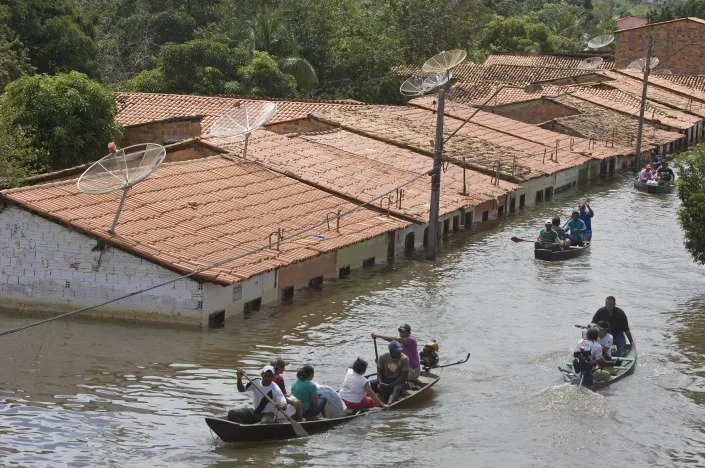
FILE - People travel by boat in a flooded street in Trizidela do Vale, state of Maranhao, Brazil, May 9, 2009. The intensity of extreme drought and rainfall has “sharply” increased over the past 20 years, according to a study published Monday, March 13, 2023, in the journal Nature Water. (AP Photo/ Andre Penner, File)
People travel by boat in a flooded street in Trizidela do Vale, state of Maranhao, Brazil, May 9, 2009. The intensity of extreme drought and rainfall has “sharply” increased over the past 20 years, according to a study published Monday, March 13, 2023, in the journal Nature Water. (AP Photo/ Andre Penner, File)
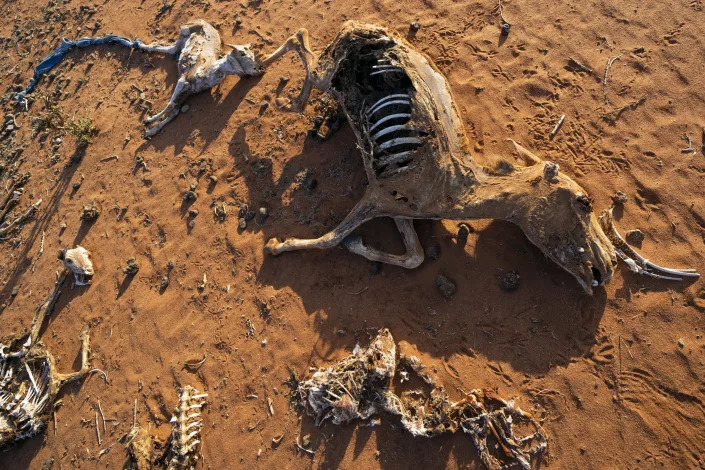
FILE - The remains of dead livestock and a donkey are scattered at a camp for displaced people on the outskirts of Dollow, Somalia, Sept. 21, 2022. The intensity of extreme drought and rainfall has “sharply” increased over the past 20 years, according to a study published Monday, March 13, 2023, in the journal Nature Water. (AP Photo/Jerome Delay, File)
The remains of dead livestock and a donkey are scattered at a camp for displaced people on the outskirts of Dollow, Somalia, Sept. 21, 2022. The intensity of extreme drought and rainfall has “sharply” increased over the past 20 years, according to a study published Monday, March 13, 2023, in the journal Nature Water. (AP Photo/Jerome Delay, File)
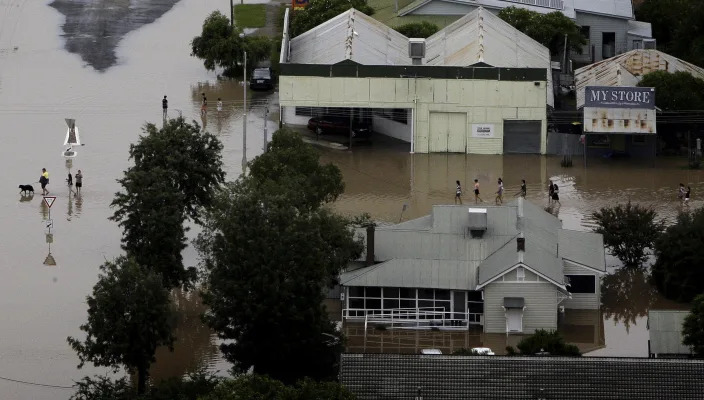
FILE - People wade through flood waters in the town of Moree, Northern New South Wales, Australia, Feb. 3, 2012. The intensity of extreme drought and rainfall has “sharply” increased over the past 20 years, according to a study published Monday, March 13, 2023, in the journal Nature Water. (AP Photo/Brad Hunter, Pool, File)
People wade through flood waters in the town of Moree, Northern New South Wales, Australia, Feb. 3, 2012. The intensity of extreme drought and rainfall has “sharply” increased over the past 20 years, according to a study published Monday, March 13, 2023, in the journal Nature Water. (AP Photo/Brad Hunter, Pool, File)
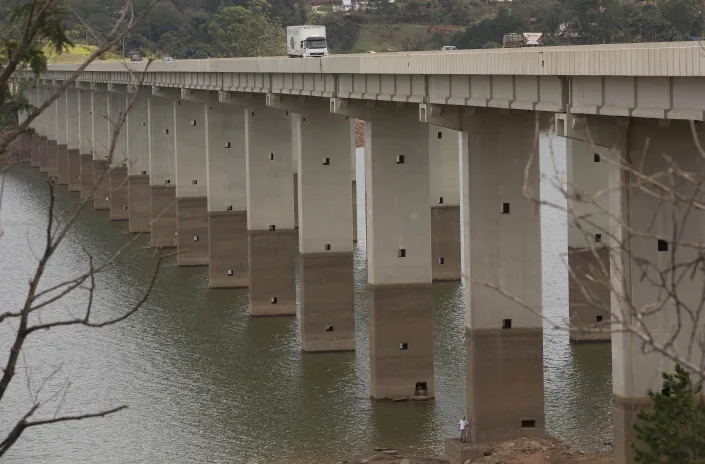
FILE - A bridge's columns are marked by the previous water line over the Atibainha reservoir, part of the Cantareira System that provides water to the Sao Paulo metropolitan area, in Nazare Paulista, Brazil, on Jan. 29, 2015. The intensity of extreme drought and rainfall has “sharply” increased over the past 20 years, according to a study published Monday, March 13, 2023, in the journal Nature Water. (AP Photo/Andre Penner, File)
A bridge’s columns are marked by the previous water line over the Atibainha reservoir, part of the Cantareira System that provides water to the Sao Paulo metropolitan area, in Nazare Paulista, Brazil, on Jan. 29, 2015. The intensity of extreme drought and rainfall has “sharply” increased over the past 20 years, according to a study published Monday, March 13, 2023, in the journal Nature Water. (AP Photo/Andre Penner, File)
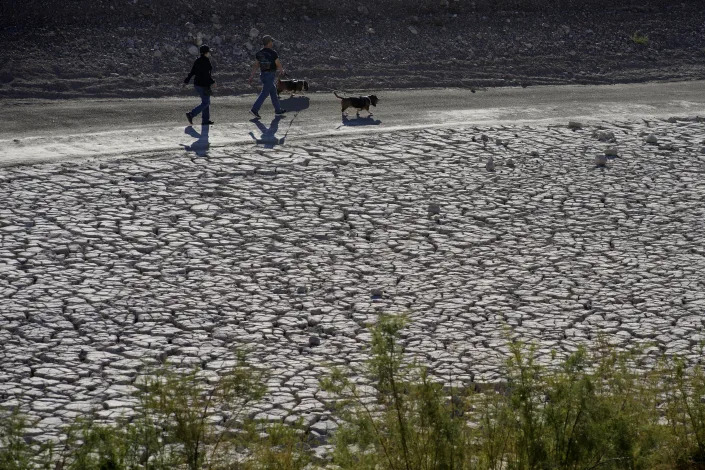
FILE - People walk by cracked earth in an area once under the water of Lake Mead at the Lake Mead National Recreation Area, Jan. 27, 2023, near Boulder City, Nev. The intensity of extreme drought and rainfall has “sharply” increased over the past 20 years, according to a study published Monday, March 13, 2023, in the journal Nature Water. (AP Photo/John Locher, File)
People walk by cracked earth in an area once under the water of Lake Mead at the Lake Mead National Recreation Area, Jan. 27, 2023, near Boulder City, Nev. The intensity of extreme drought and rainfall has “sharply” increased over the past 20 years, according to a study published Monday, March 13, 2023, in the journal Nature Water. (AP Photo/John Locher, File)
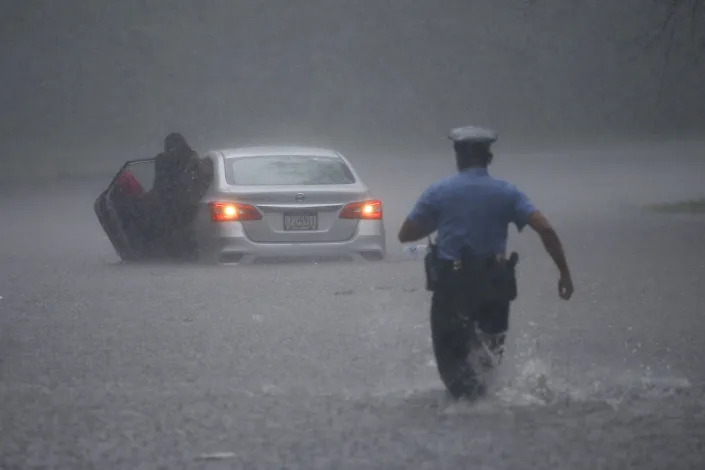
FILE - A Philadelphia police officer rushes to help a stranded motorist during Tropical Storm Isaias, Aug. 4, 2020, in Philadelphia. The intensity of extreme drought and rainfall has “sharply” increased over the past 20 years, according to a study published Monday, March 13, 2023, in the journal Nature Water. (AP Photo/Matt Slocum, File)
A Philadelphia police officer rushes to help a stranded motorist during Tropical Storm Isaias, Aug. 4, 2020, in Philadelphia. The intensity of extreme drought and rainfall has “sharply” increased over the past 20 years, according to a study published Monday, March 13, 2023, in the journal Nature Water. (AP Photo/Matt Slocum, File)
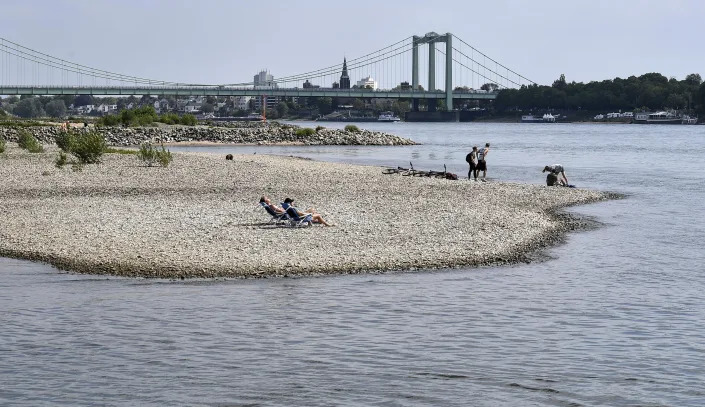
FILE - People enjoy the sunny weather on dry river banks of Germany's most important river Rhine in Cologne, Germany, after a long time of drought, April 27, 2020. The intensity of extreme drought and rainfall has “sharply” increased over the past 20 years, according to a study published Monday, March 13, 2023, in the journal Nature Water. (AP Photo/Martin Meissner, File)
People enjoy the sunny weather on dry river banks of Germany’s most important river Rhine in Cologne, Germany, after a long time of drought, April 27, 2020. The intensity of extreme drought and rainfall has “sharply” increased over the past 20 years, according to a study published Monday, March 13, 2023, in the journal Nature Water. (AP Photo/Martin Meissner, File)

The intensity of extreme drought and rainfall has “sharply” increased over the past 20 years, according to a study published Monday in the journal Nature Water. These aren’t merely tough weather events, they are leading to extremes such as crop failure, infrastructure damage, even humanitarian crises and conflict.

The big picture on water comes from data from a pair of satellites known as GRACE, or Gravity Recovery and Climate Experiment, that were used to measure changes in Earth’s water storage — the sum of all the water on and in the land, including groundwater, surface water, ice, and snow.

“It’s incredible that we can now monitor the pulse of continental water from outer space,” said Park Williams, a bioclimatologist at the University of California, Los Angeles who was not involved with the study.

“I have a feeling when future generations look back and try to determine when humanity really began understanding the planet as a whole, this will be one of the studies highlighted,” he said.

The researchers say the data confirms that both frequency and intensity of rainfall and droughts are increasing due to burning fossil fuels and other human activity that releases greenhouse gases.

“I was surprised to see how well correlated the global intensity was with global mean temperatures,” said Matthew Rodell, study author and deputy director of Earth sciences for hydrosphere, biosphere, and geophysics at NASA Goddard Space Flight Center.

The strong link between these climate extremes and rising global average temperatures means continued global warming will mean more drought and rainstorms that are worse by many measures — more frequent, more severe, longer and larger.

Researchers looked at 1,056 events from 2002-2021 using a novel algorithm that identifies where the land is much wetter or drier than normal.

That showed the most extreme rains keep happening in sub-Saharan Africa, at least through December 2021, the end of the data. The rainfall extremes also took place in central and eastern North America from 2018-2021, and Australia during 2011-2012.

The most intense droughts were a record-breaking one in northeastern South America from 2015-2016; an event in the Cerrado region of Brazil that began in 2019 and continues; and the ongoing drought in the American Southwest that has caused dangerously low water levels in two of the biggest U.S. reservoirs, Lake Mead and Lake Powell. Those remain low despite heavy rains this year.

Drought events outnumbered heavy rain events by 10%. Their geographic extents and how long they lasted were similar.

A warmer atmosphere increases the rate at which water evaporates during dry periods. It also holds more water vapor, which fuels heavy rainfall events.

The study noted that infrastructure like airports and sewage treatment plants that were designed to withstand once-in-a-100-year events are becoming more challenged as these extremes happen more often and with more intensity.

“Looking forward into the future, in terms of managing water resources and flood control, we should be anticipating that the wetter extremes will be wetter and the dry extremes will get drier,” said Richard Seager, a climate scientist at the Lamont Doherty Earth Observatory at Columbia University, who was not involved with the study.

Seager said it’s a mistake to assume that future wet and dry extremes can be managed the same as in the past because “everything’s going to get amplified on both ends of the dry-wet spectrum.”

According to the U.S. National Integrated Drought Information System, 20% of the annual economic losses from extreme weather events in the U.S. are from floods and droughts.

A drastic swing between extreme drought and unprecedented flooding, dubbed “weather whiplash,” is becoming common in some regions.

Water stress is expected to significantly affect poor, disenfranchised communities as well as ecosystems that have been underfunded and exploited.

For example, the United Nations has said that Somalia is experiencing its longest and most severe drought, an event that has caused the deaths of millions of livestock and widespread hunger. Venezuela, a country that has faced years of political and economic crises, resorted to nationwide power cuts during April 2016 as a result of the drought conditions affecting water levels of the Guri Dam.

As for solutions, using floodwaters to replenish depleted aquifers and improving the health of agricultural soil so it can absorb water better and store more carbon are just a few methods that could improve water resiliency in a warming world, the study says.

Associated Press climate and environmental coverage receives support from several private foundations. See more about AP’s climate initiative here. The AP is solely responsible for all content.

California cancels salmon fishing season: “It’s devastating”

CBS News

California cancels salmon fishing season: “It’s devastating”

Emily Mae Czachor – March 13, 2023

Officials in California have issued a ban on salmon fishing anywhere along the state’s coast for the remainder of the season, as the state’s yearslong drought is still taking its toll on the once-abundant fish population.

In a recent announcement, the California Department of Fish and Wildlife said salmon fisheries that were originally scheduled to open on April 1 would remain closed through May 15. The decision came as part of a broader effort, involving state agencies in Oregon as well as the National Marine Fisheries Service, to cancel ocean salmon fishing along much of the coast — from Cape Falcon, Oregon, to the U.S.-Mexico border.

For California, the ban aims to protect the Chinook species of salmon, which previously inhabited several of the state’s largest rivers and in recent years have been seen in dwindling numbers.

Thanks to multiple atmospheric river storms in California, rivers on land are roaring but the effects of years of drought are now being seen on the salmon population, CBS Bay Area reported.  Last year, just 60,000 of the adult fish returned to the Sacramento River to spawn, officials said. This was a small fraction of the 196,000 fish expected there, and approached a record annual low for the area, according to the fish and wildlife department. Officials are also hoping that the fishing ban will prevent the Chinook population from decreasing further in the Klamath River, which is also threatened.

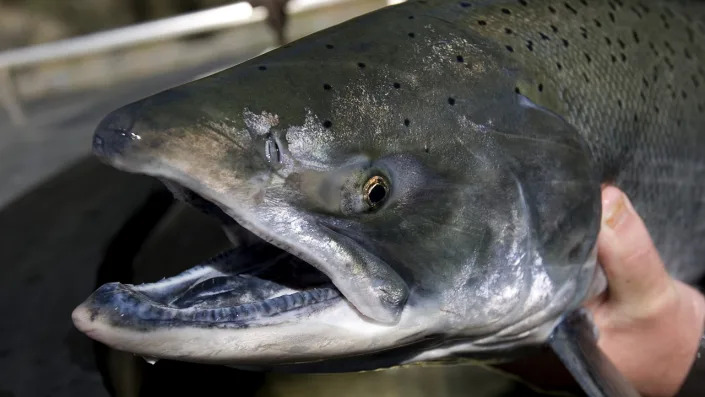
 A Chinook salmon is placed in a tank for propagation at the Livingston Stone National Fish Hatchery March 18, 2008 in Shasta Lake, California.  / Credit: Photo by Kimberly White/Getty Images
A Chinook salmon is placed in a tank for propagation at the Livingston Stone National Fish Hatchery March 18, 2008 in Shasta Lake, California. / Credit: Photo by Kimberly White/Getty Images

The Pacific Fishery Management Council has proposed additional policies to regulate salmon fishing off the coast of California through the spring of 2024, wildlife officials said. The proposals, which would ban commercial and ocean salmon sport fishing until April of next year, were approved by the council for public review at the end of last week.

This is the second time in history that California has canceled fishing season, CBS Bay Area reported, with the last ban taking place between 2008 and 2009 in response to another prolonged drought period.

“Fishery managers have determined that there simply aren’t enough salmon in the ocean right now to comfortably get a return of adult salmon to reproduce for 2023,” said John McManus, president of the Golden State Salmon Association, in comments to CBS Bay Area.

Jared Davis, who operates a charter boat for sport fishermen, told the station his entire summer has been wiped out.

“It’s devastating,” he told the station.  “This is more than just an income issue for me. It’s an inability to do what I love. So, on a financial level and on a personal level, it’s devastating.”

Dwindling marine life populations prompted wildlife officials in Alaska to cancel the winter snow crab season in the Bering Sea near the end of last year. It was a first in the state’s history.

Giant blob of seaweed twice the width of US taking aim at Florida, scientists say

Fox – News

Giant blob of seaweed twice the width of US taking aim at Florida, scientists say

Bradford Betz – March 12, 2023

Giant blob of seaweed twice the width of US taking aim at Florida, scientists say

A giant seaweed bloom – so large it can be seen from outer space – may be headed towards Florida’s Gulf Coast.

The sargassum bloom, at around 5,000 miles wide, is twice the width of the United States and is believed to be the largest in history.

Drifting between the Atlantic coast of Africa and the Gulf of Mexico, the thick mat of algae can provide a habitat for marine life and absorb carbon dioxide.

However, the giant bloom can have disastrous consequences as it gets closer to the shore. Coral, for instance, can be deprived of sunlight. As the seaweed decomposes it can release hydrogen sulfide, negatively impact the air and water and causing respiratory problems for people in the surrounding area.

CLIMATE ACTIVISTS, DEMS TURN ON BIDEN OVER LIKELY ALASKAN OIL DRILLING PROJECT: ‘AN EXISTENTIAL THREAT’

seaweed
Rafts of brown seaweed, Sargassum sp., pile up on the shore of Miami Beach, Florida, USA.

“What we’re seeing in the satellite imagery does not bode well for a clean beach year,” Brian LaPointe, a research professor at Florida Atlantic University’s Harbor Branch Oceanographic Institute told NBC News.

Brian Barnes, an assistant research professor at the University of South Florida’s College of Marine Science, told the outlet that the sargassum can still threaten critical infrastructure if it remains in coast waters.

“[I]t can block intake valves for things like power plants or desalination plants. Marinas can get completely inundated and boats can’t navigate through,” Barnes said.

The impending seaweed comes as Floridians along the state’s southwest coast have complained about burning eyes and breathing problems. Dead fish have washed up on beaches. A beachside festival has been canceled, even though it wasn’t scheduled for another month.

Florida’s southwest coast experienced a flare-up of the toxic red tide algae this week, setting off concerns that it could continue to stick around for a while. The current bloom started in October.

Red tide, a toxic algae bloom that occurs naturally in the Gulf of Mexico, is worsened by the presence of nutrients such as nitrogen in the water. The Florida Fish and Wildlife Conservation Commission warns people to not swim in or around red tide waters over the possibility of skin irritation, rashes and burning and sore eyes. People with asthma or lung disease should avoid beaches affected by the toxic algae.

The Associated Press contributed to this report.