Major storm threatens to bring more tornadoes to hard-hit South
ABC News Chief Meteorologist Ginger Zee tracks the cross-country storm heading East as areas pummeled by the deadly tornado outbreak prepare for more severe weather.
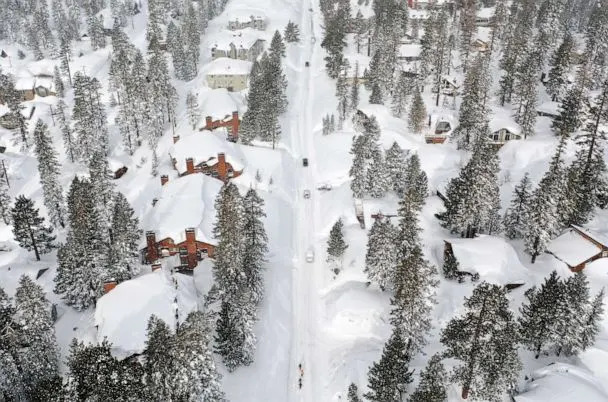
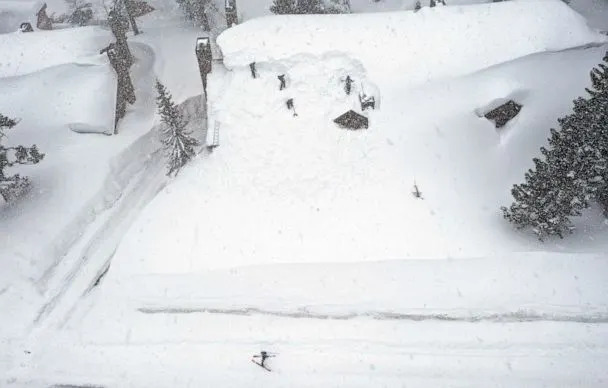
A series of mega-storms throughout March has brought snow to Mammoth Mountain in California’s Sierra Nevada Mountains, burying homes, cars and businesses.
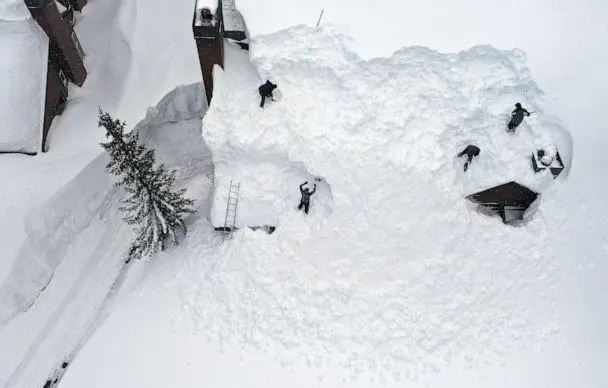
PHOTO: Snowboarders walk and cars attempt to drive in the Sierra Nevada mountains, as now reached record levels, March 29, 2023 in Mammoth Lakes, Calif. (Mario Tama/Getty Images)PHOTO: Workers remove snow from the roof of a condominium complex in the Sierra Nevada mountains, after yet another storm system brought heavy snowfall, March 29, 2023, in Mammoth Lakes, Calif. (Mario Tama/Getty Images)
Earlier this week, 20.7 inches fell in 24 hours at Mammoth Mountain, surpassing the all-time season snowfall record, according to the UC Berkeley Snow Lab, with more than 700 inches for the season. The previous record, set in the 2010-2011 season was 668 inches.
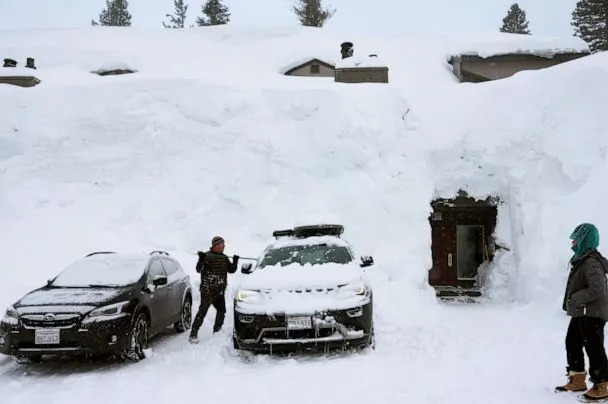
PHOTO: A person removes snow in front of lodging obscured by snowbanks piled up from new and past storms in the Sierra Nevada mountains, March 29, 2023, in Mammoth Lakes, Calif. (Mario Tama/Getty Images)PHOTO: Snow blows in the Sierra Nevada mountains after yet another storm system brought heavy snowfall, March 29, 2023, in Mammoth Lakes, Calif. (Mario Tama/Getty Images)
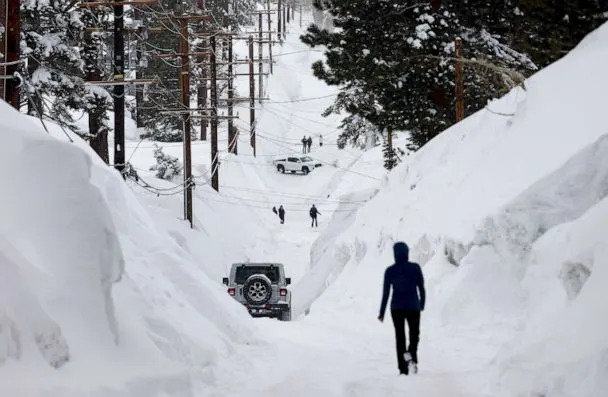
People were out shoveling snow off roofs and trying to keep roads passable with windy conditions. Wind gusts at the ski resort were reported to be as high as 98 mph.
PHOTO: People make their way down a road is lined with snowbanks piled up from multiple storms, after more heavy snow fell, March 29, 2023, in Mammoth Lakes, Calif. (Mario Tama/Getty Images)PHOTO: A skier passes by as workers remove snow from the roof of a condominium complex in the Sierra Nevada mountains after another storm system brought heavy snowfall, March 29, 2023, in Mammoth Lakes, Calif. (Mario Tama/Getty Images)
That will stretch the ski season through at least July at Mammoth Mountain ski resort, which has recorded 870 inches at the base of the Main Lodge.
Another 30 inches fell in the last 24 hours and the forecast is for snow this weekend and early next week.
PHOTO: Jeff Wright checks on his neighbor’s home in the Sierra Nevada mountains, as snow piled up from new and past storms, March 29, 2023, in Mammoth Lakes, Calif. (Mario Tama/Getty Images)PHOTO: As night falls, a person shovels snow in the Sierra Nevada mountains, March 29, 2023 in Mammoth Lakes, Calif. (Mario Tama/Getty Images)
Lyme is not the only disease to worry about this tick season. What you need to know this spring.
Cases of babesiosis — a tick-borne disease that can cause flulike symptoms — are on the rise in the Northeast, according to the CDC.
Laura Ramirez – Feldman, Reporter – March 30, 2023
The black-legged tick, otherwise known as the deer tick, can spread Lyme disease and babesiosis. (Reuters)
Spring is in full swing, and that means more sunlight, warmer temperatures and more time spent outdoors. It also means that for most of the United States, tick season has begun. Although tick exposure can occur year round, these insects are most active during the warmer months, starting in April.
Some states with greater tick activity have started to urge citizens to take precautions when enjoying the outdoors. Ticks carry several types of disease — Lyme disease being the most common — but health experts say Americans should be aware of a rise in other tick-borne illnesses in some regions of the country, including babesiosis.
What is babesiosis?
Babesiosis is a tick-borne disease caused by a parasite called Babesia microti and spread by the black-legged tick, otherwise known as the deer tick. In the U.S., the disease is more commonly found in the Northeast and Midwest, where deer ticks are abundant.
A bite from a tick carrying this parasite can infect red blood cells. While not everyone who is infected develops symptoms, some people can experience flulike symptoms such as fever, chills, muscle pain and fatigue.
Severe cases of babesiosis are rare, but the disease can be fatal for some people, particularly those who are immunocompromised, according to the Centers for Disease Control and Prevention. The agency also notes that the disease can lead to health complications, including acute respiratory distress and kidney failure.
Cases of babesiosis are increasing in the Northeast
This month, the CDC warned about a significant increase in tick-borne illnesses in the U.S. A study conducted by the agency found that U.S. tick-borne disease cases had risen by 25%, from 40,795 cases reported in 2011 to 50,856 in 2019. During the same period, “a total of 16,456 cases of babesiosis were reported to CDC by 37 states, including 16,174 (98.2%) reported from the 10 states included in this analysis,” the report noted.
Cases of babesiosis in particular climbed significantly in eight Northeastern states: Connecticut, Maine, Massachusetts, New Hampshire, New Jersey, New York, Rhode Island and Vermont.
Three New England states — Maine, New Hampshire and Vermont — saw the fastest growth in cases, which prompted the CDC to add them to the list of places where the disease is considered endemic (meaning it is consistently present).
“It’s certainly something that is of concern,” Griffin Dill, tick lab coordinator at the University of Maine Cooperative Extension, told Yahoo News. “It hasn’t reached the kind of case numbers that we’re seeing with Lyme disease or anaplasmosis quite yet, but it is certainly on the rise and something to be aware of.”
Although babesiosis cases are increasing, Lyme disease continues to be the most commonly reported tick-borne disease in the U.S., with approximately 35,000 cases reported to the CDC each year.
Dill and his team provide tick identification and testing services in Maine. By testing ticks that people bring to the lab, his team can identify the type of pathogens the insects could be carrying. Dill explained that this tool is an important one because it provides people with “a piece of risk information about the ticks on their property.” It also gives researchers a better understanding of the geographical spread of ticks and the diseases they carry.
The recent CDC report, Dill said, confirms what he’s been seeing in his lab.
“Just over the past five years that we’ve been doing this, we’ve seen an increase over time in the infection rate for Babesia,” he said. “So even just in a relatively short, five-year time frame, we’re seeing increases in the parasite within the tick itself, which then can correspond to increases in human cases as well.”
Experts believe that the actual number of cases is probably higher, because babesiosis is not reportable in all states. A main concern about the increased prevalence of the disease is that the parasite that causes it can be transmitted via blood transfusions. This, the CDC said, could pose a threat to the blood supply.
“Persons who acquire babesiosis through contaminated blood have been shown to have significantly worse health outcomes and a higher risk for death than do those who acquire the disease from a tick bite,” the agency said in the report.
However, government health agencies have already taken steps to protect the blood supply from the tick-borne disease. Since 2019, the Food and Drug Administration has recommended screening for the parasite at blood donation centers in 14 states and Washington, D.C., where the disease is more prevalent.
Blood sample showing the Babesia parasite. (Smith Collection/Gado/Getty Images)
Why are tick-borne diseases on the rise?
The CDC hasn’t explained why cases of babesiosis and other tick-borne diseases are up, but tick experts have a few theories as to why this may be happening.
Researchers say global warming is a contributing factor. Ticks thrive in warm and humid weather, usually anywhere there is lush greenery. As winters get warmer and shorter, the pests can stay active year round, causing more infections.
Dill said that seasonality patterns of black-legged ticks have almost disappeared.
“Normally, we get kind of a break in tick activity during the winter months, when it’s cold, it’s snowy, but with warmer weather [and] warmer temperatures, we can and do see them active year round, unfortunately,” he said.
The changes in climate and weather patterns have also had an impact on the geographic range of ticks. The habitat of black-legged ticks and other tick species is expanding, Dill explained.
“The black-legged tick, we’re certainly seeing them advance further and further north into northern New England and into Canada,” he said.
Another type of tick that has been on the move in the past two decades is the lone star tick. These ticks can spread an unusual disease called alpha-gal syndrome, which causes an allergic reaction to mammal meats such as beef, pork and lamb. They were historically found in the Southern U.S., but Stephen Rich, director of the New England Center of Excellence in Vector-Borne Diseases, said they are moving north, and farther inland. Their population is also growing.
“There are spots like Long Island, N.Y., where basically the lone star ticks have almost replaced the ticks that transmit Lyme disease — the black-legged ticks. So they’re definitely moving northward,” he said.
Both Dill and Rich said climate change is not the only reason why ticks and tick-borne diseases have spread throughout the country.
“We can’t say that it’s not global warming. But the stronger evidence is that this has to do with the way we manage our landscapes,” Rich said.
The way we like to see our properties, with stone walls and lawns with wooded edges, turns out to be perfect for deer and for deer ticks or black-legged ticks. “We’ve cultivated landscapes that are perfect for ticks and tick-borne diseases,” he added.
The lone star tick gets its name from the single, silvery-white spot on the female’s back. (Brian Cassella/Chicago Tribune/Tribune News Service via Getty Images)
How to prevent tick-borne disease
The best way to protect yourself from babesiosis and other tick-borne illnesses is to avoid getting bitten by a tick.
These critters live in grassy, brushy and wooded areas, so you are more likely to have encounters with them when going outside to garden, walk your dog or go camping or hiking.
To prevent tick bites, Dill recommends that people create a layer of protection.
“That barrier can be something as simple as just wearing protective clothing, so wearing long pants and tucking those pants into your boots or into your socks, just anything that’s going to prevent a tick from actually getting to your skin,” he said.
Using repellents is also a good option. Certain repellents are designed to be used on clothing; others can be applied directly to the skin. The CDC recommends using Environmental Protection Agency-registered insect repellents. If you are not sure which product to use, the EPA has a search tool that can help find the best fit for you.
Checking your body for ticks after spending time outdoors is also highly recommended.
“Just make it a routine to look over your body and see if you have ticks,” Rich said, adding that people should check their children and pets as well.
Finally, if you do find a tick on yourself, the experts said there’s no reason to panic, because not every tick is carrying a disease. If the insect has bitten you, the CDC recommends removing it with fine-tipped tweezers and cleaning the bite area with rubbing alcohol or with soap and water.
Rich told Yahoo News that people should also consider saving or photographing the tick so a professional can evaluate it and determine if it is carrying harmful bacteria. He recommended the University of Rhode Island’s TickSpotters program, which offers free tick identification service, as one place where this can be done.
If you develop a rash or fever after getting bitten by a tick, the CDC recommends that you consult a medical professional.
“I think awareness is kind of the key there,” Dill said. “We don’t want people to be afraid of these illnesses and … prevent people from going outdoors and enjoying outdoor activities. But be aware and take some precautions when recreating outside.”
No One Is Talking About What Ron DeSantis Has Actually Done to Florida
William Kleinknecht – March 29, 2023
Florida Governor DeSantis Kicks Off His “Freedom Blueprint” Tour In Florida
Florida Gov. Ron DeSantis speaks during an event spotlighting his newly released book, ‘The Courage To Be Free: Florida’s Blueprint For America’s Revival at the Orange County Choppers Road House & Museum on March 08, 2023 in Pinellas Park, Fl. Credit – Joe Raedle—Getty Images
Media coverage of Florida Gov. Ron DeSantis’s all-but-announced candidacy for president is already in full frenzy, and so far the script is exactly as his handlers would like it to be. The governor regularly opens up new fronts in the culture wars, sowing alarm over critical race theory, transgender rights, or border policies. In response, liberal pundits fall into the trap of accentuating the very issues DeSantis has chosen to fire up his base.
Omitted from the public debate about DeSantis’s policies is almost any discussion of his actual record of governance—what exactly he has delivered to the citizens of his state, especially those without seven-figure incomes and lush investment portfolios.
Even a cursory dip into the statistics of social and economic well-being reveals that Florida falls short in almost any measure that matters to the lives of its citizens. More than four years into the DeSantis governorship, Florida continues to languish toward the bottom of state rankings assessing the quality of health care, school funding, long-term elder care, and other areas key to a successful society.
Florida may be the place where “woke goes to die”—as DeSantis is fond of saying—but it is also where teachers’ salaries are among the lowest in the nation, unemployment benefits are stingier than in any other state, and wage theft flourishes with little interference from the DeSantis administration. In 2021, DeSantis campaigned against a successful ballot initiative to raise the state’s minimum wage, which had been stuck at $8.65 an hour. Under DeSantis’s watch, the Sunshine State has not exactly been a workers’ paradise.
DeSantis weaponizes the cultural wars to distract attention from the core missions of his governorship, which is to starve programs geared toward bettering the lives of ordinary citizens so he can maintain low taxes on the wealthy and corporations. Florida is the ideal haven for privileged Americans who don’t want to pay their fair share of taxes. It has no income tax for individuals, and its corporate tax rate of 5.5% is among the lowest in the nation. An investigation by the Orlando Sentinel in late 2019 revealed the startling fact that 99% of Florida’s companies paid no corporate income tax, abetted by tax-avoidance schemes and state officials who gave a low priority to enforcing tax laws.
This is a pattern that shows up in the statistics of many Republican-led states, which on average commit fewer dollars per-capita to health care, public education, and other crucial services compared to their blue counterparts, while making sure corporations and wealthy individuals are prioritized for tax relief. Arizona cut taxes every year between 1990 and 2019, following up with a shift to a flat tax this year that will cost its budget $1.9 billion. Meanwhile, its public-school spending ranks 48 among the 50 states.
In Florida, the state’s tax revenues come largely through sales and excise taxes, which fall hardest on the poor and middle class. A 2018 study by the left-leaning Institute on Taxation and Economic Policy found that Florida had the third least-equitable tax system of the 50 states. In the state’s “upside-down” tax structure, the poorest 20% of Florida families paid 12.7% of their income in taxes, while the families whose income was in the top 4% paid 4.5%, and the top 1% paid 2.3%, according to the study.
Florida taxpayers get less for their money than residents of many other states. The Commonwealth Fund, a private foundation that studies health-care systems globally, found in its 2022 “scorecard” that Florida had the 16th worst health care among the 50 states. It’s no wonder that Florida ranks below the northern blue states in life expectancy and rates of cancer death, diabetes, fatal overdoses, teen birth rates, and infant mortality.
Largely because of DeSantis’s obstinacy, Florida is one of 10 states that have refused to expand Medicaid under the Affordable Care Act, an act of political spite that has cost those states billions in federal health care dollars and cost thousands of people their lives. More than 12% of Floridians are without medical insurance, a worse record than all but four other states. Despite having the country’s highest percentage of retirees, Florida has the worst long-term care among the 50 states, according to the American Association of Retired Persons.
Public schools fare no better than health care in DeSantis’s Florida. Not only did Florida rank 49th in the country for average teacher pay in 2020, but the Education Law Center, a non-profit advocacy group based in New Jersey, found in a 2021 report that the state had the seventh-lowest per-pupil funding in the country. Education Week, which ranks states public school annually, looking beyond mere test scores, placed Florida 23rd in its 2021 report, a lackluster showing for a large and wealthy state.
It says something about the state of our political discourse that Florida’s denuded public sector was not more of an issue in last year’s gubernatorial campaign. In endorsing DeSantis’s Democratic opponent, Charlie Crist, the Tampa Bay Times spent so many column inches on the incumbent’s demagoguery, vindictiveness, and authoritarian tendencies that it never even got to the minutiae of his governance. “No matter what you think about the state of the Florida economy or its schools or its future…,” the paper wrote, “the choice really is this simple: Do you want the state governed by a decent man or a bully?”
To be fair to the media, DeSantis and his allies manned the trenches of the culture wars so ferociously that it was all reporters could do to keep up with all the bomb throwing. How do you delve into the state’s tax policy when your governor is flying planeloads of migrants to Martha’s Vineyard or declaring war on Disney for issuing a statement in opposition to the state’s so-called “Don’t Say Gay Law”?
But that is very much the point of wedge issues, as they have been wielded by scurrilous politicians for decades, to anger and distract voters so they won’t notice the actions of public officials that mainly benefit the wealthy and are against the public interest.
As the 2024 election draws closer, DeSantis must not be allowed to accomplish nationally what he did in his state—cloak his service to the wealthy by frightening working people with stories about transgender recruiting and “socialist” college professors. There are unmistakable signs that Americans are focused on what an activist government can do for the public good, as evidenced by Floridians’ vote to increase the minimum wage.
The failure of DeSantis to better serve the most vulnerable citizens of his state is his weak underbelly in a national campaign.
View from above: Aerial video shows Fort Myers Beach scars six months after Ian
Mark H. Bickel and Ricardo Rolón, F. M. News-Press March 29, 2023
The News-Press has provided special coverage for the six-month anniversary of Hurricane Ian. The Category 4 storm hit Southwest Florida on Sept. 28, 2022, leaving behind catostrophic damage and killing more than 160 people.
For a different perspective, Ric Rolon, a visuals journalist for The News-Press, piloted a drone that flew high above the beach recently and captured what things are lookings. While ongoing recovery efforts continue, the view remains one of a location that was pounded unmercifully by Hurricane Ian’s storm surge and winds.
This perspective is a unique layer to the coverage we have been providing and will continue to provide as Southwest Florida makes strides for a full recovery.
You can check out our coverage of the six-month anniversary of Hurricane Ian HERE.
See Stunning Photos of How Climate Change Is Altering Our World
Molly Taft – March 27, 2023
Photo: Paolo Patrizi
Beautiful and troubling photographs of how the world is changing and heating up are part of a competition to pressure one of the world’s leading camera companies to drop its controversial views on climate.
Business accountability watchdog Action Speaks Louder launched the “Cameras Don’t Lie” competition in February in order to pressure photography giant Canon to distance itself from the climate denial the group says is being perpetuated at a nonprofit Canon supports.
“Canon has two faces; while branding itself as an environmentally-friendly and socially responsible company, it has created a think tank, the Canon Institute for Global Studies (CIGS), which is a platform for climate denial,” the campaign’s website reads.
The Canon Institute for Global Studies was founded by Canon in 2008 “with the aim of contributing to the development of Japan and the rest of the world,” according to a company press release. As the Guardian reported last year, a fellow at the Institute, Taishi Sugiyama, has written multiple blog posts for the Institute that question the science behind climate change and endorse content and theories from prominent denier-led groups and institutions. A report released by a think tank last year also found that Canon has significantly lower climate ambitions than competitors like Nikon, Sony, and Panasonic, and recently lowered its emissions reductions targets.
Earther reached out to the Canon Institute as well as Canon for comment but did not hear back by time of publication. Multiple articles mentioned in the Guardian piece from Sugiyama, including one article calling Thunberg a communist as well as a description of a children’s book he wrote that encourages kids to “investigate the effects of global warming based on facts,” remain live on the site.
“The statements referred to by Action Speaks Louder are those published by Mr. Sugiyama, who is affiliated with CIGS. CIGS operates independently and is unrelated to the business activities of Canon. The research and statements published by Mr. Sugiyama are solely his own,” the company told PetaPixel early last month. “Therefore, Canon is not in a position to officially respond to inquiries from Action Speaks Louder. Global environmental issues are one of Canon’s management core pillars, and Canon remains committed to contributing, through a variety of means, to the realization of a net-zero CO2 emissions society.”
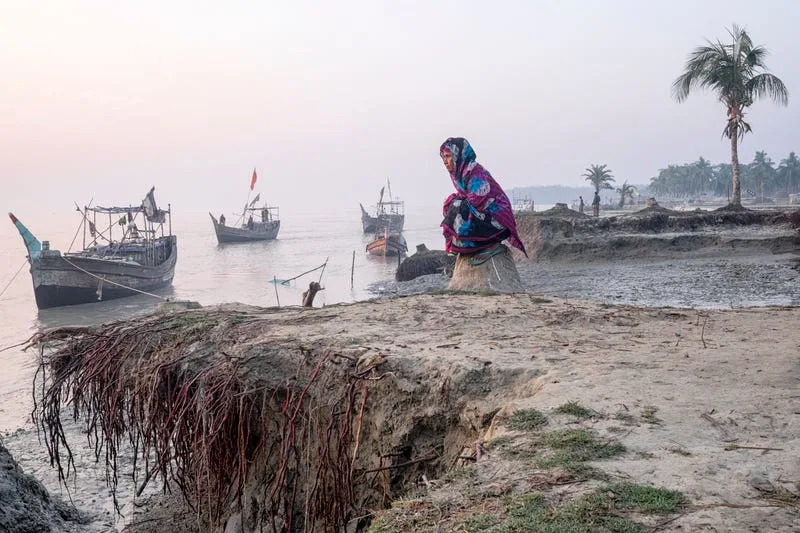
The finalists here were selected from more than 180 entries from 30 countries. The winning image, “Vanishing Island of Dhal Chor Bangladesh” by photographer Paolo Patrizi, shown above, was on display in Times Square in New York City in March, ahead of Canon’s shareholder meeting.
Click through to see the winning photograph and other finalists in the campaign.
Vanishing Island of Dhal Chor, Bangladesh
Photo: Paolo Patrizi
“Rapid erosion and rising sea levels are increasingly threatening the existence of islands off the coast of Bangladesh. Dhal Chor, Monpura and Bhola are some of many islands on the bay of Bengal affected by increasingly rapid erosion and some of the fastest recorded sea-level rises in the world,” Patrizi said of his photo. “These ‘vanishing islands’ are shrinking dramatically.”
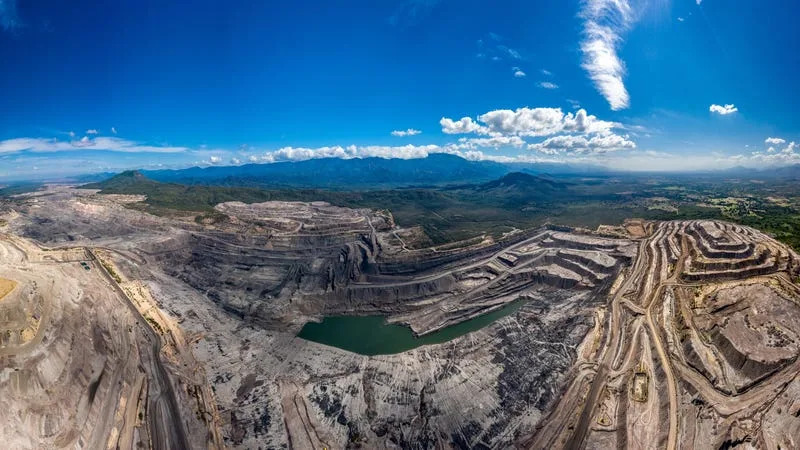
Hatonuevo mining complex, Colombia
Photo: César David Martínez
Martínez told the campaign: “The biggest open pit mine in Colombia and one of the biggest in the world, shows the deep impact that the extraction of one of the worst polluter and greenhouse gases causes in nature and environment: The coal.”
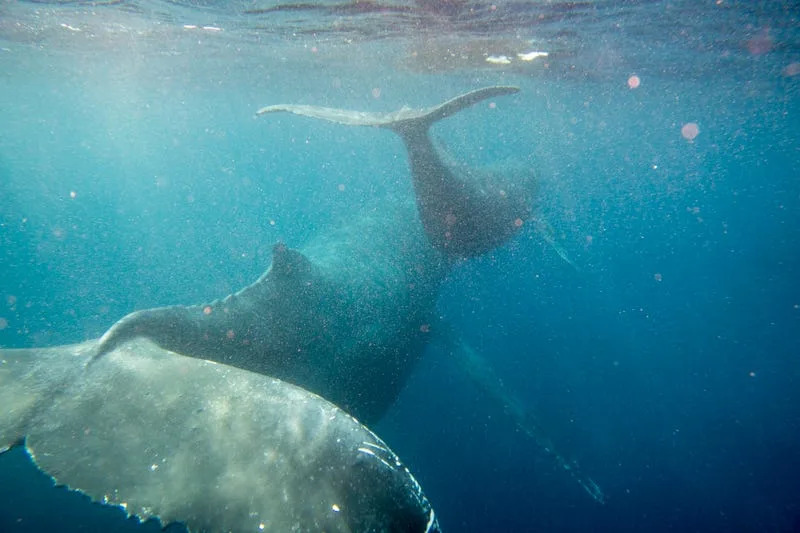
Amami Oshima Island, Japan
Photo: Hisayuki Tsuchiya
Tsuchiya described his photograph: “The breeding and calving of humpback whales are gradually moving northward due to global warming. Microplastics are also increasing, and the ecosystem of whales is changing.”
Lake Abashiri, Hokkaido, Japan
Photo: Kanade Endo
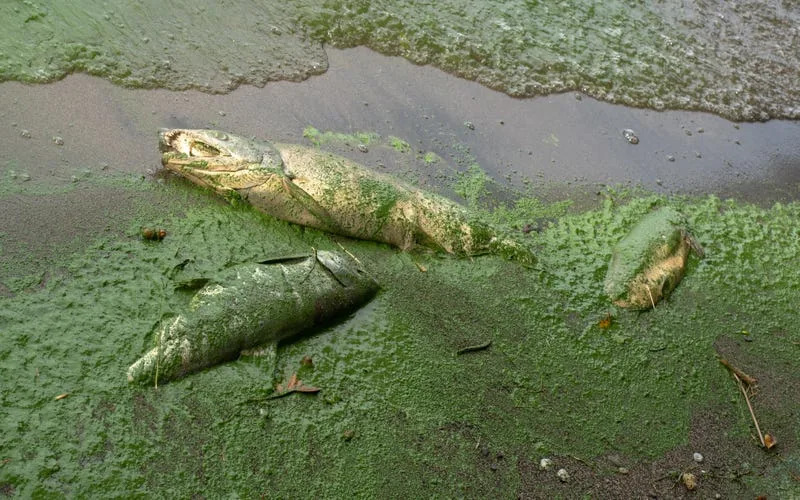
“While traveling alone in Hokkaido, I noticed a strong smell of decay on the shore of Lake Abashiri. The source of the smell was diatoms that had grown so abnormally that they filled the sand of the lakeside and the rotting corpses of salmon,” Endo said.
Presqu’ile Provincial Park, Ontario, Canada
Photo: Katherine Cheng
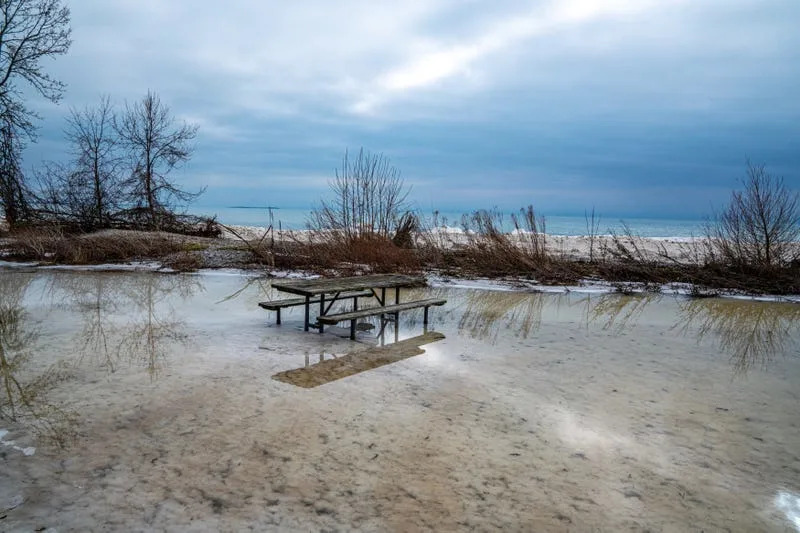
Cheng said of her photo: “On the first day of 2023, the Presqu’ile Provincial Park and its coastal trails were flooded with water. Typically on January 1, the ground and nearby lake would be covered in ice and snow in Ontario. However, record-high temperatures have been broken across the province this year, leaving many trails, river ice rinks and ski hills closed.”
Mt. Zao, on the border of Yamagata and Miyagi Prefectures, Japan
Photo: Kazuaki Koseki
“On a clear night at the end of May, when the snow had melted from the trees, I looked up wistfully at the withered ice and the starry sky, and continued to gaze at these trees, clasping my hands and praying,” Koseki said. “Global warming and climate change are believed to be one of the reasons for the death of these trees. Other possible reasons include the impact of tourism development and attraction of tourism.”
Yosemite National Park, California, USA
Photo: Marcin Zajac
“I came to Yosemite to photograph something completely different and when I arrived to the park it was covered in smoke,” Zajac told the campaign. “I considered going back home to avoid camping in smoke, but eventually I stayed around. When at night the smoke cleared for a bit it was surreal to see the fire burning in the valley. The thick smoke didn’t seem to discourage climbers though – if you look carefully you can see lights from their headlamps as they climb up El Capitan.”
Ishigaki Island, Okinawa, Japan
Photo: Marie Abe
“In the summer of 2022, rising sea temperatures caused the coral reefs around Ishigaki Island to almost completely die after large-scale bleaching,” Abe said. “This is the appearance of the bleached coral with dazzling pastel colours that will be attractive for a little while before it decays.”
San Francisco, California, USA
Photo: Patrick Perkins
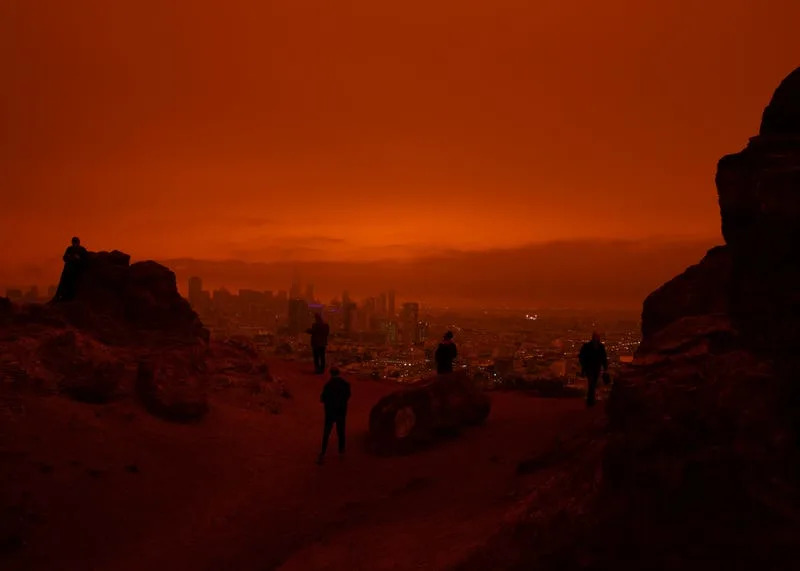
Perkins said of his photo: “The day before I took this photo, there had been severe fires all up and down the coast of California, Oregon and Washington. My sister’s house had burned down, and my father’s house had been threatened. My father told me that they had woke up at 2am to fight the fire from spreading onto their land, and my sister had drove home the next day to find her house burned down in a separate fire. The day after I heard that, the sky in San Francisco where I live turned orange from all the smoke. I went out with my camera to try to document what felt like a biblical event. This shot won Unsplash’s photo of the year in 2020.”
Kolkata, India
Photo: Satyaki Acharya
“A waterbody in Kolkata, India has dried up due to the intense heat event before the summer season has set in properly,” Acharya said. “The million footprints are proof of the struggle people undertake everyday for some water.”
Nyaung Oo Township, Mandalay Region, Myanmar
Photo: Wai Maung
“This photo shows the local people in central Myanmar were combating climate change by forest restoration and rehabilitation (i.e., planting trees in a barren land near their village),” Maung said of his photo. “Before planting, rectangular pits (trenches) were dug for capturing and storing sufficient rainwater. Cow dung & bio fertilizers were put inside the pits. The purpose of tree planting is to restore the watershed area and to create a fuel wood supply plantation. For survival and subsistence, planting trees is one of the local strategies to cope with harsh climatic and edaphic conditions.”
Florida’s Latest Tourism Problem Is Twice the Width of the United States
Jena Greene – March 27, 2023
The dreaded return of an invasive species could ruin beach-going up and down the coast.
Between hurricane season, rising water levels, ongoing feuds between Disney and the local government, and crazed spring breakers, Florida already has enough to worry about.
The last thing the state wants is a giant blob of seaweed headed directly for a coastal impact on its pristine sunny beaches — but it’s looking like that’s what it’s going to get.
Pedro Portal/Miami Herald/Tribune News Service via Getty
What is Sargassum Seaweed?
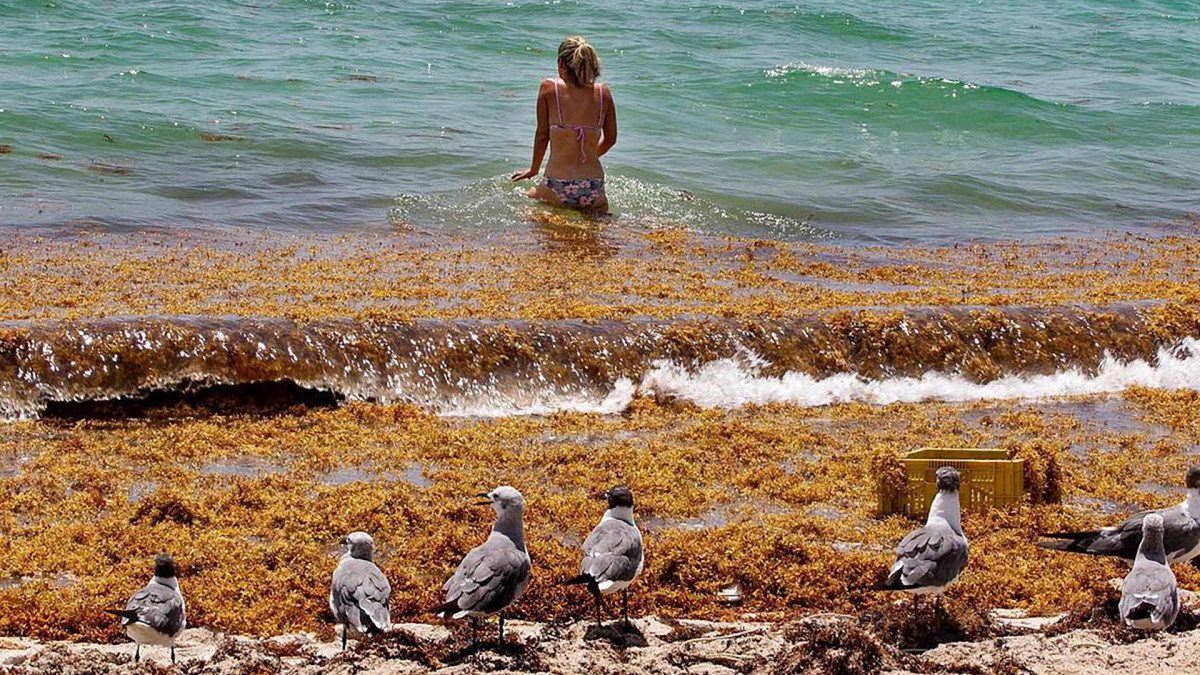
Buoyant brown seaweed, or The Great Atlantic Sargassum Belt as it’s formally known, is something many Floridians have come to know. It’s an invasive species that’s something of a grim reaper for sea life; it kills some marine animals and destroys coral reefs in its path.
Sargassum is a brown, rubbery seaweed that releases a foul odor once it washes up on the beach and decays in the sunlight. In the ocean, the seaweed tends to bind up and reproduce, creating big, blobby problems for boaters and animals. It’s also one of the few marine species that replicates (and therefore, gets bigger) while on the water’s surface.
Once it’s washed up, it can take days or even weeks to remove the stuff. Since it smells sulphuric and makes beaches difficult to enjoy, some hotels even see decreased foot traffic while it’s around.
How Big Is the Seaweed Blob Heading for the U.S.?
Sargassum regularly washes up on coastal North and central America, particularly around Florida, Mexico and the Caribbean. But this year’s Sargassum is massive at 5,000 miles (8,000 km) long, and stretches between West Africa and the Gulf of Mexico. That’s nearly twice as wide as the U.S.
“What is unusual this year compared to previous years is it started early,” University of South Florida oceanography professor Chuanmin Hu said. “The algae generally blooms in the spring and summer, but ‘this year, in the winter, we already have a lot.'”
Experts say it’s already started showing up on Key West, FL. There’s already an estimated 10 million metric tons of the seaweed floating around in the middle of the ocean and it’s likely to get bigger before it washes up.
Sargassum Can Affect Travel and Tourism
It’s no surprise that many hotels view giant seaweed blobs as problematic for tourism, but there are several measures some can take to mitigate its impact.
“Keeping sargassum at bay from a beach where it’s determined to wash ashore is like fighting a rising tide,” Afar reports. “Apart from removing what washes ashore as it arrives, [USF professor Brian] Barnes says a hotel might consider installing a floating boom offshore (usually made of PVC and deployed parallel to the shoreline) with the goal of preventing sargassum from coming ashore. But again, it represents a small measure against a monumental task.”
Luckily, mild to moderate exposure to Sargassum doesn’t a major risk to human health, and some animals, including sea turtles, even dine on the stuff.
Kerry: Americans don’t need to have ‘lower quality of life’ to fight climate change
Ben Adler, Senior Editor – March 24, 2023
Americans do not have to compromise on their quality of life in order to help prevent catastrophic climate change, special presidential envoy for climate John Kerry told Yahoo News.
When asked about the recent backlash regarding proposals to restrict the use of private jets or gas stoves, Kerry argued that no such changes are necessary in order to dramatically reduce greenhouse gas emissions.
“When you say ‘change your lifestyle,’ people feel, ‘Oh, you’re challenging me to have a lower quality of life,’” the former secretary of state and United States senator said in a Friday interview at Yahoo News’ New York City offices. “No, we don’t have to have a lower quality of life.”
Climate czar John Kerry. (Photo illustration: Yahoo News; photos: Ethan Hill for Yahoo News)
Even while addressing climate change, Kerry maintained, Americans will still be able to enjoy the comforts of modern life as long as they choose lower-emission alternatives as a part of their lifestyle.
“Do you have to change some of the choices you make in your life? Yeah, I have now a solar field outside the house that’s feeding the house,” Kerry said. “I drive an electric car now. I didn’t do that five years ago. And when I got in the electric car, I said, ‘Why did I wait so long?’ It’s a fabulous drive. So I think that, yes, we have to make different decisions, but they do not have to — and shouldn’t, absolutely shouldn’t — reduce the quality of life of our citizens.”
Although home solar panels and electric vehicles have long been unaffordable to many Americans, the Inflation Reduction Act, signed into law by President Biden last year, includes subsidies for families making less than $150,000 to buy EVs, solar panels and other low-emissions technology.
But even with the passage of Biden’s new climate law, the U.S. is projected to fall short of the president’s pledge to cut emissions by 50% by 2030. Kerry acknowledged that current policies are insufficient to achieve that goal and said new initiatives are needed to speed up the switch to clean energy.
“Despite all the efforts, we’re not at the pace we need to be to meet the goals we’ve set,” Kerry conceded. “So we have to pick up the scale, pick up the efforts of transition.
“Frankly, nobody should fear this,” he added. “It’s not a challenge to our quality of life. There are great jobs in this transition. Last year, the year before, the fastest-growing job in America was wind turbine technician and the third-fastest-growing job was solar panel installer.”
Kerry has been accused of hypocrisy by conservative media outlets such as Fox News for the fact that, until last summer, his wife’s family owned a plane through a charter-flight company. Studies have shown that private jets cause five to 14 times the amount of greenhouse gas emissions per passenger than commercial flights. Kerry noted that he doesn’t use a private jet to travel the world meeting with other governments to work on climate change agreements.
“I didn’t fly private while I was in this job,” Kerry said. “I’ve had one, maybe two private flights, which were military flights in order to get to China during COVID, where we were forced into that, but I fly commercially.” (A spokesperson has previously stated that Kerry isn’t an owner of the company that had the airplane.)
Carbon offset programs have come under increasing scrutiny, however, with critics accusing them of overestimating their environmental benefits.
Kerry went on to say that the aviation sector will ultimately see its emissions reduced through the substitution of biofuels, which are made from feedstocks like corn and manure, for traditional jet fuel.
“We’re already moving on sustainable aviation fuel,” Kerry said. “Boeing and United and others have joined in a pledge. Now 5% of the fuel they’re going to use is going to be sustainable aviation fuel — even though it’s far more expensive than other fuel available. … But we have to be thoughtful about [the fact that] we’re not going to suddenly wipe out every aircraft in the world and not fly.”
Similarly, Kerry suggested that gas stoves and home heating units won’t necessarily all have to be replaced with electric models, if their manufacturers can find a way of eliminating their emissions. “That’s the challenge for the industry, to capture their emissions,” the 2004 Democratic presidential nominee said.
Kerry, 79, is now a grandfather and has been in public service for the last four decades. Asked what the planet will look like when his young grandchildren are his age, he said the answer is up to the older generations.
“It depends entirely on the decisions their parents and grandparents make today,” he said. “We have it in our hands to guarantee them a healthy and strong future. We also — by virtue of indifference, arrogance, inattention — have it in our capacity also to really foul the planet beyond recognition.”
He also urged young people who will be most impacted by climate change to try to shape the future they will live in.
“Get involved,” Kerry said. “We need you desperately. Young people have, historically, in our country … been the agents of change. … It was kids in college who went down South and helped to break the back of Jim Crow.”
“I think that we need young people again to make sure they’re talking to their parents, their grandparents, and going out and acting on their beliefs,” he added.
Do Anti-ESG States Know They’re Facing Some of the Worst Climate Change Hazards?
By The Daily Upside – March 24, 2023
Unless the data are dead wrong, it is increasingly clear that many of the U.S. states facing some of the greatest climate change hazards appear to be the ones most virulently opposed to environmental, social and governance (ESG) policies.
The data also show something else that we don’t like to talk about: Americans are already dying due to climate change and have been since around 2005. U.S. cities from coast to coast are experiencing fatalities in the double digits yearly, especially south of the Mason-Dixon line, according to an in-depth project surveying more than 24,000 regions of the world, led by the United Nations Development Program and New York-based Rhodium Group, a provider of independent research, data and analytics tackling mission-critical global topics.
In Texas, the fatality rate due to climate change – for instance, from heat stroke or other underlying causes – is estimated to be 14 people a year per 100,000 of the population in both Dallas and Austin. Those numbers will rise to 38 and 39, respectively, by 2040, and leap to 130 and 131 people a year, respectively, by 2080, according to the data.
The situation in Phoenix is even more dire, with an annual fatality rate of 17 people per 100,000 of the population, climbing to 46 by 2040 and 148 people a year by 2080. In Atlanta, the fatality rate is estimated to be around 10 people a year per 100,000, with that number at 29 by 2040 and shooting to 100 people by 2080.
“The mortality impact is some of the most striking of the data,” says Hannah Hess, associate director at Rhodium, who worked on the project. “When you look at the year 2040, it can seem really far out and distant in the future, but the people most affected by the heat are 65 and older – those are people in their 40s today who will be impacted.”
By the same token, those in their 20s and 30s will be confronting even higher temperatures, and those who are currently in their teens or younger will be forced to contend with some of the most extreme climate challenges of anyone alive.
This week, President Biden cast his first veto since taking office, rejecting a bill that would have scuttled a Labor Department rule he put in place allowing money managers to account for climate change when making investment decisions for their clients’ retirement savings. The Biden rule supplanted a Trump-era rule that sought to impede the consideration of ESG principles in investing, “even in cases where it is in the financial interest of plans to take such considerations into account.”
In issuing the veto, Biden blasted “MAGA House Republicans” and others for risking Americans’ retirement plan savings by making it illegal to weigh ESG principles. “Your plan manager should be able to protect your hard-earned savings, whether Rep. Marjorie Taylor Greene likes it or not,” he said, noting strong opposition from the Republican congresswoman from Georgia.
Two Democrats also backed the bill. Sen. Joe Manchin of West Virginia, who charged that Biden’s veto was “absolutely infuriating” and denounced the administration’s “radical” and “progressive agenda,” and Jon Tester of Montana, who voted alongside the Senate’s Republicans to overturn the Biden rule.
Both Georgia and West Virginia are forecast to sustain pronounced effects from climate change relative to northern states, like Montana.
The ESG fight, not surprisingly, is focused on money – primarily, how resources will be marshaled or redirected in anticipation of future shifts that are expected to devastate real estate, housing and jobs markets. “Without concerted and urgent action, climate change will exacerbate inequalities and widen gaps in human development,” the UNDP projected at the end of last year.
A smattering of top money managers and private equity firms have begun to prepare for the transition, touting pro-ESG investing principles that aim to capture a profit. But they have also warned adopting these strategies poses heightened financial and reputational risks with the growing anti-ESG backlash.
The world’s biggest private-equity firm, Blackstone, disclosed in a recent filing that pushback from states across the country over so-called “boycotts” of investments in the fossil fuel industry could affect the company’s fundraising and revenue and will be perceived negatively by some stakeholders. Others signaling similar headwinds include KKR & Co., State Street, Carlyle Group, T. Rowe Price, TPG Inc., Ares Private Equity Group, Raymond James, and BlackRock.
While partisanship seems to be ruling the debate, it’s worth looking closely at what is forecast for some of the states that are most assiduously pursuing anti-ESG legislation, many of which are expected to experience some of the most serious fallout of climate change. Among them are Texas, Arizona, Oklahoma, Idaho, Louisiana, Arkansas, Tennessee, Kentucky, West Virginia, South Carolina and Florida.
Over the past few years, these states have sought to introduce or pass legislation barring companies from discriminating against investing in fossil fuel developers or energy companies contributing to climate change. Those succeeding in passing legislation against so-called “woke capitalism” include Texas, Arizona, Oklahoma, Idaho, Louisiana, Tennessee, Kentucky, West Virginia, South Carolina and Florida.
Other states that have tried or are still trying to pass anti-ESG legislation include North Dakota, South Dakota, Colorado, Wyoming, Montana, Arkansas, Nebraska, Minnesota, Pennsylvania and New Hampshire, according to the National Conference of State Legislatures, a Denver nonpartisan research organization. Meanwhile, Arizona, Texas, Oklahoma, South Carolina, Tennessee and Florida have more anti-ESG legislation pending, in addition to what they’ve already enacted, even though all of them are now dealing with fatalities from climate change.
Hess says research shows that some states’ attitudes may change on climate change as “those places start to feel the impact,” but, until then, states suffering the ongoing fatalities of climate change while fighting to ban ESG-friendly policies, sustainability practices and “social credit scores” to protect investments in fossil fuels is “an odd reality.”
Worth noting are the states that have pursued anti-ESG legislation, but will not feel the impact of climate change as strongly as some of the states mentioned above. They are Pennsylvania, New Hampshire, Indiana, Missouri, Kansas, Nebraska, Utah, Wyoming, Montana, Minnesota, North Dakota, South Dakota and Alaska.
The one state that will be hard hit by climate change but is working to bolster pro-ESG initiatives – and block any attempts to stop it from doing so – is California. According to the UNDP-Rhodium data, the state’s cities are already sustaining some of the highest annual fatality rates in the country due to climate change. At present, the death toll is estimated to be around a dozen people per 100,000 of the population in San Francisco and Sacramento, but is seen rising to 30 and 33, respectively, by 2040, and 104 and 113 people a year, respectively, by 2080.
Other cities that are being impacted by climate change include Los Angeles, Houston, San Antonio, Las Vegas, Nashville, Memphis, New Orleans, Miami, Virginia Beach, Raleigh, Charlotte and Washington, DC, according to the data.
Interestingly, the data show a handful of states will see some benefits from climate change, at least in theory. Rising temperatures likely will contribute to fewer mortality rates in cooler cities such as Seattle, Portland, Denver, Kansas City, Minneapolis, Milwaukee, Chicago, Indianapolis, Louisville, Cincinnati, Pittsburg, Philadelphia, New York and Boston. These benefits stem from the fact that, as temperatures rise, annual fatality rates resulting from cold weather will ease, Hess says.
Even with fewer fatalities in some regions, by the end of the century, the effects of climate change will eventually overtake much of the U.S., whether through rising temperatures, changes in precipitation, droughts, serious weather patterns, or what is expected to be an influx of displaced populations – also known as “climate refugees” – who will need to migrate to safer locations to survive. That means anyone living in safe zones will find their regions more and more crowded.
“Income will matter a lot in how people will be able to adapt and respond to the impact of climate,” Hess says.
Strawberry fields in Pajaro, Calif. (David Paul Morris/Bloomberg via Getty Images)
A spate of heavy rains in California that have interfered with the strawberry harvest are having a negative economic impact on farmworkers and may soon hit consumers in the wallet too.
Since December, the state has been battered by unusually heavy snows and rains, and the effects of the extreme weather — which scientists say has been exacerbated by climate change — are hurting California’s key agricultural regions.
Tricia Stever Blattler, executive director of the Tulare County Farm Bureau in the San Joaquin Valley, told ABC News on Wednesday that the state’s Central Valley is dealing with a “catastrophic level of water.”
Flooded strawberry fields damaged beyond repair in Ventura, Calif. (Mel Melcon/Los Angeles Times via Getty Images)
“There’s a lot of cropland underwater right now,” Stever Blattler said. “I can’t even begin to tell you the numbers — north of 50,000 acres. Maybe closer to 75,000, 100,000.”
Acreage for growing crops including tomatoes, onions, garlic and cotton “will be diminished for a while,” she said.
On Wednesday, the Community Alliance With Family Farmers told KCRA, a TV station in Sacramento, that hundreds of thousands of acres of California farms have been affected by the latest deluge, which hit the state earlier this week.
“The area some call ‘America’s salad bowl’ more resembles a soup bowl,” a reporter on Fox Weather quipped on Sunday, in reference to inundated portions of California’s Central Valley and coast. The state grows about half of all the fruits and vegetables produced in the United States, including 91% of U.S. strawberries, according to the Department of Agriculture.
“For the farms that were flooded, this catastrophe hit at the worst possible time,” California Strawberry Commission president Rick Tomlinson said in a statement. “Farmers had borrowed money to prepare the fields and were weeks away from beginning to harvest.”
Monterey County Farm Bureau executive director Norm Groot told Fox Weather that the latest round of flooding will likely cause even more damage than the estimated $330 million crop losses from the flooding that occurred in January.
Farmworkers wear protective gear while picking strawberries in a field in Oxnard. (Mel Melcon/Los Angeles Times via Getty Images)
California farmworkers are also feeling the effects. Last week, more than 8,000 residents in Pajaro were forced to flee when a levee on the nearby Pajaro River broke. The community is composed largely of Latino farmworkers, and many saw their homes destroyed.
Last week, agricultural experts told the Associated Press that roughly one-fifth of strawberry farms in Watsonville and Salinas, areas near Pajaro, had been flooded. “When the water recedes, what does the field look like — if it is even a field anymore?” said Jeff Cardinale, a spokesperson for the California Strawberry Commission. “It could just be a muddy mess where there is nothing left.”
Cardinale told Bloomberg News that it’s too soon to know how much strawberry prices will be affected, but the outlet reported that they “almost are certain to rise.”
“There’s going to be an impact on national supply,” Nick Wishnatzki of Wish Farms, a berry grower that has farms all over the Americas, told Bloomberg.
Pajaro and its neighbors are just the latest in a series of California towns that were flooded this winter. In January, Fidencio Velasquez, a supervisor at Santa Clara Farms in Ventura County, told the Los Angeles Times that flooding had cost the farm upwards of $900,000 in damage to crops and equipment, and that 150 of its employees would be furloughed for weeks.
A worker at American Berry Farm in Ventura surveys the damage after a recent flood destroyed strawberry fields there. (Mel Melcon/Los Angeles Times via Getty Images)
Thousands of residents of Planada, an agricultural community an hour west of Yosemite National Park, saw their homes and cars laid to waste in January by a series of dramatic rainfall events. Now they must rebuild at a time when flooded fields cannot be harvested, crops are rotting and the workers have no income.
“The very workers who put food on our table are getting hot meals from the Salvation Army,” Antonio De Loera-Brust, a spokesperson for the United Farm Workers of America, told the New York Times in late February. “Whether California is on fire or underwater, the farmworkers are always losing.”
Wildfires and floods are both becoming more severe because of climate change. As UCLA climate scientist Daniel Swain recently explained to Yahoo News, warmer temperatures are causing more evaporation, resulting in more moisture in the Earth’s atmosphere. But climate change is also increasing the likelihood of droughts.
Intense heat waves have led to worse wildfire seasons throughout the West in recent years. Smoke from those fires can destroy crops — ruining the taste of grapes, for example. Inhalation of wildfire smoke is also harmful to farmworkers, and working in extreme heat is a growing health hazard.
“We have compounding and cascading disasters from extreme storms, flooding, wildfires, heat waves and drought that are all impacting farmworkers,” Michael Méndez, assistant professor of environmental planning and policy at the University of California, Irvine, told the Los Angeles Times.
Said the United Nations chief in reaction to the report: “Our world needs climate action on all fronts — everything, everywhere, all at once.” The UN chief is calling on every country and every sector to massively fast-track efforts to tackle the climate crisis.