Red tide lingering? Bloom continues to impact south Sarasota County beaches
Jesse Mendoza, Sarasota Herald-Tribune – April 14, 2023
South Sarasota County is one of the few areas along the coast still affected by bloom levels of red tide, despite improved conditions throughout most of the region.
Samples published this week by the Florida Fish and Wildlife Commission show red tide was either not found, or only found in low levels, near most of the Sarasota and Manatee shoreline. Samples do show medium concentrations of red tide in south Sarasota County near Manasota Beach on April 10 and Blind Pass Beach on April 6.
The Florida Department of Health in Sarasota County issued an update on Thursday notifying the public that elevated levels of red tide continue to be found near local beaches in that area — specifically highlighting Nokomis, North Jetty, Venice Beach, Service Club, Venice Fishing Pier, Brohard, Casperson, Manasota Key, and Blind Pass.
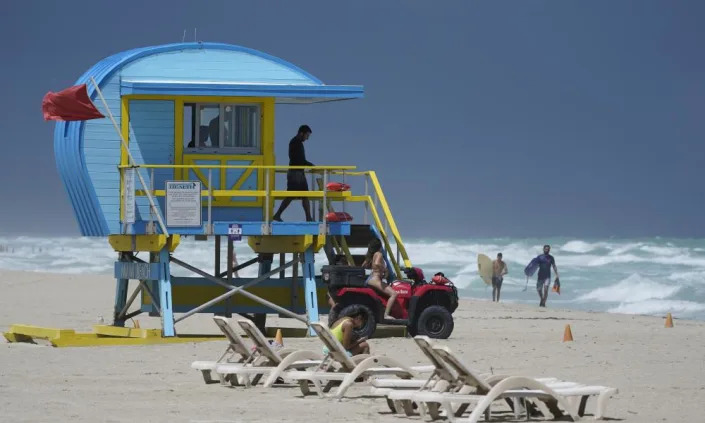
Red tide can cause short-lived respiratory symptoms such as eye, nose, and throat irritation like those associated with the common cold or seasonal sinus allergies. Red tide bloomed along the coastline at the end of October and came to a head in early March.
The bloom has largely cleared along most of Sarasota and Manatee since then, making for improved beach conditions during spring break and the Easter holiday weekend.
A map showing sample results for red tide published by the Florida Fish and Wildlife Conservation Commission for the week ending on April 13.
The bloom did persist to the south and north of the region and continues to affect the south Sarasota County area as of the latest information available this week.
There is a moderate risk of red tide-related respiratory irritation over the next 36 hours in Sarasota, Pinellas, and Charlotte counties, according to a forecast issued by the National Centers for Coastal and Ocean Science issued at 6 a.m. on Friday. Red tide is present in Collier, Lee, and Pasco counties at levels that could cause respiratory irritation as well.
Visit www.redtideforecast.com for the most up-to-date respiratory irritation forecast information.
Here’s the biggest hurdle facing America’s EV revolution
Shannon Osaka – April 13, 2023
A curbside PlugNYC Flo electric vehicle (EV) charger near Central Park West in New York, US, on Wednesday, Aug. 31, 2022. (Jeenah Moon/Bloomberg)
The Biden administration just unveiled some of the most aggressive auto climate rules in the world – the latest step for an administration that has gone all-in on EVs. But America’s EV transition could soon stumble: not because of high car costs or a lack of automaker support, but thanks to the country’s broken and dysfunctional public charging system.
Most electric vehicle drivers charge their vehicles at home. But as Americans buy EVs – to the tune of 7 percent of all new vehicle registrations in January – more and more people are finding that the public charging system is unreliable, inconvenient and simply confusing.
“I’ve seen people wait because there are only four chargers and two of them are out of service,” said Bill Ferro, the founder of EVSession, a software firm that tracks charger reliability. “Everything that I’ve seen shows that it’s driving away current and potential EV owners.”
Drivers might show up at a DC-fast charging station – which can fill a vehicle’s battery by 80 percent in about 20 minutes – to find that most of the chargers are broken. Or one might work, but only if the driver installs a particular app on their phone, creates an account, and loads money onto it.
Last year, in a preprint study conducted by researchers at the University of California, Berkeley, and the nonprofit Cool the Earth, researchers tested every single fast charging station in the San Francisco Bay Area. They found that more than a quarter of the 657 charging points didn’t function during a 2-minute charging test. Sometimes the charging cable couldn’t reach the vehicle’s charging port; other times the payment system wouldn’t work; sometimes the charger’s screen was broken or the network was down.
Some of the chargers had the option to pay by 1-800 number – but Carleen Cullen, the executive director of Cool the Earth and one of the authors of the study, said that’s not a good solution. “If we want mass market adoption, people are going to want to pay and move along and charge their vehicles,” she said.
Another survey, from the group J.D. Power and Associates, found that one in five EV owners who had recently visited a station where unable to charge – largely due to a system malfunction.
Tesla’s proprietary charging network usually gets the highest ratings from users. But the vast majority of stations are only open to Tesla drivers. The company has agreed to open a small fraction of its stations to non-Tesla drivers by 2024, beginning now with a few select locations around the country.
Ferro, who drives an electric vehicle himself, frequently has to take road trips of around 300 miles. He ended up buying a Tesla Model 3 largely to make use of the reliable charging network. “On any other network, I wouldn’t have trusted it,” he explained.
But there’s more to the problem than that. The decentralized nature of American charging is also confusing early adopters and turning off potential EV drivers. Public charging is currently managed by a hodgepodge of private companies, utilities, government spending, and automakers. There are private companies – like Electrify America, EVgo, or ChargePoint – which each have their own machines and ways of paying for charging. (A typical EV driver may have as many as eight phone apps and several RFID cards to manage all the possible chargers on the road.)
Then there are automakers, like Tesla or Rivian, that establish their own networks tailor-made for those who buy their products. Utilities are also trying to get into the game, building up their own fast-charging networks in states like Minnesota. The result is a mess for drivers who simply want to plug in – and a logistical nightmare for regulators.
“There are so many different players in this, and they all need to be singing the same song,” said Cullen.
There have been attempts to regulate chargers’ “uptime,” or the amount of time that they are functioning properly. The Biden administration has established rules for the $5 billion in funding for public chargers in the infrastructure bill, ordering that they have at least a 97 percent uptime and are accessible via a single payment method. But the federal rules also allow networks to self-report how often their chargers work – a decision that Ferro finds troubling. “It’s letting the fox in the henhouse,” he said.
And that’s only for the chargers that will receive federal funding; the vast majority of stations will not.
Unless the United States sorts out its public charging infrastructure, it’s hard to imagine EV sales growing as quickly as the Biden administration wants. The strictest version of the rules the Environmental Protection Agency proposed Wednesday would require a whopping two-thirds of all new passenger vehicle sales to be electric by 2032.
New federal subsidies, offered under the Inflation Reduction Act, are making electric vehicles more accessible to Americans. More EV drivers means more pressure on the existing malfunctioning stations, as well as more drivers who live in apartments or don’t have easy access to home charging.
While early adopters and EV enthusiasts might be happy to build in multiple contingency plans, mainstream EV adoption is going to require a more streamlined system. U.S. public charging also lags far behind other countries: According to S&P Global, China has 1.2 million charging points, Europe has 400,000 – and the United States only has 140,000.
“We’re not yet to the mass market phase,” said Ferro. “And if the infrastructure isn’t there, it will put a damper on everybody’s plans.”
Why Republicans Are Overreaching So Hard in So Many States
Philip Elliott – April 11, 2023
US-NEWS-KY-ABORTION-BILLS-LX
Kentucky state Rep. Randy Bridges, a Republican, gives a thumbs down as protesters chant “Bans off our bodies” at the Kentucky state Capitol on April 13, 2022 Credit – Ryan C. Hermens—Lexington Herald-Leader/Tribune News Service via Getty Images
In state capitals across the country, Republicans seem to be overplaying their hand. The most obvious example is abortion, which poll after poll shows most Americans support in many, if not most, circumstances. In Iowa, a state policy to cover the costs of abortion and morning-after pills for rape victims is on hold as the Republican Attorney General reviews it. In Idaho, where abortion is already illegal in all cases, it is now a crime punishable by up to five years in prison for adults who help pregnant minors to cross state lines to obtain the procedure. In South Carolina, a bill categorizing abortion the same as homicide—punishable by the death penalty—has seemed to lose steam, but nonetheless remains in play.
And those are just some of the dozens and dozens of efforts undertaken with Republican guidance to further erode abortion rights in a post-Roe world. Look around at other culture-war-flavored topics running on parallel tracks inside the GOP, and it’s clear that their leaders are chasing broadly unpopular goals: banning books and targeting drag queens; making some of the most dangerous firearms even more accessible; blocking health care for transgender individuals; fighting corporations over “wokeness”; and engaging in the most brazen political retaliation.
All of these are polling clunkers—with the important exception of gender-affirming care for trans minors—and stand to leave the 44% of Americans who identify with neither party wondering just what is animating Republican lawmakers this session, be it in statehouses or here in Washington. Here’s the most basic answer: it’s what they need to do to survive.
Now, hear me out. A lot of my liberal friends predictably will retort that this is all part of some scary, hate-filled agenda meant to oppress non-white, female, and marginalized communities. My conservative pals will say these are simply efforts to roll back government’s reach. Both can be true, but if you get down to the realpolitik of the situation, this polarized agenda is merely the logical conclusion of what happens when the party in power looks around and sees there’s no one there to stop them from drawing legislative districts however they please. The extreme gerrymandering that results means red states get redder legislatures—and, to be fair, blue states turn deeper blue; there are just fewer of them—and the resulting policies move to the extremes with few consequences.
Few consequences, that is, until someone falls out of line. It’s really, really rare to lose re-nomination as an incumbent; just 14 of the 435 House seats saw that happen last year, and roughly half were victims of ex-President Donald Trump’s petty endorsement of a challenger. Moving to last year’s November ballot, a study of most of the races on most ballots found 94% of all incumbents won another term, with congressional incumbents posting a staggering 98% win rate and state-level incumbents notching a 96% record in the general election.
This job-for-life patina is not by accident. Incumbents know it’s statistically improbable that any newcomer can credibly boot them from power. Incumbency has huge advantages, including taxpayer-funded (official) travel, the power of the bully pulpit, and donors looking to stay in good graces. But you look at the few case studies about incumbents who didn’t win re-nomination, and there are warning signs. The folks who lose spectacularly often run afoul of orthodoxy inside the party’s most fervent crowds. Rep. Liz Cheney—who dared call Jan. 6, 2021, for what it was—is a prime example. (To be fair, Rep. Caroline Maloney, who had the misfortune of being matched with another longtime institution of New York Democratic politics, is not.)
Then there are the very carefully drawn and high-cost maps themselves. Chris Cillizza smartly noted in his newsletter last week that the Cook Political Report analysis of the current map shows a scant 82 House seats in play, and only 45 would be considered truly competitive. When Cook did this analysis back in 1999, the number of potentially competitive districts totalled 164—double what it is today. Which means this: the head-to-head, D-vs.-R voting isn’t the real race. The true competition is the one that transforms a candidate into a nominee in increasingly homogeneous communities where voters are picking real estate based not only on crime and tax rates, but also their prospective neighbors’ ideologies. Being seen as an oddball for a district—AKA collaborating across the aisle on legislation—is a death sentence in a lot of districts, which explains the steady polarization in Congress itself. The name of the game for incumbents is survival, and veering to an extreme can be a gilded path for another term, while trying for comity can mean a skid toward K Street.
So as you look at the seemingly out-of-touch agenda snaking its way through state legislatures and the Republican-led parts of Washington and think the plans are incompatible with the electorate, that’s only partially true. Broadly, yes, Americans are aghast at parts of this all-culture-wars-all-the-time agenda. Some 76% of Americans tell pollsters that they’re fine with schools teaching ideas that might make students uncomfortable. And a clear majority of all Americans—64%—think abortion should be legal in most or all cases. The same number of Americans say there should be laws protecting transgender individuals from discrimination.
Dig into the numbers a little, though, and it’s quickly apparent that the lawmakers chasing these divisive notions are not completely irrational, especially when you consider their district borders are drawn to foment hardcore policies. The dirty secret among political professionals is that all voters are not created equal. Take the question of whether schools can teach ideas that make students uncomfortable. Among voters who backed Biden in 2020, just 7% of Americans said they were fine with such a block; look at Trump 2020 voters, and that number gets to 36%, meaning a full third of the GOP universe for 2024 is OK with at least some measure of book bans, and that group is probably more likely to vote in the next primary. On abortion, among Republicans, polls find 58% support for the overturning of Roe, including 35% who said they strongly support it. And while 64% of all Americans favor non-discrimination policies toward trans individuals, 58% of them also say trans student athletes should play on the team that matches their gender at birth, regardless of how they identify. Among Republicans, that number spikes to 85%, an astronomical figure that almost demands action.
Put simply: the culture wars might be less about the fight and more about how the battlefields were drawn well before any of the officeholders even showed up.
That’s a small consolation for liberals in competitive states watching as increasingly conservative lawmakers rush ahead on an agenda mismatched to what constituents actually want. Democrats may be able to claw back some of that imbalance if they ever convince their base of the reality that securing the right handful of state legislature seats would have far more power in shaping national politics than throwing millions at longshot, feel-good candidates who become darlings on social media but are chasing votes that aren’t there. Nonetheless, most of these maps are locked in place until at least 2031. Republicans know it, too, which explains why so many of them are leaning into broadly unpopular—but parochially homerun—policies.
18,000 cows killed in explosion, fire at Texas dairy farm may be largest cattle killing ever
Rick Jervis, USA TODAY – April 12, 2023
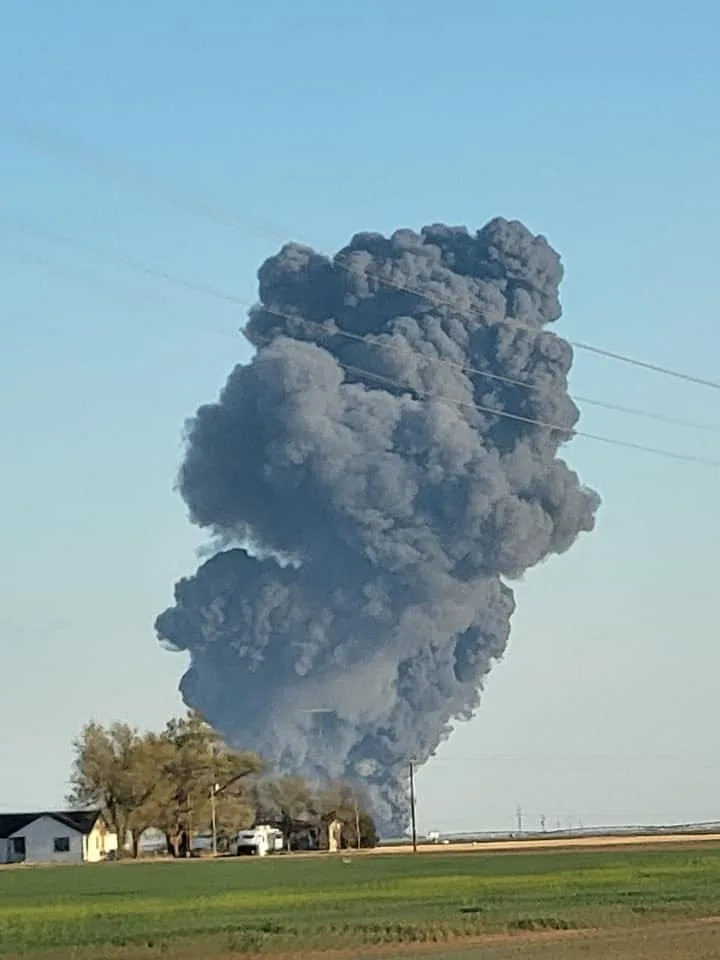
The fire spread quickly through the holding pens, where thousands of dairy cows crowded together waiting to be milked, trapped in deadly confines.
After subduing the fire at the west Texas dairy farm Monday evening, officials were stunned at the scale of livestock death left behind: 18,000 head of cattle perished in the fire at the South Fork Dairy farm near Dimmitt, Texas – or nearly three times the number of cattle led to slaughter each day across the U.S.
A dairy farm worker rescued from inside the structure was taken to an area hospital and was in critical but stable condition as of Tuesday. There were no other human casualties.
“It’s mind-boggling,” Dimmitt Mayor Roger Malone said of the number of bovine deaths. “I don’t think it’s ever happened before around here. It’s a real tragedy.”
The Castro County Sheriff’s Office was among several agencies to respond to a fire and explosion at a dairy farm near Dimmitt on Monday.
It was the biggest single-incident death of cattle in the country since the Animal Welfare Institute, a Washington-based animal advocacy group, began tracking barn and farm fires in 2013.
That easily surpassed the previous high: a 2020 fire at an upstate New York dairy farm that consumed around 400 cows, said Allie Granger, a policy associate at the institute.
“This is the deadliest fire involving cattle we know of,” she said of the Texas incident. “In the past, we have seen fires involving several hundred cows at a time, but nothing anything near this level of mortality.”
Where was the Texas cattle fire?
Castro County, where the fire occurred, is open prairie land dotted with dairy farms and cattle ranches, about 70 miles southwest of Amarillo.
Pictures posted on social media by bystanders showed the large plume of black smoke lifting from the farm fire, as well as charred cows that were saved from the structure.
What caused the dairy farm explosion?
A malfunction in a piece of equipment at the South Fork Dairy farm may have caused an explosion that led to the fire, said County Judge Mandy Gfeller, the county’s top executive. Texas fire officials are still investigating the exact cause, she said.
Malone, the mayor, said he wasn’t aware of any previous fires reported at the facility. He said the dairy had opened in the area just over three years ago and employed between 50 to 60 people.
The owners of South Fork Dairy couldn’t be reached for comment.
How many cows were killed in the dairy fire?
Most of the perished animals – a mix of Holstein and Jersey cows – were in a large holding pen before being milked, she said. The 18,000 cows represented about 90% of the farm’s total herd.
With each cow valued roughly at around $2,000, the company’s losses in livestock could stretch into the tens of millions of dollars, Gfeller said. That doesn’t include equipment and structure loss.
“You’re looking at a devastating loss,” she said. “My heart goes out to each person involved in that operation.”
How did the Texas dairy compare with the rest of the country?
Cattle stranded in a flooded pasture in La Grange, Texas, after Hurricane Harvey in 2017. The storm drowned thousands of cattle in southeast Texas.
Texas ranks fourth nationally in milk production, home to 319 Grade A dairies with an estimated 625,000 cows producing almost 16.5 billion pounds of milk a year, according to the Texas Association of Dairymen, a trade group.
And Castro County is the second-highest producing county in Texas, with 15 dairies producing 148,000 pounds of milk a month, according to the U.S. Department of Agriculture.
Even by Texas standards, South Fork Dairy was a behemoth. Its 18,000 cattle made it nearly 10 times larger than the average dairy herd in Texas.
It’s not the first time large numbers of Texas cattle have died, but rarely do so many perish from a single fire. A blizzard in December 2015killed off around 20,000 cattle across the Texas panhandle, according to the Texas Association of Dairymen.
And Hurricane Harvey in 2017 drowned thousands more in Southeast Texas, leading to $93 million in livestock losses across the state, according to Texas A&M AgriLife Extension Service.
What happens next?
Now, state and dairy officials are turning to the massive, messy task of cleaning up 18,000 charred cow carcasses. On its website, the Texas Commission on Environmental Quality lists several rules for onsite burial of carcasses, including burying the animal at least 50 feet from the nearest well and recording GPS coordinates of the site. Nowhere does it mention mass graves, however.
TCEQ and the AgriLife Extension Service are teaming up to assist in the clean up effort, officials said.
Malone, Dimmitt’s mayor, said he’s taken emergency management courses that teach how to dispose of animal carcasses after a disaster, just not at this scale.
“How do you dispose of 18,000 carcasses?” he said. “That’s something you just don’t run into very much.”
Americans Are Dying Younger—But Where You Live Makes a Big Difference
Jeremy Ney – April 12, 2023
US-SHOOTING-SCHOOL
Alexander Reddy, who’s friend’s little sister is Hallie Scruggs, pays respects at a makeshift memorial for victims by the Covenant School building at the Covenant Presbyterian Church following a shooting, in Nashville, Tennessee, March 28, 2023. – A heavily armed former student killed three young children and three staff in what appeared to be a carefully planned attack at a private elementary school in Nashville on March 27, before being shot dead by police. Credit – BRENDAN SMIALOWSKI-AFP
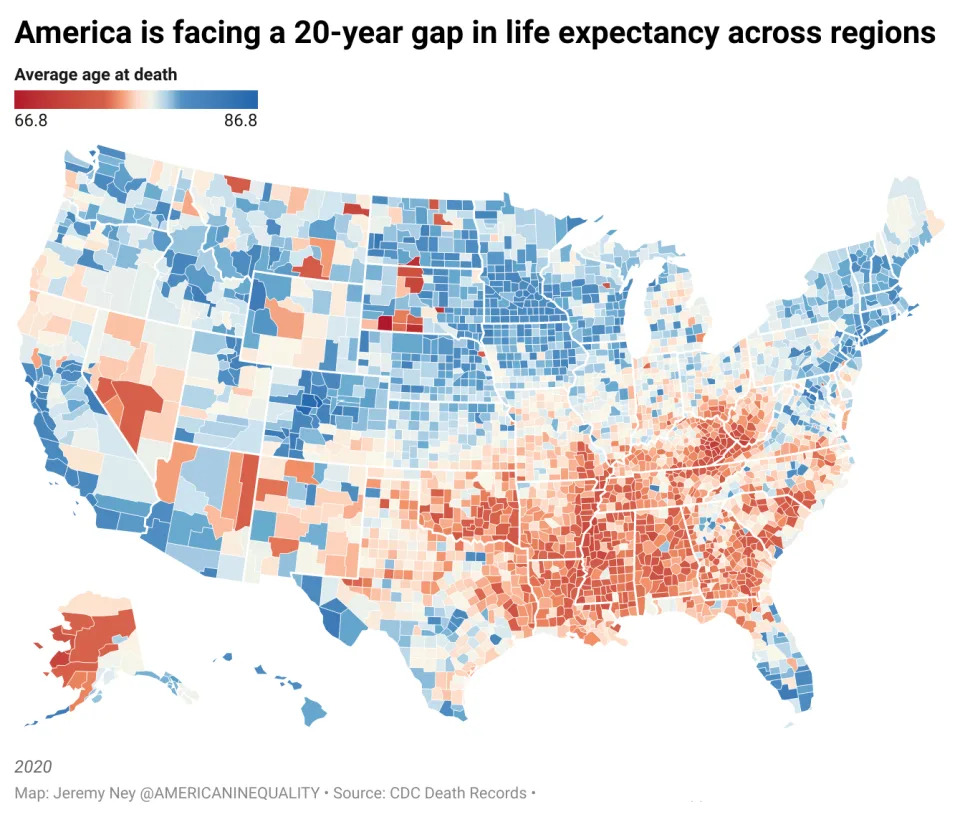
The average U.S. life expectancy has hit its worst decline in 100 years and America’s standing is dismal among peer nations. But the average obscures a more complex story. The United States is facing the greatest divide in life expectancy across regions in the last 40 years. Research from American Inequality found that Americans born in certain areas of Mississippi and Florida may die 20 years younger than their peers born in parts of Colorado and California.
The decline is not occurring equally throughout the country. In the land of opportunity, millions of people are not even given a fair shot at life.
America is facing 20 year gap in life expectancy across the countryCredit to Jeremy Ney @ AmericanInequality
America is unique among wealthy countries when it comes to how young people die, and the trend is only getting worse. From 2019 to 2020, U.S. life expectancy declined by almost 2 years according to the Center Disease Control and Prevention (CDC), the worst two-year decline since 1921-1923. When Covid hit, America experienced a larger decline in life expectancy than any other wealthy country. Life expectancy in America is now 76 years.
What is driving the differences in who lives and who dies in America? The answer is wealth, demographics, and location.
State policies tremendously influence life expectancy. Income support, medicaid expansion, stronger gun control, drug overdose prevention, and safe abortion access are among the drivers of regional divides in life expectancy. Overdoses kill more than 100,000 people each year. Guns kill more people than cars do. But digging into communities shed light on the country’s biggest issues.
More from TIME
Wealthier Americans live longer
Income is a major driver of higher life expectancies. In the wealthiest regions like Aspen, Colorado and Santa Clara, California, median household incomes reach the hundreds of thousands of dollars and Americans live to 87 on average, the highest in the country. But in poorer regions like or Owsley County, Kentucky or Union County, Florida, the median household income is $35,000 and life expectancy floats around 67 on average, the lowest in the country.
Our research has found a painfully high correlation between household income and life expectancy.
Created with Datawrapper
Poverty in America is not about income alone. Low-income communities, regardless of the state, are more likely to struggle with access to affordable healthcare; they are more likely to live near toxic sites and develop lung cancer; they are more likely to live in food deserts and wrestle with illnesses like heart disease and obesity; and they are more likely to die younger from drug overdoses.
Adequately addressing inequality in life expectancy requires looking across factors and working to improve these challenges for communities.
Black communities die younger
Thomas McGuire, professor of health economics at Harvard Medical School, explained, “In terms of health, there’s approximately a five-year penalty for being African-American compared to being a White male.”
Pemiscot County, Missouri represents this gap most clearly as it has one of the lowest Black life expectancies in America. In Pemiscot, Black residents die at 64 on average, effectively meaning that they will work until they die. 1 in 4 residents in Pemiscot is Black. Pemiscot has one public hospital that almost closed in 2013 and it’s one of the poorest counties in Missouri.
State policies make a big difference
States in the Deep South have lower life expectancies than states north of the Mason-Dixon line. These five factors may be the reasons why the residents of some states live far longer.
1. Expanding the EITC and CTC: More money means more time alive, and certain programs which put cash directly into low-income homes have improved life expectancy. The Earned Income Tax Credit (EITC) and Child Tax Credit (CTC) federally have been some of America’s most successful poverty alleviation programs, but 11 states have enacted their own CTC programs and 31 states have implemented their own EITC programs, putting more cash into the most needy homes. Residents in states that have adopted both the EITC and CTC tend to live 2 years longer than states which have implemented neither. This may even be more cost effective at increasing life expectancy than many other policies. These programs are designed to support children, too.
Created with Datawrapper
2. Medicaid Expansion: States that expanded Medicaid saved more than 200 lives per every 100,000 people and decreased the risk of premature death by roughly 50% for older adults who gained coverage. As Nobel-Prize wining economist Paul Krugman explained, “Some of the poorest states in America, with the lowest life expectancy, are still refusing to expand Medicaid even though the federal government would cover the bulk of the cost.” Such individuals in turn are therefore at the mercy of policies that differ state to state.
3. Gun Control: Stronger gun control measures in states also improve life expectancy. The South, which has some of the most lenient gun control measures, lost 5.7 million years of life expectancy in the period 2009-2018 from firearm related deaths. Conversely, Northeastern states, which tend to have much stronger gun control measures like background checks and secure storage laws, had one-fifth the loss in life expectancy. Guns are now the #1 killer of children in America and 1 in 25 American 5-year olds now won’t live to see 40, largely due to guns. If we stopped these deaths, it would effectively add 3 years of life to every 5-year old in the South.
4. Drug Overdose Prevention: States that introduced policies to prevent drug overdose deaths saw life expectancies increase by 11%. The CDC estimates that half of all the unintentional deaths last year that took people’s lives too early were attributed to drug overdoses. The Food and Drug Administration (FDA) recently approved Naloxone to be sold over the counter at pharmacies, which could help close the state-by-state gap. In the meantime, McDowell County, West Virginia has one of the lowest life expectancies in the country and has the highest rate of opioid overdoses in the country.
5. Abortion Access: Lastly, while the data has not fully revealed the impact of the Supreme Court’s ruling in Dobbs v. Jackson, this decision may drive further divides in life expectancy for Southern states that have in turn limited abortion access. Arkansas has a maternal mortality rate that is 50% higher than the national average. In Mississippi, it is 75x more dangerous for women to carry a pregnancy to term than to have an abortion due to poor healthcare. Mississippi has the lowest life expectancy in America at 71. Causing more women to carry a pregnancy to term may increase deaths of mothers in their 20s-40s.
The 20-year gap in life expectancy across regions tells story of America. The divide is deeply interwoven with healthcare, housing, race, gender, location, education, and more. But improving life expectancy across regions in possible and it starts with state legislatures. States can learn from each other about what has worked best and implement new policies with proven effectiveness. Data will be the driving force for finding patterns of inequality and leading change-makers towards solutions that engender equality.
Study warns critical ocean current is nearing ‘collapse.’ That would be a global disaster.
Doyle Rice, USA Today – April 11, 2023
Due to global warming, a deep ocean current around Antarctica that has been relatively stable for thousands of years could head for “collapse” over the next few decades.
Such a sudden shift could affect the planet’s climate and marine ecosystems for centuries to come.
So says a recent study that was published in the peer-reviewed journal Nature.
The cold water that sinks near Antarctica drives the deepest flow of a network of currents that spans throughout the world’s oceans, known as the overturning circulation. The overturning carries heat, carbon, oxygen and nutrients around the globe.
This in turn influences climate, sea level and the productivity of marine ecosystems. Indeed, the loss of nutrient-rich seawater near the surface could damage fisheries, according to the study.
‘Headed towards collapse’
This deep ocean current has remained in a relatively stable state for thousands of years, but with increasing greenhouse gas emissions and the melting of Antarctic ice, Antarctic overturning is predicted to slow down significantly over the next few decades.
“Our modeling shows that if global carbon emissions continue at the current rate, then the Antarctic overturning will slow by more than 40% in the next 30 years – and on a trajectory that looks headed towards collapse,” said study lead author Matthew England of the University of New South Wales in Australia.
Speaking about the new research, paleoclimatologist Alan Mix told Reuters “that’s stunning to see that happen so quickly.” Mix, a paleoclimatologist at Oregon State University and co-author on the latest Intergovernmental Panel on Climate Change assessments, who was not involved in the study, added “It appears to be kicking into gear right now. That’s headline news.”
Such a collapse would also impact a nearby Atlantic Ocean current, known as the Atlantic Meridional Overturning Circulation, or AMOC, which transports warm, salty water from the tropics northward at the ocean surface and cold water southward at the ocean bottom.
This current includes the well-known Gulf Stream, which affects weather patterns in the U.S. and Europe. “The main issue for the AMOC at the moment is meltwater from Greenland, which slows that current,” England told USA TODAY.
Other studies in recent years about the AMOC drew comparisons to the scientifically inaccurate 2004 disaster movie “The Day After Tomorrow,” which used such an ocean current shutdown as the premise of the film. In a 2018 study, authors said a collapse was at least decades away but would be a catastrophe.
An Antarctic “tidewater” glacier meets the ocean in this 2018 photo that also shows sea ice floating on the water’s surface.
Cause of the current slowdown
What’s causing the currents to slow down and potentially collapse? “Climate change is to blame,” England wrote for the Conversation. “As Antarctica melts, more freshwater flows into the oceans. This disrupts the sinking of cold, salty, oxygen-rich water to the bottom of the ocean”.
Specifically, more than 250 trillion tons of that cold, salty, oxygen-rich water sinks near Antarctica each year. This water then spreads northward and carries oxygen into the deep Indian, Pacific and Atlantic Oceans.
“If the oceans had lungs, this would be one of them,” England said.
“Simply put, a slowing or collapse of the overturning circulation would change our climate and marine environment in profound and potentially irreversible ways.” he wrote.
England told USA TODAY that the main impact for North America would be sea-level rise along the East Coast.
In addition, another impact of the collapse of the AMOC would be a transition to a more La Nina-like-state in the Pacific Ocean, England said. La Niña, a natural cooling of sea water in the tropical Pacific Ocean, affects weather and climate in the U.S. and around the world.
It tends to lead to worsening droughts and wildfires in the Southwest U.S., and more hurricanes in the Atlantic Ocean.
What can be done?
“Our study shows continuing ice melt will not only raise sea levels, but also change the massive overturning circulation currents which can drive further ice melt and hence more sea-level rise, and damage climate and ecosystems worldwide,” England wrote in the Conversation. “It’s yet another reason to address the climate crisis – and fast.”
Volcano eruption in Russia’s Kamchatka spews vast ash clouds
Associated Press – April 11, 2023
Smoke and ash are visible during the the Shiveluch volcano’s eruption on the Kamchatka Peninsula in Russia, Tuesday, April 11, 2023. Shiveluch, one of Russia’s most active volcanoes, erupted Tuesday, spewing clouds of ash 20 kilometers into the sky and covering broad areas with ash. (Alexander Ledyayev via AP)
MOSCOW (AP) — A volcano erupted early Tuesday on Russia’s far eastern Kamchatka Peninsula, spewing clouds of dust 20 kilometers (65,600 feet) into the sky and covering broad areas with ash.
The ash cloud from the eruption of Shiveluch, one of Kamchatka’s most active volcanoes, extended over 500 kilometers (more than 300 miles) northwest and engulfed several villages in grey volcanic dust.
Officials closed the skies over the area to aircraft. Local authorities advised residents to stay indoors and shut schools in several affected communities. Two villages had their power supplies cut for a few hours until emergency crews restored them.
Ash fell on 108,000 square kilometers (41,699 square miles) of territory, according to the regional branch of the Russian Academy of Sciences Geophysical Survey. Scientists described the fallout as the biggest in nearly 60 years.
The village of Klyuchi, which is located about 50 kilometers (some 30 miles) from the volcano, was covered by an 8-centimeter (3-inch) layer of dust. Residents posted videos showing the ash cloud plunging the area into darkness.
Kamchatka Gov. Vladimir Solodov said there was no need for mass evacuation, but added that some residents who have health issues could be temporarily evacuated.
Shiveluch has two parts, the 3,283-meter (10,771-foot) Old Shiveluch, and the smaller, highly active Young Shiveluch.
The Kamchatka Peninsula, which extends into the Pacific Ocean about 6,600 kilometers (4,000 miles) east of Moscow, is one of the world’s most concentrated area of geothermal activity, with about 30 active volcanoes.
Sea levels rising rapidly in southern U.S., study finds
Ben Adler, Senior Editor – April 10, 2023
Damage after Hurricane Ian Bonita Springs, Fla., Sept. 29, 2022. (Sean Rayford/Getty Images)
A study published Monday finds sea-level rise along the coast of the southeastern United States has accelerated rapidly since 2010, raising fears that tens of millions of Americans’ homes in cities across the South will be at risk from flooding in the decades to come.
“It’s a window into the future,” Sönke Dangendorf, an assistant professor of river-coastal science and engineering at Tulane University, who co-authored the study that appeared in Nature Communications, told the Washington Post.
That paper and another published last month in the Journal of Climate find that sea levels along the Gulf Coast and the southern Atlantic Coast have risen an average of 1 centimeter per year since 2010. That translates to nearly 5 inches over the last 12 years, and it is about double the rate of average global sea-level rise during the same time period.
The Journal of Climate study found that the hurricanes that have recently hammered the Gulf Coast, including Michael in 2018 and Ian — which was blamed in the deaths of 109 Floridians last year — had a more severe impact because of higher sea levels.
“It turns out that the water level associated with Hurricane Ian was the highest on record due to the combined effect of sea-level rise and storm surge,” Jianjun Yin, a climate scientist at the University of Arizona and the author of the Journal of Climate study, told the Post.
Residents of Houston evacuate their homes after the area was flooded from Hurricane Harvey, Aug. 28, 2017. (Joe Raedle/Getty Images)
Data from the National Oceanic and Atmospheric Administration (NOAA) show the water level at Lake Pontchartrain, an estuary bordering New Orleans, is eight inches higher than it was in 2006. Other cities threatened by rising oceans in the region include Houston, Miami and Mobile, Ala.
The centimeter-per-year rate is far faster than experts had expected, and it is more in line with projections made for the end of the century, Dagendorf said. High-tide flooding — when the tides bring water onto normally dry land on rain-free days — has more than doubled on the Gulf Coast and Southeast coast since the beginning of this century, according to NOAA. Recent years have seen records for high-tide flooding obliterated. The city of Bay St. Louis, Miss., went from three days of high-tide flooding in 2000 to 22 days in 2020.
A study by scientists with the University of Miami, NOAA, NASA and other institutions, which has not yet undergone peer review, found that the Southeastern sea-level rise accounted for “30%-50% of flood days in 2015-2020.”
“In low-lying coastal regions, an increase of even a few centimeters in the background sea level can break the regional flooding thresholds and lead to coastal inundation,” the study said.
Miami and New Orleans face greater sea-level threat than already feared
Richard Luscombe – April 10, 2023
Photograph: Wilfredo Lee/AP
Coastal cities in the southern US, including Miami, Houston and New Orleans, are in even greater peril from sea-level rise than scientists already feared, according to new analysis.
What experts are calling a dramatic surge in ocean levels has taken place along the US south-eastern and Gulf of Mexico coastline since 2010, one study suggests, an increase of almost 5in (12.7cm).
That “burst”, more than double the global average of 0.17in (0.44cm) per year, is fueling ever more powerful cyclones, including Hurricane Ian, which struck Florida in September and caused more than $113bn of damage – the state’s costliest natural disaster and the third most expensive storm in US history, according to the National Oceanic and Atmospheric Administration (Noaa).
The University of Arizona study, published in the Journal of Climate and reported on Monday by the Washington Post, provides an alarming new assessment of a key ingredient of the escalating climate emergency, particularly in popular but vulnerable areas of the US where millions of people live.
Existing projections by Nasa show a sea-level rise up to 12in (30cm) by the middle of the century, with longer-range forecasts even more dire.
The Gulf region from Texas to Florida, and southern Atlantic seaboard will see most of the change, the agency says.
“The entire south-east coast and the Gulf Coast is feeling the impact of the sea-level rise acceleration,” the study’s author Jianjun Yin, professor of geosciences at the University of Arizona, told the Post.
“It turns out that the water level associated with Hurricane Ian was the highest on record due to the combined effect of sea-level rise and storm surge.”
The threat from rising oceans hangs over numerous centers of heavy population located on, or close to the coast. Miami, and Miami Beach, cities often cited as ground zero for the climate emergency, frequently see flooding during high tides. Property insurance rates throughout Florida, which Noaa says has experienced more than 40% of all US hurricane strikes, have soared in recent years.
Earlier this month, the Guardian carried an extract from a new book about how Charleston, South Carolina, is facing a “perfect storm” of rising sea levels and racism that leaves the city, in the view of many observers, living on borrowed time.
“What is likely to happen in Charleston is likely, absent a substantial shift in attitude, to happen in many other coastal cities around the globe,” wrote Susan Crawford, author of Charleston: Race, Water, and the Coming Storm.
The Post reported on a second study, published on Monday on nature.com, effectively mirroring the finding of the Arizona analysis that an “acceleration” of sea-level rise was under way.
Researchers at Tulane University, New Orleans, also note that the increase in the Gulf and south-eastern region is greater than the global average, a surge of greater than 0.4in per year they say is “unprecedented in at least 120 years”.
The study, which says the rise is “amplified by internal climate variabilities”, cites storms such as Katrina, and Hurricane Sandy in 2012, that “illustrate that any further increases in the rate of MSL [mean sea-level] rise, particularly rapid ones, threaten the national security of the US and hamper timely adaptation measures.”
Human activity in the Gulf region, which the researchers refer to as “vertical land motion” (VLM), has played a role, the study continues.
“It is well known that tide gauges in the Gulf of Mexico are subject to significant nonlinear VLM, likely related to oil, gas, or groundwater withdrawal. These nonlinear changes appear predominantly along the western portions of the US Gulf coast (Louisiana and Texas),” it says.
Mobile home park residents form co-ops to save their homes
Claire Rush – April 8, 2023
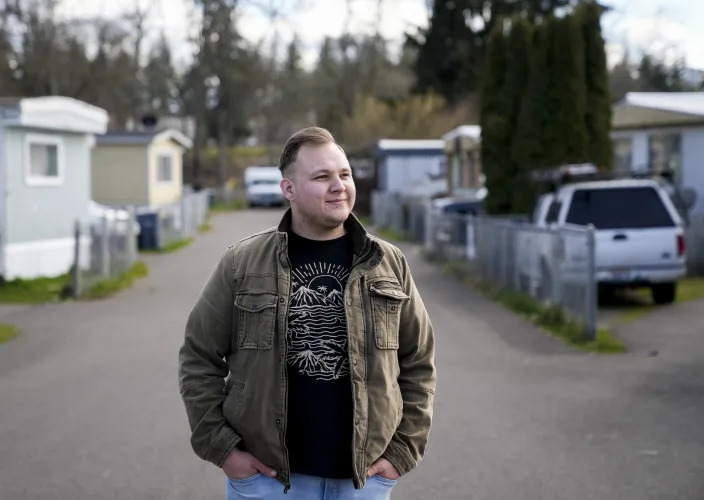
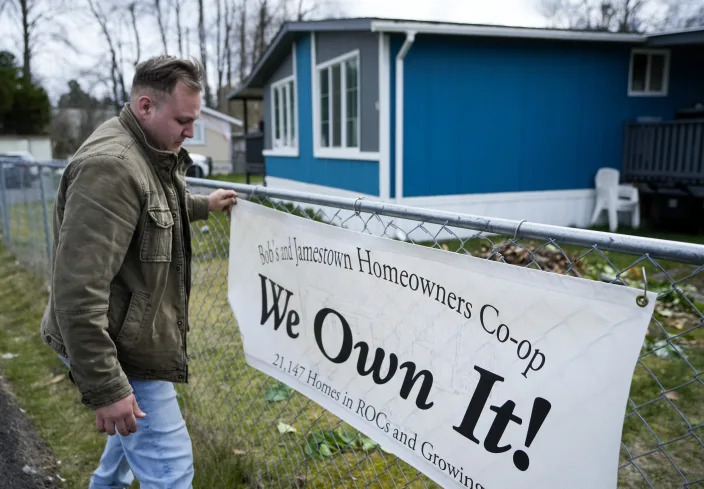
Resident and board member of the mobile home park Bob’s and Jamestown Homeowners Cooperative, Gadiel Galvez, 22, poses for a portrait in his neighborhood on Saturday, March 25, 2023, in Lakewood, Wash. When residents learned the park’s owner was looking to sell, they formed a cooperative and bought it themselves amid worries it would be redeveloped. Since becoming owners in September 2022, residents have worked together to manage and maintain the park. (AP Photo/Lindsey Wasson)Resident and board member of the mobile home park Bob’s and Jamestown Homeowners Cooperative, Gadiel Galvez, 22, takes a walk in his neighborhood on Saturday, March 25, 2023, in Lakewood, Wash. When residents learned the park’s owner was looking to sell, they formed a cooperative and bought it themselves amid worries it would be redeveloped. Since becoming owners in September 2022, residents have worked together to manage and maintain the park. (AP Photo/Lindsey Wasson)Gadiel Galvez, 22, adjusts a sign stating that his resident cooperative owns their mobile home park, Bob’s and Jamestown Homeowners Cooperative, in Lakewood, Wash., on Saturday, March 25, 2023. When residents learned the park’s owner was looking to sell, they formed a cooperative and bought it themselves amid worries it would be redeveloped. Since becoming owners in September 2022, residents have worked together to manage and maintain the park. (AP Photo/Lindsey Wasson)
PORTLAND, Ore. (AP) — When Gadiel Galvez learned that the owner of his mobile home park south of Seattle was looking to sell, he and other residents worried their largely Latino community would be bulldozed to make way for another Amazon warehouse.
So, they decided to form a cooperative and buy their park in Lakewood, Washington. With help from a nonprofit that advises communities like theirs and helps them secure loans, they bought it for $5.25 million. Since becoming owners in September, everyone’s worked to make improvements.
“Everybody thought, ‘You know what? … I’m going to make this place the best that I can,’” said Galvez, 22, who is a co-op board member. “Some people painted their homes, some people remodeled their interiors and exteriors, and some are working on their roofs.”
With rents rising at mobile home parks nationwide, advocates tout the cooperative model as a way to preserve one of the last affordable housing options for people with low- or fixed-incomes and to give them a greater voice in managing their parks.
So far these resident-owned communities are proving to be a reliable option. None of the more than 300 in the network of nonprofit ROC USA have defaulted or closed. One decided to sell back to the county housing authority it originally purchased from.
“They have a 100% track record of success, which tells you that it’s working for the residents,” said George McCarthy, president and CEO of the Lincoln Institute of Land Policy, a Cambridge, Massachusetts, think tank. “Resident ownership is an absolute bulwark against the intrusion of institutional capital in the market.”
Nearly a third of mobile home parks in the U.S. have been bought by such investors since 2015, lured by reliable cash flow and high returns from raising rents at nearly double the general rental market rate, McCarthy said.
“They’re trading on the desperation of people living in the parks,” he said. “There’s no place that they can take their homes if they can’t afford to keep paying the increasing rents.”
Park residents often own their home but rarely the land beneath it. So if a landlord raises rent, residents can be evicted or forced to sell their home. If a park is sold to be redeveloped, mobile homes that can’t be moved are demolished.
“Homelessness is really what residents are facing” if investors aggressively raise rents, said Victoria O’Banion, ROC Northwest’s marketing and acquisitions specialist.
At Rimrock Court in the central Oregon town of Madras, rent increased from $350 to $495 over five years. When the owner notified residents he planned to sell, they feared further increases — or worse, that it would be torn down to make way for apartments. So they decided to buy it.
“We were really worried about being forced out of our homes,” said Shawn King, who lives there with her husband on a fixed income and had experienced homelessness before.
To pay off the purchase loan, residents now pay $520 a month — a stretch, but one that comes with reassurance, King said.
“Just to have that peace of mind, to know that our rent is going to be locked in for awhile and not keep going up, and also knowing that our rent monies … are going back into the property, that is the cool part,” she said.
The required rent increase to go co-op was even steeper in Evergreen Village Cooperative in Mount Bethel, Pennsylvania, — from $460 a month to $750 to pay off the $12 million loan.
Still, more than two-thirds of residents voted in favor, figuring their rent would stabilize in the long run.
“We are not for profit. All the money that we get has to go back into the village and pay the mortgages off,” said Stephen Laclair, board president.
Evergreen Village has earmarked funds for improvement projects for the next decade, and this year plans to enhance the sewer plant and fix electrical issues, he said.
Co-ops can also provide social support to residents. At Liberty Landing Cooperative in Missouri, residents started a food pantry to help neighbors in need.
“If there’s a hardship, we’re willing to work with somebody. … It’s emotional when you find out that somebody’s lost their job, their child support … and they don’t know what to do,” said Kristi Peterman, the board vice president. “Our president likes to say: ‘If it doesn’t work for the poorest of us then it’s not going to work for anybody.'”
Despite the talk of better management and stronger community, most parks aren’t co-ops.
The country’s roughly 43,000 mobile home communities are home to 22 million people, according to the Manufactured Housing Institute, a national trade organization. But only about 1,000 are resident-owned, according to Carolyn Carter, deputy director at the National Consumer Law Center.
Some resistance comes from residents, many of whom are seniors and people with disabilities who may not want the responsibility of managing their park. Others argue rent control or stricter zoning regulations protecting mobile home parks from redevelopment are more effective.
“Zoning is critical. … That is what we ought to be fighting for everywhere,” said Jan Leonard, who lives in a park in Walla Walla, Washington, and worked with other residents to successfully push the city council to amend zoning codes to add mobile home parks as a land-use type.
Other residents considering buying their parks are running up against the same forces that make them popular with investors — a red-hot market and competition from private equity firms and other prospective buyers.
Sarah Marchant, vice president of Community Loan Fund, ROC USA’s New Hampshire affiliate, recalled Tara Estates, a 380-home park in Rochester. The steep $45 million asking price discouraged residents from organizing.
Another challenge is that few states provide funding for residents looking to buy their parks. The lack of grants can make it difficult for residents to finance large loans.
New Hampshire, Vermont, Rhode Island, Massachusetts, Colorado and Oregon are among states with laws that have been effective in helping residents buy their parks, the National Consumer Law Center said.
A new bill in Oregon would allocate $35 million in grants to help residents purchase their parks. Washington passed a bill last month requiring that landlords offer tenants a chance to compete to purchase their park. It also requires two years’ notice if a park will be closed, although that can be reduced if landlords financially compensate residents.
Mobile homes are “an important and affordable housing option for a lot of folks, especially older people aging in place, and we need to make sure it’s preserved,” said state Sen. Noel Frame, the Washington bill’s prime sponsor.
Some real estate groups and park owners argue the bill places an undue burden on landlords.
“If you want tenants to organize and make offers to purchase their communities … they should not wait until there’s a clock ticking,” said Robert Cochran, property manager of Contempo Mobile Home Park in Spokane.