Beware of ticks this summer and pay attention to these signs of Lyme disease.
Beware of ticks this summer and pay attention to these signs of Lyme disease.
While the arrival of summer brings the opportunity to spend more time lounging on your lawn or hiking woodsy trails, we’re not the only ones excited about the long, warm days ahead: Ticks are most active from April through September. And while no one wants a bug bite, ticks are significantly more threatening than most.
While treatable with antibiotics if caught early enough, if it’s left untreated, Lyme disease symptoms can spread to the joints, heart and nervous system, which is why it’s important to catch it early (or, ideally, to avoid getting it at all).
Below, infectious disease experts share the most common early symptoms of Lyme disease so you don’t end up with a chronic case of it ― and how to avoid getting it in the first place.
The Top Early Signs Of Lyme Disease
Dr. Tammy Lundstrom, an infectious disease specialist at Trinity Health in Michigan, and Dr. Sarah Park, an infectious disease clinician who works at the life sciences company Karius in Honolulu, suggested looking out for the following early signs of Lyme disease.
A ‘Bullseye’ Rash
Formally called “erythema migrans,” a rash that looks like a bullseye or target is the most common early Lyme disease symptom, according to Lundstrom.
“It can be very faint, however,” she said. “It also may be absent in 20-30% of cases and can be hard to see on darker skin tones.”
Park added that this rash typically appears within three to 30 days following a tick bite.
Flu-Like Symptoms
Between COVID, the flu and even the common cold, if you find yourself with achy joints, chills, a fever, a headache or other flu-like symptoms, Lyme disease may not be the first thing on your mind. But these symptoms could be signs of it.
“These symptoms can easily be mistaken for a common viral infection such as a cold or flu,” Lundstrom said. “However, the onset of these symptoms paired with potential tick exposure ― for example, hiking in the brush, woodsy areas or tall grass ― occurring three to seven days afterward can signal Lyme disease is a possible cause. Be sure to consult with a medical professional, especially if you identify the bullseye rash or develop other noted symptoms.”
Fatigue
Sudden fatigue could also be an early Lyme disease sign.
“Fatigue is an early sign that is frequently dismissed and assumed to occur from not enough sleep or regular everyday activities like working out,” Park said.
Non-Bullseye Rashes
Other rashes that don’t look like a target could be an early sign of Lyme disease, too.
“A bullseye rash may first appear as a small red bump or a solid red patch that gradually expands, but not everyone develops this type of rash,” Park said. “Other skin manifestations like hives or discomfort similar to a sunburn can also occur.”
Fatigue is one of the hallmark signs of Lyme disease.
Fatigue is one of the hallmark signs of Lyme disease.
How To Prevent Lyme Disease
While Lyme disease is treatable when caught early enough, the best case scenario is that you don’t get it at all — which is why it’s key to protect yourself from ticks, be aware of the early signs of Lyme disease, and know when and where you’re most likely to get it.
“The illness is caused by ticks in the nymph stage, not adults,” Lundstrom said. “They may be very small, around the size of a poppy seed, and hard to see, but it is important to do a thorough check for ticks after outdoor activities. This includes skin folds and your hair. Early recognition and treatment are key to preventing chronic symptoms such as arthritis, headaches, neck stiffness and facial drooping.”
In addition to checking for tinier ticks (remember: the size of a poppyseed!) Lundstrom recommends wearing long pants and long-sleeved shirts when hiking.
“Treat clothing with 0.5% permethrin or buy pretreated hiking gear, and use EPA-registered insect repellent containing DEET,” she added. “Walk in the center of trails for less contact with brush and grass, and always examine skin and clothing carefully and shower to wash off unattached ticks upon returning from a hike.”
If you prefer a DEET-free alternative, Lundstrom said picaridin, IR3535, Oil of Lemon Eucalyptus (OLE), para-menthane-diol (PMD), or 2-undecanone are options to look for in an EPA-registered repellent.
It’s also important to do regular tick checks if you live in an area with more Lyme disease and to seek help right away if you’re noticing any signs that could be symptoms of the disease.
Finally, know that in most cases, a tick has to be attached to your body for 36 to 48 hours before Lyme disease can be transmitted, which is why checking for and removing ticks quickly can make all the difference when it comes to Lyme disease prevention.
While a Lyme disease vaccine may be a possibility at some point in the future, for now, it’s a reality we’re living with. So know the signs, wear protective clothing and bug spray, and do regular tick checks this summer. Trust us, you won’t regret it.
CORRECTION: A prior version of this article incorrectly referred to ticks as insects, but they are arachnids.
The Struggle for Food Sovereignty in Immokalee, Florida
Julia Knoerr – June 14, 2023
The majority of migrant farmworkers live below the federal poverty line, without easy access to healthy foods or affordable housing. To survive, many in this tight-knit community have found strategies for mutual aid and collaborative resilience.
People wait in line for food at the annual Thanksgiving in the Park gathering where residents of the farmworker community of Immokalee are provided with a free Thanksgiving meal. (Photo by Spencer Platt/Getty Images)
After leaving three children in Guatemala, Maria Vasquez spent 15 years working in the agricultural industry in Immokalee, Florida. She worked in the fields for three years picking jalapeños, watermelons, cucumbers, melons, tomatoes, and pumpkins before spending 12 years processing tomatoes in a warehouse.
Although Vasquez handled food every day for work, she couldn’t afford to buy groceries. Instead, she began exchanging food with friends and learning about Immokalee’s community-based resources through word of mouth.
Immokalee is known as the tomato capital of the United States, yet 28 percent of the town’s 24,500 residents—the majority migrant farmworkers from Central America, Mexico, and Haiti—live below the federal poverty line and without easy access to healthy foods. This poverty rate is more than double the statewide average, and it’s compounded by higher-than-average food prices, a housing crisis, and minimal public transportation options.
A volunteer distributes bags of free food at the Meals of Hope weekly Thursday distribution at Immokalee’s Farmworker Village. (Photo credit: Julia Knoerr)
To face these challenges, Vasquez connected with local organizations committed to mutual aid and self-reliance. She began attending meal distribution events at Misión Peniel, a ministry of Peace River Presbytery that supports the Immokalee farmworker community, and joined the mission’s women’s group to build connections.
When she gave birth to a son with Down syndrome in 2015, she gave up the demanding hours of agricultural work to care for him and began providing cleaning services for the mission. She volunteered at the community garden behind the building run by Cultivate Abundance, an organization that addresses food insecurity and livelihood challenges in low-income, migrant farmworker communities, until the group hired her on as a garden aid.
Like Vasquez, many in this tight-knit community have found strategies for collaborative resilience as the pandemic and Hurricane Ian have made food access even more challenging in recent years.
A combination of informal mutual aid networks, small-scale farms, foraging, and donated meals from local organizations such as Misión Peniel and Meals of Hope keep the community nourished. Additionally, Cultivate Abundance is growing crops such as amaranth, Haitian basket vine, and chaya (a nutritious shrub native to the Yucatan peninsula) to move beyond charity and equip community members with culturally relevant, locally recognized produce.
These efforts not only bolster food security, but they also support the community’s autonomy to grow their own food and engage in collective healing. While many Immokalee residents report that they practice grueling labor each day and have experienced xenophobia, sexual violence, and rent gouging in their recent pasts, the garden behind Misión Peniel offers a safe space for community members to speak their own languages, share memories from their home countries, practice meditation, and return to their ancestral cultural knowledge to grow their own food as stewards of the land.
One of Cultivate Abundance’s community gardens sits behind Misión Peniel and has helped the organization produce over 59 tons of produce since beginning operations in 2018. (Photo credit: Julia Knoerr)
Food and Housing Insecurity in Immokalee
Immokalee’s Main Street boasts a few blocks of small markets featuring products from the community’s predominant Mexican, Guatemalan, and Haitian diasporas, as well as money-transfer services for migrants to send money home. Old school buses transporting farmworkers to work pull into the parking lot of La Fiesta supermarket, a key intersection in town bordering on the land owned and occupied by Misión Peniel and the Coalition of Immokalee Workers (CIW), a high-profile farmworker advocacy group.
Here, wild chickens cluck at all hours of the day, their chorus mixing with broadcasting from Radio Conciencia 107.7, the CIW’s community radio station. Green space is scarce, and beyond the town’s center, sidewalks fade into neighborhoods of run-down trailers and busy roads lined with fast food restaurants.
Though Immokalee sits just 30 miles from Naples, one of the wealthiest cities in Florida, wages remain a primary barrier to residents’ adequate food access. The most recent Census found an average per-capita annual income of $16,380 in Immokalee between 2017-2021. Nearly 39 percent of the town’s population was born outside of the U.S., and the number of farmworkers varies based on the season; some sources estimate that as many as 15,000–20,000 migrant seasonal farmworkers typically live in the area.
In the winter months, the majority of those workers are there to pick tomatoes. From 1980 to 2009, farmworkers received 50 cents per bucket picked rather than a guaranteed minimum wage, meaning they had to harvest at least 150 buckets per day to make enough income.
Cultivate Abundance’s banana circle offers different varieties of banans and plaintains. (Photo credit: Julia Knoerr)
CIW’s Fair Food Program, which began in 2010 to create a fairer food industry for workers, farmers, buyers, and consumers, improved those conditions. The program is known nationally as a model for providing farmworkers with human rights, and requiring that growers selling to participating buyers (such as McDonalds, Walmart, Whole Foods, and Trader Joe’s) clock workers’ time and pay them minimum wage (currently $11 per hour in Florida), as required by federal law. Participating buyers also agree to pay at least a penny more per pound of tomatoes they buy, translating to a bonus that gets split among qualifying workers.
However, not all buyers participate in the Fair Food Program. The CIW continues to advocate for a consumer boycott of Publix, Kroger, and Wendy’s, which have all refused to join. Julia Perkins, education coordinator for the CIW, says even with these gains, many workers struggle to feed themselves. Agricultural work is inconsistent, and an individual’s income will vary greatly by season.
“When there is a lot of picking to be done, when it’s not raining a lot, [if] it’s the first pick, you can do pretty well for a number of weeks,” Perkins says. “[But] not well enough to feed you for the rest of the year.”
The pandemic exacerbated farmworkers’ struggle for adequate income. The market for wholesale crops declined because industries like cruises, hotels, and restaurants shut down, lowering the prices of commodities and increasing grocery store prices.
Farmworkers experienced the brunt of the economic downturn—lower demand for the crops they picked meant fewer jobs, and inflation limited their wages’ reach. If farmworkers fell sick with the virus and couldn’t go to work, they received no pay, and as they remained essential workers, they couldn’t shelter in place.
Furthermore, many Immokalee residents are undocumented, meaning they didn’t qualify for federal stimulus checks under the Coronavirus Aid, Relief, and Economic Security Act (CARES Act), nor have they received Supplemental Nutrition Assistance Program (SNAP) benefits to help them purchase food.
Beyond wages, housing often demands 60 percent of Immokalee residents’ income, according to Arol Buntzman, chairman of the Immokalee Fair Housing Coalition. The same five or six families have owned the majority of Immokalee properties for years and charge weekly rent for each individual, including small children, living in 50-year-old trailers. Multiple families and strangers often share rooms.
In September 2022, Hurricane Ian further increased the cost of rent. Intensifying the already severe housing shortage, Hurricane Ian destroyed housing in Naples and Fort Myers, leading some residents of those towns to move to Immokalee and outbid farmworkers, which Buntzman says in turn raised rents even more.
Feeding Farmworker Families
To address these growing needs, nonprofit and religious organizations have been providing fundamental support through basic health and food services.
Julyvette Pacheco, office manager at the food security organization Meals of Hope, saw need increase in the wake of Hurricane Ian, compounded by inflation. Her organization used to feed 200 families in Immokalee every week, but after the hurricane, that number rose to 350.
“Something we have been noticing since the hurricane,” Pachecho says, “is that people are not patient. When they come here, most of them are struggling. They need food, they have been waiting.”
Meanwhile, Cultivate Abundance addresses food insecurity by growing produce reflective of migrants’ foodways and empowering them with skills to grow their own. The main garden behind Misión Peniel is one-tenth of an acre and has produced more than 59 tons of fruit and vegetables since its start in 2018.
During the garden’s inception, members of the mission’s women’s group contributed to a participatory decision-making process about the type of produce they valued, and community members can now volunteer in the garden in exchange for produce to take home. Whether through their families or professional lives, staff members share connection to the agricultural industry and have built partnership with other local farms and gardens.
Lupita Vasquez-Reyes, Cultivate Abundance’s community garden and outreach manager, grew up in Immokalee as the daughter of migrant farmworkers from Mexico. After 20 years away, she returned in 2019, just one year after the garden started in collaboration with Misión Peniel. Vasquez-Reyes says the group has worked to build intentional solidarity with an intersectional approach to diversity in the garden. The beds now boast a wide variety of medicinal herbs and produce, including edible weeds like yerba mora that many would discard.
Lupita Vasquez-Reyes (left) showcases the garden’s offerings, including many plants requested by community members or grown from shared seed. Corn (right) is an essential crop for many community members, who dry corn daily to make masa and use the silk for its medicinal qualities. (Photo credit: Julia Knoerr)
Vasquez-Reyes points to plantains, bananas, corn, chaya, edible mesquite pods, Barbados cherries, tree tomatoes native to Guatemala, and a vertical garden of herbs and lettuces. Epazote is a bitter herb that Vasquez says is helpful to make beans and other legumes easier to digest. Cactus pads have been planted to support climate and storm resilience, and a compost pile ensures that nothing goes to waste.
Cilantro is the biggest hit. “People get so joyous about being able to have it fresh,” Vasquez-Reyes says. “If we didn’t have cilantro, we probably wouldn’t have the success we have here.”
Cultivate Abundance also functions as a garden center for residents, giving out seedlings, recycled soil, fertilizer, and extra materials. Vasquez-Reyes says container gardens are accessible and can easily move with community members with very limited living space or permanence.
Landlords often deter tenants from gardening due to water costs, so many people hand water and collect rain to decrease their dependence on grocery stores.
Thursday is the official harvest day at the Misión Peniel garden; all produce goes to the mission’s meal distributions that have a policy of turning no one away. Cultivate Abundance also maintains a small budget to purchase produce from other local organic farms to supplement their own harvests for meal distributions.
Collaborating for Survival
Vasquez-Reyes says that Haitian, Guatemalan, and Mexican migrants tend to share similar conditions in Immokalee, inspiring a cross-cultural exchange of knowledge and networking. That might look like sharing food, sharing food bank tips, and comparing grocery prices between stores.
Community members will also often forage for weeds with high nutritional content or medicinal uses, according to Vasquez-Reyes. Sometimes they will return to trailer camps where they lived previously to forage plants and will then exchange information with friends about where to find different food sources.
Herbs grow vertically at Cultivate Abundance, where cilantro is the most popular crop. (Photo credit: Julia Knoerr)
Maria Vasquez is one community member who has built a strong network of mutual care. Seven blocks over from Misión Peniel, Vasquez has a small garden at her trailer where she grows everything from amaranth to chile de árbol, mostaza [mustard plant], and epazote and shares it with people in great need. This invitation often leads them to try new foods.
“A little while back, there was an older woman who I came to help. I brought her amaranth; I brought her cilantro,” Vasquez says in Spanish.
Today’s food system is complex.
It took her some time to gain her neighbor’s trust, but now that neighbor, who has diabetes, checks in with Vasquez if she doesn’t see her every day. “She said she had never eaten amaranth; she knew of it, but it was only for the animals,” Vasquez says. Now, she’s started cooking it, as well as other vegetables Vasquez introduced her to.
This knowledge sharing has gone directly back into the garden. Vasquez brought taquitos made with yerba mora one day for Cultivate Abundance staff to sample, and now the herb grows in the garden.
To Vasquez-Reyes, these strategies move away from a fear-based, scarcity approach to poverty and hunger. “We’ve been functioning in food insecurity in this country from a very harmful place, and we’re not centering what people are living,” Vasquez-Reyes says. “That includes the violence, but it includes also the resilience and the self-reliance component of what people are already doing—the networks, the economic alternatives.”
Vasquez-Reyes hopes the garden can also provide space for community members to give voice to their stories in their own healing processes surrounding their experiences as immigrants and laborers fueling an industry of mass consumption. These reflections often emerge as core memories of working in the fields, talking freely about the places they are from, or sharing family members’ stories.
For Vasquez-Reyes, the goal is to reimagine a better world. The practice of growing chemical-free, slow food itself flips the narrative of agriculture as an industry rooted in commodity production. Rather, Vasquez-Reyes says, Cultivate Abundance’s intentional, small-scale approach allows community volunteers and staff to again grow food in partnership with the land.
When planting the milpa (corn, squash, and beans), community members will share blessings and even make video calls to family members in their home countries who are simultaneously preparing the same crops. Through these types of exchanges, the garden space nurtures the community’s nutritional needs, their identities, and their souls.
“It’s not survival of the fittest; it’s collaborative survival,” Vasquez-Reyes says. “That’s the real sustainability.”
This reporting was supported by the Pulitzer Center.
Read a Spanish-language version of the story on El Nuevo Herald.
Did you breathe in a lot of wildfire smoke? Here’s what to do next
Katia Hetter – June 13, 2023
Smoke from more than 430 active wildfires in Canada spread south last week and led to the worst pollution the New York and Washington regions have ever experienced. More than 75 million people in the eastern US were under air quality alerts as wildfire smoke shrouded major cities. Some flights were grounded, events were canceled, and millions of people breathed unhealthy air.
Much of the smoke has dissipated, but people still have questions. Do we need to be concerned about air quality? What are the short-term effects of wildfire smoke inhalation? Are there long-term consequences? And how can people prepare for future wildfires, which, according to the UN Environment Program, will be even more frequent and more severe going forward?
To guide us through these questions, I spoke with CNN Medical Analyst Dr. Leana Wen. Wen is an emergency physician and professor of health policy and management at the George Washington University Milken Institute School of Public Health. She previously served as Baltimore’s health commissioner.
CNN:How do people know if they are in the clear from wildfire smoke?
Dr.Leana Wen: The federal government has an excellent website, airnow.gov, where you can put in your city or zip code and see what the current air quality is in your area.
Just as the weather forecast in your area can change, so can the air quality. As we’ve seen from the spread of smoke from Canada’s wildfires, events hundreds of miles away can lead to pollution in another area. You can use this website to track air quality, and if necessary, change your plans and add precautions accordingly.
CNN: Are there people who should still be concerned about air quality due to the Canadian wildfires?
Wen: It depends on the air quality in their area and their underlying medical circumstances. The air quality in many parts of the country has gotten much better, returning to near normal, while other areas still have unhealthy levels of pollution.
Record-breaking smog due to smoke from Canada’s wildfires partially obscures the US Capitol in Washington on June 8. People with chronic lung and heart conditions should continue to monitor air quality, CNN Medical Analyst Dr. Leana Wen said. – Mandel Ngan/AFP via Getty Images
Those most at risk during days with poor quality are young children, the elderly, pregnant individuals and people with underlying medical conditions, in particular chronic lung and heart conditions. Those people should be cautious, closely monitoring air quality in their area on a regular basis. If there are alerts and advisories, refrain from heavy exercise, stay indoors when possible and run air purifiers in indoor areas.
CNN: What are the short-term health effects of wildfire smoke inhalation?
Wen: During last week’s event, many people may have experienced adverse effects, such as throat irritation, hoarseness and cough. Some may have had worsening of their underlying asthma, bronchitis, COPD, which is short for chronic obstructive pulmonary disease, or other respiratory conditions. These are most pronounced in the initial days following smoke exposure. Studies have shown that exposure to wildfire smoke leads to an increase in emergency department visits and hospitalizations for respiratory disease in children and the elderly.
Studies have also demonstrated a more surprising link, which is the association between wildfire smoke exposure and serious cardiovascular events, including heart attacks and cardiac arrest. And there is research that has linked wildfire smoke exposure events to an increase in influenza months later, suggesting that there could be lagging effects.
It’s thought that many of these effects are due to microscopic particles called particulate matter that can enter deep into the lungs and even enter the bloodstream. These pollutants can induce inflammation and a stress response in the body, which can worsen existing medical conditions.
CNN: If people were exposed for a few days to bad air quality, should they be worried about long-term consequences?
Wen: There are people who live in parts of the world where exposure to hazardous amounts of particulate matter and other pollutants is an everyday reality. These populations are at risk for long-term consequences. Research has linked this type of chronic exposure to an increase in some cancers, for instance, and reduced lung capacity.
For most people, a one-time exposure event probably won’t cause major lasting problems. The worry is that these may not be one-time events going forward. Some people already live in areas prone to wildfires and could have exposure to events several times a year. And, as we have seen, wildfires from hundreds of miles away can cause such significant effects on air quality. With climate change, experts predict more frequent wildfires, which can lead to more days of hazardous air quality for all of us.
CNN: How can people prepare for future wildfires?
Wen: Invest in air purifiers for your home. Bad outdoor air leads to bad indoor air. Air purifiers can help remove smoke and those microscopic particles that are harmful to health.
Workplaces and schools can do this too, and also look to upgrade their ventilation system. Improving ventilation will also reduce virus transmission, including the spread of influenza and Covid-19.
People should optimize their medical health as much as possible. Those with lung disease especially should make sure to have an ample supply of inhalers and consult their physicians about whether there should be increased use in times of worse air quality.
Everyone should have a “go bag”— a bag of emergency supplies — to take with them when an emergency hits. That includes water, nonperishable food, prescription medications, flashlights, first aid kits and more.
Finally, we need to understand the intimate link between the environment and health, and work to prevent environmental hazards that can lead to many significant health problems, now and in the future.
Tanker fire causes part of Interstate 95 in Philadelphia to collapse; complete rebuild expected to take ‘months’: Updates
Francisco Guzman, Grace Hauck and Thao Nguyen, USA TODAY –
June 11, 2023
A tanker truck fire shut down I-95 in both directions after an elevated portion of the heavily traveled interstate collapsed in Philadelphia on Sunday morning, state officials said, raising concerns about possible travel headaches throughout the Northeast.
The Pennsylvania Department of Transportation said the fire closed all lanes between Exit 25 and Exit 32, which includes Allegheny Avenue, Castor Avenue, Academy Road, and Linden Avenue.
Philadelphia Fire Department Captain Derek Bowmer said emergency crews responded shortly before 6:30 a.m. local time after receiving a report of a vehicle being on fire on the interstate. Authorities later identified the vehicle as a gasoline tanker truck that may have been carrying hundreds of gallons of gasoline.
The fire took about an hour to get under control. City and state officials are “responding to address impacts to residents in the area and travelers affected by the road closure,” the state fire department said in a statement to USA TODAY.
In a Sunday night update, Pennsylvania Gov. Josh Shapiro said at least one vehicle was still trapped under the collapsed roadway but there were no immediate reports of injuries. “We’re still working to identify any individual or individuals who may have been caught in the fire and the collapse,” he said.
Interstate 95 is the main north-south highway on the East Coast and stretches from Florida through Maine to Canada.
“Travelers should expect delays and plan alternative travel routes, especially while planning for their weekday commute,” the City of Philadelphia Office of Emergency Management said.
Transportation Sec. Pete Buttigieg said he was monitoring the fire and collapse and was in touch with the governor and Federal Highway Administration to offer “help with recovery and reconstruction.” And the National Transportation Safety Board said it was working with the Pennsylvania State Police to conduct a safety investigation.
President Joe Biden was also briefed on the collapse and officials offered assistance to local and state authorities, according to White House press secretary Karine Jean-Pierre.
How did the section of I-95 in Philadelphia collapse?
Transportation Department spokesperson Brad Rudolph said some kind of crash occurred on a ramp under northbound I-95 causing the northbound section above the fire to quickly collapse.
Bowmer said runoff from the fire or compromised gas lines caused explosions underground. Because of heat from the fire, Bowmer said the northbound lanes were gone and the southbound lanes were “compromised.”
“Today’s going to be a long day. And obviously, with 95 northbound gone and southbound questionable, it’s going to be even longer than that,” said Dominick Mireles, director of the Philadelphia OEM.
According to Rudolph, the collapsed section of I-95 was part of a $212 million reconstruction project that was completed four years ago. The highway segment is closed indefinitely but Rudolph said officials would consider “a fill-in situation or a temporary structure.”
Witness describes a ‘pretty remarkable’ collapse
Mark Fusetti was driving south toward the city’s airport when he saw black smoke rising above the highway. The retired Philadelphia police sergeant said the road beneath the fire began to “dip,” creating a depression. Traffic soon came to a halt before the northbound lanes of the highway gave way.
“It was crazy timing,” Fusetti said. “For it to buckle and collapse that quickly, it’s pretty remarkable.”
Detour routes recommended
For people traveling on I-95 southbound, officials recommended using Route 63 West (Woodhaven Road), U.S. 1 South, 76 East to 676 East. For people traveling I-95 northbound, officials recommended I-676 West, I-76 West, U.S. 1 North to Route 63 East (Woodhaven Road).
Philadelphia residents should use regional public transits services, such as rapid transit, commuter rail or light rail, the city’s Office of Emergency Management said.
Fire contents did not appear to spread into environment
Concerns about the environmental effects of runoff into the nearby Delaware River were raised after a sheen was seen in the river near the collapse site. The Coast Guard contained the material by deploying a boom.
While the tanker truck had a capacity of 8,500 gallons, Ensign Joshua Ledoux said contents from the fire did not appear to be spreading into the environment and “it seems like things are under control.”
The Philadelphia Water Department said the incident had no impact on drinking water quality but will continue to monitor and work with other agencies in their emergency response.
Mireles said heavy construction equipment would be needed to remove the thousands of tons of debris at the site of the fire.
Residents in some areas should expect delays in trash and recycling collections, the Philadelphia Office of Emergency Management said.
“The Streets Department is assessing which areas will be impacted as sanitation trucks will have to be diverted to alternative travel routes,” the office said.
Heat from fire can quickly weaken bridge structures, expert says
Tanker truck fires carry a large amount of hydrocarbon fuel and can generate a “fast, intense release of heat,” said Dr. Thomas Gernay, an assistant professor of civil engineering at Johns Hopkins University who studies ways to protect structures from fires.
“These fires can exceed temperatures of 1500 F in just a few minutes,” Gernay said in an email to USA TODAY.
Heat from a fire underneath a bridge, which is generally not designed for fire exposure, can quickly weaken structural members, according to Gernay. The materials, such as steel and concrete, of structural members lose load-carry capacity as temperatures increase.
Gernay also said structural members will expand when heated and contract when cooled down, further damaging the structure.
“The parts of the structure that did not collapse can be permanently damaged by the material degradation and the movements induced by the heat exposure,” Gernay said in an email.
Incident resembles other bridge fire failures
While bridge fire failures are rare, according to Gernay, past incidents have been similar and involved a portion of a busy highway collapsing.
In 2007, the MacArthur Maze connecting ramp in Oakland, California, collapsed after a tank truck carrying 8,600 gallons of unleaded gasoline overturned. And more recently in 2017, an elevated portion of Interstate 85 collapsed in a fire and shut down the heavily traveled route.
Gernay said in both cases, contractors had to work ahead of schedule due to the “economic impact of traffic interruption.” The timeline of reconstruction of the two cases occurred over several weeks.
Shapiro said Sunday night he planned to issue a disaster declaration Monday to speed up federal funds. He said he had spoken with Buttigieg and was assured that there would be “absolutely no delay” in getting federal funds to safely reconstruct what he called a “critical roadway.”
But Shapiro also said the complete rebuild of I-95 would take “some number of months.”
Top Chinese scientist concedes that coronavirus may have leaked from Wuhan lab
George Gao told the BBC that the possibility of a lab accident should not be discounted.
Alexander Nazaryan, Senior W. H. Correspondent – June 1, 2023
Workers disinfect a school following a COVID-19 outbreak in Wuhan, China, in August 2021. (China Daily via Reuters)
The debate over the origins of the coronavirus has largely been conducted in the West, despite the fact that the pathogen originated in the Chinese city of Wuhan.
Chinese authorities have officially maintained a vague stance, meant largely to deflect criticism. Meanwhile, scientists who may hold clues to how the pandemic began — likely sometime in late 2019 — appear to have been silenced.
That changed ever so slightly this week, when George Gao, the former head of the Chinese Center for Disease Control and Prevention, offered his thoughts on the contentious question to a BBC podcast.
The Wuhan Institute of Virology in Wuhan in May 2020. (Stringer/Reuters)
“Don’t rule out anything.”
It may not seem like much, but Gao was clearly acknowledging that the coronavirus could have emerged as a result of a laboratory accident at the Wuhan Institute of Virology.
The remarks came in a new BBC podcast, “Fever: The Hunt for Covid’s Origin.”
China has strenuously denied that such a “leak” took place, and Gao did not present any evidence to counter those denials. But he also did not make such a denial himself when presented with the chance to do so.
Lab leak proponent and former National Security Council official Jamie Metzl told Yahoo News that he could not recall another Chinese scientist making a similar concession.
“At least on the surface, he has been pretty honest and straightforward from the beginning,” Metzl said of Gao. “My personal sense is that he is trying to maintain scientific credibility while not overly upsetting the Chinese government.”
In fact, Gao may have even been encouraged by Beijing, speculates Richard Ebright, a Rutgers molecular biologist and an outspoken lab leak proponent. “Gao’s statement may have been authorized by China’s government and thus may augur a change in China’s government’s stance on the subject,” Ebright told Yahoo News.
Wuhan’s Huanan Seafood Market, where the first cluster of COVID cases emerged, in 2021. (Thomas Peter/Reuters)
Gao also told the BBC that the Chinese government investigated the Wuhan laboratory, though he gave no details about the investigation.
“The government organized something,” Gao said. “That lab was double-checked by the experts in the field.”
He did not say which agency employed those experts, or what they found, other than that they discovered no “wrongdoing.”
But the revelation that an investigation had been conducted suggests that Chinese authorities took the possibility of a lab leak more seriously than they had previously indicated.
Peter Ben Embarek, Peter Daszak and Marion Koopmans, members of the WHO team tasked with investigating the origins of COVID, at a hotel in Wuhan in 2021. (Aly Song/Reuters)
In early 2021, China allowed investigators with the World Health Organization to conduct a carefully managed visit to Wuhan. In a subsequent report, the WHO endorsed the view that the virus originated at the Huanan Seafood Market, where it jumped from an “intermediate” animal species to humans.
A raccoon dog in its enclosure at the Shanghai Zoo on May 12. (Staff/Reuters)
In March, a group of researchers made a controversial, highly contested claim. Analyzing genetic data from swabs taken at the Huanan Seafood Market, which had been inadvertently uploaded to an international server, they claimed that the virus had originated in a cage containing raccoon dogs.
Critics quickly noted that the mixture of raccoon dog DNA and viral matter did not necessarily mean that the animals had transmitted the coronavirus to humans. The virus could have been deposited in the raccoon dog cage by a sneezing human already sickened with COVID-19 — or by some other inadvertent means.
And, it turned out, the amount of viral DNA in the raccoon dog sample was minuscule to begin with.
Among the critics of the raccoon dog argument was Gao, who like Chinese political leaders maintained that the virus had been brought to the Huanan market by humans, not animals, in what appeared to be an effort to discount both origin hypotheses without offering a credible alternative.
A research team investigating emerging zoonotic diseases prepares to collect samples from a bat breeding shed at Accra Zoo in Accra, Ghana, in 2022. (Francis Kokoroko/Reuters)
The attention devoted to Gao’s comments seems to reflect an enduring fascination with the pandemic’s origins, even as coronavirus concerns recede for most people in the United States and elsewhere.
Some have argued that both the wildlife trade and laboratory safety need reform, in China and elsewhere, regardless of how the virus originated.
“As Professor Gao said, science deals in probabilities and not in certainties. In reality, it may never be possible to know with confidence how the covid-19 virus entered the human population,” said James Wood, head of veterinary medicine at the University of Cambridge. “What is important is that lessons are learned and that live wildlife trade, a well recognised route for zoonotic virus transmission, is reduced or banned and that laboratory safety is properly regulated.”
Climate Shocks Are Making Parts of America Uninsurable. It Just Got Worse.
Christopher Flavelle – May 31, 2023
A firefighter tried to save a home in Meyers, Calif. (NYT)
The climate crisis is becoming a financial crisis.
This month, the largest homeowner insurance company in California, State Farm, announced that it would stop selling coverage to homeowners. That’s not just in wildfire zones, but everywhere in the state.
Insurance companies, tired of losing money, are raising rates, restricting coverage or pulling out of some areas altogether — making it more expensive for people to live in their homes.
“Risk has a price,” said Roy Wright, the former official in charge of insurance at the Federal Emergency Management Agency, and now head of the Insurance Institute for Business and Home Safety, a research group. “We’re just now seeing it.”
In parts of eastern Kentucky ravaged by storms last summer, the price of flood insurance is set to quadruple. In Louisiana, the top insurance official says the market is in crisis, and is offering millions of dollars in subsidies to try to draw insurers to the state.
And in much of Florida, homeowners are increasingly struggling to buy storm coverage. Most big insurers have pulled out of the state already, sending homeowners to smaller private companies that are straining to stay in business — a possible glimpse into California’s future if more big insurers leave.
Growing ‘catastrophe exposure’
State Farm, which insures more homeowners in California than any other company, said it would stop accepting applications for most types of new insurance policies in the state because of “rapidly growing catastrophe exposure.”
The company said that while it recognized the work of California officials to reduce losses from wildfires, it had to stop writing new policies “to improve the company’s financial strength.” A State Farm spokesperson did not respond to a request for comment.
Insurance rates in California jumped after wildfires became more devastating than anyone had anticipated. A series of fires that broke out in 2017, many ignited by sparks from failing utility equipment, exploded in size with the effects of climate change. Some homeowners lost their insurance entirely because insurers refused to cover homes in vulnerable areas.
Michael Soller, a spokesperson for the California Department of Insurance, said the agency was working to address the underlying factors that have caused disruption in the insurance industry across the country and around the world, including the biggest one: climate change.
He highlighted the department’s Safer From Wildfires initiative, a fire resilience program, and noted that state lawmakers are also working to control development in the areas at highest risk of burning.
But Tom Corringham, a research economist with the Scripps Institution of Oceanography at the University of California San Diego who has studied the costs of natural disasters, said that allowing people to live in homes that are becoming uninsurable, or prohibitively expensive to insure, was unsustainable.
He said that policymakers must seriously consider buying properties that are at greatest risk, or otherwise moving residents out of the most dangerous communities.
“If we let the market sort it out, we have insurers refusing to write new policies in certain areas,” Corringham said. “We’re not sure how that’s in anyone’s best interest other than insurers.”
A broken model
California’s woes resemble a slow-motion version of what Florida experienced after Hurricane Andrew devastated Miami in 1992. The losses bankrupted some insurers and caused most national carriers to pull out of the state.
In response, Florida established a complicated system: a market based on small insurance companies, backed up by Citizens Property Insurance Corp., a state-mandated company that would provide windstorm coverage for homeowners who couldn’t find private insurance.
For a while, it mostly worked. Then came Hurricane Irma.
The 2017 hurricane, which made landfall in the Florida Keys as a Category 4 storm before moving up the coast, didn’t cause a particularly great amount of damage. But it was the first in a series of storms, culminating in Hurricane Ian last October, that broke the model insurers had relied on: One bad year of claims, followed by a few quiet years to build back their reserves.
Since Irma, almost every year has been bad.
Private insurers began to struggle to pay their claims; some went out of business. Those that survived increased their rates significantly.
More people have left the private market for Citizens, which recently became the state’s largest insurance provider, according to Michael Peltier, a spokesperson. But Citizens won’t cover homes with a replacement cost of more than $700,000, or $1 million in Miami-Dade County and the Florida Keys.
That leaves those homeowners with no choice but private coverage — and in parts of the state, that coverage is getting harder to find, Peltier said.
‘Just not enough wealth’
Florida, despite its challenges, has an important advantage: A steady of influx of residents who remain, for now, willing and able to pay the rising cost of living there. In Louisiana, the rising cost of insurance has become, for some communities, a threat to their existence.
Like Florida after Andrew, Louisiana’s insurance market started to buckle after insurers began leaving following Hurricane Katrina in 2005. Then, starting with Hurricane Laura in 2020, a series of storms pummeled the state. Nine insurance companies failed; people began rushing into the state’s own version of Florida’s Citizens plan.
The state’s insurance market “is in crisis,” Louisiana’s insurance commissioner, James J. Donelon, said in an interview.
In December, Louisiana had to increase premiums for coverage provided by its Citizens plan by 63%, to an average of $4,700 a year. In March, it borrowed $500 million from the bond market to pay the claims of homeowners who had been abandoned when their private insurers failed, Donelon said. The state recently agreed to new subsidies for private insurers, essentially paying them to do business in the state.
Donelon said he hoped that the subsidies would stabilize the market. But Jesse Keenan, a professor at Tulane University in New Orleans and an expert in climate adaptation and finance, said the state’s insurance market would be hard to turn around. The high cost of insurance has begun to affect home prices, he said.
In the past, it would have been possible for some communities — those where homes are passed down from generation to generation, with no mortgages required and no banks demanding insurance — to go without insurance altogether. But as climate change makes storms more intense, that’s no longer an option.
“There’s just not enough wealth in those low-income communities to continue to rebuild, storm after storm,” Keenan said.
A shift to risk-based pricing
Even as homeowners in coastal states face rising costs for wind coverage, they’re being squeezed from yet another direction: Flood insurance.
In 1968, Congress created the National Flood Insurance Program, which offered taxpayer-backed coverage to homeowners. As with wildfires in California and hurricanes in Florida, the flood program arose from what economists call a market failure: Private insurers wouldn’t provide coverage for flooding, leaving homeowners with no options.
The program achieved its main goal, of making flood insurance widely available at a price that homeowners could afford. But as storms became more severe, the program faced growing losses.
In 2021, FEMA, which runs the program, began setting rates equal to the actual flood risk facing homeowners — an effort to better communicate the true danger facing different properties, and also to stanch the losses for the government.
Those increases, which are being phased in over years, in some cases amount to enormous jumps in price. The current cost of flood insurance for single-family homes nationwide is $888 a year, according to FEMA. Under the new, risk-based pricing, that average cost would be $1,808.
And by the time current policyholders actually have to pay premiums that reflect that full risk, the impacts of climate change could make them much higher.
“Properties located in high-risk areas should plan and expect to pay for that risk,” David Maurstad, head of the flood insurance program, said in a statement.
The best way for policymakers to help keep insurance affordable is to reduce the risk people face, said Carolyn Kousky, associate vice president for economics and policy at the Environmental Defense Fund. For example, officials could impose tougher building standards in vulnerable areas.
Government-mandated programs, like the flood insurance plan, or Citizens in Florida and Louisiana, were meant to be a backstop to the private market. But as climate shocks get worse, she said, “we’re now at the point where that’s starting to crack.”
Struggles continue for thousands in Florida 8 months after Hurricane Ian as new storm season looms
Curt Anderson – May 28, 2023
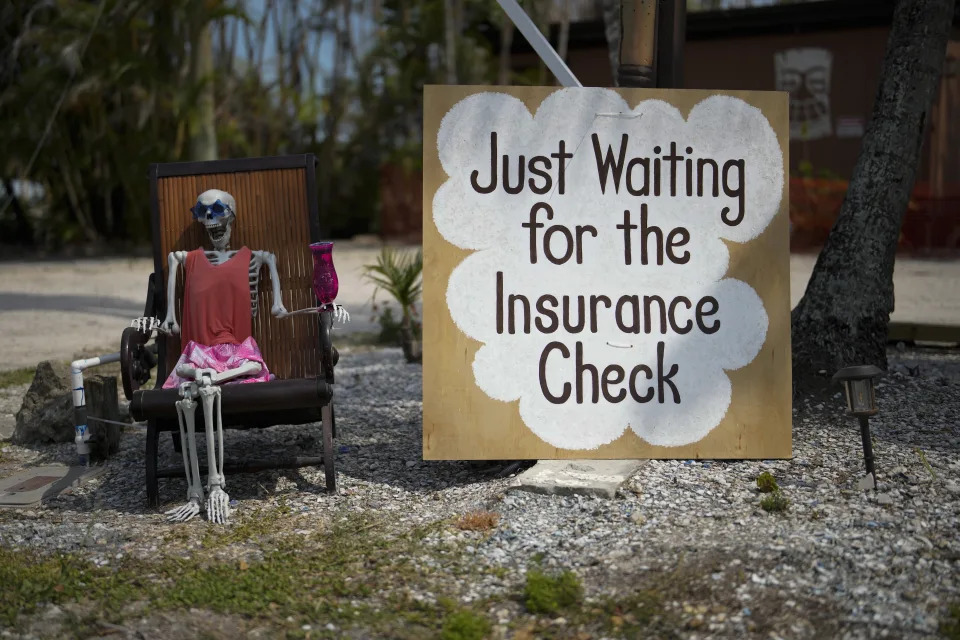
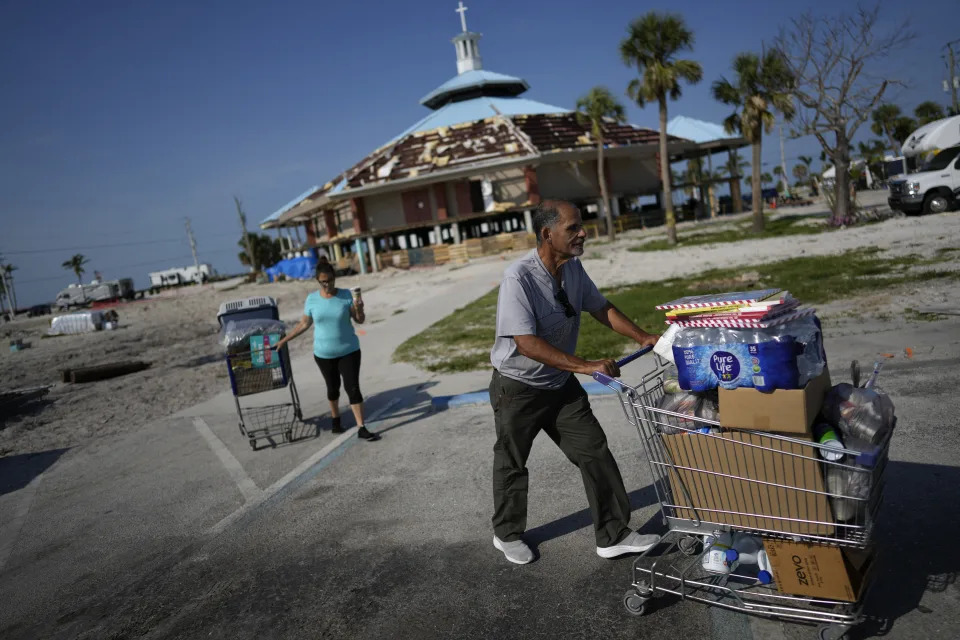
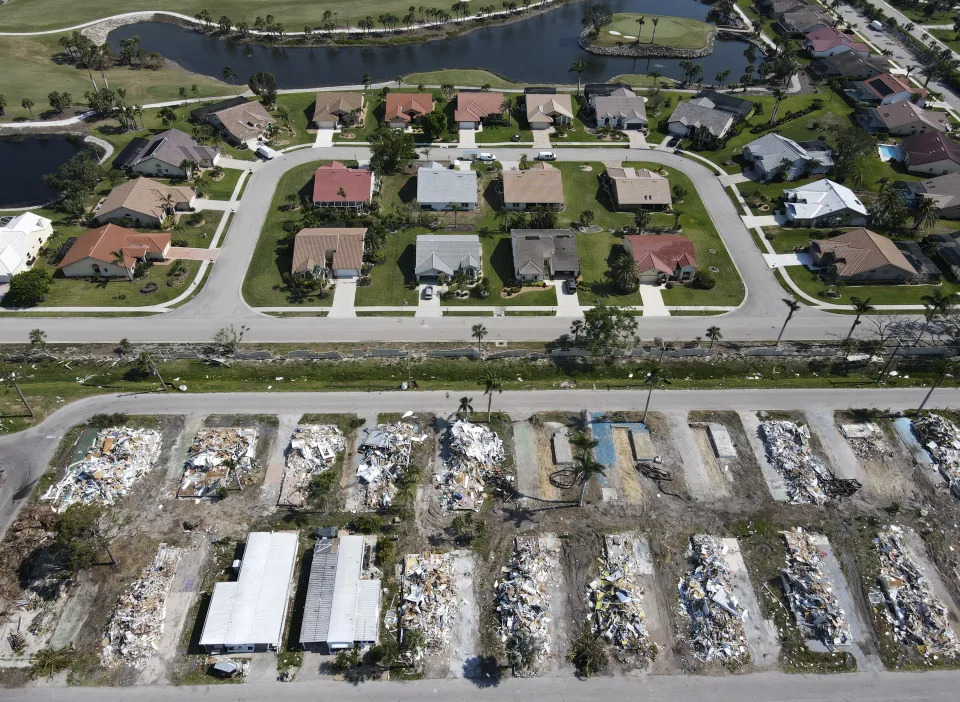
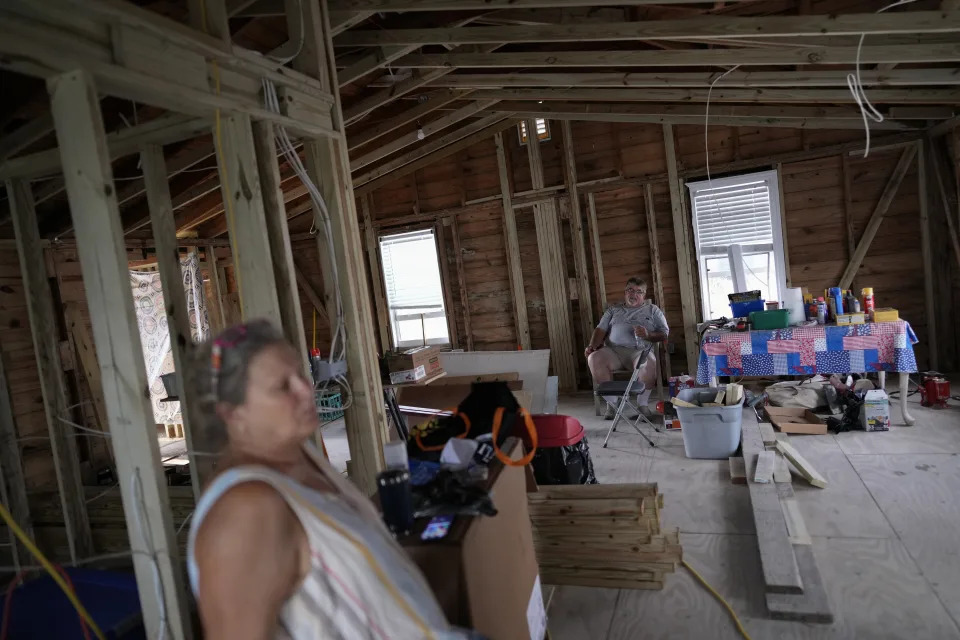
A skeleton in sunglasses sits beside a sign reading “Just waiting for the insurance check,” outside the closed Kona Kai Motel on Sanibel Island, Fla., Thursday, May 11, 2023. In Sanibel, the lingering damage is not quite as widespread as in Fort Myers Beach, but many businesses remain shuttered as they are repaired and storm debris is everywhere. Seven local retail stores have moved into a shopping center in mainland Fort Myers, hoping to continue to operate while awaiting insurance payouts, construction permits, or both before returning to the island. (AP Photo/Rebecca Blackwell)In this drone photo, restaurants operate from food trucks with outdoor seating in the Times Square area, where many businesses were completely destroyed during Hurricane Ian, in Fort Myers Beach, Fla., Wednesday, May 10, 2023. With this year’s Atlantic hurricane season officially beginning June 1, recovery is far from complete in hard-hit Fort Myers Beach, Sanibel and Pine Island. Blank concrete slabs reveal where buildings, many of them once charming, decades-old structures that gave the towns their relaxed beach vibe, were washed away or torn down. (AP Photo/Rebecca Blackwell)Omar Del Rio, a civil engineer currently subcontracted to FEMA, and his wife Maria wheel shopping carts full of groceries and supplies to their car as they leave the free food pantry operating underneath the heavily damaged Beach Baptist Church in Fort Myers Beach, Fla., Thursday, May 11, 2023. Before Hurricane Ian devastated Fort Myers Beach in 2022, the Del Rios rented an apartment on the island, living near the rented homes of their adult son and daughter, who each lived with their spouse and three children. All three homes were lost in the storm, and the six adults and six children were forced to spend months living together in one camper. (AP Photo/Rebecca Blackwell)In this photo taken with a drone, the remains of homes demolished after sustaining heavy damage in Hurricane Ian are seen in Tropicana Sands mobile home park, bottom, in Fort Myers, Fla., Wednesday, May 10, 2023. More than seven months after the storm, crews continue removing debris after demolishing all but a handful of the hundreds of manufactured homes in the community marketed to active adults ages 55 and up. The state estimated the total insured loss from Ian in Florida was almost $14 billion, with more than 143,000 claims still open without payment or claims paid but not fully settled as of March 9. (AP Photo/Rebecca Blackwell)Jacquelyn and Timothy Velazquez sit inside the gutted shell of their 910 square foot two-bedroom home, which was damaged when Hurricane Ian’s storm surge rose to within inches of the ceiling, in Fort Myers Beach, Fla., Wednesday, May 24, 2023. The couple has laid down new flooring, but is still battling with their insurance company to have the damage to the leaking roof covered, while waiting on permits for the renovation work. (AP Photo/Rebecca Blackwell)
FORT MYERS BEACH, Fla. (AP) — Eight months ago, chef Michael Cellura had a restaurant job and had just moved into a fancy new camper home on Fort Myers Beach. Now, after Hurricane Ian swept all that away, he lives in his older Infiniti sedan with a 15-year-old long-haired chihuahua named Ginger.
Like hundreds of others, Cellura was left homeless after the Category 5 hurricane blasted the barrier island last September with ferocious winds and storm surge as high as 15 feet (4 meters). Like many, he’s struggled to navigate insurance payouts, understand federal and state assistance bureaucracy and simply find a place to shower.
“There’s a lot of us like me that are displaced. Nowhere to go,” Cellura, 58, said during a recent interview next to his car, sitting in a commercial parking lot along with other storm survivors housed in recreational vehicles, a converted school bus, even a shipping container. “There’s a lot of homeless out here, a lot of people living in tents, a lot of people struggling.”
Recovery is far from complete in hard-hit Fort Myers Beach, Sanibel and Pine Island, with this year’s Atlantic hurricane season officially beginning June 1. The National Oceanic and Atmospheric Administration is forecasting a roughly average tropical storm season forecast of 12 to 17 named storms, five to nine becoming hurricanes and one to four powering into major hurricanes with winds greater than 110 mph (177 kph).
Another weather pattern that can suppress Atlantic storms is the El Nino warming expected this year in the Pacific Ocean, experts say. Yet the increasingly warmer water in the Atlantic basin fueled by climate change could offset the El Nino effect, scientists say.
In southwest Florida, piles of debris are everywhere. Demolition and construction work is ongoing across the region. Trucks filled with sand rumble to renourish the eroded beaches. Blank concrete slabs reveal where buildings, many of them once charming, decades-old structures that gave the towns their relaxed beach vibe, were washed away or torn down.
Some people, like Fort Myers Beach resident Jacquelyn Velazquez, are living in campers or tents on their property while they await sluggish insurance checks or building permits to restore their lives.
“It’s, you know, it’s in the snap of the finger. Your life is never going to be the same,” she said next to her camper, provided under a state program. “It’s not the things that you lose. It’s just trying to get back to some normalcy.”
Ian claimed more than 156 lives in the U.S., the vast majority in Florida, according to a comprehensive NOAA report on the hurricane. In hard-hit Lee County — location of Fort Myers Beach and the other seaside towns — 36 people died from drowning in storm surge and more than 52,000 structures suffered damage, including more than 19,000 destroyed or severely damaged, a NOAA report found.
Even with state and federal help, the scale of the disaster has overwhelmed these small towns that were not prepared to deal with so many problems at once, said Chris Holley, former interim Fort Myers Beach town manager.
“Probably the biggest challenge is the craziness of the debris removal process. We’ll be at it for another six months,” Holley said. “Permitting is a huge, huge problem for a small town. The staff just couldn’t handle it.”
Then there’s battles with insurance companies and navigating how to obtain state and federal aid, which is running into the billions of dollars. Robert Burton and his partner Cindy Lewis, both 71 and from Ohio, whose mobile home was totaled by storm surge, spent months living with friends and family until finally a small apartment was provided through the Federal Emergency Management Agency. They can stay there until March 2024 while they look for a new home.
Their mobile home park next to the causeway to Sanibel is a ghost town, filled with flooded-out homes soon to be demolished, many of them with ruined furniture inside, clothes still in closets, art still on the walls. Most homes had at least three feet of water inside.
“No one has a home. That park will not be reopened as a residential community,” Lewis said. “So everybody lost.”
The state Office of Insurance Regulation estimated the total insured loss from Ian in Florida was almost $14 billion, with more than 143,000 claims still open without payment or claims paid but not fully settled as of March 9.
With so many people in limbo, places like the heavily damaged Beach Baptist Church in Fort Myers Beach provide a lifeline, with a food pantry, a hot lunch stand, showers and even laundry facilities for anyone to use. Pastor Shawn Critser said about 1,200 families per month are being served at the church through donated goods.
“We’re not emergency feeding now. We’re in disaster recovery mode,” Critser said. “We want to see this continue. We want to have a constant presence.”
In nearby Sanibel, the lingering damage is not quite as widespread although many businesses remain shuttered as they are repaired and storm debris is everywhere. Seven local retail stores have moved into a shopping center in mainland Fort Myers, hoping to continue to operate while awaiting insurance payouts, construction permits, or both before returning to the island.
They call themselves the “Sanibel Seven,” said Rebecca Binkowski, owner of MacIntosh Books and Paper that has been a Sanibel fixture since 1960. She said her store had no flood insurance and lost about $100,000 worth of books and furnishings in the storm.
“The fact of the matter is, we can get our businesses back up and running but without hotels to put people in, without our community moving back, it’s going to be hard to do business,” she said. “You hope this is still a strong community.”
Yet, the sense among many survivors is one of hope for the future, even if it looks very different.
Cellura, the chef living in his car, has a new job at another location of the Nauti Parrot restaurant on the mainland. Insurance only paid off the outstanding loan amount on his destroyed camper and he didn’t qualify for FEMA aid, leaving him with virtually nothing to start over and apartment rents rising fast.
But, after 22 years on the island, he’s not giving up.
“I believe that things will work out. I’m strong. I’m a survivor,” he said. “Every day I wake up, it’s another day to just continue on and try to make things better.”
AP visual journalist Laura Bargfeld and photographer Rebecca Blackwell contributed to this story.
State Farm will no longer accept applications for homeowners insurance in California, citing wildfire risk
Julia Jacobo – May 28, 2023
One of the largest insurance agencies in the country will no longer accept applications for home and business insurance in California due to wildfire risks and the cost of rebuilding.
State Farm has ceased new applications, including all business and personal lines property and casualty insurance, starting Saturday, the company announced in a press release.
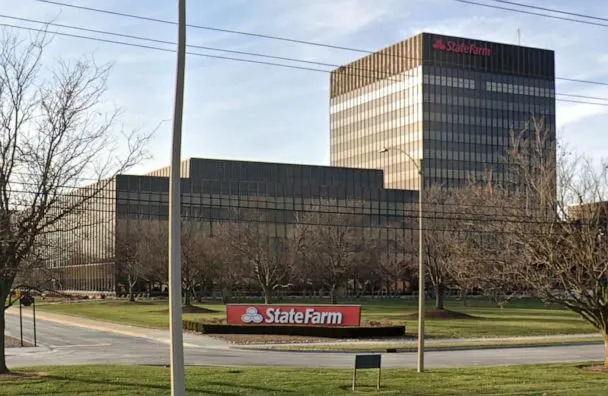
PHOTO: The headquarters for State Farm Insurance is shown in Bloomington, Illinois. (Google Maps Street View)
Existing customers will not be affected, and the company will continue to offer auto insurance in the state, according to the release.
The insurance agency cited “historic increases in construction costs outpacing inflation, rapidly growing catastrophe exposure, and a challenging reinsurance market” for its decision.
State Farm said while it takes its responsibility to manage risk “seriously” and will continue to work with state policymakers and the California Department of Insurance to help build market capacity in California, the decision was necessary to ensure the company remains in good financial standing.
“It’s necessary to take these actions now to improve the company’s financial strength,” the statement read. “We will continue to evaluate our approach based on changing market conditions. State Farm® independent contractor agents licensed and authorized in California will continue to serve existing customers for these products and new customers for products not impacted by this decision.”
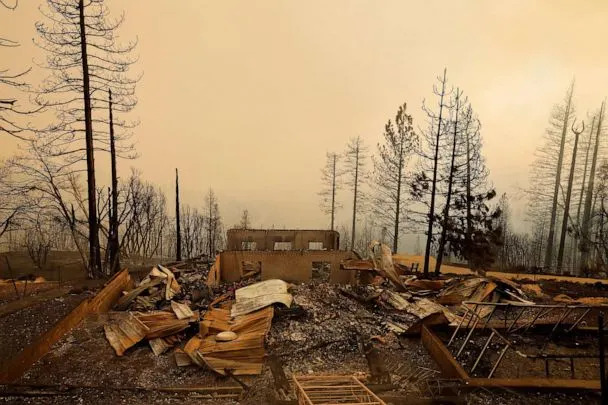
PHOTO: In this Sept. 7, 2022, file photo, a property destroyed by Mosquito Fire is shown in the Michigan Bluff neighborhood of Foresthill, in Placer County, Calif. (Fred Greaves/Reuters, FILE)
A decadeslong megadrought and climate change have been exacerbating wildfire risk in California in recent years. Severe drought during the winter is leading to matchbox conditions in the dry season, allowing intense wildfires to ignite with the slightest spark.
The warm, dry climate that serves as fuel for wildfires is typical for much of the West, but hotter overall temperatures on Earth are increasing wildfire risk in the region.
Last year, the Mosquito Fire destroyed dozens of homes in El Dorado and Placer counties. In 2021, the Dixie Fire destroyed more than 100 homes in the town of Greenville.
The Creek Fire in 2020 became the largest single fire in California history, damaging or destroying nearly 1,000 structures and burning through about 380,000 acres.
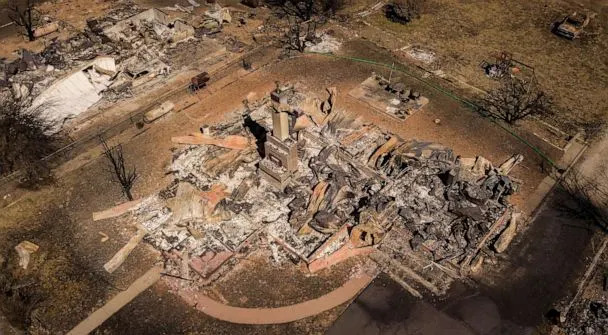
PHOTO: In this Sept. 24, 2021, file photo a burned residence is shown in Greenville, Calif. The Dixie fire has burned almost 1 million acres and remains at 94% containment after burning through 5 counties and more than 1,000 homes. (Josh Edelson/AFP via Getty Images, FILE)
Rebuilding from wildfire destruction is expensive, expensive, experts have found.
The reconstruction costs from the 2022 Coastal Fire in Southern California were estimated to be $530 million, and only 20 homes were destroyed, according to a report by property solutions firm CoreLogic.
In addition, the nationwide impact of California’s 2018 wildfire season — which included the Camp Fire, the most destructive in California history — totaled $148.5 billion in economic damage, according to a study by the University College London.
PHOTO: In this Sept. 8, 2020, file photo, a home is engulfed in flames during the ‘Creek Fire’ in the Tollhouse area of unincorporated Fresno County, Calif. (Josh Edelson/AFP via Getty Images, FILE)
The state’s FAIR Plan provides basic fire insurance coverage for high-risk properties when traditional insurance companies will not, but that plan is the last resort, Janet Ruiz, director of strategic communication for the Insurance Information Institute, told ABC San Francisco station KGO.
“It’s a basic policy, only covers fire – you have to get a wraparound policy too to cover theft and liability,” she said.
Trump Rolled Back Decades Of Clean Water Protections. The Supreme Court Just Went Even Further.
Alexander C. Kaufman, Chris D’Angelo – May 26, 2023
More than three decades ago, a Michigan man named John Rapanos tried to fill in three wetlands on his property to make way for a shopping center. State regulators warned him that doing so was illegal without federal Clean Water Act permits. Rapanos argued that you couldn’t navigate a boat from his wetlands to a federal waterway, so the Environmental Protection Agency had no jurisdiction on his land. When Rapanos ignored the EPA’s cease-and-desist letters, the government successfully brought a civil lawsuit against him, which he then vowed to “fight to the death.”
Instead, he made it all the way to the nation’s highest court. In a split decision in 2006, the Supreme Court overturned the judgment against Rapanos, but did not reach a majority ruling on whether wetlands that flowed into federally regulated “waters of the United States” qualified for the same protections.
In 2016, President Barack Obama sought to answer that question with a new EPA rule extending the Clean Water Act of 1972 to include millions of acres of marshes, bogs and lagoons whose water — and any pollution added to it — channel into already federally regulated waterways.
Republicans chided the move as a federal land grab, while environmentalists cheered what they saw as a reasonable interpretation of the decadesold law through the lens of the latest science shows about hydrology and the increasing threat of extreme droughts and toxic algae blooms.
In 2020, President Donald Trump rolled back much of the rule’s protections, slashing the total protected area of wetlands roughly in half. In 2022, President Joe Biden moved to restore the Obama-era rule.
On Thursday, the Supreme Court’s new right-wing supermajority revisited the 2006 decision to strike down federal protections for virtually all the wetlands Trump deregulated — and then some, eliminating even the few safeguards the Republican administration tried to preserve.
An environmental advocate holds up a sign during a rally outside the Supreme Court in October. (Photo by Paul Morigi/Getty Images for Protect our Waters)
An environmental advocate holds up a sign during a rally outside the Supreme Court in October. (Photo by Paul Morigi/Getty Images for Protect our Waters)
The 5-4 decision — written by Justice Samuel Alito, and joined by Justices John Roberts, Clarence Thomas, Neil Gorsuch and Amy Coney Barrett — revoked the Clean Water Act’s authority over at least 59 million acres of wetlands across the U.S., according to an estimate by the environmental group Earthjustice.
“You’re going to see the Clean Water Act significantly scaled back in terms of coverage,” said Duke McCall, a partner who specializes in federal water rules at the law firm Morgan Lewis. “The impacted waters are going to be significantly narrowed.”
The Obama administration included any wetlands linked to existing federal waterways via underground aquifers or streams. The Trump EPA narrowed the scope to only include wetlands with visible surface connections to rivers, lakes and other long-standing “waters of the United States.” But the Republican administration made an exception for wetlands cut off from federal waterways via a berm, bridge or other artificial barrier.
The court granted no such leeway, instead dismantling nearly half a century of established federal jurisdiction over wetlands — a fact that conservative Justice Brett Kavanaugh noted in his dissenting opinion.
At the very least, the ruling takes the U.S. back to the mid-1970s, to the early days of the Clean Water Act, said Emily Hammond, an energy and environmental law professor at George Washington University. But Hammond stressed it could be worse than that, noting that the majority’s opinion repeatedly cites the Supreme Court’s 1870 decision in The Daniel Ball case, which found that waterways are “navigable” only if they are “navigable in fact” and used for interstate or foreign commerce.
“It’s always been understood, I think, by courts and by Congress and by agencies that when Congress used the term ‘waters of the United States’ it meant to go further than that ‘navigable in fact’ standard that Daniel Ball stood for,” Hammond said. “To see the majority now citing that old decision suggests their eye is to shrink the scope of the Clean Water Act down back to where it would have been before we had a Clean Water Act.”
“In some ways, this takes us back that far,” Hammond said, referring to the 1870 case.
Kavanaugh wrote that while the last eight previous administrations dating back to 1977 “maintained dramatically different views of how to regulate the environment, including under the Clean Water Act,” all of them “recognized as a matter of law that the Clean Water Act’s coverage of adjacent wetlands means more than adjoining wetlands and also includes wetlands separated from covered waters by man-made dikes or barriers, natural river berms, beach dunes, or the like.”
Thursday’s ruling, he argued, will have “negative consequences for waters” across the country.
“By narrowing the Act’s coverage of wetlands to only adjoining wetlands, the Court’s new test will leave some long-regulated adjacent wetlands no longer covered by the Clean Water Act, with significant repercussions for water quality and flood control throughout the United States,” Kavanaugh wrote.
Michael and Chantell Sackett of Priest Lake, Idaho, pose for a photo in front of the Supreme Court in Washington on Oct. 14, 2011. The Supreme Court on Thursday, May 25, 2023, made it harder for the federal government to police water pollution in a decision that strips protections from wetlands that are isolated from larger bodies of water. The justices boosted property rights over concerns about clean water in a ruling in favor of an Idaho couple who sought to build a house near Priest Lake in the state’s panhandle.More
Michael and Chantell Sackett of Priest Lake, Idaho, pose for a photo in front of the Supreme Court in Washington on Oct. 14, 2011. The Supreme Court on Thursday, May 25, 2023, made it harder for the federal government to police water pollution in a decision that strips protections from wetlands that are isolated from larger bodies of water. The justices boosted property rights over concerns about clean water in a ruling in favor of an Idaho couple who sought to build a house near Priest Lake in the state’s panhandle.
The ruling is part of what liberal Justice Elena Kagan views as a clear trend by the court to curb the federal government’s legal authority to regulate pollution in an era of dramatic ecological upheaval — when other countries are taking drastic steps to preserve some semblance of nature’s current biodiversity and order. Last year, the Supreme Court drastically limited EPA’s authority to curb power plant emissions under the Clean Air Act.
“The vice in both instances is the same: the Court’s appointment of itself as the national decision-maker on environmental policy,” Kagan wrote. “So I’ll conclude, sadly, by repeating what I wrote last year, with the replacement of only a single word. ‘[T]he Court substitutes its own ideas about policymaking for Congress’s. The Court will not allow the Clean [Water] Act to work as Congress instructed. The Court, rather than Congress, will decide how much regulation is too much.’”
Last year, the Supreme Court took the unusual step of hearing a case on a defunct power plant regulation — the high court typically rejects suits with no active legal bearing — in what was widely seen as an attempt to preemptively stop the Biden administration from reviving a controversial Obama-era rule. The court’s six conservative justices, including Kavanaugh, ruled in favor of permanently sealing off the legal avenue the Obama administration took to justify parts of its Clean Power Plan regulation.
The conservative justices’ apparent partisan agenda is hardly the only perceived conflict of interest sowing mistrust in the nation’s highest court. The Trump-appointed Barrett, whose father spent much of his career working for Royal Dutch Shell, declined to recuse herself from key cases involving the oil giant, even as Justice Samuel Alito stepped aside over his disclosed investments in oil and companies.
The investigative news outlet ProPublica published a series of exposés over the past month revealing that Thomas, who was appointed by President George H. W. Bush, failed to disclose private jet trips and land deals he received from billionaire real-estate developer Harlan Crow. The National Multifamily Housing Council, which has close ties to Crow — the CEO of Crow Holdings Inc. is also the chair of that group, and three of Crow’s companies are dues-paying members — filed an amicus brief on an earlier iteration of this case, as HuffPost’s Paul Blumenthal reported.
Republican lawmakers celebrated Thursday’s decision as a win for family farmers crushed under the boot of regulators seeking to make living off the land ever harder and more complicated.
“In a huge win for farmers, ranchers, small business owners, and families — the Supreme Court has ditched the Obama/Biden WOTUS rule overreach once and for all,” Rep. Sam Graves (R-Mo.) wrote in a statement.
But while “farmers and small business owners have been held up” as the most sympathetic victims of purported government overreach, McCall said “developers are a huge affected group who have been strong opponents” of expanded wetland protections.
Another way that Thursday’s ruling turns the clock back to before the Clean Water Act was passed in 1972 is by effectively restoring a variable patchwork of state water rules, Hammond said.
“The Clean Water Act was designed of course to create some floor among the states so that we wouldn’t have the race to the bottom, polluters moving to states where they could pollute more because the policies were more lenient,” they said. “This decision so dramatically undermines the Clean Water Act that we do in a sense go back to the times of significant disparities among the states in terms of protections for our waters.”
“These kinds of decisions are starting to add up,” Hammond added. “There’s no doubt there will be cumulative impacts and we’ll see shifts as a result.”
CORRECTION: A previous version of this story suggested the facts of the Rapanos case occurred in the 2000s. They occurred in the 1980s.
The Supreme Court has narrowed the scope of the Clean Water Act
Nina Totenberg, Heard on All Things Considered – May 25, 2023
The U.S. Supreme Court is seen on May 16.Alex Brandon/AP
The U.S. Supreme Court Court on Thursday significantly curtailed the power of the Environmental Protection Agency to regulate the nation’s wetlands and waterways. It was the court’s second decision in a year limiting the ability of the agency to enact anti-pollution regulations and combat climate change.
The challenge to the regulations was brought by Michael and Chantell Sackett, who bought property to build their dream house about 500 feet away from Idaho’s Scenic Priest Lake, a 19-mile stretch of clear water that is fed by mountain streams and bordered by state and national parkland. Three days after the Sacketts started excavating their property, the EPA stopped work on the project because the couple had failed to get a permit for disturbing the wetlands on their land.
Now a conservative Supreme Court majority has used the Sacketts’ case to roll back longstanding rules adopted to carry out the 51-year-old Clean Water Act.
While the nine justices agreed that the Sacketts should prevail, they divided 5-to-4 as to how far to go in limiting the EPA’s authority.Sponsor Message
Narrowing the scope of the law
Writing for the court majority, Justice Samuel Alito said that the navigable waters of the United States regulated by the EPA under the statute do not include many previously regulated wetlands. Rather, he said, the CWA extends to only streams, oceans, rivers and lakes, and those wetlands with a “continuous surface connection to those bodies.”
Justice Brett Kavanaugh, joined by the court’s three liberal members, disputed Alito’s reading of the statute, noting that since 1977 when the CWA was amended to include adjacent wetlands, eight consecutive presidential administrations, Republican and Democratic, have interpreted the law to cover wetlands that the court has now excluded. Kavanaugh said that by narrowing the act to cover only adjoining wetlands, the court’s new test will have quote “significant repercussions for water quality and flood control throughout the United States.”
In addition to joining Kavanaugh’s opinion, the court’s liberals signed on to a separate opinion by Justice Elena Kagan. Pointing to the air and water pollution cases, she accused the majority of appointing itself instead of Congress as the national policymaker on the environment.
Reaction to the opinion
President Biden, in a statement, called the decision “disappointing.”
It “upends the legal framework that has protected America’s waters for decades,” he said. “It also defies the science that confirms the critical role of wetlands in safeguarding our nation’s streams, rivers, and lakes from chemicals and pollutants that harm the health and wellbeing of children, families, and communities.”Sponsor Message
Two former EPA chiefs saw Thursday’s decision as a major setback for the nation’s environment, and its future in combating the effects of climate change. William K. Reilly, who served as EPA administrator in the George H.W. Bush administration, said that while he understands the economic objections of farmers and builders to many wetland regulations, the Supreme Court’s decision is “too broad” and will only limit further the already disappearing wetlands that protect many parts of the country from flooding and drought.
Carol Browner, who served as EPA administrator in the Obama administration, echoed those sentiments, calling the decision “a major blow to the landmark Clean Water Act and the federal government’s ability to protect our people from pollution and its negative health side effects.”
The decision also dismayed environmental groups.
“I don’t think it’s an overstatement to say it’s catastrophic for the Clean Water act,” said Jim Murphy of the National Wildlife Federation. Wetlands play an “enormous role in protecting the nation’s water,” he said. “They’re really the kidneys of water systems and they’re also the sponges. They absorb a lot of water on the landscape. So they’re very important water features and they’re very important to the quality of the water that we drink, swim, fish, boat and recreate in.”
As in last year’s case limiting the EPA’s ability to regulate air pollution from power plants, the decision was a major victory for the groups that supported the Sacketts — mining, oil, utilities and, in today’s case, agricultural and real estate interests as well.



 People wait in line for food at the annual Thanksgiving in the Park gathering where residents of the farmworker community of Immokalee are provided with a free Thanksgiving meal. (Photo by Spencer Platt/Getty Images)