Why is America not the lawless, gun-free, socialist wasteland Republicans warned us about?
Rex Huppke, USA TODAY – July 2, 2023
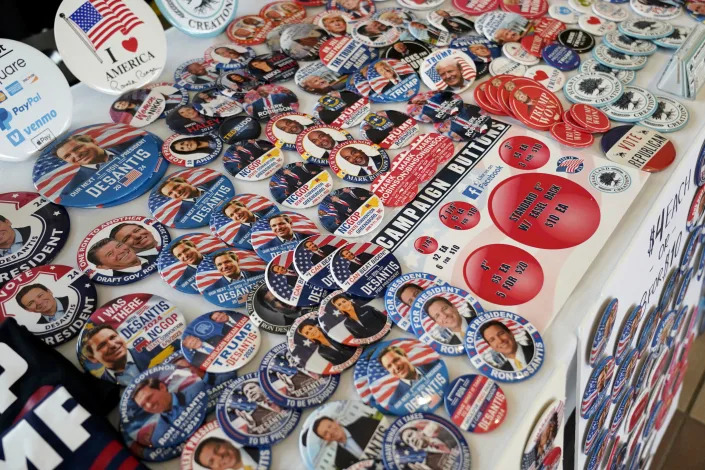
Last I checked, there are approximately 3,756 Republicans running for the GOP presidential nomination, and the vast majority of them – particularly the Donalds Trump and the Rons DeSantis of the world – want voters to know they should be terrified.
Terrified of what, you ask? Oh, I dunno. Socialism. Marxism. “Radical” teachers. Mickey Mouse. Drag queens. “Others.” Pretty much everything, it seems. All the fears. (I’d add spiders to that list, but that’s just me, a liberal scaredy cat.)
Fearmongering is a tried-and-true Republican Party tradition and with the 2024 election cycle about to kick into full gear, it’s mongering season.
Republican fearmongering, and some questions about why fears are never realized
So I have a suggestion for GOP voters, from the MAGA loyalists to the (three remaining) moderates to everyone in between. The first GOP presidential debate will be Aug. 23 in Milwaukee. At that event, you should demand answers to the following fear-related questions:
Why is “her” – the Hillary Clinton character in the “Lock her up!” chant – not locked up? Former President Donald Trump was supposed to do that, yet “her” walks free.
President Donald Trump and Hillary Clinton during a debate in 2016.
Why haven’t we been literally invaded by umpteen South American migrant caravans?
Where is the country-destroying migrant surge that was supposed to come after Title 42 ended?
Why aren’t there violent MS-13 gang members on every street corner?
Why haven’t drag shows turned all Americans into drag queens?
Years of fear, with so few results – it’s almost as if they’re manipulating voters
Why are America’s big cities not actually dystopian hellscapes?
Why is the murder rate declining when we’ve been told repeatedly that crime is spiraling out of control?
How come our children are able to watch Disney movies without turning gay?
Why are Americans still allowed to speak English?
Why are we still able to hold dear all the things we hold dear?
I was specifically promised widespread socialism. What the heck?
Why has nobody come to confiscate our guns? We have actual buckets filled with guns in the basement and bullets everywhere and not a single damn Democrat has come to rip them from our hands, cold and dead or otherwise.
Why has virtually everything a Republican candidate or Fox News talking head ever said to instill fear in our hearts wound up being either total nonsense or, at best, an almost bizarre overexaggeration of a relatively minor issue?
Why has America not been transformed into a socialist wasteland?
Why, for the last time, do we still have all of our guns?
You deserve answers to these questions, my Republican friends. Because often, in this big and confusing world of ours, there are inescapable signs that suggest you’re being lied to.
Learning to spot them is an important life skill. Off you go.
While Midwestern dry spells aren’t unusual, the current lack of rain is compounding existing problems with dry soils and streams, experts say, potentially raising the cost of cattle feed and ultimately the price Americans pay for beef.
“These are fairly serious drought conditions we’re seeing right now,” said Dennis Todey, the director of the USDA Midwest Climate Hub in Ames in Iowa. “It’s not a major national issue yet, but it can become a larger issue if things don’t turn around soon.”
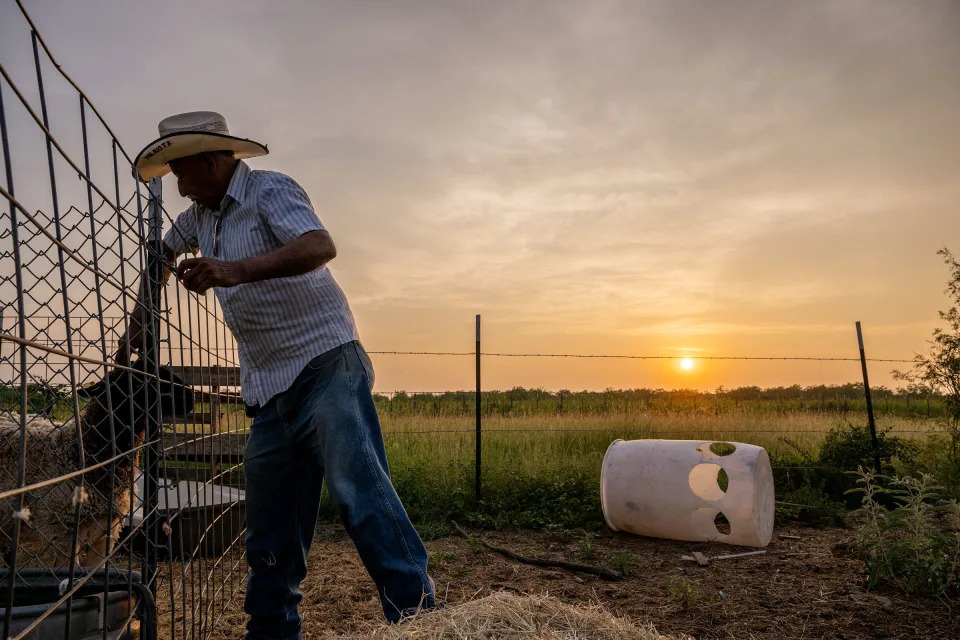
Farmer Jose Esquivel prepares to feed his livestock on June 14, 2023 in Quemado, Texas. Ranchers and farmers have begun shrinking cattle herds due to drought and high costs in the region. The shrinkage threatens steep climbs in prices for the supply of beef.
What is happening with the Midwestern drought?
Many states are reporting drought conditions, ranging from “abnormally dry” to “exceptional drought.” Those states include Nebraska, Kansas, Missouri, Iowa and further east to Indiana and Ohio. Missouri Gov. Michael Parson has issued an executive order to help his state manage the dry conditions.
“The Midwest and east-central Great Plains saw mostly worsening conditions and widespread crop stress and low streamflows after another week of mostly dry weather,” the federal government’s U.S. Drought Monitor warned Thursday. “Heavy rains in parts of Ohio and Kentucky led to some improvements in ongoing short-term drought. Otherwise, much of the region saw conditions stay the same or worsen this week…”
Drought at this time of year can be troublesome because it can stunt the growth of corn and grass, which are used primarily as food for cattle. Few Midwestern farmers irrigate their crops, and so they depend heavily on spring and early summer rains to provide water at this critical time.
Federal officials also noted reports of drought problems for vineyards, soybean growers and strawberry farmers.
The ground is already drier than it otherwise would be, thanks to a dry fall. So the moisture that does fall soaks deeper into the soil, which absorbs it like a sponge.
“It’s a bit of a bigger problem because some of this area has had on and off drought for several years now, so we have so very dry ground water conditions,” Todey said.
How does drought affect food prices?
A poor corn crop would help drive up feed prices, which in turn are passed along to consumers via the price they pay for beef at the supermarket. But corn and grass aren’t the only feed, and soybean crops so far are doing generally OK, Todey said.
The federal government’s January cattle survey showed the number of cattle at feedlots was down 4% over 2022.
Prices paid to beef producers have been rising steadily since mid-2020, and recently hit levels not seen since 2015. Consumer prices for beef have risen from $9.12 a pound for uncooked steak in May 2021 to $10.22 in May 2023, reflecting a 12% increase, according to federal statistics.
Some liberal politicians, including Vermont’s Sen. Bernie Sanders, have criticized meatpacking companies, saying that they are raising prices beyond what’s necessary to cover the higher costs paid to producers.
What happened to all the snow from this winter?
While most of the West saw historic snowfall — from Colorado to Utah, Nevada and California — the Midwest and East had mild winters with less snow. Because the vast majority of that snow fell west of the Continental Divide, levels in Lake Powell and Lake Mead are rising significantly, and drought conditions across the Southwest have generally eased.
How does climate change play into this?
It’s important to remember the difference between weather and climate: Weather is what happens on any given day, while climate reflects the patterns over years or decades.
While Midwest temperatures are generally cooler in December than August, climate change means temperatures in both months are likely to be warmer on average than they used to be. The average December temperature in the Midwest rose between 2.5 and 3 degrees over the last century, according to National Weather Service records.
Similar warming temperatures are altering heat and precipitation patterns across the country, climate scientists say. For the Midwest, scientists predict higher average temperatures of 5-10 degrees by the end of the century and more frequent heavy precipitation events in the winter but fewer spring and summer rains.
Smoke will keep pouring into the US as long as fires are burning in Canada. Here’s why they aren’t being put out
Alaa Elassar – July 1, 2023
Another wave of wildfire smoke has drifted into the US, dimming blue summer skies and igniting troubling concerns regarding the increasing frequency of fires, and what they have to do with climate change.
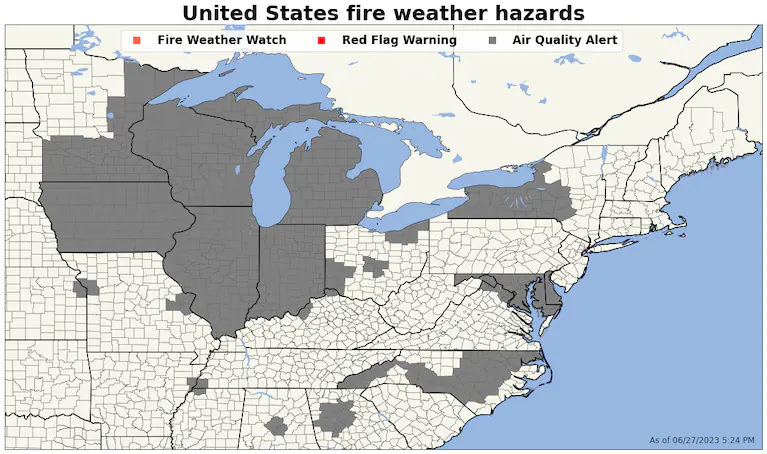
More than 100 million people are under air quality alerts from Wisconsin to Vermont and down to North Carolina as smoke from Canadian wildfires continues to waft south, though conditions are expected to improve slowly into the holiday weekend.
Air quality on both sides of the border has been affected as more than 500 active wildfires raging across Canada. Some fires are so out of control officials have no choice but to leave them burning.
Meanwhile, at least 10 countries have deployed their own firefighters to assist Canada with putting out the ones threatening communities whose residents have scrambled to evacuate.
Scientists continue to reiterate warnings the effects of climate change have arrived, emphasizing wildfires and the plumes of toxic smoke generated by them will become more frequent.
As plumes of smoke billow out of Canada’s forests, some may be wondering why many of the fires are being allowed to burn unchecked.
Here’s why:
Some of the fires are in extremely remote areas
While every Canadian province responds to the fires in their regions differently, they all have common guidelines emphasizing the importance of prioritizing which fires to fight and which to leave alone.
Massive fires burning in remote areas – like some of those currently burning in northwestern Quebec – are often too out of control to do anything about.
“If you have limited resources, and you have a lot of fires, what you do is you protect human life and property first,” Robert Gray, a Canadian wildland fire ecologist, told CNN. “You protect people, infrastructure, watersheds, so there’s a prioritization system.”
He added, “If you’ve got these fires that are burning way out in the back forty, and they’re not threatening anything immediately, then you’re going to have to let them do their thing.”
While the thought of massive fires burning through millions of hectares of forestland might sound unfathomable, it isn’t entirely new.
“There’s always been fires Canadian fire managers don’t fight. It’s expensive to do so, ecologically undesirable, and kind of just messing with nature,” said Daniel Perrakis, a fire scientist with the Canadian Forest Service.
“The smoke is a problem but even if we wanted to do something about it, it wouldn’t really be clear how to do so. You’re talking about huge areas where there’s no road access, no communities in some cases.”
Of the 522 fires currently burning, 262 are listed as out of control across Canada, including British Columbia, Alberta, Ontario and Quebec.
Along with remoteness and distance from people, terrain is another factor. Some of the fires are being allowed to burn simply because they are too treacherous for firefighters to even attempt to tackle.
“These fires are so big that you really can’t put people anywhere near them, the winds kick up, they move very fast, they can start out ahead of you and they can trap crews,” Gray said.
There are not enough resources to fight all the fires
Firefighters from at least 10 countries, including the US, Mexico, Costa Rica, Chile, Spain, Australia, New Zealand, South Africa, South Korea, and France, have been deployed to assist with the Canadian wildfires since the first week of June.
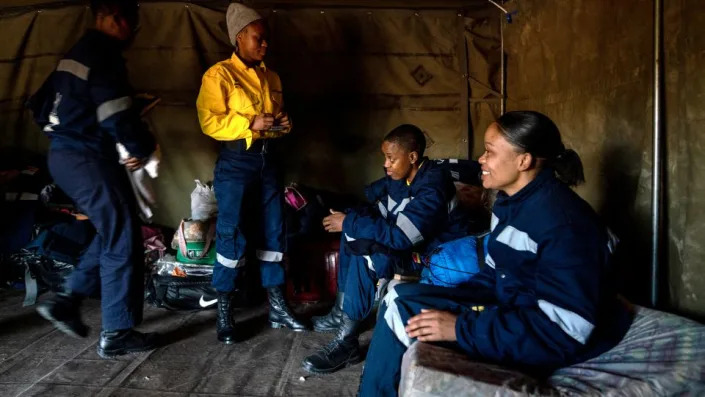
Firefighters from South Africa are among the crews working in Alberta, Canada, to help with ongoing fire suppression efforts. – Shiraaz Mohamed/AFP/Getty Images
“Canada doesn’t have a lot of firefighting resources,” Gray said. “Individual provinces have their own contracting crews, but they have brought in thousands of folks from outside the country to help.”
One factor contributing to the lack of resources, evident in the current fight against the out of control fires, is funding, Gray acknowledged.
“They don’t typically appropriate a lot of money upfront for firefighting,” he continued. “But once the fires break out, the governments can certainly find all the money necessary to suppress them.”
“International groups keep saying, you need to shift the focus to upfront mitigation and prevention so you’re spending less money on response and recovery,” he added. “It’s ridiculous. We spend billions of dollars once the fire breaks out, but we don’t invest the money upfront to mitigate the fires from happening in the first place.”
Not enough prevention tactics to decrease the number of fires
More work needs to be done to reduce the opportunity for future wildfires, which may someday end in catastrophic tragedy.
One of the most effective fire prevention tactics is through prescribed burns, which are fires set intentionally as part of a forest management plan to reduce the risk of more serious and damaging blazes.
“We don’t do anywhere near enough prescribed burning in BC,” Gray said. “Right now we’re burning about 10,000 hectares a year. The state of New Jersey burns more than we do here at BC.”
Prescribed burns have been an important cultural and environmental tradition in Indigenous communities, who for thousands of years set low-intensity fires to rid the land of wildfire fuel like debris, scrub, undergrowth and certain grasses. Such fuel ignites easily, allowing for more intense flames, which are harder to fight.
The intentional burning practices can increase the forests’ resiliency and decrease the likelihood of future wildfires.
Perrakis echoed Gray’s sentiments: “It would be very useful to have maybe 10 times or 20 times more prescribed burning than what we’re doing presently.”
Since prescribed burns come with liability issues and pose a risk of ending in accidental unmanageable fires if not done correctly and at the right time, this will require more funding from the government and proper training.
“We would be removing the fuel from the fire before there’s even a fire,” Perrakis said. “It wouldn’t be used all across the Canadian countryside, but very strategically around communities and other values and will be in line with the local ecosystem.”
Along with prescribed burns, other tactics, like large scale thinning, need to be ramped up, Gray said.
“We need large scale thinning in these forest types that don’t produce a lot of dimension lumber, so there’s a lot of small trees and we need to come to do something with them,” he added. “We can ship them into the bioeconomy, produce bioenergy markets, engineering, wood products; there’s a lot of things we can do with low value wood, and that’s a lot of what’s out there burning up right now.”
The ecosystem depends on fires, and climate change is making them worse
Fires have always served a vital ecological purpose on Earth, essential for many ecosystems. They restore soil nutrients, helping germinate plants and remove decaying matter. Without fires, overgrown foliage like grasses and shrubs can prime the landscape for worse flare-ups, particularly during extreme drought and heat waves.
Most of Canada is covered by boreal forest, the world’s largest and most intact biome. The ecosystem with trees like spruce, pine, and fir makes up about one-third of all forests on the planet.
But it is a fire dependent ecosystem, meaning the species in the forest have evolved in the presence of fire, and fire “is an essential process for conserving biodiversity,” according to the Nature Conservancy.
“We have records as far back as the 1700s and 1800s of yellow sky and black sky and smoky sky days.” he added. “It’s the natural cycle of the boreal forest. There really isn’t much Canadian fire management agencies can do, even if they wanted to.”
While natural fires in the system have always been present and are usually caused by natural elements like lightning, climate change is making them more frequent, increasingly unmanageable, and a lot more difficult to prevent.
One year ago, after enduring a record-breaking temperature of 121 degrees, the British Columbia village of Lytton was leveled by a wildfire, drawing stark attention to the effects of climate change.
Heat-trapping emissions have led to hotter and drier conditions, and wildfires now burn longer and are becoming hotter in places where they have always occurred; meanwhile, fires are also igniting and spreading in unexpected places.
“We know that the weather is the most important ingredient of fire behavior, and climate and weather are linked,” Perrakis said.
Another issue is the increase in the wildfires are caused by climate change, and are simultaneously making climate change worse.
“Things are changing due to climate change, and that’s catching everyone somewhat by surprise, even though we’ve been talking about it for decades,” Perrakis said. “It takes a big season like this one for everyone to really wake up to what climate change looks like. It’s pretty undeniable.”
As Canadians near the fires evacuate while firefighters try to save their homes and communities, other, bigger fires burn freely with no way to control them, and people in the US will continue breathing in unhealthy smoke.
It all begs the question: When will it end?
“People should probably get used to it, because it’s not something that has come out of nowhere,” Perrakis said. “Climate change is undeniable, and now it’s time to think about the future, 10 or 20 years down the line, and what needs to be done.”
Wildfire smoke puts Chicago among cities with worst air quality in the world
It’s the latest in a series of smoke invasions from Canada this month.
Ian Livingston – June 27, 2023
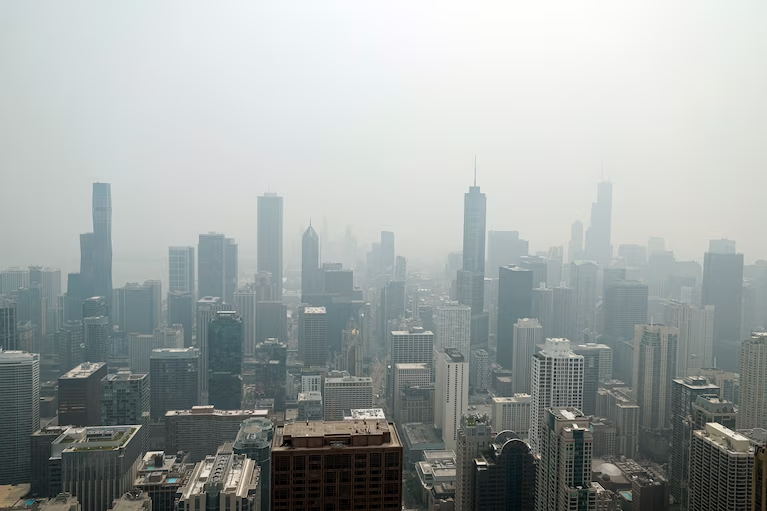
Chicago’s skyline is draped in heavy smoke from the Canadian wildfires on Tuesday. (Kamil Krzaczynski/AFP/Getty Images)
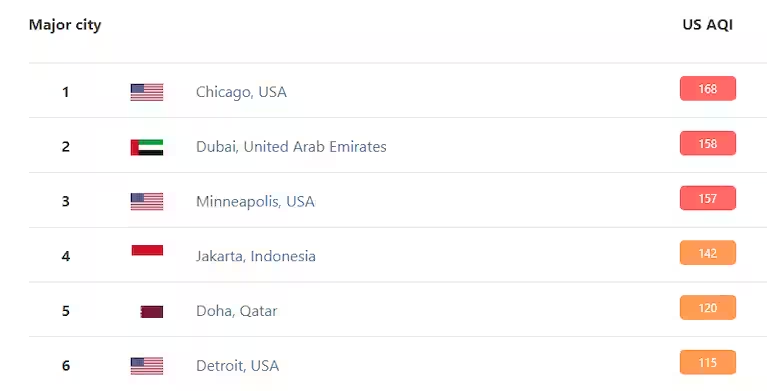
A new round of dense smoke has invaded the United States, specifically the Great Lakes region, as wildfires munch through forests across Quebec and Ontario, with more than 3.7 million acres scorched over the last week in those provinces alone. Throughout Tuesday, Chicago air quality ranked as the worst in the world among major cities.
Minneapolis and Detroit joined Chicago among the 10 worst, all dealing with conditions no better than Code Red. Air quality was even worse in other locations, such as Waukesha, Wis., west of Milwaukee, where the more severe Code Maroon was reached. Grand Rapids, Mich. — which through Tuesday has been between Red and Maroon, at Code Purple — is among places from eastern Iowa through Michigan and into Ontario that have endured air in this bout that is very unhealthy or worse.
Air quality alerts will be in effect into Wednesday or Thursday from Minnesota and Iowa through most of the Midwest, the Great Lakes region, and into parts of the Northeast, Mid-Atlantic and the Carolinas.
The Air Quality Index (AQI) moves to Code Orange (unhealthy for sensitive groups) at a reading of 101. Code Red (unhealthy for everyone) starts at 151. Once reaching 201, it’s Code Purple (very unhealthy), and finally a Code Maroon (hazardous) begins at 301.
Wildfire smoke’s primary pollutant is often referred to as PM2.5. These are fine particles from burned organic matter less than or equal to 2.5 microns in diameter — a microscopic soot.
The latest on the Canadian wildfires and smoke
Haze obscures the skyline in Cedar Rapids, Iowa, on Tuesday, June 27, 2023. (Nick Rohlman/The Gazette via AP)
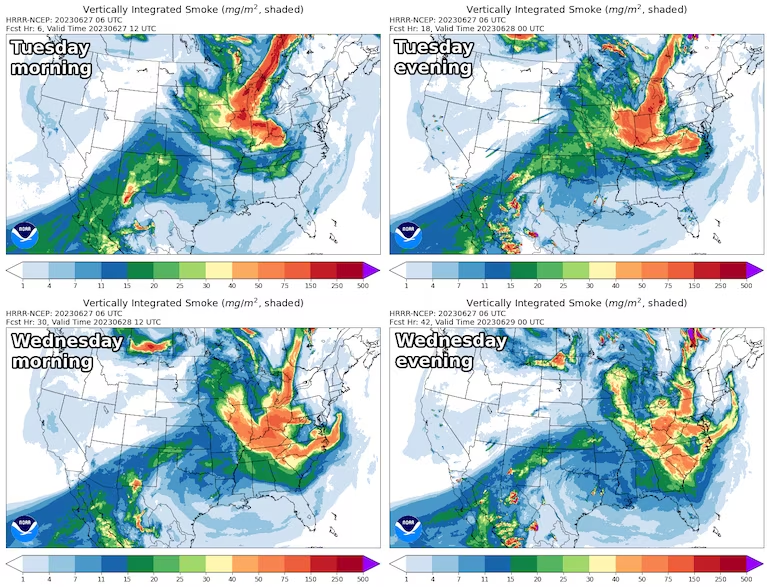
A thick pall of smoke was draped from Quebec and Ontario to the southwest, toward parts of the Midwest and Great Lakes region, and began moving into the Ohio Valley and points east in the early evening. The worst of it late Tuesday was centered over Lake Michigan and surrounding states. A particularly thick patch of smoke was approaching Chicago from the north late afternoon.
In Michigan and surrounding areas, it was a mix of smoke and low clouds.
Smoke is visible in this satellite image Tuesday morning. (Colorado State/CIRA)
Air quality values as severe as Code Purple have been recorded in Iowa, Wisconsin, Michigan, Illinois and northern Indiana so far, with an hourly AQI near Milwaukee of 312 and climbing, according to an Environmental Protection Agency monitor late afternoon. The Canadian city of Sault Ste. Marie, on the international border of Michigan, reached an AQI reading Monday night as high as 353, which is Code Maroon. The city was under Code Purple for much of Tuesday.
Many more locations, from eastern Minnesota to the western slopes of the Appalachians, were seeing Code Red conditions. The thickest of the smoke plume had advanced as far east as Cincinnati and Akron, Ohio.
In Chicago, the National Weather Service wrote that “low visibility due to wildfire smoke will continue today. Consider limiting prolonged outdoor activities.”
Visibility in the city was down to two miles, with smoke reported from Chicago O’Hare International Airport. The Weather Service expected visibility of one to three miles across the region for much of Tuesday.
“You can literally smell the smoke in the air today in Chicago from the Canadian wildfires,” wrote a Twitter user.
Into Wednesday, smoke should keep slowly moving east and somewhat south. It should remain in the lower Great Lakes and push into the Midwest or Ohio Valley region. Some of the smoke was beginning to spill over into the Appalachians late Tuesday.
Many such days
The number of days at Code Orange or worse as a result of wildfire smoke continues to increase in the northeastern United States, though that number is comparatively low when examined against areas immediately surrounding the fires in Canada.
Many of these days also saw spikes beyond Code Orange.
U.S. cities among the worst air quality in the world Tuesday morning. (IQAir)
This month but before the current wave, much of western Wisconsin — in the thick again — had already recorded four or five 24-hour readings at Code Orange or higher. It’s a similar story in and around Detroit, with five Code Orange days in the city and up to seven or eight in nearby locations.
Wildfire smoke, air quality and your health
(Photo by AFP PHOTO / Nova Scotia Government) (Handout/AFP/Getty Images)
More than a dozen days at Code Orange or worse have been tallied in June across the hardest-hit spots north of the border, in Ontario and Quebec, especially north and northwest of Ottawa.
The number of bad air quality days may soon increase in the Northeast, as well. The Washington, D.C., region has had two bad air days this month, both Code Red. Much of Pennsylvania and New Jersey and parts of Southern New England have piled up three such days, with a few locations at four or five.
While AQI values in this plume are somewhat lower than they were earlier in the month — when hourly AQI values soared toward 400 in the Northeast — any values of Code Red or above are concerning for the general public.
Smoke’s future travel plans
This round of smoke, like the one June 7-8 that smothered the Northeast, is moving into circulation via a crawling low-pressure area that’s now over the eastern Great Lakes.
In general, winds blow from the east to the north of the low pressure center, pushing smoke westward from the source, before winds out of the north and northwest behind the center push smoke south. As the low pressure inches east, so does the area of smoke it is carrying along with it.
Over the next several days, the low should track through the Mid-Atlantic and offshore along the East Coast. This trajectory is expected to bringsmoke eastward.
Code Red is now in the forecast Wednesday for Buffalo, Pittsburgh, Cleveland and Columbus, Ohio, on the eastern side of the thickest plume. Code Orange is forecast for Syracuse, N.Y., Baltimore, Washington and Raleigh, N.C.
Smoke forecast through Wednesday, from the HRRR weather model. (NOAA)
Higher-level smoke will likely cover a larger area from the northern and central Plains, through the Midwest and Great Lakes region, then through the Mid-Atlantic and as far south as Georgia on Wednesday.
The potential for smoky skies could last into the weekend, although it will probably drop in intensity as the pattern shifts slightly.
Titanic submersible: 5 passengers on missing sub likely dead following ‘catastrophic implosion’
Christopher Wilson – June 22, 2023
The Coast Guard announced Thursday that it believed the five passengers who disappeared while attempting to explore the Titanic shipwreck were likely lost due to a “catastrophic implosion” of their vessel.
U.S. Coast Guard Rear Adm. John Mauger announced at a press conference that on Thursday morning, five major pieces of debris had been found on the seafloor about 1,600 feet from the site of the Titanic, a finding “consistent with the catastrophic loss of the pressure chamber.” Mauger said they then notified the families and offered their condolences.
Shortly before Mauger’s comments, the company running the expedition, OceanGate, announced that the five passengers “have sadly been lost.”
OceanGate’s tourist submersible vessel. (OceanGate/Handout via Getty Images)
“These men were true explorers who shared a distinct spirit of adventure, and a deep passion for exploring and protecting the world’s oceans,” read the statement. “Our hearts are with these five souls and every member of their families during this tragic time.”
The grim announcement came four days after a 21-foot tourist submersible named the Titan was reported missing approximately 900 miles east of Cape Cod, triggering a massive search to find the vessel before its occupants ran out of oxygen.
The Titan had been projected to run out of its 96-hour supply of breathable air on Thursday morning. And because the door was bolted from the outside, those inside would not have been able to open it on their own even if they were able to reach the surface. Asked about the possibility of recovering remains, Mauger called the conditions “unforgiving” and said there weren’t prospects for doing so at this time.
A missing sub and extensive search
The five occupants of the Titan: Stockton Rush, Hamish Harding, Shahzada Dawood, Paul-Henri Nargeolet and Suleman Dawood, and the Titan. (Shannon Stapleton/Reuters; Courtesy of Jannicke Mikkelsen via Reuters; Courtesy of Engro Corporation Limited via Reuters; J. Sagat/AFP via Getty Images; Courtesy of Engro Corporation Limited via Reuters; OceanGate/Handout/Anadolu Agency via Getty Images)More
The Titan, operated by OceanGate, a private exploration company based in Everett, Wash., launched early Sunday morning to tour the Titanic wreckage with five passengers on board: OceanGate CEO Stockton Rush, 61; British billionaire and explorer Hamish Harding, 58; Pakistani businessman Shahzada Dawood, 48, and his 19-year-old son, Suleman; and Paul-Henri Nargeolet, a 77-year-old French explorer.
The Polar Prince, a Canadian research vessel and support ship for the expedition, lost contact with the submersible about an hour and 45 minutes after launch. OceanGate reported the Titan missing on Sunday evening, triggering a massive international search effort led by the U.S. Coast Guard and assisted by the U.S. Air Force, Navy, Air National Guard, Royal Canadian Navy and Canadian Coast Guard.
A Canadian P-3 aircraft equipped with sonar listening equipment detected underwater “banging noises” on Tuesday and Wednesday, raising hopes that the Titan crew might be found alive. But Coast Guard officials cautioned at the time they were not sure what caused the noises even while remaining adamant that the search remain in the rescue phase.
“This is a search and rescue mission, 100%,” Frederick said Wednesday. “We are smack dab in the middle of search and rescue, and we’ll continue to put every available asset that we have in an effort to find the Titan and the crew members.”
Troubling signs
OceanGate’s tourist submersible on the surface of the sea. (OceanGate/Handout/Anadolu Agency via Getty Images)
Founded in 2009, OceanGate charges up to $250,000 per person for a chance to visit the remnants of the Titanic, which sank in 1912 on its inaugural trip from England to New York. While Rush stated last year that the submersible had made it down to the wreckage a dozen times over the last two years, there had been a number of red flags about the operation. In 2018, more than three dozen oceanographers and deep-sea explorers wrote a letter to OceanGate warning that its “experimental” approach could lead to “catastrophic” consequences for its Titanic dives.
A 10-minute segment from CBS News Sunday Morning in November 2022 foreshadowed the tragedy. Journalist David Pogue discussed some of the paperwork he had to sign in an almost humorous tone, reading, “This experimental vessel has not been approved or certified by any regulatory body, and could result in physical injury, emotional trauma, or death,” before adding, “Where do I sign?”
In the 2022 piece, Pogue noted that while he was on the expedition the submersible never made it to the wreck site because of communications errors. He quoted one passenger as saying, “We were lost for two and a half hours.” Pogue’s own scheduled trip to the Titanic was canceled due to poor weather, and a back-up excursion to the trip to a Continental Shelf was called off due to technical difficulties after 37 feet of descent.
In a tweet Monday, Pogue said the craft was, in fact, lost for five hours and that adding an emergency locator beacon was discussed. Pogue added, “They could still send short texts to the sub, but did not know where it was. It was quiet and very tense, and they shut off the ship’s internet to prevent us from tweeting.” The company cited the need to keep “all channels open” as a reason for cutting off internet access, he said.
Another former passenger on the Titan told the BBC on Tuesday said he had to sign a “death waiver” that “lists one way after another that you could die on the trip,” including “[mentioning] death three times on page one, and so it’s never far from your mind.”
Their parents made China the world’s factory. Can the kids save the family business?
David Kirton – Jun 18, 2023
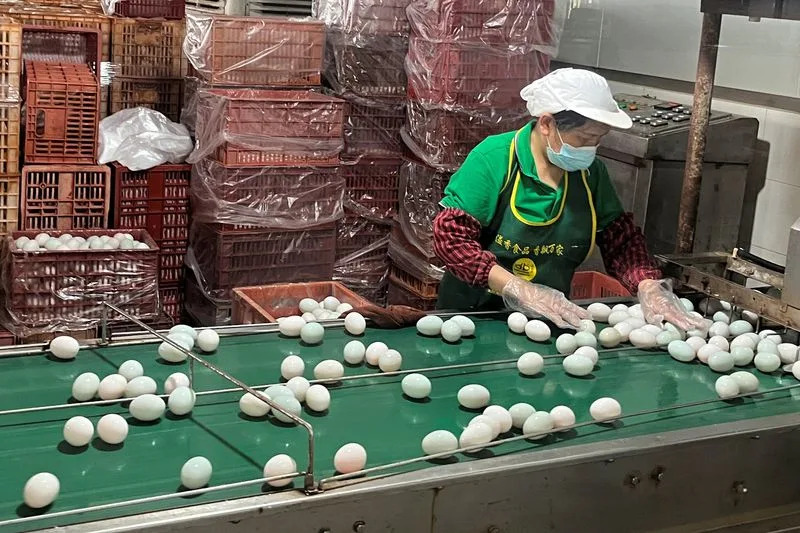
Duck egg products factory in Ruichang
RUICHANG, China (Reuters) – When Steven Du took over his parents’ factory producing temperature control systems in Shanghai, one of the first changes he made was to turn on the plant’s heating in winter – something his frugal forebears were reluctant to do.
“If you don’t improve their environment, the workers aren’t as happy and it’s harder for them to do their best work,” the 29-year-old said. “The change is worth the extra cost.”
Du, like tens of thousands of other young Chinese factory bosses, is inheriting a basic manufacturing business that can no longer rely on the labour-intensive model that made China the world’s largest exporter of goods.
A shrinking and ageing workforce and competition from Southeast Asia, India and elsewhere are making at least a third of China’s industrial base – the low-end manufacturers – obsolete, Chinese academics say.
This do-or-die mission of tech upgrades and practical changes largely falls on a group of people in their 20s and 30s known as “chang er dai”, or “the second factory generation”, a play on the derogative term for spoilt, rich children, “fu er dai”.
“If I’m chang er dai, I’m trying to save my family business from bankruptcy,” said Zhang Zhipeng, a research assistant at the Shenzhen Research Institute of High-Quality Development and New Structure, who estimates roughly 45,000 to 100,000 of this cohort are at various stages of taking over up to one-third of private Chinese manufacturing firms.
The large-scale generational transition, which comes as China’s growth prospects dim, is the first in the country’s private sector since the chang er dai’s parents emerged as industrialists in the decades after Mao Zedong’s death in 1976.
Reuters interviewed eight chang er dai for this report, who described their attempts to bring family businesses into the modern era with efficiency upgrades while facing challenges such as labour costs, shortages of workers and, in some cases, disagreements with relatives on the best way forward.
Du spoke on the condition that his business not be named to protect the privacy of his semi-retired parents, whom he said were in their 50s and largely leave factory affairs to him.
Like his peers, Du grew up with a level of comfort and opportunities his parents never dreamed of.
He went to high school and university in New Zealand, specialising in electrical engineering. He moved to the United States, working at Apple supplier Foxconn’s Wisconsin facilities. He studied Taiwanese and Japanese production methods, focused on reducing inefficiencies.
Those skills would come in handy in a factory the Chinese state set up in 1951 and privatised in 2002.
His father’s business acumen and his mother’s hard work helped turn the factory into a supplier to large Chinese appliance firms. It also sells components used in temperature-control systems for shopping malls, computer rooms, battery cooling, and medical equipment.
But production processes remained largely unchanged until Du took over in 2019. He introduced specialised industrial software that cuts across accounting, orders, procurements, deliveries, and other processes previously handled by humans, Du said.
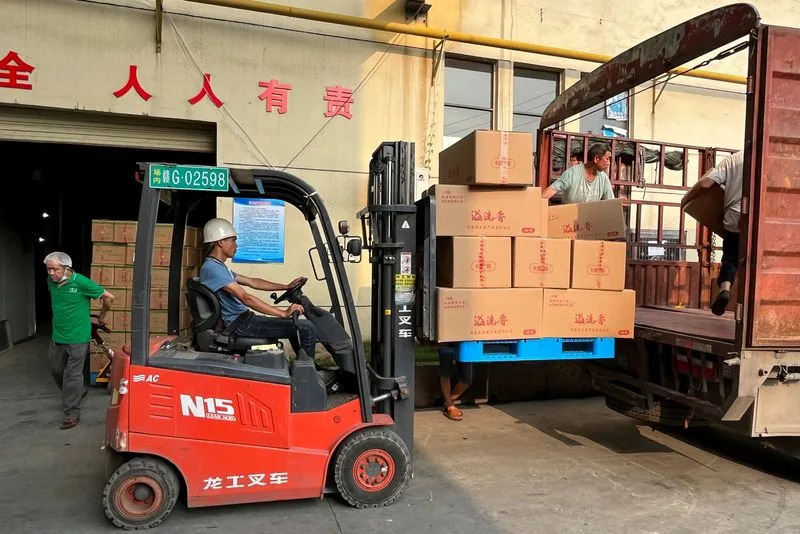
He remodelled the factory floor to allow forklifts to drive around easily, grouping storage and production units differently to minimise physical effort for a workforce whose average age is around 50. A worker now walks 300 metres to complete the more complex tasks, down from one kilometre, and needs less than a third of the time to do it.
While his mother spent long hours micromanaging production, Du ends most days around 4 p.m. in a gym he set up inside the factory, and allows workers to use, before driving home.
“Young people like to be lazier, but laziness is actually a manifestation of progress,” he said.
Du raised wages by 10-20% in the past three years, to keep staff turnover under 5%, but says his factory is 50% more efficient.
“Factories need to transition to higher-end manufacturing or are doomed to fail, because their costs are rising,” said Zhang, the researcher.
A ‘MOTHER’S SON’
Zhang Zeqing estimates he achieved a similar efficiency boost by digitalising processes since he began co-managing with his parents their egg-products factory in Ruichang, a southeastern city.
At Ruichang City Yixiang Agricultural Products, workers in green uniforms place duck eggs into cups attached to a conveyor belt that feeds a vacuum-packing machine. A new screen above the machine displays the speed at which the eggs are sealed and estimates average output per worker, as well as the time and manpower needed to pack 10,000 eggs.
Barcodes track all products from farm to factory to store, allowing supervisors to monitor orders, production and delivery on their phones and make decisions based on real-time data.
“Before, we’d record all this by hand on paper,” said the 30-year-old. “All of the internal data was muddled. It led to a lot of wastage.”
Like five of the other chang er dai who spoke to Reuters, Zhang never planned to take over the factory. He wanted to study landscape design in France.
But he felt he had to step in, at least for a few years, and convince his now 55-year-old parents that tech upgrades, and setting up new distribution channels on e-commerce platforms, were worth investing in.
Something had to be done, he thought, as “the frontline employees are getting older and young people are less willing to work on the frontline”. China has record rates of jobless youth but many of them have university degrees and prefer not to work in factories, even if they take a job below their education level.
Zhang’s parents resisted at first, unwilling to spend money on a business they thought was doing fine. But they relented, eventually.
Sales have risen 35% annually since he came on board.
“I sometimes wonder why our e-commerce was successful when others failed. A manager at a company told me that because you are your mother’s son, she will support you infinitely, that is, even if you fail,” Zhang said.
‘TOO CHALLENGING’
To be sure, China as a whole is upgrading its industrial complex in more significant ways than the changes implemented by young factory managers like Du and Zhang.
Some segments, such as the heavily robotised electric vehicle industry, are disrupting global markets thanks to state subsidies, as well as foreign capital and know-how.
Chang er dai, however, help lift the bottom, which is also important for preserving China’s share of world manufacturing, two industry experts told Reuters.
Some of the technology Zhang introduced came from Black Lake Technologies, a company founded by Zhou Yuxiang, who counts more than 1,000 chang er dai among his clients.
“For the past decades, the model of many Chinese factories was based on revenue growth, so very few of them paid attention to production efficiency or digitalisation,” said the 34-year-old, who also sees himself as chang er dai, though he is not managing his parents’ business.
“They manage their operations typically through stacks of paper. More advanced factories might use Excel, but that’s it.”
Tian Weihua, an academic specialising in manufacturing upgrades at the Science and Technology Innovation Research Institute, a government think-tank, says the tech savvy and foreign experience of chang er dai give them a better chance than their parents to keep businesses competitive in a new environment of higher costs, weaker external demand and emerging manufacturing centres in cheaper, less developed countries.
But “technological upgrading doesn’t cure all ills”, said Tian, adding that further steps will be needed, including on product innovation.
Not all chang er dai will get there.
After studying textile design at the University of Arts in London, Zhang Ying, 29, took over her family’s garment factory in the eastern city of Ningbo in 2017.
But the business was struggling. Wages had more than doubled within a decade, to over 7,000 yuan a month. Workers, mostly migrants from inland provinces, were in short supply. She wouldn’t dare fire them.
Last year, she took time off to have a child and left other managers in charge. She has no intention to return.
“It was too challenging: the pressure was too sudden and great. I was getting hives from the stress and needed to be on medication for a year, so I quit,” she said.
(Reporting by David Kirton; Editing by Marius Zaharia and David Crawshaw)
Solar-powered cars are challenging some of the most popular EV brands — and they can drive for weeks without charging
Abby Jackson – June 16, 2023
Auto manufacturers are racing to develop the latest and greatest cars. One trend we’re seeing is the rise of solar-powered cars, but how are these sun-powered machines different from other electric vehicles?
What are electric vehicles?
Electric vehicles (EVs) are battery-powered cars that use electric motors rather than an internal combustion engine for propulsion. When you charge an EV, the electricity gets stored in a large traction battery pack. This electricity gets used by an electric traction motor to drive the car’s wheels.
Gasoline vehicles have internal combustion engines that burn gasoline fuel to drive the wheels, releasing toxic fumes and harmful carbon pollution. These engines also produce noise pollution, or excessive noise and vibration.
Each year these gas-powered cars produce 3.3 billion tons of carbon pollution worldwide. Carbon air pollution traps heat from the sun within our atmosphere, causing the planet to overheat and extreme weather events like hurricanes to intensify.
It affects our health, too — fumes from car exhaust can cause or worsen asthma and other respiratory issues.
Since EVs only run on electricity, they don’t pollute the air. One study even found that having more EVs meant fewer emergency room visits for breathing problems. And compared to internal combustion engines, electric engines don’t produce nearly as much noise pollution.
A disadvantage of EVs is that we can’t always control where the electricity that charges these cars comes from — sometimes it means using dirty energy to drive a clean-energy car.
Why isn’t everyone adopting an EV?
EVs now make up 10% of all new car sales, but early adoption of new technology — like cars that don’t need to stop for gas — can be scary, though this technology isn’t very new anymore.
Today, there’s an abundance of EVs on the market at the lowest prices we’ve ever seen, and public charging infrastructure is expanding across the nation. This still isn’t enough for some drivers to trust the switch to electric cars.
One of the biggest hangups is range anxiety — defined as the fear an EV will run out of charge before reaching its destination and leaving its passengers stranded.
Though this is a bigger issue for long-distance travel rather than the majority of Americans that drive less than 30 miles a day, range anxiety is still enough to stop people from even considering the money-saving and electric alternatives to gas-powered cars.
Solar-powered cars, on the other hand, can practically erase these fears with the ability to get energy for free.
What are solar-powered cars?
Solar-powered cars (SPCs) are EVs completely or partially powered by direct solar energy. An array of photovoltaic cells converts sunlight into usable electric energy.
The panels on today’s SPCs can add between 15 and 45 additional miles in sunny conditions. When this free energy isn’t powering the car’s propulsion, it gets stored in the car’s battery.
SPCs have the same clean air and noise reduction benefits as other EVs but offer greater range independence.
California-based Aptera Motors and Dutch company Lightyear have led innovation by producing some of the first SPCs to hit the market. And there’s more to come. The 2024 Kia EV9 is partially powered by a solar panel built into the hood.
There have been a few setbacks for these solar car companies, and it will take some time before we start seeing SPCs in Super Bowl commercials.
“This is not like going from the flip phone technology to a smartphone, where they suddenly obsolete everything else,” AutoNation CEO Mike Jackson told CNBC. “This is a decadeslong journey from the internal combustion engine to electrification, but it’s here.”
In the meantime, there are a few solutions. One is to power charging stations with clean energy, like the English Shell station that converted to chargers equipped with solar panel awnings.
Another solution is to reduce EV charging anxiety — using electric vehicle apps to find charging points, ensuring your EV has a full charge before a long journey, and taking stops along your route as opportunities to charge.
To help other EV drivers, you can also call in any issues with a charging point to get them resolved.
Join our free newsletter for weekly updates on the coolest innovations improving our lives and saving our planet.
Three things to watch as US intelligence prepares for Covid ‘lab leak’ reveal
Samuel Lovett – June 16, 2023
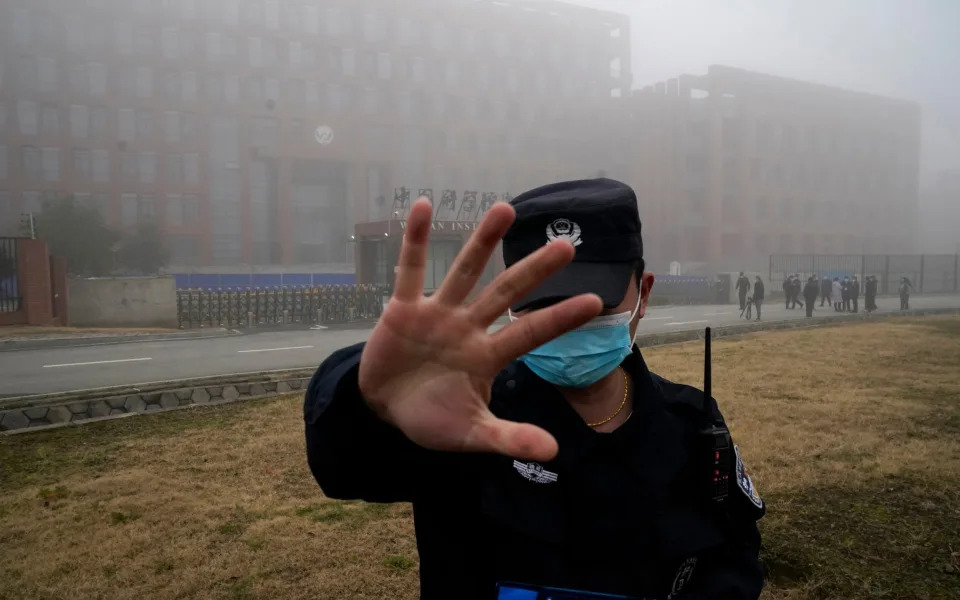
A security man moves journalists away from the Wuhan Institute of Virology – Ng Han Guan/AP
It’s showtime – and both lab leak enthusiasts and those who believe in natural origins (the ‘zoonati’) are nervous.
No later than Sunday, and perhaps sooner, America’s director of National Intelligence must, by law, “declassify” and make public all “information relating to the origins of Covid-19”.
It could be a huge moment, or a terrible anticlimax.
By the time the deadline is reached, it will have been 1,265 days since news of a “mystery pneumonia” first emerged from Wuhan – and for much of that time a small group of US intelligence officials have anonymously been briefing that the virus came from a lab.
It would not be the first time a pandemic had been caused by a laboratory-related accident: the 1977-1979 Russian Flu pandemic is widely thought to have been sparked by the accidental release of a virus used in a US flu vaccine that had not been fully deactivated.
Yet the off-the-record intelligence briefings have been characterised as unprofessional and unscientific by many, and in March this year, the US Congress unanimously passed a law demanding that all secret material the US holds on Covid’s origin be made public.
The P4 laboratory on the WIV campus. Opened in 2018, the P4 lab conducts research on the world’s most dangerous diseases – HECTOR RETAMAL/AP
Public Law Number 118-2, which was passed on March 20, is short at just 418 words but is to the point and gives the intelligence officials little, if any, wriggle room to hold things back.
It is one of the few things that those on either side of the Covid origins debate have come together to agree on, albeit for very different reasons.
Those who think the virus emerged naturally have dubbed it a “put up or shut up” law. Lab leakers, on the other hand, see it as a means to lift the lid on an episode they believe the US government itself is partly responsible for as it part-funded the high security lab in Wuhan.
As the deadline for the release of the US intelligence looms, we list the three key areas on which Law Number 118-2 demands full disclosure.
“Not later than 90 days after the date of the enactment of this Act, the Director of National Intelligence shall declassify any and all information relating to potential links between the Wuhan Institute of Virology and the origin of the Coronavirus Disease 2019 (Covid-19), including:
1. “…activities performed by the Wuhan Institute of Virology with or on behalf of the People’s Liberation Army.”
Issue: The background briefings have alleged that the Chinese People’s Liberation Army was involved with the Wuhan Institute of Virology (WIV) in creating a virus that leaked. As the Sunday Times reported, US intelligence sources believe the lab has engaged in “secret projects … on behalf of the Chinese military since at least 2017”.
Lab leakers rightly say this would be explosive if proven. In addition to the anonymous briefings, they point to already leaked – but heavily redacted – US cables, seemingly compiled by US analysts in Taiwan.
These make mention of “cyber evidence” of Chinese military involvement and “shadow labs” at the WIV. They also suggest China’s central government in Beijing knew of the outbreak of Covid-19 “earlier than they admit”.
The trouble with the cables is that they are so heavily redacted that only a few words and phrases are visible. Lab leakers will be hoping the full text bangs this virtual nail home.
The Zoonati say military links should not come as a surprise given there is hardly a high security lab anywhere in the world, including Porton Down in England, where the military do not have some involvement. They suspect the anonymous briefers have been “happily blurring shades of grey” in this respect and hope the unredacted evidence will bear this out.
2. Declassify any intelligence which shows “…coronavirus research or other related activities performed at the Wuhan Institute of Virology prior to the outbreak of Covid-19.”
Issue: The background briefings would suggest there is intelligence to show scientists at the WIV were conducting undeclared “gain-of-function” research in 2019 that sought to combine different coronaviruses and make them more infectious in humans. According to The Sunday Times, US spies also say there is evidence the lab was working on a vaccine before the pandemic started.
Lab leakers will alight on any hard evidence of any undeclared work on coronaviruses in China as a smoking gun. Some hypothesise that WIV scientists, working hand-in-hand with the military, created a mutant virus as part of a covert weapons programme which was highly effective at infecting people. That virus, now known as Sars-CoV-2, was then accidentally leaked and started spreading in Wuhan in the autumn of 2019, they say.
The Zoonati remain sceptical. They say a wrap-up of all the work the WIV conducted on coronaviruses, including a list of viruses, was submitted to Nature in October 2019 and that there was nothing unusual about the research. Further, they say, nothing “obviously nefarious or weird” happened during the submission and review process, which ran to August 2020, to suggest the Chinese were hiding secret projects.
Others say that even if declassification were to prove that WIV scientists were conducting dangerous undeclared research, this would not explain the outbreak itself. “I’d be very surprised if it was all true, but let’s pretend that it is – I think it’s still going to be really complicated trying to understand how that fits into this body of evidence that does point towards zoonotic origin,” argues Dr Angela Rasmussen, a virologist at the Vaccine and Infectious Disease Organization at the University of Saskatchewan, in Canada.
3. Declassify any intelligence which shows “…researchers at the Wuhan Institute of Virology who fell ill in autumn 2019, including for any such researcher: the researcher’s name; the researcher’s symptoms; the date of the onset of the researcher’s symptoms.”
Issue: Reports have long persisted that a group of scientists at the Wuhan lab fell with coronavirus-like symptoms and were hospitalised more than a month before the virus started to spread widely throughout Wuhan, the implication being they had become infected through a lab accident.
Lab leakers point to three scientists from the WIV who they say US intelligence believe fell ill and were hospitalised in October or November 2019. They are Yu Ping, Ben Hu and Yan Zhu, all of whom worked at the lab at the time. If US intelligence proves these researchers were struck down by a Covid-like disease and hospitalised in the October-November period it would provide compelling evidence of a lab accident, the leakers say.
The Zoonati don’t dispute that the trio worked at the lab but say they don’t believe they fell ill or were hospitalised. They say they know this because, among other things, they were working with them over the period in question and have talked to them since.
Dr Danielle Anderson, an Australian scientist, was on secondment at the Wuhan lab until November 2019, when Covid is thought to have started spreading in the city. At the time, none of her colleagues displayed any coronavirus-like symptoms, she says.
“We went to dinners together, lunches, we saw each other outside of the lab,” Dr Anderson told Bloomberg in an interview from 2021.
The virologist also confirmed to The Telegraph that she had attended a conference on the Nipah virus in Singapore, in December 2019, alongside Dr Zhengli Shi, the senior scientist at the Wuhan lab and “many other” researchers from the WIV. Colleagues say if there had been a leak and three of her juniors were ill she would not have been there.
“There was no chatter,” Dr Anderson said. “Scientists are gossipy and excited. There was nothing strange from my point of view going on at that point that would make you think something is going on here.”
The Nipah Virus International Conference 2019 – SingHealth
Xi Jinping’s new world order is collapsing before our eyes
Matthew Henderson – June 15, 2023
China’s President Xi Jinping speaks during the introduction of members of the Chinese Communist Party’s new Politburo Standing Committee – NOEL CELIS/AFP
While the UK and US, each embroiled in democracy’s perverse consequences, struggle to thwart Putin’s mad ambitions in Ukraine, their respective China strategies face forceful challenge from Beijing. Xi Jinping is pushing brinkmanship to the edge in the Taiwan Straits and doubling down, as in Honduras, on its global efforts to isolate Taiwan.
Meanwhile, leading Western technology companies, alarmed by geopolitical uncertainty and facing hostile data “legislation,” are marching out of China in droves. Microsoft has already taken LinkedIn out and is moving an expert AI team to Canada to avoid local pressure on them.
Risk has been defined as exposure to hostile intentions and capabilities. This dictum omits one vital issue: whether the party at risk is aware of what is going on. Arguably much of the “free” world is either ignorant, or in denial, about Xi Jinping’s policy drivers, intentions and capabilities.
This in itself is acutely risky. A tipping point in China Risk is rapidly approaching, and with it an opportunity to turn this to the West’s advantage.
Xi Jinping is forging ahead with plans for a revisionist New Era in which China becomes the sole super-power in an authoritarian, post-democratic world order. His immediate tactics include expedient alliances with other enemies of the West to defeat sanctions and other preemptive counter-measures short of military conflict.
He is striving to exploit Western political and economic division and disarray, not least through his tacit support for Putin’s illegal invasion of Ukraine. His spuriously neutral Ukraine peace initiative lacks substance – indeed, this may be deliberate – but it symbolises his ultimate aspiration to global authority.
However, Xi is still a long way from achieving this. Though propaganda trumpets China’s triumph over the Covid virus and prospects for renewed growth, part of Xi’s aggressive haste stems from the realisation that the Chinese Communist Party state remains riddled with vulnerabilities.
China rapidly globalised its economic influence by exploiting the West’s illusion that, once admitted to the World Trade Organisation (WTO), it would engage in trade according to WTO rules and norms. But from the outset it denied foreign businesses free and fair access to its domestic market and used massive state subsidies to capture market dominance for its own products and systems across the world.
Subsequent geopolitical and economic tensions have progressively worsened due to China’s human rights abuses, political interference, cyber espionage and IP theft, mistrust and sourcing disruption caused by the pandemic, alignment with Russia, and threats to Taiwan.
This has led to an accelerating exodus of major Western companies from China to more reliable regional bases in South-East Asia, India and Bangladesh. The low cost of factory labour in China, formerly a major draw for FDI, no longer applies. Factory wages in South China are now around three times higher than in equivalent South Asian industries.
The Chinese economy has long been struggling under Xi Jinping’s Marxist ideological chokehold. Covid lockdown early in the pandemic was a kneejerk CCP crisis management response to potential social disturbance. Imposed disastrously late, it slowed transmission but failed to boost immunity.
“Zero Covid” proved powerless against the omicron variant but was not abandoned until the export-led national economy had been badly damaged by needlessly-prolonged coercive lockdowns.
Unsurprisingly, promised recovery has not been realised. Exports are depressed and the property market is in disarray, with more and more major players being delisted on the Shanghai stock exchange. The tech sector remains traumatised by Xi’s politically-motivated crackdown in 2021, which has wiped out many jobs for educated young workers at a time of serious youth unemployment.
Debt remains toxic, demographics are intractable (despite a huge surge in mortality among the under-immunised elderly soon after Zero Covid rules were abruptly relaxed). Environmental stresses, particularly water security, are worsening.
Seemingly ignoring these headwinds, Xi Jinping’s model for economic resurgence is a distinctly ideological formula called the Dual Cycle economy. The idea is to stimulate domestic technical innovation and production, leveraging this to give China a lead in global markets for cutting-edge technologies, while concurrently driving down dependency on technical cooperation with the West.
This construct ties in existing nationalist, anti-market measures and a protectionist, sanction-proofing subtext, sitting badly with claims that China is now open to the world for “business as usual”. Recent use of arbitrary data-protection legislation to seize records, detain staff and freeze important ESG and other compliance work done by foreign consultancies in Shanghai and elsewhere also undermines this claim.
Xi is hoarding gold, securing energy supplies and building up China’s military capabilities, in particular those used to threaten Taiwan. To argue that he will not, for some time at least, invade Taiwan for fear of the economic consequences misses the real point.
Xi would prefer to annex Taiwan without a fight, but he needs to be able to flex enough military muscle to undermine US support to the point that the Taiwanese lose faith in it and accept the inevitable. But this will not pay for itself, and scaring off FDI won’t fill any coffers.
Xi shows little capacity to tackle the fundamental unsustainability of the Chinese economy. Failure to do so could sweep away his dreams of a revisionist New Era. There has been much talk lately of “de-risking” from China. This is a two-way process; it should entail renewed, concerted economic pressure, including enhanced sanctions, against a regime that is already far more of a global threat than Russia.
As an Indian commentator has observed, the imperative is to reinforce national power and work in step with China’s sole global “balancer,” the US. The “Atlantic Declaration” is welcome; now it needs to grow some teeth.
Two more property insurance companies scaling back coverage in Florida
Rich Jones – June 15, 2023
Florida homeowners have fewer options for property insurance. Just two weeks into hurricane season, The Farmers Group and AIG say they’re scaling back policy coverage.
Both companies point to their vulnerability to natural disasters like hurricanes and flood.
Over the past 18 months in Florida, 16 property insurance companies have decided to stop writing new business to new homeowners in one form or the other.
WOKV Consumer Warrior Clark Howard says insurers are pulling out of Florida and California because the risks have become incalculable.
“Florida and California will need to offer state-backed reinsurance so that insurers can issue actuarially sound policies.”, Clark said.
Clark suggests shopping for insurance through an independent agent and then get quotes for a high deductible, the highest your mortgage company will allow you take.
“You’re eliminating for the insurer what they refer to as nuisance claims. So you become a less risky, less costly person for them to insure.”, Clark said.
Clark says the Florida Legislature is going to need to step in and address Citizens Insurance, the insurer of last resort. He says the state will have to take over the role of reinsurance, eliminate Citizens, which could allow regular insurers to come back.
“That insurers would be liable for losses up to a ceiling, whatever that is. And then after that the Florida reinsurance would cover it.”, said Clark.


 Haze obscures the skyline in Cedar Rapids, Iowa, on Tuesday, June 27, 2023. (Nick Rohlman/The Gazette via AP)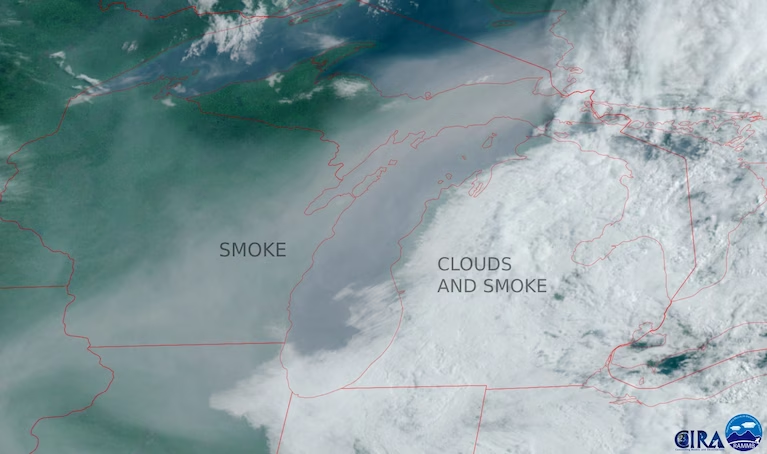
 (Photo by AFP PHOTO / Nova Scotia Government) (Handout/AFP/Getty Images)