Organic Agriculture for 10 Billion People

Resilience

Building a world of resilient communities

Organic Agriculture for 10 Billion People

By Adrian Muller, from Food Climate Research Network            November 27, 2017 

This post is written by Adrian Muller, FCRN member and senior researcher at FiBL (Research Institute of Organic Agriculture) and ETH Zurich, Switzerland. His post is based on the paper Strategies for feeding the world more sustainably with organic agriculture,(link is external) published in Nature Communications earlier in November. 

Organic agriculture can feed the world. The only question thereby being what “feeding the world” may mean. Today, it basically means high shares of animal products in diets and that a third of production is wasted. Projections for 2050 look similar. Does this make sense? No. And this is the entry point for organic agriculture to play a role in sustainable food systems and for contributing to food security.

How can we feed 10 billion people in 2050 while at the same time reducing negative environmental impacts of the food system, such as biodiversity loss and greenhouse gas emissions? Today, we produce about 2850 kcal per capita per day on average globally, according to the United Nations Food and Agriculture Organization FAO. These calories come with a high share of animal products. In the FAO projections for 2050, this value is even higher, at well over 3000 kcal per capita and day, and this is supplied for a population that is 30 percent larger than today. Without further changes in food production, this would result in correspondingly higher environmental impacts as well.

Scenarios for future food systems

These values are absurdly high, but there is much room for improvement: imagine, which changes in feeding the world would be possible if we would not produce a third of agricultural output for the garbage can and if we would not use 40 percent of all croplands to grow feed for animals to meet our high demand in animal products. We definitely have enough to eat and there are clearly problems with distribution and access, but I will leave these considerations aside in this short blogpost.

We have to make use of this room for improvements if we want to feed the global population sustainably in 2050. Which role can organic agriculture play in this? Research has shown that it has advantages regarding soil fertility and lower environmental impacts when it comes to nitrogen surplus and eco-toxicity from pesticide use, but the commonly discussed downside is its lower yields.

Figure 1: Organic agriculture improves soil quality: soils under conventional (left) and organic management (right) after heavy rain (from the long-term systems comparison trial DOK; Photo: Research Institute of Organic Agriculture FiBL, Switzerland).

Another interesting question is what role grass-fed animal production may play, where there is no competition for cropland to produce feed or food, while greenhouse gas emissions per kilogram product are higher than for animals that eat concentrate feed.

Such questions can be explored with mass- and nutrient flow models. Such models provide insights into the bio-physical and agronomic feasibility of different scenarios of future food systems. Thereby, economic and social aspects are not addressed albeit they are clearly central as well. It is however legitimate to first focus on the bio-physical and agronomic feasibility and to understand those in detail.

Unavoidable trade-offs

We analyzed the role that organic agriculture may play in sustainable food systems by creating and deploying such a mass and nutrient flow model. The results of this work have recently been published in Nature Communication(link is external). We find that more cropland would be needed than in the conventional reference scenario, to supply the production as projected by the FAO for 2050. We also find, however, that the nitrogen surplus would be reduced significantly, with corresponding positive environmental effects. Furthermore, pesticide use would clearly be reduced as well and even greenhouse gas emissions would be somewhat lower than in the reference scenario.   This is the case for a food system with high shares of animal products in diets, and high wastage volumes.  This would change if we would feed animals with less concentrate feed and more grassland-based forage, and if we would reduce food waste and loss.

In a food system with, for example, 50% less concentrate feed, 50% less food wastage and 100% conversion to organic agriculture, land use would also be lower than in the reference scenario.  Further and more detailed results can be found in the paper linked at the end of this blogpost.

It is important to emphasize that these results clearly depend on a number of central assumptions such as the yield gap between organic and conventional agriculture, the impact of climate change on yield projections, the share of nitrogen fixing legumes in organic crop rotations, or the yields of grass-fed ruminants and from pigs and poultry fed without food-competing concentrates but fed on by-products from food production only. For our main results, we primarily adopted conservative values using higher yield gaps, for example. Results for lower yield gaps and results of sensitivity analyses regarding other key assumptions are reported in the supplementary material to the paper linked below.

In any case, trade-offs are thus always central when assessing the sustainability of agricultural production systems. The negative impacts from high nitrogen surplus and pesticide use can be reduced, if we are prepared to crop relatively more land (but this in turn would have negative impacts). Thus, which indicator may be the most important one?

Efficiency, consistency and sufficiency

Here, another result becomes relevant. Organic agriculture can play a central role if we refrain from focusing on agricultural production alone and adopt a food systems perspective instead. If we also address the consumption level, e.g. via the sustainability potential of reduced concentrate feed use and reduced food wastage, we can achieve improvements along all sustainability indicators and none of them needs to be judged as being more important than any other. In a food system with these changes regarding animal feed and wastage, dietary composition would clearly look very different, as the share of animal products would drop considerably. This would be so in particular for pigs and poultry that are predominantly fed on concentrate feed, and less so for ruminants that can eat grass. We emphasize that these statements refer to the global average and reductions are relevant in particular for high-income countries and future projections; in certain regions, increasing shares of animal source food in diets clearly still makes sense.

The food systems approach can be captured by three central concepts; efficiency, consistency and sufficiency. First, sustainable agriculture is often assessed with a focus on “efficiency”: how to produce more with as low as possible inputs and environmental impacts. This concept puts environmental impacts in relation to production volumes and gives guidance on improvements of single farm processes and production practices. It is however blind for aspects that become effective on an aggregate level only, such as in relation to the carrying capacity of ecosystems or cropland and water scarcity. Therefore, we also need to work with “consistency”. This concept stands for optimal resource use in a systemic context and for closed nutrient cycles. An example are ruminants that feed on grass.

Figure 2: Ruminants utilize grasslands and turn them into a source for food (Photo: Flickr (https://www.flickr.com/photos/justanotherhuman/14564836544/(link is external)), Creative Commons).

Like this, it is possible to utilize these areas for food production, which would otherwise not be possible. Furthermore, these animals are then fed without competition on cropland areas for food or feed production. On the other and, such grass-fed animals are less efficient regarding greenhouse gas emissions per kilogram meat and milk. Thus, we also need “sufficiency”. This concept relates to the overall size of the system and its impacts. Sufficiency opens up the space for producing with lower yields or higher emissions per unit product while harvesting the benefits such as from reduced nitrogen surplus or pesticide applications, without increasing total land use or total greenhouse gas emissions. Sufficiency is often explained via “consumption reduction”, in our case here, this is the reduction of animal source food that is produced with concentrate feed inputs and also behavioral change resulting in the reduction of food waste and loss.

Conclusions

When working on and discussing sustainable agriculture, we need to address the whole food system including consumption and not only production. On the food systems level, we have to open up the needed space to deal with the unavoidable trade-offs. We do not have to rely on extreme solutions for this, but a wise combination of different promising complementary strategies is already able to deliver a more sustainable food future. In such a setting, organic agriculture can play a central role as one of these complementary strategies to move towards more sustainable food systems.

References:

This is a blog post based on the paper “Muller, A., Schader, C., El-Hage Scialabba, N., Brüggemann, J., Isensee, A., Erb, K.-H., Smith, P., Klocke, K., Leiber, F., Stolze, M. and Niggli, U., 2017, Strategies for feeding the world more sustainably with organic agriculture, Nature Communications”.

The paper is open-access and can be found here: https://www.nature.com/articles/s41467-017-01410-w(link is external)  and you can see a video by lead author Muller here https://www.youtube.com/watch?v=z4daLqmureU(link is external)

A discussion of the Nature paper is posted on the FCRN website here.

For further discussion of the ‘livestock on leftovers’ approach, see Section 5.4.1 (pp 105-116) of the FCRN Grazed and Confusedreport.

See also the report Lean mean green obscene…? What is efficiency and is it sustainable? which explores and critiques different understandings of the concept of ‘environmental efficiency’ and as part of this discusses some of the ideas raised in Adrian’s blog and paper.

The Entire World Needs to Hear This, and Act Accordingly.

Veterans Against the GOP.

Wow!

Posted by Anonymous on Wednesday, August 3, 2016

CO2 is Making Our Brains Fuzzy.

EcoWatch – via Years of Living Dangerously

This is your brain on carbon.    November 28, 2017

This is your brain on carbon.via Years of Living Dangerously

Posted by EcoWatch on Tuesday, November 28, 2017

Senate Tax Bill Bad For Veterans. VoteVets.org

VoteVets.org 

November 28, 2017

Many working families with parents who are veterans won’t get the full increase from the Senate Tax Bill Child Tax Credit because their incomes are too low. In fact, many veterans would receive only a token increase of $75 or less.

Senate Tax Bill Bad For Veterans | VoteVets.org

Many working families with parents who are veterans won't get the full increase from the Senate Tax Bill Child Tax Credit because their incomes are too low. In fact, many veterans would receive only a token increase of $75 or less.

Posted by VoteVets.org on Tuesday, November 28, 2017

Worn-out shoes and two new knees and still farming at 92

Boston Globe

Worn-out shoes and two new knees and still farming at 92

Joseph Gerry has spent most of his 92 years working on his family’s farm.Joseph Gerry has spent most of his 92 years working on his family’s farm.  John Tlumacki/Globe Staff 

By Sheryl Julian, Globe Correspondent        November 28, 2017

BROCKTON — Joseph George Gerry has been picking rocks off Gerry’s Farm since he was a boy. Beyond the fields, you can see rock walls of the sort that landowners have been building in this region for centuries.

Gerry, 92, “The Chief,” as his family calls him, is the second generation to farm this land. He inherited it from his father, an immigrant from Poland. Gerry (pronounced with hard “G”) works every day; retirement of any sort isn’t something he ever considers. He has a good example: His father farmed until he was almost 90. Gerry’s wife, Dolores “Dolly” Gerry, 88, “Babci” to her grandchildren, stays close to the farmhouse, where she is surrounded by her favorite Polish pottery, religious images, and photos of her family and Polish Pope John Paul II.

Twenty years ago, I spent the growing season at Gerry’s Farm, visiting several times a week from the moment in May when the first plants went into the soil — timed to the cycles of the moon — until the stand was piled with pumpkins and then closed for the year. I stopped by recently to see how the Gerrys are faring and how the season went.

The couple sit at the kitchen table in their 1740 farmhouse kidding each other. When I ask something that Dolly Gerry thinks her husband shouldn’t answer, she chides him in Polish, calling him Jozef. (In Poland, the family surname was Giero.) It’s not hard to tell what she’s up to. She’s cautious and he’s an open book and they’re both very cheerful. Dolly Pazyra was a nurse before she married Joseph 67 years ago. They met at a dance at the Polish club in Chelsea. She could dance well and she could speak Polish, and he knew she was for him. “When we were young,” Dolly Gerry told me years ago, “you had to marry your own.” They moved into the farmhouse with his parents and, after the children were born, she never returned to nursing.

Dolly and Joseph Gerry at Gerry Farm in Brockton.Dolly and Joseph Gerry at Gerry Farm in Brockton.                                          John  Tlumacki/Globe Staff 

They had five children in nine years and her family took the train from Chelsea to help, cooking and cleaning and saving her sanity. At the time, he farmed and worked nights at the local egg auction and often slept only an hour or two before heading back to the fields. Other years he drove a truck all night and off season.

RELATED LINKS

8/14/97--GERRY'S FARM BROCKTON ---Joseph George Gerry is pleased with the previous night's rain, his flowers look beautiful.

Read Story:  From the archives | May 28, 1997: Farm team

While the city of Brockton transformed around them, three generations of the Gerry family stood firm, sowing seeds, reaping vegetables, and serving their loyal customers.

Joseph Gerry could be in an ad for farm life. Years in the outdoors have weathered his skin and he doesn’t seem to feel the cold. In the fields on a day when the wind is wrapping itself around us, he wears a flannel shirt, jeans, a zipper sweat shirt, and shoes that open in the front when he walks because the soles have pulled away from the tops. He’s got a new pair but he loves these because they were made in Brockton at one of the few shoe factories left in this once-thriving manufacturing city. During the season, he’s in the greenhouses by 4:30 a.m., where he’s surrounded by flowers.

At one time, Gerry’s Farm only grew raspberries. Now they have other berries, a full array of vegetables, and honey from their own hives. The bees’ work of pollination is essential to agriculture. “If you don’t have bees, you might as well close the door,” he says. Raspberries thrive in the rocky soil. At one time, cows and chickens provided manure. In the 1950s, after an especially dry summer, and after the city stopped allowing Gerry to pull water off city hydrants, he took a bifurcated branch from an apple tree to use as a divining rod and found a pond on his own land, then a second one. “Mother Nature doesn’t want you to be too happy or jump too high,” he told me decades ago. “She’ll give you a little bit this time, then she’ll take it back.”

Joseph Gerry in a refrigerated room with freshly picked parsley.Joseph Gerry in a refrigerated room with freshly picked parsley.            John Tlumacki/Globe Staff

Farming comes with exhaustion, worries about droughts, wet seasons, frost, hail, equipment, and more. This season it was wild animals in the fields. Gerry doesn’t mind coyotes because they eat the woodchucks. “Terrible year with turkeys and deer,” he says. He attributes this to Brockton’s leash law. When residents used to let their dogs out without leashes, “they would drive the deer into the woods.”

It’s a difficult life without much remuneration, particularly when the profits from 55 acres are going to several families. In this case it’s the Gerrys, sons Carl and Christopher, and Carl’s son, Greg. Carl does the planting and plowing and Greg works beside his dad. “I think he’s going to take over,” says his grandfather. Christopher oversees the greenhouses and farmstand and runs a Christmas stand after the growing season. Daughter Julie Ann Clark, a nurse, also helps at the stand. There are seven grandchildren and nine great-grandchildren. Son Andrew is a rancher in Arizona and another son, Joseph, a retired engineer in North Carolina, comes back in the summer to farm.

Christopher lives upstairs in the farmhouse. “Nobody checks on us,” says Dolly Gerry. “It’s constant here. The great-grandchildren are here every day.”

Joseph Gerry had disk surgery when he was younger and it was so serious he was told he had a 50-50 chance of paralysis. “I was back working two weeks later,” he says. He’s also got two new knees. “I can’t stand up straight. When I walk I lean.” Otherwise he’s in good health.

Gerry’s land has been attractive to developers for years. Route 24, built in the 1950s, connected Brockton to Boston. Once when someone offered the family a staggering amount for the farm, he sat down with his sons to tell them what was on the table. They all wanted to continue farming. During the recent recession, the Gerrys sold some acres “to someone who built houses,” says Joseph Gerry. He will not use the word “developer.” It had been a bad year. “At the time it was desperation,” he says.

Operating the farmstand is a family affair.Operating the farmstand is a family affair.  John Tlumacki/Globe Staff

West Acres Nursing Home, which overlooks the fields, was built next door to the Gerrys on land Joseph sold to the business 45 years ago when he had a huge tax bill and nothing to pay it with. That was before farmland tax rates were lowered by the state Legislature. If they hadn’t, he told me, “no one would have survived.”

Joseph Gerry’s boyhood friend Al Wilbur died three years ago. Dolly Gerry affectionately called Wilbur her husband’s “first wife.” They went fishing and hunting every fall in rural Quebec for 75 years, in a spot so remote they had to be flown in by helicopter. Inside a big shed on the farm, where tractors are stored for the winter, a large canoe straddles the top of the cabinets, the one he and Wilbur used on their adventures. Gerry stopped when Wilbur died, but Dolly Gerry fulfilled a lifelong dream six years ago and went to Poland with her daughter and two grandchildren. She found the home where her father was born.

Recently, Joseph Gerry sold a little more land to the neighboring nursing home so it could expand. “They sit out and watch me,” he says of the residents. “Some of them are 50. I never want to go there.”

Looking skyward, he says, “The guy upstairs, he’s damn good to me.”

Gerry Farm, 810 Pleasant St., Brockton, 508-586-3371, www.gerrysfarm.com.

Related

From the archives | August 27, 1997: Weathering the season

From the archives | October 22, 1997: Harvest of time

Sheryl Julian can be reached at sheryl.julian@globe.com.

Mysterious North Korean Ghost Ships Full Of Skeletons Wash Up In Japan

Newsweek

Mysterious North Korean Ghost Ships Full Of Skeletons Wash Up In Japan

C. Paton, Newsweek November 28, 2017

Ships believed to have come from North Korea and filled with dead bodies and skeletons have been washing up on the west coast of Japan, as desperate fishermen are forced further and further out to sea in search of a catch.

Japanese authorities said Monday they uncovered the skeletons of eight individuals from the hull of one wooden boat that washed ashore on Miyazawa beach in the northwest of Japan’s main island of Honshu.

Related: Kim Jong Un May Have Caused a Parasitic Worm Epidemic in North Korea By Making Farmers Spread Human Faeces on Their Crops

According to CNN, the unidentified “ghost ship” was spotted by the Akita Coast Guard drifting offshore Friday but it wasn’t until it came into land that the grisly discovery was made.

It is not entirely clear the boat came from North Korea but the discovery of the wooden vessel fits a pattern of debris and other boats being washed up from the waters of the hermit nation on the Japanese coast, officials said.

11_28_North_Korea_Boat

A wooden boat, which according to a police official carried eight men who said they were from North Korea and appear to be fishermen whose vessel ran into trouble, is seen near a breakwater in Yurihonjo, Akita Prefecture, Japan November 24, 2017. Kyodo/via REUTERS

Satoru Miyamoto, a professor at Seigakuin University, explained the number of these kind of ships finding their way to Japanese shores had risen since 2013. Their arrival appeared to be in conjunction with a military scheme to expand the North Korean fisheries industry.

“It’s after Kim Jong Un decided to expand the fisheries industry as a way of increasing revenue for the military. They are using old boats manned by the military, by people who have no knowledge about fishing,” Miyamoto said. “It will continue.”

The recent discovery of as many as eight bodies in one vessel recalls the arrival of more than a dozen ships containing bodies in 2015. Contemporary reports claimed the bodies could belong to desperate fishermen driven into treacherous waters by food shortages in North Korea.

Other experts said at the time the 2015 arrivals could have been the result of a refugee exodus.

In January 2017 Japanese authorities rescued a crew of 26 North Koreans sinking in a tanker off the Islands of Goto. They were later collected by another North Korean vessel.

Pyongyang has regularly claimed that those washing up on the shores of neighboring countries from North Korea are not attempting to flee but rather have simply made navigational errors. Several North Korean fishermen rescued earlier this month have since returned home.

Their return flies in the face of a series of high-profile defections this year. In one such escape, earlier this month, one soldier made a dramatic defection over the demilitarized zone between North and South Korea in a hail of bullets fired by his former comrades.

Medical examinations carried out by the South Koreans on the soldier found he was suffering from a number of parasitic worms as well as from poor nutrition. Experts have said his general condition has pointed to the desperate state of healthcare and diet in North Korea.

Solar Power…Even When There’s No Sunshine

DeSmog                                                            (via Years of Living Dangerously)

November 27, 2017. As amazing as solar power is, it’s not much use when the sun isn’t shining. Right? Wrong. #WeCanSolveThis #YEARSproject

We Can Solve This: Concentrated Solar

As amazing as solar power is, it's not much use when the sun isn't shining. Right? Wrong. #WeCanSolveThis #YEARSproject (via Years of Living Dangerously)

Posted by DeSmogBlog on Monday, November 27, 2017

The big short: Why the Senate doesn’t have the votes it needs to pass GOP tax plan

ThinkProgress

The big short: Why the Senate doesn’t have the votes it needs to pass GOP tax plan

The upper chamber can only afford to lose two votes, yet has at least seven maybes.

Chairman Sen. Bob Corker, R-Tenn., confers with Sen. Ron Johnson, R-Wisc., Right, as Sen. Jeff Flake, R-Ariz., Left, reads nearby during Senate Foreign Relations Committee hearing on North Korea on capitol hill in Washington, Tuesday, Nov. 14, 2017. (AP photo/ Pablo Martinez Monsivais)
Rebekah Entralgo       November 27, 2017

As the Senate prepares to vote on their version of the tax bill as early as this week, all eyes are on six Senators.

Three Senators, Jeff Flake (R-AZ), Bob Corker (R-TN), and John McCain (R-AZ) are virtually immune from outside pressure as they are unlikely to face voters again. Flake and Corker are retiring and McCain is 80, just won reelection and is battling a serious illness. All three have expressed serious concerns about how much the tax proposal will increase the federal deficit.

Meanwhile Senators Susan Collins (R-ME), Steve Daines (R-MT), and Ron Johnson (R-WI) have all outwardly expressed hesitancy over voting for the Senate tax bill citing other policy concerns. Daines and Johnson don’t think the legislation does enough for “pass-through business,” small businesses that also include larger corporations like hedge funds and law firms. Collins, who was a key vote in stopping multiple GOP attempts at repealing the Affordable Care Act, has stated the Senate’s decision to include a repeal of the individual mandate to help pay for a massive corporate tax cut is the reason why she is hesitant to vote for the bill as written.

The Senate Finance Committee is considering some last minute alterations to the legislation in an effort to get some support, this includes an expansion of the pass-through deduction to win over Johnson and Daines and a change allowing taxpayers to deduct $10,000 in local property taxes from their taxable income, a provision included in the House bill but not yet in the Senate, to get Collins’ vote.

These minor alterations, however, won’t lower the deficit, and that will be a tougher nut to crack. Corker and Flake have cited the deficit, which is expected to increase by $1.5 trillion if the proposal were to become law, as a major concern. This may understate the true deficit impact. The individual tax cuts will expire in 2025 while the corporate tax cut is permanent. Temporary individual tax cuts would help pay for the long-term costs of the bill, and Republicans argue there is no way a future Congress would allow the tax cuts to completely expire. If that’s true, the real impact on the deficit would be substantially higher.

Then there are the claims that the tax proposal would raise wages across-the-board and boost the economy. The Congressional Budget Office (CBO) estimated Monday that the Tax Cuts and Jobs Act would hurt more low-income Americans than previously reported, while the conservative-leaning Tax Foundation’s dynamic scoring found the legislation wouldn’t yield sustainable 3 percent economic growth like the White House previously promised.

The bill’s inability to deliver results on economic growth could cause Republicans to lose another vote in the Senate.

Republicans can only afford to lose two votes in the Senate or the tax proposal will go down. Right now there are at least seven Republican Senators with serious concerns about the bill.

New polling has found the bill is incredibly unpopular in Corker’s home state of Tennessee (30% approve), McCain’s home state of Arizona (26% approve) and Collins’ home state of Maine (22% approve).

This puts Senate passage of the bill later this week in jeopardy.

Congressional Budget Office Says GOP Senate Tax Bill Hits Poor, Including Many Veterans, Harder

CNBC

Lowest-income Americans would take bigger hit than first thought under Senate GOP tax bill, CBO says

Jacob Pramuk, CNBC    November 27, 2017 

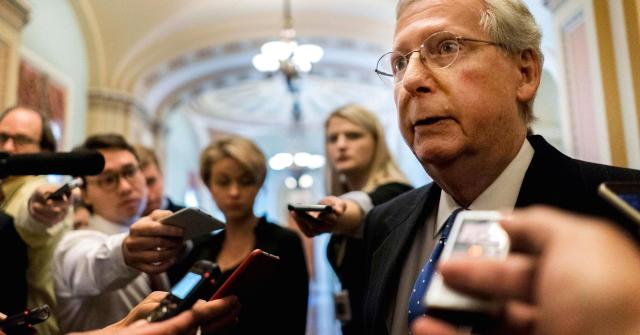
Melina Mara | The Washington Post | Getty Images. The CBO report estimates that lower-income groups would foot a bigger bill from tax cuts than previously expected.
The lowest-income American households would take a hit while higher-earning taxpayers would see their burden reduced under the Senate Republican tax plan, according to the latest analysis from the nonpartisan Congressional Budget Office.

The Senate proposal permanently chops the corporate tax rate and temporarily reduces individual income taxes, while changing numerous deductions . GOP senators hope to pass that plan this week and approve a final bill agreed upon with the House before the end of the year.

The CBO report, released Sunday, estimates that lower-income groups would foot a bigger bill from tax cuts than previously expected. In 2019, all income groups under $30,000 would have a bigger burden under the bill, the CBO projected.

In 2027, that would extend to all income groups under $75,000, as individual tax reductions expire.

The change largely stems from the bill effectively getting rid of the Obamacare provision requiring most Americans to have health insurance or pay a penalty.

Low-income Americans would receive fewer premium tax credits if more of them choose not to have insurance. The CBO estimate also includes the effects of changes to spending for programs like Medicaid and Medicare.

A previous Joint Committee on Taxation analysis that showed more modest effects on low-income Americans did not include the changes in those programs.

In a statement, Senate Finance Committee spokeswoman Julia Lawless criticized the CBO report, calling its logic related to the individual mandate “confusing and erroneous.”

“Unfortunately, this is not the first time CBO has vastly overestimated the impact of the deeply flawed individual mandate,” the statement said. “And, for members concerned about the sunset date for individual tax cuts, Democrats will have a chance to make these strong middle-class tax cuts permanent on the floor.”

Democrats, who oppose the GOP tax bill, have repeatedly cast it as a plan helping corporations and the wealthy at the expense of poorer Americans.
More From CNBC:

Wavering GOP senators must face three hard truths on tax reform

Rand Paul: ‘I plan to vote for the Senate tax bill’ despite problems

Ken Griffin: We ‘probably’ don’t need to cut taxes as much as proposed

The Red-State Revolt Spreads to Oklahoma

The Atlantic

The Red-State Revolt Spreads to Oklahoma

Republican voters soured on tax cuts in Kansas. Now a similar budget crisis is playing out in Oklahoma, and in a string of special-election wins, Democrats are taking advantage.

Ogrocki / AP

Russell Berman     November 27, 2017

Republicans have a vise grip on power in Oklahoma, and they are in no imminent danger of losing it.

In a state that gave 65 percent of its vote to Donald Trump a year ago, the GOP controls pretty much everything: the governorship and every statewide office, both U.S. Senate seats, all five House seats. The state legislature is almost laughably one-sided; Republicans have super-majorities of more than 70 percent of the seats in each chamber.

But in the last four months, voters have repudiated those Republicans running in Oklahoma at the polls. Democrats have captured four state legislative seats held by the GOP, two in special elections for the House and two for the Senate.  The most recent—and perhaps the most surprising—win occurred last week, when a 26-year-old lesbian Democrat named Allison Ikley-Freeman edged out the Republican candidate by 31 votes in a conservative state House district near Tulsa that went heavily for Trump in 2016. Democrats may have a chance to make an even bigger statement in a few months, when a vacancy caused by the likely Senate confirmation of Representative Jim Bridenstine to be NASA administrator could trigger a special congressional election in the district that includes Tulsa.

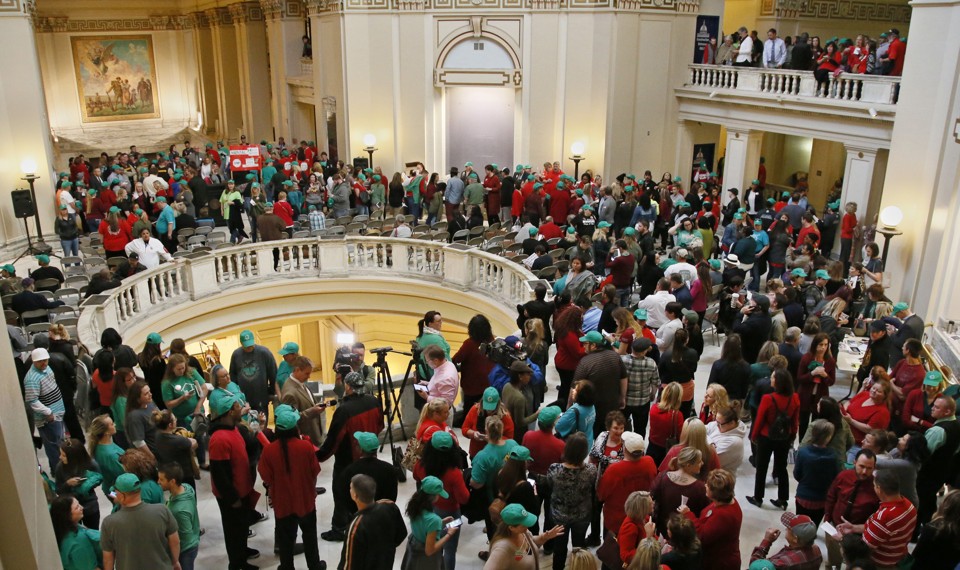
Officials in both parties attribute the Democrats’ run in part to the party’s motivation to fight back in the Trump era, scandals that have forced Republican legislators to resign, and the low-turnout quirkiness of special elections. But the overriding factor is likely a budget crisis that has starved funding for Oklahoma’s schools, resulting in a teacher shortage and prompting more than one-quarter of the state’s districts to hold classes only four days a week.

“The people are just not happy,” former Oklahoma Governor Frank Keating, a Republican, told me in a phone interview. “Government appears dysfunctional, and government officials appear unwilling to solve the problems of the state and the nation. And there will be hell to pay.”

The political backlash in Oklahoma has parallels to the recent reckoning in Kansas, its neighbor to the north and another Republican-led state where deep tax cuts led to significant, ongoing budget shortfalls. Both states are heavily reliant on the oil-and-gas industries, and the drop in prices in recent years hit their economies hard and contributed to a falloff in state revenues. In Kansas, voters rebelled by ousting conservatives in favor of moderate Republicans and some Democrats in 2016. Earlier this year, the reconfigured legislature voted to roll back the signature tax cuts of conservative Governor Sam Brownback.

Lawmakers in Oklahoma City are now debating similar measures, and the Democrats’ special-election victories could help tip the balance in a state where a third-quarter super-majority is needed to raise taxes. “It really feels like the dam has broken, and the conversation has shifted in Oklahoma,” said David Blatt, executive director of the Oklahoma Policy Institute, a left-leaning advocacy group and think tank.

“The hostility from the general public is palpable, and it will be directed at incumbents. They will held to task.”

The budget crisis in Oklahoma has been longer in the making than the one that erupted in Kansas soon after Brownback signed his tax cuts in 2011 and 2012, Blatt said. And it implicates both parties, since it was a Democratic governor, Brad Henry, who first agreed to cut the state’s income tax in exchange for future increases in teacher pay and spending.

Those policies accelerated after Mary Fallin’s election as governor in 2010 gave Republicans full control of the government in Oklahoma, which Democrats had dominated at the state level for nearly the entire century after it joined the Union in 1907. A state that was once near the national average in the percentage of income taxes it collected from residents fell to 48th in the nation by 2014. In addition to about $1 billion in annual income tax cuts, Oklahoma have legislators voted to give between $300 million and $500 million in yearly tax breaks to the oil-and-gas industry, according to Blatt. “It’s been a serious erosion of our tax base,” he said.

In Kansas, Brownback resisted any reversal in his tax cuts on income, forcing Republican majorities to override his veto earlier in the year. But Fallin has taken the opposite approach, demanding that conservatives in the state legislature pass a budget that has substantial and recurring new revenues. A 1992 state law requiring super-majority support for tax increases has made that a challenge, however. Fallin earlier this month vetoed parts of a “cuts-and-cash” bill that closed the budget gap with a combination of one-time money transfers and spending reductions, which will likely force the legislature into a second special session to consider tax increases.

Oklahoma Democrats view the situation as evidence of a fundamental failure on the part of Republicans who spent years railing against government spending and blaming the state’s fiscal woes on a federal government led by Barack Obama, whose unpopularity in the state made his administration an effective foil. “They can’t blame it on Obama anymore, so they have no choice but to take responsibility for the failures across the board in Oklahoma,” said State Senator John Sparks, the Democratic leader.

It’s a message the party is sounding on the national level as well, where Republicans won control of both the White House and Congress but have struggled to enact their agenda and are now debating tax cuts that are similar in scope to the ones that busted the budgets in Oklahoma and Kansas. “When you have a bunch of government haters getting control of the government, it’s no surprise they don’t know how to make things operate effectively,” Sparks said.

Where the Democrats in Oklahoma see the beginnings of a wave, the state Republican Party sees little more than a ripple. Two of the seats Democrats flipped in special election came in districts where Republicans had resigned over sex-related scandals. Pam Pollard, the state GOP chairwoman, downplayed the results in an interview, pointing out that despite the Republican dominance of the state legislature, Democrats had actually won two-thirds of the special elections held in recent years. And she suggested that given the GOP’s lopsided numerical advantage, it had nowhere to go but down. Even after the special elections this year, Republicans control 40 of 48 Senate seats and 71 out of 101 in the House. “We fully anticipated that some of these would revert back to more representative of the districts,” Pollard told me.

Pollard pushed back hard against the Democratic argument that Republicans had mismanaged the state’s government. She accused local officials of playing politics  “to tug at the heart strings” by cutting down the school week rather than reducing bloated administrative expenses. And Pollard said Republicans were willing to spend more money on government where needs were demonstrated, noting that the state Department of Corrections got a 10 percent boost after an outside study recommended higher spending.

Yet the topic of tax increases remains delicate for the GOP. When Pollard broached the possibility, she stopped herself. “Let me say it better: What Republicans are looking at is not necessarily a tax increase but a change in the way revenue is collected in Oklahoma,” Pollard said. It sounds like a euphemism, and it is. But she tried to explain that the state was seeking a better balance between income taxes and sales taxes, since the rise in online shopping has led to a drop off in revenue from retail stores.

“All seats are in play, and they will be until Republicans can figure out how to keep our schools open five days a week.”

Keating, the former two-term governor who left office in 2003, saw more of a warning sign in the election results for Republicans, if only because as the party in power, they had more to lose. He told me of a conversation he recently had with a GOP state legislative candidate who had been knocking on doors in his district. The first threshold question potential voters asked was not whether he was a Republican or a Democrat, but whether he was an incumbent. “The hostility from the general public is palpable, and it will be directed at incumbents,” Keating said. “They will be held to task.”

What remains to be seen is whether the voter anger will carry over into a possible special election to replace Bridenstine in Congress. The 1st district is strongly Republican, so much so that Bridenstine first won the seat by knocking off a veteran Republican incumbent in a primary in 2012 before facing little opposition in the general election. Democrats haven’t seriously contested the seat in years.

RELATED STORY

The Death of Kansas’s Conservative Experiment