Vox
The case for normalizing impeachment
Impeaching an unfit president has consequences. But leaving one in office could be worse.
by Ezra Klein November 30, 2017
/cdn.vox-cdn.com/uploads/chorus_image/image/57788303/TRUMP_FIN01_3000x2000_150dpi.0.jpg) Chris Malbon for Vox
Chris Malbon for Vox
In recent months, I have grown obsessed with a seemingly simple question: Does the American political system have a remedy if we elect the wrong person to be president? There are clear answers if we elect a criminal, or if the president falls into a coma. But what if we just make a hiring mistake, as companies do all the time? What if we elect someone who proves himself or herself unfit for office — impulsive, conspiratorial, undisciplined, destructive, cruel?
My fixation on this question began with President Donald Trump’s tweets to North Korea’s Kim Jong Un. This was the president of the United States, the man who controls the world’s largest nuclear arsenal, launching deranged, unvetted provocations at the most singularly irrational regime in the world:
Donald J. Trump: Just heard Foreign Minister of North Korea speak at U.N. If he echoes thoughts of Little Rocket Man, they won’t be around much longer! Sept 23, 2017
This was not even his official policy. The rest of the Trump administration was trying to ratchet down tensions with North Korea. But the president himself was undermining the effort:
Donald J. Trump: I told Rex Tillerson, our wonderful Secretary of State, that he is wasting his time trying to negotiate with Little Rocket Man, Oct 1, 2017
Republican Sen. Bob Corker, the widely respected chair of the Foreign Relations Committee, warned that the president was treating his office like “a reality show” and setting the country “on the path to World War III.” In an interview with the New York Times, he said of Trump, “I know for a fact that every single day at the White House, it’s a situation of trying to contain him.” These concerns, Corker told the Times, “were shared by nearly every Senate Republican.”
It’s not just Senate Republicans who worry over the president’s stability. Carl Bernstein, of Watergate fame, told CNN that his reporting found “a consensus developing in the military, at the highest levels in the intelligence community, among Republicans in Congress, including the leaders in the business community,” that Trump “is unfit to be the president of the United States.” A subsequent poll by the Military Times found only 30 percent of commissioned officers approved of the job Trump was doing.
The fear is shared by members of Trump’s own staff. Axios’s Mike Allen reported that a collection of top White House advisers see themselves as an informal “Committee to Save America,” and they measure their success “mostly in terms of bad decisions prevented, rather than accomplishments chalked up.” The Associated Press reported that Defense Secretary Jim Mattis and then-Homeland Security Secretary John Kelly “agreed in the earliest weeks of Trump’s presidency that one of them should remain in the United States at all times to keep tabs on the orders rapidly emerging from the White House.”
Their concerns echo across the broader public. A September Quinnipiac poll found that 56 percent of voters believe Trump is unfit for office. Despite low unemployment and steady economic growth, Trump’s favorability is stuck below 40 percent — making him, at this point in his term, the most unpopular president since the advent of polling.
Of late, I have been asking Republicans who work either in the White House or closely with it whether Trump is learning on the job — whether he is becoming more judicious, more disciplined, more serious. The answer, unanimously, is that he is not. He is the man he was the day he stepped into the Oval Office, the same man he was on the campaign trail, the same man so many of us feared he would be as president.
/cdn.vox-cdn.com/uploads/chorus_asset/file/9755319/voximpeachment02.JPG) Gabriella Demczuk for Vox
Gabriella Demczuk for Vox
In a November 2 interview on WMAL radio in Washington, Trump lamented his inability to use his power to prosecute his political enemies. “You know the saddest thing, because I’m the President of the United States, I am not supposed to be involved with the Justice Department,” he said. “I am not supposed to be involved with the FBI. I’m not supposed to be doing the kinds of things that I would love to be doing. And I’m very frustrated by it.” It is impossible to imagine the hellstorm that would have followed a similar utterance by President Barack Obama or George W. Bush. That Trump’s daily provocations have left us inured and jaded to such authoritarian yearnings is, itself, an injury he has inflicted upon us.
Of late, Trump has taken to suggesting the Access Hollywood tape — where he is clearly shown bragging about sexual assault — is a fraud. These are statements, notably, that Trump can not only be seen making, and heard making, but statements he has admitted making. As is often the case, it is unclear whether Trump is lying to us, or if he is somehow lying to himself, as well. And it is hard to say which would be scarier.
We talk often about running the US government like a business, but businesses — at least public ones — have clear methods for deposing a disastrous executive. The president of the United States controls the world’s largest nuclear arsenal, not to mention the vast resources and powers of the federal government, and so the possible damage of letting the wrong person inhabit the Oval Office stretches all the way to global catastrophe. But is there anything we can do about it?
WHAT IF AMERICA SIMPLY MADE A MISTAKE?
A number of House Democrats have introduced bills that point toward Trump’s removal. Rep. Brad Sherman, a California Democrat, introduced articles of impeachment built around Trump’s possible violations of the law. Rep. Zoe Lofgren, also a California Democrat, introduced a resolution calling for Trump to receive medical evaluation to uncover whether he is capable of carrying out the duties of his office — if not, the Cabinet could invoke the 25th Amendment and remove him.
But what if Trump isn’t a criminal or mentally incompetent? What if he’s exactly the man we saw in the election and that man just shouldn’t be president? What if America simply made a mistake?
In that case, even these Democrats are fatalistic.
“I think they’re stuck with the mistake,” says Lofgren.
“We’re more or less a democracy,” says Sherman. “There are 320 million people out there. When they hear the term ‘high crimes and misdemeanors,’ their reaction is, ‘Show me the crime.’”
Sometimes I imagine this era going catastrophically wrong — a nuclear exchange with North Korea, perhaps, or a genuine crisis in American democracy — and historians writing about it in the future. They will go back and read Trump’s tweets and his words and read what we were saying, and they will wonder what the hell was wrong with us. You knew, they’ll say. You knew everything you needed to know to stop this. And what will we say in response?
/cdn.vox-cdn.com/uploads/chorus_asset/file/9755225/GRENADE_MAP_3000x2000_150dpi.jpg) Chris Malbon for Vox
Chris Malbon for Vox
What is an impeachable offense?
The first federal official ever removed from office under Article II, Section 4 of the Constitution — the impeachment clause — was Judge John Pickering, in 1803. Pickering was an alcoholic and likely suffered from early-stage dementia. He would rant and rave from the bench. The official charges held that Pickering exhibited “loose morals and intemperate habits,” neither of which sounds like a high crime or misdemeanor to modern ears. He was convicted on all counts and removed from office. But was his removal proper?
The historian Lynn W. Turner has argued that “by confusing insanity with criminal misbehavior,” Pickering’s critics “wiped out the line between good administration and politics and made any word or deed which a political majority might think objectionable the excuse for impeachment and removal from office.”
Another way of looking at Pickering’s removal is that it shows the founding generation defining what the impeachment power was for, and what high crimes and misdemeanors meant. In his 1833 Commentaries, Supreme Court Justice Joseph Story concluded that impeachment is “of a political character” and can be triggered by “gross neglect, or usurpation, or habitual disregard of the public interests, in the discharge of the duties of political office.”
The Constitution’s framers considered a few variants of the impeachment power. An early proposal would have restricted it to acts of “treason and bribery” only. That was rejected for being too narrow. A subsequent proposal would have expanded it to acts of “maladministration” as well. That was rejected for being too broad. “High crimes and misdemeanors” was the compromise, but it was never clearly defined.
What is clear is that high crimes and misdemeanors described far more than mere legal infractions. In The Federalist Papers, Alexander Hamilton wrote that questions of impeachment will “proceed from the misconduct of public men, or, in other words, from the abuse or violation of some public trust. They are of a nature which may with peculiar propriety be denominated POLITICAL, as they relate chiefly to injuries done immediately to the society itself.”
THERE IS NO ACTUAL DEFINITION OF “HIGH CRIMES AND MISDEMEANORS”
Asked, for instance, about a president who removed executive officials without good reason, James Madison replied that “the wanton removal of meritorious officers would subject him to impeachment and removal.” Capricious firings are not a crime, but they were, according to the founders, an impeachable offense.
“The grounds for impeachment can be extremely broad and need not involve a crime,” says political scientist Allan Lichtman, author of The Case for Impeachment. “That’s why they put impeachment not in the courts but in a political body. They could have put it in the Supreme Court, but they put it in the Senate.”
As Harvard law professor Cass Sunstein puts it in Impeachment: A Citizen’s Guide, “while the voices in the ratification debates were not entirely consistent and often less than precise, they can be fairly summarized in this way: If a president were to engage in some egregious violation of the public trust while in office, he could be impeached, convicted, and removed from office.”
In the course of reporting this piece, I spoke to a slew of legal scholars and impeachment specialists. Here is my conclusion: There is no actual definition of “high crimes and misdemeanors.” There is wide agreement that it describes more than violations of the criminal code, but very little agreement beyond that. When is the “misconduct of public men” impeachable? When does a tweetstorm rise to the level of “egregious violation of the public trust”?
/cdn.vox-cdn.com/uploads/chorus_asset/file/9755325/voximpeachment01.JPG) Gabriella Demczuk for Vox
Gabriella Demczuk for Vox
Political elites are scared of removing a president, and for good reason
On May 16, Ross Douthat, a conservative columnist at the New York Times, wrote a searing column arguing for President Trump’s removal from office. “From the perspective of the Republican leadership’s duty to their country, and indeed to the world that our imperium bestrides, leaving a man this witless and unmastered in an office with these powers and responsibilities is an act of gross negligence, which no objective on the near-term political horizon seems remotely significant enough to justify,” he wrote.
Douthat’s preference was to bypass impeachment entirely and invoke the 25th Amendment to the Constitution. That amendment, which permits the president’s removal if the vice president and a majority of the Cabinet certify him “unable to discharge the powers and duties of his office,” was ratified in 1967 as a response to President Dwight Eisenhower’s health problems and President John F. Kennedy’s assassination. It is designed for a president who has fallen comatose or been shot — a president who has become physically incapable of carrying out his duties.
When I spoke to Rep. Lofgren, she argued that the language was open to interpretation. “The 25th Amendment doesn’t mention medical,” she said. “It mentions ‘unable to discharge one’s duties,’ so it’s a judgment call.” But the text of her resolution shows how deeply we associate the power with physical deterioration. It calls on “the vice president and the cabinet to quickly secure the services of medical and psychiatric professionals to examine the president … to determine whether the president suffers from a mental disorder or other injury that impairs his abilities and prevents him from discharging his Constitutional duties.”
It is worth playing out that scenario. Imagine that Vice President Mike Pence and the Cabinet did compel Trump to undergo psychiatric evaluation. And imagine the psychiatrist did return a diagnosis of some kind, be it early-stage dementia or narcissistic personality disorder (plenty of psychiatrists stand ready to diagnose Trump with all manner of mental ailments, so this is not far-fetched). The vote is taken, and Trump is removed from office.
To many of Trump’s supporters — and perhaps many of his opponents — this would look like nothing less than a coup; the swamp swallowing the man who sought to drain it. Imagine the Breitbart headlines, the Fox News chyrons. And would they truly be wrong? Whatever Trump is today, he was that man when he was elected too. The same speech patterns were in evidence; the same distractibility was present. The tweets, the conspiracy theories, the chaos: It was all there. The American people, mediated by the Electoral College, delivered their verdict; mustn’t it now be respected?
/cdn.vox-cdn.com/uploads/chorus_asset/file/9755333/voximpeachment05.JPG) Gabriella Demczuk for Vox
Gabriella Demczuk for Vox
Here is the counterargument: Our political system was designed by men who believed the mass public could make mistakes, and so they set up failsafes, emergency processes by which political elites could act. The Electoral College, which was ironically the key to Trump’s victory, was one of those failsafes — a collection of political actors who would be informed by the popular vote, but not bound by it. Today, however, the ideology of democracy has taken fiercer hold, elites are held in low regard, and those failsafes are themselves failing.
FOR ALL THE DANGERS TRUMP POSES, HIS REMOVAL POSES DANGERS TOO
Perhaps political elites have forgotten the work they are actually here to do — which is not simply to win elections or give blind quotes to Politico. “The case for the 25th Amendment or any other solution is that if a situation is dangerous, elites have a responsibility to risk popular backlash and even appear to be overturning the results of the election,” Douthat told me. In this telling, it is the job of elites to be a bulwark precisely when that job is hardest to carry out.
The question is whether this cure is worse than the disease. For all the dangers Trump poses, his removal poses dangers too. In August, the New Yorker posted a viral piece questioning whether America was barreling toward a new civil war. In it, Yale historian David Blight warned, “We know we are at risk of civil war, or something like it, when an election, an enactment, an event, an action by government or people in high places, becomes utterly unacceptable to a party, a large group, a significant constituency.” Invoking the 25th Amendment seems, to me, like the precise sort of event Blight describes. The bitter political polarization that marks Trump’s America would look gentle compared to America if Trump were removed from office.
But this analysis leaves us in a place that seems absurd when stated clearly: Though we have mechanisms for removing a dangerous president, those mechanisms are too politically explosive to actually invoke. President Trump could order a nuclear holocaust before breakfast, but unless society can agree that he is either criminal or comatose, both America and the world are stuck with him and all the damage he can cause.
Can this really be our system?
/cdn.vox-cdn.com/uploads/chorus_asset/file/9755245/BOILING_POINT_3000x2000_150dpi.jpg) Chris Malbon for Vox
Chris Malbon for Vox
This is not what the Founding Fathers envisioned
“We’ve talked ourselves into believing impeachment is some kind of constitutional doomsday device: ‘Break glass in case of existential emergency,’” says Gene Healy, a vice president at the libertarian Cato Institute. “The result is we almost never break the glass.”
In its roughly 240 years of existence, America has had 45 presidents and three serious impeachment proceedings. None of them has led to the removal of a president, though Richard Nixon’s would have if he hadn’t resigned. “It’s very hard to say of 45 presidents in 240 years [that] never, or once if you count Nixon, is the right number of impeachments historically,” Healy continues. “It’s a much easier case to make that we’ve impeached far too infrequently.”
There is a tendency to hold this conversation as a kind of seance with the founders, to try to divine what they meant, precisely, and what they would do in our situation. There are two problems with this approach. The first is that the founders were intentionally imprecise in designing these powers. It would have been simple enough to enumerate the offenses that could lead to impeachment, and some at the Constitutional Convention proposed doing so. Instead, “high crimes and misdemeanors” was the result — a recognition that flexibility would be needed and future generations would need a term they could define for themselves.
The second problem is that the presidency of 2017 is nothing like the presidency of 1776. “The office was constructed not just for a smaller country, but for a different conception of what executive power was,” says Jeremi Suri, a historian at the University of Texas Austin and the author of The Impossible Presidency. The president of 1776 had no nuclear weapons and not much of a military. There was no thought of universal health care systems, or of the management required by the sprawling, post-World War II executive branch. Congress held the sole power to declare war, so there was no consideration of an executive who could launch a world-destroying first strike entirely under his own authority.
But perhaps more importantly, the Founding Fathers envisioned a political system without parties, where the salient political competitions would be between states and between branches rather than between Democrats and Republicans. “There was an assumption that the different branches check each other because they all have different politics,” says Julia Azari, a political scientist at Marquette University.
Instead, parties share the same politics across branches; congressional Republicans today see their fates as intertwined with Trump’s, and so they protect him, because to protect him is to protect themselves. Believing that the American political system would resist parties and then designing our mechanisms of accountability around that assumption was, Azari continues, “the most important constitutional failure.”
/cdn.vox-cdn.com/uploads/chorus_asset/file/9755347/voximpeachment03.JPG) Gabriella Demczuk for Vox
Gabriella Demczuk for Vox
To date, serious impeachment proceedings have only been carried out when Congress is controlled by the opposing party to the White House. “Impeachment is dysfunctional,” Azari says. “It’s proven to be a partisan tool and nothing more.”
THE PRESIDENT IS MORE POWERFUL THAN THE FOUNDERS EVER ENVISIONED
Even a Congress that intended to contain Trump would be limited in its reach. It is hard to overturn a presidential veto, and the expansion of executive authority we’ve seen in recent decades has given the president plenty of power to wield even faced with a hostile legislature.
“Having worked in the modern executive branch, the notion that Congress has plenty of weapons in the case of a very bad president is overstated,” says Sunstein, who ran the Office of Information and Regulatory Affairs under Obama. “If we really had a terrible president determined to go in directions that were economically terrible or terrible for national security, my view is Congress would have very limited ability to stop it; first because of the difficulty of getting a consensus, but second because even if you got one, there’s much the president can do on his own.”
So here’s where we are now. The president is more powerful than the founders ever envisioned. We have a political system built around parties, which gives the president protection from the massive congressional majorities needed to activate impeachment. We have constructed an electoral system that neither follows the public will nor includes safeguards against demagogues and knaves — elites have lost control of primaries and ceded power over the Electoral College even as 40 percent of presidential elections since 2000 have been won by the loser of the popular vote. And atop all that, our political culture has evolved to see the removal of a president as a historic, perhaps dangerous, affront.
Whatever this is, it is not the system the founders foresaw.
The result of all this is that faced with an erratic and even dangerous president, we try to criminalize or medicalize his actions. Democrats want to see Donald Trump removed from office because they believe he is unfit to hold the job and a danger every day he remains in it, but few believe that is enough to merit impeachment. This is why Rep. Sherman, who introduced articles of impeachment against Trump into Congress, says, “the legal theoreticians will tell you that impeachment just a matter of politics. I’m a politician, and I’m here to tell you that it’s a matter of legal analysis.” This is why Lofgren calls for a medical evaluation.
Even if this is a correct judgment about politics, it is profoundly reckless. We have made the presidency too powerful to leave the holder of the office functionally unaccountable for four years. We have created a political culture in which firing our national executive is viewed as a crisis rather than as a difficult but occasionally necessary act. And we have done this even though we recognize that the consequences of leaving the wrong president in power can include horrors beyond imagination — World War III, as Sen. Corker suggested.
/cdn.vox-cdn.com/uploads/chorus_asset/file/9755349/voximpeachment04.JPG) Gabriella Demczuk for Vox
Gabriella Demczuk for Vox
We are too afraid of the impeachment power, and too complacent about leaving an unfit president in office
It is time to reassess. Impeachment, in Donald Trump’s case, would lead to the elevation of Mike Pence — a Republican who is better liked by his party and who, to Democrats’ chagrin, would likely be much more effective at pushing a conservative legislative agenda. But it would mean less danger of an accidental war with North Korea, less daily degradation of democratic norms and civil discourse, an executive who has the attention span to follow briefings and the temperament to stay off Twitter when he’s angry, and the precedent that there is some minimal level of job performance that the American people and their political representatives are willing to demand of their president.
WE HAVE GROWN TOO AFRAID OF THE CONSEQUENCES OF IMPEACHMENT
An objection to this is that it might lead to more common impeachment proceedings in the future. And indeed it might. Other developed countries operate on roughly that basis, with occasional no-confidence votes and snap elections being used to impose midterm accountability, and they get along just fine.
Impeachment under the American political system requires a majority in the House of Representatives and a two-thirds majority in the Senate; it is not easy to use and, as Republicans learned in the aftermath of their attempt to impeach Clinton, can backfire on those who use attempt it frivolously. It seems unlikely that America is at risk of regular or trivial impeachments even as it seems quite likely that the holders of an office as powerful as the American presidency might be well served to believe that impeachment is a real possibility if they perform their duties unacceptably poorly.
A lesson of Trump’s presidency, thus far, is that we have come to see the impeachment power as too sacrosanct, as too limited. While I was writing this piece, Trump embarked on a diplomatic trip to Asia. While there, he sent this tweet:
Donald J. Trump: Why would Kim Jong-un insult me by calling me “old,” when I would NEVER call him “short and fat?” Oh well, I try so hard to be his friend – and maybe someday that will happen! Nov 11, 2017
There are plenty of people who simply should not be president of a nuclear hyperpower, and Trump is one of them. This is a truth known by his staff, known by Republicans in Congress, and known by most of the country. That so few feel able to even suggest doing the obvious thing and replacing him with another Republican who is better suited to the single most important job in the world is bizarre. (It is a particular irony in this case, given that Trump’s entire public persona is based on the idea that well-run organizations need to swiftly and ruthlessly fire poor performers.)
We have grown too afraid of the consequences of impeachment and too complacent about the consequences of leaving an unfit president in office. If the worst happens, and Trump’s presidency results in calamity, we will have no excuse to make, no answer to give. This is an emergency. We should break the glass.
But even if we muddle through Trump’s presidency, it should be a reminder that the presidential elections are as fallible a method of selecting an executive as any other. American government is built so that a president can be removed and a duly elected co-partisan is always present to step in and take his place. Impeachment is not a power we should take lightly; nor is it one we should treat as too explosive to use. There will be presidents who are neither criminals nor mental incompetents but who are wrong for the role, who pose a danger to the country and the world.
It is a principle that sounds radical until you say it, at which point it sounds obvious: Being extremely bad at the job of president of the United States should be enough to get you fired.
/cdn.vox-cdn.com/uploads/chorus_asset/file/9754929/voximpeachment06.JPG) Gabriella Demczuk for Vox
Gabriella Demczuk for Vox

 Getty
Getty
 Jim Carrey at the Jane Fonda Hand And Foot Print Ceremony as part of the 2013 TCM Classic Film Festival (
 Jim Carrey, The GOP and WH have become sinister conclaves of souless traitors, liars and thieves – a gangrene we must remove so democracy can live.
 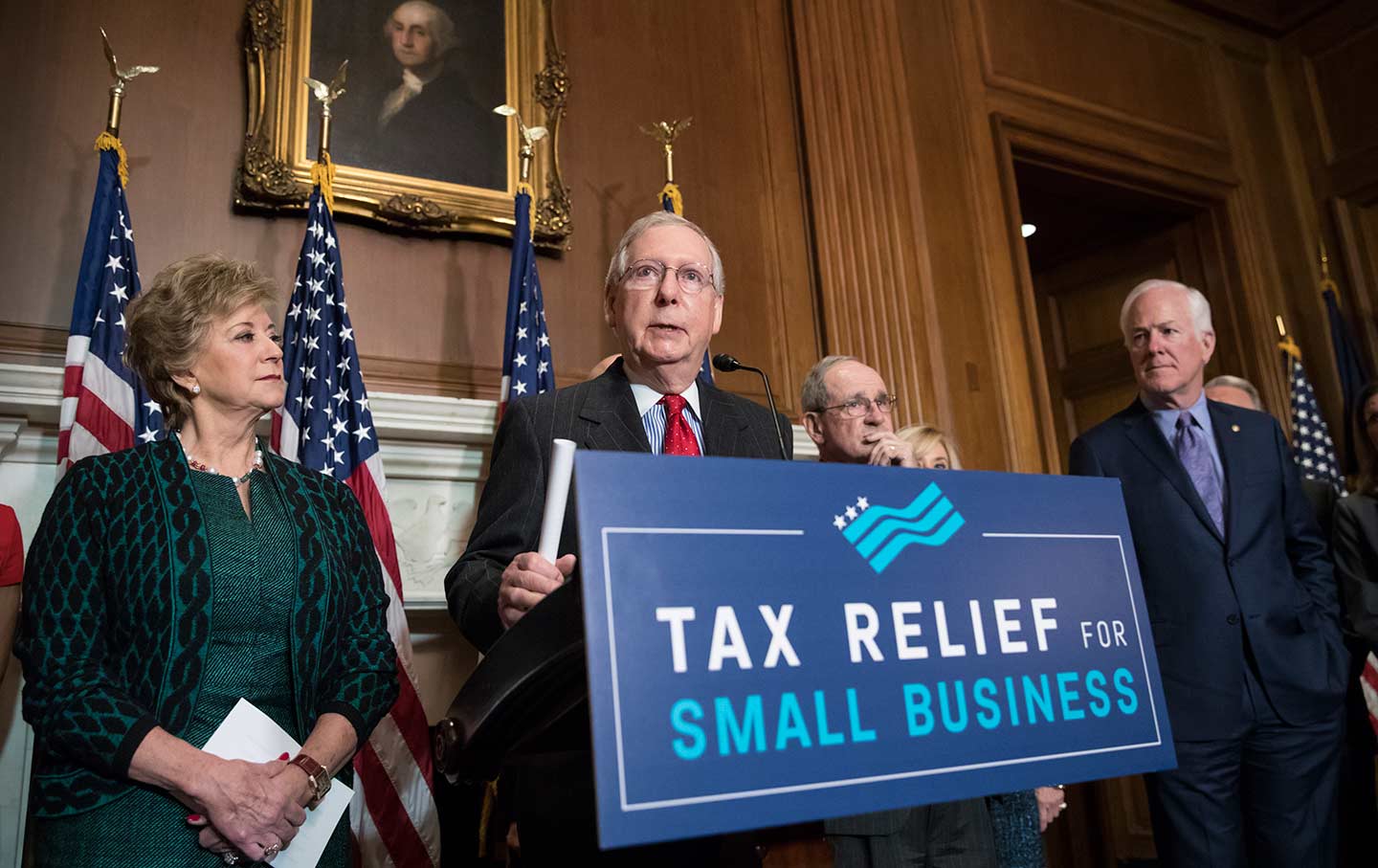 Mitch McConnell holds a news conference to talk about the Republican tax plan in Washington, DC, November 28, 2017. (AP Photo / J. Scott Applewhite)
 In this Jan. 12, 2016 file photo, Kansas Gov. Sam Brownback speaks to the legislature in Topeka, Kan. Photo by Orlin Wagner/AP