Why is a top aide to the EPA chief ‘moonlighting for private clients’?

MSNBC

The Rachel Maddow Show – The Maddow Blog

 Why is a top aide to the EPA chief ‘moonlighting for private clients’?

 By Steve Benen       March 6, 2018

The headquarters of the Environmental Protection Agency (EPA) stands in Washington, D.C. Photo by Andrew Harrer/Bloomberg/Getty
Since Donald Trump put Scott Pruitt in charge of the EPA, the agency has faced one controversy after another, but today’s is just … bizarre.

Last year, Pruitt hired a Republican political consultant named John Konkus to serve as the EPA’s deputy associate administrator for public affairs. It’s not, however, just a public-relations job. The Washington Post  reported in September that Konkus, despite his lack of environmental policy experience, is in charge of “vetting the hundreds of millions of dollars in grants the EPA distributes annually.”

We learned at the time that Konkus “reviews every award the agency gives out, along with every grant solicitation before it is issued.” As part of his reviews, he looks out for “the double C-word” – climate change – and according to the Post, he’s repeatedly “instructed grant officers to eliminate references to the subject in solicitations.”

It’s against this backdrop that the Associated Press reports that the EPA official is also moonlighting for unnamed private-sector clients.

A key aide to Environmental Protection Agency Administrator Scott Pruitt has been granted permission to make extra money moonlighting for private clients whose identities are being kept secret.

A letter approving outside employment contracts for John Konkus – signed by an EPA ethics lawyer in August – was released Monday by Democrats on the House Energy and Commerce Committee.

The ethics official noted that Konkus’ outside contracts presented a “financial conflict of interest” and barred him from participating in matters at EPA that would have a “direct and predictable” financial benefit for his clients.

Apparently, Konkus, a former Trump campaign aide who now receives a $145,000 annual salary at the EPA, received permission to work for at least two unnamed clients, with the expectation that this list will grow.

What’s more, according to the AP, he’s not the only one.

Along with the information about Konkus’ side jobs, the House Democrats also got a copy of letter approving similar outside employment for Patrick Davis, another Trump political appointee working as a senior adviser for public engagement in the EPA’s regional office in Denver.

Like Konkus, Davis is a Republican political consultant who led Trump’s presidential campaign in Colorado. According to a 2015 report by ProPublica, Davis was accused two years earlier of defrauding a conservative super PAC called Vote2ReduceDebt, which was funded by an elderly oil tycoon. The group collapsed after Davis allegedly paid nearly $3 million of the PAC’s funds to organizations run by him or his close associates, according to the news report. […]

An EPA ethics lawyer in February 2017 approved of Davis receiving outside compensation for work as sales director for a company called Telephone Town Hall Meeting, which provides services such as robocalls to political campaigns and advocacy groups. The agency redacted how much Davis is to be paid for the agreement, but his outside compensation would also be capped at less than $28,000.

I don’t know how long it’ll take to repair the Environmental Protection Agency, but I have a hunch it’s going to take a while.

Update: Norm Eisen, the chief ethics lawyer in Obama’s White House, described these EPA waivers as “insane,” adding, “In the Obama White House, I even made people quit uncompensated non-profit outside positions because of conflicts risks. This is for-profit work that could conflict with official duties.”

Is Mueller Closing in on Trump?

Newsweek

Is Mueller Closing in on Trump? Incidents Involving President’s Lawyer and Russia Under Scrutiny, Report Says

Greg Price, Newsweek    March 6, 2018 

Two particular events involving President Donald Trump’s longtime personal attorney Michael Cohen have reportedly become areas of interest in the special counsel investigation into Russian meddling in the 2016 election.

Robert Mueller’s team has asked for documents and spoken with witnesses specifically about Cohen, involving the Trump Organization’s plan to build a new property in Moscow during the president’s campaign and a peace plan for Ukraine that favored Russian interests, according to The Washington Post’s report Tuesday. The report cited people familiar with the investigations subpoenas and interviews with witnesses.

Cohen’s work on those two matters has “drawn Mueller’s attention,” the report stated. Cohen is said to have handed Trump a letter of intent from a Russian developer in October 2015 to build a new tower in Russia’s capital city and then later reached out to Russian President Vladimir Putin’s right-hand man to try and move the project along. At that point, Trump had already been on the campaign trail for several months.

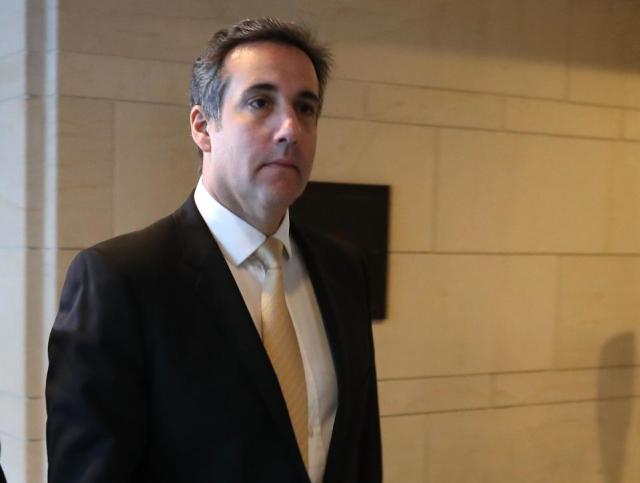
Michael Cohen, a personal attorney for President Trump, departs from a House Intelligence Committee on Capitol Hill, October 24, 2017 in Washington, DC. Getty Images/Mark Wilson

Nine days before his inauguration, and with allegations of Russian collusion swirling, Trump vehemently denied having any business ties to Russia whatsoever:

“Russia has never tried to use leverage over me. I HAVE NOTHING TO DO WITH RUSSIA – NO DEALS, NO LOANS, NO NOTHING!” Trump tweeted January 11 of last year.

As well as the Trump Tower negotiations, Cohen is reported to have received the Ukraine peace proposal plan from a Ukrainian lawmaker a week after Trump took office. Russia’s annexation of Crimea from Ukraine in 2014 sparked sanctions from the United States and European Union members that Putin’s regime has tried to lift or circumvent.

“Unsourced innuendo like this succeeds only because the leakers know the Special Counsel will not respond to set the record straight,” Cohen’s attorney, Stephen Ryan, told The Post in a statement.

Cohen, who has worked for Trump for more than two decades, previously spoke to both the House and Senate Intelligence Committees in October. Both committees reportedly asked about the Trump Tower Moscow deal that never was.

More from Newsweek

Mueller Could Use Trump Lawyer Cohen to ‘Take Down’ President, Former Campaign Aide Says

Can a Lawyer (Michael Cohen) Pay a Witness (Stormy Daniels) Hush Money to Silence Her?

Trump Lawyer Michael Cohen Says The ‘Haters’ Are Trolling Him For Supporting the President

This evangelical Christian is also a world-renowned climate scientist

New York Post

This evangelical Christian is also a world-renowned climate scientist

By Reuters       March 6, 2018 

Climate scientist Katharine Hayhoe. AFP/Getty Images
EDMONTON, Canada – Katharine Hayhoe, a climate scientist and evangelical Christian, says she gets slammed every day on social media for her contributions to establishing that climate change is human-made.

But on Monday, she was welcomed with applause at a United Nations-backed climate summit in the capital of Canada’s western province of Alberta, where polls show that climate skepticism rates are among the highest in the country.

Hayhoe, a professor at Texas Tech University, has emerged in recent years as a leading voice sharing the science of climate change to skeptics — many of whom are fellow evangelical churchgoers.

A 2015 survey from the Washington DC-based Pew Research Center found that just one-quarter of white evangelicals in the United States believe that climate change is caused by humans.

A separate Pew poll from 2016 showed that white evangelicals voted overwhelmingly to elect United States President Donald Trump, who has pulled his country out of the Paris agreement, a global pact to curb climate change.

But Hayhoe said it is that same Christianity that fuels her dedication to climate science.

“I study climate change because I think it’s the greatest humanitarian crisis of our times,” she said.

“It exacerbates poverty and hunger and disease and civil conflicts and refugee crises,” she told the Thomson Reuters Foundation.

Traits that have made Hayhoe uniquely qualified to speak authoritatively in such conservative circles are best summed up by two accolades she has received.

For her work in explaining climate change, Hayhoe has made TIME magazine’s list of most influential people and she was named one of the 50 Women to Watch by the evangelical magazine Christianity Today.

Her calling came “completely serendipitously.”

Six months into her marriage, her husband, a linguistics professor, told her about his disbelief in global warming.

“You have somebody you respect and you also love and you also want to stay married. I said well, ‘Let’s talk about it.’”

It took two years of discussion to agree that heat-trapping greenhouse gas emissions attributable to human activity are driving today’s climate change.

The marital episode and her subsequent engagement with faith groups have firmed up her views that the traditional conservative tenet of small government – not science – usually explains why some resist the issue.

“(It’s) not because they really have a problem with the science,” she said. “It’s because they have a problem with the perceived solutions.”

“Taxes, government legislation, loss of personal liberty … that’s the real problem people have.”

Hayhoe did not field any questions from climate change skeptics during her talk at the summit in Edmonton. And her message struck particularly close to home in a province that is Canada’s main oil producer.

“The world energy system is undergoing an energy revolution … from old dirty energies that we have been using for hundreds of years to clean, endless sources of energy like wind,” she said, in an interview after her speech.

“Oil and gas companies, they look down the road and they understand that the world is changing.”

Under the Paris agreement, nearly 200 countries agreed to curb planet-warming emissions enough to keep the rise in global temperatures to well below 2 degrees Celsius (3.6 Fahrenheit) above pre-industrial times, ideally to 1.5 degrees.

But without unprecedented action temperatures could rise above 1.5 degrees, according to a draft report by the UN’s Intergovernmental Panel on Climate Change seen by Reuters earlier this year.

Senate inches closer to passing bill to ease bank safeguards

Associated Press

Senate inches closer to passing bill to ease bank safeguards

Kevin Freking and Marcy Gordon, Associated Press  March 6, 2018

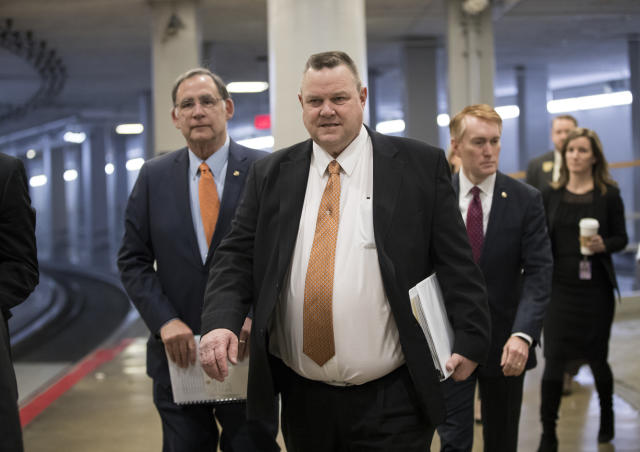
Sen. Jon Tester, D-Mont., flanked by Sen. John Boozman, R-Ark., left, and Sen. James Lankford, R-Okla., arrive with other lawmakers for a procedural vote as the Senate moves to pass legislation that would roll back some of the safeguards Congress put into place after a financial crisis rocked the nation’s economy ten years ago at the Capitol in Washington, Tuesday, March 6, 2018. (AP Photo/J. Scott Applewhite)

WASHINGTON (AP) — The Senate advanced legislation Tuesday to roll back some of the safeguards Congress put in place to prevent a repeat of the financial crisis. Enough Democrats supported a procedural vote on the bipartisan bill to show it has a good chance of passage in the coming days.

The move to alter some key aspects of the Dodd-Frank law comes ten years after the financial crisis rocked the nation’s economy. The bill has overwhelming Republican support and enough Democratic backing that it’s expected to gain the 60 votes necessary to clear the Senate. That was reflected in the 67-32 vote Tuesday, with 16 Democrats and one independent voting to move ahead with consideration of the bill.

Several Democratic lawmakers facing tough re-election races this year have broken ranks with Minority Leader Chuck Schumer, D-N.Y. and Sen. Elizabeth Warren, D-Mass.

Sen. Jon Tester, D-Mont., said he was proud to support Dodd-Frank eight years ago, and for the most part, the legislation was successful, but the bill also had unintended consequences, which he said included consolidation in the banking industry and a decline in small business lending. He said local banks in Montana have suffered from regulations specifically designed to rein in risky behavior on Wall Street.

“As a result of complying with these regulations, many of our community bankers are hanging up their hats,” Tester said.

Nonpartisan congressional analysts say the legislation would slightly increase the probability of a big bank failure — prompting a possible taxpayer bailout — or another financial meltdown. The probability of those events is deemed to be small under current law. The new assessment by the Congressional Budget Office estimates the bill would increase federal deficits by $671 million between 2018 and 2027 if it became law.

Sen. Sherrod Brown, D-Ohio, said the drumbeat for derailing Dodd-Frank has been constant. He said Wall Street banks always want “a new exception, or a new, weaker standard, or a new tax break.”

“We know what happens next. It is hubris to think we can gut the rules on these banks again, but avoid the next crisis,” said Brown, the top Democrat on the Senate Banking Committee.

But the bill’s proponents insisted it would bring a needed boost to beleaguered banks outside Wall Street that didn’t engage in the reckless practices that fueled the financial crisis.

“Dodd-Frank’s enormous regulatory burden has been inefficient and unhelpful for financial institutions of all sizes, but it has hit Main Street lenders especially hard,” Senate Majority Leader Mitch McConnell said.

The legislation would increase the threshold at which banks are subject to stricter capital and planning requirements. Lawmakers are intent on easing those rules for midsize and large regional banks, asserting that would boost lending and the economy.

Banks have long complained about the cost of complying with the many requirements of Dodd-Frank. Under the Senate bill, some of the nation’s biggest banks would no longer have to undergo an annual stress test conducted by the Federal Reserve. The test assesses whether a bank has enough capital to survive an economic shock and continue lending. Dozens of banks would also be exempted from making plans called “living wills” that spell out how the bank will sell off assets or be liquidated in a way that won’t create chaos in the financial system.

The Senate legislation increases from $50 billion to $250 billion the threshold at which banks are considered critical to the system. The change would ease regulations on more than two dozen financial companies, including BB&T Corp., Sun Trust Banks Inc. and American Express.

Opponents of the bill argue that the same banks getting regulatory easing through the Senate bill also got about $50 billion in taxpayer-funded bailouts during the financial crisis. Warren said banks got their wish-list in the bill, but consumers got next to nothing.

“This bill was written by big banks to help big banks,” said Warren, who is hoping to offer several amendments to the bill.

The Senate bill emerged from lengthy negotiations between Sen. Mike Crapo, the Republican chairman of the banking committee, and several Democratic members on the committee. Crapo said the Federal Reserve will have the authority to tailor tougher capital and liquidity requirements for individual banks when it believes it’s necessary. For the others, compliance costs should drop.

The bill has 13 Republican and 13 Democratic or independent co-sponsors, a rare level of bipartisanship for substantive legislation in the current Congress. By contrast, the House effort to roll back Dodd-Frank didn’t generate a single Democratic vote in support.

Sen. Bernie Sanders, I-Vt., said the financial sector spent more than $200 million alone on lobbying last year and has donated billions to election campaigns since the 1990s.

“That is why Congress will be spending day after day trying to make life easier for these large financial institutions while at the same time ignoring the needs of working families,” Sanders said.

Trump White House quietly issues report vindicating Obama regulations

The stinky, disgusting downside of the world’s demand for pork

New York Post

The stinky, disgusting downside of the world’s demand for pork

The Associated Press     March 5, 2018

All the waste from the Everette Murphrey Farm is stored in open-air lagoons and sprayed onto fields as fertilizer. AP

WILLARD, NC — Terry “Pap” Adams says he was out in the backyard, tinkering on one of his car projects, when another cloud of noxious pinkish-brown mist drifted overhead. The droplets hit his wife’s black car, leaving blotches with greasy little dots in the center.

“You can feel it on your clothes,” he said as he stood outside his home in rural Willard, about 70 miles southeast of Fayetteville. “You could feel it, like a misting rain. But it wasn’t misting rain. It was that stuff.”


Tesla: The world’s largest rooftop solar farm.

EcoWatch
March 5, 2018

The world’s largest rooftop solar farm.

via World Economic Forum

Tesla wants to power its city-sized factory with renewable energy

The world's largest rooftop solar farm.via World Economic Forum

Posted by EcoWatch on Monday, March 5, 2018

State Dept. Was Granted $120 Million to Fight Russian Meddling. It Has Spent $0.

New York Times

State Dept. Was Granted $120 Million to Fight Russian Meddling. It Has Spent $0.

 By Gardiner Harris            March 4, 2018   

Rex W. Tillerson, the secretary of state, has voiced skepticism that the United States is capable of doing anything to counter Russian meddling. CreditPool photo by Lintao Zhang

WASHINGTON — As Russia’s virtual war against the United States continues unabated with the midterm elections approaching, the State Department has yet to spend any of the $120 million it has been allocated since late 2016 to counter foreign efforts to meddle in elections or sow distrust in democracy.

As a result, not one of the 23 analysts working in the department’s Global Engagement Center — which has been tasked with countering Moscow’s disinformation campaign — speaks Russian, and a department hiring freeze has hindered efforts to recruit the computer experts needed to track the Russian efforts.

The delay is just one symptom of the largely passive response to the Russian interference by President Trump, who has made little if any public effort to rally the nation to confront Moscow and defend democratic institutions. More broadly, the funding lag reflects a deep lack of confidence by Secretary of State Rex W. Tillerson in his department’s ability to execute its historically wide-ranging mission and spend its money wisely.

Mr. Tillerson has voiced skepticism that the United States is even capable of doing anything to counter the Russian threat.

“If it’s their intention to interfere, they’re going to find ways to do that,” Mr. Tillerson said in an interview last month with Fox News. “And we can take steps we can take, but this is something that once they decide they are going to do it, it’s very difficult to pre-empt it.”

The United States spends billions of dollars on secret cyber capabilities, but these weapons have proved largely ineffective against Russian efforts on Facebook, Twitter and elsewhere that simply amplify or distort divisive but genuine voices in the United States and elsewhere.

The role for the Global Engagement Center would be to assess Russian efforts and then set about amplifying a different set of voices to counter them, perhaps creating a network of anti-propaganda projects dispersed around the world, experts said.

“There are now thousands of former Russian journalists who have been exiled or fired who are doing counter-Russian stuff in exile who we could help,” said Richard Stengel, who as the under secretary for public diplomacy in the Obama administration had oversight of the Global Engagement Center.

Concerted campaigns to highlight the roles of Russian troll farms or Russian mercenaries in Ukraine and Syria could have a profound effect, Mr. Stengel said.

At the end of the Obama administration, Congress directed the Pentagon to send $60 million to the State Department so it could coordinate government-wide efforts, including those by the Defense Department and the Department of Homeland Security, to counter anti-democratic propaganda by Russia and China. This messaging effort is separate from other potential government actions like cyber-attacks.

Mr. Tillerson spent seven months trying to decide whether to spend any of the money. The State Department finally sent a request to the Defense Department on Sept. 18 to transfer the funds, but with just days left in the fiscal year, Pentagon officials decided that the State Department had lost its shot at the money.

With another $60 million available for the next fiscal year, the two departments dickered for another five months over how much the State Department could have.

After The New York Times, following a report on the issue by Politico in August, began asking about the delayed money, the State Department announced on Monday that the Pentagon had agreed to transfer $40 million for the effort, just a third of what was originally intended.

State Department officials say they expect to receive the money in April. Steve Goldstein, the under secretary for public diplomacy, said he would contribute $1 million from his own budget to “kick-start the initiative quickly.”

“This funding is critical to ensuring that we continue an aggressive response to malign influence and disinformation,” Mr. Goldstein said.

On Wednesday, Mark E. Mitchell, a top official in the Defense Department, said much wrangling remained before any of the promised $40 million is transferred to the State Department.

“We’re still a ways off,” Mr. Mitchell said.

The delays have infuriated some members of Congress, which approved the funding transfer with bipartisan support.

“It is well past time that the State Department’s Global Engagement Center gets the resources Congress intended for it to effectively fight Kremlin-sponsored disinformation and other foreign propaganda operations,” Senator Robert Menendez of New Jersey, the top Democrat on the Senate Foreign Relations Committee, said on Wednesday.

Adele Ruppe, the center’s chief of staff, defended the administration’s broader efforts to counter Russian propaganda, pointing out that the State Department had provided $1.3 billion in assistance in 2017 to strengthen European resilience to Russian meddling. But that money was largely obligated during the Obama administration, and the Trump administration has proposed slashing that assistance by more than half for the coming year, to $527 million, and to $491 million for the next year.

While it waits for the funding transfer from the Pentagon, the center, which has a staff of around 60 people, including 23 contract analysts, will continue working on its original mission: countering jihadist and extremist propaganda.

Most of the center’s leaders are working in temporary assignments, a product of Mr. Tillerson’s halt in promotions. The analysts work in a warren of cubicles in the basement of a tired building that once housed the Office of Strategic Services, the World War II predecessor to the C.I.A.

The analysts are divided into five teams that largely work in four languages: Arabic, Urdu, French and Somali. The analysts said in interviews that they had notched some significant victories, including a video montage proving that the Islamic State had itself destroyed Al Nuri Grand Mosque in Mosul, Iraq, and a widely seen cartoon in French depicting the miserable life of an Islamic State fighter.

Still, these efforts are a small fraction of what Congress envisioned. A 2015 internal assessment found that the Islamic State had been far more nimble on social media than the United States had been. In May, Congress more than doubled the center’s budget, providing an additional $19 million over its earlier budget of $14 million. But by Jan. 1, the department had spent just $3.6 million of the additional $19 million, Mr. Goldstein said.

James K. Glassman, the under secretary for public diplomacy during the George W. Bush administration, said the center’s uncertain funding and temporary leadership reflected the administration’s lack of interest in countering either jihadist or Russian propaganda.

“They’ve got the vehicle to do this work in the center,” Mr. Glassman said. “What they don’t have is a secretary of state or a president who’s interested in doing this work.”

Mr. Tillerson is focusing his energies instead on drastically shrinking the department, leaving a significant part of its budget unused and hundreds of important decisions unmade.

Last year, the State Department spent just 79 percent of the money that Congress had authorized for the conduct of foreign affairs, the lowest such level in at least 15 years and well down from the 93 percent spent in the final year of the Obama administration, according to an analysis of data from the Office of Management and Budget.

Because of the hiring and promotion freezes that have left large sums unspent, as well as Mr. Tillerson’s refusal to delegate spending decisions, the department had a backlog of more than 1,400 official requests for Mr. Tillerson’s signoff at the end of last year, according to a former senior diplomat who left the department then.

Trash in the Fjords? Norway Turns to Drones

New York Times – Europe

Trash in the Fjords? Norway Turns to Drones

Richard Martyn-Hemphill and Henrik Pryser Libel,   March 4, 2018

A promenade in Oslo. The fjord in Norway’s capital is filled with garbage, and the city has approved the use of drones to pinpoint the trouble spots. Credit: James Silverman for The New York Times

OSLO — Norway’s fjords have long inspired the country’s artists and drawn streams of tourists. In winter, their ice-laced surfaces shimmer beside snow-capped mountains: a vision of natural beauty, blissfully untouched.

But lost in the depths of the fjord in Oslo, stretching out from the capital, is a trove that would please any intrepid archaeologist or Nordic noir sleuth: sunken Viking trinkets, bullion from Hitler’s prized warship and, possibly, a few victims of homicide.

Mostly, though, the fjord is filled with garbage, like unwanted cars. And that has alarmed environmentalists.

“Not many years ago, a mayor said if you want to get rid of a car, put it on the ice,” said Solve Stubberud, general secretary of the Norwegian Divers Federation.

Now, the capital is turning to new technology to help pinpoint the litter so that human divers can scour it off the seabed. This past Thursday, board members of Oslo’s Port Authority approved a pioneering trash-removal plan.

“We will test out drones,” said Svein Olav Lunde, the chief technical officer of the Oslo Port Authority, shortly after the meeting, explaining how these unmanned vessels will be used to help clear out underwater “islands of trash.”

Geir Rognlien Elgvin, a board member, says he believes that Oslo’s port will be the first in the world to try this sort of trash pickup. The drones will plunge into the depths of Oslo Fjord this spring. An electric-powered ship with a crane will join the cleanup fleet by next year.

Oslo is turning to drone technology partly because of a dead dolphin — bloodied, beached and ensnared in plastic. Gory images of the carcass, taken in January on a trash-strewn shore of Oslo Fjord, resonated on social media among Norwegians, who tend to see their jagged coastline as a paragon of untouched natural beauty.

Mr. Stubberud said that recent images of beached dolphins and whales have woken up Norway, but that “plastic is the real problem.” Politicians and the public have shown more interest in the cleanup campaign in the past two years, he said.

But it’s mainly driven by environmentalists. Ambitious plans to clean up the city’s industrial waste and sewage have been in the works for decades, along with a proposal for a car-free city center and a ban on using oil to heat buildings that is to go into effect in 2020. Campaigns like these won Oslo the European Green Capital Award for 2019.

By The New York Times

Fjords are indelibly linked to Norway’s identity as a seafaring nation. The long, narrow, deep inlets form at the base of mountains where ocean water flows into valleys formed near the coast. The Oslo Fjord is 62 miles long.

But in the fjord — roughly one-third of Norway’s five million people live on its shores — the problems started with industrialization and increased shipping after the oil boom in the 1960s and ‘70s.

Even as the first drones are set to plumb the fjords, the national government is moving in another direction. Norway is one of the few countries that allow offshore dumping of mining waste, which can destroy vast numbers of fish stocks in fjords with hundreds of thousands of tons of sludge.

Norway has refused to sign an International Union for Conservation of Nature resolution outlawing the practice, putting it in the company of Chile, Indonesia, Papua New Guinea and Turkey.

“It’s wrong, and I wish that we didn’t do it,” said Lan Marie Nguyen Berg, vice mayor for the environment and transportation in Oslo. Ms. Nguyen Berg says Norway should preserve the fjords “for future generations.”

But the national government has emphasized that the mining projects provide local jobs.

Now, to tackle the household trash in the city’s surrounding seabed, a drone bidding war awaits for the technology to map the trash spots.

“There are whole households of furniture,” Christine Spiten, 27, a drone operator and tech entrepreneur, said recently at Oslo’s Lysaker River, which forms the boundary between the municipalities of Oslo and Baerum.

Ms. Spiten spoke before unraveling a bright yellow cable of rubber and Kevlar that linked a video game controller and touch screen to an underwater drone called BluEye. She had showcased the drone to representatives of the port authority and Norway’s shipping industry at the mouth of the river in February. The demonstration uncovered a rusty red bike and showed how drones could save time, money and hassle in cleaning the seabed.

Ms. Spiten and her team in the seaport town of Trondheim, where she lives in a sailboat, engineered the drone’s technology. She said her skills were partly drawn from her training at an oil company. Some board members see Ms. Spiten as the favorite to take home the contract, but she has stiff competition from international drone makers.

After the meeting on Thursday, the litter collection plan settled, Roger Schjerva, the chairman of the port authority, noted even more important items in the fjords that continue to need urgent attention: mines.

The mines date back to the Second World War. There are more than 1,550 of them in Oslo Fjord. Of the 270 that have been located so far, around 100 of those have been detonated, said a spokesman for the Royal Norwegian Navy. When detonated in the fjords, they can damage ships and fish. The mines are also leaking.

So another wave of mine sweeping may come to the fjords. Mr. Schjerva said, “We will prioritize removing remaining mines from World War II.”

Economic Equality Is Key to Solving Climate Change, Report Shows

Bloomberg – Technology

Economic Equality Is Key to Solving Climate Change, Report Shows

Economies need to reduce inequality and promote sustainable development for the world to avert the perils of runaway global warming, according to new research.

The risk of missing emissions targets increased dramatically under economic scenarios that emphasizes high inequality and growth powered by fossil fuels, according to research published Monday by a team of scientists in the peer-reviewed Nature Climate Change journal.

“Climate change is far from the only issue we as a society are concerned about” said Joeri Rogelj, the paper’s lead author and a research scholar at the International Institute for Applied Systems Analysis outside of Vienna. “We have to understand how these many goals can be achieved simultaneously. With this study, we show the enormous value of pursuing sustainable development for ambitious climate goals in line with the Paris Agreement,” he said.

The paper bridges two of the most intractable challenges facing policy makers across the globe. Scientists predict higher frequencies of floods, famines and superstorms unless the world keeps temperature rises well below 2 degrees Celsius (3.6 degrees Fahrenheit) this century. At the same time, growing income inequality has been robbing advanced economies of dynamism needed to boost their resilience to change.

The IIASA researchers modeled six different scenarios in order to determine conditions that would limit warming to 1.5 degrees Celsius, according to the paper.

“Our assessment shows particularly the enormous value of pursuing sustainable development for reaching extreme low climate change targets,” said Keywan Riahi, a coauthor of the paper. “On the other hand, fragmentation and pronounced inequalities will likely come hand-in-hand with low levels of innovation and productivity, and thus may push the 1.5 degrees Celsius target out of reach.”

Greenhouse gas emissions should peak before 2030 after which they’ll “decline rapidly” with a combination of phasing out of industry and energy related CO2 combined with an “upscaling” carbon capture and carbon dioxide removal, according to the report. An estimated 37 billion metric tons of carbon dioxide was released last year, 2 percent more than 2016, according to researchers in the Global Carbon Project.

“Bioenergy and other renewable energy technologies, such as wind, solar, and hydro, scale up drastically over the coming decades in successful scenarios, making up at least 60 percent of electricity generation by the middle of the century,” according to the researchers. “Traditional coal use falls to less than 20% of its current levels by 2040 and oil is phased out by 2060.”

— With assistance by Eric Roston
