Profiles in congressional cowardice

Chicago Tribune – Letters – April 15, 2018

Profiles in congressional cowardice

Morton H. Kaplan, professor emeritus, Columbia College, Chicago

John F. Kennedy wrote a book called “Profiles in Courage,” a story about eight senators who were the personification of integrity and heroic behavior, the likes of Sens. Daniel Webster, Robert Taft and John Quincy Adams. They stood for principles, risking their futures.

Where are such men today among the Republicans in the Senate or the House of Representatives? Oh, sure, there are Sen. Jeff Flake of Arizona and Sen. Bob Corker of Tennessee.

Neither is running for re-election.

Sens. John McCain and Lindsey Graham and Ben Sasse have stuck a few oppositional toes in tepid waters. Not exactly an all-out attack to stop President Donald Trump, even though most senators dislike everything about the president and most of what he stands for. But the senators have built personal moats so that nobody can cross them and thereby ensure they will retain their seats. The easiest way for them to do that is to support the president and avoid his rancor, which would bring threats of primaries against them and launch his 40 percent to dislodge them — not to mention being tagged with scurrilous nicknames.

And what of the pied pipers who lead the House and Senate? Senate Majority Leader Mitch McConnell is of the never-say-a-bad-word school. And House Speaker Paul Ryan should have followed his original instincts to not take the job instead of showing the spinelessness that has destroyed his career.

Isn’t it time that these so-called representatives of the people who have gone into hiding acknowledge that the emperor has no clothes? Who’s going to go first?

A $76,000 monthly pension: Why States and Cities Are Short On Cash

The New York Times

A $76,000 monthly pension: Why States and Cities Are Short On Cash

Governments are struggling as mounting pension obligations crowd out the rest of their budgets. Oregon faces a severe, self-inflicted crisis.

By Mary Williams Walsh     April 14, 2018

A public university president in Oregon gives new meaning to the idea of a pensioner. Joseph Robertson, an eye surgeon who retired as head of the Oregon Health & Science University last fall, receives the state’s largest government pension.

It is $76,111.               Per month.

That is considerably more than the average Oregon family earns in a year.

Oregon — like many other states and cities, including New Jersey, Kentucky and Connecticut — is caught in a fiscal squeeze of its own making. Its economy is growing, but the cost of its state-run pension system is growing faster. More government workers are retiring, including more than 2,000, like Dr. Robertson, who get pensions exceeding $100,000 a year.

The state is not the most profligate pension payer in America, but its spiraling costs are notable in part because Oregon enjoys a reputation for fiscal discipline. Its experience shows how faulty financial decisions by states can eventually swamp local communities.

Oregon’s costs are inflated by the way in which it calculates pension benefits for public employees. Some of the pensions include income that employees earned on the side. Other retirees benefit from long-ago stock market rallies that inflated the current value of their payouts.

For example, the pension for Mike Bellotti, the University of Oregon’s head football coach from 1995 to 2008, includes not just his salary but also money from licensing deals and endorsements that the Ducks’ athletic program generated. Mr. Bellotti’s pension is more than $46,000 a month.

“You get to the point where you can no longer do more with less — you just have to do less with less,” Nathan Cherpeski, the manager of Klamath Falls, said. Credit: Leah Nash for The New York Times

The bill is borne by taxpayers. Oregon’s Public Employees Retirement System has told cities, counties, school districts and other local entities to contribute more to keep the system afloat. They can neither negotiate nor raise local taxes fast enough to keep up. As a result, pensions are crowding out other spending. Essential services are slashed.

“You get to the point where you can no longer do more with less — you just have to do less with less,” said Nathan Cherpeski, the manager of Klamath Falls, a city of about 21,000 in south-central Oregon.

Klamath Falls’s most recent biennial bill from the pension system, known as PERS, was $600,000 more than the one before. PERS has warned that the bills will keep rising. Mr. Cherpeski has had to cut back on repairing streets and bridges.

Even as the American economy is humming, many states and cities are still hurting from the 2008 financial meltdown. The crash hammered their pension funds and tax revenues, but didn’t reduce the amounts they owe retirees.

It wasn’t until 2016 that average state tax collections returned to pre-2008 levels. In the meantime, states and cities have had to rebuild pension funds to cover the rising numbers of retirees drawing benefits. That has left less money for the police, school sports programs and everything else. Local residents might not know why, but they are paying more taxes and getting scantier services in return.

Kate Dwyer, a board leader in the Three Rivers School District in southwestern Oregon, worries that because of the drain on funding, a generation is growing up without theater, wood shop, orchestra and other school programs that were offered in the past. Credit: Leah Nash for The New York Times

Costs are rising even in places that previously acted to defuse the problem. Colorado trimmed pensions in 2010, but a new $32 billion shortfall means more pension cuts and tax increases are likely. Detroit sliced its pension obligations in bankruptcy and persuaded philanthropists to chip in, but it is not clear that the city has an affordable plan.

In San Francisco, the school board wants voters to approve a $298 “parcel tax” on real estate, ostensibly to raise $50 million to pay teachers a living wage.

“That’s a worthy objective, but it’s not the real reason,” said David Crane, a former trustee of the California teachers’ pension system. He said the school district’s retirement costs had grown by $50 million over the last five years, devouring resources that would have gone to teachers.

Obligatory Contributions

Oregon is a blue state, but in its restive red hinterlands, tax increases are politically off limits and financial distress has been severe since 1994, when logging was curtailed to save an endangered owl. Lately, things have been getting even worse.

When a man was reported yelling and firing his gun on the property of a school in rural Josephine County, it took two hours for a sheriff’s deputy to arrive, said Kate Dwyer, chairwoman of the board for the Three Rivers School District.

Evergreen Elementary School, part of the Three Rivers district, operates without a physical education teacher. Credit: Leah Nash for The New York Times

The county has cut sheriff patrols, closed its mental health department and kept its jail at less than half capacity because of a lack of guards.

Dave Valenzuela, the Three Rivers school superintendent, traces the latest woes directly to PERS. The system is run at the state level, but it is bankrolled in large part by obligatory contributions from local governments.

This year, Three Rivers was poised to receive its first increase in state education funding in years, a reflection of growing enrollment. But Oregon raised by more than 50 percent the amount that Three Rivers had to contribute to PERS. So Mr. Valenzuela had to lop five days off the school year, ask each school to cut its budget by 10 percent and lay off the district librarian and English specialist.

PERS sets the pension bill for each entity — local government, university system and the like — based on the pay and demographics of its workers. Just about everyone’s bills are getting bigger.

That includes the state, by far the system’s biggest contributor.

Oregon now has fewer police officers than in 1970, is losing foster-care workers at an alarming rate and has allowed earthquake and tsunami preparations to lapse. A 2016 survey turned up “a large number of bridges with critical and near-critical conditions” because of “longstanding inadequate funding.”

Because Evergreen cannot afford a physical education teacher, Tiffany Bonney’s first-grade class uses a video program called GoNoodle to exercise. Credit: Leah Nash for The New York Times

Even prosperous communities are being pinched. The Beaverton School District, outside Portland, had to get rid of 75 teachers last year when its mandatory pension contribution rose by $14 million. That was after shedding 340 teachers in 2012.

“I have town hall meetings, and the parents are just confounded by this,” said Mark Hass, a Democratic state senator from Beaverton.

A Golden Touch

Oregon’s unusual method for calculating pensions tends to generate lavish payouts.

For decades, PERS calculated pensions two different ways, and retirees could choose whichever produced the bigger numbers.

The first way was similar to what most states do, basing pensions on each worker’s final salary and years of service. But Oregon’s lawmakers included a golden touch, redefining “salary” to include remuneration from any source.

That was how Mr. Bellotti, the former football coach, came to be the state’s third-highest-paid pensioner, at roughly $559,000 a year.

                                                                  Mike Bellotti in 2007, when he was the University of Oregon’s head football coach. After retiring as the university’s athletic director in 2010, he started drawing the biggest government pension in the state. Since then, two other retirees have surpassed him. Credit: Chris Pietsch/The Register-Guard, via Associated Press

When he retired in 2010 as the university’s athletic director, the standard pension formula was applied to his salary, plus a share of the outside licensing fees and product endorsements the football program brings in. (His pension details, along with those of other retirees in the system, were first obtained in 2011 from PERS by two newspapers, The Oregonian and The Statesman Journal.)

Mr. Bellotti said he never asked for a supersize pension. In 1995, he said, the university started to include a percentage of all endorsement and licensing fees in coaches’ salaries.

“It was basically to augment the university’s ability to pay a competitive salary to its coaching staff,” he said.

When Mr. Bellotti retired, he was partway through a five-year, $1.9 million-a-year contract, which he said was still below the league average of about $3 million.

PERS made up for it with a big pension. “It was pay later as opposed to paying now,” he said.

Dr. Robertson, the former Oregon Health & Science University president, said he had retired and started drawing his pension last fall, after learning he had multiple sclerosis. He said he agreed to stay on through the end of the academic year, without pay, “for the sake of continuity.”

A building at the Dome School, a private alternative school in Josephine County, Ore. The county cannot afford 24-hour sheriff patrols, and during one emergency at the school, two hours passed before a deputy could respond. Credit: Leah Nash for The New York Times

A spokeswoman for the medical center said Dr. Robertson’s pension was based on his salary, incentive payments, clinical pay and unused sick or vacation time.

Oregon’s second way of calculating pensions dates back to 1946: For decades, every public worker got a simulated tracking account. It was credited with 6 percent of each paycheck, then left to compound at a predetermined rate.

In the early years, a low rate was used because the pension system invested in bonds that didn’t yield much.

But in the 1970s, lawmakers started nudging the rate up, eventually to 8 percent. Then, the system’s trustees decided 8 percent should be a guaranteed minimum. In years when markets produced higher returns, the accounts compounded at those rates, after money-management fees. During the 1990s bull market, accounts compounded by up to 21 percent a year.

When workers retired, their employers were required to “match” the account balances, doubling them. Then PERS would base the pensions on the total.

Children at the Dome School. Across Oregon, local officials have been told to brace for 15 to 20 more years of rising pension bills. Credit: Leah Nash for The New York Times

‘Planet Tiffany’

Randall Pozdena, an economist who supervised the pension system’s investments in the 1990s, gave speeches warning that the situation was unsustainable.

“The only way you’re going to get out of this is if the state is hit by a golden asteroid from Planet Tiffany,” he recalled saying.

But efforts to change the system, including a 1994 ballot initiative, were blocked by the State Supreme Court, which ruled that accruals could not be reduced during any public worker’s career.

So, when lawmakers required government retirees to pay Oregon’s 9 percent income tax, as everybody else did, they also increased pensions by 9.89 percent, giving retirees extra money to pay the tax with.

“It’s an affront to everybody who pays taxes,” said Bruce Dennis, a retired carpenter from outside Portland who earned a $54,000-a-year pension by swinging a hammer for 45 years. No one gives him extra money to cover his taxes.

Students at Evergreen and other schools in the Three Rivers district, which covers a thinly populated area larger than Rhode Island, spend hours on buses every day. The district has asked Oregon officials to help cover its transportation costs, so far in vain. Credit: Leah Nash for The New York Times

“At every step of the way, they’ve made decisions that went against the interests of the public,” he said.

Starting in 2003, the tracking accounts were phased out. But workers who already had the accounts were allowed to keep them. New hires got a more modest retirement plan.

“The cost of this pension system is not caused by the people we are hiring today,” said Steven Rodeman, executive director of the Public Employees Retirement System. “This is a legacy problem from the 1980s and 1990s.”

For workers with the tracking accounts, PERS dialed back the annual returns to 8 percent, then to 7.5 percent in 2016. That is still more than what PERS’s investments have generated over the last decade. And so the pension fund’s financial hole continues to deepen.

Across Oregon, local officials have been told to brace for 15 to 20 more years of rising pension bills. That’s when the current generation of retirees will start dying out.

“All we can do is wait,” said Jay Meredith, finance director of Grants Pass, the seat of Josephine County.

In the meantime, mounting pension costs mean that a generation of schoolchildren is growing up in the area with no theater program, no orchestra, no wood shop and minimal sports, chorus and art.

That’s if they can get to school.

A county road recently washed out, stranding 300 people. Ms. Dwyer, of the Three Rivers School District, reported the problem to a public-works official.

She recalled his response: “I have trucks, but I can’t put gas in them to come to you and dig it out.”

The Paul Ryan Story: From Flimflam to Fascism

The New York Times

The Paul Ryan Story:
From Flimflam to Fascism

By Paul Krugman, Opinion Columnist          April 12, 2018

Paul Ryan speaking to reporters in Washington on Wednesday. CreditTom Brenner/The New York Times

Why did Paul Ryan choose not to run for re-election? What will be the consequences? Your guess is as good as mine — literally. I can speculate based on what I read in the papers, but so can you.

On the other hand, I do have some insight into how Ryan — who has always been an obvious con man, to anyone willing to see — came to become speaker of the House. And that’s a story that reflects badly not just on Ryan himself, not just on his party, but also on self-proclaimed centrists and the news media, who boosted his career through their malfeasance. Furthermore, the forces that brought Ryan to a position of power are the same forces that have brought America to the edge of a constitutional crisis.

About Ryan: Incredibly, I’m seeing some news reports about his exit that portray him as a serious policy wonk and fiscal hawk who, sadly, found himself unable to fulfill his mission in the Trump era. Unbelievable.

Look, the single animating principle of everything Ryan did and proposed was to comfort the comfortable while afflicting the afflicted. Can anyone name a single instance in which his supposed concern about the deficit made him willing to impose any burden on the wealthy, in which his supposed compassion made him willing to improve the lives of the poor? Remember, he voted against the Simpson-Bowles debt commission proposal not because of its real flaws, but because it would raise taxes and fail to repeal Obamacare.

And his “deficit reduction” proposals were always frauds. The revenue loss from tax cuts always exceeded any explicit spending cuts, so the pretense of fiscal responsibility came entirely from “magic asterisks”: extra revenue from closing unspecified loopholes, reduced spending from cutting unspecified programs. I called him a flimflam man back in 2010, and nothing he has done since has called that judgment into question.

So how did such an obvious con artist get a reputation for seriousness and fiscal probity? Basically, he was the beneficiary of ideological affirmative action.

Even now, in this age of Trump, there are a substantial number of opinion leaders — especially, but not only, in the news media — whose careers, whose professional brands, rest on the notion that they stand above the political fray. For such people, asserting that both sides have a point, that there are serious, honest people on both left and right, practically defines their identity.

Yet the reality of 21st-century U.S. politics is one of asymmetric polarization in many dimensions. One of these dimensions is intellectual: While there are some serious, honest conservative thinkers, they have no influence on the modern Republican Party. What’s a centrist to do?

The answer, all too often, has involved what we might call motivated gullibility. Centrists who couldn’t find real examples of serious, honest conservatives lavished praise on politicians who played that role on TV. Paul Ryan wasn’t actually very good at faking it; true fiscal experts ridiculed his “mystery meat” budgets. But never mind: The narrative required that the character Ryan played exist, so everyone pretended that he was the genuine article.

And let me say that the same bothsidesism that turned Ryan into a fiscal hero played a crucial role in the election of Donald Trump. How did the most corrupt presidential candidate in American history eke out an Electoral College victory? There were many factors, any one of which could have turned the tide in a close election. But it wouldn’t have been close if much of the news media hadn’t engaged in an orgy of false equivalence.

Which brings us to the role of the congressional G.O.P. and Ryan in particular in the Trump era.

Some commentators seem surprised at the way men who talked nonstop about fiscal probity under Barack Obama cheerfully supported tax cuts that will explode the deficit under Trump. They also seem shocked at the apparent indifference of Ryan and his colleagues to Trump’s corruption and contempt for the rule of law. What happened to their principles?

The answer, of course, is that the principles they claimed to have never had anything to do with their actual goals. In particular, Republicans haven’t abandoned their concerns about budget deficits, because they never cared about deficits; they only faked concern as an excuse to cut social programs.

And if you ask why Ryan never took a stand against Trumpian corruption, why he never showed any concern about Trump’s authoritarian tendencies, what ever made you think he would take such a stand? Again, if you look at Ryan’s actions, not the character he played to gullible audiences, he has never shown himself willing to sacrifice anything he wants — not one dime — on behalf of his professed principles. Why on earth would you expect him to stick his neck out to defend the rule of law?

So now Ryan is leaving. Good riddance. But hold the celebrations: If he was no better than the rest of his party, he was also no worse. It’s possible that his successor as speaker will show more backbone than he has — but only if that successor is, well, a Democrat.

The Deep State is coming for Trump, and it’s using Republicans!

The Chicago Tribune

The Deep State is coming for Trump, and it’s using Republicans!

Rex Huppke, Contact Reporter      April 11, 2018

Special counsel Robert Mueller, at left, and President Donald Trump, are both Republicans, (Saul Loeb/Getty-AFP)

Now that the FBI has raided the home and office of Michael Cohen, President Donald Trump’s personal attorney, it’s time we have a talk about the Deep State.

If you don’t know what the Deep State is then you’re obviously part of the Deep State, SO STOP READING THIS RIGHT NOW, TRAITOR!!

OK, I think those rotten Democratic Deep Staters are gone and we can speak freely.

We know, of course, that the liberal Deep State that lurks within our government is and always has been hellbent on destroying President Trump and preventing him from making America great again. And we know for certain that Deep State weasels fabricated the whole Russia HOAX and, quite likely, rigged the election so Hillary Clinton would lose, allowing Trump to win and be mercilessly persecuted by — you guessed it! — the Deep State. (It all tracks, believe me.)

But this week’s raids on Cohen’s Manhattan office and hotel room confirm one of my long-held suspicions: The Democratic Deep State has sunk to an even more insidious level and is now targeting our Republican president in the sneakiest way possible — by using Republicans.

Let’s start with Robert Mueller, the special counsel investigating all this Russia nonsense. As Trump has said, the whole thing is a big witch hunt, and that makes Mueller the lead witch hunter. Well, Mueller is a registered Republican and was first appointed head of the FBI by President George W. Bush, who is also a Republican. (I’m telling you, this conspiracy goes DEEP!)

The raid on Trump’s lawyer began with a referral from the Mueller investigation to the U.S. attorney’s office for the Southern District of New York. What the heck kind of Republican special counsel and lifetime law enforcement official would refer a legal matter that might make a Republican president look bad to a U.S. attorney’s office? That stinks to high heaven of Deep State involvement.

But it gets crazier. The U.S. attorney for the Southern District of New York is Geoffrey Berman, a Trump supporter who also gave money to the president’s campaign.

In a normal world in which the Deep State doesn’t exist and wacky libs aren’t constantly trying to ruin America, you’d expect Berman to shut this investigation down and protect his president. But no, Berman reportedly recused himself from the case and didn’t get involved in obtaining the warrants for the Cohen raids.

Is that a case of a public servant adhering to reasonable ethical standards? HELL NO! It’s a case of the Deep State finding a way to turn a Republican feral and make him attack his own kind.

And it gets worse. (If you’re feeling weary already, try one of the herbal supplements I promote on my website. Since I started taking them I’m more alert, I have rock solid abs, I’m earning more money and my patriotism is through the roof. They’re only $99.99 a month and rumors that they cause your toes to fall off are FAKE NEWS!!!)

The warrants for the Cohen raids had to get approved by the Department of Justice, which is run by Attorney General Jeff Sessions, a Republican. But Sessions recused himself from all criminal matters relating to the 2016 election, a decision that led to the appointment of Mueller (a Republican) by Deputy Attorney General Rod Rosenstein (a Republican) after Trump fired FBI Director James Comey (a Republican).

So it was Rosenstein who signed off on the warrants. And Rosenstein (a Republican) was handpicked by Trump (a Republican).

You don’t need to be as smart or conspiracy-attuned as I am to see the trend here. It’s so crazy my head should’ve exploded three paragraphs ago, but it didn’t because I’m taking these amazing herbal supplements (also $99.99 a month, available on my website) that inoculate me from head explosions.

The Democrats in the Deep State are clearly using Republicans to undermine President Trump. I’m not sure how they’re doing it — could be fluoride in the water, or possibly just standard mind control via dental fillings implanted between the years of 1965 and 1977, which was when the Deep State had a stranglehold on the National Dental Association.

What’s clear is this conspiracy has taken root, and it’s spreading.

On Wednesday, a pair of Republican senators joined a pair of Democratic senators and introduced legislation that would protect Mueller if the president tries to fire him.

The so-called Republicans are Sens. Thom Tillis of North Carolina and Lindsey Graham of South Carolina. The legislation is a combination of two previously introduced bipartisan bills aimed at protecting Mueller.

So let’s get this crooked story straight: Two Republican senators are trying to prevent a Republican president from firing a Republican special counsel appointed after the Republican president fired the Republican head of the FBI. (Take another one of those herbal supplements, please.) Those two Republican senators are doing this despite the fact that the Republican special counsel tipped off a Republican U.S. attorney in New York about possible criminal activity by the Republican president’s Republican attorney, then that Republican U.S. attorney recused himself and let warrants get approved by a handpicked Republican deputy attorney general who is making decisions because the Republican attorney general previously recused himself.

Amazing. As sure as the moon landing was faked, these Democratic Deep Staters will stop at nothing.

Stay vigilant, patriots. The Republicans can’t be trusted!

rhuppke@chicagotribune.com

Kentucky teachers march on state capitol

Yahoo News

Kentucky teachers march on state capitol

Yahoo News Photo Staff        April 14, 2018

Kentucky teachers march on state Capitol

Teachers from across Kentucky gather inside the state Capitol to rally for increased funding for education, Friday, April 13, 2018, in Frankfort, Ky. (Photo: Bryan Woolston/AP)

As Kentucky teachers declare victory after the Republican-dominated legislature overrode vetoes from the state’s GOP governor on a spending plan that included new money for education, the question going forward is whether teachers will be able to sustain their momentum into the fall elections, when Republicans will try to defend their supermajority.

Teacher Karen Schwartz brought a sign to Kentucky’s state capitol on Friday declaring “Support our Schools.” But it was her shoes, a comfortable pair of Crocs, that had a bigger message for state lawmakers. “They think we are going to get tired and go home,” she said. “We’re not going to get tired.”

Teachers had been booing Republicans for months after they passed changes to the teachers’ pension system. But Friday, teachers cheered as Republicans voted to override Gov. Matt Bevin’s vetoes.

Those cheers were dampened later when Bevin decried teachers for leaving work to protest at the Capitol, causing more than 30 school districts in the state to close for the day.

Thousands of teachers rallied inside and outside the Capitol on Friday. The rally took on a festival-like atmosphere as some teachers sat in lawn chairs or sprawled out on blankets. The Crosby, Stills, Nash and Young hit “Teach Your Children” bellowed from the loudspeakers. (AP)

How disability is holding back the Trump economy

Yahoo Finance

How disability is holding back the Trump economy

Rick Newman         April 13, 2018

In some parts of the country, the economy is so strong that companies can’t find enough workers to fill all the orders they have. Yet wage growth is weak, participation in the labor force is low and some areas seem chronically depressed. And economists can’t quite explain these disparities.

New research by the Conference Board examines one factor that might account for the large number of workers on the sidelines: disability. The portion of working-age adults who say they’re not in the labor force because of a disability rose from 4.2% in 1995 to 6.1% in 2017, according to government data analyzed by the Conference Board. The unemployment rate was 5.6% at the end of 1995, and it’s much lower now, at 4.1%. So you’d think the economy is stronger now. Yet GDP growth is actually lower now than it was in 1995.

Today’s higher disability rates suggest there’s more softness in the labor market than the low unemployment rate suggests. “There’s no doubt there’s a connection between labor market conditions and the share of people saying they’re disabled,” Gad Levanon, chief economist at the Conference Board, told Yahoo Finance. “The disability rate reflects weak labor market conditions in some areas.”

Getting in the way of growth

And that, in turn, may frustrate President Trump’s goal of sharply boosting economic growth. Trump insists his policies will help the economy grow at sustained growth rates of 3% or more, compared with the 2.2% average of the last five years. But cutting taxes and easing regulations won’t do the trick, if companies are turning down business because they can’t find enough workers, and several million people who ought to be earning and spending money instead are relying on others.

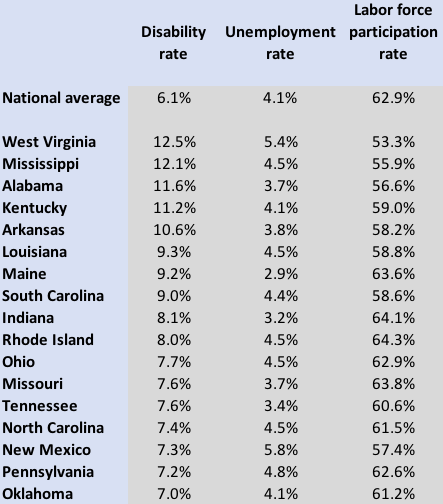
The Conference Board, as part of a new report on labor shortages in the economy, broke down disability rates by states for adults aged 20 to 64. In 17 states the disability rate is 7% or higher, and it’s above 10% in five states: West Virginia, Mississippi, Alabama, Kentucky and Arkansas. Here’s the national map:

Source: The Conference Board

One important caveat: These disability rates are not the ones used to determine who gets federal disability benefits under the Social Security program. That’s a completely different system. So these numbers don’t represent people saying they’re disabled just to get a government check. Rather, these are answers to Census Bureau survey questions asking people why they’re not in the labor force.

People who say they’re out of the labor force on account of disability aren’t counted in the unemployment statistics, which only measure people who have a job or are looking for a job. The 13.8% of working-age adults in West Virginia who are out of the labor force because of a disability, for instance, don’t have a job, aren’t looking for a job, and aren’t counted as unemployed.

Weak participation

But it’s those people who are completely out of the labor force who may explain labor shortages, sluggish economic growth and living standards that have barely been rising. While the unemployment rate is close to record lows, the portion of Americans who have a job or want one is also low. The so-called labor force participation rate peaked at 67.3% in 2000. It’s now at just 62.9%, roughly equal to where it was in the late 1970s—before women began surging into the work force. Disability may be one of the reasons the participation rate is so weak.

Six of the seven states with the highest disability rates have participation rates well below the national average. Here are the numbers for all states with a disability rate of 7% or higher:

                            Source: The Conference Board, Bureau of Labor Statistics
So it could be a high rate of disability in some states that is hollowing out the work force, or at least contributing to a hollowing out. Normally, when the economy improves and employers create more jobs, pay goes up and that draws some people off the sidelines—even people who consider themselves disabled. That has happened somewhat in the current recovery, which has been underway since 2009. But the trend this time has been muted, with more people staying out of the work force for longer. Economists can’t fully explain that, but in addition to disability, it may involve opioid addiction, lack of relevant skills in a fast-changing digital economy, and government benefits that create a disincentive to work.

States with high disability rates don’t necessarily have high unemployment rates. In fact, three of the seven states with the highest disability rates have unemployment rates below the national average. But the high disability rate means those states also have a significant portion of working-age adults who might have been in the labor force 20 years ago, but aren’t now.

For employers, this may help explain why workers are hard to find, even when pay goes up, as Yahoo Finance documented in a February report. Labor shortages could become more acute in coming years, and they may already be constraining growth, because there are fewer people earning money and generating economic activity. For President Trump, it means tax cuts and deregulation may not be enough to hit 3% growth rates. He may also have to persuade people who aren’t working that they should get off the sidelines.

Confidential tip line: rickjnewman@yahoo.comEncrypted communication available.

What Your Great Lake Needs Is a Leaky Oil Pipeline

Esquire – U.S.

What Your Great Lake Needs Is a Leaky Oil Pipeline

Charles P. Pierce, Esquire          April 13, 2018 

From Esquire

Yes, there are disasters to every point on the compass, and all the way down, too. So many, in fact, that you miss stories like the one hipped to us by the continually invaluable Electablog in Michigan. Apparently, we came within a scary couple of feet of turning the Straits of Mackinac into an irreversible chemistry set. From The Detroit Free Press:

“Submerged cables that carried electricity between Michigan’s two peninsulas were shut down after leaking about 550 gallons of coolant fluid into the waterway that connects Lake Huron and Lake Michigan, officials said Tuesday. Jackie Olson, spokeswoman for American Transmission Co., which operates the cables, told the Associated Press the fluid is a mineral-based synthetic oil used for insulation that can be harmful if released into the environment. Joe Haas, district supervisor for the Michigan Department of Environmental Quality, told the Free Press on Wednesday the cables have been shut down and will be permanently decommissioned.”

This sounds pretty bad but, as the Freep also informs us, it could have been much, much worse. The leak was caused by a ship that sailed through the straits with its anchor deployed. The anchor came into contact with the superannuated power cables, and that’s how we got gallons of benzenes floating free between Lakes Huron and Michigan.

Not far from the underwater power lines is the Line 5 pipeline, owned by Enbridge, that carries oil and natural gas under the straits. You have to know what’s coming, right?

“The same “vessel activity” that appears to have damaged submerged electric cables in the Straits of Mackinac last week, causing a leak of 550 gallons of benzene-containing coolant, may have also caused three dents just discovered in the Line 5 oil and natural gas liquids pipeline, also underwater where lakes Michigan and Huron connect. Canadian oil transport giant Enbridge, which owns and operates Line 5, informed state officials late Tuesday of the dents, characterized as “very small” and posing “no threat to the pipeline,” Gov. Rick Snyder’s office said in a statement Wednesday.”

And why would anyone doubt Enbridge’s devotion to the environment?

These damn pipelines are 65 years old. They are underwater time bombs that inevitably will go off because they are pipelines and pipelines leak. And this one has been a sieve for decades. From MLive:

“Pipelines do not belong in the Straits of Mackinac, period,” said Sean McBrearty, coordinator of Oil and Water Don’t Mix, a coalition of nonprofit organizations, citizens and businesses opposed to oil continuing to flow through the underwater lines. “Our state’s economy, tourism, and way of life revolves around keeping our Great Lakes in a pristine condition. There’s simply too much at stake to keep Line 5 in operation.” Snyder called on Enbridge to accelerate both identification of anchor strike mitigation measures, as well as evaluation of alternatives to replace the Straits pipelines, measures called for in an agreement between Enbridge and state officials last November.”

I can’t tell you how relieved I am that this happened during Infrastructure Week.

Respond to this article on the Esquire Politics Facebook page.

Pruitt tells climate deniers he’ll stop counting value of lives saved for new rules

ThinkProgress

Pruitt tells climate deniers he’ll stop counting value of lives saved for new rules

Scott Pruitt plans to stop tallying the co-benefits of cutting pollution.

By Philip Newell, Nexus Media    April 13, 2108

EPA Administrator Scott Pruitt. Credit: Gage Skidmore/

Scott Pruitt, still clinging to the helm of President Trump’s EPA, met with allies at the Heritage Foundation Wednesday for what one attendee described as a “deniers’ convention,” according to E&E News. Pruitt told attendees that he is planning to stop counting the co-benefits of environmental protections, The Daily Caller reported.

If Pruitt hangs on to his job long enough to implement the proposal — and it survives inevitable legal challenges — it could be prove critical to his efforts to discredit the science underpinning numerous environmental protections.

In doing cost-benefit analyses of new rules, experts account for auxiliary benefits of those rules. For example, the goal of the EPA’s Clean Power Plan — a target for Pruitt — is to reduce heat-trapping carbon pollution from coal-fired power plants. But, in prompting utilities to switch away from coal to cleaner energy sources like wind and solar, the measure would also reduce emissions of particular matter, sulfur dioxide and other pollutants, saving thousands of lives. These saved lives are counted as co-benefits.

Federal agencies must assign a monetary value to a human life when performing cost-benefit analyses. That valuation varies slightly from agency to agency, but the rough consensus is that an American life is worth a little more than $9 million. That is significant when considering a new rule’s impact on industry. The Clean Power Plan, for example, would cost the coal sector billions of dollars, but it would save the country billions more by guarding public health.

Under Pruitt’s proposal, the EPA wouldn’t deny that the Clean Power Plan could save around 4,500 lives each year — a fact it currently acknowledges. Rather, when tallying up the benefits of reducing pollution, those lives simply would not count. In short, the man charged with protecting Americans’ health believes that, when performing a cost-benefit analysis, the EPA should not consider the value of saving American lives.

The proposal comes on the heels of Pruitt’s plans to prevent the agency from using certain scientific research in issuing new rules. Pruitt’s efforts to restrict the EPA’s use of science draw on plans championed by conservative commentator Steve Milloy, who attended Wednesday’s meeting at the Heritage Foundation. Milloy has close ties to the fossil fuel and tobacco industries.

In recent weeks, Pruitt has come under attack for several potential ethics violations. This week’s announcement could be intended to shore up support among conservative allies, who will pressure Trump not to fire the embattled EPA Chief. Pruitt appears eager to make friends with co-benefits.

Phil Newell writes for Nexus Media, a syndicated newswire covering climate, energy, policy, art and culture.

HuffPost

Former EPA Aide Accuses Scott Pruitt Of ‘Unethical, Potentially Illegal’ Behavior

Alexander C. Kaufman, HuffPost    April 12, 2108

Environmental Protection Agency Administrator Scott Pruitt directed staff to book travel that allowed him to personally accrue more frequent flier miles, insisting on flying first class on an airline not on the government’s approved list and staying in pricey hotels, according to a bombshell new letter released Thursday by congressional investigators.

The allegations come from Kevin Chmielewski, a lifelong Republican and former Trump aide who served as the EPA’s deputy chief of staff until he was removed for raising alarm over Pruitt’s spending, and are detailed in a six-page letter signed by two senators and three House members, all Democrats. The lawmakers ―Reps. Elijah E. Cummings (MD), Gerald Connolly (Va.), Donald Beyer (Va.) and Sens. Tom Carper (Del.), and Sheldon Whitehouse (RI) ― sent the letter to Pruitt and President Donald Trump.

“He said that when he refused to approve your inappropriate and unethical spending, he claimed he was marginalized, removed from his senior position and placed on administrative leave,” the letter to Pruitt reads.

It adds: “The new information provided by Mr. Chmielewski, if accurate, leaves us certain that your leadership at EPA has been fraught with numerous and repeated unethical and potentially illegal actions on a wide range of consequential matters that you and some members of your staff directed.”

Pruitt allegedly told staff to “find me something to do” in locations around the country to justify spending taxpayer money, according to the letters. Pruitt “frequently stayed in” hotels that exceeded the allowable government per diem by as much as 300 times the cap permitted in exceptional circumstances. On trips to Australia and Italy, the administrator “refused” to stay in the hotels recommended by the U.S. embassy staff there, instead booking more expensive hotels with less on-site security, bringing his personal bodyguards in tow.

Pruitt was reimbursed for these travel expenses when he personally laid out the money for them, though some of his security detail were not fully compensated for their luxury travel, Chmielewski alleged.

Chmielewski told investigators he overheard Pruitt speaking to his landlord, the energy lobbyist who gave him a sweetheart $50-a-night deal on a room in a Capitol Hill condominium. The lobbyist, J. Steven Hart, whose wife co-owns the building, complained that the administrator had failed to pay rent, and that his adult daughter, McKenna Pruitt, damaged the hardwood floors by repeatedly rolling her luggage though the residence while she stayed there during a White House internship.

“We acknowledge the receipt of this letter from Democrats on Capitol Hill and look forward to responding,” EPA spokesman Jahan Wilcox said in a statement to HuffPost.

The letters put more pressure on Pruitt to resign as a ballooning scandal over accusations of rampant corruption and runaway spending continues into a third consecutive week. In a testament to just how quickly the disparate controversies have mounted, The Washington Post reported earlier on Thursday that Pruitt used four different email addresses, prompting concerns that he has avoided releasing documents requested in public records disclosures.

The allegations come as the Senate is poised to vote to confirm Andrew Wheeler, a former coal lobbyist and Republican congressional staffer, as the EPA’s deputy administrator, putting him next in line to take over the agency should Pruitt exit.

The oceans’ circulation hasn’t been this sluggish in 1,000 years. That’s bad news.

Washington Post – Energy and Environment

The oceans’ circulation hasn’t been this sluggish in 1,000 years. That’s bad news.

By Chris Mooney       April 11, 2018

 (Levke Caesar/Potsdam Institute for Climate Impact Research)

The Atlantic Ocean circulation that carries warmth into the Northern Hemisphere’s high latitudes is slowing down because of climate change, a team of scientists asserted Wednesday, suggesting one of the most feared consequences is already coming to pass.

The Atlantic meridional overturning circulation has declined in strength by 15 percent since the mid-20th century to a “new record low,” the scientists conclude in a peer-reviewed study published in the journal Nature. That’s a decrease of 3 million cubic meters of water per second, the equivalent of nearly 15 Amazon rivers.

The AMOC brings warm water from the equator up toward the Atlantic’s northern reaches and cold water back down through the deep ocean. The current is partly why Western Europe enjoys temperate weather, and meteorologists are linking changes in North Atlantic Ocean temperatures to recent summer heat waves.

The circulation is also critical for fisheries off the U.S. Atlantic coast, a key part of New England’s economy that have seen changes in recent years, with the cod fishery collapsing as lobster populations have boomed off the Maine coast.

Some of the AMOC’s disruption may be driven by the melting ice sheet of Greenland, another consequence of climate change that is altering the region’s water composition and interrupts the natural processes.

This is “something that climate models have predicted for a long time, but we weren’t sure it was really happening. I think it is happening,” said one of the study’s authors, Stefan Rahmstorf of the Potsdam Institute for Climate Impact Research in Germany. “And I think it’s bad news.”

But the full role of climate change in the slowing ocean current is not fully understood, and another study released Wednesday drew somewhat different conclusions.

This study, which was also published in the journal Nature, found that the AMOC has slowed over the past 150 years and similarly found that it is now weaker than at any time in more than a millennium.

“The last 100 years has been its lowest point for the last few thousand years,” said Jon Robson, a researcher at the University of Reading and one of the study’s authors. (The study’s lead author was David Thornalley of the University College London.)

The two studies have their differences: The second suggests the slowdown probably began for natural reasons around the time of the Industrial Revolution in 1850, rather than being spurred by human-caused climate change, which fully kicked in later.

But like the first study, the second finds that the circulation has remained weak, or even weakened further, through the present era of warming.

“These two new papers do point strongly to the fact that the overturning has probably weakened over the last 150 years,” Robson said. “There’s uncertainty about when, but the analogy between what happened 150 years ago and today is quite strong.”

The AMOC amok?

The AMOC circulation is just one part of a far larger global system of ocean currents, driven by differences in the temperature and salinity of ocean water. Warm surface waters flow northward in the Atlantic, eventually cooling and — because cold, salty water is very dense — sink and travel back southward at great depths. The circulation has thus been likened to a conveyor belt.

But the melting of Arctic sea ice and Greenland’s ice sheet can freshen northern waters and interfere with sinking. Recent research has in fact confirmed that meltwater from Greenland is lingering on the ocean surface, where it could be interrupting the circulation.

Direct measurements of the circulation are only a little over a decade old. And while those have shown a downturn, that’s too short a time period to detect a definitive trend.

So the new studies sought to infer the state of the circulation from more indirect evidence.

In the first, the authors highlight a curious pattern of ocean temperatures that match what you would expect from a weakening AMOC — namely, a strong warming off the coast of the eastern United States, paired with a cooling south of Greenland, which sometimes been called the cold “blob”:

The cold “blob” was particularly pronounced in the first half of the year 2015. (NOAA)

The research finds that the odd alignment, which has produced regions of record cold and record warmth right next to one another, has been developing since the 1950s and closely matches what a very high resolution climate model predicted would occur.

The study was led by the Potsdam Institute’s Levke Caesar with along with co-authors at institutions in Germany, Greece, and Spain, as well as from the U.S. National Oceanic and Atmospheric Administration.

The second study, meanwhile, draws on sediment samples from the deep ocean off Cape Hatteras, N.C., to infer the strength of the current going back well over a thousand years. Because a stronger current can carry thicker sand grains, the study was able to detect a weakening beginning around 160 or 170 years ago when the “Little Ice Age” in the Northern Hemisphere ended. That trend has then continued through the present.

“In terms of this initial drop in the AMOC, it’s very likely that’s a kind of natural process,” Robson said. “It’s very likely, based on other evidence, that human activities may have continued to suppress the AMOC, or maybe led to further weakening.”

Consistent, or contradictory?

Meric Srokosz, an oceanographer at the National Oceanography Center in Britain, noted that the two studies have “somewhat different messages” — but emphasized that neither makes a direct measurement of the circulation.

“Essentially, what view you take of the results depends on how good you believe the models used are and likewise how well the chosen proxies represent the AMOC over the time scales of interest,” he said.

Marilena Oltmanns, an oceanographer at the GEOMAR Helmholtz Center for Ocean Research in Kiel, Germany, went further, saying that the two studies may not be entirely measuring the same thing.

“I think by applying different methods and looking at different time scales, the two studies focused on different components of the ocean circulation,” she said. “Both of them had to use some kind of approximation or proxy, which inevitably results in limitations and cannot give a complete picture.”

But Rahmstorf argued in an email that, given the difficulties and limitations involved in such work, “I think the overall agreement of the various independent estimates is very good!”

Sharp changes off the coast of Maine

A lobster boat heads out to sea off Kennebunkport, Maine, at sunrise on Aug. 17, 2015. Fishermen in northern New England have been catching record numbers of lobsters, but south of Cape Cod, the lobster population has plummeted to the lowest levels ever seen, in a northward shift that scientists attribute in large part to the warming of the ocean. (Robert F. Bukaty/AP)



The authors of the first study believe the shift in the circulation may already having a big impact along the U.S. coastline.

“Of all the U.S. waters, this region has definitely warmed the fastest in the last decade,” said Vincent Saba, a marine biologist at the National Oceanic and Atmospheric Administration and one of its co-authors.

And that has had major effects on fisheries. The Gulf of Maine, for instance, has seen a giant boom in the local lobster industry and crash of the cod fishery.

“A lot of these changes are happening relatively fast, and our fisheries management is unable to keep up,” Saba said. “We’re trying to figure out how to deal with some of these species shifts that we’re seeing.”

It’s not just fisheries: If the slowdown trend continues, it is expected to drive strong sea-level rise against the Eastern Seaboard. Previous research has already shown that from 2009 to 2010, sea level in the region suddenly shot up five inches, thanks in part to a brief slowdown of the circulation.

This occurs, Rahmstorf explains, because the northward flow of the Gulf Stream pushes waters to its right — which means that the ocean piles up against the coast of Europe. But as the current weakens, some of the water flows back toward the United States’ East Coast instead.

As for the future, Rahmstorf predicts the circulation will only weaken further as climate change advances. It may not be slow and steady: There is great fear that there may be a “tipping point” where the circulation comes to an abrupt halt.

This is one of the most infamous scenarios for abrupt climate change, as it is known: Studies from the planet’s history suggest that such a sudden change in the North Atlantic has occurred many times in Earth’s past, perhaps as recently as about 13,000 years ago. But it’s not clear how close the tipping point might be.

“I think in the long run … Greenland will start melting even faster, so I think the long-term prospect for that ocean circulation system is that it will weaken further,” Rahmstorf said. “And I think that’s going to affect all of us, basically, in a negative way.”

Read more at Energy & Environment:

Why the Earth’s past has scientists so worried about the Atlantic Ocean’s circulation

Climate change is doing some very strange things to the waters off New England

Why some scientists are worried about a surprisingly cold ‘blob’ in the North Atlantic Ocean

For more, you can sign up for our weekly newsletter here, and follow us on Twitter here.

Chris Mooney covers climate change, energy, and the environment. He has reported from the 2015 Paris climate negotiations, the Northwest Passage, and the Greenland ice sheet, among other locations, and has written four books about science, politics and climate change.

Cities around the world should prepare for running out of water, experts say

CNBC – World Economy

Cities around the world should prepare for running out of water, experts say

Cape Town’s recent water shortage crisis has raised global concern about the threat of water scarcity.
The increasing risks have cast a spotlight on the issue of water theft and mitigation efforts.

Andrew Wong     April 11, 2018

It’s called “Day Zero”: when Cape Town, South Africa’s bustling port city, sees its water taps run dry, and its population thrust into a perilous situation.

Originally projected for this year, the impending crisis has been delayed in part by severe measures — the city instituted restrictions that amount to less than one sixth of an average American’s water consumption. Yet despite that effort, “Day Zero” is still projected to arrive next year.

And when it comes, the crisis will see the government switching off all the taps and rationing the resource through collection points.

https://www.cnbc.com/video/2018/03/29/why-water-is-the-only-smart-investment-for-the-future.html

Why water is the only smart investment for the futureWhy water is the only smart investment for the future.

That future isn’t just Cape Town’s. It’s a scenario cities around the globe may face, experts say.

It may be hard to fathom just how cities could be at risk of a water scarcity crisis when approximately 70 percent of the world is made up of the resource. The stark reality, however, is that the percentage of fresh water probably only amounts to about 2.5 percent, according to often-cited assessments.

A public swimming pool, in a suburb of Cape Town has been emptied due to local water restrictions on March 6, 2018.Morgana Wingard | Getty Images

A public swimming pool, in a suburb of Cape Town has been emptied due to local water restrictions on March 6, 2018.


Even then, a significant supply is locked up in ice and snow, which means just 1 percent of all fresh water is easily accessible to the global population.

Inequality in access to water is also quickly becoming a problem. While the affluent can find ways to get access to water— through deliveries or in-built tanks — poorer populations are left to their own devices.

That situation oftentimes leads to water theft — for profit, for survival, or for both.

A ‘wake-up call’

A nation’s development has frequently come at the cost of undercutting its sources of clean water, Betsy Otto, director of the World Resources Institute’s global water program told CNBC.

“For example, quite a bit of scientific evidence has shown that deforestation changed the hydrological cycle in the Amazon,” she said.

Although water scarcity is a very real and pervasive problem, experts said most cities are not immediately at risk of running out of water.

Still, it is extremely important that water scarcity is acknowledged as a global problem because cities should begin working on unique solutions to local problems now, according to Rebecca Keller, a senior science and technology analyst at intelligence firm Stratfor

“It won’t be the same exact scenario that Cape Town is facing,” Keller said. “It might be pollution, drought, drier climates or significant population growth.”

An indian woman carries drinking water in steel and plastic containers, walking towards her temporary shelters in Rataiora Village on December 15, 2016.NurPhoto | Getty Images

An indian woman carries drinking water in steel and plastic containers, walking towards her temporary shelters in Rataiora Village on December 15, 2016.


The troubles faced by Cape Town should serve as a “wake-up call” for other countries about the realities of increasing water stress, Otto said.

Water stress occurs when demand for the resource exceeds the available supply. It taxes the reserves and may lead to deterioration of fresh water resources.

In recent years, California faced a drought that lasted years, Australia survived the millennium drought, and Sao Paulo faced a water shortage crisis in 2015 due to both drought and inefficient infrastructures.

Otto summed up the global state of preparedness for water scarcity, saying: “We’ve either under-invested in measures or allowed existing structures to fall apart.”

Water theft

The United Nations’ 2010 recognition of water as a human right has complicated the issue of water theft, said Vanda Felbab-Brown, a senior fellow in the foreign policy program at think-tank the Brookings Institution.

“The right to water does not mean the right to free water,” Felbab-Brown explained, saying many people had misunderstood the UN. “In the same manner that people have to pay for food, they should expect to pay for safe water.”

That sentiment hasn’t stopped outright water theft on a large scale in countries like BrazilIndia and Mexico. Companies and individuals illegally tap into pipelines and reservoirs, or they find other ways to avoid water meters.

There’s no single solution to the issue, however, as the context of water theft varies between places, Felbab-Brown said. But, she pointed out, better law enforcement, water monitoring, and creating comprehensive databases, are good starting points for governments.

“Governments need to recognize that they can’t just apply law enforcement without providing legal alternatives,” she added.

As of now, water smuggling mostly operates within countries’ borders, but it will eventually occur on an international scale, Felbab-Brown said.

Ethiopian construction workers working on the Grand Renaissance Dam near the Sudanese-Ethiopian border on March 31, 2015.Zacharias Abubeker | AFP | Getty Images

Ethiopian construction workers working on the Grand Renaissance Dam near the Sudanese-Ethiopian border on March 31, 2015.

That could become a point of geopolitical tension between countries dealing with transboundary water issues, Keller said.

For an example of international water tensions, take the construction of the Grand Renaissance Dam in the Nile, a $4 billion hydroelectric project financed by Ethiopia. It’s left Egypt fearing a potential disruption to its fresh water supply.

Controling demand

Mitigating water scarcity has proven to be a tricky political subject because, in many countries, environmental or climate solutions tend to have a hard time gathering enough political support to become a reality.

It is also extremely expensive to build out new water supplies, dams and desalination plants.

“Unless there is an acute event — a severe drought for example — it is the [political] constraints that play out in a long time frame,” Keller said.

Consequently, many governments have done little to guide their citizens on water-efficient behavior. That can be implemented through price controls, Otto said, but it’s rarely a popular measure.

“There should be two tiers of pricing. Conservation pricing, which charges the minimum amount for water that is sufficient for basic needs, should be provided at low rates. Discretionary water use, which is anything beyond the necessary amount, should be charged more,” Otto said.

On a national level, she said, governments should encourage conversation about conservation issues. That is, saving water will always be cheaper than building or drilling for new sources, Otto added.

The good news, experts said, is there will be time for governments to start preparing for a Day Zero scenario.

“It’s not going to be a surprise. The city is not going to run out of water suddenly,” Keller said.

WATCH: Michael Phelps on the quest to ‘Save Water’

https://www.cnbc.com/video/2018/04/12/michael-phelps-on-the-quest-to-save-water.html

Michael Phelps on the quest to 'Save Water'