Ma’s Backyard Bees shared a post.
March 8, 2019
Read About The Tarbaby Story under the Category: About the Tarbaby Blog

March 8, 2019

WASHINGTON – Within moments of Paul Manafort being sentenced to less than four years in federal prison, there was shock on cable news and online.
It was a far cry from the 12 to 25 years he could have been ordered to serve behind bars.
Many outlined cases in which defendants accused of lesser crimes were given much harsher punishments. Some used the case as a way to display the racial disparities within the criminal justice system.
Others targeted U.S. District Judge T.S. Ellis, who had been critical of prosecutors in special counsel Robert Mueller’s office. During Manafort’s sentencing on Thursday, Ellis said had committed “serious, very serious crimes,” but he also said Manafort had “lived an otherwise blameless life and earned the admiration of many.”
The issue sparked debate on how much time President Donald Trump’s former campaign chairman should spend behind bars and why the sentence was considerably below what sentencing guidelines called for and what prosecutors had noted in court filing.
But data from the U.S. Sentencing Commission for 2017 shows that Manafort is not alone in receiving a lesser sentence.
In the Eastern District of Virginia, where Manafort was sentenced, about a quarter of defendants were sentenced below federal guidelines. The data for the 2017 fiscal year shows that about two-thirds of defendants received sentences that fit within the guidelines.
For fraud cases, in particular, the Eastern District was harsher on defendants than the national average. Defendants were given 36 months in prison on average, compared to the national average of 24 months.
Data shows the Eastern District took up 126 fraud cases in 2017.
When it came to drug and gun crimes, the sentences varied but were higher in the Eastern District of Virginia than national averages.
Data shows the Eastern District handed down an average of a 66-month sentence for firearm charges, whereas the national average was 52 months. For drug trafficking, defendants in the District were sentenced to 84 months, higher than the national average of 60.
Of course, handing down a sentence is complex and judges consider an array of information, including who was harmed, any previous crimes and the sheer size of the crime.
A jury in Virginia convicted Manafort of eight charges, including bank and tax fraud, after a three-week trial last summer. The case, as well as a related one in Washington, stem from his work as a political consultant in Ukraine before he joined Trump’s campaign in 2016.
In explaining his sentencing decision, Ellis said “it is important to avoid unwarranted disparity” among comparable white-collar cases.
As an example, he cited a previous case that involved a more substantial loss to victims. In that case, over which Ellis also presided, he sentenced the defendant to seven months in prison.
Ellis also raised pointed questions about whether Manafort deserved credit for cooperation with prosecutors in the related criminal case in the District of Columbia where he agreed to plead guilty and assist the special counsel in the ongoing inquiry into Russian interference in the 2016 election.
Prosecutor Greg Andres told Ellis that Manafort deserved no credit, describing how the cooperation agreement collapsed when Manafort repeatedly lied to prosecutors and to a federal grand jury.
In the 50 hours Manafort spent with prosecutors as part of the cooperation agreement, Andres said Manafort provided no useful information. The prosecutor said Manafort either provided information prosecutors already knew or lied.
Ellis also questioned whether Manafort intended to defraud bank authorities on a $5.5 million loan application by not disclosing the existence of a separate outstanding loan, suggesting that it might have been an oversight by a “very busy man.”
The notions did not sit well with others, including Democratic lawmakers.
“My view on Manafort sentence: Guidelines there for a reason. His crimes took place over years and he led far from a ‘blameless life.’ Crimes committed in an office building should be treated as seriously as crimes committed on a street corner,” Democratic Sen. Amy Klobuchar, a 2020 presidential candidate. “Can’t have two systems of justice!”
The difference in Manafort’s sentence from that of someone who commits a drug or gun violation was noted by many attorneys, public defenders and former federal prosecutors on social media Thursday.
Scott Hechinger, who serves as a public defender in New York for the Brooklyn Defender Services, outlined an array of cases he and his colleagues have worked, including a client that he said on Wednesday was offered a sentence by prosecutors of between 36 to 72 months for stealing $100 in quarters from a residential laundry room.
He said the offer was a result of the crime being considered a second-degree felony in New York, where the minimum sentence is listed as 3 1/2 years.
Hechinger said he was not advocating for harsher sentences or that Manafort should serve more time but wanted to showcase “the outrageous disparity” between Manafort’s case and that of poor people of color. He added he wished “my clients received [the] same treatment as the privileged few.”
Ken White, an attorney and former federal prosecutor, said on Twitter that Manafort’s sentence was one “defense lawyers dream of.”
“It’s the kind of departure that’s FAR more likely to be enjoyed by the sort of person who commits crimes with banks and wires than drugs or guns,” he tweeted.
In an interview with USA TODAY, White added that Ellis’ leniency wasn’t a sign of bias.
“I think that’s the simple explanation that lets this system off the hook,” White said. “The real issue isn’t Manafort getting 47 months, but that so many other people get much longer sentences.”
He noted Ellis’ track record of opposing mandatory minimum sentences for drug and gun crimes that constrain judges to hand down harsh sentences but allow “broad discretion for cases like Manafort’s, where the defendant has money.”
White noted that while this case may be a good example in the harsh realities of the criminal justice system, it’s just one of many similar cases.
“The problem isn’t too short of sentences,” White said. “The problem is who is getting the much larger sentences.”
In addition to 47 months in prison, Ellis ordered Manafort to pay a $50,000 fine and approximately $24 million in restitution, and to spend an additional three years on federal supervision. Ellis said the nine months Manafort has already spent in jail should count against his total sentence.
Ellis’ decision is not the end for Manafort.
He will be sentenced again next week in a related case in Washington where he faces an additional 10 years in prison after pleading guilty to conspiracy charges for failing to report his lobbying work in Ukraine and tampering with witnesses.
Contributing: Kevin Johnson, Brad Heath and Kristine Phillips
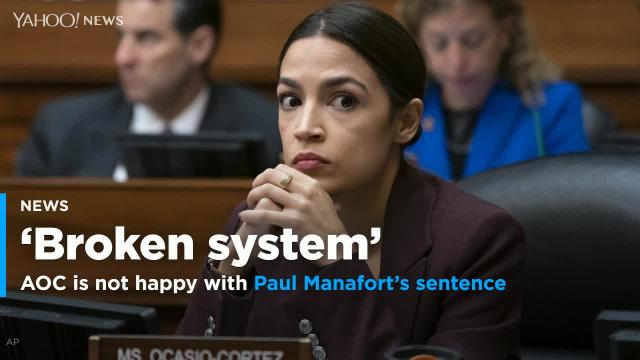
The New York Congresswoman said Paul Manafort’s punishment – well below the 19 to 24 years sought by prosecutors – was an example of how rich people were treated differently in court.
“In our current broken system, “justice” isn’t blind,” she tweeted. ”It’s bought.”
The sentencing by federal judge TS Ellis, who was appointed by Ronald Reagan, prompted lawyers and politicians to compare it to other cases involving longer prison terms, particularly those involving small amounts of drugs.
Last year the same judge sentenced Frederick Turner, 37, to a mandatory minimum of 40 years in prison for dealing methamphetamine. Judge Ellis expressed misgivings at the time, adding that the mandatory minimum was “wrong, but not immoral.”
Democrat 2020 presidential candidate Elizabeth Warren brought up the example of Fate Winslow, a homeless man who was jailed for life for helping to sell $20 (£15) worth of cannabis.
In other cases, a Texas woman, Crystal Mason, was sentenced to five years in prison for voting while on probation while a man was offered a prison sentence of between three and six years for stealing $100 from a laundry room.
Financial crimes attorney Louis Laverone said: “Manafort’s sentence is an example of a broader problem: white collar crimes (e.g. fraud, money laundering) just aren’t taken seriously.”
Following a jury trial in Virginia last year, Manafort was convicted of hiding millions of dollars earned through his work advising politicians in Ukraine, including the former pro-Russia president Viktor Yanukovych.
His lawyers argued that it amounted to a routine tax evasion, which often results in prison sentences of less than 12 months, and claimed that Manafort would never have been charged if it were not for the investigation by FBI special counsel Robert Mueller into links between the Trump campaign and Russia.
While the charges were not related to his work on Trump’s campaign, prosecutors argued for a significant jail term because the 69 year-old tampered with witnesses during his trial, tried to shift the blame to others and failed to accept responsibility for his crimes.
Manafort still faces up to 10 years in prison when he is sentenced on two conspiracy charges in Washington DC next week. He had offered to cooperate with the Mueller probe after pleading guilty to those offences, but the deal was thrown out after a judge agreed he had lied to investigators.
Additional reporting by Associated Press
Norway Deals a Blow to an Oil Industry That’s Quickly Losing Friends
(Bloomberg).
The decision of the world’s largest sovereign wealth fund to reduce holdings in oil stocks wasn’t as far-reaching as the industry feared, but dealt a symbolic blow to fossil fuels that will reverberate for energy companies and their investors.
While the divestment by Norway’s $1 trillion fund doesn’t include Big Oil, instead rooting out $7.5 billion of companies that focus purely on exploration and extraction, the impact of the announcement rippled through the sector. Shares of all oil companies initially plunged on the news, suggesting the move sets the industry up for greater disruption.
It’s a bitter taste of the new reality for oil producers, which increasingly have to fight for investor dollars rather than enjoying the perks of being indispensable to the global economy.
“The Norwegian sovereign wealth fund is seen as something of a poster-child amongst sovereign wealth funds,” said Alejandro DeMichelis, director of oil and gas research at Hannam & Partners LLP. “This decision could also trigger other large investors to review their stance toward investing in the oil and gas sector.”
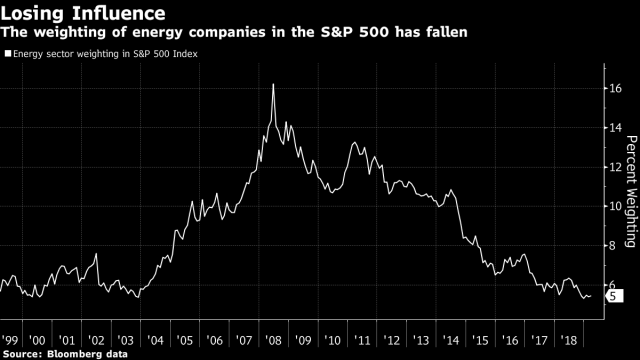
Life is changing for oil companies. Ten years ago, they accounted for about 15 percent of the S&P 500 index. Today, they make up just 5 percent, having been mostly displaced by technology giants such as Facebook Inc. and Apple Inc.
Driving this shift is a smorgasbord of new energy sources that’s bringing unprecedented competition for capital. Consumer choices are set to drift farther from the hydrocarbons of the 20th century, with renewables potentially meeting about a quarter of demand by 2040, according to oil major BP Plc.
It’s no surprise, then, that investors are increasingly questioning the wisdom of betting on oil and gas. A divestment campaign started by activist group 350.org in 2012 has already persuaded funds holding $8 trillion to back away from fossil fuels, according to its website.
Scrutiny could intensify as AGM season approaches. Catherine Howarth, chief executive officer of ShareAction — a group that has targeted Royal Dutch Shell Plc in the past — said she expects a “ramp-up” of pressure at annual general meetings that start in the spring.
“Institutional investors are withdrawing their capital from oil and gas companies on the grounds that quicker-than-expected growth in clean energy and associated regulation is making oil and gas business models highly vulnerable,” Howarth said in an email.
It’s not only oil companies facing pressure. One of the world’s biggest sellers of coal, Glencore Plc, yielded to investor demands earlier this year by promising to limit production of the fuel and align the business with Paris climate targets. In oil and gas, Shell and BP have made pledges around transparency and climate after facing the wrath of shareholders.
The list of companies to be excluded from the Norwegian fund includes Anadarko Petroleum Corp., Cnooc Ltd. and Tullow Oil Plc. Shale producers like EOG Resources Inc., which extract fuel from the heartland of America’s oil and gas boom, are also included.
In the longer term, a dearth of capital will push up the cost of borrowing to explore for oil and gas, with those costs likely passed on to consumers, according to Georgi Slavov, head of research at energy broker Marex Spectron. That makes renewables comparatively cheaper, further pushing fossil fuels out of the market.
While Shell, BP and other oil majors were spared in Norway’s decision on Friday, they may yet be earmarked for divestment in the future.
“The country may eventually revisit the issue and target such holdings,” said Rob Barnett, an analyst at Bloomberg Intelligence. In particular, the fund could consider shedding “integrated companies not allocating a portion of their capital spending toward clean energy.”
For those oil companies moving to diversify, there’s light at the end of the tunnel. In its statement, Norway said some of the biggest investments in renewables now come from Big Oil. The fund “should be able to participate in this growth,” the Finance Ministry said.
“While the fund was initially built on revenue from oil and gas, the Ministry of Finance understands that the future belongs to those who transition away from fossil fuels,” said Mark Campanale, founding director of energy researcher Carbon Tracker. “Now is the time for smart investors around the world to follow their lead and make decisions driven by the reality of the energy transition.”
March 5, 2019
Five ways to get around Trump’s useless and racist border wall:
5 Reasons the Border Wall Won't Stop Drugs
Five ways to get around Trump's useless and racist border wall:
Posted by U.S. Senator Bernie Sanders on Tuesday, March 5, 2019
11 MILLION TAXPAYERS LOSE $323 BILLION IN DEDUCTIONS IN TRUMP TAX…

March 4, 2019
As president, I will put service above self—the interests of the American people above any personal interests—and stand up against the powerful forces of greed and corruption. #TULSI2020 tulsi.to/stand
As president, I will put service above self—the interests of the American people above any personal interests—and stand up against the powerful forces of greed and corruption. #TULSI2020 tulsi.to/stand
Posted by Tulsi Gabbard on Monday, March 4, 2019
‘I am pro-life, but I am pro-humanity, too’ — This Republican lawmaker shared an emotional story to oppose a law that would completely outlaw abortions in his state.
Pro-Life Politician Stands Up to Anti-Abortion Policy in Arkansas
‘I am pro-life, but I am pro-humanity, too’ — This Republican lawmaker shared an emotional story to oppose a law that would completely outlaw abortions in his state
Posted by NowThis Election on Monday, March 4, 2019
March 5, 2019
Donald Trump and Republicans across the country are ramping up their attacks on Medicare for All to protect the profits of insurance and pharmaceutical industries, but the American people are clear about what they want: to end the international disgrace of being the only major country not to guarantee health care as a right. via Robert Reich.
It's Time for Medicare for All
Donald Trump and Republicans across the country are ramping up their attacks on Medicare for All to protect the profits of insurance and pharmaceutical industries, but the American people are clear about what they want: to end the international disgrace of being the only major country not to guarantee health care as a right. via Robert Reich
Posted by U.S. Senator Bernie Sanders on Tuesday, March 5, 2019
Bob Brigham March 5, 2019
 Composite image of Nicolle Wallace and Donald Trump (screengrabs)
MSNBC anchor Nicolle Wallace broke down how indicting the Trump organization as a “criminal enterprise” could allow prosecutors to take down President Donald Trump’s “entire empire.”
“A legal theory that has long been whispered about by legal experts and veteran prosecutors has spilled out into the open in the wake of Michael Cohen’s explosive testimony — the possibility that Donald Trump and the Trump Organization are being investigated as a criminal enterprise,” Wallace reported on MSNBC’s “Deadline: White House” on Tuesday.
“The undercurrents have been there all along, with federal law enforcement officials and lawmakers comparing Donald Trump’s conduct to that of a mob boss,” she continued.
The host then played clips from people close to the organization making the argument.
“It’s like, you know, a “Sopranos” episode where Tony is going to a poorly-lit [sic] parking garage and meeting with a leader from another mob,” suggested Rep. Eric Swalwell (D-CA), who sits on the Judiciary Committee and the House Permanent Select Committee on Intelligence.
“This is classic kind of criminal enterprise behavior, right? You have a very — a strong leader who rules by force of will and personality, who demands unquestioned loyalty from those people around him,” former FBI Deputy Director Andrew McCabe charged.
She also played a clip of former FBI Director James Comey explaining how “very strange” it was for him to compare the president of the United States to a mafia boss.
Wallace then introduced a New York Times column by Garrett Graff that she described as explaining, “how pursuing Trump-world as a mob operation could take down Trump and his entire empire.”
“Indicting the whole Trump Organization as a ‘corrupt enterprise’ could also help prosecutors address the thorny question of whether the president can be indicted in office; they could lay out a whole pattern of criminal activity, indict numerous players — including perhaps Trump family members — and leave the president himself as a named, un-indicted co-conspirator,” Graff explained.
“Such an action would allow investigators to make public all the known activity for Congress and the public to consider as part of impeachment hearings or re-election,” Graff continued. “It would also activate powerful forfeiture tools for prosecutors that could allow them to seize the Trump Organization’s assets and cut off its income streams.”
Wallace noted the “theme emerging” with House Intel Chair Adam Schiff (D-CA) hiring former Russian mob prosecutor — and former MSNBC legal analyst — Daniel Goldman as director of investigations.
“It’s in the context of this devastating legal peril that the president appears to be spiraling into meltdown mode, tweeting, ‘presidential harassment’ in his outside voice as a refrain and publicly attacking the numerous investigations into his conduct that are now encircling the White House, his family, his business and his closest allies.”
Frank Figliuzzi, the former assistant director for counterintelligence at the FBI and a MSNBC contributor, explained the mechanism for going after Trump as a mafia don — the Racketeer Influenced and Corrupt Organizations Act, known as RICO.
“There’s a way we address mob families and organizations and it’s called RICO,” he explained.
“The basic notion is that the sum is greater than the parts,” he explained. “So you can go ahead and attack an organization by hitting individuals with prosecutions on this charge and that charge — and it’s very unwieldy and takes a long time and then you really never essentially get to the boss.”
“RICO is designed to get to the boss, because if you charge the underlings and they don’t talk because they use the omertà code — the code of silence — we’ve seen that even in this organization, then you may never get him,” he continued. “So RICO says, look, all of this together is much larger than the individual parts, and there’s a leader behind this. And that’s what RICO’s designed to do.”
“I’ll tell you when the light bulb went off over my head, I said this has got to be a RICO consideration, which is Michael Cohen’s testimony,” he noted. “Michael Cohen’s testimony did it for me.”
“This was essentially a mob informant talking about the [caporegime] and I’d be surprised if Southern District or some other prosecution arm is not seriously approaching this as a RICO,” Figliuzzi concluded.
Watch:
