My Garden Was My Refuge. Then Climate Change Came for It.

The New Republic

My Garden Was My Refuge. Then Climate Change Came for It.

Melody Schreiber – December 11, 2023

When I first set out to report on climate change, I was convinced I knew what to do: I needed to show how climate change was going to be personal and deeply connected to our lives. People are selfish—or, put another way, strongly motivated by what affects us personally. The more intimately I could tie climate change to our well-being, I reasoned, the more driven we would be to change course.

So, eight years ago, I trundled off to the UN climate change conference known as COP21 in search of ways global warming was poised to affect our everyday lives, especially the threats to our mental health and the emergence of infectious diseases. I discovered, of course, that these close connections weren’t theoretical or futuristic; our lives were already being disrupted. And I realized that people already care plenty about climate change; a majority of Americans believe climate change is a threat, and one in 10 Americans are showing signs of climate anxiety. It’s just hard to know what to do about it, and sometimes our actions seem too insignificant to make a difference. Without action, we feel helpless. The problem looms ever more immense, and we start tuning out.

In 2023, for instance, we reached temperatures of 1.5 degrees Celsius over pre-industrial levels for a record number of days—about one-third of the year. Scientists are warning that the planet is close to crossing five tipping points, with three more on the horizon.

The news comes amid the malicious obstructionism of this year’s conference, COP28. The state oil company of the United Arab Emirates has been privy to emails to and from the COP28 office. The conference president and head of that company, Sultan Al Jaber, who has used the event to push more oil trades, said there is “no science” behind phasing out fossil fuels to stop warming. It’s not just the leaders of COP pushing a pro-hydrocarbon agenda; four times more fossil-fuel lobbyists than ever before have descended on this year’s summit.

I don’t always know anymore how to get anxious people to tune into these kinds of stories, because I struggle myself. Evidence of our rapidly changing world and the failures of our leaders to do anything about it are everywhere, all the time, and nothing I do seems to stop it. A few years ago, I started to go the other direction—to dissociate from it. It was too big to process. The problems felt too immense and thus too far removed from my life.

The summer of 2020 was a particularly low point for me. The pandemic kept us home even as racial violence brought us out to the streets; wildfires and storms battered our neighborhoods even as the Trump administration exited the landmark Paris agreement; a heated presidential election grew increasingly chaotic and nerve-wracking. But most earth-shattering for me, my youngest brother died.

I felt surrounded by death, and I wanted more life. So I started collecting plants. I knew I was probably setting myself up for failure. I’d never been able to keep a plant alive for very long. I was probably going to get attached to yet another thing only to watch it die. (Like I said: a low place.)

Even so, I signed up for a plant subscription box, like a Wine of the Month club, that would start me off with something hard to kill and teach me how to care for it. Plants arrived every month. Some of them died, but most of them lived. A friend gave me a prayer plant; another gave me an amaryllis. Plants became a way to connect with friends in a tenuous time; they gave us something happy to talk about.

I started reading about native species, and how easy they are to maintain because they are perfectly adapted to my environment. (This summer, in the midst of drought, I didn’t need water my garden once.) I planted rows of phlox, goldenrod, asters; one of the most serene and accomplished moments of my year was spent watching a hummingbird bury its head amid the flowers of a turtlehead plant.

I knew my garden wouldn’t solve the biodiversity crisis, stop overdevelopment, or save pollinators single-handedly. But I could build those pollinators a little corner, offer a little respite for them and for me. I could do this small thing imperfectly, and I could keep striving to do it better.

I was, perhaps, too successful with my new gardening hobby. Now I have dozens of native species in my front yard, and (if you’re my husband, you can stop reading now) about 150 houseplants.

I learned to frequent native plant sales and local seed swaps, instead of buying plants at commercial nurseries that frequently use powerful insecticides and contribute to the spread of invasive species and plant diseases, which can further destabilize ecosystems. I started paying attention to what was happening outside my window, focusing on first and last frosts, on temperature highs and lows, on precipitation reports. I thought hard about when to bring plants outside for summer and inside for winter; I hustled to move them when strong storms swept the Doppler.

That’s why I noticed when the new U.S. Department of Agriculture’s Hardiness Map, which I’d never heard of before I started this hobby, was updated for the first time in more than a decade. USDA hardiness zones are based on average annual minimum winter temperature and can help people figure out which plants will or won’t survive and thrive in their location.  

Because I’ve been paying closer attention to the vagaries of my local weather, I wasn’t surprised to learn from the recent update that my zone has changed from 7a to 7b, meaning the winter average minimum has risen from 0 to 5 degrees Fahrenheit, to 5 to 10 degrees. These changes may seem small, but they make a huge difference with plants—and pollinators—needing exact temperatures and conditions to grow. Before I got into plants, I might have assumed warmer temperatures would simply expand the number of plants I could grow in my area, but it’s not that simple, particularly if the trend continues: these changes are being accompanied, for instance, by hotter and wetter summers in the region. What will that mean for pollination, seed dispersal, growing times, or the spread of plant pathogens? What about the species needing a certain number of winter “chill hours” in order to germinate and grow?

My area isn’t alone. About half the country moved into a warmer zone with this change. It’s part of a decades-long trend of warming temperatures across the nation that could disrupt both ecosystems and agriculture.

The news brought the specter of climate change into a passion project that was supposed to serve as a refuge. I braced myself for it to feel hopeless now, too. But surprisingly, given my original fears of failure when getting into plants, this news didn’t break my spirit.  I do wonder what my garden will look like in 10 or 20 or 50 years, and which species will make it through the gauntlet ahead. But at some point in the past few years, I’ve stopped worrying about killing every plant I cultivate. 

Instead, this change makes me think about climate in a new way. It’s something I can feel every day. I can push my hands into the earth; I can smell the flowers blooming in the yard, even now, in December. I now understand the way a small change in temperature or frost patterns can disrupt an entire crop. Plants have connected me in practical, daily, intimate ways to the earth and its changes—giving those changes a new significance, a deeper understanding, and simultaneously grounding my experience of nature in something calming, soul-nourishing, and refreshingly distant from the hard work of processing news, analyzing policy, and taking action. Plants also open up space for any backyard gardener to have conversations about the hyper-local effects of this crisis—conversations that can drive further change.

It’s a lesson I’m clinging to as the overwhelming reality of the climate crisis splashes across headlines this week, courtesy of COP28. Now, I’m searching out the sometimes-smaller but no less important wins at the conference: a new deal for a loss and damage fund; Colombia joining a the Fossil Fuel Nonproliferation Treaty; a bigger push to fund sustainable agriculture; and the possibility, though faint, of the newest agreement spelling out the end to fossil fuels. Despite the glacial pace of policy change, the steps we take in our own lives, though small and incremental, can transform our experience of the world around us. And before you know it, you have a life filled with new growth.

I came to gardening because I was mourning. Mourning, in a largely abstract way, the millions dead from pandemics, wildfires, storms. Mourning, in a painfully specific way, my baby brother, who was supposed to be an inextricable part of my future until the day he left it.

When we mourn, we sit with our loss. We let it weigh on us with its full heft. We examine the dearly held beliefs of how we thought these lives of ours would go, what we’d hoped to do, and we undergo a swift and shattering reorientation of those hopes and dreams. When we mourn, philosopher and author Thomas Attig writes, we “relearn” the world. Mourning is a painful and absolutely crucial process of reacting to a new reality and continuing, despite and because of that pain, to inhabit that reality.

There is a plant that reminds me of my brother: a Hoya kerrii, a vining plant with thick, heart-shaped leaves. I was nervous to acquire it—I’ve grown less precious about killing plants, but if this one were to die on my watch, it would be a pointed blow. But I screwed up my courage and posted a query in a gardening group, expecting to buy a small propagation or seedling. Instead, I ended up with a monster with thick vines as tall as I am, one of the largest plants in my collection, a plant that I instantly fell in love with because of its very wildness and abundance. Taking care of it feels like taking care of my brother; and, in the meditative time spent nurturing, it has begun to feel like he is taking care of me.

It’s a small thing, watering these plants and watching them grow leaf by leaf. But that’s how actions are. If you’d told me when I received my first plant in the mail that my collection would grow to 150, I would’ve laughed at you—and perhaps I would have failed in my new hobby, because of the pressure to do too much too fast. In the face of seemingly impossible goals, it’s hard to know where to start. So I went plant by plant, caring for whatever I had the capacity to care for.

Somehow, my desperate instinct in 2020, my Hail-Mary pass with plants, was right. Surrounding myself with life keeps death—and dread, and despair, and immobility—at bay. Plants make you stop, slow down, and care for each one. It’s an antidote to the crushing immensity of the big picture. It’s a radical act of joy.

Study reveals major factor that could put many Americans at risk for homelessness — here’s what’s happening

The Cool Down

Study reveals major factor that could put many Americans at risk for homelessness — here’s what’s happening

Susan Elizabeth Turek – December 11, 2023

In recent years, rising prices have been a pain point for many consumers.

When it comes to the housing market, one major concern is reportedly contributing to not only expensive home prices but also sky-high insurance rates that could increase the risk of homelessness for many Americans.

What’s happening?

According to open Democracy‘s Chrissy Stroop, the nonprofit First Street Foundation found that dangerous weather events make it difficult for many to buy affordable insurance for their residences and may contribute to climate-related migration.

Notably, California — the state with the largest population in the United States — saw a 335% increase in buildings destroyed by wildfires since 2009, with a nearly 800% uptick in denials to renew insurance in high-risk areas between 2015 and 2021.

The search for safety and affordability — including an exodus from California — also seems to be driving up home prices.

“In high-risk areas, decreased demand for properties might result in declining real estate values, and, conversely, urban centers experiencing an influx of residents may experience increased demand for housing, leading to rising property values,” the report said, per openDemocracy.

Why is this trend concerning?

Extreme weather events are expected to grow in intensity and frequency because of the warming temperature of our planet caused by human activities, which could exacerbate the cycle of rising insurance rates, housing costs, and homelessness.

This year’s State of the Nation’s Housing report found a record 21.6 million renter households were “cost-burdened.”

Homelessness in the U.S. also rose at a record rate of 11% in 2023, according to the Wall Street Journal, adding to the number of people who are vulnerable to the elements.

For residents living in risky areas, the inability to obtain insurance could hinder recovery efforts after natural disasters, with some insurers pulling out of certain states or not adding new customers.

What’s being done about the housing crisis?

State and local governments are taking action by passing incentives that support the construction of more affordable housing, while the federal government has also stepped in.

In September, the U.S. Department of Energy allocated $400 million for states to invest in climate-resilient buildings and energy efficiency.

In the meantime, individuals can do their part by investing in the health of our environment.

Air-drying clothes, for example, could help households save money on electricity while reducing the amount of harmful carbon pollution they each contribute to the atmosphere on average by 2,400 pounds annually.

‘His curiosity is unbounded’: What it’s like to work with David Attenborough at 97

Independent

‘His curiosity is unbounded’: What it’s like to work with David Attenborough at 97

Ellie Harrison – December 11, 2023

Friends in the Arctic: David Attenborough and Mike Gunton ((Provided))

Thirty-six years ago, when Mike Gunton joined the BBC’s Natural History Unit as a keen young producer at the start of his career, he was told that he’d be working on David Attenborough’s last-ever programme. It was The Trials of Life, a study in animal behaviour, and Attenborough, in his sixties then, thought it was time to stop. “Well, that seems hilarious now,” says Gunton. “I don’t know how many series he’s done since, but it must be 20 at least. Long may it last.”

The pair have worked together for almost four decades – Gunton is now 66 and Attenborough 97 – and their latest project is Planet Earth III, which airs its final episode tonight. Just like its two predecessors, which were broadcast in 2006 and 2016, the series has shown us spectacular stories from across the animal kingdom – from a minutes-old ostrich hatchling searching for its mother in the Namib desert to a group of courageous seals driving away great white sharks off the coast of South Africa. But a new element to the show, and one that is increasingly present in Attenborough’s other programmes, is its message: this series is all about how animals are being forced to adapt, to survive the challenges they face in a world changed by humans.

“I’ve done a lot of shows in my life,” says Gunton, “but this is definitely a really important one. It still feels like we’re getting the Planet Earth tingle, in that it’s giving us wonderful stuff about nature, but we’re also saying something about being sensitive to how heavily we tread on our planet.” Planet Earth III certainly demonstrates our negative impact on animal life (turtles on Australia’s Raine Island, for example, are dying en masse as temperatures rise). Yet it also shows how we are innovating to make things better (while the right whale was hunted to near extinction 40 years ago, a ban on commercial whaling has restored numbers to around 12,000). “It’s a very intriguing time to be observing the natural world at the moment, and it’s slightly worrying as well. But there are parts of it that make you hopeful, and that has to be reflected in the programmes.”

In some ways, a lot has changed since Gunton and Attenborough started working together. Attenborough was not a fan of drones when they first arrived on the scene. They would constantly malfunction, and he would have to do countless takes walking through a meadow or a jungle as the camera on the drone zoomed off to reveal him on location. “He’s now a convert, and he absolutely thinks the drone is the key, the breakthrough, in the perspective it can give you on what happens in nature,” says Gunton. The advances in technology have been huge over the decades. “He is astounded by the leap we have taken in the way we use robotic cameras,” Gunton adds. “We can take audiences beyond where the human eye can.”

If somebody ever asked me, ‘What are your memories of him?’, one of the top things I would say is us rolling around laughing, sometimes about the absurdity of the world and the absurdity of what we do

In other ways, nothing has changed at all. Attenborough has always had “a penchant for bird courtship” stories on his shows, and he always will. “There’s a sequence in Planet Earth III with the tragopan, which is a very strange bird that lives in China and has a very complex and bizarre courtship display,” says Gunton. “I think it’s never been filmed in the wild. And of all the things that we showed David, it was that which made his eyes light up.” And Attenborough has always been “hilarious”, says Gunton. “If somebody ever asked me, ‘What are your memories of him?’, one of the top things I would say is us rolling around laughing, sometimes about the absurdity of the world and the absurdity of what we do. He’s a brilliant raconteur.”

So is Gunton. We far-exceed our time slot on Zoom and I can tell he would happily tell stories about his and Attenborough’s adventures for hours (I hear about him sending Attenborough into battle with warrior-like termites Nigeria, and the pair of them sitting, surrounded by butterflies in Kent’s Downe Bank nature reserve). Gunton didn’t always think he would go into natural history – he initially wanted to be a social documentary filmmaker – but during his time as a zoology student at the University of Bristol, a palaeontology professor took him under his wing and he became an “obsessive” student. After going to Cambridge to do a PhD in zoology, he returned to Bristol to work at the BBC’s Natural History Unit, where he is now creative director.

Attenborough and Gunton inspecting wildlife decades ago (Provided)

He says that, over the years, Attenborough’s “curiosity has absolutely continued to be unbounded”. When Gunton visits Attenborough’s house in Richmond, “there’ll be a stack of books on the piano that he’s reading, working his way through. He’ll say, ‘Have you read this? Have you seen this?’ It’s that kind of constant scholarship. He’s so busy. It’s bonkers. He’s away at this event and that event and at some library here, and the energy is astonishing.”

He tells me a story to prove the point. During the filming of The Green Planet, which came out last year, there was a sequence where Attenborough was presenting from a rowing boat on a lake in Croatia. Gunton, three decades Attenborough’s junior, was meant to be doing most of the rowing when the cameras weren’t rolling, but Attenborough wasn’t having any of it. He jumped into the rowing seat at the first opportunity. “I’ll row. No, no, I’ll do it. I’ll do it,” Gunton remembers him insisting. “We started getting competitive because he was a rower at university [in Cambridge] and so was I. I was saying, ‘Look, come on, I’m a rower.’ He said, ‘No, we could row just as well as you row.’ So, as a 94-year-old, he basically rowed that boat about a mile, and it was a big heavy boat. Working with him in his nineties is not that hard, because he can do almost anything.”

Gunton and Attenborough become competitive in a boat in Croatia (Provided)

While Attenborough tends to go out in the field less and less these days, Gunton says his influence on the series goes far beyond his narration. “This has been his format, ever since he made Life on Earth [in 1979]. So these shows are effectively modifying or twiddling around the edges of that format, with his DNA there all the time.” Gunton says that with every shot, every storyline in the series, he’s thinking, “How is this going to be told by David?” He will bounce ideas off Attenborough, too, and seek his advice on trickier scenes.

Attenborough is the right man to ask. He has been the single biggest influence on nature programming in, well, forever. His playful storytelling has had us gripped by the antics of everything from spindly weeds in the ground to tiny sea angels in the ocean. Seeing nature in this awe-inspiring way has taught us all about the wonders of the world and the need to protect them. And many others – most recently Morgan Freeman, who presented the inferior Life on Our Planet on Netflix – have failed to replicate his magic.

Attenborough during the filming of ‘Planet Earth III’ (BBC, Mark Harrison)

The last time Attenborough properly went out on location on a series, doing hardcore expeditions, was for The Green Planet. “We went to Costa Rica and across America and to [its] deserts,” says Gunton. “And we went to just outside the Arctic Circle in Finland, and to Croatia. He loved it. Beforehand, we were talking about how many days we’d have, and we said, you know, maybe three weeks or something in total. And his daughter was there, who he works with a lot, and she said, ‘Look, you’ve got to be careful, don’t do too many days.’ And when she nipped out to go and make us a cup of tea, he turned to me and whispered, ‘Actually, let’s do another couple of days!’ That sums him up, actually. He was 94.”

Gunton struggles to envisage a future without Attenborough guiding us through the natural world. “Forty years ago, I was a new boy at the Natural History Unit,” he says. “And they said, ‘Of course, this is David’s last series, so we ought to be thinking about who’s going to take over.’ And that is something that people have been talking about ever since. I think it’s one of those things where we cross that bridge when we come to it, but at the moment, he seems to be going on six cylinders.”

He laughs as he admits he “cheekily” asked Attenborough if he’ll ever retire. Attenborough’s response? “I don’t know what that word means.”

The final episode of ‘Planet Earth III’ will air at 6.20pm on BBC One on Sunday 10 December

Retribution Campaign: Trump again defends infamous ‘Access Hollywood’ comments and warns Biden, ‘Be very careful’

ABC News

Retribution Campaign: Trump again defends infamous ‘Access Hollywood’ comments and warns Biden, ‘Be very careful’

Lalee Ibssa, Soo Rin Kim and Kendall Ross – December 10, 2023

Former President Donald Trump spoke on Saturday night to some of his most staunch conservative supporters, filling a speech at the New York Young Republican Club’s annual gala with praise for his political allies on the far right and doubling down on his controversial comment that he’d only be a “dictator” if reelected on “Day 1.”

He also bragged about his ability to win the 2016 election after the release of a video from behind the scenes of “Access Hollywood” years earlier, where he was seen making lewd and vulgar statements about women.

Trump spotlighting the “Access Hollywood” tape — an infamous episode late in his 2016 campaign that fueled widespread condemnation and calls for him end his campaign — started out on Saturday as a seemingly off-the-cuff remark.

In his speech, he mentioned “the biggest inescapable” situation he endured in politics and then shared more details, making it clear he was talking about the “Access Hollywood” video.

In that notorious clip, he had said, “You know I’m automatically attracted to beautiful [women] — I just start kissing them. It’s like a magnet. Just kiss. I don’t even wait. … And when you’re a star they let you do it.”

“Grab them by the p—-,” Trump said in the video. “You can do anything.”

He later tried to play that down as “locker room talk,” including during one of the 2016 debates, but his defense only fueled some other notable Republicans to call for him to step aside.

Trump on Saturday described how all of his political advisers, except Steve Bannon, encouraged him to drop out of the 2016 race after the video surfaced. Trump claimed that an unnamed general told him the “locker room talk” explanation he gave was the “bravest thing I’ve ever seen” over witnessing people die on the battlefield.

“It was an incredible campaign and we won and nobody thought we could win,” Trump said.

The unusual rehashing of the “Access Hollywood” video — which has not been in the headlines for years — is the latest example of how Trump continues to brush aside scandal while remaining popular with the Republican base.

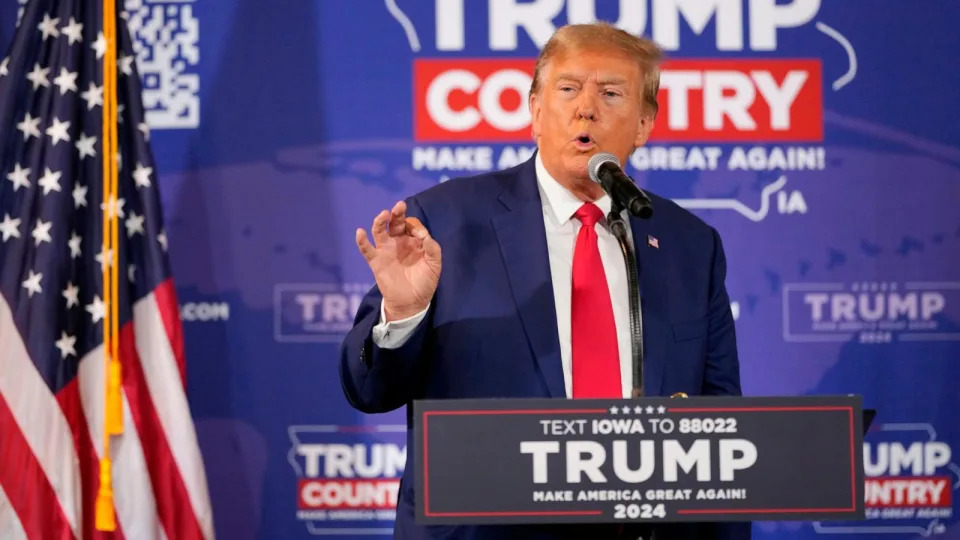
PHOTO: Former President Donald Trump speaks during a Commit to Caucus rally, Dec. 2, 2023, in Ankeny, Iowa. (Matthew Putney/AP)

Trump is campaigning for the White House for a third time while facing numerous legal battles, including four sets of criminal charges. He denies all wrongdoing and has pleaded not guilty to all of his charges.

In Saturday’s speech, he claimed it was another example of his opponents attempting to stop his political rise — an accusation prosecutors have rejected.

“Our mission in this race is to win a historic and powerful mandate to take back our nation from the shadow government of corrupt alliances,” he said.

He also continued focusing on a theme of retribution and retaliation, seemingly threatening President Joe Biden.

MORE: Kash Patel tells members of media, government: ‘We’re going to come after you’ in Trump’s 2nd term

He has said that as president, he would appoint a special prosecutor “to go after” Biden and Biden’s family, whom he blamed for the destruction of the country.

“They’ve opened up a Pandora’s box and I only can say to Joe is: Be very careful what you wish for,” Trump said Saturday.

In front of a friendly crowd, he joked about his comments from a town hall with Fox News’ Sean Hannity last week where he said he wasn’t going to be a dictator if reelected “other than Day 1,” when he would focus on the border and drilling.

That statement raised new alarms about whether Trump would abuse his power as president, something he did not rule out when questioned by Hannity.

“You know why I wanted to be a dictator, because I want a wall. Right? I want a wall and I want to drill, drill, drill,” Trump said on Saturday to “build the wall” chants.

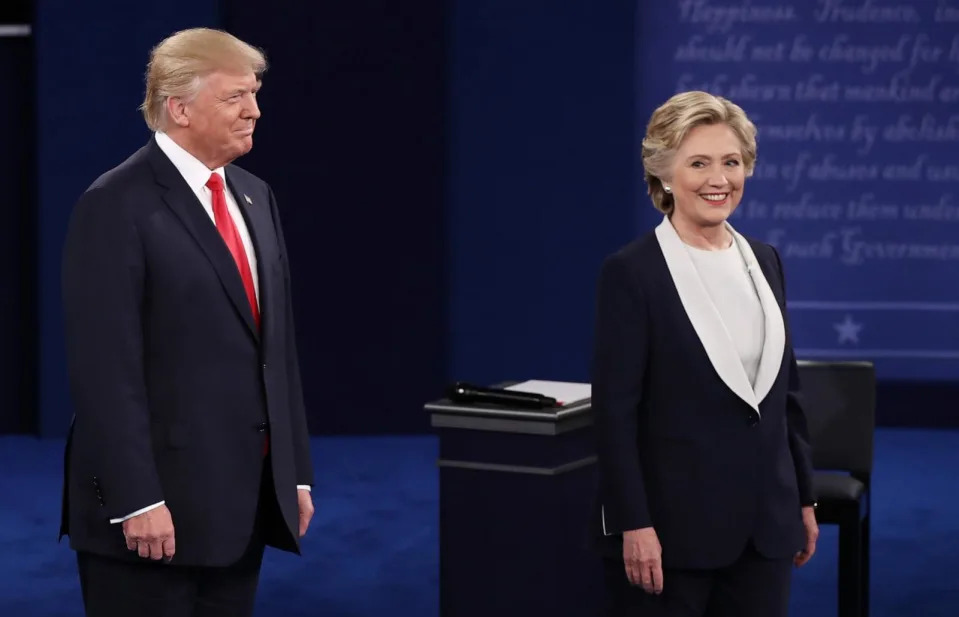
PHOTO: Formers Republican presidential nominee Donald Trump (L) and Democratic presidential nominee former Secretary of State Hillary Clinton stand on stage during the town hall debate at Washington University on Oct. 9, 2016 in St Louis, Mo. (Win Mcnamee/Getty Images, FILE)

The club’s gala is known for making headlines with its speeches and a room full of guests with their own controversies.

Saturday’s event honored figures like Bannon, who was sentenced last year after being convicted of contempt of Congress.

Bannon has had an off-and-on relationship with Trump, including serving briefly as a senior White House strategist in 2017. Trump pardoned him in early 2021 after Bannon was accused of money laundering and conspiracy to commit wire fraud by federal prosecutors. Bannon has pleaded not guilty to similar charges filed by prosecutors in New York City.

Other guests on Saturday included former New York City Mayor Rudy Giuliani, who is charged with Trump in a Georgia election subversion indictment (Giuliani has pleaded not guilty); and Arizona Rep. Paul Gosar, who was previously censured and removed from committees after posting a graphic anime clip featuring violence against New York Rep. Alexandria Ocasio-Cortez.

MORE: Trump’s ‘retribution’ campaign theme has apparent roots in old Confederate code, new book says

At one point during the gala, host Alex Stein tried to make a punchline out of stereotyping the Black and Hispanic community as criminals and gang members, saying it would be “good if Donald Trump went to jail” because it would help him earn the support from those communities.

Stein then repeated the joke later in the night when Trump was in the room.

“Once President Trump is back in office, we won’t be playing nice anymore. It will be a time for retribution,” the club’s president, Gavin Wax, said in his own remarks. “After baseless years of investigations and government lies and media lies against this man, now it is time to turn the tables on these actual crooks and lock them up for a change.”

‘Grifters and sycophants’: the radicals who would fill key posts if Trump is re-elected

The Guardian

‘Grifters and sycophants’: the radicals who would fill key posts if Trump is re-elected

Peter Stone – December 8, 2023

<span>Photograph: Leah Millis/Reuters</span>
Photograph: Leah Millis/Reuters

As Donald Trump and his allies start plotting another presidency, an emerging priority is to find hard-right lawyers who display total fealty to Trump, as a way to enhance his power and seek “retribution” against political foes.

Related: Trump says ‘I’m not a dictator’ but top figures warn of authoritarian takeover

Stocking a future administration with more ideological lawyers loyal to Trump in key posts at the justice department, other agencies and the White House is alarming to former DoJ officials and analysts who say such plans endanger the rule of law.

Trump’s former senior adviser Stephen Miller, president of the Maga-allied legal group America First Legal, is playing a key role in seeking lawyers fully in sync with Trump’s radical agenda to expand his power and curb some major agencies. His search is for those with unswerving loyalty to Trump, who could back Trump’s increasingly authoritarian talk about plans to “weaponize” the DoJ against critics, including some he has labeled as “vermin”.

Miller is well known in Maga circles for his loyalty to Trump and the hard-line anti-immigration policies he helped craft for Trump’s presidency. Notably, Trump has vowed to make those policies even more draconian if he is the GOP nominee and wins again.

Such an advisory role for Miller squares with Trump’s desire for a tougher brand of lawyer who will not try to obstruct him, as some top administration lawyers did in late 2020 over his false claims about election fraud.

Trump doesn’t care about the rule of law or the quality of the criminal justice system. He only cares about fealty to him

Former Trump White House lawyer Ty Cobb

“They’re looking for lawyers who worship Trump and will do his bidding,” Ty Cobb, a former White House lawyer during the Trump years and former justice department official, said. “Trump is looking to Miller to pick people who will be more loyal to Trump than the rule of law.”

Cobb added that “Trump trusts Miller greatly”, although Miller is not a lawyer.

“Trump doesn’t care about the rule of law or the quality of the criminal justice system,” Cobb said. “He only cares about fealty to him.”

Miller’s legal group, which raked in a hefty $44m dollars in 2022, also has a board seat with Project 2025, a sprawling effort led by the Heritage Foundation and dozens of other conservative groups to map policy plans for a second Trump term – or another GOP presidency if Trump is not the nominee.

Project 2025 includes schemes to curb the justice department, the FBI and other agencies, giving Trump more power to seek revenge – as he has pledged to do in campaign speeches and Truth Social posts – against critics in both parties, which could benefit from conservative lawyers’ sign-offs, but which justice department veterans warn would undermine the legal system.

It seems that they are looking for lawyers who will do whatever Trump wants them to do, and that is the antithesis of implementing the rule of law,” Donald Ayer, a former deputy attorney general under George HW Bush, said.

“When you consider the number of lawyers who became Trump’s severe critics after joining the first Trump administration and participating in a lot of questionable actions, selection for a new administration will have to exclude pretty much anyone who has any inclination to defend our legal system or question the president asserting absolute authority.”

Ayer’s analysis is underscored by Trump’s 2020 anger at top lawyers such as the then attorney general William Barr, the then White House counsel Pat Cipollone and others, who pushed back on Trump for his false claims that he lost to Biden due to fraud.

Trump has cited Barr – one of several former top lawyers and officials who later became critics – as someone he would press the justice department to launch inquiries against, according to the Washington Post.

The former president, who faces 91 criminal charges in four jurisdictions including 17 involving his aggressive efforts to overturn his 2020 election defeat, has also threatened to appoint a special prosecutor to “go after” Biden and his family.

Trump has attacked the prosecutions against him as political witch-hunts, arguing they give him the right if he wins the presidency again to use the justice department and FBI as tools to attack his opponents.

Trump’s retribution agenda was partly revealed on Tuesday at a Fox News town hall, when he slyly said if he was elected again he would not be a dictator “except for day one”.

To help facilitate Trump’s agenda, Miller plus the former Trump aide John McEntee, who started as Trump’s personal aide and then became a key adviser in 2020, have reportedly been working with others at Project 2025 to identify tougher pro-Trump lawyers.

Besides Miller’s group, numerous conservative groups have board seats on Project 2025 including the Center for Renewing America, a thinktank run by the former Trump budget director Russ Vought. The center employs Jeffrey Clark, a former justice department official who pushed false information about voting fraud in 2020 as part of Trump’s efforts to overturn his election loss. Clark has written a paper that Vought’s center published titled The US Justice Department Is Not Independent.

However, Clark and several other former Trump lawyers are now facing major legal headaches after aiding Trump’s efforts to block Biden’s victory, which could complicate Miller’s hunt for new diehard Trump lawyers.

This is a search for people with situational ethics

Timothy Naftali of Columbia University

Clark and other key conservative lawyers including Rudy Giuliani and John Eastman have been charged by the Fulton county, Georgia, district attorney, Fani Willis, in a sprawling racketeering case against Trump and 18 others for seeking to thwart Biden’s Georgia victory. Other Trump legal advisers who were charged, including Kenneth Chesebro, Sidney Powell and Jenna Ellis, have struck plea deals with Willis.

Some experts foresee real dangers to democracy in Miller’s search for lawyers who would back Trump’s emerging far-right agenda.

“This is a search for people with situational ethics,” Timothy Naftali, a senior research scholar at Columbia University’s School of International and Public Affairs, said.

“They’re trying to screen out people who have higher loyalties to the US constitution. It’s likely they’re looking for people whose higher loyalty is to Donald Trump,” he said. “They’re trying to find lawyers who believe in dictatorship. You have to wonder what kind of people in good conscience could sign up for a Trump revenge tour. This appears to be a casting call for an American political horror movie.”

If Trump wins, some of the lawyers who may be candidates for key posts according to the New York Times include a few who work at either Miller’s group or have worked for Texas’s attorney general, Ken Paxton, a close Trump and Miller ally who has faced several ethics and criminal inquiries.

Miller and his legal center did not respond to a request for comment for this story.

Miller’s lawyer search could benefit from his group’s contacts in Maga circles and rapid growth. When America First Legal was launched in 2021, it soon garnered $1.3m from the Maga-allied Conservative Partnership Institute, where Trump’s ex-chief of staff Mark Meadows is a senior official. Meadows and Vought have both served on the board of Miller’s group.

America First Legal’s deep pockets have helped fund an array of lawsuits against the Biden administration, states targeting immigration policies and what Miller has labeled “the equity cult”. Just last month, America First Legal filed a brief opposing the limited gag order placed on Trump by a federal judge overseeing special counsel Jack Smith’s four-count criminal indictment of Trump for election subversion.

More broadly, the mission statement of Miller’s America First Legal reveals its ideological compatibility with Trump’s authoritarian-leaning agenda, of which hard-right lawyers would be assets in implementing should Trump get another term.

“Our security, our liberty, our sovereignty, and our most fundamental rights and values are being systematically dismantled by an unholy alliance of corrupt special interests, big tech titans, the fake news media, and liberal Washington politicians,” the mission statement reads.

Given Miller’s strong ties to Trump, some GOP congressional veterans are alarmed by his search for more ideological lawyers who would not question Trump’s emerging authoritarian agenda.

“They’re looking for grifters and sycophants like Jeffrey Clark and Ken Paxton,” said the former House member Charlie Dent.

In Dent’s eyes, these kinds of lawyers would “do whatever they’re told. This is absolutely dangerous.”

A second Trump term ‘poses a threat to the existence of America as we know it,’ says The Atlantic’s top editor

CNN

A second Trump term ‘poses a threat to the existence of America as we know it,’ says The Atlantic’s top editor

Oliver Darcy, CNN – December 5, 2023

Bloomberg/Getty Images

Jeffrey Goldberg, the editor-in-chief of The Atlantic, refuses to go gently into that good night.

“We can’t participate in the normalization of Donald Trump,” an impassioned Goldberg told me by phone on Monday. “I refuse to participate in the normalization of Donald Trump.”

Goldberg is one of the few major newsroom leaders who has been exceptionally clear-eyed about the perilous storm on the horizon for American democracy. Using plain language, Goldberg and his team of writers at the renowned magazine have not shied away from portraying Trump as a vandal of civilized society and an outright menace to the U.S. Constitution.

On Monday, The Atlantic published a special edition of its monthly magazine focusing on what a second Trump term would look like. The aptly-titled “If Trump Wins” issue features two dozen articles laying out how the twice-impeached, four-time indicted candidate would shred norms, weaponize government, warp the rule of law, and degrade democracy.

“I want people to be able to hand this issue to people… who are still unsure about the nature of Trump’s authoritarianism,” Goldberg explained to me.

While the leaders of major American newsrooms might privately believe Trump will aim to rule as an authoritarian, it is rare to hear any of them say so aloud — especially in such frank terms. But Goldberg is more than comfortable doing so. He points out that his position is not a partisan one. It’s “not about Republicans and Democrats,” he stressed, but “about authoritarians versus pro-democracy Americans.” And, in his view, not being open with readers about dangerous forces on the march would amount to a dereliction of duty.

“I would prefer journalists to speak plainly about what they’re seeing,” Goldberg said. “And I believe that a second Trump term poses a threat to the existence of America as we know it.”

It is not difficult for newsrooms to state that they are pro-democracy. Most leaders in the Fourth Estate have no problem saying as much. The conundrum they face is that, in this dark time in which we find ourselves, staking out a vocal pro-democracy stance effectively means being anti-Trump. And most news organizations are not comfortable in that territory, given it could be perceived as partisan and turn away audiences.

“This is one of the discomforting aspects of this whole dilemma that people in the news media face,” Goldberg noted. “Our eyes and ears tell us that Donald Trump fomented an insurrection against the Constitution. Right? We saw it. We heard it. It happened. That means that he placed himself outside the norms of American democratic behavior. That is why I am comfortable devoting an entire issue of answering the question of what a second Trump term would look like and reaching the conclusion that it would be terrible. Absolutely terrible.”

When I asked Goldberg about whether being outspoken about the prospect of a second Trump presidency could alienate otherwise persuadable audiences, he argued that self-censorship is not the solution. As he put it, “At a certain point, you can’t convince people of reality.”

“All we can do is try to present fairly and completely our fact-checked views of Trump and Trumpism and hope that people read it and understand that we are trying to be truthful with our readers and truthful with ourselves and transparent,” Goldberg said.
“And if some voters in America can’t handle that, then they can’t handle that. There’s not much I can do about it.”

“And this is the dilemma facing all journalism institutions,” Goldberg continued. “We’d like to be able to speak to 100% of Americans. But at a certain point you don’t want to twist or muffle or downplay certain realities simply because reporting those realities offends a segment of your audience.”

Goldberg personally knows that being candid and reporting aggressively on Trump can come with severe consequences. After Goldberg reported in September 2020 that Trump had disparaged American servicemembers who had died in war as “suckers” and “losers” (something former White House chief of staff John Kelly later confirmed on the record to Jake Tapper), he had to move out of his house over security concerns for a period.

But, he warned, a second Trump presidency could be even worse for the press. And, for that reason, members of the news media will need to contemplate their editorial decisions now, given Trump’s already-declared hopes to muzzle critics if he were to regain power.

“We all understand that Trump thinks of us as enemies of the state, and we understand that there are consequences for us that come with this belief,” Goldberg said. “There’s a chance that he would try to somehow criminalize reporting in a second term, and so we have to sound the alarm about that, along with the more generalized threats to American democracy. And we have to sound the alarm now

A New Trump Administration Will ‘Come After’ the Media, Says Kash Patel

Donald Trump, who has already promised to use the Justice Department to “go after” his political adversaries, is expected to install Mr. Patel in a senior role if he returns to power.

By Jonathan Swan, Maggie Haberman and Charlie Savage December 5, 2023

Kash Patel stands holding a microphone in his right hand and gesturing with his left hand.
“We are going to come after the people in the media who lied about American citizens,” said Kash Patel, who served on the National Security Council during former President Donald J. Trump’s administration. Credit…Haiyun Jiang/The New York Times

A confidant of Donald J. Trump who is likely to serve in a senior national security role in any new Trump administration threatened on Tuesday to target journalists for prosecution if the former president regains the White House.

The confidant, Kash Patel, who served as Mr. Trump’s counterterrorism adviser on the National Security Council and also as chief of staff to the acting secretary of defense, made the remarks on a podcast hosted by Stephen K. Bannon, Mr. Trump’s former strategist, during a discussion about a potential second Trump presidency beginning in 2025.

“We will go out and find the conspirators, not just in government but in the media,” Mr. Patel said. “Yes, we’re going to come after the people in the media who lied about American citizens, who helped Joe Biden rig presidential elections — we’re going to come after you. Whether it’s criminally or civilly, we’ll figure that out.” He added: “We’re actually going to use the Constitution to prosecute them for crimes they said we have always been guilty of but never have.”

Earlier in the interview, when asked by Mr. Bannon whether a new administration would “deliver the goods” to “get rolling on prosecutions” early in a second term, Mr. Patel noted that the Trump team had a “bench” of “all-America patriots,” but he said he did not want to name any names “so the radical left-wing media can terrorize them.”

A spokeswoman for Mr. Patel, Erica Knight, pointed out that in the same conversation with Mr. Bannon, Mr. Patel said they would “follow the facts and the law.” She also sent The New York Times a statement from Mr. Patel, reading, “When President Trump takes office in 2025, we will prosecute anyone that broke the law and end the weaponized, two tier system of justice.”

But Mr. Trump, who is facing 91 felony charges in four separate cases, has already promised to use the Justice Department to “go after” his political adversaries — signaling that a second Trump term would build on the ways it opened investigations into his enemies during his first term and fully abandon the post-Watergate norm of Justice Department independence.

“I will appoint a real special prosecutor to go after the most corrupt president in the history of the United States of America, Joe Biden, and the entire Biden crime family,” Mr. Trump said in June.

Mr. Patel was a relatively unknown Capitol Hill staffer in the early days of the Trump administration, in 2017, but he became an aggressive defender of Mr. Trump against the investigation into whether the president’s 2016 campaign conspired with Russians to affect the outcome. Over the next four years, he rose to become one of Mr. Trump’s most trusted aides and among the most powerful national security officials in the federal government.

In late 2020, Mr. Trump trusted Mr. Patel to such a degree that he asked for him to be installed as a deputy director of either the C.I.A. or the F.B.I. Mr. Trump jettisoned this plan only after senior officials, including the former C.I.A. director Gina Haspel and former Attorney General William P. Barr, argued forcefully against the move. Mr. Barr wrote in his memoir that he told Mark Meadows, then the chief of staff, that having Mr. Patel become deputy F.B.I. director would only happen “over my dead body.”

Over the past three years, since leaving government, Mr. Patel has capitalized on his fame as a Trump insider. He has sold “Kash” merchandise on an online store and wrote a children’s book about the Russia investigation in which a “King Donald” is persecuted by a wicked “Hillary Queenton.” The story’s hero is a wizard named “Kash” who exposes a conspiracy to tear down King Donald. Mr. Trump declared that he wanted to “put this amazing book in every school in America.”

Mr. Patel himself has filed defamation suits against The New York Times, CNN and Politico. And since leaving government he has set up a fund-raising entity to “fight the deep state” and finance lawsuits on behalf of the “everyday Americans” who he says have been “defamed” by what he calls “the fake news mafia.”

Mr. Patel’s threats against the news media echo warnings from Mr. Trump himself.

In a Truth Social post in September, the former president wrote: “I say up front, openly, and proudly, that when I WIN the Presidency of the United States, they and others of the LameStream Media will be thoroughly scrutinized for their knowingly dishonest and corrupt coverage of people, things, and events.” He added: “Why should NBC, or any other of the corrupt & dishonest media companies be entitled to use the very valuable Airwaves of the USA, FREE?”

In the same post, Mr. Trump wrote that “Comcast, with its one-side and vicious coverage by NBC NEWS, and in particular MSNBC,” should be “investigated for its ‘Country Threatening Treason.’”

Earlier this year, Mr. Trump recorded a video for his campaign website in which he promised that in a second term he would bring the Federal Communications Commission, which regulates broadcast licenses, “back under presidential authority as the Constitution demands.”

A spokesman for Mr. Trump, Steven Cheung, was asked if the former president disavowed Mr. Patel’s comments. Mr. Cheung did not answer the question directly, instead referring to a recent public statement from Mr. Trump’s top two campaign advisers that read, “Any personnel lists, policy agendas, or government plans published anywhere are merely suggestions. Likewise, all 2024 campaign policy announcements will be made by President Trump or members of his campaign team. Policy recommendations from external allies are just that — recommendations.”

Mr. Patel is among a small number of former senior national security officials from Mr. Trump’s first term who have stayed close to him. He was appointed by Mr. Trump in June 2022 to be one of his representatives to interact with the National Archives, whose officials had spent months the previous year trying to retrieve reams of presidential records that left the White House when Mr. Trump did, including classified material.

Mr. Patel told Breitbart News during an interview in 2022 that he had been on hand when Mr. Trump declassified documents before leaving office.

That interview attracted interest from federal investigators, who in May 2022 had subpoenaed any remaining classified documents that he hadn’t turned over. Three months later, the F.B.I. executed a search warrant to locate additional classified material at Mr. Trump’s Palm Beach club, Mar-a-Lago. Mr. Trump’s office claimed shortly after the search of the club that he had a standing order in place as president by which materials that left the Oval Office for the White House residence were considered declassified.

Several former senior officials, including former Vice President Mike Pence, said they knew of no such order.

Despite Mr. Trump’s obsession with news coverage and his need to stay in the headlines dating back to the 1980s, he has grown increasingly threatening toward the press throughout his life and particularly since his political campaigns began in 2015.

He has talked about changing libel laws to make it easier to sue over coverage. He repeatedly encouraged crowds at his rallies to antagonize the reporters gathered at the back covering the events. Once in office, he began referring to the press in public as “the enemy of the people,” language often used by despots globally to justify anti-press crackdowns.

He was obsessed with leaks. He wanted aides to interfere with the merger between AT&T and CNN, which covered him rigorously. And he told advisers he wanted officials to obtain phone records of a journalist covering him, a request that apparently was never fulfilled.

But Mr. Trump is suggesting there will be results next time.

“They are a true threat to Democracy and are, in fact, THE ENEMY OF THE PEOPLE!” Mr. Trump wrote in September on Truth Social. “The Fake News Media should pay a big price for what they have done to our once great Country!”

Trump doesn’t sound like somebody trying to get elected

Yahoo! Finance

Trump doesn’t sound like somebody trying to get elected

Rick Newman, Senior Columnist – December 5, 2023

Donald Trump promises more of the same if he wins the 2024 presidential election — more of the protectionism that defined his first presidential term, more dismantling of government, more slashing and burning of the system that many Trump supporters think is rigged against them.

But he may be misreading what voters want. Trump found surprise success in 2016 with his populist, America-first agenda, but voters didn’t love all of it. Plus, the electorate has changed since Trump first won the White House.

Trump, for instance, said recently that he still wants to repeal and replace Obamacare, the 2010 health reform law President Obama signed that extended health insurance to 40 million Americans. “Obamacare sucks!!!” Trump wrote recently on his social media site, Truth Social, vowing to replace it with something better.

In 2016, most Americans agreed with Trump that Obamacare, aka the Affordable Care Act (ACA), was a bummer. But not anymore. Public approval of the ACA has grown from around 40% in 2016 to nearly 60% in 2023, according to polling by KFF.

Republicans, who uniformly opposed the law when in passed in 2010, warned of socialized medicine, soaring costs, and other dire developments. Big surprise: That was hyperbole.

There were, in fact, some problems at the outset. But Republicans who vowed to repeal it couldn’t get the votes in 2017, even though they controlled both chambers of Congress and the White House. After Joe Biden took office in 2021, he signed legislation and issued new regulations to patch up the ACA, which is now embedded in the US healthcare system, much as Medicare and Medicaid took root after Congress created them in 1965.

Repealing the ACA would cause hardship well beyond blue states and districts. The state with the most ACA enrollees is Florida, which leans red and which Trump won in 2016 and 2020.

Voters in the six swing states likely to determine the 2024 outcome — Arizona, Georgia, Michigan, Nevada, Pennsylvania, and Wisconsin — would be among those affected if a second-term Trump repealed the ACA. Biden won all of those states in 2020 by a combined 312,000 votes. Around 3.2 million people in those six states get health coverage through the ACA. The data doesn’t reveal how many of those 3.2 million people are swing voters who could tip the election one way or the other, but some of them certainly are.

Georgia is a stark example of the risk Trump faces by threatening, once again, to kill the ACA. Nearly 850,000 Georgians get coverage through the ACA. Biden won the state in 2020 by less than 12,000 votes. So whatever portion of those 850,000 are not die-hard Trumpers would have a new incentive to vote for Biden.

Former President Donald Trump speaks during a Commit to Caucus rally, Saturday, Dec. 2, 2023, in Ankeny, Iowa. (AP Photo/Matthew Putney)
Former President Donald Trump speaks during a Commit to Caucus rally, Saturday, Dec. 2, 2023, in Ankeny, Iowa. (Matthew Putney/AP Photo) (ASSOCIATED PRESS)

Trump also wants to impose a new tax of 10% on virtually all imports to the United States. That’s a political head-scratcher. Trump already tried something like that the first time around when he slapped tariffs on steel and aluminum imports and about half of all goods coming to the United States from China. Many economists slammed the tariffs as a foolish idea likely to raise costs for Americans, kill jobs, and undermine growth. The Tax Foundation estimates the tariffs amounted to an $80 billion tax hike during Trump’s term. Voters soundly disapproved of the tariffs and Trump’s overall trade war.

Trump’s across-the-board 10% tariff would be costlier, with the Tax Foundation estimating it would add $300 billion per year to consumer costs — at a time when voters’ biggest economic concern is inflation. Vowing to raise taxes is not a normal campaign promise, so maybe it’s possible Trump actually believes his own gobbledygook about foreign producers paying the tariff, which is patently untrue. At any rate, any politician threatening to raise costs for consumers is giving his political opponents a gift, and Biden is sure to attack that one as the 2024 election heats up.

Trump also has some explaining to do about his fight with labor unions and his trash talk relating to auto workers. In September, when unionized workers at Ford, General Motors, and Stellantis went on strike, Trump criticized Shawn Fain, president of the United Auto Workers (UAW) union, saying “auto workers are being sold down the river by their leadership.” Then he went to Michigan to give a speech at a non-union plant whose workers weren’t on strike, where he said “the workers of our country … are getting screwed.”

Fain and the UAW ended up negotiating a four-year raise of at least 25% for workers at the Detroit Three, which promptly led to wage hikes at many nonunion auto plants. Biden played the strike well, expressing solidarity with striking workers, touting his lifelong support for unions, and even showing up at a picket line. Trump’s campaign website, by contrast, still features a video in which Trump says, “What’s happening to our auto workers is an absolute disgrace. Auto workers are getting totally ripped off by Crooked Joe Biden.” Doesn’t seem that way, but hey, maybe Trump is playing three-dimensional chess.

Trump’s revenge? GOP braces for daily blasts from ‘orange Jesus’

Politico

Trump’s revenge? GOP braces for daily blasts from ‘orange Jesus’

Burgess Everett, Olivia Beavers and Meridith McGraw – December 4, 2023

Eric Gay/AP

Congressional Republicans are steeling themselves for a return to daily life with Donald Trump — which means constant, uncomfortable questions about his erratic policy whims and political attacks.

With Trump far ahead of the GOP primary pack and leading President Joe Biden in some polls, Republicans are getting a preview of future shellshock akin to their experiences in 2016 and his presidency. It’s likely to continue for the next 11 months. And perhaps four more years after that.

Trump’s recent call to replace the Affordable Care Act is triggering a particularly unwelcome sense of deja vu within the GOP. Even as many Senate Republicans steered away from Trump over the past couple years, now they’re increasingly resigned to another general election that could inundate them with the former president’s often fact-averse and hyperbolic statements.

But Hill Republicans are girding to treat Trump the third-time nominee the same way they did Trump the neophyte candidate and then president. They’re distancing themselves and downplaying his remarks, which touch on policy stresses like his urge to end Obamacare and political grievances like his vow to come down “hard” on MSNBC for its unfavorable coverage.

“He is almost a stream of consciousness,” said Sen. Bill Cassidy (R-La.), one of only three Senate Republicans who will remain in office after voting to convict Trump in his second impeachment trial — the other four have either already left or plan to next year. It’s “analogous to when every day he would tweet,” Cassidy added, “and 99 percent of the time it never came to anything.”

Even so, Trump’s return threatens to spark the same clashes with the Hill GOP that took a heavy political toll on the party, perhaps to an even stronger degree than his first term. Some potential flashpoints are evident in his agenda: Trump is likely to tap nominees who rankle Senate Republican leaders and pursue a polarizing bid to reshape the civil service into a less independent force.

Other sources of tension will be political. Trump could try to force an ouster of Senate Minority Leader Mitch McConnell, if the Kentucky Republican even tries to keep the top job under another Trump presidency. House Republicans could see their own leadership shakeup if Trump is elected, since the former president has the power to purge a leader he dislikes.

“One thing I’m pretty certain of is that the leadership is all up in the air. And I don’t think any of them survive after this term,” said Rep. Max Miller (R-Ohio), a Trump ally who recently began airing public criticisms of Speaker Mike Johnson.

Trump’s first four years as president were a time of nearly constant tension within the establishment GOP, which wanted another nominee in 2016 but gradually fell in line behind him. Those stresses boiled over after the violent riot of Jan. 6, 2021, with many Republicans savaging Trump for stoking the Capitol insurrection and 17 Republicans in both chambers opposing him at his second impeachment trial.

Most of those 17 Republicans will be gone from Congress by the end of 2024. Those who will remain are slowly resurrecting a familiar dynamic: pushing aside worries that he’ll lose again to Biden and minimizing his online screeds and less palatable policy proposals.

“I’m under no illusions what that would be like,” said Sen. John Cornyn (R-Texas), who served as the GOP whip during Trump’s first two years as president and voted to acquit Trump. “If it’s Biden and Trump, I’m gonna be supporting Trump. But that’s obviously not without its challenges.”

The retiring Sen. Mitt Romney (R-Utah), who voted to convict Trump at two impeachment trials, put it more bluntly. He recalled meeting with a health secretary during Trump’s administration to delve into the president’s policies: “They had nothing. No proposal, no outlines, no principles.”

“He says a lot of stuff that he has no intention of actually doing,” Romney said of Trump. “At some point, you stop getting worried about what he says and recognize: We’ll see what he does.”

Trump is paying little heed to how Republicans on Capitol Hill are reacting to his candidacy or plans for a second term. While only 13 of the 49 Republican senators have endorsed Trump, he has racked up over 80 House GOP endorsements and the list is expected to grow. In a statement, Trump spokesperson Steven Cheung said the former president’s “second term will be one for the ages” and attacked Biden.

Even for those who liked Trump’s policies during his term, his related slew of controversies is an inescapable part of the deal.

“We have a lot of people on our side that utilize Donald Trump for their political benefit,” Rep. Kelly Armstrong (R-N.D.) said, people who “get really tired of answering questions about Donald Trump. And I don’t think that’s fair to the president. You don’t get the good without … the whole package.”

Another House-Senate GOP split is also likely to emerge if Trump continues steaming toward the nomination. Senate Republicans can win back the majority next year even if he loses the presidential election, given their red-leaning map.

But in the House, Republicans’ future is more deeply intertwined with the vacillations of the mercurial ex-president. And many of Trump’s House GOP critics don’t even want to entertain the idea of trying to govern alongside him; in interviews, some simply shook their heads and furrowed their brows in feigned fatigue.

“Shit, yeah,” Rep. David Joyce (R-Ohio) replied when asked whether his colleagues are worried about clashing with Trump. “The orange Jesus?” he added with a laugh.

Trump’s allies argued that his second term would be smoother than the first, notwithstanding the reality of his chaotic exit from office and subsequent indictments.

Rep. Andy Biggs (R-Ariz.), an influential voice on the House’s right flank, said Trump has “learned that there are people who [he] can trust and can’t trust.”

Miller, a former Trump aide, said that the presidential frontrunner would look more closely to “allies like me who are moderately pragmatic, that are all in on the America First agenda,” than more unpredictable conservatives like the eight (including Biggs) who voted to oust former Speaker Kevin McCarthy. He dismissed those Trump allies as “the freak shows within our party.”

Trump’s team is confident of their broader relationships in the House and predicted GOP senators would fall in line behind pro-Trump colleagues like Sens. J.D. Vance of Ohio and Rick Scott of Florida. Indeed, Johnson has endorsed Trump for president and recently met with him at Mar-a-Lago on the sidelines of a political fundraiser at Trump’s club. The two men, who have a good relationship since Johnson’s days on the Judiciary Committee during Trump’s first impeachment, had a friendly conversation and smiled for a photo together.

Johnson also supported Trump’s efforts to overturn the election, as did most House Republicans. Most Senate Republicans, on the other hand, did not — which could mean more static toward McConnell and his allies should Trump reclaim the White House.

A Trump adviser laughed off a question about McConnell’s relationship with Trump, arguing “there’s not much that Trump hasn’t said on that himself.”

McConnell’s office declined to comment for this story. He’s made zero effort to rejuvenate his partnership with Trump, which crumbled after Jan. 6.

Sen. Kevin Cramer (R-N.D.) argued that McConnell and Trump could still rekindle their partnership, “remembering that there’s pre-election and then there’s post-election. Things change after people become elected.”

Another Republican close to Trump’s campaign specifically mentioned Senate Minority Whip John Thune (R-S.D.), whose reelection Trump threatened to oppose, as a potential target of future ire. (Thune won his race handily in 2022.)

In an interview, Thune acknowledged that Trump was in a strong position but said he likes what he’s hearing from former South Carolina Gov. Nikki Haley’s presidential campaign. Thune advised fellow Republicans to “be prepared to respond to similar types of ideas and proposals and statements in the future” from Trump as the primary accelerates.

Other Republicans who served during the first Trump presidency are reluctant to make any predictions about the future — beyond expecting the unexpected.

Still, Rep. Mike Simpson (R-Idaho) said plenty in the GOP dread Trump’s return to the political spotlight but “everybody is being more private about it.”

“I wouldn’t expect him to be different,” Simpson said, adding that many colleagues worry about “four years of revenge … we just have to wait and see.”

Texas is about to follow Arizona through the immigration gates of hell

AZ Central – The Arizona Republic – Opinion

Texas is about to follow Arizona through the immigration gates of hell

Phil Boas, Arizona Republic – December 4, 2023

To say the U.S.-Mexico border is in chaos is to actually understate the problem.

Some 2.5 million migrants have been encountered trying to illegally cross the border in fiscal 2023, topping the record of the year before.

As quickly as the state of Texas can put up razor wire to stop the influx, the federal government is cutting it down.

Democratic governors and big-city mayors in Illinois, New York and Massachusetts have screamed at the Democratic White House to get control as migrants flood their social services.

Even Jesse Jackson — yes, Jesse Jackson — is scolding the feds for failing to secure the U.S.-Mexico line.

“Laws need to be enforced at the border,” the long-time civil rights leader said, as reported by Politico on Thursday.

Texas mimics Arizona’s immigration law

Today in Arizona, U.S. Customs and Border Protection will temporarily close their crossing at Lukeville to free up agents to help manage the rising level of migrant encounters between ports of entry, reports Arizona Republic writer José Ignacio Castañeda Perez.

But the real madness comes from Texas, where Gov. Greg Abbott is poised to walk through the gates of hell by signing a bill that looks very much like Arizona’s notorious Senate Bill 1070, signed into law in 2010.

Texas Senate Bill 4 would make it a misdemeanor for a person from a foreign nation to illegally enter or attempt to enter Texas at a location other than a lawful port of entry.

“If a police officer has probable cause to believe a person crossed the Rio Grande, that person could be charged with a Class B misdemeanor, which carries a punishment of up to six months in jail, Texas Tribune reporter Uriel J. García explained.

“If the person has been previously convicted of entering Texas illegally under SB 4, the charge could be increased to a second-degree felony, which carries a punishment of two to 20 years in prison.”

Those convicted of the law would then be returned to a port of entry and ordered to return to Mexico. If they refuse, they could face a felony charge, Garcia explained.

Arizona Republicans argued this before

Tell me where you’ve heard this before:

SB 4 merely follows federal immigration law, the bill’s sponsor in the Texas House, Republican David Spiller, said.

That was the reigning argument when Arizona Republicans passed and signed into law SB 1070, meant to shrink the size of Arizona’s undocumented immigrant population through aggressive state enforcement of the federal law.

In time, much of that Arizona law was gutted by the federal court.

Spiller argues that SB 4 is significantly different than Arizona’s controversial law in that it would focus exclusively on people who have recently crossed the U.S.-Mexico border illegally into Texas, not the undocumented who have been living illegally in Texas for years.

The opponents of SB 4 are lining up to legally challenge the State of Texas if and when the bill becomes law. And they are not appreciating the distinctions Texas makes from Arizona’s beleaguered SB 1070.

“(This is) one of the country’s most radical anti-immigrant laws — EVER,” the ACLU of Texas said. “If Gov. Abbott signs #SB4 into law, we’ll sue.”

“Senate Bill 4 is the broadest, most invasive piece of legislation to ever potentially challenge the very nature of our federal and state power,” said Texas state Rep. Victoria Neave Criado, a Dallas Democrat and chair of the Mexican American Legislative Caucus.

“The power to enforce immigration is unquestionably, exclusively a federal power.”

The biggest problem with Arizona’s SB 1070

The problem with Arizona’s SB 1070 was that it opened fissures between the white and Latino communities in a border state where the Latino population is a significant and growing part of the community.

No matter how many assurances Arizona Republicans offered that SB 1070 would not target legal citizens, Latino citizens and their allies were unconvinced.

They saw SB 1070 as a target on the back of every person with brown complexion. Feelings were raw. And many Latino citizens talked about leaving the state.

Then-President Barack Obama stood with then Mexican President Felipe Calderón to oppose Arizona’s law.

“In the United States of America, no law-abiding person — be they an American citizen, a legal immigrant, or a visitor or tourist from Mexico — should ever be subject to suspicion simply because of what they look like.”

The times have changed on immigration

Already, the office of Mexico Foreign Minister has said in a statement that the proposed Texas law “categorically rejects any measure that allows state or local authorities to detain and return nationals or foreigners to Mexican territory.”

Good luck trying to send detained migrants back to Mexico, immigration experts tell the Texas Tribune. Mexico is under no obligation to receive those people.

“In fiscal year 2023, about 83% of the 1 million immigrants encountered by Border Patrol on the Texas-Mexico border were not Mexican citizens,” the news organization reported. “Many are coming from Central and South America, Asia or Eastern European countries.”

Without a doubt the earth is shifting on immigration.

During the 2010s when SB 1070 made Arizona a national flash point, you did not hear the howls of Democrats worried about unchecked immigration.

Democratic cities were lining up to boycott Arizona, along with national conventions and arts and entertainment, including Kanye West and Rage Against the Machine.

The real damage was eroded trust

But the boycotts never did real damage to Arizona. The real damage was the erosion of trust between Latinos and the majority white population.

Much of the white business establishment had begun to see this too late and tried to fend it off, but the damage was done. I remember this newspaper entertaining a delegation of some of the most distinguished Latinos in our state speaking to us with real anguish and fear.

The federal court would dispense with much of the law, and it was never enforced. But both parties would work for a decade to avoid the wrenching emotions of that time.

Gallego is proof: Border politics have reached a tipping point

For a decade after, Arizona’s GOP-dominated Legislature and governor’s office steered cleared of similar iron-fist immigration measures.

Many of the politicians who pushed SB 1070 would eventually be driven from office, and the author of the bill, Russell Pearce, would see his gambit to follow SB 1070 with roughly a half-dozen follow-up bills unravel.

Working behind the scenes to help Arizona’s moderate Republican lawmakers dismantle those follow-up Pearce bills was a retired judge of some note — former U.S. Supreme Court Justice Sandra Day O’Connor.

Learn from us, Texas. Don’t go there

Texas Republicans, like Arizona Republicans, aren’t likely to care about what Mexican officials think about our state immigration laws. They can thump sand.

They’re not likely to flinch at rock bands canceling concerts, or California cities boycotting them.

But they will feel the sting of their fellow Arizonans and Texans — Latinos who are their friends, colleagues, neighbors and family members — who feel betrayed by laws that no matter how you write them are likely to distinguish by race.

The Texas governor would be wise to learn from Arizona and its encounter with the abyss.

So far, President Joe Biden and his immigration officials have not commented on the Texas bill.

They may be waiting for the Texas governor to generously take from the White House the lightning rod that is illegal immigration.

Phil Boas is an editorial columnist.