If The Average American Household Is A Millionaire With A Net Worth Of $1.06 Million, Why Do People Feel So Broke?
Jeannine Mancini – December 4, 2023
The Federal Reserve’s 2022 consumer finance survey unveils a striking picture of American prosperity, revealing that the mean net worth of the average household has ascended to $1.06 million, a 23% from $868,000 in 2019. This statistic, while impressive, masks a more nuanced and unequal economic landscape.
Despite the seemingly thriving financial status of American households, the reality is more complex, particularly for the middle class. The COVID-19 pandemic, which drastically impacted economic activities, didn’t halt the growth in family finances, particularly in net worth. Between 2019 and 2022, real median family income modestly grew by 3%, while the real mean family income saw a more significant 15% increase. These gains were predominantly enjoyed by the higher income brackets, amplifying existing income inequalities.
The period witnessed a 37% surge in real median net worth and a 23% rise in real mean net worth, marking the largest three-year increase in the history of the modern Survey of Consumer Finances. Yet, this aggregate growth masks the unequal distribution of wealth gains. Homeownership, often a key component of net worth, rose slightly to 66.1%, with the median net housing value jumping from $139,100 in 2019 to $201,000 in 2022. The growth in housing values contributed significantly to net worth increases but also exacerbated housing affordability issues, as median home values soared to more than 4.6 times the median family income.
Inequality is further highlighted in retirement plan participation and stock market investments. While over two-thirds of working-age families participated in retirement plans, the increases in account balances were mainly seen in families in the upper half of the income distribution. Similarly, stock market participation grew across all income groups, but the gains were substantially higher for those between the 50th and 90th percentiles.
A report by USAFacts using Federal Reserve data underscores this disparity. The top 1% of households in America hold 26% of U.S. wealth. The wealth inequality becomes starkly evident when comparing asset distribution across income quintiles. The top 20% of earners hold over four times as much wealth as the fourth 20%, with the top 1% alone possessing more than half the wealth of the entire top 20%. The greatest asset disparity lies in stocks and mutual fund shares, where the top 1% has more in these investments than the rest of the top 20% combined. This disparity continues down the income quintiles, with the middle class having significantly less in stock wealth.
Mortgage debt burdens the middle class the most. For the middle 60% of earners, mortgage debt represents a larger percentage of their net worth compared to the top 1%. This burden reflects the challenges faced by the middle class in growing their wealth relative to higher earners.
Inflation and other economic pressures have led 64% of Americans to live paycheck to paycheck, struggling to cover day-to-day expenses. Many households are unable to cover a $400 unexpected expense, highlighting the lack of emergency funds for unforeseen circumstances.
Economic uncertainty has contributed to the continuous growth of consumer debt, adding to the financial strain on many Americans. The burden of student loan debt remains a significant issue, especially as payments resumed after the pandemic. Credit card debt, often with high interest rates, contributes to financial stress for many Americans.
The average length of car loans has also increased, indicating that Americans are taking longer to pay off vehicle purchases, adding to their financial burdens.
These factors, when combined with the skewed distribution of wealth and income highlighted in the Federal Reserve’s data, explain why many Americans may not feel the prosperity suggested by the average household net worth figure. Despite the overall increase in net worth, issues like debt, insufficient savings and the disproportionate growth of wealth among higher earners contribute to the feeling of financial strain among many.
The growing gap between the average American household’s perceived wealth and actual financial difficulties underscores the importance of financial advisers. This is especially true for the newly affluent earning between $150,000 and $250,000 a year, a group that might not usually seek financial advice. Financial advisers offer crucial insights and strategies to manage present financial challenges and prepare for potential asset growth. Their guidance ensures effective navigation through financial complexities, aiding households in aligning their financial realities with their goals and expectations.
Study reveals simple act could stave off 2 leading causes of death among adults: ‘Doesn’t need to be complicated’
Erin Feiger – December 4, 2023
A quick walk a day may keep an early death away.
A study published in the British Journal of Sports Medicine found that as little as 75 minutes a week of moderately intense, non-occupational physical activity substantially lowers the risk of dying from certain types of cancer or heart disease, two of the leading causes of death among adults.
That’s just over an hour a week – and half the 150 minutes a week recommended by the CDC – of activity where your heart rate is 50% to 60% higher than when at rest.
You’ll know you’re at the right level of activity if you can speak while doing it but not sing, according to the CDC. So, while walking outside might make you feel like singing, in order to reap the health benefits of this walk, you’ll have to leave that to the birds.
This study is the largest ever done on this topic, pooling data from 196 articles and over 30 million participants from nearly 100 study groups, so the results are significant.
The Mayo Clinic agrees with its findings, stating that “physical activity doesn’t need to be complicated. Something as simple as a brisk daily walk can help you live a healthier life.”
This is good news for a large part of the population who find it difficult to carve out 30 minutes a day, five days a week, to commit to a strenuous workout.
Being able to walk in nature, or at least in a park or among trees, has added physical benefits, too.
An article by Lincoln Larson and Aaron Hipp of North Carolina State points out that “nature-based programs can even be prescribed by health care providers as part of alternative, cost-effective treatment plans.”
However, a brisk 10-minute walk among trees is likely not an option for over 80% of the population in the United States and over 50% of the world’s population who live in urban centers or urban heat islands.
Creating more green space and more walkable cities would not only allow more people to easily achieve this health benefit, but it would also reduce pollution caused by cars.
If a 10-minute walk isn’t an option for you, then find something that is, like dancing, biking, or swimming.
With Offices Sitting Empty, Landlords Are ‘Handing Back the Keys’
Peter Eavis – December 2, 2023
The deadline for spending the money in the health accounts is approaching, and people are stretching the definition of eligible expenses. (Melanie Lambrick/The New York Times)
Office landlords, hit hard by the work-from-home revolution, are resorting to a desperate measure in the real estate world: “handing back the keys.”
When this happens, the landlord stops paying the mortgage on the office building or declines to refinance it. The bank or investors who made the loan then repossess the building.
Some of the biggest names in commercial real estate, like Brookfield and Blackstone, have defaulted on mortgages and have started or completed the process of handing back the keys on office towers. The tactic reveals both the depth of the problems in the office market and the ability of big property companies to push much of the financial pain onto others — in this case, banks and other lenders.
Since the pandemic began, office employees showed they could get their jobs done from home, and many have been reluctant to come back. And companies realized they could save a lot of money by renting less office space, making many office towers unprofitable for their owners and turning many business districts into ghost towns. About 23% of office space in the United States was vacant or available for sublet at the end of November, according to Avison Young, a real estate services firm, compared with 16% before the pandemic.
Handing back the keys is a drastic move, but it makes sense because it can limit a landlord’s losses on a building.
Take a property company that bought an office tower for $100 million just before the pandemic, investing $25 million of its own money and borrowing $75 million. If the building is hemorrhaging tenants and now has a value of $45 million, the landlord’s initial investment could be worth zero — and the lower rent income may not be enough to cover the building’s costs.
Rather than continue to pay interest and other expenses, the landlord can decide to default on the loan, which means the lenders get the beleaguered building. And in theory, the lenders could end up with a $30 million loss — the difference between the amount they lent ($75 million) and the resale value of the building ($45 million).
Today’s handing back the keys is reminiscent of the term “jingle mail,” which became notorious after the financial crisis of 2008 when homeowners abandoned their homes — and supposedly sent their keys back to their banks — because their homes were worth far less than what they owed on the mortgage.
But there is a difference: Big property companies can keep doing business after they default and are even considered savvy for jettisoning distressed buildings. But homeowners who stopped paying their mortgages suffered a huge hit to their credit ratings and had to find somewhere else to live.
‘We do not have insurance. We have an insurance bill’: Condos hit with 563% rate increase
Mark Harper, USA TODAY – December 2, 2023
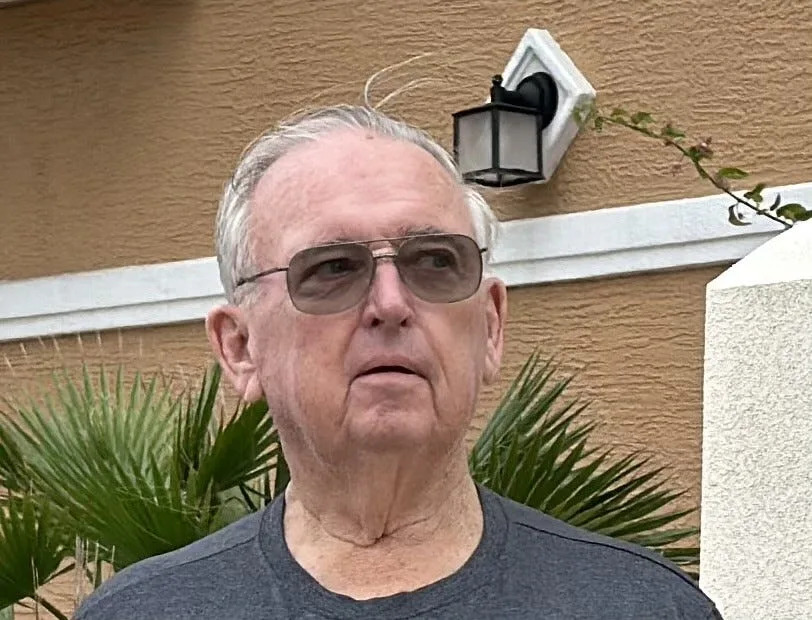
Marbella Condominiums Association board members (from left) Tom Baker, Jim Smith and Rob Lasch stand outside their beachside home, where property insurance has increased more than 500% since two hurricanes caused damage to the structure’s back patio and pool in 2022.
DAYTONA BEACH SHORES, Florida – Tom Baker lives in a retirement dream building: A spacious three-bedroom beachside condo with unobstructed morning sunrises, waves marking the time and the soft sand of comfort.
The retired Marine and Army veteran and his wife Joan moved here from the Tampa Bay area. She had a Daytona Beach timeshare they regularly visited. Ten years ago they moved to their retirement home: a fourth-story condo on the Atlantic Ocean.
“I absolutely love Daytona Beach,” he said. “I absolutely love where I live, and I love this building.”
Daytona Beach Shores condo owner Tom Baker sent a six-page memo to all of Florida’s senators and representatives, seeking help to rein in property insurance costs. He said one of the 160 legislators, Sen. Jason Pizzo, D-Sunny Isles Beach, responded to him.
So why does he seem so angry? Two words: Property insurance.
For Baker and many other Florida condo owners, the very concept of insurance – to ease worries during times of distress – seems lost, especially after the 2021 collapse of the Champlain Towers South in Surfside and the two-punch combo of the 2022 hurricane season: Ian and Nicole.
The latter storms just over a year ago pounded a seawall outside the Marbella Condominiums, then destroyed a pool and deck area. And the Surfside disaster, which killed 98 people, shined a light on structural safety, delayed maintenance and the need for the state to enact more strict regulations to prevent future collapses.
As bad as all of that was, for Baker, the real disaster arrived in December 2022: the property insurance bill for Marbella, where he serves on the condo association’s board.
For the 24-unit building, property insurance jumped from $40,534 for 2022 to nearly $269,000 – a 563% increase. And Rob Lasch, another Marbella board member, said he’s expecting another increase when the policy offer arrives, which could be any day now.
And the increase came in spite of a history of Marbella, which was built in 2007, never having filed a claim, Lasch and Baker said. There was no claim filed for the $2 million damage on the condo’s ocean-facing deck.
“Nothing got paid out for the damage outside because it was the seawall, and nobody was insuring the seawalls,” Lasch said.
So Marbella residents are getting hit hard on both sides of the hurricane. They’re having to come up with the full amount to fix the damage, while also bearing the burden of increased rates.
Baker said his wife wants to move, leaving him to contemplate simply not buying property insurance for the building – something his fellow board members don’t support because it violates Florida law and would leave the board members personally exposed to lawsuits.
“In a minute, I wouldn’t pay another dime in property insurance, because it is illegal, it is immoral, and it’s wrong. You can’t justify this payment. This is out-and-out stealing. Theft,” he said. “And excuse me for being passionate. I am pissed.”
Other condo owners also see exponential rate hikes
Marbella isn’t alone. Many condo associations across the state have said they, too, have faced astronomical property insurance rate hikes.
Right next door, the 109-unit Grand Coquina Condo went from paying $207,000 for property insurance in 2022 to $680,000 for 2023, a 228% increase, said Jeff Sussman, the association’s treasurer.
That amounted to a $2,331 additional assessment per unit this year, while Sussman projects another assessment of between $3,000 and $6,000 per unit will be required in 2024.
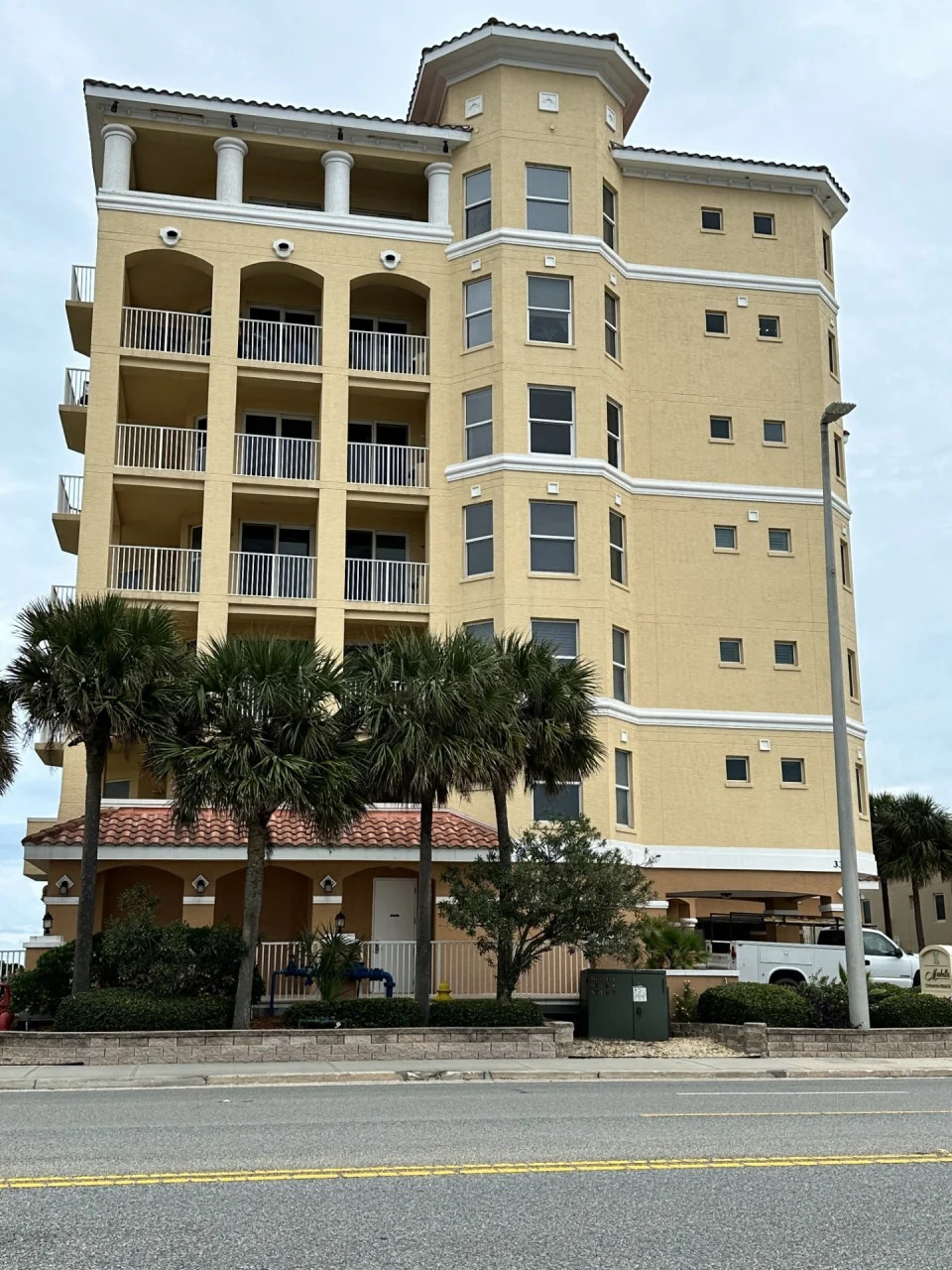
The Grand Coquina Condominiums, 3333 S. Atlantic Ave., in Daytona Beach Shores, saw a 228% increase in property insurance rates in 2023, despite the fact that its insurer denied a water damage claim. The condo association is fighting that determination.
Grand Coquina filed a claim seeking reimbursement for water damage its board members contend was caused by wind during the storms. The claim was denied, said Marro Porcelli, president of the Grand Coquina Condo Association Inc.
Grand Coquina hired an attorney and a structural engineer to challenge the denial. Board members expect they will receive a settlement offer.
“There’s a lot of fight left in us,” Porcelli said. “We’re not giving in to the criminals.”
Marbella is relatively new, built 15 years ago under strict building codes. As a result, it stands on 42 pylons that are 40 feet long and reach down to the hard core beneath the sand, Smith said.
In other words, residents there are confident if the building itself could withstand Ian and Nicole, it’s unlikely to crumble anytime soon.
And Smith said the deductible for any disaster is $1 million.
That leads Baker to question what the insurance is actually covering.
‘We don’t have insurance. We have an insurance bill’
“If a tornado came across this building and ripped the roof completely off, our deductible is more than the repair. If an atomic bomb goes off downtown, and blows this building down, we don’t collect because of the war clause,” Baker said.
The Marbella Condominium Association, 3343 S. Atlantic Ave., in Daytona Beach Shores, was hit with a huge insurance increase last year and faces another increase, even while property insurance did not cover some $2 million in damage caused by Tropical Storms Ian and Nicole.
“There is no way this building can collect,” he said. “This is a concrete building with sprinklers. You couldn’t burn the damn thing down if you built a bonfire inside. We do not have insurance. We have an insurance bill.”
Baker has written to all 160 state lawmakers as well as 15 news organizations about the plight of condo owners. He went to Tallahassee during this year’s session.
“I learned something a long time ago in the military,” he said. “If you make a complaint, have a suggestion on how to fix it, OK?”
He’s proposed dropping the requirement that condos purchase insurance. And he’s also talked about condos finding a way to self-insure.
Mostly, Baker said his pleas have been ignored.
Baker met with Rep. Tom Leek, R-Ormond Beach, who was receptive to at least one of his ideas. The office of Sen. Jason Pizzo, D-Sunny Isle Beach, responded to a packet of information Baker mailed to all lawmakers. But otherwise, he’s heard nothing.
Baker said he’s most disappointed in Sen. Tom Wright, R-New Smyrna Beach, who represents Daytona Beach Shores.
“For one year, I’ve been trying to get an appointment with Sen. Wright,” Baker said. “I even went to his office. He walked right past me. He didn’t extend me the courtesy of shaking my hand.”
Wright did not respond to a request for comment.
Leek, whose district includes Daytona Beach Shores, likes at least one of Baker’s ideas.
Is self-insuring a good idea?
“We are actively finding ways to help the Florida consumer, and allowing condominium associations to self-insure is a good idea. In fact, measures that increase competition in the insurance market and drive more carriers into Florida will benefit consumers,” he wrote.
Mark Friedlander, Florida spokesman for the Insurance Information Institute, said Florida has long had a complicated relationship with property insurance, and it got more challenging with the Surfside collapse and the hurricanes of 2022.
Many of the insurers that offer condo coverage started to pull back from the Florida market due to increased risk at the older coastal properties, Friedlander said in an email.
“The insurers that remained enhanced their underwriting criteria. This began the trend of significant premium increases for master association coverage,” he said. “Insured losses incurred from substantial property damage generated by hurricanes Ian and Nicole last year further impacted the availability and cost of master condo insurance,” Friedlander wrote.
In addition to “master policy costs” shared among all condo unit owners, individual condo owners living in high-risk properties are seeing their condo unit policy premiums increase substantially – 50% to 100% on average, he added.
Over the past two years, the Florida Legislature has passed a flurry of changes with the goal of resolving the property insurance crisis, so far to no avail.
Some of those measures include tweaking regulations related to Citizens Property Insurance Corp, the state-run insurer of last resort, authorizing actions to be taken by the Florida Office of Insurance Regulation, and cracking down on bad-faith claims.
In an early November special session, lawmakers allocated $181.5 million to the My Safe Florida Home Program, which provides homeowners a wind-mitigation survey and grant funds to make homes more sturdy.
Leek said he’s confident that what lawmakers have been doing has been done is working.
Rep. Tom Leek, R-Ormond Beach, speaks during a Volusia County Legislative Delegation meeting in DeLand in October. Leek, the House budget chair, says lawmakers are working to resolve Florida’s property insurance crisis.
“The Legislature’s insurance reforms are taking hold,” Leek wrote in response to questions. “New carriers are entering the Florida insurance market for the first time in years. Just this month, a new carrier entered the Florida condo association insurance market.
“It’s happening and it does take time, and we will continue to work to provide a climate of competition and choice,” he wrote.
Friedlander also referenced the new carrier as a positive sign: “Last week, Florida’s insurance regulator announced that a new insurer, the Condo Owners Reciprocal Exchange, will be entering the state’s market in 2024 and provide master condo policy coverage to associations. We hope this will be a first step toward stabilizing the market for this coverage.”
Condo owners socked with $64,000 in assessments
As a result of both sides of the property insurance problem – high rates and being awarded no claims for the damage, Marbella condo owners have each paid approximately $64,000 in HOA fees and assessments in 2023, said board President Jim Smith.
Tom Baker, a member of the Marbella Condominium Association Board, has been writing lawmakers, trying to get them to help stop property insurance rates from skyrocketing.
Baker acknowledges beachside condo owners – particularly those who have thus far been able to absorb the high insurance bills and the assessments to pay for damages – probably don’t attract much sympathy in Florida.
“Now us rich son-of-a-bitches, pardon me, we can manage somehow and get away with it,” he said.
But other condo owners have had their retirement dreams dashed, moving because of the high costs, while an exodus awaits if the problem isn’t contained, association board members say.
They appreciate what Baker has done to raise awareness of the problem.
“He’s taken this on, and he’s very passionate about it,” said Jim Smith, the Marbella Condo Association Board president.
Baker said: “People who moved down here on fixed incomes and bought themselves their final place now find themselves with an impossible bill.”
This number will shape Earth’s future as the climate changes. You’ll be hearing about it.
Elizabeth Weise, USA TODAY – November 30, 2023
Consider that 3 degrees Fahrenheit is the difference between a raging fever and a healthy toddler. Between a hockey rink and a swimming pool. Between food going bad or staying at a safe temperature.
Now consider that Earth is about 2 degrees Fahrenheit hotter on average than it was in the 1800s. It’s little wonder that has already led to measurable shifts in the climate: The last eight years have been the hottest in recorded history and 2023 is expected to be the hottest yet.
But there’s a looming threshold that will dictate the future of planet Earth. It could have cascading effects on how hot the planet gets, how much seas rise and how significantly normal daily life as we now know it will change.
The number is 2.7 degrees Fahrenheit.
World leaders at an annual gathering beginning Thursday will be spending considerable energy pondering that number, although they will use the Celsius version: 1.5 degrees.
“We can still make a big difference and every single tenth of a degree is enormously important,” said Anthony Leiserowitz, director of the Yale Program on Climate Change Communication.
Representatives and negotiators from 197 nations are gathering at an event called COP (Conference of the Parties) in the United Arab Emirates, a 13-day meeting that comes at what scientists say is a critical moment in the fight to keep the already dangerous effects of climate change from tipping over into the catastrophic.
Research published last month estimated humanity has only six or so more years before so much carbon dioxide has been pumped into the atmosphere that there’s only a 50% chance of staying below the threshold.
Why 2.7 degrees Fahrenheit is so important
In 2016, the United States and 195 other parties signed the Paris Agreement, a legally binding international treaty on climate change aimed at lowering the amount of greenhouse gases in the atmosphere to keep global warming at bay.
All the nations that signed the Agreement pledged to try as hard as possible to keep the global average temperature increase below 2.7 degrees, and to definitely keep it below a 3.6 degrees Fahrenheit rise. (Only the Agreement said it in Celsius, which comes out to the smoother-sounding 2.0 degrees Celsius and 1.5 degrees Celsius.)
The numbers sound pretty small – but they aren’t.
A few degrees is a big deal
The difference between 65 degrees and 67.7 degrees (that critical 2.7-degree difference) isn’t even worth carrying a sweater. So why does it worry climate scientists?
It’s because they’re thinking about global temperature averages, and when the global average goes up, the extremes go way up.
People across America are already noticing the effects. Storms are more extreme, drenching areas with more water that’s causing an increasing number of devastating flash floods. Dozens of people in Vermont, Tennessee and Pennsylvania are only the most recent victims.
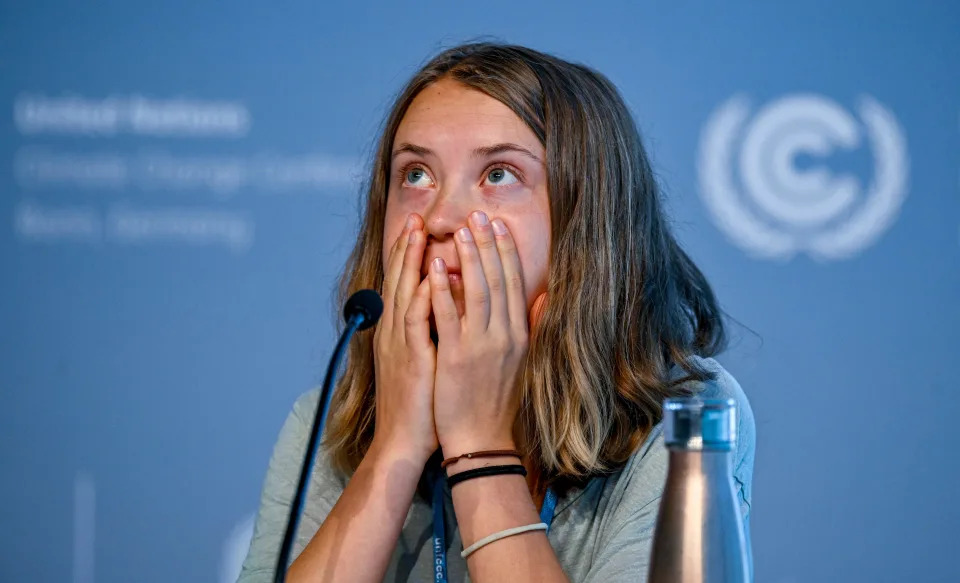
Swedish climate activist Greta Thunberg takes part in a press conference at the UNFCCC SB58 Bonn Climate Change Conference on June 13 in Bonn, Germany. The conference lays the groundwork for the adoption of decisions at the upcoming COP28 climate conference in Dubai in December.
Why is it important to not let the Earth warm an extra degree?
The difference between an aspiration of no more than 2.7 degrees warming and a serious commitment to no more than 3.6 degrees might not seem large.
But multiply the extremes and their effects, and each results in a vastly different world. One is difficult, resulting in a less reliable and more chaotic climate than the one we live with today. The other verges on a movie cataclysm.
At their heart, the 13 days of COP28 negotiations are the place global governments sit down to hammer out just how much each will lower its carbon emissions, though many other climate change topics are on the table as well.
Using published research and reports from the U.N.’s Intergovernmental Panel on Climate Change, Carbon Brief laid out the likely measurable difference between a world that is 2.7 degrees warmer and one that is 3.6 degrees warmer:
◾ Sea level rise by 2100 of 18 inches vs. 22 inches
◾ Ice-free Arctic summer chance of 10% vs. 80%
◾ Central U.S. warm spells last 10 days vs. 21 days
◾ Percentage of people facing at least one severe heat wave in five years is 14% vs. 37%
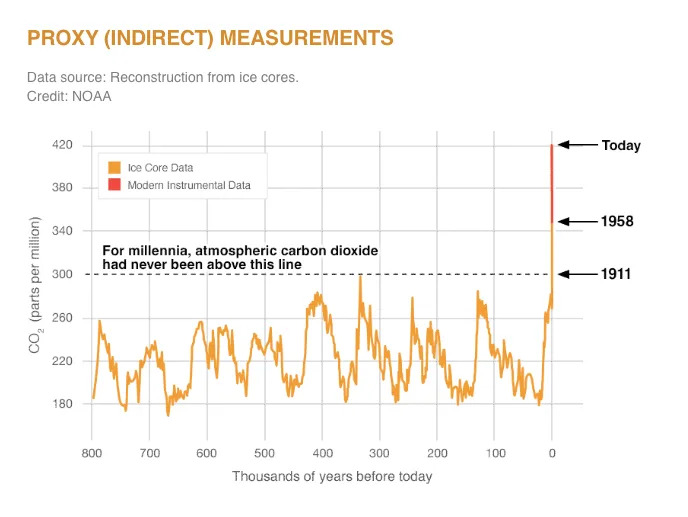
NASA graph showing the rise of carbon dioxide levels in the Earth’s atmosphere from 800,000 years ago to today.
The change has been underway for decades, but the extent of the shift is only now becoming clearly evident. In the 1980s, the country experienced on average a $1 billion, adjusted for inflation, disaster every four months. It now experiences one every three weeks. This year, the country has set a new record with 25 billion-dollar disasters.
The Earth crossed a key warming threshold in 2023, with one-third of the days so far having an average temperature at least 1.5 degrees Celsius higher than preindustrial levels. On Nov. 17, it reached 2.07 degrees above. This year is expected to be the warmest in recorded history, warmer than any other in 125,000 years.
What is COP28?
COP28 is the annual United Nations meeting of the 197 parties that have agreed to the U.N. Framework Convention on Climate Change, originally adopted in 1992. The meeting is the decision-making body of the countries that signed onto the U.N. framework. It is held to assess how well nations are dealing with climate change and set agendas and goals.
How important is this COP?
In a major report, the UN’s climate change body said earlier this month that global greenhouse gas emissions need to fall by 45% by the end of this decade compared to 2010 levels to meet the goal of limiting global temperature rise to 1.5 degrees Celsius.
Things are not going in the right direction. Instead, emissions are set to rise by 9%.
COP28 is where changes can be made.
Scientists say humanity has about a decade to dramatically reduce heat-trapping gas emissions before thresholds are passed that may make recovery from climate collapse impossible.
To do so will require cutting nearly two-thirds of carbon pollution by 2035, the Intergovernmental Panel on Climate Change said. That means ending new fossil fuel exploration and weaning wealthy nations away from coal, oil and gas by 2040.
“Humanity is on thin ice – and that ice is melting fast,” United Nations Secretary-General Antonio Guterres said in the spring. “Our world needs climate action on all fronts – everything, everywhere, all at once.”
Hundreds of new oil and gas projects approved despite climate crisis
Valentin Rakovsky – November 30, 2023
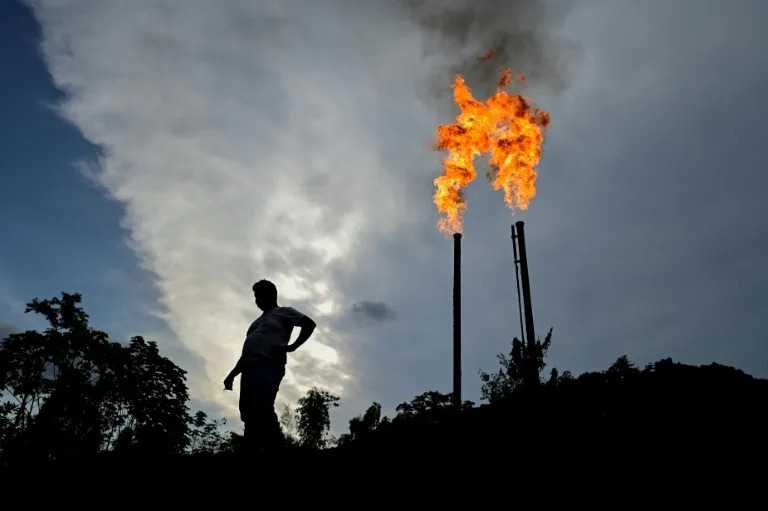
A gas flare from a refinery in Ecuador (Pedro PARDO)
More than 400 oil and gas projects were approved globally in the last two years despite calls to abandon all new hydrocarbon development, new figures showed as the UN COP28 climate talks opened Thursday.
With greenhouse gas emissions threatening to heat the planet to catastrophic levels, countries at the talks in Dubai are under pressure to agree to phase out oil, gas and coal in order to meet the Paris Agreement goal of limiting warming to 1.5 degrees.
Nearly 200 private and public corporations across 58 countries were involved in the 437 new fossil fuel projects, according to figures from the nonprofit Reclaim Finance, based on data from Rystad Energy consultants.
The data demonstrates the mismatch between the continuing exploitation of fossil fuels — responsible for most of humanity’s greenhouse gases — and the target of limiting warming.
“We are in denial about the environmental emergency and the conclusions drawn by IPCC (Intergovernmental Panel on Climate Change) scientists,” Lucie Pinson of Reclaim Finance told AFP.
The UN’s IPCC climate expert panel has said emissions need to be slashed by over 40 percent this decade to keep the 1.5C threshold in sight.
And in May 2021, the International Energy Agency (IEA) issued an explosive warning saying “no new oil and gas fields” could be approved for its pathway to net zero emissions to be met, as well as no new coal mines.
Countries agreed at Glasgow’s COP26 in late 2021 to “phasedown” coal power that does not involve emissions being captured before they go into the atmosphere.
But attempts to widen ambition to include targets on reducing oil and gas have so far met stiff opposition, despite a surge in renewable energy.
– ‘Desperate’ need –
And fossil fuel expansion shows no sign of stopping.
All of the 437 new projects since 2022 have received their “final investment decision” — a key commitment where investors sanction the development and production of a new hydrocarbon field.
Once in production, they will produce oil and gas in vast quantities for years to come.
State-backed oil companies were behind 57 percent of the projects.
Some 22 percent were linked to just seven oil giants: BP, ExxonMobil, Shell, Chevron, ConocoPhillips, Eni and TotalEnergies.
Qatar alone is due to host 17 percent of the total expected future production of these planned gas and oil projects, when measured in volume.
Saudi Arabia would host 13 percent, Brazil 10 percent, the United States eight percent and this year’s COP28 host, the United Arab Emirates would have six percent.
The IEA estimates that global demand for oil and gas will peak by 2030, but oil giants argue the transition to renewables is not happening fast enough to replace fossil fuels.
There is a “desperate need” for oil and gas still, said Shell CEO Wael Sawan in July.
And several European oil giants — including Shell, BP and Enel — have recently rolled back on some of their energy transition targets.
In February, BP backtracked on plans to cut its oil and gas output by 40 percent from 2019 levels by 2030, targeting a 25 percent reduction instead.
The third heatwave of the summer hits SpainHeatwave in Beijing, China
DUBAI (Reuters) – With a month to run, 2023 will reach global warming of about 1.4 degrees Celsius (2.5 Fahrenheit) above preindustrial levels, adding to “a deafening cacophony” of broken climate records, the World Meteorological Organization (WMO) said on Thursday.
The WMO’s provisional State of the Global Climate report confirms that 2023 will be the warmest year on record by a large margin, replacing the previous record-holder 2016, when the world was around 1.2C warmer than the preindustrial average.
It adds to the urgency world leaders face as they wrestle with phasing out fossil fuels at the United Nations annual climate summit COP28, which begins on Thursday in Dubai.
“Greenhouse gas levels are record high. Global temperatures are record high. Sea level rise is record high. Antarctic sea ice record low,” WMO Secretary General Peterri Taalas said.
The report’s finding, however, does not mean the world is about to cross the long-term warming threshold of 1.5C that scientists say is the ceiling for avoiding catastrophic climate change under the 2015 Paris Agreement.
For that, the level of warming would need to be sustained for longer.
Already, a year of 1.4C has provided a frightening preview of what permanently crossing 1.5C might mean.
This year, Antarctic sea ice reached its lowest winter maximum extent on record, some 1 million square kilometres (386,000 sq miles) less than the previous record. Swiss glaciers lost about 10% of their remaining volume over the last two years, the report said. And wildfires burned a record area in Canada, amounting to about 5% of the country’s woodlands.
Climate change, driven by the burning of fossil fuels, combined with the emergence of the natural El Nino climate pattern in the Eastern Pacific pushed the world into record territory this year.
Next year could be worse, the scientists said, as El Nino’s impacts are likely to peak this winter and drive higher temperatures in 2024.
(Reporting by Gloria Dickie; editing by Barbara Lewis)
The sun sets behind a burned forest near Mariposa, California (DAVID MCNEW)
This year is set to be the hottest ever recorded, the UN said Thursday, demanding urgent action to rein in global warming and stem the havoc following in its wake.
The UN’s World Meteorological Organization warned that 2023 had shattered a whole host of climate records, with extreme weather leaving “a trail of devastation and despair”.
“It’s a deafening cacophony of broken records,” said WMO chief Petteri Taalas.
“Greenhouse gas levels are record high. Global temperatures are record high. Sea level rise is record high. Antarctic sea ice is record low.”
The WMO published its provisional 2023 State of the Global Climate report as world leaders gathered in Dubai for the UN COP28 climate conference, amid mounting pressure to curb planet-heating greenhouse gas pollution.
United Nations chief Antonio Guterres said the record heat findings “should send shivers down the spines of world leaders”.
The stakes have never been higher, with scientists warning that the ability to limit warming to a manageable level is slipping through humanity’s fingers.
The 2015 Paris climate accords aimed to limit global warming to well below two degrees Celsius above pre-industrial levels — and 1.5C if possible.
But in its report, the WMO said 2023 data to the end of October showed that this year was already around 1.4C above the pre-industrial baseline.
– ‘Not just statistics’ –
The agency is due to publish its final State of the Global Climate 2023 report in the first half of 2024.
But it said the difference between the first 10 months of this year and 2016 and 2020 — which previously topped the charts as the warmest years on record — “is such that the final two months are very unlikely to affect the ranking”.
The report also showed that the past nine years were the hottest years since modern records began.
“These are more than just statistics,” Taalas said, warning that “we risk losing the race to save our glaciers and to rein in sea level rise”.
“We cannot return to the climate of the 20th century, but we must act now to limit the risks of an increasingly inhospitable climate in this and the coming centuries.”
The WMO warned that the warming El Nino weather phenomenon, which emerged mid-year, was “likely to further fuel the heat in 2024”.
That is because the naturally-occurring climate pattern, typically associated with increased heat worldwide, usually increases global temperatures in the year after it develops.
The preliminary report also found that concentrations of the three main heat-trapping greenhouse gases — carbon dioxide, methane and nitrous oxide — reached record high levels in 2022, with preliminary data indicating that the levels continued to grow this year.
Carbon dioxide levels were 50 percent higher than the pre-industrial era, the agency said, meaning that “temperatures will continue to rise for many years to come”, even if emissions are drastically cut.
– ‘Climate chaos’ –
The rate of sea level rise over the past decade was more than twice the rate of the first decade of satellite records (1993-2002), it said.
And the maximum level of Antarctic sea ice this year was the lowest on record.
In fact, it was a million square kilometres less than the previous record low at the end of the southern hemisphere winter, the WMO said — an area larger than France and Germany combined.
Meanwhile, glaciers in North America and Europe again suffered an extreme melt season, with Swiss glaciers losing 10 percent of their ice volume in the past two years alone, the report showed.
Dramatic socio-economic impacts accompany such climate records, experts say, including dwindling food security and mass displacement.
“This year we have seen communities around the world pounded by fires, floods and searing temperatures,” UN chief Guterres said in a video message.
He called on the leaders gathered in Dubai to commit to dramatic measures to rein in climate change, including phasing out fossil fuels and tripling renewable energy capacity.
“We have the roadmap to limit the rise in global temperature to 1.5C and avoid the worst of climate chaos,” he said.
“But we need leaders to fire the starting gun at COP28 on a race to keep the 1.5 degree limit alive.”
Some Republicans sound alarm after Trump revives focus on Obamacare
Kristen Holmes, Alayna Treene and Kate Sullivan – November 30, 2023
Go Nakamura/Reuters
Former President Donald Trump’s renewed focus on repealing and replacing the Affordable Care Act, known colloquially as Obamacare, has alarmed some Republicans scarred by the GOP’s failure to deliver on promises to dismantle the law and who view the issue as a political loser with the American people.
Many on Trump’s team said they were surprised by the former president’s recent declaration on his social media website Truth Social that replacing Obamacare would be a priority of his administration, as Obamacare had not been a focal issue in ongoing policy conversations and the campaign has not yet drafted any kind of health care policy alternative. One Trump adviser told CNN the post came “completely came out of nowhere,” and said the team “has not been talking to him about health care.”
Some Trump advisers who spoke with CNN also conceded that calling for the termination of a health care law that provides millions of Americans coverage and is largely viewed favorably by the public is a political loser going into 2024. Republicans have tried and failed for years to implement substantial changes to Obamacare and the party has largely abandoned efforts to campaign on the issue.
The resurrection of the health care battle has given Democrats fresh political ammo, and the Biden campaign quickly seized on Trump’s threats. The campaign held a press call with former House Speaker Nancy Pelosi and North Carolina Democratic Gov. Roy Cooper, whose state will become the 40th to expand Medicaid on Friday, to respond to Trump’s comments. The campaign also on Thursday released an ad focused on health care and prescription drug costs, attempting to draw a sharp contrast with Trump. The ad – which features a pediatric nurse who calls Trump’s health care policies “troubling” – will run in media markets in seven states that will be key to Biden’s 2024 electoral map.
“There are very few issues where Republicans are at a greater disadvantage then health care. The Biden campaign desperately wants the election to be about health care and abortion. If the election is about those two issues in 2024, then Democrats will have a great night in November,” Ken Spain, a GOP consultant and former communications director for the National Republican Congressional Committee, told CNN.
“The concern that Republicans have always had about Trump is his lack of discipline. The question is, is this really an issue he intends to campaign and formulate a strategy around, or is this just another lapse in discipline?” Spain added.
Health care “was a loser in 2018 and it’s a loser now,” one Trump-aligned Republican operative told CNN, referencing the 2018 midterm elections that ushered in a Democratic majority in the House of Representatives.
Trump’s health care legacy while in office is viewed by many Republicans as lackluster at best. His failure to fulfill his core campaign promise of repealing and replacing Obamacare – even with a GOP monopoly on power in Washington – was an early blow to Trump, who had painted himself as the ultimate dealmaker.
“Talk about the border,” the operative said. “Talk about the economy. Talk about no more foreign wars. Don’t talk about health care.”
Advisers to Trump said the catalyst for the former president’s posts was a recent article written by the Wall Street Journal editorial board that raised concerns that patients are seeing higher costs because insurers are using work arounds to an Affordable Care Act rule. Trump included a portion of the op-ed in his initial post on the issue.
The topic had also recently been brought up to Trump during a Mar-a-Lago meeting with Jeff Colyer, the former governor of Kansas. The two discussed health care policy over lunch, a Trump adviser told CNN.
Trump’s online pronouncements about replacing the law with his own belied the fact that his campaign has not settled on health care plan.
The campaign’s in-house policy team, led by advisers Vince Haley and Ross Worthington, has been drafting aggressive proposals for a potential second Trump term, but the campaign has not been actively working on a health care proposal, the Trump adviser told CNN. The team first started floating ideas for an alternative to Obamacare in recent days — but only after Trump started posting about it online.
One person familiar with the campaign’s process said it was likely that Trump’s team would also review health care proposals put forward by outside advocacy groups, including Project 2025, a partnership of groups organized by the conservative think tank the Heritage Foundation. But this person stressed the proposals by the outside groups are merely suggestions and that the campaign would look at a range of ideas before putting forward its own unique proposal.
“The campaign is not going to adopt a position that’s suicidal,” this person said, acknowledging how politically fraught the issue can be. “But it is equally suicidal not to recognize the American people’s profound cry for health care reform.”
Like many of the policy proposals Trump’s current team is drafting for a potential second term, there are also serious concerns about how the former president could successfully enact them if reelected, acknowledging the necessary obstacles Congress and the courts could pose to a new health care agenda.
Trump bringing health care back to the forefront has also reignited talk of his failure to repeal and replace Obamacare in 2017.
Members of Trump’s orbit have long blamed that failure on the late Sen. John McCain of Arizona, who famously voted that year against repealing the ACA with a dramatic “thumbs down” on the Senate floor, tanking the Trump administration’s efforts.
And despite Trump’s promises to release a health care plan that could replace Obamacare, Trump left office in 2020 without having produced one. Just weeks before the 2020 presidential election, Trump issued an executive order pledging to protect Americans with preexisting conditions, but the plan fell far short of a comprehensive proposal.
CNN’s Betsy Klein and Tami Luhby contributed to this story.
Trump’s 48-Hour Manic Rant Had Immediate Consequences
Ellie Quinlan Houghtaling – November 30, 2023
The GOP’s presidential front-runner had himself a bit of an unhinged social media binge over the last couple of days, using Truth Social to air his scattered grievances, attack the wife of the judge overseeing his New York bank fraud trial, and take a wild left turn by claiming sudden allyship with the broader Black Lives Matter movement.
Kicking off the rapid-fire onslaught of posts late Tuesday, Trump called MSNBC’s coverage of the Republican Party “illegal activity,” adding that the “so-called ‘government’ should come down hard” on the news outlet and “make them pay.”
Then the former president revived an old gripe that “Obamacare sucks”—thus reopening the possibility that his campaign will renew the call to “repeal and replace” the Affordable Care Act that has dogged the GOP since that law’s inception. Less than 20 minutes later, he redirected his attention to the sexual assault allegations made against him by columnist E. Jean Carroll, spewing comments eerily similar to the ones that have already lost him two defamation cases brought by the writer, in which he claimed that the allegations were a “made up fairytale” that was “funded by political operatives” to interfere with the 2020 presidential election results.
Over the ensuing hours, Trump also warned that the indictments against him had opened up “pandora’s box,” which he followed by snubbing his Koch-backed GOP opponent Nikki Haley as “a very weak and ineffective Birdbrain.”
In yet another post, Trump said he had done “more for Black people than any other President,” including Lincoln. He also confused the support of Mark Fisher, the founder of Black Lives Matter Incorporated, for that of the larger, national movement, despite statements front and center on BLM INC.’s web page that they’re not affiliated with “any other Black Lives Matter Movement.”
But the pièce de résistance of Trump’s 48-hour digital diatribe was a string of attacks on the wife of the judge overseeing his business fraud trial, Manhattan Supreme Court Justice Arthur Engoron, whose gag order on Trump had been repealed. In five separate posts, Trump uplifted a conspiracy theory that Dawn Engoron and her husband were inherently biased in his case and that Mrs. Engoron had attacked Trump and other “white male politicians” online.
“Judge Engoron’s Trump Hating wife, together with his very disturbed and angry law clerk, have taken over control of the New York State Witch Hunt Trial aimed at me, my family, and the Republican Party,” Trump wrote on Truth Social.
In a statement to Newsweek, Engoron denied ownership of the account and any of its content.
“I do not have a Twitter account. This is not me. I have not posted any anti-Trump messages,” she told the outlet.
That may have been enough to convince a New York appeals court that Trump wasn’t capable of playing nice without his recently stayed gag order, which the four-judge panel dutifully reinstated on Thursday, in an attempt to halt the verbal onslaught against the judge, his court staff and, apparently, his family.