We created scorching ‘heat islands’ in East Coast cities. Now they’re becoming unlivable

The Staunton News Leader

We created scorching ‘heat islands’ in East Coast cities. Now they’re becoming unlivable

Joyce Chu, Eduardo Cuevas and Ricardo Kaulessar – July 27, 2022

Thelma Mays couldn’t breathe.

On a blazing summer day, she began gasping for air inside her Petersburg, Virginia, apartment, and was forced to call 911. If she’d been able to look out her window to see the ambulance pull up at Carriage House, an income-based complex for the elderly, she wouldn’t have been able to see a single tree. Just the other side of the sprawling brick building.

She lives on the edge of a type of “heat island,” with wide stretches of concrete that bake in the sun and retain heat. She turns on the air conditioner when her room gets unbearably stuffy, which may have been the cause of her sudden coughing spasm.

Tanisha Garner stands in front of a former beer plant while a plane passes overhead. The building is among the many structures that trap heat and contribute to high temperatures for residents of Newark's Ironbound section.  July 1, 2022.
Tanisha Garner stands in front of a former beer plant while a plane passes overhead. The building is among the many structures that trap heat and contribute to high temperatures for residents of Newark’s Ironbound section. July 1, 2022.

When it is too hot to go outside on city streets, the indoors can be just as dangerous for her lung condition, if she gulps refrigerated air for a precious few minutes in front of the AC vent. Mays, 78, has chronic obstructive pulmonary disease, and a quick shift in humidity or temperature can trigger a respiratory emergency.

These days in central Virginia, trapped on the edge of a hotter-than-normal part of an often-overlooked majority Black city, escalating heat and weather patterns are putting Mays and others under health and financial stress. It’s pressure not yet being felt equally in wealthier, majority white suburban areas of the state with landscaped gardens and plentiful indoor cool spaces.
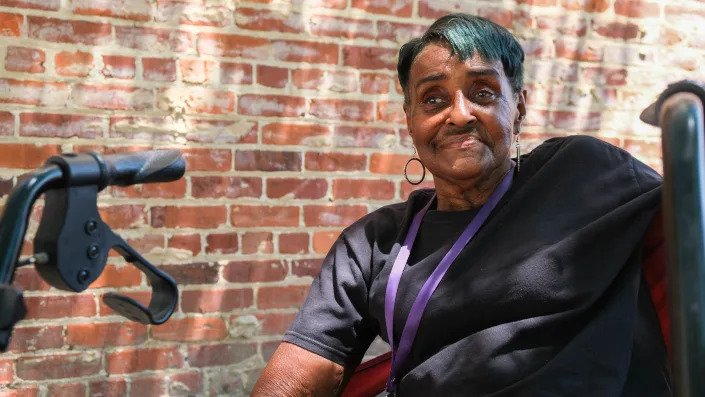
Thelma Mays, 78, has chronic obstructive pulmonary disease. Everyday, she uses a machine to help her breathe. When it gets too hot or too cold, it triggers her wheezing and coughing spasms, sending her to the hospital.

Graphics:Record-high temperatures from heat dome affect millions

Mays was transported to the emergency room that day.

Doctors worked for hours to stabilize her breathing, giving her IV steroids to help her lungs function.

Stranded on an urban heat island, many don’t survive

The Carriage House apartment complex has a few small trees by the sidewalk, none big enough to provide cover for a single person.

By contrast, Walnut Hill — one of the wealthiest and most tree-lined parts of the city — was more than 13 degrees cooler in the shade. Large trees create an arching canopy over the streets. Nearly every house has wide lawns skirted by mature shade-providing trees. Even in the sun, it was 6 degrees cooler than in Old Towne.
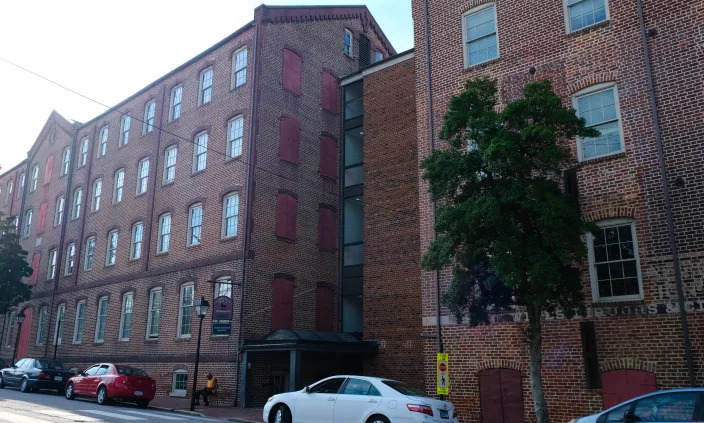
Temperatures in Old Towne outside the Carriage House, where Thelma Mays lives, were more than 6 degrees hotter than one of the most tree-lined areas of the city on a scorching July afternoon.

Old Towne is the hottest area in Petersburg based on 2021 heat-mapping.

Even on hot days, Mays uses her walker to reach the other side of the street where she can sit under the shade of a couple of small trees by a parking lot. She hates being cooped up in her apartment.

Blocks of shops and long treeless stretches of asphalt and concrete trap the heat in Old Towne. On a sweltering July afternoon, we recorded field temperatures at a scorching 101 degrees. Unlike in the West, this level of heat on the East Coast is often accompanied by moisture in the air.

Temperatures in Old Towne outside the Carriage House where Thelma Mays lives was more than 6 degrees hotter than one of the most tree-lined areas of the city on a scorching July afternoon.

What to know about the impactUrban heat islands are why it can feel 20 degrees hotter in different parts of the same city

“When you have very high humidity, your body can’t evaporate your sweat off of your skin,” said Jeremy Hoffman, the David and Jane Cohn Scientist at the Science Museum of Virginia. “It’s very difficult to cool off naturally. You really need additional help.”

Everything you need to know about heat:From the heat index to a heat dome to an excessive heat warning
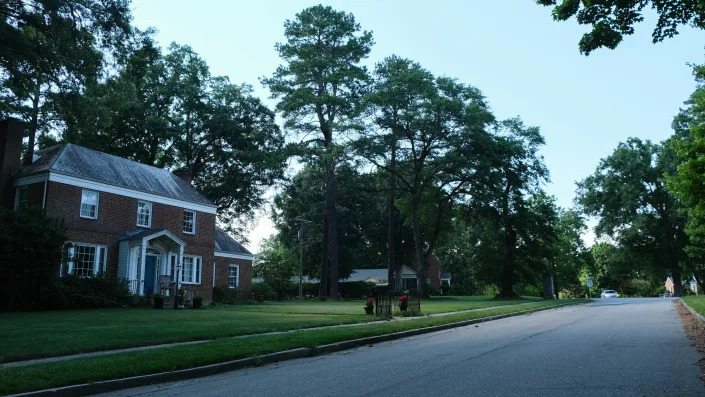
Walnut Hill, one of the most tree-lined and wealthiest neighborhoods in Petersburg, was 6 degrees cooler in the shade than Old Towne, the hottest part of the city with minimal trees.

A difference of a few degrees in extreme heat can affect the body’s ability to regulate its temperature. Some emergency rooms will put out extra gurneys in anticipation of more patients who’ll come in with syncope, respiratory illnesses or heart failure.

Thelma Mays recovered and her granddaughter drove her home. Others in her situation are not so lucky.

Heat death in East Coast cities

We looked at heat islands during an extensive USA TODAY Network reporting project called “Perilous Course,” a collaborative examination of how people up and down the East Coast are grappling with the climate crisis. Journalists from more than 30 newsrooms from New Hampshire to Florida are speaking with regular people about real-life impacts, digging into the science and investigating government response, or lack of it.

Death on a heat island is not as visible or cinematic as the dramatic images of homes crushed by a hurricane, belongings washed away and trees bent by the wind. The elderly and young children fall victim to excessive heat in their homes or inside of cars, away from the public eye and the flashy news headlines.

Hurricanes are short-lived phenomena which are often predicted weeks in advance. Heat’s different. It can come as a heat wave, which can last for days and have no set, predictable spatial boundaries. It enhances conditions on the ground which absorb the heat.

About that dire climate report:We have the tools we need to fix things

“A heat wave is very hard to define in space and time,” said Hoffman. “It’s not something that you can see on the map; it is something that you feel in the outdoors. So, we have a crisis of communication around heat.”

Climate change has exacerbated the intensity of heat waves, the number of excessive heat days per year and the length of these heat waves. The average length of a heat wave season in 50 big cities studied is now around 70 days, compared to 20 days back in the 1960s. In less than one lifetime, the heat wave season has tripled.

In some places, summer can feel like one long heat wave.

Children cool off in the spray area at Hull Park on Tuesday June 14, 2022 as the heat index climbed over 100 for the second straight day.

The warming climate has been tied to increased mortality around the world. In a large-scale study that examined heat in 43 countries, including the U.S., researchers found that 37 percent of heat-related deaths could be attributed to the climate crisis.

Extreme heat can be more dangerous for those in the Northeastern United States.

“What becomes really dangerous in these more northern cities is that they haven’t yet adopted air conditioning very widely yet,” Hoffman said. “And especially in lower income and communities of color or immigrant communities, prevalence of air conditioning utilization is very low.”

Three of the country’s nine least-air-conditioned cities are in the Northeastern states — Providence, Rhode Island; Hartford, Connecticut; and Buffalo, New York, according to U.S. Census bureau data and a USA TODAY report.

‘Code Red’ Heat:The climate emergency is sending more kids of color to the emergency room

In Florida, researchers have been measuring the impact of heat islands.

The National Oceanic and Atmospheric Administration has conducted studies in West Palm Beach and Jacksonville, sometimes using volunteers to capture data. Its studies have indicated that low-income neighborhoods in Florida have less ability to cope with the damaging results of manmade heat islands.

A nonprofit research group called Climate Central found that Jacksonville’s heat island was potentially raising the overall average temperature of the entire city by as much as 6 degrees.

The “feels like” temperature or heat index can make a major difference for people living in humid places like Florida.

On 58th Street in West Palm Beach on a block barren of shade trees it reached 93.9 degrees near noon on July 22 with a relative humidity of 58%. That means it felt like 106 degrees.

“My electric bill was almost two-fold in June from what it was in March,” said 27-year-old Varun Parshad. “I try to be more disciplined with the temperature settings.”

Six miles to the southwest, the National Weather Service’s official gauge at Palm Beach International Airport registered 88 degrees with a lower feels-like temperature of 100 degrees.

The difference between 58th Street and the airport is significant enough when meteorologists and emergency officials have to make heat-related decisions, and it’s something some cities are recognizing as they plan for a warmer future.

No matter what part of the East Coast you’re in, things are getting hotter and more dangerous.

Extreme heat affects low-income communities and people of color on a greater scale due to structural inequities. From 2005 to 2015, the number of emergency room visits increased by 67% for Black people, 63% for Hispanic people and 53% for Asian Americans, compared to 27% for whites.

The conditions for heat to become deadly in certain places were set into motion decades ago by people who were very aware of race. As Hoffman himself would discover, those intentional decisions led to unintentional consequences in the present.

Discrimination made East Coast neighborhoods worse

In Petersburg, to the west of Thelma Mays’ apartment, there is an empty lot that dates back to colonial America and has housed a trading post, tobacco stemmery and Civil War prison in a town that had the highest percentage of African Americans of any in the Confederacy.

The block that remains has grass and some shady trees, and money has been spent on history signage and the stabilization of a crumbling wall. But there are not municipal improvements that give anyone who lives nearby many options to sit and use the shady space during the suffocating summer.

Hundreds of miles north from Thelma Mays’ apartment, there’s another woman who can’t stay indoors when the sun comes up in summer.

Several streets in Brianna Rodriguez’s Nodine Hill neighborhood in Yonkers, New York, are named for trees. But few trees actually line the sidewalks, and there aren’t many parks.

Brianna Rodriguez, a recent Yonkers High graduate, grew up playing in the playground at School 23 in Yonkers. Working with Groundwork Hudson Valley she has realized that her old playground is one of the hottest spots in Yonkers July 1, 2022.

“I couldn’t just stay in my room,” she said about the July 4 holiday weekend. Unable to afford AC units, Rodriguez’s family goes outside instead, to try to find a park to cool off.

When they have to be inside, three industrial fans normally used to quickly dry paint circulate air toward the center of Rodriguez’s living room in Yonkers. But even on full blast, they can’t cool the 18-year-old, her mom, stepdad and their dog inside their third-floor apartment.

There isn’t much shade throughout the working-class Black and Latino neighborhood. Rodriguez avoids certain streets she knows would be too hot between rows of taller apartment buildings and scalding pavement and asphalt.

The new normal:People haven’t just made the planet hotter. We’ve changed the way it rains.

The characteristics of the neighborhood Rodriguez lives in — residential areas with little or no parks or tree-shade, often bordered by industrial areas, warehouses or bisected by highways and overpasses — are the material remnants of an economic rating system nearly a hundred years old that disincentivized mortgage loans and devalued property.

The creation of “undesirable” economic districts by the government and banks isolated parts of the city populated by non-white people. Those “redlined districts” and the neglect of those areas that followed created the conditions which studies are now proving to be dangerous for human health amid the climate crisis that has already arrived.

Maps of city heat islands are a deadly mirror of redlined neighborhoods

In July 2017, Jeremy Hoffman set out to map Richmond, Virginia, using a new heat-tracking methodology developed by his colleague Vivek Shandas.

Someone told Hoffman that his heat map looked a lot like a map of Richmond’s redlined districts, which Hoffman didn’t know much about at that time. When he compared them, they looked almost identical.

He went to Baltimore, Boston and Washington, D.C., to gather temperatures. The results of the heat maps again matched up with the redlined maps of each city.

That next summer, Hoffman gathered surface temperatures through satellite imaging in each of the 250 redlined cities to see if the heat islands correlated with previously redlined areas, available through historical maps.

The pattern repeated itself in virtually every redlined city across America. Hoffman found redlined areas were on average 4.7 degrees hotter than greenlined areas of the same city.

His team was the first to compare heat and redline maps on a nationwide scale.

When Hoffman started the research, some scientists in his circle were skeptical. Was he looking at heat-mapping through a racial lens?

What he saw was the consequence of historical human decisions which themselves were racial in nature. Which areas should get investment? Or parks? And which areas could be sacrificed to have freeways built through existing neighborhoods?

“Cities don’t happen by accident,” Hoffman said. “Our neighborhoods don’t happen by accident. Everything is a decision that’s been made. Every single second of your daily life in a city is the integrated outcome of all the historical planning policies and decisions that were made before that.”
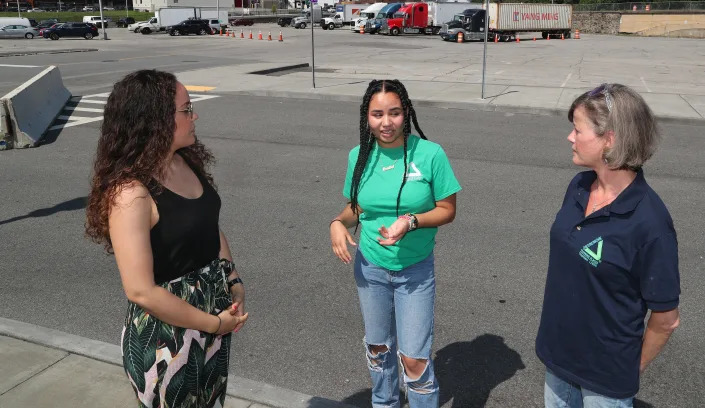
From left, Candida Rodriguez, with Groundwork Hudson Valley, Brianna Rodriguez, a recent Yonkers High graduate, and Brigitte Griswold, Groundwork Hudson Valley CEO, talk about the heat in the area of Getty Square in Yonkers July 1, 2022.

A harsh but telling example: Maps made by the Home Owners’ Loan Corporation described Nodine Hill, then heavily Italian, as “hazardous,” a September 1937 form said. Its detrimental influences, the form said, were aging buildings and the “character of occupants.”

On average, a person of color lives in a census tract with higher surface urban heat island intensity than non-Hispanic white people in all but six of the 175 largest urbanized areas in the U.S., according to a 2021 study published in the science journal Nature Communications.

‘By design or neglect’Flood, climate hazards threaten Massachusett’s redlined neighborhoods

Black residents had the most exposure to heat islands, researchers said, followed by Hispanic people.

The underlying conditions for heat islands were set decades ago by the economic isolation of redlining. Climate change just catalyzed these places to make them even more dangerous to human life.

Absorbing the history of heat

As a young child, Rodriguez didn’t play on the swings at her Nodine Hill elementary school on the hottest days, though they were her favorite part of the playground.

At recess, she skirted School 23’s playground, built on a black rubber mat over concrete, and joined hundreds of students huddled under a few trees. The sun glared directly down on the swings’ metal links, making them too hot to hold onto.

A photo Brianna Rodriguez, 18, took of her elementary school's playground in the Nodine Hill neighborhood of Yonkers, New York. Rodriguez was capturing images in urban heat islands for her work with the environmental justice nonprofit Groundwork Hudson Valley.
A photo Brianna Rodriguez, 18, took of her elementary school’s playground in the Nodine Hill neighborhood of Yonkers, New York. Rodriguez was capturing images in urban heat islands for her work with the environmental justice nonprofit Groundwork Hudson Valley.

“I had always felt that it was hotter,” Rodriguez said on a recent Friday afternoon in the shadow of her old school, a large brick building for pre-K-8 students built in 1918.  “It was just evident to me.”

Temperatures were in the 90s on July 1, 2022. But Rodriguez felt it was even hotter in Nodine Hill. The neighborhood is just a mile uphill from the Hudson River, which provides daily breeze for those along the water.

School 23’s playground was nearly empty a week after classes ended. A few teens sat by one of the basketball hoops in the shade. Rodriguez’s gold necklace with her middle name, Brooklyn, glinted in the sun.

On hot days, without shade or greenspace that can cool neighborhoods, fewer people are outside in Southwest Yonkers. Instead, many cluster indoors to keep cool.

The Civil Rights Act’s eighth provision, the Fair Housing Act, ended redlining in 1968. But previously redlined areas remain low-income and overwhelmingly non-white.

Upscale neighborhoods are edged with trees and parks with shaded pathways. In Southwest Yonkers, where Nodine Hill is located, residential areas are edged with unwanted facilities, congested roadways, sewage and wastewater treatment plants, according to Brigitte Griswold, executive director of Groundwork Hudson Valley, an environmental justice nonprofit that’s studied the local effects of redlining.

Resulting air pollution contributes to higher rates of asthma and heart disease in these communities, she added.
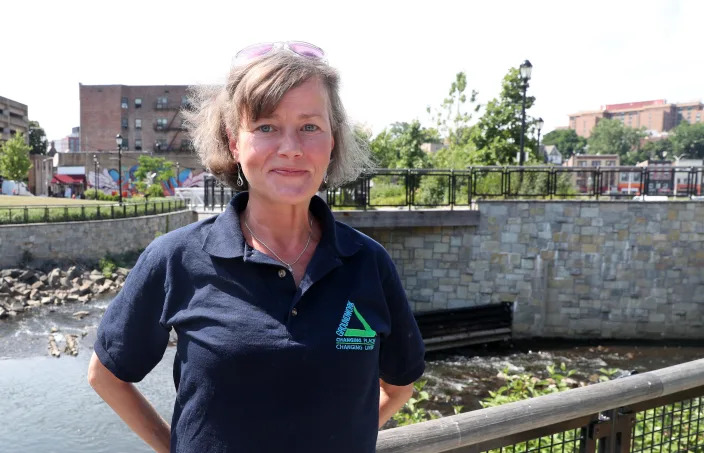
Brigitte Griswold, Groundwork Hudson Valley CEO, talks about the daylighting of the Saw Mill River in the Getty Square section of Yonkers July 1, 2022.

Griswold said the self-imposed isolation impedes people from checking on each other during a heat wave.

“It’s kind of a double-edged sword,” she said. “The heat itself prevents that social cohesion from happening. And then that breaks down community resilience to respond to the very thing that is driving people apart.”

Growing development brings more heat

The little growth that has come from the end of redlining is not always welcome or healthy. In these spaces, where land is cheaper and zoning fluid, manufacturing sites, energy plants and big box stores have sprung up.

New Jersey resident Tanisha Garner knows more buildings in her neighborhood mean more heat.

Garner, a Newark native who has lived in an area called the Ironbound for the past four years, said at least 10 projects are being planned for the area — and that they will be built with materials that absorb and radiate heat.

Newark resident Tanisha Garner spoke about the impact of heat in the area and the various factors that contribute to it being one of the hottest areas in a city considered one of the worst heat islands in the United States here in Newark, NJ, on July 1, 2022.

The Ironbound area got its name from the metalworking factories and railroad tracks in the area. For over a hundred years, this eastern section of Newark was home to all kinds of industrial activity. It was also an area redlined back in the late 1930s, classified as “dangerous” and marked by the federal government to be excluded from mortgage eligibility.

Many of those industries are long gone. Others have taken their place. A waste-to-energy incinerator, a sewage treatment plant, a metal plating shop and numerous warehouses. The area has been subject to some of the worst pollution in the state.

Garner thinks these development projects take out greenery and open space and fill them with buildings that help amplify the heat in her neighborhood.

“What creates that heat island? Is it the structure of the building, is it a lack of trees, is it the lack of balance between nature and construction?” Garner said. “When you look at the Ironbound, you can see there is an imbalance.”

During a tour of her neighborhood in July, Garner pointed out some of the areas designated for development.

A thermometer reads 95 degrees in the shade under one of the few trees in this section of Newark, one of the hottest areas in a city considered one of the worst heat islands in the United States here. July 1, 2022.

One of those areas encompasses Freeman and Ferry streets, the future site of a six-story, 280-unit complex to be built at the site of the historic Ballantine Brewery, starting this summer. The current area has no trees lining the sidewalk. A rendering of the proposed project shows numerous trees surrounding the building. Will it be enough to offset the potential heat effect of such a huge structure?

A temperature check of that block at 11:20 a.m. registered 95.7 degrees, six degrees more than the city’s temperature of 89 degrees at that time, according to the website Weather Underground.

Heat island as zombie apocalypse

In July 2020, Brianna Rodriguez took her handheld FLIR thermal camera and pointed the bullseye at School 23’s black rubber mat where she once played. It was 88 degrees in Yonkers that day, she noted. Down on the mat, it was 127 degrees.

The infrared camera captured yellow and orange colors around the mat, signaling more surface heat, as opposed to blue and purple meaning cool.

She jotted the reading down in her journal, as part of Groundwork Hudson Valley’s green team, composed of Yonkers teens interested in sustainability and climate change. They were completing an exercise developed by Shandas, where they pretended the heat was a zombie apocalypse affecting her neighborhood. Where it was yellow and orange on the camera, there were more zombies.

The image of her playground looked like the surface of the sun.
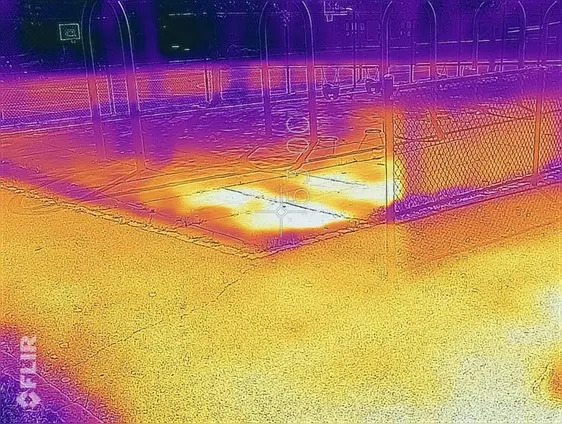
The thermal image Brianna Rodriguez, 18, took of her elementary school's playground swing set in the Nodine Hill neighborhood of Yonkers, New York. Rodriguez was capturing images in urban heat islands for her work with the environmental justice nonprofit Groundwork Hudson Valley. The brighter spots indicate greater heat intensity.
The thermal image Brianna Rodriguez, 18, took of her elementary school’s playground swing set in the Nodine Hill neighborhood of Yonkers, New York. Rodriguez was capturing images in urban heat islands for her work with the environmental justice nonprofit Groundwork Hudson Valley. The brighter spots indicate greater heat intensity.

Ultimately, potential solutions for minimizing the deaths from heat islands should be a lot easier than protecting a city from zombies. Shandas, a chronicler of the “heat dome” phenomenon that settled over Portland, Oregon, with deadly results in its hottest neighborhoods last summer, said immediate action can be taken with lifesaving results.

  • Cities can open more cooling centers during hot days to give residents respite from the heat.
  • Property managers can do checks on apartments when indoor temperatures soar above 90 degrees.
  • Planting trees in heat islands can also have an immediate impact that will only grow as increasing canopy creates more shaded area, while adding oxygen to the local atmosphere.

Such changes, Shandas said, can be implemented ahead of more complex structural changes to amend building codes for cooler buildings with walls or roof construction materials that deflect heat.

Tree planting programs have been implemented in many states. But where the trees are planted matters. While thousands of trees have been planted in Newark in the last several years, the agency in charge would not say how many were planted in the Ironbound. Walking through the Ironbound’s streets, it’s hard to think that this area has been targeted for a tree-based solution.

A few years ago in Rhode Island, a young musician-turned-activist noticed a similar lack of new trees being planted in the least shady neighborhoods in places such as South Providence and Central Falls. Kufa Castro worked with local governments and citizens to make sure that over 190 trees were planted in a two-year period in areas with little tree canopy.

Ultimately, Shandas explained, heat islands are manmade and can be managed.

“It goes back to a lot of conditions that have been created by human decision-making processes,” he said. “What we really want to do is try to figure out what are the ways we can unpack some of this and get ahead of it.”

Down the street from School 23, children took turns running past an open fire hydrant that sprayed water into the middle of the street. Scrambling in a ragged line, they screamed with delight as the cool water hit them. Rodriguez had done the same as a kid.

That night, as fireworks sizzled and boomed overhead, the pavement by the hydrant had long since dried in the heat. The heat of the day, held like a memory by the playground’s metal and rubber matting, slowly released into the night.

— Palm Beach Post reporter Kimberly Miller contributed to this story.

This article originally appeared on Staunton News Leader: City heat islands force vulnerable residents to weather summer’s worst
U.S. swelters in latest heat wave, with Texas and Oklahoma hitting 115°F

Yahoo! News

U.S. swelters in latest heat wave, with Texas and Oklahoma hitting 115°F

David Knowles, Senior Editor – July 20, 2022

The latest extreme heat wave to hit the United States is showing no mercy, leaving more than 105 million Americans in 28 states under heat advisories and excessive heat warnings from the National Weather Service.

Temperatures of 115 degrees Fahrenheit have been recorded in Texas and Oklahoma this week, and more than 211 million people across the country will experience heat of 90 degrees or higher on Wednesday.

In a year when record-breaking heat waves have become commonplace, scientific research has shown that climate change is behind the uptick in their frequency and duration.

“While each heat wave itself is different, and has individual dynamics behind it, the probability of these events is a direct consequence of the warming planet,” Jason Smerdon, a climate scientist for the Columbia Climate School’s Lamont-Doherty Earth Observatory in New York, told ABC News.

Residents of Texas, a state that has been subjected to daily triple-digit temperatures and is in the midst of a mega-drought affecting much of the West, have for weeks been asked to conserve water and electricity.

As in much of Europe, where local officials have urged residents to avoid unnecessary travel as a heat wave there has buckled roadways, airport runways and rail lines, people in several U.S. states have retreated inside air-conditioned spaces.

“When it’s 110 outside, you’re a prisoner in your home,” Andrew Dessler, a professor of atmospheric sciences at Texas A&M University, told the Washington Post. “Is this the kind of life you want to live?”

Like Texas, Oklahoma has been particularly hard hit by the heat, with every one of the state’s 120 weather monitoring stations recording temperatures of 102°F or higher on Tuesday.

Coupled with high humidity, the high temperatures pose a serious risk to human health. The human body sweats in order to cool off, but when humidity is high and there is too much moisture in the atmosphere, that sweat cannot evaporate and results in even higher internal temperatures.

Over the last several days in Spain and Portugal, where temperatures have reached near 110°F, more than 1,700 people have died due to heat-related causes.

Officials in Phoenix are worried that the city will once again break heat-death records this year, especially among the vulnerable homeless population.

“I wouldn’t be surprised if we are in worse shape from a heat-associated-death standpoint than we were last year because there are so many more unsheltered folks that are at 200 to 300 times the risk of heat-associated death,” David Hondula, director of the city’s Office of Heat Response and Mitigation, told Yahoo News.

While climate change skeptics often argue that excessive heat is simply a normal seasonal consequence, scientists have established that the burning of fossil fuels since the start of the Industrial Revolution is responsible for rising temperatures.

This year alone, there have been 92 new high-temperature records set in the U.S., compared with just five new records for low temperatures. That same pattern has played out across the planet, with 188 new high-temperature marks having been set through July 16 as compared with 18 new record lows, data from the National Oceanic and Atmospheric Administration shows.

Of course, that would be exactly what you would expect if, as has been proved, global temperatures are rising. In states sweltering in triple-digit heat, meanwhile, the reality of climate change is playing out in real time.

“It looks like we’re going to stay in the range of highs of 100 to 105 degrees for the next week and a half,” Erin Maxwell, a meteorologist at the National Weather Service in Norman, told the Oklahoman. “But in terms of real relief from the heat, that doesn’t look to be on the horizon any time soon.”

London wakes up to the grim realities of heat wave hell

CBS News

London wakes up to the grim realities of heat wave hell

CBS News – July 20, 2022

London — Some European nations were still battling their worst wildfires in decades Wednesday as the U.K. woke up to relief after its hottest day on record. As CBS News correspondent Ramy Inocencio reports, flames have torn through tinder dry brush in an area covering thousands of miles from Greece to Portugal.

The widespread heat wave that fueled those flames stretched all the way up to Scotland on Tuesday, delivering record-high temperatures in towns and cities across Britain and leaving Londoners shocked to see their town hit by the same kind of bushfires they’ve grown accustomed to watching on the news.

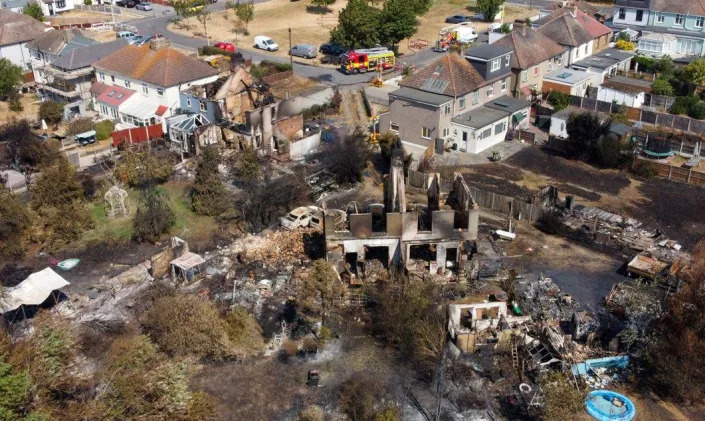
Charred ground and gutted homes in the British capital were testament to the fact that even the stereotypically damp and dreary U.K., where umbrellas and overcoats are more commonplace than air-conditioners, cannot escape the consequences of a rapidly warming climate.

Houses destroyed in a major fire in Wennington, Greater London, England, are seen on July 20, 2022. Fires broke out across London amid record-breaking heat the previous day. / Credit: Chris Ratcliffe/Bloomberg/Getty

Rare wildfires burned and billowed across London on Tuesday as much of England endured 100-plus-degree heat. A new temperature record was set in the town of Coningsby, in eastern England, at 40.3 Celsius, which is over 104 degrees Fahrenheit.

As much of the country has gone a month or more with barely a drop of rain, the scorching temperatures were all it took to ignite matchstick-dry grass and brush in back yards and along highways.

The London Fire Brigade worked its busiest day since World War II, with firefighters responding to more than 2,600 calls and fighting 12 fires simultaneously at one point, according to Mayor Sadiq Khan.

At least 41 properties were destroyed by the fires in London, the mayor said, and 16 firefighters were treated for smoke inhalation or other injuries.

Dee Ncube and her family fled their burning neighborhood in the capital, leaving everything behind. She told Inocencio the only time she’d seen anything like it was in movies or on TV.

“We’ve got nothing, everything’s gone,” Timothy Stock, whose home was among those lost to the flames in the village of Wennington, in Greater London, told CBS News partner network BBC News.

Government cabinet minister Kit Malthouse told other members of Britain’s parliament on Wednesday that 13 people died amid the heat wave after “getting into difficulty in rivers, reservoirs and lakes while swimming in recent days — seven of them teenage boys.”

But while many Londoners were shocked by the extreme heat, people who study the Earth’s changing climate were not.

“This is it, right? This is the climate change that we’ve been promised by scientists,” Dr. Michal Nachmany, a climate policy expert at the London School of Economics, told CBS News. “This level of extreme weather is life threatening, and we really want to make sure that people are not under any illusion that this is serious, and this is here to stay.”

Climate campaigners were also keen to stress Tuesday’s extremes as a warning of danger ahead, and a call to action.

Demonstrators from a protest group called “Just Stop Oil” climbed onto metal framework for signs over the M25, one of Britain’s busiest highways, which encircles London, causing a long traffic backup Wednesday morning.

The group said it was sorry about the disruption for morning commuters, but it declared the M25 “a site of civil resistance,” and warned there would be more protests in the coming days. “This is the moment when climate inaction is truly revealed in all its murderous glory for everyone to see: as an elite-driven death project that will extinguish all life if we let it,” the group said in a statement, announcing its action and demand that the U.K. government stop investing in fossil fuel extraction.

Other countries further south were still battling major blazes on Wednesday that erupted last week. Thousands have died and tens of thousands have been evacuated.

Firefighters in southwest France were still battling twin blazes that cover ground twice the size of Paris for a ninth straight day on Wednesday, but weather conditions improved there overnight, too, and officials said they were gaining control.

“Our assessment is generally positive. The situation improved overnight,” local fire service spokesman Arnaud Mendousse told reporters, according to The Associated Press. President Emmanuel Macron was set to visit the hard-hit Gironde region on Wednesday, where the fires have driven about 37,000 people from their homes. Spain and Portugal were still recording new deaths from the extreme heat and fires, with the toll already well over 1,000.

Spain’s Prime Minister Pedro Sanchez said Wednesday that “more than 500 people died because of such high temperatures” over the last week or so in his country, citing a statistical analysis by a public health institute.

“I ask citizens to exercise extreme caution,” said Sanchez, adding that the “climate emergency is a reality.”

A wildfire burns near a house in Ntrafi, Athens, Greece, July 19, 2022. / Credit: COSTAS BALTAS/REUTERS

Further west, police in Greece ran door to door, shouting at residents to flee just north of Athens as a fire approached.

Evacuations continued in Italy, also, where fires were still growing and temperatures haven’t yet started to ease.

While the worst of the heat wave appeared to be over for much of Western Europe, with temperatures dropping dramatically overnight from the north of Britain to the south of France, climate experts and campaigners were desperate to get the point across that while this week has been an exception, these exceptions are expected to become more common — and get even hotter.

Justice Thomas’ lusterless tenure began with a lie. It keeps getting worse.

The Columbus Dispatch

Justice Thomas’ lusterless tenure began with a lie. It keeps getting worse. |Opinion

Michael M. Lederman – July 19, 2022

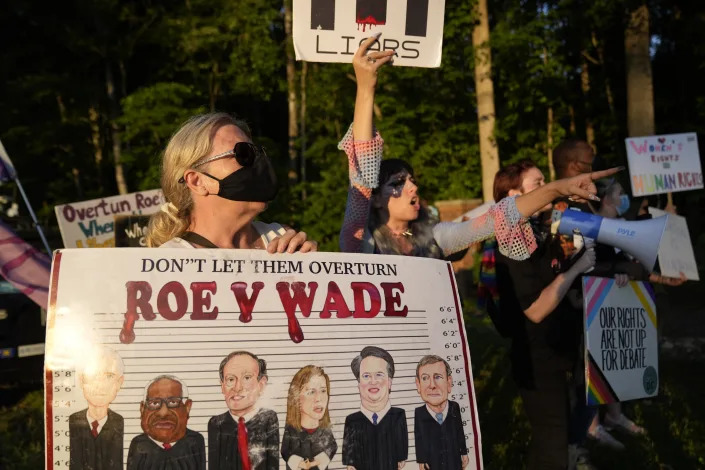
Abortion-rights protesters demonstrate near the home of Associate Justice Clarence Thomas in Fairfax Station, Va. on June 24, 2022, after the Supreme Court opinion in Dobbs v. Jackson Women's Health Organization overturned the landmark 1973 Roe v. Wade decision that established a constitutional right to abortions.
Abortion-rights protesters demonstrate near the home of Associate Justice Clarence Thomas in Fairfax Station, Va. on June 24, 2022, after the Supreme Court opinion in Dobbs v. Jackson Women’s Health Organization overturned the landmark 1973 Roe v. Wade decision that established a constitutional right to abortions.

Dr. Michael M. Lederman is professor of medicine (emeritus) and biomedical ethics at Case Western Reserve University. He is editor-in-chief of the scientific journal Pathogens and Immunity.

Clarence Thomas should not be on the Supreme Court.

He was approved to sit on the court by a timid Democrat majority Senate that was afraid to conclude that this Black man had sexually harassed a colleague, Anita Hill.

More: Petition calls for impeachment of Chatham’s Clarence Thomas. Can you impeach a Supreme Court justice?

The truth of the matter is undetermined but to my eye and in the eyes of many, Professor Anita Hill (and two other women) were telling us the truth and Judge Thomas was lying.

Clarence Thomas, then a Supreme Court nominee, testifies before the Senate Judiciary Committee during his 1991 confirmation hearing.

A terrible start for a Supreme Court justice and it did not get any better. His tenure on the Supreme Court has been lusterless. For many years, he would not even write an opinion and his writings have been largely pedestrian or extremist.

Law professor Anita Hill testifies before the Senate Judiciary Committee on Capitol hill Oct. 11, 1991. In a 1994 book titled " Strange Justice, The selling of Clarence Thomas," written by two Wall Street Journal reporters, the authors revealed that Thomas' volatile Supreme Court confirmation hearings raise fresh questions about his denial that he had talked dirty to Hill while she worked for him as an aide at two government agencies in the 1980s.
Law professor Anita Hill testifies before the Senate Judiciary Committee on Capitol hill Oct. 11, 1991. In a 1994 book titled ” Strange Justice, The selling of Clarence Thomas,” written by two Wall Street Journal reporters, the authors revealed that Thomas’ volatile Supreme Court confirmation hearings raise fresh questions about his denial that he had talked dirty to Hill while she worked for him as an aide at two government agencies in the 1980s.

His wife – Virginia “Ginni” Thomas, a refugee from an 80’s cult –  is a danger to America who has placed Justice Thomas proximate to sedition. Ginni Thomas has worked relentlessly to undermine the outcome of the 2020 presidential election using lies and misrepresentations to urge electors to resist the legitimate transition of government.

More: Clarence Thomas’ wife asks Anita Hill for apology

This is an embarrassment to the court.

But even worse is Clarence Thomas’s refusal to recuse himself from deliberations that address this very election.

Most recently, Thomas delivered the majority opinion in New York State Rifle and Pistol Association v. Bruen, finding that the right to carry concealed handguns in public for the purpose of self-defense is protected by the Second Amendment to the Constitution.

Michael M. Lederman, M.D., is professor of medicine (emeritus) and biomedical ethics at Case Western Reserve University. He is editor-in-chief of the scientific journal Pathogens and Immunity.

More: How to submit guest opinion columns to the Columbus Dispatch

Justice Thomas (and other conservative justices) deliberately misunderstand the Second Amendment. None of the other nine amendments to the Constitution that comprise the Bill of Rights requires justification; those are self-evident and fundamental.

The Second Amendment alone has an explanatory introduction: “A well-regulated Militia, being necessary to the security of a free state,” the Amendment begins, “the right of the people to keep and bear Arms shall not be infringed.”

Nowhere in the Amendment is self-defense mentioned.

More: Supreme Court justices don’t have a code of ethics. Hundreds of judges say that’s a problem

If the framers of Bill of Rights understood that that the right to keep and bear arms was fundamental, why was this unique introduction even warranted?

In the 2008 Heller decision, the unique importance of this introduction is simply ignored as nearly accidental and a labyrinth of decisions is used to link the Amendment to the use of arms in activities such as self-defense. When applied to the original words of the  framers, this is sophistry.

Thomas is marinated in conflicts of interest that render impartiality risible. He has been a headliner for the Eagle Forum (an anti-abortion organization) and the conservative Council for National Policy.

He gave a keynote speech at a fundraiser for the conservative Manhattan Institute and has a longstanding relationship with the Heritage Foundation.

Supreme Court Associate Justice Clarence Thomas, left and his wife Virginia Thomas, right, on Feb. 20, 2016. Virginia Thomas sent weeks of text messages imploring White House Chief of Staff Mark Meadows to act to overturn the 2020 presidential election, according to copies of the messages obtained by The Washington Post and CBS News.

His wife has prominent roles in a number of conservative activist organizations and she was actively engaged in promoting the Jan. 6, 2021, Ellipse rally that ultimately resulted in the violent assault on the Capitol. Mrs. Thomas has given at least $13,000 to support Republicans seeking elected office.

More: What ties does Ginni Thomas, the Supreme Court justice’s wife, have to Jan. 6?

Apparently, Thomas’ colleagues have been unable or unwilling to get Thomas to recuse himself when conflicted.

His service on the court offers a compelling argument for term limits, if not impeachment.

Dr. Michael M. Lederman is professor of medicine (emeritus) and biomedical ethics at Case Western Reserve University. He is editor-in-chief of the scientific journal Pathogens and Immunity.

How not to solve the climate change problem

The Conversation

How not to solve the climate change problem

Kevin Trenberth, Scholar, NCAR; Univ. of Auckland – July 19, 2022

This direct air capture plant in Iceland was designed to capture 4,000 metric tons of carbon dioxide per year. <a href=
This direct air capture plant in Iceland was designed to capture 4,000 metric tons of carbon dioxide per year. Climeworks 2021 via AP Photos

When politicians talk about reaching “net zero” emissions, they’re often counting on trees or technology that can pull carbon dioxide out of the air. What they don’t mention is just how much these proposals or geoengineering would cost to allow the world to continue burning fossil fuels.

There are many proposals for removing carbon dioxide, but most make differences only at the edges, and carbon dioxide concentrations in the atmosphere have continued to increase relentlessly, even through the pandemic.

I’ve been working on climate change for over four decades. Let’s take a minute to come to grips with some of the rhetoric around climate change and clear the air, so to speak.

What’s causing climate change?

As has been well established now for several decades, the global climate is changing, and that change is caused by human activities.

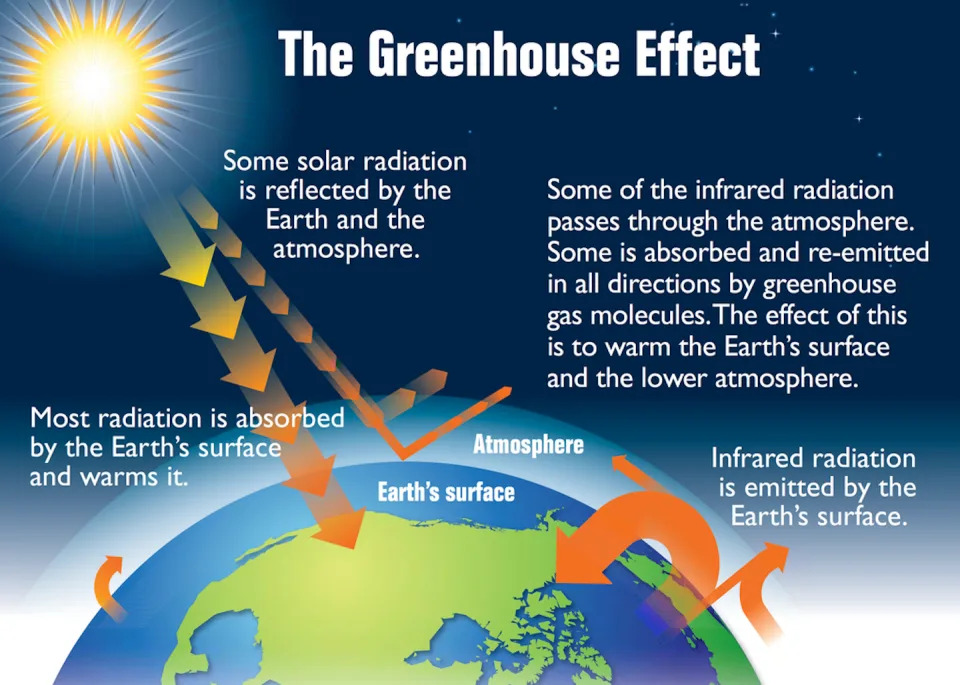
When fossil fuels are burned for energy or used in transportation, they release carbon dioxide – a greenhouse gas that is the main cause of global heating. Carbon dioxide stays in the atmosphere for centuries. As more carbon dioxide is added, its increasing concentration acts like a blanket, trapping energy near Earth’s surface that would otherwise escape into space.

When the amount of energy arriving from the Sun exceeds the amount of energy radiating back into space, the climate heats up. Some of that energy increases temperatures, and some increases evaporation and fuels storms and rains.

How the greenhouse effect works. <a href=
How the greenhouse effect works. EPA

Because of these changes in atmospheric composition, the planet has warmed by an estimated 1.1 degrees Celsius (2 F) since about 1880 and is well on the way to 1.5 C (2.7 F), which was highlighted as a goal not to be crossed if possible by the Paris Agreement. With the global heating and gradual increases in temperature have come increases in all kinds of weather and climate extremes, from flooding to drought and heat waves, that cause huge damage, disruption and loss of life.

Studies shows that global carbon dioxide emissions will need to reach net-zero carbon emissions by midcentury to have a chance of limiting warming to even 2 C (3.6 F).

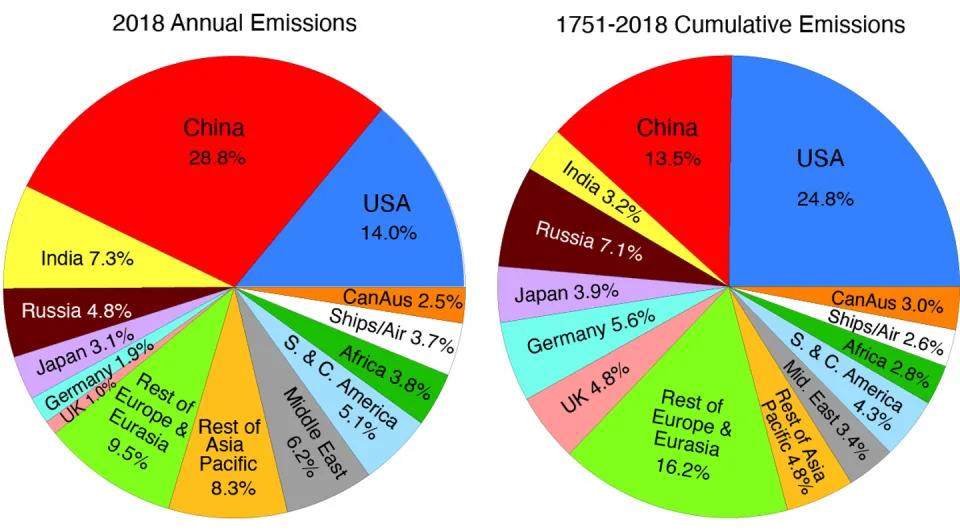
Currently, the main source of carbon dioxide is China. But accumulated emissions matter most, and the United States leads, closely followed by Europe, China and others.

Estimated shares of carbon dioxide emissions from fossil fuels in 2018 compared with cumulative emissions over time, based on data released by BP. Kevin Trenberth, Author provided
What works to slow climate change?

Modern society needs energy, but it does not have to be from fossil fuels.

Studies show that the most effective way to address the climate change problem is to decarbonize the economies of the world’s nations. This means sharply increasing use of renewable energy – solar and wind cost less than new fossil fuel plants in much of the world today – and the use of electric vehicles.

Unfortunately, this changeover to renewables has been slow, due in large part to the the huge and expensive infrastructure related to fossil fuels, along with the vast amount of dollars that can buy influence with politicians.

What doesn’t work?

Instead of drastically cutting emissions, companies and politicians have grasped at alternatives. These include geoengineeringcarbon capture and storage, including “direct air capture”; and planting trees.

Here’s the issue:

Geoengineering often means “solar radiation management,” which aims to emulate a volcano and add particulates to the stratosphere to reflect incoming solar radiation back to space and produce a cooling. It might partially work, but it could have concerning side effects.

The global warming problem is not sunshine, but rather that infrared radiation emitted from Earth is being trapped by greenhouse gases. Between the incoming solar and outgoing radiation is the whole weather and climate system and the hydrological cycle. Sudden changes in these particles or poor distribution could have dramatic effects.

Some methods of solar radiation management that have been proposed. <a href=
Some methods of solar radiation management that have been proposed. Chelsea Thompson, NOAA/CIRES

The last major volcanic eruption, of Mt. Pinatubo in 1991, sent enough sulfur dioxide and particulates into the stratosphere that it produced modest cooling, but it also caused a loss of precipitation over land. It cooled the land more than the ocean so that monsoon rains moved offshore, and longer term it slowed the water cycle.

Carbon capture and storage has been researched and tried for well over a decade but has sizable costs. Only about a dozen industrial plants in the U.S. currently capture their carbon emissions, and most of it is used to enhance drilling for oil.

Direct air capture – technology that can pull carbon dioxide out of the air – is being developed in several places. It uses a lot of energy, though, and while that could potentially be dealt with by using renewable energy, it’s still energy intensive.

Boris Johnson, then mayor of London, plants a tree in 2008. <a href=
Boris Johnson, then mayor of London, plants a tree in 2008. Peter Macdiarmid/Getty Images

Planting trees is often embraced as a solution for offsetting corporate greenhouse gas emissions. Trees and vegetation take up carbon dioxide though photosynthesis and produce wood and other plant material. It’s relatively cheap.

But trees aren’t permanent. Leaves, twigs and dead trees decay. Forests burn. Recent studies show that the risks to trees from stress, wildfires, drought and insects as temperatures rise will also be larger than expected.

How much does all this cost?

Scientists have been measuring carbon dioxide at Mauna Loa, Hawaii, since 1958 and elsewhere. The average annual increase in carbon dioxide concentration has accelerated, from about 1 part per million by volume per year in the 1960s to 1.5 in the 1990s, to 2.5 in recent years since 2010.

This relentless increase, through the pandemic and in spite of efforts in many countries to cut emissions, shows how enormous the problem is.

Carbon dioxide concentrations at Mauna Loa, Hawaii. The monthly mean, in red, rises and falls with the growing seasons. The black line is adjusted for the average seasonal cycle. <a href=
Carbon dioxide concentrations at Mauna Loa, Hawaii. The monthly mean, in red, rises and falls with the growing seasons. The black line is adjusted for the average seasonal cycle. Kevin Trenberth, based on NOAA dataCC BY-ND

Usually carbon removal is discussed in terms of mass, measured in megatons – millions of metric tons – of carbon dioxide per year, not in parts per million of volume. The mass of the atmosphere is about 5.5×10¹⁵ metric tons, but as carbon dioxide (molecular weight 42) is heavier than air (molecular weight about 29), 1 part per million by volume of carbon dioxide is about 7.8 billion metric tons.

According to the World Resources Institute, the range of costs for direct air capture vary between US$250 and $600 per metric ton of carbon dioxide removed today, depending on the technology, energy source and scale of deployment. Even if costs fell to $100 per metric ton, the cost of reducing the atmospheric concentrations of carbon dioxide by 1 part per million is around $780 billion.

Keep in mind that the carbon dioxide concentration in the atmosphere has risen from about 280 parts per million before the industrial era to around 420 today, and it is currently rising at more than 2 parts per million per year.

Tree restoration on one-third to two-thirds of suitable acres is estimated to be able to remove about 7.4 gigatons of carbon dioxide by 2050 without displacing agricultural land, by WRI’s calculations. That would be more than any other pathway. This might sound like a lot, but 7 gigatons of carbon dioxide is 7 billion metric tons, and so this is less than 1 part per million by volume. The cost is estimated to be up to $50 per metric ton. So even with trees, the cost to remove 1 part per million by volume could be as much as $390 billion.

Geoengineering is also expensive.

So for hundreds of billions of dollars, the best prospect with these strategies is a tiny dent of 1 part per million by volume in the carbon dioxide concentration.

This arithmetic highlights the tremendous need to cut emissions. There is no viable workaround.

This article is republished from The Conversation, a nonprofit news site dedicated to sharing ideas from academic experts. It was written by: Kevin TrenberthUniversity of Auckland.

Read more:

Kevin Trenberth does not work for, consult, own shares in or receive funding from any company or organization that would benefit from this article, and has disclosed no relevant affiliations beyond their academic appointment.

European Heat Wave Kills Hundreds, Threatens Tourism Revival

Daily Beast

European Heat Wave Kills Hundreds, Threatens Tourism Revival

Barbie Latza Nadeau – July 16, 2022

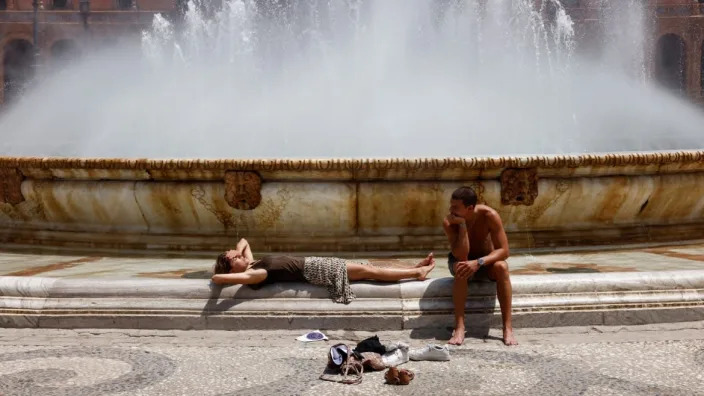
Jon Nazca/Reuters
Jon Nazca/Reuters

Extreme temperatures and devastating droughts across Europe are quickly turning what was supposed to finally be a return to normalcy for the region’s tourist entities into an inferno.

More than 360 people have died in Spain since July 10 in an historic heat wave that has seen temperatures hover around 115 degrees for several days in a row. At least 84 of the deaths have occurred in the last 72 hours, prompting the Spanish government to urge people to limit exposure to the heat and ban some tourist activities like guided walks in Barcelona during the midday hours.

At the Madrid Zoo, several cold-water reptiles have perished, and zookeepers are giving popsicles to many creatures that are refusing to eat due to the extreme conditions that are not expected to let up before the end of the month. Spain already endured an early summer heat wave with 829 people dying between June 11 and 20. Temperatures this time around are expected to be at least two degrees higher.

<div class="inline-image__credit">Susana Vera/Reuters</div>
Susana Vera/Reuters

In Portugal, more than 235 people have died this month from heat-related causes, and temperatures have continued to climb. Wildfires across the regions have led to the evacuation of several tourist camping and outdoor recreational areas that were booked for the entire summer, sending the travel industry into chaos, according to the government.

The Italian government has called a national emergency along the River Po, which cuts across northern Italy and is so low people can walk across it at certain points. The drought has also led to extreme water restrictions, including turning off ornamental fountains in Milan and restricting hair dressers from double shampooing clients to save water. In southern Italy, droughts have sparked wildfires, including several devastating blazes within Rome’s city limits in the last two weeks.

<div class="inline-image__credit">Isabel Infantes/Reuters</div>
Isabel Infantes/Reuters

In the U.K., where summers are often disappointingly gray and air conditioning is rare, people were told to avoid alcohol and stay inside over the weekend as temps there are set to top 104 degrees. The Met Office issued a red warning for London, Manchester and York until Tuesday, warning that Britons “are not adapted to what is coming.”

The never-before-used weather red alert signals a danger to life or risk of serious illness to the general population due to extreme heat. “Population-wide adverse health effects are likely to be experienced, not limited to those most vulnerable to extreme heat, leading to potential serious illness or danger to life,” the Met Office said in a statement Saturday.“Significantly more people are likely to visit coastal areas, lakes and rivers leading to increased risk of water safety incidents.”

Fires are also raging across the South of France and Greek islands, complicating travel and isolating some of the region’s beloved summer getaway spots.

National weather agencies across the affected region warn that it may be another week before temperatures start to return to normal.

In a Twist, Old Coal Plants Help Deliver Renewable Power. Here’s How.

The New York Times

In a Twist, Old Coal Plants Help Deliver Renewable Power. Here’s How.

Elena Shao – July 15, 2022

Silos of ash and other waste at the Brayton Point Power Station, a retired coal-fired power plant in Somerset, Mass., on July 7, 2022. (Simon Simard/The New York Times)

Across the country, aging and defunct coal-burning power plants are getting new lives as solar, battery and other renewable energy projects, partly because they have a decades-old feature that has become increasingly valuable: They are already wired into the power grid.

The miles of high-tension wires and towers often needed to connect power plants to customers far and wide can be costly, time-consuming and controversial to build from scratch. So solar and other projects are avoiding regulatory hassles and potentially speeding up the transition to renewable energy by plugging into the unused connections left behind as coal becomes uneconomical to keep burning.

In Illinois alone, at least nine coal-burning plants are on track to become solar farms and battery storage facilities in the next three years. Similar projects are taking shape in Nevada, New Mexico, Colorado, North Dakota, Nebraska, Minnesota and Maryland. In Massachusetts and New Jersey, two retired coal plants along the coast are being repurposed to connect offshore wind turbines to the regional electrical grids.

“A silver lining of having had all of these dirty power plants is that now we have fairly robust transmission lines in those places,” said Jack Darin, director of the Illinois chapter of the Sierra Club, an environmental advocacy group. “That’s a huge asset.”

Over the past two decades, more than 600 coal-burning generators totaling about 85 gigawatts of generating capacity have retired, according to the U.S. Energy Information Administration. (Individual power plants can have more than one generator.) A majority of the 266 remaining coal-burning power plants in the country were built in the 1970s and 1980s and are nearing the end of their approximately 50-year operational lifetime.

Most of that retired capacity will not be replaced with coal, as the industry gets squeezed out by cheaper renewable energy and tougher emissions regulations. At the same time, renewable energy producers are facing obstacles getting their projects connected to the grid. Building new power lines is costly and controversial, as neighbors often oppose transmission lines that can disturb scenic vistas or potentially reduce property values nearby. In addition, getting power line projects approved by regulators can be time-consuming.

Building and operating renewable energy projects has long been cheaper than fossil fuel plants. The barrier “is not economics anymore,” said Joseph Rand, a scientist at the Lawrence Berkeley National Laboratory, which conducts research on behalf of the U.S. Department of Energy. “The hardest part is securing the interconnection and transmission access.”

This makes old coal plants an attractive option as sites for renewable energy projects. Not only are the old plants already wired into the transmission system, they also have substations, which help convert electricity to a supply that is suitable for use in homes and businesses.

That was a key factor in choosing Brayton Point Power Station as a grid connection point for a 1,200-megawatt wind farm 37 miles off the coast of Massachusetts, said Michael Brown, CEO of the offshore wind developer Mayflower Wind.

At 1,600 megawatts, the coal-fired plant was the largest one in New England when it retired in 2017. The facility itself, located in the waterfront town of Somerset, will be replaced by an undersea-cable factory owned by the Italian company Prysmian Group. And the offshore wind project will connect to the grid at the Brayton Point interconnection point, making use of the existing substation there.

In one of the most ambitious efforts, Vistra Corp., a Texas-based power generation company that also owns a variety of power plants in California and Illinois, said it would spend $550 million to turn at least nine of its coal-burning facilities in Illinois into sites for solar panels and battery storage.

The largest, a plant in Baldwin, Illinois, that is set to retire by 2025, will get 190,000 solar panels on 500 acres of land. Together, the panels will generate 68 megawatts of power, enough to supply somewhere between 13,600 and 34,000 homes, depending on the time of year. It will also get a battery that can store up to 9 megawatts, which will help distribute electricity when demand peaks or the sun is not shining.

Vistra CEO Curtis Morgan said it became clear that the power company would need to “leave coal behind,” and it was eager to build new zero-emissions projects to replace some of the power from those plants. However, he said, the slow process of getting approval from grid operators, which coordinate and monitor electricity supplies, has been a roadblock for a number of Vistra’s proposed projects.

A surge in proposals for wind, solar and battery storage projects has overwhelmed regulators in recent years, according to an analysis from the Lawrence Berkeley National Laboratory, which overlooks the University of California’s Berkeley campus. In 2021, wait times had almost doubled from a decade before, to nearly four years, and that does not include the increasing number of projects that are withdrawing from the process entirely.

If every project currently waiting for approval gets built, “we could hit 80% clean energy by 2030,” said Rand, the lead author of the report. “But we’d be lucky if even a quarter of what’s proposed actually gets completed.”

Three of Vistra’s battery storage projects in Illinois — at the Havana, Joppa and Edwards coal plants — also benefited from an infusion of grants from a state law, the Climate and Equitable Jobs Act, aimed at supporting a “just transition” for coal-dependent communities toward renewable energy. It was signed by Gov. J.B. Pritzker last fall and also required all fossil-fuel-burning plants to cut their emissions to zero by 2045, which could lead to their closure, though most of the coal plants in Illinois were already poised to shut down within a decade.

The Coal-to-Solar Energy Storage Grant Program that emerged from the legislation also supports two other battery projects, owned by NRG Energy, which will be built at the Waukegan and Will County coal-burning power stations.

The advantage of building renewable energy projects on old coal plants is twofold, said Sylvia Garcia, director of the Illinois Department of Commerce and Economic Opportunity, which oversees the coal-to-solar program. First, projects benefit from the ease of reusing an existing connection to the grid. Second, it is an effort toward “trying to reinvest in the communities that have lost those coal plants” in the first place, she said.

While the new projects will temporarily create construction jobs, operating a solar plant or battery facility usually does not require as many employees. The Baldwin plant previously employed around 105 full-time workers. And while Vistra has not yet finalized numbers on a site-by-site basis, the nine Illinois projects combined will create 29 full-time jobs annually, the company’s communications director, Meranda Cohn, said in an email.

Coal plants also typically sit on a sizable parcel of land, and redeveloping those sites into renewable energy projects is a way to put something productive on a piece of property that might otherwise go unused.

“It’s really shifting a very negative resource into one that is more positive for the community,” said Jeff Bishop, CEO of Key Capture Energy, which plans to locate a 20-megawatt battery storage project at a retired coal plant near Baltimore.

Elsewhere in Holyoke, Massachusetts, the retirement of Mount Tom Station, a coal plant that had operated for more than five decades, presented a number of possibilities, said Julie Vitek, vice president of government and regulatory affairs for the power producer ENGIE North America. After meetings with government officials, environmental groups and residents, a solar farm emerged as the best way to “give new life to the industrial land at Mount Tom,” she said.

Today, the property is home to some 17,000 solar panels and a small battery installation that form a community solar project managed by Holyoke Gas & Electric, a city-owned utility that gives customers the choice to opt in to receiving solar power from the project. The panels produce about 6 megawatts of power, enough to power about 1,800 homes.

It is not only solar, battery and wind developers that are eyeing old coal plants for their infrastructure. TerraPower, a nuclear power venture founded by Bill Gates, is locating a 345-megawatt advanced nuclear reactor adjacent to a retiring coal plant in Kemmerer, Wyoming. The location will not only allow the reactor to take advantage of the existing grid connection but also to make use of the coal plant’s cooling system, said Chris Levesque, TerraPower’s president and CEO.

“In a way, it’d be a real shame not to make use of those coal plants,” Levesque said.

‘Things Are Going to Break’: Texas Power Plants Are Running Nonstop

Bloomberg

‘Things Are Going to Break’: Texas Power Plants Are Running Nonstop

Will Wade, Mark Chediak and Naureen Malik – July 15, 2022

(Bloomberg) — As searing Texas heat drives power demand to record highs, the state’s grid operator is ordering plants to run at a historic pace, often forcing them to put off maintenance to keep cranking out electricity. That’s helped keep the lights on, for now, but the short-term focus is putting even more stress on a system that’s already stretched near the limit.

Twice in the past week, officials have called on Texans to limit electricity use during scorching afternoons as demand inched perilously close to overwhelming supply. Now, there are growing concerns over how long power plants can maintain the grueling pace as they run nonstop, according to Michele Richmond, executive director of Texas Competitive Power Advocates, a generator industry group.

“Things are going to break,” she said. “We have an aging fleet that’s being run harder than it’s ever been run.”

Also See: Texas Confident Stressed Grid Will Hold Up Amid Summer Heat

To meet the surge in power demand, Ercot, the grid operator, is leaning heavily on a mechanism called reliability unit commitments to ensure there’s enough supply. Plants are being regularly ordered to go into service, or remain in operation, and skip any scheduled maintenance. The measure also overrides shutdowns for economic factors or any other issues. And Ercot is using the rule more than ever before as the state battles bout after bout of extreme weather.

The Electric Reliability Council of Texas, as the operator is formally known, called for 2,890 hours of RUCs system-wide in the first half of this year. That’s more than triple the 801 hours in the first half of 2021, according to data from Ercot’s independent market monitor provided by Richmond. For all of 2020, there were 224 RUC hours.

The problem is that deferring repairs now will likely come back to haunt power-plant owners, Richmond said.

“If you put off preventative maintenance because it’s needed for reliability, it increases the chances you’ll need a more comprehensive outage” later on as plants start to malfunction, she said.

Growing Population, Crypto

The situation underscores that the Texas grid is relying on short-term solutions for what’s poised to be a long-term problem. The state is contending with a population boom that’s driven demand higher. Crypto mining has also taken off in the past year, bringing with it the industry’s power-intensive operations. Meanwhile climate change has made extreme weather events that drive up electricity use more likely to occur and more severe — creating situations like a deadly February 2021 freeze that caused blackouts across the state.

Brad Jones, Ercot’s interim chief executive officer, is aware he’s walking a fine line. On one hand, there have been six times in the past year that using RUCs have enabled the operator to avoid declaring grid emergencies. Or as Peter Lake, chairman of the Public Utility Commission of Texas, said at a June 22 hearing: Six times when the grid otherwise would’ve been “on the brink of rolling blackouts.”

However, Jones says he knows that forcing plants to stay in service is raising the risk of breakdowns. For example, a key concern at this time of year is boiler-tube leaks, especially at older plants. These leaks don’t always mean a plant must shut down immediately, but if they’re not closely monitored they can lead to bigger, more costly repairs.

“Typically, a generator can run for a while with the water leaking,” Jones said in an interview. “The question is, how long is that.”

The grid operator is in constant contact with generators and works to give them time to make needed repairs when conditions allow, Jones said. Ultimately, the state needs more power plants, and regulators are working on ways to make that happen, he said.

Ercot and other operators are facing dual challenges, said Michael Webber, an energy-resources professor at the University of Texas at Austin. Most companies schedule maintenance during the spring and fall, when the weather is mild and power use is typically lower.

But climate change means these windows of temperate weather are getting shorter. This year, for instance, an early May heat wave forced some generators to skip tune-ups. And periods of high heat are also lasting longer, putting more stress on power plants that are running all-out for weeks at a time.

Maintenance for power plants — especially older ones — can be time consuming and complicated, said Webber, who also serves as chief technology officer of Energy Impact Partners, a clean tech venture fund

“You kind of have to dismantle the plant,” he said. “It’s not something you can do in a couple of hours.”

All of this is exacerbated by the state’s aging fleet. The average age of coal-powered plants in Texas is about 50 years, and natural-gas plants average about 30 years.

“It’s kind of like humans — we need to rest and recover,” Webber said. “If we run full speed for a long time, we can collapse.”

Poll shows Tight Race for Control of Congress as Class Divide Widens

THe New York Times

Poll Shows Tight Race for Control of Congress as Class Divide Widens

Nate Cohn – July 13, 2022

The fight for control of Congress may come down to the big contrast in voters who cite the economy as their top issue and those who cite abortion and guns as their foremost concern.   (Stefani Reynolds/The New York Times)
The fight for control of Congress may come down to the big contrast in voters who cite the economy as their top issue and those who cite abortion and guns as their foremost concern. (Stefani Reynolds/The New York Times)

With President Joe Biden’s approval rating mired in the 30s and with nearly 80% of voters saying the country is heading in the wrong direction, all the ingredients seem to be in place for a Republican sweep in the November midterm elections.

But Democrats and Republicans begin the campaign in a surprisingly close race for control of Congress, according to the first New York Times/Siena College survey of the cycle.

Overall among registered voters, 41% said they preferred Democrats to control Congress compared with 40% who preferred Republican control.

Among likely voters, Republicans led by 1 percentage point, 44% to 43%, reflecting the tendency for the party out of power to enjoy a turnout advantage in midterms.

The results suggest that the wave of mass shootings and the recent Supreme Court decision to overturn Roe v. Wade have at least temporarily insulated the Democrats from an otherwise hostile national political environment while energizing the party’s predominantly liberal activist base.

But the confluence of economic problems and resurgent cultural issues has helped turn the emerging class divide in the Democratic coalition into a chasm, as Republicans appear to be making new inroads among nonwhite and working-class voters — perhaps especially Hispanic voters — who remain more concerned about the economy and inflation than abortion rights and guns.

For the first time in a Times/Siena national survey, Democrats had a larger share of support among white college graduates than among nonwhite voters — a striking indication of the shifting balance of political energy in the Democratic coalition. As recently as the 2016 congressional elections, Democrats won more than 70% of nonwhite voters while losing among white college graduates.

With four months to go until the election, it is far too soon to say whether the campaign will remain focused on issues such as abortion and gun control for long enough for the Democrats to avoid a long-expected midterm rout. If it does, a close national vote would probably translate to a close race for control of Congress, as neither party enjoys a clear structural advantage in the race. Partisan gerrymandering has slightly tilted the map toward the Republicans in the House, but Democrats enjoy the advantages of incumbency and superior fundraising in key districts.

Recent unfavorable news for Democrats, in the form of Supreme Court rulings, and some tragic news nationally might ordinarily mean trouble for the party in power, but that is not what the results suggest.

The survey began 11 days after the Supreme Court’s decision to overturn Roe v. Wade, when cellphones were still buzzing with news alerts about the mass shooting in Highland Park, Illinois.

In an open-ended question, those who volunteered that issues related to guns, abortion or the Supreme Court were the most important problem facing the country represented about 1 in 6 registered voters combined. Those voters preferred Democratic control of Congress, 68% to 8%.

Some of the hot-button cultural issues thought to work to the advantage of Republicans at the beginning of the cycle, such as critical race theory, have faded from the spotlight. Only 4% of voters combined said education, crime or immigration was the most important issue facing the country.

The Times/Siena survey is not the first to suggest that the national political environment has improved for Democrats since the Supreme Court overturned Roe. On average, Democrats have gained about 3 points on the generic congressional ballot compared with surveys taken beforehand.

In the wake of the court’s ruling, the poll finds greater public support for legal abortion than previous Times/Siena surveys. Sixty-five percent of registered voters said abortion should be mostly or always legal, up from 60% of registered voters in September 2020.

The proportion of voters who opposed the court’s decision — 61% — was similar to the share who said they supported Roe v. Wade two years ago.

Democrats are maintaining the loyalty of a crucial sliver of predominantly liberal and highly educated voters who disapprove of Biden’s performance but care more about debates over guns, democracy and the shrinking of abortion rights than the state of the economy.

Voters who said issues related to abortion, guns or threats to democracy were the biggest problem facing the country backed Democrats by a wide margin, 66% to 14%.

For some progressive voters, recent conservative policy victories make it hard to stay on the sidelines.

Lucy Ackerman, a 23-year-old graphic designer in Durham, North Carolina, said Biden had repeatedly failed to live up to election promises. She recently registered with the Democratic Socialists of America. Nonetheless, she has committed herself to getting as many Democrats elected this fall as possible.

She said the Supreme Court’s decision to overturn Roe made politics personal: She and her wife married after the decision leaked, out of fear that the court might roll back same-sex marriage rights next.

“The recent events have given me this push to do more,” she said. “I’ve gotten more involved in political efforts locally. I’ve helped sign friends up to vote.”

The liberal backlash against conservative advances in the court appears to have helped Democrats most among white college graduates, who are relatively liberal and often insulated by their affluence from economic woes. Just 17% of white college-educated Biden voters said an economic issue was the most important one facing the country, less than any other racial or educational group.

Overall, white college graduates preferred Democratic control of Congress, 57-36. Women propelled Democratic strength among the group, with white college-educated women backing Democrats, 64-30. Democrats barely led among white college-educated men, 46-45.

Although the survey does not show an unusually large gender gap, the poll seems to offer some evidence that the court’s abortion ruling may do more to help Democrats among women. Nine percent of women said abortion rights was the most important issue, compared with 1% of men.

The fight for congressional control is very different among the often less affluent, nonwhite and moderate voters who say the economy or inflation is the biggest problem facing the country. They preferred Republican control of Congress, 62% to 25%, even though more than half of the voters who said the economy was the biggest problem also said abortion should be mostly legal.

Just 74% of the voters who backed Biden in the 2020 election, but who said the economy or inflation was the most important problem, said they preferred Democratic control of Congress. In contrast, Democrats were the choice of 87% of Biden voters who saw abortion or guns as the most important issue.

The economy may be helping Republicans most among Hispanic voters, who preferred Democrats to control Congress, 41-38. Although the sample size is small, the finding is consistent with the longer-term deterioration in Democratic support among the group. Hispanics voted for Democrats by almost a 50-point margin in the 2018 midterms, according to data from Pew Research, but President Donald Trump made surprising gains with them in 2020.

No racial or ethnic group was likelier than Hispanic voters to cite the economy or inflation as the most important issue facing the country, with 42% citing an economic problem compared with 35% of non-Hispanic voters.

Republicans also appear poised to expand their already lopsided advantage among white voters without a college degree. They back Republicans by more than a 2 to 1 ratio, 54-23. Even so, nearly one-quarter remain undecided, compared with just 7% of white college graduates.

As less-engaged working-class voters tune in, Republicans may have opportunities for additional gains. Historically, the party out of power excels in midterm elections, in no small part by capitalizing on dissatisfaction with the president’s party.

Only 23% of undecided voters approved of Biden’s job performance.

Silvana Read, a certified nursing assistant who lives outside Tampa, Florida, is one of the Hispanic voters whom Republicans will try to sway to capitalize on widespread dissatisfaction with Biden.

An immigrant from Ecuador, she despised Trump’s comments about women and foreigners but voted for him because her husband convinced her it would help them financially. Now she and her husband, 56 and 60, blame Biden for their falling 401(k)s.

“My husband, he sees the news on the TV, he says, ‘I don’t think I can retire until 75,’” she said. “We can’t afford to finish paying the mortgage.”

Still, her allegiance to the Republican Party does not extend far beyond Trump. She offered no preference in the fight for control of Congress. She does not plan to vote in the midterms.

Could this SCOTUS case push America toward one-party rule?

The Week

Could this SCOTUS case push America toward one-party rule?

Grayson Quay, Weekend editor – July 12, 2022

The Supreme Court.
The Supreme Court. Illustrated | Getty Images

The Supreme Court has announced its intention to take up Moore v. Harper this fall, a case that critics claim is “perhaps the gravest threat to American democracy since the Jan. 6 attack.” Here’s everything you need to know: 

What’s at stake in ‘Moore v. Harper’?

North Carolina House Speaker Timothy Moore (R) is suing a voter named Rebecca Harper as part of a dispute over a federal electoral map drawn by the state’s Republican-controlled legislature. According to The Carolina Journal, the case will test a legal theory known as the “independent state legislature doctrine,” which asserts that “only the state legislature has the power to regulate federal elections, without interference from state courts.”

Article I, Section 4 of the U.S. Constitution states that the “Times, Places, and Manner of holding Elections for Senators and Representatives, shall be prescribed in each State by the Legislature thereof.” Proponents of the “independent state legislature doctrine” argue that this clause gives state legislatures the power to draw congressional districts, set rules for federal elections, and appoint presidential electors, and that state courts have no power to interfere — even if the legislature blatantly violates the state constitution.

Which, in this case, it totally did. The North Carolina Supreme Court ruled in February that the proposed map, which would have guaranteed Republicans easy wins in 10 of the state’s 14 districts, was “unconstitutional beyond a reasonable doubt under the … North Carolina Constitution.”

The situation in North Carolina is not so clear-cut, however. Robert Barnes noted in The Washington Post that the state’s General Assembly passed a law two decades ago empowering state courts to review electoral maps and even create their own “interim districting plan[s].” Moore’s lawyers must therefore prove that the legislature violated the U.S. Constitution by abdicating its own authority over redistricting.

The U.S. Supreme Court rejected the case in March but agreed on June 30 to hear it. Justices Clarence Thomas, Samuel Alito, Neil Gorsuch, and Brett Kavanaugh have all signaled their openness to Moore’s argument. The Washington Post‘s editorial board suggests that Chief Justice John Roberts — who three years ago left open the possibility that state courts could override partisan gerrymanders — is now “poised” to side with Moore as well. The board considers Justice Amy Coney Barrett “a possible swing vote.” All three of the court’s liberals are expected to reject the independent state legislature doctrine.

The case will be heard during the term beginning in October 2022, with a decision expected in the summer of 2023 — just in time to upend the 2024 elections.

What about the Electoral College?

In January, Ryan Cooper wrote for The Week that the state of Wisconsin “effectively exists under one-party rule.” Democrats can still win statewide elections — say, for governor or U.S. Senate — but state legislative districts are hopelessly gerrymandered in favor of Republicans. If the Supreme Court sides with Moore, GOP-controlled legislatures in states like Wisconsin would have full authority to rig not only their own states’ legislative elections, but elections to the U.S. House of Representatives as well.

And it might not stop there. Article II, Section 1 of the U.S. Constitution empowers each state to “appoint, in such Manner as the Legislature thereof may direct, a Number of Electors” equal to that state’s number of senators and representatives. The clause doesn’t say anything about the popular vote. This means, in theory, that state legislators can appoint whoever they want to the Electoral College. If SCOTUS side with Moore next summer on the question of federal redistricting, they’re likely to apply the same reasoning to presidential elections. This interpretation was floated by conservative justices — including Thomas — during the Bush v. Gore (2000) case that handed George W. Bush the presidency.

The Electoral Count Act of 1887 stipulates that each state’s slate of electors must be certified by the governor of that state. In states like Wisconsin— which has a Democratic governor — this law could prevent the Republican-led legislature from handing the state’s electoral votes to a losing Republican candidate.

But wait — if the independent state legislature doctrine is correct, then the governor has no right to usurp the legislature’s constitutionally granted powers. That provision of the Electoral Count Act (ECA) would be struck down.

This idea “is quickly becoming dogma among Republican legal apparatchiks,” Cooper wrote. Convincing Republican-controlled states won by President Biden to submit alternate slates of Republican electors was a key part of Trump lawyer John Eastman’s strategy to overturn the 2020 presidential election. His plan also rested on the assumption that the ECA is “likely unconstitutional.”

What’s the worst-case scenario?

Zach Praiss of the nonprofit Accountable Tech and progressive talk show host Thom Hartmann have laid out similar nightmare scenarios that could arise if SCOTUS rules in Moore’s favor.

Hartmann imagines a 2024 presidential contest between Biden and Florida Gov. Ron DeSantis in which Biden wins the popular vote in Georgia, North Carolina, Wisconsin, Michigan, Pennsylvania, and Arizona. The GOP-controlled legislatures of these six states then decide to disregard the will of the voters and award their 88 electoral votes to DeSantis, making him the winner and president-elect.

Republicans control both legislative houses in 29 states, plus the unicameral legislature of Nebraska, and they might soon gain the power to gerrymander themselves into a permanent majority. Those states control 306 electoral votes, more than enough to elect a president.

“It is difficult … to see the desire to put sole control of election rules in the hands of a partisan legislative body as anything more than a power grab,” argued Christine Adams in The Washington Post. Laurence H. Tribe and Dennis Aftergut were even blunter in the Los Angeles Times: “Adopting the independent state legislature theory would amount to right-wing justices making up law to create an outcome of one-party rule.”