Flash flood closes Palm Springs Aerial Tramway for a week as monsoons slam California deserts
Gregory Yee – August 9, 2022
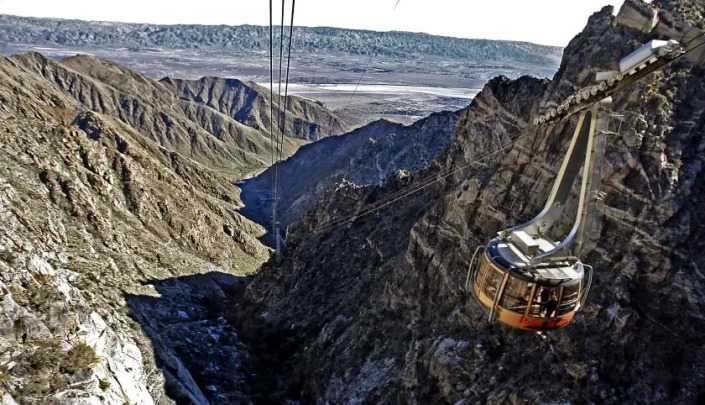
The Palm Springs Aerial Tramway, pictured in 2011, is scheduled to reopen Monday after a flash flood sent mud and debris into the area and stranded more than 200 people. (Luis Sinco / Los Angeles Times)
A flash flood that stranded more than 200 people on the Palm Springs Aerial Tramway on Monday in California’s latest bout of heavy summer rainfall is expected to close the attraction for a week.
Citing extended cleanup efforts, officials said the tramway is scheduled to reopen next Monday.
“After completing a thorough inspection earlier today, we realized that it would take additional days for the mud and debris to be fully removed from our equipment and dock area,” said Nancy Nichols, the tramway’s general manager. “We sincerely regret the inconvenience this is causing our visitors and appreciate their understanding.”
The National Weather Service in San Diego had warned that storms developing in the mountains and deserts Monday afternoon were becoming more numerous and could lead to torrential rainfall.
In a preliminary local storm report published Tuesday morning, the weather service said 1.99 inches of rain fell at San Jacinto Peak around 4 p.m. Monday, causing “impassible mudflows along the exit road from the Valley Station.”
The mudflows temporarily stranded more than 200 people on the tramway, the weather service said. The flow appeared to be mostly mud and not debris.
This week’s flooding followed a series of recent monsoonal downpours in California’s deserts and mountain areas.
Death Valley National Park was closed after 1.46 inches of rain fell in a few hours Friday, nearly 75% of the park’s average annual rainfall. About 1,000 people were trapped amid floodwaters and debris flows that uprooted trees, overturned boulders and sent parked cars colliding into one another.
Early last week, about 30 cars were stranded when heavy rain sent mud and debris onto Highway 38 leading to Big Bear, and flash flooding washed out parts of the Mojave National Preserve, closing most paved roads into the park.
Though monsoonal storms are not atypical at this time of year, climate change and rising global temperatures increase the chances that rainfall will be more intense when conditions are right for a storm, experts say.
“We’re already in a climate where the odds of intense precipitation are elevated,” climate scientist Noah Diffenbaugh, a professor and senior fellow at Stanford University, told The Times after the historic flooding in Death Valley. “And we have a clear understanding that as global warming continues, the heavy precipitation events are likely to continue to intensify overall.”
Tourist boats marooned, farm land parched as drought lowers Europe’s rivers
Denis Balibouse – August 9, 2022
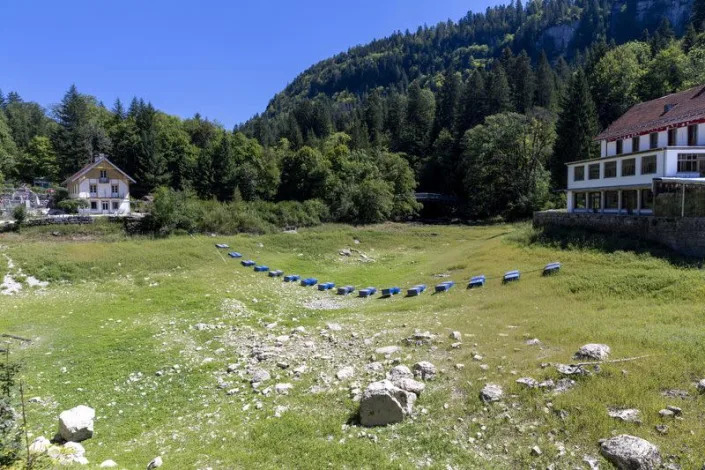
Drought affected Doubs river in Arcon
VILLERS-LE-LAC, France (Reuters) – Business for Francoise Droz-Bartholet has reduced to a trickle, just like stretches of the Doubs River straddling the French-Swiss border that her cruise boats usually ply.
Water levels in rivers, lakes and reservoirs across western Europe are running low, or even dry, amid the severest drought in decades which is putting stress on drinking water supplies, hampering river freight and tourism and threatening crop yields.
The Doubs river should coarse through a forested canyon and cascade over waterfalls before spilling out into Brenets Lake, a draw for tourists in eastern France’s Jura region. After months without meaningful rain, the river water has receded up the canyon and sluggishly reaches the lake in a narrow channel.
“We hope this drought is an exception to the rule,” said Droz-Bartholet, whose bookings are 20% lower than usual for the time of year.
She now has to bus clients along the gorge to a starting point further upstream to a point in the river where there is enough water for her cruise boats to navigate.
Asked how his boat tour had gone, holidaymaker Alain Foubert said simply: “It was a lot shorter than normal.”
Conditions have deteriorated across Europe as multiple heatwaves roll across the continent.
In Spain, farmers in the south fear a harsh drought may reduce olive oil output by nearly a third in the world’s largest producer. In France, which like Spain has had to contend with recent wildfires, trucks are delivering water to dozens of villages without water.
In Germany, cargo vessels cannot sail fully loaded along the Rhine, a major artery for freight, and along Italy’s longest river, the Po, large sandbanks now bake in the sun as water levels recede sharply. In July, Italy declared a state of emergency for areas surrounding the Po, which accounts for more than a third of the country’s agricultural production.
As France contends with a fourth heatwave this week, many scientists say the blistering temperatures so far this summer are line with the increasing frequency and intensity of extreme weather episodes in Europe.
Britain’s weather service on Tuesday issued an amber “Extreme Heat” warning for parts of England and Wales, with no respite in sight from hot dry conditions that have sparked fires, broken temperature records and strained the nation’s infrastructure.
On the Doubs River, fewer boat tourists means fewer meals to serve for restaurateur Christophe Vallier – a painful blow just as he hoped to recover from the COVID-19 downturn. And he sees little cause for hope in the future.
“All the Doubs experts say the river is getting drier and drier,” Vallier lamented.
(Reporting by Denis Balibouse; Writing by Richard Lough; Editing by Susan Fenton)
‘I can’t do it again’: Can Appalachia blunt the devastating impacts of more flooding, climate change?
Chris Kenning, Connor Giffin, James Bruggers – August8, 2022
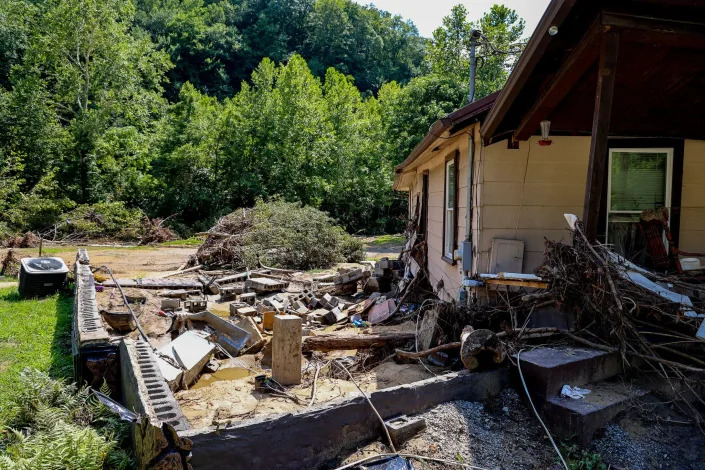
JACKSON, Ky. – Teresa Watkins worked to salvage a few mud-caked belongings from her home on a Breathitt County branch of the Kentucky River after floods slammed her neighborhood July 28for the second time in 17 months.
The 54-year-old, who has lived off Quicksand Road since she was a teenager, said the flooding in recent years – “more and more, worse and worse” – has left difficult dilemmas in a county where median household incomes of $29,538 areless than half the national average.
She pointed to a mobile home one family abandoned last year. More say they’re leaving for safer areas, she said, but it’s not that easy.
“I don’t know how they can afford it or where they’re going to go. Any property is basically along the river line or creek banks,” she said. “And if they go up on the mountains, the mountains slide.”
Devastating floods that killed at least 37 people in Kentucky and damage in other parts of Appalachia, including Virginia and West Virginia, raise urgent questions about how to mitigate the impact of hazardous flooding that is likely to increase as climate change leads to more extreme weather.
In one of America’s most economically depressed regions, there are few easy answers.
The region’s mountainous landscape, high poverty rates, dispersed housing in remote valleys, coal-mining scars that accelerate floods and under-resourced local governments all make solutions extremely difficult.
Teresa Watkins, 54, salvages belongings from her flood-damaged home outside Jackson, Ky.
Measures such as flood wells, drainage systems or raising homes are expensive for cash-strapped counties. Buyouts or building restrictions are difficult in areas where safer options and home construction are limited. Many are unable or unwilling to uproot.
Tamping down extreme weather by reducing climate-changing emissions nationwide is a goal that is politically fraught, including in a region with coal in its veins, and promises no quick relief.
“If we had all the money in the world, and we had the political will and cooperation, we could go a long way towards solving these problems,” said Bill Haneberg, director of the Kentucky Geological Survey and a professor of Earth and environmental sciences at the University of Kentucky.
Even as Kentucky’s devastation renews attention to long-standing challenges, some residents said they have little hope that effective protections will arrive anytime soon.
The emphasis is on trying to rebuild what was lost.Kentucky Gov. Andy Beshear said he may call a special legislative session for more aid to the region, and the Federal Emergency Management Agency provides housing and other help.
In Pilgrim’s Knob, Va., Sherry Honaker, 55, oversees the removal of debris from her niece’s home on Dismal Creek. It was gutted in a major flood, the county’s second this year.
Repeat floods have prompted some officials to search for longer-term answers. Buchanan County, Virginia, for example, is drawing up a plan to identify projects to blunt flooding’s impact. Those projects would still have to be paid for.
Some residents are fatalistic or doubt the government can do much. Others push for more protections in areas where many have few options to move and can’t afford flood insurance.
In the Buchanan County community of Pilgrim’s Knob, Sherry Honaker, 55, watched crews remove debris from her niece’s home on Dismal Creek. It was gutted in a major flood about two weeks before the Kentucky floods – the county’s second this year.
“Something needs to be done,” she said.
How susceptible is Appalachia?
Central Appalachia is no stranger to flooding. The latest high water in eastern Kentucky broke records, and experts expect more to follow.
Amid the larger pattern of extreme weather in the USA, from wildfires to heat waves, meteorologists and climate scientists say human-driven climate change comes with a warmer atmosphere capable of holding more moisture.
That can mean more bouts of intense rainfall, and more rain in a short period fuels flash flooding, said Antonia Sebastian, an assistant professor at the University of North Carolina at Chapel Hill specializing in flood resilience and mitigation.
The region’s topography contributes to how “flashy” a flood can be, Sebastian said.
The steep slopes of the Appalachians allow water to rush quickly into the narrow valleys, sometimes swamping hollows before residents have a chance to escape.
Flooding damaged a church in Breathitt County, Ky.
In 2019, an Inside Climate News analysis of U.S. Army Corps of Engineers stream flow data and satellite images of disturbed land from strip mining found areas such as the Big Sandy watershed, which straddles the Kentucky and West Virginia state line, to be among the most threatened by climate-change-drivenextreme weather within the Ohio River Basin.
The region’s history of coal mining, as well as logging, can exacerbate flooding, experts said, by altering the landscape.
In surface mining, trees are the first to go, then sometimes hundreds of feet of rock are blasted away from the tops and sides of mountains to get at underground seams of coal.
“Normally, on a forested hillside, the trees and their roots will absorb 40% to 50% of the rain that falls, then slowly release it,” said Jack Spadaro, a former top federal mine safety engineer. After mining, surfaces robbed of vegetation facilitate flash flooding, he said.
An area strip mined from 1985 through 2015 is superimposed on the Army Corps of Engineers’ forecast for stream flows. The area with the most land disturbance from mining could see the biggest increase in stream flows from climate change.
Housing patterns contribute to the area’s vulnerability. Many residences are scattered in smaller communities along a road that often winds along a creek lined with steep hillsides.
In Kentucky’s Breathitt County, half of all homes are at a high risk of flooding, according to data provided to USA TODAY by the First Street Foundation, a research and technology nonprofit that tracks flood risks.
The same is true of 46% of homes in the state’s Perry County and 58% in Letcher County.
“You hear people say, ‘Oh, you know, they shouldn’t live in a flood plain. They should move someplace else.’ But if you look at a lot of these towns, there are really not a lot of good options,” Haneberg said.
Added to that is the area’s economic vulnerability. Many residents cannot afford flood insurance.
ATV drivers ferry generator fuel and water around Jessica Willett’s home in Bowling Creek, Ky. Flooding tore it from its foundations and left it in the middle of the road.
Amid coal’s decline, good jobs are hard to find. Breathitt County’s poverty rate is 28%, more than twice the national rate of 11%. The median home value of $53,000 is less than a quarter of the national average, according to the U.S. Census Bureau.
The region has higher rates of chronic disease, and populations have fallen in recent decades.
Jessica Willett, 34, whoseremote Jackson homewas pushed downstream by floodingwhile she and her two children were inside, said she was nervous about rebuilding on Bowling Creek.
But she doesn’t want to leave her home.
“My aunt down the road, she is going to move. She lost everything,” she said. “It’s just hard because down here, there’s a lot of family land. We want our kids and grandkids to grow up on it.”
The ‘pain points’ of climate change
Standing near Dismal Creek in Virginia, Honaker looked over a giant pile of rubble. She said she wants officials to ramp up unclogging draining culverts or increasing the creek’s depth.
She looked at her niece’s home: “Maybe stilts would have helped,” she said.
Though it’s impossible to halt heavy rains and flooding, counties and towns can consider measures to limit their impact, said Tee Clarkson, a principal at First Earth 2030, a company helping Buchanan County develop its flood resiliency plan.
That could include flood walls, strengthening creek banks, dredging creeks to greater depths and expanding piping and drainage systems, he said. Houses could be raised on stilts.
A flood lifted a home in Pilgrim’s Knob, Va., from its foundation.
“It’s hard to keep areas from flooding, but you want to lower the pain points” for residents and infrastructure, he said.
U.S. Rep. Hal Rogers, a Republican who represents eastern Kentucky, said that in an area with a “long and daunting history of flooding,” he helped secure more than $800 million over 40 years to help build flood walls, levees, tunnels and other public safety projects.
“However, this flash flood was a natural disaster that turned small creeks and mountain runoff into raging rivers that charted a new destructive course through our valleys and hollows,” he said. “These types of floods have always been one of the greatest challenges to mitigate in the mountains, and I will continue to advocate for every possible resource that we can afford to protect our mountain communities.”
What could help, experts said, is tackling the hundreds of thousands of acres of former mine land in Appalachia still to be reclaimed, according to a report in 2021 by the environmental group Appalachian Voice.
Counties can restrict building or add stricter building requirements, but that is easiest for new construction – in Perry County, Kentucky, few new building permits were issued in recent years, according to the U.S. Census Bureau.
Perry County Judge-Executive Scott Alexander said he looks for ways to make his county more flood-resilient, such as raising bridges or expanding reservoirs. He said a discussion might include raising homes in flood-prone areas.
“We’ve got to start looking at preventive flooding measures,” he said. He cautioned that “when you get to 12 inches of rain, especially in Appalachia, there’s not a whole lot of anything that can handle that.”
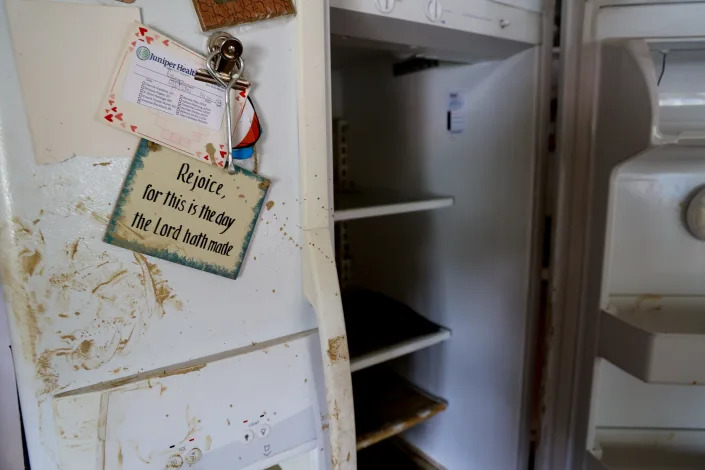
Flooding left a refrigerator covered in river mud in Teresa Watkins’ home outside Jackson, Ky.
FEMA buyouts have been an option, but they take time and can be fraught with potential harm, Sebastian said. The central Appalachian population is one of the poorest in the country and moving that population out of a region with a generally low cost of living could bring further economic hardship.
The properties in the most flood-prone areas tend to be the most affordable, further endangering the very poorest Appalachians, said Colette Easter, president of Kentucky’s section of the American Society of Civil Engineers.
“That involves gut-wrenching questions about moving away from a place that you’ve lived for a very long time, maybe generations, and you’re very connected to,” Eric Dixon, a researcher at the Ohio River Valley Institute, said with a deep sigh. “But maybe you don’t have another choice. Maybe that’s literally what you have to do. That’s the real heartbreaking part of this, I think.”
Flooded residents, to choices
For 15 years, Angie Rosser has lived along the Elk River in Clay County, West Virginia.
In 2016, a powerful flood hit the state, killing 23 people and causing more than $1 billion in damage.
Six years later, Rosser said her community still doesn’t have a grocery store. She hasn’t replaced much of the furniture she lost. In Rosser’s house, you’ll find a bed but no couch and no dining table.
“My house is pretty empty, because I am expecting another flood to happen – which is not a great way to live,” said Rosser, executive director of the West Virginia Rivers Coalition.
Rosser understands the commitment to stay and rebuild shared by many of her neighbors, but “I’m not one of those people,” she said. “If it floods again, I’m out. I can’t do it again. It was just too exhausting.”
That same weary uncertainty has spread across hard-hit counties in Kentucky this week, where the next disaster lurks behind each heavy rainfall to come.
Dee Davis was a Hazard, Kentucky, kindergartner when a flood devastated the area in 1957. It is seared into his memory. He recalls his grandmother and great-uncle taking a canoe to buy groceries.
“We lost everything,” he said.
That flood 65 years ago set a record water level for the North Fork Kentucky River, at 14.7 feet in Whitesburg. Locals never forgot the damage it wrought.
The most recent flooding put that same river at about 21 feet. The water rushed in with enough force to destroy the U.S. Geological Survey sensor designed to monitor the water level.
On Whitesburg’s Main Street this week, the stuffy odor of mud lingered everywhere. The sidewalks were littered with growing piles of discarded furniture, rubble and children’s toys.
The path ahead starts by reckoning with what was lost.
“You mourn the dead,” Davis said, “and you find a way to go forward.”
‘We’re heading into a housing recession’: Here’s what the NAHB CEO sees in real estate right now — and why it spells trouble for the economy
Vishesh Raisinghani – August 7, 2022
Housing, which is a key segment of the national economy, looks extraordinarily weak right now, according to a recent report by the National Association of Home Builders (NAHB).
‘We’re heading into a housing recession’: Here’s what the NAHB CEO sees in real estate right now — and why it spells trouble for the economy
“We’re heading into a recession,” NAHB CEO Jerry Howard told Bloomberg in a recent interview. He described how a rapid decline in homebuilding and demand for new homes could drag the national economy lower.
Here are some of the highlights of Howard’s thesis.
Don’t miss
Mitt Romney says a billionaire tax will trigger demand for these two physical assets — get in now before the super-rich swarm
There’s a ‘perfect storm’ brewing in the multifamily housing market — here are 3 of the easiest ways to take advantage
Housing leads every recession since Second World War
Residential real estate is an integral part of the American economy. In fact, housing activity contributes between 15% to 18% of gross domestic product (GDP) every year, according to the NAHB. A slowdown in this sector naturally pulls down the rest of the economy.
A decline in home building and buying has led to every recession since the end of the Second World War, according to Howard. The association’s latest report indicates that buyers and builders are both pulling back from the market yet again, which could be a leading indicator for another recession on the horizon in 2022.
Builders are holding off
Homebuilders face multiple demand- and supply-side pressures.
On the demand front, potential homebuyers have receded from the market. Existing home sales slid 5.4% in June. Meanwhile, borrowing capacity has been curtailed by rising interest rates. The average mortgage rate has accelerated at the fastest pace in 35 years. A 15-year fixed rate mortgage is now about 4.8%, up from 2.2% a year ago. These factors have effectively destroyed demand.
Meanwhile, the supply chain for home building material and the cost of labor continues to increase the cost of building new homes. This is why homebuilders’ sentiment dropped 12 points in June, according to the NAHB survey.
A dangerous situation
The fundamental weakness in both demand and supply-side factors creates a “dangerous situation,” said Howard. Housing has not only led the country into every recession, but it has also led the nation out of every recession since the Second World War. This time the recovery could be slower.
There’s no easy solution to the lack of labor and supply chain disruptions that plague the industry. If these issues persist, the economic recovery could take longer. Howard believes regulators need to get involved to reignite growth.
Regulators need to get serious
Policy changes are essential to resolve issues in the housing market, according to Howard. He suggests that regulators try to secure a deal with Canadian authorities to improve the supply of lumber into the U.S. That would significantly reduce the cost pressures on homebuilders.
Policies to encourage labor supply would also help. Better training for skilled labor and higher immigration of tradespeople would improve homebuilder sentiment.
Some regulations, however, need to be reduced to boost the homebuilding sector. Development charges and prohibitive planning regulations on the state and local level could be a bottleneck on housing supply.
Lowering these barriers could play a part in stabilizing homebuilding and helping the national economy course-correct. However, these recommendations may not be enough to prevent the near-term pressures homebuilders face.
Some economists believe a housing-led recession may be inevitable — if it hasn’t already begun.
Saltwater toilets, desperate wildlife: Water-starved Catalina Island battles against drought
Hayley Smith – August 5, 2022
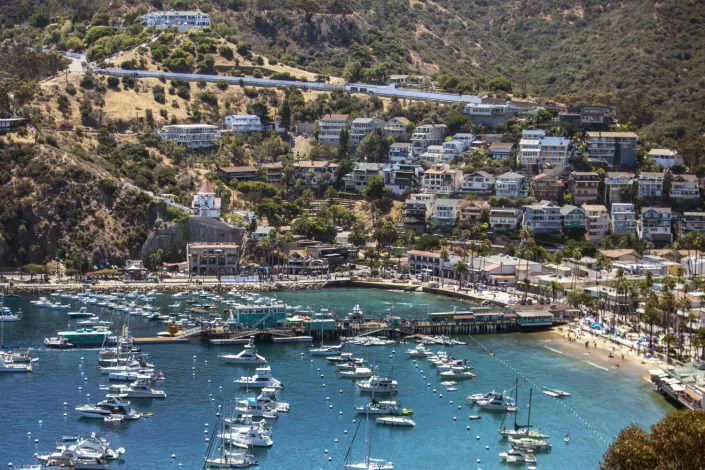
Raymond Valdez, 8, pours cool seawater on his head to rinse off the sand at the beach in Avalon. (Francine Orr / Los Angeles Times)
Island-dweller Lori Snell grimaced as she tallied her bill recently at the Avalon Laundry — nearly $50 for three large loads.
“It’s always an adventure to live in Catalina,” said Snell, 64. “It’s a joy, it’s a paradise, it’s a challenge.”
For Snell and Santa Catalina Island’s other 4,000 full-time residents, water is a bit of an obsession. When you live an hourlong ferry ride from Long Beach, a gallon of the stuff can cost six times more than it does “over town” — the islanders’ term for the mainland.
That preoccupation with water has now become critical as severe drought grips California and its Channel Islands — a rugged, eight-isle archipelago that hosts several human outposts and a handful of species that exist nowhere else on Earth.
But although some of the island’s wildlife is struggling for survival, conditions for humans are a little different today than in droughts past, due largely to a desalination plant that opened in Avalon in 2016. The plant today provides about 40% of Avalon’s drinking water.
“Over town, you’re not affected by drought as much as you are here,” said Snell, a former resident of Encino. “All the locals and businesses are very aware. Our ability to live here depends on us having fresh water.”
Conditions on Catalina Island are a little different this time around, thanks in large part to a desalination plant that opened in Avalon at the end of the last drought. (Francine Orr / Los Angeles Times)
Many Avalon residents still have vivid memories of the state’s last punishing drought, which forced them into severe Stage 3 water restrictions at the end of 2016.
Things got so bad that even some fine-dining restaurants switched to paper plates to avoid running dishwashers, and hotels ferried their linens to the mainland for laundering in an effort to cut costs and conserve tight supplies, several locals said.
But desalination has helped keep them out of similarly severe water restrictions so far this year, according to Ronald Hite, senior manager of Catalina Island for Southern California Edison, the island’s water provider.
“We run desal 100% of the time and rely on it, and then supplement with groundwater,” Hite said. “That’s bought us a year, and taken us really from the front of the line — where we were last time, going into drought restrictions and rationing — to the back of the line, which is fantastic.”
Although desalination provides potable water to Catalina’s humans, it can’t do quite as much to help the island’s wildlife, including bison, amid the worsening drought. (Francine Orr / Los Angeles Times)
Indeed, although most of mainland Los Angeles moved into Stage 3 restrictions at the start of June, Avalon in July crept into only Stage 1, even as its reservoir dropped about 100 acre-feet in the last three months. Hite said it’s a remarkable feat for an island that has no access to state or federal water supplies, and which for decades relied primarily on its reservoir to supply full-time residents and roughly 1 million visitors each year.
“This is different this time — we’re actually in a much better spot than our peers elsewhere,” he said. “And the main driver of that is that we are using every drop of our drought-resistant resources that we possibly can. … We might be facing mandatory rationing right now had we operated the system like we used to.”
That’s not to say water is taken for granted on Catalina, where conservation has largely become a way of life. According to Hite, residents use an average of 57 gallons per day — about half of the residential average in the area served by the Los Angeles Department of Water and Power. What’s more, there are very few lawns that require water, and most homes have saltwater toilets that keep them from flushing freshwater down the drain.
Gregg Miller, who owns Avalon’s Hotel Metropole and Market Place, which includes several restaurants and the laundromat, said he’s spent the last four years converting most of the hotel’s bathtubs into showers in order to save water. He also got rid of all their hot tubs.
“It’s such an ongoing situation,” Miller said of drought. “It never gets quite resolved, so you’re always really doing things that you hope will save some water. It’s a challenge.”
Scooping cups of water from a bucket rather than using a hose, a woman cleans the sidewalk outside the Hotel Atwater in Avalon. Water is not taken for granted on the island. (Francine Orr / Los Angeles Times)
And although he said it can be “hard to tell people paying $300 a night, ‘Don’t take a long shower,’ ” the new desalination plant has helped give everyone some breathing room.
“To some degree, the desal plant has taken a little bit of the pressure off,” Miller said. “Because unlike most other places, we don’t have any secondary source, another municipal district that could lend us water or share water with us. We have only what we have in our reservoirs and a few small wells.”
The message hasn’t necessarily registered with all of the island’s visitors, including the thousands of tourists who arrive each week via cruise ships and those who take the ferry from L.A., Long Beach and Orange County.
Phil and Cheryl Gaston, who were visiting from Georgia, said they were aware of the drought conditions plaguing the West but that it hadn’t really factored into their plans to visit the island.
“If I had been planning a vacation in Lake Mead, though, I wouldn’t go,” said Phil Gaston, 66.
Visitors enjoy snorkeling and scuba diving lessons in Avalon. (Francine Orr / Los Angeles Times)Alex Romero manages the burger-and-dog outpost Coney Island West in Avalon. He recently converted the restaurant’s three-compartment sink into two compartments to help save water. (Francine Orr / Los Angeles Times)
Alex Romero, a 40-year resident of Avalon who runs and owns the burger-and-dog outpost Coney Island West, said that “it would be nice if [tourists] would be more conscious — their long showers really kill us.” But he also added that visitors are the lifeblood of the island and essential to the residents’ way of life. “They’re what keep us going.”
Romero recently converted the restaurant’s three-compartment sink into two compartments to help save water, he said. And instead of hosing down the patio nightly, he’s doing it once a week and using a mop the rest of the time.
“The reservoir and desal help, but we need rain this year for sure,” he said. “If not, it will get a lot worse.”
Desalination is also not without controversy. In May, plans for the massive Poseidon plant in Huntington Beach were rejected by the California Coastal Commission due to concerns about high costs, ecological hazards and other significant hurdles. The desalination process, which typically includes the discharge of hypersaline brine back into the ocean, has been criticized for negatively affecting marine life near facilities, as well as high energy consumption.
Hite, the Edison manager, said many of those effects have been mitigated at the Avalon plant because of its relatively small scale. Although the Poseidon plant would have produced up to 50 million gallons of drinking water a day, the facility in Avalon produces about 240,000.
Ava Jessie McDonald, a water and gas operator mechanic at Southern California Edison, checks the numbers on the control panel inside the desalination plant in Avalon. (Francine Orr / Los Angeles Times)
“We’ve got a couple things going for us here in terms of desal production in that number one, we are surrounded by water so we have easy access to it, and number two, we’re relatively small scale,” he said. “It’s much less of an impact for someone like us than for, say, a giant plant such as those that have been proposed recently.”
According to the most recent monitoring report submitted to state regulators, salinity levels from the plant are relatively low, around 50 parts per thousand at the discharge point and 30 to 35 parts per thousand at various depths and distances from the facility. Average ocean salinity, broadly speaking, is about 35 parts per thousand.
Hite said the reverse-osmosis plant, which is diesel-powered, also uses the high-pressure reject water to help turn its pump, enabling it to use a smaller motor and reduce electrical consumption. Edison is currently seeking a grant for a new deepwater well that would allow it to bring an older desalination facility on the island, built in the 1990s, back online, he said.
Yoram Cohen, a desalination expert and professor of chemical and biomolecular engineering at UCLA who is not affiliated with the Avalon plant, said size can be a factor when it comes to the impact of the brine.
“If you discharge 20, 25 million gallons a day, that’s a lot more than 200,000 gallons a day,” he said, “so the impact on the environment, the local impact, is going to be very different. It may be easier to disperse a small volume, or a small volumetric flow, than it is a huge one.”
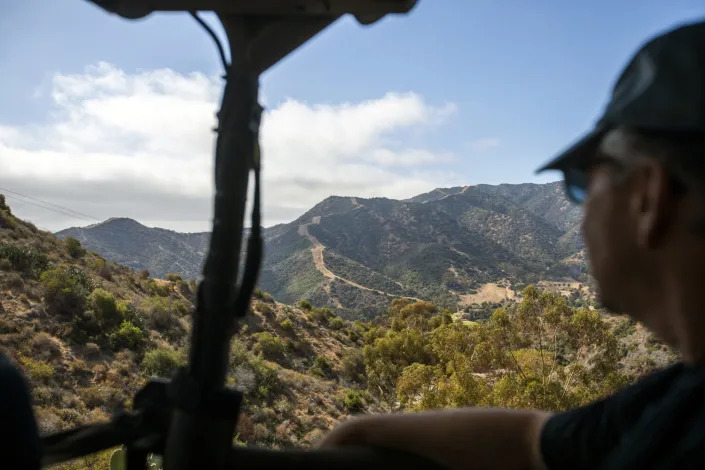
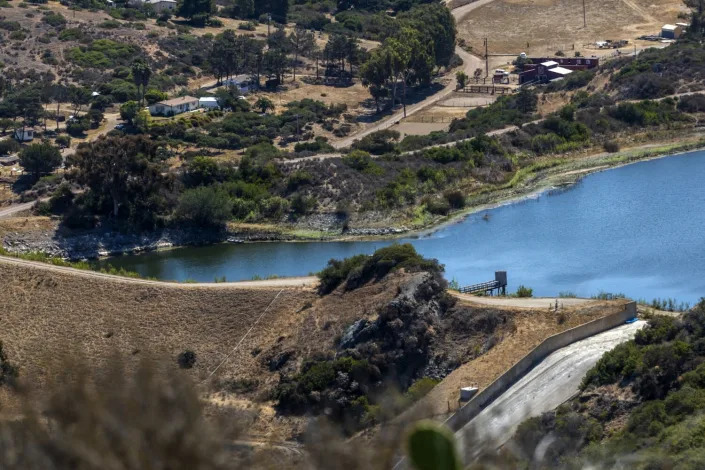
Visitors take a two-hour “eco-tour” with the Catalina Island Conservancy in Avalon. They explore parts of the island’s interior to see plants, landscape and wildlife, including bison. (Francine Orr / Los Angeles Times)The water level at the Middle Ranch Reservoir in Avalon dropped 100 acre-feet in the last three months. (Francine Orr / Los Angeles Times)
Cohen said recent studies from Australia, Israel, Singapore, Saudi Arabia and other places using desalination have also shown that discharge “should not have an adverse impact” if it is done properly. But although desalination can be a helpful tool — especially for areas near the coast — it shouldn’t be the only source of supplies, he said.
“Desal alone is not going to solve the problem, but it’s an added component of our water portfolio,” Cohen said. “At the end of the day, I think that we have to keep our water portfolio diversified, just like you would keep your money invested in multiple places. You want to be safe, right? You don’t put your money in one investment.”
There are other challenges too. Many residents are now fighting a proposed rate hike by Edison that they say will make their already-pricey water even more expensive. The agency said the increase will help recoup some losses from the last drought and keep the systems running.
“Desal is not an inexpensive operation,” Avalon Mayor Anni Marshall acknowledged. She said the island’s small number of ratepayers also drive up the costs because there are fewer people to share the expense. “But I think the trade-off is, we love living here and we’re willing to sacrifice as much as we can — or as much as we have to.”
Thousands of tourists arrive each week in Catalina via cruise ships and ferries from L.A. (Francine Orr / Los Angeles Times)
Marshall said she wants the island to work toward new groundwater capture and water recycling projects in the near future. But she also noted that because most homes use saltwater toilets and don’t have frontyards, the significant 50% savings residents achieved during the last drought were hard-won.
“That large reduction we did was basically personal consumption — it was in our showers, washing dishes and that kind of thing,” she said.
The mindset is apparent all around the town, where beachgoers this week rinsed off under saltwater showers and restaurants declined to provide tap water, offering only bottles. One woman was spotted cleaning the sidewalk with a bucket and a cup, carefully doling out one splash at a time. For many, including Marshall, it’s a success story.
“It’s amazing,” she said. “The situation we’re in now is nothing compared to what it was in the previous drought.”
The water level of water at the Middle Ranch Reservoir on Catalina Island is down due to the current draught. (Francine Orr / Los Angeles Times)
But although desalination is keeping Catalina’s humans supplied with potable water, it can’t do quite as much to help the island’s flora and fauna amid worsening drought.
The famed Catalina Island fox, as well as the island’s non-native deer and bison, are “suffering mightily” due to the lack of moisture, which is tied closely to their food supply, according to Deni Porej, senior conservation director with the Catalina Island Conservancy. Lately, he said, deer have been appearing on the island’s golf course in the evenings, when they know the sprinklers will turn on and provide them with a spot of relief.
What’s more, a combination of dry conditions, deer predation and pollination problems is threatening the island’s ancient ironwood trees, of which there are only about 120 left.
“Groundwater is hugely important to us, because a lot of the plants that we have here have very deep roots, and they tap into the groundwater,” Porej said, noting that for the ironwoods, “the issue of groundwater is a matter of life and death.”
A couple takes a break from the water fun in Avalon. (Francine Orr / Los Angeles Times)
“It’s a weird feeling when you’re standing in the grove and you’re looking at basically a species dying out. It’s kind of a gut punch,” he said.
Porej said he hoped to see island officials come together to develop a more comprehensive groundwater management plan, but he also credited the desalination plant with improving some of Catalina’s conditions.
“It’s helping, but it’s not the ultimate solution, because there’s always a need for more,” he said. “We will always be looking for opportunities to have more water on the island. That’s the limiting factor to our ecosystem, it’s the limiting factor to growth. Like many parts of California, it’s about gold and water.”
3 Downpours in 8 Days: How Extreme Rain Soaked the Midwest
Amanda Holpuch – August 5, 2022
3 Downpours in 8 Days: How Extreme Rain Soaked the Midwest
Three separate downpours across three states over a span of eight days this summer swept away homes, destroyed crops and left at least 39 people dead.
The intense rainfall, in Missouri, Kentucky and Illinois, broke century-old records and destroyed swaths of communities, prompting warnings from climate experts, who said the intensity and frequency of heavy rain was likely to increase as Earth continued to warm.
Some areas of southeastern and central Illinois recorded more rain in 36 hours Monday and Tuesday than they usually get in the entire month of August. In eastern Kentucky and central Appalachia, rainfall observed from July 26 to July 30 was over 600% of normal. In Missouri, rainfall records were obliterated during a two-day downpour last week.
No one storm can be directly attributed to climate change without further analysis, but the intensity of these downpours is consistent with how global warming has led to an increase in the frequency of extreme rainfall. A warmer Earth has more water in the atmosphere, resulting in heavier rainstorms.
“We anticipate that these type of events might become even more frequent in the future or even more extreme in the future as the Earth continues to warm, which means that this is kind of a call to action that climate change is here,” said Kevin Reed, an associate professor at the School of Marine and Atmospheric Sciences at Stony Brook University in New York. “It’s not a problem for 50 years from now. It’s a problem now.”
‘Historically Unheard-of’ Amounts of Rain
The strain on cities and states to prepare for these events was evident in Kentucky, where at least 37 people died, and Missouri, where two people died.
In Kentucky, rainfall was at times in excess of 4 inches per hour, the National Weather Service said, and swept away homes and parts of some communities.
In four days, 14-16 inches of rain fell in a narrow swath in the eastern part of the state, according to radar-based estimates from the weather service. It said that this is “historically unheard-of” and that there was a less than 1 in 1,000 chance of that much rain falling in a given year.
Earlier that week in east-central Missouri, the weather service said 7.68 inches of rain fell in a six-hour period, an event that also had a 0.1% chance of occurring in a given year.
That downpour hit the area in and around St. Louis particularly hard, forcing residents to flee their homes in inflatable boats after roadways were swamped with water.
The deluge on July 25 and 26 was the most prolific rainfall event in St. Louis since records began in 1874, according to the weather service. Roughly 25% of the area’s normal yearly rainfall came down in about 12 hours.
Neil Fox, a professor of atmospheric science at the University of Missouri, said the heavy rain in Missouri was caused by thunderstorms developing over and over again in the same area, known by meteorologists as training. Training is a common cause of heavy rainfall and drove the downpours in Illinois and Kentucky as well.
“The amount the records were broken by, it’s like someone beating the 100 meter world record by a second or something,” Fox said. “It’s an incredible increase over the previous record.”
The Illinois rainfall this week was less severe, and there were no reported deaths, but the deluge caused flash flooding and damaged crops. The weather service said the highest measured rainfall in that storm was 7 inches, which has a 1% to 2% chance of occurring in a given year.
“We typically get a little over 3 inches in the month of August, and we got 5 to 7 inches just in the first two days here of August,” said Nicole Albano, a meteorologist at the National Weather Service office in Lincoln, Illinois. “That’s pretty substantial.”
The United States and other parts of the world have seen an increase in the frequency of extreme rainstorms as a result of climate change, caused by the burning of fossil fuels such as oil and gas. The frequency of these heavy downpours is likely to increase as warming continues.
“We also expect the heaviest possible precipitation events at any given location to get heavier as temperature increases,” said Angeline Pendergrass, an assistant professor at Cornell University in Ithaca, New York, who studies extreme precipitation. “That means we should expect more precipitation records to get broken than we would without global warming.”
The Western sanctions and widespread corporate exodus from Russia since Feb. 24 have ravaged the Russian economy—and its future prospects look even bleaker, according to a new report from Yale University researchers and economists led by Jeffrey Sonnenfeld, Yale School of Management professor and senior associate dean for leadership studies. It’s now become clear that the Kremlin’s “finances are in much, much more dire straits than conventionally understood” and that the large-scale “business retreats and sanctions are catastrophically crippling the Russian economy,” the researchers wrote.
Deterioration
As of Aug. 4, over 1,000 companies, including U.S. firms like Nike, IBM, and Bain consulting, have curtailed their operations in Russia. Though some businesses have stayed, the mass corporate exodus represents 40% of Russia’s GDP and reverses 30 years’ worth of foreign investment, says the Yale report.
The international retreat is morphing into a larger crisis for the country: a collapse in foreign imports and investments.
Russia has descended into a technological crisis as a result of its isolation from the global economy. It’s having trouble securing critical technology and parts. “The domestic economy is largely reliant on imports across industries…with few exceptions,” says the report. Western export controls have largely halted the flow of imported technology from smartphones to data servers and networking equipment, straining its tech industry. Russia’s biggest internet company, Yandex—the country’s version of Google—is running short of the semiconductor chips it needs for its servers.
At the same time, Russia’s “domestic production has come to a complete standstill—with no capacity to replace lost businesses, products, and talent,” the Yale report said. Russian producers and manufacturers are unable to fill the gaps left by the collapse of Western imports. Russia’s telecom sector for instance, now hopes to lean on China, India, and Israel to supply 5G equipment.
In the weeks following the Ukraine invasion, the Kremlin largely prevented a “full scale financial crisis” owing to quick and harsh measures, like restricting the movement of money out of the country and imposing a 20% emergency interest rate hike, Laura Solanko, senior adviser at the Bank of Finland Institute for Emerging Economies in Transition, an organization that researches emerging economies, told Fortunelast month. The ruble even rebounded from a March low, when it was valued at less than one U.S. cent.
Yet Russia’s financial markets are the worst-performing in the world this year, the report noted. “Putin is resorting to patently unsustainable, dramatic fiscal and monetary intervention to smooth over these structural economic weaknesses,” which has led to a government budget deficit for the first time in years and drained the Kremlin’s foreign reserves even with its continued inflow of petrodollars, the researchers wrote. The Russian government is giving subsidies to businesses and individuals to mitigate any economic shocks caused by sanctions. This “inflated level” of fiscal and social stimulus, on top of military expenditures, is “simply unsustainable for the Kremlin,” the report said.
And the ruble’s recent dramatic turnaround doesn’t indicate a strong Russian economy, but marks something far worse: the clear collapse of foreign imports. Sergei Guriev, scientific director of the economics program at Sciences Po, in France, and a research fellow at London-based think tank the Centre for Economic Policy Research, previously told Fortune that it represents a “very bad” situation for the nation.
The EU is now phasing out Russian energy, which could hit the Kremlin’s oil and gas profits. Such a scenario would severely strain the Kremlin’s finances, since Western countries have frozen half of its $300 billion in foreign reserves.
Heading toward economic oblivion
Russia’s precarious economic position means that it faces even more dire, long-term challenges ahead.
Sanctions aren’t designed to cause an immediate financial crisis or economic collapse, but are long-term tools to weaken a nation’s economy while isolating it from global markets, the report said. And the sanctions are doing exactly that for Russia.
The country is losing its richest and most educated citizens as its economy crumbles. Most estimates say that at least 500,000 Russians have fled the country since Feb. 24, with the “vast majority being highly educated and highly skilled workers in competitive industries such as technology,” the report said. Many wealthy Russians who flee are taking their money with them. One estimate is that 20% of Russia’s ultra-high-net-worth individuals have left this year. In the first quarter of 2022, official capital outflows stood at $70 billion, according to Bank of Russia estimates—but this figure is likely to be a “gross underestimate” of the actual amount of money that has left the country, the Yale team wrote.
Russian citizens are also set to become poorer, despite Putin’s minimum wage and pension income hikes. A former Putin aide predicts that the number of Russians living in poverty will likely double—and perhaps even triple, as the war continues. Russia “hasn’t seen the worst yet,” Russian political scientist Ilya Matveev, told Fortunelast month.
“There is no path out of economic oblivion as long as the allied countries remain unified in maintaining and increasing sanctions pressure against Russia,” the researchers wrote.
Upwards of 2.8 million people die every year in the United States. As a funeral director who heads a university mortuary science program, I can tell you that while each individual’s life experiences are unique, what happens to a body after death follows a broadly predictable chain of events.
In general, it depends on three things: where you die, how you die and what you or your family decide on for funeral arrangements and final disposition.
In death’s immediate aftermath
Death can happen anywhere: at home; in a hospital, nursing or palliative care facility; or at the scene of an accident, homicide or suicide.
A medical examiner or coroner must investigate whenever a person dies unexpectedly while not under a doctor’s care. Based on the circumstances of the death, they determine whether an autopsy is needed. If so, the body travels to a county morgue or a funeral home, where a pathologist conducts a detailed internal and external examination of the body as well as toxicology tests.
Once the body can be released, some states allow for families to handle the body themselves, but most people employ a funeral director. The body is placed on a stretcher, covered and transferred from the place of death – sometimes via hearse, but more commonly these days a minivan carries it to the funeral home.
State law determines who has the authority to make funeral arrangements and decisions about the remains. In some states, you can choose during your lifetime how you’d like your body treated when you die. In most cases, however, decisions fall on surviving family or someone you appointed before your death.
Preparing the body for viewing
In a 2020 consumer survey conducted by the National Funeral Directors Association, 39.4% of respondents reported feeling it’s very important to have the body or cremated remains present at a funeral or memorial service.
To prepare for that, the funeral home will usually ask whether the body is to be embalmed. This process sanitizes the body, temporarily preserves it for viewing and services, and restores a natural, peaceful appearance. Embalming is typically required for a public viewing and in certain other circumstances, including if the person died of a communicable disease or if the cremation or burial is to be delayed for more than a few days.
When the funeral director begins the embalming process, he places the body on a special porcelain or stainless steel table that looks much like what you’d find in an operating room. He washes the body with soap and water and positions it with the hands crossed over the abdomen, as you’d see them appear in a casket. He closes the eyes and mouth.
Next the funeral director makes a small incision near the clavicle, to access the jugular vein and carotid artery. He inserts forceps into the jugular vein to allow blood to drain out, while at the same time injecting embalming solution into the carotid artery via a small tube connected to the embalming machine. For every 50 to 75 pounds of body weight, it takes about a gallon of embalming solution, largely made up of formaldehyde. The funeral director then removes excess fluids and gases from the abdominal and thoracic cavities using an instrument called a trocar. It works much like the suction tube you’ve experienced at the dentist.
Next the funeral director sutures any incisions. He grooms the hair and nails and again washes the body and dries it with towels. If the body is emaciated or dehydrated, he can inject a solution via hypodermic needle to plump facial features. If trauma or disease has altered the appearance of the deceased, the embalmer can use wax, adhesive and plaster to recreate natural form.
Lastly, the funeral director dresses the deceased and applies cosmetics. If the clothing provided does not fit, he can cut it and tuck it in somewhere that doesn’t show. Some funeral homes use an airbrush to apply cosmetics; others use specialized mortuary cosmetics or just regular makeup you might find at a store.
Toward a final resting place
If the deceased is to be cremated without a public viewing, many funeral homes require a member of the family to identify him or her. Once the death certificate and any other necessary authorizations are complete, the funeral home transports the deceased in a chosen container to a crematory. This could be onsite or at a third-party provider.
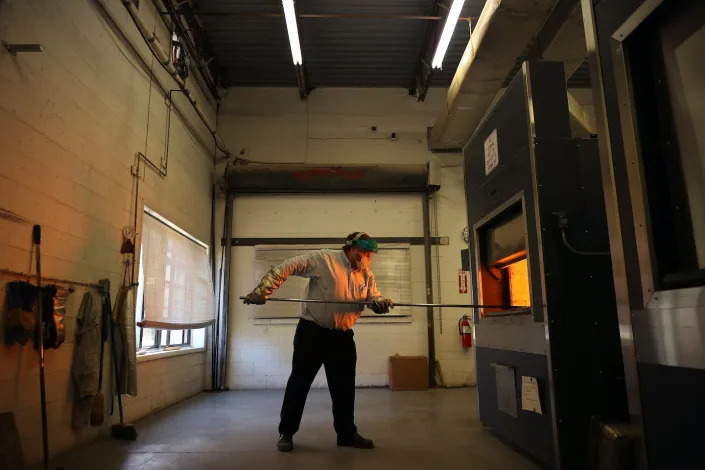
Cremations are performed individually. Still in the container, the deceased is placed in the cremator, which produces very high heat that reduces the remains to bone fragments. The operator removes any metal objects, like implants, fillings and parts of the casket or cremation container, and then pulverizes the bone fragments. He then places the processed remains in the selected container or urn. Some families choose to keep the cremated remains, while others bury them, place them in a niche or scatter them.
When earth burial is chosen, the casket is usually placed in a concrete outer burial container before being lowered into the grave. Caskets can also be entombed in above-ground crypts inside buildings called mausoleums. Usually a grave or crypt has a headstone of some kind that bears the name and other details about the decedent.
Some cemeteries have spaces dedicated to environmentally conscious “green” burials in which an unembalmed body can be buried in a biodegradable container. Other forms of final disposition are less common. As an alternative to cremation, the chemical process of alkaline hydrolysis can reduce remains to bone fragments. Composting involves placing the deceased in a vessel with organic materials like wood chips and straw to allow microbes to naturally break down the body.
I’ve seen many changes over the course of my funeral service career, spanning more than 20 years so far. For decades, funeral directors were predominantly male, but now mortuary school enrollment nationwide is roughly 65% female. Cremation has become more popular. More people pre-plan their own funerals. Many Americans do not have a religious affiliation and therefore opt for a less formal service.
Saying goodbye is important for those who remain, and I have witnessed too many families foregoing a ceremony and later regretting it. A dignified and meaningful farewell and the occasion to share memories and comfort each other honors the life of the deceased and facilitates healing for family and friends.
Climate scientist says total climate breakdown is now inevitable: ‘It is already a different world out there, soon it will be unrecognizable to every one of us’
Katherine Tangalakis-Lippert – July 30, 2022
Rich nations are likely to delay action on climate change.peepo/Getty Images
In his new book, Bill McGuire argues it’s too late to avoid catastrophic climate change.
The Earth science professor says lethal heatwaves and extreme weather events are just the beginning.
Many climate scientists, he said, are more scared about the future than they are willing to admit in public.
In his new book published Thursday, “Hothouse Earth: An Inhabitant’s Guide,” Bill McGuire argues that, after years of ignoring warnings from scientists, it is too late to avoid the catastrophic impacts of climate change.
The University College London Earth sciences professor pointed to a record-breaking heatwave across the UK this month and dangerous wildfires that destroyed 16 homes in East London as evidence of the rapidly changing climate. McGuire says weather will begin to regularly surpass current extremes, despite government goals to lower carbon emissions.
“And as we head further into 2022, it is already a different world out there,” McGuire told The Guardian. “Soon it will be unrecognizable to every one of us.”
His perspective — that severe climate change is now inevitable and irreversible — is more extreme than many scientists who believe that, with lowered emissions, the most severe potential impacts can still be avoided.
McGuire did not immediately respond to Insider’s request for comment.
Many climate scientists, McGuire said, are much more scared about the future than they are willing to admit in public. He calls their reluctance to acknowledge the futility of current climate action “climate appeasement” and says it only makes things worse.
Instead of focusing on net-zero emission goals, which McGuire says won’t reverse the current course of climate change, he argues we need to adapt to the “hothouse world” that lies ahead and start taking action to try to stop material conditions from deteriorating further.
“This is a call to arms,” McGuire told The Guardian: “So if you feel the need to glue yourself to a motorway or blockade an oil refinery, do it.”
Las Vegas, NM declares emergency, with less than 50 days of clean water supply left
Nadine El – Bawabn – July 29, 2022
The city of Las Vegas has declared an emergency over its water supply after the Calf Canyon-Hermits Peak Fire, the largest wildfire in New Mexico history, contaminated the Gallinas River. The city relies solely on water from the river, which has been tainted with large amounts of fire-related debris and ash, according to city officials.
New Mexico Gov. Michelle Grisham said in a tweet that $2.25 million in state funding has been made available to ensure residents receive access to safe drinking water.
The city is currently relying on reservoirs which, at the current consumption rate, contain less than 50 days worth of stored water, according to Las Vegas Mayor Louie Trujillo.
PHOTO: A gauge measures water levels on the Rio Nambe amid extreme drought conditions in the area on June 3, 2022 near Nambe, N.M. According to the U.S. Drought Monitor, 90 percent of New Mexico is experiencing extreme drought conditions. (Mario Tama/Getty Images, FILE)
The large amounts of ash and turbidity in the river have prevented the city from being able to pull water from it, as the city’s municipal water treatment facility is not able to treat the contaminated water, according to the mayor.
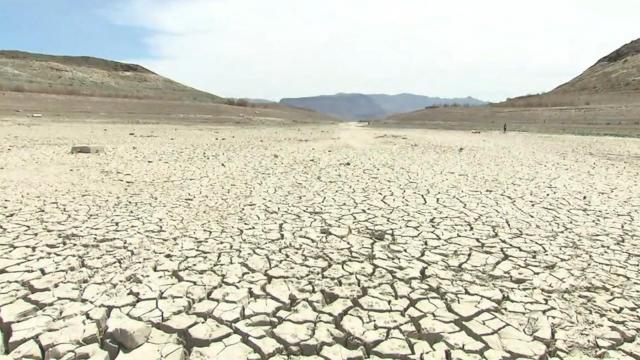
Related video: NASA releases startling image of Lake Mead shrinkage
0:04 1:48 NASA releases startling image of Lake Mead shrinkage for some 40 million Americans. Scroll back up to restore default view.
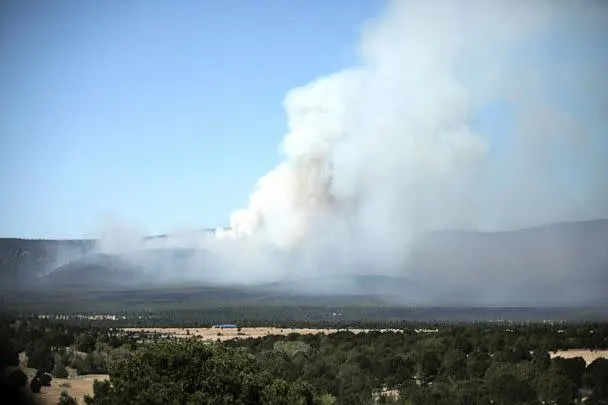
The Hermit’s Peak Fire and Calf Canyon Fire merged on April 27. By May 2, the blaze had grown in size and caused evacuations in multiple villages and communities in San Miguel County and Mora County.
PHOTO: Smoke billows from the Hermits Peak and Calf Canyon fire, outside of Las Vegas, N.M., May 11, 2022. (Adria Malcolm/Reuters, FILE)
President Joe Biden issued a major disaster declarations for the New Mexico counties of Colfax, Mora and San Miguel on May 4.
The fire resulted in the loss of federal, state, local, tribal and private property including thousands of acres of the watershed for the Gallinas River, the primary source of municipal water for the city and surrounding areas, according to the emergency declaration.
The Gallinas River has resulted in thousands of acres of scorched forest, flooding, ash and fire debris.














 Scroll back up to restore default view.