Northeastern farmers face new challenges with severe drought

Associated Press

Northeastern farmers face new challenges with severe drought

Jennifer McDermott – August 14, 2022

PROVIDENCE, R.I. (AP) — Vermont farmer Brian Kemp is used to seeing the pastures at Mountain Meadows Farm grow slower in the hot, late summer, but this year the grass is at a standstill.

That’s “very nerve-wracking” when you’re grazing 600 to 700 cattle, said Kemp, who manages an organic beef farm in Sudbury. He describes the weather lately as inconsistent and impactful, which he attributes to a changing climate.

“I don’t think there is any normal anymore,” Kemp said.

The impacts of climate change have been felt throughout the Northeastern U.S. with rising sea levels, heavy precipitation and storm surges causing flooding and coastal erosion. But this summer has brought another extreme: a severe drought that is making lawns crispy and has farmers begging for steady rain. The heavy, short rainfall brought by the occasional thunderstorm tends to run off, not soak into the ground.

Water supplies are low or dry, and many communities are restricting nonessential outdoor water use. Fire departments are combatting more brush fires and crops are growing poorly.

Providence, Rhode Island had less than half an inch of rainfall in the third driest July on record, and Boston had six-tenths of an inch in the fourth driest July on record, according to the National Weather Service office in Norton, Massachusetts. Rhode Island’s governor issued a statewide drought advisory Tuesday with recommendations to reduce water use. The north end of the Hoppin Hill Reservoir in Massachusetts is dry, forcing local water restrictions.

Officials in Maine said drought conditions really began there in 2020, with occasional improvements in areas since. In Auburn, Maine, local firefighters helped a dairy farmer fill a water tank for his cows when his well went too low in late July and temperatures hit 90. About 50 dry wells have been reported to the state since 2021, according to the state’s dry well survey.

The continuing trend toward drier summers in the Northeast can certainly be attributed to the impact of climate change, since warmer temperatures lead to greater evaporation and drying of soils, climate scientist Michael Mann said. But, he said, the dry weather can be punctuated by extreme rainfall events since a warmer atmosphere holds more moisture — when conditions are conducive to rainfall, there’s more of it in short bursts.

Mann said there’s evidence shown by his research at Penn State University that climate change is leading to a “stuck jet stream” pattern. That means huge meanders of the jet stream, or air current, get stuck in place, locking in extreme weather events that can alternately be associated with extreme heat and drought in one location and extreme rainfall in another, a pattern that has played out this summer with the heat and drought in the Northeast and extreme flooding in parts of the Midwest, Mann added.

Most of New England is experiencing drought. The U.S. Drought Monitor issued a new map Thursday that shows areas of eastern Massachusetts outside Cape Cod and much of southern and eastern Rhode Island now in extreme, instead of severe, drought.

New England has experienced severe summer droughts before, but experts say it is unusual to have droughts in fairly quick succession since 2016. Massachusetts experienced droughts in 2016, 2017, 2020, 2021 and 2022, which is very likely due to climate change, said Vandana Rao, director of water policy in Massachusetts.

“We hope this is maybe one period of peaking of drought and we get back to many more years of normal precipitation,” she said. “But it could just be the beginning of a longer trend.”

Rao and other water experts in New England expect the current drought to last for several more months.

“I think we’re probably going to be in this for a while and it’s going to take a lot,” said Ted Diers, assistant director of the New Hampshire Department of Environmental Services water division. “What we really are hoping for is a wet fall followed by a very snowy winter to really recharge the aquifers and the groundwater.”

Rhode Island’s principal forest ranger, Ben Arnold, is worried about the drought extending into the fall. That’s when people do more yardwork, burn brush, use fireplaces and spend time in the woods, increasing the risk of forest fires. The fires this summer have been relatively small, but it takes a lot of time and effort to extinguish them because they are burning into the dry ground, Arnold said.

Hay farmer Milan Adams said one of the fields he’s tilling in Exeter, Rhode Island, is powder a foot down. In prior years it rained in the spring. This year, he said, the dryness started in March, and April was so dry he was nervous about his first cut of hay.

“The height of the hay was there, but there was no volume to it. From there, we got a little bit of rain in the beginning of May that kind of shot it up,” he said. “We haven’t seen anything since.”

Farmers are fighting more than the drought — inflation is driving up the cost of everything, from diesel and equipment parts to fertilizer and pesticides, Adams added.

“It’s all through the roof right now,” he said. “This is just throwing salt on a wound.”

The yield and quality of hay is down in Vermont too, which means there won’t be as much for cows in the winter, said Vermont Agriculture Secretary Anson Tebbetts. The state has roughly 600 dairy farms, a $2 billion per year industry. Like Adams, Tebbetts said inflation is driving up prices, which will hurt the farmers who will have to buy feed.

Kemp, the president of the Champlain Valley Farmer Coalition, is thankful to have supplemental feed from last year, but he knows other farmers who don’t have land to put together a reserve and aren’t well-stocked. The coalition is trying to help farmers evolve and learn new practices. They added “climate-smart farming” to their mission statement in the spring.

“Farming is challenging,” Kemp said, “and it’s becoming even more challenging as climate change takes place.”

Cheney predicts a lengthy fight for American democracy in her campaign’s closing message

Yahoo! News

Cheney predicts a lengthy fight for American democracy in her campaign’s closing message

Jon Ward, Chief National Correspondent – August 11, 2022

Rep. Liz Cheney released a closing message video ahead of a Republican primary she is expected to lose next week, framing the congressional race as part of a bigger fight for the soul of the nation.

Regardless of the race’s outcome, Cheney, a Wyoming Republican, has publicly hinted recently that she will run for president in 2024. Privately, those close to her have done nothing to discourage others from assuming she will. And while her video message spoke of a long fight required to reject the “poisonous lies” of former President Donald Trump about the 2020 election, she did not give any specific hints about her future plans.

Cheney did, however, talk of a cause that she said would unite Republicans, Democrats and independents. That is a nod to a national effort she seems intent on leading that transcends party and ideology.

“America cannot remain free if we abandon the truth. The lie that the 2020 presidential election was stolen is insidious. It preys on those who love their country. It is a door Donald Trump opened to manipulate Americans to abandon their principles, to sacrifice their freedom, to justify violence, to ignore the rulings of our courts and the rule of law,” Cheney said.

“This is Donald Trump’s legacy, but it cannot be the future of our nation,” she said.

Liz Cheney
Rep. Liz Cheney. (Via YouTube)

“If we do not condemn these lies, if we do not hold those responsible to account, we will be excusing this conduct and it will become a feature of all elections. America will never be the same.”

Polls show Cheney is likely to lose her seat in Congress next Tuesday by double-digit margins, to a Republican primary challenger who has shown fealty to Trump and his baseless claims of a rigged election in 2020.

That challenger, Harriet Hageman, is expected not only to win the primary contest for Wyoming’s only congressional seat but, in a state that is largely Republican, to easily win the fall election.

Cheney has said for over a year that she is intent on keeping Trump out of the presidency for a second time, following his central role in fomenting an assault on the Capitol on Jan. 6, 2021.

Since then she has been the top Republican on the select committee investigating Jan 6. The panel’s work has revealed how much of what happened on Jan. 6 was premeditated by Trump and his allies.

The questions facing Cheney now — if she does lose to Hageman — will revolve around how much she says about her future plans, including a possible White House run.

Saudi firm has pumped Arizona groundwater for years without paying. Time to pony up

Saudi firm has pumped Arizona groundwater for years without paying. Time to pony up

Bruce Babbitt and Robert Lane – August 11, 2022

The Butler Valley is an empty stretch of desert west of Phoenix, worthy of note for two reasons.

  • It holds more than 6 million acre-feet of groundwater, strategically located near the Central Arizona Project canal.
  • And more than 99% of Butler Valley is owned by the state of Arizona in trust for the support of public schools.

In 1982 as the Central Arizona Project canal neared completion, Wes Steiner, the renowned director of the Department of Water Resources, proposed that the state set aside Butler Valley as a groundwater reserve for future use in connection with the CAP.

Acting on his advice, we worked with the federal Bureau of Land Management to transfer the Valley into state ownership to be managed by the State Land Department.

How much water has Fodomonte pumped?

In June, The Arizona Republic uncovered the story of how the State Land Department had recently handed over thousands of acres to a Saudi corporation called Fondomonte, giving it permission to pump unlimited amounts of groundwater to grow alfalfa hay for export to Saudi Arabia.

This tale of official misfeasance began in 2015 when the State Land Department began leasing land to Fondomonte at an annual rental of just $25 per acre.

Sweet deal for Saudis: Arizona allows farm to use Phoenix’s backup supply

However, the 2015 lease in addition allowed Fondomonte to pump unlimited amounts of groundwater at no cost whatever.

How much is Fondomonte pumping? The company refuses to disclose how much water it uses each year, and the State Land Department has never bothered to demand reports. That Fondomonte is growing alfalfa year round on approximately 3,500 acres can be verified from aerial photos.

And according to U.S. Geological Survey studies, alfalfa in Butler Valley requires 6.4 acre-feet of water per acre. That means the company has likely been pumping 22,400 acre-feet of water each year for the last 7 years.

Void its lease, charge for past rent

How much should the state be charging for this water? The Arizona Constitution, Article 10, Section 4, requires that land leases and “products of land” … “shall be appraised at their true value.”

The appropriate method for determining true value is hiding in plain sight. The Central Arizona Project sells water to customers throughout Maricopa County for $242 per acre foot delivered through the project canal that passes just south of Butler Valley.

Add these figures, and Fondomonte should have been paying $5.42 million per year for each of the last seven years.

What should be done to clean up this scandal? First, Gov. Doug Ducey should instruct the State Land Department to void the lease and restore Butler Valley to its intended use as a groundwater reserve for the future.

Second, Gov. Ducey should instruct the attorney general to collect past due rentals of about $38 million to be held in trust for the benefit of Arizona school children.

Bruce Babbitt served as governor of Arizona from 1978 to 1987. Robert Lane served as State Land commissioner from 1982 to 1987. 

DRIED UP: Lakes Mead and Powell are at the epicenter of the biggest Western drought in history

The Hill

DRIED UP: Lakes Mead and Powell are at the epicenter of the biggest Western drought in history

Zack Budryk – August 11, 2022

A formerly sunken boat rests on a now-dry section of lakebed at drought-stricken Lake Mead on May 10. (Photo by Mario Tama/Getty Images)

“The moment of truth
is here for everyone. …
We need to change fundamentally how we manage and use water.”

Christopher Kuzdas, Environmental Defense Fund

The American West is experiencing its driest period in human history, a megadrought that threatens health, agriculture and entire ways of life. DRIED UP is a series of stories examining the dire effects of the drought on the states most affected — as well as the solutions Americans are embracing.

Nowhere is the Southwest’s worst drought since the year 800 more evident than Lake Powell and Lake Mead, the pair of artificial Colorado River reservoirs whose plunging levels threaten major water and power sources for tens of millions of people.

Already, the region is being forced to adapt to the sweeping effects of climate change, and the lakes and their surrounding area are nearing an environmental point of no return.

The retreating waters have revealed everything from World War II-era boats to multiple sets of human remains, including one in a barrel, a morbid reminder of Las Vegas’s history of organized crime.

Lake Mead is projected to get down to 22 percent of its full capacity by year’s end, while Lake Powell is expected to drop to 27 percent, according to estimations from the federal Bureau of Reclamation. Both now sit at record lows.

In Lake Mead alone, the net water loss has worked out to more than 6 trillion gallons, according to data from the National Park Service.

Hoover Dam is already seeing reduced electricity production from Lake Mead’s shrinking size, and the reservoir is projected to fall to approximately 150 feet above “dead pool” status, or the point at which the levels are too low to flow downstream, endangering both power and drinking water.

Related: Seven stats that put the West’s epic drought into perspective

“The moment of truth is here for everyone,” said Christopher Kuzdas, a senior water program manager with the Environmental Defense Fund. The issues, he added, are an “unmistakable signal that people — we need to change fundamentally how we manage and use water.”

The Colorado River’s vital importance to the West

The Colorado River Basin is in a unique position when it comes to drought: The river’s waters are governed by a century-old agreement among seven states, which allocates more water than actually exists in the river because it was based on data from one of the wettest decades in U.S. history.

The river, America’s sixth-longest, winds through Arizona, California, Colorado, Nevada, New Mexico, Utah and Wyoming, and its basin covers about 8 percent of the continental U.S. Approximately 80 percent of its waters eventually go to agriculture, but it also provides drinking water for 25 million people, and its hydroelectric dams produce an average of 8,478 gigawatt hours a year in power-generating capacity.

“Failure isn’t an option, because there is so much at stake here.”

— Christopher Kuzdas, Environmental Defense Fund

Under the interstate usage compact, a new round of water cuts will kick in automatically on Jan. 1 for Arizona, Nevada, New Mexico and possibly California if water levels have not increased by year’s end.

For Lake Powell, specifically, the seven states reached an agreement in April to forfeit their water from the reservoir so that it can keep producing power. The federal government, meanwhile, plans to move about 162 billion gallons from the Flaming Gorge Reservoir into Lake Powell.

And if the states involved in the Colorado River compact can’t agree on a plan to reduce water use by 2 million to 4 million acre-feet by Monday, the federal government will step in to determine the cuts.

“Failure isn’t an option, because there is so much at stake here,” Kuzdas said.

Much of the water policy in the U.S., particularly in the West, was developed so long ago that the era’s different values and priorities made an eventual reckoning inevitable, Kuzdas said.

“We were already trending on this trajectory, but climate change is happening maybe 20 or 30 years sooner than it otherwise would have,” he said.

For residents, difficult choices may lie ahead

The western U.S. in general has already had to make numerous overhauls to how it manages water over the centuries and decades, said Jay Lund, a professor of civil and environmental engineering at the University of California at Davis.

“We’re going to have to continue to make those changes for these macroeconomic reasons. But we’re also going to have to make these changes because of this sort of macro climatic change that we’re seeing with the climate warming,” Lund said. That’s going to mean less water, but it’s also going to mean changes in local ecosystems as hotter temperatures become a new normal, he added.

“We’re going to have some very difficult philosophical, political, practical, economic decisions on how we want to manage these changing conditions,” he said.

Meanwhile, the West, like much of the U.S., is baking under more and more record-shattering, climate change-fueled heat waves. Between 2000 and 2021, the West saw average temperatures about 1.64 degrees Fahrenheit above the average through the second half of the 20th century.

A study published in the journal Nature Climate Change indicates the drought, which could persist until 2030, has been made approximately 40 percent worse by the effects of the warming planet.

Robert Glennon, a law and public policy professor at the University of Arizona, emphasized the importance of local solutions.

“We have tools in our toolkit capable of changing the direction that we’ve been moving,” Glennon said.

Active conservation measures, he told The Hill, “remain the fruit that’s easiest to pick.” He pointed to water conservation steps already taken by major western and southwestern cities including Phoenix, San Diego and Los Angeles. Those cities, he said, have managed to get their water use below that of the 1980s despite major population growth.

To some extent, however, Glennon said, meaningful conservation will also require a “cultural shift” around how Americans, those in the West particularly, think about water needs.

“I think we can back up and ask ourselves … why on Earth are we watering our lawns in the desert?” he said.

“I often get the question, ‘Can we fix it?’ … and the answer is, absolutely yes,” said Jonathan Deason, director of the Environmental and Energy Management Program at George Washington University’s School of Engineering and Applied Science. “We caused it and so humans can fix it. We will fix it. But how much pain will we go through before we do?”

People ride in a boat.
Boaters cruise in front of mineral-stained rocks in The Narrows upstream of the Hoover Dam on July 28 in the Lake Mead National Recreation Area, Nevada. The drought has left a white “bathtub ring” of mineral deposits left by higher water levels on the rocks around the lake. (Photo by Ethan Miller/Getty Images)

State and local policymakers have pressed for active changes to address the drought as well. In a June hearing of the Senate Energy and Natural Resources Committee, John J. Entsminger, general manager of the Southern Nevada Water Authority, called on Congress to make “massive investments in agricultural efficiencies.” And Maurice Hall, vice president of climate resilient water systems for the Environmental Defense Fund, said the Bureau of Reclamation should have wide latitude to develop groundwater policies with states.

Beyond the Colorado River: Water crises lurk beneath the surface

Some of the challenges facing Lakes Mead and Powell are specific to the Colorado River basin due to the interstate agreement. But as unprecedented heat slams broad swathes of the country, the basin may be a preview of what it looks like for America to pivot to an adaptational approach to heat and drought.

“The Colorado River is getting the most attention recently, but the Central Valley in California has hideously overpumped its groundwater,” Glennon said. “The ground levels there have dropped by 30 to 40 feet — the whole surface of the Earth has dropped in response to excessive groundwater [depletion].”

Separately, he noted, the Ogallala Aquifer, which underlies much of the Great Plains states and parts of Texas, is projected to be 70 percent depleted over the next few decades, and the Supreme Court last year had to intervene in a water dispute between the states of Florida and Georgia, ruling against the Sunshine State’s claim that water overconsumption by Georgia is depleting Florida’s oyster fisheries.

The Lake Mead and Lake Powell crises are also coming at a major moment for federal climate policy — the White House, after nearly two years, appears poised to secure major climate climate legislation, which has cleared the Senate and is set for a vote in the Democratic-controlled House on Friday.

But if, as expected, Democrats lose their majority in one or both chambers in November’s midterm elections, much of the further work on climate reform will likely be limited to the state level.

But Glennon says in many ways, that’s already the case.

“Even if you had a vast, grand [climate change] mitigation policy at the federal level, you would still have to have tremendous amounts of state and federal activities in terms of climate change adaptation, because there’s just very little likelihood that mitigation alone get rid of the need for local adaptation,” he said.

Inside the Russian Penal Colony Where Brittney Griner Will Serve Her 9-Year Prison Sentence

People

Inside the Russian Penal Colony Where Brittney Griner Will Serve Her 9-Year Prison Sentence

Jason Duaine Hahn – August 10, 2022

After nearly six months in Russian custody, Brittney Griner was sentenced Thursday to nine years in prison and will begin her stay in a Russian penal colony.

The WNBA star and her lawyers had asked for leniency after officials at a Russian airport allegedly found less than a gram of hash oil in her luggage in February, but a Russian court sentenced Griner to nine years, just below the maximum-possible sentence of 10.

There’s hope that Griner could leave earlier — her lawyers previously told PEOPLE that they’re putting together an appeal to attempt to reduce her sentence, and the Biden administration confirmed that they are working on a potential prisoner exchange to bring her home — but for now, she’ll live in a penal colony in Russia.

Across Russia, there are 35 women’s penal colonies that house an estimated 60,000 inmates, Ivan Melnikov, the vice president of the Russian Department of the International Human Rights Defense Committee, and Yekaterina Kalugina, a Russian human rights activist who observed Griner and her living conditions in March, tell PEOPLE.

RELATED: Brittney Griner Sentenced to 9 Years in Russian Prison on Drug Possession Charges

The cells have just over 11 feet of private space, with most cells holding anywhere between 40 to 60 women who sleep in bunk beds.

Brittney Griner is escorted to a courtroom for a hearing in the Khimki district court

Jim Heintz/AP/Shutterstock Brittney Griner is escorted to a courtroom for a hearing in the Khimki district court

Melnikov and Kalugina say much of what goes on in the colonies depends on the prison governor, with some being more strict than others. (Both say they cannot reveal which colony Griner is located.)

“Brittney is being held in a detention cell within a penal colony,” Melnikov says. At the detention center, the spaces are cramped and there’s only a small exercise yard, but there is a benefit to staying there — each day counts as two towards a prison sentence.

Kalungina expects that the guards will keep Griner in the detention center until Russia and the U.S. decide if they’ll go through with her prisoner exchange.

Melnikov adds that “she is likely to stay there for the time of her appeal, which might be up to three months if she isn’t pardoned and exchanged before then, but if her appeal fails, she might be sent on to another colony.”

WNBA star and two-time Olympic gold medalist Brittney Griner sits in a cage in a courtroom prior to a hearing at the Khimki City Court outside Moscow, Russia, 27 July 2022. Griner, a World Champion player of the WNBA's Phoenix Mercury team was arrested in February at Moscow's Sheremetyevo Airport after some hash oil was detected and found in her luggage, for which she now could face a prison sentence of up to ten years. US basketball player Brittney Griner attends hearing on drug charges, Moscow, Russian Federation - 27 Jul 2022
WNBA star and two-time Olympic gold medalist Brittney Griner sits in a cage in a courtroom prior to a hearing at the Khimki City Court outside Moscow, Russia, 27 July 2022. Griner, a World Champion player of the WNBA’s Phoenix Mercury team was arrested in February at Moscow’s Sheremetyevo Airport after some hash oil was detected and found in her luggage, for which she now could face a prison sentence of up to ten years. US basketball player Brittney Griner attends hearing on drug charges, Moscow, Russian Federation – 27 Jul 2022

ALEXANDER ZEMLIANICHENKO/POOL/EPA-EFE/Shutterstock Brittney Griner

Inside the colony, there’s more space and Griner will have to work eight hours a day. For most prisoners, this means sewing, cleaning, cooking and serving food, but, because of her career as a WNBA player, Griner can see about coaching women’s basketball. There’s a precedent for such an arrangement — Russian soccer players Alexander Kokorin and Pavel Mamayev coached inmates while they served time in one of the colonies.

RELATED: What’s Next for Brittney Griner as Lawyers Plan Appeal and She Awaits a Potential Prisoner Exchange

Melnikov says that it’s up to the prison governor to decide if Griner can coach.

“I hope that she will be sent to a colony with a lenient governor who allows her to coach basketball in the daytime rather than being a seamstress,” he says. “Prisoners are encouraged to play sports or do yoga and so on, and basketball is popular. I think that would be the best thing for her.”

Brianna Turner #21, Skylar Diggins-Smith #4, Kia Nurse #0 and Brittney Griner #42 of the Phoenix Mercury

Ethan Miller/Getty (L-R) Brianna Turner, Skylar Diggins-Smith, Kia Nurse and Brittney Griner

Each morning, Melnikov says, the prisoners “are woken at 6 a.m., they wash, dress, make their beds, stand to attention for the register, go to breakfast and then start an eight-hour working day, usually as a seamstresses. But we are trying to encourage governors to use the talents of the inmates. For example, working with art.”

Prisoners in the colony get some free time outside of their work requirements, Melnikov says.

“Their free time is set by the governor, from half an hour to two hours a day and during that time they can just chat with each other, read a book from the library, write letters home, play sports, play board games and call friends and family.”

The prisoners are supposed to get a minimum wage of $180 a month, Melnikov says, which they can spend in the prison shop on items like toiletries, tampons, cigarettes and fresh fruit and vegetables, and they can also pay for the internet to send emails.

Generally, though, the conditions are difficult. Tuberculosis is common in the colonies, many prisoners are malnourished from the limited food and the medical care is poor. Most need friends and family to send them food and basic toiletries, but that isn’t possible for some prisoners.

Sarah Krivanek, another American who has been imprisoned in Russia for the last nine months on charges of assaulting a Russian man who quickly dropped any charges against her, went through a similar process to Griner. She stayed in a detention center through her trial and appeal, and is now serving a one-year, three-month sentence at a penal colony in Ryazan, a city about 120 miles southeast of Moscow, PEOPLE reported. Krivanek, too, is hoping for the U.S. to bring her home.

RELATED VIDEO: ‘Forgotten’ American Woman Jailed in Russia with Brittney Griner Tried to Flee with U.S. Help Before Arrest

For now, though, Griner is again waiting to hear what will happen to her. She’s staying in the detention center, where she can choose to work to get outside and see other people, but the two-time Olympic gold medalist doesn’t know if she’ll be exchanged, have a successful appeal, or if she’ll live out her next nine years in a Russian penal colony.

When Griner heard about the potential exchange, she was “quite happy to know that she’s not been forgotten and that there are some possible developments,” her lawyer, Maria Blagovolina, previously told PEOPLE. “But she’s quite realistic about what’s going on.”

Evictions spiking as assistance, protections disappear

Associated Press

Evictions spiking as assistance, protections disappear

Michael Casey – August 10, 2022

Jada Riley sits in her car at night with her son Jayden Harris, 6, as she contemplates where she might spend the night, having had to move out of her apartment a few days before, Thursday, July 28, 2022, in New Orleans. “I've slept outside for a whole year before. It's very depressing, I'm not going to lie,” said Riley, who often doesn't have enough money to buy gas or afford food every day. “I don't want to have my son experience any struggles that I went through.” (AP Photo/Gerald Herbert)
Jada Riley sits in her car at night with her son Jayden Harris, 6, as she contemplates where she might spend the night, having had to move out of her apartment a few days before, Thursday, July 28, 2022, in New Orleans. “I’ve slept outside for a whole year before. It’s very depressing, I’m not going to lie,” said Riley, who often doesn’t have enough money to buy gas or afford food every day. “I don’t want to have my son experience any struggles that I went through.” (AP Photo/Gerald Herbert)
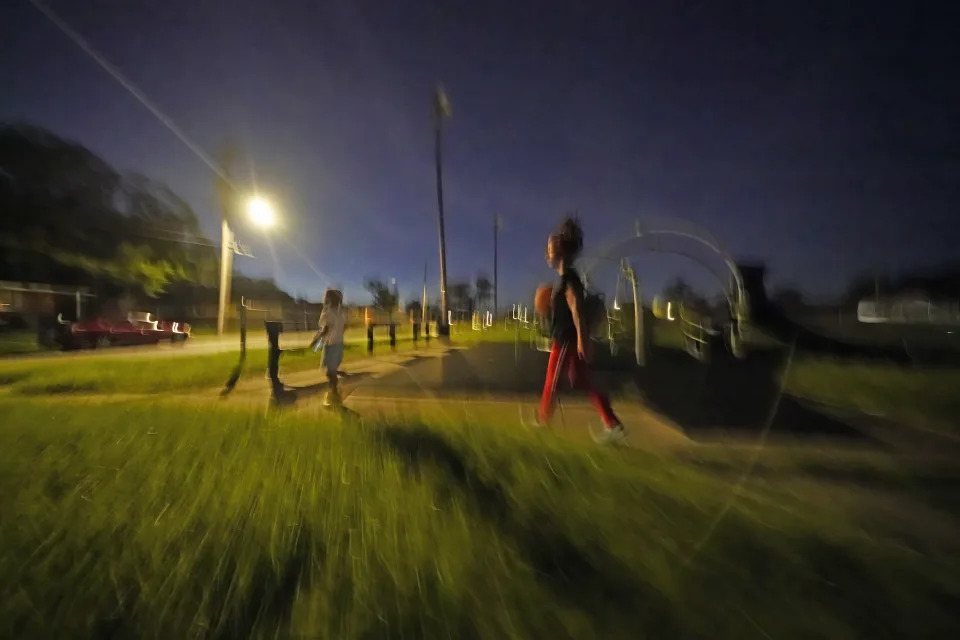
Jada Riley poses with her son Jayden Harris, 6, as they play on a basketball court near her former apartment, Thursday, July 28, 2022, in New Orleans. Two months behind on rent, Riley made the difficult decision last month to leave her apartment rather than risk an eviction judgment on her record. Now, she's living in her car with her 6-year-old son, sometimes spending nights at the apartments of friends or her son's father. (AP Photo/Gerald Herbert)
Jada Riley poses with her son Jayden Harris, 6, as they play on a basketball court near her former apartment, Thursday, July 28, 2022, in New Orleans. Two months behind on rent, Riley made the difficult decision last month to leave her apartment rather than risk an eviction judgment on her record. Now, she’s living in her car with her 6-year-old son, sometimes spending nights at the apartments of friends 
Jada Riley blows bubbles on a basketball court to entertain her 6-year-old son Jayden Harris, Thursday, July 28, 2022, near her former apartment in New Orleans. “I've slept outside for a whole year before. It's very depressing, I'm not going to lie,” said Riley, who often doesn't have enough money to buy gas or afford food every day. “I don't want to have my son experience any struggles that I went through.” (AP Photo/Gerald Herbert)
Jada Riley blows bubbles on a basketball court to entertain her 6-year-old son Jayden Harris, Thursday, July 28, 2022, near her former apartment in New Orleans. “I’ve slept outside for a whole year before. It’s very depressing, I’m not going to lie,” said Riley, who often doesn’t have enough money to buy gas or afford food every day. “I don’t want to have my son experience any struggles that I went through.” (AP
Jada Riley goes through her possessions in the trunk of her car near her former apartment, Thursday, July 28, 2022, in New Orleans. Two months behind on rent, Riley made the difficult decision last month to leave her apartment rather than risk an eviction judgment on her record. Now, she's living in her car with her 6-year-old son, sometimes spending nights at the apartments of friends or her son's father. (AP Photo/Gerald Herbert)
Jada Riley goes through her possessions in the trunk of her car near her former apartment, Thursday, July 28, 2022, in New Orleans. Two months behind on rent, Riley made the difficult decision last month to leave her apartment rather than risk an eviction judgment on her record. Now, she’s living in her car with her 6-year-old son, sometimes spending nights at the apartments of friends or her son’s father. (AP
Jayden Harris, 6, sits in the backseat of his mother Jada Riley's car, after having to move out of her apartment days before, Thursday, July 28, 2022, in New Orleans. Eviction filings nationwide have steadily risen in recent months and are approaching or exceeding pre-pandemic levels in many cities and states. That's in stark contrast to the pandemic, when state and federal moratoriums on evictions, combined with $46.5 billion in federal Emergency Rental Assistance, kept millions of families housed. (AP Photo/Gerald Herbert)
Jayden Harris, 6, sits in the backseat of his mother Jada Riley’s car, after having to move out of her apartment days before, Thursday, July 28, 2022, in New Orleans. Eviction filings nationwide have steadily risen in recent months and are approaching or exceeding pre-pandemic levels in many cities and states. That’s in stark contrast to the pandemic, when state and federal moratoriums on evictions, combined
Jada Riley leaves a basketball court as she walks to her car with her 6-year-old son Jayden Harris, Thursday, July 28, 2022, near her former apartment in New Orleans. Eviction filings nationwide have steadily risen in recent months and are approaching or exceeding pre-pandemic levels in many cities and states. That's in stark contrast to the pandemic, when state and federal moratoriums on evictions, combined with $46.5 billion in federal Emergency Rental Assistance, kept millions of families housed. (AP Photo/Gerald Herbert)
Jada Riley leaves a basketball court as she walks to her car with her 6-year-old son Jayden Harris, Thursday, July 28, 2022, near her former apartment in New Orleans. Eviction filings nationwide have steadily risen in recent months and are approaching or exceeding pre-pandemic levels in many cities and states. That’s in stark contrast to the pandemic, when state and federal moratoriums on evictions, combined with $46.5 billion in federal Emergency Rental Assistance, kept millions of families housed. (AP Photo/Gerald Herbert)

Jada Riley thought she had beaten homelessness.

The 26-year-old New Orleans resident was finally making a steady income cleaning houses during the pandemic to afford a $700-a-month, one-bedroom apartment. But she lost nearly all her clients after Hurricane Ida hit last year. Then she was fired from a grocery store job in February after taking time off to help a relative.

Two months behind on rent, she made the difficult decision last month to leave her apartment rather than risk an eviction judgment on her record. Now, she’s living in her car with her 6-year-old son, sometimes spending nights at the apartments of friends or her son’s father.

“I’ve slept outside for a whole year before. It’s very depressing, I’m not going to lie,” said Riley, who often doesn’t have enough money to buy gas or afford food every day.

“I don’t want to have my son experience any struggles that I went through.”

Eviction filings nationwide have steadily risen in recent months and are approaching or exceeding pre-pandemic levels in many cities and states. That’s in stark contrast to the pandemic, when state and federal moratoriums on evictions, combined with $46.5 billion in f ederal Emergency Rental Assistance, kept millions of families housed.

“I really think this is the tip of the iceberg,” Shannon MacKenzie, executive director of Colorado Poverty Law Project, said of June filings in Denver, which were about 24% higher than the same time three years ago. “Our numbers of evictions are increasing every month at an astonishing rate, and I just don’t see that abating any time soon.”

According to The Eviction Lab, several cities are running far above historic averages, with Minneapolis-St. Paul 91% higher in June, Las Vegas up 56%, Hartford, Connecticut, up 32%, and Jacksonville, Florida, up 17%. In Maricopa County, home to Phoenix, eviction filings in July were the highest in 13 years, officials said.

Some legal advocates said the sharp increase in housing prices due to inflation is partly to blame. Rental prices nationwide are up nearly 15% from a year ago and almost 25% from 2019, according to the real estate company Zillow. Rental vacancy rates, meanwhile, have declined to a 35-year low of 5.8%, according to the Census Bureau.

A report last month from the National Low Income Housing Coalition found that a tenant working full time needs to make nearly $26 per hour on average nationally to afford a modest two-bedroom rental and $21.25 for a one-bedroom. The federal minimum wage is $7.25 an hour.

“Landlords are raising the rent and making it very unaffordable for tenants to stay,” said Marie Claire Tran-Leung, the eviction initiative project director for the National Housing Law Project.

“Inflation has really shrunk the supply of housing that is available for people with the lowest incomes,” she added. “Without more protections in place, which not all states have, a lot of those families will be rendered homeless.”

Patrick McCloud, chief executive officer of the Virginia Apartment Management Association, said the trend is a return to normal. “No one likes evictions, but they are in some ways a reset to the economy,” McCloud said, adding that evictions have been “artificially depressed.”

“Housing is based on supply and demand. And when no one moves and you have no vacancies, you have a tight market and prices go up.”

Graham Bowman, a staff attorney with Legal Aid Society of Columbus, Ohio, said evictions there are rising — 15% above historic averages in June alone — at a time when there are fewer places for those forced out to go.

Sheryl Lynne Smith was evicted in May from her two-bedroom townhouse in Columbus after she used her rent money to repair a sewage leak in the basement. Smith, who is legally blind and has a federal housing voucher, fears she won’t be able to find anything by September when the voucher expires because of rising housing prices and the eviction on her record.

“It’s very scary,” said Smith, 53, whose temporary stay at a hotel funded through a state program ends this weekend.

In Boise, Idaho, Jeremy McKenney, 45, moved into his car last week after a judge sided with a property management company that nearly tripled the rent on his two-bedroom house. The Lyft and DoorDash driver will have to rent a hotel room whenever he has custody of his children, 9 and 12.

“It’s definitely mind blowing,” said McKenney, adding that everything on the market is beyond his reach even after a nonprofit offered to cover the security deposit. “I have never been homeless before. I have always had a roof over my head.”

The other challenge is the federal emergency rental assistance that helped keep millions housed during the pandemic has dried up in some jurisdictions or been increasingly rejected by some landlords.

“What really gets me is there is rental assistance and so many landlords just don’t want it. They would rather throw someone on the street than take money,” Eric Kwartler, managing attorney of Lone Star Legal Aid’s Eviction Right to Counsel Project, which covers Houston and Harris County in Texas. “If you take the money, you can’t evict them. They want them out.”

The U.S. Treasury said last week that more than $40 billion of the $46.5 billion in Emergency Rental Assistance had been spent or allocated.

According to the National Low Income Housing Coalition, California, Connecticut, Massachusetts, Minnesota, North Carolina, and Virginia have gone through at least 90% of their first disbursement. Twelve states and the District of Columbia had used 50% of the second allocation, known as ERA2, by the end of May. Three — Idaho, Ohio and Iowa — haven’t spent any ERA2 money and two — Nebraska and Arkansas — didn’t accept the funds.

“The public health emergency may still be here but the funds to deal with it are rapidly disappearing,” said Martin Wegbreit, director of litigation for the Central Virginia Legal Aid Society.

Treasury is encouraging states and cities to tap other federal stimulus funds to cover the gaps. So far, over 600 state and local governments had budgeted $12.9 billion in stimulus funds to meet housing needs, including affordable housing development.

Gene Sperling, who oversees President Joe Biden’s $1.9 trillion coronavirus rescue package, highlighted the success of its rental assistance program, which has reached 7 million mostly low-income households.

But, more needs to be done to ensure the country doesn’t return to pre-pandemic times when 3.6 million tenants were evicted annually and “evictions were too often a first resort, not a last resort,” he told a forum on eviction reforms at the White House last week.

Some lawmakers said the answer is a permanent rental assistance program. A bill introduced in July would provide $3 billion annually for rental assistance and fund services to keep families housed. A study commissioned by the National Apartment Association and the National Multifamily Housing Council says the answer is building 4.3 million apartments by 2035.

Other advocates called for permanent legal protections like right to counsel for tenants or eviction diversion programs to resolve evictions before they reach the courts.

In Richmond, Virginia, eviction filings in June were 54% below historic averages, attributed to rental assistance and more legal representation for tenants in court, Wegbreit said. Similar programs were credited with New Mexico’s eviction filings being 29% below historic averages in June.

Philadelphia, which passed a law making eviction diversion mandatory through this year, saw filings down 33%. The City Council in Philadelphia also approved spending $30 million over two years for rental assistance.

“We are trying to change the way we look at this issue in Philadelphia, where the only thing you do is go to landlord tenant court or start an eviction,” said Catherine Anderson, supervising attorney with Philadelphia Legal Assistance, who oversees the paralegals on the Save Your Home Philly hotline.

Associated Press writers Jesse Bedayn in Denver, Ben Finley in Norfolk, Virginia, and Claudia Lauer in Philadelphia contributed to this report

This story has been corrected to show that McKenney is from Boise, Idaho, not Boise, Utah.

‘Getting harder and hotter’: Phoenix fire crews race to save lives in America’s hottest city

The Guardian

‘Getting harder and hotter’: Phoenix fire crews race to save lives in America’s hottest city

Nina Lakhani in Phoenix. Photography by Adriana Zehbrauskas. Data visuals by Elisabeth Gawthorp from APM Research Lab and Andrew Witherspoon – August 10, 2022

The 911 call came in about an elderly man who had fallen outside a storage facility in central Phoenix. The fire crew, who are also paramedics, found 80-year-old Noel laid on his back on the concrete ramp under direct sunlight; he was weak, thirsty and very hot.

Noel, an Englishman with diabetes and hypertension, had been moving furniture when his legs gave way. His core temperature was 104F – dangerously hot. (The typical range for a healthy older adult is 97 to 99F.) His blood pressure was also very high at 242/110, and his pulse was racing.

Noel had been lying on the piercing hot concrete ramp for about 45 minutes. A firefighter wrapped an ice cold towel around his neck and inserted IV lines into both arms. It was 3.30pm and the outside temperature hovered above 100F – below the average for the time of year in Phoenix, but several degrees hotter than the previous week when monsoon rains cooled the city.

This was not an isolated incident.

So far this year, 1,215 emergency calls have been designated by dispatch as heat-related – a 34% increase on the same period in 2020, and 18% more than last year. The 911 dispatch data showed 11 heat calls that day but did not include Noel, suggesting the actual numbers could be higher.

Hotspots include areas where the city’s growing unsheltered population are concentrated, but calls are spread across the metropolitan area.

Heat can kill, so once the call comes in it’s a race against time.

The ambulance arrived within five minutes, and the crew helped Noel on to a gurney and into the air conditioned vehicle, where they placed ice packs under his armpits and on his chest. He was hooked up to a cold saline IV drip to start cooling down his core temperature.

“I feel so stupid, I pushed myself too hard,” said Noel, who was lucid but could barely open his eyes as the paramedics turned on the sirens and sped off to the ER.

It’s getting hotter in America’s hottest city, and the fire service is on the frontline of dealing with heat-related emergencies.

So far this summer, almost half the US has been under a heat advisory at one point or another, with record daytime temperatures from the Pacific north-west to Kansas and Oklahoma in the midwest to Texas and Phoenix in the south and New England and Philadelphia in the east.

Scientists warn that dangerous heatwaves will become more frequent and unpredictable unless sweeping action is taken to stop burning fossil fuels and curtail global heating.

But the scale of the health burden – the impact of heat-associated deaths, injuries and illness on individuals and services – is not fully known due to variations in the way incidents are investigated and recorded at the local level.

The Guardian recently shadowed a crew at fire station 18 in central Phoenix on three separate days in order to better understand the impact of extreme heat on first responders.

Station 18 is the busiest in Arizona, with two trucks and two ambulances covering a densely populated section of the city with few trees but plenty of strip malls, low-income apartment blocks and a growing homeless population. Each vehicle has an ice chest with cooling towels, bottled water and saline packs for heat calls.

Three teams – the A, B and C shift – work 24 hours on, 48 hours off, although many do overtime as citywide, the service is short-staffed. The station mascot is a bedbug, an ode to the frequent encounters with the tiny blood suckers.

By the end of July the B shift, which the Guardian followed, had at least five patients – two women, three men – with core temperatures over 108F – which is when their thermometer maxes out and simply reads “high”. All were unconscious and needed intubation (help breathing).

In one case a passerby called 911 after spotting a man face down, unconscious behind a wall. His core temperature at the hospital was 112F – the hottest so far this year.

The crew ripped off his clothes, placed cold towels and ice packs under his armpits, groin, and neck, and administered cold IV fluids through a hole drilled into his shin. He had no gag reflex when the crew tested it, and burn blisters on his arms and neck.

In the ER, he was put inside a body bag filled with ice, what’s known as a hot pocket, in a last-ditch attempt to cool him down. A catheter was inserted to remove any hot urine before transferring him to the ICU.

“You could feel the heat coming off his body … we do everything we can but it’s very hard to come back from that temperature,” said Brennan Johnsson, 27, who is assigned to an ambulance.

Last year’s record for Johnsson was a young homeless woman in her 20s, whose core temperature was 114F. He is relatively new to the service and remembers all the heat calls.

Excessive heat can exacerbate chronic medical conditions such as diabetes, heart disease and asthma, while some drugs – prescription and illicit – can elevate the risk of heat illness. Public health experts agree that heat-associated morbidity and mortality is preventable, but socioeconomic risk factors such as homelessness, addiction and fuel poverty are rising.

Since records began in 2014, there have been just three days during the months of June and July with no 911 calls for heat illness in Phoenix, according to an analysis by APM Research Lab shared with the Guardian.

“Heat affects so much of what the fire service does,” said Rob McDade, the fire department’s public affairs chief. “This environment can be very inhospitable and it’s getting hotter.”

It was around 1pm and 106F when the fire alarm sounded, triggering a Pavlovian-type response from the guys (the crews are all male) who were cleaning up after lunch. The alarm for a fire is distinct to a medical call, and within seconds all four crews were en route with sirens and lights blazing, pulling on heavy protective gear as they rode towards the smoke.

Lofty flames emanated from an air conditioner on the roof of a gift store, the corner unit of a strip mall. Old AC units can overwork, overheat and catch on fire.

It was the third week of June, and by 2pm it was 110F outside. The captain pulled out the crew battling the blaze after about half an hour: when it’s this hot outside, they fatigue faster and it’s harder to cool down. As another team took over inside, the station 18 crew stripped down, poured cold water over their heads and chugged water and Gatorade. Half an hour later, they went back inside.

As temperatures rise every summer, more fire crews are needed to make sure they can be rotated every 30 minutes. At one point, there were seven fire trucks and three ambulances at the scene.

“If you get too hot or dehydrated, it’s game over,” said Brian Peter, a ladder specialist from a neighboring station.

Training is key. As a desert city, Phoenix gets relatively cool in the winter, so when temperatures start edging back up, the firefighters must re-acclimate to extreme heat.

Outside at the station building, a whiteboard details the skills training regimen which includes dragging tires, ladders and sledge across the car park in full gear – twice when the temperature is below 105F, once when it’s above. Station 18 is a teaching hub, and rookies train for hours listening to thrash metal, while the crews make time between calls, cooking, gym workouts and occasional power naps.

“The summer months take a physical toll. Maybe it’s my age, but it’s definitely getting hotter and harder,” said Tim West, 39, a captain with 16 years in the service who said he loses five to 10lb every year.

It’s not just his age. On 13 July 2022, dispatch recorded 52 heat calls – the highest number since records began in 2014. Five of the 10 highest heat call days have been this year, APM Research Lab found.

Overheated hikers are among the most costly and challenging calls, and last summer four firefighters were hospitalized after conducting mountain rescues in triple digit temperatures. It’s not just badly prepared out-of-towners, a sprained ankle or snake bite can also turn into a heat emergency as hikers can be hard to reach.

As a result, some popular trailheads now close when the National Weather Service (NWS) issues a heat advisory.

“Hiking calls put a lot of stress on some teams, 100%,” said McDade. “But heat trickles down into everything we do.”

On a hot day, any call can turn into a heat emergency.

A person injured in a traffic accident or a homeless person without shade or adequate clothing can end up with severe burns if their skin is in contact with a hot surface like a road or bench. “If the body is sandwiched between the ground at 150F and direct sunlight, it won’t end well,” said Johnsson.

In Phoenix, the trifecta of extreme heat, homelessness and substance misuse have contributed to hundreds of preventable deaths in recent years.

In one call the Guardian attended, a security guard at a Circle K convenience store found an unresponsive man who had been smoking fentanyl. In another, a recently evicted man with sores over his arms and legs was responsive but confused . Intoxicated individuals can easily overheat, burn and become dehydrated without realizing, but neither wanted to go to hospital, which is pretty much all the fire crew can offer.

But some of the worst heat emergencies this year have come after sundown.

In June and July 2022, the night-time low in Phoenix didn’t fall below 80F on 45 occasions, including 11 nights over 90F. Night-time temperatures in Phoenix are rising twice as fast as daytime temps, according to the NWS. The impact of heat is cumulative, and the body only starts to recover when it drops below 80F.

Last month, the crew responded to what dispatch said was a traffic accident involving a cyclist. It was around 8.30pm but still very hot, and the man had collapsed with heatstroke. He was confused and combative, his core temperature 107F. “At that time, it should be the home straight, people think they’ll be OK,” said firefighter Geoff Pakis, 40. “Heat deaths are 100% preventable.”

Rhine River could fall below critical mark, risking industry

Associated Press

Rhine River could fall below critical mark, risking industry

Daniel Niemann and Frank Jordans – August 10, 2022

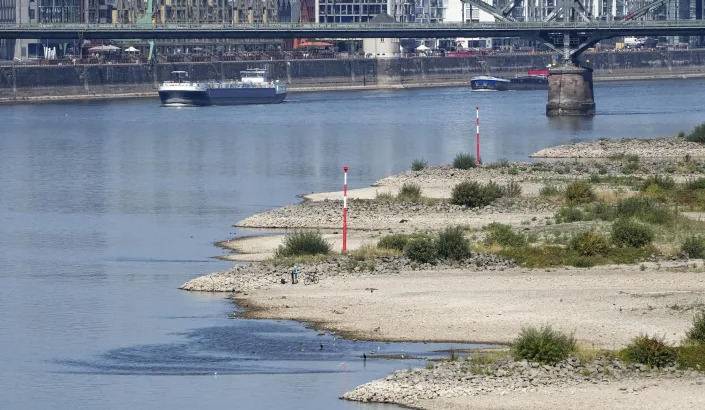
The river Rhine is pictured with low water in Cologne, Germany, Wednesday, Aug. 10, 2022. The low water levels are threatening Germany's industry as more and more ships are unable to traverse the key waterway. Severe drought will worsen in Europe in August as a hot and dry summer persists. (AP Photo/Martin Meissner)

COLOGNE, Germany (AP) — Water levels on the Rhine River could reach a critically low point in the coming days, German officials said Wednesday, making it increasingly difficult to transport goods — including coal and gasoline — as drought and an energy crisis grip Europe.

Weeks of dry weather have turned several of Europe’s major waterways into trickles, posing a headache for German factories and power plants that rely on deliveries by ship and making an economic slowdown ever more likely. Transporting goods by inland waterways is more important in Germany than in many other Western European countries, according to Capital Economics.

“This is particularly the case for the Rhine, whose nautical bottleneck at Kaub has very low water levels but which remains navigable for ships with small drafts,” said Tim Alexandrin, a spokesman for Germany’s Transport Ministry.

Authorities predict that water levels at Kaub will dip below the mark of 40 centimeters (16 inches) early Friday and keep falling over the weekend. While this is still higher than the record low of 27 centimeters seen in October 2018, many large ships could struggle to safely pass the river at that spot, located roughly mid-way along the Rhine between Koblenz and Mainz.

“The situation is quite dramatic, but not as dramatic yet as in 2018,” said Christian Lorenz, a spokesman for the German logistics company HGK.

From France and Italy, Europe is struggling with dry spellsshrinking waterways and heat waves that are becoming more severe and frequent because of climate change. Low water levels are another blow for industry in Germany, which is struggling with shrinking flows of natural gas that have sent prices surging.

Due to the lack of water, ships bringing salt down the Rhine River from Heilbronn to Cologne that would normally carry 2,200 metric tons (2,425 U.S. tons) of cargo are only able to transport about 600 tons, he said.

“Of course, we hope that shipping won’t be halted, but we saw in 2018 that when water levels got very low the gas stations suddenly had no more fuel because ships couldn’t get through,” Lorenz said.

Authorities are taking steps to shift more goods traffic onto the rail network and, if necessary, give it priority, said Alexandrin, the Transport Ministry spokesman.

Those other options will be more expensive and take longer, with the higher cost making it impossible in some cases, said Andrew Cunningham, chief Europe economist for Capital Economics.

The river transportation issues are not problematic for German industry as shrinking flows and rising prices for natural gas, he said, with Russia having reduced deliveries to Germany through the Nord Stream 1 pipeline to 20% of capacity. But the woes on the Rhine could still take a small bite out of economic growth if they last until December, add a bit to already-high inflation and lead industrial production to drop slightly, the economist said.

But with Capital Economics already expecting flat economic growth in Germany in the third quarter and a contraction in the last three months of the year, “the low water level in the Rhine simply makes a recession even more likely,” Cunningham said.

HGK and other shipping companies are preparing for a “new normal” in which low water levels become more common as global warming makes droughts more severe, sapping water along the length of the Rhine from the Swiss Alps to the North Sea.

“There’s no denying climate change and the industry is adjusting to it,” said Lorenz.

All new ships being ordered by the company will be built with a view to making them suitable for low water levels on the Rhine, he said.

Jordans reported from Berlin.

State refuses request for more water in communities with high wildfire risk

Los Angeles Times

State refuses request for more water in communities with high wildfire risk

Alex Wigglesworth – August 9, 2022

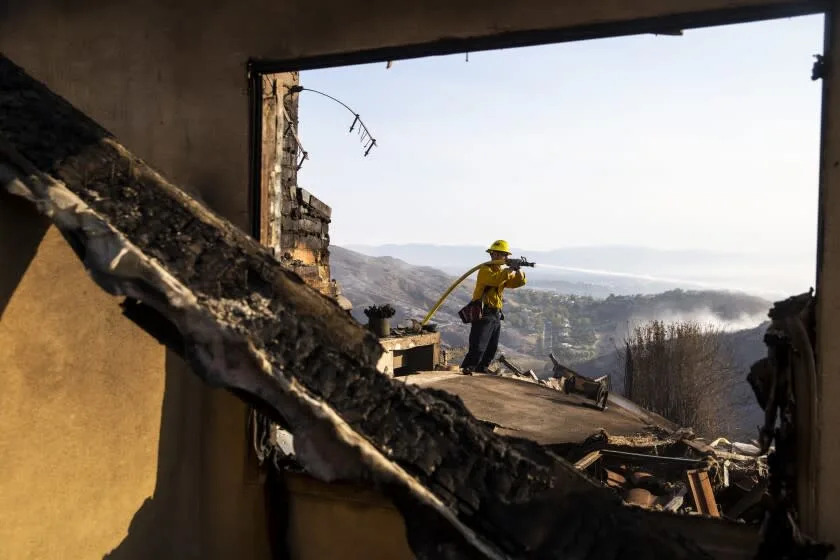
Kent Nishimura  Los Angeles Times THE WOOLSEY FIRE destroyed 27 homes in Bell Canyon and damaged 17 more. The home that Mayor Eric Garcetti asked to be checked came out unscathed.
The Woolsey fire destroyed multiple homes in 2018. (Kent Nishimura/Los Angeles Times)

State officials have denied a request by Southern California municipal water districts for more water to mitigate wildfire risk.

The agencies had worked with the Metropolitan Water District of Southern California to ask the California Department of Water Resources to allocate 26,300 more acre-feet of water under the health-and-safety exception to drought rules, using the rationale that the exception should include supplies to reduce wildfire hazards by irrigating vegetation in high-risk areas.

“Irrigation of landscaping within defensible space, as described in your request, can play a role in reducing wildfire risk,” read the July 29 response from DWR and the California Department of Forestry and Fire Protection. “However, alternative approaches for fire prevention are available that will be equally effective as supplemental deliveries, and therefore DWR is denying your request.”

Residents and officials should reduce risk by hardening structures with fire-resistant materials, creating defensible space and putting in place fuel management programs, the letter recommended. If vegetation within a defensible space can’t be watered sufficiently to keep it from dying, it should be cut back, the letter said.

“We’re frustrated by the decision but understand the state’s challenge to balance the needs of more than 27 million people receiving water from the State Water Project, along with the real possibility of another dry year,” David Pedersen, general manager of the Las Virgenes Municipal Water District, said in a statement.

The state is already providing the agencies with additional water under the health-and-safety exception to prevent tree die-off that would contribute to fire risk and to maintain reservoirs and other water sources for firefighting, the letter noted.

“At this time, providing supplemental water beyond these narrow demands increases the likelihood that the State will have to make even more difficult tradeoffs over water supplies in 2023,” it read.

The Las Virgenes Municipal Water District, which spearheaded the request for more water, said it would pursue alternate strategies. Those include trying to purchase water from other agencies, as well as working with the Los Angeles County Fire Department to hold community workshops and other outreach efforts to educate customers about reducing fire risk around their homes, said district spokesman Mike McNutt.

“It seems like what the state is doing is pivoting out of necessity to trying to educate and push homeowners to take more responsibility for creating defensible space for themselves in the event of an advancement of a wildfire,” he said. “It’s really just this new realization that each person who lives in California has to take the responsibility on themselves to minimize their water usage and to protect their own home from the possibility of wildfires and other natural disasters.”

The Las Virgenes water district serves communities in and around the Santa Monica Mountains, most of which are rated by Cal Fire as being at the highest risk of severe wildfire. Customers in the service area, which includes Agoura Hills, Hidden Hills, Westlake Village and Calabasas, reduced water use by 20% in May and 37% in June from the same months in 2020, but the district’s allocation is 73% less, officials said.

Las Virgenes is wholly dependent on imported water, most of it from the State Water Project, and is not able to pull from groundwater supplies or alternate sources like the Colorado River, McNutt said.

For that reason, the district said, it has been forced to draw about 17 acre-feet a day from the Las Virgenes Reservoir, which is intended to meet emergency needs. The reservoir provides a roughly six-month supply of water when it’s full and is now at about 79% capacity, McNutt said.

In a letter supporting the request for more water, L.A. County Fire Chief Daryl Osby (who has since retired) wrote that should the situation continue, it could jeopardize the district’s ability to provide the department with the minimum supply needed to support flow requirements to fight fires.

Residents at a May town hall meeting of the Las Virgenes Municipal Water District voiced fears over how drought restrictions would affect wildfire activity. Several speakers had survived the Woolsey fire, which destroyed more than 1,600 structures from Thousand Oaks to Malibu and killed three people. No drought restrictions were in place at the time.

“This is a public safety issue that has created concern amongst the LVMWD staff, board, residents and the communities that we serve,” Jay Lewitt, president of the water district’s board, said in a statement. “We are well aware of our region’s potential for fire danger and that is yet another reason why we relentlessly pursue more water.”

McNutt said the district will continue to have enough water to support firefighting operations, but residents can no longer count on sufficient supplies to maintain flourishing vegetation around their homes.

“In terms of having enough water to continue to irrigate your outdoor living space, where the vegetation is still alive and will help combat the flames, I don’t think that from now moving forward, that’s really going to be something people can rely upon,” he said. “It’s the new reality of what is happening in the state of California, with climate change rearing its head and with unusual and erratic weather patterns that we can’t rely on now.”

The water district understands the state’s reasoning, he added. “There’s just not enough water to satisfy the needs of everybody,” he said. “And what happened to us is just indicative of how truly historic and dire the water-scarcity situation is right now.”

Times staff writer Brittny Mejia contributed to this report.

Here’s what the Inflation Reduction Act will do to combat climate change

Yahoo! News

Here’s what the Inflation Reduction Act will do to combat climate change

Ben Adler, Senior Editor – August 9, 2022

The Inflation Reduction Act (IRA) passed by the Senate over the weekend will pursue an extremely wide and varied array of strategies intended to combat climate change. The $369 billion in climate-related spending over 10 years targets five areas: consumer clean energy costs, decarbonizing various sectors of the economy, domestic clean energy manufacturing, environmental justice, and agriculture and land use. Taken together, these programs would help the U.S. reduce its greenhouse gas emissions by 40% from 2005 levels by 2030, and would save an estimated 3,700 to 3,900 lives per year thanks to cleaner air from a reduction in burning fossil fuels.

Steam rises from the cooling towers of the coal-fired power plant at Duke Energy's Crystal River Energy Complex in Crystal River, Fla.
Steam rises from the cooling towers of the coal-fired power plant at Duke Energy’s Crystal River Energy Complex in Crystal River, Fla. (Dane Rhys/Reuters)

This approach represents a break from many past congressional proposals designed to reduce the greenhouse gas emissions that cause global warming, most of which proposed using a singular, overarching policy, such as taxing emissions or requiring tradable permits for emissions. Those measures all died in Congress, but this one made it through the Senate and is expected to pass the House later this week.

“The whole package in terms of dealing with climate change is a long-overdue improvement,” former Democratic Rep. Henry Waxman told Yahoo News on Tuesday. Waxman was chair of the House Energy and Commerce Committee for many years, and he co-wrote a bill that passed the House but died in the Senate that would have capped carbon emissions and gradually reduced the number of tradable credits for them, a system known as cap-and-trade.

“Unlike other efforts in the past, such as cap-and-trade or a carbon tax, this approach gives a lot of incentives, financial especially, through the tax code and appropriations for industry to accomplish a reduction in emissions,” Waxman said. “This climate proposal has very little, if any, regulation. It’s a lot of incentives to develop, in effect, a partnership with industry and the government … to sharpen up the technology to accomplish our goals.”

Here’s a guide to the biggest programs in each bucket of climate policies, and what they will mean for American families.

Consumer clean energy costs
Solar panels create electricity on the roof of a house in Rockport, Mass.
Solar panels create electricity on the roof of a house in Rockport, Mass. (Brian Snyder/Reuters)

The IRA would pour money into helping homeowners, especially those with low and moderate incomes, and lower their carbon footprint and their energy bills by helping them transition to more efficient heating and cooling systems. There will be a $9 billion program to help low-income households switch to electric appliances (such as stoves) and to retrofit their homes for energy efficiency (by insulating windows, for example).

There will also be tax credits for replacing oil and gas burners with electric heat pumps and water heaters and installing rooftop solar, allowing customers to get 30% off the cost of these purchases.

To reduce dependence on oil, the bill would provide a $4,000 consumer tax credit for lower- and middle-income individuals to buy used electric vehicles, and a $7,500 tax credit to those who make less than $150,000 per year or couples who make less than $300,000 per year who buy new electric vehicles. (Qualifying EVs must cost less than $55,000 for cars and less than $80,000 for trucks.) There is also a $1 billion grant program to help local authorities make affordable housing more energy-efficient.

A family that uses all these rebates and tax credits could receive an additional grand total of $28,500 in incentives, according to the Center for American Progress. Rewiring America, an advocacy group that promotes electrification, estimates that a family that takes advantage of these incentives will save an average of $1,800 per year on home heating fuel and lower energy bills.

However, in order to win the crucial support of Sen. Joe Manchin, D-W.Va., the IRA requires that an EV eligible for the tax credit must have a battery built in North America with minerals mined or recycled there as well. Currently, most EVs on the market would not qualify. The purpose is to develop EV building capacity domestically, instead of relying on China, which is the main producer of lithium-ion batteries. But automakers have expressed doubts that they will be able to meet the bill’s requirements on its timeline.

Decarbonizing the economy
Piles of coal at the PacifiCorp Hunter coal-fired electrical generation plant in Castle Dale, Utah.
Piles of coal at the PacifiCorp Hunter coal-fired electrical generation plant in Castle Dale, Utah. (George Frey/Bloomberg via Getty Images)

About $30 billion will be doled out in grants and loan programs to states and electric utilities to switch utilities from burning gas and coal to using clean energy sources such as wind and solar power. There are also grants and tax credits for clean commercial vehicles — think electric delivery trucks, buses and taxis — and money for efforts to reduce emissions from industrial processes, such as chemical, steel and cement plants.

In order to use the federal government’s buying power to catalyze private sector investment as well, the IRA contains $9 billion for the U.S. to buy clean technologies. For example, it includes $3 billion for the U.S. Postal Service to purchase zero-emission vehicles.

As part of this bill’s emphasis on equity, there is a $27 billion “clean energy technology accelerator” that will distribute funds to deploy clean energy technologies, especially in lower-income communities. An example of a recipient of these funds would be, say, a nonprofit that helps low-income renters, who can’t buy a solar panel for their own home, enjoy the cost savings of buying solar panels by pooling their money and buying solar panels to go in a public space and sharing in the savings

In a major win for environmentalists, there is also going to be a program to reduce the leakage of methane, a highly potent greenhouse gas, from oil and gas wells and pipelines. This is the rare portion of the IRA that includes sticks as well as carrots: grants to help the industry comply and the imposition of fees for operators that continue to leak methane at a high rate.

Domestic clean energy manufacturing
An electric vehicle charging station in New Rochelle, N.Y.
An electric vehicle charging station in New Rochelle, N.Y. (Star Max/IPx via AP)

Whatever the costs and benefits of Manchin’s buy-American requirements for the EV tax credits, every Democrat agrees that developing the ability to produce the key ingredients of a clean energy economy within the United States would be beneficial. So the IRA includes $30 billion worth of tax credits for manufacturing solar panels, wind turbines, batteries capable of storing wind and solar energy, and the processing of key minerals needed for all those technologies (and for electric vehicles).

Separate from those tax credits for making the actual products, there are $10 billion in tax credits for building the infrastructure needed for that production, such as wind turbine and solar panel factories, and $2 billion for renovating auto factories to make EVs. The federal government will also offer up to $20 billion in loans to build new EV manufacturing facilities across the country and will provide $2 billion for additional clean energy research.

Environmental justice

Predominantly Black and Latino neighborhoods and poorer communities suffer an outsize share of the effects of climate change, such as extreme heat, flooding and the pollution from burning fossil fuels on highways and in factories and power plants. The IRA will give out $3 billion in block grants for community-led projects to deal with those kinds of problems, another $3 billion for neighborhood improvements like reconnecting areas separated by highways, $3 billion to reduce pollution at ports and $1 billion for electric heavy-duty vehicles, like garbage trucks.

Agriculture and land use
Drought-conditioned saplings from resilient seeds used to reforest burn scars are grown at John T. Harrington Forestry Research Center in Mora, N.M.
Drought-conditioned saplings from resilient seeds used to reforest burn scars are grown at John T. Harrington Forestry Research Center in Mora, N.M. (Adria Malcolm/Reuters)

Plants absorb carbon dioxide, so how they are managed can affect how much carbon is in the atmosphere. The IRA will spend $20 billion on climate-smart agriculture practices (rotating crops instead of planting the same ones in the same place every year, for example) and $5 billion for forest conservation and urban tree planting.

The bill also incorporates tax credits and grants to support the domestic production of lower-carbon biofuels and $2.6 billion in grants to conserve and restore coastal areas that are needed both to absorb carbon and to manage storm surges that are becoming severe because of climate change, via rising sea levels and more intense storms.

The bill also includes some measures that were needed to win Manchin’s support that will actually make climate change worse, such as requirements that the federal government lease swaths of federal land and coastal areas for oil and gas drilling. As with the electric vehicles, Manchin is focused on producing as much energy domestically as possible. Still, the overwhelming majority of environmentalists are exultant at the IRA’s overall potential to reduce the severity of climate change.