Midterm elections will leave us even more divided — the ‘Disunited States of America | Opinion
Andres Oppenheimer – November 4, 2022
If Republicans win the Nov. 8 midterm elections by a wide margin, as several polls are forecasting, the U.S. Congress will be virtually controlled by legislators who have not accepted the results of the 2020 elections, including many who have supported the violent takeover of the Capitol on Jan. 6, 2021.
A Congress controlled by election skeptics and coup-mongers — people who are not willing to accept their rivals’ victory — may turn an already politically divided country into an even more polarized one.
Worse, it may lead to greater political violence, prompting more incidents like the recent attack on the 82-year-old husband of House Speaker Nancy Pelosi by a right-wing extremist. We may soon become known as the Disunited States of America.
According to a Washington Post investigation, 51% of Republican candidates running for Congress, governorships and attorney general positions in Tuesday’s elections have either challenged or questioned President Biden’s victory in 2020. Many of those candidates are likely to be elected, and will be in charge of certifying the votes in the 2024 presidential elections.
A similar study by the New York Times found that 70% of Republicans running for Congress on Nov. 8 have echoed former President Trump’ s false claims that Biden’s election was rigged.
For the record, virtually all of Trump’s lies about the 2020 elections have been proven wrong by numerous vote recounts.
In addition to the Electoral College, the conservative-majority U.S. Supreme Court, more than 60 lower courts, Trump’s then-Vice President Mike Pence and former Trump Attorney General William Barr looked into Trump’s fraud claims and concluded that Biden was legitimately elected in 2020.
Biden won the Electoral College by 306 electoral votes to Trump’s 232 and the popular vote by 7.5 million votes. By comparison, Trump had won the Electoral College in 2016, but lost the popular vote by 3 million votes.
Even the conservative Wall Street Journal’s editorial page, after supporting Trump during his term, concluded after the 2020 elections that the former president’s fraud claims were rubbish. The newspaper said that isolated disputes over mailed ballots did “not add up to a stolen election.” It added that even if Biden’s victory had been overturned in one of the contested states’ vote recounts, Biden would have won in the Electoral College by a comfortable margin.
And yet, despite all of this, Americans are likely to elect many Republicans who reject the basic foundation of democracy: the sanctity of the vote.
Historically, the opposition party tends to win U.S. midterm elections. And polls suggest that the same will happen on Tuesday, with Republicans almost sure to retake the House of Representatives and, perhaps, also the Senate.
Many voters are more concerned about inflation than about the future of democracy.
Although 71% of Americans say they are worried about the future of democracy, only 7% say this is the most important issue facing the country, a recent New York Times -Siena poll shows.
But the Republican Party has been successful in pushing the narrative that the high U.S. inflation rate is all of Biden’s fault and not an international problem mainly caused by the COVID-19 pandemic and Russia’s invasion of Ukraine.
In fact, America remains one of the world’s strongest economies. The country’s 8.1 annual inflation rate is below Germany’s 10.2%, or Great Britain’s 11.3%, according to International Monetary Fund data.
And Biden has done a good job countering Russia’s invasion, which is the biggest current threat to world peace. Biden managed to revamp U.S. ties with the European Union, which Trump had crippled when he threatened to withdraw from the NATO military alliance, and added Japan and other Asian countries to the trans-Atlantic bloc that is helping defend Ukraine.
Still, I’m pretty pessimistic about the future of America’s democracy. I’m afraid that despite the fact that many moderate Republicans don’t believe Trump’s election lies and are true believers in the rule of law, they will cast their votes based on other issues, and will elect a new generation of extremists who are not ready to play by the rules of democracy.
We are heading toward a more divided, and probably more violence-ridden country.
Americans among dozens held hostage by Indigenous group in Amazon
CBSNews – November 4, 2022
A photo posted online by Angela Ramirez on November 3, 2022, shows a group of tourists, including Ramirez, being held on a boat in Peru’s Amazon region by an Indigenous group protesting what they say is the government’s failure to help after an oil spill. / Credit: Angela Ramirez/Facebook
A group of Indigenous people in Peru’s Amazon region has taken dozens of foreign and Peruvian tourists hostage as they made their way through the area on river tour boat. The Indigenous group says it took the action to protest the lack of government aid following an oil spill in the area, according to local media and members of the tour group.
“(We want) to call the government’s attention with this action, there are foreigners and Peruvians, there are about 70 people,” Watson Trujillo Acosta, the leader of the Cuninico community, told the country’s national RPP radio network.
The tourists include citizens from the United States, Spain, France, the U.K. and Switzerland.
Lon Haldeman, one of the Americans held captive, said in a statement shared with CBS News on Friday by his wife that the group had been held “for the past 26 hours.”
He said that the hostage-takers were demanding “medical help and clean water and food” after an oil spill in the area “contaminated the wells and river.”
“The villagers are peaceful toward us but they did take over the boat with spears and clubs,” Haldeman said in the statement. “No one had guns. We were parked near an island last night and the villagers took the battery from the boat motor. The captain and drivers are being held in a village jail. The village wants to keep the big boat for ransom. We might get some small rescue boats. There is new action every hour.”
Angela Ramirez, a Peruvian national who said she was among the hostages, said in a Facebook post on Thursday afternoon that there were children, pregnant women and disabled people among those seized on the boat.
Ramirez also said the Indigenous community was treating them with kindness and respect, adding that holding the tourists was “the only way they have found to look for solutions for their community” after oil spills that allegedly led to the deaths of two children and one woman.https://www.facebook.com/plugins/post.php?href=https%3A%2F%2Fwww.facebook.com%2Fpermalink.php%3Fstory_fbid%3Dpfbid02yScfATG6Qmr29TXQNkKMV8bBK6EV45qzSrrcmG8d2GrJkjjmJ791JQDJNJMqzR6Wl%26id%3D100005041500479&show_text=true&width=500
“The sooner they are heard, the sooner they will let us go,” said Ramirez in the online post. “Help me help them be heard.”
Acosta said his group had taken the “radical measure” in an effort to put pressure on the government to send a delegation to assess the environmental damage from a September 16 incident that spilled 2,500 tons of crude oil into the Cuninico River. He said the detainees would spend the night inside the vessel while awaiting a resolution to the situation.
Susan Notorangelo, Haldeman’s wife, told CBS News her husband had been sending sporadic updates to let her know he was OK, but not responding to many questions, which she suspected was an effort to conserve battery power on his iPad. Notorangelo said she had been told the U.S. State Department was sending a boat with food and water, but didn’t believe it had yet arrived at the remote location.
Haldeman is a tour guide, but was not running the tour that was detained. Notorangelo said her husband and the other tourists were supposed to have ended their boat ride at noon on Thursday and then ridden bikes to the nearby town of Iquitos. She said her husband has an airline ticket to leave Peru on Tuesday, and hopes he and the other hostages will be released in time for him to make the flight.
Ramirez told RPP that the Cuninico community had said it was prepared to hold the hostages for six to eight days, until it receives a response from the government.
She said they were “physically fine,” but in a new post on Friday morning she said the sun was strong, babies were crying and they were almost out of water.
Local media indicated no public comment from the Peruvian government or police on the incident, which took place on a tributary of the Maranon River.
Environmental activists protest outside the headquarters of the Peruvian Petroleum Company (Petroperu) in Lima, Peru, August 22, 2016. / Credit: Getty
Indigenous communities had already been blocking the transit of all vessels on the river in protest against the spill, which was caused by a rupture in the Norperuano oil pipeline.
On September 27, the government declared a 90-day state of emergency in the impacted region, which is home to about 2,500 members of the Cuninico and Urarinas communities.
The roughly 500-mile-long Norperuano pipeline, owned by the state-run Petroperu, was built four decades ago to transport crude oil from the Amazon region to the ports of Piura, on the coast.
According to Petroperu, the spill was the result of an eight-inch cut made deliberately in the pipeline, which the company said had suffered over a dozen similar attacks in the past.
CBS News’ Maddie Richards and April Alexander contributed to this report.
About 150 tourists are reportedly being held hostage in Peru. Locals are demanding a response to oil spills that have polluted their river.
Paola Rosa-Aquino, Natalie Musumeci – November 4, 2022
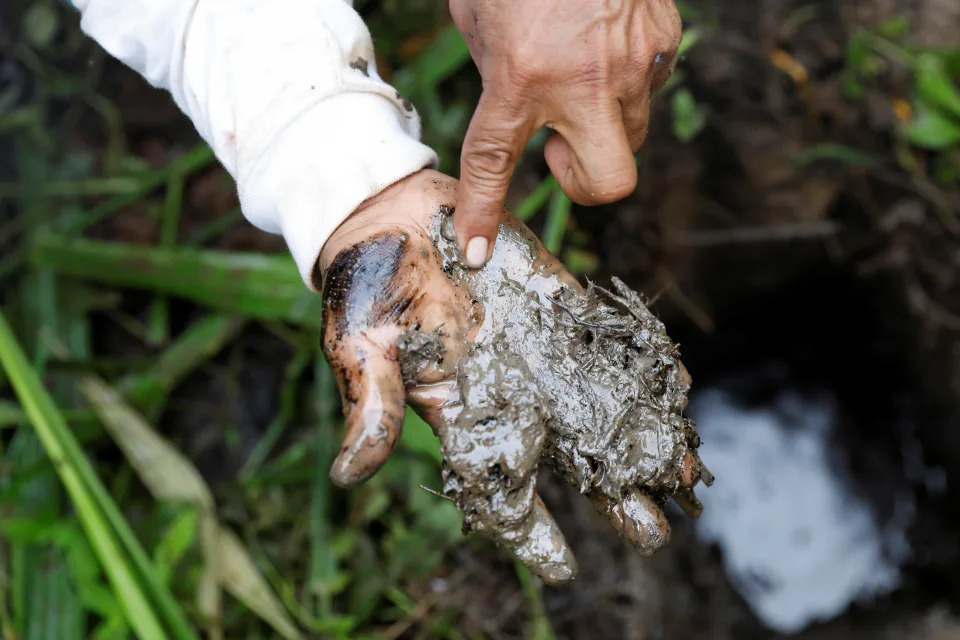
A man shows oil contamination inside Block 192, a dormant Amazon oil field in Peru.Reuters
Locals from a Peruvian area of the Amazon rainforest have reportedly taken up to 150 tourists hostage.
Those detained reportedly include citizens from the US, UK, Spain, France, and Switzerland.
Locals took the hostages in protest of repeated oil spills plaguing the region, RPP Noticias reported.
Locals from an Indigenous tribe in a Peruvian area of the Amazon rainforest have taken up to 150 tourists, including Americans, hostage in protest of repeated oil spills plaguing the region, according to a local report.
Ángela Ramírez, who was among those taken hostage on Thursday while traveling by boat near Cuninico in the Loreto province of Peru, told local media that those taken captive include elderly people, pregnant women, and a one-month-old baby.
“They told us that it was because they wanted attention from the state, in search of a solution for oil spills that have happened 46 times, which led to the death of two children and a woman,” Ramírez told RPP Noticias.
The people being held include Peruvian nationals as well as citizens from the United States, the United Kingdom, Spain, France, and Switzerland, Ramírez told the news outlet.
The woman said that it has been indicated that the hostages could be held for up to eight days. No one had been harmed.
Ramírez’s mother, Araceli Alva, told RPP Noticias that her daughter had been traveling with cyclists through the Peruvian jungle last week. Ramírez decided to leave by boat via the river on Thursday and was taken, Alva said.
Ramírez issued a plea on her Facebook story, saying, “The sooner they’re heard, the sooner they’ll let us go. Help me share, we are well physically. Help me help them be heard,” according to the news outlet.
Watson Trujillo Acosta, the leader of the Cuninico community behind the action, told RPP Noticias that the tourists were taken hostage “in a radical and indefinite manner” in order “to be able to attract the attention of the government.”
“They are in a safe place on the banks of the Marañón River gorge in front of the native community of Cuninico,” said Acosta, who claimed 70 tourists and nationals were taken, according to the news outlet.
Acosta said that his community is seeking “a state of emergency [to] be declared due to the constant [oil] spills that have been taking place in our territory.”
He also wants the Peruvian government to lead an investigation into the matter.
The US Department of State and Peru’s Ministry of Foreign Affairs did not immediately respond to requests for comment about the situation by Insider on Friday.
It’s an outrage that Saudis use Arizona’s water for free. I’ll work to stop it
Kris Mayes – November 4, 2022
Arizona should not be giving its water away to the Saudi Arabians, or anyone else for that matter. Yet, for the past seven years, the attorney general and governor have allowed a Saudi company to pump out more than $38 million worth of groundwater from La Paz County for free.
That’s right. Arizona is giving away its groundwater for nothing to one of the richest nations on Earth – and to the severe detriment of Arizonans.
It is an outrage and a scandal at a time when the Saudi government is deliberately raising the price of gasoline for U.S. citizens by cutting back OPEC oil supplies.
As attorney general, I will work to put an end to these sweetheart Saudi deals.
Below-market leases short Arizona schools
As first disclosed in The Arizona Republic last June, the State Land Department has leased state trust land to the Saudi-owned Fondomonte corporation for $25 per acre, so that the Saudi company could grow alfalfa and send it back to Saudi Arabia to feed that country’s cows.
More unbelievably, the state is allowing this company to pump groundwater for free. The $25/acre land lease is well below market rates, and the water being given away comes from the Butler Valley Basin and Vicksburg – areas that Arizona cities may very well need to rely on for their water needs in the near future.
To comply with the Gift Clause, a government expenditure must (1) serve a public purpose, and (2) the consideration the public has paid must not far exceed the value received.
As stated by the Arizona Supreme Court 38 years ago, the deal between the government and the private entity cannot be “so inequitable and unreasonable” that it amounts to providing a subsidy to the private party.
Giving away more than $38 million of groundwater for free is both inequitable and unreasonable. Agreeing to lease state land to a Saudi company for only one-sixth of the market price for similar land is probably inequitable and unreasonable as well. Pursuant to the Arizona Constitution, money that is generated from state trust land leases must go to benefit Arizona K-12 schools.
Wells are going dry, complaints unanswered
Ground water is used to irrigate an alfalfa field, April 7, 2022, at Fondomonte’s Butler Valley Ranch near Bouse.
Four months ago, the La Paz County supervisors filed a complaint with Attorney General Mark Brnovich concerning the below-market Fondomonte lease and the groundwater giveaway. To date, Brnovich has done nothing, not even respond to the county supervisors.
Moreover, several years ago, more than 500 La Paz County residents signed a petition that they hand-delivered to Gov. Doug Ducey’s advisers, voicing their outrage about the free groundwater giveaway.
Recently, I traveled to Vicksburg and met with La Paz County Supervisor Holly Irwin, who showed me the Fondomonte farm in that western Arizona community. Alfalfa fields stretch for miles, and commercial wells can be seen from the road gushing the state’s precious and irreplaceable water at thousands of gallons per minute.
Irwin also took me to a nearby Baptist church whose well has been dewatered. She told me that many of her constituents living around the Fondomonte farms have had their wells sucked dry by the Saudi-owned farms.
Records at the Department of Water Resources show that the Saudis are drilling deeper and deeper wells, which will likely cause residential wells to go dry.
During my first week as attorney general, I will request an auditor general’s audit of all industrial-scale leases of state trust land where water is being pumped to determine if the rates are below market and how much school funding has been lost as a result.
If such abuses have occurred, I will work to ensure that the companies are required to restore the proper funding to the state and our schools.
I will also proactively advise the Arizona State Land Department on an ongoing basis that leasing water at rates that are significantly below market rates could represent a violation of the state’s Gift Clause and that the leaseholders could face efforts to recover undercharges in the future.
Arizona’s water supplies have never been more threatened.
Lakes Mead and Powell are less than 150 feet from “dead pool” status and hydrologists believe they will hit dead pool sometime in 2023. It is time for Arizona’s leaders to act like they care about Arizona more than a country thousands of miles away that is trying to harm America.
I will do that as Arizona’s next attorney general.
Kris Mayes is the Democratic candidate for Arizona attorney general. She served two terms on the Arizona Corporation Commission.
‘Morning Joe’ Host Scarborough Explodes on Lack of ‘Humanity’ in GOP: ‘I’m So Sick and Tired of This Bulls–‘ (Video)
Benjamin Lindsay – November 4, 2022
A week out from the attack on House Speaker Nancy Pelosi’s husband, Paul, “Morning Joe” host Joe Scarborough became uncharacteristically irate Friday while discussing the Republican Party’s overall response. He even warned viewers at one point to “cover the kids’ ears” so he could curse them out: “I’m so sick and tired of this bulls—!”
The explosive diatribe against the GOP began with Scarborough highlighting the party’s lack of empathy in their response to the attack. Many within the party haven’t responded it all, and of those who have, very few have outright denounced the attack, instead opting to mock Pelosi and spread conspiracy theories about his assailant.
“Here’s a guy who’s in great shape, but he’s 82 years old. He got brutally attacked, he got hit in the head, he had emergency surgery because of a fractured skull. And Republicans and the most powerful people in the world are making fun of this guy and spreading lies,” Scarborough said. “This is not ‘our politics are broken.’ Let’s stop saying, ‘Our politics are broken.’ The Republican Party is broken. The MAGA Right is broken. There is a sickness here.”
The morning show host then acknowledged Senate minority leader Mitch McConnell’s speaking out against the attack, “but not many others spoke out about it.” He also compared the response seen today to how Democrats responded to Louisiana’s Steve Scalise when he was shot in 2017.
“I’ve gotta say this – cover the kids’ ears – I’m so sick and tired of this bulls— about, ‘Oh but what about Steve Scalise?’ Nancy Pelosi was practically in tears after Steve Scalise was shot, and she said, ‘We’re all one family.’ There is no humanity in the Republican Party. No humanity at all, and this has proven it,” Scarborough said. “Where are these people? They’re mocking Paul Pelosi!
“By the way,” he continued, “the same people who in primetime mocked police officers who wept about Jan. 6 – they wanna support the blue, unless the blue is trying to save American democracy against their most freakish supporters. They wanna support law enforcement – unless it’s the FBI, who’s investigating corruption at the the highest level in the Republican Party. It’s select enforcement. They only support Madisonian Democracy if their side wins. They only support law enforcement if their side gets a free pass. It is a sickness in the Republican Party. It is not a sickness in American politics.”
Watch Scarborough’s “Morning Joe” rant in full in the video above.
Wonking Out: Inequality, Mortality, Medicare and Social Security
Paul Krugman – November 4, 2022
Credit…Illustration by The New York Times; images via Getty Images
My Thursday column is about the assault on Medicare and Social Security that is almost certain to follow if Republicans prevail on Tuesday. If the G.O.P. wins control of Congress, we can expect it to hold the economy hostage, most obviously by weaponizing the debt ceiling, in an attempt to force big cuts in Medicare and Social Security.
This isn’t an outlandish scenario. It already happened once. In 2011, after taking control of the House, Republicans sought to extort major cuts in the social safety net from the Obama administration — and they almost succeeded. In fact, President Barack Obama agreed to a rise in the age of Medicare eligibility, from 65 to 67. The deal fell through only because Republicans were unwilling to accept even modest tax increases as their part of the bargain.
This time around, the demands are likely to be even bigger. A report from the Republican Study Committee, which probably gives a good idea of where the G.O.P. will go, calls for upping the retirement age and the age of Medicare eligibility to 70.
The report justifies such a rise by pointing to the long-term increase in the number of years Americans can expect to live after age 65, which it calls a “miracle.”
What the report doesn’t note are two probably related caveats for this miracle. First, the increase in seniors’ life expectancy has actually been much smaller here than in other wealthy nations. Second, progress has been very uneven within America, with much bigger gains for groups with high socioeconomic status — precisely the people who need Medicare and Social Security the least — than for the less fortunate.
Let’s talk first about America’s lagging performance.
In the 2000s, as Democrats were nerving themselves up for another push on health care reform — a push that culminated in the Affordable Care Act — I would frequently encounter people who asserted, not having checked the numbers, that the United States had the world’s highest life expectancy. Not by a long shot. I don’t know how many people still believe that, but my sense is that relatively few Americans are aware just how badly we’ve fallen behind.
Much of America’s shortfall in life expectancy reflects factors that apply only or mainly to the nonelderly: high infant mortality, high rates of shootings and deaths in traffic accidents. Even among seniors, however, we have lagged ever further. Here’s a comparison of life expectancy at age 65 in the United States and France since 1980.
How’s that life, liberty, etc. thing going?Credit…O.E.C.D.
What explains older Americans’ tendency to die younger than their counterparts abroad? It’s not, for the most part, their inability to pay for health care in their later years. For now, at least, all Americans 65 or older are covered by Medicare, a universal, single-payer system, although it doesn’t cover everything, and many seniors still have trouble paying for medical necessities.
So what’s the problem? Inadequate health care earlier in life surely takes a toll, but more broadly, our high mortality probably reflects our society’s extreme inequality — not just in income but also in status, perceived economic opportunity and more. Americans on the losing side of high inequality have trouble affording health care and adequate nutrition; they are also, all too often, demoralized by their position, leading to deaths of despair and unhealthy lifestyles that take a toll over time.
That Republican report calling for Medicare and Social Security cuts mentions “inequality” just twice — both times in footnotes citing articles claiming that government antipoverty programs make poverty worse. That’s only to be expected: Conservatives tend to bristle at any mention of inequality and class, often denouncing anyone who even raises the issue as Marxist.
Yet progress in raising life expectancy has been extremely unequal among income groups. Here are widely cited estimates from Dana P. Goldman and Peter R. Orszag of likely life expectancy at 65 for American men born in 1928, 1960 and 1990, broken out by wage quartile — that is, which quarter of the wage distribution they were in while working. (The numbers for women are similar.)
Prosper and live long, or don’t and don’t.Credit…Goldman and Orszag
Life expectancy has been rising much more for relatively affluent Americans than for the less well off.
It’s not necessarily income per se that is driving these disparities. To some extent, it could reflect other factors that are correlated with income, especially education. Anne Case and Angus Deaton, who famously pointed out the rise of deaths of despair, have shown that mortality for adults — surely including adults over 65 — has been rising for Americans without a college degree but not for those with one.
And there’s also a strong regional element. Woolf and Schoomaker show that overall life expectancy, probably reflected among seniors, too, has diverged between lagging heartland states and coastal states, part of a trend of rising regional disparities as the knowledge economy has favored large metropolitan areas with highly educated work forces.
Here are estimates of life expectancy at birth — again, most likely closely correlated with life expectancy at 65 — for some selected states:
What’s the matter with Oklahoma?Credit…Woolf and Schoomaker
The numbers in parentheses are each state’s rank in 1959, 1990 and 2016. The rise of New York is striking; so is the relative decline of Oklahoma and Kansas, both of which had higher life expectancy than New York as recently as 1990.
How does all this bear on Republican proposals to raise the retirement and Medicare eligibility ages? Because seniors’ life expectancy varies so much by class, an increase in the age of eligibility for major programs will take a much bigger bite out of retirement for Americans with low socioeconomic status, and correspondingly fewer years to collect benefits, than it will on those higher on the ladder.
And because disparities have been rising over time, the disproportionality of that effect has been rising, too.
Look back at the figure on life expectancies by quartile. According to these estimates, American men in the bottom quartile born in 1960 can expect to live only 1.9 more years after 65 than their counterparts born in 1928. That’s slightly less than the increase in the retirement age that has already taken place. And even men in that quartile born in 1990 are expected to have only 3.5 years more time after 65 than those born in 1928; meanwhile, Republicans are proposing a rise in the retirement age to 70, a five-year total increase, and an equal rise in the Medicare age.
One way to think about all of this, which is only a slight caricature, is that Republicans are telling janitors in Oklahoma that they can’t get benefits in their 60s — even though their life expectancy hasn’t gone up by much — because lawyers in New York are living longer.
It’s quite a position to take, and it would surely provoke a huge backlash — if voters knew about it, which most of them seem not to.
Paul Krugman has been an Opinion columnist since 2000 and is also a distinguished professor at the City University of New York Graduate Center. He won the 2008 Nobel Memorial Prize in Economic Sciences for his work on international trade and economic geography.
This Is What Happens When Republicans Tear Off Their Masks
Opinion –Jamelle Bouie – November 4, 2022
In costume for Jan. 6.Credit…Mark Peterson/Redux for The New York Times
Even by the degraded standards of 2022, it has been shocking to watch Republican politicians and conservative media personalities respond to the brutal attack on Paul Pelosi — Speaker Nancy Pelosi’s husband — with lies, conspiracymongering and gleeful disregard for the victim.
Glenn Youngkin, the Republican governor of Virginia, made light of the assault — which left the 82-year-old Pelosi hospitalized with serious injuries — while campaigning for Yesli Vega, the Republican running to unseat Abigail Spanberger, the Democratic representative in Virginia’s Seventh District.
“Speaker Pelosi’s husband, they had a break-in last night in their house, and he was assaulted. There’s no room for violence anywhere,” Youngkin said, in what appeared to be a straightforward condemnation of the attack until he added, to the cheers of the crowd, that “we’re going to send her back to be with him in California.”
“That’s what we’re going to go do,” he continued. “That’s what we’re going to go do.”
Kari Lake, the Republican nominee for governor of Arizona, used the attack on Pelosi — who underwent surgery to repair a skull fracture after he was struck on the head with a hammer by his assailant — as fodder for a joke.
“Nancy Pelosi, well, she’s got protection when she’s in D.C. — apparently her house doesn’t have a lot of protection.” According to Kate Sullivan, a CNN reporter, the joke landed: “The crowd burst into laughter, and the interviewer was laughing so hard, he covered his face with his notes.”
The crucial midterm elections
Republicans seem to be surging heading into November, with Democrats struggling to break through, as voters turn their focus from abortion to crime and inflation. Even if the polls are as off, as pollsters fear, all signs seem to be pointing toward a strong showing for the G.O.P.
For months now, Times Opinion has been covering how we got here. Chloe Maxmin and Canyon Woodward argued that Democrats abandoned rural America. Alec MacGillis traced how the party ignored the economic decline of the Midwest. And Michelle Cottle described the innovative Republican ground game in South Texas.
Opinion has also been identifying the candidates who could define the future of their party. Sam Adler-Bell captured the bleak nationalism of Blake Masters, the Arizona Republican challenging Senator Mark Kelly. Christopher Caldwell described the transformation of J.D. Vance, the venture capitalist from Ohio who went from Trump critic to proud member of the MAGA faithful. Michelle Goldberg traveled to Washington state to profile Joe Kent, a burgeoning star on the right.
And throughout this election cycle, Opinion has held discussions with groups of experts – hosted by Frank Bruni, Ross Douthat and others – that have followed the season’s twists and turns, from reviewing the primary landscape to a Democratic backlash against the Dobbs decision which gave way to a Republican surge in the fall. And we paused to consider the mysteries of polls and the politically homeless along the way.
In a now-deleted post on Instagram, where he has more than six million followers, Donald Trump Jr. shared a photograph of a hammer and a pair of men’s underwear with the caption “Got my Paul Pelosi Halloween costume ready.”
Not to be outdone, Representative Clay Higgins, a Louisiana Republican poised to chair a congressional subcommittee if his party wins the House, echoed a conservative conspiracy theory about the attack when he tweeted a picture of Nancy Pelosi with the comment “That moment you realize the nudist hippie male prostitute LSD guy was the reason your husband didn’t make it to your fund-raiser.”
The American political landscape has never been a particularly virtuous place, but nonetheless an important part of our politics has been the pretense that our leaders care about appearances, even as they fight to gain and hold power by any means necessary. Abraham Lincoln was both a bare-knuckled partisan brawler and a sagacious, broad-spirited political leader. So were many of our most revered and respected presidents, from Thomas Jefferson to Franklin Roosevelt and beyond.
From the beginning, Americans saw virtue — whether real or feigned, sincere or performed — as a key ingredient in the practice of republican self-government. Yes, the American system was built on the insight that institutions shape behavior and structure incentives. And yes, the main players at the Philadelphia convention tried to build a government that would harness self-interest and vice rather than rely on the better angels of our nature. But they still devoted a good deal of thought and attention to the role of virtue in their new order.
James Madison hoped that “the people will have virtue and intelligence to select men of virtue and wisdom” to lead their republic. And if not? If there was “no virtue among us,” then Americans were in a “wretched situation.” The reason, he explained, was that there were “no theoretical checks” that could render the nation secure in the absence of virtue: “To suppose that any form of government will secure liberty or happiness without any virtue in the people, is a chimerical idea.”
James Wilson, who helped produce the first draft of the Constitution and served as one of the first six justices on the Supreme Court, did not think that republican government could survive among a citizenry that could not or would not sacrifice its personal interest for the public good. “By the will and by the interest of the community, every private will and every private interest must be bound and overruled. Unless this maxim be established and observed; it is impossible that civil government could be formed or supported.”
Writing in a somewhat different vein, John Dickinson, who served as a delegate from Delaware to the constitutional convention, asked skeptics of the Constitution to ask how, exactly, a virtuous people would undermine their government. “Will a virtuous and sensible people choose villains or fools for their officers? Or, if they should choose men of wisdom and integrity, will these lose both or either, by taking their seats? If they should, will not their places be quickly supplied by another choice? Is the like derangement again, and again, and again to be expected? Can any man believe, that such astonishing phenomena are to be looked for?”
In all of this, the framers and founding fathers were interpreting the classical republican theorists, who emphasized, in one way or another, the vital importance of civic virtue. The Americans’ vision of virtue was different from that of many of their interlocutors — “Virtue became less the harsh and martial self-sacrifice of antiquity,” the historian Gordon Wood notes, “and more the modern willingness to get along with others for the sake of peace and prosperity” — but it was still critical to the maintenance and preservation of republican liberty.
As George Washington said in his first inaugural address, “There is no truth more thoroughly established, than that there exists in the economy and course of nature, an indissoluble union between virtue and happiness, between duty and advantage, between the genuine maxims of an honest and magnanimous policy, and the solid rewards of public prosperity and felicity.”
I used to scoff at much of this, thoroughly convinced that institutions mattered more than virtue. It was more important, in my view, to provide the right incentives than it was to try to cultivate values of honesty, decency, forbearance and public spiritedness.
But the example of the past seven years, from Donald Trump’s infamous ride down the escalator in June of 2015 to the present, has pushed me in the opposite direction. Institutions matter, but so does virtue, especially among the nation’s leaders. Even if it is insincere, the performance of virtue helps inculcate those values in the public at large. It says, in essence, that this is how we behave, even as we fight for power and political influence.
When politicians and other political leaders refuse to play this game — when they drop the pretense of virtue and embrace a politics of cruelty and malice, in which nothing matters but the will to power — voters act accordingly. Some may recoil, but just as many will embrace the chance to live vicariously through leaders who celebrate vice and hold virtue in contempt.
In a 1941 essay on socialism and British democracy, George Orwell observed, “An illusion can become a half-truth, a mask can alter the expression of a face.” In Britain, he wrote, “such concepts as justice, liberty and objective truth are still believed in. They may be illusions, but they are very powerful illusions. The belief in them influences conduct, national life is different because of them.”
“Even hypocrisy,” Orwell continued, “is a powerful safeguard.”
It is no small thing to have a public and political culture in which people feel the need to perform virtue, even if they don’t actually practice it. The mask alters the expression of the face; the performance becomes real.
And when would-be leaders and the people who follow them no longer want to wear the mask? When they no longer want to perform virtue in any sense or in any form? Then the face underneath can turn out to be very ugly indeed.
Marjorie Taylor Greene Makes Alarming Promise About Ukraine If GOP Wins Congress
Lee Moran – November 4, 2022
Far-right Rep. Marjorie Taylor Greene (R-Ga.) on Thursday vowed to nix American funding for Ukraine’s resistance to Russia’s invasion if the GOP retakes Congress in next week’s midterm elections.
“The only border they care about is Ukraine, not America’s southern border,” Greene said of Democrats at a rally in Iowa. “Under Republicans, not another penny will go to Ukraine. Our country comes first. They don’t care about our border or our people.”
Greene’s pledge was met with cheers from the audience.
Outgoing Rep. Liz Cheney (R-Wyo.) slammed Greene’s comment as being “exactly” what Russian President Vladimir Putin wants.
“If we’d had Republicans like this in the 1980s, we would have lost the Cold War,” Cheney wrote on Twitter.
The GOP is currently split over whether to continue financially assisting Ukraine against the invasion, which Putin launched in February. The U.S. has so far donated more than $67 billion to the Ukrainian cause.
But this week, House Minority Leader Kevin McCarthy (R-Calif.) suggested U.S. pursestrings for the defense will be significantly tightened if his party wins control of the House and Senate.
“I think people are gonna be sitting in a recession and they’re not going to write a blank check to Ukraine,” McCarthy said. “They just won’t do it.”
Wisconsin Republicans Stand on the Verge of Total, Veto-Proof Power
Reid J. Epstein – November 4, 2022
Gov. Tony Evers campaigns at the Blue Wave Inn in Ashland, Wis., on Thursday, Nov. 3, 2022. (Tim Gruber/The New York Times)
FRANKS FIELD, Wis. — The three counties in Wisconsin’s far northwest corner make up one of the last patches of rural America that have remained loyal to Democrats through the Obama and Trump years.
But after voting Democratic in every presidential election since 1976, and consistently sending the party’s candidates to the state Legislature for even longer, the area could now defect to the Republican Party. The ramifications would ripple far beyond the shores of Lake Superior.
If Wisconsin Democrats lose several low-budget state legislative contests here on Tuesday — which appears increasingly likely because of new and even more gerrymandered political maps — it may not matter who wins the $114 million tossup contest for governor between Gov. Tony Evers, a Democrat, and Tim Michels, a Republican. Those northern seats would put Republicans in reach of veto-proof supermajorities that would render a Democratic governor functionally irrelevant.
Even though Wisconsin remains a 50-50 state in statewide elections, Democrats would be on the verge of obsolescence.
“The erosion of our democratic institutions that Republicans are looking to take down should be frightening to anyone,” said John Adams, a Democratic candidate for the state Assembly from Washburn, on the Chequamegon Bay of Lake Superior. “When you start losing whole offices in government, I don’t know where they’re going to stop.”
This rural corner of Wisconsin — Douglas, Bayfield and Ashland counties — has become pivotal because it has three Democratic-held seats that Republicans appear likely to capture; two in the Assembly and one in the state Senate. Statewide, the party needs to flip just five Assembly districts and one in the Senate to take the two-thirds majorities required to override a governor’s veto.
That outcome — “terrifying,” as Melissa Agard, a Democratic state senator and the leader of the party’s campaign arm in the chamber, described it — would clear a runway for Republican state legislators to follow through on their promises to eliminate the state’s bipartisan elections commission and take direct control of voting procedures and the certification of elections.
Wisconsin is not the only state facing the prospect of a Democratic governor and veto-proof Republican majorities in its legislature.
North Carolina Republicans, who also drew a gerrymandered legislative map, need to flip just three seats in the state House and two in the state Senate to be able to override vetoes by Gov. Roy Cooper, a Democrat. Gov. Laura Kelly of Kansas, a Democrat in a tight contest for reelection, already faces veto-proof Republican majorities, as do the Democratic governors of deep-red Kentucky and Louisiana.
Wisconsin Republicans, who have had a viselike grip on the Legislature since enacting the nation’s most aggressive gerrymander after their 2010 sweep of the state’s elections, make no apologies for pressing their advantage to its limits. Michels, the party’s nominee for governor, told supporters this week, “Republicans will never lose another election in Wisconsin after I’m elected governor.”
Former Rep. Reid Ribble, a Republican who served northeastern Wisconsin, said, “There’s a lot of complaining about gerrymandered House or state Assembly seats, and there’s some truth to that.”
But he added: “At the end of the day, you’d be hard-pressed to come up with a district in rural Wisconsin that would elect a Democrat right now.”
Republican control of the Wisconsin Legislature is so entrenched that party officials now use it as a campaign tactic. Craig Rosand, the GOP chairman in Douglas County, said that because Democrats had so little influence at the state Capitol, voters who want a say in their government should elect Republicans.
“The majority caucus always determines what passes,” he said. “Having a representative that’s part of the majority gets them in the room where the decisions are made.”
Of Wisconsin’s 33 state Senate seats, 17 are on the ballot on Tuesday, including two Democratic-held districts that President Donald Trump carried in 2020. The picture is similarly bleak for Democrats in the state Assembly, where President Joe Biden, who won the state by about 20,000 votes, carried just 35 of 99 districts.
“When you can win a majority of voters and have close to a third of the seats, it’s not true democracy,” said Greta Neubauer, the Democratic leader in the State Assembly. “We are very much at risk of people deciding that it’s not worthwhile for them to continue to engage because they see how rigged the system is against the people of the state in favor of Republican politicians.”
As former President Barack Obama campaigned for Wisconsin Democrats on Saturday in Milwaukee, he addressed the implications of Republican supermajorities in the Legislature.
“If they pick up a few more seats in both chambers, they’ll be able to force through extreme, unpopular laws on everything from guns to education to abortion,” Obama said. “And there won’t be anything Democrats can do about it.”
The Republican leaders in the Wisconsin Legislature say they will bring back all 146 bills Evers has vetoed during his four years in office — measures on elections, school funding, pandemic mitigation efforts, policing, abortion and the state’s gun laws — if they win a supermajority or if Michels is elected. Evers warned of “hand-to-hand combat” to find moderate Republican legislators to sustain vetoes if he is reelected with a GOP supermajority.
“Katy, bar the door,” Evers said Thursday during an interview on his campaign bus in Ashland. “They’re going to shove all this stuff down our throat and it’s going to happen quickly and before anybody can pay attention. It could be bad.”
Evers predicted that Democrats would be able to narrowly sustain veto power in the Assembly. The state Senate, he said, is “tougher.”
In northwest Wisconsin, the three incumbent Democratic legislators decided against running for reelection under new, more Republican-friendly maps. Under the old maps, Biden carried each of the districts, which are home to large numbers of unionized workers in paper mills, mines and shipyards. Under the new lines Republicans adopted last year, Trump would have won them all.
Kelly Westlund, a Democrat running for the state Senate here, spent Wednesday morning going up and down the long driveways of rural homes 15 miles south of Superior. It was grueling door-to-door outreach that illustrated the difficulty of introducing herself to voters as a new candidate in a new district that includes three media markets.
“You don’t find a whole lot of folks here that are super jazzed about Joe Biden,” Westlund said. “But you do find people that understand there’s a lot at stake.”
Her pitch included warnings about what would happen if Republicans flip her seat and claim a supermajority. Few of the voters she met knew much about the candidates for the Legislature — but they did express strong feelings about the national parties.
“The Democrats have to own up to a certain amount of things that are going on now,” said John Tesarek, a retired commercial floor installer who would not commit to voting for Westlund. “I’m not totally certain I’m hearing them own up to much.”
The picture wasn’t much different during early voting at the city clerk’s office in Superior.
Ann Marie Allen, a hospital janitor, said she had voted for Evers and Lt. Gov. Mandela Barnes, the Democrat challenging Sen. Ron Johnson, a Republican. But she said she had also backed Westlund’s Republican opponent, Romaine Quinn, because she liked that he had his toddler son in his commercials. Quinn has spent eight times as much on TV ads as Westlund has.
“There was no smut in his ads,” Allen said. “You know how they cut down on other people? There wasn’t that much of that.”
Chad Frantz, a plumber, said he had voted a straight Republican ticket.
“I’ve been watching the Democrats bash every Republican,” he said. “They’ve been trying to make out every guy that’s a Republican running for a position into a male chauvinist pig.”
Mayor Jim Paine of Superior, a Democrat, said Republicans were capitalizing on “fissures” in local Democratic politics between union workers and environmentalists.
“Labor and the environment are both very important, but it’s leading to very real challenges,” Paine said. “They’re breaking up. That’s why you see more Republicans getting elected.”
The Republicans likely to head to Madison are far different from their Democratic predecessors.
Nick Milroy, a moderate Democrat, won seven terms in the Assembly and ran unopposed for a decade until he was reelected in 2020 by just 139 votes. His old district was Democratic in presidential years; Trump carried the new one by two percentage points.
The Republican who would replace him is Angie Sapik, a marketing executive. During the Capitol riot in 2021, Sapik tweeted, “It’s about time Republicans stood up for their rights,” “Rage on, Patriots!” and “Come on, Mike Pence!”
In a brief phone call, Sapik agreed to an interview, then ended the call and did not respond to subsequent messages.
Her Democratic opponent is Laura Gapske, a Superior school board member who said she had to call the police after receiving threatening calls when advertising that promoted Sapik’s candidacy included her cellphone number.
Democrats here described an uphill battle against better-funded Republican opponents, with the political atmosphere colored by inflation, concerns about faraway crime and an unpopular president.
They also spoke of the difficulty of spreading their message in what is effectively a news desert.
Adams, the Assembly candidate, is running in a district Trump would have carried by four points. Last week, Adams — an organic farmer who previously worked at small-town newspapers in Minnesota and Montana — drove two hours each way to Rhinelander to be interviewed by a local TV station.
“Because we live in a low-media environment up here, too many of us are getting our cable news and not enough are getting our local news,” he said. “If Fox News is telling the story of Democrats, then we lose.”
Forget the polls. This election is far from over for Democrats.
Donna Brazile – November 3, 2022
As campaign manager for former Vice President Al Gore’s 2000 presidential campaign, I spent the final days of the election desperately trying to increase voter turnout in key counties in battleground states and recruiting more canvassers to help us get out the vote. While our media strategists had completed their work and the final tracking polls came in, it was my job to reach people where they live, work, play or pray.
With only days left in the 2022 midterm political cycle, any campaign manager worth his or her reputation is now experiencing “crunch time.” Volunteers have what they need: canvass lists of infrequent voters, phone numbers, scripted text messages and posters to put up around key precincts cross their communities. Now is the time for candidates to focus on their closing messages to voters.
There’s no question with so many polls – tracking polls, individual candidate polling, aggregate polling – that some voters are likely to start tuning out rather than getting ahead of the crowd by voting early or filling out their ballots and returning them before the deadline.
But no matter where candidates stand in the most recent poll, it’s not over. It’s never done until the voting has ended and the counting gets underway.
No one really knows what Election Day will bring
Despite many predictions that Republicans will capture control of the U.S. House and are in contention to win a Senate majority, no one knows for sure what will happen. The same goes for predictions in races for governor and other state and local contests.
Remember 2016? Almost no pollsters and pundits predicted Donald Trump would defeat Democratic presidential nominee Hillary Clinton. In fact, an analysis by The New York Times updated on its website at 10:20 p.m. ET on Nov. 8, 2016 – election night, when polls in the eastern half of the country were closed – boldly stated: “Hillary Clinton has an 85% chance to win.”
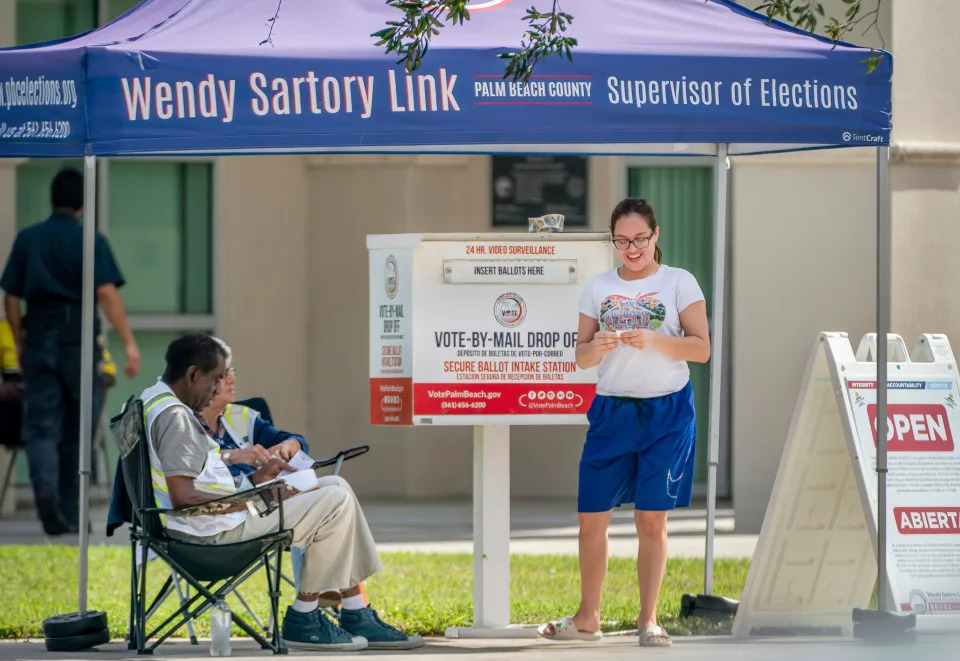
A voter gets a sticker after delivering her vote-by-mail ballot to a drop box in West Palm Beach, Fla., on Oct. 24, 2022.
There are many other examples of polls and political forecasts coming up short.
A danger of the intense media focus on polls is that simply reporting poll results can discourage people from voting, altering the outcome of elections. Hearing their favored candidate has a sizable lead or trails badly in a race inevitably convinces some voters that their vote doesn’t matter.
Key variables in every election poll involve who is polled and the expected size of voter turnout. To be accurate, the small group of people polled must mirror the makeup of the far larger number of people who actually vote. And, of course, views people hold when polled may change by the time they vote.
While the national news media understandably focuses on candidate positions on national issues in their coverage, many voters look to candidate positions on state and local issues when deciding whom to support, particularly when it comes to candidates for governor and other state offices. Candidates need to keep that in mind. They need to increase their visibility and make one last plea to voters to help them.
Although nothing is certain, a wave election – where one party picks up a large number of offices – seems unlikely this year because Democrats and Republicans are both showing strength in different states and congressional districts. Wave elections aren’t a series of landslides, but a series of close races that primarily break for the same party.
Voter turnout is traditionally lower in midterm elections than in presidential election years. But that may not be the case this year, if strong early voter turnout in Georgia and other states is any indicator. Large turnouts usually benefit Democrats. But Republicans know how to get out their vote, including infrequent voters in rural areas and many independent voters who might not be inclined to vote for either major party.
That’s the wild card in 2022: Voter turnout and voter choices could come down to which candidate reached out to them, not by advertising on TV or their favorite digital platform but by visiting their neighborhood, speaking their language and understanding their concerns.
Final 96 hours are critical
The question now is how many young voters, independent voters and nonaligned voters will decide not to stay home but to take a chance to vote for the candidate they believe speaks to their concerns. This is why the final 96 hours are vital as a few undecided voters will decide to vote.
I believe in democracy, so I hope as many Americans as possible vote in coming days, even if they vote for candidates I might oppose. To keep our democracy healthy, we need voters to vote. We need to respect the right of every eligible citizen to cast their ballot without intimidation or threats of violence.
We also need candidates and voters alike to accept the election results. I’ll accept the November election results even if Republicans come out on top, just as I did in 2000 when I was campaign manager for Vice President Gore and joined him in accepting his narrow presidential election defeat by George W. Bush. Trump is the only presidential candidate in American history to refuse to accept his election loss.
So, it’s not over. We need to remember that polls don’t decide elections; voters do.
Following election news is important, but actually participating in elections is far more important. As the old saying goes, politics isn’t a spectator sport. Get out of the stands and get onto the political playing field.
Donna Brazile is a member of USA TODAY’s Board of Contributors, an ABC News contributor and an adjunct professor at Georgetown University. She previously served as interim chair of the Democratic National Committee and of the DNC’s Voting Rights Institute, and managed the Gore campaign in 2000.