California fuel pipeline to resume service Saturday after fuel leak caused disruption
Nadine El Bawab – February 11, 2023
A California pipeline, that delivers the majority of fuel to the Las Vegas Valley and surrounding areas, is expected to resume operations Saturday afternoon, the pipeline operator announced.
The Kinder Morgan gas pipeline, which supplies about 90% of needed gas, diesel, jet fuel and other refined petroleum products to the Las Vegas Valley and surrounding areas, experienced a disruption that resulted in a temporary shutdown of the line.
“We have isolated the source of the release within our Watson Station in Long Beach, California. Restart activities are underway for Watson Station’s associated SFPP West and CalNev pipelines. We expect these pipelines to resume operations this afternoon and begin delivering fuel to their respective market areas later today. We continue to be in close contact with our customers and the appropriate regulatory agencies as we work to resolve this issue,” Kinder Morgan, the pipeline operator, said in a statement to ABC News.
Nevada Gov. Joe Lombardo declared a state of emergency Friday due to the disruption.
On Thursday, Kinder Morgan, the pipeline operator, began investigating a leak inside its Watson Station in Long Beach, California, the company said in a statement.
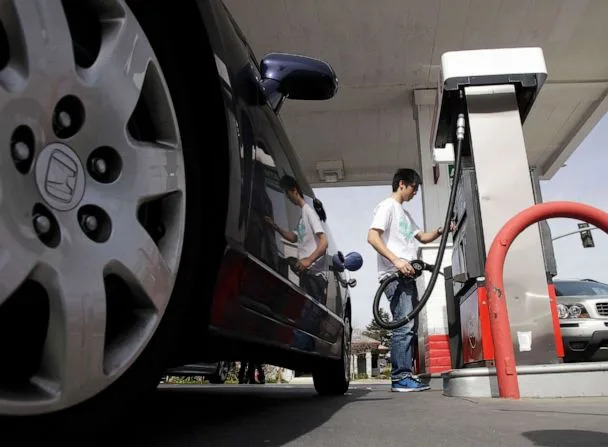
PHOTO: In this March 7, 2011, file photo, a motorist fuels up at a gas station in Santa Cruz, Calif. (Marcio Jose Sanchez/AP, FILE)
“Watson Station and its associated SFPP West and CALNEV pipelines have been isolated and shut down while we work to resolve this issue. There are no injuries or fire reported as a result of this incident,” Kinder Morgan said in its statement. Kinder Morgan’s 566-mile CALNEV pipeline system transports gasoline, diesel and jet fuel from Los Angeles to terminals in Barstow, California, and Las Vegas.
“The appropriate regulatory agencies have been notified, and an investigation into the cause and quantity of the release will be conducted. We are working closely with our customers on potential impacts,” Kinder Morgan said.
The disruption may cause a shortage of fuel supplies in Nevada, according to the declaration of emergency.
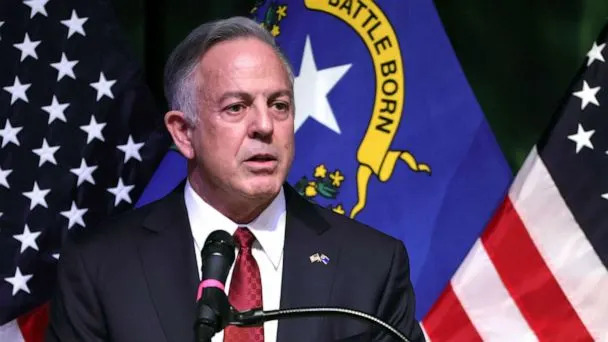
PHOTO: In this Nov. 14, 2022, file photo, Nevada Gov.-elect Joe Lombardo speaks at his alma mater, Rancho High School, in North Las Vegas, Nevada. (Ethan Miller/Getty Images, FILE)
The emergency declaration will allow Nevada to receive federal waivers, resources to repair the pipeline and allow the state to increase the transportation of fuel by other means, according to Lombardo.
“To avoid any unnecessary shortages, I strongly urge all Las Vegas residents to avoid panic buying while awaiting repair timeline updates,” Lombardo said in a statement posted on Twitter.
The declaration expires in 15 days unless it is renewed.
Living with natural gas pipelines: Appalachian landowners describe fear, anxiety and loss
Erin Brock Carlson, Assistant Professor of Professional Writing and Editing, West Virginia University and Martina Angela Caretta, Senior Lecturer in Human Geography, Lund University – February 11, 2023
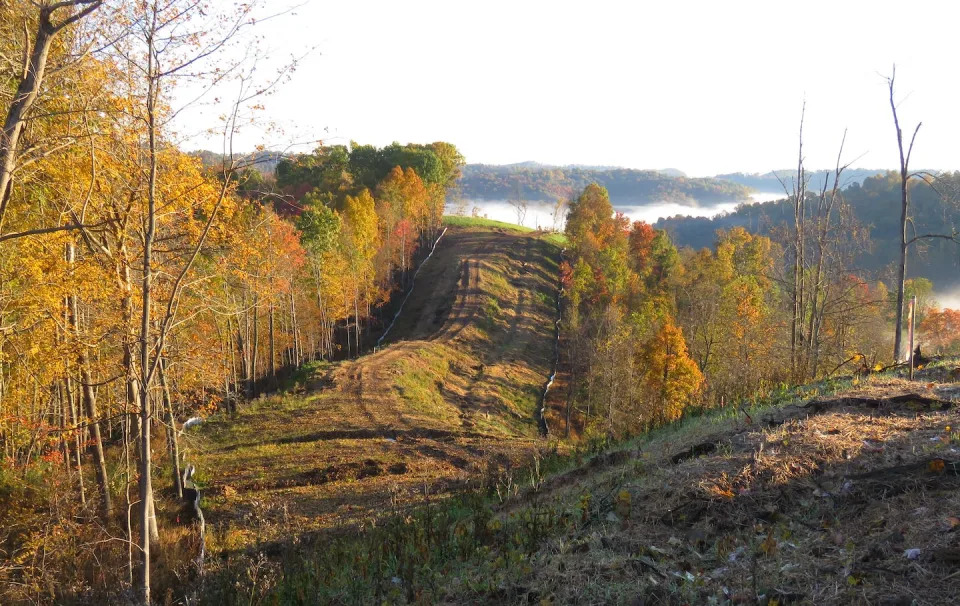
Pipeline construction cuts through forests and farms in Appalachia. Provided by Erin Brock Carlson, CC BY-SA
Many of these lines were built in just the past five years to carry natural gas from the Marcellus Shale region of Ohio, Pennsylvania and West Virginia, where hydraulic fracturing has boomed. West Virginia alone has seen a fourfold increase in natural gas production in the past decade.
Such fast growth has also brought hundreds of safety and environmental violations, particularly under the Trump administration’s reduced oversight and streamlined approvals for pipeline projects. While energy companies promise economic benefits for depressed regions, pipeline projects are upending the lives of people in their paths.- ADVERTISEMENT -https://s.yimg.com/rq/darla/4-10-1/html/r-sf-flx.html
As a technical and professional communication scholar focused on how rural communities deal with complex problems and a geography scholar specializing in human-environment interactions, we teamed up to study the effects of pipeline development in rural Appalachia. In 2020, we surveyed and talked with dozens of people living close to pipelines in West Virginia, Ohio and Pennsylvania.
What we found illuminates the stress and uncertainty that communities experience when natural gas pipelines change their landscape. Residents live with the fear of disasters, the noise of construction and the anxiety of having no control over their own land.
‘None of this is fair’
Appalachians are no strangers to environmental risk. The region has a long and complicated history with extractive industries, including coal and hydraulic fracturing. However, it’s rare to hear firsthand accounts of the long-term effects of industrial infrastructure development in rural communities, especially when it comes to pipelines, since they are the result of more recent energy-sector growth.
For all of the people we talked to, the process of pipeline development was drawn out and often confusing.
Some reported never hearing about a planned pipeline until a “land man” – a gas company representative – knocked on their door offering to buy a slice of their property; others said that they found out through newspaper articles or posts on social media. Every person we spoke with agreed that the burden ultimately fell on them to find out what was happening in their communities.
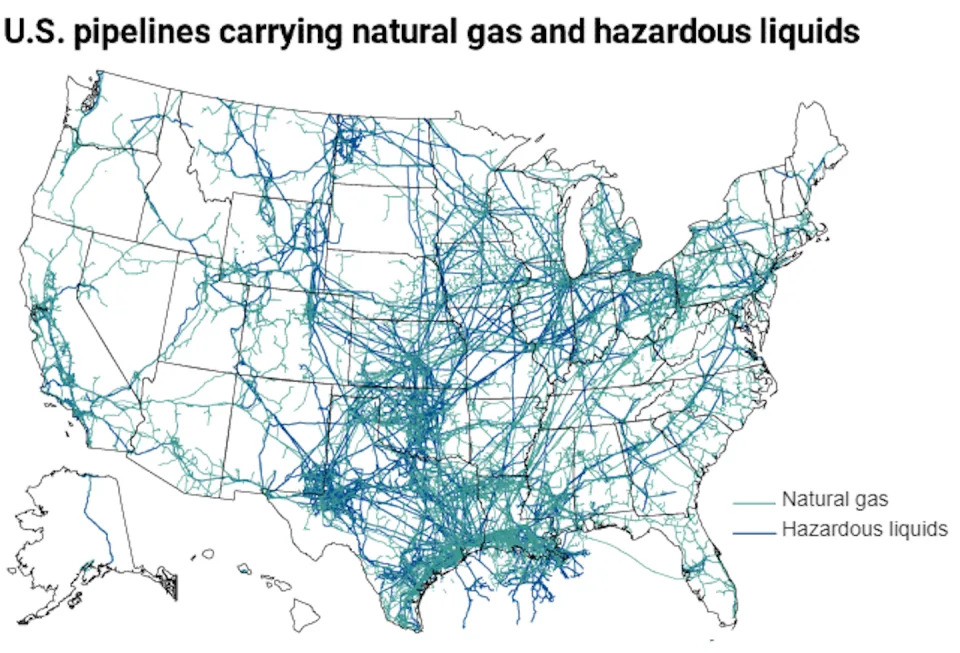
A map shows U.S. pipelines carrying natural gas and hazardous liquids in 2018. More construction has been underway since then. GAO and U.S. Department of Transportation
One woman in West Virginia said that after finding out about plans for a pipeline feeding a petrochemical complex several miles from her home, she started doing her own research. “I thought to myself, how did this happen? We didn’t know anything about it,” she said. “It’s not fair. None of this is fair. … We are stuck with a polluting company.”
‘Lawyers ate us up’
If residents do not want pipelines on their land, they can pursue legal action against the energy company rather than taking a settlement. However, this can result in the use of eminent domain.
Eminent domain is a right given by the Federal Energy Regulatory Commission to companies to access privately held property if the project is considered important for public need. Compensation is decided by the courts, based on assessed land value, not taking into consideration the intangibles tied to the loss of the land surrounding one’s home, such as loss of future income.
Through this process, residents can be forced to accept a sum that doesn’t take into consideration all effects of pipeline construction on their land, such as the damage heavy equipment will do to surrounding land and access roads.
One man we spoke with has lived on his family’s land for decades. In 2018, a company representative approached him for permission to install a new pipeline parallel to one that had been in place since 1962, far away from his house. However, crews ran into problems with the steep terrain and wanted to install it much closer to his home. Unhappy with the new placement, and seeing erosion from pipeline construction on the ridge behind his house causing washouts, he hired a lawyer. After several months of back and forth with the company, he said, “They gave me a choice: Either sign the contract or do the eminent domain. And my lawyer advised me that I didn’t want to do eminent domain.”
Pipeline construction cuts through a farmer’s field. Provided by Erin Brock Carlson, CC BY-SA
There was a unanimous sense among the 31 people we interviewed that companies have seemingly endless financial and legal resources, making court battles virtually unwinnable. Nondisclosure agreements can effectively silence landowners. Furthermore, lawyers licensed to work in West Virginia who aren’t already working for gas companies can be difficult to find, and legal fees can become too much for residents to pay.
One woman, the primary caretaker of land her family has farmed for 80 years, found herself facing significant legal fees after a dispute with a gas company. “We were the first and last ones to fight them, and then people saw what was going to happen to them, and they just didn’t have – it cost us money to get lawyers. Lawyers ate us up,” she said.
The pipeline now runs through what were once hayfields. “We haven’t had any income off that hay since they took it out in 2016,” she said. “It’s nothing but a weed patch.”
‘I mean, who do you call?’
Twenty-six of the 45 survey respondents reported that they felt that their property value had decreased as a result of pipeline construction, citing the risks of water contamination, explosion and unusable land.
Many of the 31 people we interviewed were worried about the same sort of long-term concerns, as well as gas leaks and air pollution. Hydraulic fracturing and other natural gas processes can affect drinking water resources, especially if there are spills or improper storage procedures. Additionally, methane, a potent greenhouse gas, and volatile organic compounds, which can pose health risks, are byproducts of the natural gas supply chain.
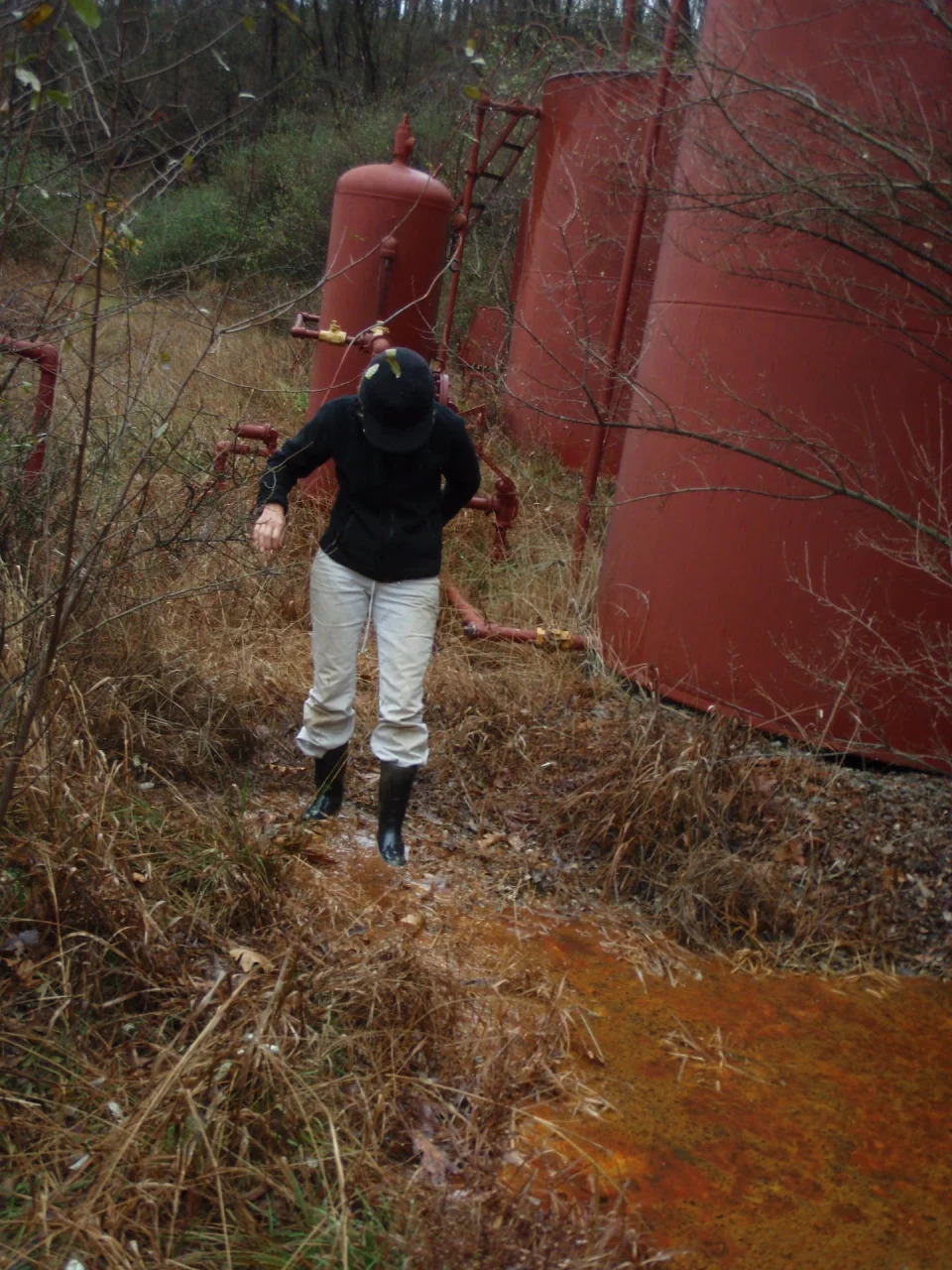
Oil spills are a major concern among land owners. Provided by Erin Brock Carlson, CC BY-SA
“Forty years removed from this, are they going to be able to keep track and keep up with infrastructure? I mean, I can smell gas as I sit here now,” one man told us. His family had watched the natural gas industry move into their part of West Virginia in the mid-2010s. In addition to a 36-inch pipe on his property, there are several smaller wells and lines. “This year the company servicing the smaller lines has had nine leaks … that’s what really concerns me,” he said.
The top concern mentioned by survey respondents was explosions.
According to data from 2010 to 2018, a pipeline explosion occurred, on average, every 11 days in the U.S. While major pipeline explosions are relatively rare, when they do occur, they can be devastating. In 2012, a 20-inch transmission line exploded in Sissonville, West Virginia, damaging five homes and leaving four lanes of Interstate 77 looking “like a tar pit.”
A gas line explosion near Sissonville, West Virginia, sent flames across Interstate 77. AP Photo/Joe Long
Amplifying these fears is the lack of consistent communication from corporations to residents living along pipelines. Approximately half the people we interviewed reported that they did not have a company contact to call directly in case of a pipeline emergency, such as a spill, leak or explosion. “I mean, who do you call?” one woman asked.
‘We just keep doing the same thing’
Several people interviewed described a fatalistic attitude toward energy development in their communities.
“It’s just kind of sad because they think, once again, this will be West Virginia’s salvation,” one landowner said. “Harvesting the timber was, then digging the coal was our salvation. … And then here’s the third one. We just keep doing the same thing.”
This article is republished from The Conversation, a nonprofit news site dedicated to sharing ideas from academic experts. The Conversation is trustworthy news from experts. Try our free newsletters.
Amsterdam plans to ban weed from Red Light District streets
Hannah Sampson – February 10, 2023
Amsterdam, Netherlands – October 1, 2012: Amsterdam’s red-light district at night. There are about three hundred cabins rented by prostitutes in the area. (sborisov via Getty Images)
In their latest effort to rein in carousing visitors, Amsterdam officials announced plans this week to tamp down disruptive behavior in the city’s Red Light District, including barring pot-smoking on the streets, reducing hours for restaurants and brothels, and tightening some alcohol restrictions.
The rules are meant to ease the impact of hordes of sometimes-rowdy tourists on people who live in the area. An announcement from the city council referenced an alcohol- and drug-fueled atmosphere at night that makes the neighborhood unsafe and prevents residents from sleeping.
Officials are taking public comments on many of the proposed measures for the next four weeks before finalizing amendments to municipal bylaws.
Under the measures announced Thursday, the smoking ban would go into effect in mid-May. The city could take more action if the ban doesn’t go far enough to reduce nuisance behavior.
Also under consideration: banning to-go sales of drugs at coffee shops at certain times and potentially restricting smoking on cafe terraces.
The Netherlands has a tolerance policy for weed, meaning people will not be prosecuted for buying up to five grams of cannabis, which is classified as a “soft drug” and sold in coffee shops. Only visitors 18 and older can enter cannabis cafes, which are not allowed to sell alcohol. While weed can be consumed in coffee shops, most clubs or bars do not allow people to smoke pot on-site.
The city issues permits for brothels and sex clubs to operate. Under rules that had already been decided, brothels will only be able to stay open until 3 a.m., not the 6 a.m. closing time in place now. Restaurants and sex establishments with catering licenses will have to close at 2 a.m. on Fridays and Saturdays, rather than 3 or 4 a.m.
No new visitors would be allowed into businesses with a catering license after 1 a.m., the English-language publication NL Times reported. The time changes would go into effect April 1, the publication said.
Officials also want to close terraces at 1 a.m. in the summer, a change from the previous closing time of 2 a.m.
Alcohol sales at stores and cafeterias in the district will continue to be blocked starting at 4 p.m. from Thursday through Sunday. The city says alcohol displays must also be removed from the shops or hidden from view. Visitors are already not allowed to drink on the streets.
Amsterdam has tried for years to address overtourism concerns, restricting some tours of the historic Red Light District before the pandemic and voting to move sex workers to an erotic center outside of the district in 2021. According to a November story in the Guardian, however, residents of the proposed neighborhoods for relocation don’t want the businesses – and the workers also don’t want to move.
Late last year, authorities said they planned to take steps to combat tourism problems, including limiting river cruises, curbing rowdy bachelor parties, cracking down on organized pub crawls and taking other measures. Part of the plan included some of the rules announced this week, such as reducing hours for sex businesses and catering establishments and banning smoking in some parts of the city.
A campaign is expected to start this year discouraging global visitors who want to party hard in the city.
“Amsterdammers live in every neighborhood, including the Red Light District and Leidseplein,” the official visitor information site I amsterdam says. “Limit noise and drunkenness, clean up your mess and don’t pee in the canals. Keep in mind the locals and they will welcome you with open arms.”
Jonathan Amos – BBC Science Correspondent – February 10, 2023
Satellite map
It seems almost insensitive to start to have a deep dive into the science behind Monday’s earthquake events in Turkey.
More than 22,000 people are already confirmed dead and an unknown number still lie trapped, with the window for their rescue closing rapidly.
And yet the science will go on. The insights gleaned from this event will save lives in the future.
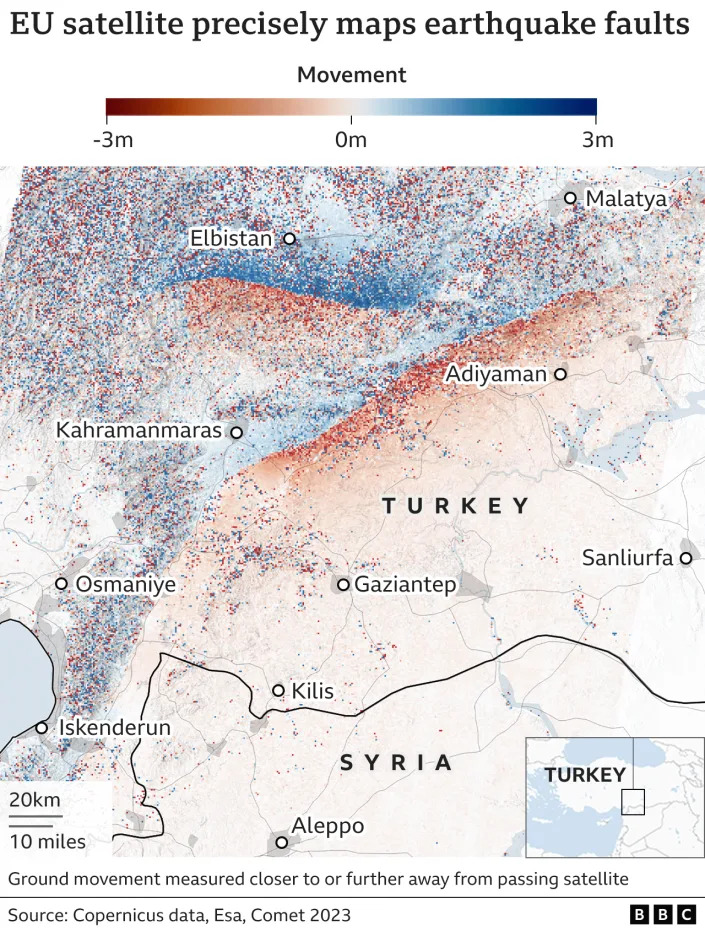
Take a look at the map on this page. It is the most precise yet produced of how the ground lurched in response to the enormous energies that were unleashed.
The data behind it was acquired in the early hours of Friday by the European Union’s Sentinel-1A satellite as it traversed north to south over Turkey at an altitude of 700km (435 miles).
The Sentinel carries a radar instrument that is able to sense the ground in all weathers, day and night.
It is routinely scanning this earthquake-prone region of the world, tracing the often very subtle changes in elevation at the Earth’s surface.
Except, of course, the changes on Monday were not subtle at all; they were dramatic. The ground bent, buckled and in places ripped apart.
Researchers use the technique of interferometry to compare “before” and “after” views. But you do not really need to be an expert to see the consequences for Turkey in the latest Sentinel map.
The red colours here describe movement towards the satellite since it last flew over the country; the blue colours record the movement away from the spacecraft.
It is abundantly clear how the ground has been deformed along and near the East Anatolian Fault line.
For both the Magnitude 7.8 quake that struck first on Monday at 01:17 GMT and the Magnitude 7.5 event at 10:24, the motion is “left-lateral”. That is to say: whichever side of the fault you are on, the other side has moved to the left. And by several metres in places.
The shocking thing is that the lines of rupture have gone right through settlements; in lots of places they will have gone right through buildings.
Artist’s impression: The Sentinel routinely maps earthquake-prone Turkey
The Sentinel map will help scientists understand exactly what happened on Monday, and this knowledge will feed into their models for how earthquakes work in the region, and then ultimately into the risk assessments that the Turkish authorities will use as they plan the recovery.
There is sure to be a lot of discussion about how the two major tremors were related and what that could mean for further instability.
The map was processed by the UK Centre for Observation and Modelling of Earthquakes, Volcanoes and Tectonics (Comet). Its director, Prof Tim Wright, said the Sentinel observations vividly brought home the scale of the forces involved.
“News outlets always show earthquakes as ‘the epicentre’, as if it is a single point source (like a bomb). Actually, all earthquakes are caused by slip on extended faults, and the bigger the quake the bigger the fault that ruptured,” he told BBC News.
“We can map those ruptures with satellites because the ground around them is displaced, in this case by up to 5m or 6m. The rupture of the first event was 300km or so long and the second big event ruptured another 140km or so of a different fault. To put those distances in context, London to Paris is roughly 345km.
“Damage will be highest near the fault but of course spreads over a wide region either side of the fault, too. It’s absolutely horrific.”
The insights will assist Turkish authorities as they plan the recovery
In the era before satellites, geologists would map earthquake faults by walking the lines of rupture. It was a laborious process that naturally also missed a lot of detail. Radar interferometry from space was developed in the 1990s, and in recent years it has become a particularly compelling tool.
In part that is down to the quality of the sensors now in orbit, but it is also the result of more powerful computers and smarter algorithms.
It is possible today to get a data product on to the computers of experts, ready for analysis, within hours of a satellite making an overhead pass. Comet, unfortunately, had to wait several days for Sentinel-1A to be in the right part of the sky to get an optimal view of Turkey. But this will improve as more and more radar satellites are launched.
“By the end of the decade, we should be able to do this kind of analysis within a day of most damaging earthquakes, and then we would be more useful for the relief effort. As things stand, we are of course outside the 72-hour window for search and rescue,” Prof Wright said.
The Republican Distraction Farm Is Failing Because They’re Employing Less Talented Grievance-Farmers
Jack Holmes – February 10, 2023
Republican Grievance-Farmers Lose Green ThumbsPool – Getty Images
“Hearst Magazines and Yahoo may earn commission or revenue on some items through these links.”
Sarah Huckabee Sanders, now the governor of Arkansas, gave a rebuttal to President Joe Biden’s State of the Union address this week that suggested Republicans have learned precious few lessons from their dramatic underperformance in the midterms. Biden’s speech was a full-throated appeal to everyday Americans on populist economic grounds—one that actually echoed some of Donald Trump’s rhetoric in the 2016 campaign. Sanders brought the now-standard routine about The Woke Mob “that can’t even tell you what a woman is,” and that is ushering in a world where “children are taught to hate one another on account of their race.” She referred to “C.R.T.” as if everyone listening would know that stands for Critical Race Theory (and that it is inherently evil). Sanders did outline a plan to raise starting salaries for Arkansas teachers, which is welcome in an era in which the American right increasingly seeks to paint educators as rogue agents of Woke determined to brainwash your kids.
The latter is the kind of stuff that cost them seats in the midterms. It hits squarely with people who are up-to-date on their Fox News folklore, fluent in the language of culture-war apocalypto. But for most people, it’s probably pretty weird. They mostly like their kids’ teachers, who are usually trying to do the best job they can in sometimes challenging circumstances. For years, the Democratic Party was the one considered out of touch, if only because of the alienating way that some liberals talked about the issues. But that’s now the Republican Party’s stock-in-trade. The right’s rising star—at least in the view of media-politico types—is the governor of Florida, Ronald DeSantis, who has replaced his pandemic anti-interventionist crusade (which at least dealt with a major issue of public concern) with campaigns against Woke Corporations and in favor of the government’s prerogative to police what teachers teach in schools. It’s gotten fewer national headlines that he, too, has sought to raise salaries, but that nugget is competing with news that teachers have been told to remove or cover up books out of fear they could face criminal charges for their content.
Maybe DeSantis is reluctant to talk about other parts of his record because, as the political press finally turns to it, we’re fully realizing how committed he once was to changing Social Security and Medicare. (We’ve also seen how touchy Republicans get when you talk about this since Biden brought it up at the State of the Union. Even a talk-radio host interviewing Ron Johnson was explicitly trying to brand this stuff as “reforms” not “cuts.”) The president pointed out that some Republicans—including chair of the National Republican Senatorial Committee and Lizard-American Rick Scott—have called for sunsetting all federal legislation after five years. This would by definition include Medicare and Social Security.
Time will tell if Ronald DeSantis is the kind of right-winger who can still thread the needle.SOPA Images – Getty Images
Maybe they would be renewed as-is, but that’s quite a bet to make, particularly when you examine the record of the hospital chain Scott once ran. DeSantis, though, used to be even more forthright. He supported privatizing aspects of both programs in his 2012 congressional campaign, CNN found, and once in Congress he supported Paul Ryan’s agenda on “entitlements.” (They are earned benefits.) All this is based on the combined notions that these programs are fiscally unsustainable and raising taxes is a kind of supreme evil. None of this is new: George W. Bush tried to privatize Social Security. Ronald Reagan launched his political career with this stuff. Maybe DeSantis is an example of how how you can get away with this kind of policy record, considering he’s extremely popular in the old folks’ Mecca of Florida. Or maybe we in the press have just done a godawful job.
Republicans lose votes when people get a good look at their proposals on these issues, so maybe it’s no wonder they’re now permanently engaged in culture-war food fights. Except that also seems to have lost its luster outside The Base. Trump at least had a canny ear for the more transcendent gripes, particularly in 2016. His would-be successors are less talented grievance farmers, and some absolute loony toons have joined their ranks in Congress. It’s not a change so much as it’s become more obvious than it was that Republicans have no plans to address problems in normal people’s lives. They’re getting so high on their own supply that they can no longer even explain some of these bedrocks of their politics. The Louisville Courier-Journal‘s Joe Sonka asked Kentucky Senate President Robert Stivers for his definition of “woke” on Friday and he replied, “Woke? That is the definition to me that is a describing of a mentality or a culture that certain individuals have about how things are progressing through society.” Hey man, maybe carve out some time to think about this or just admit that it’s become a hollow vehicle for reactionary rage.
Daunting medical issues for earthquake survivors are just beginning
David Ovalle – February 9, 2023
Members of the Lebanese Red Cross carry the corpse of a victim retrieved from the rubble of a collapsed building in the Syrian town of Jableh northwest of Damascus on Thursday. (Louai Beshara /AFP/Getty Images)
As international medical teams stream into the earthquake-ravaged areas of Turkey and Syria, the injuries they are encountering are horrific but no surprise: broken bones, arms and legs crushed by collapsed buildings, infected gashes.
But that’s only the beginning for doctors and paramedics working feverishly to save lives in a disaster that has already claimed more than 20,000 people, experts say.
In coming weeks, as search efforts turn to the grim task of recovering bodies, countless survivors will need medications for high blood pressure, diabetes and asthma left behind in the rubble. Many who are pregnant will give birth in makeshift shelters and refugee camps. Cancer patients will go without treatment.
Freezing temperatures mean survivors in thrown-together shelters face hypothermia or frostbite. Close quarters in shelters could also lead to the spread of the coronavirus and other respiratory viruses.
And there’s another looming risk: waterborne diseases such as cholera, which had already appeared in the affected war-torn region of northwest Syria because of poor water quality and sanitation.
“It’s a horrible situation. You can’t do everything you want to do and you have to adapt to a whole different way of treating people. It’s a mentally and morally taxing situation,” Thomas Kirsch, a professor of emergency medicine at the George Washington University School of Medicine and Health Sciences, said of the coming challenges for medical workers.
Paul Spiegel, director of the Center for Humanitarian Health at the Johns Hopkins Bloomberg School of Public Health, said the time period after the search-and-rescue efforts will be crucial, if less dramatic.
“You likely will save a lot more people by ensuring you have surveillance and thinking about continuing care and supplies,” he said.
Those efforts are already being spearheaded by the Turkish government, the World Health Organization and other aid groups that regularly send emergency teams into earthquake zones.
The challenges to providing medical care are especially daunting in Turkey and Syria, which was rocked by a 7.8-magnitude quake early Monday morning, and a second one hours later that was recorded at 7.5.
The disaster toppled hospitals and other medical facilities that would have been crucial for treating those injured in building collapses, not to mention other ailments. Buckled and impassible roads won’t make it any easier for medical organizations, said Kirsch, who has worked extensively in disaster zones, including in Haiti after it was devastated by a 2010 earthquake.
“The logistics and coordination of the health-care response is really a problem,” he said.
Syria is of particular concern because of the destruction of its health care infrastructure after years of civil war, Iman Shankiti, the WHO’s representative in the country, told reporters Wednesday.
“Definitely, the health needs are tremendous. It’s important to note that the health system has suffered for the last 12 years, and continues to suffer and continues to be strained by the ongoing emergencies, and the last one is this earthquake,” Shankiti said.
The WHO said it was sending three flights with medical supplies to both countries, including trauma kits, from a logistics hub in Dubai. It also has released $3 million in funding.
The Israeli Defense Forces has said it is setting up a field hospital in Turkey.
Nongovernmental groups will also be key. Doctors Without Borders, which was already in northwest Syria, said it is continuing to support seven hospitals, health-care centers and a burn unit in the area.
Americares, a Connecticut-based health-focused relief group, has already sent a shipment of hygiene kits, IV fluids and some chronic-disease medicines. A four-person team is already on the ground in southern Turkey.
“In the coming days, there’s going to be a tremendous need for those chronic-need medicines,” said Julie Varughese, the organization’s chief medical officer.
Project Hope, a global health and humanitarian aid organization, is also in Gaziantep, Turkey, a city hit hard by the earthquakes. Like many medical relief organizations, it is assessing what help each area will need with short- and long-term health care, as search-and-rescue operations continue to look for survivors.
The organization’s humanitarian health adviser, Pranav Shetty, fears that in coming days, doctors will see many of the same medical conditions that unfolded in Haiti after its devastating earthquake in 2010.
Doctors will need to work quickly to remove dead tissue from wounds, lest it lead to dangerous infections, he said.
Another pressing concern is what’s known as “crush syndrome,” which happens when survivors are pulled from the rubble, releasing pressure on muscles and releasing toxins from damaged tissue. That can wreak havoc on survivors’ kidneys, requiring dialysis – no easy task to provide when hospitals are destroyed.
“That’s a pretty robust intervention that requires a lot of resources,” Shetty said.
Still, the everyday maladies may end up being a wider problem as the months pass.
Kirsch, of George Washington University, said foreign medical assistance will be needed to help with everyday conditions such as diabetes, heart attacks and strokes.
“Turkey has a pretty strong health-care system, so its recovery will be better than a lot of less economically robust countries,” he said.
And both countries will need to pour resources into mental health treatment, not just for survivors but for medical personnel who have been overwhelmed ministering to those in need.
“At times you make decisions about life and death you wouldn’t have to make in other situations,” Kirsch said of medical personnel in earthquake zones. “That’s the struggle early on.”
To avert ‘poppy apocalypse,’ California city closes canyon to visitors
Hannah Sampson – February 9, 2023
Visitors pose for a picture among wildflowers in bloom in March 2019 in Lake Elsinore, Calif. (Gregory Bull/AP)
Wildflower lovers won’t be able to get their fix this year in one Southern California city after officials announced that they were closing trails, roads and parking at a canyon that attracted thousands of visitors during an earlier poppy bloom.
The superbloom of 2019 blanketed Lake Elsinore’s Walker Canyon with a layer of vibrant orange poppies. They proved irresistible to phone-wielding, Instagram-posting visitors, who clogged roadways and trails, trampled the growth and occasionally needed rescuing due to heat and exertion and at least one rattlesnake bite.
“The flowers were beautiful,” Lake Elsinore Mayor Natasha Johnson said during a news conference this week with patches of California poppies in the background. “The scene was a nightmare.”
Facing another seasonal bloom – though likely not a supersized one – city, county and law enforcement officials decided not to risk a repeat. Johnson announced that the trails on Walker Canyon, as well as parking around it and an access road, are all closed. Shuttles will not run to the canyon, as they did for part of the 2019 season. Trails were closed in the spring of 2020 due to the pandemic, and drought kept blooms away for the last couple of years.
“While typically the city of Lake Elsinore welcomes visitors to enjoy our vibrant community and boost our economy, the overwhelming number and unfortunate behavior of our visitors to Walker Canyon in 2019 came at a cost that was way too steep for our residents and our wildlife,” Johnson said.
Riverside Sheriff Chad Bianco warned that the penalty for visiting anyway could be steep, though he said courts would determine any fine.
“We don’t want anybody coming here thinking that they’ll pay the fine and be good with it,” he said. “It’s a misdemeanor infraction subject to arrest.”
Walker Canyon, which closed in 2019 due to the crowds, has become the latest popular destination to close because of overtourism. A daffodil-dotted ranch east of Sacramento that had been open to the public for decades announced it was closing indefinitely in 2019 after being overwhelmed by a “crush of visitors.” Comparing the influx of tourists to a “zombie apocalypse,” Ontario farmers shut down access to their sunflower fields after a little more than a week, the New York Times reported in 2018.
The story has been similar around the globe, with a canyon in Iceland, an island in the Philippines and a bay in Thailand closing, at least temporarily, due to an influx of tourists.
In Lake Elsinore, reaction on the Facebook page that carried the news conference ranged from laudatory to disappointed to politically charged.
“So instead of responsibility, City officials decide to take away our rights,” one person wrote. “Taking their orders from the progressives.”
Another was more succinct: “Poppy police,” they wrote.
Some residents said they had been excited to explore the canyon, though others – still scarred from 2019 – were glad to escape a few weekends of gridlock. Many chastised officials for missing out on the chance to make some money from the phenomenon.
“You’re going to lose million in tax and tourist revenue,” one commenter wrote. “Should have leaned in and had a poppy festival with shuttles etc. Missed opportunity.”
But Bianco, the county sheriff, said there was no way to safely accommodate the crowds that have shown up in the past.
“Your warning is right now; we will have a zero-tolerance policy for people that are here trespassing and parking on sides of the roadways,” he said. “If you are going to come here and you are going to park your car, you are subject to citation and possibly the towing of your vehicle.”
For poppy fans who need updates on the bloom, the city has live video footage of Walker Canyon linked from its website.
“We understand that this is not the news that everybody may want to have heard, but our community’s safety as well as preservation is our main focus,” Johnson said. “Thank you for your support and especially your poppy patience. This weekend I encourage you to focus on the Super Bowl and not the superbloom that we’re not having.”
How Hecklers Turned the State of the Union Into a Biden 2024 Ad
Philip Elliott – February 8, 2023
State of the Union 2023
Rep. Marjorie Taylor Greene, R-Ga., yells during President Joe Biden’s State of the Union address in the House Chamber of the U.S. Capitol on Tuesday, February 7, 2023. Credit – Tom Williams—CQ-Roll Call, Inc via Getty Images
When a fur-coiffed Rep. Marjorie Taylor Greene yelled “liar” Tuesday night, among the loudest in an abrupt chorus of boos, the oldest President to ever deliver a State of the Union address didn’t miss a beat. He smiled and went far afield from his script as GOP lawmakers tried to reject his claims that Republicans were ready to gut social entitlement programs.
“Social Security and Medicare is off the books now, right? We’ve got unanimity?” he asked. “Apparently it’s not going to be a problem,” he deadpanned at another moment.
The striking exchange, and Biden’s ease in handling it in front of an audience of millions, illustrated why the Democratic establishment isn’t yet ready to toss their 80-year-old standard-bearer overboard.
Despite a halting, vamped opening to Tuesday’s State of the Union speech—a Super Bowl joke? Why?— Biden proved himself plenty capable of holding his own when his Republican hecklers started to stalk him. In fact, he actually demonstrated how he might be able to troll them into their own self-own status in real time. Give Biden acrimony, he’ll toss back accomplishments. Throw him hostility, he’ll offer hope.
“As my football coach used to say, ‘Lots of luck in your senior year,’” he deadpanned at one point, mocking lawmakers who seemed to think high school was the same as the big leagues of Congress.
Biden baited Greene’s fellow Republicans into pledges of fealty to Social Security. When others pummeled him on the U.S.-Mexican dotted line—”secure the border”—Biden taunted them with an offer to work on comprehensive immigration reform. And when Republicans tried to lay blame at the ongoing drug addiction and overdose crisis at Biden’s feet, he simply asked Republicans if they’d work with him to combat it.
For as much as Democrats are gritting their teeth and girding for the worst when it comes to Biden’s likely 2024 campaign, Tuesday night’s State of the Union gave them reason to hold onto optimism. It wasn’t a robust reason, but it was sufficient. Biden showed he can keep his ground in the face of Republican attack; in fact, he seemed to delight in the heckling that came from the floor of the House. For every “liar”—and worse—that rose from the floor, Biden seemed ready with the rejoinder of his first-term economic record. For every peel of stage laughter coming from his physical left and his political right, Biden stood ready to offer some undeniably impressive facts. And for every protest to his trolling suggestion that Republicans were ready to ditch Social Security, Biden had a taunt right in the margins of his heavy black binder.
Biden’s third joint address to Congress set the tone not just for the next year but also his still-unannounced re-election campaign. Biden laid the trap of bipartisan collaboration as well as anyone in recent memory but also set the timer on some partisan timebombs.
Biden is convinced that he is the only Democrat in the land who can block Donald Trump’s return to the White House and is increasingly itchy to make his 2024 re-election bid real. He has effectively frozen the field of would-be challengers, resetting the nominating calendar in such a way that renders challengers as also-rans. He has never been a strong fundraiser or nurturer of outside moneybags, but the deep-pocketed allies are nonetheless ready to bankroll his efforts to stay in the gig that he has chased since his 20s.
So it’s worth considering Tuesday night’s State of the Union as the prologue to Biden’s next chapter, perhaps the final eighth volume in his Robert Caro-esque chronicle. (For the record, not that I’d write it: the first volume would be the first Senate race; Volume II: his Senate term ahead of the 1988 race; III: his return to the Senate; IV: the 2008 primary: V: his time as Vice President; VI: his time as a free radical from 2016-20; and VII: the last two years, leading us to the present.) Biden holds dear to him the spirit of Irish poets, in that the specter of legacy is always just barely off-stage and always above it. Biden wants wins, and his speech—and the interruptions to it—suggest a measure of confrontation is going to define it.
That said, Republicans weren’t entirely sure that the interludes of heckling and hectoring were useful to their side. In fact, plenty of Republicans groaned in the chamber and groused privately that the likes of Greene managed to make the speech into an interactive experience not terribly dissimilar to the British Parliament’s tradition of P.M. Questions. In public, House Speaker Kevin McCarthy shushed his caucus a number of times as they chucked invectives at Biden. More quietly—but still in view of the public—Utah Sen. Mitt Romney tried to silence a GOP House member who has proven plenty shameful to the brand. Romney—who in 2008 and 2012 thought he would do well to be giving a State of the Union himself as President—told Rep. George Santos that he was an embarrassment. Biden seemed to share that assessment, opting to see Santos and deny him a handshake on the aisle.
Again, Biden mightn’t be the most optimal nominee-in-waiting Democrats have ever had on deck, but he’s hardly the most problematic. And that, right there, is why Tuesday night’s State of the Union leaves a whole of the Democratic Party’s top donor roster less dour than they began their week. It’s also why the ragtag Republican contenders hoping to see a slow, doddering commander in chief ready to be put out to pasture were standing at the starting line with empty hands.
Those standing nearby reported that the Utah senator told Santos he ought to be embarrassed showing up and called him an “ass” to his face.
Handler rolled the footage, then made her confession.
“I would like to go on the record tonight and say that I am sexually attracted to Mitt Romney,” she declared. “It’s not the first time, and it won’t be the last time. I don’t even care that he’s a Republican or a Mormon. In fact, since he’s a Mormon, he’ll be open to another wife, and if not he’s a Republican, so he’ll be open to having an affair. Problem solved.”
Climate change contributing to spread of antibiotic-resistant ‘superbugs’: UN report
Zack Budryk – February 7, 2023
Climate change is heightening the risk posed by antibiotic-resistant viruses, according to research published Tuesday by the United Nations Environment Program.
The report found so-called superbugs have been exacerbated by climate change due to increased bacterial growth caused by warmer temperatures and pollutants that have increased the spread of antibiotic-resistance genes.
The analysis notes that overuse of antimicrobials and pollutants can spread resistance, while contact with resistant microorganisms can create resistance in bacteria already present in air, water and soil. Pollution associated with wastewater, particularly from hospitals, is a major factor, as well as runoff from pharmaceutical production and agriculture, according to the report.
The risk is particularly great for historically polluted waterways, which are more likely to provide shelter for microorganisms that foster antibiotic resistance. A combination of increased pollution and decreased resources for pollutant management has made the problem worse in combination with resistance in health care and agriculture settings.
Meanwhile, 2021 research published in the journal Sci Total Environ suggests urban flooding is also increasing the threat from antibiotic resistance due to disruptions of soil, with the risk possibly lingering for up to five months after major floods or hurricanes.
“While the relationship between environmental pollution and AMR [antimicrobial resistance] and the reservoir of resistance genes in the environment has been established, the significance and its contribution to AMR globally is still unclear,” researchers wrote. “Even so, there is enough knowledge to implement measures to reduce the factors that influence AMR from an environmental perspective; this will also address the triple planetary crisis by addressing sources, sinks and waste.”
The report calls for stronger regulatory frameworks to address the spread of AMR, as well as increased incorporation of environmental factors into National Action Plans for antimicrobial resistance and international standards for signs of antimicrobial resistance.
Policymakers should also develop stronger water sanitation standards, U.N. Environment Program researchers wrote.