Escaping one of the nation’s worst environmental disaster zones

Washington Post-Health & Science

Escaping one of the nation’s worst environmental disaster zones

By Katie Mattler         August 20, 2017

https://img.washingtonpost.com/wp-apps/imrs.php?src=https://img.washingtonpost.com/rw/2010-2019/WashingtonPost/2017/08/03/Production/Daily/Local/Images/JL_521.jpg?uuid=FbXd5nbeEeeerNVr1VaNuA&w=600In May, Demetra Turner holds a letter telling her to vacate her home in the West Calumet Housing Complex in East Chicago, Ind. With her is her son, Jeremiah Kinley.(Joshua Lott/for The Washington Post)

EAST CHICAGO, Ind. — The smell of burning bacon stirred Demetra Turner from her makeshift bed on the floor, a stack of quilts the only padding between her body and the ground.

Long gone was her mattress, tossed into a dumpster with her couch, her recliner, her favorite theater chairs, her kids’ beds. She had thrown them out on instructions from health officials, who said that everything in the West Calumet Housing Complex was poisoned with arsenic and lead.

Everyone must move, Mayor Anthony Copeland said last August, because the land was too dangerous to live on. But now it was May, and Turner and her children were still trying to escape.

She shuffled past barren walls, packed boxes and cases of bottled water. “Who cooked that bacon?” Turner, 44, asked her 18-year-old son, Jeremiah. He sheepishly replied, “I did.”

She smiled and shook her head. He was just trying to help, she knew. Her overnight job at a gas station left her exhausted, and everyone in the family was desperate to find a new place to live.

https://img.washingtonpost.com/wp-apps/imrs.php?src=https://img.washingtonpost.com/rw/2010-2019/WashingtonPost/2017/08/21/Health-Environment-Science/Graphics/2300-SUPERFUNDeChicagoV2.jpg?uuid=Q23FuIYWEeeWp9F4zzUk6w&w=600

In May 2016, Turner unknowingly moved her family into one of the nation’s worst environmental disaster zones. Last summer, shocked residents in the public housing complex called West Calumet were told that the soil in their yards had been contaminated for decades. In some places, the lead in the dirt measured 228 times the maximum level considered safe.

Subsequent blood tests found that 18 out of 94 children younger than 6, the age group most at risk, had elevated lead levels. Then officials tested the water and discovered that it, too, contained lead, raising concerns that East Chicago was becoming the next Flint, but worse.

Vice President Pence was governor of Indiana at the time of the announcement a year ago that the neighborhood was uninhabitable. He refused to grant East Chicago emergency status and did not visit, and his legal counsel wrote that Indiana had already provided adequate aid to East Chicago. (Pence’s office declined to comment for this article.)

Soon Turner was searching for a new place to call home in a region suddenly bombarded with far more demand for real estate than supply. An environmental crisis morphed into a housing crisis, and West Calumet became a national flash point, a cautionary tale about the Environmental Protection Agency’s underfunded cleanup program.

West Calumet and two nearby neighborhoods were declared a Superfund site in 2009, but it took five years to secure the first round of cleanup funding — $26 million — and another round of money was collected just this March.

In April, EPA Administrator Scott Pruitt declared during a visit to East Chicago that places such as West Calumet would be his top priority. During a 90-second statement at a news conference, he said he had come to “restore confidence” that the EPA was “going to get it right.”

Officials should “assess and make decisions and put the community first,” he said, adding that he was “taken” by his conversation with a few residents during the spring visit.

https://img.washingtonpost.com/wp-apps/imrs.php?src=https://img.washingtonpost.com/rw/2010-2019/WashingtonPost/2017/08/20/Health-Environment-Science/Images/JL_528.jpg?uuid=AAJDfHbeEeeerNVr1VaNuA&w=600An empty road runs through the nearly West Calumet complex. (Joshua Lott/for The Washington Post)

“The emotion, the passion was just telling,” Pruitt said.

Later, in an interview with The Washington Post, Pruitt criticized previous administrations for moving slowly and distributing fact sheets and warning signs. “How about cleaning it up? Pruitt said. “How about cleaning it up?”

At the end of July, Pruitt’s Superfund Task Force recommended creating a “top 10 list” of sites to prioritize. The administrator did not specify which sites but mentioned East Chicago to reporters at EPA headquarters and called residents’ despair “heartbreaking.”

Ben Carson, secretary of the Department of Housing and Urban Development, which oversees the local housing authority, paid a visit this month. He acknowledged that West Calumet residents had been “inconvenienced” but said their relocations were “done in a good way.”

Of the hundreds of families who were ordered out of West Calumet last summer, Turner’s was one of the last to leave, dodging letters from housing officials threatening to ship her across state lines to Chicago. That was the city she fled a decade ago, where moms fear not dirt but bullets. She wanted to whisk her kids to safer ground but just couldn’t find any.

For decades, lawmakers and officials have been aware of the dangerous dirt beneath West Calumet.

The housing complex was built in the 1970s in the footprint of a demolished lead factory, beside an operating lead smelter cited for pollution, and parallel to a canal that feeds a waterway eventually named the most toxic in the United States. West Calumet children have been exposed to lead in the soil, water and air capable of damaging the developing brain.

At least four times over the past three decades, local leaders have asked the federal government to clean up the area. In 2009, the EPA added West Calumet and two nearby neighborhoods to the National Priorites List list through the agency’s Superfund program.

The EPA initially sampled some yards and removed “hot spots” — sections of dirt with the highest lead levels — while they formulated a more comprehensive plan. But extensive testing from 2014 to 2016 showed that the contamination was far worse than initially realized. That data reached Copeland, the East Chicago mayor, in the spring of 2016. He criticized the EPA for operating at a glacial pace and, a few months later, ordered the complex to be demolished.

All the while, federal, state and local officials did little to protect residents such as Turner, who knew nothing of West Calumet’s history when she moved in last year. She said there was no lead disclaimer in her lease or warning signs posted on the property, an egregious result of poor communication between the EPA, HUD and the East Chicago Housing Authority, according to housing and environmental advocates.

“It merely reflects the glaring lack of oversight and enforcement of existing housing and environmental laws,” said Debbie Chizewer, a Chicago-based attorney at Northwestern University’s Environmental Advocacy Clinic. “ECHA, the City of East Chicago and EPA all knew [about the lead] and did not act here to address this grave danger to this low-income community of color.”

Turner’s old neighborhood, at the harbor near Lake Michigan, was plagued by gang activity and more expensive than West Calumet.

In May of last year, she moved into a two-story, three-bedroom duplex within sight of the neighborhood’s baseball field, basketball court, playground and pool, all perks for Jeremiah and his 11-year-old sister, Makasha. The streets at West Calumet teemed with children, and neighbors hosted backyard barbecues and tended flower gardens. On the Fourth of July, every­one gathered to watch fireworks.

“It was life,” Turner said.

But in late July 2016, just as her family had unpacked and settled, EPA officials began planting alarming signs in the yards: “DO NOT PLAY IN THE DIRT OR THE MULCH,” they said in bold blue letters.

Because West Calumet had been their home only for a short time, the risk to Turner’s kids wasn’t as high as for children born there. Jeremiah’s blood tested below the CDC’s actionable threshold of 5 micrograms per deciliter, and Makasha was never tested.

Even so, Turner felt a bubbling resentment when she looked at the water tower outside her window, painted with words that seemed to mock them all. “EAST CHICAGO,” it reads. “FOR OUR CHILDREN.”

In no time, personal injury attorneys appeared, offering limousine rides and steak dinners to potential clients. Turner brushed them off, wary of what she considered predatory tactics.

In August 2016, the EPA began deep-cleaning the walls and floors and vacuuming the furniture at homes across the complex. But the agency also encouraged residents to buy new furnishings after they moved, Turner said. She thought she would be out within weeks, so she started purging her things, dropping them into large blue dumpsters officials had placed outside.

Family photos went back into boxes. She instituted a new rule: Shoes come off at the door. And she placed an order online for a few dozen quilts that would become their sleeping “pallets.”

That August and September, HUD gave Turner and her neighbors Section 8 housing vouchers that low-income families can use to find homes in the private market. Copeland said the city provided on-site relocation assistance, contacted neighboring housing authorities and “did everything it could to assist those displaced by this unfortunate situation.”

But residents, many of whom regard the city’s housing authority and mayor with animosity, tell a different story. They say the housing authority distributed an outdated list of properties with landlords who refused to accept their vouchers, heightening their anxiety as the city pressured them to leave.

A housing discrimination complaint filed by Chicago lawyers on their behalf bought residents more time. HUD eventually settled and agreed, among other things, to extend their move-out deadline to at least April.

So Turner created profiles on ­every real estate website she could find — Zillow, HotPads, Trulio, Rent.com, Apartments.com, Section 8, Craigslist.

She struck out in East Chicago and transferred her housing voucher to the neighboring town of Whiting, and then Hammond, and then back to East Chicago, a laborious process that requires meetings and paperwork with each new housing authority.

Other neighbors moved to Chicago, but Turner had grown up and raised her children there — Jeremiah, Makasha and their four older brothers — and considered it too dangerous. “I moved out of Chicago to save them,” she said.

By May, Turner’s duplex was the only place on her street still showing signs of life — the only door with a welcome sign, only driveway with a car, only full trash cans at the curb. This exposed her family to yet another danger: burglars.

So Jeremiah, who spends most nights home alone with Makasha, started a new routine.

The teen would jam a chair under each door knob and stack others in front of the picture window. If someone tried to get inside overnight, Jeremiah reasoned, the toppling furniture would wake him so he could call police. It made him feel safer, he said.

Then the city cut power to the streetlights.

Twice, knocks on the door came late at night. Once, while Jeremiah was taking the garbage cans to the curb before bed, people in a car driving by shot at him with a BB gun. Soon after, Turner came home from work to a heart-wrenching sight: Pillows and blankets were on the floor under the kitchen table, just feet from the front door, and Jeremiah was on guard but asleep.

It was a morning in mid-May when Turner came home and found the eviction notice.

She and her kids had less than a week to find a new place to live with her Section 8 voucher or relocate to city-provided temporary housing across town. If they refused, the letter said, they would be evicted and risk losing their voucher.

So in June, Turner finally drove her family away from the dangers of West Calumet forever, past her neighbors’ abandoned homes and the mocking water tower, toward a bug-infested unit that made her cry.

With a furniture stipend, she bought a new living room set and three beds, the family’s first real mattresses in a year. Then Turner plotted their final escape from East Chicago.

At the end of July, a week before her voucher was set to expire, she and the kids loaded up the moving truck again. They said goodbye to the only school Makasha had ever known and left behind Demetra’s broken down minivan, which she could no longer afford to fix.

An hour away in Joliet, Ill., a suburb of Chicago, they had found a house with safe water and clean dirt. But Demetra couldn’t help but fret over all that she had lost: a steady job, trusted doctors, her West Calumet support system. “I’m like a fish out of water,” Turner said.

She planned to tell Carson about her family’s ordeal when he visited East Chicago this month. Community leaders asked HUD to let her into the listening session. Carson, they thought, needed to hear her story.

It wasn’t until the morning of the visit, when Turner was already halfway to West Calumet, that she learned HUD’s response: No.

Brady Dennis contributed to this report.

Katie Mettler is a reporter for The Washington Post’s Morning Mix team. She previously worked for the Tampa Bay Times.
How the Republican party quietly does the bidding of white supremacists

The Guardian-Politics

How the Republican party quietly does the bidding of white supremacists | Russ Feingold

Russ Feingold, The Guardian      August 19, 2017

Let us finally rip off the veneer that Trump’s affinity for white supremacy is distinct from the Republican agenda. It isn’t.

https://s.yimg.com/uu/api/res/1.2/qcDlNHavBBZICwr9lRIaRw--/Zmk9c3RyaW07aD0zODQ7dz02NDA7c209MTthcHBpZD15dGFjaHlvbg--/http://media.zenfs.com/en-US/homerun/the_guardian_765/c806bcaa856b54204b98526ffe5d84b4

‘If Republican lawmakers want to distinguish themselves from Trump’s comments, they need to do more than type out 144 characters on their phone.’ Photograph: Andrew Harnik/AP

It takes approximately 30 seconds to send a tweet. A half hour to draft and release a statement. And the shelf life of both is only marginally longer. We should not commend Republican party elected officials who claim outrage on social media at Trump’s remarks, often without daring to mention his name. The phony claimed outrage becomes dangerous if it convinces anyone that there is a distinction between Trump’s abhorrent comments and the Republican Party agenda.

The lesson from Charlottesville is not how dangerous the neo-Nazis are. It is the unmasking of the Republican party leadership. In the wake of last weekend’s horror and tragedy, let us finally, finally rip off the veneer that Trump’s affinity for white supremacy is distinct from the Republican agenda of voter suppression, renewed mass incarceration and the expulsion of immigrants.

There is a direct link between Trump’s comments this week and those policies, so where is the outrage about the latter? Where are the Republican leaders denouncing voter suppression as racist, un-American and dangerous? Where are the Republican leaders who are willing to call out the wink (and the direct endorsement) from President Trump to the white supremacists and acknowledge their own party’s record and stance on issues important to people of color as the real problem for our country?

Republicans on the voter suppression commission are enabling Trump’s agenda and that of the white Nazi militia

Words mean nothing if the Republican agenda doesn’t change. Governors and state legislatures were so quick to embrace people of color in order to avoid the impression, they too share Trump’s supreme affinity for the white race. But if they don’t stand up for them they are not indirectly, but directly enabling the agenda of those same racists that Republican members were so quick to condemn via Twitter.

Gerrymandering, strict voter ID laws, felon disenfranchisement are all aimed at one outcome: a voting class that is predominantly white, and in turn majority Republican.

The white supremacist chant of, “you will not replace us,” could easily and accurately be the slogan for these Republican politicians. Their policies will achieve the same racial outcome as Jim Crow – the disenfranchisement and marginalization of people of color.

It is a sad day when more CEOs take action by leaving and shutting down Trump’s Strategy and Policy Forum, and Manufacturing Council, than elected officials take action leaving Trump’s “election integrity” commission.

Businessman are acting more responsive to their customers than politicians are to their voters. At the end of the day, which presidential council is more dangerous? Which most embodies the exact ideology that Trump spewed on Monday? A group of businessmen coming together to talk jobs or a group of elected officials coming together to disenfranchise voters of color?

Anyone still sitting on the voter suppression commission is enabling Trump’s agenda and that of the white Nazi militia that stormed Charlottesville to celebrate a time when the law enforced white supremacy.

If Republican lawmakers want to distinguish themselves from Trump’s comments, they need to do more than type out 144 characters on their phone. They need to take a hard look at their party’s agenda.

A good start would be with voting rights. Let’s see lawmakers like John Kasich in Ohio immediately stop the state’s intended purging of voting records. Let’s see Wisconsin lawmakers throw out their gerrymandered district map and form a non-partisan redistricting commission.

Let’s see strict voter ID laws criticized with the same vitriol that Republicans used in responding to the events in Charlottesville. Let’s see Republicans call out their own agenda, and openly recognize the connection between the agenda of the racist alt-right and that of the Republican party.

Anything short of radical change to the Republican party’s war on voters of color is merely feigned outrage. Even if the white supremacists are condemned, even if the entire Republican party rises up in self-professed outrage at white supremacists, if voter suppression and other such racist policies survive, the white supremacists are winning. And America is losing.

Russ Feingold is a former Senator for Wisconsin

Mr. Trump Wants to Keep Our “Beautiful Confederate Statues and Monuments” ‘We Must Tear Them Down’

John Hanno, tarbabys.com   August 17, 2017

Mr. Trump Wants to Keep Our “Beautiful Confederate Statues and Monuments”

    ‘We Must Tear Them Down’

All across America, cities and towns, big and small, are debating whether the toxic reminders of our Civil War and a fatally divided country should  finally be torn down. 

I think a better idea, in this age of worsening climate change, would be to melt down and recycle these toxic metal sculptures and then turn them into a grand Washington monument, to those who fought and died to heal the country during reconstruction, to those who’ve spent their lives bringing America’s races together instead of dividing us and to our black brothers and sisters who paid some of the highest costs for that war and its ongoing consequences.

Its a sad thing indeed, as we’ve witnessed since our incursion into Iraq, when radical Islamic terrorists tear down or destroy the centuries old artifacts or monuments to any semblance of a religion or culture that doesn’t conform to their narrow extreme ideology.

This is not the same. Most of these Civil War monuments were constructed many decades after the civil war ended, most during the height of Jim Crow. In many cases, they were used to glorify and rewrite the most painful and divisive episodes in our history.

My idea, not new of course, would be to turn our “Swords into Plowshares.” Something resourceful folks have been doing for centuries.

We could model it after the “Swords to Plowshares Memorial Bell Tower” project; only on a much grander scale.

“The Swords to Plowshares Memorial Bell Tower, initiated by the Eisenhower Chapter of Veterans For Peace, is a traveling monument dedicated to stopping the cycle of war and violence, healing the wounds of war that is caused on both sides of conflict, and providing a forum for all victims to start the healing process caused by wars.

Wherever the tower appears, veterans and victims of war of different national origins will ring the bell and share stories of how their families have been effected by war. It is hoped that an honest dialogue about the costs of war may help victims heal and veterans recover from the “moral injury” that has been linked to an epidemic of veteran suicides.

Roger Ehrlich and Joe McTaggert built the bell tower from reclaimed steel, aluminum cans and a bell donated from the Church of Reconciliation in Chapel Hill who unburied it during renovations. The tower is made of 4 stackable pieces, each 6 feet high, so when assembled the tower stands 24 feet high. The aluminum bricks are each attached independently to allow movement from the wind, and reflect the sun and lights from the surface. The bell is suspended within the tower and can be rung by pulling on an attached rope.”

The plaque on the tower reads:

https://sites.google.com/site/stpbelltower/_/rsrc/1405809341940/home/10403977_10202520701247062_3230966444822165065_o.jpg?height=320&width=240

I think we should have a contest to create a plaque for a new Washington monument, dedicated to those who work tirelessly to bring all races and religions together.

My own version would be:

     ‘Turn Relics of a Sad War Into a Symbol of Hope and Change’

To Mark the 150th Anniversary of the Emancipation Proclamation;

Rational Folks of All Races and Religions Dedicate this Monument;

Made from Remnants Donated from Repentant Confederate States;

To Victims, Soldiers and Families who Suffered this Unresolved Conflict;

Without Regard to Race, Religion, Family History or Political Persuasion;

To Those Who Find no Comfort in Perpetrating Our National Disgrace;

To Those Who Struggle to Heal or Bridge Our Racial or Political Divides;

We Erect a Monument to America’s Ability to Forgive and Forget;

To Call For an End to All Racial Animosity and Persecution;

In Order to Spare All Future Generations the Same Fate!


Donald Trump said: “Sad to see the history and culture of our great country being ripped apart with the removal of our beautiful statues and monuments,”

But if he’s so concerned about our historical legacy fading away, then for every civil war relic, who folks like Mr. Trump insist on preserving, there should be a companion monument displaying the other side of the issue of slavery. Maybe a statue next to Robert E. Lee, (who did more than almost anyone to preserve slavery, even after the war) depicting one of our black brothers hanging from a tree limb at the end of a rope. And along side other Confederate monuments, maybe a group of peaceful protesters being attacked by police armed with clubs, attack dogs and fire hoses. Or maybe a depiction of Emmett Till lying in his coffin with thousands of mourners filing by his mutilated body.

Of course we probably wouldn’t do that. There’s no glory in such a display. No regal soldier dressed in his uniform and perched on a beautiful horse. Just pain and suffering.

Maybe if we tear down all these painful reminders, we can finally turn the corner on the tenuous race relations that keep bubbling up to the surface.  John Hanno www.tarbabys.com

New Orleans Mayor Blasts Confederate Nostalgia

Southern Mayor blasts Confederate nostalgia

Watch the mayor of New Orleans call out Confederate monuments for what they truly are: symbols of white supremacy.Via CREDO Mobile

Posted by Daily Kos on Thursday, August 17, 2017

Trump: Keep our ‘beautiful’ Confederate monuments

Yahoo News

Trump: Keep our ‘beautiful’ Confederate monuments

Julia Munslow      August 17, 2017 

https://www.yahoo.com/sy/ny/api/res/1.2/GO10azvFY5RCQqFrGkjfNg--/YXBwaWQ9aGlnaGxhbmRlcjtzbT0xO3c9ODAw/http://media.zenfs.com/en/homerun/feed_manager_auto_publish_494/de5e92fd67d325d33f9c1889ce816e29Donald Trump, Confederate monuments. (Yahoo News photo-illustration; photos: AP, Denise Sanders/The Baltimore Sun via AP, Jerry Jackson/The Baltimore Sun via AP)

President Trump on Thursday bemoaned the removal of “beautiful” Confederate monuments across the U.S. after last weekend’s violent clashes in Charlottesville, Va., where white supremacists rallied against the removal of Robert E. Lee statue.

“Sad to see the history and culture of our great country being ripped apart with the removal of our beautiful statues and monuments,” Trump wrote on Twitter Thursday morning. “You can’t change history, but you can learn from it. Robert E Lee, Stonewall Jackson – who’s next, Washington, Jefferson? So foolish!”

Trump continued: “Also the beauty that is being taken out of our cities, towns and parks will be greatly missed and never able to be comparably replaced!”

Last weekend’s violent Charlottesville protests rekindled the debate over Confederate monuments, which critics say symbolize the slavery issue that prompted the Southern secession. Baltimore, Lexington, Ky., and other municipalities have already started removing memorials.

Trump has repeatedly equated Lee, a Confederate general, with the Founding Fathers.

“So this week it’s Robert E. Lee,” the president said Tuesday in Trump Tower. “I noticed that Stonewall Jackson is coming down. I wonder, is it George Washington next week? And is it Thomas Jefferson the week after? You know, you really do have to ask yourself, where does it stop?”

But when asked if he thought Confederate statues should be removed, Trump said, “That’s up to a local town, community or the federal government, depending on where it is located.”

Trump, reeling from widespread criticism over such comments, has apparently decided such monuments should stay.

Group wants to end war, not glorify it, with traveling memorial in Raleigh

The News & Observer-Wake County

Group wants to end war, not glorify it, with traveling memorial in Raleigh

http://www.newsobserver.com/latest-news/43zuoj/picture7558070/alternates/FREE_1140/BHdLo.So.156.jpegDoug Ryder, left, Roger Ehrlick, right, and Jim Senter, on ground, put together the final pieces of a hand-made memorial bell tower Friday on the south side of the State Capitol in Raleigh. jhknight@newsobserver.com

By Martha Quillin – November 7, 2014

A stiff wind from Friday’s cold front blew across the State Capitol grounds and struck the tower that Roger Ehrlich and his partners were trying to raise, making its hundreds of aluminum plates rattle like sabers.

But instead of weapons of war, the plates are meant to be symbols against it, forming a sort of anti-war memorial Ehrlich hopes will encourage people this Veterans Day to consider the cost of world conflict rather than to glorify it.

“A lot of war monuments are built with the idea that war is fought to guarantee freedom,” said Ehrlich, a sociologist-turned-artist who lives in Cary. “That’s a big lie, and we wanted to do something different.”

Ehrlich conceived the tower for the local chapter of Veterans For Peace, a global nonprofit based in St. Louis that says its main mission is to end war, in part by educating the public on what the group says are war’s true causes and effects. It also hopes to help veterans heal from their combat experiences, Ehrlich says, by supporting conciliatory efforts such as the clearing of mines from former battlefields, so the land can be used for farming.

The group first erected the 24-foot structure on Memorial Day and has displayed it several times since.

It was built in three pieces that can travel on the back of a trailer – the smaller pieces nestled inside the larger – and be put back together on site. Between its metal frame are stretched metal stakes once used to support young apple trees in Ehrlich’s family’s orchards near Asheville. Each metal rod becomes a rack on which hang the metal plates, hammered from empty aluminum drink cans.

The group calls the triangular tower “Swords to Plowshares,” a biblical reference to Isaiah’s prophesy that one day, nations will not lift swords against one another.

The tower has evolved since it was introduced. Veterans – and those who remember them – inscribe names and messages on the plates, the way thousands of people have left notes at the base of the Vietnam Veterans Memorial in Washington.

John Hueur, president of the local chapter, helped raise the tower Friday afternoon so it would be in place on the south side of the State Capitol building in time for today’s Veterans Day Parade, which will pass close by.

Members of Veterans For Peace will participate in the parade, which will wind along several blocks of downtown Raleigh, a moving salute to those who have served.

Ehrlich and Hueur, who were not members of the armed forces but who had relatives who fought in both world wars, say their intent with the memorials is not to diminish veterans’ sacrifices but to see a world in which such sacrifice is no longer needed.

http://www.newsobserver.com/latest-news/o3geyy/picture7558073/alternates/FREE_768/1r6nhV.So.156.jpeg

Doug Ryder, left, John Heuer, center, and Roger Ehrlich hold a rope to keep control of a hand-made memorial bell tower while it was lifted using a hand winch Friday on the south side of the State Capitol in Raleigh.

Read more here: http://www.newsobserver.com/news/local/counties/wake-county/article10122032.html#storylink=cpy

President Trump flunks a moral test

The Economist-Politics

https://s3.amazonaws.com/proxy-image-cache/https%253A%252F%252Fcdn.static-economist.com%252Fsites%252Fdefault%252Ffiles%252Fcharlottesville_1.jpg

President Trump flunks a moral test

August 14, 2017

DEEP down, it is always about him: what the world thinks of him. The applause that is his due. The glory that enemies are trying to take from him. That, perhaps, is how best to understand the cramped, self-regarding moral code which seems to guide Donald Trump at moments which call for grand, inspiring acts of leadership.

To understand why Mr. Trump could not bring himself to condemn white supremacists who brought fear and murderous violence to the Virginia college town of Charlottesville on Saturday, some Americans sought vast, dramatic explanations. They puzzled over the president’s mealy-mouthed reaction to the sight of Nazi banners waving in their country. They fretted about Mr. Trump’s muted response to what appeared to be a political murder, as a car was driven at speed into a group of anti-racist marchers in Charlottesville, leaving one woman dead and at least 19 injured. And then some of those Americans peered into the moral void left by their president on a terrible day, and wondered if somewhere within that blankness they could make out something very dark and frightening indeed. Does the president of America sympathize with white racists, they wondered? Or at a minimum, does Mr. Trump believe the votes of white racists to be so important that he does not want to alienate them as a voting block?

That is a weighty allegation, for which critics of the president offer mostly circumstantial evidence. On this latest occasion, Mr. Trump was asked by reporters if he condemned the 500 or so white racists who assembled in Virginia this weekend, led by such provocateurs and publicity-seekers as David Duke, a former leader of the Ku Klux Klan, and Richard Spencer, a leader of the so-called “alt-right”, to protest the planned removal of a Confederate monument. Mr. Trump, so often a man of trenchant opinions, proved oddly reluctant to pin the blame for the violence on the white nationalists who set out to start a riot and inspire fear, and succeeded.

Instead the president deplored what he called a scene of: “hatred, bigotry and violence on many sides.” Mr. Trump, who is usually quick to claim credit for all important events that occur during his presidency, then sought to cast the protests as a historic, non-partisan sort of wickedness, like a bank robbery. “It’s been going on for a long time in our country, it’s not Donald Trump, it’s not Barack Obama,” Mr. Trump said, before calling for the “swift restoration of law and order,” and calling for unity among Americans of all races and creeds.

His feeble response certainly made Mr. Trump sound isolated. Other national leaders of the Republican Party saw the same protests and had no hesitation in assigning blame. Paul Ryan, the Speaker of the House of Representatives, called the views on display in Charlottesville “repugnant” and “vile bigotry.” Senator Marco Rubio of Florida, who ran against Mr. Trump for the presidential nomination last year and who has since co-existed with the president uneasily, said it was “very important for the nation” to hear the president describe the events in Charlottesville for what they are: “a terror attack by white supremacists.” On the Republican hard right, Senator Ted Cruz of Texas, another presidential rival from 2016, said that “all of us” have a duty to speak out against white supremacists spreading hatred, racism and antisemitism, and called on the Department of Justice to probe the car-borne murder as a “grotesque act of domestic terrorism.” A moderate Republican from the swing state of Colorado, Senator Cory Gardner, tweeted a plea to acknowledge that the violence was the work of white supremacists, saying: “Mr. President—we must call evil by its name.”

It is also striking that Mr. Trump is always quick to condemn Islamist terror attacks in Europe, often tweeting that they prove his wisdom in demanding harsh, border-tightening measures to keep America safe. Yet when a mosque was attacked in Minnesota earlier this month, the president was silent.

Lexington does not pretend to know what lies within Mr. Trump’s heart. For his part the president has said that he is “the least racist person that you have ever met.” But here is something eminently knowable. Mr. Trump ignored a question shouted by a reporter at his golf club in Bedminster, New Jersey, about what he had to say to white supremacists who say that they support him. Some of those on the march in Charlottesville carried Trump campaign signs alongside Confederate battle flags and torches. Mr. Duke, the former leader of the Ku Klux Klan, had earlier said that he and other protesters were “going to fulfill the promises of Donald Trump” to “take our country back”.

In other words, as Mr. Trump watched the protests in Charlottesville, he knew that they threatened to sully the triumph that he returns to again and again in speeches and at rallies, even as his legislative agenda as president lurches from one setback to another: his unexpected election victory in 2016. Who knows what deep political calculations or personal beliefs seethe in Mr. Trump’s head when he sees avowed racists waving placards with his name on them? It is enough to know something much simpler. Mr. Trump is a man with an all-consuming interest in his image, and how it is perceived.

Consider the peevish tweet that the president sent out on Saturday afternoon complaining that the violence in Charlottesville had distracted attention from a staged photo-call with veterans from the American armed services, and officials from the Veteran’s Administration (VA) which provides old soldiers, sailors and airmen with medical services. Mr. Trump said: “Am in Bedminster for meetings & press conference on V.A. & all that we have done, and are doing, to make it better-but Charlottesville sad!”

There is a parallel with the ongoing probes into whether the Trump campaign in 2016 colluded with Russian spooks attempting to influence the election. It remains a mystery whether Mr. Trump or senior aides worked with a foreign power to attack American democracy. But it is already quite enough that Mr. Trump thinks his victory’s legitimacy is being challenged. That questioning of his success is sufficient to make him furious. The president himself has said his frustration at not being exonerated over Russian meddling made him angry enough to fire the FBI director, James Comey.

Remember that the next time Mr. Trump fails to live up to the office which he holds. When trying to understand him, start by looking for small, shallow explanations. Perhaps there are others, but self-regard is the right place to start. Whatever the subject, for this president, it is always about him.

Unequal justice under the law

CBS Sunday Morning

Unequal justice under the law

CBS News        August 13, 2017

Does our criminal justice system truly guarantee JUSTICE FOR ALL? Not if you don’t have the money to hire your own top-notch attorney, it doesn’t. Our Cover Story is reported by Lee Cowan:

You’re about to hear some pretty strong words from this law professor … so strong they’re almost hard to believe:

“When we pledge allegiance to the flag and we say ‘liberty and justice for all,’ that’s just not true. I’m sorry,” said Stephen Bright.

“So is the notion of equal justice under the law really just a myth?” asked Cowan.

“Oh, I think it is, yes. Unless something changes, we’re going to have to someday sandblast ‘equal justice under law’ off the Supreme Court building, because for the 80% of people who are poor, we don’t have anything that comes anywhere close to being equal justice under law.”

Bright currently teaches law at Yale University, but spent much of his career at the Southern Center for Human Rights, fighting to help those charged with a crime but who can’t afford an attorney to defend them in court.

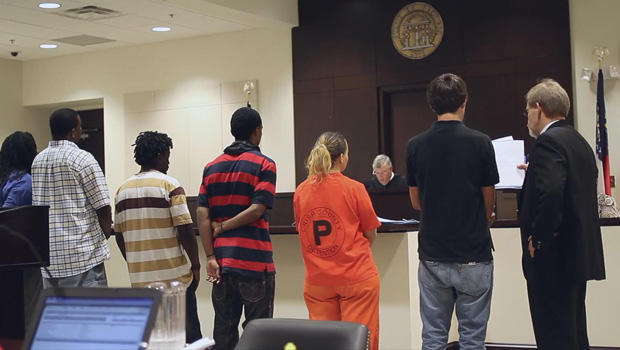
People like Shanna Shackelford, who says her life was ruined after her home outside Atlanta caught fire in 2009.

She wasn’t home at the time, but a small insurance policy she had taken out on the rental house made investigators suspicious.

“I thought it was just a misunderstanding, like, they’re going to figure this out, and it’s going to be okay,” she told Cowan.

http://cbsnews3.cbsistatic.com/hub/i/r/2017/08/12/6a1e13b1-d756-4ace-b932-3af59f6b3614/resize/220x/929aaf4ce9b0217cd0a8eac143629f44/shanna-shackelford-promo.jpg

After a fire in her home led to an arson charge, Shanna Shackelford had to rely on a public defender to represent her case. He recommended she accept 25 years behind bars.  CBS News

But it wasn’t. Shackelford found herself under arrest, charged with arson. “My grandma was like, ‘You might need to get an attorney and talk to somebody,'” Shackelford said.

But she didn’t have money for an attorney. So she applied for a public defender — a court-appointed lawyer tasked with making sure the 6th Amendment is upheld. (That’s the part of our Constitution that guarantees any of us the “assistance of counsel.”)

It’s a right that’s been tested in court, most notably in a case brought in the ’60s by a petty thief in Florida named Clarence Gideon. Unable to afford an attorney, Gideon was convicted and sentenced without one.

He appealed, arguing his right to an attorney had been violated, and the U.S. Supreme Court agreed. But while the Constitution may promise everyone legal counsel, it says nothing about the quality of that legal counsel, a deficit Shackelford felt right away.

She told Cowan it took about two for her to hear from her public defender: “His response was, ‘I have a bunch of cases like yours, so I’ll get to it when I get to it.'”

When he finally did “get to it,” instead of going over the details of her case, Schackelford says he simply told her to plead guilty, and take 25 years behind bars.

“He said, ‘If you didn’t do it, who did?’  And I said, ‘I don’t know, but I didn’t burn it down.’ He was like, ‘Well, I mean, looks like you did.’ He knew nothing about my case when he was talking to me. He was mixing me up with some other case — like, he had no idea what was going on.”

http://cbsnews2.cbsistatic.com/hub/i/r/2017/08/13/03c61960-404f-4aa0-bc28-0efd5762d7bb/resize/220x/68ed47aacc991864b14740434bbe5310/public-defender-with-case-files-promo.jpg

A public defender at court with her case files. CBS News

Shackelford’s case is not unusual. Nearly every case, roughly 90% in fact, often end in a guilty plea, largely because even if a poor defendant is innocent, most can’t afford bail or to wait in jail for trial, which means losing their jobs, their cars, maybe even their homes in the process.

“Being arrested and spending four or five days in jail can be enough to ruin a person’s life, even if they’re ultimately found not to be guilty of anything,” said Stephen Bright.

Take the city of Cordele, Georgia, for example, where at one hearing defendants all plead guilty as a group, with no evidence presented. Bright calls it the “Meet ’em and plead ’em” defense.

“You’ll see a crowded courtroom and there will be a lawyer there with his legal pad, and he’ll be, ‘Ms. Smith? Is Ms. Smith…? Raise your hand,'” said Bright. “They’re trying to identify their own clients! They’re getting ready to go before a judge in just a moment.”

http://cbsnews3.cbsistatic.com/hub/i/r/2017/08/12/cb6ef49b-34e2-453f-bfff-d811a1962956/resize/620x/ba49077e88b57b7722b3814d9f1c4700/misdemeanor-arraignments-cordele-judicial-circuit-mass-plea-620.jpg

Misdemeanor arraignments, conducted en masse, in Cordele, Ga. CBS News

Cowan saw the same thing happen in a Miami courtroom, where one Public Defender had to handle a crowd of clients all at once.

“I don’t care who the person is, I don’t care how dedicated they are; you cannot represent 500 criminal clients at the same time and give those clients the representation that they’re entitled to,” said Bright.

Nowhere is the problem of indigent defense more acute than in Louisiana, which has the highest incarceration rate not only in the country, but in the world.

http://cbsnews2.cbsistatic.com/hub/i/r/2017/08/13/15df80fc-05d4-4315-972b-bff79e22551d/resize/220x/7fdf84ba092d0bb2972945f25a59d609/rhonda-covington-at-work-promo.jpg

Public defender Rhonda Covington handles 500 to 600 cases a year. CBS News

Rhonda Covington is the sole public defender responsible for representing anyone too poor to afford a lawyer in her judicial district. That district encompasses about a thousand square miles.

She says she has to defend five to six hundred people every year. The professional standard, according to the American Bar Association, is about 150 felony cases a year … and some think even that’s too much.

Covington has two paralegals and two contract attorneys who help with the load, but they’re only part time. It’s mostly just her and her two cats (named Liberty and Justice).

She even cleans the office herself.

“Some people say, ‘Well, any defense will do,'” Covington said. “And some people think, ‘Well, you know, they shouldn’t have representation because they’ve been arrested.’ My job is not to get people off when they’ve committed crimes. That’s not what I do. What I do is to ensure that their Constitutional rights are protected.”

The bulk of the state funding for Louisiana’s Public Defender offices comes from an unpredictable source: its traffic tickets, which out on these country roads isn’t exactly a windfall.

According to Covington, the District Attorney’s office budget is five to six times hers.

“And out of that budget comes assistants, and investigators, and access to pay for things like DNA testing?” asked Cowan.

“Exactly. I’ve gone to crime scenes before with my own camera taking photographs. Each year, it’s always something a little less, a little less, a little less.”

Doing more with less is why she thinks she lost the case for one of her clients, 56-year-old James Waltman. She told him, “I’ve decided to go ahead and file a second motion for a new trial, citing the reason being that we had insufficient funds in order to investigate your case.”

Waltman admitted he assaulted his wife during an argument, but the state also charged him with kidnapping and rape — sentence-heavy crimes he insists he never committed. Rhonda believes with some investigation she could have at least lessened the charges. But she didn’t have the time or the money. “I couldn’t shut down my whole office for that one case,” she explained.

“Being innocent I had all the confidence in the world, that I’d walk out,” Waltman said, getting emotional. “But it didn’t happen.”

All across Louisiana, public defenders in 33 of the state’s 44 judicial districts now admit they’re in the same boat Rhonda Covington is in; they’re simply too busy to ethically handle their caseloads.

“If you ain’t’ got a paid lawyer, you’re going to go through this,” said Joseph Allen. He was arrested last year in Baton Rouge for a firearms violation, as well as a marijuana charge. The court didn’t even know he was in jail, because his public defender didn’t know he was in jail.

Dowan asked, “Did you feel like anybody was on your side?”

“Not really. No,” he replied.

“Nobody there to sort of help you through the legal maze, nobody to explain the charges?”

“No, sir. I did all that up on my own, reading the law book.”

Now, Allen and 12 others are suing Louisiana’s Governor and the Public Defender Board in a class action lawsuit brought by the Southern Poverty Law Center.

“We’re arguing that being appointed an attorney who doesn’t know who you are, doesn’t investigate your case, doesn’t come to see you, doesn’t take your calls, doesn’t ask for a bond reduction, doesn’t investigate the evidence, doesn’t talk to any witnesses, and doesn’t do anything else to move your case, file any motions that are particularized to you, you don’t have an attorney; you have an attorney in name only,” said Lisa Graybill, Southern Poverty Law Center’s deputy legal director.

“I don’t believe in filing lawsuits unless you really have to, right?” she said. “If there were a way to avoid filing it, we would have, but this injustice has gone on really for too long. It’s unacceptable.”

Back in Georgia, Shanna Shackelford spent years researching her case by herself. Her public defender was too busy with other cases, she says.

In the process, she lost two jobs and her home. After all, who wants to hire or rent to a suspected arsonist?

Had it not been for Stephen Bright — the only person who would seriously look into her case — Shackelford would probably be in jail. His investigation, which he did for free, proved that the fire was the result of faulty wiring, not arson.

It took him just two weeks to get her case dismissed.

“Two weeks,” Shackelford said. “That’s all it took. Someone to do a little research, and try.”

It still took Shackelford three more years to get the charge off her record.

But now with the nightmare finally behind her, she has started anew. She’s opening her own business, and focusing on being a mom to her two-year-old son, Ja’Ben.

“You did get justice, but not the way it should have come,” said Cowan. “Or at the price.”

“No,” she said. “It was almost like having to give up my life, for my freedom. And that’s what I had to choose in the end. I had to give up so many years in order to get the point of freedom.”

It’s No Longer About Southern Heritage. In Fact, It Never Was.

Esquire

It’s No Longer About Southern Heritage. In Fact, It Never Was.

It’s time Southerners recognize the lies we’ve been telling ourselves for over a century.

http://esq.h-cdn.co/assets/17/32/980x490/landscape-1502561907-gettyimages-830696386.jpgGetty NurPhoto

By Tyler Coates       August 12, 2017

“It’s about heritage, not hate.”

As a kid growing up in Virginia, that’s the answer I always received when I questioned a Confederate flag hanging on the side of a shed or the statues of Confederate generals lining Monument Avenue in Richmond, our state capital. These weren’t symbols of intolerance, racism, or white supremacy. No, these were to honor the lives lost in a lost cause: a war that divided our country in two, a series of battles in which the Southern man bravely defended his homeland and tragically lost.

We Southerners have a strong sense of pride for our history and culture. We’re very good at lying to ourselves to fit the narrative we want to believe.

A statue of Confederate general Robert E. Lee, standing on Monument Avenue in Richmond, Virginia

http://esq.h-cdn.co/assets/17/32/640x822/gallery-1502561611-robert-e-lee.jpg

Getty Hank Walker

I grew up in Montross, Virginia, a tiny little town about an hour from Richmond. There’s not much to say about it, but our bragging rights come from the fact that Montross is the seat of Westmoreland County, where two of America’s most famous generals were born: George Washington and Robert E. Lee. Both of them moved away when they were children, but the symbolism is still there: Two men who played major roles in fundamental moments of our nation’s history had their origins in our tiny part of the world.

Robert E. Lee, I’ll admit, always cast a darker shadow over that part of Virginia than his Revolutionary War counterpart. I grew up being fed the tall tales of his devotion to his home state, his compassion and integrity; he sided not with the South, but with Virginia, and that is why he led the Confederate army against a tyrannical Union. It’s bullshit, of course, but again: Southerners like their legends, and we like to present beautiful odes to our heroes even when the acts they committed were hardly heroic—but were, in fact, treasonous.

I have never looked up to the men whose effigies stand tall in various parts of the South. I never thought they were heroes, simply because of the fact that they were fighting for a destructive, evil cause. We can have an endless debate over “states’ rights” as the root of the Civil War; I find it pointless, because it is nothing more than a convenient narrative to avoid the truth. These men were fighting against the notion that all men and women—not just the white men in power, and the women who stood beside them—deserve the life, liberty, and the pursuit of happiness for which our forefathers fought in the late 18th century. They wanted to continue the practice of enslaving black men and women, of protecting whiteness. I will never see a Confederate flag or monument and separate it from a history of white supremacy, no matter how often I was instructed by our biased history lessons to ignore it.

I will never see a Confederate flag or monument and separate it from a history of white supremacy.

Last night in Charlottesville, Virginia, white supremacists descended upon the town—and upon the grounds of the University of Virginia—to protest the removal of a statue of Robert E. Lee from a city park. (Emancipation Park, to be exact; Southerners often turn a blind eye to irony.) Brandishing tiki torches, racist and homophobic slogans, and Nazi salutes, the group began to clash with Black Lives Matter activists and other groups protesting the planned “Unite the Right” rally. Those clashes continued on Saturday morning, when Virginia governor Terry McAuliffe declared a state of emergency.

http://esq.h-cdn.co/assets/17/32/768x512/gallery-1502562251-gettyimages-830755838.jpgGetty Chip Somodevilla

To my fellow Virginians and Southerners who have stood so steadfast in their refusal to see our Confederate monuments for what they are, I ask you: What does this say about our heritage? These men and women are not protesting the elimination of Southern culture and history, but rather reacting to their own deluded notions that white people are losing control of our country. When a group of men and women shout out “Jew will not replace us” in front of a statue of Robert E. Lee, what does that say about your symbol of Southern heritage? When these people brandish Nazi symbols and scream “fuck you faggots” in front of your idol, what does it say about a historical figure who supposedly stood up against a tyrannical government to protect his land?

The South lost the war. Over a century later, we’re still fighting one—but it has nothing to do with states’ rights or Southern pride. It is about racism, intolerance, and hatred. And at the center of it all are symbols that, despite the well-intended Southern narratives that have failed to reframe them as anything else, are the strongest representation of racism in our country’s history.

It is time the Confederate monuments come down for good, as they are now forever linked with an intolerance that extends beyond the borders of the Southern states. It’s not about Southern heritage anymore, but rather America’s heritage of propagating white supremacy as we comfort ourselves with slogans that suggest otherwise.

GOP senators react to Trump’s Charlottesville comments: “Mr. President – we must call evil by its name.”

Vox

GOP senators react to Trump’s Charlottesville comments: “Mr. President – we must call evil by its name.”

Updated by Tara Golshan        August 12, 2017

 https://cdn.vox-cdn.com/thumbor/csCVvxSgvj1mOP5-A0Gk6mRrmD4=/0x0:4704x3136/1520x1013/filters:focal(2568x595:3320x1347)/cdn.vox-cdn.com/uploads/chorus_image/image/56167087/534430992.0.jpgSen. Cory Gardner Photo by Drew Angerer/Getty Images

It was perfectly clear what President Donald Trump was avoiding in his comments about the violent white supremacist rally in Charlottesville, Virginia Saturday. He condemned the hate and bigotry “on many sides.” He didn’t call out white nationalists or supremacists by name.

His words did not go unnoticed — prompting top GOP senators, like Sens. Chuck Grassley (IA), Orrin Hatch (UT), John McCain (AZ), Rob Portman (OH), Cory Gardner (CO) and Marco Rubio (FL), to call out the president for sidestepping the force of evil at play.

Cory Gardner @SenCory Gardner    Mr. President – we must call evil by its name. These were white supremacists and this was domestic terrorism

Rubio followed suit, pressing the need for Trump to acknowledge the events that transpired.

Marco Rubio @marcorubio  Very important for the nation to hear @potus describe events in #Charlottesville for what they are, a terror attack by #whitesupremacists

For context, keep in mind that these are not back-bench Republicans. They’re well-known and influential players in Republican politics. They’re also not reflexive critics. They’ve defended Trump in the past. From this perspective, it’s a big deal to see senators buck their party leader so forcefully.

Still, their obvious statements against neo-Nazis shouldn’t normally look like an act of political courage. They are telling Trump that he needs to call today’s events for what they are: an act of domestic terrorism by white supremacists and white nationalists.

Chuck Grassley @ChuckGrassley   What “WhiteNationalist” are doing in Charlottesville is homegrown terrorism that can’t be tolerated anymore that what Any extremist does.

Senator Hatch Office @senorrinhatch    Their tiki torches may be fueled by citronella but their ideas are fueled by hate, & have no place in civil society.

Senator Hatch Office @senorrinhatch    We should call evil by its name. My brother didn’t give his life fighting Hitler for Nazi ideas to go unchallenged here at home. -OGH

Rob Portman @senrobportman   The tragedy in Charlottesville this afternoon was domestic terrorism. We must all condemn hatred and white nationalism.

On Saturday, crowds of white Americans donned confederate flags and swastikas to march in the name of bigotry and hate leaving one counter-protester dead and injuring more than a dozen others. A rally goer purposefully drove his car into a crowd of counter-protesters — an act that Trump has found it easy to call terrorism in the past.

In a statement, McCain said the event put the ideals fought for in the Civil War at stake:

Our Founders fought a revolution for the idea that all men are created equal. The heirs of that revolution fought a Civil War to save our nation, conceived in liberty and dedicated to that revolutionary proposition.

Nothing less is at stake on the streets of Charlottesville, Virginia, where a violent attack has taken at least one American life and injured many others in a confrontation between our better angels and our worst demons.

White supremacists and neo-Nazis are, by definition, opposed to American patriotism and the ideals that define us as a people and make our nation special.

As we mourn the tragedy that has occurred in Charlottesville, American patriots of all colors and creeds must come together to defy those who raise the flag of hatred and bigotry.

As many have pointed out through the day, condemning these actions is among the lowest bars to pass — but it is one that Trump decidedly chose not to cross. He ignored questions from reporters asking if he condemns white supremacy.

Instead, as Vox’s Dara Lind wrote, the president ended up “signaling to the white supremacists that he is on their side.”