Ohio Court Overturns Law Preventing Cities From Voting on Anti-Fracking Measures

DeSmog

Ohio Court Overturns Law Preventing Cities From Voting on Anti-Fracking Measures

By Simon Davis-Cohen              November 1, 2017 

https://www.desmogblog.com/sites/beta.desmogblog.com/files/styles/full_width_blog_image/public/blogimages/Ohio_State_Office_Building_supreme-court_credit-Sixflashphoto_creative-commons.jpg?itok=DajTIJa8The Thomas J. Moyer Ohio Judicial Center, Ohio State Office Building, is home to the Supreme Court of Ohio. Credit: Sixflashphoto, CC BY-SA 4.0

In a slight break with previous state policies that have encouraged fracking activity and new pipelines, the Ohio Supreme Court recently struck down a controversial provision restricting citizen efforts to vote locally on these and other issues through the ballot initiative process.

Getting Out (of) the Vote

The state Supreme Court ruling, which came on October 19, is a departure from earlier rulings that prevented residents* from placing county charters and a city ordinance to ban fracking from appearing on ballots. In 2015 the network had expanded beyond municipal ballot initiatives to include new county charters to elevate rights of local residents and ecosystems. Fossil fuel-friendly Ohio Secretary of State Jon Husted responded by claiming he possessed “unfettered authority” to remove the county charters from the ballot, regardless of whether they gathered enough signatures.

Central to Husted’s argument was an assertion that local residents do not have the power to vote on laws that challenge the state’s supremacy. Since 2015, Husted, Husted-appointed county boards of elections, and the Ohio Supreme Court have removed a total of 10 proposed fracking-related county charters from Ohio ballots.

To justify keeping the charters off the ballot, the Ohio Supreme Court developed a legal rationale that gave Husted and his boards of elections broad discretion to use what proved to be unpredictible technicalities to prevent all 10 from being voted on, despite petitioners gathering the needed signatures. However, that legal approach was not applied to municipal ballot initiatives, which continued to be proposed, voted on, and in some cases passed.

But at the end of 2016, HB463 passed in a lame duck legislative session and allowed unelected boards of elections to remove municipal initiatives from ballots as well. The bill also granted boards of elections similar unilateral power to strike proposed county charters, freeing them from having to rely on revolving technical arguments.

Taking Initiative

Apparently unfazed by the new law, this year local community groups* advanced county charters in Athens and Medina counties and ballot initiatives for the cities of Bowling Green and Youngstown. These efforts all included “Community Bills of Rights,” which would outlaw fracking, injection wells, and related infrastructure for producing and transporting natural gas in their respective counties and cities.

Bowling Green’s ballot initiative, which threatens to complicate the development of the nearby NEXUS natural gas pipeline, proposes an amendment to an existing city charter. Although the NEXUS pipeline is not slated to pass through the city itself, the ordinance would bar the pipeline from a piece of farmland owned by the city, which is key to the pipeline’s proposed route.

All of the ballot initiatives gathered the required number of signatures to get on the ballot. And all but Bowling Green’s initiative were opposed and removed by their boards of elections, whom Secretary Husted had appointed. However, Bowling Green’s board voted to allow the people to vote first.

Then came the legal challenges. After hearing appeals, the Ohio Supreme Court ruled against the two county charters and the Youngstown initiative. But in each of the rulings the court avoided weighing in on the constitutionality of HB463, instead relying on technical arguments to keep the initiatives off the ballot.

The Ballot’s in Your Court

But then the court ruled on the Bowling Green initiative.

Because Bowling Green’s board of elections ruled to allow a vote, in this case it was the board of elections — rather than citizen-petitioners — defending the local ballot process and arguing that HB463 was unconstitutional.

The issue was only brought to the state Supreme Court after a private individual appealed the board’s decision to allow voting to take place. (The challenge was defended by a law firm that last year wrote briefs for the American Petroleum Institute and Affiliated Construction Trades Ohio Foundation to defend the practice of keeping anti-fracking initiatives off local ballots.)

In a 4-3 decision, the Ohio Supreme Court struck down and ruled unconstitutional the section of HB463 that applied to municipal ballot initiatives, but not county charters. The ruling leaves unanswered how future proposed county charters will be treated. And because of how long the court took to make its decision, according to Terry Lodge, an attorney who represented the petitioners in all the cases, there is no time for Youngstown to use the ruling to return its previously removed initiative to this November’s ballot. That means Bowling Green’s “Citizens Right to a Healthy Environment and Livable Climate” initiative will be the only one in Ohio up for a vote in 2017.

Should it pass, as a similar effort did in the nearby City of Waterville last year, Nexus Gas Transmission, LLC may face yet another challenge from local communities as it attempts to build its pipeline across this stretch of northwestern Ohio.

Still, petitioners face an uphill battle from Bowling Green officials. “Our city [officials are] coming out so vehemently against [the ordinance],” local petitioner Lisa Kochheiser told DeSmog. Kochheiser also shared with DeSmog emails she obtained through a freedom of information request, showing Bowling Green’s mayor and law director knew about the proposed pipeline route — which passes within 700 feet of the Bowling Green regional drinking water treatment plant — two years before the public did. In addition, when the pipeline company filed a lawsuit to invoke eminent domain against individuals and local governments “holding out” access to their land in early October, Bowling Green’s law director quickly granted the company access to the disputed piece of farmland. Lodge wonders if the city “would even lift a finger to enforce [the ordinance]” if it passes.

The campaign is on in Bowling Green, but the numerous legal hoops that delayed the campaign until two and half weeks before the election means petitioners were “late coming out of the gate,” according to Kochheiser.

Update 11/2/17: This was corrected to clarify that local community groups, not the Ohio Community Rights Network, which works to support groups working on these issues, were advancing ballot initiatives.

No Mr Trump, You’re Disrespecting The Flag

BBC Sport

Osi and Jason’s passionate defence of NFL players’ right to protest is well worth watching.

Osi and Jason's passionate defence of NFL players' right to protest is well worth watching.

Posted by BBC Sport on Wednesday, September 27, 2017

Donald J. Trump May Be Enshrined in American History as The Tarriest of Political Tarbabys


Donald J. Trump May Be Enshrined in American History as The Tarriest of Political Tarbabys

John Hanno           October 31, 2017

https://s.yimg.com/uu/api/res/1.2/_.QL6siDOvu62mCJl71dzw--~B/Zmk9c3RyaW07aD0xNjA7cHlvZmY9MDtxPTgwO3c9MzQwO3NtPTE7YXBwaWQ9eXRhY2h5b24-/https://s.yimg.com/os/creatr-images/GLB/2017-10-30/9efe9170-bda0-11e7-9b57-5de36f287067_NTK_manafort_gates.jpg.cf.jpg

The list of folks who probably wished they never associated with Trump, his campaign, or his administration grows daily. The latest I’m sure, are Paul Manafort, Rick Gates and George Papadopoulos. Trump’s entire administration and campaign team have had to hire personal legal defense. During the entire 8-year Obama Administration, not one single person was embroiled in scandal or had to hire defense lawyers.

During a news conference on July 22, 2016, Trump said Campaign Chairman Paul Manafort and assistant chairman Rick Gates “were doing a fantastic job” and had earlier called Papadopoulos an “oil and gas consultant and an excellent guy.”

These first indictments appear just the beginning. The allegations against Manafort and Gates look iron clad and serious enough to induce their full cooperation in the possible implication and prosecution of others. And Papadopoulos’s guilty plea, in the works since July, ratted out other campaign operatives.

What implores these people to sell their souls to a devil like Trump? Is it the money; most of them are already wealthy beyond reason? Is no amount of wealth enough for them? Or are they attracted to the absolute power of the American presidency?

Trump’s stated goal is to “Make America Great Again” but everything he’s done, every executive order he’s signed has done just the opposite. He and the Republi-cons in congress have tried to make American’s sicker again by attacking the ACA and taking health care away from the 10’s of millions of poor Americans who finally acquired health insurance under Obama.

Its attack on the Consumer Protection Agency and its handouts to Wall Street will make most Americans poorer. They’ve made America’s air and water dirtier and more detrimental to its citizens. It works day and night proposing ways to plunder America’s natural resources and national treasures and turn them over to profit seeking fossil fuel and mining interests.

It’s proposed tax bill, will attempt to make incredibly rich people and corporations even richer. And it will starve the federal governments ability to fix the nation’s crumbling infrastructure. It’s policies will take power and resources away from workers, organized labor, consumers and anyone who supports the Democrats and their progressive agenda to rebuild our middle class.

Its obvious their main goal is to reverse every progressive accomplishment of the Obama Administration. And at the same time, to “Make Trump Inc. Great Again.”

Most of us, including progressive Democrats, critical thinkers, cheated business acquaintances of Trump, folks who bought into the bogus Trump University, women subjected to Trump’s sexual abuse, unrepentant Never Trumpers, and most of the rest of the entire world, saw the tar right from the start. Trump clearly showed us “who he really was”; and the dubious types he admired, praised and brought into his campaign and administration emphasized his flawed morality and character.

The swamp he promised to drain was obviously just another blatant Trump campaign lie. And the conflicts and mingling of his questionable business empire with his Executive Branch responsibilities, which he quite publicly promised to separate, was never perfected.

The Republican’s wholly tainted by Trumpism, are for the most part hanging on for dear life, hoping to rehabilitate their damaged reputations with their mythical tax reform legislation. They’re looking for a brier patch to escape into but the options are limited at this late date. A very few of the Republicans in Congress have managed to extricate themselves from the dirty tarbaby. Sen. John McCain, never a Trump fan, finally stood up and decided to make peace with his conscience before he meets his maker. Sen. Bob Corker, a principled conservative, decided that two 6-year senate terms were enough, and is attempting to clean his moral slate during the balance of his term. Sen. Jeff Flake, another principled conservative and very popular in his caucus, decided one term is all he could stomach when someone like Trump was steering the party into the abyss.

As the chips continue to fall, maybe others in congress will come to Jesus. There’s a good chance the promised monumental tax reform Trump and the Republi-cons promise will be as successful as their 7 year campaign to repeal President Obama and the Democrats efforts to heal our sick health care system.

Many of us, soon after Trump was elected but long before he took office, realized these Republi-cons would get drunk on their newfound power trifecta and couldn’t help but overreach. The insane promises this radical right cabal trumpeted during and since the campaign sealed their legislative fate long before the first vote was cast. The promises were so far removed from reality that even Trump’s bamboozled base supporters are even now beginning to drift back to Earth.

The Putinistic propaganda being spewed from the White House, from spokes-person Sarah Huckabee Sanders and from the ult-right media, rings more incredulous every day. Attempting to shift the focus from Trump’s Russia thing to Hillary’s Russia thing will fail on the facts Mr. Mueller and his team are uncovering by the hour.

Still, I can’t understand, that in spite of Trump’s historically low approval ratings, why are more than 80 percent of Republicans still solidly behind him. What will it take to finally turn his supporters from co-indicted treasonous co-conspirators into the courageous American patriots they pretend to be.

I can’t even imagine the hue and cry from the Republi-cons in congress if an Obama or Clinton Administration were implicated in 1/10th the scandals and conspiracies as Trump World. Articles of Impeachment would have already issued from every Republi-con controlled congressional committee.

When all is said and done, the list of criminal conduct and conspiracy will be impressive and substantial. But Robert Mueller may have a legal tight rope to walk, so that all the work his investigative team undertakes getting to the bottom of Putin’s attack on our Democracy, and the Trump campaign’s collusion, couldn’t be undone by pardons from Trump. Mr. Mueller may have to somehow slow-walk some of the prosecutions until after Trump is impeached, in order to bring all these criminals to justice.

John Hanno

Behind West Virginia’s Massive Chemical Spill, A History Of Poverty And Pollution

ThinkProgress

Behind West Virginia’s Massive Chemical Spill, A History Of Poverty And Pollution

Emily Atkin, Katie Valentine         January 22, 2014

https://i1.wp.com/thinkprogress.org/wp-content/uploads/2014/01/02Sa4jlUWSzsu87u2.jpg?resize=1280%2C720px&ssl=1The Pond Fork River in Boone County, West Virginia after a 2,500 chemical spill turned it white in September. CREDIT: MARIA GUNNOE

CHARLESTON, WEST VIRGINIA — Maria Gunnoe remembers a time when the rivers in Boone County, West Virginia ran clear.

“In my childhood, I fished these streams, I spent time in these streams,” Gunnoe, who lives in Bob White, a town in Boone County, said. “That’s what we did. Nobody needed a pool; the streams were our playground.”

In September, the stream where she used to fish and play as a child turned white. The culprit was 2,400 gallons of a chemical called DT-50-D, which is used to cover coal and rail cars to cut down on dust. It had leaked into the river from the Eastern Associated Coal prep plant, and to Gunnoe, it was just one more example of how the coal and chemical industries have polluted West Virginia — the second poorest state in the nation — over her lifetime.

This happens all the time. The coal companies are using stuff here that would absolutely eat the skin off of your body.

Industrial pollution, like what turned the Pond Fork River white, is a constant worry for many West Virginians, but Gunnoe said it took a major chemical spill like the one that polluted the water of 300,0000 West Virginians to get the nation to notice.

“This happens all the time. The coal companies are using stuff here that would absolutely eat the skin off of your body,” she said. “This time, it ended up in the water supply, and the world knows about it now. But it happens all the time.”

A Culture Of Poverty And Pollution

In a state where 17.8 percent of the population lives in poverty and 47 percent of children live in low-income families, many West Virginians depend on jobs from the chemical or coal industries — the same industries responsible for polluting the state’s water. Coal mining in West Virginia, a state that in 2011 ranked 49th out of 50 in terms of median household income, supports more than 88,000 jobs, while the chemical industry supports about 12,000.  Any attempt to put strict regulation on those industries is therefore met with hostility from those whose families have for generations depended on the jobs to get by, Paula Clendenin, a lifelong West Virginia resident, said shortly after the spill. Without that strict regulation, she said, spills become more likely.

“If you keep people poor, you keep them desperate,” Clendenin said. “It’s a vicious cycle.”

https://i2.wp.com/thinkprogress.org/wp-content/uploads/2014/01/0uh2J42jE576APJfq.jpg?w=629&crop=0%2C0px%2C100%2C369px&ssl=1The poorest in West Virginia are those who live in rural counties, which house much of the state’s coal mines and associated jobs. In those counties, like Boone, the poverty rate is 20.4 percent, five points higher than the urban poverty rate. Out of the nine counties affected by last week’s chemical spill, six are considered rural. Four of those rural counties are considered “mostly or entirely” hosts to mountaintop removal activity — a process largely considered to be the most efficient, but also the most destructive method of extracting coal.
“[Poverty] goes hand-in-hand with the fact that it’s the coal industry that’s polluting,” said Laura Merner, who has spent the last five years at the Alliance for Appalachia testing groundwater in West Virginia and surrounding states.

People who have their water running orange year round, you internalize that pollution as something that’s OK because you’ve been in it your entire life.

Merner tests groundwater across southern West Virginia for communities reliant on coal fields. She’s seen faucet water run black year-round, and bathtubs filled orange. She’s measured water with high levels of lead, arsenic and strontium. The media generally focuses on isolated areas of West Virginia when reporting on contamination, she said, but the reality is that one in every five streams she tests have been spoiled.

“People who have their water running orange year round, you internalize that pollution as something that’s OK because you’ve been in it your entire life,” she said.

Lida Shepherd, who runs a youth group for low-income teenagers in Boone county, said many of the kids she works with live “literally right below” mountaintop removal sites. Their communities have significantly higher total poverty rates and child poverty rates every year compared to other counties, according to a recent peer-reviewed study from Michael Hendryx, a professor at West Virginia University. Shepherd’s kids, she said, weren’t surprised to hear of the water ban that was enacted January 9.

“These kids are no strangers to not being able to drink their water,” Shepherd said. “These kids deal with this kind of thing on a pretty regular basis just because they live in very heavily mined areas.”

Because their water is so often contaminated, Shepherd said some of the kids were not taking last week’s ban on potable water very seriously.

“One of my girls, she was saying she was taking a shower in it anyway,” Shepherd said. “And that could be a product of just, ‘Hey, we hear this all the time, and we’re still alive. We haven’t died yet.’”

Christina Rhodes, another one of the girls Shepherd mentors, lives in Seth, in Boone County. Before she moved there, she said, the county used well water. That was until mass injection of coal slurry made the well water there run yellow, orange and black, and water testing revealed concentrations of iron, manganese, lead, aluminum, and arsenic that were sometimes hundreds of times over safe drinking water limits, according to the Sludge Safety Project. The Department of Environmental Protection (DEP) enacted new regulations on coal slurry injection in 2009, including requiring companies to regularly test water in injection site mines, as well as nearby groundwater, for contamination.

“My family went through the issues with the well water, and found [the chemical spill] situation just as stressful as when we had to stop using the wells,” Rhodes told Climate Progress in an email.

On top of the water pollution from the mountaintop removal sites, Shepherd’s kids — all born into poverty and first-generation college bound — live in the same valley with some of the nation’s largest coal slurry impoundments, which are massive toxic lakes used to dispose of coal waste. West Virginia has more slurry impoundments than any other state, and in 2011, residents of Mingo County settled a seven-year lawsuit with Massey Energy company that alleged that the company had injected 1.4 billion gallons of coal slurry into underground mines, and that the slurry had leached into aquifers, waterways, wells and drinking water.

“We had some faith that if your water was contaminated, that your government would step in and do something,” West Virginian and former miner Brenda McCoy said in 2011. “But they didn’t.”

Treating the Cause

Gunnoe has been a community organizer in West Virginia for 19 years, fighting to get lawmakers to recognize the threat industry poses to citizens’ water and the need for stronger regulations in the state. She said the state of West Virginia has been “held under the thumb” of the coal industry for the last 150 years, and that this month’s chemical spill should be a wake-up call for West Virginia and the world to how dependence on coal is hurting people and the environment.

“The water infrastructure has been polluted, and it’s because of mountaintop removal, underground injection and basically coal production. Period.” she said.

Several of West Virginia’s top politicians have been adamant about denying the recent chemical spill’s link to the coal industry. Gov. Earl Ray Tomblin in particular asserted last week that the incident was chemical-related, and had nothing to do with coal. “As far as I know, there are no coal mines within miles of this particular incident,” he said. “This was not a coal company.”

The water infrastructure has been polluted, and it’s because of mountaintop removal, underground injection and basically coal production. Period.

To Merner, Tomblin’s statements show a groundwork already in place to prevent real reform to the industries that she has witnessed polluting the state for the last five years. The government needs to protect the coal industry, she said, because every coal mining job brings in more jobs for the transportation and chemical industries.

“There’s not a true separation between coal and chemicals anyway,” she said. “The wall that the media has perpetuated is that there’s some some of separation, but it’s not true.”

Merner and Gunnoe are pushing for more regulation of the coal and chemical industries — something many of the state’s environmental leaders have long said is needed.

“Freedom Industries should be held accountable, but that won’t fix the problem,” Angie Rosser, executive director of the West Virginia Rivers Coalition in Charleston, wrote in the Charleston Gazette. “That’s because the Elk River spill wasn’t an isolated accident. It was the inevitable consequence of weak regulatory enforcement over many years, made possible by our collective failure to uphold the values we profess.”

Like Gunnoe, Evan Hansen, president of Downstream Strategies in Morgantown, West Virginia, said he hopes the spill will serve as a wake-up call for state and national lawmakers. But he said the first thing that needs to happen for any regulatory changes to be made in West Virginia is for the governor and the DEP to acknowledge the link between clean water and a healthy economy — something he said they have yet to do.

“They have been very clear that their number one priority is protecting jobs and the fossil fuel industry, no matter the environmental consequences,” he said.

Until they decide to acknowledge that link, those who live in the poor areas housing West Virginia’s mountaintop removal communities have little choice but to deal with their white or orange or chemical-laced water. Or, as West Virginia resident James Simon has put it, they could hit the road.

“The environmental protection [agency] won’t help us … the law won’t help us. Nobody on earth wants to help us,” Simon said. “My only solution is to get out of here.”

How big pharma’s money – and its politicians – feed the US opioid crisis

The Guardian

How big pharma’s money – and its politicians – feed the US opioid crisis

Tom Marino might have withdrawn from consideration as Trump’s drug czar, but drug money is coursing through the veins of Congress – contributing directly to an epidemic that kills thousands of Americans each year.

https://i.guim.co.uk/img/media/0cb2a0221e26618719b0ff5bf01046639fcb31d2/0_192_5760_3456/master/5760.jpg?w=1140&q=20&auto=format&usm=12&fit=max&dpr=2&s=336089e917d5ed2413bd245e8870ac54The pharmaceutical industry attempted to place blame for the crisis on the millions who have became addicted instead of the mass prescribing of powerful opioids. Photograph: Dominick Reuter/AFP/Getty Images
 

Chris McGreal, in Washington         October 19, 2017 

Donald Trump was not wrong. Hours before his nominee for “drug czar” withdrew from consideration over his part in a law limiting the Drug Enforcement Administration’s ability to crack down on pharmaceutical distributors feeding the US’s opioid epidemic, the president took a shot at the influence of drug companies over Congress.

“They contribute massive amounts of money to political people,” he said, standing next to Mitch McConnell, the Senate majority leader.

“I don’t know, Mitch, maybe even to you,” he added.

Trump was right on both counts. Pharmaceutical companies spend far more than any other industry to influence politicians. Drug makers have poured close to $2.5bn into lobbying and funding members of Congress over the past decade.

Hundreds of thousands of dollars have gone to McConnell – although he is hardly alone. Nine out of 10 members of the House of Representatives and all but three of the US’s 100 senators have taken campaign contributions from pharmaceutical companies seeking to affect legislation on everything from the cost of drugs to how new medicines are approved.

Trump’s nominee for drug czar, the US congressman Tom Marino, was forced to withdraw after a report by the Washington Post and CBS’s 60 Minutes highlighted his role in forging legislation that hinders the DEA’s ability to move against drug distributors or pharmacies recklessly dispensing the opioid painkillers at the heart of the epidemic, which claims more than 100 lives a day.

Marino’s acceptance of substantial donations from those same companies compromised his nomination to head the federal agency charged with tackling the opioid crisis.

But for Congress, the process was nothing unusual. Hundreds of millions of dollars flow to lobbyists and politicians on Capitol Hill each year to shape laws and policies that keep drug company profits growing. The pharmaceutical industry, which has about two lobbyists for every member of Congress, spent $152m on influencing legislation in 2016, according to the Center for Responsive Politics. Drug companies also contributed more than $20m directly to political campaigns last year. About 60% went to Republicans. Paul Ryan, the speaker of the House of Representatives, was the single largest beneficiary, with donations from the industry totaling $228,670.

The impact of so much drug company money coursing through the veins of Congress is often incremental or largely unseen by the American public, such as the industry’s efforts to block competitors in India from making generic versions of HIV/Aids medicines that are more affordable to developing countries.

But on occasion it has a hugely visible impact.

In his comments alongside McConnell, Trump was vocal in his criticism of what he said were pharmaceutical manufacturers “getting away with murder” by charging much higher prices in the US than other countries. That is the result of a 2003 law, in effect written by the industry, preventing the federal government from seeking bids for the manufacture of drugs and medical devices – a process used in other areas, such as defense spending.

Instead, the pharmaceutical companies can charge whatever price they want for drugs bought for the publicly run Medicare and Medicaid programs – and the federal government has no choice but to pay up.

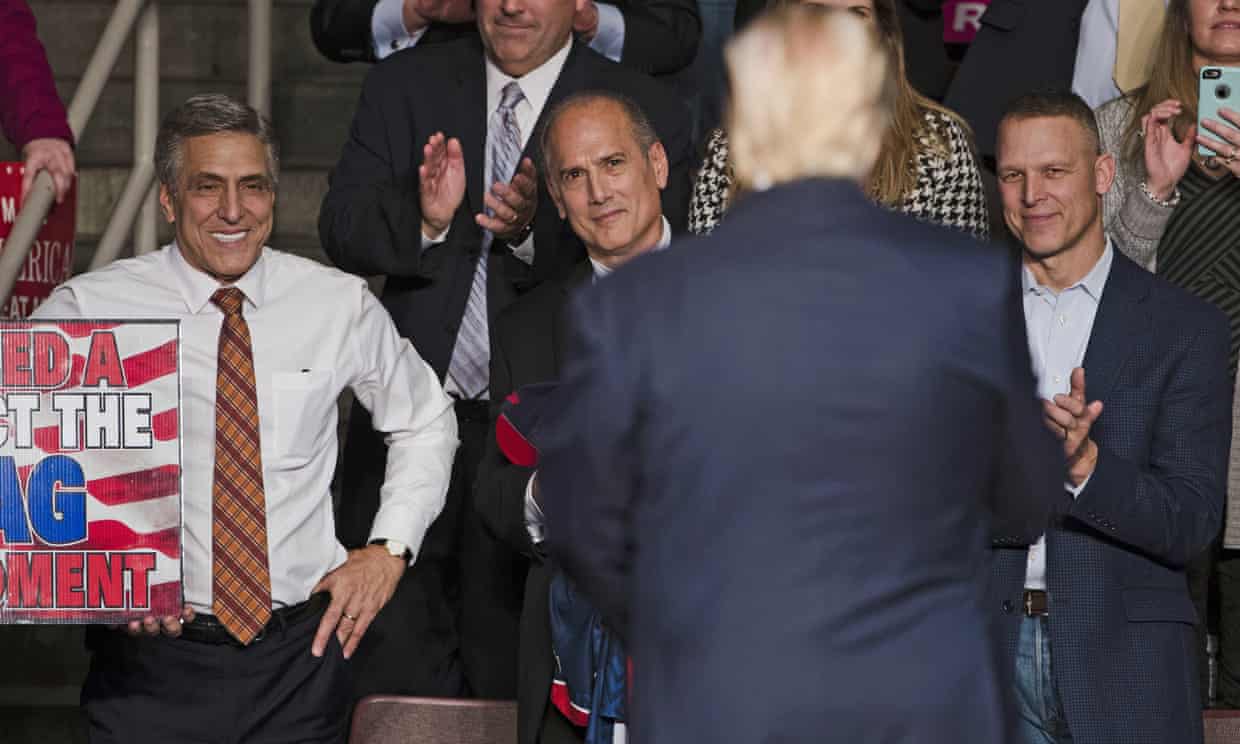
https://i.guim.co.uk/img/media/fb1bd91c5981ad43aabcc63ee226269bd215239d/0_94_4143_2486/master/4143.jpg?w=620&q=20&auto=format&usm=12&fit=max&dpr=2&s=aac5b189f53b4d9c8c119bc5bb9854ebTom Marino, second left, at a Trump rally in Hershey, Pennsylvania, in 2016. Marino faced scrutiny over donations from pharmaceutical companies. Photograph: Matt Rourke/AP



Meanwhile, the drug companies say that to allow foreign imports would endanger the quality and safety of medicines in the US. But that justification has been widely scorned in the face of escalating and sometimes opportunistic pricing, such as the surge in the price of EpiPen antidotes to allergic reactions last year, to $600.

Britain’s National Health Service negotiated a price of about $70 for the same product. Scores of attempts by some members of Congress to introduce legislation to bring down the price of prescription medicines or to let people buy them from Canada, where they are often cheaper, have failed to make it out of committee.

While lobbying shapes medical policy across the board, it has had a profound impact on the opioid epidemic as deaths quadrupled between 1999 and 2015. The pharmaceutical industry poured resources into attempting to place blame for the crisis on the millions who have became addicted instead of on the mass prescribing of powerful opioids.

The relatively small number of members of Congress who led the charge against the epidemic years before it became a significant political issue have struggled to push through legislation.

Representatives Hal Rogers and Mary Bono saw repeated efforts to pass laws curbing the mass prescribing of opioid painkillers fail amid concerted campaigns by the drug makers. Rogers and Bono founded the Congressional Caucus on Prescription Drug Abuse in 2010 and proposed several pieces of legislation over a number of years.

Bono, who was alerted to the opioid crisis after Chesare, her son with the late singer Sonny Bono, became addicted, said there was a false but effective campaign by companies profiting from the epidemic to portray any attempt to rein in the mass prescribing of painkillers as depriving millions of people of legitimate treatment for chronic pain.

“We were getting tremendous pushback from the industry. It was a massive, well-organized effort,” she said. “Of course we felt it, maybe indirectly at times. We didn’t have an awful lot of people lining up to help us.”

Some of the pressure came through industry-funded groups such as the Pain Care Forum, which spent $740m over a decade lobbying in Washington and state legislatures against limits on opioid prescribing and similar issues, according to the Center for Public Integrity.

Among those who received political contributions from the group were Senator Orrin Hatch, who took $360,00. The senator introduced legislation intended to head off one of the bills put forward by Rogers and Bono by proposing a federal study of pain treatment. Hatch, who is running for Senate again in 2018 even though he previously said he would not, is the recipient of the most political donations from the pharmaceutical industry so far this year, at $208,000.

Bono said the American Medical Association was instrumental in blocking another law, the Ryan Creedon act, to require doctors to get training on the risks of opioids. The AMA objected to it as a burden on physicians.

Drug companies gave more than $200,000 in campaign contributions to Jason Chaffetz (who recently left Congress), acting as the single largest donor to his re-election fights. Chaffetz, as chair of the committee on oversight and government reform, led an effort against the Centers for Disease Control and Prevention to reduce opioid prescribing by recommending that doctors first seek alternative treatments for chronic pain.

Lobbying by the wider healthcare industry also had an important impact on the shape of Barack Obama’s Affordable Care Act (ACA), widely known as Obamacare.

The chair of the committee drafting the ACA legislation, Senator Max Baucus, was at the time the single largest recipient of health industry political donations, with $1.5m given to his political fund over the previous year. Baucus led votes in the committee against the inclusion in the legislation of public insurance strongly opposed by private insurers who saw a threat to its profits.

Baucus was known within the health industry for annual fly-fishing and golfing weekends in his home state of Montana that lobbyists paid handsomely to attend. Other members of the committee received hundreds of thousands of dollars, including Senator Pat Roberts, who at one point tried to hold up the bill by claiming lobbyists needed three days to read it. The drafting of large parts of the ACA was done by a former vice-president of a major health insurer, Wellpoint.

In his attack on drug company money in American politics, Trump failed to mention that the companies were among the leading donors to his inauguration alongside tobacco and oil companies.

Pfizer, the maker of Viagra, was the largest pharmaceutical donor, giving $1m.

Thank you …

… for supporting us, funding our independent journalism and keeping it open. Your contribution and the similar pledges of hundreds of thousands of readers around the world enables the Guardian’s journalists to cover important issues like this year’s elections. And your knowledge and experience makes our reporting better too. Did you know we publish articles and podcasts for our supporters, featuring your views and voices?

You can learn more about how to get involved here.

Cub Scout Ousted From Den After Asking Politician Tough Questions

HuffPost

Cub Scout Ousted From Den After Asking Politician Tough Questions

David Moye, HuffPost       October 19, 2017

A cub scout in Colorado has been cast out of his den after he asked a state legislator pointed questions about racially charged comments she made about African-Americans in 2013 and a gun bill she co-sponsored.

Ames Mayfield, 11, and other members of his den in Broomfield had a question-and-answer session with state Sen. Vicki Marble (R) at an Oct. 9 meeting. Topics raised by the scouts  included the border wall, fossil fuels, and former President Barack Obama, according to The Denver Post.

Mayfield queried Marble about comments she made during a 2013 hearing on poverty suggesting that mortality rates among blacks were tied to their consumption of barbecue ribs and fried chicken.

“I was astonished that you blamed black people for poor health and poverty because of all the chicken and barbecue they eat,” Ames asked, according to ABC News.

Marble responded, “I didn’t; that was made up by the media.” She added, “So, you want to believe it? You believe it. But that’s not how it went down. I didn’t do that. That was false. Get both sides of the story.”

The complete exchange can be seen here:

For the sake of accuracy, the Denver newspaper reprinted Marble’s original comments:

“When you look at life expectancy, there are problems in the black race. Sickle-cell anemia is something that comes up. Diabetes is something that’s prevalent in the genetic makeup, and you just can’t help it.

“Although I’ve got to say, I’ve never had better barbecue and better chicken and ate better in my life than when you go down South and you, I mean, I love it. Everybody loves it.”

Mayfield also asked the senator about her co-sponsorship of a bill to allow domestic violence offenders to continue to own a gun, phrasing it bluntly.

“Why on earth would you want someone who beats their wife to have access to a gun?” he said.

The boy’s den leader cut him off and he was kicked out of the group a few days later, according to Denver station KMGH-TV.

His mother, Lori Mayfield, told the station that her son had no clue he did anything wrong.

“He is heartbroken his den leader kicked him out. What does that teach scouts (about asking challenging questions)?” she said.

https://s.yimg.com/lo/api/res/1.2/eZrZbgWFF5v4O9G9uwSm2A--/YXBwaWQ9eW15O3c9NjQwO3E9NzU7c209MQ--/http://media.zenfs.com/en-US/homerun/the_huffington_post_584/49c7b9d20eeac0b06fa0c871662af3cf

Marble is steering clear of the controversy.

“Decisions about who is in or out of a den are internal organizational matters that I won’t second guess,” Marble told the Denver Post by email. “I don’t blame the boy for asking the questions, since I believe there was an element of manipulation involved, and it wasn’t much different from the questions I normally field in other meetings.”

Lori Mayfield told the paper that her son spent a lot of time researching Marble before the den meeting.

“The only coaching I gave him was to be respectful,” she said. “Don’t be argumentative, preface things ‘with all due respect.’ I felt my son followed directions. He asked hard questions, but he was not disrespectful.”

Now she and her son are looking for a new den.

The Denver area council of the Boy Scouts told KMGH that a scout’s eligibility is ”up to the chartered organization, but it is working to help Ames find another den “so that he may continue to participate in the scouting program.”


There Could Be a Real Solution to Our Broken Economy. It’s Called Universal Basic Assets.

Resilience

There Could Be a Real Solution to Our Broken Economy. It’s Called Universal Basic Assets.

By Marina Gorbis, originally pub. by Medium.com – October 16, 2017

http://www.resilience.org/wp-content/uploads/2017/10/1-tc-3fnAVRgk8qaOd6vu8ag-304x200.png

Institute for the future

“The marketplace in which most commerce takes place today is not a pre-existing condition of the universe,” says author and Institute for the Future fellow Douglas Rushkoff. “It’s not nature. It’s a game, with very particular rules, set in motion by real people with real purposes.”

Over the past 100 years such rules have fostered unprecedented economic growth. However, today they are also producing deeply damaging social and ecological outcomes.

The numbers are striking. In 2010, 288 of the richest people in the world collectively owned as much wealth as the bottom 3.5 billion people. Last year, according to a recent study by Oxfam International, just eight people owned as much wealth as half of the world’s population.

In this moment of massive wealth inequality​,​ we urgently need to develop a new model for society to deliver both social and economic equity.

The answer may be in the concept of Universal Basic Assets (UBA),​ which​ in my definition​ is​ a core, basic set of resources that every person is entitled to, from housing and healthcare to education and financial security.

It Can Get Worse

The social instability caused by vast economic disparities is likely to only grow deeper under the pressure of two forces.

The first is the unrelenting progression of global warming that is already driving massive migrations of climate refugees due to wars, water and food shortages.

The second force — rapid advances in automation, artificial intelligence, and machine learning — is undermining traditional sources of income for vast swaths of populations in developed and developing countries alike.

A whole set of new technological tools, from networking to machine learning to robotics, are making it possible to produce goods and services in abundance without employing large numbers of workers. Growing numbers of people are making livelihoods in various types of flexible yet precarious employment arrangements rather than in stable, well-paying jobs that come with essential social benefits and risk protections.

As a result, the system that worked relatively well under conditions of scarcity is poorly suited to fulfill the needs of many when products and knowledge can be produced in abundance by relatively few.

In a healthy society, every person has the right to resources to safely live, learn, heal, and grow into the best version of themselves. These are Universal Basic Assets.

A Framework for Equity

We urgently need to design a new framework that delivers greater social and economic equity. Some economists and activists are proposing Universal Basic Income, a guaranteed minimum payment for everyone, as a way to ensure a guaranteed minimum for people to live on. We believe that a universal basic income is only the first step in making our economic system more equitable.

French economist Thomas Pikkety, author of the best-selling book, Capital in the Twenty-First Century, documented that in this point in history, it’s impossible for a person simply earning a salary to see the same economic returns as investors and capital owners secure through their assets.

Such disparities are likely to grow ever larger as the result of automation. An enterprise with fewer workers can reward owners with larger profits. As a result, solutions to economic inequality need to address more equal access to primary assets that generate better economic and social outcomes.

New Assets, New Rules

In designing Universal Basic Assets we take into account access to traditional physical and financial assets like land and money, as well as the growing pools of digital assets (data, digital currencies, reputations, etc.). We also recognize and assign value to exchanges we engage in as a part of maintaining the social fabric of our society but that do not currently carry with them monetary value (caring, creative output, knowledge generation, etc.).

https://cdn-images-1.medium.com/max/640/1*9FaozXoQD9kH-HHfoR2dWQ.png

In essence, we need to look at the concept of assets in its broadest sense, considering three classes of assets: private, public, and open.

Private Assets https://cdn-images-1.medium.com/max/640/1*MUWRwpb-xJ2eGEgBLIjxEw.png

Private assets are resources that we own individually. Housing, land, personal money, and retirement accounts fall into this category.

Since the 18th century, thinkers across the political spectrum have been advocating for equitable access to private assets, with some focusing on redistribution of incomes in the form of various types of taxes in order to achieve greater economic equity (Universal Basic Income comes under this umbrella). Others frame the issue around equal access to opportunity — that is, giving people a more equal starting point for achieving economic and social mobility. In this latter category, legal scholars Bruce Ackerman and Anne Alstott, for example, propose creation of The Stakeholder Society by granting a one time lump sum payment of $80,000 to everyone upon reaching the age of maturity. The UK’s Child Trust and efforts to create Individual Development Accounts (IDA’s) in the U.S. similarly aim to give children a head start while helping them understand personal finance and the importance of saving for and investing in the future.

Public Assets  https://cdn-images-1.medium.com/max/640/1*u7ihWWJ9SBeApSek-V_9zw.png

Public assets include resources collectively owned by the public and are managed by different types of government bodies on their behalf. They can include everything from national parks to mineral and cultural resources to critical parts of physical or digital infrastructure.

The four countries that have consistently been at the top in global rankings of social mobility are Denmark, Norway, Finland, and Canada. What they have in common is a high level of access to public resources like education, healthcare, and transportation.

If you are born to a poor family in Denmark, your chances of attaining economic success are not that different than those of your peers born into wealthier household.

Access to a whole variety of public assets makes it possible for children in countries like Denmark and Finland to move up the social and economic ladder independent of where they start.

In the United States, by contrast, your socio-economic status at birth is a big determinant of how well you will do as an adult.

Within the U.S., access to public resources accounts for regional differences in socio-economic mobility. Children born to families at the bottom fifth of the income distribution, have a 10 percent chance of reaching the top fifth of income levels during their lifetime if they live in San Francisco, New York, or Boston. The chance for the same children living in Charlotte, Columbus, or Atlanta is 5 percent, and for those from Memphis, only 2.8 percent. This is largely due to lower access to public schools, transportation, healthcare, and, of course, well-paying jobs. Being born poor dooms you to staying poor.

Open Assets https://cdn-images-1.medium.com/max/640/1*Xeyohr4XIQ29QOPEQFRW5w.png

Open assets are resources that are owned and managed neither privately or by a government. They are open to anyone and governed by a defined group.

Open assets are created in what MIT Media Lab researcher and IFTF affiliate John Clippinger calls the “open sector.” According to Clippinger, in the open sector, a group of “founders” create a set of initial conditions from which rules emerge through the interactions of participants.

Clippinger cites the example of the British Common Law, a basis for America’s legal system, which evolved from customs and norms, and was eventually codified into constantly evolving laws. “It wasn’t top-down. It was constantly reinventing itself around the circumstances, and there was no single point of control,” he says. This is how the open software community operates today. Wikipedia is another familiar example of a community bound by common practices and principles that has established an architecture and a set of practices for entering and editing information, which in turn, has made it possible to create an open resource used by billions of people worldwide.

In the analog domain, we find examples of open systems for value creation in physical communities such as Burning Man or Freespace, where no money is allowed. People choose to come together freely and exchange or gift each other anything from physical goods to knowledge and services. This model is probably the form of existence most familiar to us as a human species as this is how many of our human ancestors lived before we invented money and market capitalism.

However, we don’t have to participate in the open-source software movement or go to Burning Man to experience non-monetary, non-profit-based economies — we participate in them on a daily basis in many ways. We don’t pay for love, for dinners at our parents’ homes, for our child’s affection, for art and music and other creative outputs that have become invisibly woven into the infrastructure of our daily lives (if we are lucky). As we transition to new forms of value creation we have opportunities to enlarge our pool of open assets and reconsider how and what we assign value to.

In the face of rising economic inequality in a society where those with capital get richer far faster than those who labor, we need to focus attention on more equitable distribution and access to a variety of assets. This would ensure not only greater socio-economic mobility for individuals but also help sustain the social fabric of our society.

Let us not forget that high levels of economic inequality come at a price not only for the poor but also for the extremely wealthy themselves. Some are building protective bunkers on secluded islands as they prepare for the inevitable social upheavals. Historical research shows that any concentration of wealth and power requires investments in vast networks of expensive security institutions leading to what Dr. Rachel Kleinfeld calls privilege violence. Such violence stems from a “power structure that allows or enables violence against some citizens as the price for maintaining extreme privilege.”

Creating a new kind of economy based on Universal Basic Assets can enrich all of our lives. Without it, the future may be a much poorer place for everyone.

For more on this topic, please read the IFTF working paper “Universal Basic Assets: Manifesto and Action Plan” (PDF)

Colin Kaepernick’s grievance all but ends any shot of QB playing in NFL

Yahoo Sports

Colin Kaepernick’s grievance all but ends any shot of QB playing in NFL

Charles Robinson, Yahoo Sports         October 16, 2017 

For months, some close to Colin Kaepernick debated whether he should cross the ultimate line. The one you don’t come back from in the NFL. The one that casts a person into football exile permanently. No matter how much it felt like Kaepernick was being blackballed or that team owners might have been conspiring against him, there was a well-defined line between thinking it and saying it. A line between faint hope and career-ending finality. To breach it, and effectively speak out against the shield, was to concede that the league’s door had closed forever.

Today, Kaepernick is there.

By all accounts, his NFL career is over. But his opportunity to challenge the league, and to step far over the line that few have gone near, has just arrived. That’s what the grievance he has filed against the NFL represents: an end, a beginning and a stronger position than before.

Colin Kaepernick is accusing NFL owners of blackballing him from the league. (AP)

It will cost him any faint chance he might have had of getting back on an NFL field. His grievance is loaded with monster allegations and seeks to dig deep under the nails of franchises. That all but assures that no team will ever take a look at him again. Not a call. Not a workout. And most definitely not a paycheck. While some (or many) owners see taking a knee during the national anthem as disrespectful, all of them feel that way about a litigious kick in the ass.

That’s what Kaepernick delivered, accusing NFL owners of scheming to end his career because of his outspoken social activism, and then bowing down to the political pressure of President Donald Trump, who has railed against NFL player protests. And he’s dropped the accusations on the doorstep of the league’s fall meetings in New York, making it a virtual certainty that both the owners and commissioner Roger Goodell will once again be confronted about why he isn’t in the NFL.

If the finance of sports has shown us anything, billionaires don’t react well when being called on the carpet for their decisions. Even less so when they feel they’re being told how to conduct their businesses. And when it’s a player challenging them in the legal realm, it’s basically the career kiss of death. Particularly if that player is someone like Kaepernick, whose fan popularity skews to either heroic or hated. If he was indeed facing an orchestrated freeze-out before this moment, it’s a safe bet his accusations of collusion and conspiracy will deliver his career only into the deepest of nuclear winters.

Of course, that’s not an earth-shattering outcome to some around Kaepernick, who have long-believed he has been on the league’s blacklist. They’ve suspected as much since the summer, after months of the NFL efficiently sending the message that he wasn’t wanted. As reporters asked why he wasn’t getting a chance, Kaepernick’s supporters saw only what they believed to be a litany of anonymous and wholly fabricated lies: that Kaepernick wanted too much money; that he wouldn’t sign to be a backup; that he was too poor of a player; that he cared more about social activism than being an NFL player. And then there was the reasoning that left Kaepernick’s camp absolutely flabbergasted – that he was too good to sign for a backup position when interested teams already had a defined starter.

In the end, every one of those justifications pushed Kaepernick closer to his belief that the past seven months were all a choreographed show. That behind the scenes, NFL owners had come to a collective decision that he was no good for their game. And that each time someone debunked the reasons why he wasn’t on a team, the NFL came up with something new to feed the masses and denounce him.

Deep down, what Kaepernick and some around him have long believed is what is now laid out in his grievance: That the NFL wanted to be rid of him because of his outspoken voice and the wave of social activism that he triggered. That he was too dangerous to a brand that craves power, control and muted obedient labor. By putting those accusations out there, Kaepernick will strike his career down. And in doing so, he may become a more powerful voice in how the NFL handles outspoken players.

That’s where the beginning lies in all of this. For months, Kaepernick has shunned interviews. Primarily for two reasons: He didn’t want to be seen as begging some NFL team for a job; and keeping quiet limited the ability of others to twist his voice into controversy, and destroy any chance he had of playing in the league.

There was a consequence of that duality. The vast majority of NFL teams simply never called and he never got close to signing anywhere. Also, others were left to speculate about Kaepernick’s thoughts and feelings while the league’s social activism moved forward without him.

New Orleans Saints players kneel before the anthem is played at a game in London. (Getty Images)

Now? All of that is poised to change. With the grievance filed and Kaepernick well-aware that he has crossed a boundary of no return, there is no incentive to remaining silent. He no longer has anything to lose. If he chooses, his life’s work can now become two things: proving the NFL has been operating with a hidden agenda against him; and vocally re-entering the social activism realm that largely hasn’t heard his voice for more than a year.

If none of that suits Kaepernick, the very least he can do now is defend himself. Against the NFL. Against the hatred of some fans. And against a president who has invoked his name and turned his efforts into a viable political platform.

The line has been crossed and the league’s door has closed. But other portals are ready to be opened. Now Kaepernick finds himself with a voice again – with nothing to lose and no need to hold back. He’s standing at a new line, between the end of his career and the beginning of something else. All he needs to do now is choose where he goes next.

Values Voter Summit is the type of right-leaning entity that cannot continue to be called Christian.

AM Joy on MSNBC

October 15, 2017.  Rev. Dr. William Barber just told AM JOY that in his view the Values Voter Summit is the type of right-leaning entity that cannot continue to be called Christian.

Rev. Dr. William Barber just told AM JOY that in his view the Values Voter Summit is the type of right-leaning entity that cannot continue to be called Christian. Leave your thoughts on his explosive commentary below.

Posted by AM Joy on MSNBC on Saturday, October 14, 2017

Dear North Korea, it’s President Trump

Yahoo News

Dear North Korea, it’s President Trump

Matt Bai’s Political World     October 12, 2017

https://s.yimg.com/lo/api/res/1.2/v_gx7UpLWbSVp.yy_hJTJw--/YXBwaWQ9eW15O3c9NjQwO3E9NzU7c209MQ--/http://media.zenfs.com/en/homerun/feed_manager_auto_publish_494/eabdb512e189205177f9c4531533653ePhoto illustration: Yahoo News; photos AP [3], Getty Images.

FROM THE WHITE HOUSE
Washington, D.C.

To the Honorable Kim Jong Un

Dear Leader:

I hope you’ll treat this letter as personal and confidential, from one large-handed leader to another. I got the idea to write it from my generals, who were telling me all about this big showdown over Cuban missiles back in the 1960s, which apparently really happened.

I figured, hey, if John Kennedy can negotiate over missiles directly with a dictator — and he was a very low-quality person, let me tell you — then so can Trump.

You can’t leave diplomacy to a loser like Tillerson, believe me. But I’m trying not to think about him right now.

It’s very important that you and I talk, very important. Because like I said during one of those debates we had during the campaign, which were a total waste of time, although people said I won them all and frankly that I was the greatest debater ever, and that’s a direct quote from somebody somewhere, but anyway, what I said during a debate was, “I think, for me, nuclear is just the power, the devastation is very important to me.”

I can’t say it any clearer than that.

First off, let me just point out that our great peoples have a long history together, and all of Korea is frankly very special to us — very, very special. I mean, you gave us the TV show “M*A*S*H,” which had a tremendous run.

Also, without the Korean people, we wouldn’t have all those unbelievable grocery stores in Manhattan. Seriously, I have so much love for the people, so much love. I told my guys at ICE, leave the Koreans alone, because a lot of actual Americans depend on them for kimchi. Great respect, believe me.

You and I have plenty in common, we really do. I know they said that calling you “Little Rocket Man” was a terrible insult, but you can’t believe anything you read in the failing New York Times or lying CNN or the rest of the fake news media. These are the same people who said that I could never win the primaries, and that Hillary was going to be the president, and that Puerto Rico was part of the United States.

The truth is that “Rocket Man” is a very popular song here in America — very much loved, believe me. It’s about a guy who goes into space and finds out that Mars isn’t a very good place to raise a kid, because it’s cold as hell, and there’s no one there to raise them if you did. Which frankly makes no sense, even in English, but it was the ’70s.

The point is, we’re a lot alike. For one thing, we both value family, am I right? I saw you just promoted your sister to a powerful job in the Politburo — very touching, very beautiful. I’m getting ready to turn the White House over to Ivanka in 2020, even though my poll numbers are just unbelievable, better than any president in history, let me tell you.

I’d point out that Ivanka is smarter than Pence, but frankly I think Donald Jr. is smarter than Pence, and I’m pretty sure he still eats crayons when he’s nervous, so that’s not saying very much

And while we’re on the subject of family, let me say I admired the way you took out your brother, having strangers run up and poison him in the airport, which was genius. I made a comment about it, and ever since then, every time I go to hug Jared, he jumps back and shields his face. Hysterical.

Let’s see, what else. Both of us have great hair, right? I see that everyone in your country wants to do their hair just like you, which I applaud. I mean, I look at a guy like Tillerson, who’s 65 years old and still parts his hair in the middle, and I think it’s just sad, frankly. But I’m not bothered by him, I’m really not.

We’re both deeply committed to the mining industry. I’m getting rid of these Obama rules, which are very, very harmful to our economy, and you’re giving people jobs for the rest of their lives in labor camps, which is basically the same thing.

We both know how to handle critics. Although I have to rely on tweets for that, because I don’t have the same kind of latitude you enjoy over there, which is something we need to change, let me tell you.

I can’t tell you how many mornings I wake up and think: Wouldn’t it be nice to throw Bob Corker into a pit of starving dogs, or pin him to an antiaircraft battery?

And don’t even get me started on Tillerson. Everyone told me, “Get Tillerson, you’ve got to get Tillerson for State.” And then he calls me a moron. You know who’s a moron? A guy who gives up 25 million bucks a year so he can come running whenever I ring a bell, that’s who.

Let’s just say that if I were to send Tillerson on a diplomatic mission to Pyongyang, and he were to, say, disappear into one of your work camps, I could see how we might end up in a very long standoff before negotiating his freedom. It could take years, a deal like that. But that’s a hypothetical.

Anyway, we’ve got a great thing going here. This business with me tweeting about blowing up your country, and you coming back with “final doom” and all of that. The ratings are off the charts, right? It’s a hell of a show, it really is.

We’ve got the whole world waiting to hear every twist and turn. It’s playing on all the networks at once, which is really something, let me tell you.

But you do know it’s a show, right? Because words are one thing. Words have no consequences, near as I can tell. You can say anything, incite any kind of rage or reaction, and your people just love you more for it. This is what I’ve learned in politics, believe me.

Nuclear war, though — my generals tell me that would be very, very horrible. Millions and millions of people would disappear, and not like on “The Apprentice.” Our ratings would tank. The show would be terrible.

I’m sure we’re on the same page here, but it can’t hurt to double check. So good luck with the public executions, and please pass along my fire and fury to the entire family!

Sincerely,

Donald J. Trump

P.S. If you really need to sink Guam, as kind of a season finale, I get it. Just maybe give me a heads-up, so I can see about Tillerson’s travel schedule. But I’m not thinking about him right now. I’m really not.