Mike Ditka Just Showed Why the NFL’s National Anthem Protests Are Necessary

Mike Ditka Just Showed Why the NFL’s National Anthem Protests Are Necessary

“There has been no oppression in the last 100 years that I know of.”

https://hips.hearstapps.com/hmg-prod.s3.amazonaws.com/images/ditka-1507650185.jpg?crop=1.00xw:0.848xh;0,0.0190xh&resize=768:*Getty

By Jack Holmes           October 10, 2017

Mike Ditka is a Hall of Fame football player and coach who made a damn good cameo in Will Ferrell’s Kicking and Screaming. He is also the latest standard-bearer for the growing number of Americans completely allergic to historical reality. You need only look to his latest comments on the so-called national anthem protests in the NFL, in which a group of primarily black players have demonstrated during pregame festivities in various ways to bring attention to racial inequality in the criminal justice system and a lack of accountability for police who kill unarmed black citizens.

Like many people—including the president—Ditka has conflated the vehicle for their protest with the subject of the protest. (Again, the players are not protesting the anthem or the flag, and their stated intention has nothing to do with disrespecting the armed forces. No player has criticized the troops.) But Ditka also took things to a new level of unreality.

It’s one thing to contend there’s no racial injustice in this country right now. Although that flies in the face of reality—the statistics on criminal justice are quite clear—it is not yet a settled matter of historical record. But the idea that there has been “no oppression in the last 100 years”—since 1917—is a statement beyond comprehension.

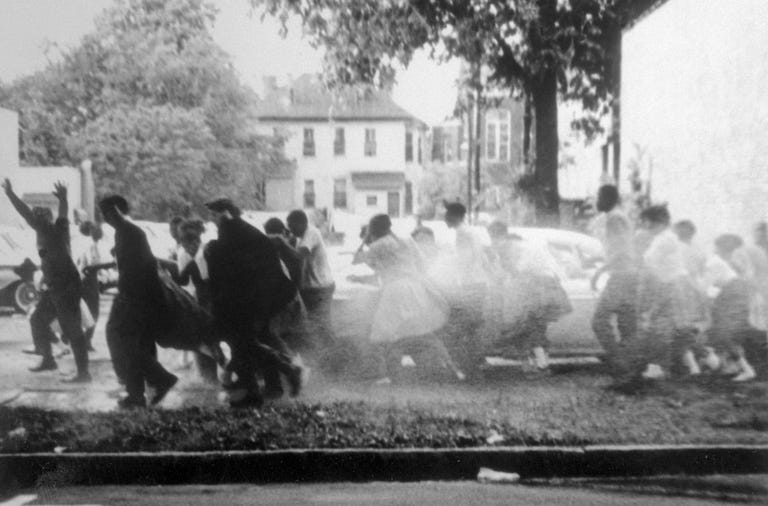
Mike Ditka is 77 years old. He was alive during the Civil Rights Movement, when African-American citizens were dragged off to jail for sitting at the wrong lunch counter or in the wrong part of the bus. He was alive when black Americans were sprayed with firehoses and had police dogs sicced on them because they dared march for equal rights in Birmingham, Alabama. He played in the NFL, with black teammates, throughout the 1960s as the movement hit its prime. Did he never speak to them about their experience in America, as Martin Luther King, Jr. marched on his TV screen? Did he ever wonder why John Lewis, now a United States congressman, was willing to nearly die marching alongside King in Selma?

A 1963 civil rights protest in Birmingham, Alabama.
https://hips.hearstapps.com/hmg-prod.s3.amazonaws.com/images/civilrights-1507650264.jpg?crop=1xw:1xh;center,top&resize=768:*Getty

This is all within the last 60 or so years. The 1920s—still within Ditka’s gobsmacking historical window of racial harmony in America—was the heyday of the Ku Klux Klan. One of the Klan’s methods of enforcing white supremacy and the oppressive regime of Jim Crow—also a fixture of the real Ditka-era America—was lynching. According to the The NAACP, there were 4,743 recorded lynchings between 1882 and 1968. This is the reality. This is what happened in parts of the United States of America as recently as 50 years ago.

And this is also why the national anthem protests Ditka finds so unacceptable are so necessary. While Ditka’s apparent ignorance is certainly extraordinary, his basic unfamiliarity with the experience of being black in America is not. Put simply, many white people are often unaware that injustice exists because it does not affect them personally, as the rest of The Washington Post‘s writeup of Ditka’s conversation shows:

Later on Monday, Gray asked Ditka, “For those who want social justice, and for those who look back at the lives of Muhammad Ali and Jesse Owens, and John Carlos and Tommy Smith, your response would be?” 

“I don’t know what social injustices have been,” the Pro Football Hall of Fame inductee replied. “Muhammad Ali rose to the top. Jesse Owens is one of the classiest individuals that ever lived. I mean, you can say, are you talking that everything is based on color? I don’t see it that way.

“I think that you have to be colorblind in this country. You’ve got to look at a person for what he is, and what he stands for and how he produces, not by the color of his skin. That has never had anything to do with anything. 

“But all of a sudden, it’s become a big deal now, about oppression. There has been no oppression in the last 100 years that I know of.

“Now maybe I’m not watching it as carefully as other people. I think the opportunity is there for everybody. Race, religion, creed, color, nationality—if you want to work, if you want to try, if you want to put effort into yourself, I think you can accomplish anything.”

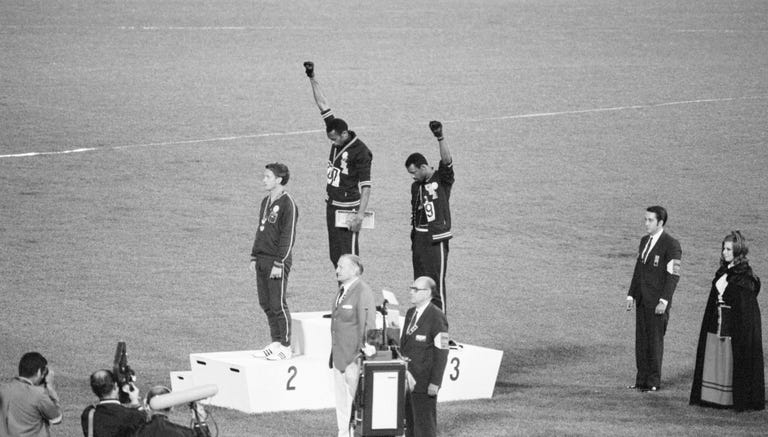
In the United States, only white people have the luxury of pretending that people can be colorblind. (In fact, this was a running joke on The Colbert Report.) People of color know this is not the case, and the national anthem protests—like Muhammad Ali’s or Jon Carlos’ and Tommie Smith’s before it—are an attempt to make the wider population (that is, white people) aware that inequalities and discrimination exist. If you have never been discriminated against personally, it is much easier to believe there is no discrimination and the system is just. That was the power in Martin Luther King’s decision to march peacefully, knowing the reaction from southern whites would be violent. It demonstrated to the wider world how the system actually worked.

Tommie Smith and John Carlos at the 1968 Olympic Games.
https://hips.hearstapps.com/hmg-prod.s3.amazonaws.com/images/johncarlos-1507650361.jpg?crop=1xw:1xh;center,top&resize=768:*Getty

Ditka’s belief that “if you want to work, if you want to try…you can accomplish anything” is also simply not true across the board. Racial discrimination in hiring processes is real and pervasive. In one study, résumés with “white-sounding names” got 50 percent more callbacks than résumés with “black-sounding names.” If you’re black in America, wanting to work is not always enough.

“There has been no oppression in the last 100 years that I know of.” – Mike Ditka

In another demonstration of historical illiteracy, what Ditka and other opponents of today’s protests don’t seem to understand, is that MLK and Muhammad Ali were deeply unpopular in their time. Like Colin Kaepernick and those who have followed him, they were reviled by many as ungrateful upstarts who were always choosing the wrong place and time to protest. Except that is the very point of protest: It is supposed to be at the wrong place and time. It is supposed to make people uncomfortable and frustrated, because that is the baseline experience of the oppressed classes in society. If the status quo works for you, you’re unlikely to change the status quo—unless others can show you that it is morally indefensible.

The reactions from others around the National Football League have begun rolling in. That includes one from Martellus Bennett, a tight end for the Green Bay Packers whose brother, Michael, had a telling experience of his own this year when Las Vegas police reportedly told him they would “blow his fucking head off” when they mistook him for a criminal suspect after the Mayweather-McGregor prize fight in August.

Michael Bennett’s teammate on the Seahawks, Richard Sherman, weighed in as well:

Martellus Bennett @MartysaurusRex      Hasn’t seen oppression in 100 years bruh?….

Richard Sherman @RSherman_25    Some only see what they want to see

Sherman may indeed have made the essential point. It seems Ditka, likes millions around the country, has developed an entire world-historical view tailored to the idea of unequivocal American greatness. There can’t be racial discrimination, because there hasn’t been for a century. When you mold your own reality, even basic history isn’t safe. That can have dangerous consequences for the present.

Editor’s Note: It was Michael Bennett, not Martellus, who was involved in an incident with Las Vegas police in August. We regret the error.

Newt Gingrich compares Trump to former president who engineered genocide of native tribes

ThinkProgress

Newt Gingrich compares Trump to former president who engineered genocide of native tribes

“I think he’s… probably the biggest change agent since Andrew Jackson,” Gingrich said.

Melanie Schmitz           October 10, 2017

https://i2.wp.com/thinkprogress.org/wp-content/uploads/2017/10/untitled.png?resize=1280%2C720px&ssl=1Credit: CBS This Morning

In an interview with CBS This Morning on Tuesday, former House Speaker and GOP presidential candidate Newt Gingrich called President Trump a “remarkable” and “historic” figure, comparing him to the seventh president of the United States, Andrew Jackson.

“I think Trump is a remarkable figure,” Gingrich said, responding to questions about the president veering off course and antagonizing his own party ahead of a major budget and tax reform battle. “I think he’s a historic figure, he’s certainly probably the biggest change agent since Andrew Jackson in the 1820s and 1830s.”

Despite the fact that it was intended to be complimentary, the Trump-Jackson comparison is unfortunate. Jackson, a historic figure with a number of military achievements under his belt, admittedly shares certain similarities with the current president, including his anti-establishment legacy and, as one onlooker at the time put it, the “rabble mob” he brought with him to the White House after his inauguration in 1829.

But the seventh president is also notorious for a number of troubling, inhumane reasons: Jackson was a slave-owner who offered rewards to anyone who gave escaped slaves especially cruel beatings. At the time of his death he owned approximately 150 slaves, though it’s been estimated that, over the course of his lifetime, he owned over 300.

Jackson is perhaps most famous for engineering one of the worst genocides in American history. A longtime proponent of removing native tribes who were taking up what he considered to be valuable land meant for white settlers, Jackson signed the Indian Removal Act in 1830, eventually forcing nearly 50,000 indigenous people off their lands and into the West. In the winter of 1838 alone, some 4,000 Native Americans died along the Trail of Tears.

In certain ways, the Trump-Jackson comparison seems depressingly fitting: since his own inauguration in January, Trump has become laser-focused on the removal of certain populations of people from the United States, including undocumented immigrants and their children, as well as on banning travelers and immigrants from several Muslim-majority nations. His antagonistic views toward social justice movements meant to draw attention to the deaths of minority populations, such as Black Lives Matter, has also drawn criticism. And as ThinkProgress’ Josh Israel pointed out in March, “Jackson, like Trump, preferred to ignore federal courts rather than enforce constitutional protections for all people.”

But, given Gingrich’s praise on Tuesday morning, it’s clear that many don’t view these comparisons negatively — quite the opposite, in fact.

Trump himself has touted those similarities in the past, using them to prop up his own legacy and play himself off as a change-maker. During a speech this past March at Jackson’s Nashville estate and plantation, The Hermitage, Trump noted, “It was during the revolution that Jackson first confronted and defied an arrogant elite. Does that sound familiar?”

Chief justice: Pay no attention to the rigged election behind the curtain

Detroit Free Press-USA Today

Chief justice: Pay no attention to the rigged election behind the curtain

Brian Dickerson, Detroit Free Press Columnist         October 8, 2017

SCOTUS is lined up to hear cases on topics like labor relations, gerrymandering and voters’ rights. Video available by Newsy Newslook

https://www.gannett-cdn.com/-mm-/074d5f7ecc0ce812ca86f1f8658ac0d10e5cf9ce/c=112-0-1888-1335&r=x404&c=534x401/local/-/media/2017/10/03/USATODAY/USATODAY/636426246221827488-scotus-wisconsin-redistricting-100317.jpg(Photo: Olivier Douliery, Getty Images)

For 12 years, Chief Justice John Roberts has worked overtime peddling the dubious conceit that he and his life-tenured colleagues on the U.S. Supreme Court are above politics and determined to remain so.

Yet Roberts himself is a consummate politician — a strategist who worries about appearances and harbors a ward heeler’s contempt for the intelligence of the average voter. And his cynicism was on full display last week when justices took up the politically fraught problem of gerrymandering.

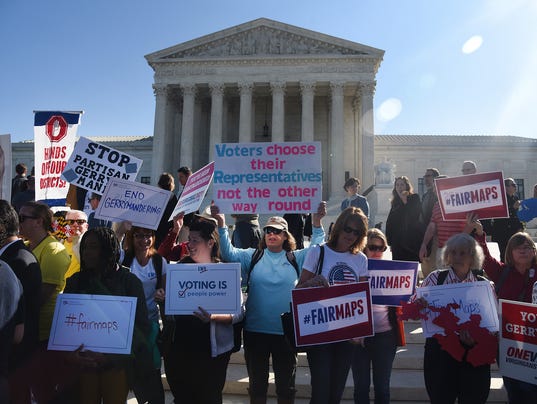
Plaintiffs in a case known as Gill v. Whitford want the Supreme Court to rule that Wisconsin legislators violated the U.S. Constitution when they drew district boundaries that systematically diluted the electoral clout of their state’s Democratic voters.

Dickerson: Has Justice Kennedy finally had enough of partisan gerrymandering?
More: State panel approves petition aimed at ending gerrymandering

A lower court ordered Wisconsin to draw a fairer map after concluding that evidence and voting data submitted by the plaintiffs proved Republicans had configured districts  designed to preserve their party’s legislative majority even when Democrats win a majority of the popular vote.

Roberts, who knows a ruling in favor of the plaintiffs will jeopardize Republican gerrymanders in more than a dozen other states, wants his colleagues to stay out of a partisan process even simpatico conservatives like Justice Samuel Alito concede is “distasteful.” The chief justice says the public will lose respect for the courts if he and his colleagues stick their noses into all that distastefulness.

https://www.gannett-cdn.com/-mm-/f3404b2811ac9fe7ae036ab7219c1bdebca084d5/c=171-0-716-727&r=183&c=0-0-180-240/local/-/media/2017/10/06/DetroitFreeP/DetroitFreePress/636429233253627468-Roberts-web.jpgBuy Photo

Supreme Court Chief Justice John Roberts says voters would think the high court was throwing elections for Democrats if tried to put a stop to gerrymandering. (Photo: Mike Thompson/Detroit Free Press)

But what if a majority party uses its mapmaking prowess to effectively disenfranchise the opposing party’s voters? And what if those aggrieved voters can use the same technological advances their opponents exploited to prove an election was rigged, and even to quantify the advantage its rivals gained by manipulating a state’s political boundaries?

That’s exactly what has happened in the Wisconsin case, as one of the country’s premier scientists explained in a remarkable friend-of-the-court brief filed on behalf of the plaintiffs.

Mapping chromosomes and rigged elections

It’s rare for disinterested third parties to play a decisive role in landmark Supreme Court cases. But the arguments filed by Eric Lander, a geneticist and mathematician who oversees the Broad Institute of Harvard and MIT, may prove an exception.

Lander was one of the principal leaders of the decade-long effort to map the human genome, and he has advised the White House and the Pentagon on innovative uses of technology for national defense. In a brief that several justices cited during Tuesday’s oral arguments, Lander says the sort of data-crunching the federal government uses to assess whether a nuclear weapon will detonate properly or whether Miami is safely outside the path of a hurricane can be used to prove when political boundaries have been manipulated to guarantee one party the largest possible electoral advantage.

Lander’s argument is a crucial one, because lawsuits challenging the fairness of gerrymandered political districts have foundered on the high court’s doubts that challengers could propose an objective standard for evaluating partisan bias.

Lander says technological advances that allow mapmakers to project likely electoral outcomes in thousands of different scenarios mean that a party that controls the redistricting process can pick the map that yields the most extreme partisan advantage. But he adds that the same analytical methods allow courts to discover when district lines have been manipulated to produce the maximum distortion of the electorate’s will, whether by amplifying the impact of one party’s voters or minimizing its opponents’ ability to muster an electoral majority in most districts.

By comparing the district lines a state has adopted with all the other possible configurations that comply with state and federal law, courts can determine not only whether a given map handicaps one party’s voters, but also how much. Using these reliable analytical tools, Lander says, deciding which of several possible maps yields electoral outcomes most consistent with the majority’s druthers becomes “a mathematical question to which there is a right answer” — exactly the sort of objective test judges worried about the corrosive effects of gerrymandering have been seeking.

Gobbledygook?

Chief Justice Roberts, of course, doesn’t see it that way. During oral arguments last week, he dismissed the evidence Lander and other mathematical analysts have submitted as proof Wisconsin’s legislative elections are rigged as “sociological gobbledygook.”

In another exchange with the plaintiffs’ attorneys, the chief justice appeared to concede that the evidence he disparaged might be persuasive after all, once you took the time to digest it, but hinted that few voters had the patience or smarts to do so.

“The intelligent man on the street is going to say that’s a bunch of baloney,” Roberts insisted. If justices blow the whistle on Republican cheating, he believes, the public will inevitably conclude that they’re simply shilling for Democrats — “And that is going to cause very serious harm to the status and the integrity of the decisions of this Court in the eyes of the country.”

Roberts’ argument amounts to a rejection of rational inquiry itself: If the evidence that Wisconsin has violated its citizens’ constitutional rights is too sophisticated for laymen to grasp at first glance, he says, the court would be better off to ignore it.

This is the same cynically anti-intellectual rationale cheerleaders for the fossil fuel industry have marshaled to discredit the evidence of climate change. Until “the intelligent man on the street” has a keener understanding of the role greenhouse gases play in global warming, why should elected officials kowtow to experts who do?

Of course, the same logic could be marshaled to discount the warnings of hurricane forecasters or military strategists trying to anticipate the likely consequences of a military confrontation in the Middle East or on the Korean peninsula. If we don’t understand their calculations, why should we pay any attention to them?

The answer, of course, is that democratic government, like many other aspects of daily life, requires a reasonable deference to those with superior expertise: the surgeon who does hundreds of bypass operations a year, the repair technician who diagnoses malfunctioning furnaces for a living, or the pilot with 10,000 hours of in-flight service under her belt.

Roberts is right to be worried about the credibility of the judiciary, and its capacity to command the confidence of citizens across the political spectrum. But he should be at least as concerned about the credibility of representative democracy itself.

As Paul Smith, who represents the plaintiffs challenging Wisconsin’s legislative map argues, the stakes in Gill v. Whitford are larger than the public’s perception of Justice Roberts and his colleagues.

“If you let this go, if you say … we’re not going to have a judicial remedy for this problem, in 2020 you’re going to have a festival of copycat gerrymandering the likes of which this country has never seen,” Smith warned Roberts near the end of Tuesday’s oral arguments. “Voters everywhere are going to be like voters in Wisconsin, and (say): No, it really doesn’t matter whether I vote.”

Contact Brian Dickerson: bdickerson@freepress.com

Republicans Are Kicking People Off Food Stamps

Newsweek

https://s.yimg.com/lo/api/res/1.2/1Pna1xR07iflOJUFYOiupw--/YXBwaWQ9eW15O3E9NzU7dz02NDA7c209MQ--/http://l.yimg.com/yp/offnetwork/a20053974e213a534fa78b54117b404f

Under Trump’s New Budget, If You Don’t Work, You Don’t Eat: Republicans Are Kicking People Off Food Stamps

By Christianna Silva      October 7, 2017

UPDATE: The budget resolution passed by the House on Thursday will push millions of already struggling people off food stamps, leaving the neediest Americans—children and the elderly among them—without food.

The $4.1-trillion budget will take over $150 billion away from several poverty programs, including the Supplemental Nutrition Assistance Program (SNAP), which helps low-income people keep food on the table, by giving them small amounts of supplemental money to spend on groceries—anywhere from $100 a month to $700 a month for a family of five, according to the Center on Budget and Policy Priorities.

This budget isn’t the newest problem SNAP has had to face. The number of people on SNAP ebbs and flows with the economy, but only 75 percent of people who are eligible for SNAP actually participate in the program, the website Snap to Health says. And it’s because applying can get really complicated.

Evan Teske, a 26-year-old medical student, needed assistance while he was working for Americorps. After graduating from college in 2014, Americorps assigned him to Focuspoint Family Research Center, which focuses on education from childhood to adulthood. His stipend just wasn’t enough.

“So I had to apply for food stamps,” Teske told Newsweek.

The application process was pretty confusing, he said, but Americorps helped him apply. Then, after about a year and a half, he was taken off.

“I got taken off by the government against my will because every six months I had to update my paperwork so they could see how much they were giving me,” Teske said. “And at one point, when food stamps and a stipend still wasn’t quite enough, I had help from my parents and family members to help me out in a pinch. When I put that down in the updated documents, they didn’t call it an income, but they said it was extra. So they cut me off.”

Teske worked for Americorps for the next six months and then moved to New Mexico for medical school. He said SNAP and food stamps made his life more livable.

Teske was taken off food stamps because his family helped him when he was needing a bit more. If Trump’s budget proposal passes the Senate, as it has already passed the House, many more people will be bumped off SNAP—and a lot of them won’t have the familial safety net that Teske did.

“SNAP is the first line of defense against hunger in the U.S.,”  Ellen Vollinger, the legal director who directs SNAP work at the Food Research and Action Center, told Newsweek. “It’s the one program that’s available all over the country to serve people who need food. It’s the most accessible and available to people.”

But lately, for two big reasons, fewer people have been taking advantage of SNAP. First of all, the economy is doing better, which means fewer people are struggling with poverty and fewer people need the program.

In 2009, about 32 million people received SNAP benefits. The number increased during the great recession to an annual high of 47.6 million in 2013. Then, as the economy began to improve, it was down to 43 million in April 2010. And it’s continue to show. From April 2015 to April 2016, it was all the way down by 1.9 million participants.

“The unemployment rate has often been a pretty good indicator for the need for SNAP. As it comes down, there might be a bit of a lag, but we see SNAP come down,” Vollinger said.

The second reason, however, is that some states are cutting corners by making it more difficult to apply for SNAP so they make more room in their budget.

“A lot of people don’t know that they’re eligible,” Ginger Zielinskie, president and CEO of Benefits Data Trust, a company that connects people with the services they need, told Newsweek. “The first barrier is awareness. … It can be a really complicated application process.”

Moreover, some state laws don’t allow people to stay on SNAP for longer than a few months unless they have jobs, are training for jobs or are doing community service. But in times of economic stress, there aren’t always jobs available for them.

Take, for example, Devon Bracher, who graduated from Vanderbilt with an engineering degree and was living with her two sisters in Portland, Oregon, when she applied to get on SNAP after not being able to find a job.

“Technically, my residency was in Virginia, but all my work experience was in Tennessee,” Bracher told Newsweek. “I didn’t have a job, I was looking for jobs. This was my first year after graduating. That was part of what’s complicated. I wasn’t an Oregon resident, but I didn’t have an official job in Virginia. Virginia told me to apply to Tennessee.”

So Bracher went through the online application for SNAP. But the system had her call a SNAP representative because she wasn’t a Tennessee resident.

“I probably called maybe like five different times and the line was always busy,” Bracher said. Eventually, she just gave up.

“I benefitted a lot from being able to live with family,” Bracher said. “My sisters helped a lot.”

Not everyone has a family like Bracher’s, and if the proposed cuts to SNAP make its way through, the states will be responsible to keep families from starving.

In Alabama, for instance, the number of able-bodied people on SNAP has dropped from around 5,000 to 800. Most of it is because of the regulations states are forced to place on the benefits so that they can make their budget, a trend that’s seen all over the U.S.

Californians have concerns people who need programs like SNAP won’t be able to access them under Trump’s new budget, according to Jared Call from California Food Policy Advocates.

“We try to think of people first, but this particular [budget proposal] … would really seek to shift a substantial share to the states or propose penalties to put states on the hook and that’s just not something that state budgets are prepared to absorb,” he told Newsweek.

“California would go down $1.8 billion to just keep even. So you’re faced with cutting other important services or education or other programs or cutting benefit amounts or cutting eligibility,” Call said. “We want SNAP to go to the people who need it, but this proposal does not work that way. There is no way to cut SNAP without impacting benefit levels or eligibility. Ninety-four percent of these funds go directly to benefits, there’s no fat to cut.”

One in six people in America faces hunger, more than almost any other country in the developed world. If this budget goes through, and important programs like SNAP are axed, that number will be on the rise.

Story was updated to clarify the number of SNAP participants between 2015 and 2016 and the number of able-bodied people on SNAP in Alabama.

Tom Steyer: I’m a billionaire. Please raise my taxes

Los Angeles Times  Op ED

Tom Steyer: I’m a billionaire. Please raise my taxes

http://www.trbimg.com/img-59d40e18/turbine/la-1507069459-wg4n8t5ik7-snap-image/1150/1150x647Tom Steyer, the author of this article, speaks at the California Democratic Convention, in Los Angeles on March 8, 2014. (Los Angeles Times)

Tom Steyer    October 5, 2017

As a billionaire, I would profit substantially from the tax cuts proposed last week by President Trump and the Republican Party. But I am strongly opposed to even one more penny in cuts for rich people and corporations.

My reason is simple: Tax cuts for the rich defund the critical public programs on which American families depend.

Three decades of data prove that tax cuts for the wealthy do not “trickle down” to working people or grow the overall economy. Since the Reagan era, Republicans have prescribed cuts for rich people and corporations as a cure-all. But every time they put their theory into practice, the rich just get richer and everyone else gets left behind. When such cuts drain the government of the revenue it needs to pay for essential services like public education, Medicare and Social Security, Republicans then seize the opportunity to shrink those programs.

Consider Kansas, where Republicans recently had the chance to pursue their tax-cut fantasy with an extreme anti-tax experiment. In 2012, they slashed taxes and promised fantastic growth. Instead, their scheme blew a hole in the state budget. The resulting shortfall in revenue forced severe cuts to public education and other essential programs, hurt working families and drove businesses out of the state.

Let’s raise taxes on the rich and use the money to invest directly in the American people.

Similar experiments at the national level have left the U.S. teetering on the edge of dangerous economic inequality. Today, the top 1% of the population takes more than 20% of the income generated here in a year. That’s more than double the share that rich people took in the 1970s. Meanwhile, the earnings of America’s working families have stagnated.

This degree of inequality is a major crisis, yet Republicans are proposing to exacerbate it by stripping trillions more in government revenue. Indeed, the GOP plan would put the country on a path to permanent economic inequality — and maybe that’s the point.

Some members of the ruling class are making a concerted effort to expand the wealth gap. A gang of powerful interests, led by the Koch brothers, launched a campaign to build support for the tax overhaul before it even existed. The coalition of wealthy conservatives spent tens of millions to mislead Americans about tax cuts. They had to: As the president of the Koch-backed group Americans for Prosperity, Tim Phillips, recently said of the “average Americans” whose support would be needed: “If they think it’s just a group of wealthy corporations or powerful special interests battling it out to see who gets the best carve-outs, then it will fail.” If the coalition succeeded in obscuring the truth, in other words, its investments would pay off.

This campaign illustrates why economic inequality poses a grave threat to democracy. In our political system, money is power. The more we allow Republicans to concentrate the lion’s share of wealth in the hands of a few, the more power these wealthy few will have. And they will use this power to continue rewriting the rules of both our economy and our political system in their favor.

As a presidential candidate, Donald Trump promised to “fix the rigged system.” By “fix,” he apparently meant rigging it to permanently benefit billionaires like himself.

Unrigging the system will require us to acknowledge that the American middle class enjoyed its strongest period of growth from 1950 to 1970 — a time when the effective tax rates for the wealthy were above 40% and the U.S. took unrivaled leadership in the global economy. It will require that we think of investment not as something done solely by the private sector, but as a category that encompasses public spending.

Bullish investment in the American people has arguably been the most important factor in our national success. But out of greed and selfishness, Republicans are intent on fighting such investment at every turn. After accumulating nearly all of the economy’s gains over the last 10 years, billionaires like Trump, and me, can more than afford to pay our fair share.

Let’s raise taxes on the rich and use the money to invest directly in the American people — by improving infrastructure, promoting clean energy, strengthening public education and expanding healthcare. Let’s boost wages to stimulate economic growth and job creation. It’s the only way we will create broad prosperity, rebuild the middle class and give working families a fair shake.

At a time like this, there’s only one reasonable position to take: I’m a billionaire. Please raise my taxes.

Tom Steyer is president of the progressive advocacy organization NextGen America.

The Price of Freedom?????

Define “good guy” with a gun…

GUNTOWN

Define "good guy" with a gun…

Posted by Rogue Kite Productions on Wednesday, June 21, 2017

“America doesn’t have a gun problem. It has several of them.”

MoveOn.org Shared a Video From Vox

“America doesn’t have a gun problem. It has several of them.”     October 4, 2017
Demand commonsense gun control: MoveOn.org/guncontrol

America's gun problem, explained in 18 charts

A mass shooting in Las Vegas has claimed over 50 lives according to police, which would make it the deadliest shooting in modern US history. Yet mass shootings are the tip of the iceberg when it comes to America's problem with gun violence.

Posted by Vox on Monday, October 2, 2017

“Something Needs to Be Done Already”

Powerful: Jimmy Kimmel on gun control: "Something needs to be …

Share if you agree with Jimmy Kimmel: Something needs to be done already.Like CREDO Mobile for more videos like this.Tell Congress: Gun control now: http://credo.cm/GunControlNow

Posted by CREDO Mobile on Tuesday, October 3, 2017

Conan O’Brien’s Response to Las Vegas Shooting

Occupy Democrats

Conan O’Brien’s Response to Las Vegas Shooting

Conan's Emotional Response to the Las Vegas Terror Attack

Conan just delivered this and it is ABSOLUTELY perfect!Shared by Occupy Democrats; like our page for more!

Posted by Occupy Democrats on Monday, October 2, 2017

Make America Great Again-Enact Gun Reform!

Occupy Democrats

Colbert Pleads with Trump: DO Something About Guns!

WHOA! Stephen Colbert just went there!Shared by Occupy Democrats; like our page for more!

Posted by Occupy Democrats on Monday, October 2, 2017