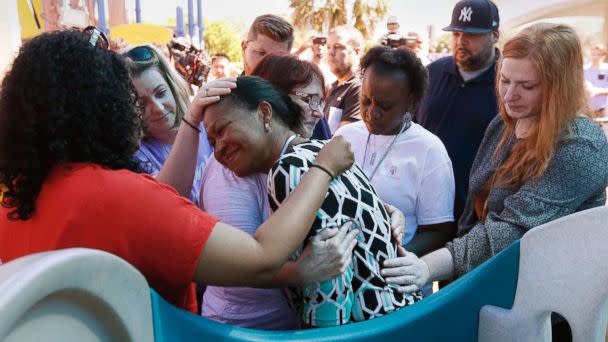
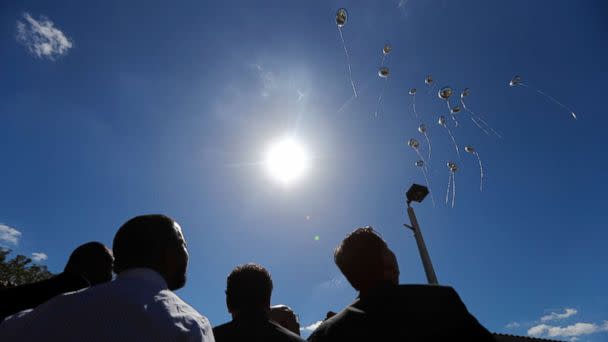
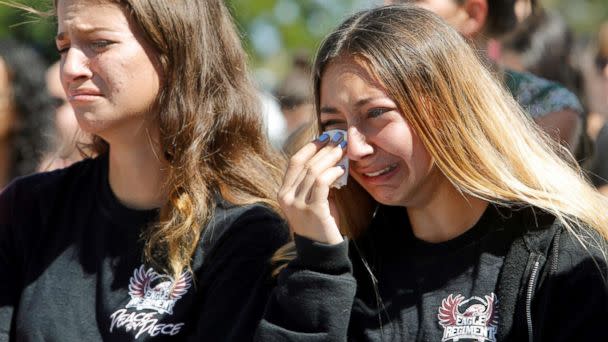
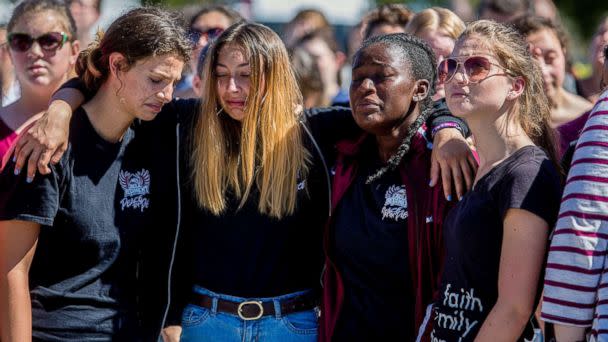
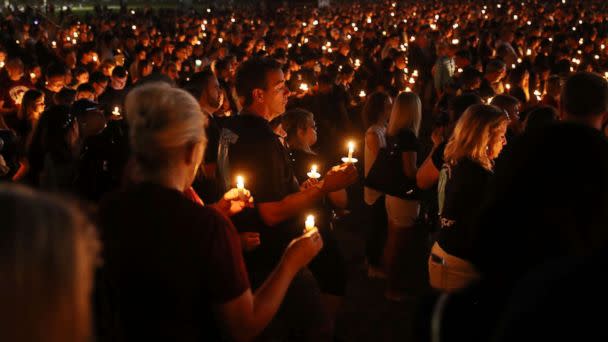
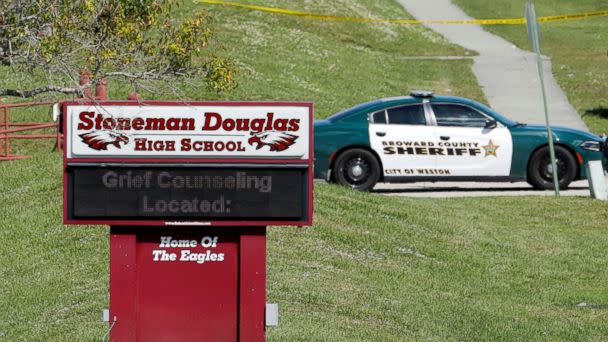
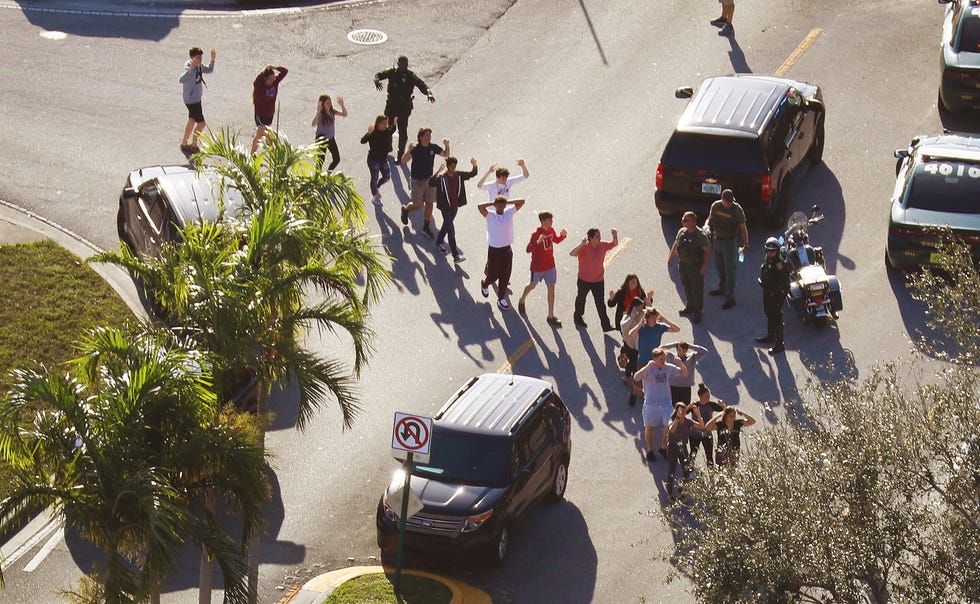
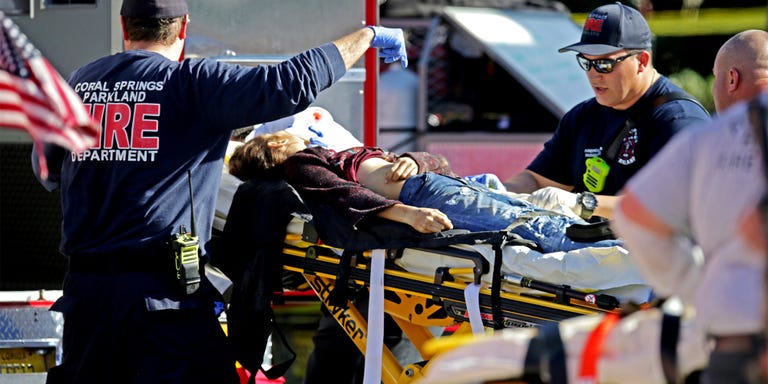
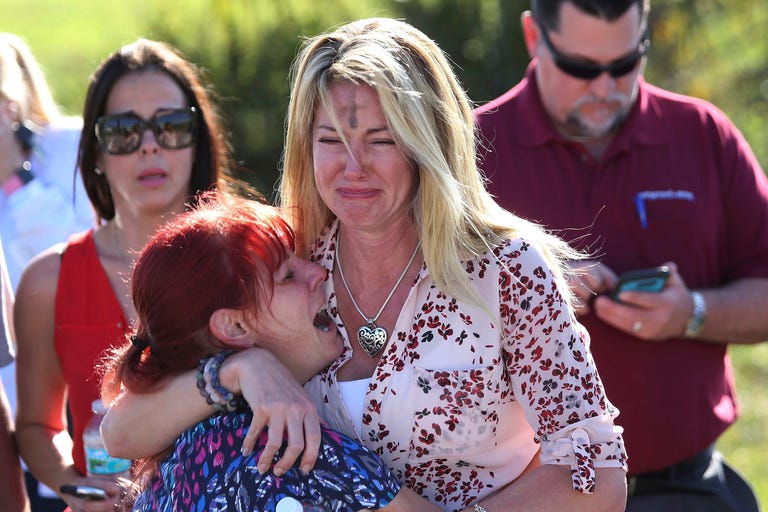
Sheriff promises Florida vigil attendees: Politicians ‘will not get re-elected’ if gun laws don’t change

Good Morning America

Sheriff promises Florida vigil attendees: Politicians ‘will not get re-elected’ if gun laws don’t change

Julia Jacobo, Good Morning America      February 16, 2018

Florida school shooting victims identified as families, community grieve

Jimmy Kimmel gets emotional in call for action on gun violence: ‘Children are being murdered’

Good Morning America

Jimmy Kimmel gets emotional in call for action on gun violence: ‘Children are being murdered’

Mark Osborne, Good Morning America      February 15, 2018

Late-night host Jimmy Kimmel slammed President Donald Trump and Congress over inaction on gun control Thursday night in the wake of the shooting at a Florida high school which killed 17 people on Valentine’s Day.

More Kids Are Dead

Esquire

More Kids Are Dead

Those four words are the cost of our uniquely American “freedom.”

By Charles P. Pierce     February 15, 2018

Getty Images

There was another unfortunate exercise of Second Amendment freedoms in an American high school on Wednesday. Seventeen students were killed. The shooter is in custody. This time the scene was Marjory Stoneman Douglas High School in Parkland, Florida. From CNN:

Nicole Baltzer, 18, said she was in trigonometry class about 10 minutes before the end of the school day when the fire alarm went off. As students evacuated, she heard six gunshots and everyone started running back inside the school, Baltzer told CNN’s Sara Ganim. “I heard so many gunshots, at least like six. They were very close,” Baltzer said. A police officer told her to close her eyes as she walked past a classroom with broken glass, telling her “there’s nothing good to see in there,” she said.

In a school.

“We have been liberated. God bless, America,” Aidan tweeted after being evacuated from the building. “Love each other. You may never know when it may be the last day you meet someone.”

In a fcking school.

AP

By now we know that the shooter was a troubled young man named Nikolas Cruz, who was expelled from the same school he shot up on Wednesday. From The Boston Globe via AP:

Cruz, 19, had been expelled from Marjory Stoneman Douglas High School for ‘‘disciplinary reasons,’’ Broward County Sheriff Scott Israel said, but he insisted he didn’t know the specifics. Math teacher Jim Gard told the Miami Herald that before Wednesday’s fatal shooting of 17 people, Cruz may have been identified as a potential threat – Gard believes the school had sent out an email warning teachers that Cruz shouldn’t be allowed on campus with a backpack. “There were problems with him last year threatening students, and I guess he was asked to leave campus,’’ Gard told the paper.

Unhappy there, Nikolas Cruz asked to move in with a friend’s family in northwest Broward. The family agreed, and Cruz moved in around Thanksgiving. According to the family’s lawyer, who did not identify them, they knew that Cruz owned the AR-15 but made him keep it locked up in a cabinet. He did have the key, however. Jim Lewis said the family is devastated and didn’t see this coming. They are cooperating with authorities, he said.

Good god. This guy was so freaking dangerous he was on the FBI’s goddamn radar. (The countdown has begun to the moment when the president* uses this fact to take another shot at the FBI for his own problems.) There is almost no way the Army or the Marines—or anybody’s army or marines, except, possibly, ISIL—would have handed an AR-15 to anybody with Cruz’s background. But he was able to own it as long as he locked it up at night in a cabinet to which he had the damn key. And it was sitting there, in the cabinet, to which he had the key, while he was posting threats on social media, bragging about killing animals, and shooting stuff with a pellet gun. His AR-15 was right there, locked in the cabinet, to which Nikolas had a key, until it wasn’t anymore.

                                                Shutterstock

Until he opened up and killed 17 people in the school from which he’d been expelled for being dangerously violent, Nikolas Cruz had broken no laws. That’s because this was Florida, and in Florida: a) you don’t need a permit to buy a gun or to register the weapon once you do; b) you don’t need a permit to carry a concealed rifle or shotgun, just a handgun, and it’s hard to believe the NRA let that one slip by; c) you can buy as many guns as you want; d) there are no regulations on military-style weapons or the amount of ammunition you can buy for them, and e) if you want to sell guns, you don’t need a license. The state does require a three-day waiting period, which clearly was effective in this case.

And, in case you were feeling relieved that you don’t live in an armed asylum like Florida, don’t get comfortable. Right now, in the Congress, there is pending something called the Concealed Carry Reciprocity Act. This would allow people from armed asylums like Florida to carry concealed weapons without penalty, and without notifying local authorities. In December, two months after a well-armed lunatic named Stephen Paddock shot 58 people to death in Las Vegas, this dog’s breakfast of a bill passed the House of Representatives, in which you cannot carry a gun, concealed or otherwise. It may not pass the Senate. It’s probably unconstitutional as hell. But it got 231 votes in the House. There are 231 members of Congress who thought this was a good idea, even in the wake of mass murder in Nevada.

AP

Of course, I had to look up Stephen Paddock’s name because I’d forgotten it—just as, I suspect, I will have forgotten Nikolas Cruz’s name the next time someone exercises his Second Amendment freedoms in a school, because that’s just the way things are in this country. The entire argument from the National Rifle Association and the members of its terrorist cult can be boiled down to a contention that massacres like the one in Las Vegas and the one in Florida are simply the price one pays for constitutional liberties. This, of course, implies that the Founders, some of whom owned slaves, were also psychopaths.

Senator Chris Murphy, Democrat of Connecticut, took to the floor of the Senate almost immediately to excoriate the Congress for being accessories before and after the fact. As CNN reported, Murphy, of course, represents the state in which the Sandy Hook massacre was supposed to be a game changer on this issue. It was, and the game changed for the worse. On Wednesday, Murphy told the Senate.:

“This epidemic of mass slaughter, this scourge of school shooting after school shooting, it only happens here not because of coincidence, not because of bad luck, but as a consequence of our inaction. We are responsible for a level of mass atrocity that happens in this country with zero parallel anywhere else.”

Getty Images

In December, after Steven Paddock shot up the concert in Las Vegas, Murphy said this:

“This must stop. It is positively infuriating that my colleagues in Congress are so afraid of the gun industry that they pretend there aren’t public policy responses to this epidemic. There are, and the thoughts and prayers of politicians are cruelly hollow if they are paired with continued legislative indifference. It’s time for Congress to get off its ass and do something.”

A month before that, when Devin Kelley—Remember his name? I didn’t—killed 26 people at a church in Sutherland Springs, Texas. Murphy said:

“As my colleagues go to sleep tonight, they need to think about whether the political support of the gun industry is worth the blood that flows endlessly onto the floors of American churches, elementary schools, movie theaters, and city streets. Ask yourself – how can you claim that you respect human life while choosing fealty to weapons-makers over support for measures favored by the vast majority of your constituents.

This was the 18th such unfortunate exercise of Second Amendment freedoms in an American school this year. It was the eighth one in which people were killed. It is over five years since Adam Lanza—I remembered his name—slaughtered toddlers in Newtown, which was going to change everything. And it did, too. It demonstrated that, to our government, mass slaughter is just part of the price we pay for being free. It is now the second week of February and nobody is going to do a thing.

This post has been updated to correctly reflect the number of victims.

RELATED STORY

Why Mass Shootings Keep Happening 

Respond to this post on the Esquire Politics Facebook page.

Anthony Rizzo heads home to mourn, heal following Parkland Shooting

Yahoo Sports

Anthony Rizzo heads home to mourn, heal following Parkland Shooting

Tim Brown, Yahoo Sports       February 15, 2018 

Cubs Anthony Rizzo On School Shooting: “Something Has to Change”

MESA, Ariz. – Maybe it gets better when you’re running the cones. Maybe if you turn up Dire Straits and Jimi Hendrix and pick up one foot and put it down and pick up the other, maybe then your head can slow down and your heart can fill with oxygen again. Maybe then it can be just another day, for just a little while, and those dark clouds can be just clouds and won’t feel quite so heavy, like they’re lying on your chest.

Man, you wake up and it’s so early, still dark outside, and the world is waiting. You get up and think about some coffee and, oh yeah, check your phone and, that’s right, Rizz went back to Florida.

And then you remember why. Those kids. All those people. His people.

Could there possibly have been another day like the others? Could it have happened again?

“There’s a lot of bad people out there,” Kris Bryant says. “I don’t know how to change it.”

So you stand mid-morning on a terrace out back, where Chicago Cubs are spread across the yard. They’re running cones. They’re playing catch. You clasp your hands behind you and open your shoulders a little and take a long breath, and you stare at this piece of life happening in spite of itself. You stare as if it’s the first time you’ve ever seen it. And if you’re like everyone else you think, “This is how we survive this stuff. We go back to work. We put one foot in front of the other. We cry and hope there’s an answer and pray for the fallen. We pray for peace for them. We scream and shout and hope somebody hears.”

You run the cones.

“It’s just hard for me,” Bryant says, “because I just want to see good people. That’s something that personally I strive to do every day, is just to be a good person. And it’s not that hard to do. I just see too much of that in the world today. … But there is a way and it starts with the actions of each human being.”

Chicago Cubs’ Anthony Rizzo takes a practice swing during the eighth inning of a baseball game against the Arizona Diamondbacks Friday, Aug 11, 2017, in Phoenix. The Cubs defeated the Diamondbacks 8-3. (AP)

On Wednesday night, after a day of driving from Las Vegas, Bryant texted his friend and teammate, Anthony Rizzo. Rizzo had been at camp since Monday and had worked out every day since.

What’s the plan tomorrow? Bryant messaged.

His phone buzzed.

I’m actually going home.

Rizzo grew up in Parkland, Florida. He attended Marjory Stoneman Douglas High, class of ’07. His parents and brother live in town. He lives in a neighboring town. Every winter he fills Pine Trails Park for an event that funds pediatric cancer research. This year it raised almost $1 million. He just sprung for new lights for the baseball and softball fields at the high school. Those are his people, all of them. And now there are 17 fewer of them, and the rest will fight not to be broken forever, and Rizzo couldn’t fix any of that but he could go be among them, mourn with them. Because they’re good people. So is he. They need each other.

Gone are sisters and brothers, fathers, teachers and coaches and students and friends, and who knows when it will be safe to smile again, to laugh again, to be normal again. To breathe again.

“It’s his community,” Bryant says. “He’s right there with them. … As sad as it is to say, I’ve been through it.”

Not five months ago, 58 people died at a music festival in Las Vegas, Bryant’s hometown. One man. Automatic weaponry. Another day like the others.

“Parkland and Coral Springs please stay strong!” Rizzo tweeted in the aftermath of Wednesday’s massacre. “This is out of control and our country is in desperate need for change. I hope in this darkest of times back home this brings everyone together and we can find love. You’re all in my prayers.”

You spend all that time hoping to help kids who have cancer, just like when you had cancer, hoping they can live longer and better, hoping they can be kids today and grownups tomorrow, buying hours and days and years for them if you can. Because you love life so much. Because you believe in the good of it. So they will love and believe, too. And then when you’re not looking, when you couldn’t possibly have been looking, this thing happens, this horrific thing. Like someone out there hates life as much as you value it. And the people like him may not be winning, but they’re damn well making a game of it, close enough, and how is that even right? How is it even fair?

When Rizzo told them he had to go, the Cubs told him to go. To stay for as long as he needed. To be sure to ask for help. They’d be there.

“These moments in our culture,” manager Joe Maddon said, “have got to stop. Nobody has the answers, but we have to figure it out somehow. … It’s just horrible. Horrible.

“You just imagine your own kids. Or your family. Anybody that you possibly know, being involved in that. It’s getting way too familiar. … Words. What are the proper words right now? I don’t even know what the proper words are.”

Maybe it’s the guns. It’s probably all the guns.

“I don’t know enough,” he said. “Except that it just doesn’t make sense that an automatic rifle has to be in anybody’s hands. I don’t understand that.”

The sun sets and it’s dark outside again, and now you can’t get the faces out of your head, or the names. Or the noise. Your friend could probably put a lot of those names with those faces, a different kind of agony, and that’s probably why he left. Because of that. To be with the people who maybe won’t ever be the same. To wear that himself, too, maybe.

“It’s so sad,” Bryant says. “I can’t imagine.”

And it occurs to you how exhausted you are, how your soul just can’t bear another hit, that it’s so tired of being mad and helpless and sad, and you’re running out of cones.

What do NRA-backed politicians plan to do about gun violence beyond ‘thoughts and prayers’? Nothing

What do NRA-backed politicians plan to do about gun violence beyond ‘thoughts and prayers’? Nothing

MoveOn.org shared NowThis Politics‘s video.
February 15, 2018

“Have you taken any votes ever to take guns from the hands of criminals or crazy people? Can you point to a single vote?”

NRA-backed lawmakers offer thoughts and prayers, but their inactions speak louder than words.

NRA-Backed Politicians Have Nothing to Offer Outside 'Thoughts and Prayers'

What do NRA-backed politicians plan to do about gun violence beyond 'thoughts and prayers'? Nothing

Posted by NowThis Politics on Thursday, February 15, 2018

How to Reduce Shootings

The New York Times – Opinion

How to Reduce Shootings

By Nicholas Kristof, Graphics by Bill Marsh   February 15, 2018

Inevitably, predictably, fatefully, another mass shooting breaks our hearts. This time, it was a school shooting in Florida on Wednesday that left at least 17 dead at the hands of 19-year-old gunman and his AR-15 semiautomatic rifle.

But what is perhaps most heartbreaking of all is that they shouldn’t be shocking. People all over the world become furious and try to harm others, but only in the United States do we suffer such mass shootings so regularly; only in the United States do we lose one person every 15 minutes to gun violence.

So let’s not just mourn the dead, let’s not just lower flags and make somber speeches. Let’s also learn lessons from these tragedies, so that there can be fewer of them. In particular, I suggest that we try a new approach to reducing gun violence — a public health strategy. These graphics and much of this text are from a visual essay I did in November after a church shooting in Texas; sadly, the material will continue to be relevant until we not only grieve but also act.

America Has More Guns Than Any Other Country

The first step is to understand the scale of the challenge America faces: The U.S. has more than 300 million guns – roughly one for every citizen – and stands out as well for its gun death rates. At the other extreme, Japan has less than one gun per 100 people, and typically fewer than 10 gun deaths a year in the entire country.

Guns per 100 people

The United States stands alone among developed countries: It has by far the highest rate of firearms ownership.

88.8   UNITED STATES

45.7   SWITZERLAND

31.6   SWEDEN

31.2   FRANCE

30.8   CANADA

30.3   GERMANY

15.0   AUSTRALIA

11.9   ITALY

10.4   SPAIN

6.2   ENGLAND, WALES

0.6   JAPAN

Gun murders per 100,000 people

America’s private arsenal is six times as lethal as Canada’s, and 30 times worse than Australia’s.

3.0   UNITED STATES

0.7   ITALY

0.5   CANADA

0.3   SWEDEN

0.2   GERMANY

0.2   SWITZERLAND

0.1   AUSTRALIA

0.1   ENGLAND, WALES

0.1   FRANCE

0.1   SPAIN

0   JAPAN

The New York Times | Sources: United Nations Office on Drugs and Crime (gun murders); Small Arms Survey (guns per 100 people) |Murder data for U.S., Canada, Sweden, Switzerland, Australia and Spain from 2015 and latest available for other countries; 2007 data for guns per 100 people.

We Have a Model for Regulating Guns: Automobiles

Gun enthusiasts often protest: Cars kill about as many people as guns, and we don’t ban them! No, but automobiles are actually a model for the public health approach I’m suggesting.

We don’t ban cars, but we work hard to regulate them – and limit access to them – so as to reduce the death toll they cause. This has been spectacularly successful, reducing the death rate per 100 million miles driven by 95 percent since 1921.

Take a look at the history of motor vehicle safety since World War II:

Deaths per 100 million vehicle miles traveled

1946   (9.35 deaths)

1950   First seat-belt offered in an American car  (7 deaths)

1968   First federal safety standards for cars  (5 deaths)

1974   55 m.p.h. national speed limit (4 deaths)

1978   Tennessee is first to require child safety seats (3.5 deaths)

1984   New York is first to require seat belt use  (2.5 deaths)

1993   Car safety ratings introduced  (2 deaths)

1999   Airbags, invented in 1951, become mandatory (1.80 deaths)

2000   Mandatory reporting of defects by car-makers (1.75 deaths)

2016   (1.18 deaths per 100 million miles)

The New York Times | Source: National Highway Traffic Safety Administration

The Liberal Approach Is Ineffective. Use a Public Health Approach Instead.

Frankly, liberal opposition to guns has often been ineffective, and sometimes counterproductive. The 10-year ban on assault weapons accomplished little, partly because definitions were about cosmetic features like bayonet mounts (and partly because even before the ban, such guns were used in only 2 percent of crimes).

The left sometimes focuses on “gun control,” which scares off gun owners and leads to more gun sales. A better framing is “gun safety” or “reducing gun violence,” and using auto safety as a model—constant efforts to make the products safer and to limit access by people who are most likely to misuse them.

What would a public health approach look like for guns if it were modeled after cars? It would include:

Background Checks: 22 percent of guns are obtained without one.

Protection Orders: Keep men who are subject to domestic violence protection orders from having guns.

Ban Under-21’s: A ban on people under 21 purchasing firearms (this is already the case in many states).

Safe Storage: These include trigger locks as well as guns and ammunition stored separately, especially when children are in the house.

Straw Purchases:  Tighter enforcement of laws on straw purchases of weapons, and some limits on how many guns can be purchased in a month.

Ammunition Checks: Experimentation with a one-time background check for anybody buying ammunition.

End Immunity: End immunity for firearm companies. That’s a subsidy to a particular industry.

Ban Bump Stocks: A ban on bump stocks of the kind used in Las Vegas to mimic automatic weapon fire.

Research ‘Smart Guns’: “Smart guns” fire only after a fingerprint or PIN is entered, or if used near a particular bracelet.

If someone steals my iPhone, it’s useless, and the same should be true of guns. Gun manufacturers made child-proof guns back in the 19th century (before dropping them), and it’s time to advance that technology today. Some combination of smart guns and safe storage would also reduce the number of firearms stolen in the U.S. each year, now about 200,000, and available to criminals.

We also need to figure out whether gun buybacks, often conducted by police departments, are cost-effective and help reduce violence. And we can experiment more with anti-gang initiatives, such as Cure Violence, that have a good record in reducing shootings.

Fewer Guns = Fewer Deaths

It is true that guns are occasionally used to stop violence. But contrary to what the National Rifle Association suggests, this is rare. One study by the Violence Policy Center found that in 2012 there were 259 justifiable homicides by a private citizen using a firearm.

In Order, Estimated Percent of Households With Guns, by State.                  U.S Average is 32%.

Less Than 20%: Hawaii, Massachusetts, Rhode Island, New Jersey, New York, Delaware, Connecticut, Illinois, California

20% to 40%: Florida, Maryland, Washington, New Hampshire, Indiana, Ohio

40% to 50%: Colorado, Pennsylvania, Iowa, Minnesota, Arizona, Nevada, North Dakota, Michigan, Virginia, Oregon, New Mexico, North Carolina, Texas, South Carolina, Nebraska, Kansas, Georgia, Missouri, Oklahoma, Wisconsin, Louisiana, Kentucky, Utah, Alabama

50% to 60%: Maine, Tennessee, South Dakota, West Virginia, Arkansas, Alaska, Vermont, Mississippi

70%: Idaho. 75%: Montana. + 80%: Wyoming

Source: Michael Siegel, Boston University School of Public Health

Gun Law ‘Grades’ and Gun Death Rates

The Law Center to Prevent Gun Violence finds that states where guns are more regulated tend to have lower gun death rates. In its grading system, the strongest gun regulations get an “A;” the weakest, an “F.”

Gun Death Rate Per 100,000

Grade A

Hawaii 2.7, Massachusetts 3.1, New York 4.2, Connecticut 4.9, New Jersey 5.3, California 7.4, Maryland 9.0

Grade B

Rhode Island 3.0, Illinois 9.0, Washington 9.6, Delaware 10.9

Grade C

Minnesota 6.6, Iowa 7.4, Wisconsin 8.2, Pennsylvania 10.4, Michigan 11.0, Oregon 11.7, Colorado 12.2

Grade D:

New Hampshire 8.6, Nebraska 9.4, Virginia 10.3, Ohio 10.3, North Carolina 11.8, Indiana  12.3

Grade F:

Maine 9.4, Vermont 10.2, South Dakota 10.3,  Texas 10.6, Kansas 11.3, Florida 11.5, North Dakota 12.0, Utah 12.4,  Idaho 13.2, Arizona 13.4, Georgia 13.6, Kentucky 13.9 West Virginia 14.5, Nevada* 14.7, Tennessee 15.1, Missouri 15.2, South Carolina 15.4, Oklahoma 15.6, New Mexico 15.8, Montana 16.1,  Wyoming 16.3, Arkansas 16.5, Alabama 16.8,   Mississippi 18.3, Louisiana 19.0, Alaska 19.1

*Nevada’s grade of F would improve to a C-minus if a recently passed ballot initiative mandating universal background checks is implemented. So far, the state has failed to do so. Source: Law Center to Prevent Gun Violence.

But the problem is that lax laws too often make it easy not only for good guys to get guns, but also for bad guys to get guns. The evidence is overwhelming that overall more guns and more relaxed gun laws lead to more violent deaths and injuries. One study published in the Annals of Internal Medicine found that a gun in the house was associated with an increased risk of a gun death, particularly by suicide but also apparently by homicide.

In 2015, Gov. Greg Abbott of Texas tweeted that he was “embarrassed” that his state was ranked second (behind California) in requests to buy new guns, albeit still with one million requests. “Let’s pick up the pace Texans,” he wrote. Abbott apparently believes, along with the N.R.A., that more guns make a society more safe, but statistics dispute that. Abbott should look at those charts.

Greg Abbott: I’m EMBARRASSED: Texas #2 in nation for new gun purchases, behind CALIFORNIA. Let’s pick up the pace Texans.

Mass Shootings Are Not the Main Cause of Loss of Life

Critics will say that the kind of measures I cite wouldn’t prevent many shootings. The Las Vegas carnage, for example, might not have been prevented by any of the suggestions I make.

That’s true, and there’s no magic wand available. Yet remember that although it is mass shootings that get our attention, they are not the main cause of loss of life. Much more typical is a friend who shoots another, a husband who kills his wife – or, most common of all, a man who kills himself. Skeptics will say that if people want to kill themselves, there’s nothing we can do. In fact, it turns out that if you make suicide a bit more difficult, suicide rates drop.

Here are the figures showing that mass shootings are a modest share of the total, and the same is true of self-defense – despite what the N.R.A. might have you believe.

Gun Suicides:  About 22,000

Homicides: About  11,760

Other Causes:  3,500

Victims Killing Perpetrators in Self Defense: 589   1.6% of gun deaths

Deaths From Mass Shootings: 456   1.2% of gun deaths

The New York Times | Source: Gun Violence Archive

America Is Moving in the Wrong Direction

Yet while we should be moving toward sensible regulation, in fact we’ve been moving in the opposite direction. Gun laws have been loosened in many parts of the country. Check out these maps:

States Allowing in Red. Not Allowing in White.

1st Map is for Concealed Carry 1991 compared to Today

2nd Map is for Open Carry (Handguns) 1991 compared to Today

3rd Map is for Open Carry (Long Guns) 1991 compared to Today

The New York Times | Source: Michael Siegel, Boston University School of Public Health

Tightening Gun Laws Lowered Firearm Homicide Rates

For skeptics who think that gun laws don’t make a difference, consider what happened in two states, Missouri and Connecticut. In 1995, Connecticut tightened licensing laws, while in 2007 Missouri eased gun laws.

The upshot? After tightening gun laws, firearm homicide rates dropped 40 percent in Connecticut. And after Missouri eased gun laws, gun homicide rates rose 25 percent.

Connecticut after 1995 law tightening licensing requirements:

Change in rate of gun homicide –40%, rate of gun suicide–15%

Missouri after 2007 repeal of license requirements:

Change in rate of gun homicide +25%, rate of gun suicide +16%

The New York Times | Source: Johns Hopkins School of Public Health

One of the lessons of gun research is that we often focus just on firearms themselves, when it may be more productive to focus on who gets access to them. A car or gun is usually safe in the hands of a 45-year-old woman with no criminal record, but may be dangerous when used by a 19-year-old felon with a history of alcohol offenses or domestic violence protection orders.

Yet our laws have often focused more on weapons themselves (such as the assault weapons ban) rather than on access. In many places, there is more rigorous screening of people who want to adopt dogs than of people who want to purchase firearms.

In these two states, the laws affected access, and although there’s some indication that other factors were also involved in Connecticut (and correlations don’t prove causation), the outcomes are worth pondering.

There Is a Shocking Lack of Research on Guns

There’s simply a scandalous lack of research on gun violence, largely because the N.R.A. is extremely hostile to such research and Congress rolls over. When the Centers for Disease Control and Prevention did try to research gun violence, Congress responded by cutting its funding.

Here is the American toll from four diseases and firearms over the years 1973-2012 – and the number of National Institutes of Health research grants to explore each problem over that same time.

Number of cases of a Disease, and N.I.H. research awards granted

Rabies: 65 cases…..89 N.I.H. research awards granted

Polio: 266 cases…..129 N.I.H. research awards granted

Cholera: 400 cases…..212 N.I.H. research awards granted

Diphtheria 1,337 cases…..56 N.I.H. research awards granted

Firearm Injuries >4 million…..3 N.I.H. research awards granted

The New York Times | Source: University of Chicago Crime Lab

The Right Type of Training Could Go a Long Way

One approach that could reduce the abuse of guns is better training. As a 13-year-old farm boy in Oregon, I attended a N.R.A. gun safety class (which came with a one-year membership to the N.R.A., making me an N.R.A. alum who despises what that organization has become). These classes can be very useful, and audits found that more than 80 percent cover such matters as checking the gun to see if it’s loaded, keeping one’s finger off the trigger until ready to fire and being certain of the target.

Yet the audits also suggest that trainers are more likely to advocate for the N.R.A. or for carrying guns than for, say, safe storage. This is a missed opportunity, for all classes should cover the risks of guns and alcohol, the risks of abuse with suicide and domestic violence, the need for safe storage, and so on. Here’s what researchers found that the gun classes they audited actually covered:

Percent of Classes Where Gun Topic was Discussed or Not Discussed:

Trainers encouraged gun carrying 81%, Not Discussed 19 %

Encouraged gun ownership 76%, Not Discussed 24%

Prevent unsupervised access by children 70%, Not Discussed 30%

Encouraged gun use for self-defense 69%, Not Discussed 31%

Ricochet 60%, Not Discussed 40%

Theft prevention 60%, Not Discussed 40%

Encouraged membership in gun-rights group 56%, Not Discussed 44%

Legal ramifications of shooting in self-defense 55%, Not Discussed 45%

Child access laws 53%, Not Discussed 47%

Recommendation: when not in use, store unloaded 50%, Not Discussed 50%

Recommendation: use gun only as last resor45%, Not Discussed 55%

Young children and gun accidents 45%, Not Discussed 55%

Decision-making in crises 30%, Not Discussed 70%

Theft is an important source of firearms used in crime 20%, Not Discussed 80%

Techniques for de-escalating threats 15%, Not Discussed 85%

Recommendation: report stolen firearms 10%, Not Discussed 90%

Watch for signs of suicide in household members 10%, Not Discussed 90%

Domestic violence risk 10%, Not Discussed 90%

The New York Times | Source: David Hemenway, Injury Prevention |The classes studied, some of which were required by law, took place in 7 Northeast states.

A Way Forward: On Some Issues, Majorities Agree

It may sometimes seem hopeless to make progress on gun violence, especially with the N.R.A. seemingly holding Congress hostage. But I’m more optimistic.

Look, we all agree on some kinds of curbs on guns. Nobody believes that people should be able to drive a tank down Main Street, or have an anti-aircraft gun in the backyard. I’ve been to parts of northern Yemen where one could actually buy a tank or an anti-aircraft gun, as well as fully automatic weapons — and that area’s now embroiled in a civil war – but fortunately in America we have agreed to ban those kinds of weaponry.

So the question isn’t whether we will restrict firearms, but where to draw the line and precisely which ones to restrict.

Check out these polling numbers as a basis for action on gun safety:

Agree with the following:

Gun households:                          and                   Households with no guns:

Background checks for all gun buyers   93%, 96%

Preventing the mentally ill from buying guns 89%, 89%

Nationwide ban on the sale of guns to people convicted of violent crimes 88%, 85%

Barring gun purchases by people on no-fly or watch lists 82%, 84%

Background checks for private sales and at gun shows 77%, 87%

Federal mandatory waiting period on all gun purchases 72%, 89%

A ban on modifications that make a semi- automatic gun work like an automatic gun 67%, 79%

A ban on the sale of guns to people convicted of violent crimes would reduce gun violence 61%, 75%

New gun laws will not interfere with the right to own guns 57%, 71%

Congress is not doing enough to reduce gun violence 56%, 81%

Creating a federal database to track gun sales 54%, 80%

A ban on the sale of high-capacity ammunition magazines (10+ bullets)* 52, 77

The New York Times | Sources: Pew Research Center survey conducted in March and April (questions on mental illness, no-fly lists, background checks for private sales and federal database); Quinnipiac University National Poll conducted Oct. 5-10 (all other questions)|*A Pew Research Center survey found only 44 percent of gun owners favored such a ban.

Looking ahead, I’m optimistic that there can be progress at the state level, and some of the necessary research funding will come from private foundations. Maybe some police departments will put in orders for smart guns to help create a market.

But the real impetus for change will come because the public favors it. In particular, note that 93 percent of people even in gun households favor universal background checks for gun purchases.

The terrible truth is that Wednesday’s school shooting was 100 percent predictable. So is the next one. After each such incident, we mourn the deaths and sympathize with the victims, but we do nothing fundamental to reduce our vulnerability.

Some of you will protest (as President Trump did the last time) that it’s too soon to talk about guns, or that it is disrespectful to the dead to use such a tragedy to score political points. Yet more Americans have died from gun violence, including suicides, since 1970 (about 1.4 million) than in all the wars in American history going back to the Revolutionary War (about 1.3 million). And it’s not just gang members: In a typical year, more preschoolers are shot dead in America (about 75) than police officers are.

Yes, making America safer will be hard: There are no perfect solutions. The Second Amendment is one constraint, and so is our polarized political system and the power of the gun lobby. There’s a lot of talk about banning assault weapons, for example, but the 10-year assault weapons ban didn’t accomplish much for reducing gun violence, partly because defining assault weapons proved to be much more complex than anybody had anticipated (in the end, the definition depended partly on cosmetic features). And new restrictions have limited effectiveness because we have delayed so long that there are already so many guns out there. So it’s unclear how effective some of my suggestions will be, and in any case this will be a long, uncertain, uphill process.

But automobiles are a reminder that we can chip away at a large problem through a public health approach: Just as auto safety improvements have left us far better off, it seems plausible to some gun policy experts that a sensible, politically feasible set of public health steps could over time reduce firearm deaths in America by one-third — or more than 10,000 lives saved each year.

So let’s not just shed tears for the dead, give somber speeches and lower flags. Let’s get started and save lives. Let’s not accept that school classrooms can turn any moment into war zones.

I invite you to sign up for my free, twice-weekly email newsletter. Please also join me on Facebook and Google+, watch my YouTube videos and follow me on Twitter (@NickKristof).

Las Vegas Autopsies Reveal The True Brutality Of Mass Shootings

HuffPost

Las Vegas Autopsies Reveal The True Brutality Of Mass Shootings

Nick Wing, HuffPost      February 14, 2018

The bullet struck the woman’s right forearm, passing cleanly through the flesh below her wrist and exiting the other side. The round was tumbling now, but still carrying enough force to re-enter her arm, lower down this time, before exiting again and plunging into her chest. The lead projectile then burst through her liver, finally coming to rest in the first lumbar vertebra of her lower back. Her death, described by a medical examiner, was determined to be a homicide.

The unnamed woman was one of 58 victims killed by a lone gunman at a country music concert on the Las Vegas Strip on Oct. 1, the deadliest mass shooting in modern U.S. history.

HuffPost obtained autopsies for each of the 58 victims. The reports, released by the Clark County, Nevada, coroner’s office earlier this month, offer a raw account of the power of civilian weaponry and the damage it inflicts on human bodies, even when the gunman appears to have no particular firearms expertise.

They describe catastrophic injuries, most the result of single rounds striking from a range of nearly 500 yards ― details of carnage that we tend to shy away from in media coverage.

After a mass shooting, news stories often reduce victims to parts of a larger body count, the latest casualties of this particularly American form of gun violence. Just look at the headlines for the school shooting in Florida on Wednesday: “Mass Casualty Shooting At Florida School.

Other coverage focuses exclusively on honoring slain individuals, a celebration of life that seeks to underscore the tragedy of a mass shooting.

Both types of stories can obscure and desensitize us to the disturbing violence. The autopsies, on the other hand, give an unsanitized truth to those stories.

Among the victims in Las Vegas were 36 women and 22 men; 51 were killed by a single shot, while seven were hit by multiple rounds; 34 suffered fatal gunshot wounds to the body, while 21 were struck in the head or neck and three were struck in their extremities. In addition, 851 people were injured in the attack, including 422 who suffered non-fatal wounds from gunfire.

With bullets exiting the shooter’s weapons at a velocity of about 3,000 feet per second ― about three times as fast as a bullet fired out of a handgun ― and spinning at thousands of revolutions per second, the consequences for anyone hit directly were dire.

“You’ve got a relatively small cross-sectional area with a tremendous amount of kinetic energy lined up behind it, so that just penetrates,” said Arthur Alphin, a ballistics expert and former West Point professor who has testified in a number of multiple shooting cases.

The autopsies describe bullets carving through flesh, leaving massive trauma in their wake. One victim suffered a gunshot wound to the left upper back. The round appeared to be tumbling end over end at the moment of impact, said Alphin, likely a sign that the gunman’s weapon had begun to overheat from firing so rapidly, sending the bullet on an unstable trajectory out of an expanded barrel.

After being struck in the back, the round coursed through the woman’s body, ricocheting off a rib and perforating her left lung before stopping between her eight and ninth vertebrae, where a medical examiner recovered the bullet.

The autopsy for the woman described at the beginning of this article shows she was shot in the forearm. The bullet passed through her arm twice and then entered her body.

“I’m thinking that this person had their arm up at the shoulder, but bent back at the elbow, as if scratching their ear or trying to shield their eyes or keep a hat from flying off their head,” said Alphin.

It’s also possible she was trying to shield herself.

Another report describes a woman who was struck in the head. As with the other victims who suffered direct shots to the head, the impact caused “instant death,” Alphin said.

“The only good thing is she didn’t suffer. She felt no pain at all,” he said. “Some of those others, even though they died with the chest cavity wounds, they survived on the ground for 60 to 90 seconds, their heart continued to beat, the blood filled up into the pleural cavity and the thoracic cavity, their brain was still functioning, and they knew they were dying and they were in pain. At least this poor woman, it was instant.”

The only good thing is she didn’t suffer. She felt no pain at all. Arthur Alphin, ballistics expert

Wounds from these military-style rifles look much different from those caused by a handgun, said Dr. Brian H. Williams, a trauma surgeon who now serves as medical director of the Parkland Community Health Institute in Dallas.

Williams said that most of the gunshot wounds he’s treated appeared to be from handguns, but he was on duty during a July 2016 mass shooting in Dallas in which a gunman killed five police officers with a semi-automatic rifle. To get a sense of a handgun shot, Williams compared the impact to what happens when you drop a rock in the water and it makes a small splash and some ripples. Now, take that same rock, bring it up over your head and slam it into the water. That much bigger splash with larger ripples that emanate farther illustrates the difference of a rifle round hitting human flesh.

“That’s similar to what a bullet does when it enters the body,” said Williams. “The projectile from the military weapon that’s going much faster can cause much more damage.”

In just 10 minutes, the Las Vegas shooter was able to fire off more than 1,100 of these rounds from his perch on the 32nd floor of the Mandalay Bay hotel, each one a potential death sentence. Investigators say he was outfitted with more than a dozen assault-style rifles, many of them equipped with 100-round magazines and bump stocks, after-market accessories that simulate automatic fire.

With this sort of firepower, the gunman didn’t even need to have good marksmanship or anything more than a basic understanding of his weapons. All he needed to do was pick up a loaded gun, point it toward the helpless people in the distance and pull the trigger until it was empty, discard the spent rifle and pick up another one.

At the range he was firing from, the rounds had likely lost enough speed to make them subsonic when they reached their target, meaning they wouldn’t have made the cracking noise a bullet makes when it breaks the sound barrier, said Alphin. As a result, the concertgoers stayed tightly packed for moments before they had any idea they were under fire.

There was no hope of survival for many of those unlucky enough to be hit.

“These are military rounds, and they’re designed to be one shot, one kill,” said Dr. John Fildes, a trauma surgeon at University Medical Center in Las Vegas, who was on duty the night of Oct. 1. “They do more than just bore holes through people. They tumble and they create cavities, and that tears at tissue.”

To get a sense of the extent of the wounds, Fildes recommended looking at what happens when a round of this caliber passes through ballistic gel, which is meant to mimic human flesh.

It appears that the bullets functioned as intended in many cases. Other patients ended up in the hospital with a variety of gunshot-related injuries, though many appeared not to have been struck cleanly, Fildes said.

“We had patients that had bullet fragments that tore blood vessels, like an artery or a vein,” said Fildes. “We had patients who had fragments that went into their chest and caused bleeding but didn’t kill them, and they had to have a chest tube placed. We had patients who had fragments that went into the abdomen and injured their intestines, so those had to be repaired.”

Fildes added that some of the fragments were traveling fast enough to puncture the chest, abdomen or extremities, and even to fracture bones. And it’s possible that victims were hit by shrapnel from sources other than bullets.

“You could’ve been standing at row 32 at the concert and a guy off to your right at row 35 gets hit in the back. That bullet might exit his body, turn in flight and hit you,” said Alphin. “Or it might be tumbling in the guy’s body, hit his femur or some other major bone, eject a bone fragment and it hits you with a bone fragment. That’s just common.”

Over the past decade, we’ve seen Americans gunned down en masse at concerts, in churches, schools, movie theaters and nightclubs. We’re often called upon to remember the victims who’ve died in those incidents, but rarely are we asked to confront the unsettling circumstances of the deaths themselves.

In 2015, then-California Attorney General Kamala Harris, now a U.S. senator, argued that lawmakers should have been forced to do exactly that before voting on gun legislation after the 2012 mass shooting at Sandy Hook Elementary School in Newtown, Connecticut.

“Spread out the autopsy photographs of those babies and require them to look at those photographs,” Harris said. “And then vote your conscience.”

Read a summary of each of the 58 autopsies in the Las Vegas massacre 

‘Serial stowaways’ like Marilyn Hartman are all around us

Chicago Sun Times – Opinion

Editorial: ‘Serial stowaways’ like Marilyn Hartman are all around us

Sun-Times Editorial Board         February 8, 2018

Marilyn Hartman was arrested at O’Hare Airport, most recently, last Sunday. | Chicago Police Department via AP

There is nobody like Marilyn Hartman. Her constant attempts to sneak aboard airplanes have drawn media attention around the world.

We are fascinated by her persistence, her grandmotherly appearance and her obvious mental health problems. We’re not sure what’s to be done about her, as she sits in jail again, but she certainly doesn’t fit our idea of a dangerous criminal. What’s a little old lady doing behind bars?

In truth, of course, we are surrounded by people like Marilyn Hartman, even when we fail to notice. There’s the loud man who makes a little scene every morning at the corner Starbucks. There’s the woman who harasses riders on the L because “people” are chasing her. There’s the young guy who steals candy bars because, he says, God told him to.

They are no less harmless than Hartman, if less benign in their appearance — in our stereotypical and even racist perception. As Hartman herself has said, “I’m an old white lady. Nobody stops me.”

If we don’t know what to do about Hartman, that’s because we don’t know what to do about any of these people. Or we do know but don’t do it. Instead of seriously treating their mental illness, in the words of the Cook County Sheriff’s Office, we put Hartman and the others on “the conveyor belt” of our criminal justice system.

It should surprise nobody, though it should offend us all, that one in every four detainees in Cook County Jail — 1,500 men and women — has been diagnosed with a mental illness.

Last week, Hartman again was arrested at O’Hare Airport, just days after she was released from custody for allegedly sneaking aboard a British Airways flight to London. On Wednesday, a judge declined a request to move her from Cook County Jail to a community-based counseling center, making the perfectly valid point that Hartman might slip out and head right back to O’Hare.

Now Hartman will undergo an exam to determine whether she is fit to stand trial, as she has undergone before, and she likely will pass the test, as she has before. She is said to be intelligent and not unaware, and her ability to comprehend what’s going on in a criminal proceeding would seem to be fine.

What Hartman really needs, though, is to get off that conveyor belt of arrests, courtrooms and jails altogether, says the sheriff’s office. She should, instead, be provided with a highly individualized mental health treatment plan that finally gets to the source of her compulsion to stow away on planes.

The aim, says Cara Smith, chief policy officer for the sheriff’s office, should be to “connect Marilyn with someone who really cares about her” and can help her work her way to better mental health. In return for Hartman’s willing participation, the criminal charges against her could be held in abeyance.

Would this work? We don’t share Smith’s “cautious optimism” — Hartman has walked out of treatment facilities before — but the sheriff’s plan is a far sight more humane than the criminalizing of mental illness. And given the high expense of locking people up, it’s arguably cheaper.

There is nobody like Marilyn Hartman, true enough. But there are some 2 million people a lot like her. That’s roughly the number of people with mental illness in the United States who are jailed each year, according to the National Alliance on Mental Health.

The vast majority of these people, like Hartman, are not violent; but once incarcerated, their mental health generally grows worse.

Then, once released from jail or prison, they typically have little access to the health care they need, and their criminal records make it hard to find a job or housing. They wind up homeless. They fill our emergency rooms. They are arrested again. They put a strain on law enforcement — and law enforcement budgets — and, for all of that, none of us is any more or less safe.

“We need to hit the pause button,” Smith said. Hartman and other “super users” of our criminal justice system, she said, should be treated “as individuals with individualized issues, instead of items on an assembly line.”

And those “individual issues” should include not only mental illness, but also such scourges as drug addiction and poverty.

Any sensible person can see that Marilyn Hartman needs help, not punishment.

If only we, as a society, would extend that compassion to all the others among us who are broken by mental illness or drug addiction or poverty or worse, even when they don’t look like Beaver Cleaver’s grandmother.

Send letters to: letters@suntimes.com.

Wisconsin Supreme Court primary will leave just 2

Miami Herald – National Politics

Wisconsin Supreme Court primary will leave just 2

By Scott Bauer, Associated Press    February 11, 2018

FILE – This 2016 file photo shows Sauk County Circuit Court Judge Michael Screnock, a candidate for the Wisconsin Supreme Court. Screnock is one of three candidates in the race for the court. One of the three will be eliminated in the Feb. 20, 2018, primary. Baraboo News Republic via AP, File Tim Damos

Madison, Wis. The latest battle over the ideological balance of the Wisconsin Supreme Court plays out in the Feb. 20 primary, where one of three candidates will be eliminated ahead of a spring election.

Partisan politics have weighed heavy over weeks of campaigning. Madison attorney Tim Burns has most embraced his liberal beliefs, while Milwaukee County Circuit Judge Rebecca Dallet sought to appear as a moderate. Sauk County Circuit Judge Michael Screnock, an appointee of Republican Gov. Scott Walker, has the backing of conservatives.

The primary is the first statewide race this year, and while officially nonpartisan, it could be a bellwether for how Republicans and Democrats stand heading into the fall. Turnout is expected to be low, likely less than 10 percent.

The top two vote-getters advance to the April 3 general election, with the winner replacing outgoing conservative Justice Michael Gableman. He decided against seeking another 10-year term.

The court is currently controlled 5-2 by conservatives, so no matter who wins the ideological control will not change.

Burns is the most vocal about his Democratic beliefs and political leanings, saying that the nonpartisan race is a charade and candidates should be honest about who they are. He introduces himself as an “unshakable champion for progressive values” and has called President Donald Trump an “unhinged billionaire.”

Burns, who represents clients nationwide in lawsuits against insurance companies, is the only non-judge in the race. He also has little experience litigating in Wisconsin courtrooms, having argued only one case in state court and six in federal court in Wisconsin.

Burns argues his experience outside of Wisconsin is a strength that will help him fix what he views as a broken system. And, he argues a victory for him will energize liberals across the state headed into the fall.

Dallet argues that Burns has gotten too political. But she’s walking a fine line trying to win over many of the same liberal voters Burns is appealing to. She ran a commercial attacking Trump and has criticized the current Supreme Court for voting in 2015 to end an investigation into Walker and conservatives.

“We have a Supreme Court that has lost the confidence our state needs, our public needs, in its ability to do justice for all of us,” she said at a forum earlier this month.

Although not as strident as Burns, she advocates for clean air and water, empowering women, and fighting opioid abuse. She describes the current Supreme Court as “broken.”

Dallet spent 11 years as an assistant district attorney in Milwaukee County before being elected a judge in 2008.

Screnock, who was appointed as a judge by Walker in 2015, is the choice of conservatives. He argues that all he cares about is the rule of law, but he’s also embraced his past, saying it was a “privilege” as an attorney to defend Walker’s Act 10 law taking away collective bargaining rights from public unions. Screnock has also said he has no regrets about being twice arrested as a college student in 1989 for taking part in anti-abortion protests.

“Both of my opponents are actively campaigning on the political issues they hold dear,” Screnock told the Wisconsin Counties Association earlier this month. He called that “deeply troubling” and said he won’t let his personal beliefs affect his rulings.

Burns’ unusual approach has won him the endorsement of Our Revolution, the political arm of Vermont Sen. Bernie Sanders. Burns is also endorsed by liberal U.S. Rep. Mark Pocan, who represents the Madison area in Congress, as well as former U.S. Reps. David Obey and Steve Kagen.

Dallet has endorsements from more than 200 judges and 150 other elected officials from across the state.

Screnock has been endorsed by anti-abortion groups Wisconsin Family Action and Wisconsin Right to Life and uses the hashtag #wiright on his Twitter posts. The state chamber of commerce, Wisconsin Manufacturers and Commerce, has run nearly half a million dollars in ads supporting Screnock.

FILE – In this May 1, 2017, file photo, Madison attorney Tim Burns announces his run for Wisconsin Supreme Court in Madison, Wis. Burns is one of three candidates in the race for the court. One of the three will be eliminated in the Feb. 20, 2018, primary. Scott Bauer, File AP Photo

FILE – In this June. 1, 2017 file photo, Milwaukee County Circuit Judge Rebecca Dallet announces she is running for the Wisconsin Supreme Court in Madison, Wis. Dallet is one of three candidates in the race for the court. One of the three will be eliminated in the Feb. 20, 2018, primary. Scott Bauer File AP Photo

Follow Scott Bauer on Twitter at https://twitter.com/sbauerAP

Supreme Court on the verge of reversing some of its old decisions

USA Today

Supreme Court on the verge of reversing some of its old decisions

Richard Wolf, USA Today      February 9, 2018

 (Photo: Michael Owens, USAT)

WASHINGTON — Supreme Court precedents that have stood the test of time for generations are in danger of falling like dominoes in the next few months.

First on the chopping block is a 1977 ruling that allowed public employee unions to collect fees from non-members for collective bargaining. The court’s conservative justices have been itching to overrule that unanimous decision for decades.

Next up is a 1992 case in which the court refused to require that mail-order retailers collect sales taxes from buyers in other states. For a quarter century, that has given online retailers a competitive advantage over brick-and-mortar stores.

The court also will consider second-guessing one of its least popular chestnuts — a 20-year-old ruling, based on one from 1945, that gives federal agencies broad discretion to interpret their own regulations.

Since Chief Justice John Roberts took the center seat on the court in 2005, the justices have been reticent to second-guess the decisions of their predecessors. They have done so at a pace just above once a year, considerably less often than in the past.

“That’s not an accident,” says Jonathan Adler, director of the Center for Business Law & Regulation at Case Western Reserve University School of Law. “The chief justice, in particular, doesn’t like the court to be a disruptive force. He prefers to maintain stability and predictability where possible.”

It’s not always possible. Roberts could not prevent the court’s conservatives from overturning two of their precedents in 2010’s Citizens United v. Federal Election Commission ruling, which eliminated limits on independent political spending by corporations.

And five years later, the court’s decision in favor of same-sex marriage overruled a 1972 decision that found no federal basis to block states from prohibiting the practice.

The court usually adheres to the principle of stare decisis, or adhering to its earlier decisions. But occasionally those earlier rulings cry out for change, and the court waits too long to correct them. Perhaps the top example is Plessy v. Ferguson, which upheld separate public facilities on the basis of race and stood for 60 years before being overruled by Brown v. Board of Education.

The court in recent years has had scores of opportunities to overrule earlier decisions and has taken a pass, according to the Supreme Court Database, a research facility housed at Washington University School of Law. The Roberts Court has done so less than any of its predecessors dating to the 1950s.

Few rulings have been up for grabs as often as Auer v. Robbins, the 1997 decision that upheld federal agencies’ right to interpret their own regulations without court interference.

When the court last refused to hear a case that would have toppled Auer, dissenting Justice Clarence Thomas warned that “the doctrine is on its last gasp.” Now the justices have another chance to extinguish it in a case they will consider at next week’s private conference.

“You wrote it.”

Thomas is fond of recounting a conversation on the bench with the late Justice Antonin Scalia, who complained that “Auer is one of the worst opinions in the history of this country.”

“Nino,” Thomas responded, “you wrote it.”

The court later this month will hear a challenge to the fees paid by non-members to public employee labor unions that would overrule Abood v. Detroit Board of Education, a 1977 decision. The justices stopped short of that extreme step in 2012, 2014 and 2016.

Many of the court’s conservative justices believe Abood was wrongly decided to begin with, since it forces workers to contribute to a group they may disagree with. Opponents argue that as a constitutional case based on First Amendment rights, it is less sacred than rulings based on statutes that Congress can amend.

“Although this court reconsiders its precedents with caution, stare decisis does not warrant preserving Abood’s error,” Solicitor General Noel Francisco argues in the government’s court papers.

But Abood has its defenders, including Michael Kimberly, co-director of the Yale Law School Supreme Court Clinic.

If it’s scuttled, Kimberly warns, “Contracts entered into based on unions’ ability to provide specified services, funded through agency fees, would have to be renegotiated. And government employees’ existing reliance on unions’ abilities to negotiate effectively and to provide contractually required services would be eliminated.”

Precedents don’t last forever

The high court’s consideration in April of a case that would level the playing field between online and brick-and-mortar retailers when it comes to collecting sales taxes presents a clear case of technological change influencing legal rulings.

The justices ruled 8-1 in Quill v. North Dakota (1992) that companies selling wares by catalog across state lines were exempt from collecting sales taxes. Now that North Dakota case is being challenged by one from South Dakota.

“As this court has long recognized, stare decisis is not an inexorable command,” former Solicitor General Donald Verrilli wrote in a brief for the Retail Litigation Center. “When the world changes, it is appropriate to consider whether the law should change as well.”