The 1 Cartoon About School Shootings Every American Needs to See

PopSugar

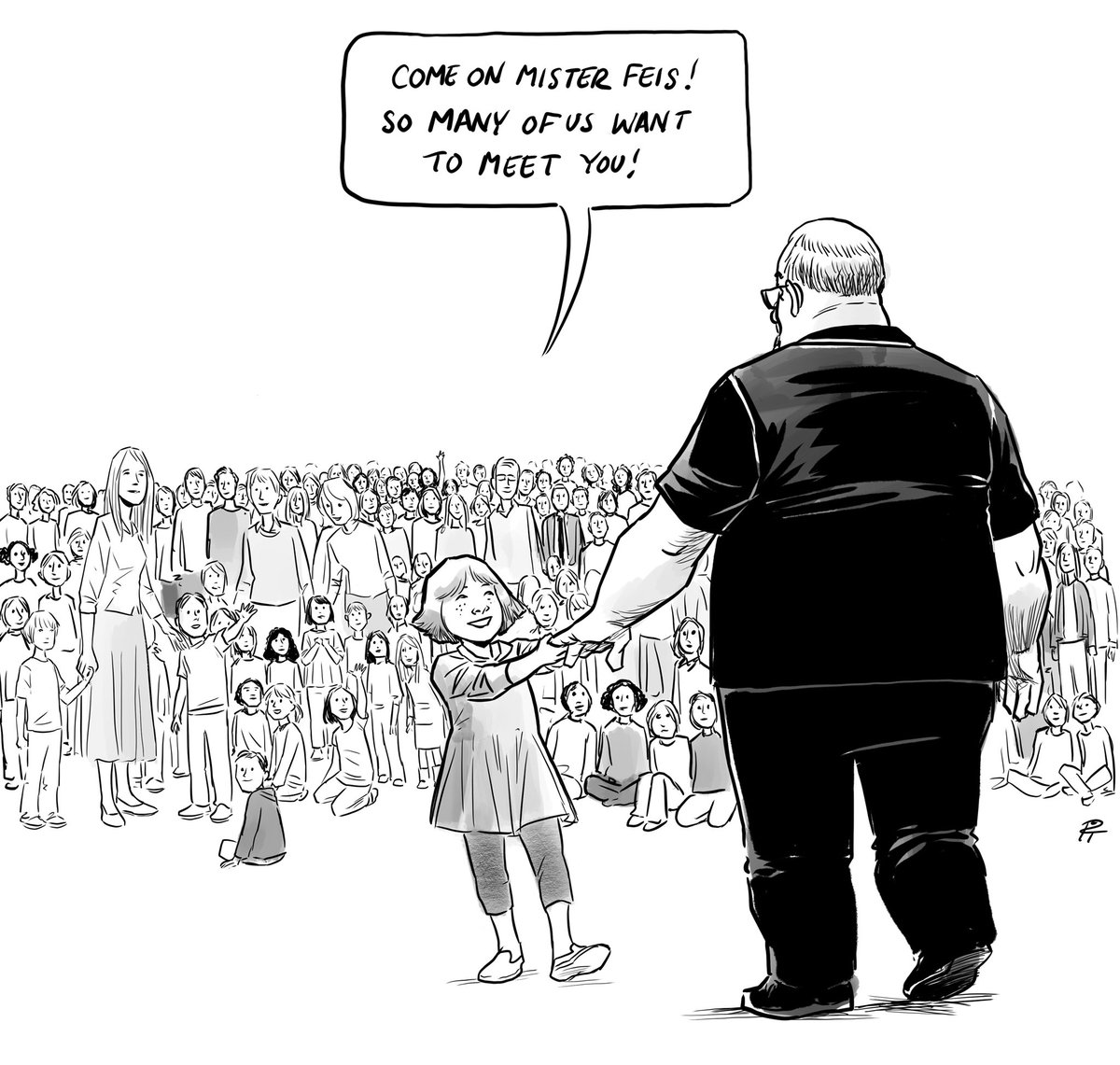
Parkland Shooting and Gun Control Cartoon by Pia Guerra

The 1 Cartoon About School Shootings Every American Needs to See

By Chelsea Adelaine Hassler      February 22, 2018

An absolutely stunning cartoon drawn in the wake of the Feb. 14 mass shooting at Marjory Stoneman Douglas High School in Parkland, FL, is breaking hearts across the internet — and it’s an image that we won’t (and shouldn’t) soon forget.

“Hero’s Welcome” is the brainchild of artist Pia Guerra and depicts Aaron Feis — the football coach and security guard who was killed when he used himself as a human shield to protect Parkland students — being ushered toward a group of children and adults by a young girl saying, “Come on, Mister Feis! So many of us want to meet you!”

“It’s not often that an image pops in your brain and you feel a lump in your throat,” Guerra told The Washington Post, noting that the crowd in the cartoon is representative of all the many individuals who have tragically lost their lives in school shootings over the years and that the cartoon was a direct response to her feeling helpless in the face of yet another mass gun tragedy.

Guerra posted the image to Twitter, and it has since gone viral — serving as yet another incredibly important reminder of the important role that each and every individual voice plays in the fight for gun control and how essential it is to our own safety as Americans to make those voices heard at the highest levels.

#NeverAgain: ‘This generation … The next generation will never have to worry about this.’

Naples Daily News

#NeverAgain: ‘This generation … The next generation will never have to worry about this.’

Patrick Riley     February 18, 2018

A press conference was held Wednesday, Feb. 21, 2018, at the Florida Capitol Senate building in Tallahassee as Marjory Stoneman Douglas High School students advocate for stricter gun control and mental health laws.

NDN 0216 Parkland Student 003

Nicole Raucheisen/Naples Daily News)

PARKLAND – A contingent of 100 students from Marjory Stoneman Douglas High School, the site of one of the deadliest school shootings in modern American history Wednesday, will travel to the state capital to speak with lawmakers about enacting stricter gun laws.

“Our coping mechanism is dealing with it in a political aspect,” said Jaclyn Corin, a junior at the high school who organized the trip.

“I know that a lot of us in the school have different coping mechanisms, and it’s good that we do because we need a wide variety of comfort and mourning, but also political action.”

The students will pack into buses Tuesday and make the nearly 450-mile trek from Parkland to Tallahassee, where they will split up into groups of 10 to talk to 10 state senators and representatives from both parties Wednesday. The journey comes less than a week after a gunman killed 17 people at the school.

More: Trump to hold ‘listening session’ with Florida high school students

More: Florida school shooting: Hundreds rally for stricter gun laws after massacre

More: Collier schools react to Parkland shooting with increased security

“The action has been so quick,” said Corin, 17. “And that’s necessary because this is a fresh and open wound and we can’t let it close up. We need to do something about it before it just disappears like it always has.”

Corin, who was hiding in a classroom during the shooting, said a family friend connected her with U.S. Rep. Debbie Wasserman Schultz, whose aide helped her start organizing the trip.

A handful of other Democratic politicians, including state Sens. Lauren Book and Kevin Rader and state Reps. Carlos Guillermo Smith and Jared Moskowitz, also helped, she said.

“I knew that I wanted to change something,” Corin said. “I’m the type of person, when something bad happens to me, I can’t just sit back and cry and go in a ball. I like to speak out and I like to act and distract myself from pain.”

Because the Legislature is in the middle of a session, the group can’t introduce new bills but will instead focus on pre-existing ones “that haven’t gotten the time and consideration that they deserve” regarding assault weapons, high-capacity magazines and mental health screenings, Corin said.

Included on the students’ list of top priorities is a ban on military-style assault weapons, like the AR-15 used in the shooting. That rifle and other assault weapons were banned in 1994 by President Bill Clinton as part of the Public Safety and Recreational Firearms Use Protection Act, but that ban expired in 2004.

Hundreds gather for gun control rally after Parkland shooting

A woman yells in response to a speech during a gun

A woman yells in response to a speech during a gun control rally in front of the federal courthouse in Fort Lauderdale, Fla. on Saturday, Feb. 17, 2018. Students, community members, elected officials and gun control advocates gathered together to call for common sense gun laws and firearm safety legislation in the wake of the school shooting that left 17 people dead and 15 others injured this past Wednesday in Parkland, Fla.                                     Nicole Raucheisen/Naples Daily News

The gun has been the “weapon of choice” in shootings from San Bernardino to Las Vegas and Newtown, Corin said.

“The AR-15 was what caused all of this,” she said. “We need that out. I don’t know how people haven’t realized that yet, because it’s a continuing pattern.”

Corin emphasized that the group’s pitch is to elected officials on both sides of the aisle.

“It’s just about kids’ lives,” she said. “Looking into their eyes and telling our stories, we just hope is going to make a huge difference.”

Corin and many of her fellow classmates have garnered national attention for their outspokenness on the issues of gun control in the days since the massacre.

Some of their most vocal leaders, like Emma Gonzalez, Cameron Kasky and David Hogg, have appeared on national and international news outlets and have had celebrities reach out to them on social media.

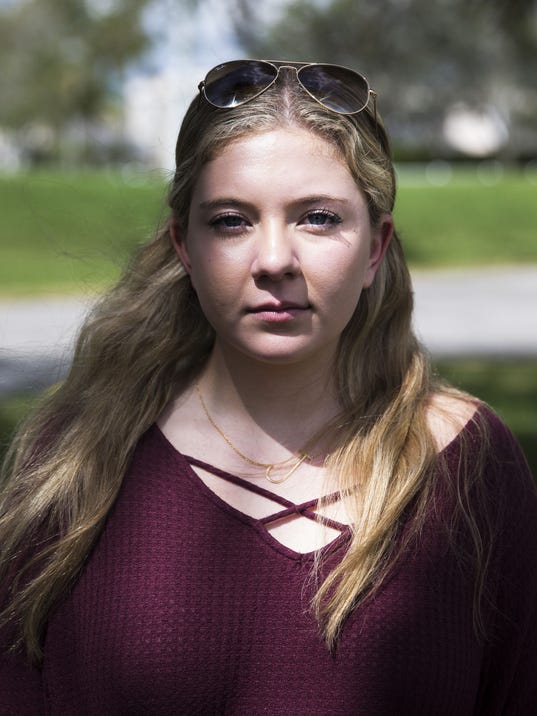
Emma González, 18, a senior at Marjory Stoneman Douglas High School, at North Community Park on Sunday, Feb. 18, 2018. González became a viral sensation after videos of her impassioned speech at an anti-gun rally Saturday in Fort Lauderdale flooded social media. Now, she is helping to lead the #NeverAgain movement with her fellow classmates. “It’s funny. I didn’t even have a Twitter account before two hours ago and it was trending on Twitter all day yesterday,” González said. “I have become somewhat of a spokesperson for this, but we’re all saying the same thing. That’s why we teamed up together like this because we know each other, we love each other very much and we all agree on the same stuff. We’re happy that all of us are still alive and we’re gonna make sure it stays that way for the people in our neighboring communities. For our neighbors, our cousins, this generation, not the next generation because the next generation will never have to worry about this because of us.” (Photo: Nicole Raucheisen/Naples Daily News)

“Maybe it’s because we’re old enough to talk about it,” said Gonzalez, a senior at the school, when asked why the students’ advocacy for change has been so visible.

“They sent us to school to get a thorough education and they act shocked that we’re educated.”

Corin said the pervasiveness of social media has also helped spread the group’s message of “Never Again.”

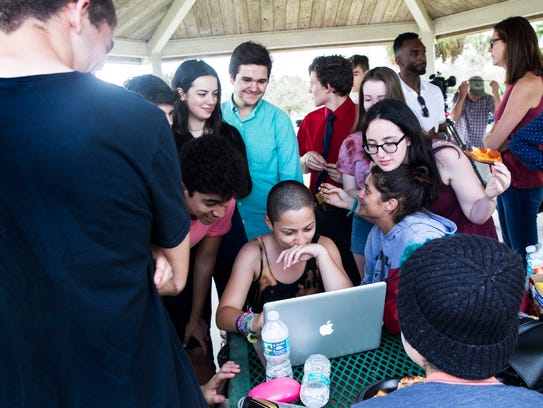
Emma Gonzalez, 18, center, a senior at Marjory Stoneman Douglas High School, is surrounded by her friends as she answers a social media message from actress and singer Zendaya at North Community Park on Sunday, Feb. 18, 2018. Gonzalez became a viral sensation after videos of her impassioned speech at an anti-gun rally in Fort Lauderdale flooded social media. Now, she is helping to lead the #NeverAgain movement with her fellow classmates. (Photo: Nicole Raucheisen/Naples Daily News)

“The fact that this can all be spread and our want for change can be spread in the click of a button is just so helpful,” she said. “And we’re going to use that to our advantage.”

The trip to Tallahassee comes on the heels of a gun control rally Saturday in Fort Lauderdale, where students pleaded for stricter gun laws and blasted officials who have taken political donations from the National Rifle Association. The students are currently planning a “March For Our Lives” in Washington, D.C., on March 24 to demand legislative action by Congress to address gun violence.

President Donald Trump is scheduled to host students and teachers from the school for a listening session Wednesday, although it is unclear which students will be invited to the session.

“This is just our opportunity,” said Gonzalez, 18, a senior at the school, referring to the Tallahassee trip. “This is the time to do this.”

The tight-knit group of students is poised to make sure those who come after them won’t have to suffer the way they did, she said.

“This generation,” Gonzalez said. “Not the next generation. Because the next generation will never have to worry about this.”

U.S. Courts Jailing Thousands over Civil Debts ‘Without Due Process,’ ACLU Says

Newsweek

U.S. Courts Jailing Thousands over Civil Debts ‘Without Due Process,’ ACLU Says

 Chantal Da Silva, Newsweek      February 21, 2018

Scott Walker to sign bills that will deprive poor families of public assistance

ThinkProgress

Scott Walker to sign bills that will deprive poor families of public assistance

Even more rules designed to kick low-income families further down the economic ladder.

Alan Pyke       February 21, 2018

Wisconsin Governor Scott Walker (R) with Donald Trump at a campaign event in 2016. Credit : Chip Somodevilla/Getty Images)

Poor families in Wisconsin will soon get kicked off of food stamps and evicted from their public housing under a package of laws passed Tuesday by the state Senate.

Gov. Scott Walker (R) pushed state lawmakers to double down on his previous tweaks to the Supplemental Nutrition Assistance Program (SNAP) and other safety net systems. Taken together, the earlier changes and those passed Tuesday make Wisconsin a living experiment with very old conservative policy ideas. The changes are hard-hearted and soft-brained, a recipe for greater human misery masquerading as a plan to lift the destitute back toward dignity.

One bill ups existing work requirements for food stamps. Another sets humiliating new conditions for eligibility to live in public housing. Others set aside money to pay private companies that contract with the state if those companies can realize further savings.

Food stamps recipients are already required to work to receive the meager stipend SNAP provides. Though media coverage often portrays legislation like Wisconsin’s as a new corrective action, the truth is SNAP families already work. When unemployment reaches a crisis level in a given geographic area, state administrators are allowed to waive the federal requirement that able-bodied adults without dependents (ABAWDs) work or volunteer at least 20 hours per week. That flexibility is essential to the program’s ability to cushion recessions. If there are no jobs and a family that can’t find work loses food benefits, the program can’t do what it’s supposed to, and poor people will go hungry.

Walker has already stripped his state’s food aid system of that essential responsiveness to economic conditions. A law he signed in 2015 barred Wisconsin from ever waiving the work rules, regardless of unemployment levels. For every person who found a job that met that 2015 bill’s requirements, 3.5 food stamps recipients were kicked off of the program, according to the Journal-Sentinel.

How Do You Help A Food Stamp Recipient Get A Job?

That kind of lopsided outcome — three or four times as many people dumped into the gutter as lifted into the workforce — will be replicated under the additional changes adopted this week. One bill approved by the Senate Tuesday will increase the existing work requirement from 20 hours a week to 30.

Wisconsin’s newest tweaks to food stamps rules spotlight the deception inherent to conservative policy ideas on poverty. Even if you accept the premise that a hard-and-fast requirement to work helps move people toward self-sufficiency — which you shouldn’t, since requiring work does nothing to create job opportunities— it is absurd to think that raising the bar for qualifying work hours by 50 percent will do the same.

Someone who’s been able to find a part-time job would suddenly lose food stamps anyhow if their boss won’t schedule them for 10 more hours a week. Resetting the definition of an acceptable food stamps beneficiary to “someone clocking 30 hours a week” only narrows the eligibility pool. This is a plan to kick people off of food stamps, not to improve anyone’s quality of life.

Walker’s agenda will cost Wisconsin taxpayers $38 million a year to implement. The inevitable savings from kicking people off of anti-poverty programs will accrue to the U.S. Treasury, not his state. Benefits are covered entirely through federal dollars, with states paying only a share of the administrative costs of SNAP.

Wisconsin Republicans Don’t Want Food Stamp Recipients Buying Beans, Potatoes, Pasta Sauce

Other bills passed Tuesday go even further to restrict access to safety net systems. The state will impose an asset test for food stamps, barring anyone who owns a home appraised at more than $321,200 or whose car is worth $20,000. Like work rules, asset tests are an old idea long understood to depress quality of life without any positive impact on poverty. Several states have gone the other direction in recent years and abandoned old asset rules.

Walker’s policy package also extends the same logic he has used for food stamps to public housing. Wisconsin residents who live in subsidized housing would have to submit to drug tests and find paying work or be booted onto the street.

Walker got his votes, but under a cloud of undemocratic illegitimacy. The governor is holding two seats — one in the Senate and another in the Assembly — vacant throughout this year’s legislative session, seemingly for fear that anti-Republican sentiment would hand the two chairs to Democrats.

Republicans would still hold majorities in each chamber even if the two vacancies went blue, and Walker would probably still get to sign the same poverty-increasing package. But his defiance of state laws mandating special elections “as promptly as possible” casts the policy changes in a dim light.

Watch police chief comments on Wisconsin gun law written by the NRA

NowThis Politics

February 18, 2018

Watch this police chief completely dismantle a horrifying gun law that’s backed by the NRA

Milwaukee Police Chief Tears Apart NRA-Backed Concealed Carry Law

Watch this police chief completely dismantle a horrifying gun law that's backed by the NRA

Posted by NowThis Politics on Sunday, February 18, 2018

This woman decided to cut her gun in half

CNN
February 20, 2018

“I really like this gun. But you know what I like more? Is when people don’t get killed.” After the Florida school shooting that left 17 dead, this woman decided to cut her gun in half. http://cnn.it/2C9QS7u

Gun owner destroys gun after school shooting

"I really like this gun. But you know what I like more? Is when people don't get killed." After the Florida school shooting that left 17 dead, this woman decided to cut her gun in half. http://cnn.it/2C9QS7u

Posted by CNN on Tuesday, February 20, 2018

8 Presidents Who Most Shaped the U.S. Food System

Civil Eats

8 Presidents Who Most Shaped the U.S. Food System

Every president has played a role in making the food system what it is today, but these eight stand out, for better and for worse.

Nathaniel Currier lithograph, 1852.

By Karen Perry Stillerman – Commentary, Food Justice, Food Policy

February 19, 2018

As we prepare to observe Presidents Day, I’m thinking about a president’s role in shaping the way we grow food in the United States, and how we eat. Quite a few of our past presidents were farmers or ranchers at some point in their lives, and some had infamous relationships with certain foods, whether cheeseburgers or jelly beans or broccoli.

But a small number of presidents spanning the history of the republic have had particular influence on our food supply and culture, and its impact on the health and well-being of all Americans, including farmers. And notably, as we’re also observing Black History Month, the interventions of those past presidents in our food system have often particularly affected African Americans.

1. George Washington: First farmer, innovator, and slaveholder

Whether or not young George chopped down that famous fruit free, the post-presidency Washington grew cherries, along with apples, pears, other tree fruits, and a whole lot of other food at his Mount Vernon estate, which comprised five neighboring farms on 8,000 acres. An innovative farmer who kept meticulous records, Washington was an early proponent of composting for soil health, and eventually phased out tobacco (the plantation crop of his day in Virginia) in favor of a diversified seven-crop rotation system including wheat for sale, corn for domestic consumption, and fertility-enhancing legume crops. (Sounds like a good idea.)

The grim reality behind Washington’s farming success, though, is that his farms were worked by slaves. A slaveowner since age 11, when he inherited ten slaves from his father, Washington bought and sold Black people throughout his life (reportedly treating them severely and separating family members through sale), and 317 slaves worked on his estate at the time of his death.

The devastating legacy of racial injustice and inequality at Mount Vernon is still with us, but it is being gradually undone. The 126-acre historic Woodlawn estate—originally part of Washington’s farm network—was purchased by northern Quakers prior to the Civil War, expressly to prove that you could farm profitably without slavery. Today, the site is occupied by the Arcadia Center for Sustainable Agriculture, whose work includes a mobile market delivering fresh, healthy, affordable food to food-insecure neighborhoods like this one in the Washington DC area.

2. Thomas Jefferson: Experimentation, failure, and a legacy of slave-centered agriculture

The third president has been called America’s “first foodie” for his love of the table, and of French cuisine in particular. He ate a lot of vegetables, and introduced many new ones to the United States. On his Monticello estate, Jefferson introduced and experimented with a vast variety of food crops, including 330 varieties of eighty-nine species of vegetables and herbs and 170 varieties of the fruits. An avid experimenter, Jefferson’s trials often resulted in failure, leading neighbors to call him “the worst farmer in Virginia.” But in truth he promoted techniques to build soil health through adding organic matter, and by sharing seeds and techniques widely, he promoted commercial market gardening and spread new crops that expanded the young nation’s food traditions and palate.

Perhaps even more than Washington, Jefferson’s legacy is marred by the stain of his complicity in slavery, and his racial views. He embodied the inherent social contradictions at the birth of this nation that we have yet to resolve, by denouncing the institution of slavery while simultaneously profiting from it—he owned some 600 slaves who worked on his Monticello farm and other holdings, employed brutal overseers, and fathered children with his slave Sally Hemings through a relationship that, by definition, could not have been consensual. His goal of “improving” slavery as a step towards ending was misguided, as it was used during his time as an argument for its perpetuation.

3. Abraham Lincoln: The USDA and the land-grant college system

Born in that legendary log cabin on his father’s farm in Kentucky, Lincoln was, as he put it, “raised to farm work.” His father farmed frontier land in southern Indiana before moving the family to Illinois, where Abe later got his political start in the state legislature. A believer in technological progress in agriculture, Lincoln advocated for horse-drawn machines and steam plows to take the place of hand labor. As president, he advocated for and signed legislation creating the U.S. Department of Agriculture (USDA), which he later called “The People’s Department,” since about half of all Americans at the time lived on farms. And Lincoln’s early belief in the value of educating farmers came to fruition in 1862 when he signed the Morrill Land Grant College Act, which facilitated the transfer of public land to each of the states to establish colleges of agriculture and the mechanical arts.

Lincoln fought a war over slavery (perhaps we’re finally coming to agreement on that point?), issued the Emancipation Proclamation in 1863, and submitted the 13th Amendment prohibiting slavery to the states for ratification just a few month before his violent death in 1865. But it would be another quarter century before freed slaves in the former Confederate states would get the benefit of a land-grant education Lincoln envisioned. A second Morrill Act in 1890 required each state to show that race was not an admissions criterion for its land-grant colleges, or else to designate a separate institution for students of color. (See some of the achievements of some of the institutions known as 1890 schools here.)

4. Theodore Roosevelt: Cattle ranching and conservation

Teddy Roosevelt’s is known as one of the nation’s great conservationists, but that legacy was born out of a series of calamities. On a hunting trip in the Dakota Territory in 1883, the passionate outdoorsman discovered that native bison herds had been decimated by commercial hunters. Cattle ranching on the region’s vast grasslands was booming in bison’s wake, and he became interested in the cattle business, investing $14,000 (a huge sum at the time) in a ranch. Returning to politics in New York, Roosevelt was struck by tragedy with the death of both his mother and his wifeon the same day in 1884, and he turned to the West and the ranching life to forget. But cattle in the Badlands at the time was itself a looming disaster: a boom with no regulation quickly led to massive overgrazing, and a scorching summer followed by a harsh winter in 1886-87 proved deadly. Tens of thousands of cattle, about 80 percent of the region’s herds, froze and starved to death in a blizzard. Roosevelt himself lost over half his herd, and soon got out of the business.

But his experience with agricultural disaster helped shape the future president’s views on the importance of conservation and led to an inspiring conservation legacy. Using his presidential authority, Roosevelt gave federal protection to more than 230 million acres of public land, creating the National Forest Service (now part of the USDA) and five national parks, and setting aside 51 federal bird reservations, 18 national monuments, and four national game preserves. In his words in 1908: “We have become great because of the lavish use of our resources and we have just reason to be proud of our growth. But the time has come to inquire seriously what will happen when our forests are gone, when the coal, the iron, the oil and the gas are exhausted, when the soils have been still further impoverished and washed into the streams, polluting the rivers, denuding the fields, and obstructing navigation.” (Nah, that couldn’t happen, could it?)

5. Franklin Delano Roosevelt: Dust Bowl and soil conservation

In the Great Depression and the Dust Bowl of the 1930s, FDR inherited economic and ecological catastrophes that hit farmers particularly hard. The Dust Bowl was caused by massive-scale plowing up of grasslands (the Great Plow-Up of the 1910s and ’20s) followed by four distinct drought eventsin the 1930s. It scorched the Plains and literally blew away its soil, leaving millions of acres of farmland useless, driving farmers into bankruptcy and off the land, and worsening the banking and unemployment crises.

An amateur forester, Roosevelt understood the importance of soil conservation, and soon after taking office he established the Civilian Conservation Corps and the Soil Erosion Service. The latter (now the USDA’s Natural Resources Conservation Service) was the first major federal conservation effort to focus on privately owned natural resources. FDR also launched the Plains Shelterbelt Project effort that planted millions of trees, creating windbreaks (now at risk) on farms from the Canadian border to Texas. And he initiated farm policies to help farmers manage future boom-and-bust cycles by preventing overproduction. The Agricultural Adjustment Act enacted on his watch would grow into today’s wide-ranging farm bill, which still struggles with how to deal with overproduction while providing livelihood for the nation’s farmers and conserving soil and water.

6. Richard Nixon: Turning farming into big business

Nixon was a contradiction. Scholars continue to dissect his deep character flaws and divisiveness, but also his achievements. Among the latter, he created the EPA and signed the National Environmental Policy Act (both of which, one hopes, will survive the current administration’s manyassaults), and he made dozens of other environmental proposals.

But his lasting legacy in agriculture continues to haunt us. That’s because Nixon gave his blessing to his agriculture secretary, Earl Butz, to essentially undo decades of FDR’s supply management policy. The Nixon years would be all about maximizing and consolidating farm production. “Get big or get out,” Butz told farmers in 1973, and boy, did they. His policies encouraged farmers to plant as much corn and other commodities as they could, on every possible bit of land. Today, one might argue, we have Nixon and Butz to thank for persistent fertilizer pollution in our nation’s waterways, for high-fructose corn syrup and the power and deception of the food industry, and for our enduring crisis of obesity and diet-related disease. (Read the full story of Secretary Butz, entertainingly told by Tom Philpott back in 2008.) Buzz’s obit recounts how a nasty racist comment ended his political career.

7. George W. Bush: Justice for Black farmers denied

While George W. Bush spent a lot of his presidency clearing brush on his Texas ranch, he wasn’t particularly known for his agriculture policy. But during his administration, a long-simmering dispute between the USDA and Black farmers came to a head. The background: in 1997 a group of Black farmers sued the USDA, citing years of racial discrimination by the department, which denied Black producers loans and other assistance and failed to act on their claims for years. The farmers prevailed in 1999, winning a $2.3 billion settlement from the government, the biggest in civil rights history. But there were limitations on who could collect under the Pigford settlement (named for lead plaintiff Timothy Pigford, a Black corn and soybean farmer from North Carolina), and what kinds of documentation they would need to provide.

Under W’s watch, many of the 22,000 farmers who had joined the Pigford suit were denied payment; by one estimate, nine out of 10 farmers who sought damages were denied. And the Bush Department of Justice, representing the USDA, reportedly spent 56,000 office hours and $12 millioncontesting farmers’ claims. Many farmers believed their claims were rejected on technicalities.

8. Barack Obama: Justice and healthy food, served

Much of the Obama food and farming legacy (which is hers as much as his) is well known: the now permanent White House kitchen garden (which, incidentally, includes a section honoring Thomas Jefferson with favorite varieties from his own garden at Monticello) along with the (possibly less permanent) improvements to school meals that resulted from the bipartisan Healthy Hunger-Free Kids Act they championed, and the Let’s Move! campaign. The USDA under the Obama administration also made other efforts to improve our nation’s food system by promoting local and regional farm economies, increasing agricultural research, and strengthening federal dietary guidelines.

He also fixed a lingering problem with the Pigford discrimination settlement described above. Failure to effectively notify and communicate with Black farmers eligible for payout under the 1999 settlement meant that many farmers were left out. Obama’s Secretary of Agriculture Tom Vilsack and Attorney General Eric Holder advocated for a fix, and in 2010, the administration announced a $1.25 billion settlement of the so-called “Pigford II” claims.

And now what?

These eight former presidents have made their mark on U.S. agriculture and food, delivering both progress and setbacks. Bottom line this Presidents Day? We still have a lot of work to do to achieve a healthy, sustainable, and just food system in this country.

Next time I’ll look at what happens when the occupant of the White House is not only not a farmer, but seems puzzlingly (if not cynically) indifferent to farmers’ concern. And when, instead of a healthy food advocate, he’s an unabashed proponent of the same processed and fast foods that are damaging the health—and even shortening the lives—of our nation’s children.

This post originally appeared on the Union of Concerned Scientists blog and is reprinted with permission.

Medicaid covers nearly 104 million medical visits, but that may soon change

PBS News Hour

Medicaid covers nearly 104 million medical visits, but that may soon change

By JoNel Aleccia, Kaiser Health News     January 30, 2018

Driver Donavan Dunn loads Maddie Holt into the van on Nov. 21, 2017. The only way Maddie and her mother, Meagan Holt, can make the trip to the hospital is by using a service provided by Medicaid called non-emergency medical transportation, or NEMT. (Heidi de Marco/KHN)

EVERETT, Wash. — Unable to walk or talk, barely able to see or hear, 5-year-old Maddie Holt waits in her wheelchair for a ride to the hospital.

The 27-pound girl is dressed in polka-dot pants and a flowered shirt for the trip, plus a red headband with a sparkly bow, two wispy blond ponytails poking out on top.

Her parents can’t drive her. They both have disabling vision problems; and, besides, they can’t afford a car. When Maddie was born in 2012 with the rare and usually fatal genetic condition called Zellweger syndrome, Meagan and Brandon Holt, then in their early 20s, were plunged into a world of overwhelming need — and profound poverty.

“We lost everything when Maddie got sick,” said Meagan Holt, now 27.

More than 1 in 5 Americans — about 74 million people — now rely on Medicaid to pay for their health care.

Multiple times each month, Maddie sees a team of specialists at Seattle Children’s Hospital who treat her for the condition that has left her nearly blind and deaf, with frequent seizures and life-threatening liver problems.

The only way Maddie can make the trip, more than an hour each way, is through a service provided by Medicaid, the nation’s health insurance program started more than 50 years ago as a safety net for the poor.

Called non-emergency medical transportation, or NEMT, the benefit is as old as Medicaid itself. From its inception, in 1966, Medicaid has been required to transport people to and from such medical services as mental health counseling sessions, substance abuse treatment, dialysis, physical therapy, adult day care and, in Maddie’s case, visits to specialists.

“This is so important,” said Holt. “Now that she’s older and more disabled, it’s crucial.”

More than 1 in 5 Americans — about 74 million people — now rely on Medicaid to pay for their health care. The numbers have grown dramatically since the program expanded in 32 states plus the District of Columbia to cover prescription drugs, health screening for children, breast and cervical cancer treatment and nursing home care.

With a Republican administration vowing to trim Medicaid, Kaiser Health News is examining how the U.S. has evolved into a Medicaid Nation, where millions of Americans rely on the program, directly and indirectly, often unknowingly.

Medicaid’s role in transportation is a telling example. Included in the NEMT coverage are nearly 104 million trips each year at a cost of nearly $3 billion, according to a 2013 estimate, the most recent, by Texas researchers.

Citing runaway costs and a focus on patients taking responsibility for their health, Republicans have vowed to roll back the benefits, cut federal funding and give states more power to eliminate services they consider unaffordable.

Already, states have wide leeway in how to provide and pay for the transportation.

Proponents of limiting NEMT say the strategy will cut escalating costs and more closely mirror private insurance benefits, which typically don’t include transportation.

They also contend that changes will help curb what government investigators in 2016 warned is “a high risk for fraud and abuse” in the program. In recent years, the Centers for Medicare & Medicaid Services (CMS) reported that a Massachusetts NEMT provider was jailed and fined more than $475,000 for billing for rides attributed to dead people. Two ambulance programs in Connecticut paid almost $600,000 to settle claims that they provided transportation for dialysis patients who didn’t have medical needs for ambulance transportation. And the mother of a Medicaid patient who was authorized to transport her child for treatment billed Medicaid for trips that didn’t take place. She was sentenced to 30 days in jail and ordered to pay $21,500.

At least three states, Iowa, Indiana and Kentucky, have received federal waivers — and extensions —allowing them to cut Medicaid transportation services. Massachusetts has a waiver pending.

Last March, Rep. Susan Brooks, an Indiana Republican, introduced a resolution that would have revoked the federal requirement to provide NEMT in an effort to provide states with “flexibility.” That effort stalled.

Another Republican proposal in 2017 would have reversed the Affordable Care Act’s Medicaid expansion and reduced federal funding for the NEMT program. It failed, but other efforts by individual states still stand.

Former Health and Human Services Secretary Tom Price and CMS Administrator Seema Verma encouraged the nation’s governors to consider NEMT waivers, among other actions, in a March letter to them.

“We wish to empower all states to advance the next wave of innovative solutions to Medicaid challenges,” they wrote. The Trump administration has used state waivers to bypass or unravel a number of the Obama administration’s more expansive health policies, and has granted some states’ requests.

At least three states, Iowa, Indiana and Kentucky, have received federal waivers — and extensions —allowing them to cut Medicaid transportation services. Massachusetts has a waiver pending.

Critics of the cuts worry the trend will accelerate, leaving poor and sick patients with no way to get to medical appointments.

“I wouldn’t be surprised to see more of these waivers in the pipeline,” said Joan Alker, executive director of the Georgetown University Center for Children and Families.

Because medical transportation isn’t typically covered by the commercial insurance plans most Americans use, it’s unfamiliar to many people and could be seen as unnecessary, said Eliot Fishman, senior director of health policy for Families USA, a nonprofit, nonpartisan consumer health advocacy group.

Formerly a Medicaid official in the federal government, Fishman called the transportation program “vital” not only for children with severe disabilities, but also for non-elderly, low-income adults.

CMS released results of a 2014 survey of Medicaid users, which found that lack of transportation was the third-greatest barrier to care for adults with disabilities, with 12.2 percent of those patients reporting they couldn’t get a ride to a doctor’s office.

“This is not something to be trifled with lightly,” Fishman said. “We’re talking about a lifesaving aspect of the Medicaid program.”

“This is not something to be trifled with lightly. We’re talking about a lifesaving aspect of the Medicaid program.”

About 3.6 million Americans miss or delay non-emergency medical care each year because of transportation problems, according to a 2005 study published by the National Academy of Sciences.

That same study analyzed costs for providing NEMT to patients facing 12 common medical conditions and found that providing additional transportation is cost-effective. For four of those conditions — prenatal care, asthma, heart disease and diabetes — medical transportation saved money when the total costs for both transportation and health care were tallied.

Medicaid is required to provide NEMT services using the most appropriate and least costly form of transportation, whether that’s taxis, vans or public transit.

Most states rely on NEMT brokers or managed-care organizations to administer the transportation services. Other states run the service directly, paying providers on a per-ride basis, while some use local ride services and pay independent taxi firms to shuttle patients.

Proponents of revamping NEMT note that disabled children like Maddie and other people with serious disabilities are in little danger of losing services. In Iowa and Indiana, Medicaid transportation remains available to several groups of patients, including those classified as “medically frail,” though the definition of who qualifies can vary widely.

In addition, one managed-care provider, Anthem, continues to transport Indiana Medicaid patients, despite the waiver that was first enacted in 2007.

Still, Medicaid clients like Fallon Kunz, 29, of Mishawaka, Ind., are often stuck. Kunz, who has cerebral palsy, migraine headaches and chronic pain, uses a power wheelchair. When she was a child, she qualified for door-to-door service to medical appointments, she said.

Today, she lives with her father, whose home is outside the route of a Medicaid transit van. Getting to and from medical appointments for her chronic condition is a constant struggle, she said. Taxis are too expensive: $35 each way for a wheelchair-enabled cab.

“The majority of our patients are in survival mode.”

“The only way I can get rides to and from my doctor’s appointment is to ride the 2 miles in my wheelchair, despite all kinds of weather, from my home, across the bridge, to the grocery store,” she said. “Right outside the grocery store is the bus stop. I can catch the regular bus there.”

Sometimes, she’s in too much pain or the Indiana weather — warm and humid in the summer, frigid and windy in the winter — is too much to battle and she skips the appointment.

“Today I didn’t go because it was too cold and my legs hurt too much,” she said on a December Tuesday. “I didn’t feel like getting blown off the sidewalk.”

In Maddie Holt’s case, she was shuttled to Seattle Children’s on a rainy Tuesday morning in a medical van driven by Donavan Dunn, a 47-year-old former big-rig trucker. He works for Northwest Transport, one of several regional brokers that manage NEMT services for Washington state.

Dunn said he received special training to transport patients like Maddie, who is loaded onto a motorized platform, wheelchair and all, into the van and then carefully strapped in.

“I have to drive different,” said Dunn. “I have to watch my corners, watch my starts, watch my stops. It’s always in the back of my mind that I have somebody on board that’s fragile.”

The transportation service can be used only for medical visits to the specialists who treat Maddie’s condition, which is caused by mutations in any one of at least 12 genes. If Meagan Holt needs to pick up prescriptions or get groceries, she leaves Maddie and a second daughter, Olivia, 3, at home with their dad and takes the bus or walks to her destinations.

Caring for a severely disabled child is not the life she expected, Meagan Holt said, but she cherishes time with Maddie, who has learned to communicate through tactile sign language spelled into her hand.

“She knows about 100 words. She knows the alphabet,” Meagan said. “She likes Disney princesses. She loves ‘Frozen.’”

Maddie is one of hundreds of NEMT-eligible children transported to Seattle Children’s each month. Last September, for instance, more than 1,300 clients made more than 3,600 trips at a cost of more than $203,000, according to the Washington Health Care Authority, which oversees the state’s Medicaid program called Apple Health.

The need is so great, in fact, that the hospital created a transportation will-call desk to help organize the comings and goings.

“When we realized how much transportation is a barrier to getting to your appointment, we decided to do something about it,” said Julie Povick, manager of international exchanges and guest services at Seattle Children’s.

“The majority of our patients are in survival mode,” Povick added. “You need a lot of handholding.”

But Verma, the architect of Indiana’s Medicaid overhaul plan, has suggested that too much handholding might be “counterproductive” for patients — and bad for the country.

In a 2016 Health Affairs essay, Verma noted that early analysis of the effects of curtailing NEMT in Indiana showed that more Medicaid patients with access to the program said transportation was a primary reason for missed appointments than did members without access.

“Moreover, 90 percent of [Healthy Indiana Plan] members report having their own transportation or the ability to rely on family and friends for transportation to health care appointments,” she wrote.

But Marsha Simon, a Washington, D.C., health policy consultant who has tracked NEMT for years, said Medicaid is the option of last resort. People who are able to get rides on their own already do.

“If 90 percent can and 10 percent can’t, what about the 10 percent?” Simon said.

It’s a question that haunts Kunz every day.

“I’m a college student, I have a cat,” said Kunz, who is studying psychology online at Southern New Hampshire University. “I’m just a regular human trying to do things, and the inaccessibility in this area is ridiculous.”

Kaiser Health News is an editorially independent program of the Henry J. Kaiser Family Foundation, a nonprofit, nonpartisan health policy research and communication organization not affiliated with Kaiser Permanente. You can view the original report on its website.

If Pruitt Attempts to Muck Up Our Environment, People Will Be Angry!

HuffPost

EPA Says Scott Pruitt Flies First Class Because Angry People Yell At Him Too Much

Nick Visser, HuffPost          February 16, 2018 

Often costing thousands of dollars more than equivalent seats in coach. The report, citing EPA receipts obtained through a Freedom of Information Act request, noted several flights cost more than $90,000 in total during a few weeks last June.

Federal regulations mandate government employees travel in the “least expensive class of travel” for their needs, but individuals are allowed to book premium seats if there are security concerns.

The EPA briefly said this week Pruitt had a “blanket wavier” to travel first class but later rolled back its statement when Politico noted that the regulations state that such travel must be approved on a “trip-by-trip basis.” A spokesman later clarified to the news site that Pruitt’s office submitted a waiver seeking an exemption before each trip, citing security concerns.

Until Thursday’s report, it was unclear what those concerns were, although Pruitt defended the bookings in an interview with the New Hampshire Union Leader, blaming what he called a “very toxic environment politically.”

“We’ve reached the point where there’s not much civility in the marketplace and it’s created, you know, it’s created some issues and the (security) detail, the level of protection is determined by the level of threat,” he told the Union Leader on Tuesday.

Pruitt’s tenure at the EPA over the past year has been controversial among environmentalists. The agency has quickly worked to roll back many regulations meant to combat climate change. The agency has also moved to unravel the Clean Water Act and the Clean Power Plan, and Pruitt was one of the driving forces behind President Donald Trump’s decision to withdraw the U.S. from the landmark Paris climate deal.

He receives many more threats than his predecessors, E&E News reported in January, and is the first EPA administrator to have a full-time security detail.

The agency also refuses to release many details about Pruitt’s schedule in advance, citing similar security concerns.

The politicians who keep blocking gun safety laws all have this one thing in common.

ATTN: Video

February 15, 2018

The politicians who keep blocking gun safety laws all have this one thing in common.

The politicians who keep blocking gun safety laws all have this one thing in common.

The politicians who keep blocking gun safety laws all have this one thing in common.

Posted by ATTN: Video on Thursday, February 15, 2018