Mitch McConnell refuses to vote on gun safety bill after 10,000 deaths in 100 days

Mitch McConnell refuses to vote on gun safety bill after 10,000 deaths in 100 days

Mitch McConnell
AP Photo/J. Scott Applewhite


The House passed historic gun safety legislation 100 days ago, but McConnell is blocking the Senate from taking any action.

Senate Majority Leader Mitch McConnell still refuses to allow a vote on a pair of gun safety bills 100 days after the landmark legislation passed the House of Representatives.

On February 27, the House passed a bipartisan universal background checks bill, the first piece of significant gun safety legislation in a generation. The next day, the House overcame Republican opposition to pass another bill to close the “Charleston loophole,” which would make it harder for those with a criminal record to bypass a background check and obtain a gun.

“Our constituents sent us here to do something — and we did,” Rep. Jennifer Wexton (D-VA) told Shareblue Media. “100 days ago, leaders who ran on a promise to take action delivered a historic victory for gun safety,” former Rep. Gabby Giffords said in a Thursday statement. “Every day since, the House majority continued fighting for stronger gun laws — fighting to make our country a safer place to live, work, study, worship, and play.”

Giffords, who was shot eight years ago during an event with constituents, now runs a gun safety advocacy group bearing her name.

Despite overwhelming public support (64% of gun owners agree that the government needs to address gun violence), McConnell continues to engage in an obstructionist agenda.

McConnell’s inaction “presents another hurdle,” to making America a safer country, Wexton noted. “It’s been 100 days with zero action by the Senate Leader. This bill would save lives, yet he allows it to languish on his desk — it’s shameless.”

McConnell refuses to do anything with the gun safety legislation, even after a dozen people in Virginia Beach were killed in a mass shooting at the end of May. In fact, 10,000 people in America died from gun violence during the 100 days McConnell allowed these bills to languish on his desk.

Sen. Chris Murphy (D-CT), a leading gun safety advocate, said McConnell’s “inaction is complicity.”

Gun safety advocates refuse to stop fighting for a safer, less violent America.

“The Senate has yet another opportunity to do the right thing — something their constituents overwhelmingly support — and pass a law requiring a background check on every gun sale,” Shannon Watts, founder of Moms Demand Action told Shareblue Media. “Polls show more than 90 percent of Americans support closing this loophole in federal law. Every Senator who refuses to act to keep our families and communities safe the should expect to be held accountable.”

In her statement, Giffords added that “Americans are watching Senate Majority Leader Mitch McConnell and President Trump and waiting for them to take the next step. How many more lives will be lost before they sign the background checks bill into law?”

House Speaker Nancy Pelosi took aim at McConnell’s do-nothing attitude during her weekly press conference. “We’re very proud of the work that we have done to send over to the Senate where Mr. McConnell has said he’s the Grim Reaper,” she said. “It’s a Senate graveyard.”

Pelosi was referencing a speech McConnell gave to supporters about blocking legislation moving through the House, where McConnell dubbed himself the “Grim Reaper.”

With approximately 100 people dying every day from gun violence, McConnell’s description of himself is far too accurate.

Published with permission of The American Independent. 

Bernie Sanders: There is no role for private insurance in a Medicare for All plan.

CNN posted an episode of CNN Replay.
June 9, 2019

CNN’s Dana Bash: Is there a role for private insurance in your Medicare for All plan?

Sen. Bernie Sanders: “No. The function of this system is to make money for the insurance companies… we need a cost-effective health care system guaranteeing health care to all people.” https://cnn.it/2XzKBcd

Bernie Sanders says there is no role for private insurers in Medicare For All plan

CNN’s Dana Bash: Is there a role for private insurance in your Medicare for All plan?Sen. Bernie Sanders: "No. The function of this system is to make money for the insurance companies… we need a cost-effective health care system guaranteeing health care to all people." https://cnn.it/2XzKBcd

Posted by CNN on Sunday, June 9, 2019

The Donald Thinks D-Day Is About Him

New York Times

The Donald Thinks D-Day Is About Him

To have Trump commemorate the Normandy landings is to understand the word impostor.

By Roger Cohen, Opinion Columnist             June 5, 2019

President Trump and other world leaders looking on as Queen Elizabeth II arrived for a D-Day commemorative event in Portsmouth, England, on Wednesday. Credit: Doug Mills/The New York Times


PARIS — How small he is! Small in spirit, in valor, in dignity, in statecraft, this American president who knows nothing of history and cares still less and now bestrides Europe with his family in tow like some tin-pot dictator with a terrified entourage.

To have Donald Trump — the bone-spur evader of the Vietnam draft, the coddler of autocrats, the would-be destroyer of the European Union, the pay-up-now denigrator of NATO, the apologist for the white supremacists of Charlottesville — commemorate the boys from Kansas City and St. Paul who gave their lives for freedom is to understand the word impostor. You can’t make a sculpture from rotten wood.

It’s worth saying again. If Europe is whole and free and at peace, it’s because of NATO and the European Union; it’s because the United States became a European power after World War II; it’s because America’s word was a solemn pledge; it’s because that word cemented alliances that were not zero-sum games but the foundation for stability and prosperity on both sides of the Atlantic.

Of this, Trump understands nothing. Therefore he cannot comprehend the sacrifice at Omaha Beach 75 years ago. He cannot see that the postwar trans-Atlantic achievement — undergirded by the institutions and alliances he tramples upon with such crass truculence — was in fact the vindication of those young men who gave everything.

As Eisenhower, speaking at the Normandy American Cemetery, last resting place of 9,387 Americans, told Walter Cronkite for the 20th anniversary of the D-Day landings: “These people gave us a chance, and they bought time for us, so that we can do better than we have before.”

That was a solemn responsibility. For decades it was met, culminating with the fall of the Berlin Wall in 1989. Doing better, however, is not rising nativism, xenophobia, nationalism and authoritarianism given a nod and a wink by the president of the United States. It’s not Brexit, Britain turning its back on the Europe it helped free.

The American moral collapse personified by Trump is not “beautiful” or “phenomenal” or “incredible” or any of the president’s other clunky two-a-penny superlatives. It’s sickening and dangerous.

My impression here is that Europe has gotten used to Trump to the point that it is no longer strange that the American president is a stranger. In less than two and a half years Trump has stripped his office of dignity, authority and values.

His foreign policy increasingly consists of a single word, “tariffs.” His contempt for allies undermines American diplomacy, or whatever is left of it, from Iran to North Korea, from Venezuela to China. His trampling of truth is so consistent that when he says in London that Britain is the largest trading partner of the United States — it’s nowhere near that — the impulse is to shrug.

Before arriving in London, Trump set the tone. He mocked the city’s mayor, Sadiq Khan, as short. It was a tweet in keeping with the president’s signature stunt as schoolyard bully. Khan, who had criticized “rolling out the red carpet” for Trump, responded by comparing the president to an 11-year-old.

This was generous. Most 8-year-olds know better.

Of course Khan — the brown Muslim son of a bus driver, self-made guy — would get under the skin of a man like Trump, who was born on third base and imbibed his reflexive racism in the family real estate business.

Khan called Trump’s policies — on the reproductive rights of women, on immigrant children at the Mexican border, on “amplifying messages from racists” — the antithesis of Londoners’ values and “abhorrent.” In response, Trump tweeted that Khan was as bad as the “very dumb” New York Mayor Bill de Blasio, “only half his height.”

There is something so disturbing about a very small man like Trump impugning the height of the mayor of the great international city he is visiting that even 28 months of progressive inurement to his outrages feels inadequate.

America is much better than this, much better than an American president who, as the cartoonist Dave Granlund suggested, probably thinks the D in D-Day stands for Donald and spends the night of the commemoration trashing Bette Midler on Twitter.

As for the Republican Party, don’t get me started. To recover its bearings the G.O.P. would do well to recall one of its own, Eisenhower, who in that same 20th-anniversary interview said that America and its allies stormed the Normandy beaches “for one purpose only.”

It was not to “fulfill any ambitions that America had for conquest.” No, it was “just to preserve freedom, systems of self-government in the world.” It was an act, in other words, consistent with the highest ideals of the American idea that Trump and his Republican enablers seem so intent on eviscerating.

Roger Cohen has been a columnist for The Times since 2009. His columns appear Wednesday and Saturday. He joined The Times in 1990, and has served as a foreign correspondent and foreign editor.

Trump administration has triggered soaring health care costs: top industry exec.

Yahoo – Finance

Trump administration has triggered soaring health care costs: top industry exec.

By Brian Sozzi      June 3, 2019

What the attempt to hide the USS John S. McCain shows about Trump — and his staff

Washing Post – Opinions

What the attempt to hide the USS John S. McCain shows about Trump — and his staff

In this Aug. 20, 2008, file photo, Australian sailors tie up the USS John S McCain (DDG-56) as she arrives in Sydney, Australia for the 100th Anniversary of the Great White Fleet. (AP Photo/Rob Griffith)

On Wednesday night, the Wall Street Journal broke the news that White House staff asked Navy officials to keep a ship bearing the name of the late senator John McCain out of the president’s sight lines during his recent visit to Japan.

While the USS John S. McCain could not be moved, shortly before the visit the ship’s name was covered by a tarp. That was quickly removed. Then a work barge was placed in a position that all but hid the name. That too was quickly moved. Then, according to The Post, senior naval leadership put a stop to the maneuvers. By the time the president would have been in a position to see the ship, the configuration was back to normal. But sailors assigned to the ship — unlike others assigned to other nearby American naval vessels were not invited to hear Trump’s Memorial Day speech on the USS Wasp.

Trump quickly stepped forward on Twitter to deny on knowledge of these events and there is no reason to doubt him. But it’s also worth noting he later characterized the staffer responsible as “well-meaning.” The destroyer was originally named for McCain’s father and grandfather, both Navy admirals; the senator’s name was added shortly before his death in 2018.

The fact that people working for our president went out of their way to try to make sure that Trump saw no reminders of McCain while on his visit to Japan is more than the usual outrage of the day. It’s not a distraction from the results of Mueller report, which all but stated the president of the United States sought to obstruct justice, and the White House’s ongoing defying of congressional subpoenas. Instead, it’s all of a piece — and shows what a dangerous spot our nation is in.

Trump is a notoriously thin-skinned man, quick to dish out insults, but unable to take anything resembling normal give and take, whether in politics or life. He shows no grace, humility or growth as a human being, never mind a politician. Trump bashes his enemies — either real or perceived — with a third-grader’s wit, coming up with nasty nicknames or other insults for those who he believes are against him. But he can’t abide even the slightest criticism, no matter how light. And when nasty names don’t work, Trump issues threats, urging Americans to consider boycotting everything from CNN (for being “unfair”) to motorcycle manufacturer  Harley Davidson (for contemplating moving manufacturing operations out of the country). He’s demanded investigations of Hillery Clinton and former FBI director James B. Comey.

Trump’s feud with McCain perfectly captured the former’s thin skin. The man who skipped the draft to Vietnam courtesy of “bone spurs” in his foot that mysteriously disappeared routinely raged against the man who spent more than five years as a prisoner of war and was left permanently disabled as a result. McCain’s famous thumbs down on repealing the Affordable Care Act did add to Trump’s rage against him, but it’s no coincidence that the president hated a living, breathing rebuke to his faux patriotism. McCain, agree or disagree with his politics, served his country and did a heroic thing when called to do so. Trump, on the other hand, appears less than concerned he might well be in the White House thanks to Russian interference in the 2016 election.

As for the appearing, disappearing and reappearing USS John S. McCain, the entire episode contains more than a whiff of a reminder of how censors in the Soviet Union made formerly prominent figures who’d fallen out of favor with Joseph Stalin disappear in official photos. If a former high-ranking Communist Party official was executed, assassinated, sent to the gulag or otherwise exiled from government, their literal likeness often also vanished from official photographs. It happened to well-known political rivals such as Leon Trotsky, and as well as to the faces of those only factotums connected to the Kremlin would likely recognize. It was a form of rewriting history by erasing it from existence.

Trump, it is obvious, would like to do the same. He repeatedly exaggerated the size of the crowds at his inauguration, and just last week retweeted a Fox Business montage of House Majority Leader Nancy Pelosi having trouble speaking. He repeatedly lies about matters large and small, all but willing a not unsubstantial number of Americans to believe his own personal version of reality, which can often best be described with the phrase he so often likes to use — fake news. At the same time, he governs the White House in a stream of invective and chaos, subjecting people who fall out of favor to public humiliation.

No doubt the White House staffer who asked that the USS John S. McCain get temporarily vanished thought it was a good idea. This person no doubt didn’t want to risk a presidential temper tantrum, or Trump saying something vile and inappropriate about McCain on — of all days — Memorial Day. But democracies can’t survive when good governance is downgraded in favor of attempts to satisfy the moods and whims of a small, petty and greedy man at the top. But Trump, it seems, is just fine with that.

U.S., China firms scramble as new tariffs hurt business

Robert Mueller’s Speech Was a Repeat of His Appeal to Congress: Initiate Impeachment Proceedings

Esquire

Robert Mueller’s Speech Was a Repeat of His Appeal to Congress: Initiate Impeachment Proceedings

The special counsel could not charge Donald Trump with obstruction of justice. The legislature must wield its power to hold him accountable for what he’s done.

By Jack Holmes     May 29, 2019


US-politics-investigation-MuellerMANDEL NGANGETTY IMAGES

Special Counsel Robert Mueller is an “institutionalist” at a time when the institutions of our republic are crumbling, undermined by the most powerful people in our society and, in some cases, the very people who run them. This is a perilous position when democracy is sliding into autocracy, a big-money bet that relentlessly observing institutional norms is the best defense against those hell-bent on destroying them. It requires the supreme conviction of a devout acolyte of The Order of Things—the kind of person who would privately write a letter to Attorney General William Barr complaining about how he rolled out The Mueller Report, then state publicly that he has no doubt Barr conducted that rollout in good faith.

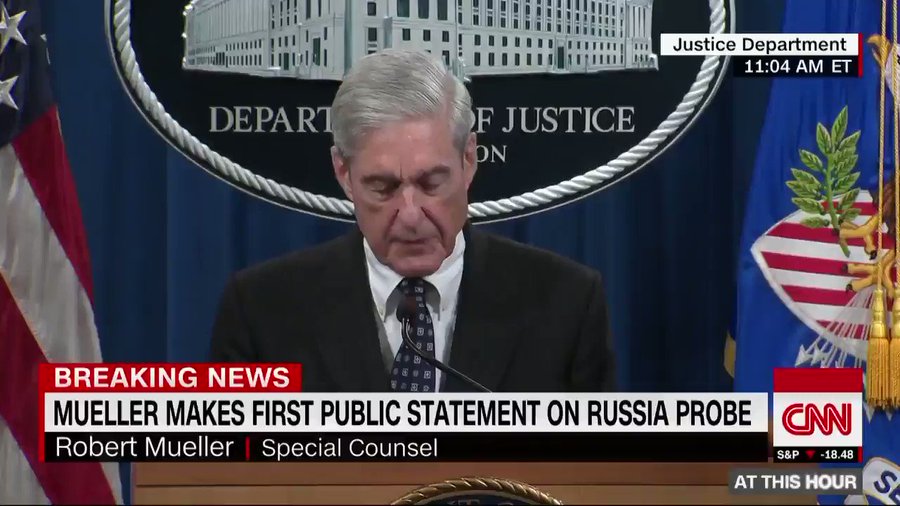
That’s what Mueller said at a press conference Wednesday—that he doesn’t think Barr conducted himself in bad faith. It was a stunning piece of counter-evidence against the claim Mueller is some kind of Honest Abe character. He might be squeaky clean, but it seems he’ll take on a smudge if it means protecting the institution of the Department of Justice—and, with it, the fading notion of the rule of law. Mueller spoke on Department property, symbolizing his commitment to Order, and largely refused throughout to speak about anything beyond the text of the Mueller Report. But there was one moment that stood out.

Embedded video

CNN Politics: Mueller: “If we had confidence that the President clearly did not commit a crime, we would have said so. We did not, however, make a determination as to whether the President did commit a crime”

Overall, this is an extension of the Mueller Report’s appeal to Congress, which goes something like this:

1) Justice Department regulations hold a sitting president cannot be indicted.

2) As a result, my team could not file charges against the president.

3) We did not accuse him of a crime without charging him, because then he would have no chance to defend himself in a court of law. It would be unfair.

4) Here is evidence of up to 10 incidents in which the president meddled in the investigation, many of which could rise to the level of obstruction of justice.

5) Congress has broad powers to investigate the president and hold him accountable for unacceptable or criminal conduct in office.

6) It is up to Congress to use the vast body of evidence laid out here to hold the president accountable by initiating impeachment proceedings.

In the time since, more than 450 former federal prosecutors have signed a letter attesting to the fact that if Donald Trump were not the president, he would be charged with obstruction. Mueller could not charge him, so Congress must. It was not a Witch Hunt, the report is not a COMPLETE EXONERATION or NO COLLUSION or NO OBSTRUCTION. There was collusion, but that’s not a crime. There was evidence of conspiracy, but it did not rise to a level where the special counsel sought charges against members of Trump’s campaign. And there was a huge amount of evidence that the president obstructed justice, but Mueller felt he could not charge him according to institutional norms.

Typically, the president responded with a lie:

Donald Trump: Nothing changes from the Mueller Report. There was insufficient evidence and therefore, in our Country, a person is innocent. The case is closed! Thank you.

Remember when it was a Deep State Coup that ended with a COMPLETE EXONERATION? It never made any sense, and now he’s saying something entirely different. It is time for Congress to act.

Jack Holmes is the Politics Editor at Esquire.com, where he writes daily and edits the Politics Blog with Charles P Pierce.

Trump is exactly what we feared he was.

act.tv

May 22, 2019

Jeff Daniels sees the writing on the wall. Trump is exactly what we feared he was.

Jeff Daniels on Trumpism

Jeff Daniels sees the writing on the wall. Trump is exactly what we feared he was.

Posted by act.tv on Wednesday, May 22, 2019

Memorial Day is to remember the fallen

Chicago Sun-Times

Memorial Day is to remember the fallen

No harm in having a picnic, but keep in mind the day’s purpose. “It’s not a happy day,” vet says.

By Neil Steinberg       May 26, 2019

Tom Dier in Vietnam in 1970. He’ll be speaking in Northbrook at its Memorial Day commemoration Monday. Photo provided by Tom Dier


The Jerry Corp Memorial Highway is not long. A section of U.S. Highway 160, it runs two and a half miles through Ozark County, Missouri, 250 miles southwest of St. Louis.

A green highway sign flashes by, the name registers and some drivers may feel a passing curiosity: does anybody remember Jerry Corp?

Tom Dier remembers him.

“We weren’t really close or anything like that,” said Dier, 70. “He wasn’t in my platoon.”

A mortar platoon in Company C, First Battalion, 52nd Infantry. Corp was a radioman attached to the command post in Quang Ngai province Vietnam.

“We got to know each other that way,” said Dier, who grew up in Northbrook and has returned home to speak at the northwest suburb’s Memorial Day commemoration after the parade Monday. “You didn’t really get close to people too much.”

In fact, Dier has exactly one memory of Corp, but it’s a good one.

“Someone on the perimeter called in for a routine fire mission, asking for illumination,” Dier plans to say in his speech. “I dropped a round down the 81-millimeter mortar tube. The shot went out, and we waited for the familiar pop and the subsequent intense light that the round would provide as it drifted slowly back to the ground for several hundred feet in the air.

“The descending illumination revealed a nearby hillside covered in jungle. Jerry and I laughed as the flare drifted toward the hillside, watching a multitude of chirping birds who mistook the flare for a sunrise. The noise from the birds stopped suddenly—as if a switch had been flipped—when the flare burned out.”

That’s it. And if you’re wondering how Dier would remember such a small moment with a stranger in a long-ago war in a far-off country, it’s because Corp was killed the next day—his platoon was trying to flush out a sniper, and in the confusion Corp stepped on a Vietcong boobytrap attached to a grenade. It was April 21, 1970, one week after his 20th birthday.

“Beyond that night, it’s hard to remember too much about Jerry.”

Dier was drafted at Christmas, 1968. He spent 10 months and 29 days in Vietnam and won the Silver Star for gallantry. He moved to Tennessee in 1972, worked as a house painter and raised three boys.

“All very responsible citizens,” he said. “One thing I taught them is how to work.”

Like many Vietnam veterans, he at first tried not to think about the war, but eventually circled back, writing a book about his experiences, “Miss Li Thi Van & Other Stories of Vietnam.”

How, I wondered, did the memory of those who died affect his post-war life?

“I wasn’t a great fan of the war,” Dier replied, “but I have never felt that the country owed me anything because there were a lot of guys who didn’t come home. There was one guy, he lost both arms and both legs; I feel guys like that really pay the bigger price. I never was wounded. I did what I was supposed to do, but I never felt I was owed anything, because other guys paid a much steeper price. I feel very blessed I made it.”

And how should the American public mark Memorial Day?

“There’s no harm in having a picnic,” Dier said. “But I don’t like when people say ‘Happy Memorial Day.’ It’s not a happy day, it’s a very solemn day for me. The guys who sacrificed, they paid the ultimate price.”

Dier mentioned a scene in “Saving Private Ryan,” where a surviving vet is asked if he lived the type of life that justified his surviving.

“His friends who didn’t survive, did his life honor them?” Dier said. “I’ve often thought of that. When I first came home, I wasn’t living the right way. Eventually I had a different way of looking at things, I really appreciated I survived. I didn’t have self-pity. I was blessed. I thought, ‘There has got to be a reason I made it, today.’ I realized I had a purpose.”

One of the things Dier felt he had to do was visit Jerry Corp’s mother, Irene, in Ozark County.

Tom Dier with Irene Corp, whose son Jerry died in Vietnam, one week after his 20th birthday. Photo provided by Tom Dier


“We never got used to Jerry not coming home,” she told him. But Jerry’s mother, now 92, also said something else.

“Irene has mentioned that she lost her son but, at the same time, she gained many sons”—Corp’s former comrades who call, write, visit, keep tabs.

“There are things we can do or say that make a difference,” Dier said.

Wild Rice is Feeding Indigenous Communities in Detroit and Beyond

Dedicated tribes are working to protect and revive Manoomin, weaving it back into Native diets and the fabric of the community in the Upper Midwest.

By Jo Erickson, Health, Indigenous Foodways     May 27, 2019

Civil Eats is a sponsor of the Feet in 2 Worlds journalism workshopTelling Immigrant Food Stories, taking place in San Francisco May 31-June 2. This article originally appeared in the Feet in 2 Worlds Magazine, and is reprinted with permission.

When Renee Dillard tastes freshly cooked wild rice harvested by her hands, she feels a spiritual connection to the “sacred food” of her people. That spell is broken when she tastes the wild rice that most of us buy and eat.

Native wild rice, often referred to as Manoomin, which means “the good berry” in Ojibwe, isn’t the perfectly uniform dark brown long grains you find in supermarkets. Although it has the same name, much of that rice is commercially grown and has been genetically engineered. Just because the label says it’s wild, that’s not always true. Native wild rice, with flecks of brown and yellow, has a grass-like quality and a subtle flavor.

“As soon as I put that mass-cultivated rice on my tongue I can taste the emptiness,” Dillard says. “This food is soulless. It doesn’t fill me with life or joy, but reminds me of caged chickens who never see the light of day, nor touch the ground . They don’t know who they are. This rice is empty.”

Renee Dillard parching wild rice

Renee Dillard parching wild rice. Photo by Jo Erickson.

Dillard is a traditional ricer and basket weaver from the Little Traverse Bay Bands of Odawa Indians, based in the northern part of the state. Through spoken word she has learnt about the ancestry of wild rice from elders in her community.

Dillard is a survivor of the U.S. government boarding school experiment to “Americanize” her and her community. “I’ve been kidnapped, abused and robbed of language, culture and everything that makes me who I am,” she says.

Now in her 50’s, she teaches the next generation the traditions of weaving with wild rice stalks and stewardship of the land and lakes. During last winter’s Arctic freeze that covered most of the Midwest, Dillard was out in the woods with her long grey hair fighting the wind, her traditional moccasin shoes knee-deep in the snow, observing the changes of the seasons. With the arrival of spring, the 57-year-old waits for the first shoots of wild rice.

Dillard remembers when she was very young she’d walk to the edge of reservation and there would be wild rice growing. But with urban development, pollution, and the threat of GMO seed contamination, native wild rice is struggling to survive. Dillard is part of a movement to restore wild rice in Michigan.

For the past 10 years several tribes, including the Little Traverse Bay Bands of Odawa Indians, and the Lac Vieux Desert Band of Lake Superior Chippewa Indians have come together to form Michigan’s wild rice restoration project where they can track and restore native wild rice in the state’s rivers and lakes.

Indigenous People Living in Detroit Connected to Wild Rice

Shiloh Maples, 33, lives and works in the heart of downtown Detroit. She brings her passion for Native foods to city streets, food banks, and community gardens. Working for American Indian Health Family Services she helps provide food relief to Native Americans and other struggling communities living below the poverty line. As the program manager for food sovereignty and wellness, her mission is to develop the concept of food sovereignty.

Marginalized communities are empowered to have a stake in the food system, to control what they eat, and how they eat it. About seven years ago Shiloh noticed that a lot of families relied on local corner stores for their food or food stamps. With limited finances and no transportation, struggling families had to make do with whatever food they had access to. Often it was canned foods and junk food.

Under the program Shiloh manages they have a choice. Native Americans can get traditional, culturally appropriate foods including wild rice soups, berries, fish and turkey.

Shiloh’s work on food sovereignty within the indigenous community has led her to develop community gardens in Romanowski Park that grow traditional foods, and cooking classes to rediscover traditional Native American meals. “As the community garden grew, the community realized that they cared about how their food was grown,” she said. “Was it done in an ethical way? Did it respect mother earth? They wanted to make sure that culture and tradition were part of how their food is produced. So that means incorporating song and ceremony and prayers to the planting and harvesting.”

With the help of Shiloh’s project poverty-stricken families feel they can make life-changes. “It’s exciting to watch. They’re making connections of where their food comes from and their relationship to that food. That changes people, ” she said.

Food offers an emotional connection to urban tribes-people in cities including Detroit, Seattle and Chicago who are looking to strengthen bonds to family and cultural roots.

Shelley Means, 55, is one of the many city dwelling tribes people who see traditional meals and sharing stories over food as keys to unlock history and family traditions. Shelley’s mother is from the White Earth Nation and her father was Lakota. She grew up in the city knowing very little of her family history.

As a young girl she recalls that her grandfather would send packets of wild rice and occasionally they would visit him for gatherings in Bemidji, Minnesota. She realized that some of her most powerful childhood memories are gatherings where hundreds of tribe members gathered for meals with bowls of wild rice. “I can’t remember much about the reason for the gathering, but I do remember the smell and taste of wild rice,” she recalls.

A boat-sized haul of wild rice.

A boat-sized haul of wild rice. Photo by Jo Erickson.

These memories drove Shelley to seek out family members who could tell her more about her family and traditions. One of her aunts told her what she knew so that Shelly could in turn pass on family history to her son.

Whenever she thinks about wild rice, she thinks about her family. She smiles as she recalls how her uncle would grind the grain to make bread and her mother prepared wild rice, “She’d heat it up in the microwave, then put a bit of milk and black pepper, that’s her favorite thing.”

Threats to Wild Rice

According to Barb Barton, Aquatic Resource Specialist at the Michigan Department of Transportation, restoring native wild rice across the state will take several years to accomplish.

One of the biggest challenges is the decimation of wild rice found in the north of the state. “There were 212 historical wild rice sites scattered across the state dating back to the 1800’s, but only 14 are known to still exist,” says Barton, author of “Manoomin: The Story of Wild Rice in Michigan.”

Zizania palustris, a native wild rice plant found in northern Michigan, is on the threatened species list. In the last two years Michigan’s Department of Natural Resources has worked with tribes to restore some of the old rice sites.

In Michigan wild rice harvesting is unregulated. That’s in contrast to Minnesota and Wisconsin, where state laws give tribes sovereignty over wild rice. Tribal members carry permits to harvest rice and non-tribal ricers buy licenses. Despite these challenges, Michigan’s wild rice restoration project has replanted and manages 136 native wild rice beds. At the same time more and more urban tribes people are rediscovering the value of returning to a traditional diet of wild rice.

There is still a long way to go before northern wild rice is taken off the threatened species list. If Michigan were to lose its native wild rice, “it would be devastating,” says Shelly Means. “The stories will still be here, but the rice will not.”