‘They’re killing us,’ Texas residents say of Trump rollbacks

Associated Press – U.S.

‘They’re killing us,’ Texas residents say of Trump rollbacks

Ellen Knickmeyer, A.P.        April 19, 2020
‘They’re killing us,’ Texas residents say of Trump protections rollbacks.

HOUSTON (AP) — Danielle Nelson’s best monitor for the emissions billowing out of the oil refineries and chemical plants surrounding her home: The heaving chest of her 9-year-old asthmatic son.

On some nights, the boy’s chest shudders as he fights for breath in his sleep. Nelson suspects the towering plants and refineries are to blame, rising like a lit-up city at night around her squat brick apartment building in the rugged Texas Gulf Coast city of Port Arthur.

Ask Nelson what protection the federal government and plant operators provide her African American community, and her answer is blunt. “They’re basically killing us,” says the 37-year-old, who herself has been diagnosed with respiratory problems since moving to the community after Hurricane Harvey in 2017.

“We don’t even know what we’re breathing,” she says.

The Texas Gulf Coast is the United States’ petrochemical corridor, with four of the country’s 10 biggest oil and gas refineries and thousands of chemical facilities.

Residents of the mostly black and Latino communities closest to the refineries and chemical plants say that puts them on the front line of the Trump administration’s rollbacks of decades of public health and environmental protections.

Under President Donald Trump, federal regulatory changes are slashing requirements on industry to monitor, report and reduce toxic pollutants, heavy metals and climate-damaging fossil fuel emissions, and to work transparently with communities to prevent plant disasters — such as the half-dozen major chemical fires and explosions that have killed workers and disrupted life along the Texas Gulf Coast over the past year alone.

And that plunge in public health enforcement may be about to get even more dramatic. Last month, Environmental Protection Agency administrator Andrew Wheeler, a coal lobbyist before Trump appointed him to the agency, announced enforcement waivers for industries on monitoring, reporting and quickly fixing hazardous releases, in cases the EPA deems staffing problems related to the coronavirus pandemic made compliance difficult.

Since then, air pollutants in Houston’s most heavily industrialized areas have surged as much as 62%, a Texas A & M analysis of state air monitor readings found.

EPA says it is balancing public and business interests in trimming what the Trump administration considers unnecessary regulations.

“Maintaining public health and enforcing existing environmental protections is of the upmost importance to EPA,” agency spokeswoman Andrea Woods said by email. “This administration’s deregulatory efforts are focused on rooting out inefficiencies, not paring back protections for any sector of society.”

But environmentalists call the EPA’s waiver during the coronavirus crisis the latest in a series of alarming moves.

“Traditionally less data and enforcement has never added up to cleaner air, water or land for communities of color and lower wealth communities,” said Mustafa Santiago Ali, head of the EPA environmental justice office under President Barack Obama.

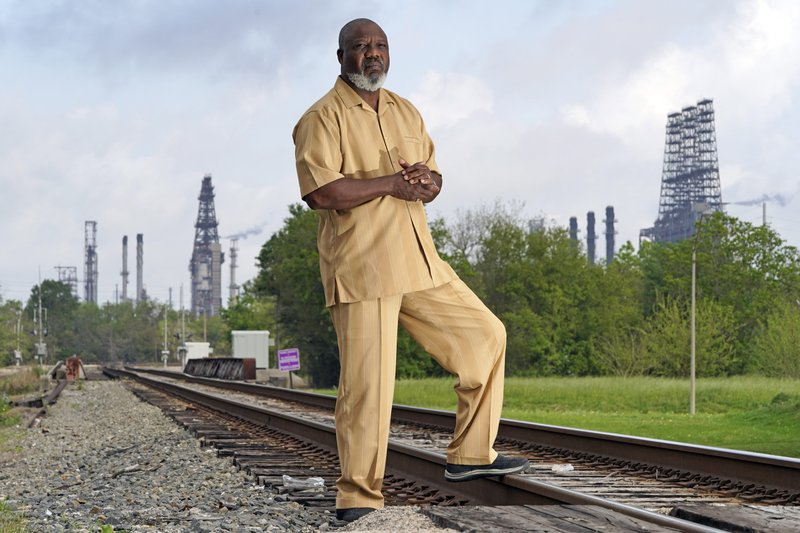
On the Texas Gulf Coast, African Americans under segregation were shunted to low-lying coastal areas prone to high water — literally on the wrong side of the tracks, Port Arthur activist Hilton Kelley says. bumping over those rails on a tour of his industrial neighborhood. As Texas towns grew, refineries, interstates and other, dirtier industries moved to those areas.

Stopping at the site of a razed public housing project where he was born in a bedroom looking out on the refineries, Kelley recalls, “always hearing about someone dying of cancer, always smelling smells, watching little babies using nebulizers.”

During the Obama administration, Kelley traveled to Washington for signing ceremonies for rules tightening regulations on pollutants and other health threats, and requiring industries to do more to report hazardous emissions. These days, Kelley’s trips to Washington are to protest rollbacks relaxing those rules.

”That’s a death sentence for us,” Kelley says, driving past the the sickly yellow light of a refinery burning off methane gas. “Now we may not drop dead that day,” he says. “But when you’re inundated day after day…we’re dead. We’re dead.”

In Houston, one of the country’s largest cities without zoning rules, the exposure to toxins is compounded. In Hispanic Galena Park, a developer this year fracked an oil and gas well just hundreds of yards (meters) from a school. In another Hispanic community, Manchester, chemical storage tanks tower over single-story frame homes, encasing all but their porches and driveways.

Before dawn one day last month a headache-inducing chemical stench suffused the neighborhood as a child waited for a school bus. An Immigration and Customs Enforcement vehicle rolled by. Latino residents, afraid of attracting official attention, lay low and don’t often complain, resident and activist Juan Flores says.

Even before the Trump administration began the rollbacks, Houston’s urban freeways and industries were pumping enough poisonous refinery chemicals, heavy metals, and diesel and car exhaust to “almost certainly” be to blame for some respiratory problems and early deaths, as well as an “unacceptable increased risk” for cancers and chronic disease, concluded a landmark city task force, started in 2005 to study the health impacts.

Residents of some predominantly minority Houston neighborhoods face at least three times the cancer risks of Americans overall, according to a 2014 EPA assessment, the most recent available.

Last year, state health officials confirmed a cancer cluster in one African American Houston neighborhood where residents had for years complained that creosote from a former rail yard was killing multiple members of families. One woman drove around with a mock human skeleton in her passenger seat to try to draw attention to the deaths.

Among other health harms, Houston’s African American families, many of them in neighborhoods near one of the nation’s largest clusters of petrochemical plants, report twice as many asthma cases as the city’s white families, according to a federal government study.

One recent day, 50-year-old Felicia Lacy hummed a hymn in the early-morning darkness as she nuzzled her 4-year-old granddaughter, Kdynn, who lay in bed with a plastic oxygen mask on her face. Lacy wakes the girl at 5:30 a.m each morning for an hour of asthma treatment.

Lacy blames Houston’s polluted air for the asthma-related pneumonia that killed a son at 27, and for the little girl’s asthma and her own. She takes her own turn at the nebulizer after she gets the child off to preschool.

Lacy doesn’t often allow Kdynn and another grandchild play outside, no matter how much they plead.

“I can’t have it happen to them,” she says, referring to her son’s asthma death. “Not on my watch.”

In 2017, Hurricane Harvey released hundreds of millions of gallons of contaminated industrial products and hundreds of tons of air toxins. Low-lying black and Latino neighborhoods were devastated, including Galena Park, which for days became an island cut off by a half-billion gallons of toxic industrial wastewater.

Over the past year, additional chemical disasters have been similarly life-changing.

“Boom! Boom! Boom!” resident Cruz Hinojosa says, describing life in Galena Park.

Six major chemical plant and facility fires and explosions in the area since March 2019 have killed at least four people, destroyed hundreds of homes and sent tens of thousands of people fleeing or hunkering down under shelter-in-place orders. The disasters poured cancer-causing xylene, benzene and other petrochemicals into the air, nauseating residents.

Port Arthur and Houston residents say it’s difficult to find out from authorities what they’re breathing and how bad it is.

After Hurricane Harvey, EPA and state officials declined to have a NASA monitoring plane gauge the threat from chemical releases. An EPA internal watchdog faulted authorities’ failures in tracking toxic releases, which included turning off air monitors to protect them from damage.

A joint investigation by The Associated Press and Houston Chronicle a year later found the toxic contamination far more widespread and extensive than authorities reported.

Woods, the EPA spokeswoman, said the NASA offer came more than two weeks after Harvey made landfall, and at a time when EPA and Texas environmental regulators were going out day and night with hand-held monitors and other equipment to gauge hazardous emissions.

“Any assertion that EPA’s decision not to accept NASA’s flight offer obstructed information-gathering that would have helped Houstonians, particularly those in low-income communities near industrial facilities, is misleading and does not reflect the more effective monitoring efforts that were in place,” Woods wrote.

Three years after Harvey, community activists have taken monitoring into their own hands.

Last month, Bridgette Murray, a retired nurse and community leader in Houston’s African American community of Pleasantville, snapped cellphone pictures of neighborhood volunteers erecting the last of seven new air monitors, given to the community by an environmental group.

In Galena Park, Flores, the activist in that Latino community, is moving on a project to install air monitors at schools, after toying with the idea of giving each schoolchild a monitor to dangle off their backpacks.

The aim of the monitors, Flores says, is not to warn children when the air is unsafe for them to play outside, but to alert them when plant emissions are low enough to make outside activities safe.

“We have to defend ourselves,” Flores says. “Because the federal government isn’t going to do it.”

How billionaires’ short-term greed could upend America and destroy their own wealth

Raw Story

How billionaires’ short-term greed could upend America and destroy their own wealth

By Thom Hartmann, Independent Media Institute       April 17, 2020


The coronovirus crisis is highlighting how dysfunctional states run by Republicans are. This is a feature of GOP rule, not a bug.

For the past 40-plus years, a group of “conservative” billionaires have been working as hard as they can to reshape our federal government from one that provides education, health care, housing, food and other necessities into one that does nothing more than run the military and fight wars.

It’s time to give them what they’ve worked so hard to get.

In the process, “blue states” can continue to flower and prosper, while “red states” go back to their pre-Civil War poverty and local oligarchies. All it’ll take is a small tweak to our federal system, something that the billionaires have been pushing for since the 1970’s.

First, end the federal income tax, as David Koch called for when he ran for vice president in 1980. Most billionaires don’t pay much (if anything) into it anyway; as economists have documented and the New York Times (among others) reported, in 2019 billionaires paid a lower federal tax rate than anybody—including the working poor, the bottom 50 percent of American households.The federal income tax has become a massive annual transfer of wealth from blue states to red states. Just let it go, so the states can raise their own taxes to take care of their citizens without having to subsidize other states.

“Taker” Mississippi, for example, gets about 40 percent of its total budget in federal funds taken from “maker” blue states, with fully 24 percent of its residents being fed via the federal food stamp program (compared to 10 percent of Californians). If they’re so gung-ho about “states’ rights” when it comes to denying citizens the right to vote or to get a safe abortion, or putting limits on carrying assault weapons, why not give them the “right” to pay for their own social programs?

Education, housing, food stamps, health care, and pretty much every other program funded by the income tax (Social Security has its own separate tax and fund) can be picked up by the states. Ending the federal income tax (and leaving the federal government with tariffs and fees to pay for the military, as we did from the founding of the republic up until World War I) would give the states lots of elbow room.

Take away the 30 percent or 40 percent (for the top income brackets; or, before Reagan, even 91 percent to 70 percent on a progressive sliding scale) federal tax rate, and the states can then raise their state income taxes to those levels. Blue states, no longer having to subsidize red states via the federal government, can easily pick up all the social safety net costs and have enough money left over to build a multi-state world-class coronavirus-resistant nonprofit hospital system.

To make things easier, the blue states need to enter into a compact like several New England and Mid-Atlantic states did to control greenhouse gases, a move emulated by California, Oregon and Washington.

For a project this large, though (particularly if it includes a single-payer health care system), it’ll take all of the blue states: an interstate compact including the New England and Mid-Atlantic states, the West Coast states, and the few remaining blue states in the Midwest like Illinois and Minnesota. And with their “pact” to decide when and how to open their states after the coronavirus crisis ends, numerous blue states have already laid the foundation for exactly this.

America’s wealthiest billionaires, including Walmart’s Walton family, the Kochs, and Jeff Bezos, have famously worked to gut the right of workers to form unions; fine, let them have their federal “right to work for less” law. But don’t forbid the blue states from enforcing union rights; they’re the key to the prosperous middle class America had between the 1940’s and Reagan’s election in 1980, and blue states are all about prosperity.

When the red states start to collapse or see a mass exodus of their people to blue states, let them join the compact but, as with the European Union, only if they agree to the terms of the Blue State Compact: higher taxes and fully funded health, education and welfare programs, as well as high-functioning infrastructure to support modern business activity.

Pick your metric:  Livability, family-friendliness, quality of health care, quality and availability of education, “personal freedom,” economic strength, job growth, business climate, worker rights… in nearly every case, blue states outrank red states, and often by a huge margin.

While the variation in GDP growth between the world’s top 20 economies averages around 1.75 percent, America’s blue states have grown 3.5 percent more than red states since the Great Recession. Blue states can definitely take care of themselves.

As part of their interstate compact, blue states could even define their own regulatory programs to keep their air and water clean and their food and drugs safe, as California has done for years with auto emissions. Without their taxes being sucked away to red states, the Compact can afford to create its own versions of the FDA, EPA, USDA and OSHA.

Ending the federal income tax (or dialing it back to functional meaninglessness) and creating an interstate compact like this would require a few steps, but they’ve been followed numerous times in American history.

The federal income tax, authorized in 1913 by the 16th Amendment, has been raised and lowered repeatedly in the more than 100 years since its inception. It’s been as low as a single-digit percent and as high as 91 percent. Given that the GOP has been begging for years to cut it as much as possible, if the Democrats in Congress were to offer to cut it to 1 percent or whatever minimum would, along with tariffs and fees, provide for the core functions of government (Army, Congress, SCOTUS, White House, etc.), it’s hard to imagine that the Republicans could say no.

Similarly, although Section 10 of Article I of the Constitution says, “No state shall, without the consent of Congress, … enter into any agreement or compact with another state,” that consent hasn’t been routinely withheld when interstate compacts were formed to do everything from controlling pollution to disposing of nuclear waste. This should be a viable idea.

Speaking to a group of 450 billionaires and multimillionaires, Charles Koch, in 2015, compared their struggle to that, according to the Washington Post, of “Frederick Douglass, Susan B. Anthony and the Rev. Martin Luther King Jr.” Not to mention George Washington.

“Look at the American revolution,” Koch said, “the anti-slavery movement, the women’s suffrage movement, the civil rights movement. All of these struck a moral chord with the American people. They all sought to overcome an injustice. And we, too, are seeking to right injustices that are holding our country back.”

A staple argument among America’s conservative uber-rich, going all the way back to their reaction to Brown v. Board of Education in the 1950s, has been that the federal government needs to stop interfering with states, and that federal regulations and subsidies are distorting markets and holding back “the magic of the free market.”

They tried their experiments with Chile and Russia, “libertarianizing” those nations’ economies, and the results were less than spectacular. Perhaps they can do better with the states they already control (via Charles Koch’s ALEC, for example) once those states are unencumbered by federal taxes, regulations or the “stifling” effect of federal welfare and subsidy programs.

The right-wing billionaire definition of “freedom” includes the right to poverty, the right to die without health care, the right to be uneducated and illiterate, and the right to be hungry and homeless. Red states seem to like this, since they repeatedly vote for it; we should let them have it.

Thom Hartmann is a talk-show host and the author of The Hidden History of the War on Voting and more than 30 other books in print. His most recent project is a science podcast called The Science Revolution. He is a writing fellow at the Independent Media Institute.

This article was produced by Economy for All, a project of the Independent Media Institute.

When it’s all over. A pandemic fantasy.

A chalk mural by Heather Gentile Collins outside Roscoe Village Pub in Chicago conveys an encouraging message for Chicagoans April 9, 2020.
A chalk mural by Heather Gentile Collins outside Roscoe Village Pub in Chicago conveys an encouraging message for Chicagoans April 9, 2020.(Antonio Perez / Chicago Tribune).

When it was all over, when the virus had retreated and the fear had faded, the people came out of their homes, and they were changed.

Changed by solitude. By gratitude. By grief.

They came out of little houses and big ones, out of apartments and rented rooms, to count their blessings and their losses. The virus hadn’t hurt everyone equally but it had hurt everyone somehow.

When it was over, they no longer greeted each other by shaking hands, though their hands were cleaner than ever. They hugged fewer people now, but most could not resist hugging the ones they loved; they wept to feel the pulse and warmth of the bodies they had missed so deeply. Others continued to keep their distance, and simply placed their hands over their hearts and bowed.

Can coronavirus spread through delivery? And other COVID-19 food questions answered

Is it safe to eat a meal handled by cooks and delivery people? Is it safe to go to the grocery store? We have your answers.

Some gathered for overdue mourning in honor of those who had died. So many had died. When it was over, the living understood more about death.

When they came out of their homes, they felt smaller, but in some ways stronger. Isolation had made them feel like pioneers, like immigrants, all of them displaced in time, removed from the familiar, aware that they would never return to the way they had lived before. Some had learned to bake, to sew, to properly clean. Many learned to live on less, though for those already living on little, less was even harder to bear.

In their renewed freedom, the people once again sat together at restaurants and bars and coffeehouses, though not as often as they once did, or as close, and rarely without a trace of fear. They laughed and told stories and gossiped, though every now and then someone would say, “It’s weird to be doing this again, isn’t it?” and, with a twitch, they would register that among the things they’d lost was the presumption of safety.

During their enforced isolation, some had dreamed they would go out dancing again, and they did.

By the time it was over, the concept of the weekend was dead. Some people still went to “the office” but there were fewer offices. The older people still looked for a newspaper on their doorsteps, but print newspapers, along with some online news outlets, had been among the casualties of the plague.

And their neighborhoods had changed. At first, they looked around and thought, “What used to be there?” Then they remembered that oh, yeah, it was that old family restaurant. Or that cute shop that sold things no one really needed but that made life more fun.

New businesses, mostly online, had been born while they were in exile, but they missed the old ones. Until, eventually, they forgot. Against the odds, a few bookstores hung on.

By the time it was over, some people were heftier because they’d been living on whatever weird food they could find on the scavenged grocery store shelves. Some were thinner for the same reason.

The ones who could afford bidet toilets bought them, because they never again wanted to worry about the toilet paper supply chain.

Men who had been clean shaven when the collective self-isolation began now wore shaggy beards. “If Pete Buttigieg can do it,” some said, “why not me?” Women whose hair had been a vivid color at the outset of the madness had gone gray. “What the hell,” some said. “It’s easier this way.”

Humor, they had learned, is an essential supply even during a pandemic, which was why Chicago Mayor Lori Lightfoot was leading in the presidential polls.

Yes, the people were sad, but in some ways happier, or at least wiser, than before.

Why had it taken so much pain for them to clearly see what and who they loved? To appreciate a slower life? To reconnect with old friends? To marvel at the beautiful places they’d once been able to travel to without fear? To listen to the birds?

Why had so many people had to suffer before more people understood the value of a government that works? The deadly danger of one that doesn’t? The profound inequities in health care and education and, well, everything?

They saw it all more clearly now, which was not to say they knew how to fix it.

They spoke with a new vocabulary: exponential, epidemiology, telemedicine, Zoom. More of them — not everyone, it’s never everyone — now believed in science.

Other things they had learned:

“Essential” does not mean “paid well.”

Schooling your own children is harder than it looks.

Crisis reveals the best in humans. And the worst.

Nature does not care what human beings want.

The sun still rises.

“We’ll never take so much for granted again,” they said. A few of them kept the promise.

Then time passed. Eventually those who remembered the Great Pandemic of 2020 were gone, and in some bar somewhere, a young person would say, “My great-grandfather died of some weird virus. Corvid or something? I don’t know exactly when, but can you imagine? Thank God that would never happen now.” And that young person would laugh, not knowing that one day, in their lifetime, a calamity previously unimagined would arrive and say, “Surprise.”

But that day is in the future. So is the day this calamity will be in our past.

Until then, we wait and hope and distract ourselves by wondering: What will it be like when this is over?

Mary Schmich is a columnist for the Chicago Tribune and winner of the 2012 Pulitzer Prize for commentary. A Georgia native, she has written her column since 1992 and was previously a Tribune national correspondent. She also teaches yoga, plays mandolin and piano, and co-hosts an annual holiday singalong at the Old Town School of Folk Music.

IMF chief says pandemic will unleash worst recession since Great Depression

Reuters

IMF chief says pandemic will unleash worst recession since Great Depression

By Andrea Shalal and David Lawder                 April 9, 2020
IMF chief says pandemic will unleash worst recession since Great Depression
IMF Managing Director Kristalina Georgieva speaks during a conference hosted by the Vatican on economic solidarity

WASHINGTON (Reuters) – The pandemic sweeping the world will turn global economic growth “sharply negative” in 2020, triggering the worst fallout since the 1930’s Great Depression, with only a partial recovery seen in 2021, the head of the International Monetary Fund said.

IMF Managing Director Kristalina Georgieva painted a far bleaker picture of the social and economic impact of the new coronavirus than even a few weeks ago, noting governments had already undertaken fiscal stimulus measures of $8 trillion, but more would likely be needed.

She said the crisis would hit emerging markets and developing countries hardest of all, which would then need hundreds of billions of dollars in foreign aid.

“Just three months ago, we expected positive per capita income growth in over 160 of our member countries in 2020,” she said on Thursday in remarks prepared for delivery ahead of next week’s IMF and World Bank Spring Meetings.

“Today, that number has been turned on its head: we now project that over 170 countries will experience negative per capita income growth this year.”

If the pandemic faded in the second half of the year, the IMF expected a partial recovery in 2021, Georgieva said, but she warned the situation could also get worse.

“I stress there is tremendous uncertainty about the outlook: it could get worse depending on many variable factors, including the duration of the pandemic,” she said.

The IMF, which has 189 member countries, will release its detailed World Economic Outlook forecasts on Tuesday.

The novel coronavirus that emerged in China in December has raced around the globe, infecting 1.41 million people and killing 83,400, according to a Reuters tally.

Georgieva said the pandemic was hitting both rich and poor countries, but many in Africa, Asia and Latin America were at higher risk because they had weaker health systems. They were also unable to implement social distancing in their densely populated cities and poverty-stricken slums.

She said investors had already removed some $100 billion in capital from those economies, more than three times the outflow seen during the same period of the global financial crisis.

With commodity prices down sharply, emerging market and developing countries would need trillions of dollars to fight the pandemic and rescue their economies, she said.

“They urgently need help,” she said, estimating hundreds of billions of dollars would have to be pumped in from outside sources since those governments could only cover a portion of the costs on their own, and many already had high debts.

Georgieva said it was encouraging that all governments had sprung into action, enacting some $8 trillion in fiscal measures and massive monetary measures.

To ensure a future recovery, Georgieva called for continued efforts to contain the virus and support health systems, while averting export controls that could slow the flow of vital medical equipment and food.

“The actions we take now will determine the speed and strength of our recovery,” she said.

It was critical to provide affected people and companies with “large, timely and targeted” measures such as wage subsidies, extended unemployment benefits and adjusted loan terms, while reducing stress to the financial system.

Coordinated fiscal stimulus was critical, and monetary policy should remain accommodative, where inflation remained low.

“Those with greater resources and policy space will need to do more; others, with limited resources will need more support,” she said.

The IMF was created for times like these, and stood ready to deploy its $1 trillion in lending capacity, Georgieva said.

The Fund’s executive board had approved doubling its emergency funding to $100 billion to meet the requests of over 90 countries, and staff were racing to process those requests.

The IMF was also looking at ways to provide additional liquidity support, including through creation of a new short-term liquidity line, and solutions that would allow lending even to countries whose debt was unsustainable, she said.

The IMF was also looking to increase its Catastrophe Relief and Containment Fund, which provides grants for the poorest countries to cover IMF debt service payments, to $1.4 billion from around $200 million, she said.

To further aid the poorest economies, the Fund and the World Bank were urging creditors such as China and other countries to temporarily stop collecting debt payments on their bilateral loans.

(Reporting by Andrea Shalal and David Lawder; Editing by Sam Holmes)

We’re Going to Need a Truth Commission Examining Trump’s Coronavirus Response

Esquire

We’re Going to Need a Truth Commission Examining Trump’s Coronavirus Response

All the bungling and temporizing and malfeasance in the administration*’s process needs a full airing.

By Charles P. Pierce                                March 26, 2020


White House Coronavirus Task Force Holds Daily BriefingDREW ANGERERGETTY IMAGES


Return with us now to those thrilling days of yesteryear, courtesy of Politicoback to when we had an actual president who was up to the actual job.

But according to a previously unrevealed White House playbook, the government should’ve begun a federal-wide effort to procure that personal protective equipment at least two months ago.

“Is there sufficient personal protective equipment for healthcare workers who are providing medical care?” the playbook instructs its readers, as one early decision that officials should address when facing a potential pandemic. “If YES: What are the triggers to signal exhaustion of supplies? Are additional supplies available? If NO: Should the Strategic National Stockpile release PPE to states?”

The strategies are among hundreds of tactics and key policy decisions laid out in a 69-page National Security Council playbook on fighting pandemics, which POLITICO is detailing for the first time. Other recommendations include that the government move swiftly to fully detect potential outbreaks, secure supplemental funding and consider invoking the Defense Production Act — all steps in which the Trump administration lagged behind the timeline laid out in the playbook.

Sounds like a handy thing to have lying around during a pandemic, no?

The Trump administration was briefed on the playbook’s existence in 2017, said four former officials, but two cautioned that it never went through a full, National Security Council-led interagency process to be approved as Trump administration strategy. Tom Bossert, who was then Trump’s homeland security adviser, expressed enthusiasm about its potential as part of the administration’s broader strategy to fight pandemics, two former officials said. Bossert declined to comment on any particular document, but told POLITICO that “I engaged actively with my outgoing counterpart and took seriously their transition materials and recommendations on pandemic preparedness.”

And good for you. Of course, the administration*, filled with All The Best People, ignored this document—which was drafted decades ago, in 2016.

An NSC official confirmed the existence of the playbook but dismissed its value. “We are aware of the document, although it’s quite dated and has been superseded by strategic and operational biodefense policies published since,” the official said. “The plan we are executing now is a better fit, more detailed, and applies the relevant lessons learned from the playbook and the most recent Ebola epidemic in the [Democratic Republic of the Congo] to COVID-19.”

The evidence supporting this contention is, of course, everywhere. And I do mean everywhere.

But under the Trump administration, “it just sat as a document that people worked on that was thrown onto a shelf,” said one former U.S. official, who served in both the Obama and Trump administrations. “It’s hard to tell how much senior leaders at agencies were even aware that this existed” or thought it was just another layer of unnecessary bureaucracy.

When this all settles down, we are going to need a truth commission to sort out all the bungling and temporizing and malfeasance that has been such a big part of this administration*’s response to the pandemic. And then maybe another one to sort out how we elected these characters in the first place.

Coronavirus is a fast-forward version of what will happen with climate change

Yahoo – Lifestyle

Coronavirus is a fast-forward version of what will happen with climate change

Ryan Cooper, The Week                       


The United States will shortly become the epicenter of the novel coronavirus pandemic, if it isn’t already. At time of writing some 60,653 American cases have been confirmed, and 784 people have died. It’s going to get much, much worse before it gets better — especially if President Trump goes ahead with his evident plan to open the country back up before the virus is controlled.

It’s very hard to get one’s mind around the scale of the developing calamity. But it also provides an important window into a potential future of unchecked climate change. The coronavirus pandemic is a warp-speed tutorial in what will happen if we don’t get our act together and slash greenhouse gas emissions.

The skyrocketing U.S. number of coronavirus cases and deaths is the direct consequence of President Trump’s previous inattention and delay months ago. By late December it was clear there was a major risk the virus was going to get out of China, yet Trump didn’t set up pre-emptive containment measures. He didn’t set up testing or quarantine facilities, and didn’t even shut down commercial travel from China until January 31, which was almost certainly already too late — and in any case his administration bungled the transportation of 14 infected Americans so badly that they may have seeded several outbreaks on their own.

As a result, the virus has been spreading in the wild in the U.S. since late January or early February, and the entire time Trump has dragged his feet on setting up an all-out response. He was slow to activate the Army Corps of Engineers, slow to get behind economic rescue plans, and slow to take steps to ramp up the production of tests. To this day he refuses to actually invoke the Defense Production Act to secure needed supplies of ventilators and other medical equipment, leading to chaos as states and foreign countries desperately bid against each other for what remains. Now hospitals are starting to be overwhelmed across the country, and the corpses are piling up.

This is what an uncontrolled, exponentially-accelerating crisis looks like on the ground: first slow, then all at once. Past procrastination and dithering means that once the seriousness of what is happening is undeniable, the worst effects can only be mitigated, not avoided.

Climate change is going to be exactly like this, only on a much longer time scale. Decades have passed with greenhouse gas emissions rising steadily, yet so far the carnage has been relatively modest. The sea level keeps inching up, biological systems are increasingly stressed, ordinary weather patterns keep getting more and more odd, and extreme weather disasters keep getting worse and worse, but so far most human societies have not been seriously threatened.

Absent gargantuan efforts across the world to wrench down emissions, in a couple decades that is going to change very fast. Normal weather patterns will simply not happen anymore. Some areas will suffer devastating drought, and others heavy precipitation — and some places, like California, will swing wildly between the two. Sea level rise will begin to swallow cities where hundreds of millions of people live. Extreme weather disasters — floods, tornado outbreaks, hurricanes, dust storms, and so on — will obliterate crops and crush cities around the world. Many biological systems will break completely, and food sources for billions of people will vanish. Hundreds of millions of refugees will stream around the world.

Indeed, there might well be additional outbreaks of pandemic diseases. Ancient pathogens are still alive in the Siberian permafrost, including anthrax, and possibly smallpox. As the permafrost melts, these could break out and infect a human population with no resistance.

All that is exceptionally grim. However, there may be a glimmer of hope in the response to this coronavirus epidemic. Outside of the United States and Brazil, virtually every country has thrown aside traditional political worries and attacked the pandemic with unprecedented speed and aggression. Concerns about national deficits, printing money, or increasing welfare benefits have evaporated in the face of a society-wide threat. Countries are outright nationalizing whole industries at the drop of a hat. Even in the U.S., after a primary season dominated by moronic “how are you going to pay for that?” concerns, Congress is casually debating a $2 trillion economic rescue package.

What we see is that when sufficiently motivated, countries really can transform themselves practically overnight. Whole continents have gone into emergency lockdown with as few people working as possible. Emissions are tanking with little transportation or production happening. The air around cities like Los Angeles is amazingly clear with so few pollution-spewing cars on the road.

A bold, world-wide climate policy would not be like the coronavirus response in the details or objectives, but the scale is about right. We need to radically transform our systems of manufacturing, energy, agriculture, and transportation, and it needs to happen as soon as possible. If we can completely overhaul whole countries in a matter of days to fight off a pandemic, we could do the same thing to forestall disastrous climate change. It’s just a question of political will.

Denmark’s Idea Could Help the World Avoid a Great Depression

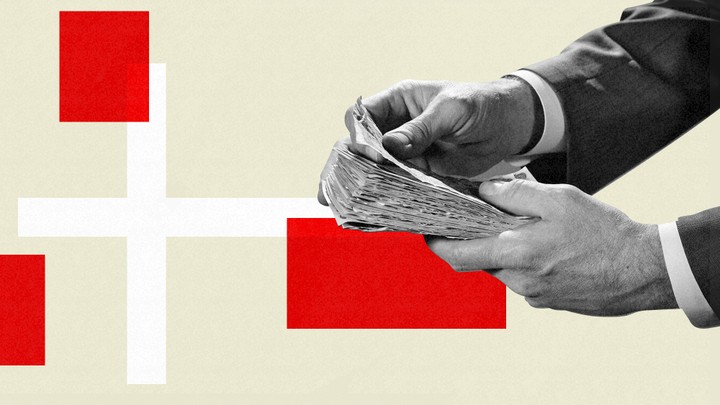
An illustration of money and the Danish flag.
H. ARMSTRONG ROBERTS / GETTY / THE ATLANTIC
 

While the White House and lawmakers haggle over the terms of an emergency economic-stabilization package, Denmark has gone big—very, very big—to defeat the unprecedented challenge of the coronavirus.

This week, the Danish government told private companies hit by the effects of the pandemic that it would pay 75 percent of their employees’ salaries to avoid mass layoffs. The plan could require the government to spend as much as 13 percent of the national economy in three months. That is roughly the equivalent of a $2.5 trillion stimulus in the United States spread out over just 13 weeks. Like I said: very, very big.

This response might strike some as a catastrophically ruinous overreaction. Perhaps for Denmark, it will be. But we are at a fragile moment in American history. The U.S. faces the sharpest economic downturn in a century, and statistics that seem impossibly pessimistic one moment look positively optimistic hours later. In weeks—even days—Denmark’s aggressive response could be a blueprint for how the world can avoid another Great Depression.

To find out more, I corresponded with Flemming Larsen, a professor at the Center for Labor Market Research at Denmark’s Aalborg University, over two days of emails and an hour-long Skype call. The following interview blends those conversations, which have been edited for length and clarity.

Flemming Larsen: Denmark has nearly entirely closed down universities, schools, public institutions, restaurants, museums, cinemas. No assembly of more than 10 persons is allowed. The borders have been closed too.

Thompson: Denmark’s government has announced a very aggressive plan to help workers in the next few months. Tell me what it’s doing.

Larsen: Denmark’s government agreed to cover the cost of employees’ salaries at private companies as long as those companies do not fire people. If a company makes a notice saying that it has to either lay off 30 percent of their workers or fire at least 50 people, the state has agreed to take on 75 percent of workers’ salaries, up to $3,288 per month. (This would preserve the income for all employees earning up to $52,400 per year.)

The philosophy here is that the government wants companies to preserve their relationship with their workers. It’s going to be harder to have a strong recovery if companies have to spend time hiring back workers that have been fired. The plan will last for three months, after which point they hope things come back to normal.

Thompson: So the government is offering to pick up the tab for workers whose employment is threatened by the downturn. Couldn’t companies easily defraud the government and collect the money anyway?

Larsen: Maybe, but the workers compensated are not allowed to work in the period. Workers staying with the company do not receive the 75 percent compensation.

Thompson: Some American economists say the U.S. should copy Germany’s work-sharing plan, Kurzarbeit, in which workers’ hours are reduced and then the government takes on part of workers’ salaries. Is Denmark’s plan like that?

Larsen: Not exactly. In the German plan, the government and the employer share the cost of paying for work. Here, the government is paying companies for employees who are going home and not working. These workers are being paid a wage to do nothing. The government is saying: Lots of people are suddenly in danger of being fired. But if we have firing rounds, it will be very difficult to adapt later. This way, the company maintains their workforce under the crisis and people maintain their salaries. You are compensating people even though they have to go home.

Thompson: I think I understand you, and I’m going to try to summarize, but tell me if this summary is wrong: Denmark is putting the economy into the freezer for three months. You’re saying: We know that all these people won’t be able to work for the next few months. It’s inevitable. Rather than do rounds of firing followed by rounds of hiring, which will delay the recovery, let’s throw the whole economy into a deep freezer, and when the virus winds down we can thaw it out and almost everybody will still be with the company they worked for in January.

Thompson: What else is Denmark’s government proposing?Larsen: There are a few things. To prevent the financial sector from shutting down, the state will guarantee 70 percent of new bank loans to companies. This will encourage more lending even in the case of more bankruptcies.

Also, people on unemployment benefits are put on pause. Typically, people have to go to meetings at job centers and make a certain number of job applications to receive jobless benefits. There are a lot of rules. But those rules are suspended for now. There are no requirements. The other part of the pause is that, while you can only be on unemployment benefits for two years in Denmark, people who pass that threshold will still receive benefits. Again, we are freezing everything.

Also, the state agreed to compensate companies for their fixed expenses, like rent and contract obligations, depending on their level of income loss. If they typically sell $1 million in a period, but now they can only sell $100,000, they lose 90 percent of their income. That will qualify them to receive large government help to cover fixed expenses.

Also, the spring payment of taxes for companies have been postponed until autumn, and all public employees will keep their salaries when sent home.

Thompson: This sounds incredibly bold and incredibly expensive. How much does the government expect this is going to cost?

Larsen: The cost is 287 billon DKK. [Over email, we worked out that this is the equivalent of approximately 13 percent of the country’s GDP. In the U.S., that would be about $2.5 trillion.]

Thompson: How does this response compare with what Denmark did during the global financial crisis in 2008?

Larsen: Back then, there was nothing at all at this scale. There was no huge amount of spending. The government was worried about public debt. There was a huge, long debate about whether Denmark should spend a lot of money at all. And Denmark had one of the highest increases in unemployment during the last crisis.

But today, the Danish economy is extremely strong. We have a huge surplus. We have a negative interest rate. There is a lot of public savings. So there is a lot of room to do this now. Also, the political environment has changed. We’ve tried to make higher investments in welfare spending in the last few years.

Thompson: It sounds like 10 years ago, there was a debate about stimulus. But today, everybody agrees that you just have to save the economy.

Larsen: Yes. They just want to save the economy. The philosophy is, if we don’t do it now, it will be more expensive to save the economy later. We’ve seen what the virus can do in Italy, in Spain. So I think people are very concerned. We are facing a huge, huge crisis.

Larsen: I have to say that the decision-making process in Denmark has been very extraordinary. We have 10 parties in Parliament. From the very left-wing to the really, really right-wing. And they all agree. There is nearly 100 percent consensus about this. And that’s really amazing. People are convinced that it’s wise to do this now.

Many of these policies are made as tripartite agreements between unions, employers’ associations, and the state. That’s because, in Denmark, most labor-market regulation is done by the unions and the employers’ associations. They regulate the labor market mainly through their own collective agreements. To make all this possible, you need the unions and employers’ associations to be a part of these agreements. That is very difficult. But they succeeded rapidly. In a matter of days, this was a signed agreement.

Thompson: Do you think it’s a good idea?

Larsen: I don’t know. Nobody knows for sure. This is unknown territory. I think it’s a good attempt. If you ruin people’s private lives and companies go bankrupt, it will take years to build this up again. So I think it’s a wise decision.

It’s Time to Quarantine the Crazy Coming Out of the White House

Esquire

It’s Time to Quarantine the Crazy Coming Out of the White House

Why even bother tuning in when all we get are unproven theories about left-wing conspiracies and unproven COVID-19 treatments?

By Charles P. Pierce          March 19, 2020

Coronavirus Task Force Briefs Press At White HouseCHIP SOMODEVILLA/GETTY IMAGES


The now-daily gathering of the Coronavirus SuperFriends on Thursday took the express bus to Crazytown, perhaps never to return. This is because they insist on telling El Caudillo del Mar-A-Lago where the briefing is and at what time it will be held. Can’t someone just lie to him about all that? First, out of the clear blue nowhere, the president* began promoting the use of the anti-malarial drug chloroquine as a possible therapeutic for COVID-19. This came as some surprise to the Food and Drug Administration, whose director was also on the dais today. From Bloomberg: 

The drug, chloroquine, hasn’t yet been approved for treatment of Covid-19, the disease caused by the new coronavirus. While it’s been available for decades for malaria, it’s not clear whether it will work against the new illness. A March 10 review of existing research found that there’s little solid proof one way or the other. During an at-times-confusing White House press conference, Trump said that chloroquine was approved for use and that he wanted to “remove every barrier” to test more drugs against Covid-19 and “allow many more Americans to access drugs that have shown really good promise.” “Normally the FDA would take a long time to approve something like that, and it’s — it was approved very, very quickly and it’s now approved by prescription,” Trump said. An FDA spokesperson said the drug had not been approved for use in Covid-19 patients. However, U.S. doctors are legally able to prescribe a drug for any illness or condition they think is medically appropriate.

At Thursday’s press conference, Trump and FDA Commissioner Stephen Hahn appeared to differ substantially about the status of the drugs being tested. Trump said chloroquine had been approved and could be given to patients by doctors with a prescription. “It’s been around for a long time, so we know that if things don’t go as planned it’s not going to kill anybody,” Trump said. Shortly thereafter, Hahn said that use of the drug would be in a controlled trial to find out whether or not it works, and if so, what dose would be safe and effective. “We want to do that in a setting of a clinical trial,” Hahn said.

Good god, get the hook.

But the presser didn’t go zooming off the rails until a “reporter” named Chanel Rion from One America News, the outlet that the president* watches when Fox News gets too Chomsky for him, chimed in from the izonkosphere:

On that note, major left-wing media, including some in this room, have teamed up with Chinese Communist Party narratives and they’re claiming you’re a racist for making these claims about Chinese virus. Is it alarming that major media who just oppose you are consistently siding with foreign state propaganda, Islamic radicals, and Latin gangs and cartels, and they work right here in the White House with direct access to you and your team?

(Media Matters has the 411 on Rion, and, well, wow.)

This gave the president* his cue to go off on a rant about how the Fake News is keeping the country from throwing him the parade his performance in office is due. It’s past time for the networks to decide whether or not these exercises in executive wankery are harmful to the general effort against the pandemic. It’s time to quarantine the Crazy.

Small Farms Also Struggle as Restaurants Shut Down Due to Coronavirus

Civil Eats

Small Farms Also Struggle as Restaurants Shut Down Due to Coronavirus

With the sudden closure of restaurants around the country, farmers are looking for new ways to feed their communities and stay afloat.


At Norwich Meadows Farm in upstate New York, Zaid Kurdieh and his wife Haifa grow varieties of vegetables coveted by New York City chefs. If this were a normal week, diners would be enjoying their produce at restaurants like Blue HillABC Kitchen, and Gramercy Tavern. Due to the coronavirus outbreak, however those restaurants are closed indefinitely—creating a dire situation for them and others like them. But it’s not just restaurant owners and workers who stand to suffer in the wake of the virus.

While it’s still unclear how all farmers will be economically impacted by the coronavirus, the situation is already affecting small-scale producers who sell into local markets.

“It’s unprecedented. I’ve never seen anything like this,” Kurdieh said, estimating that about 60 percent of his business depends on restaurants, and at this time of year, that number is closer to 75 percent. “We are figuring everything out day by day.”

The fate of farmers’ markets is still uncertain in many places, but COVID-19’s catastrophic effect on restaurants that buy from local growers is now assured. President Trump issued new guidelines on Monday that advised Americans to avoid groups of 10 or more people and called for governors in affected states to close restaurants and bars. Before that, governors in many states across the country had already ordered restaurants closed except for takeout and delivery.

Mayors in cities such as New York, Los Angeles, and Washington, D.C. all issued similar but varying directives. And in places where government officials haven’t stepped in, many restaurants are closing anyway, either out of necessity due to lack of customers or in service of the public interest to slow the spread of the virus.

“We really rely on restaurants,” Joe Schirmer, owner of Dirty Girl Produce, a 40-acre organic farm in Santa Cruz, California told Civil Eats on Monday. “[Those sales are] at zero. It’s totally done. There are no restaurants buying.”

The shuttering of institutions—especially schools—is also affecting small farms. As of March 16, 35 states had closed public schools.

Sky Island Farm's Kate Harwell. (Photo courtesy of Sky Island Farm)

Kate Harwell. (Photo courtesy of Sky Island Farm)

Kate Harwell grows vegetables, fruit, herbs, and flowers at Sky Island Farm in Grays Harbor, Washington, a couple of hours outside of Seattle. She had been structuring her whole season around starting a contract to sell produce to Seattle public schools starting in mid-April.

“We were basically going to be wholesaling a large percentage of what we’re growing to them. That was going to be a big chunk of money,” she said. Seattle schools are now officially closed through April 24, and Harwell hasn’t heard back from her district contact. “I’m sure she’s dealing with a lot right now,” she said.

Given the uncertainty around when schools will reopen, Harwell is now working with the assumption that she has lost that sales channel. Her goal is to make up the income by shifting gears and expanding her community supported agriculture (CSA) program, which she had previously kept small.

After she reopened it and began posting about it on Instagram, including a new offer for home delivery, her membership grew faster than it ever had before. “I got 10 sign-ups just yesterday,” she said.

And she’s not alone. Many farmers are pivoting from restaurant and institutional sales to sell directly to customers who are holed up at home. In New York, Kurdieh is ramping up online sales of his produce through the platform OurHarvest. In the Bay Area, which instituted a “shelter in place” order as of March 17, Schirmer is working on quickly putting together a “box” program with both pick-up and delivery options. (Essential activities including food shopping and medical visits are not restricted by the order.)

One of his oldest restaurant customers, Zuni Café, is helping put together a produce pick-up that will aggregate local food from Dirty Girl Produce and other farms they work with. In an Instagram post on Monday, the restaurant hinted at the initiative. “In the coming days we will be starting a new project that we are hopeful will keep our farmers connected to everyone,” they wrote.

Schirmer said there has been an outpouring of support from the local food community, and that keeping the business afloat will require his team to be extraordinarily nimble. “We’ve got food, we’ve got a crew, we’ve got trucks and infrastructure,” he said. “We’re just changing our business model on the fly.”

Emma Jagoz, small farmer at Moon Valley Farm.

Emma Jagoz. (Photo courtesy of Moon Valley Farm)

Like many East Coast farms, Moon Valley Farm, a favorite supplier for restaurants in Baltimore and Washington, D.C., would typically be gearing up to start its CSAseason in the coming weeks. But farmer Emma Jagoz announced on Saturday that the farm would begin “veggie home delivery,” offering a la carte CSA shares (rather than requiring a seasonal commitment) delivered to customers, starting this week.

Also in Maryland, Beckie Gurley owns the seven-acre organic fruit and vegetable farm Calvert’s Gift Farm with her husband, Jack. She also runs Chesapeake Farm to Table, a platform that has aggregated produce from local growers to sell to restaurants in Baltimore, including Rye Street TavernDylan’s, and Larder.

“Of course [the closures] are going to affect our bottom line,” Gurley said, but the cooperative is in a better position than it would be otherwise, because it already has the capacity to take online orders and offer home delivery. “We’re hoping the word gets out. In order to recoup the lost restaurant business, we hope that we can get these direct sales moving, and people realize we’re out there and how safe and available local food is.”

Gurley has also set up a pick-up point for produce orders in conjunction with a restaurant partner, Well Crafted Kitchen, that is continuing to operate a takeout business.

So far, farmers say the pandemic is not affecting them as much as it would during summer or fall, when most of their revenue generally comes in. But if it continues into peak harvest time, things are going to get much more difficult. “If this was peak season, this would be a disaster,” Kurdieh said. “We don’t know how this is going to turn out, but we’re planning [for summer] just as if it was a normal year, because I don’t know how else to do it.”

Depending on the length of the crisis, without restaurants and institutions, they may have to sell all their food directly to consumers.

“[We’re asking]: ‘How do we feed our communities?’ I think that’s the goal of every small farmer at this point,” Kate Harwell said. “If [global] commerce stops, we have to get our food from somewhere. I think people should absolutely start thinking about their local farmers, and I hope this puts them in a position to support them.”