More jobless workers sue their states for ending unemployment benefits early
Denitsa Tsekova, Reporter June 28, 2021
Workers in Indiana, Texas, and Maryland have filed lawsuits against their respective states for canceling pandemic-era unemployment benefits early, a growing movement that one expert said could be successful in some states.
Indiana was the first state where workers filed a lawsuit. On Friday, Marion Superior Court Judge John Hanley temporarily reinstated the federal unemployment benefits programs until a final ruling is made in the case.
“The decision by Judge Hanley was a breakthrough, as many states have similar state law provisions that could be brought up in court,” Andrew Stettner, an unemployment insurance expert and senior fellow at the Century Foundation, told Yahoo Money. “I expect more judges to be sympathetic to the facts in the cases.”
In Maryland, the Unemployed Workers Union on Thursday filed a class-action lawsuit against Gov. Larry Hogan’s order to end the federal programs on July 3.
“Our petition is that this order is illegal and a threat to the public welfare,” Alec Summerfield, an attorney representing the six jobless workers suing, said at a press conference on Thursday. “People are depending on these $300 even if it’s just for three months to carry them through to find a job and put food on the table.”
In Texas, a lawsuit was organized by two Facebook jobless workers groups with over 30,000 members. The temporary restraining order against Texas Gov. Greg Abbott filed by attorney David Sibley in Travis County District Court was denied on Friday, but the two groups intend to seek an injunction, according to reports.
Nearly 1 million Texas workers saw their benefits significantly reduced or cut down to zero after the state canceled the federal programs on Saturday. The state itself is losing $6.5 billion in benefits.
Texas Governor Greg Abbott attends a press conference where he signed Senate Bills 2 and 3 at the Capitol on June 8, 2021 in Austin, Texas. (Photo by Montinique Monroe/Getty Images)
Indiana, Texas, and Maryland are among the 26 states that eliminated or plan to eliminate certain expanded unemployment programs this month and early next month.
More than 4 million workers will see their benefits slashed by at least $1,200 a month, losing a total of $22.5 billion in potential benefits, according to estimates by the Century Foundation. Nearly 3 in 5 workers affected by the early expiration will be left with no benefits at all. The federal expiration is September 6.
The cut-off in benefits in those three states includes the extra $300 in weekly benefits, the Pandemic Unemployment Assistance (PUA) program for workers who don’t normally qualify for unemployment, and the Pandemic Emergency Unemployment Compensation (PEUC) program that provides extra weeks of benefits.
“Unemployed individuals made financial decisions based on a promised aid, and have been deeply harmed by the decision to cancel them,” Stettner said. “As the saying goes ‘there ought to be a law against that.’ And maybe the law is already against that.”
Toyota stands out with contributions to anti-election Republicans
Dozens of corporate PACs have donated to anti-election Republicans, but “Toyota leads by a substantial margin.”
By Steve Benen June 28, 2021
Visitors walk past a logo of Toyota Motor Corp on a Toyota Prius hybrid vehicle at the company’s showroom in Tokyo August 5, 2014. REUTERS/Yuya Shino/File Photo
Within a few days of the Jan. 6 attack on the Capitol, a handful of prominent companies said they would pause political contributions to congressional Republicans who voted to reject President Joe Biden’s victory. As regular readers may recall, many others soon followed — including Comcast, the parent company of NBCUniversal, which owns MSNBC (my employer).
The shift did not go unnoticed. Stuart Stevens, a longtime Republican strategist, told the New Yorker that Senate Minority Leader Mitch McConnell (R-Ky.), in particular, was “scared to death” of corporate America’s response to the insurrectionist violence.
The question, of course, was how long the pause would last.
In April, JetBlue was among the first to open its corporate wallet, making a contribution through the airline’s corporate political action committee to Rep. Nicole Malliotakis (R-N.Y.) — who, like most House Republicans, opposed certification of the results of the 2020 presidential election, even after the deadly insurrectionist attack. Soon after, major defense contractors also resumed support for the GOP’s anti-election wing.
But relying on data from Citizens for Responsibility and Ethics in Washington (CREW), Axios reported this morning that one company stands out as being especially generous toward Republicans who took a stand against their own country’s democracy.
Nearly three-dozen corporate PACs have donated at least $5,000 to Republicans who objected to certifying the 2020 election, yet Toyota leads by a substantial margin…. Toyota gave more than twice as much — and to nearly five times as many members of Congress — as the No. 2 company on the list, Cubic Corp., a San Diego-based defense contractor.
In a written statement, a spokesperson for the automaker said, “We do not believe it is appropriate to judge members of Congress solely based on their votes on the electoral certification.”
It’s a flawed defense. The bare minimum of public service in the United States should include respect for election results, and it’s a test these Republicans failed.
Toyota’s spokesperson added, however, that the company is being judicious: “Based on our thorough review, we decided against giving to some members who, through their statements and actions, undermine the legitimacy of our elections and institutions.”
That sounds like a step in the appropriate direction, though Toyota did not offer any specifics about the company’s “review” or who failed to meet the threshold.
We know, for example, that Rep. Andy Biggs (R-Ariz.), who reportedly helped organize the pre-riot “Stop the Steal” rally on Jan. 6, and who opposed Congressional Gold Medals to honor Capitol Police officers who protected the building during the pro-Trump riot, was among those who benefited from Toyota’s money.
Evidently, under Toyota’s “review,” the far-right Arizonan didn’t quite demonstrate an indifference toward “the legitimacy of our elections.”
It’s worth emphasizing for context that the amount of money at issue here is relatively modest: Toyota has donated $55,000 to 37 GOP objectors so far this year. To the typical American family, $55,000 is certainly a lot of money, but in the world of campaign financing, especially at the federal level, it’s a small drop in an enormous bucket.
But the more Toyota feels comfortable supporting anti-election Republicans, the more others are likely to follow, removing another layer of accountability for those who chose to defy democracy without remorse.
A paralyzing disease that can cause people to die within 4 years is spreading in part of Australia, and toxic algae blooms could be to blame
Andrea Michelson
A paralyzing disease that can cause people to die within 4 years is spreading in part of Australia, and toxic algae blooms could be to blame
A girl uses a stick to try and scoop algae from an algal bloom off the beach at Maumee Bay State Park in Oregon, OH on August 3, 2014. Ty Wright for The Washington Post via Getty
Certain parts of Australia have unusually high rates of motor neuron disease.
People with MND are progressively paralyzed and typically die 2-4 years after diagnosis.
Multiple factors cause the disease, and some scientists think toxic algae is one of them.
Algae blooms can cause a host of problems, from mass-murdering fish to poisoning the air we breathe.
In Australia and beyond, some researchers believe that harmful blooms of blue-green algae are linked to increasingly high rates of motor neuron disease, a condition which causes paralysis and early death.
Folks in the US might be familiar with ALS or Lou Gehrig’s disease, which is the most common type of motor neuron disease.
Motor neuron diseases progressively attack nerve cells, reducing one’s ability to speak, move, and breathe and typically killing patients within two to fours years after diagnosis, researchers told the Sydney Morning Herald.
Rates of deaths due to MND have risen 250 percent over the past 30 years in Australia, Macquarie University scientists told the Herald. MND sufferers and scientists are trying to understand why certain areas of the country have especially high rates, which led them to the algae theory.
Some algae blooms release harmful toxins into the water and air
Certain areas of Australia have curiously high rates of MND. Riverina, an agricultural region of New South Wales, has between five and seven times the national incidence.
The region is home to Lake Wyangan, a reservoir that frequently has outbreaks of cyanobacteria, or blue-green algae. The area around the lake is currently on red alert, meaning people should avoid fishing and swimming in the potentially toxic water, as well as drinking it.
Cyanobacteria are known to release a number of toxins, including a neurotoxin called BMAA. Some animal research suggests that BMAA could be one of many factors that leads to the development of motor neuron deterioration.
Researchers have found BMAA in other algae-infested waterways in the Riverina area, but they haven’t yet confirmed a link to MND. It’s likely that the neurodegenerative disease stems from a combination of genetic and environmental factors.
Even in genetically predisposed cases of MND, environmental stressors like algae blooms could contribute to the disease’s onset and progression, Dominic Rowe, chair of Macquarie Neurology, told the Herald. But more research is needed to better understand how those factors interact.
“Until we actually, systematically study the genetic causes and take them out of the environment, it’s hard to be 100 percent accurate about the environmental factors,” Rowe said.
‘Worst is yet to come’: Disastrous future ahead for millions worldwide due to climate change, report warns
Doyle Rice, USA TODAY
Millions of people worldwide are in for a disastrous future of hunger, drought and disease, according to a draft report from the United Nations’ Intergovernmental Panel on Climate Change, which was leaked to the media this week.
“Climate change will fundamentally reshape life on Earth in the coming decades, even if humans can tame planet-warming greenhouse gas emissions,” according to Agence France-Presse , which obtained the report draft.
The report warns of a series of thresholds beyond which recovery from climate breakdown may become impossible, The Guardian said. The report warns: “Life on Earth can recover from a drastic climate shift by evolving into new species and creating new ecosystems… humans cannot.
“The worst is yet to come, affecting our children’s and grandchildren’s lives much more than our own.”
Species extinction, more widespread disease, unlivable heat, ecosystem collapse, cities menaced by rising seas – these and other devastating climate impacts are accelerating and are bound to become evident in the decades ahead, according to AFP.
The IPCC’s 4,000-page draft report, scheduled for official release next year, offers the most comprehensive rundown to date of the impacts of climate change on our planet and our species, AFP said.
Climate change, also known as global warming, is caused by the burning of fossil fuels such as oil, gas and coal, which release greenhouse gases such as carbon dioxide and methane into the Earth’s atmosphere. Those greenhouse gases have caused our atmosphere to warm to levels that scientists say cannot be due to natural causes.
So far, since the Industrial Revolution of the 1800s, the Earth has warmed by 1.1 degrees Celsius (which is roughly 2 degrees Fahrenheit), according to NASA.
Coal-fired power plants such as the Homer City Generating Station in Pennsylvania emit carbon dioxide and other greenhouse gases that contribute to global warming.
The report warns of “progressively serious, centuries’ long and, in some cases, irreversible consequences.” The report also said that the millions of people who live along coastlines almost everywhere around the world could be battered by multiple climate calamities at once: drought, heatwaves, cyclones, wildfires and flooding.
Simon Lewis, a professor of global change science at University College London, told The Guardian that “nothing in the IPCC report should be a surprise, as all the information comes from the scientific literature. But put together, the stark message from the IPCC is that increasingly severe heatwaves, fires, floods and droughts are coming our way with dire impacts for many countries.
“On top of this are some irreversible changes, often called tipping points, such as where high temperatures and droughts mean parts of the Amazon rainforest can’t persist. These tipping points may then link, like toppling dominoes.”
In a statement following the leak of the report, the IPCC said that it does not comment on the contents of draft reports while work is still ongoing. The official report, designed to influence critical policy decisions, is not scheduled for release until February, AFP said.
California’s drought and wildfire dangers rising at stunning pace
Faith E. Pinho, Alex Wigglesworth
A home destroyed in the 2020 North Complex fire sits above Lake Oroville in Oroville, Calif. At the time of this photo, the reservoir was at 39% of capacity and 46% of its historical average. (Noah Berger / Associated Press)
California’s drought and wildfire conditions are accelerating at unprecedented rates, according to state officials, and residents should brace for a summer of widespread burning and mandatory water conservation measures in some regions.
As reservoir levels across the state continue to drop, and as parched vegetation poses an increasing threat of wildfire, officials in Sacramento and Southern California offered a bleak assessment of the state’s drying climate, saying it has already begun to affect people, plants and animals.
The current drought, which blankets the entire state and a broad swath of the western United States, according to the U.S. Drought Monitor, is already outpacing the state’s devastating 2012-16 drought, said Karla Nemeth, director of the California Department of Water Resources.
“It really wasn’t until year three or four when we saw these intense conditions … we’re now experiencing in the second year of the drought,” Nemeth said Friday. “That acceleration is really what’s new about this drought and what we’re working to respond to.”
California typically relies on the gradual melting of Sierra snowpack to fill its reservoirs, Nemeth said. But this year, the state saw record evaporation and record low runoff into streams and reservoirs.
It is “unprecedented in the breadth and severity of this regional drought,” said Wade Crowfoot, secretary of the state’s Natural Resources Agency.
At the same time, fire officials in Southern California warned that wildfire conditions are already like those typically seen in August and September.
“We’re seeing fires move fast,” said Chief Brian Fennessy of the Orange County Fire Authority. “Fires that normally would be an acre, 2 acres, 5 acres, so far this year are getting to 30, 50 and beyond.”
They’re also spreading more quickly, he said.
“We are seeing fire spread that is even stunning many of us that have been doing this for a very long time — fire spread that could quite easily surprise many of the citizens within this region,” he said. He urged people to evacuate as soon as they’re told to do so.
These dry conditions do not bode well for the Fourth of July weekend, when first responders will probably face their first big test as a predicted heat wave collides with amateur fireworks displays.
Last month, Gov. Gavin Newsom expanded a drought emergency to 41 California counties, covering 30% of the state’s population. On Friday, Santa Clara County declared its own local emergency, saying drought conditions were so extreme that water levels were not adequate to meet demand.
“The reality is we live in an arid region that will continue to experience droughts,” Jasneet Sharma, director of Santa Clara County’s Office of Sustainability, said in a statement. “There are many steps that we should all take, from large-scale conservation projects and household-level water conservation retrofits to simple household changes like turning off the faucet when you brush your teeth. Each one is an important part of sustainability.”
Water conservation is likely to ramp up, possibly becoming mandatory in some communities, said Joaquin Esquivel, chair of the State Water Resources Control Board.
“It’s not about conservation just because it’s drought. … We really need to see conservation and efficiency here as just [a] simple course of action that we must do, no matter if it’s dry or it’s wet,” Esquivel said.
Usually the natural world can adapt to gradual changes in the climate, but California’s conditions are changing so frequently that plants and animals are not able to keep up, said Chuck Bonham, director of California’s Department of Fish and Wildlife.
“They don’t have the luxury of adapting over millennia anymore; they’re being forced to adapt over a period of years,” he said.
The decrease in water levels has caused some rivers to heat up, becoming uninhabitable for some fish. Department of Fish and Wildlife teams recently removed almost 17 million Chinook salmon from four hatcheries in the Central Valley and released them into the ocean at places such as San Francisco Bay. The number of fish rescues has increased since the previous drought, Bonham said.
“We also know we’re going to end up serving as a Noah’s Ark,” he added, referring to a menagerie of animals kept at UC Davis until their environments become cool enough to live in again. “Every drop of water we can save as Californians is going to matter for people, but it’s going to matter for nature too.”
The drying also carries severe consequences for wildfire.
Live fuel moisture levels, which measure the dryness of vegetation, are on par with those typically seen in the late summer or fall, said Los Angeles County Fire Chief Daryl Osby, who serves as mutual aid coordinator for the region comprising Los Angeles, Orange, San Luis Obispo, Santa Barbara and Ventura counties.
The fire broke out in an area that hadn’t burned in 50 years and that was choked with drought-killed vegetation, he said. Because of the topography and dryness, it grew to more than 1,000 acres before firefighters were able to bring it under control, despite relatively calm winds.
“Our expectations are that during this summer, we’re going to have those types of fires and larger with just the winds off the ocean,” Osby said. “And then we’re really concerned moving into the fall months when we start getting our significant wind-driven fires.”
Officials have taken steps to prepare. When the forecast looks dire — for instance, if the National Weather Service issues a red-flag warning — the California Governor’s Office of Emergency Services works with local jurisdictions to pre-position extra firefighters, engines and aircraft and reimburses the governments for the added cost, said Cal OES Fire and Rescue Chief Brian Marshall.
“That gives us a fighting chance to catch the fires when they’re small,” he said.
Key to that is the prompt use of aircraft, which enables ground crews to then go in and extinguish the fires, Fennessy said. Southern California fire personnel have more aircraft available this year than in years past, including large helitankers that can fly at night, he said.
The California Department of Forestry and Fire Protection moved to peak staffing earlier this year, sooner than normal, and will maintain that level for the rest of the year, said Chief Glenn Barley, assistant region chief for Cal Fire’s Southern Region.
“Last year was the worst fire season we’ve seen in California,” Barley said. “At this point this year, we are ahead of those numbers for last year, both in terms of number of fires and number of acres burned.”
Yet fire officials said that while they’re well resourced, they still don’t have enough, particularly in light of the potentially historic fire season bearing down on the region.
“I will say that from my municipality to the state to the federal government, that we’re stretched. We’re busy,” Osby said, adding that local municipalities still have to go on medical calls — more than 1,000 a day in the case of his department — in addition to fighting fires. “None of us have all the resources that we need.”
He said L.A. County would normally have 24 inmate firefighting crews but is down to eight, as many were sent home from prison after the state granted them early release because of the pandemic. That has forced the department to dip into its budget to train more paid crew members, he said.
Meanwhile, the National Interagency Fire Center this week raised its preparedness level to 4, the second-highest, said Angeles National Forest Fire Chief Robert Garcia.
“The significance of that is that the last time we were in this preparedness Level 4 at this time of year was in 2002,” he said. “And prior to that, the last time was 1991.”
Republicans can win the next elections through gerrymandering alone
David Daley
Photograph: Saul Loeb/AFP/Getty Images
In Washington, the real insiders know that the true outrages are what’s perfectly legal and that it’s simply a gaffe when someone accidentally blurts out something honest.
And so it barely made a ripple last week when a Texas congressman (and Donald Trump’s former White House physician) said aloud what’s supposed to be kept to a backroom whisper: Republicans intend to retake the US House of Representatives in 2022 through gerrymandering.
“We have redistricting coming up and the Republicans control most of that process in most of the states around the country,” Representative Ronny Jackson told a conference of religious conservatives. “That alone should get us the majority back.”
He’s right. Republicans won’t have to win more votes next year to claim the US House.
In fact, everyone could vote the exact same way for Congress next year as they did in 2020 – when Democratic candidates nationwide won more than 4.7m votes than Republicans and narrowly held the chamber – but under the new maps that will be in place, the Republican party would take control.
How is this possible? The Republican party only needs to win five seats to wrench the speaker’s gavel from Nancy Pelosi. They could draw themselves a dozen – or more – through gerrymandering alone. Republicans could create at least two additional red seats in Texas and North Carolina, and another certain two in Georgia and Florida. Then could nab another in Kansas, Kentucky, Tennessee and New Hampshire.
They won’t need to embrace policies favored by a majority of Americans. All they need to do is rework maps to their favor in states where they hold complete control of the decennial redistricting that follows the census – some of which they have held since they gerrymandered them 10 years ago. Now they can double down on the undeserved majorities that they have seized and dominate another decade.
If Republicans aggressively maximize every advantage and crash through any of the usual guardrails – and they have given every indication that they will – there’s little Democrats can do. And after a 2019 US supreme court decision declared partisan gerrymandering a non-justiciable political issue, the federal courts will be powerless as well.
It’s one of the many time bombs that threatens representative democracy and American traditions of majority rule. It’s a sign of how much power they have – and how aggressively they intend to wield it – that Republicans aren’t even bothering to deny that they intend to implode it.
“We control redistricting,” boasted Stephen Stepanek, New Hampshire’s Republican state party chair. “I can stand here today and guarantee you that we will send a conservative Republican to Washington as a congressperson in 2022.”
In Kansas, Susan Wagle, the Republican party state senate president, campaigned on a promise to draw a gerrymandered map that “takes out” the only Democrat in the state’s congressional delegation. “We can do that,” Wagle boasted. “I guarantee you that we can draw four Republican congressional maps.”
Texas Republicans will look to reinforce a map that has held back demographic trends favoring Democrats over the last decade by, among other things, dividing liberal Austin into five pieces and attaching them to rural conservative counties in order to dilute Democratic votes. Texas will also have two additional seats next decade due largely to Latino population growth; in 2011, when similar growth created four new seats for Texas, Republicans managed to draw three for themselves.
North Carolina Republicans crafted a reliable 10-3 Republican delegation throughout the last decade. When the state supreme court declared the congressional map unconstitutional in 2019, it forced the creation of a fairer map in time for 2020. Democrats immediately gained two seats. But the state GOP will control the entire process once again this cycle, so those two seats will likely change side – and Republicans could find a way to draw themselves the seat the state gained after reapportionment.
Two Atlanta-area Democrats are in danger of being gerrymandered out of office by Republicans. The single Democratic member from Kentucky, and one of just two from Tennessee, are in jeopardy if Republicans choose to crack Louisville and Nashville, respectively, and scatter the urban areas across multiple districts. Florida Republicans ignored state constitution provisions against partisan gerrymandering in 2011 and created what a state court called a conspiracy to mount a secret, shadow redistricting process. It took the court until the 2016 election to unwind those ill-gotten GOP gains, however, which provides little incentive not to do the same thing once more. This time, a more conservative state supreme court might even allow those gains to stand.
Might Democrats try the same thing? Democrats might look to squeeze a couple seats from New York and one additional seat from Illinois and possibly Maryland. But that’s scarcely enough to counter the overall GOP edge. In Colorado, Oregon and Virginia, states controlled entirely by Democrats, the party has either created an independent redistricting commission or made a deal to give Republicans a seat at the table. Commissions also draw the lines in other Democratic strongholds like California, Washington and New Jersey. There are no seats to gain in overwhelmingly blue states like Massachusetts, New Mexico and Connecticut.
In many ways, the Republican edge is left over from 2010, when the party remade American politics with a plan called Redmap – short for the Redistricting Majority Project – that aimed to capture swing-state legislatures in places like North Carolina, Pennsylvania, Ohio, Wisconsin, Michigan and Florida, among others. They’ve never handed them back. Now Redmap enters its second decade of dominance – just as the lawmakers it put into office continue rewriting swing-state election laws to benefit Republicans, under the unfounded pretext of “voter fraud” that did not occur during 2020.
Republicans already benefit from a structural advantage in the electoral college and the US Senate. Presidents that lost the popular vote have appointed five conservative justices to the US supreme court. Now get ready for a drunken bacchanalia of partisan gerrymandering that could make “hot vax summer” look like a chaste Victorian celebration.
Meanwhile, this is how a democracy withers and disappears – slowly, legally, and in plain sight.
David Daley is the author of Ratf**ked: Why Your Vote Doesn’t Count and Unrigged: How Americans Are battling Back to Save Democracy. He is a senior fellow at FairVote
New Michael Wolff book reports Trump’s confusion during Capitol attack
Edward Helmore in New York
Donald Trump told supporters he would march on the Capitol with them on 6 January – then abandoned them after a tense exchange with his chief of staff, according to the first excerpt from Landslide, Michael Wolff’s third Trump White House exposé.
The extract was published by New York magazine. Wolff’s first Trump book, Fire and Fury, blew up a news cycle and created a whole new genre of salacious political books in January 2018, when the Guardian revealed news of its contents.
That book was a huge bestseller. A sequel, Siege, also contained bombshells but fared less well. Wolff’s third Trump book is among a slew due this summer.
On 6 January, Congress met to confirm results of an election Trump lost conclusively to Joe Biden. Trump spoke to supporters outside the White House, telling them: “We’re going to walk down [to the Capitol to protest] – and I’ll be there with you.”
According to Wolff, the chief of staff, Mark Meadows, was reportedly approached by concerned Secret Service agents, who he told: “No. There’s no way we are going to the Capitol.”
Wolff, one of a number of authors to have interviewed Trump since he left power, writes that the chief of staff then approached Trump, who seemed unsure what Meadows was talking about.
“You said you were going to march with them to the Capitol,” Meadows reportedly said. “How would we do that? We can’t organize that. We can’t.”
“I didn’t mean it literally,” Trump reportedly replied.
Trump is also reported to have expressed “puzzlement” about the supporters who broke into the Capitol in a riot which led to five deaths and Trump’s second impeachment, for inciting an insurrection.
Wolff says Trump was confused by “who these people were with their low-rent ‘trailer camp’ bearing and their ‘get-ups’, once joking that he should have invested in a chain of tattoo parlors and shaking his head about ‘the great unwashed’.”
Trump and his family watched the attack on television at the White House.
As reported by Wolff, the exchange between Trump and Meadows sheds light on how the would-be insurrectionists were abandoned.
The White House, Wolff writes, soon realised Mike Pence had “concluded that he was not able to reject votes unilaterally or, in effect, to do anything else, beyond playing his ceremonial role, that the president might want him to do”.
Trump aide Jason Miller is portrayed as saying “Oh, shit” and alerting the president’s lawyer and chief cheerleader for his lie about electoral fraud, Rudy Giuliani.
Wolff writes that the former New York mayor was “drinking heavily and in a constant state of excitation, often almost incoherent in his agitation and mania”.
As the riot escalated – soon after Trump issued a tweet attacking the vice-president – aides reportedly pressed the president to command his followers to stand down.
Ivanka Trump, the president’s daughter and adviser, reportedly saw the assault on the Capitol as “an optics issue”. After an hour or so, Wolff writes, Trump “seemed to begin the transition from seeing the mob as people protesting the election – defending him so he would defend them – to seeing them as ‘not our people’”.
In a further exchange, Trump reportedly asked Meadows: “How bad is this? This looks terrible. This is really bad. Who are these people? These aren’t our people, these idiots with these outfits. They look like Democrats.”
Trump reportedly added: “We didn’t tell people to do something like this. We told people to be peaceful. I even said ‘peaceful’ and ‘patriotic’ in my speech!”
Russian snipers are picking off Ukrainian soldiers
Abraham Mahshie
HRANITNE VILLAGE, Ukraine front line — Ukrainian soldiers are taught to drop in their trench position and stay down for at least 15 minutes if a sniper’s bullet misses them. The hope is the sniper will believe them dead. But elite Russian snipers usually don’t miss.
In a hand-dug trench a half-mile from the front line in the restive Donbas region on eastern Ukraine, bright green grass grows and red poppies flower just inches above the heads of Ukrainian soldiers manning their position.
The nearby village of Hranitne is like many in post-industrial eastern Ukraine. A showy, Soviet-era rectangular City Hall, an abandoned agricultural factory converted to a military installation, and a central plaza with a stepped platform where a statue of Lenin once stood.
But this village is different.
Schoolchildren cross a military checkpoint from occupied territory to Ukrainian-controlled territory so they can continue attending the same school. Young soldiers walk the streets. Many of them volunteered from wealthier western Ukraine to fight Russian officers and commandos and their own Ukrainian brethren who have taken sides with Vladimir Putin in yet another protracted conflict spurred by the Russian president.
The war between Ukraine and Russian-backed separatists in the semi-states known as the Donetsk and Luhansk People’s Republics is largely contained to a no man’s land in empty fields on the outskirts of small villages like this. Tree lines are where the opposing sides establish their positions, digging trenches to store weapons and provisions and to hide armored vehicles, should they be necessary.
In this low-intensity conflict, most soldiers are dying from sniper fire.
“At night, you see nothing,” said a Ukrainian soldier who gave his name as Unit Commander “Marhanets” to the Washington Examiner for operational security.
“Right now, there is no sniper at this position, but they are there. We received a warning because their intelligence position is nearby,” Marhanets said, a green face mask pulled up just below his eyes to conceal his identity.
All day, every day, he and the other dozen or so troops in his unit take turns peering through periscope binoculars positioned just below camo netting and fixed on the enemy front line.
They used to watch the enemy dig trenches until spring rains came and the grass grew taller. Now, they stare at a tree line across the field, looking for movement.
The view of the enemy frontline in the so-called Donetsk People’s Republic through periscope binoculars near Hranitne village, eastern Ukraine June 6, 2021. Photo by Abraham Mahshie/Washington Examiner
Marhanets knows two comrades hit by sniper fire. One died. One survived. The one who survived is still in the hospital, paralyzed from the neck down.
In the underground network of sandbag positions and lookout spots, any peek above ground level is potentially lethal.
“There’s a little window where you look up, and the sniper hits exactly where you look,” he said.
In 2015, shortly after the conflict broke out, Marhanets was on the front line with no night-vision goggles or thermal vision technology.
“We were in a position at the north, and on the radio, we captured a signal, that’s how we knew a diversion group was moving towards our direction,” he said. “But what can you do? You cannot make your eyes see better, you cannot make your ears hear better. You are just sitting and waiting, and there’s nothing you can do to know when they will arrive. And when you have this vision, it really helps to see the situation.”
Russian snipers with night-vision technology can see Ukrainian movements and kill the soldiers one by one. Enemy intelligence groups known as “sabotage groups” can walk right up to a position, shielded by darkness, and kill soldiers directly in the trench.
Then, American assistance began to arrive.
It included sniper rifles, thermal optics, laser rangefinders, optical detection systems, and electronic warfare systems.
“There’s actually a very dangerous situation in eastern Ukraine in terms of the sniper attacks that we see on Ukrainian forces,” Deputy Assistant Secretary of Defense for Russia, Ukraine, and Eurasia Laura Cooper told the Washington Examiner in a May Pentagon interview.
“There’s also a number of other systems that we’re providing that are effective and fill critical requirements for the Ukrainian armed forces. That includes sniper rifles, counter-artillery radars, grenade launchers,” she added, noting that nonlethal assistance includes military medical equipment and armored Humvees. “I want to also be clear that this isn’t something we invent in Washington. This is something that responds to what the Ukrainian armed forces themselves have identified.”
Ukrainian Foreign Minister Dmytro Kuleba underscored the importance of the American support in a meeting with the Washington Examiner in Kyiv.
“Almost every week, we lose soldiers in the east, and almost every day, some young Ukrainian man enlists in the Ukrainian army willing to defend it,” Kuleba said.
“All of us have friends or relatives or someone who has been affected by the war, either as an internally displaced person or as a soldier or as a civilian. I mean, this is part of our life,” he said. “We know that no one is going to fight this war for us. We’re going to fight it, but it’s much easier to fight and prevail when you have reliable friends next to you, standing by you and behind you. And that’s the role of the United States of America.”
Ukrainian Foreign Minister Dymtro Kuleba in an interview with the Washington Examiner in Kyiv June 3, 2021 described his country’s hopes for a comprehensive defense agreement with the United States. Photo courtesy Ukrainian Foreign Ministry
In late March, Russia built up 100,000 troops on the border of eastern Ukraine, threatening another invasion and escalation in the conflict. Ukrainian President Volodymyr Zelensky visited front-line positions, calling for international assistance and a path to entry into NATO.
Leaders of NATO, the European Union, and President Joe Biden condemned the Russian move.
The U.S. spoke of support for a path to eventual NATO entry, but needed reforms would have to come first. Secretly, the National Security Council prepared a $100 million contingency aid package, the NSC confirmed to the Washington Examiner.
“In addition to the $275 million that has already been authorized for aid to Ukraine this fiscal year, as has been reported, a $100 million contingency package was prepared given escalating tensions on Ukraine’s border in April 2021,” a U.S. official said. “That contingency package is prepared for whenever it is needed.”
U.S. assistance to Ukraine since Russia’s invasion of Crimea in 2014 has totaled $2.5 billion.
Ukrainian soldiers walk near a frontline position in the ongoing war with Russian-backed separatists in eastern Ukraine June 6, 2021 Photo by Abraham Mahshie/ Washington Examiner
Kuleba said absent NATO entry, his country seeks a broader defense agreement with the U.S.
“Ukraine exists in a security void. We are not members of NATO. We do not have a single security guarantee agreement,” he said.
“If NATO membership is not an immediate answer, then a defense partnership with the United States could be an answer,” he suggested. “We are buying the military equipment from you. You are giving us some of the equipment, but what we need is an agreement that would kind of certify that relationship that would bring it to the next level.”
Kuleba said his government envisions tying up disparate programs so that U.S. departments from the State Department to USAID to the Defense Department are working in concert to secure Ukraine’s democracy against Russian aggression.
Meanwhile, 600 miles from the capital, over muddy tracks on gently rolling hills outside an otherwise peaceful village, young Ukrainian soldiers forfeit rotations back home to serve repeat tours on the front line.
Here, they live in a sort of primitive brotherhood but with the sophisticated tools they need to survive.
“Right now, many people die from snipers,” Marhanets said. “When there is a ceasefire, when there is no heavy artillery working, then snipers are working.”
What a wonderful thing it is to purchase an ice-cold bottle of water from a major global brand and see these comforting words of guilt-free consumption right there on the label: “100% recyclable.” Makes the drink go down so much easier, doesn’t it?
Too bad it’s not true.
On the contrary, the product Americans use at a rate of 3,400 every second—100 billion a year—is far more likely to end up in rivers, oceans, roadsides, landfills, and incinerators than inside any sort of recycled product.
On June 16, federal lawsuits were filed by the Sierra Club and a group of California consumers against major bottled water manufacturers Coca-Cola, Niagara, and BlueTriton (a subsidiary of global giant Nestlé). The suits allege that these companies’ labeling and marketing claims about the full recyclability of their beverage bottles are not just a little off, but blatantly false and a violation of consumer and environmental protection laws. They accuse the three global beverage titans of unfair business practices, false advertising, consumer fraud, and violations of state environmental marketing claims laws and Federal Trade Commission regulations.
The plaintiffs argue that these companies must be compelled to admit that their claims of recyclability are false and to end them.
Calling the recycling labels “a misinformation campaign,” Sierra Club executive director Michael Brune said, “These major plastic bottle manufacturers have known for decades that their products aren’t truly recyclable, and the public deserves to know the truth.”
That truth, according to the lawsuits and the studies they cite, is that the US recycling system is currently unable to recycle even a quarter of those supposed 100 percent recyclable bottles and lacks the capacity to recycle more than 12 percent of the bottle caps. Even the portion that does get recycled is never “100 percent recyclable”—about 28 percent is lost to processing or contamination and ends up in landfills.
In a final irony, the polypropylene plastic film labels on which the “100 percent recyclable” claims are printed on the bottles are themselves completely unrecyclable.
FTC Green Guide regulations state that a company can claim that a plastic bottle is recyclable only if recycling facilities for that type of plastic are available to at least 60 percent of the consumers or communities where the product is sold. Under 60 percent, and all recycling claims have to be qualified on the label—such as saying, for example, “This product is recyclable only in the few communities that have appropriate recycling facilities.”
“By that standard, these companies’ ‘100% recyclable’ claims are completely false,” said Sierra Club attorney Marie McCrary of San Francisco law firm Gutride Safier LLP. She said the suits are part of a larger campaign to educate consumers and businesses about recycling myths and the true impact of single-use plastic products on the environment. Accurate information stripped of green-washing claims, she says, can create demand for—and incentives to bring to market—truly recyclable and sustainable products and materials.
“As long as there are companies making 100 percent recyclability claims that are false, consumers can’t make an educated decision in the marketplace, and businesses lack an incentive to create an actually recyclable product,” she said.
A Coca-Cola representative said the company did not comment on active litigation, and spokespeople for BlueTriton and Niagara did not respond.
The brands specifically called out in the suits for allegedly deceptive recycling labels include Dasani, Arrowhead, Poland Springs, Ozarka, and Deer Park (in both lawsuits), and Niagara, Costco Kirkland, Save Mart Sunny Select, and Save Mart Market Essentials (in just the consumer class action lawsuit).
Lauren Cullum, Sierra Club California’s Sacramento-based policy advocate, said the suits are part of a broader effort to pick up lost ground after the ambitious California Circular Economy and Plastic Pollution Reduction Act stalled in the legislature in 2020. That act would have reinvented recycling in the state and created a system of producer responsibility, in which manufacturers of wasteful products such as plastic water bottles would have to bear the dollar cost of environmental damage and cleanup—an extension of the “polluter pays” concept in the state that already exists for the oil and gas industry.
Cullum says the costs to California cities to clean up single-use product litter on beaches, parks, and streets is massive: nearly a half billion dollars statewide, according to 2017 data compiled by the Natural Resources Defense Council. Los Angeles alone pays over $36 million a year, equivalent to $9.50 for every man, woman, and child in the city. Long Beach’s per resident cost is $28, and the city of Commerce, with a population of 12,000, pays $890,000 a year for litter cleanup, a whopping $69 for each citizen.
“Government and ratepayers are being swamped,” Cullum said.
Many of the goals of the circular economy and plastic pollution legislation have been resurrected as a citizen voter initiative, which will be on the November 2022 election ballot. Cullum sees the twin lawsuits as a means not only of holding global brands accountable for misinformation about recyclability, but also raising awareness about the need for new laws that rein in plastic pollution and lead to more sustainable products and materials.
“The end goal with all this is to get further and further away from relying on any type of single-use products,” Cullum said. “Any steps in that direction are what we need.”
“People want to make consumer choices that are good for the environment,” says Hoiyin Ip, Sierra Club California zero waste committee co-chair. “If they know the truth, I believe they will change those choices, just as they did with grocery bags. If they are confused or given false information, they end up making choices they might otherwise avoid.”
Judith Enck, a former EPA regional administrator who now leads the Vermont-based Beyond Plastics project, said the lawsuits pull the curtain back on the “abysmal failure” of plastics recycling and the beverage companies’ attempts to market their way out of taking responsibility for the damage their products cause. She puts the goal of the lawsuits in the bluntest of terms:
‘Historic Moment’: ‘Ecocide’ Definition Unveiled By International Lawyers
If adopted, the draft law would mean individuals could be prosecuted in the International Criminal Court for causing ‘widespread or long-term damage to the environment’.
By Theodore Whyte
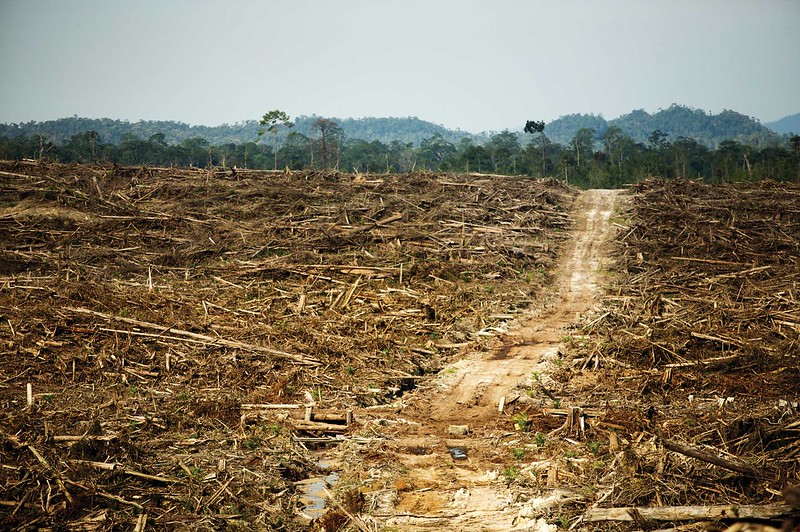
Deforestation in West Kalimantan, Borneo. Credit: David Gilbert / RAN (Creative Commons via Flickr)
A team of international lawyers has unveiled a definition of “ecocide” that, if adopted, would treat environmental destruction on a par with crimes against humanity.
After six months of deliberation, a panel of experts yesterday published the core text of a legal document that would criminalize “ecocide” if taken on by the International Criminal Court (ICC).
“This is an historic moment,” said Jojo Mehta, chair of the Stop Ecocide Foundation which commissioned the team of lawyers. “This expert panel came together in direct response to a growing political appetite for real answers to the climate and ecological crisis.”
Balancing Act
In the draft law, the panel of 12 lawyers defined ecocide as “unlawful or wanton acts committed with knowledge that there is a substantial likelihood of severe and either widespread or long-term damage to the environment being caused by those acts”.
If ratified by signatory states, ecocide would become the fifth international crime investigated and prosecuted by the ICC, alongside genocide, war crimes, crimes against humanity and the crime of aggression.
During a webinar marking the release of the document, panel co-chair Philippe Sands QC said the proposed definition would “cause us to think about our place in the world differently and it causes us to imagine the possibility that the law could be used to protect the global environment at a time of real challenge”.
“None of our international laws protect the environment as an end in itself and that’s what the crime of ecocide does,” Sands added.
Mehta described the draft law as a “necessary guardrail that could help steer our civilization back into a safe operating space”.
“Without some kind of enforceable legal parameter addressing the root causes of these crises, it’s hard to see how the Paris targets and the UNSDGs [United Nations Sustainable Development Goals] can possibly be reached,” she said.
The panel said that the idea of “unlawful or wanton” acts would allow judges and prosecutors to balance consideration of these elements. This idea of balance could be vital to the law’s success if it is to be agreed to by the states that subscribe to the ICC, according to co-chair Sands, who said it avoids “setting the bar too low and frightening states who we need to adopt the definition, or setting the bar so high that it becomes effectively useless in practice”.
A team of lawyers published its proposed definition of ‘ecocide’ on June 22, 2021. Credit: Stop Ecocide Foundation.
Defining ‘Ecocide’
Mehta acknowledged that ecocide legislation was likely to meet resistance from some richer nations, as it would inevitably force changes in corporate practice, “by making severe and reckless damage to nature illegal, and therefore unlicensable and uninsurable”.
This would close the door on “the old polluting ways”, she said. At the same time, Mehta argued, adopting ecocide legislation may be economically beneficial for stimulating innovation in green industries.
Sands said that oil spills, deforestation, and the authorization of new coal fired power stations could all potentially be considered ecocide under the definition.
However, specific acts such as these were left out of the final document, Mr Sands said, as doing so could run the risk of unintentionally omitting certain practices from the definition.
“This is not about catching every single horror that occurs in relation to the environment, but those horrors that cross a threshold and are of international concern,” he said, adding that it would be up to prosecutors and judges to form a view on whether a particular act is ecocide.
The campaign to criminalise ecocide, a term which was first coined in the 1970s, faces a number of further obstacles, with the entire process expected to take at least four years.
As a next step, any of the ICC’s 123 member states can propose the core text as an amendment to the Rome Statute treaty, before the annual assembly holds a vote on whether it can be considered for future enactment. It will then have to be approved by two thirds of the member states to go ahead, ahead of it being adopted by individual members into national jurisdiction.