A Former NRA President Was Tricked Into Speaking At A Fake High School Graduation

BuzzFeed

A Former NRA President Was Tricked Into Speaking At A Fake High School Graduation

Instead, the 3,044 empty seats represented the students who did not graduate this year because they were killed by gun violence.

Amber Jamieson, BuzzFeed Reporter,                 June 23, 2021

Hundreds of empty white fold-out chairs
Change the Red

3,044 chairs placed in a stadium in Las Vegas to represent those seniors who didn’t graduate because they were killed by gun violence

In a speech to the James Madison Academy 2021 graduating class, David Keene, a former NRA president and current board member of the gun rights group, called on the teens to fight those looking to implement tighter gun restrictions.

“I’d be willing to bet that many of you will be among those who stand up and prevent those from proceeding,” he said, to a Las Vegas stadium of thousands of socially distanced chairs on June 4.

“An overwhelming majority of you will go on to college, while others may decide their dream dictates a different route to success,” said Keene. “My advice to you is simple enough: follow your dream and make it a reality.”

Except, they can’t. The students aren’t real. James Madison Academy doesn’t exist.

Without realizing it, Keene was actually addressing his comments to thousands of empty chairs set up to represent the estimated 3,044 kids who should have graduated high school this year and instead were killed by gun violence.

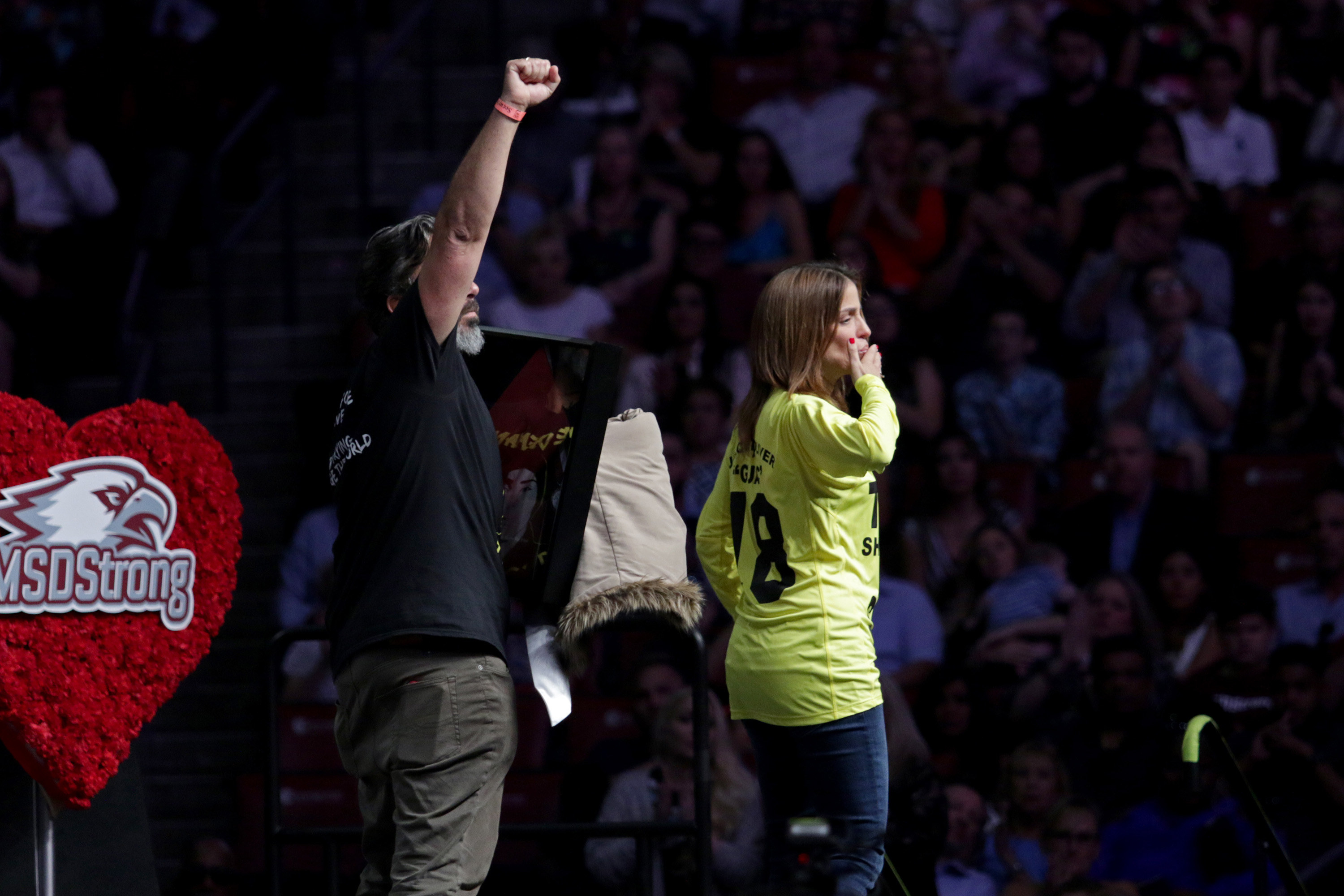
Change the Ref, an organization founded by Manuel and Patricia Oliver, whose son Joaquin “Guac” was killed in 2018 at Marjory Stoneman Douglas High School in Parkland, held a fake high school graduation for what they call “The Lost Class” of students.

They invited Keene and John Lott, an author and gun rights activist, to give remarks to a high school graduating class and filmed what they were told was a rehearsal in a stadium of empty chairs.

“Ironically, had the men conducted a proper background check on the school, they would have seen that the school is fake,” a Change the Ref spokesperson said in a press release.

Keene in a cap and gown is addressing a crowd in front of a Class of 2021 sign
Change the Ref

David Keene addressing the stadium

After filming, Keene and Lott were told the graduation was canceled and were not informed before the videos were released on Wednesday that the event was fake.

“You’re telling me the whole thing was a setup?” said Lott, when he responded to BuzzFeed News’ request for comment. “No, I didn’t know that.”

The stunt was designed to highlight how powerful gun advocates speak. “These two guys are part of the problem,” Manuel Oliver told BuzzFeed News. “We need to call them out, we need to show everyone — this is how they process the logic behind the gun industry.”

“We need to show we’re brave and we’re not afraid of these guys,” Oliver said. “We’ve already felt the worst possible situation. There’s no threat that can make me feel different.”

In videos released on Wednesday, Lott and Keene’s graduation speeches — in which they call for gun rights protections and talk about James Madison, the Founding Father who proposed the Second Amendment — are interspersed with audio from 911 calls about school shootings and the sound of gunfire.

Both Keene and Lott traveled to Vegas and were excited to speak, said Oliver, who did not meet either of them to make sure the stunt did not get disrupted by anyone recognizing him. Advertising agency Leo Burnett and production company Hungry Man helped create the event.

Lott said he was disappointed about the way the video was edited — he does support background checks but believes the current system mainly prevents law-abiding Black and Latino people from buying guns and should be adjusted.

“You want to stop dangerous people from getting guns, but you don’t want to stop the people who are potential victims from getting guns?” he asked.

Lott said he’d driven down from Montana for the speech, which took 13 hours, and showed emails where he’d been promised that he would receive $495, the equivalent of a plane ticket, but was never paid back. In the original email inviting him, Lott was told he was to be given the “Keeper of the Constitution” award.

Originally Lott wanted to give more general life advice in his commencement speech but had been encouraged to speak about James Madison and background checks. After the rehearsal, he was told the ceremony was canceled because of a credible threat of violence and after discussion with police. A week later, Lott tried to call the person who’d been in contact with him and the number was disconnected.

“Unfortunately, the fact they lied to me many times is kind of illustrated by the way they edited and chopped up the video that’s there,” Lott said. “Is that the way we want to have political debate in the country? Where people lie and creatively edit what people say?”

James Madison Academy isn’t a real school (a Google cache shows that a website was created to help ensure the stunt’s success). But the experience of thousands of families who’ve lost children to gun violence enduring graduations in recent months is very real, Oliver said.

“We lost Joaquin three months before his graduation. We know exactly the feeling of being there and receiving the diploma without your kid being there,” Oliver said. “Because we understand that, we know there are a lot of people going through that same experience right now.”

Sun Sentinel / Tribune News Service via Getty Images

Joaquin Oliver’s mother, Patricia, and father, Manuel, walk offstage after receiving their son’s diploma, which was awarded posthumously, during a graduation ceremony on Sunday, June 3, 2018, in Sunrise, Florida.

Oliver entwines his activism for gun violence prevention with art. To celebrate what would have been his son’s 21st birthday on Aug. 4, he is hosting Guacathon, a 21-hour festival of performances and exercise.

Gun violence is the leading cause of death for American middle and high school students. The 3,044 number was estimated by compiling firearm deaths by age since 2003 and matching it to student age.

“Never for a minute doubt that you can achieve that dream,” Keene said in his rehearsed speech to the seniors.

The contrast of knowing the students they are addressing are dead makes the comments appear deeply sarcastic, Oliver said.

“It shows them [as] weak,” he told BuzzFeed News. “But this is not about bragging about doing this to the former president of the NRA. No, this is about pushing our reps to move on with universal background check laws.”

UPDATE

This story has been updated with comments from John Lott.

Amber Jamieson is a reporter for BuzzFeed News and is based in New York.

This Louisiana Town Is A Bleak Forecast Of America’s Future Climate Crisis

This Louisiana Town Is A Bleak Forecast Of America’s Future Climate Crisis

Bridget Boudreaux didn’t know she was saying goodbye to her father last August when an ambulance took him away from her sweltering, hurricane-battered home near Lake Charles, Louisiana. The 72-year-old died alone after medics rushed him from a hospital to nursing homes, trying to find a facility that still had power after Hurricane Laura hit. But Boudreaux’s grief didn’t end there: It took her family another seven months to finally bury her father, as one disaster after another pummeled the riverbank city where she grew up.

With its 150-mile-per-hour sustained winds, Laura was the worst storm to hit the state in a century. Then, in October, Hurricane Delta rammed into Lake Charles as a Category 2 storm. Hurricane Zeta hit later that month. These were followed by a brutal ice storm that froze pipes and wrecked houses in February of this year. In May, historic rains flooded the area with upwards of 19 inches of water in a single day. Now, as the 2021 hurricane season gets underway, Boudreaux’s three-bedroom home — still askew on its foundation, with holes in its roof — is one of thousands in Lake Charles still waiting for a recovery that never happened.

“Right when you think you’re catching your breath, boom,” Boudreaux told BuzzFeed News. “You are constantly getting hit with these natural disasters, and sometimes it feels like you’re living in Revelations.”

Lake Charles exposes a grim, rarely discussed reality of climate change: Back-to-back or overlapping disasters, also known as compounding disasters, are becoming more frequent. And the US government’s largely hands-off approach to disaster recovery means the most vulnerable cities — those already struggling with aging infrastructure, housing shortages, pollution problems, segregation, and poverty — can’t cope.

Far from being an outlier, Lake Charles’s plight is “actually more of a window into the future,” said Jeff Schlegelmilch, director of Columbia University’s National Center for Disaster Preparedness.

Lingering heaps of debris render the city vulnerable to more flooding from future rains and storms.

And the city is close to its breaking point. People are exhausted, stressed, and hurting, and many cannot afford to change their circumstances. The crushing housing crisis has left families like Boudreaux’s living in unsafe conditions in their broken, mold-infested homes or in tents. Others have moved away. And lingering heaps of debris render the city vulnerable to more flooding from future rains and storms.

“There is a lot of PTSD in this community from what we have gone through,” Lake Charles Mayor Nic Hunter told BuzzFeed News. “In the past 25 years, Lake Charles had been through 11 federally declared disasters; five of those occurred just in the past year. We can debate what is causing it. But something is happening. You don’t have to be a scientist or a genius to see that.”

As the planet warms and people continue to build homes and businesses in high-risk areas, disasters have become more destructive, more frequent, and more costly. In 2020, the US experienced the most billion-dollar disasters on record. And it’s often low-income families and communities of color that are most impacted and get the least amount of support to build back.

Of the more than 56,000 homes statewide that were damaged by Laura, most were in Calcasieu Parish, home to Lake Charles. It’s one of the most segregated residential communities in the US, and its Black residents have among the highest rates of poverty and unemployment in the country. Against the backdrop of the COVID-19 pandemic, with many Black communities already clustered near the chemical plants and refineries spewing toxic emissions along the state’s Gulf Coast, the compounding disasters in Lake Charles epitomize how climate change disproportionately impacts those already most at risk.

“Lake Charles will be the poster child for climate racism,” said Kathy Egland, a climate rights activist who chairs the NAACP’s Environmental and Climate Justice Committee.

The parish now faces not only digging itself out of billions in damages, but also strengthening local defenses against future disasters. Though it has already received hundreds of millions from the Federal Emergency Management Agency (FEMA), the state’s request for an extra $3 billion from Congress — an unusual boost reserved for the nation’s worst disasters — remains in limbo.

“Lake Charles will be the poster child for climate racism.”

“What we are trying to do right now is use a water gun to put out a brush fire,” said Hunter, who has been begging leaders in Washington, DC, for help for months. Although President Joe Biden recently visited his city and met with him in person, the mayor is still waiting for the White House and Congress to push through the billions in additional disaster relief.

“We are languishing because of politics,” Hunter said.

The White House and the offices of Louisiana’s two senators have publicly come out in support of extra funding in the past month. But when asked about the holdup, none of them commented.

As the 2021 Atlantic hurricane season gets into full swing, Lake Charles residents worry that another major storm could mean they won’t ever fully recover.

“We are praying that we get a break this year so we can get on our feet and stay standing for a minute,” Boudreaux said. “If we get hit again, we will lose everything.”

More than nine months after Hurricane Laura’s devastating blow to Lake Charles, many of the city’s streets are still lined with homes covered by blue tarps.

“It’s startling, gut-wrenching to see how many people are living under blue tarps. It’s everywhere you look,” said Gary LeBlanc, cofounder of the nonprofit Mercy Chefs, which has provided food in disaster response situations for more than a decade. The group has visited Lake Charles multiple times over the past year. “We’ve been in places that had [Category 5 hurricane] damage, and we’ve never seen this many blue tarps a year after a storm.”

Chastity Bishop is one of those people. After a freak fire in her attic burned a hole in her roof last July, the 41-year-old, her fiancé, and her 9-year-old daughter moved to a rental on the southeastern side of town. When Hurricane Laura tore through the city, it caused severe wind and water damage in both structures. The rest of the year came with even more destruction: In October, Hurricane Delta flooded their rental home, and in February, the historic winter storm froze and burst its pipes. Then, as sheets of rain hit Lake Charles on May 17, Bishop watched in disbelief as water rose from the sidewalk to her porch to the windows before hitting her waist and submerging the house. Her fiancé helped rescue stranded residents, loading them into boats floating down the street, before they made it to higher ground a few miles away.

“It’s hard to explain the smell of flood — you have to live it to understand it.”

After the floods receded, Bishop’s family did everything they could to dry out the house with fans and dehumidifiers. But two weeks later, she and her daughter got sick from the mold. They had to evacuate so that the landlord could rip out all the flooring and walls.

“It’s hard to explain the smell of flood — you have to live it to understand it,” said Bishop, who grew up in Lake Charles. “And in these situations, you either live in a molded house or you come up with some money or find some family to live with.”

The family was able to shell out $1,500 to stay in hotels for a week before running out of money and moving back to their original home, where they’re living in their garage while they fix their tattered roof. They’ve set up a porta-potty, a gas grill, a microwave, and a mini fridge and are sharing a mattress. To bathe, they heat water on a burner. It’s tough, but there are much worse situations around them: Many people are still camping out in their yards and on their patios.

“People who didn’t need help for hurricanes need help now after floods, and no one is really helping,” Bishop said. “You are seeing people just quit, give up. People who are just trying to retire, who had all these plans, what do they do?”

It’s been hard for officials to tally the number of damaged structures or displaced residents in Lake Charles because the numbers keep shifting with each new disaster. Hunter estimates that Laura impacted 95% of the city’s homes and businesses and that 1,000 buildings still remain unoccupied just from that one hurricane. Hurricane Delta and the May floods then battered and rendered another 2,000 houses in the city unlivable.

“What we’re seeing is that the recovery cycle is continuing to get interrupted by disasters, so you can never quite get back up to that previous baseline,” said Columbia’s Schlegelmilch.

The main issue is supply. Building materials are so scarce and expensive that people are driving nearly 150 miles to Houston just to buy lumber. The direst scarcity is housing. Residents in ruined homes, as well as workers who are being hired to fix them, can’t find affordable places to live.

The housing situation “is a serious crisis,” said Tarek Polite, the director of human services for Calcasieu Parish, who is also in charge of recovery support for housing. “The supply that is left has become extremely expensive. Unfortunately, 50% of our low-income housing was damaged, and many apartment complexes are still fighting with insurance companies for payouts.”

“I have over 80 pictures of the damage,” Washington said. “You can’t tell me I can live there.

Lake Charles was already on the brink of an affordable housing shortage before the August hurricane struck, thanks to an industrial boom and an influx of chemical and energy plant workers, Polite explained. The result, he said, is a “new class of homeless individuals” who are toughing it out until they get money from the federal government.

Since Laura hit Lake Charles, the city has lost an estimated 6.7% of its population, according to Mark Tizano, the city’s community development director, though he said the real number is probably much higher. “People are living with relatives, gone out of town, anywhere they can lay their heads,” Tizano said.

For a small percentage of those who stayed, FEMA has helped fill the housing gap. As of mid-June, nearly 2,100 people statewide who were displaced after Laura and Delta were living in federally provided temporary housing.

But that’s not nearly enough, local officials say, and they don’t understand why the city has yet to receive more housing support from the federal government. “This is the first time we’ve seen this type of displacement after storms,” Tizano said. Months after Hurricane Rita slammed into Lake Charles in 2005, he added, “we were already quickly underway with a program to help people with housing.”

Monica Washington says she’s one of the lucky ones. After Laura’s intense winds tore open her condo, Washington, her 32-year-old daughter, and their two dogs and cat spent nearly a year hopping between hotels and sleeping crammed together in their car. She ended up spending about $21,700 on hotel bills, depleting her savings. Finally, they got a break on May 13 when FEMA placed them in one of the coveted temporary housing trailers outside of town.

It took months of back-and-forth with FEMA, and a formal request from Rep. Clay Higgins, to prove her family qualified for temporary housing. “I have over 80 pictures of the damage,” Washington said. “You can’t tell me I can live there. There’s no power.”

There wasn’t much to move into the trailer. Most of what they own has been destroyed, including Washington’s grandmother’s silverware and her daughter’s baby pictures. “Everything we own fits in one drawer,” she said. “Everything I have worked for my entire life, gone.”

To keep supporting her family, Washington, 58, will have to come out of retirement. She’s still fighting with her condo’s rental insurance for a payout and repeatedly emailing and calling FEMA about getting additional aid. “I can feel the anger building up when I think about what that storm did to us,” she said.

A big reason the country’s disaster response system is dysfunctional, experts say, is because the federal government’s role is limited. While FEMA is the country’s expert on emergency response, officials are adamant that their job is only to advise and support state and local governments as they rebuild, not take the lead. Local governments are usually the ones in charge of disaster response and finances.

But if it weren’t for nonprofit and volunteer organizations, many Americans, especially those with low incomes, would not make it through a disaster. These groups are on the ground first and often stay for months, filling a crucial void for survivors by providing food, healthcare, and other support, such as helping people navigate the confusing FEMA claims process.

“The issue with how the US approaches recovery is that it is highly reliant on people using their own resources to pay for their own recovery,” said Samantha Montano, an assistant professor in emergency management at Massachusetts Maritime Academy.

Insurance is “usually your best bet” to get enough money to rebuild your home, Montano explained. But, she later added, “there can be all kinds of problems actually getting payouts from insurance.”

Since many residents in Lake Charles were uninsured or renting their homes, they are responsible for trying to rebuild their lives using whatever savings they might have. And for those who did have insurance and have applied for assistance from FEMA, there is often a sizable gap between the reimbursement they receive and what it will cost to actually repair their homes.

FEMA also runs the nation’s flood insurance program, a broken system that has racked up billions in debt. Louisianans submitted more than 3,600 flood insurance claims for the three hurricanes combined, resulting in more than $120 million in funds paid by early June. More than 3,200 claims have already been filed in the aftermath of the May storms, roughly half of them coming from Calcasieu Parish, according to FEMA.

But most flood insurance policies do not repay people for hotels, food, or other costs incurred because their home was uninhabitable, meaning they have to pay those thousands of dollars on their own.

And it’s often people of color and those with low incomes who “get aid last,” said LeBlanc from Mercy Chefs. This heartbreaking reality has grown more widespread as climate change–fueled weather events have intensified in the last decade.

After 2020’s historic spate of disasters, a federal advisory panel published a scathing report that found FEMA’s disaster relief programs perpetually shortchange low-income communities and people of color while providing “an additional boost to wealthy homeowners.”

FEMA did not respond to questions from BuzzFeed News about Lake Charles’ slow recovery. “The people of Lake Charles, Calcasieu Parish and all of [Southwest] Louisiana have been through a difficult time,” Debra Young, a FEMA spokesperson, told BuzzFeed News in an email. Young added that FEMA has been a constant presence in the area and will “continue to work in Lake Charles to assist survivors by providing grants, loans and housing to those who are eligible.”

While Lake Charles is an extreme example, there are more than 50 towns and cities across the country currently dealing with compounding disasters, according to Mustafa Santiago Ali, vice president of environmental justice, climate, and community revitalization at the National Wildlife Federation.

“People don’t talk about it because they are Black, brown, and Indigenous people,” Ali said. “They are unseen and unheard.” He attributed the problem in part to decades of discriminatory housing policies, such as redlining, that forced people of color into floodplains and other disaster-prone areas.

“Many people ask, ‘Well, why don’t they just leave?’” said Egland, the NAACP climate justice chair. “They can’t. People who are economically challenged don’t have the luxury of choice; they’re bound by their situation.”

Egland, who lives in Gulfport, Mississippi, and survived Hurricane Katrina, said the ripples of climate racism are extensive and long-lasting. One event can impact food supply, agriculture, housing, access to healthcare, and education for years afterward, setting struggling communities even further back.

“You can get hit one time and maintain hope,” said LeBlanc. “You can get hit twice and still have hope and a promise for a new day. But getting hit a fourth time, a fifth time…people get to a place emotionally where it’s hard to find a bright spot. They’ve used them all up.”

For officials in Lake Charles and at the state level, getting Washington to provide enough financial aid and housing support to lift the community out of the shadow of these disasters feels impossible.

Last November, Louisiana Gov. John Bel Edwards sent a letter to former president Donald Trump asking for support, including asking Congress to approve nearly $3 billion to help rebuild homes and create more affordable rental housing. Without this funding, he wrote, “many neighborhoods and communities will not be able to recover.”

“The most disaster-stricken city in the most disastrous year in recent memory.”

The Trump administration did not fulfill his request. He then made a fresh appeal to Biden, writing to him in January to ask Congress to approve the money. The Biden administration appeared to take notice.

“When someone inevitably writes the book of what it was like to live through the past year, they might want to begin the story in Lake Charles,” said Treasury Secretary Janet Yellen following a roundtable with Hunter after the winter storm in late February. Lake Charles, she said, might have the unfortunate distinction of being “the most disaster-stricken city in the most disastrous year in recent memory.”

President Biden visited the city on May 6, using the Calcasieu River Bridge as a backdrop to announce his $2 trillion national infrastructure proposal, which could eventually help Lake Charles and places like it. He also announced $1 billion in additional funding for FEMA specifically to help communities prepare for future disasters. But weeks after his visit, there’s still no word on whether more recovery funds will be given to Lake Charles and the surrounding region.

For Mayor Hunter, the experience has left him feeling like his city is a “pawn” in a nonsensical political battle.

“Washington, DC, is failing American citizens in southwest Louisiana,” he said. “I have a problem with the narrative that it’s everyone else’s problem.”

As the days continue to tick by, bringing the area deeper into hurricane season, Boudreaux and other residents hope their funds and resilience will stretch until more help arrives. If she had a choice, Boudreaux would leave or buy a home, she doesn’t want to leave her family, her hometown. Her children and grandchildren are here. So she’ll continue to do what she and others in Lake Charles have gotten too good at doing: wait.

“We are good people, we work, we pay our bills, we live in a decent home, we go to church and do right by others,” she said. “Just seems everything is against us.”


Republicans are using baffling legalese and underhanded tactics to quietly push through their deeply unpopular policies. Don’t fall for their shady tricks.

Republicans are using baffling legalese and underhanded tactics to quietly push through their deeply unpopular policies. Don’t fall for their shady tricks.

Texas governor Greg Abbott with a feather quill drawing question marks on pieces of old parchment paper on a red background
Montinique Monroe/Getty Image; Samantha Lee/Insider 

  • The GOP’s agenda isn’t popular, so right-wing lawmakers around the country are using technical workarounds.
  • Right-wing policies like abortion restrictions don’t necessarily need to go into effect to be effective.
  • Relying on confusion and stalling tactics is the right-wing approach.
  • Eoin Higgins is a journalist in New England.
  • This is an opinion column. The thoughts expressed are those of the author.

The GOP is winning more battles than a minority party with an unpopular platform should. But they aren’t paying as high of a political price because Republican lawmakers around the country are hiding their unpopular agenda behind confusing technicalities and baffling legalese.

Republicans are using obfuscation tactics to lead Americans to believe that laws are in place when they actually aren’t, that gridlock in Washington is an unshakable truth rather than a parliamentary strategy, and that voting in the country is far harder than it is.

The GOP passes laws they know will never stand up in court, because the message of its passage is likely to change behavior even if the law ultimately falls. These officials pontificate self-importantly about the necessity of keeping parliamentary tradition and rules in place, and then turn around and break them whenever it’s convenient. The GOP deploys whatever means are necessary to bend and even outright break the political rules of engagement.

The right has been pursuing this strategy of confusion for decades. It’s a tried and true tactic to force the window of what is considered “acceptable” policy further and further to the right in hopes that enough challenges slip through and establish a precedent. Winning individual battles in the traditional sense is secondary to this broader war.

Faced with an electorate that’s broadly opposed to the details of their policies, the GOP has relied on passage, not enforcement, to get the results that they’re after. It’s a savvy approach to lawmaking for a party with a broadly disliked policy vision, allowing for various workarounds at the federal and state level to remain in power.

Most people don’t really know

In May, I talked to women in Texas who have had to fight against the state’s existing abortion restrictions. Briana McClellan, a social worker with reproductive rights group the Texas Equal Access Fund, got an abortion in Texas in 2009. The process was arduous, she told me, due mostly to cost and geography.

Today, things are even worse. Republican Governor Greg Abbott signed a bill last month that would restrict abortions to only six weeks after conception, a ban that would effectively end Roe v Wade, which established a Constitutional right to abortion up to 24 weeks. Therein lies the trick. The law, whether or not it goes into effect, is going to make access even more difficult. Even if it is struck down in the courts, the ban’s passage through the state legislature means that there will be more confusion surrounding the issue. McClellan told me that she already frequently needs to remind clients that abortion is still legal.

“I did have to explain to them that what they were doing was legal, because a lot of the time most people don’t really know,” McClellan said.

Access is even more restricted in Mississippi, where there’s only one clinic statewide and social conservatism adds to the stigma. Serita Wheeler, a sociologist in the state, told me that she believes that is by design. Right-wing economic goals are being realized by the use of religious morality to restrict reproductive healthcare access.

“The major industries in this state are food, hospitality, tourism, and retirement; all powered by feminized poverty,” Wheeler said.

Industry and religion work together with the state’s Republican lawmakers to ensure the right to abortion is always up in the air, even while the right to reproductive access is technically in place, leaving people around Mississippi in a constant state of confusion. Just the way the GOP likes it.

Stalling tactics

Abortion laws aren’t the only deliberately confusing ones: Republicans are doing the same with voting rights. Members of the public often do not understand the laws around voting, which can change state by state and year by year. The confusion over which rights are in place and which are not can be a powerful motivator to those going to the polls.

Laws passed in GOP state legislatures, like Georgia’s ban on giving water to people waiting in line to vote, are aimed at restricting rights and making voting seem like a confusing, intractable burden. Republican-sponsored bills in state legislatures around the country are designed to reduce participation and make exercising the franchise difficult – if not impossible.

Federal attempts to solve the problem have stalled out against GOP manipulation of the Senate. Even before nominal Democrat Joe Manchin announced on Sunday that he was voting against the For the People Act, the House Democrats’ omnibus voting rights act, Republicans were blocking the bill’s passage into law in the Senate by holding up the process via the filibuster.

“Democrats’ poster child for why the Senate should change its rules is a bill that would forcibly change the rules for elections in every state in America,” Senate Minority Leader Mitch McConnell said Monday.

By using this age-old parliamentary tactic to stop any legislation from moving forward unless Democrats use reconciliation – a tactical move that the majority party has, for some reason, left to the unelected Senate Parliamentarian to decide when it can and can’t be used – the GOP are ruling from the minority and stopping the ruling party’s agenda in its tracks.

This has created an inertia similar to that seen during the Obama years. GOP Senators, faced with legislation they don’t want to pass, hold it up with a 60-vote majority needed to pass it and enforce the filibuster without having to get on the floor and actually speak.

Not only does this tactic stop the legislation, it allows the GOP to distance themselves from the actual work of opposing whatever bill is in front of the Senate. Not allowing the bills to come to the floor in the first place – by using a largely anonymized system that lets senators stop the legislative process without actually having to actually do the work of stopping it – is perfect for Republicans.

Needed change

One of the primary reasons the right relies on such convoluted, legalese tactics to get their policies into legislatures around the country is that the right-wing agenda just isn’t that popular. Poll after poll shows that the GOP’s policy prescriptions for what ails the US to be massively unpopular on a policy by policy issue (with the possible exception of tax cuts as long as they don’t go to the rich).

Democrats at both the federal and state level are complicit in this approach to governing. Bad messaging, a disinterest in holding the GOP accountable, and multiple tactical errors have left the Democrats wanting when it comes to even playing the game in the same universe as their opponents.

Progressives and rights advocates are thus constantly on the defensive. The use of disinformation and confusion to push forward an agenda as unpopular as the one Republicans have is the only tool the GOP has that can work – but it’s still working due to inertia from the other side.

If American voters don’t know whether they can go to the ballot box, think Washington is hopelessly gridlocked for no reason other than its natural state, and believe basic civil rights like the right to an abortion are up in the air – irrespective of reality – then the battle’s halfway won for the GOP already. It’s up to liberals and the left to fight back.

The lakes in California that have been swallowed up by the ‘megadrought’

Take a look at some of the lakes in California that have been swallowed up by the ‘megadrought’

Take a look at some of the lakes in California that have been swallowed up by the ‘megadrought’
California drought
Associated Press

  • California has been hit by a “megadrought” that has dried up key reservoirs in the state.
  • Entire lakes have shrunk exponentially, leaving yachts and docks beached on dry land.
  • Nearly 95% of the state is experiencing “severe drought” and is susceptible to wild fires.

California is facing its worst drought in over four years.

Over 37 million people have already been impacted by the “megadrought” and nearly 95% of the state has been classified as experiencing “Severe Drought,” which puts the land in significant danger of wildfires, according to the National Integrated Drought Information System (NIDIS).

Last year, California land was consumed by over 8,200 wildfires – a number double the state’s previous record. This year, scorching weather has dried out reservoirs and made the state even more susceptible to breakout wildfires than the record 2020 season. NIDIS analysts call the outlook for the land “grim.”

california wildfire
October 15, 2017. Jim Urquhart/Reuters


Water levels of California’s over 1,500 reservoirs are 50% lower than they should be at this time of year, Jay Lund, co-director of the Center for Watershed Sciences at UC-Davis told the Associated Press.

In April, scorching weather turned the San Gabriel reservoir lake bed to dust. The reservoir is not expected to see rain fall until the end of the year.

The drought turned the San Gabriel reservoir lake bed to dust
The drought turned the San Gabriel reservoir lake bed to dust Getty

On Wednesday, the drought dried up a lake so much that it potentially exposed a decades old mystery, allowing officials to find a plane that had crashed in 1965.

A composite image showing Folsom Lake, California, at drought levels in 2017, and a sonar image of a plane underwater there.
Folsom Lake, California, under drought conditions in 2017 (L), and the sonar image of a plane there taken by Seafloor Systems (R) Robert Galbraith/Reuters/CBS13


The California drought has been caused by climate change which has pushed temperatures an average of about 2 degrees hotter, drying out soil and melting Sierra snow rivers, which causes less water to soak into the ground, as well as flow through rivers and reservoirs. The state also endured two unusually dry winters that didn’t bring needed storms to the area.

Officials are predicting the water level of Lake Oroville – a primary body of water that helps the state generate energy through hydroelectric power plants – will hit a record low in August. If that happens, they would need to shut down a major hydroelectric power plant, putting extra strain on the electrical grid during the hottest part of the summer.

Earlier this month, about 130 houseboats had to be hauled out of the lake as its water levels hit 38% capacity. The water levels are only at about 45% of average June levels, according to California Department of Water Resources.

House boats pulled out of Lake Orovill
Getty


It’s going to be a rough summer for boat owners in the state.

Pictures from the Associated Press show massive lakes have run dry, leaving boats and docks completely beached

Boats at Fulsom Lake
Associated Press


Experts say the drought could devastate local wildlife populations, as well as California’s tourism industry.

California drought
Associated Press


In April, Governor Gavin Newsom held a press conference in the dried up waterbed of Lake Mendocino. Where he stood there should have been about 40 feet of water.

“This is without precedent,” Newsom said. “Oftentimes we overstate the word historic, but this is indeed an historic moment.”

California drought
Associated Press


The month before, the California Department of Water Resources reduced farmers and growers to 5% of their expected water allocation in March. A move that has farmers leaving large portions of their land unseeded, while other have been forced to purchase supplemental water, which comes at a hefty cost. Supplemental water was priced at $1,500 to $2,000 per acre-foot in mid-May, according to a report from California Farm Bureau.

It has also made it difficult for ranchers to feed and water their livestock

California drought
Getty


As California temperatures continue to rise while water reservoirs fall, the state could be in for a devastating summer. From increased fears for wildfires to the impact on state agriculture and tourism, California residents are bracing for the worst drought season since 2014.

Sugar isn’t just empty, fattening calories — it’s making us sick

Sugar isn’t just empty, fattening calories — it’s making us sick

<span class="caption">Don't add sugar.</span> <span class="attribution"><a class="link rapid-noclick-resp" href="http://www.shutterstock.com/pic-116939734/stock-photo-wooden-bowl-of-sugar-with-metal-spoon.html?src=JQV6o_KbozN-HPe3TJY8Mg-1-64" rel="nofollow noopener" target="_blank" data-ylk="slk:Sugar bowl via www.shutterstock.com">Sugar bowl via www.shutterstock.com</a></span>
Don’t add sugar. Sugar bowl via www.shutterstock.com


Children are manifesting increased rates of adult diseases like hypertension or high triglycerides. And they are getting diseases that used to be unheard of in children, like Type 2 diabetes and fatty liver disease. So why is this happening?

Everyone assumes this is the result of the obesity epidemic – too many calories in, too few out. Children and adults are getting fat, so they’re getting sick. And it is generally assumed that no one specific food causes it, because “a calorie is a calorie”.

I’ve been studying the role that sugar plays in contributing to chronic disease for years, and my research group at the University of California, San Francisco has just published research in the journal Obesity that challenges this assumption. If calories come from sugar, they just aren’t the same.

Diabetes is increasing faster than obesity

It’s clear that the cause of rising rates of health conditions like Type 2 diabetes isn’t as simple as people just eating too many calories.

Obesity is increasing globally at 1% per year, while diabetes is increasing globally at 4% per year. If diabetes were just a subset of obesity, how can you explain its more rapid increase?

And certain countries are obese without being diabetic (such as Iceland, Mongolia and Micronesia), while other countries are diabetic without being obese (India, Pakistan and China, for instance). Twelve percent of people in China have diabetes, but the obesity rate is much lower. The US is the fattest nation on Earth and our diabetes prevalence is 9.3%.

While 80% of the obese population in the US is metabolically ill (meaning they have conditions like diabetes, hypertension, lipid problems and heart disease), 20% is not. Conversely, 40% of the normal weight population has metabolic syndrome.

If normal weight people have these conditions, how then are they related to obesity? Indeed, we now know that obesity is a marker rather than a cause for these diseases.

Epidemiological studies have found a correlation between added sugar consumption and health conditions like cardiovascular disease. So could cutting excess sugar out of our diets reverse metabolic syndrome?

What happens when you stop feeding kids added sugar?

Our group at UCSF studied 43 Latino and African-American children with obesity and metabolic syndrome over a 10-day period. We started by assessing their metabolic status – insulin and glucose levels, as well as blood fats and other markers for disease, like lactate and free fatty acids – on their home diet.

For the next nine days, each child ate an individual tailored diet. We catered their meals to provide same number of calories and protein and fat content as their usual home diet. We gave them the same percentage of carbohydrate, but we substituted starch for sugar. The big difference: this special diet had no added sugar. This means their diet had no sugar from sugarcane or high fructose corn syrup. The kids consumed foods such as fruits and other whole foods that naturally contain some sugar. These foods also have fiber, which reduces the rate of sugar absorption, so they don’t affect the body the same way that added sugar does.

We took chicken teriyaki out. We put turkey hot dogs in. We took sweetened yogurt out. We put baked potato chips in. We took donuts out. We put bagels in. We gave them unhealthy processed food, just with no added sugar. Each child was given a scale to take home, and if their weight was declining, we made them eat more. Then we studied them again.

The children had eaten the same number of calories and had not lost any weight, and yet every aspect of their metabolic health improved. With added sugar cut out of their diet for 10 days, blood pressure, triglycerides, low-density lipoprotein (LDL, or “bad cholesterol”), insulin sensitivity and glucose tolerance all improved. And remember, we weren’t giving them just leafy greens and tofu – we fed the kids processed foods, just ones without sugar.

Further studies are needed to see if this will also work in adults, and if the benefits are short-term or long-term.

Sugar is like alcohol

This study demonstrates that a calorie is not a calorie, and that sugar is a primary contributor to metabolic syndrome, unrelated to calories or weight gain. By removing added sugar, we improved metabolic health.

Sugar may not be the only contributor to chronic disease, but it is far and away the easiest one to avoid. Kids could improve their metabolic health – even while continuing to eat processed food – just by dumping the sugar. Can you imagine how much healthier they’d be if they ate real food?

The naysayers will say, “But sugar is natural. Sugar has been with us for thousands of years. Sugar is food, and how can food be toxic?”

Webster’s Dictionary defines food as:

material consisting essentially of protein, carbohydrate, and fat used in the body of an organism to sustain growth, repair, and vital processes and to furnish energy.

Sugar by itself furnishes energy, and that’s about it. In that sense, sugar is like alcohol. It’s got calories, but it’s not nutrition. There’s no biochemical reaction that requires it. And at high doses, alcohol can fry your liver.

Same with sugar. Fructose, the sweet molecule in sugar, contains calories that you can burn for energy, but it’s not nutrition, because there’s no biochemical reaction that requires it. In excess, it can fry your liver, just like alcohol. And this makes sense, because where do you get alcohol from? Fermentation of sugar.

Too much sugar causes diabetes, heart disease, fatty liver disease and tooth decay. When consumed in excess, it’s a toxin. And it’s addictive – just like alcohol. That’s why children are getting the diseases of alcohol – Type 2 diabetes and fatty liver disease – without alcohol. But our research suggests we could turn this around in 10 days – if we chose to.

Read more:

Robert Lustig does not work for, consult, own shares in or receive funding from any company or organization that would benefit from this article, and has disclosed no relevant affiliations beyond their academic appointment.

My front row seat to the radicalization of the Republican Party

Op-Ed: My front row seat to the radicalization of the Republican Party

Future House Speaker Newt Gingrich of Georgia looks over his shoulder as he arrives for a Capitol Hill news conference, Monday, Dec. 5, 1994 in Washington, after his fellow Republicans voted him as speaker. To serve alongside Gingrich, the Republicans voted Rep. Dick Armey, R-Texas, as House Majority Leader and Rep. Tom DeLay, R-Texas, as House Majority Whip. (AP Photo/John Duricka)
Newt Gingrich at a Capitol Hill news conference on Dec. 5, 1994, after his fellow Republicans voted him in as speaker of the House. (John Duricka / Associated Press)


Since before he became president, Joe Biden has told crowds, “Folks, this is not your father’s Republican Party.” As a political reporter, I’d been hearing that lament since the late 1990’s, from far better sources — those Republican fathers’ sons and daughters.

The radicalization of the Republican Party has been the biggest story of my career. I’ve been watching it from the start, from the time I arrived in then-Democratic Texas just out of college in 1978 to my years as a reporter in Washington through four revolutions — Ronald Reagan’s, Newt Gingrich’s, the tea party’s and Donald Trump’s — each of which took the party farther right.

From this perspective, it seems clear that the antidemocratic drift of the GOP will continue, regardless of Trump’s role. He didn’t cause its crackup, he accelerated it. He took ownership of the party’s base, and gave license to its racists, conspiracists, zealots and even self-styled paramilitaries, but that base had been calling the shots in the Republican Party for some years, spurred by conservative media. Now, emboldened, its activists will carry on with or without him.

The first elections I covered in 1978, at the midterm of Jimmy Carter’s presidency, marked the beginning of the Republican Party’s reemergence from its Watergate ruins and the shift of its base from the north to the south. In a poll a year earlier, fewer than 1 in 5 Americans had identified as Republicans. Texas was a Democratic bastion. But many Democrats I met there were more conservative than Republicans I knew up north; they often bucked the national party, yet remained “yellow dog Democrats” in state and local elections — so loyal, the saying went, that they’d vote for a yellow dog over a Republican, just like voters elsewhere in the South.

Republicans revived nationally in the late ’70s largely because of the governing Democrats’ misfortunes — a global energy crisis, double-digit inflation, a stagnant economy, party infighting.

Evangelicals threw off their longtime aversion to earthly politics and took over local party organizations, becoming culture warriors. By mid-1978, the property tax revolt in California kindled an anti-tax movement nationwide. With both moderate establishment Republicans and insurgent conservatives seeing the possibility of retaking the White House in 1980, the two camps intensified their decades-long war to define the party.

It’s clear now that the norms-abiding moderates never had a chance. As right-wing activist Paul Weyrich warned, “We are different from previous generations of conservatives. We are no longer working to preserve the status quo. We are radicals, working to overturn the present power structure in the country.” That could stand as conservatives’ mission statement today.

That November, my election-night story for the Abilene Reporter-News included mention of the defeat of a young George W. Bush for a House seat representing Midland and Odessa.

Yet he and other Republicans across the South did better than expected. Some actually won, including third-time candidate Newt Gingrich in suburban Atlanta. Texans elected the first Republican governor since Reconstruction. It all signaled the wave Reagan would ride two years later, carrying other Republicans in his wake. The Democrats who won congressional races across the south, replacing some New Deal liberals who retired, were more conservative and allies-in-waiting for Reagan, many of them future defectors to his party.

By 1984, I’d moved to Washington to cover Congress and got to know Gingrich. While he was a backbencher in House Republicans’ seemingly permanent minority, he led a maverick faction calling itself the Conservative Opportunity Society (Gingrich himself was more opportunist than truly conservative, his lieutenants grumbled to me).

After he read stories I’d written about the ethics scrapes of some Democrats in Congress, Gingrich would have an aide in his congressional office contact me with dirt on others, often just allegations culled from the lawmakers’ local newspapers.

That was just one sign that he was a new breed of Republican, more interested in ruthless partisanship than in passing laws and representing constituents. His goal was nothing short of ending Democrats’ decades-long lock on the House majority and leading the next Republican revolution.

In 1990, Gingrich — by then the second-highest ranking House Republican leader — made a prediction that I found unbelievable: Republicans would win a House majority in the 1994 midterm elections. He explained to me that if George H.W. Bush lost reelection in 1992, with a Democrat in the White House the Republicans could benefit from the midterm jinx for a president’s party, and win enough seats to take control.

Gingrich did his part to weaken Bush. Most famously, he led a conservative mutiny against a bipartisan deficit-reduction deal the president had negotiated, assailing him for violating his “no new taxes” campaign promise.

With Bush’s loss to Bill Clinton, Gingrich immediately looked toward 1994. Since the late 1980s, he had mobilized a nationwide network of right-wing talk-radio hosts emerging in local markets. They echoed his talking points daily.

On election day 1994, Gingrich was confident of big gains — if not a House majority — and certain that conservative media had helped. “I think one of the great changes in the last couple of years was the rise of talk radio, which gives you an alternative validating mechanism,” separate from the mainstream media, he told me. In fact, he was about to be interviewed by a new local host — a young guy named Sean Hannity.

The Republicans triumphed beyond even Gingrich’s messianic dreams, winning House and Senate majorities for the first time since 1952. As the new speaker who’d taken the party to the promised land, Gingrich led a cult of personality presaging Trump’s.

“Be nasty,” he’d tell followers, and he kept conservatives perpetually angry at Democrats and at government generally, with the aid of his right-wing media megaphone.

On the first day of the new Republican-controlled Congress in January 1995, Gingrich had set up “Radio Row” in a Capitol corridor — table after table of talk-show hosts interviewing Republicans for conservative audiences back home. Rush Limbaugh, the king of them all, was declared an honorary House Republican. Collectively, these local celebrities became a power center within the party.

Gingrich would find governing harder and less popular than campaigning, however. He overreached to please the base, shutting down the government in a doomed bid to force deep cuts in domestic programs, and then impeaching Clinton. Within four years, after election losses and scandals, he resigned.

Back in Texas, then-Gov. George W. Bush positioned himself as the un-Gingrich for mainstream voters — a “compassionate conservative” — while telling those on the right he was different from his father: that Jesus Christ was his personal savior, he’d slash taxes, and his foreign policy would eschew interventionist nation-building. (He’d break that last promise big time in Iraq.)

But even as Bush sought to soften his party’s hard lines to win election, the GOP’s nationalistic, protectionist and even nativist populism ran deep. As president, Bush had hoped to build a broader party — for example, by giving millions of undocumented, longtime residents a path to citizenship. But the growing xenophobia among the party’s increasingly white, older and rural base foiled him.

Trump didn’t unleash those forces 16 years later. He simply harnessed and amplified them.

By the end of Bush’s presidency, conservatives were rebellious against both Bush, for his immigration proposals, Mideast wars and rising debt, and the Republican majority in Congress for its overspending and corruption.

After the near-collapse of the financial system and its bailout by the Bush administration, in 2008, Barack Obama became the first Black American elected president. Almost immediately, the third Republican revolution took shape, this one a headless movement from the bottom up: the tea party.

Republican Party leaders sought to unite with tea party activists against their common enemy — Obama. In the midterm elections of Obama’s two terms, Republicans regained control of the House in 2010 and then the Senate in 2014.

Yet just as Gingrich found with Clinton, sharing responsibility for governing requires occasional compromise with the Democratic president on must-pass bills. And compromise infuriated the Republican base and conservative media. “They don’t give a damn about governing,” former Rep. Tom Latham, an Iowa Republican, told me in 2015. Latham, who was first elected in the 1994 Gingrich revolution, had just left Congress in frustration after 20 years.

A year later, against a field of establishment Republicans vying for the presidential nomination, Trump quickly rose to the top, speaking a language of aggrievement that resonated with the mostly white, less educated voters living in rural America and long-struggling industrial areas like my Ohio hometown.

They jumped on the Trump train and stayed on even after he’d lost reelection and the GOP’s control of Congress. As Donald Trump Jr. said of other Republican officials on Jan. 6, just before the attack on the Capitol, “This isn’t their Republican Party anymore. This is Donald Trump’s Republican Party.”

It was a straight line from Gingrich’s uncompromising, smash-mouth politics to the tea party and then to Trump.

Should Trump remain exiled at Mar-a-Lago, his MAGA army will soldier on, forcing party officials and 2024 presidential aspirants to fall in line. And if Republicans lose in 2022 or 2024, many seem poised to reject the result, turn to force or countenance those who do — Trump or no Trump.

Jackie Calmes is the White House editor for the Los Angeles Times. This article is adapted from her book “Dissent: The Radicalization of the Republican Party and Its Capture of the Court,” which will be published June 15.

Insurance Giants Under Fire from First Nations for Backing Trans Mountain Tar Sands Pipeline

DeSmog

Insurance Giants Under Fire from First Nations for Backing Trans Mountain Tar Sands Pipeline

Dozens of events on four continents hope to turn up the pressure on the insurance industry that underwrites Canada’s Trans Mountain Expansion pipeline.
By Nick Cunningham               
 
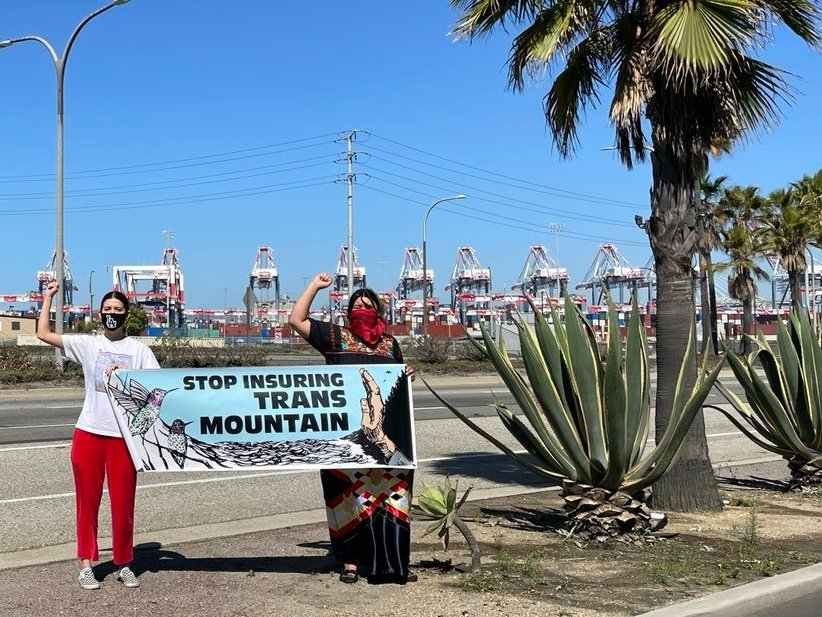
International Indigenous Youth Council protest outside Port of Long Beach, CA. Credit: IICY LA

Indigenous peoples in Canada and a coalition of environmental groups launched a “Global Week of Action” for June 14-21, aimed at pressuring an array of insurance companies to cut ties with a long-distance tar sands pipeline under construction in Canada.

On Wednesday, the Braided Warriors, an Indigenous youth group in British Columbia, held a rally in front of Chubb Insurance Canada in Vancouver, B.C. On Friday, activists in London are set to protest outside Lloyd’s of London — one of the world’s largest insurers of fossil fuels. Other acts of solidarity are planned as far away as the Pacific Islands and Sierra Leone.

The Indigenous and environmental groups are targeting the handful of global insurance companies that provide coverage for the Trans Mountain pipeline system, a long-distance pipeline running from Alberta’s tar sands to the Pacific Coast near Vancouver.

Canoe protest in Manitoba. Credit: Manitoba Energy Justice Coalition


The original pipeline has been operating for decades, but Canada is building what has been termed a “twin” pipeline that would nearly triple the capacity of the existing system to 890,000 barrels of oil per day. For years the Trans Mountain Expansion struggled to get off the ground. It met intense resistance from multiple First Nations in British Columbia, and as it became ensnared in legal limbo, it grew into a financial boondoggle.

The former owner Kinder Morgan sought to bail on the project, and instead of letting it die, Prime Minister Justin Trudeau bought the system in 2018 for C$4.5 billion, effectively nationalizing it to keep it alive and push it forward.

Since then, the Trans Mountain Expansion has broken ground, felling trees and digging trenches along part of its 700-mile route. At the start of 2021, the project was roughly 22 percent completed, and despite the ballooning cost, is scheduled to come online at the end of 2022.

“The Trans Mountain pipeline and tanker project is an existential threat to Tsleil-Waututh Nation. It also fuels the climate crisis, which is a threat to us all. This is why Tsleil-Waututh Nation does not grant our Free, Prior, Informed Consent, and why we are calling on all insurance companies to drop Trans Mountain and recognize the violation of Indigenous rights as a material risk,” Charlene Aleck of the Tsleil-Waututh Nation Sacred Trust Initiative, said in a statement.

The Tsleil-Waututh Nation has lived on the Burrard Inlet in what is now Vancouver for millennia. The expanded pipeline system is estimated to result in a sevenfold increase in oil tanker traffic in the inlet. That would boost the number of tankers navigating the island-studded waters leading to the pipeline’s terminal from 60 per year currently to over 400 per year. A technical assessment conducted by the Tsleil-Waututh Nation found that there is a 79 to 87 percent likelihood of an oil spill in the inlet over a 50-year period.

Turning up the Pressure

But completion is not inevitable, and First Nations and environmental groups opposed to the project see the insurance industry as a key point of leverage. Without insurance, the pipeline cannot proceed.

DeSmog previously reported on the effort by First Nations and environmental groups to pressure global insurance companies to sever their ties with Trans Mountain, among other acts of resistance.

The campaign has proven to be partially successful thus far. In early June, Argo Group said it would stop insuring the pipeline when its policy expires at the end of August. “This type of project is not currently within Argo’s risk appetite,” Argo said in a statement to Insurance Journal.

Last year, other insurance giants — Zurich Insurance, Talanx, and Munich Re — also backed out. At least 14 major insurance companies have ruled out insuring the pipeline, according to Stand.earth, an environmental group pressuring the industry.

The shrinking pool of insurance is also part of a larger story. Greater scrutiny over the oil industry in general, and Canada’s tar sands in particular — some of the dirtiest forms of oil production — has led to a growing number of insurance companies restricting coverage to the sector.

“They’re standing on the wrong side of history. They should know and understand that the fossil fuel industry is in a state of demise. They shouldn’t be investing their funding into a dying industry that has proven itself to be incredibly destructive to the environment,” Grand Chief Stewart Phillip, president of the Union of British Columbia Indian Chiefs, told DeSmog, referring to the insurance companies backing the project.

Joe Seeger, an expert in insurance for oil projects, told the CBC that the number of large insurance companies providing coverage to Canadian tar sands has fallen roughly in half over the past decade. “It really is a supply and demand situation where we always go to our clients and have the bad news of [explaining there] are fewer insurers and we have to try to figure out new ways to do the business,” Seeger told the CBC in May.

The insurers that remain have tightened up their offerings. The major insurers in London have restricted the amount of coverage for tar sands operations to just $200 million, according to Willis Towers Watson, an international insurance broker. As recently as 18 months ago, those companies would offer $500 million in coverage.

Activists hand petitions to Chubb Insurance in Zurich, Switzerland. Credit: Campax
Credit: Texas Campaign for the Environment


The pressure from activists and First Nations apparently had enough of an impact on the project that Trans Mountain appealed to the Canada Energy Regulator in February to allow them to keep the names of its insurers secret.

In its application, Trans Mountain said that “insurance companies have faced negative pressure for insuring the Trans Mountain Pipeline” and that Trans Mountain “experienced a significant reduction in available insurance capacity” in 2020. If the growing pressure from activists continues, the pipeline operator said, it would “likely result in material loss to Trans Mountain.”

The federal regulator agreed and allowed the insurers to remain confidential. “It’s a troubling example of Trans Mountain’s culture of secrecy and attempts to evade transparency and accountability to its owners, which are the Canadian taxpayers,” Elana Sulakshana, an energy finance campaigner with Rainforest Action Network, told DeSmog.

DeSmog reached out to eight insurers that are thought to be the remaining companies backing the Trans Mountain system — AIG, Chubb, Energy Insurance Limited, Liberty Mutual, Lloyd’s, Starr, Stewart Specialty Risk Underwriting, and W.R. Berkley. AIG declined to comment and the rest did not respond.

Trans Mountain did not respond to a request for comment.

“The key companies that were insuring the project last year have yet to cut ties and for the most part have not commented publicly on their support for the project. And that’s why we’re having this week of action, to ramp up the pressure and keep the public scrutiny on them so that they are forced to respond,” Sulakshana said.

A ‘paradigm shift

Even as the Trans Mountain Expansion is proceeding without the consent of some First Nations, there is something of a reckoning unfolding at the moment in Canada surrounding its relationship with Indigenous communities.

Both British Columbia and the Canadian parliament are moving legislation forward that would align provincial and federal law with the principles laid out in the U.N. Declaration on the Rights of Indigenous Peoples (UNDRIP), an attempt at some form of reconciliation. On June 16, the Canadian Senate passed the bill.

“Grand Chief Stewart Phillip” by The Narwhal Canada is licensed under CC BY 2.0 


The practical impact is unclear as of yet, but the legislation is a “paradigm shift,” according to Grand Chief Stewart Phillip, potentially shifting more power to First Nations when it comes to resource extraction on Indigenous lands.

“We have a federal bill and a provincial bill that seeks to send a strong message to governments at all levels, to industry, business — that it’s a new day,” he said.

But he doesn’t expect the legislation to defuse simmering tension in British Columbia. “We’re expecting to hear the usual racist backlash from industry,” Phillip said. He pointed to the epidemic of Missing and Murdered Indigenous Women and Girls (MMIWG), concerns about radicalized violence, and also the recent revelation that the remains of 215 children were found on the grounds of the Kamloops Indian Residential School, one of many schools that forcibly sought to assimilate Indigenous children and which operated until the late 1970s. The discovery made national, and indeed, international headlines.

“It’s a very, very volatile situation here in British Columbia,” Phillip said. And the construction of the Trans Mountain Expansion “could be a flashpoint, no doubt about it.”

But opposition to the pipeline continues. “This resistance has been consistent and unrelenting,” Phillip said. “We intend to continue to vigorously oppose TMX [Trans Mountain Expansion] until it’s dead.”

In Congress, Republicans Shrug at Warnings of Democracy in Peril

In Congress, Republicans Shrug at Warnings of Democracy in Peril

The biggest attack on American democracy, these photos will bow to the eyes of superpower


  • WASHINGTON — Sen. Christopher S. Murphy concedes that political rhetoric in the nation’s capital can sometimes stray into hysteria, but when it comes to the precarious state of American democracy, he insisted he was not exaggerating the nation’s tilt toward authoritarianism.

“Democrats are always at risk of being hyperbolic,” said Murphy, D-Conn. “I don’t think there’s a risk when it comes to the current state of democratic norms.”

After the norm-shattering presidency of Donald Trump, the violence-inducing bombast over a stolen election, the pressuring of state vote counters, the Capitol riot and the flood of voter curtailment laws rapidly being enacted in Republican-run states, Washington has found itself in an anguished state.

Almost daily, Democrats warn that Republicans are pursuing racist, Jim Crow-inspired voter suppression efforts to disenfranchise tens of millions of citizens, mainly people of color, in a cynical effort to grab power. Metal detectors sit outside the House chamber to prevent lawmakers — particularly Republicans who have boasted of their intention to carry guns everywhere — from bringing weaponry to the floor. Democrats regard their Republican colleagues with suspicion, believing that some of them collaborated with the rioters on Jan. 6.

Republican lawmakers have systematically downplayed or dismissed the dangers, with some breezing over the attack on the Capitol as a largely peaceful protest, and many saying the state voting law changes are to restore “integrity” to the process, even as they give credence to Trump’s false claims of rampant fraud in the 2020 election.

They shrug off Democrats’ warnings of grave danger as the overheated language of politics as usual.

“I haven’t understood for four or five years why we are so quick to spin into a place where part of the country is sure that we no longer have the strength to move forward, as we always have in the past,” said Sen. Roy Blunt of Missouri, a member of Republican leadership, noting that the passions of Republican voters today match those of Democratic voters after Trump’s triumph. “Four years ago, there were people in the so-called resistance showing up in all of my offices every week, some of whom were chaining themselves to the door.”

For Democrats, the evidence of looming catastrophe mounts daily. Fourteen states, including politically competitive ones like Florida and Georgia, have enacted 22 laws to curtail early and mail-in ballots, limit polling places and empower partisans to police polling, then oversee the vote tally. Others are likely to follow, including Texas, with its huge share of House seats and electoral votes.

Because Republicans control the legislatures of many states where the 2020 census will force redistricting, the party is already in a strong position to erase the Democrats’ razor-thin majority in the House. Even moderate voting-law changes could bolster Republicans’ chances for the net gain of one vote they need to take back the Senate.

And in the nightmare outcome promulgated by some academics, Republicans have put themselves in a position to dictate the outcome of the 2024 presidential election if the voting is close in swing states.

“Statutory changes in large key electoral battleground states are dangerously politicizing the process of electoral administration, with Republican-controlled legislatures giving themselves the power to override electoral outcomes on unproven allegations,” 188 scholars said in a statement expressing concern about the erosion of democracy.

Sen. Angus King, an independent from Maine who lectured on American politics at Bowdoin College before going to the Senate, put the moment in historical context. He called American democracy “a 240-year experiment that runs against the tide of human history,” and that tide usually leads from and back to authoritarianism.

He said he feared the empowerment of state legislatures to decide election results more than the troubling curtailments of the franchise.

“This is an incredibly dangerous moment, and I don’t think it’s being sufficiently realized as such,” he said.

Republicans contend that much of this is overblown, though some concede the charges sting. Sen. Patrick Toomey, R-Pa., said Democrats were playing a hateful race card to promote voting-rights legislation that is so extreme it would cement Democratic control of Congress for decades.

“I hope that damage isn’t being done,” he added, “but it is always very dangerous to falsely play the race card and let’s face it, that’s what’s being done here.”

Toomey, who voted to convict Trump at his second impeachment trial, said he understood why, in the middle of a deadly pandemic, states sharply liberalized voting rules in 2020, extending mail-in voting, allowing mailed ballots to be counted days after Election Day and setting up ballot drop boxes, curbside polls and weeks of early voting.

But he added that Democrats should understand why state election officials wanted to course correct now that the coronavirus was ebbing.

“Every state needs to strike a balance between two competing values: making it as easy as possible to cast legitimate votes, but also the other, which is equally important: having everybody confident about the authenticity of the votes,” Toomey said.

Trump’s lies about a stolen election, he added, “were more likely to resonate because you had this system that went so far the other way.”

Some other Republicans embrace the notion that they are trying to use their prerogatives as a minority party to safeguard their own power. Sen. Rand Paul of Kentucky said the endeavor was the essence of America’s system of representative democracy, distinguishing it from direct democracy, where the majority rules and is free to trample the rights of the minority unimpeded.

“The idea of democracy and majority rule really is what goes against our history and what the country stands for,” Paul said. “The Jim Crow laws came out of democracy. That’s what you get when a majority ignores the rights of others.”

Democrats and their allies push back hard on those arguments. King said the only reason voters lacked confidence in the voting system was that Republicans — especially Trump — told them for months that it was rigged, despite all evidence to the contrary, and now continued to insist that there were abuses in the process that must be fixed.

“That’s like pleading for mercy as an orphan after you killed both your parents,” he said.

Sen. Tim Kaine, D-Va., said in no way could some of the new state voting laws be seen as a necessary course correction. “Not being able to serve somebody water who’s waiting in line? I mean, come on,” he said. “There are elements that are in most of these proposals where you look at it and you say, ‘That violates the common-sense test.’”

Missteps by Democrats have fortified Republicans’ attempts to downplay the dangers. Some of them, including President Joe Biden, have mischaracterized Georgia’s voting law, handing Republicans ammunition to say that Democrats were willfully distorting what was happening at the state level.

The state’s 98-page voting law, passed after the narrow victories for Biden and two Democratic candidates for Senate, would make absentee voting harder and create restrictions and complications for millions of voters, many of them people of color.

But Biden falsely claimed that the law — which he labeled “un-American” and “sick” — had slapped new restrictions on early voting to bar people from voting after 5 p.m. Sen. Chuck Schumer of New York, the majority leader, said the Georgia law had ended early voting on Sunday. It didn’t.

And the sweep — critics say overreach — of the Democrats’ answer to Republican voter laws, the For the People Act, has undermined Democratic claims that the fate of the republic relies on its passage. Even some Democrats are uncomfortable with the act’s breadth, including an advancement of statehood for the District of Columbia with its assurance of two more senators, almost certainly Democratic; its public financing of elections; its nullification of most voter identification laws; and its mandatory prescriptions for early and mail-in voting.

“They want to put a thumb on the scale of future elections,” Sen. John Cornyn, R-Texas, said Wednesday. “They want to take power away from the voters and the states, and give themselves every partisan advantage that they can.”

Sen. Mitt Romney, R-Utah, who could conceivably be a partner in Democratic efforts to expand voting rights, called the legislation a “fundamentally unserious” bill.

Republican leaders have sought to take the current argument from the lofty heights of history to the nitty-gritty of legislation. Sen. Mitch McConnell of Kentucky, the minority leader, pointed to the success of bipartisan efforts such as passage of a bill to combat hate crimes against Asian Americans, approval of a broad China competition measure and current talks to forge compromises on infrastructure and criminal justice as proof that Democratic catastrophizing over the state of American governance was overblown.

But Democrats are not assuaged.

“Not to diminish the importance of the work we’ve done here, but democracy itself is what we’re talking about,” said Sen. Brian Schatz of Hawaii. “And to point at other bills that don’t have to do with the fair administration of elections is just an attempt to distract while all these state legislatures move systematically toward disenfranchising voters who have historically leaned Democrat.”

King said he had had serious conversations with Republican colleagues about the precarious state of American democracy. Authoritarian leaders like Vladimir Putin, Viktor Orban and Adolf Hitler have come to power by election, and stayed in power by warping or obliterating democratic norms.

But, he acknowledged, he has yet to get serious engagement, largely because his colleagues fear the wrath of Trump and his supporters.

“I get the feeling they hope this whole thing will go away,” he said. “They make arguments, but you have the feeling their hearts aren’t in it.”

OPINION: Like Donald Trump, Tennessee GOP voters are delusional

Tribune Publishing

Jun. 12—Tennessee used to be a state with a centrist temperament, a state where in election after election voters cast ballots for moderate politicians of both political stripes — Howard Baker, Fred Thompson, Zach Wamp, Ned McWherter, Bill Frist, Al Gore, Phil Bredesen, Lamar Alexander and Bill Haslam to name a few.

But that’s over. Tennessee Republicans are no longer centrists and moderates. They are now leaning hard, hard right — and straight over the edge of a flat earth.

Judging from a recent Vanderbilt University survey of 1,000 registered voters, it isn’t just former president Donald Trump who is delusional in insisting the election was stolen from him.

It’s also 71% of Tennessee’s Republican voters who last month told Vandy pollsters they agreed with the statement: “Joe Biden stole the 2020 presidential election.”

And why not? As disheartening as it is, it shouldn’t be completely surprising. Tennessee’s new hard-right politicians bang the drum daily on social media and Fox News, peppering Tennesseans with continued references to Trump and his ever-increasing false claims.

Never mind that the “big lie” of a rigged or stolen election was soundly rejected by state officials, the courts, the Electoral College, Trump’s own administration and eventually Congress — which acted to certify the results amid a Capitol breach by a violent mob of Trump supporters.

You already know how Republicans answered that question posed in the statewide survey by Vanderbilt’s Center for the Study of Democratic Institutions in Nashville. But among all of those 1,000 voters, only 40% agreed with the big lie; among independents, 30% agreed and among Democrats, only 5% agreed.

“This is a remarkable number — that the vast majority of a political party feels the other party is illegitimate, despite the lack of any evidence,” said Dr. Josh Clinton, a Vanderbilt political science professor and co-director of Vanderbilt’s Center for the Study of Democratic Institutions.

The partisan disconnect doesn’t stop there:

— 37% of Republicans and 30% of Independents said they do not plan to get the COVID-19 vaccine (60% of Republicans and 94% of Democrats said they already are or plan to be vaccinated).

— 90% of Democrats but only 29% of Republicans said they agree that the legacy of slavery affects the position of Black people in today’s America a great deal or a fair amount.

— 57% of Republicans and 8% of Democrats approve of making it legal for those 21 and over to carry a handgun without a permit. (Overall, only 39% of Tennesseans approve.)

Testing the partisan divide, the pollsters ran a small experiment, asking about voters’ support for infrastructure upgrades two different ways.

When respondents were asked if they approved of Biden’s American Jobs Plan that would use $2.3 trillion to upgrade the country’s infrastructure over the next 10 years, including improving roads and bridges, electric grids, drinking water and access to broadband internet, only 29% of Republicans approved while 96% of Democrats approved. But when the question was posed without naming the plan or President Biden, Republican approval for infrastructure doubled — to 59%, while the same 96% of Democrats approved.

It seems those anti-Biden, anti-Democrats Fox News talking points are getting through.

Professor Clinton was more tactful: “The fact that there is broad support for these economic issues when partisan indicators are omitted shows that political context can really affect people’s reactions to important policy issues, depending on how the issues are framed.”

Of course, the Vandy survey isn’t alone in noticing the hard right-wing slide in Tennessee. History is telling, too. Trump won the state in 2020 by 23 percentage points, and the Republican margin of victory has consistently widened in every presidential election since 1996 — the last time the state went to a Democrat.

Former Tennessee Gov. Haslam talked about that slide in a Q & A published last week in The Atlantic about his new book, “Faithful Presence.”

Haslam, a moderate and an evangelical Christian who says he loved being a mayor and loved being governor, faces a dilemma with Tennessee’s new right-wing lean. It’s a place where he’s having a hard time identifying with his own evangelical faith and with his party’s recent direction.

“One of the reasons I wrote the book is this conflation of folks’ personal views of Christianity with the personal political views. This to me is a sign of how far off track the Church has gone. There’s been damage to the Church by the identification with this political cause [Trumpism].”

Haslam told The Atlantic he hasn’t figured out whether he’s going to run for office again, and the magazine noted it’s also not clear that he could win in today’s political environment.

Talking of Tennessee voters, Haslam noted that unlike in Georgia where newcomers helped flip the Peach State blue in 2020, “the folks who are moving here are actually more conservative than the people who were here to begin with.”

Haslam added that Republicans did a good job in the last election of reaching out to more rural voters, even attracting a lot of people who haven’t been heavy voters in the past. But at the same time, the GOP lost a lot of the suburban voters — particularly women.

“As a party, we’re trading high-propensity voters for low-propensity voters,” he said. “That’s a concern for the Republican Party in Tennessee, and everywhere else for that matter.”

Perhaps therein lies another hint as to why 71% of Tennessee’s Republican voters believe the “big lie.”

Guns a danger to their owners most of all

Chicago Suntimes – Opinion

Guns a danger to their owners most of all


Gun sales leapt during the COVID lockdown, and a California judge just overturned that state’s ban on assault weapons. Here, a clerk shows a customer a TPM Arms LLC California-legal featureless AR-10 style .308 rifle an Orange County gun show.
Gun sales leapt during the COVID lockdown, and a California judge just overturned that state’s ban on assault weapons. Here, a clerk shows a customer a TPM Arms LLC California-legal featureless AR-10 style .308 rifle an Orange County gun show. PATRICK T. FALLON, Getty


There’s no hope for help from laws, but you can protect yourself from guns with common sense.

Or do — it’s your choice. I don’t want you to immediately clutch at yourself and collapse to the floor, writhing and moaning how wronged you are. I’m so tired of that. Grow up. My saying “Don’t buy a gun” isn’t a command from the ooo-scary, all-powerful media.

Rather, it’s just a suggestion. From me. A friendly suggestion. Please don’t buy a gun. Why? They’re dangerous, for starters. And apparently confusing, because the reasons that people typically offer for buying guns — to protect themselves and guard their families — are actually the top reasons not to buy a gun. Gun ownership imperils you and your family.

How? There’s suicide, for starters. Two-thirds of gun deaths are self-inflicted. I don’t want to start throwing numbers at you, since people are flummoxed already. Be assured the odds of killing yourself leap when you buy a gun.

Why isn’t this better known? Imagination trips people up. It’s far easier for men to imagine Freddy Krueger breaking through the door, while much harder to imagine themselves rashly deciding to end it all on some dark night of the soul.

Guess which happens more often? It isn’t that you can’t kill yourself without a gun. Just that guns are such efficient killing machines. Three percent of those who attempt suicide with drugs succeed; 85 percent of those using a gun do.

I know I’m applying rational thought to an area of emotion and frenzy. In the set piece fantasy of male power and safety, guns are a masturbatory aid. Why else would some guys get so worked up over them?

Guns are part of the whole Republican fear junkie scramble. Not only the fear of somebody coming through the door. But fear that guns might get taken away, a terror that gun companies profit by stoking. A reader sent me a laughable letter from the National Rifle Association with “NOTICE OF GUN CONFISCATION” in huge letters on the envelope.

I wish I could share the whole letter. It’s ridiculous. The first three sentences will have to serve: “Dear Friend of Freedom,” it begins. “Unless you fight back starting right now, you face the real threat of having your guns forcibly confiscated by the federal government after the next election. No, I’m not talking about run-of-the-mil gun control. I’m talking about armed government agents storming your house, taking your guns, and hauling you off to prison.”

What does it mean to “fight back ”— any guesses? Of course. Send $30 to the NRA.

If this prompts you to give even more money to the NRA, to spite me, no need to write your vindictive little note. Having rung the Pavlovian bell, I’ll also react here: “Curses, I am so shocked! Foiled again.” (Note to everybody else: ot-nay, eally-ray).

You don’t need a gun. Most police officers never use theirs, not once in their entire career. And in situations when you think you need a gun, you usually don’t. They’re worse than unnecessary; they’re problem multipliers. Guns take whatever situation you’re faced with and make it a thousand times worse.

Look at Deshon Mcadory. If the Lombard barber hadn’t been packing a gun, he’d be out the price of a trim after Christian McDougald supposedly refused to pay for a haircut at his Maywood shop. But Mcadory did — a legally purchased, legally carried gun — so now McDougald is dead, and Mcadory in jail, charged with first-degree murder. I don’t want to speak for Mcadory, but were it me, I’d rather simply be out the $20.

I’ll be honest, I don’t really care if you buy a gun. They’re like vaccines. I’ve got mine. I’m safe, relatively, if you don’t want your vaccine, well, it’s your funeral. I hope you’re OK, but if you’re not, the person to blame is as close as the nearest mirror.

With guns, I don’t have mine. I’m safer because of it. And, frankly, better. I manage to go to the hardware store to buy birdseed without arming or wetting myself; if you can’t do that, well, you have my sympathy. It must be awful to be that afraid without your comfort object, your lethal pacifier, your mechanical teddy bear that sometimes kills people.

Space dwindles, so let’s end as we began, with a sentiment you don’t read nearly enough:

Don’t buy a gun.