Former Fox Exec Calls Network ‘Poison For America’ In Blistering Rebuke
By Josephine Harvey July 5, 2021
Rupert Murdoch “owes himself a better legacy than a news channel that no reasonable person would believe,” Preston Padden wrote.
A former top Fox Broadcasting executive has voiced a searing condemnation of Fox News, calling it “poison for America” and saying even the network’s owner, Rupert Murdoch, doesn’t believe its coverage.
“Rupert Murdoch, whom I served for seven years, has many business and journalistic achievements. He owes himself a better legacy than a news channel that no reasonable person would believe,” wrote Preston Padden in an op-ed for The Daily Beast.
Padden served as president of network distribution at the Fox Broadcasting Company in the 1990s and played a role in the launch of Fox News, which was started with a goal to fill “an opening for a responsible and truthful center-right news network,” he said.
But in recent years, he continued, things have gone “badly off the tracks at Fox News.”
He accused the channel, particularly its prime-time opinion programming, of making a substantial and direct contribution to: COVID-19 deaths via vaccine and mask misinformation; societal divisions by stoking racial animus and spreading falsehoods about Black Lives Matter protests; former President Donald Trump’s “Big Lie” about the 2020 election; and the violent Jan. 6 attack on the U.S. Capitol led by his supporters.
“Fox News has caused many millions of Americans — most of them Republicans (as my wife and I were for 50 years) — to believe things that simply are not true,” he wrote.
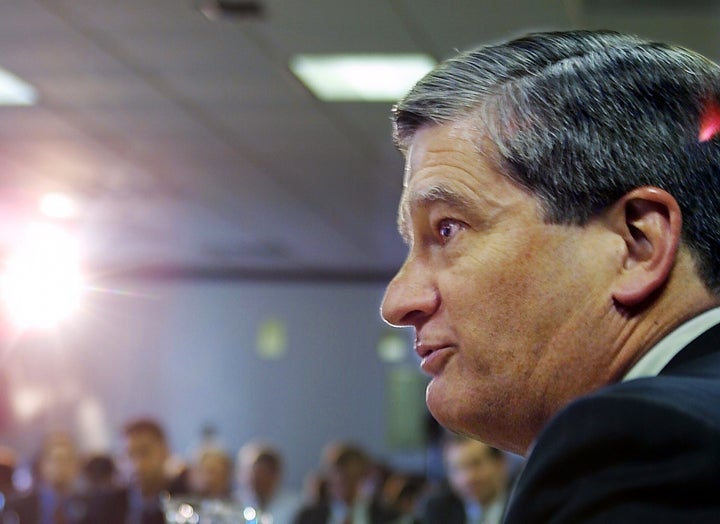
MANNY CENETA VIA GETTY IMAGES, 2001.
Preston Padden has been in the media industry for more than two decades. In that time, he’s served as an executive at Fox Broadcasting, ABC, the Walt Disney Company, among other organizations.
He referred to polling that indicates a significant portion of Republicans blame “left-wing protesters” for the Jan. 6 attack. “Of course, that is ludicrous,” he wrote. He also pointed to statistics that suggested two-thirds of Republicans believe or suspect the 2020 election was stolen from Trump.
“This ridiculous notion has been thoroughly refuted,” Padden continued. “But millions of Americans believe these falsehoods because they have been drilled into their minds, night after night, by Fox News.”
He said the “greatest irony” lay in his belief that most of the falsehoods on Fox News did not reflect Murdoch’s own views. He added:
I believe that he thought that it was important to protect his own health by wearing a mask during the pandemic and he encouraged me to do the same. I believe that he thought that it was important to protect his own health by getting vaccinated at the earliest opportunity and he encouraged me to do the same. And I believe that he thinks that former President Trump is an egomaniac who lost the election by turning off voters, especially suburban women, with his behavior.
Padden, who currently serves as the principle of a consulting business and as an advisory board member for a private equity investment firm, said he had tried and failed over the past nine months to make Murdoch understand the damage Fox News is doing to America.
“I am at a loss to understand why he will not change course,” he said.
Fox News did not immediately respond to HuffPost’s request for comment.
The electorate is shifting — and not in the Republican Party’s favor
David Faris July 6, 2021
Illustrated | Getty Images, iStock
A new deep dive into the 2020 electorate by Pew Research contains mostly bad news for Republicans, whose approaching demographic doom is less racial than it is generational. While it shouldn’t be news to anyone at this point that young voters are a solidly blue voting bloc, the more worrisome developments for the GOP are the unexpectedly elderly nature of the party’s coalition and the unyielding Democratic lean of younger voters as they age. If Pew’s numbers are to be believed, the only solidly Republican age demographic last year was 75 and over, meaning that every time the sun comes up, the GOP’s struggle to win a majority of American voters gets harder.
Pew’s in-depth study uses validated voter files – matching panelists to a registration database confirming whether or not they turned out – to offer a different, and possibly more accurate, view of the electorate than the exit polls taken on Election Day. Often this new data can challenge narratives that set in stubbornly and immediately after the votes are counted – in 2016, for example, Pew’s research found that Donald Trump won white women by a considerably smaller margin than Election Day surveys indicated, upending one prevailing story about who was most responsible for Hillary Clinton’s stunning loss.
There were some important differences between exit polls and the new study. For example, Pew found that Trump did better with Latino voters, and worse with Black voters, than exit polls indicated. Still, both sets of numbers showed Trump making modest inroads with these groups, easily the most concerning development for Democrats because of their centrality to the party’s coalition. Exit polls had Trump winning married men by 11 points, while Pew gave this group to Biden by 5. Trump, seemingly paradoxically, lost ground with men and gained some with women, narrowing the overall gender gap. It’s pretty difficult to discern a pattern in these differences, and the truth probably lies somewhere in the middle.
But then there are the age numbers. Biden, predictably, obliterated Trump with the youngest voters – members of the so-called Generation Z, born after 1996, as well as younger millennials. Exit polls had Biden winning 18- to 29-year-olds by 24 points, 60-36, whereas Pew pegs it at 58-38. Exit polls also showed Trump with just a 52-47 edge among voters over 65, and Pew’s numbers came in almost identical – 52-48 for Trump over Biden. And if those were the only topline stats you saw, you wouldn’t think there was a huge problem for Republicans.
But Pew also broke the survey down into not just age groups but generational cohorts. And it’s here where you’ll find the most terrifying information for the GOP. According to Pew, Trump won a decisive majority only with members of the “Silent Generation,” those born between 1928 and 1945 (and the extremely tiny number of living people older than that). Trump dominated that cohort by 16 points, 58-42. That means that the only reliably Republican voter bloc will shrink considerably between now and 2024, and that 65- to 74-year-olds must have been a much more blue-leaning group in 2020 to produce Trump’s comparatively narrow 4-point margin with all over-65s.
You don’t need a degree in actuarial science to know that in general, 65- to 74-year-olds will be around considerably longer than 75- to 102-year-olds. According to the Social Security Administration, a 65-year-old man has a remaining life expectancy of almost 18 years. At 75, it’s just over 11 years, and at 85 it’s less than six. Members of the Silent Generation are expected to shrink from 9 percent of the voting eligible population in 2020 to 7 percent in 2024. And while I hope that my over-75 parents are around as long as humanly possible, if I were a GOP operative I would be apoplectically trying to figure out ways to make the age profile of the average party supporter substantially younger, rather than tripling down on whatever Fox-driven cultural hysteria is dominating headlines in the conservative media. This stuff is not resonating with anyone who has more than 30 years to live.
Perhaps even worse for former President Trump and his acolytes, the Pew data showed little erosion in the millennial preference for Democrats over Republicans. Fifty-six percent of millennials voted for Clinton in 2016, and 58 percent voted for Biden in 2020. Remember, the first millennials voted in 2002, and as a group they simply have not budged. “Elder millennials” are turning 40 this year and they don’t love the Republican Party any more than they did when George W. Bush was lighting several trillion dollars on fire prosecuting a pointless war in Iraq. And that’s terrible news for the GOP’s hopes of ever becoming a majority party again, because if they keep losing the youngest voters by double digits election after election, they need a significant number of them to get more conservative as they age just to hold current margins in place.
That doesn’t mean Democrats are guaranteed to win the next several elections, even if the playing field is fair. “Demography is destiny” as a theory has aged badly, largely because Republicans remain competitive at the national level even as the country becomes more diverse and less white. Trump’s gains among Latino voters helped avert a total bloodbath in 2020, and there is no particular reason why Republicans couldn’t do better with them in 2024, in theory.
After all, Democrats’ deteriorating performance with non-college educated white voters over the past decade offset the ongoing diversification of the electorate. But according to Pew, the rightward march of white voters was halted and marginally reversed by Joe Biden in 2020, who did 4 points better with non-college-educated whites than Clinton. Republicans may have already run headlong into a white ceiling.
Republicans also continue to make up zero ground with young people. This year’s Harvard Youth Poll of 18- to 29-year-olds was the same horror show for the GOP that it has been for years, and it included yet another year of newly eligible voters who are repulsed by the dyspeptic, off-putting spectacle of the modern Republican Party, whose leading thinkers and politicians are staking their 2022 election strategy on a Woke Panic gambit dependent on demonizing an obscure academic concept (Critical Race Theory) and convincing voters that their imminent (and completely imagined) “cancellation” is their most important problem.
Thirty percent of Americans under 29 think Donald Trump was the worst president in American history. Sixty-five percent have an unfavorable view of the former president. Just 18 percent watch Fox News, the primary national vector for viral paranoia and disinformation, regularly. The Pew report is just a brutal document for Republicans. And it suggests that the light at the end of the tunnel, far from illuminating a path out of the wilderness for the GOP, is instead an oncoming, hostile generation poised to put Republicans at a decisive disadvantage in national elections for years.
In push to end gerrymandering, an unlikely state steps into the spotlight
Erin Einhorn
PORT HURON, Mich. — In a country where Democrats and Republicans have spent the past year battling over allegations of election fraud and attempts at voter suppression, the earnest scene playing out in a conference room here last week almost didn’t make sense.
The stakes were high. A commission charged with redrawing Michigan’s political boundaries was preparing to make crucial decisions that could affect the future of the state — and even the nation.
Yet there was no heckling, no chanting, no catcalls.
Instead, the roughly 70 people gathered in a brightly lit convention hall at the base of an international bridge that connects Michigan with Canada listened respectfully as one speaker after another offered ideas for how the state’s legislative and congressional districts should be drawn.
An environmental advocate asked for a district linking towns along the nearby St. Clair river so future representatives might prioritize its water quality.
A Methodist pastor requested a district that would consider the needs of religious voters, keeping churchgoers together.
A farmer and union leader asked for the rural and tourism communities in Michigan’s thumb region — named for its location in the mitten-shaped state — to be grouped together in a district separate from the industrial areas closer to Detroit. That way, he said, the thumb would have elected officials focused on agriculture rather than on industry.
“I don’t think we get a fair shake up here,” said the farmer, Dick Cummings, 78.
Image: Public hearing, Michigan (Brian Wells / Times Herald via Imagn)
This genteel display of civic discourse was part of a new nonpartisan effort by Michigan to redraw its political boundaries this year. The approach — handing redistricting power over to a 13-member independent citizens commission — is being watched by other states with interest, said Michael Li, senior counsel for the Democracy Program at the Brennan Center For Justice, a nonpartisan law and policy organization at New York University Law School.
“I can’t overstate how many eyes are on Michigan right now,” Li said.
Michigan has some of the most gerrymandered political boundaries in the nation, Li said. The sprawling districts twist and turn to give electoral advantages to Republicans, who drew the lines a decade ago.
The state has also had some of the fiercest political fights of recent years. Protesters stormed the statehouse with assault weapons to protest Covid-19 restrictions last spring, and supporters of former President Donald Trump pounded on the windows of a Detroit convention center as election workers counted votes after the November election. Last fall, 13 men were charged with attempting to kidnap the state’s Democratic governor.
So if an independent commission can draw fair political districts here that meet legal requirements and that can survive an expected flood of court challenges, it could serve as a model for other states to follow, Li said. Eventually, that could lead to fairer elections across the country — and maybe even a less rancorous political dynamic.
“A lot of people are rooting for Michigan now because the state looked hopeless in a lot of ways,” Li said.
If Michigan can do it, he added, “there’s a lot of hope for other places that also might seem hopeless.”
‘Just trying to work together’
Most states are preparing to redraw legislative and congressional districts after the 2020 federal census in the same way they always have: People in power will work behind closed doors to create districts designed to give their party an electoral edge for the coming decade.
The traditional partisan method has led in the past to strangely shaped districts in some states that zigzag to ensure that as many districts as possible are “safe” for the party drawing them up. The opposing party either gets packed into single districts, or carved up so its political power is diluted.
Critics say the approach — called gerrymandering — is a major reason the nation’s politics have become so deeply partisan. Since candidates running in safe districts typically don’t need to worry about the general election, they’re more likely to cater to the hard-core party stalwarts who vote in low-turnout primaries by adopting more extreme views.
“Some of the divide we’re seeing right now is that legislatures know they don’t have to be 100 percent responsive,” said Hannah Wheelan, a senior analyst with the electoral innovation lab at Princeton University. “A lot of their districts are safe, and they’re going to be able to win them no matter what.”
Voters then don’t feel like their votes matter, she said, which drives down turnout and puts even more power into the hands of party bosses.
Gerrymandering in Michigan 10 years ago, after the last census, was so effective for the Republican Party that the GOP has maintained a majority in both legislative houses for the last decade, though Democrats have won a majority of votes in some elections, including 2018 when they swept four statewide offices and earned more votes in legislative races overall.
This time, however, the process will be different, thanks to a grassroots effort that began in 2016, when a Michigan woman lamented the effects of gerrymandering on Facebook.
Her post went viral, bringing out volunteers who gathered more than 400,000 signatures to put a proposed redistricting change on the state ballot. The measure overcame a host of legal challenges and, in 2018, won overwhelming support from voters who amended the state Constitution to create the independent commission.
The voters made Michigan one of four states, along with Arizona, California and Colorado, that have removed elected officials and political parties from the process of redrawing political lines.
Michigan’s new process doesn’t even use elected officials to choose the members of the commission.
The 13 commissioners — four Democrats, four Republicans and five independents — were chosen by lottery from among 9,000 applicants. The secretary of state last summer randomly selected 200 semifinalists using a statistical weighting process to ensure diversity and statewide representation. Political parties only had the power to remove a limited number of candidates who they thought would be particularly partisan before the 13 commissioners were randomly chosen.
The commissioners, including lawyers, a retired banker, a medical student and a trauma practitioner who works with survivors of violent crimes, will start drawing political lines this summer or fall once final census numbers are available. The maps will apply to Congressional and legislative races next year.
Image: Public hearing, Michigan (Brian Wells / Times Herald via Imagn)
Districts must comply with state and federal laws and be similarly sized with reasonable, not zigzagging shapes. The commission, which does its work in public meetings, must also consider “communities of interest,” which could be anything — a religious group, a group of people who work in the same industry or people who send their children to a particular school. The goal is to keep voters in those communities together in a district, so that they can more powerfully lobby for their views.
Learning about these communities was one the goals of the 16 public meetings the commission held in May and June, including the one last week in Port Huron.
More than a thousand people have addressed the commission. Hundreds more have submitted comments and proposed maps online.
All of the public meetings have been as peaceful and civil as the one in Port Huron, said Douglas J. Clark Jr., 74, a Republican commissioner from the Detroit suburb of Rochester Hills. At some meetings, he said, people have applauded every speaker.
Not everyone will be happy with the new districts, said Clark, a retired operations and development manager. That’s not possible given the broad range of opinions people have expressed. But he believes the lines drawn through this process will be better than the ones drawn by political parties.
“We’re going to represent the public a lot better than they did,” Clark said. “The Republicans aren’t forcing anything Republican. The Democrats aren’t forcing anything Democrat. We’re all just trying to work together to get these maps drawn in a nonpartisan way.”
‘David overcoming Goliath’
The commissioners’ goals are lofty, but the process could be messy. A couple of lawsuits have already tried to stop the commission’s work — unsuccessfully, so far — and more are likely once maps are drawn, said Nancy Wang, the president of Voters Not Politicians, the nonpartisan advocacy organization that wrote the constitutional amendment and led the campaign to pass it.
Many in Michigan oppose the process, particularly Republicans who would have had the power to draw districts again this year.
Tori Sachs, the executive director of the conservative Michigan Freedom Fund, whose former director filed a lawsuit last year to stop the commission, said in a statement that the focus on communities of interest seems like just another form of gerrymandering.
“Activists are asking the Commission to gerrymander maps that divide communities based on partisan political issues,” she said in the statement, citing reports that describe potential communities of interest formed around political issues like the environment or immigration.
“That’s a mistake,” Sachs said. “Voters established a nonpartisan commission to draw fair maps and avoid gerrymandering. They deserve a commission that does what it promised.”
Advocates for overhauling redistricting across the country worry that a botched process in Michigan, whether that’s maps thrown out in court, a chaotic rollout or unfair lines that everyone hates, could harm the national movement. But, as Wang sees it, the fact that the process is happening here at all is a sign of progress.
“This really was David overcoming Goliath,” she said. “People in power are doing everything they can to fight this, but this is what the people want.”
When Arizona became the first state to use an independent redistricting commission after the 2000 census, it was something of a curiosity, Wang said.
When California followed suit in 2010, the effort won attention and applause. But Colorado and Michigan adopting the approach this year has the potential to show that the idea can work more broadly, Wang said.
“If you add Michigan to the mix, it just builds a case that you can’t really refute.”
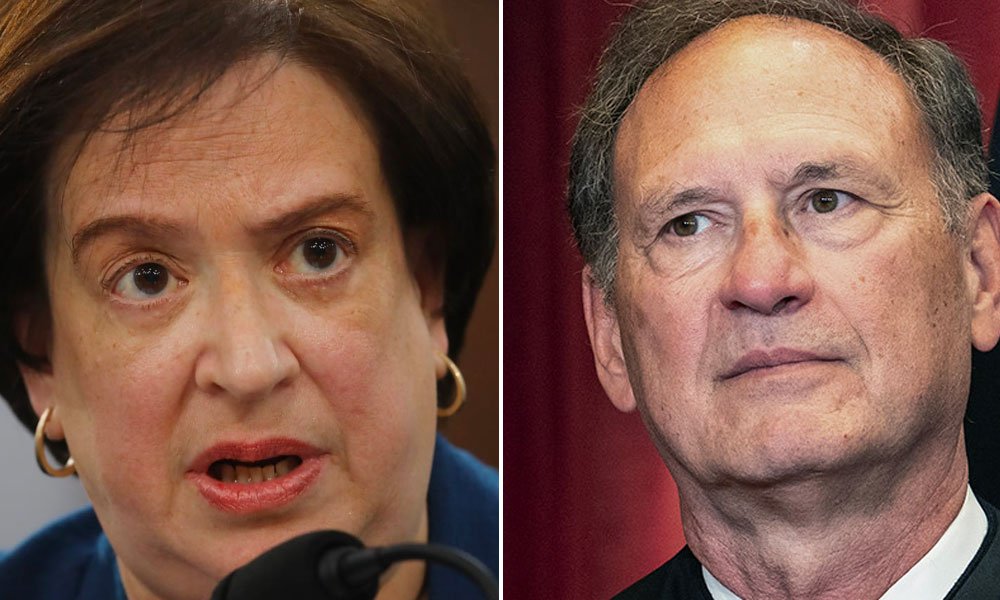
In a fiery 41-page dissent in a voting rights case, Supreme Court Justice Elena Kagan slammed her conservative colleagues, accusing them of ignoring the legislative intent of the 1965 Voting Rights Act as well as the high court’s own precedents.
Kagan’s fiery opinion, which was joined by the two other liberal members of the court, Justices Stephen Breyer and Sonia Sotomayor, accused her conservative colleagues of undermining Section 2 of the landmark Voting Rights Act and tragically weakening what she called “a statute that stands as a monument to America’s greatness.”
“Never has a statute done more to advance the nation’s highest ideals. And few laws are more vital in the current moment. Yet in the last decade, this court has treated no statute worse,” she wrote, according to The Hill.
Kagan also warned that “efforts to suppress the minority vote continue” yet “no one would know this from reading the majority opinion” and said the court in its 6-3 decision penned by stalwart conservative Justice Samuel Alito gave “a cramped reading” to the “broad language” of the voting law and used that reading to uphold two Arizona voting restrictions “that discriminate against minority voters.”
One is a 2016 Arizona law that prohibits the transporting of another person’s absentee ballot to election officials unless done by a family member or caregiver, a practice which critics call “ballot harvesting” but proponents say is necessary to give voters with limited mobility or in remote areas access to the polls.
The second is a longtime Arizona election rule that requires provisional ballots cast in the wrong precincts to be discarded.
Kagan argued that “in recent months, state after state has taken up or enacted legislation erecting new barriers to voting” and those laws shorten the time polls are open, imposed new prerequisites to voting by mail, make it harder to register to vote and easier to purge voters from the polls.
The court’s majority opinion upheld both policies and overturned an en banc decision by the 9th Circuit Court of Appeals in San Francisco that held the restrictions disproportionately impacted minority voters and thus violated the Voting Rights Act.
Newsletter: How many abandoned oil wells threaten your favorite national park?
By Sammy Roth, Staff Writer July 1, 2021
June has barely come to an end, and parts of California and the West are already suffering through unprecedented heat, punishing drought and rapidly spreading wildfire — a harrowing preview of life on a planet that is only getting more chaotic.
In Vancouver, police responded to 65 sudden deaths over four days as temperatures soared. A town even farther north obliterated Canada’s all-time temperature record with a 121-degree reading, which also would have shattered the record high in Las Vegas.
Portland broke its heat record three days in a row, ultimately reaching 116 degrees. In Seattle, where fewer than half of homes have air conditioning, the mercury hit 108 degrees, also an all-time high. There are at least 80 deaths being reported as potentially heat-related in the Pacific Northwest, and I’d be stunned if that number didn’t grow. Pay close attention to Spokane, in eastern Washington, where thousands of people lost power as the heat forced an electric utility to implement rolling blackouts.
Then there are the fires. We’re not yet seeing the kinds of landscape-devouring, sky-turns-orange mega-blazes that made last summer so nightmarish, but we’re already ahead of last year’s pace in terms of acres burned in the West. In Northern California’s Siskiyou County, the lightning-sparked Lava fire forced thousands of people to evacuate and is growing. The Inyo Creek fire closed the Mt. Whitney trailhead, and the Willow fire in Los Padres National Forest, near Big Sur, led to this stunning photograph:
Captain Justin Grunewald of the Mill Creek Hotshots takes a short rest amid his battle against the Willow fire.
(U.S. Forest Service)
The captain pictured is part of a hotshot crew. They’re the country’s most elite firefighting teams, but the federal government has had trouble keeping them staffed because pay is so low and the job is more grueling than ever. President Biden this week boosted firefighter pay to at least $15 an hour, up from as little as $13 today, my colleagues Chris Megerian and Anna M. Phillips report.
You probably don’t need me to tell you that climate change is the underlying condition connecting all these threads. It’s why so many scientists say we must rapidly move toward eliminating emissions from the burning of coal, oil and natural gas.
It’s also why fires, droughts and heat were on my mind as I explored a new analysis from the National Parks Conservation Assn., finding there are more than 31,000 “orphaned” oil and gas wells within 30 miles of national park sites nationwide.
These are wells that are no longer producing and yet haven’t been properly plugged, and whose operators are defunct or can’t be found, and thus can’t be forced to pay for cleanup. As The Times detailed in an investigation last year, California is littered with idle wells at risk of becoming orphaned, and cleaning them up could cost taxpayers billions of dollars. Left unplugged, they can spew planet-warming methane into the atmosphere, expose communities to toxic fumes and contaminate groundwater aquifers.
It’s no huge shock that many of these risky wells are near national park sites, considering how many park units there are — more than 400 overseen by the National Park Service, from name-brand parks such as Yosemite to national monuments, historic sites and scenic trails. Working with FracTracker Alliance, and using state-by-state orphaned-well data, the National Parks Conservation Assn. estimated there are 214,538 orphaned wells across the country, including 31,737 within 30 miles of a national park.
What really caught my eye was the park with the most risky wells nearby: Santa Monica Mountains National Recreation Area. I hike in the Santa Monica Mountains all the time, and I definitely wouldn’t have guessed there are 5,705 orphaned oil and gas wells within 30 miles — nearly twice as many as the park with the next most, Harry S Truman National Historic Site in Missouri.
The Santa Monicas are truly a national treasure, stretching from Point Mugu on the coast to the Hollywood Hills, and offering jutting sandstone cliffs, foggy ocean views and a feeling of immense wilderness just steps from a sprawling metropolis.
“People go to the Santa Monicas to get into nature, to get away from the normal urban ills that we deal with day to day,” said Dennis Arguelles, a senior program manager at the National Parks Conservation Assn. “But to think that so close to the mountains there are all these wells contributing to poor air quality in the region, contributing to climate change — it’s just a stark reminder that … it’s hard to leave behind all the damage we’ve done to the environment over the decades.”
Here are some views from Nicholas Flat Trail, which I hiked two weeks ago:
The fog begins to clear as Nicholas Flat trail ascends from Leo Carrillo State Park into the Santa Monica Mountains in June 2021.
(Sammy Roth / Los Angeles Times)
A view from Nicholas Flat trail in the Santa Monica Mountains.
(Sammy Roth / Los Angeles Times)
National parks advocates worry that abandoned oil and gas wells could pollute air and water within parks and in surrounding towns. They also know that rising global temperatures are already beginning to decimate beloved landscapes, causing ice to melt in Glacier National Park, snowfall to plummet in Yellowstone and Joshua trees to start dying off in the park that bears their name.
The Santa Monica Mountains are no exception. A recent climate change planning document from the National Park Service features a photo of the burn scar from the 2018 Woolsey fire in the Santa Monicas, alongside a warning that, across the country, “it will not be possible to safeguard all park resources, processes, assets, and values in their current form or context over the long term.”
In addition to growing fire risk in the Santa Monicas, global warming could limit the range’s suitability for dozens of bird species and potentially harm plant life, mountain streams and natural ecosystems more broadly, according to the park service.
Here are the 10 national parks with the most orphaned oil and gas wells within 30 miles, per the conservation group’s analysis:
— Santa Monica Mountains National Recreation Area (California): 5,705
— Harry S Truman National Historic Site (Missouri): 2,962
— George Rogers Clark National Historic Park (Indiana): 2,873
— Channel Islands National Park (California): 1,920
— Scotts Bluff National Monument (Nebraska): 1,751
— President William Jefferson Clinton Birthplace Home National Historic Site (Arkansas): 1,588
— Theodore Roosevelt National Park (North Dakota): 1,585
— Mammoth Cave National Park (Kentucky): 1,313
— Fort Scott National Historic Site (Kansas): 1,189
— Big South Fork National River and Recreation Area (Tennessee): 1,187
You can scroll through an interactive map of parks and orphaned wells here. Zooming in on Southern California, it becomes clear why the Santa Monica Mountains top the list. The park is sprawling, and drawing a 30-mile buffer zone around it encompasses the entirety of Los Angeles, as well as the oil fields of Ventura County. If you ever need a reminder that L.A. is an oil town, this is it.
The remains of Southern California’s first commercial oil well, Pico No. 4, were moved from their original location years ago and reconstructed for posterity. (Glenn Koenig / Los Angeles Times)
America Fitzpatrick, energy program manager at the National Parks Conservation Assn., cautioned that the analysis is based on state-specific data that vary in quality, and that some states probably do a better job tracking abandoned wells than others. It’s also worth keeping in mind that in a place like Southern California, the freeway capital of the world, orphaned oil and gas wells are likely only a small contributor to air pollution and climate emissions.
Still, these abandoned wells are a problem worth tackling — and by some estimations, an economic opportunity.
Researchers from Columbia University and the think tank Resources for the Future found last year that the federal government could create as many as 120,000 jobs through a program to plug half a million orphaned wells, potentially keeping oil and gas workers employed as the fossil fuel industry shrinks. Some estimates of the total number of orphaned wells are much higher.
Colorado Sen. Michael Bennet reintroduced a bill last week that would put $8 billion toward cleaning up orphaned wells over the next decade and require oil and gas companies to set aside more money for cleanup before they’re allowed to drill.
“It’s really unfortunate that the American taxpayer has (had) to address the cleanup that these oil and gas companies should really be responsible for,” Fitzpatrick said. “But we do have this moment where we can provide for the cleanup of these wells, and also reform the system so we’re not continuing to dig ourselves into this hole.”
As for the Santa Monica Mountains, there are only a few orphaned wells within the park’s boundaries, per the interactive map. But in an interesting twist, the proposed Rim of the Valley expansion — which I wrote about last year, and is currently working its way through Congress — would add the site of Southern California’s first commercial oil well, known as Pico No. 4, to the park.
Whether that oil well ultimately serves as a monument to a long-gone era of fossil fuel extraction — or as a cruel reminder of our inability to save ourselves, and our parks, from a grim reality of worsening heat, drought and fire — is yet to be seen.
For now, here’s what else is happening around the West:
TOP STORIES
The Russian River, just north of drought-stricken Lake Mendocino in Ukiah, Calif. (Brian van der Brug / Los Angeles Times)
Folks along California’s Russian River know climate change is worsening droughts, fires, floods and heat — and they’re determined to find a way to live with it. My colleagues Diana Marcum and Brian van der Brug paddled down the Russian River, producing powerful words and pictures about a region where residents are being asked to cut water use by 20% to 40%, and where as many as 2,300 wineries and farms may have their supplies cut off. It’s just one manifestation of a climate emergency in a state that could once again suffer its worst fire season on record, as The Times’ Faith E. Pinho and Alex Wigglesworth report.
President Biden and a bipartisan group of senators agreed on a nearly $1-trillion infrastructure deal. It includes a bunch of climate-related stuff, including $7.5 billion for electric car chargers, $49 billion for public transit and $55 billion to replace lead pipes and upgrade water systems — investments Biden is eager to highlight, my colleague Eli Stokols reports. But it’s still unclear whether the package will be approved — and even if it is, it’s a far cry from the much larger clean energy plan Biden originally proposed. The fate of ambitious climate action may rest in a separate bill that Democrats hope to pass without Republican votes.
It may be a while before we know whether saltwater intrusion from rising seas contributed to the horrifying Florida building collapse. But the disaster — more than 150 people are feared dead — has residents up and down the Sunshine State’s low-lying Atlantic shoreline nervous about what comes next as the ocean continues to rise, The Times’ Jenny Jarvie reports.
In a tiny bit of good news, drought also means less polluted beaches in Southern California. My colleague Rosanna Xia wrote about Heal the Bay’s latest beach record card, which found a big reduction in pollution last summer — seemingly because there wasn’t much rain to flush trash, pesticides and bacteria to the ocean through storm drains. Heal the Bay also published its third annual River Report Card, which is a good resource to have on hand if you enjoy fishing, swimming or kayaking in local streams.
The U.S. Supreme Court declined to hear an an appeal filed by Imperial Valley farmer Mike Abatti in a dispute over who controls the largest share of Colorado River water in the American West. The high court’s decision means the publicly owned Imperial Irrigation District will continue to shepherd the region’s 3.1 million acre-feet, the Desert Sun’s Janet Wilson reports. I wrote last year about how the case could affect the 40 million people across seven states who depend on the Colorado.
THE ENERGY TRANSITION
The Chevron oil refinery under storm clouds in El Segundo, Calif.
(Genaro Molina / Los Angeles Times)
Oil companies face growing pressure from investors to do more on climate — but whether they’re responding is another question. L.A. Times columnist Michael Hiltzik wrote about what investors are demanding, noting that 60% of Chevron shareholders voted for the company to “substantially” reduce its greenhouse gas emissions. A few weeks before that, an Exxon Mobil lobbyist acknowledged in a private meeting — which was actually a sting operation by Greenpeace UK — that the company is working to weaken federal climate action despite its public pledges of support, as the New York Times’ Hiroko Tabuchi reports.
Returning to abandoned oil and gas wells, an artificial island off the coast of Ventura County tells the story of how drilling companies can often walk away from huge liabilities. The Desert Sun’s Mark Olalde found that taxpayers have footed millions of dollars in offshore cleanup costs as a result of the island’s operator using bankruptcy to avoid paying the full bill.
California officials are ordering utilities to buy 11,500 megawatts of new clean power. That is a staggering amount, and it’s designed to help replace the Diablo Canyon nuclear reactors and several coastal gas plants, which I wrote about in May. Canary Media’s Jeff St. John notes that the requirement includes 1,000 megawatts of long-duration storage (which will make the Eagle Mountain pumped hydro folks happy) and 1,000 megawatts of 24/7 zero-carbon power (which will make the Imperial County geothermal folks happy). In Oregon, meanwhile, lawmakers passed a bill requiring the state’s major electric utilities to eliminate carbon emissions by 2040 — five years ahead of California’s timeline, as Dirk VanderHart reports for Oregon Public Broadcasting.
U.S. West faces little-known effect of raging wildfires: contaminated water
Donna Bryson
U.S. West faces little-known effect of raging wildfires: contaminated water
A fly fisherman tries his luck on the Poudre River inside the Cameron Peak fire burn scar west of Fort Collins
FORT COLLINS, Colo. (Reuters) – Early this spring, water bills arrived with notes urging Fort Collins Utilities customers to conserve. The Colorado customers may have thought the issue was persistent drought in the U.S. West.
But the problem was not the quantity of water available. It was the quality.
Utilities are increasingly paying attention to a little-known impact of large-scale fires: water contamination.
Huge forest fires last year denuded vast areas of Colorado’s mountains and left them covered in ash – ash that with sediment has since been washed by rains into the Cache la Poudre River. The river is one of two sources for household water in this college town of 165,000. With more and fiercer storms expected this year, officials worry about water quality worsening beyond what treatment systems can handle.
The problem could apply to watersheds across the U.S. West, which has faced ever-increasing extremes in heat, drought and wildfire amid climate change in recent years. The United States relies on water originating on forested land for about 80% of its freshwater supply, according to a government report https://on.doi.gov/3qvw4hf.
“If a wildfire is not in my watershed, it will be in someone else’s watershed,” said Sean Chambers, director of water and sewer in the nearby northern Colorado town of Greeley.
So far, Chambers and other northern Colorado utilities managers have avoided clogged pipes simply by skipping the Cache la Poudre water and using other supplies. But they worry that’s not a long-term solution, and so they sent out those notes pleading with customers to voluntarily conserve: Water lawns sparingly. Don’t let the hose run on the sidewalk when washing your car.
THE COST OF WATER
Corporate headhunter Jim Croxton moved to Fort Collins so he could take in the mountain scenery while fishing.
“I really don’t care about how big the fish are,” Croxton said after buying a half dozen flies at a Fort Collins fishing and guide shop. “I just like to be out in” nature.
He had considered drought to be the West’s water concern. But the utility’s letter urging conservation struck a chord; he had read about polluting fires affecting recreational fishing, too.
“Water in the West is a central issue,” Croxton said.
Fort Collins water rates rose 2% from January. That works out to less than $1 per month for the typical home, and generates about $600,000 toward covering an estimated $45 million in potential fire-related measures, according to calculations prepared for Fort Collins City Council.
Those measures include laying mulch on burn scars to hold down soil, and funding further fire impact research. To make up the balance, officials in Fort Collins, Greeley and other communities are pooling resources and seeking state and federal help.
Katrina Jessoe is an economist at UC Davis who has advised utilities on seeking funding to decontaminate water supplies from pollutants such as fertilizers.
“You can’t get around the fact that the cost of water is getting higher,” which could be a concern for low- and middle-income earners, Jessoe said.
Water managers say they need also to explore new ways of raising funds and making capital improvements to deal with fire-related contamination, for example, removing tastes and odors left by algae fed by nutrients in the sediments washed into reservoirs. The tastes and odors don’t mean the water is unsafe, but customers don’t like it.
Water managers are “making decisions right now that will affect whether or not this is a liveable place in 50 years, 100 years,” said John Matthews, who heads the Alliance for Global Water Adaptation, a nonprofit that advises on adapting water systems for climate change.
UNPRECEDENTED FIRES
The two fires that have marred the watersheds relied on by Fort Collins, Greeley, Thornton and other towns were notable not just for the devastation they caused, but for having burned at such high elevation.
“We really don’t understand these high-elevation fires very well, because they haven’t happened very often,” said Matt Ross, an ecosystem scientist at Colorado State University who is studying how last year’s fires are impacting algae blooms now.
The Cameron Peak Fire broke out in August and was the first in Colorado history to consume more than 200,000 acres, including swathes of the Arapahoe and Roosevelt national forests and Rocky Mountain National Park. The East Troublesome came close, burning 193,812 acres across the Continental Divide.
In both cases, flames tore through forests where rivers originate and where snowpack – that frozen reservoir – builds up over winter.
Given the large region burned, researchers need to understand how long it will take for vegetation to grow back, so it can keep sediment from washing into water sources, said biogeochemist Chuck Rhoades at the U.S. Forest Service.
“The implications are that people need to think a little bit more about how to manage and sustain reservoirs,” Rhoades said.
(Reporting by Donna Bryson; Editing by Katy Daigle and Lisa Shumaker)
Op-Ed: Will Biden choose fossil fuel or Minnesota’s rivers, and a cooler planet, in the fight against Line 3?
Alan Weisman
Climate activists and Indigenous community members demonstrate against the Line 3 tar sands pipeline on June 7. (Kerem Yucel/AFP via Getty Images)
It was mid-afternoon on June 7 when nearly three dozen sheriffs, deputies and police arrived at the Two Inlets pump station site on Enbridge Inc.’s Line 3 oil pipeline, now under construction in northern Minnesota. In riot helmets, wielding long truncheons, they formed two lines and stood in unusual 90-degree heat, awaiting orders to move in against nearly 200 nonviolent protesters.
Earlier, I’d watched a Homeland Security helicopter repeatedly buzz the demonstrators, apparently attempting to dislodge them with clouds of choking dust. “Stay! Don’t let them weaponize our Mother Earth against us!” someone yelled, although many had already chained and padlocked themselves to earth-moving equipment, pipeline infrastructure and an old blue speedboat that now blocked the way into the site.
Once completed, the pump station the protesters had seized would push heavy crude bitumen — tar sands oil, up to three times dirtier than conventional oil — from western Canada through Minnesota and Wisconsin to a terminal on Lake Superior. Burning the pipeline’s daily potential capacity of 915,000 barrels would more than double Minnesota’s annual output of greenhouse gases.
That was one reason protesters were here. “They knew about climate change in the ’80s,” said one 27-year-old woman. “We should’ve been getting off fossil fuels before I was born.”
With the Dakota Access pipeline’s permit under reconsideration and the Keystone XL pipeline canceled, Line 3 is a last gasp at keeping the filthy tar sands industry alive. The science isn’t debatable: To counter mounting climate catastrophes, and to hold global warming to the Paris accords’ limit of 1.5 degrees Celsius (2.7 degrees Fahrenheit) tar sands must stay in the ground. Anything else risks incinerating our species’ future.
About 20 miles from where the pump station protesters would ultimately be unchained and arrested, nearly 2,000 more demonstrators had another reason to stop Line 3: What the local Ojibwe, Anishinaabe and Chippewa call Misi-Ziibi.
If Enbridge has its way, Line 3, which partly reroutes and replaces a decaying older pipeline, will bore under the Mississippi River twice as it flows north and then loops south from its source, Lake Itasca. Any leaks and spills — by one count of company records, Enbridge is responsible for more than 1,000 between 1996 and 2014 — could poison the Mississippi and more: Line 3 will cross 211 other rivers and streams, and threaten scores of lakes and wetlands in Minnesota’s choicest wild rice harvesting region, granted to Indian tribes by 19th century treaties.
The first Mississippi crossing site lies just miles from a state park where countless tourists have hopped across the trickle that soon widens and deepens into America’s most famous river. Even non-Natives consider the headwaters sacrosanct. “We’re going to protect the sacred,” vowed Leech Lake band Ojibwe Nancy Beaulieu to the protesters gathered on the river’s reedy banks, “for all those not born yet.”
In Ojibwe culture, women are the water protectors; Beaulieu is one of several leading a seven-year fight against Line 3. Recently, they’ve been dealt two setbacks. First, Minnesota’s Court of Appeals rejected a challenge to Enbridge’s state permit to run Line 3 through tribal land, despite its threat to water quality and sovereign treaty rights.
Then last week, despite President Biden’s climate agenda, the Army Corps of Engineers went to court to defend its permits for Line 3, which had been rushed through in the last days of the Trump administration. With Enbridge racing to complete the pipeline before further appeals can stop them, sheriffs have begun raiding the remaining “resistance camps” where water protectors are blocking construction with their bodies.
“It’s a total betrayal by the administration,” said White Earth Ojibwe leader Winona LaDuke about last week’s court filing. “The Army Corps of Engineers under Trump should not be the Army Corps under Biden.”
A few days after the June 7 protests, LaDuke took me canoeing on the meandering Shell River, which Line 3 will cross five times. We dragged the boat more than paddled, because like the far west, Minnesota is in deepening drought.
In water still clear enough to drink, I saw big freshwater mollusks that give the Shell its name, and long, flowing wild rice stalks LaDuke will harvest this fall — unless the river keeps dropping. It enrages her that Minnesota is allowing Enbridge to pump almost 5 billion gallons of groundwater as it tunnels through the state.
Her tribe now manufactures solar furnaces; they know the time to stop fossil fuels is running out. LaDuke believes the stand she and her Ojibwe water protector sisters are taking against Enbridge is among humanity’s last chances to confront an existential threat.
“We’re going to fight to the end,” she said. “But we’re the poorest damn people. It’s devastating how callous these politicians and corporations are to life.”
Whether Line 3’s CO2 ends up in our atmosphere depends on the president — “Our only hope now,” in LaDuke’s words.
Not long ago, a white neighbor told LaDuke , “We’re thinking the Indians are going to stop this pipeline.”
“The Indians could use a little help, ma’am,” she replied.
Journalist Alan Weisman is the author of the bestseller “The World Without Us” and “Countdown,” winner of the 2013 Los Angeles Times Book Prize for science and technology. His next book explores our best hopes for surviving the coming decades
House Democrats propose government-run credit reporting system
Marissa Gamache, Reporter June 29, 2021
House lawmakers on Tuesday called for sweeping reforms to the credit reporting industry — with some Democrats going so far as proposing a nationally run system, saying the three major bureaus are failing Americans.
Three pieces of legislation were put forth for discussion, including the National Credit Reporting Agency Act that “would establish the Public Credit Registry (PCR) within the Consumer Financial Protection Bureau, creating a public option for consumers who choose to utilize it.”
“This is a system that fails people with perfect credit that may be victims of identity theft,” Chairwoman Maxine Waters said at the Financial Services Committee hearing. “This is a system that fails people who get caught in a debt trap because of predatory lending, and this is a system that fails people who don’t have the means to dispute errors that reporting agencies make.”
Chairwoman Maxine Waters, D-Calif., at a House Financial Services Committee meeting. (Photo:Getty)
The three major credit bureaus — Equifax, TransUnion, and Experian — compile and store financial data about a person’s debt obligations submitted by creditors into a credit report. That report can be used to determine if that person qualifies for a loan and at what terms. Landlords, employers, utilities, cell phone companies, and insurers also can use this information.
While ranking Republican committee member Patrick McHenry agreed that major reforms to the current “oligarchy” are needed, he doesn’t support a nationally run system.
“We should be promoting competition to create better opportunities for consumers,” McHenry said, “not allowing a single government entity to run the credit reporting process for all Americans.”
The United States capitol building in Washington DC on a summer day. (Photo: Getty)
The committee also heard testimony on how credit scores — which are calculated from the information found in credit reports — may disadvantage certain groups.
“Although credit scores never formally take race into account, they draw on data about personal borrowing and payment history that is shaped by generations of discriminatory public policies and corporate practices that limit access to wealth for Black and Latinx families,” Amy Traub, associate director of policy and research at Demos, testified at the hearing.
In a 2020 survey of 5,000 people by Credit Sesame, 54% of Black Americans and 41% of Hispanic Americans reported having a credit score below 640, while 37% of white Americans and 18% of Asian Americans reported the same.
The committee hearing comes after the Supreme Court ruling last week on a case involving TransUnion and credit reporting errors.
(Photo: Getty Creative)
In TransUnion vs. Sergio Ramirez, 8,185 individuals claimed that TransUnion failed to use proper measures to ensure their credit files were accurate. The court ruled in favor of 1,853 of the claimants whose inaccurate information was passed on to third parties, but denied the remaining claimants because they did demonstrate “concrete harm” and lacked standing to sue, according to court records.
Credit report errors are not uncommon, according to a recent study by Consumer Reports. One in 3 individuals who volunteered to check their credit report found at least one error, with 1 in 9 discovering inaccurate account information.
On Tuesday, Rep. Waters called for more accountability and alternatives to be offered.
“I encourage my colleagues to join me in reevaluating how we determine creditworthiness,” she said, “and learning how we can harness new technologies to build a fairer and equitable credit system.”
Yahoo Money sister site Cashay has a weekly newsletter.
‘Two Americas’ may emerge as Delta variant spreads and vaccination rates drop
Edward Helmore
Photograph: Anita Beattie/AFP/Getty Images
With Covid vaccination penetration in the US likely to fall short of Joe Biden’s 70% by Fourth of July target, pandemic analysts are warning that vaccine incentives are losing traction and that “two Americas” may emerge as the aggressive Delta variant becomes the dominant US strain.
Efforts to boost vaccination rates have come through a variety of incentives, from free hamburgers to free beer, college scholarships and even million-dollar lottery prizes. But of the efforts to entice people to get their shots some have lost their initial impact, or failed to land effectively at all.
“It’s just not working,” Irwin Redlener at the Pandemic Resource and Response Initiative at Columbia University, told Politico. “People aren’t buying it. The incentives don’t seem to be working – whether it’s a doughnut, a car or a million dollars.”
In Ohio, a program offering five adults the chance to win $1m boosted vaccination rates 40% for over a week. A month later, the rate had dropped to below what it had been before the incentive was introduced, Politico found.
Oregon followed Ohio’s cash-prize lead but saw a less dramatic uptick. Preliminary data from a similar lottery in North Carolina, launched last week, suggests the incentive is also not boosting vaccination rates there.
Public officials are sounding alarms that the window between improving vaccination penetration and the threat from the more severe Delta variant, which accounts for about 10% of US cases, is beginning to close. The Delta variant appears to be much more contagious than the original strain of Covid-19 and has wreaked havoc in countries like India and the United Kingdom.
“I certainly don’t see things getting any better if we don’t increase our vaccination rate,” Scott Allen of the county health unit in Webster, Missouri, told Politico. The state has seen daily infections and hospitalizations to nearly double over the last two weeks.
Overall, new US Covid cases have plateaued to a daily average of around 15,000 for after falling off as the nation’s vaccination program ramped up. But the number of first-dose vaccinations has dropped to 360,000 from 2m in mid-April. A quarter of those are newly eligible 12- to 15-year-olds.
Separately, pandemic researchers are warning that a picture of “two Americas” is emerging – the vaccinated and unvaccinated – that in many ways might reflect red state and blue state political divides.
Only 52% of Republicans said they were partially or fully vaccinated, and 29% said they have no intention of getting a vaccine, according to a CBS News/YouGov poll. 77% of Democrats said they were already vaccinated, with just 5% responding that were resisting the vaccine.
“I call it two Covid nations,” Peter Hotez, a vaccine researcher at Baylor College of Medicine in Houston, told BuzzFeed News.
Bette Korber, a computational biologist at the Los Alamos National Laboratory in New Mexico, said she expected variant Delta to become the most common variant in the US within weeks. “It’s really moving quickly,” Korber told Buzzfeed.
On Friday, Joe Biden issued a plea to Americans who have not yet received a vaccine to do so as soon as possible.
“Even while we’re making incredible progress, it remains a serious and deadly threat,” Biden said in remarks from the White House, saying that the Delta variant leaves unvaccinated people “even more vulnerable than they were a month ago”.
“We’re heading into, God willing, the summer of joy, the summer of freedom,” Biden said. “On July 4, we are going to celebrate our independence from the virus as we celebrate our independence of our nation. We want everyone to be able to do that.”