It’s the accumulation’: The Jan. 6 hearings are wounding Trump, after all

Politico

‘It’s the accumulation’: The Jan. 6 hearings are wounding Trump, after all

David Siders – July 20, 2022

Shawn Thew/AP Photo

The conventional wisdom about the Jan. 6 committee hearings was that no single revelation was going to change Republican minds about Donald Trump.

What happened instead, a slow drip of negative coverage, may be just as damaging to the former president. Six weeks into the committee’s public hearing schedule, an emerging consensus is forming in Republican Party circles — including in Trump’s orbit — that a significant portion of the rank-and-file may be tiring of the non-stop series of revelations about Trump.

The fatigue is evident in public polling and in focus groups that suggest growing Republican openness to an alternative presidential nominee in 2024. The cumulative effect of the hearings, according to interviews with more than 20 Republican strategists, party officials and pollsters in recent days, has been to at least marginally weaken his support.

“It is definitely kind of this wet drip of, do you really want to debate the 2020 election again? Do you really want to debate what happened on Jan. 6?” said Bob Vander Plaats, the evangelical leader in Iowa who is influential in primary politics in the first-in-the-nation caucus state. “Frankly, I think what I sense a little bit, even among some deep, deep Trump supporters … there’s a certain exhaustion to it.”

Trump’s public approval rating among Republicans remains high as he prepares for a widely expected run for president again in 2024. He still tops most primary polls, and Republicans largely haven’t been persuaded by much of what the Jan. 6 committee is doing. They were more likely last month than last year — before the hearings began — to describe the events of Jan. 6 as a “legitimate protest.”

But for many Republicans, the ongoing, backward-looking call-and-response between the committee and Trump may nevertheless be getting old.

“I think what everybody thought was that the first prime-time hearing was such a non-event that that would continue,” said Randy Evans, a Georgia lawyer who served as Trump’s ambassador to Luxembourg. “But over the course of the hearings, the steadiness, the repetitiveness, has had a corrosive effect. You’d have to be oblivious to the way media works, the way reputations work, the way politics works, to not understand that it’s never the one thing. It’s the accumulation.”

Evans said, “This is all undoubtedly starting to take a toll — how much, I don’t know. But the bigger question is whether it starts to eat through the Teflon. There are some signs that maybe it has. But it’s too early to say right now.”

For more than a year after Trump lost the presidential election, his political durability was not even in question. But the committee hearings appear to have had an effect on Trump’s enormous fundraising operation, which has slowed in recent months. Florida Gov. Ron DeSantis, who may run in 2024, has been gaining on Trump in some polls, including in New Hampshire, the first primary state, where one recent survey had DeSantis statistically tied with Trump among Republican primary voters. Republicans are still poring over a New York Times/Siena College poll last week that showed nearly half of Republican primary voters would rather vote for a Republican other than Trump in 2024.

In a series of focus groups with 2020 Trump supporters from across the country since the riot at the Capitol on Jan. 6, 2001, Sarah Longwell, a moderate Republican strategist who became a vocal supporter of Joe Biden in 2020, for more than a year found about half of participants consistently said they wanted Trump to run again. But that number has fallen off since the hearings began, she said.

“We’ve had now three focus groups where zero people have wanted him to run again, and a couple other groups where it’s been like two people,” Longwell said. “Totally different.”

The Trump supporters in her focus groups are still dismissive of the hearings, Longwell said, “and I don’t think people are sitting down and being persuaded” by them.

However, she said, the hearings have “turned the volume up on the Trump baggage.”

“The other thing,” she said, “is I cannot tell you how much these Republican voters want to move on from the conversation of January 6th.”

‘Political Theater’

That’s a far cry from the Republican view of the hearings when they started: Rep. Jim Banks (R-Ind.) derided what he called a “prime-time dud.” Jim Justice, the Republican governor of West Virginia, dismissed them as “political theater.” And Sen. Josh Hawley of Missouri called them a “complete waste of time.”

One reason that the hearings are resonating now is that even if Republicans don’t agree with the committee’s findings, they read polls. The percentage of Republicans who say Trump misled people about the 2020 election has ticked up since last month, while a majority of Americans say Trump committed a crime. Perhaps most problematic for Trump, 16 percent of Republicans in the Siena College survey said they would vote for someone else in the general election or aren’t sure what they will do in 2024 if Trump is the nominee.

That’s a relatively small segment of the Republican electorate, but a critical one in competitive states that will decide which party controls the White House.

“I think you’re starting to see the impact of the hearings, and just overall his behavior since he lost the election,” said Dick Wadhams, a former Colorado Republican Party chair and longtime party strategist.

“He’s got a hard-core base, and there’s no doubt about that,” said Wadhams. “I voted for him twice, I loved his accomplishments. But I do think he’s compromised himself into a situation where it would be very difficult for him to win another election for president.”

Electability concerns may loom especially large this year for Republicans, who view Biden as a beatable incumbent. His cratering public approval ratings, now hovering below 39 percent, are worse than Trump’s at this point in his presidency. One senior House Republican aide described the resonance of the Jan. 6 committee hearings as in part a product of the contrast they are drawing between “a golden opportunity to win back the White House in 2024 and the only person who might not be able to do it.”

A Trump spokesperson did not respond to a request for comment. Trump has regularly criticized the committee’s work as a partisan exercise. And because most other Republicans view it that way, too, it’s unlikely that many of Trump’s opponents will leverage the committee’s revelations explicitly in the run-up to 2024.

Proxy wars

Still, the Republicans who may run against Trump in 2024 are increasingly breaking with him as the midterm year drags on.

On Friday, former Vice President Mike Pence will campaign in Arizona for gubernatorial candidate Karrin Taylor Robson, while Trump that same day appears in the presidential swing state for Robson’s rival for the GOP nomination, former TV news anchor Kari Lake. Former New Jersey Gov. Chris Christie and former Secretary of State Mike Pompeo, among others, have split with Trump in midterm endorsements in other states. So has outgoing Maryland Gov. Larry Hogan, who engaged in proxy war with Trump in the gubernatorial primary held Tuesday in Hogan’s home state.

As much has anything, those midterm primaries – coinciding with the Jan. 6 committee hearings – have laid bare the willingness of Republicans in at least some cases to disassociate their adoration for Trump with support for him politically. Trump’s endorsement has pulled Republicans across the line in competitive primaries in places like Ohio and Pennsylvania, but his chosen candidates have flopped in other races, including in Georgia and Nebraska.

“The effect of the hearings will be negligible on Trump’s favorable ratings among Republicans,” said Whit Ayres, the longtime Republican pollster. “The ‘Always Trumpers’ and the ‘Maybe Trumpers’ are resolute in their insistence that they are paying no attention whatsoever to the hearings. It’s almost an article of faith among Republicans to say, ‘I am not paying attention to these hearings’.”

However, Ayres said, “The way it translates is that they believe that other candidates will carry less baggage … and that gets reinforced by what seeps into the political water from these hearings.

And as the Jan. 6 committee prepares for another hearing on Thursday, the ongoing focus on Trump’s behavior on Jan. 6 is now in the political waters.

John Thomas, a Republican strategist who works on House campaigns across the country, said that in recent conversations with state party chairs and Republican activists in numerous states, “almost to the T, and I don’t really care what state it’s in, they all say, ‘Love Trump, love his policies, wish he would just be a kingmaker.’ And that’s really a shift, because six months ago, a year ago, it was, ‘Trump’s got to run again, he’s the only one who can fight the swamp, drive the policy agenda.’”

“It’s not Trump hatred,” Thomas added. “It’s Trump fatigue. I think [the Jan. 6 committee hearings] reminds people to the degree that they’re tuning in that, eh, is this that important of an issue? No. But damn … And then Trump goes on his rants and it’s like, ‘We’re tired of it.’”
Justice Thomas’ lusterless tenure began with a lie. It keeps getting worse.

The Columbus Dispatch

Justice Thomas’ lusterless tenure began with a lie. It keeps getting worse. |Opinion

Michael M. Lederman – July 19, 2022

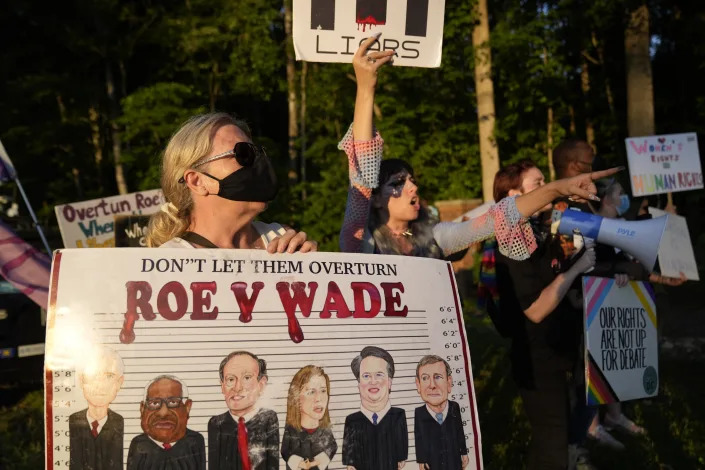
Abortion-rights protesters demonstrate near the home of Associate Justice Clarence Thomas in Fairfax Station, Va. on June 24, 2022, after the Supreme Court opinion in Dobbs v. Jackson Women's Health Organization overturned the landmark 1973 Roe v. Wade decision that established a constitutional right to abortions.
Abortion-rights protesters demonstrate near the home of Associate Justice Clarence Thomas in Fairfax Station, Va. on June 24, 2022, after the Supreme Court opinion in Dobbs v. Jackson Women’s Health Organization overturned the landmark 1973 Roe v. Wade decision that established a constitutional right to abortions.

Dr. Michael M. Lederman is professor of medicine (emeritus) and biomedical ethics at Case Western Reserve University. He is editor-in-chief of the scientific journal Pathogens and Immunity.

Clarence Thomas should not be on the Supreme Court.

He was approved to sit on the court by a timid Democrat majority Senate that was afraid to conclude that this Black man had sexually harassed a colleague, Anita Hill.

More: Petition calls for impeachment of Chatham’s Clarence Thomas. Can you impeach a Supreme Court justice?

The truth of the matter is undetermined but to my eye and in the eyes of many, Professor Anita Hill (and two other women) were telling us the truth and Judge Thomas was lying.

Clarence Thomas, then a Supreme Court nominee, testifies before the Senate Judiciary Committee during his 1991 confirmation hearing.

A terrible start for a Supreme Court justice and it did not get any better. His tenure on the Supreme Court has been lusterless. For many years, he would not even write an opinion and his writings have been largely pedestrian or extremist.

Law professor Anita Hill testifies before the Senate Judiciary Committee on Capitol hill Oct. 11, 1991. In a 1994 book titled " Strange Justice, The selling of Clarence Thomas," written by two Wall Street Journal reporters, the authors revealed that Thomas' volatile Supreme Court confirmation hearings raise fresh questions about his denial that he had talked dirty to Hill while she worked for him as an aide at two government agencies in the 1980s.
Law professor Anita Hill testifies before the Senate Judiciary Committee on Capitol hill Oct. 11, 1991. In a 1994 book titled ” Strange Justice, The selling of Clarence Thomas,” written by two Wall Street Journal reporters, the authors revealed that Thomas’ volatile Supreme Court confirmation hearings raise fresh questions about his denial that he had talked dirty to Hill while she worked for him as an aide at two government agencies in the 1980s.

His wife – Virginia “Ginni” Thomas, a refugee from an 80’s cult –  is a danger to America who has placed Justice Thomas proximate to sedition. Ginni Thomas has worked relentlessly to undermine the outcome of the 2020 presidential election using lies and misrepresentations to urge electors to resist the legitimate transition of government.

More: Clarence Thomas’ wife asks Anita Hill for apology

This is an embarrassment to the court.

But even worse is Clarence Thomas’s refusal to recuse himself from deliberations that address this very election.

Most recently, Thomas delivered the majority opinion in New York State Rifle and Pistol Association v. Bruen, finding that the right to carry concealed handguns in public for the purpose of self-defense is protected by the Second Amendment to the Constitution.

Michael M. Lederman, M.D., is professor of medicine (emeritus) and biomedical ethics at Case Western Reserve University. He is editor-in-chief of the scientific journal Pathogens and Immunity.

More: How to submit guest opinion columns to the Columbus Dispatch

Justice Thomas (and other conservative justices) deliberately misunderstand the Second Amendment. None of the other nine amendments to the Constitution that comprise the Bill of Rights requires justification; those are self-evident and fundamental.

The Second Amendment alone has an explanatory introduction: “A well-regulated Militia, being necessary to the security of a free state,” the Amendment begins, “the right of the people to keep and bear Arms shall not be infringed.”

Nowhere in the Amendment is self-defense mentioned.

More: Supreme Court justices don’t have a code of ethics. Hundreds of judges say that’s a problem

If the framers of Bill of Rights understood that that the right to keep and bear arms was fundamental, why was this unique introduction even warranted?

In the 2008 Heller decision, the unique importance of this introduction is simply ignored as nearly accidental and a labyrinth of decisions is used to link the Amendment to the use of arms in activities such as self-defense. When applied to the original words of the  framers, this is sophistry.

Thomas is marinated in conflicts of interest that render impartiality risible. He has been a headliner for the Eagle Forum (an anti-abortion organization) and the conservative Council for National Policy.

He gave a keynote speech at a fundraiser for the conservative Manhattan Institute and has a longstanding relationship with the Heritage Foundation.

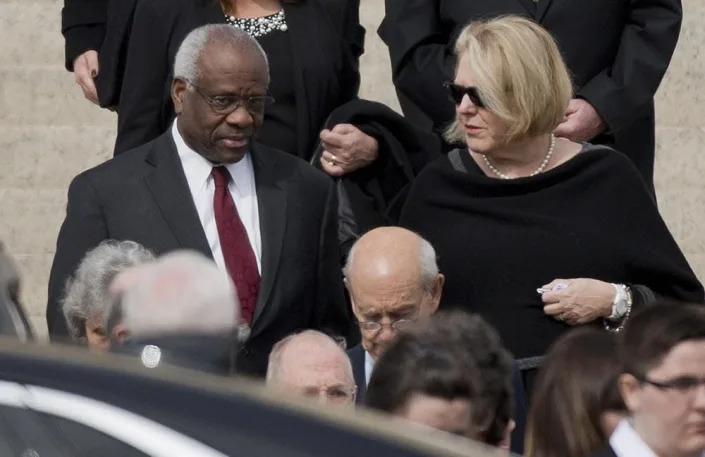
Supreme Court Associate Justice Clarence Thomas, left and his wife Virginia Thomas, right, on Feb. 20, 2016. Virginia Thomas sent weeks of text messages imploring White House Chief of Staff Mark Meadows to act to overturn the 2020 presidential election, according to copies of the messages obtained by The Washington Post and CBS News.

His wife has prominent roles in a number of conservative activist organizations and she was actively engaged in promoting the Jan. 6, 2021, Ellipse rally that ultimately resulted in the violent assault on the Capitol. Mrs. Thomas has given at least $13,000 to support Republicans seeking elected office.

More: What ties does Ginni Thomas, the Supreme Court justice’s wife, have to Jan. 6?

Apparently, Thomas’ colleagues have been unable or unwilling to get Thomas to recuse himself when conflicted.

His service on the court offers a compelling argument for term limits, if not impeachment.

Dr. Michael M. Lederman is professor of medicine (emeritus) and biomedical ethics at Case Western Reserve University. He is editor-in-chief of the scientific journal Pathogens and Immunity.

House Democrats tout bill to add four seats to Supreme Court

The Hill

House Democrats tout bill to add four seats to Supreme Court

Julia Mueller – July 18, 2022

A group of House Democrats called for legislation on Monday that would add four seats to the Supreme Court, lamenting a “ultra right-wing” branch that just overturned the Roe v. Wade decision on abortion rights.

The eight lawmakers cited recent Supreme Court decisions that rolled back Miranda rights, threw out a New York gun control law and allowed religion to surface in schools — as well as the Dobbs v. Jackson Women’s Health decision that overturned the right to abortion in Roe — in saying there was a need to add new justices to the court.

Rep. Hank Johnson (D-Ga.), the lead sponsor of the 2021 Judiciary Act, called the current makeup “a Supreme Court at crisis with itself and with our democracy” where “basic freedoms are under assault” from the 6-3 conservative supermajority on the bench.

The Supreme Court isn’t susceptible to the popular vote the way Congress is, Johnson said, and it has used that fact to amass power. “It’s making decisions that usurp the power of the legislative and executive branches,” he said.

Facing Republican opposition and some Democratic skepticism, the bill has little chance of becoming law, but it illustrates the deep anger among progressive Democrats about the court’s direction under three conservative justices nominated by former President Trump: Neil Gorsuch, Brett Kavanaugh and Amy Coney Barrett.

Those three justices have radically altered the direction of the court, which now has twice as many conservative justices as liberal ones. Kavanaugh replaced Justice Anthony Kennedy, a previous swing vote who had been nominated to the court by a Republican, while Barrett replaced liberal Justice Ruth Bader Ginsburg.

Adding to Democratic anger, a GOP Senate blocked former President Obama’s last nominee to the court, Merrick Garland, who is now the attorney general. Gorsuch ended up being nominated to the court in place of Garland.

Introduced last year, the Judiciary Act has not progressed in Congress.

Some Democrats wary of the proposal are concerned that expansion would open the court up for Republicans to push more of their nominees into the openings.

“The nightmare scenario of GOP court-packing is already upon us,” said Rep. Mondaire Jones (D-N.Y.). “That’s how they got this far-right 6-3 majority in the first place.”

Lawmakers at Monday’s press conference, hosted by the Take Back the Court Action Fund, blamed Trump and the conservative legal movement for enabling a partisan court.

Republican politicians made controlling the judicial branch part of their platform, said Rep. Mark Takano (D-Calif.), adding that the court has “gone rogue” and “become a radical institution.”

The lawmakers also emphasized that the longevity of the lifelong terms the sitting justices are now serving makes action to expand the court more urgent.

Of 72-year-old conservative Justice Samuel Alito, Johnson said, “You can see the gleam in his eye as he thinks about what he wants to do to decimate the rights of people and put us back in the Dark Ages.”

Trump-nominated Gorsuch, Barrett and Kavanaugh, in their 50s, are “gonna be there for a while,” Johnson said.

Congress has changed the number of seats on the nation’s highest court seven times in the nation’s history. The new proposal would bring the total seat count to 13, meaning a decision from the court would need a 7-6 majority rather than the present 5-4.

Reps. Andy Levin (D-Mich.), Jan Schakowsky (D-Ill.), Bonnie Watson Coleman (D-N.J.), Rashida Tlaib (D-Mich.) and Sheila Jackson Lee (D-Texas) were also at the conference, along with Sen. Ed Markey (D-Mass.), who sponsored the bill in the Senate, and a handful of progressive activists.

The 18 House Republicans who voted against a resolution to support Finland, Sweden joining NATO

The Hill

The 18 House Republicans who voted against a resolution to support Finland, Sweden joining NATO

Mychael Schnell – July 18, 2022

More than a dozen House Republicans voted against a resolution on Monday that expressed support for Finland and Sweden joining NATO.

The House passed the measure, which had bipartisan sponsorship, in a 394-18 vote, with all the opposition coming from the Republican Party. Two Democrats and 17 Republicans did not vote.

Eighteen House Republicans objected to the measure: Reps. Andy Biggs (Ariz.), Dan Bishop (N.C.), Lauren Boebert (Colo.), Madison Cawthorn (N.C.), Ben Cline (Va.), Michael Cloud (Texas), Warren Davidson (Ohio), Matt Gaetz (Fla.), Bob Good (Va.), Marjorie Taylor Greene (Ga.), Morgan Griffith (Va.), Thomas Massie (Ky.), Tom McClintock (Calif.), Mary Miller (Ill.), Ralph Norman (S.C.), Matt Rosendale (Mont.), Chip Roy (Texas) and Jefferson Van Drew (N.J.).

The measure specifically demonstrates support for Finland and Sweden joining NATO — which they applied to do in May — and urges member states to formally support their push to join the alliance.- ADVERTISEMENT -https://s.yimg.com/rq/darla/4-10-1/html/r-sf-flx.html

Additionally, the resolution opposes any attempts by the Russian Federation to adversely react to the decision by the two Nordic countries to join the military alliance and urges NATO countries to fulfill their 2 percent of gross domestic product (GDP) defense spending pledge that was agreed to at the 2014 Wales summit.

Passage of the measure came exactly two months after Finland and Sweden applied to become members of NATO and less than three weeks after the military alliance invited the pair of countries to join the group.

The push for Sweden and Finland to join NATO ramped up after Russia began its invasion of Ukraine on Feb. 24. Moscow has since continued its offensive.

Massie said on Twitter on Monday following the vote that “America can’t afford to subsidize socialist Europe’s defense, nor should we. Tonight, I voted against the House Resolution urging NATO’s expansion into Sweden and Finland.”

His tweet included a link to a Newsweek article from March that said only eight of the 30 NATO countries met the guideline of spending 2 percent of their GDP on defense in 2021 — a fact that was reflected in the NATO secretary general’s annual report.

Massie and other GOP lawmakers who objected to Monday’s resolution have voted against measures related to the Russia, Ukraine and the invasion in the past.

In May, Massie and Greene voted “no” on three bills connected to the invasion. One compelled foreign entities and individuals under U.S. authority to comply with sanctions on Russia and Belarus. Another called for making it U.S. policy to bar Russian officials from participating in meetings and activities in the Group of 20 and other financial institutions. The third would forbid the Treasury secretary from taking part in transactions related to the exchange of special drawing rights that Russia or Belarus possesses.

Belarus has supported Russia throughout its invasion of Ukraine.

The lawmakers also joined 54 Republicans that day in voting against a bill to suspend multilateral debt payments Ukraine owes.

In April, Massie, Greene, Cawthorn and Roy joined with four progressive lawmakers in opposing a measure urging President Biden to seize assets from sanctioned Russian oligarchs and use the money to help Kyiv amid its battle with Moscow.

Also in April, 10 GOP House members — including Massie, Greene, Biggs, Bishop, Davidson, Gaetz and Norman — voted against the Ukraine lend-lease bill, which sought to make it easier for the U.S. to send military assistance to Ukraine during Russia’s invasion.

Russia is using rape as a weapon of war in Ukraine. Here’s what can be done about it.

USA Today

Russia is using rape as a weapon of war in Ukraine. Here’s what can be done about it.

Carli Pierson, USA TODAY – July 13, 2022

Warning: This column contains graphic descriptions of sexual violence against women, men and children.

“This is how an 11 year old boy sees the world after having been raped by #Russia soldier in front of his mother.” That was the caption above a photograph of chaotic swirls of black marker on a white background painted by a Ukrainian child tweeted by that country’s lawmaker Lesia Vasylenko.

There are many more equally horrific reports, too many to detail here.

As Russian dictator Vladimir Putin continues the onslaught of Ukraine, and this week, as Bosnian Muslims remember the massacre at Srebrenica 27 years after it happened, the unlearned lessons from the horrors of Balkan war scream out at us: “What can we do better?”

The answer isn’t as elusive as it might seem. In fact, it has been proposed by international criminal law and human rights experts for years.

‘Sexual violence can be used strategically as a method of warfare’

Rape has been considered a war crime since the 1949 Geneva Conventions. But it has not been prosecuted like other war crimes and crimes against humanity.

It wasn’t until 1993 that the United Nations Security Council officially recognized mass rape as a weapon of war, and made it eligible for prosecution in the International Criminal Tribunal for the former Yugoslavia.

Bosnian refugees carry bags of relief aid near the besieged town of Srebrenica in 1993.

Catherine Dunmore specializes in international criminal law, human rights law and sexual and gender-based violence. She has served on legal teams that have investigated and prosecuted war crimes, including conflict-related sexual violence.

I reached out about her work investigating sexual violence as a war crime. She said, “The vast majority of victims of conflict-related sexual violence are women and girls, although it’s also perpetrated against men, boys and the LGBTIQ+ community in many settings.”

“Sexual violence” Dunmore said, “can be used strategically as a method of warfare, for instance as a deliberate tactic to undermine the opposition or strike fear in civilian populations.”

She also pointed out that sexual violence can be committed by any party to the conflict, including humanitarian actors.

What is Russia doing in Ukraine?

►Over the past five months of conflict, Russia has carried out repeated, deadly assaults on civilian targets, including a shopping mall and apartment buildings.

►Last week, Ukrainian Prosecutor General Iryna Venediktova told USA TODAY that the number of cases of war crimes is likely more than 10,000.

►As of June 3, the U.N. High Commissioner for Human Rights’ monitoring team had received over 120 reports of alleged conflict-related sexual violence in Ukraine.

►On July 5, High Commissioner Michelle Bachelet reported that her team had “verified 28 cases of conflict-related sexual violence, including cases of rape, gang rape, torture, forced public stripping, and threats of sexual violence. The majority of cases were committed in areas controlled by Russian armed forces, but there were also cases committed in government-controlled areas.”

An independent investigative organization

While investigators inside and outside Ukraine work to collect evidence of war crimes with the hope of eventually prosecuting those crimes, additional options have long been proposed.

A protest in front of the Russian Embassy in Bucharest, Romania, on May 16, 2022.

In an interview on National Public Radio in May, British lawmaker Arminka Helic talked about her work to “create a permanent, independent and international body to investigate and prosecute rape and sexual violence as war crimes,” reported Leila Fadel.

Helic explained, “If we had a body that is funded, in existence, that has forensic trauma and medical experts already available to be deployed or to be approached by the investigators in Ukraine, we would have by now had an opportunity to collect this evidence, either from the internally displaced people or from the people who have crossed the border.”

My late mentor, the godfather of international criminal law, M. Cherif Bassiouni, had been proposing the same idea since the Balkan war.

The knowledge of a swift, efficient and powerful investigative body charged with the full U.N. authority might also serve as a deterrent to potential war criminals. For instance, fighters would be on notice that it would be much harder to get away with the evidence of their crimes, including the so-called silent ones like rape. Perhaps they would think twice before joining in on the criminal sadism.

We’ve known for decades what we need to do – it’s about time we call on world leaders to make it happen.

Carli Pierson, a New York licensed attorney, is an opinion writer with USA TODAY and a member of the USA TODAY Editorial Board

Could this SCOTUS case push America toward one-party rule?

The Week

Could this SCOTUS case push America toward one-party rule?

Grayson Quay, Weekend editor – July 12, 2022

The Supreme Court.
The Supreme Court. Illustrated | Getty Images

The Supreme Court has announced its intention to take up Moore v. Harper this fall, a case that critics claim is “perhaps the gravest threat to American democracy since the Jan. 6 attack.” Here’s everything you need to know: 

What’s at stake in ‘Moore v. Harper’?

North Carolina House Speaker Timothy Moore (R) is suing a voter named Rebecca Harper as part of a dispute over a federal electoral map drawn by the state’s Republican-controlled legislature. According to The Carolina Journal, the case will test a legal theory known as the “independent state legislature doctrine,” which asserts that “only the state legislature has the power to regulate federal elections, without interference from state courts.”

Article I, Section 4 of the U.S. Constitution states that the “Times, Places, and Manner of holding Elections for Senators and Representatives, shall be prescribed in each State by the Legislature thereof.” Proponents of the “independent state legislature doctrine” argue that this clause gives state legislatures the power to draw congressional districts, set rules for federal elections, and appoint presidential electors, and that state courts have no power to interfere — even if the legislature blatantly violates the state constitution.

Which, in this case, it totally did. The North Carolina Supreme Court ruled in February that the proposed map, which would have guaranteed Republicans easy wins in 10 of the state’s 14 districts, was “unconstitutional beyond a reasonable doubt under the … North Carolina Constitution.”

The situation in North Carolina is not so clear-cut, however. Robert Barnes noted in The Washington Post that the state’s General Assembly passed a law two decades ago empowering state courts to review electoral maps and even create their own “interim districting plan[s].” Moore’s lawyers must therefore prove that the legislature violated the U.S. Constitution by abdicating its own authority over redistricting.

The U.S. Supreme Court rejected the case in March but agreed on June 30 to hear it. Justices Clarence Thomas, Samuel Alito, Neil Gorsuch, and Brett Kavanaugh have all signaled their openness to Moore’s argument. The Washington Post‘s editorial board suggests that Chief Justice John Roberts — who three years ago left open the possibility that state courts could override partisan gerrymanders — is now “poised” to side with Moore as well. The board considers Justice Amy Coney Barrett “a possible swing vote.” All three of the court’s liberals are expected to reject the independent state legislature doctrine.

The case will be heard during the term beginning in October 2022, with a decision expected in the summer of 2023 — just in time to upend the 2024 elections.

What about the Electoral College?

In January, Ryan Cooper wrote for The Week that the state of Wisconsin “effectively exists under one-party rule.” Democrats can still win statewide elections — say, for governor or U.S. Senate — but state legislative districts are hopelessly gerrymandered in favor of Republicans. If the Supreme Court sides with Moore, GOP-controlled legislatures in states like Wisconsin would have full authority to rig not only their own states’ legislative elections, but elections to the U.S. House of Representatives as well.

And it might not stop there. Article II, Section 1 of the U.S. Constitution empowers each state to “appoint, in such Manner as the Legislature thereof may direct, a Number of Electors” equal to that state’s number of senators and representatives. The clause doesn’t say anything about the popular vote. This means, in theory, that state legislators can appoint whoever they want to the Electoral College. If SCOTUS side with Moore next summer on the question of federal redistricting, they’re likely to apply the same reasoning to presidential elections. This interpretation was floated by conservative justices — including Thomas — during the Bush v. Gore (2000) case that handed George W. Bush the presidency.

The Electoral Count Act of 1887 stipulates that each state’s slate of electors must be certified by the governor of that state. In states like Wisconsin— which has a Democratic governor — this law could prevent the Republican-led legislature from handing the state’s electoral votes to a losing Republican candidate.

But wait — if the independent state legislature doctrine is correct, then the governor has no right to usurp the legislature’s constitutionally granted powers. That provision of the Electoral Count Act (ECA) would be struck down.

This idea “is quickly becoming dogma among Republican legal apparatchiks,” Cooper wrote. Convincing Republican-controlled states won by President Biden to submit alternate slates of Republican electors was a key part of Trump lawyer John Eastman’s strategy to overturn the 2020 presidential election. His plan also rested on the assumption that the ECA is “likely unconstitutional.”

What’s the worst-case scenario?

Zach Praiss of the nonprofit Accountable Tech and progressive talk show host Thom Hartmann have laid out similar nightmare scenarios that could arise if SCOTUS rules in Moore’s favor.

Hartmann imagines a 2024 presidential contest between Biden and Florida Gov. Ron DeSantis in which Biden wins the popular vote in Georgia, North Carolina, Wisconsin, Michigan, Pennsylvania, and Arizona. The GOP-controlled legislatures of these six states then decide to disregard the will of the voters and award their 88 electoral votes to DeSantis, making him the winner and president-elect.

Republicans control both legislative houses in 29 states, plus the unicameral legislature of Nebraska, and they might soon gain the power to gerrymander themselves into a permanent majority. Those states control 306 electoral votes, more than enough to elect a president.

“It is difficult … to see the desire to put sole control of election rules in the hands of a partisan legislative body as anything more than a power grab,” argued Christine Adams in The Washington Post. Laurence H. Tribe and Dennis Aftergut were even blunter in the Los Angeles Times: “Adopting the independent state legislature theory would amount to right-wing justices making up law to create an outcome of one-party rule.”

Brett Kavanaugh’s Right to Dine Shall Not Be Infringed

Esquire

Brett Kavanaugh’s Right to Dine Shall Not Be Infringed

Jack Holmes – July 8, 2022

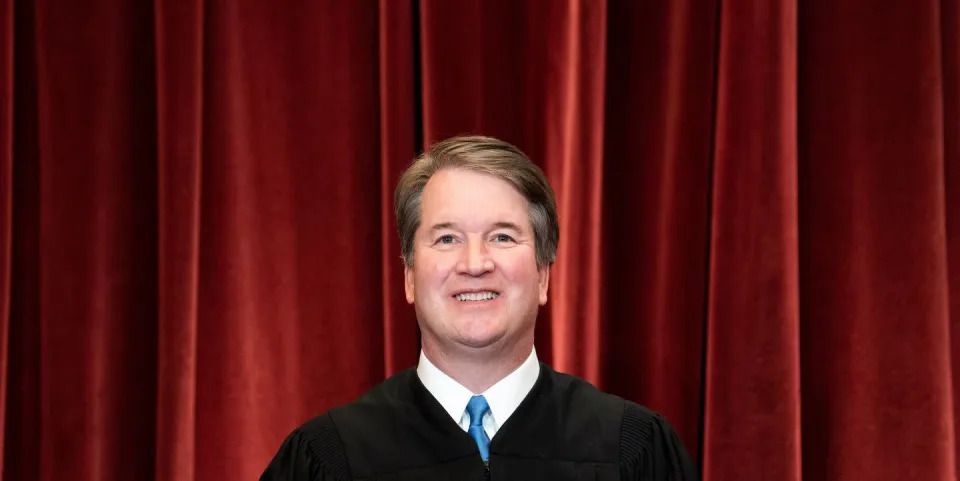
Brett Kavanaugh was nominated to become a member of our nine-person SuperCongress by a president who took office despite earning the votes of millions fewer Americans than his opponent did. That president never enjoyed the support of a majority of citizens and got spanked in the popular vote by an even larger margin—7 million—in the next election. He then tried to overthrow the government to stay in power. Only one of the five other right-wing justices was nominated by a president who took office having secured the support of a majority of actual Americans.

Photo credit: Pool - Getty Images
Photo credit: Pool – Getty Images

Brett Kavanaugh was then confirmed by 50 senators who represented just 44 percent of the American population. The 48 senators who voted “nay” represented tens of millions more citizens. Kavanaugh secured the crucial 50th vote of Senator Susan Collins based on her publicly stated belief that he considered Roe v. Wade to be “settled legal precedent.” In the public hearings into the question of his confirmation, where he testified under oath, Kavanaugh said this:

Senator, I said that it is settled as a precedent of the Supreme Court, entitled the respect under principles of stare decisis. And one of the important things to keep in mind about Roe v. Wade is that it has been reaffirmed many times over the past 45 years, as you know, and most prominently, most importantly, reaffirmed in Planned Parenthood v. Casey in 1992.

And as you well recall, senator, I know when that case came up, the Supreme Court did not just reaffirm it in passing. The court specifically went through all the factors of stare decisis in considering whether to overrule it, and the joint opinion of Justice Kennedy, Justice O’Connor and Justice Souter, at great length went through those factors.

And then, a couple of weeks ago, Kavanaugh voted with the five other Republicans on the Court to overrule Roe v. Wade and Planned Parenthood v. Casey.

If you have a problem with any of this—unelected judges selected by presidents who got fewer votes and confirmed by senators who represent a minority of citizens making policy without regard for legal precedent or their own previous statements under oath—you don’t seem to have much recourse.

You can’t vote the superlegislators out. It is unreasonable to expect any will be impeached thanks to the entrenched advantages that allow Republicans outsize control of the Senate. Even the House of Representatives is dangerously skewed, thanks to gerrymandered redistricting maps and the hyperpolarization they help to generate. The reason Senate Republican leader Mitch McConnell and others worked so hard to seize control of the judiciary was precisely because so many other institutions have ceased to function properly. Even if you do succeed in electing representatives to make policy through the legislature—after this same Court savaged the Voting Rights Act and unleashed an avalanche of money in our elections—the courts can throw out whatever they choose.

Photo credit: Bill Clark - Getty Images
Photo credit: Bill Clark – Getty Images

You cannot protest at the steps of the Supreme Court, as they’ve walled that shit off. You can’t protest at the justices’ houses, and there’s some merit to the idea that private residences—where spouses and children are in the mix—should be off-limits. (Of course, in the case of Clarence Thomas, his spouse has very much been in the mix.) But you can’t protest in neutral public venues, either, even if you’re on a city street outside a restaurant. We learned that this weekend, when Mr. Kavanaugh was disturbed during a meal at a Washington, D.C. steakhouse, as reported by the Beltway encyclical known as Politico Playbook:

On Wednesday night, D.C. protesters targeting the conservative Supreme Court justices who signed onto the Dobbs decision overturning the constitutional right to abortion got a tip that Justice BRETT KAVANAUGH was dining at Morton’s downtown D.C. location. Protesters soon showed up out front, called the manager to tell him to kick Kavanaugh out and later tweeted that the justice was forced to exit through the rear of the restaurant.

We have returned, inevitably, to Red-Henghazi. Do public figures who make the rules we all have to live by get to do whatever they want at all times without any social repercussions? Do they have some right to privacy in public spaces, despite choosing to wield huge power over others in a democratic republic? Morton’s seems to think so.

“Honorable Supreme Court Justice Kavanaugh and all of our other patrons at the restaurant were unduly harassed by unruly protestors while eating dinner at our Morton’s restaurant. Politics, regardless of your side or views, should not trample the freedom at play of the right to congregate and eat dinner. There is a time and place for everything. Disturbing the dinner of all of our customers was an act of selfishness and void of decency.”

The right to eat dinner shall not be infringed. (Particularly by the Unduly Unruly.) Which, according to Politico‘s Daniel Lippman, it was not.

While the court had no official comment on Kavanaugh’s behalf and a person familiar with the situation said he did not hear or see the protesters and ate a full meal but left before dessert, Morton’s was outraged about the incident.

The right to tiramisu shall not be infringed. Seriously, though, at this point we’re talking about what appears to be a complete non-incident. He went out the back because he heard secondhand there were some folks out front?

But even if the honorable justice had to hear the urban rabble outside—described by Politico as “D.C. protestors”—tell him to fuck himself while he chowed down on a ribeye, what exactly is the problem here? The protesters are exercising their rights to speech and “peaceably to assemble, and to petition the Government for a redress of grievances.” Kavanaugh and the others may fashion themselves as blind arbiters of the law, but in reality they are agents of state power, representing the Government. And they have generated some grievances.

Meanwhile, we’re hearing about Brett the Honorable’s right to dine, what we can only assume is an unenumerated one under the Ninth Amendment. It also sounds more than somewhat related to the right to privacy—also rooted in the Ninth—which undergirded Roe and Casey before these six luminaries threw those decisions out. Justice Clarence Thomas has signaled they’re interested in going after the right to privacy itself with a so-called reconsiderationof Griswold v. Connecticut, a move that would go way beyond contraception. Although the prospect of this Republican Court empowering states controlled by their ideological allies to restrict women’s access to the pill in the Year of Our Lord 2022 does have a particular resonance.

And if that happens, you can expect the same bullshit routine from these same people. The work of working the refs is never done, and the self-victimization will never stop. This is the same impulse undergirding much of the Cancel Culture debate: while social-media mobs and a lack of due process are real problems, many of the fiercest Free Speech Warriors actually see free speech as their right to say whatever they want without getting criticized or made fun of. Similarly, these right-wing superlegislators believe they should be able to nakedly advance the policy priorities of the conservative movement by reverse-engineering decisions to meet preordained conclusions, all the while battering the lives of powerless people, without ever getting called an asshole while they drink a $300 bottle of wine. There are consequences for behaving badly in public office, at least until these people are finished savaging the foundations of this democratic republic. Or until the Democratic Party finds the stones to nix the Senate filibuster, expand the Supreme Court, reform the judiciary, and restore the people’s means of translating their will into the law we all are bound to live by.

SCOTUS Justices ‘Prayed With’ Her — Then Cited Her Bosses to End Roe

Rolling Stone

SCOTUS Justices ‘Prayed With’ Her — Then Cited Her Bosses to End Roe

Kara Voght and Tim Dickinson – July 6, 2022

Reverend Rob Schenck (C) from Faith and - Credit: Jewel Samad/AFP/Getty Images
Reverend Rob Schenck (C) from Faith and – Credit: Jewel Samad/AFP/Getty Images

At an evangelical victory party in front of the Supreme Court to celebrate the downfall of Roe v. Wade last week, a prominent Capitol Hill religious leader was caught on a hot mic making a bombshell claim: that she prays with sitting justices inside the high court. “We’re the only people who do that,” Peggy Nienaber said.

This disclosure was a serious matter on its own terms, but it also suggested a major conflict of interest. Nienaber’s ministry’s umbrella organization, Liberty Counsel, frequently brings lawsuits before the Supreme Court. In fact, the conservative majority in Dobbs v. Jackson Women’s Health, which ended nearly 50 years of federal abortion rights, cited an amicus brief authored by Liberty Counsel in its ruling.

More from Rolling Stone

In other words: Sitting Supreme Court justices have prayed together with evangelical leaders whose bosses were bringing cases and arguments before the high court.

Nienaber is Liberty Counsel’s executive director of DC Ministry, as well as the vice president of Faith & Liberty, whose ministry offices sit directly behind the Supreme Court. She spoke to a livestreamer who goes by Connie IRL, seemingly unaware she was being recorded. “You actually pray with the Supreme Court justices?” the livestreamer asked. “I do,” Nienaber said. “They will pray with us, those that like us to pray with them.” She did not specify which justices prayed with her, but added with a chortle, “Some of them don’t!” The livestreamer then asked if Nienaber ministered to the justices in their homes or at her office. Neither, she said. “We actually go in there.”

Nienaber intended her comments, broadcast on YouTube, to be “totally off the record,” she says in the clip. That’s likely because such an arrangement presents a problem for the Orlando-based Liberty Counsel, which not only weighed in on the Dobbs case as a friend of the court, but also litigated and won a 9-0 Supreme Court victory this May in a case centered on the public display of a religious flag.

The Supreme Court did not respond to a request for comment. Liberty Counsel’s founder, Mat Staver, strenuously denied that the in-person ministering to justices that Nienaber bragged about exists. “It’s entirely untrue,” Staver tells Rolling Stone. “There is just no way that has happened.” He adds: “She has prayer meetings for them, not with them.” Asked if he had an explanation for Nienaber’s direct comments to the contrary, Staver says, “I don’t.”

But the founder of the ministry, who surrendered its operations to Liberty Counsel in 2018, tells Rolling Stone that he hosted prayer sessions with conservative justices in their chambers from the late-1990s through when he left the group in the mid-2010s. Rob Schenck, who launched the ministry under the name Faith and Action in the Nation’s Capital, described how the organization forged ministry relationships with Samuel Alito, Clarence Thomas, and the late Antonin Scalia, saying he would pray with them inside the high court. Nienaber was Schenk’s close associate in that era, and continued with the ministry after it came under the umbrella of Liberty Counsel.

Louis Virelli is a professor at Stetson University College of Law who wrote a book about Supreme Court recusals. He’s blunt in his assessment: “Praying with a group that filed an amicus brief with a court,” he says, “is a problem.”

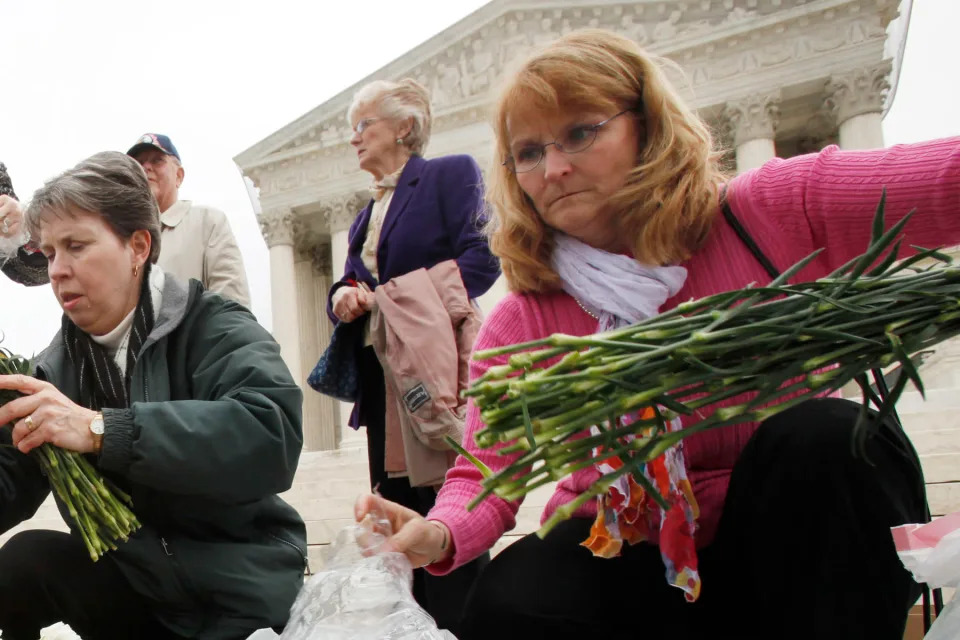
Peggy Nienaber, right, at an event outside the Supreme Court led by Christian faith organizations on the eve of the Supreme Court arguments on President Obama’s health care legislation in 2012. - Credit: Jacquelyn Martin/AP Images
Peggy Nienaber, right, at an event outside the Supreme Court led by Christian faith organizations on the eve of the Supreme Court arguments on President Obama’s health care legislation in 2012. – Credit: Jacquelyn Martin/AP Images

In the shadow of the high court, across the street from its chambers, sits a cluster of unassuming row houses known only to the initiated as “Ministry Row.” The strip is host to evangelical political groups that have spent the past several decades pushing Beltway conservatives to embrace the religious right’s political causes — and, most of all, reverse Roe v. Wade. The street view offers few clues as to what transpires behind the painted brick facades, save for a granite slab inscribed with the Ten Commandments planted in the grassy patch before a modest cream-colored Victorian with maroon trim.

The home serves as Faith & Liberty’s headquarters. The Ten Commandments statue had been placed there by Schenck, an evangelical minister famous for orchestrating high-profile anti-abortion stunts, such as shoving an aborted fetus in a plastic container into the face of former President Bill Clinton during the 1992 campaign. Schenck had opened the ministry in the 1990s as Faith and Action in the Nation’s Capital, a nonprofit dedicated to ending federal abortion rights. The organization operated on a “utopian ‘trickle-up’ theory” of influence: building access “higher and higher up within the government, until we got to the top, my ultimate target — members of Congress, U.S. senators, cabinet secretaries, Supreme Court justices — even presidents,” Schenck wrote in his 2018 autobiography.

The group established a strong foothold in both chambers of Congress and, eventually, the White House. But Faith and Action ultimately directed its energies toward the judicial branch. “There were no pro-life groups directly approaching the judges and justices, who shaped abortion law simply by their precedent-setting decisions,” Schenck wrote. “We knew we were stuck with members of the federal bench — they were appointed for life — so why not convert them while in office?” (Schenck has since reversed course: He is now a fierce critic of evangelical politicking and says Liberty Counsel assumed Faith and Action’s operations in 2018. He says he has no knowledge of the group’s inner workings after he left.)

At first, the high court regarded Faith and Action and its peer organizations as nuisances, according to Schenck. “Justice Thomas would say to me, ‘You know those groups outside? Are they crazy or are they good people?’” Schenck recalls in an interview with Rolling Stone. When Schenck first began his approach in 1994, prayer activities on the Supreme Court’s property was considered an act of demonstration, and therefore illegal. Eventually, Justices Alito, Scalia, and Thomas would embrace Schenck, he says, and pray with him in various corners of the high court’s grounds — including, occasionally, in their chambers. (Chief Justice John Roberts, meanwhile, remained more guarded and skeptical of such groups’ influence.)

To pray with the justices was to perform a sort of “spiritual conditioning,” Schenck explains. “The intention all along was to embolden the conservative justices by loaning them a kind of spiritual moral support — to give them an assurance that not only was there a large number of people behind them, but in fact, there was divine support for very strong and unapologetic opinions from them.” Prayer is a powerful communication tool in the evangelical tradition: The speaker assumes the mantle of the divine, and to disagree with an offered prayer is akin to sin. “It’s just not common to interrupt or challenge a prayer,” Schenck explains. “That’s not something a devout Supreme Court justice would ever consider doing.” That was true even for the devout Catholic justices, such as Scalia, who joined the evangelical Faith and Action members in prayer, Schenck says.

Sometimes the prayers would be general; other times, on specific subjects, such as ending abortion, according to Schenck. He says Faith and Action took assiduous care to avoid speaking blatantly about cases in the Supreme Court’s pipeline, discussing the political agenda only in broad strokes. Even so, under the time period Schenck describes, prayers with the justices occurred as Faith and Action signed onto several amicus briefs for landmark SCOTUS cases such as Gonzales v. Planned Parenthood, which ultimately upheld the Partial-Birth Abortion Ban Act of 2003.

Schenck walked away from his life on the Hill after receiving a late-career doctorate on the teachings of Dietrich Bonhoeffer, the German pastor who questioned the collaborative relationship between Adolf Hitler and 1930s German evangelicals. He drew parallels between the Republican Party and American evangelicalism, concerned that he’d weaponized worship to fuel a hate-filled agenda. No longer an anti-abortion activist, Schenck views his past efforts with regret. “Prayer is a positive exercise, until it’s politicized — and too many prayers that I and my colleagues offered in the presence of the justices were political prayers,” he explains. He also believes the work “contributed to the internal moral and ethical corruption of the justices at the court,” he says.

“I was sure, while we were doing it, it would be a positive contribution to our public life,” Schenck says. “It didn’t have the effect I thought it would. In some ways, it set the stage for the reversal of Roe, which I now think of as a social catastrophe.

When Liberty Counsel absorbed Faith and Action in 2018, Peggy Nienaber, who had worked alongside Schenck since at least 2005, continued with the group. In a July 2021 conversation with Staver, Liberty Counsel’s founder, Nienaber described the group’s new incarnation as similar to Faith and Action’s mission. It’s “the ministry right here on Capitol Hill,” she said, devoted to “changing the hearts and minds of not only our elected officials, but the staffers all the way down.” Nienaber highlighted Faith & Liberty’s proximity to the court by pointing to the window of the conference room where the justices decide their cases. ”When you’re sitting in that conference room, you cannot miss those Ten Commandments,” she said. (Faith & Liberty sits so close to the Supreme Court, in fact, that it has been included in the “buffer zone” surrounding the high court, shut off to protesters and the public. There’s irony here, given that Liberty Counsel has for decades  litigated to abolish buffer zones near abortion clinics.)

“There’s a lot of things that Faith & Liberty does — and that you do — that obviously we can’t put in an email, can’t put in a newsletter, can’t put in a press release,” Staver said to Nienaber during their chat, “because it’s private relationships that are spiritually transformative.” Nienaber’s social media accounts show her hobnobbing with high-profile Republicans such as Sen. Lindsay Graham (R-S.C.) and former Vice President Mike Pence. She hung close to the confirmation of Justice Brett Kavanaugh in 2018: She posted photographs from inside the Senate Judiciary Committee’s hearing room, as well as a screenshot of her invitation to Kavanaugh’s swearing-in ceremony.

Nienaber told Rolling Stone, “I do not socialize with the justices.” Yet she has posed for photos with Justices Kavanaugh and Thomas, calling the latter a “friend” in a Facebook post, praising him for “passing by our ministry center to attend church and always taking time to say hello.”

In addition to her proximity to conservative power players, Nienaber has championed the plaintiffs who have brought right-wing religious causes before the Supreme Court. Ahead of oral arguments, she prayed with Joe Kennedy, the football coach who recently succeeded in his suit to allow prayer during football games. Liberty Counsel also filed an amicus brief in that case, calling on the court to rule that the school district “engaged in viewpoint discrimination against Coach Kennedy’s private speech.”

Nienaber was recorded telling the livestreamer that she prayed with Supreme Court justices on June 27, the Monday after the high court issued the Dobbs ruling. She was at a celebration she helped organize with Sean Feucht, a prominent Christian-worship musician. Nienaber identifies herself only as “Peggy” in the footage, but she references the ministry she runs behind the court and its 850-pound replica of the Ten Commandments. For most of the interview, Nienaber is not on camera. But when the video pans on her briefly, she can be seen wearing the same dress and necklace she has on in a selfie with Feucht posted to Faith & Liberty’s website.

Last week, Rolling Stone spoke to Patty Bills, the director of constituency affairs at Faith & Liberty. Bills did not want to discuss Faith & Liberty’s ministry practices, citing privacy concerns. Bills would not, however, deny that Faith & Liberty ministers to Supreme Court justices. “I never said we didn’t — I just said we provide privacy,” she said.

Staver, in denying that members of Faith & Liberty prayed with Supreme Court justices, says that such prayers would have been inappropriate, especially given Liberty Counsel’s litigation efforts. “That’s why we wouldn’t do that,” he says. “And especially on cases that are pending before the Supreme Court, we would make a very clear firewall. We just would never do something like that.”

In a written statement to Rolling Stone, Nienaber says of her hot-mic comments: “I do not recall making such a statement. I listened to the livestream, and I did not hear such a statement.” She adds that Covid restrictions have limited public access to the Supreme Court: “The public has not been allowed access, and I am no different.” When she has had access to public areas of the court, she says, “I will generally silently pray for the justices, their staff, and the Court.”

But after this story was published, Nienaber acknowledged her remarks and conceded she has prayed personally with Supreme Court justices. Despite speaking in the present tense on the livestream, Nienaber asserted, “My comment was referring to past history and not practice of the past several years.” Nienaber added: “During most of the history up to early 2020, I met with many people who wanted or needed prayer. Since early 2020, access to the Supreme Court has been restricted due to COVID. It has been many years since I prayed with a Justice.”

Liberty Counsel was founded in 1989 by Staver. The organization is an uncommon hybrid of religious ministry and legal practice, dedicated to “advancing religious freedom, the sanctity of human life and the family through strategic litigation.” Staver is the organization’s senior pastor as well as its top litigator. This mix of law and religion is central to Staver’s career; he previously served as dean of the law school at Liberty University, founded by the televangelist Jerry Falwell.

Staver has argued numerous cases in front of the Supreme Court. He started in 1994 in a case that struck a blow against protest-limiting buffer zones near abortion clinics. In the court’s most recent term, Staver argued and won a 9-0 judgment in Shurtleff v. Boston, a case in which the court ruled a Christian flag couldn’t be excluded from a public flagpole that displayed a rotating assortment of secular flags.

Staver also wrote an amicus brief in the Dobbs case that purports to tie abortion and birth control to eugenics. Calling Roe “the low watermark in this Court’s history,” it argued that Dobbs was ”an ideal vehicle for the Court to finally overrule Roe v. Wade and its progeny, which have constitutionalized eugenic abortions as a fundamental right.”

In the Dobbs majority opinion written by Justice Alito, he cited this brief to impugn the motives of pro-abortion-rights advocates, arguing that “some such supporters have been motivated by a desire to suppress the size of the African American population,” adding, “it is beyond dispute that Roe has had that demographic effect,” because “a highly disproportionate percentage of aborted fetuses are Black.”

When Roe v. Wade was reversed, Staver was triumphant: “I have dedicated my life to defend life and overturn the bloody decisions of Roe v. Wade and Planned Parenthood v. Casey,” he wrote. “This global earthquake will impact the world.”

Prayer unto itself in no way presents a conflict of interest for the justices, says Russell Wheeler, a visiting fellow of governance studies at the Brookings Institution, not even with a group like Faith & Liberty that has business before the court. Justices are allowed to visit there with whomever they’d like in their private chambers, and have socialized with interested parties throughout the court’s history. President Franklin Delano Roosevelt, for example, routinely played cards with the high court’s magistrates, and Scalia went duck hunting with former Vice President Dick Cheney. What would amount to an ethical concern would be if they’re discussing those cases as they pray — “or if the prayer sessions would influence how justices rule in a particular case,” says Adam Winkler, a Supreme Court expert at the University of California Los Angeles.

But even among legal experts troubled by the court’s ties, they acknowledge there are few remedies to address ethical conflicts. A federal statute governs when judges and justices should step away from cases, but the Constitution leaves questions of partiality to the justices themselves. Their general unwillingness to step aside isn’t necessarily a bad thing, Virelli, the Stetson law professor, says: When justices recuse themselves from a case, no one replaces them, a scenario that can create more problems than it solves. “The court changes shape,” he explains. “That makes the decision to recuse difficult.”

That the justices are their own keepers in regard to those rules creates complications, however, says Steve Vladeck, a constitutional-law expert at the University of Texas Law School. The relationship between Faith & Liberty and Liberty Counsel, as described by Rolling Stone, “could make a reasonable observer worry about the appearance of partiality,” he says. But the concerns the scenario raised shouldn’t be about recusal. “What that really reveals is how problematic it is that there isn’t an objective mechanism to resolve these sorts of questions.”

For Winkler, the greater concern is not prayers, but the “religious-themed” decisions he’s seen come down from the high court this term, pointing to not only the Roe reversal but also opinions that permit unchecked free exercise of First Amendment rights. “The problematic aspect isn’t whether they’re praying,” Winkler says, “but that several justices seem committed to reading their religion into the Constitution.”

Petition calling for Clarence Thomas removal from Supreme Court gets 1M signatures

THe Hill

Petition calling for Clarence Thomas removal from Supreme Court gets 1M signatures

Olafimihan Oshin – July 6, 2022

An online petition that calls for the removal of Supreme Court Justice Clarence Thomas has attracted more than 1 million signatures.

The petition, titled “Impeach Justice Clarence Thomas,” was created on the public advocacy organization website MoveOn in May.

The petition description cited Thomas’s vote to overturn Roe v. Wade as reasoning for his removal.

“Supreme Court Justice Clarence Thomas—who sided with the majority on overturning Roe—made it clear what’s next: to overturn high court rulings that establish gay rights and contraception rights,” the petition read.

The description also mentioned Thomas’s wife, Ginni Thomas, and her role in encouraging members of the Trump administration to continue to challenge the 2020 election results.

The Supreme Court earlier this year rejected a request by former President Trump to prevent the release of documents related to the Jan. 6 Capitol riot. Thomas was the only justice to dissent on the matter.

“He has shown he cannot be an impartial justice and is more concerned with covering up his wife’s coup attempts than the health of the Supreme Court.”

“He must resign — or Congress must immediately investigate and impeach,” the petition concluded.

The petition garnered more than 1.1 million signatures and urges Congress to either investigate or impeach Thomas for his actions.

The MoveOn petition follows a similar one created by George Washington University students last week in an effort to remove Thomas from his teaching position with the Washington, D.C., university.

The student-led petition came after the high court’s decision to overturn Roe v. Wade, a landmark 1973 ruling that determined a woman’s right to abortion was constitutional.

In a school-wide letter, GWU officials said they don’t have plans to remove Thomas as an adjunct instructor in their law school, stating that he did not violate the school’s policy on academic freedom.

“Just as we affirm our commitment to academic freedom, we affirm the right of all members of our community to voice their opinions and contribute to the critical discussion that is foundational to our academic mission,” school officials wrote in their letter.

Putin is threatening poor countries with starvation as the ‘next stage’ in his ruthless Ukraine war, experts warn

Insider

Putin is threatening poor countries with starvation as the ‘next stage’ in his ruthless Ukraine war, experts warn

John Haltiwanger – July 5, 2022

Russian President Vladimir Putin during a meeting with farmers on July, 28, 2016.Mikhail Svetlov/Getty Images
Putin is threatening poor countries with starvation as the ‘next stage’ in his ruthless Ukraine war, experts warn

Russia’s war in Ukraine is fueling a global food crisis, which experts say is a deliberate tactic.

Ukraine is one of Europe’s biggest wheat producers, but the war has made exporting extremely difficult.

Experts say Putin is willing to starve poorer countries to create a crisis that paves the way for Russia’s victory in Ukraine.

Russia’s invasion of Ukraine is exacerbating a global food crisis, and experts say this is part of a deliberate effort by the Kremlin to stoke famine and pressure the Western coalition that’s supporting Ukraine’s government, an effort the EU has decried as a war crime.

“Russia has a hunger plan. [Russian President] Vladimir Putin is preparing to starve much of the developing world as the next stage in his war in Europe,” Timothy Snyder, a Yale historian and expert on authoritarianism, tweeted on Saturday, adding that Moscow is “planning to starve Asians and Africans in order to win its war in Europe.”

“This is a new level of colonialism,” Snyder added.

Ukraine, widely described as Europe’s breadbasket, is a major exporter of wheat, sunflower oil, and corn. It provides roughly 10% of the globe’s wheat exports, 15% of corn exports, and close to half of the world’s sunflower oil. But the war in Ukraine — particularly Russia’s blockade of Black Sea ports — has thrown a wrench in its export business. This is leading to a shortage in food supply and skyrocketing prices in many countries that could plunge tens of millions more people into starvation, experts are warning.

Roughly 18 million tons of grain are sitting in storage in Ukraine as a result, and the country’s farmers are expected to harvest 60 million additional tons by the fall, according to the UN Food and Agriculture Organization (FAO). “Ukraine’s farmers are feeding themselves and millions more people around the world,” Rein Paulsen, director of the FAO’s emergencies and resilience office, said this week, per Reuters. “Ensuring they can continue production, safely store and access alternative markets is vital to strengthen food security within Ukraine and ensure other import-dependent countries have sufficient supply of grain at a manageable cost,” Paulsen added.

The UN has warned that the conflict in Ukraine could make an additional 47 million people  food insecure in 2022. Countries in Africa and the Middle East that rely heavily on Ukrainian grain are especially at risk. Together, Russia and Ukraine provide over 40% of Africa’s wheat supply.

Indeed, Russia also accounts for a massive portion of the world’s wheat and sunflower oil. Russia continues to export wheat and other commodities despite the Ukraine war, but has signaled it’s being selective about who will receive its supply. “We will only be supplying food and agriculture products to our friends,” former Russian President Dmitry Medvedev, a close ally of Putin and deputy chairman of Russia’s Security Council, said April 1 on Telegram. Similarly, Putin in early April said, “We will have to be more careful about food supplies abroad, especially carefully monitor the exports to countries which are hostile to us.”

Snyder said Putin’s “hunger plan” is designed to work on three levels, including as a larger effort to “destroy the Ukrainian state” by cutting off exports. It’s also an attempt to foment instability in the EU by generating “refugees from North Africa and the Middle East, areas usually fed by Ukraine.”

“Finally, and most horribly, a world famine is a necessary backdrop for a Russian propaganda campaign against Ukraine. Actual mass death is needed as the backdrop for a propaganda contest,” Snyder said. “When the food riots begin, and as starvation spreads, Russian propaganda will blame Ukraine, and call for Russia’s territorial gains in Ukraine to be recognized, and for all sanctions to be lifted.”

Rita Konaev, a Russian military expert, told Insider that Russia employed similar tactics in the war in Syria. “They’ve openly sought to destabilize Syria, neighbors, and Europe through the outpour of refugees — knowing that they would push the envelope towards ending the war in Syria and accepting the future of Syria with Assad. It’s part of their playbook,” Konaev said of the Russians.

‘The Russian invasion into Ukraine exacerbated an already bad situation’
A grain farm in Ukraine
A farm implement harvests grain in the field, as Russian-Ukrainian war continues in Odessa, Ukraine on July 04, 2022.Metin Aktas/Getty Images

Russia’s military offensive in Ukraine began as the global economy was still dealing with the lingering impact of the COVID-19 pandemic, which disrupted supply chains and raised fuel prices. In 2020, the first year of the pandemic, as many as 811 million people globally faced hunger.

“The Russian invasion into Ukraine exacerbated an already bad situation” and it’s “affecting the entire global community,” Ertharin Cousin, who served as executive director of the UN World Food Programme from 2012 to 2017, told Insider.

“There are some countries that are more affected than others, particularly those in Sub-Saharan Africa, where they are net importers from Ukraine. So, this has a direct effect on their ability to purchase food — where their source of commodities is no longer available to them. But because of the effect that the lack of those grains in the global food system has on the escalating prices of food for the entire world, it affects us all,” Cousin said.

In lower-income countries like Somalia, the effects of Russia’s war in Ukraine on the food supply are already being felt. Skyrocketing prices for grain and other commodities are pushing Somalia to the brink of famine.

“The crisis is worse now than anytime in my lifetime working in Somalia for the last 20 years, and it is because of the compounded effect of the war in Ukraine,” Mohamud Mohamed Hassan, Somalia country director for the charity Save the Children, recently told the Washington Post. “Communities are at a breaking point.”

“Many people would have survived if the Ukrainian crisis was not there and food was coming in,” Hassan told the Post, adding, “At least food prices would have been stable, and food would have been available.”

‘Russia attacked Ukraine…that is what created this problem’
Two people looking out at the Black Sea.
A view of the beach as authorities ban swimming in the sea due to naval mines in Odessa, Ukraine on July 03, 2022.Metin Aktas/Getty Images

Ukrainian President Volodymyr Zelenskyy has explicitly blamed the growing food crisis on Russia. “If it was not for the Russian war against Ukraine, there simply would be no shortage in the food market,” Zelenskyy said in a remote address to the African Union in June. “If it was not for the Russian war, our farmers and agricultural companies could have ensured record harvests this year.”

Josep Borrell, the EU’s foreign policy chief, has described Russia’s blockade on Ukrainian food exports as a “real war crime.”

“You cannot use the hunger of people as a weapon of war,” Borrell said last month in Luxembourg.

As Kyiv and its Western allies accuse the Kremlin of weaponizing food and stealing Ukrainian grain, Putin has denied that Russia is blocking grain exports from Ukraine.

The Kremlin has blamed the brewing food crisis on the West, pointing to the harsh sanctions it’s imposed on Moscow over the war. The Russian government has offered safe passage to ships carrying grain in exchange for the lifting of sanctions. Meanwhile, Russia has also blamed Ukrainian naval mines in the Black Sea for the situation, which Kyiv is reluctant to remove because it would make Ukraine’s ports more vulnerable as the Russian onslaught continues.

When it comes down to it “the war is to blame” for the escalating food crisis, Cousin said, adding, “Russia’s occupation of the Black Sea has a direct effect on the ability to move food.”

“Russia’s arguing that they can’t move their fertilizer or grain because of the sanctions. If you listen to the parties involved in this — and I’m your audience — I can see where there are challenges from all sides. But we can’t ignore the fact that it’s not about whether the grain is moving — it’s about the fact that Russia attacked Ukraine. And that is what created this problem overall,” Cousin said.

At the recent G7 summit, leaders pledged $4.5 billion to help address the global food crisis linked to Russia’s invasion. As countries move to address the situation, Cousin said it’s important for governments “to avoid the mistake of thinking they can protect their own populations from food insecurity by implementing export bans or export restrictions — that only further exacerbates the challenges on the global food system, particularly for net importing countries during a time when they are so dependent on that global food system.”

Cousin underscored that it’s key for the global community to take “preemptive actions” now, warning that “what is today an accessibility problem could become an availability problem by this time next year.”