Polio in US, UK and Israel reveals rare risk of oral vaccine

Associated Press

Polio in US, UK and Israel reveals rare risk of oral vaccine

Maria Cheng – August 21, 2022

FILE - An Afghan health worker uses an oral polio vaccine on a child as part of a campaign to eliminate polio, on the outskirts of Kabul, Afghanistan, April 18, 2017. For years, global health officials have used billions of drops of an oral vaccine in a remarkably effective campaign aimed at wiping out polio in its last remaining strongholds — typically, poor, politically unstable corners of the world. Now, in a surprising twist in the decades-long effort to eradicate the virus, authorities in Jerusalem, New York and London have discovered evidence that polio is spreading there. The source of the virus? The oral vaccine itself. (AP Photo/Rahmat Gul, File)
An Afghan health worker uses an oral polio vaccine on a child as part of a campaign to eliminate polio, on the outskirts of Kabul, Afghanistan, April 18, 2017. For years, global health officials have used billions of drops of an oral vaccine in a remarkably effective campaign aimed at wiping out polio in its last remaining strongholds — typically, poor, politically unstable corners of the world. Now, in a surprising twist in the decades-long effort to eradicate the virus, authorities in Jerusalem, New York and London have discovered evidence that polio is spreading there. The source of the virus? The oral vaccine itself. (AP Photo/Rahmat Gul, File)
FILE - An auto rickshaw with a poster advertising an oral polio campaign, drives through a market in Peshawar, Pakistan in this 2020 photo. In a surprising twist in the decades-long effort to eradicate the virus, authorities in Jerusalem, New York and London have discovered evidence that polio is spreading there. The source of the virus? The oral vaccine itself. For years, global health officials have used an oral vaccine in an attempt to wipe out polio from its last remaining strongholds in countries including Afghanistan, Pakistan and Nigeria. (AP Photo/Muhammad Sajjad, File)
An auto rickshaw with a poster advertising an oral polio campaign, drives through a market in Peshawar, Pakistan in this 2020 photo. In a surprising twist in the decades-long effort to eradicate the virus, authorities in Jerusalem, New York and London have discovered evidence that polio is spreading there. The source of the virus? The oral vaccine itself. For years, global health officials have used an oral vaccine in an attempt to wipe out polio from its last remaining strongholds in countries including Afghanistan, Pakistan and Nigeria. (AP Photo/Muhammad Sajjad, File)
FILE - An Afghan polio victim makes her way in a wheelchair in the International Committee of the Red Cross (ICRC) physical rehabilitation center in Kabul, Afghanistan, May 16, 2022. In a surprising twist in the decades-long effort to eradicate the virus, authorities in Jerusalem, New York and London have discovered evidence that polio is spreading there. The source of the virus? The oral vaccine itself. For years, global health officials have used an oral vaccine in an attempt to wipe out polio from its last remaining strongholds in countries including Afghanistan, Pakistan and Nigeria. (AP Photo/Ebrahim Noroozi, File)
An Afghan polio victim makes her way in a wheelchair in the International Committee of the Red Cross (ICRC) physical rehabilitation center in Kabul, Afghanistan, May 16, 2022. In a surprising twist in the decades-long effort to eradicate the virus, authorities in Jerusalem, New York and London have discovered evidence that polio is spreading there. The source of the virus? The oral vaccine itself. For years, global health officials have used an oral vaccine in an attempt to wipe out polio from its last remaining strongholds in countries including Afghanistan, Pakistan and Nigeria. (AP Photo/Ebrahim Noroozi, File)
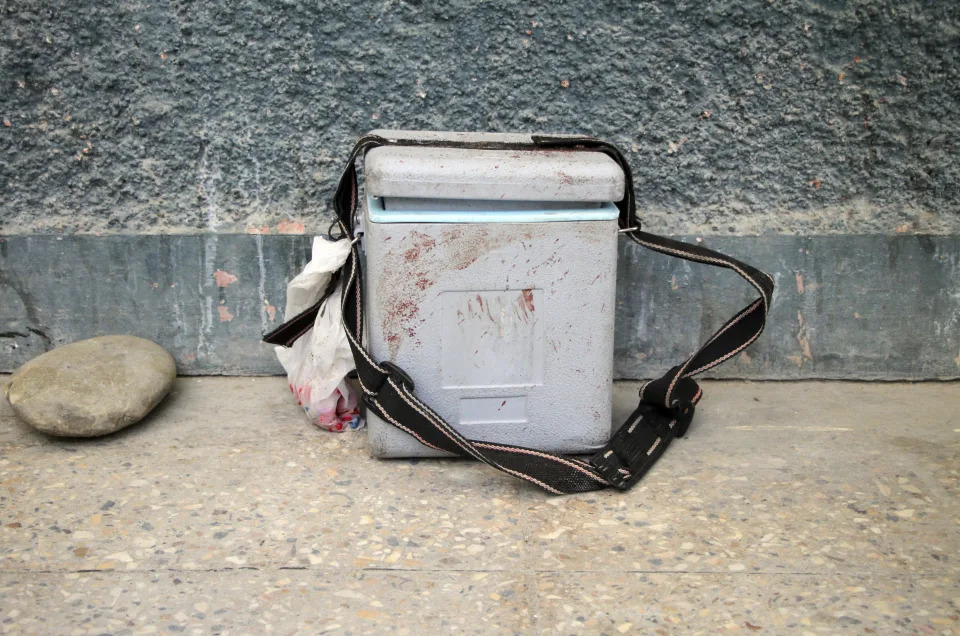
FILE - A bloodied polio vaccine cooler is left on the ground after women working to administer the anti-polio vaccine were killed by gunmen in the city of Jalalabad east of Kabul, Afghanistan, March 30, 2021. Aidan O'Leary, director of the World Health Organization's polio department, described the recent discovery of polio spreading in London and New York as "a major surprise," saying that officials have been focused on eradicating the disease in Afghanistan and Pakistan, where health workers have been killed for immunizing children and where conflict has made access to some areas impossible. (AP Photo, File)
 A bloodied polio vaccine cooler is left on the ground after women working to administer the anti-polio vaccine were killed by gunmen in the city of Jalalabad east of Kabul, Afghanistan, March 30, 2021. Aidan O’Leary, director of the World Health Organization’s polio department, described the recent discovery of polio spreading in London and New York as “a major surprise,” saying that officials have been focused on eradicating the disease in Afghanistan and Pakistan, where health workers have been killed for immunizing children and where conflict has made access to some areas impossible. (AP Photo, File)
FILE - A police officer escorts health workers arriving to administer polio vaccine in a slum area of Peshawar, Pakistan, Jan. 24, 2022. Aidan O'Leary, director of the World Health Organization's polio department, described the recent discovery of polio spreading in London and New York as "a major surprise," saying that officials have been focused on eradicating the disease in Afghanistan and Pakistan, where health workers have been killed for immunizing children and where conflict has made access to some areas impossible. (AP Photo/Muhammad Sajjad, File)
A police officer escorts health workers arriving to administer polio vaccine in a slum area of Peshawar, Pakistan, Jan. 24, 2022. Aidan O’Leary, director of the World Health Organization’s polio department, described the recent discovery of polio spreading in London and New York as “a major surprise,” saying that officials have been focused on eradicating the disease in Afghanistan and Pakistan, where health workers have been killed for immunizing children and where conflict has made access to some areas impossible. (AP Photo/Muhammad Sajjad, File)
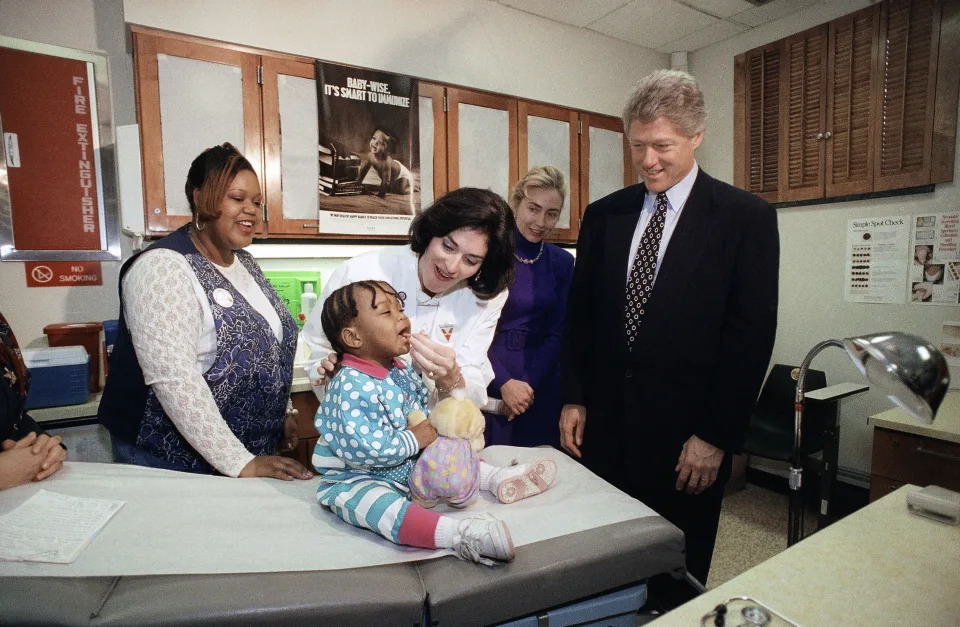
FILE - Then U.S. President Bill Clinton and First Lady Hillary Rodham Clinton watch as nurse Dorothy Sellers administers an oral polio vaccine to 20-month-old Danielle Bailey at an Arlington County health clinic in Arlington, Va., Feb. 13, 1993. The oral vaccine is credited with dramatically reducing the number of children paralyzed by polio. For years, global health officials have used an oral vaccine in an attempt to wipe out polio from its last remaining strongholds in countries including Afghanistan, Pakistan and Nigeria. In recent weeks, scientists have found evidence of polio spread within Israel, the U.S. and Britain and genetic analyses show the viruses are not only connected, but that the cases were triggered by viruses linked to the oral vaccine. (AP Photo/Greg Gibson, File)
Then U.S. President Bill Clinton and First Lady Hillary Rodham Clinton watch as nurse Dorothy Sellers administers an oral polio vaccine to 20-month-old Danielle Bailey at an Arlington County health clinic in Arlington, Va., Feb. 13, 1993. The oral vaccine is credited with dramatically reducing the number of children paralyzed by polio. For years, global health officials have used an oral vaccine in an attempt to wipe out polio from its last remaining strongholds in countries including Afghanistan, Pakistan and Nigeria. In recent weeks, scientists have found evidence of polio spread within Israel, the U.S. and Britain and genetic analyses show the viruses are not only connected, but that the cases were triggered by viruses linked to the oral vaccine. (AP Photo/Greg Gibson, File)
FILE - A health worker gives an oral polio vaccine to a girl on a street in Lahore, Pakistan, June 27, 2022. For years, global health officials have used billions of drops of an oral vaccine in a remarkably effective campaign aimed at wiping out polio in its last remaining strongholds — typically, poor, politically unstable corners of the world. Now, in a surprising twist in the decades-long effort to eradicate the virus, authorities in Jerusalem, New York and London have discovered evidence that polio is spreading there. The source of the virus? The oral vaccine itself. (AP Photo/K.M. Chaudary, File)
A health worker gives an oral polio vaccine to a girl on a street in Lahore, Pakistan, June 27, 2022. For years, global health officials have used billions of drops of an oral vaccine in a remarkably effective campaign aimed at wiping out polio in its last remaining strongholds — typically, poor, politically unstable corners of the world. Now, in a surprising twist in the decades-long effort to eradicate the virus, authorities in Jerusalem, New York and London have discovered evidence that polio is spreading there. The source of the virus? The oral vaccine itself. (AP Photo/K.M. Chaudary, File)

LONDON (AP) — For years, global health officials have used billions of drops of an oral vaccine in a remarkably effective campaign aimed at wiping out polio in its last remaining strongholds — typically, poor, politically unstable corners of the world.

Now, in a surprising twist in the decades-long effort to eradicate the virus, authorities in Jerusalem, New York and London have discovered evidence that polio is spreading there.

The original source of the virus? The oral vaccine itself.

Scientists have long known about this extremely rare phenomenon. That is why some countries have switched to other polio vaccines. But these incidental infections from the oral formula are becoming more glaring as the world inches closer to eradication of the disease and the number of polio cases caused by the wild, or naturally circulating, virus plummets.

Since 2017, there have been 396 cases of polio caused by the wild virus, versus more than 2,600 linked to the oral vaccine, according to figures from the World Health Organization and its partners.

“We are basically replacing the wild virus with the virus in the vaccine, which is now leading to new outbreaks,” said Scott Barrett, a Columbia University professor who has studied polio eradication. “I would assume that countries like the U.K. and the U.S. will be able to stop transmission quite quickly, but we also thought that about monkeypox.”

The latest incidents represent the first time in several years that vaccine-connected polio virus has turned up in rich countries.

Earlier this year, officials in Israel detected polio in an unvaccinated 3-year-old, who suffered paralysis. Several other children, nearly all of them unvaccinated, were found to have the virus but no symptoms.

In June, British authorities reported finding evidence in sewage that the virus was spreading, though no infections in people were identified. Last week, the government said all children in London ages 1 to 9 would be offered a booster shot.

In the U.S., an unvaccinated young adult suffered paralysis in his legs after being infected with polio, New York officials revealed last month. The virus has also shown up in New York sewers, suggesting it is spreading. But officials said they are not planning a booster campaign because they believe the state’s high vaccination rate should offer enough protection.

Genetic analyses showed that the viruses in the three countries were all “vaccine-derived,” meaning that they were mutated versions of a virus that originated in the oral vaccine.

The oral vaccine at issue has been used since 1988 because it is cheap, easy to administer — two drops are put directly into children’s mouths — and better at protecting entire populations where polio is spreading. It contains a weakened form of the live virus.

But it can also cause polio in about two to four children per 2 million doses. (Four doses are required to be fully immunized.) In extremely rare cases, the weakened virus can also sometimes mutate into a more dangerous form and spark outbreaks, especially in places with poor sanitation and low vaccination levels.

These outbreaks typically begin when people who are vaccinated shed live virus from the vaccine in their feces. From there, the virus can spread within the community and, over time, turn into a form that can paralyze people and start new epidemics.

Many countries that eliminated polio switched to injectable vaccines containing a killed virus decades ago to avoid such risks; the Nordic countries and the Netherlands never used the oral vaccine. The ultimate goal is to move the entire world to the shots once wild polio is eradicated, but some scientists argue that the switch should happen sooner.

“We probably could never have gotten on top of polio in the developing world without the (oral polio vaccine), but this is the price we’re now paying,” said Dr. Paul Offit, director of the Vaccine Education Center at the Children’s Hospital of Philadelphia. “The only way we are going to eliminate polio is to eliminate the use of the oral vaccine.”

Aidan O’Leary, director of WHO’s polio department, described the discovery of polio spreading in London and New York as “a major surprise,” saying that officials have been focused on eradicating the disease in Afghanistan and Pakistan, where health workers have been killed for immunizing children and where conflict has made access to some areas impossible.

Still, O’Leary said he is confident Israel, Britain and the U.S. will shut down their newly identified outbreaks quickly.

The oral vaccine is credited with dramatically reducing the number of children paralyzed by polio. When the global eradication effort began in 1988, there were about 350,000 cases of wild polio a year. So far this year, there have been 19 cases of wild polio, all in Pakistan, Afghanistan and Mozambique.

In 2020, the number of polio cases linked to the vaccine hit a peak of more than 1,100 spread out across dozens of countries. It has since declined to around 200 this year so far.

Last year, WHO and partners also began using a newer oral polio vaccine, which contains a live but weakened virus that scientists believe is less likely to mutate into a dangerous form. But supplies are limited.

To stop polio in Britain, the U.S. and Israel, what is needed is more vaccination, experts say. That is something Columbia University’s Barrett worries could be challenging in the COVID-19 era.

“What’s different now is a reduction in trust of authorities and the political polarization in countries like the U.S. and the U.K.,” Barrett said. “The presumption that we can quickly get vaccination numbers up quickly may be more challenging now.”

Oyewale Tomori, a virologist who helped direct Nigeria’s effort to eliminate polio, said that in the past, he and colleagues balked at describing outbreaks as “vaccine-derived,” wary it would make people fearful of the vaccine.

“All we can do is explain how the vaccine works and hope that people understand that immunization is the best protection, but it’s complicated,” Tomori said. “In hindsight, maybe it would have been better not to use this vaccine, but at that time, nobody knew it would turn out like this.”

The Associated Press Health and Science Department receives support from the Howard Hughes Medical Institute’s Department of Science Education. The AP is solely responsible for all content.

Trump frantically packed up documents to take with him in the last days of his presidency

Insider

Trump frantically packed up documents to take with him in the last days of his presidency after finally accepting he was leaving the White House, report says

Kelsey Vlamis – August 13, 2022

President Donald Trump talks to reporters while hosting Republican Congressional leaders and members of his cabinet in the Oval Office at the White House July 20, 2020 in Washington, DC.
President Donald Trump talks to reporters while hosting Republican Congressional leaders and members of his cabinet in the Oval Office at the White House July 20, 2020 in Washington, DC.Doug Mills-Pool/Getty Images
  • FBI agents recovered classified materials during a raid on Mar-a-Lago Monday, court documents say.
  • Sources told NBC News that in the last days of Trump’s presidency aides rushed to pack up documents.
  • One source said Trump didn’t seriously start preparing to exit the White House until after January 6.

Between the January 6 Capitol attack, challenges to the 2020 election, and his impending second impeachment, President Donald Trump had some chaotic final days in office.

Amid the chaos and the realization that every election challenge was failing, Trump began instructing aides to pack up documents he planned to take with him to Mar-a-Lago, according to an NBC News report published Saturday.

Two sources with knowledge of the situation told the outlet Trump’s aides were hurriedly stuffing documents and other materials into banker boxes that were then shipped to Mar-a-Lago, Trump’s Palm Beach club and residence.

One source said Trump only seriously began making plans to leave the White House after January 6, his final two weeks in office, after months of baselessly claiming he had won the election.

“It was a chaotic exit,” the source told NBC. “Everyone piled everything — staff, the White House movers — into the moving trucks. When they got to Mar-a-Lago, they piled everything there in this storage room, except for things like the first lady’s clothes. Everything in a box went there.”

The source said Trump was in a “dark place” at the time and that “he didn’t care about the boxes,” adding: “If you had brought him into that storeroom, and asked, ‘Which are your presidential papers?’ he couldn’t tell you.”

Mar-a-Lago was raided on Monday by FBI agents who seized 11 boxes of classified materials, some labeled “top secret,” according to court records unsealed Friday. The raid was part of the Justice Department’s investigation into possible violations of three laws related to handling government records, including part of the Espionage Act.

Trump has denied any wrongdoing and claimed he had declassified all the records at Mar-a-Lago, though he did not provide documentation of the declassification.

The New York Times reported on Saturday that one of Trump’s lawyers told the Justice Department in June that all classified documents had been returned. But, given the recovery of additional classified documents on Monday, the report raised questions about how cooperative and forthcoming the former president and his team have been with investigators.

Trump’s office did not immediately respond to Insider’s request for comment.

During his four years in office, Trump developed a reputation for being flippant with presidential records, which are required by law to be preserved. Reports have said Trump would rip up papers or even flush them down the toilet. Some of his former staff members also said he would ask to keep certain documents.

Cheney predicts a lengthy fight for American democracy in her campaign’s closing message

Yahoo! News

Cheney predicts a lengthy fight for American democracy in her campaign’s closing message

Jon Ward, Chief National Correspondent – August 11, 2022

Rep. Liz Cheney released a closing message video ahead of a Republican primary she is expected to lose next week, framing the congressional race as part of a bigger fight for the soul of the nation.

Regardless of the race’s outcome, Cheney, a Wyoming Republican, has publicly hinted recently that she will run for president in 2024. Privately, those close to her have done nothing to discourage others from assuming she will. And while her video message spoke of a long fight required to reject the “poisonous lies” of former President Donald Trump about the 2020 election, she did not give any specific hints about her future plans.

Cheney did, however, talk of a cause that she said would unite Republicans, Democrats and independents. That is a nod to a national effort she seems intent on leading that transcends party and ideology.

“America cannot remain free if we abandon the truth. The lie that the 2020 presidential election was stolen is insidious. It preys on those who love their country. It is a door Donald Trump opened to manipulate Americans to abandon their principles, to sacrifice their freedom, to justify violence, to ignore the rulings of our courts and the rule of law,” Cheney said.

“This is Donald Trump’s legacy, but it cannot be the future of our nation,” she said.

Liz Cheney
Rep. Liz Cheney. (Via YouTube)

“If we do not condemn these lies, if we do not hold those responsible to account, we will be excusing this conduct and it will become a feature of all elections. America will never be the same.”

Polls show Cheney is likely to lose her seat in Congress next Tuesday by double-digit margins, to a Republican primary challenger who has shown fealty to Trump and his baseless claims of a rigged election in 2020.

That challenger, Harriet Hageman, is expected not only to win the primary contest for Wyoming’s only congressional seat but, in a state that is largely Republican, to easily win the fall election.

Cheney has said for over a year that she is intent on keeping Trump out of the presidency for a second time, following his central role in fomenting an assault on the Capitol on Jan. 6, 2021.

Since then she has been the top Republican on the select committee investigating Jan 6. The panel’s work has revealed how much of what happened on Jan. 6 was premeditated by Trump and his allies.

The questions facing Cheney now — if she does lose to Hageman — will revolve around how much she says about her future plans, including a possible White House run.

Saudi firm has pumped Arizona groundwater for years without paying. Time to pony up

Saudi firm has pumped Arizona groundwater for years without paying. Time to pony up

Bruce Babbitt and Robert Lane – August 11, 2022

The Butler Valley is an empty stretch of desert west of Phoenix, worthy of note for two reasons.

  • It holds more than 6 million acre-feet of groundwater, strategically located near the Central Arizona Project canal.
  • And more than 99% of Butler Valley is owned by the state of Arizona in trust for the support of public schools.

In 1982 as the Central Arizona Project canal neared completion, Wes Steiner, the renowned director of the Department of Water Resources, proposed that the state set aside Butler Valley as a groundwater reserve for future use in connection with the CAP.

Acting on his advice, we worked with the federal Bureau of Land Management to transfer the Valley into state ownership to be managed by the State Land Department.

How much water has Fodomonte pumped?

In June, The Arizona Republic uncovered the story of how the State Land Department had recently handed over thousands of acres to a Saudi corporation called Fondomonte, giving it permission to pump unlimited amounts of groundwater to grow alfalfa hay for export to Saudi Arabia.

This tale of official misfeasance began in 2015 when the State Land Department began leasing land to Fondomonte at an annual rental of just $25 per acre.

Sweet deal for Saudis: Arizona allows farm to use Phoenix’s backup supply

However, the 2015 lease in addition allowed Fondomonte to pump unlimited amounts of groundwater at no cost whatever.

How much is Fondomonte pumping? The company refuses to disclose how much water it uses each year, and the State Land Department has never bothered to demand reports. That Fondomonte is growing alfalfa year round on approximately 3,500 acres can be verified from aerial photos.

And according to U.S. Geological Survey studies, alfalfa in Butler Valley requires 6.4 acre-feet of water per acre. That means the company has likely been pumping 22,400 acre-feet of water each year for the last 7 years.

Void its lease, charge for past rent

How much should the state be charging for this water? The Arizona Constitution, Article 10, Section 4, requires that land leases and “products of land” … “shall be appraised at their true value.”

The appropriate method for determining true value is hiding in plain sight. The Central Arizona Project sells water to customers throughout Maricopa County for $242 per acre foot delivered through the project canal that passes just south of Butler Valley.

Add these figures, and Fondomonte should have been paying $5.42 million per year for each of the last seven years.

What should be done to clean up this scandal? First, Gov. Doug Ducey should instruct the State Land Department to void the lease and restore Butler Valley to its intended use as a groundwater reserve for the future.

Second, Gov. Ducey should instruct the attorney general to collect past due rentals of about $38 million to be held in trust for the benefit of Arizona school children.

Bruce Babbitt served as governor of Arizona from 1978 to 1987. Robert Lane served as State Land commissioner from 1982 to 1987. 

Inside the Russian Penal Colony Where Brittney Griner Will Serve Her 9-Year Prison Sentence

People

Inside the Russian Penal Colony Where Brittney Griner Will Serve Her 9-Year Prison Sentence

Jason Duaine Hahn – August 10, 2022

After nearly six months in Russian custody, Brittney Griner was sentenced Thursday to nine years in prison and will begin her stay in a Russian penal colony.

The WNBA star and her lawyers had asked for leniency after officials at a Russian airport allegedly found less than a gram of hash oil in her luggage in February, but a Russian court sentenced Griner to nine years, just below the maximum-possible sentence of 10.

There’s hope that Griner could leave earlier — her lawyers previously told PEOPLE that they’re putting together an appeal to attempt to reduce her sentence, and the Biden administration confirmed that they are working on a potential prisoner exchange to bring her home — but for now, she’ll live in a penal colony in Russia.

Across Russia, there are 35 women’s penal colonies that house an estimated 60,000 inmates, Ivan Melnikov, the vice president of the Russian Department of the International Human Rights Defense Committee, and Yekaterina Kalugina, a Russian human rights activist who observed Griner and her living conditions in March, tell PEOPLE.

RELATED: Brittney Griner Sentenced to 9 Years in Russian Prison on Drug Possession Charges

The cells have just over 11 feet of private space, with most cells holding anywhere between 40 to 60 women who sleep in bunk beds.

Brittney Griner is escorted to a courtroom for a hearing in the Khimki district court

Jim Heintz/AP/Shutterstock Brittney Griner is escorted to a courtroom for a hearing in the Khimki district court

Melnikov and Kalugina say much of what goes on in the colonies depends on the prison governor, with some being more strict than others. (Both say they cannot reveal which colony Griner is located.)

“Brittney is being held in a detention cell within a penal colony,” Melnikov says. At the detention center, the spaces are cramped and there’s only a small exercise yard, but there is a benefit to staying there — each day counts as two towards a prison sentence.

Kalungina expects that the guards will keep Griner in the detention center until Russia and the U.S. decide if they’ll go through with her prisoner exchange.

Melnikov adds that “she is likely to stay there for the time of her appeal, which might be up to three months if she isn’t pardoned and exchanged before then, but if her appeal fails, she might be sent on to another colony.”

WNBA star and two-time Olympic gold medalist Brittney Griner sits in a cage in a courtroom prior to a hearing at the Khimki City Court outside Moscow, Russia, 27 July 2022. Griner, a World Champion player of the WNBA's Phoenix Mercury team was arrested in February at Moscow's Sheremetyevo Airport after some hash oil was detected and found in her luggage, for which she now could face a prison sentence of up to ten years. US basketball player Brittney Griner attends hearing on drug charges, Moscow, Russian Federation - 27 Jul 2022
WNBA star and two-time Olympic gold medalist Brittney Griner sits in a cage in a courtroom prior to a hearing at the Khimki City Court outside Moscow, Russia, 27 July 2022. Griner, a World Champion player of the WNBA’s Phoenix Mercury team was arrested in February at Moscow’s Sheremetyevo Airport after some hash oil was detected and found in her luggage, for which she now could face a prison sentence of up to ten years. US basketball player Brittney Griner attends hearing on drug charges, Moscow, Russian Federation – 27 Jul 2022

ALEXANDER ZEMLIANICHENKO/POOL/EPA-EFE/Shutterstock Brittney Griner

Inside the colony, there’s more space and Griner will have to work eight hours a day. For most prisoners, this means sewing, cleaning, cooking and serving food, but, because of her career as a WNBA player, Griner can see about coaching women’s basketball. There’s a precedent for such an arrangement — Russian soccer players Alexander Kokorin and Pavel Mamayev coached inmates while they served time in one of the colonies.

RELATED: What’s Next for Brittney Griner as Lawyers Plan Appeal and She Awaits a Potential Prisoner Exchange

Melnikov says that it’s up to the prison governor to decide if Griner can coach.

“I hope that she will be sent to a colony with a lenient governor who allows her to coach basketball in the daytime rather than being a seamstress,” he says. “Prisoners are encouraged to play sports or do yoga and so on, and basketball is popular. I think that would be the best thing for her.”

Brianna Turner #21, Skylar Diggins-Smith #4, Kia Nurse #0 and Brittney Griner #42 of the Phoenix Mercury

Ethan Miller/Getty (L-R) Brianna Turner, Skylar Diggins-Smith, Kia Nurse and Brittney Griner

Each morning, Melnikov says, the prisoners “are woken at 6 a.m., they wash, dress, make their beds, stand to attention for the register, go to breakfast and then start an eight-hour working day, usually as a seamstresses. But we are trying to encourage governors to use the talents of the inmates. For example, working with art.”

Prisoners in the colony get some free time outside of their work requirements, Melnikov says.

“Their free time is set by the governor, from half an hour to two hours a day and during that time they can just chat with each other, read a book from the library, write letters home, play sports, play board games and call friends and family.”

The prisoners are supposed to get a minimum wage of $180 a month, Melnikov says, which they can spend in the prison shop on items like toiletries, tampons, cigarettes and fresh fruit and vegetables, and they can also pay for the internet to send emails.

Generally, though, the conditions are difficult. Tuberculosis is common in the colonies, many prisoners are malnourished from the limited food and the medical care is poor. Most need friends and family to send them food and basic toiletries, but that isn’t possible for some prisoners.

Sarah Krivanek, another American who has been imprisoned in Russia for the last nine months on charges of assaulting a Russian man who quickly dropped any charges against her, went through a similar process to Griner. She stayed in a detention center through her trial and appeal, and is now serving a one-year, three-month sentence at a penal colony in Ryazan, a city about 120 miles southeast of Moscow, PEOPLE reported. Krivanek, too, is hoping for the U.S. to bring her home.

RELATED VIDEO: ‘Forgotten’ American Woman Jailed in Russia with Brittney Griner Tried to Flee with U.S. Help Before Arrest

For now, though, Griner is again waiting to hear what will happen to her. She’s staying in the detention center, where she can choose to work to get outside and see other people, but the two-time Olympic gold medalist doesn’t know if she’ll be exchanged, have a successful appeal, or if she’ll live out her next nine years in a Russian penal colony.

When Griner heard about the potential exchange, she was “quite happy to know that she’s not been forgotten and that there are some possible developments,” her lawyer, Maria Blagovolina, previously told PEOPLE. “But she’s quite realistic about what’s going on.”

Evictions spiking as assistance, protections disappear

Associated Press

Evictions spiking as assistance, protections disappear

Michael Casey – August 10, 2022

Jada Riley sits in her car at night with her son Jayden Harris, 6, as she contemplates where she might spend the night, having had to move out of her apartment a few days before, Thursday, July 28, 2022, in New Orleans. “I've slept outside for a whole year before. It's very depressing, I'm not going to lie,” said Riley, who often doesn't have enough money to buy gas or afford food every day. “I don't want to have my son experience any struggles that I went through.” (AP Photo/Gerald Herbert)
Jada Riley sits in her car at night with her son Jayden Harris, 6, as she contemplates where she might spend the night, having had to move out of her apartment a few days before, Thursday, July 28, 2022, in New Orleans. “I’ve slept outside for a whole year before. It’s very depressing, I’m not going to lie,” said Riley, who often doesn’t have enough money to buy gas or afford food every day. “I don’t want to have my son experience any struggles that I went through.” (AP Photo/Gerald Herbert)
Jada Riley poses with her son Jayden Harris, 6, as they play on a basketball court near her former apartment, Thursday, July 28, 2022, in New Orleans. Two months behind on rent, Riley made the difficult decision last month to leave her apartment rather than risk an eviction judgment on her record. Now, she's living in her car with her 6-year-old son, sometimes spending nights at the apartments of friends or her son's father. (AP Photo/Gerald Herbert)
Jada Riley poses with her son Jayden Harris, 6, as they play on a basketball court near her former apartment, Thursday, July 28, 2022, in New Orleans. Two months behind on rent, Riley made the difficult decision last month to leave her apartment rather than risk an eviction judgment on her record. Now, she’s living in her car with her 6-year-old son, sometimes spending nights at the apartments of friends 
Jada Riley blows bubbles on a basketball court to entertain her 6-year-old son Jayden Harris, Thursday, July 28, 2022, near her former apartment in New Orleans. “I've slept outside for a whole year before. It's very depressing, I'm not going to lie,” said Riley, who often doesn't have enough money to buy gas or afford food every day. “I don't want to have my son experience any struggles that I went through.” (AP Photo/Gerald Herbert)
Jada Riley blows bubbles on a basketball court to entertain her 6-year-old son Jayden Harris, Thursday, July 28, 2022, near her former apartment in New Orleans. “I’ve slept outside for a whole year before. It’s very depressing, I’m not going to lie,” said Riley, who often doesn’t have enough money to buy gas or afford food every day. “I don’t want to have my son experience any struggles that I went through.” (AP
Jada Riley goes through her possessions in the trunk of her car near her former apartment, Thursday, July 28, 2022, in New Orleans. Two months behind on rent, Riley made the difficult decision last month to leave her apartment rather than risk an eviction judgment on her record. Now, she's living in her car with her 6-year-old son, sometimes spending nights at the apartments of friends or her son's father. (AP Photo/Gerald Herbert)
Jada Riley goes through her possessions in the trunk of her car near her former apartment, Thursday, July 28, 2022, in New Orleans. Two months behind on rent, Riley made the difficult decision last month to leave her apartment rather than risk an eviction judgment on her record. Now, she’s living in her car with her 6-year-old son, sometimes spending nights at the apartments of friends or her son’s father. (AP
Jayden Harris, 6, sits in the backseat of his mother Jada Riley's car, after having to move out of her apartment days before, Thursday, July 28, 2022, in New Orleans. Eviction filings nationwide have steadily risen in recent months and are approaching or exceeding pre-pandemic levels in many cities and states. That's in stark contrast to the pandemic, when state and federal moratoriums on evictions, combined with $46.5 billion in federal Emergency Rental Assistance, kept millions of families housed. (AP Photo/Gerald Herbert)
Jayden Harris, 6, sits in the backseat of his mother Jada Riley’s car, after having to move out of her apartment days before, Thursday, July 28, 2022, in New Orleans. Eviction filings nationwide have steadily risen in recent months and are approaching or exceeding pre-pandemic levels in many cities and states. That’s in stark contrast to the pandemic, when state and federal moratoriums on evictions, combined
Jada Riley leaves a basketball court as she walks to her car with her 6-year-old son Jayden Harris, Thursday, July 28, 2022, near her former apartment in New Orleans. Eviction filings nationwide have steadily risen in recent months and are approaching or exceeding pre-pandemic levels in many cities and states. That's in stark contrast to the pandemic, when state and federal moratoriums on evictions, combined with $46.5 billion in federal Emergency Rental Assistance, kept millions of families housed. (AP Photo/Gerald Herbert)
Jada Riley leaves a basketball court as she walks to her car with her 6-year-old son Jayden Harris, Thursday, July 28, 2022, near her former apartment in New Orleans. Eviction filings nationwide have steadily risen in recent months and are approaching or exceeding pre-pandemic levels in many cities and states. That’s in stark contrast to the pandemic, when state and federal moratoriums on evictions, combined with $46.5 billion in federal Emergency Rental Assistance, kept millions of families housed. (AP Photo/Gerald Herbert)

Jada Riley thought she had beaten homelessness.

The 26-year-old New Orleans resident was finally making a steady income cleaning houses during the pandemic to afford a $700-a-month, one-bedroom apartment. But she lost nearly all her clients after Hurricane Ida hit last year. Then she was fired from a grocery store job in February after taking time off to help a relative.

Two months behind on rent, she made the difficult decision last month to leave her apartment rather than risk an eviction judgment on her record. Now, she’s living in her car with her 6-year-old son, sometimes spending nights at the apartments of friends or her son’s father.

“I’ve slept outside for a whole year before. It’s very depressing, I’m not going to lie,” said Riley, who often doesn’t have enough money to buy gas or afford food every day.

“I don’t want to have my son experience any struggles that I went through.”

Eviction filings nationwide have steadily risen in recent months and are approaching or exceeding pre-pandemic levels in many cities and states. That’s in stark contrast to the pandemic, when state and federal moratoriums on evictions, combined with $46.5 billion in f ederal Emergency Rental Assistance, kept millions of families housed.

“I really think this is the tip of the iceberg,” Shannon MacKenzie, executive director of Colorado Poverty Law Project, said of June filings in Denver, which were about 24% higher than the same time three years ago. “Our numbers of evictions are increasing every month at an astonishing rate, and I just don’t see that abating any time soon.”

According to The Eviction Lab, several cities are running far above historic averages, with Minneapolis-St. Paul 91% higher in June, Las Vegas up 56%, Hartford, Connecticut, up 32%, and Jacksonville, Florida, up 17%. In Maricopa County, home to Phoenix, eviction filings in July were the highest in 13 years, officials said.

Some legal advocates said the sharp increase in housing prices due to inflation is partly to blame. Rental prices nationwide are up nearly 15% from a year ago and almost 25% from 2019, according to the real estate company Zillow. Rental vacancy rates, meanwhile, have declined to a 35-year low of 5.8%, according to the Census Bureau.

A report last month from the National Low Income Housing Coalition found that a tenant working full time needs to make nearly $26 per hour on average nationally to afford a modest two-bedroom rental and $21.25 for a one-bedroom. The federal minimum wage is $7.25 an hour.

“Landlords are raising the rent and making it very unaffordable for tenants to stay,” said Marie Claire Tran-Leung, the eviction initiative project director for the National Housing Law Project.

“Inflation has really shrunk the supply of housing that is available for people with the lowest incomes,” she added. “Without more protections in place, which not all states have, a lot of those families will be rendered homeless.”

Patrick McCloud, chief executive officer of the Virginia Apartment Management Association, said the trend is a return to normal. “No one likes evictions, but they are in some ways a reset to the economy,” McCloud said, adding that evictions have been “artificially depressed.”

“Housing is based on supply and demand. And when no one moves and you have no vacancies, you have a tight market and prices go up.”

Graham Bowman, a staff attorney with Legal Aid Society of Columbus, Ohio, said evictions there are rising — 15% above historic averages in June alone — at a time when there are fewer places for those forced out to go.

Sheryl Lynne Smith was evicted in May from her two-bedroom townhouse in Columbus after she used her rent money to repair a sewage leak in the basement. Smith, who is legally blind and has a federal housing voucher, fears she won’t be able to find anything by September when the voucher expires because of rising housing prices and the eviction on her record.

“It’s very scary,” said Smith, 53, whose temporary stay at a hotel funded through a state program ends this weekend.

In Boise, Idaho, Jeremy McKenney, 45, moved into his car last week after a judge sided with a property management company that nearly tripled the rent on his two-bedroom house. The Lyft and DoorDash driver will have to rent a hotel room whenever he has custody of his children, 9 and 12.

“It’s definitely mind blowing,” said McKenney, adding that everything on the market is beyond his reach even after a nonprofit offered to cover the security deposit. “I have never been homeless before. I have always had a roof over my head.”

The other challenge is the federal emergency rental assistance that helped keep millions housed during the pandemic has dried up in some jurisdictions or been increasingly rejected by some landlords.

“What really gets me is there is rental assistance and so many landlords just don’t want it. They would rather throw someone on the street than take money,” Eric Kwartler, managing attorney of Lone Star Legal Aid’s Eviction Right to Counsel Project, which covers Houston and Harris County in Texas. “If you take the money, you can’t evict them. They want them out.”

The U.S. Treasury said last week that more than $40 billion of the $46.5 billion in Emergency Rental Assistance had been spent or allocated.

According to the National Low Income Housing Coalition, California, Connecticut, Massachusetts, Minnesota, North Carolina, and Virginia have gone through at least 90% of their first disbursement. Twelve states and the District of Columbia had used 50% of the second allocation, known as ERA2, by the end of May. Three — Idaho, Ohio and Iowa — haven’t spent any ERA2 money and two — Nebraska and Arkansas — didn’t accept the funds.

“The public health emergency may still be here but the funds to deal with it are rapidly disappearing,” said Martin Wegbreit, director of litigation for the Central Virginia Legal Aid Society.

Treasury is encouraging states and cities to tap other federal stimulus funds to cover the gaps. So far, over 600 state and local governments had budgeted $12.9 billion in stimulus funds to meet housing needs, including affordable housing development.

Gene Sperling, who oversees President Joe Biden’s $1.9 trillion coronavirus rescue package, highlighted the success of its rental assistance program, which has reached 7 million mostly low-income households.

But, more needs to be done to ensure the country doesn’t return to pre-pandemic times when 3.6 million tenants were evicted annually and “evictions were too often a first resort, not a last resort,” he told a forum on eviction reforms at the White House last week.

Some lawmakers said the answer is a permanent rental assistance program. A bill introduced in July would provide $3 billion annually for rental assistance and fund services to keep families housed. A study commissioned by the National Apartment Association and the National Multifamily Housing Council says the answer is building 4.3 million apartments by 2035.

Other advocates called for permanent legal protections like right to counsel for tenants or eviction diversion programs to resolve evictions before they reach the courts.

In Richmond, Virginia, eviction filings in June were 54% below historic averages, attributed to rental assistance and more legal representation for tenants in court, Wegbreit said. Similar programs were credited with New Mexico’s eviction filings being 29% below historic averages in June.

Philadelphia, which passed a law making eviction diversion mandatory through this year, saw filings down 33%. The City Council in Philadelphia also approved spending $30 million over two years for rental assistance.

“We are trying to change the way we look at this issue in Philadelphia, where the only thing you do is go to landlord tenant court or start an eviction,” said Catherine Anderson, supervising attorney with Philadelphia Legal Assistance, who oversees the paralegals on the Save Your Home Philly hotline.

Associated Press writers Jesse Bedayn in Denver, Ben Finley in Norfolk, Virginia, and Claudia Lauer in Philadelphia contributed to this report

This story has been corrected to show that McKenney is from Boise, Idaho, not Boise, Utah.

Russia’s Trump Raid Tantrum Is a Spectacle You Don’t Want to Miss

Daily Beast

Russia’s Trump Raid Tantrum Is a Spectacle You Don’t Want to Miss

Julia Davis – August 9, 2022

Photo Illustration by Elizabeth Brockway/The Daily Beast/Getty

The FBI raid on former U.S. President Donald J. Trump’s Mar-a-Lago residence in Florida triggered shockwaves across Russia, with outraged Kremlin propagandists rushing to defend their favorite American president and going so far as to predict that the raid will eventually spark a civil war in the United States.

When Trump lost the last presidential election to Joe Biden, experts and pundits in Moscow worried out loud that his prosecution for a bevy of potential offenses is imminent. They even contemplated offering their beloved “Trumpushka” asylum in Russia. As time went by, Putin’s mouthpieces became convinced that Trump was in the clear, and their fears subsided.

On Monday’s broadcast of The Evening With Vladimir Solovyov, the host and his panelists praised the participants of the Conservative Political Action Conference (CPAC) and expressed their admiration for Trump and his allies. The same day, appearing on state TV program 60 Minutes, military expert Igor Korotchenko openly called for Russia to support Trump’s candidacy in the 2024 elections.

News of the raid landed in Moscow with a thud, as angry propagandists embellished the search with made-up details, claiming that “one hundred FBI agents” and hordes of police dogs rummaged through Mar-a-Lago. On Tuesday’s broadcast of 60 Minutes, Korotchenko angrily condemned the raid: “There is a straight-up witch hunt happening in America. Trump, as the most popular politician in the United States—who has every chance of prevailing in the upcoming presidential election—was chosen as such a witch,” he raged. “They won’t just be vilifying him, they will be strangling him. These raids, involving dozens of FBI officers and police dogs—this is worse than McCarthyism, my friends! This is a symbol of inordinate despotism.”

Russian Media Wants Moscow to Grant Asylum to Trump

In the days preceding the raid, the host of 60 Minutes, Evgeny Popov, who is also a deputy of Russia’s State Duma, repeatedly referred to Trump as Russia’s “friend,” “protégé”, and a favored candidate, but cautiously added that Moscow is yet to decide on who to support in the upcoming U.S. elections. On Tuesday, Popov said: “As soon as Donald Trump complained that Biden was the worst president in the history of the United States, which is fast becoming a third world country, there was a knock on Donald’s door: “Knock-knock, this is the FBI!” More than one hundred agents stormed in and searched Trump’s Florida residence, Mar-a-Lago.” Popov joked that the agents were said to have found a couple of matryoshka, Putin’s portrait, a pioneer scarf, two icons, a parachute, and a chained bear with balalaika.

Without a hint of irony, the state TV host described the search of the former president’s home as a symptom of political persecution of dissidents in the United States. “Dozens of agents ransacked every office, went through every box, and took every document that was of interest to them. It is thought that the FBI was interested in the Top Secret documents supposedly taken by the ex-president from the White House… Biden, with his dictatorial tendencies, repressions, and persecution of dissidents, is turning America into Ukraine. He already did that, since the opposition is being persecuted by authorities,” Popov said. He fantasized that as the result of the raid, Florida would split from the United States and its new constitution would feature Trump’s assertion that there are only two genders: male and female.

Decorated Kremlin propagandist Vladimir Solovyov started Tuesday’s broadcast of his radio program, Full Contact With Vladimir Solovyov, by bringing up the raid of Trump’s Florida digs. He brought on state TV correspondent Valentin Bogdanov, reporting from New York City. “You couldn’t say we didn’t anticipate this turn of events. Machinery, meant to squeeze Trump out of political life, has been activated… They want to deprive him of an opportunity to participate in the upcoming presidential election… All of this is designed to create a nasty aura, to make Trump more toxic.”

Summing up the potential penalties for the suspected removal of top secret government documents, Bogdanov said they weren’t all that bad and were limited to a three-year prison term or a fine. He added: “The scariest consequence is that a person convicted for such a crime can’t be a candidate in the presidential election. Bingo! That’s what his opponents want: to deprive him of the opportunity to take part in this race.”

Assuming that Trump would be knocked out of the upcoming presidential election, Bogdanov speculated that Florida governor Ron DeSantis—whom he described as “Number Two” in the GOP—could easily defeat Joe Biden.

Solovyov asked: “Could this be the beginning of a civil war?” He ominously opined: “This is totally unprecedented, I don’t remember anything like this in American history. If Trump calls on his supporters to come out—and half the states are led by Trump’s allies—there’ll be hell to pay.”

Bogdanov replied: “The civil war is already underway in the United States. For now, this is a cold civil war, but it keeps heating up.”

How Ruth Bader Ginsburg Will Have The Last Laugh on Samuel Alito

Politico

How Ruth Bader Ginsburg Will Have The Last Laugh on Samuel Alito

John F. Harris – August 4, 2022

Susan Walsh/AP Photo

Justice Samuel Alito, in drafting Dobbs v. Jackson Women’s Health Organization, said he and the other justices who joined him in ending a constitutional right to abortion had no ability to foresee what the political implications would be. Even if they could know, he added, justices have “no authority to let that knowledge influence our decision.”

Does Alito genuinely write his opinions with no concern at all of what the practical political consequences might be?

In overturning Roe v. Wade, a decision he said was “egregiously wrong,” Alito asserted that the place to decide the morality and legality of abortion is not the Supreme Court but the political process in 50 states.

So what does Alito think now, in the wake of Kansas voters resoundingly rejecting a proposal to remove protections for abortion rights from their state constitution?

These are not gotcha questions. Alito presumably would answer that what happened in Kansas on Tuesday is precisely the kind of democratic process that the Supreme Court “short-circuited,” as he wrote in Dobbs, when it established a national right to abortion by judicial edict even as the issue remained deeply unsettled in the society.

They are questions, however, that highlight how life is full of surprise and paradox, even for a Supreme Court justice who specializes in blustery self-assurance. Alito’s career as an advocate for social conservatism began long before he joined the court. His record is replete with deference to religious tradition and skepticism of loosening sexual mores on all fronts, including gay rights. His references to “abortionists” in the Dobbs opinion hardly conceal his personal disdain. There can be little doubt of how he would have cast his ballot if he were a Kansas voter.

Yet the Kansas result raises an arresting possibility: Alito’s long-term legacy may well be as the justice who facilitated a national consensus on behalf of abortion rights. Quite unintentionally, today’s hero of the “pro-life” movement could end up being a giant of the “pro-choice” movement.

Alito’s achievement was to take abortion out of the arena where it has been for a half-century — a place in which aggrieved advocates on both sides invoked a hypothetical world in which abortion is no longer legal — and move it to an emphatically real-world arena. In this new environment, all kinds of people who under ordinary circumstances would prefer not to have to think and argue about abortion must decide which side they are on.

There is good reason to be wary the old maxim of Fleet Street journalism — first simplify, then exaggerate — in some of the post-Kansas analysis. The impact of abortion politics on the mid-term elections remains murky. In most cases, voters will be choosing among candidates, not deciding a sharply framed referendum. Moreover, while Kansas is undoubtedly conservative, it is also a state with a Democratic governor and is not necessarily predictive of the dynamics in conservative states with abortion bans that took place immediately after the Supreme Court’s June ruling.

But if the Kansas result isn’t necessarily a portent of the politics of 2022 it is suggestive of the politics of 2032. Long-term, under current trends, it is easy to envisage a decisive shift that would leave a national resolution of the issue in favor of abortion rights, even in states that do not currently support that. It is hard to envisage the opposite result.

The difference lies in the gap between abstract politics and concrete politics. This is the same dynamic that makes Social Security highly popular among people who claim they disdain big government. The Kansas result, which mirrors polling showing solid majorities of people supported leaving Roe v. Wade intact, suggests that opponents of legal abortion do better when the prospect of an abortion ban is hypothetical, while abortion-rights supporters do better when the issue is tangibly real.

Values take on meaning not in the abstract but in the particular. What do you really believe when it is your adolescent child who is pregnant or has impregnated someone? Or your extramarital affair that results in a pregnancy? Or your obstetrician who calls to say she has unwelcome news from the results of a genetic test?

Thankfully, most people do not get to learn what they really believe by landing in such a situation. But lots of people — of all political persuasions — do get to learn. The Guttmacher Institute, which conducts research on abortion policy, found that about one in five pregnancies in 2020 ended in abortion. In an earlier study, from 2017, it found that about one in four women will have an abortion by age 45.

Is that number surprising? As long as abortion was a legal right, plenty of these women and their partners were likely animated by plenty of other political issues. The question now is what has changed, and Kansas suggests an answer.

Even many abortion-rights advocates acknowledge there is some truth to what Alito asserted multiple times in his opinion: That the court hindered, rather than helped, a national resolution of the abortion question. Somewhat tauntingly, the Dobbs opinion cited a 1992 speech from one of the most prominent abortion-rights supporters of all, Ruth Bader Ginsburg, that Roe “halted a political process that was moving in a reform direction and thereby, I believed, prolonged divisiveness and deferred stable settlement of the issue.”

It was as if Alito was playing a joke on Ginsberg’s memory by quoting her. It seems entirely likely that she will end up having the last laugh.

Justice Kagan gives pointed warning about the ‘legitimacy’ of the court, seemingly calling out justices with ‘political social preferences’

Insider

Justice Kagan gives pointed warning about the ‘legitimacy’ of the court, seemingly calling out justices with ‘political social preferences’

Azmi Haroun – July 21, 2022

Justice Elena Kagan
Justice Elena KaganErin Schaff-Pool/Getty Images
  • SCOTUS Justice Elena Kagan opened up about the public perception of the Supreme Court on Thursday.
  • She said that “partisan” justices harm the legitimacy of the court, according to The Washington Post.
  • Only a quarter of Americans have confidence in the SCOTUS, according to a June 2022 Gallup Poll.

US Supreme Court Justice Elena Kagan ruminated on the legitimacy of the Supreme Court at a conference full of lawyers and judges, warning that a disconnected court and political appointments could be “a dangerous thing for the democratic system.”

Kagan said that SCOTUS justices had their work cut out for them in terms of earning and maintaining “legitimacy” in the eyes of Americans, according to a report from The Washington Post.

“By design, the court does things sometimes that the majority of the country doesn’t like,” Kagan said. “Overall, the way the court retains its legitimacy and fosters public confidence is by acting like a court, is by doing the kind of things that do not seem to people political or partisan, by not behaving as though we are just people with individual political or policy or social preferences.”

In June, Supreme Court justices voted 5-4 to overturn Roe v. Wade, in a majority opinion supported by conservative Justices Samuel Alito, Clarence Thomas, Neil Gorsuch, Brett Kavanaugh, and Amy Coney Barrett.

The core of the challenge to abortion rights that had been codified for 50 years was a Mississippi law that aimed to ban abortion after 15 weeks – which is stricter than the 24-week standard set by Roe v. Wade.

At least 61% of people support abortion access in the US, according to a Pew Research poll.

Within two weeks, the court also expanded gun rights and imposed limits on the Environmental Protection Agency’s ability to implement greenhouse gas regulations.

She added that the court generally being on the opposite side of public opinion could have grave consequences for democracy.

“I’m not talking about any particular decision or any particular series of decisions. But if, over time, the court loses all connection with the public and the public sentiment, that’s a dangerous thing for democracy,” Kagan told the conference.

In the days before the Roe V. Wade decision, a Gallup poll showed that confidence in the Supreme Court had tanked — with only 25% of Americans saying that they had faith in the institution.

“We have a court that does important things, and if that connection is lost, that’s a dangerous thing for the democratic system as a whole,” Kagan reiterated.

Liz Cheney says Trump is ‘preying’ on his supporters by pushing 2020 election lie

Yahoo! News

Liz Cheney says Trump is ‘preying’ on his supporters by pushing 2020 election lie

Jon Ward, Chief National Correspondent – July 21, 2022

The patriotism of many Americans was turned into a “weapon” during the Jan. 6 attack on the U.S. Capitol, by a former president who continues to prey on his supporters, Rep. Liz Cheney said Thursday night.

Cheney, the vice chair of the Jan. 6 House select committee investigating the attack, delivered a forceful and sober final statement at the conclusion of a nearly three-hour hearing on Capitol Hill.

The Republican congresswoman from Wyoming addressed her comments to those who are skeptical of the committee’s work, which includes many voters in her own home state.

“The case against Donald Trump in these hearings is not made by witnesses who were his political enemies. It is, instead, a series of confessions by Donald Trump’s own appointees, his own friends, his own campaign officials, people who worked for him for years, and his own family,” Cheney said.

Rep. Liz Cheney at a House select committee hearing.
Rep. Liz Cheney, R-Wyo., delivers a closing statement during the House select committee hearing on Thursday. (Saul Loeb/AFP via Getty Images)

Cheney made a distinction between Trump and his supporters, noting that many who voted for the former president would eagerly defend the country with their own lives. “Donald Trump knows that millions of Americans who supported him would stand up and defend our nation were it threatened. They would put their lives and their freedom at stake to protect her,” she said.

But, she said, on Jan. 6, 2021, Trump “turned their love of country into a weapon against our Capitol and our Constitution.”

Trump is even now “preying on their patriotism” by continuing to insist he somehow won the 2020 election, despite no evidence to support his baseless claims, Cheney said.

The nine hearings so far, she said, have shown that “Donald Trump’s plan to falsely claim victory in 2020, no matter what the facts actually were, was premeditated.”

A video of former President Donald Trump plays during a Jan. 6 committee hearing.
A video of former President Donald Trump plays during Thursday night’s hearing of the Jan. 6 committee. (Al Drago/Bloomberg via Getty Images)

The hearing Thursday showed evidence that Trump did nothing to stop the violence on Jan. 6, that Vice President Mike Pence called in police and military units to shut down the riot and that Trump rejected calls from his family and aides to call off the mob until he knew the attack would be repelled by law enforcement.

Cheney closed her comments by asking Americans to consider the gravity of allowing Trump back into power again.

“Every American must consider this: Can a president who is willing to make the choices Donald Trump made during the violence of Jan. 6 ever be trusted with any position of authority in our great nation again?” she said.

Cheney is facing the possibility of losing her seat in Congress if she loses the Aug. 16 primary in Wyoming to a Republican challenger who has parroted Trump’s lies about the 2020 election. But her words Thursday demonstrated a resolve on her part to continue waging a battle for the soul of the Republican Party.

Rep. Liz Cheney shakes hands with Sandra Garza, the longtime partner of Capitol Police Officer Brian Sicknick.
Cheney shakes hands with Sandra Garza, the partner of Capitol Police Officer Brian Sicknick, who died from injuries he sustained in the insurrection. (Saul Loeb/AFP via Getty Images)

When Cheney was stripped of her leadership position in the House Republican Conference last year, she vowed then to stop Trump from being reelected. “I will do everything I can to ensure that the former president never again gets anywhere near the Oval Office,” she said.

If Cheney loses her congressional seat, and even if she wins, she’s likely to run for president in 2024 in order to keep making the case that Trump is unfit to lead the GOP, much less the nation, according to conversations with Republicans close to the matter.

Cheney ended the hearing Thursday by making clear that the committee’s work is not done, and that there will be more hearings after Labor Day.

“Ronald Reagan’s great ally Margaret Thatcher said this: ‘Let it never be said that the dedication of those who love freedom is less than the determination of those who would destroy it,’” she said. “Let me assure every one of you this: Our committee understands the gravity of this moment, the consequences for our nation. We have much work yet to do, and will see you all in September.”