Patagonia founder is giving away his billion dollar company and ensuring that all profits go towards fighting climate change
Kelsey Vlamis and Lakshmi Varanasi – September 14, 2022
Yvon Chouinard announced Wednesday he is giving away his multi-billion dollar company, Patagonia.
Chouinard said instead of selling it or taking it public, Patagonia will be owned by a trust and nonprofit.
The trust is set up to ensure Patagonia’s profits go towards addressing climate change.
Patagonia founder Yvon Chouinard is giving away the company by transferring it to a newly established trust and nonprofit in order to ensure its profits go towards combatting the climate crisis.
Chouinard, the rock climber-turned-billionaire, announced the move in a statement on Wednesday.
“Instead of ‘going public,’ you could say we’re ‘going purpose.’ Instead of extracting value from nature and transforming it into wealth for investors, we’ll use the wealth Patagonia creates to protect the source of all wealth,” he wrote.
Chouinard, 83, said that he opted for the unique ownership model instead of selling the company to an owner that could potentially compromise Patagonia’s values, or going public and leaving the company beholden to shareholders first.
Instead, ownership of the outdoor apparel company, valued at around $3 billion, is being transferred to the Patagonia Purpose Trust and Holdfast Collective.
“It’s been nearly 50 years since we began our experiment in responsible business, and we are just getting started. If we have any hope of a thriving planet—much less a thriving business—50 years from now, it is going to take all of us doing what we can with the resources we have. This is another way we’ve found to do our part,” Chouinard said.
Patagonia said going forward all profits that are not reinvested back into the company will be distributed to Holdfast Collective to go towards environmental causes, according to an additional statement provided to Insider. The company estimates this amount will total about $100 million each year.
Founded by Chouinard nearly 50 years ago, Patagonia is well known for breaking with conventional business practices and for its commitment to sustainability.
In an interview with The New York Times about the decision, Chouinard said he hopes the move will “influence a new form of capitalism that doesn’t end up with a few rich people and a bunch of poor people.”
“We are going to give away the maximum amount of money to people who are actively working on saving this planet,” he said.
Dan Mosley of merchant bank BDT & Co., who helped Patagonia structure the move, told The Times he’s never seen anything like it: “In my 30 plus years of estate planning, what the Chouinard family has done is really remarkable.”
“It’s irrevocably committed. They can’t take it back out again, and they don’t want to ever take it back out again,” Mosley said.
Chouinard and his family have given away most of their wealth throughout his lifetime, making them one of the most charitable families in the US.
Chouinard has also famously said that Patagonia’s decisions that were good for the planet have also been good for business.
“I didn’t know what to do with the company because I didn’t ever want a company,” Chouinard told The Times. “I didn’t want to be a businessman. Now I could die tomorrow and the company is going to continue doing the right thing for the next 50 years, and I don’t have to be around.”
Complaints about inaccurate credit reports are soaring
Khristopher J. Brooks – September 14, 2022
Americans are on pace to set a record this year for the most complaints about credit report inaccuracies filed with the Consumer Financial Protection Bureau, according to Consumer Reports.
Credit score concerns accounted for slightly more than half of all complaints sent to the federal agency in 2020 and 2021, the nonprofit consumer advocacy group found. But during the first half of this year, that number has ballooned to three-quarters of all complaints.
“Mistakes on credit reports are all too common and can have serious consequences, especially for those who are already struggling to make ends meet,” Consumer Reports policy analyst Syed Ejaz said in a statement. “No one should have to pay to access their own financial information.”
Consumer Reports urged the three major credit bureaus — Equifax, Experian and TransUnion — to take action to ensure that people’s credit reports are accurate. One way to accomplish this, it said, is to stop making consumers pay for their report. Equifax and TransUnion charge between $20 and $30 a month for unlimited access to personal credit reports. Experian’s reports are free.
Under the Fair and Accurate Credit Transactions Act, consumers can get a free, complete credit report once a year at the site annualcreditreport.com. Experian and TransUnion charge consumers for repeated access to their reports.
Free access
Seeing your credit report once a year isn’t enough, Ejaz said in a letter to the credit bureaus. Consumers need constant and free access to their report so they can quickly spot and dispute errors, he argued. “[C]onsumers should be able to access their credit reports securely and for free at any time, as frequently as they deem necessary,” Ejaz said.
Companies use credit scores for employment decisions, while landlords use them to assess new tenants, and insurance companies use them to set prices. So a person’s financial history shouldn’t be locked behind a paywall, Ejaz said.
The push for unlimited free access to credit reports comes a few months after Equifax accidentally sent the wrong credit score out for hundreds of thousands of Americans. Equifax now faces a class-action lawsuit over the credit scores, which were sent out between March 17 and April 6. Federal lawmakers also have called on Equifax to explain what caused the error and how consumers will be compensated for the mistake.
Aside from free reports, said Ejaz in the letter, credit bureaus can also improve accuracy by:
Double-checking a consumer’s full name, date of birth and full Social Security number before placing a mark on someone’s credit report;
Letting a consumer dispute the investigation findings of a previously submitted inaccuracy dispute;
Mot locking a consumer out of their credit report if the person cannot answer identity questions.
Consumer Reports has launched an online petition further urging the credit bureaus to make their reports free always.
Inaccurate credit reports have become a growing national problem in recent years, with many consumers reporting difficulty inn getting Equifax, Experian or TransUnion to delete mistakes from their file.
An analysis from the CFPB found that the three credit bureaus collectively resolved less than 2% of credit report complaints they received in 2021, down sharply from 25% in 2019. The number of complaints Americans sent to the CFPB about inaccurate credit reports more than doubled between 2018 and 2021, Consumer Reports said.
California’s drought touches everyone, but water restrictions play out unevenly across communities
Soudi Jiménez – September 13, 2022
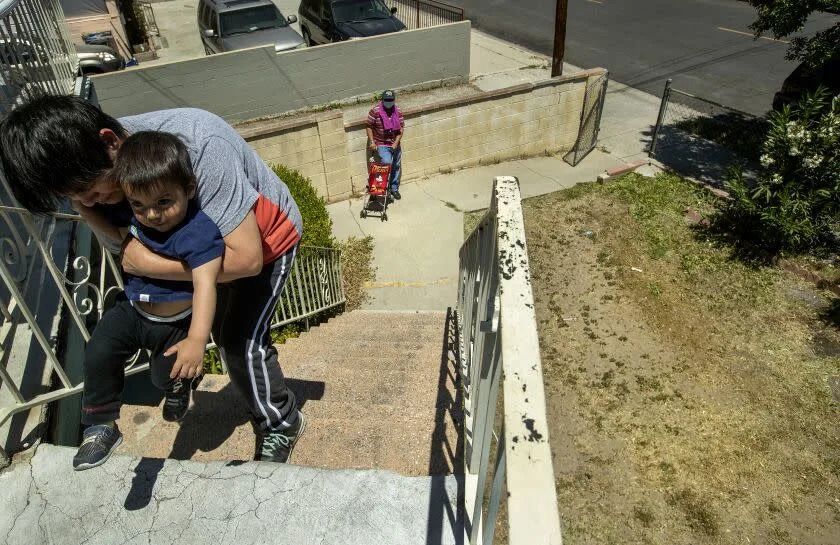
Benita Perez teaches her grandson, Nevaeh Perez, 1, how to walk at their apartment building in Lincoln Heights. Area at right, below used to be all grass until a year ago, because of the drought. (Mel Melcon/Los Angeles Times)
Raúl Monterroso of San Fernando knows that he can do little to help the struggling garden patio in front of his house. After all, he takes the new water restrictions seriously.
“Here, everything is dry, we have the entire irrigation system closed, my poor wife is crying over her plants,” said the Guatemala native, who stopped watering the grass on June 1 when instructions to cut outdoor watering to once a week were issued.
Further restrictions went into effect Sept. 6, when a 15-day ban through Sept. 20 was mandated by an emergency repair that shut down the 36-mile Upper Feeder pipeline that brings water from the Colorado River to Southern California. The Metropolitan Water District of Southern California said that more than 4 million people are being affected by the shutdown across the region, including Beverly Hills and Malibu, Burbank and Glendale, Long Beach, the city of Inglewood and a large swathe of the South Bay, and other areas stretching as far east as Pomona.
Also under the ban is the city of San Fernando, at the northern edge of L.A.’s San Fernando Valley, 92% of whose 24,000 residents are Latino.
“The reality is that when they give you the alert, you have to be aware. The measures must be followed, there is no other option,” Monterroso said.
In Long Beach, an hour’s drive south of San Fernando, businesswoman Sandy Cajas said that urgent measures are needed to maintain a steady flow of water and find new sources of it.
“We are experiencing the worst drought in decades,” she said. “What is going to happen here is that we are going to have to recycle the water due to the scarcity that exists.”
That’s one item, among many, on the state capital’s agenda. Last month, a 16-page document released by Gov. Gavin Newsom, “California’s Water Supply Strategy — Adapting to a Hotter, Drier Future,” indicated that California’s water supply will shrink 10% by 2040.
Among other measures, the plan, backed by billions of dollars in investment, calls for recycling more wastewater and desalinating seawater and salty groundwater, as well as speeding up infrastructure development and pushing conservation, in hopes of providing enough water for more than 8.4 million homes by 2040.
According to Newsom, this “aggressive plan” will guarantee that future generations “continue to call California home in this hotter, drier climate.”
“The best science tells us that we need to act now to adapt to California’s water future. Climate change means drought won’t just stick around for two years at a time like it historically has — extreme weather is the new normal here in the American West and California will adapt to this new reality,” Newsom said in an Aug. 11 statement.
Yet the drought is playing out unevenly across different communities and among different households. Since June 1, about 6 million residents in Los Angeles, Ventura and San Bernardino counties have had to limit outdoor water use to once a week. But not everyone is complying.
Every day since 2003, Álex Guzmán has driven a truck for work from the San Fernando Valley to Beverly Hills. The Mexican immigrant labors for a landscaping company. His task is to maintain the trees and lawns of the mansions. But, above all, to water lots and lots of plants.
Hearing that additional restrictions on water use have been implemented, Guzmán just smiles.
“We have never stopped working in Beverly Hills, we have never stopped watering mansion gardens because of the restrictions,” he said.
“We are working normally, the bosses have not told us anything about lowering the use of water,” Guzmán added.
As reported by The Times, celebrities such as Sylvester Stallone, Dwyane Wade, Kevin Hart, Kim and Kourtney Kardashian are among the more than 2,000 customers who have received “notices of exceedance” for surpassing 150% of their monthly water budgets at least four times since the Las Virgenes Municipal Water District declared a drought emergency in late 2021.
That disparity in following restrictions shows up in many public spaces, said Patty López, a former Assemblywoman for District 39, pointing for example to the contrast between the independent city of San Fernando and Sylmar, which is part of the city of Los Angeles.
“If you look at the Veterans Memorial Community Regional Park in Sylmar it is completely green, but in the parks in our area the grass is dead,” said López, a San Fernando resident, lamenting that there is no clear, consistent application of policies, or rigorous follow-up and enforcement, throughout the region.
Under current conditions, if the use of water is not controlled, worse consequences won’t be long in coming.
Samuel Sandoval Solís, professor of water resources management at UC Davis, said that California has 30% of its water stored in dams, meaning that, because of the drought’s effects, 70% of its capacity is gone. Water level in the subsoil has dropped 25 feet since 2016.
“Everything is looking very bad,” said the academic, who has been researching, monitoring and teaching on the subject of water for 20 years.
According to a UC Berkeley study, as temperatures in California rose between 1960 and 1980, rainfall also diminished, based on climatological records and analyzing the cores of trees.
Given the current scarcities of water, and recent extreme heatwaves across the Golden State, even downpours in the upcoming rainy season wouldn’t be enough to compensate, Sandoval Solís said.
“It’s not enough to make it to the next year,” he said.
Sandoval Solís said that if Californians don’t do more to conserve water, the authorities will have to implement restrictions such as those imposed on some municipalities during a previous drought phase between 2014 and 2016. Those restrictions limited the amount of gallons per person to between 12 and 15 daily.
According to the California Dept. of Water Resources, the “current statewide median indoor residential water use is 48 gallons per capita per day, and that a quarter of California households already use less than 42 gallons per capita per day.” The U.S. Environmental Protection Agency website states that each American uses an average of 82 gallons per day at home, including consumption.
“We need to raise awareness that we must all enter this equally,” Sandoval Solís said, “regardless of whether you live in a luxury house or in an apartment, we all have to reduce water consumption.”
Panel: Archives still not certain it has all Trump records
Farnoush Amirit – September 13, 2022
WASHINGTON (AP) — The National Archives is still not certain that it has custody of all Donald Trump’s presidential records even after the FBI search of his Mar-a-Lago club, a congressional committee said in a letter Tuesday.
The House Committee on Oversight and Reform revealed that staff at the Archives on an Aug. 24 call could not provide assurances that they have all of Trump’s presidential records. The committee in the letter asked the Archives to conduct an assessment of whether any Trump records remain unaccounted for and potentially in his possession.
“In light of revelations that Mr. Trump’s representatives misled investigators about his continued possession of government property and that material found at his club included dozens of ‘empty folders’ for classified material, I am deeply concerned that sensitive presidential records may remain out of the control and custody of the U.S. Government,” Rep. Carolyn Maloney, D-N.Y., the chairwoman of the Oversight Committee, wrote in the letter.
The House committee has jurisdiction over the Presidential Records Act, a 1978 law that requires the preservation of White House documents as property of the U.S. government. The request is the latest development in a months long back-and-forth between the agency and the committee, which has been investigating Trump’s handling of records.
Trump wants his White House records back so he can add them to his presidential library
Donald Trump asked for all documents taken from his Mar-a-Lago home to be returned so that he can give the files to the National Archives and Records Administration, while also claiming they will be needed again later for his presidential library.
The request also comes weeks after the FBI recovered more than 100 documents with classified markings and even more than 10,000 other government documents from Trump’s Mar-a-Lago estate. The search came after lawyers for Trump provided a sworn certification that all government records had been returned.
But the letter notes a call between Archives staff and the committee on Aug. 24, where lawmakers were informed that documents could still be missing.
As a result, Maloney wrote, the committee is asking the agency to conduct an “urgent review” of all of the government records that have been recorded from the Trump White House to determine whether any additional records remain unaccounted for and potentially in the possession of the former president.
In addition, the committee also asked for the Archives to get a personal certification from Trump “that he has surrendered all presidential records that he illegally removed from the White House after leaving office.”
The committee is asking the Archives to provide an initial assessment of this review by Sept. 27.
For Trump’s Lawyers, Legal Exposure Comes With the Job
Michael S. Schmidt and Luke Broadwater – September 11, 2022
A dark joke has begun circulating among lawyers following the many legal travails of former President Donald Trump: MAGA actually stands for “making attorneys get attorneys.”
Over six years and nine major investigations by Congress, the Justice Department and local prosecutors, as Trump has managed to avoid removal from the presidency and indictment, it has become clear that serving as one of his lawyers is a remarkably risky job — and one that can involve considerable legal exposure. Time after time, his attorneys have been asked to testify as witnesses to potential crimes — or evaluated as possible criminal conspirators themselves.
While the consequences his lawyers faced were extraordinary when Trump was in the White House, the dangers have only intensified since he left office and have become increasingly acute in recent weeks, as the former president has come under scrutiny in two different Justice Department investigations and has been forced yet again to find lawyers willing to represent him.
Last week, a Justice Department filing revealed that Trump’s lawyers had misled federal investigators about whether he had handed over to the Justice Department all the classified documents he took from the White House when he left office. That raised questions about whether the lawyers, M. Evan Corcoran and Christina Bobb, could be prosecuted themselves and might ultimately be forced to become witnesses against their client. (Bobb recently retained a lawyer, according to a person familiar with the situation.)
The revelation capped a summer in which a team of lawyers that had been advising Trump as he tried to overturn the 2020 election faced a range of repercussions across the country from federal investigators, local prosecutors, state bar associations and government accountability groups.
One of Trump’s highest-profile lawyers, Rudy Giuliani, was named as a target in a state criminal investigation in Georgia. Conservative lawyer John Eastman, who came up with what he conceded privately was an unlawful strategy to help Trump overturn the election, said he believed he was a target in that same investigation and declined to answer questions while being deposed before a grand jury. Giuliani and Eastman have also been named as subjects of interest in a flurry of federal grand jury subpoenas seeking evidence about attempts by Trump’s allies to create fake slates of electors to help keep him in office.
Two others who worked for Trump in the White House — White House counsel Pat A. Cipollone and his deputy Patrick F. Philbin — were subpoenaed to appear before a federal grand jury in Washington investigating the efforts to overturn the 2020 election, including the roles that Giuliani and Eastman had played in helping Trump.
Cipollone, Philbin and at least nine other lawyers who worked for Trump have testified before the congressional committee investigating the Jan. 6 attack. Earlier this year, Cipollone and Philbin also were interviewed by the FBI as part of its investigation into the classified documents investigation.
And 17 mostly lesser-known lawyers who represented Trump in battleground states as he tried to overturn the election are facing ethics complaints, putting them at risk of being disciplined or disbarred by bar associations or the courts.
Vigorously defending the client — even one known for unscrupulous behavior or accused of an egregious crime — is part of a lawyer’s basic job description. But attorneys are bound by a code of professional conduct that forbids them from crossing certain lines, including knowingly making false claims, filing frivolous lawsuits or motions, and doing anything to further a crime.
The adage for lawyers representing clients accused of criminality, said Fritz Scheller, a longtime Florida defense lawyer, is that at the end of the day, no matter how bad it may have been for the client, the lawyer still gets to walk out the front door of the courthouse without any personal legal issues.
“That bad day for the criminal defense attorney becomes his worst day when he leaves through the courthouse door used for defendants on their way to jail,” Scheller said.
Long before he became president, Trump viewed lawyers as tools to carry out whatever unsavory errand he required. As president, his disdain for institutional norms and demand for unswerving loyalty meant that Trump expected White House lawyers to act in his personal interest, whether or not doing so was within the bounds of the law or in the interest of the country.
He is also known for refusing to pay his lawyers for their work; last year, the Republican National Committee agreed to settle up to $1.6 million of Trump’s personal legal bills.
Six weeks after taking office, Trump made clear to his aides what he expected of his lawyers when he raged about Jeff Sessions, the attorney general, for recusing himself from the inquiry into whether Russia had meddled in the 2016 election.
“I don’t have a lawyer,” Trump said to aides in the Oval Office, including White House counsel Donald F. McGahn II. “Where’s my Roy Cohn?”
Trump was referring to the notorious New York fixer who had represented and mentored Trump in the 1970s when he was an up-and-coming real estate investor. Cohn, who was chief counsel to Sen. Joseph McCarthy during the 1954 Army-McCarthy hearings investigating suspected communists, was disbarred by a New York court in 1986 for unethical conduct.
Trump’s quest for such a lawyer fueled a destructive cycle: As his legal difficulties mounted, he hired more lawyers, who in turn faced problems for their work on his behalf, leading established lawyers concerned about their reputations to balk at representing him.
“There’s no way to adhere to your ethical integrity and keep your job,” Kimberly Wehle, a University of Baltimore law professor who has closely tracked the investigations into the Jan. 6, 2021, attack on the Capitol, said of the dilemma Trump’s lawyers have faced. “There’s just no way to not step into a mess.”
The personal ramifications of doing legal work for Trump became painfully apparent to lawyers around him four months into his administration when McGahn and several of his lieutenants — fearing they could be held responsible for Trump’s conduct — retained a high-powered Washington lawyer to represent them in an investigation into whether the president had obstructed justice.
Within two years, McGahn had racked up hundreds of thousands of dollars in legal bills, and prosecutors had turned him into a chief witness against Trump.
Around the same time, Trump’s longtime New York lawyer, Michael Cohen, began a three-year prison sentence for his role in paying off a woman in the final days of the 2016 presidential campaign to ensure she did not disclose an affair with Trump.
More recently, a long list of lawyers who have represented Trump have found themselves on the receiving end of ethics complaints and disciplinary action.
“Ultimately, we want to demonstrate to all the lawyers that the next time that Sidney Powell or Rudy Giuliani calls and says, ‘Hey, will you sign your name to this?’ they’ll say no because they’ll realize that there are professional consequences,” said Michael Teter, the director of the 65 Project, which has filed complaints against 40 lawyers who took part in suits challenging the 2020 results, including 17 last month.
Teter’s group has identified more than 110 lawyers across 26 states who agreed to participate in various plots by Trump and his allies as they sought to overturn the 2020 election. Thus far, at least 10 of them have been fined or sanctioned.
“This is part of a well-funded effort to attack every attorney who participated in any of the 2020 election challenges,” Eastman said in a statement in response to a bar complaint filed against him, adding that the goal of the 65 Project was to “shame them and make them toxic in their communities and their firms.”
The most serious repercussions have come for four lawyers who acted as ringleaders in the effort. Giuliani’s licenses to practice law in the District of Columbia and New York were suspended, while Powell has been sanctioned in Detroit and faces a disciplinary action brought by the state bar of Texas. Both are also facing separate defamation lawsuits by Dominion, a voting machine company that claims that the two acted recklessly in falsely asserting that Dominion machines had helped flip votes from Trump to Biden. The suits each seek more than $1 billion in damages.
Lin Wood is under investigation by the bar association in his home state of Georgia and was sanctioned in Michigan. Eastman, who has said he could also be a target of the Georgia inquiry, may face additional legal jeopardy; federal agents have seized his phone, and a federal judge said in March that he and Trump likely committed felonies while attempting to overturn the 2020 election.
Among the 40 lawyers whom Teter’s group has singled out for ethics complaints are James Bopp; Kenneth Chesebro; Sen. Ted Cruz, R-Texas; Joseph diGenova; Jenna Ellis; Boris Epshteyn; Cleta Mitchell; and William Olson.
The House investigation into Jan. 6 has also focused on potential wrongdoing by Trump’s lawyers, particularly their role in the scheme to put forward slates of pro-Trump electors in states won by Joe Biden.
Giuliani also faced a federal investigation in New York by prosecutors who are said to be looking into his dealings in Ukraine to help Trump dig up dirt on Biden’s son. As part of that investigation, federal agents seized cellphones and computers from Giuliani in April during searches of his apartment on Madison Avenue and his Park Avenue office in Manhattan. The investigation is unlikely to result in charges.
Powell’s nonprofit organization, Defending the Republic, which raised millions of dollars by spreading lies about election fraud, is under investigation by a federal grand jury in Washington, according to two people with direct knowledge of the inquiry.
Ellis was also accused of professional misconduct in an ethics complaint in Colorado by the bipartisan legal watchdog group the States United Democracy Center. It said that Ellis assisted Trump in an “unsuccessful and potentially criminal effort” to stave off his electoral defeat.
Some lawyers who worked for Trump have managed to emerge with their careers intact, including Emmet T. Flood, who took the lead at the White House dealing with the Russia investigation, and two other lawyers who represented the president around that time: Jane Raskin and Joanna C. Hendon.
Now two of them are among the lawyers being hired by Trump’s former attorneys to represent them as they deal with the fallout from their work for Trump.
Flood is now representing Cipollone, the former White House counsel, who is facing federal investigators’ questions about Trump’s conduct. And Raskin is helping to represent Ellis.
Visa, Mastercard, AmEx to start categorizing gun shop sales
Ken Sweet- September 10, 2022
FILE – Visa credit cards are seen on Aug. 11, 2019, in New Orleans. Payment processor Visa Inc. said late Saturday, Sept. 10, 2022, that it plans to start separately categorizing sales at gun shops. (AP Photo/Jenny Kane, File) (ASSOCIATED PRESS)
NEW YORK (AP) — Payment processor Visa Inc. said Saturday that it plans to start separately categorizing sales at gun shops, a major win for gun control advocates who say it will help better track suspicious surges of gun sales that could be a prelude to a mass shooting.
But the decision by Visa, the world’s largest payment processor, will likely provoke the ire of gun rights advocates and gun lobbyists, who have argued that categorizing gun sales would unfairly flag an industry when most sales do not lead to mass shootings. It joins Mastercard and American Express, which also said they plan to move forward with categorizing gun shop sales.
Visa said it would adopt the International Organization for Standardization’s new merchant code for gun sales, which was announced on Friday. Until Friday, gun store sales were considered “general merchandise.”
“Following ISO’s decision to establish a new merchant category code, Visa will proceed with next steps, while ensuring we protect all legal commerce on the Visa network in accordance with our long-standing rules,” the payment processor said in a statement.
Visa’s adoption is significant as the largest payment network, and with Mastercard and AmeEx, will likely put pressure on the banks as the card issuers to adopt the standard as well. Visa acts as a middleman between merchants and banks, and it will be up to banks to decide whether they will allow sales at gun stores to happen on their issued cards.
Gun control advocates had gained significant wins on this front in recent weeks. New York City officials and pension funds had pressured the ISO and banks to adopt this code.
Two of the country’s largest public pension funds, in California and New York, have been pressing the country’s largest credit card firms to establish sales codes specifically for firearm-related sales that could flag suspicious purchases or more easily trace how guns and ammunition are sold.
Merchant category codes now exist for almost every kind of purchase, including those made at supermarkets, clothing stores, coffee shops and many other retailers.
“When you buy an airline ticket or pay for your groceries, your credit card company has a special code for those retailers. It’s just common sense that we have the same policies in place for gun and ammunition stores,” said New York City Mayor Eric Adams, a former police captain who blames the proliferation of guns for his city’s deadly violence.
The city’s comptroller, Brad Lander, said it made moral and financial sense as a tool to push back against gun violence.
“Unfortunately, the credit card companies have failed to support this simple, practical, potentially lifesaving tool. The time has come for them to do so,” Lander said recently, before Visa and others had adopted the move.
Lander is a trustee of the New York City Employees’ Retirement System, Teachers’ Retirement System and Board of Education Retirement System — which together own 667,200 shares in American Express valued at approximately $92.49 million; 1.1 million shares in MasterCard valued at approximately $347.59 million; and 1.85 million shares in Visa valued at approximately $363.86 million.
The pension funds and gun control advocates argue that creating a merchant category code for standalone firearm and ammunition stores could aid in the battle against gun violence. A week before the mass shooting at the Pulse Nightclub in Orlando, Florida, where 49 people died after a shooter opened fire in 2016, the assailant used credit cards to buy more than $26,000 worth of guns and ammunition, including purchases at a stand-alone gun retailer.
Gun rights advocates argue that tracking sales at gun stores would unfairly target legal gun purchases, since merchant codes just track the type of merchant where the credit or debit card is used, not the actual items purchased. A sale of a gun safe, worth thousands of dollars and an item considered part of responsible gun ownership, could be seen as a just a large purchase at a gun shop.
“The (industry’s) decision to create a firearm specific code is nothing more than a capitulation to anti-gun politicians and activists bent on eroding the rights of law-abiding Americans one transaction at a time,” said Lars Dalseide, a spokesman for the National Rifle Association.
Over the years, public pension funds have used their extensive investment portfolios to influence public policy and the market place.
The California teacher’s fund, the second largest pension fund in the country, has long taken aim on the gun industry. It has divested its holdings from gun manufacturers and has sought to persuade some retailers from selling guns.
Four years ago, the teacher’s fund made guns a key initiative. It called for background checks and called on retailers “monitor irregularities at the point of sale, to record all firearm sales, to audit firearms inventory on a regular basis, and to proactively assist law enforcement.”
With more than 40 Trump lawyers singled out for ethics complaints and even more facing charges, legal experts joke MAGA now stands for ‘Making Attorneys Get Attorneys’
Katherine Tangalakis-Lippert – September 10, 2022
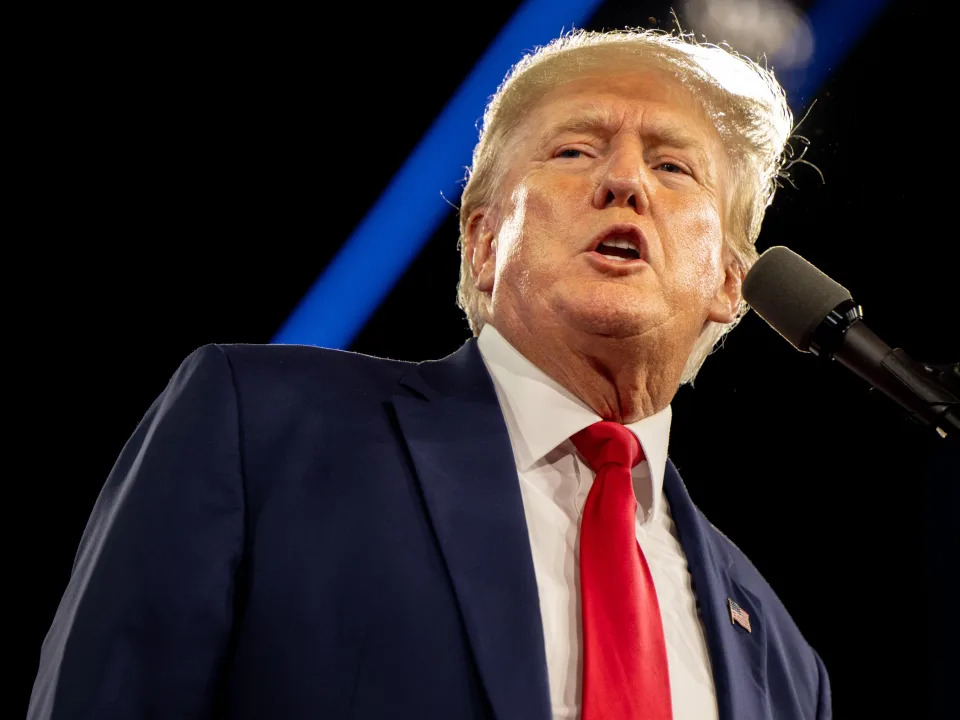
Former President Donald Trump speaks at the Conservative Political Action Conference on August 6, 2022 in Dallas, Texas.Brandon Bell/Getty Images
The 65 Project has filed more than 40 ethics complaints against lawyers who tried to overturn the 2020 election.
For lawyers working with former President Donald Trump, legal risk is considered an expected part of the job: More than 40 attorneys who worked to overturn the 2020 election on his behalf have been hit with ethics complaints.
The New York Times reported legal experts joke MAGA now stands for “Making Attorneys Get Attorneys,” based on the reputational risk of working with Trump.
“There’s no way to adhere to your ethical integrity and keep your job,” Kimberly Wehle, a University of Baltimore law professor who closely tracked investigations into the Jan. 6, 2021 attack on the Capitol, told The New York Times of the dilemma Mr. Trump’s lawyers face: “There’s just no way to not step into a mess.”
The 65 Project, a bipartisan effort to hold Trump-allied lawyers accountable for filing 65 lawsuits across swing states in an attempt to overturn legitimate 2020 election results, has filed more than 40 ethics complaints with their respective state bar associations against lawyers who participated in the scheme.
Among the complaints, including 17 filed last month, are ethical concerns raised against former Trump lawyers John Eastman, Cleta Mitchell, and Jenna Ellis.
Christina Bobb, a current Trump lawyer, is currently facing legal trouble after she signed a letter attesting that a “diligent search” had been conducted and all material that was in Mar-a-Lago at the time had been returned to the US government, per a court filing. Two months later, the FBI raided Trump’s Florida golf club and found 20 boxes worth of new material, including 11 sets that were marked as classified.
“Ultimately, we want to demonstrate to all the lawyers that the next time that Sidney Powell or Rudy Giuliani calls and says, ‘Hey, will you sign your name to this,’ they’ll say ‘no,’ because they’ll realize that there are professional consequences,” Michael Teter, director of the 65 Project, told The New York Times.
Democrats Didn’t Conjure Up the Demand for MAGA Candidates
By Jamelle Bouie, Opinion Columnist – September 10, 2022
Credit…Adriana Zehbrauskas for The New York Times
In my column this week, I tackled some of the major objections to President Biden’s Philadelphia speech on MAGA Republicans and the threat they pose to democracy, including the view that it was too divisive.
Even if it was, most Americans land on Biden’s side of the argument — in a Reuters poll conducted just a few days after the speech, 58 percent of respondents, including a quarter of Republicans, said that Trump’s “Make America Great Again” movement is “threatening America’s democratic foundations.”
What I didn’t address was the charge that Biden, and Democrats in general, are acting in bad faith when they condemn Trump and his allies. If Democrats truly believe that MAGA Republicans are a threat to democracy, goes the argument, why are they spending tens of millions of dollars to elevate them in Republican primaries? My colleagues Ross Douthat and Bret Stephens both made a version of this point in their respectivecolumns this week.
They are keyed into something real: that it is a bit unsavory, if not outright hypocritical, for Democrats to spend huge sums to help nominate MAGA Republicans at the expense of their more moderate, pro-democracy colleagues while condemning those same candidates, and the movement they represent, as a threat to the constitutional order.
Where I part ways with my colleagues is in their conclusion that Democrats are therefore crying alligator tears when they condemn MAGA extremists. If the top priority is depriving the Republican Party of power and influence, then the most important thing for Democrats to do, right now, is win elections. And if the most Trump-aligned candidates tend to be the weakest challengers in a general election, then it is entirely consistent with the argument in Biden’s speech to want to elevate those candidates over more moderate alternatives.
At the end of the day, a more moderate Republican in Congress is still a vote for Kevin McCarthy as speaker of the House or Mitch McConnell as Senate majority leader. It is still a vote, in other words, for a coalition that includes MAGA Republicans.
I could leave it there, except that I think that this answer concedes too much to the premise. Implicit in the question is the factual claim that Democratic spending in Republican primaries is either responsible for — or a significant factor in — the success of MAGA candidates with Republican voters. Otherwise, why would Democrats spend the money and why would conservatives complain about the outcome?
I think it is true that Democratic spending has had an effect. But I think the more significant reason that Republican voters keep nominating MAGA candidates is that Republican voters like MAGA candidates. All you have to do is look at the results of the Republican primaries in question and ask if Democratic money really mattered that much.
Did Illinois Governor J.B. Pritzker, a Democrat, spend millions to give a boost to Darren Bailey, the Trumpiest candidate in the Republican gubernatorial primary? Yes. But Bailey led the Republican field before Pritzker’s intervention, swamping his opponents in an October 2021 poll. Democrats may have nudged some undecided voters into Bailey’s camp, but that alone does not explain how the hard-right Republican won more than 57 percent of the vote in a six-way primary. The more likely answer, given his early lead, is that Republican voters liked what Bailey was selling.
The same goes for Doug Mastriano in Pennsylvania, the pro-insurrection Republican candidate for governor. Democrats gave him a boost as well. But he led the Republican pack for much of the race and his final tally — nearly 44 percent of the vote in an eight-way contest — reflects his very real popularity with Republican voters in the state.
The other thing to consider is the actual content of Democratic ads on behalf of MAGA Republican candidates. The ad meant to support Mastriano, for example, simply stated his conservative views and emphasized his support for Trump. The ad said that Mastriano wanted to “outlaw abortion” and is “one of Donald Trump’s strongest supporters.” It also points out that Mastriano “wants to end vote by mail, and he led the fight to audit the 2020 election. If Mastriano wins, it’s a win for what Donald Trump stands for.”
It is not the Democratic Party’s fault that Republicans are attracted to this message, and nothing forced Republicans in Pennsylvania or Illinois (or Michigan or Arizona) to nominate the most MAGA candidates in the field. Republicans voters like Trump and they want Trumpist candidates, and where there’s demand, supply usually follows.
Which is to say that even with Democratic intervention in Republican primaries, the thrust of Biden’s story about the Republican Party still holds up. The party has been captured by extremists, and it’s up to the rest of us to ensure that it doesn’t win more power than it already has.
What I Wrote
My Friday column was on President Biden’s Philadelphia speech, why I think the objections to it are misguided, and what, if anything, was missing from his argument that the MAGA movement is a threat to American democracy.
To divide against a radical minority that would attack and undermine democratic self-government is to divide along the most inclusive lines possible. It is to do a version of what Franklin Roosevelt did when he condemned“organized money,” “economic royalists” and the “forces of selfishness and lust for power.”
‘Deeply Problematic’: Experts Question Judge’s Intervention in Trump Inquiry
Charlie Savage –September 6, 2022
Former President Donald Trump speaks at a rally in Wilkes-Barre, Pa., Saturday, Sept. 3, 2022. (AP Photo/Mary Altaffer) (ASSOCIATED PRESS)
WASHINGTON — A federal judge’s extraordinary decision Monday to interject in the criminal investigation into former President Donald Trump’s hoarding of sensitive government documents at his Florida residence showed unusual solicitude to him, legal specialists said.
This was “an unprecedented intervention by a federal district judge into the middle of an ongoing federal criminal and national security investigation,” said Stephen I. Vladeck, a law professor at the University of Texas.
Siding with Trump, the judge, Aileen M. Cannon, ordered the appointment of an independent arbiter to review the more than 11,000 government records the FBI seized in its search of Mar-a-Lago last month. She granted the arbiter, known as a special master, broad powers that extended beyond filtering materials that were potentially subject to attorney-client privilege to also include executive privilege.
Cannon, a Trump appointee who sits on the U.S. District Court for the Southern District of Florida, also blocked federal prosecutors from further examining the seized materials for the investigation until the special master had completed a review.
In reaching that result, Cannon took several steps that specialists said were vulnerable to being overturned if the government files an appeal, as most agreed was likely. Any appeal would be heard by the 11th U.S. Circuit Court of Appeals in Atlanta, where Trump appointed six of its 11 active judges.
Paul Rosenzweig, a former homeland security official in the George W. Bush administration and prosecutor in the independent counsel investigation of Bill Clinton, said it was egregious to block the Justice Department from steps like asking witnesses about government files, many marked as classified, that agents had already reviewed.
“This would seem to me to be a genuinely unprecedented decision by a judge,” Rosenzweig said. “Enjoining the ongoing criminal investigation is simply untenable.”
Born in Colombia in 1981, Cannon graduated from Duke University in 2003 and the University of Michigan Law School in 2007. After clerking for a Republican-appointed appeals court judge in Iowa, she worked as an associate for a corporate law firm for three years before becoming an assistant federal prosecutor in Florida.
In her Senate questionnaire, she described herself as having been a member of the conservative Federalist Society since 2005. Trump nominated her in May 2020, and the Senate confirmed her on Nov. 12, nine days after he lost reelection.
After Cannon was assigned to Trump’s special master lawsuit, she made the unusual move of publicly declaring that she was inclined to instate one even before hearing arguments from the Justice Department. But she could have done so in a far more modest fashion.
“Judge Cannon had a reasonable path she could have taken — to appoint a special master to review documents for attorney-client privilege and allow the criminal investigation to continue otherwise,” said Ryan Goodman, a New York University law professor. “Instead, she chose a radical path.”
A specialist in separation of powers, Peter M. Shane, who is a legal scholar in residence at NYU, said there was no basis for Cannon to expand a special master’s authority to screen materials that were also potentially subject to executive privilege. That tool is normally thought of as protecting internal executive branch deliberations from disclosure to outsiders like Congress.
“The opinion seems oblivious to the nature of executive privilege,” he said.
The Justice Department is itself part of the executive branch, and a court has never held that a former president can invoke the privilege to keep records from his time in office away from the executive branch itself.
The department had argued that even if a special master were appointed, there would be no legal basis for that person to examine issues of executive privilege. It cited a 1977 Supreme Court case involving the papers of former President Richard Nixon, who had tried to use executive privilege to shield them even though the sitting president disagreed.
But Cannon wrote that she was not convinced and believed the Justice Department’s stance “arguably overstates the law.” In that case, she said, the Supreme Court also stated that former presidents retained some residual power to invoke executive privilege.
The Supreme Court also said the incumbent officeholder is in the best position to assess such issues. But Cannon wrote that the justices had not “ruled out the possibility” that a former president could ever prevail over the current one.
“Even if any assertion of executive privilege by plaintiff ultimately fails in this context,” she wrote, “that possibility, even if likely, does not negate a former president’s ability to raise the privilege as an initial matter.”
She did not address a 1974 Supreme Court case that upheld the Watergate prosecutor’s demand for White House tapes as part of a criminal investigation despite the attempt by Nixon, then the sitting president, to block it by asserting executive privilege.
“Even if there is some hypothetical situation in which a former president could shield his or her communications from the current executive branch,” Shane said, “they would not be able to do so in the context of a criminal investigation — and certainly not after the material has been seized pursuant to a lawful search warrant.”
Cannon allowed a separate review of the documents, by the Office of the Director of National Intelligence, to continue. It is assessing the risk to national security that the insecure holding of sensitive documents at Mar-Lago may have caused.
David Alan Sklansky, a Stanford University law professor, said he was glad that work had been allowed to continue given its importance. But he said there was an inherent contradiction in allowing the executive branch to use the files for that purpose while blocking it from using them for an active criminal investigation.
“There is this odd situation where one part of the executive branch can use the materials and another not,” he said.
In reasoning that she had a basis to install a special master, Cannon relied heavily on a 1975 appeals court ruling. It held that courts had jurisdiction to decide whether to order the IRS to return a businessman’s records that he claimed had been taken unlawfully, and laid out a multipronged test for such situations.
One part of the test is whether the government had displayed a “callous disregard” for the constitutional rights of the person subjected to the search. On that issue, she sided with the Justice Department, which had obtained a warrant from a magistrate judge.
But she said the other parts of the test favored Trump. They included whether he had an individual interest in and need for the seized property, would be “irreparably harmed” by a denial of that request and lacked any other remedy.
While Trump does not own the government documents he repeatedly failed to return, the warrant permitted the FBI to take anything else of his that he had left in the same containers as evidence of how he stored sensitive information.
Cannon noted that a department report said this had included “medical documents, correspondence related to taxes and accounting information.”
“In addition to being deprived of potentially significant personal documents, which alone creates a real harm,” she wrote, Trump faced “an unquantifiable potential harm by way of improper disclosure of sensitive information to the public.” A footnote insinuated that the Justice Department might leak those files to reporters.
In weighing such factors, she emphasized Trump’s status as a former president.
“As a function of plaintiff’s former position as president of the United States, the stigma associated with the subject seizure is in a league of its own,” she wrote. “A future indictment, based to any degree on property that ought to be returned, would result in reputational harm of a decidedly different order of magnitude.”
Ronald S. Sullivan Jr., a Harvard Law School professor, said anyone targeted by a search warrant fears reputational harm, but that does not mean they can get special masters appointed. He called Cannon’s reasoning “thin at best” and giving “undue weight” to the fact that Trump is a former president.
“I find that deeply problematic,” he said, emphasizing that the criminal justice system was supposed to treat everyone equally. “This court is giving special considerations to the former president that ordinary, everyday citizens do not receive.”
Samuel W. Buell, a Duke University law professor, agreed.
“To any lawyer with serious federal criminal court experience who is being honest, this ruling is laughably bad, and the written justification is even flimsier,” he wrote in an email. “Donald Trump is getting something no one else ever gets in federal court, he’s getting it for no good reason, and it will not in the slightest reduce the ongoing howls that he is being persecuted, when he is being privileged.”
Barbara Ehrenreich, Explorer of Prosperity’s Dark Side, Dies at 81
By Natalie Schachar –September 2, 2022
Her book “Nickel and Dimed,” an undercover account of the indignities of being a low-wage worker in the United States, is considered a classic in social justice literature.
The author Barbara Ehrenreich in 2020. She tackled a variety of themes: the myth of the American dream, the labor market, health care, poverty and women’s rights.Credit…Jared Soares
It was a casual meeting.
Over salmon and field greens, Barbara Ehrenreich was discussing future articles with her editor at Harper’s Magazine. Then, as she recalled, the conversation drifted.
How could anyone survive on minimum wage? She mused. A tenacious journalist should find out.
Her editor, Lewis Lapham, offered a half smile and a single word reply: “You.”
The result was the book “Nickel and Dimed: On (Not) Getting By in America” (2001), an undercover account of the indignities, miseries and toil of being a low-wage worker in the United States. It became a best seller and a classic in social justice literature.
Ms. Ehrenreich, the journalist, activist and author, died at 81 on Thursday at a hospice facility in Alexandria, Va., where she also had a home. Her daughter, Rosa Brooks, said the cause was a stroke.
Working as a waitress near Key West, Fla., in her reporting for “Nickel and Dimed,” Ms. Ehrenreich quickly found that it took two jobs to make ends meet. After repeating her journalistic experiment in other places as a hotel housekeeper, cleaning lady, nursing home aide and Wal-Mart associate, she still found it nearly impossible to subsist on an average of $7 an hour.
Every job takes skill and intelligence, she concluded, and should be paid accordingly.
One of more than 20 books written by Ms. Ehrenreich, “Nickel and Dimed” bolstered the movement for higher wages just as the consequences of the dot-com bubble snaked through the economy in 2001.
“Many people praised me for my bravery for having done this — to which I could only say: Millions of people do this kind of work every day for their entire lives — haven’t you noticed them?” she said in 2018 in an acceptance speech after receiving the Erasmus Prize, given to a person or institution that has made an exceptional contribution to the humanities, the social sciences or the arts.
Ms. Ehrenreich noticed those millions throughout a writing career in which she tackled a variety of themes: the myth of the American dream, the labor market, health care, poverty and women’s rights. Her motivation came from a desire to shed light on ordinary people as well as the “overlooked and the forgotten,” her editor, Sara Bershtel, said in an email.
“Nickel and Dimed,” one of more than 20 books Ms. Ehrenreich wrote, xCredit…
Barbara Alexander was born on Aug. 26, 1941, in Butte, Mont., into a working-class family. Her mother, Isabelle Oxley, was a homemaker; her father, Benjamin Howes Alexander, was a copper miner who later earned a Ph.D. in metallurgy at Carnegie Mellon University in Pittsburgh and became director of research at Gillette.
Having grown up steeped in family lore about the mines, Ms. Ehrenreich recalled thinking it was normal for a man over 40 to do dangerous work and be missing at least a finger.
“So to me, sitting at a desk all day was not only a privilege but a duty: something I owed to all those people in my life, living and dead, who’d had so much more to say than anyone ever got to hear,” she wrote in the introduction to “Nickel and Dimed.”
Both of her parents were heavy drinkers. In a 2014 memoir, she described her mother’s wrath as the “central force field” of her childhood home. She believed that her mother’s death, from a heart attack, had been induced by an intentional overdose of pills.
Ms. Ehrenreich graduated from Reed College in Portland, Ore., in 1963. She received a Ph.D. in cell biology in 1968 from Rockefeller University in New York, where she met her first husband, John Ehrenreich.
After her studies, she became a budget analyst for New York City and then a staff member at the New York-based (and now defunct) nonprofit Health Policy Advisory Center in 1969. In 1971 she began working as an assistant professor in the Health Sciences Program at the State University of New York, Old Westbury. But the social and political upheaval of the 1960s awakened her anger and fueled her desire to write.
Her first book, “Long March, Short Spring: The Student Uprising at Home and Abroad” (1969), co-written with Mr. Ehrenreich, grew out of her anti-Vietnam War activism. Their second book, “The American Health Empire: Power, Profits and Politics,” was published the next year.
Ms. Ehrenreich quit her teaching job in 1974 to become a full-time writer, selling a number of articles to Ms. magazine in the 1970s.
Numerous critically acclaimed books followed, including “The Hearts of Men: American Dreams and the Flight from Commitment” (1983), “Fear of Falling: The Inner Life of the Middle Class” (1989), “The Worst Years of Our Lives: Irreverent Notes from a Decade of Greed” (1990) and “Blood Rites: Origins and History of the Passions of War” (1997).
It was her firsthand reporting in “Nickel and Dimed,” however, that resonated with working Americans and became a turning point in her career.
Ms. Ehrenreich in 2006. Her firsthand reporting in “Nickel and Dimed” became a turning point in her career.Credit…David Scull for The New York Times
Following the book’s success, Ms. Ehrenreich applied her immersive journalism technique to works about the dysfunctional side of the American social order. Those included “Bait and Switch: The (Futile) Pursuit of the American Dream” (2005) and “Smile or Die” (2009), about the dangers of “positive thinking” amid inadequate health care.
In her memoir, “Living With a Wild God” (2014), she focused on her troubling, unconventional experiences as a teenager.
She also wrote articles and essays for The New York Times, The Washington Post Magazine, The Atlantic, Harper’s, The Nation and The New Republic and held academic posts, teaching women’s studies at Brandeis and essay writing at the Graduate School of Journalism at the University of California, Berkeley.
Her marriage to Mr. Ehrenreich in 1966 ended in divorce in 1982. In addition to their daughter, Ms. Brooks, a law professor, she is survived by their son, Ben Ehrenreich, a journalist; two siblings, Benjamin Alexander Jr. and Diane Alexander; and three grandchildren. Her second marriage, to Gary Stevenson in 1983, ended in divorce in 1993.
In recent years Ms. Ehrenreich came to believe that many people living at or near the poverty level didn’t need someone else to give voice to their struggles.
Instead, she thought that individuals could tell their own stories if they had greater support. She created the Economic Hardship Reporting Project, which focused on helping the work of underrepresented people get published and providing economic assistance to factory workers, house cleaners, professional journalists and others who had fallen on hard times.
Her most recent book, “Had I Known: Collected Essays” (2020), compiles four decades of her articles on sexism, health, the economy, science, religion and other topics. Almost all of them shared repeated warnings about growing poverty and worsening inequality.
Ms. Ehrenreich’s anger at inequity remained unabated late in her life. In a 2020 interview with The New Yorker, she said a lack of paid sick-leave and the declining well-being of the working class still gave her “grim and rageful thoughts.”
“We turn out to be so vulnerable in the United States,” she said. “Not only because we have no safety net, or very little of one, but because we have no emergency preparedness, no social infrastructure.”
In 2018, she published “Natural Causes,” which addressed the topic of growing old and bluntly excoriated the wellness movement.
“Every death can now be understood as suicide,” she wrote. “We persist in subjecting anyone who dies at a seemingly untimely age to a kind of bio-moral autopsy: Did she smoke? Drink excessively? Eat too much fat and not enough fiber? Can she, in other words, be blamed for her own death?”
Ms. Ehrenreich continued writing into her 80s and at her death had begun work on a book about the evolution of narcissism, her daughter said.
Ms. Ehrenreich said she believed that her job as a journalist was to shed light on the unnecessary pain in the world.
“The idea is not that we will win in our own lifetimes and that’s the measure of us,” she told The New Yorker, “but that we will die trying.”