The US Navy said ‘traces’ of jet fuel were found in the water on the aircraft carrier USS Nimitz. A sailor says the problem was way worse.
Jake Epstein – October 1, 2022
Washing down on the flight deck of the aircraft carrier USS Nimitz.US Navy
The US Navy said it found only “traces” of jet fuel in the water on the aircraft carrier USS Nimitz.
But a sailor told Insider that they were exposed to an “unhealthy amount” of fuel and shared a photo as evidence.
They also said they didn’t immediately receive medical attention, despite health concerns.
The US Navy acknowledged recently that the water the crew of the aircraft carrier USS Nimitz uses to bathe and drink was contaminated by what it described as “traces” of jet fuel, but a sailor on the ship said the situation was worse than the service first let on.
The crew learned about two weeks ago that the water supply had a problem. Specifically, the water had become a troublingly discolored fluid with a bad smell, a sailor said. Testing found what the Navy said were “detectable traces” of hydrocarbons, a chemical component of jet fuel.
In a recent interview with Insider, a sailor aboard the ship described a situation that appears to be far worse than what was initially indicated by the Navy.
“We were exposed to an unhealthy amount of JP-5,” the Nimitz sailor, whose identity is known to Insider but is being withheld due to concerns about the possibility of retribution, said this week. JP-5, or jet-propellant-5, is a kerosene-based fuel that is used in military aircraft and is a go-to for the Navy’s carrier air wings.
Related video: The true cost of the most advanced aircraft carrier, USS Ford
https://s.yimg.com/rx/martini/builds/49027198/executor.htmlScroll back up to restore default view.
The sailor explained that although they and their shipmates drank and showered with the contaminated water, they were initially denied medical attention for issues that were believed to be related to their exposure to jet fuel.
After earlier Navy assurances there had been no ill effects, a spokesman for 3rd Fleet told Insider on Friday that five sailors have reported health issues that could be related to the contamination and that the ship’s leadership is monitoring the situation. In an overnight update, Insider was informed the number has since risen to 10.
Cmdr. Sean Robertson, a fleet spokesperson, told Insider on Friday that “if we receive any additional reports of potentially contaminated water, we will immediately investigate and take appropriate action to safeguard the crew.” The parents of the sailor Insider spoke with said at that time that the carrier’s medical team was still turning away some sailors.
Discovering jet fuel in the water
The sailor said they were first informed there was jet fuel in the water on the evening of September 16. A Navy spokesperson confirmed this date to Task & Purpose, one of the outlets that along with Navy Times first reported on the problem, and said that the crew “immediately took action.”
The sailor said that the ship’s commanding officer announced to the ship that night that jet fuel had been discovered in the water, stressing that the crew of roughly 3,000 should not drink it and that they should drink only distributed bottled water until they returned to port.
The sailor said that later that night, however, they were told by the ship’s executive officer and the commanding officer that the water was actually safe to drink and that there was nothing to worry about.
“It was not safe to drink,” the sailor said. “People believed the CO and XO, and people were showering in this stuff.”
On the morning of September 17, the aircraft carrier arrived at San Diego’s Naval Air Station North Island, and by noon, the carrier was connected to the local water supply. It wasn’t until that point that the Nimitz leadership reversed course again and said the water was actually unsafe to drink and shower in, the sailor said.
Throughout the night and through the morning, people were under the impression that the water was safe, despite indications that it wasn’t, the sailor said.
“Medical was refusing to see patients or acknowledge that anything going on with patients or different sailors had anything related to the JP-5,” the sailor said, adding that medical staff “refused” to note the JP-5 exposure in sailors’ records.
The Nimitz sailor said that one fellow service member was throwing up while another had a rash. In a separate interview with Insider, the sailor’s parents — whose identities are also known to Insider but are being withheld to protect the sailor — said they noticed their sailor had developed a dry cough after the exposure.
“Medical was telling us that it’ll just pass through you,” the sailor said. They said that after reviewing a safety data sheet, which has information about hazardous chemicals, and cross-referencing their jet fuel exposure, it was clear they should seek medical attention.
Sailors participate in a countermeasure wash down on the flight deck of the aircraft carrier USS Nimitz.US Navy
Testing the water
The sailor explained that when the ship’s water tanks were opened for inspection late on September 17, a “thick layer of JP-5 on top of the potable water” was found. The next step was trying to flush the jet fuel out of the system.
They said that starting the next day on September 18, crewmembers began conducting taste- and smell-tests of the ship’s water — a process that continued for at least the following 10 days and something the sailor described as a “big concern.”
Though Cmdr. Robertson did not say anything about taste testing, he did tell Insider that a “sniffer team” of Nimitz sailors has been tasked with checking out “hot spots,” areas with concerning odors.
The process described by the sailor involved filling and then dumping the water tanks and then sampling the water for jet fuel. In draining the tank, however, they frequently spotted the fuel leaving residue along the sides of the tank.
“So basically what we’re doing is draining the water out, filling it back up, and letting the JP-5 coat the sides of the tank,” the sailor said.
A Navy official told Insider that an initial test of water samples from September 19 did not “detect measurable amounts of fuel hydrocarbons.” The official said more testing on water samples from the Nimitz’s potable water tanks on September 21, however, did reveal “detectable traces of hydrocarbons.” The Navy did not disclose the specific amount detected.
But the sailor rejected the notion that there were only “traces” of jet fuel, pointing to the “thick layer” of fuel they saw on top of the water in samples.
The aircraft carrier was supposed to depart San Diego late last week, but it ended up staying in port. The sailor speculated that this may have been because of media coverage and attention, which they said is what initially triggered the laboratory tests — not the crew’s suspicion that there was still jet fuel in the water.
To highlight the visible impact of the jet fuel contaminating the water, the sailor’s family provided Insider with a screenshot of a text exchange between the parents and the sailor.
A screenshot of a text exchange with a photo of a sample of what a sailor said was water from the USS Nimitz contaminated with jet fuel.Courtesy photo
In the exchange is a photograph, shared with the sailor by a shipmate. The photo was taken shortly after it was first announced that there was jet fuel in the water, the sailor said, and appears to show a water sample — drawn from a water fountain — consisting of a thick, green, layer on the top and a murky, white layer on the bottom.
Working through the aftermath
The sailor said that as of this week, some of their fellow Navy sailors were still drinking and showering with the contaminated water because “we don’t have much of another option.”
The shore water looks clear and has gotten better, they said, but the smell and taste of jet fuel still lingers, as residual amounts continue to stick to the water tanks and piping.
“So the only way we can get all the contamination out of the tank is by completely draining it and scrubbing it, because the way JP-5 sticks to metal,” the sailor said.
Cmdr. Robertson told Insider in an email on Friday that the potable water system on the Nimitz continues to be evaluated so sailors get the “highest quality water” when the ship eventually leaves San Diego.
“The health and well-being of all of our Sailors is our top priority,” he added. “To that end, Nimitz leadership encourages the crew daily to report to medical immediately if they exhibit any illness or injury that could potentially be caused by exposure to contaminated water.”
As of Friday, Robertson said, 10 sailors have reported health issues that “could be associated with JP-5 ingestion, with no new reports in the last 24 hours.”
He said symptoms — which include headache, diarrhea, and rashes — were present between September 17 and September 26. None of those individuals are “currently reporting any symptoms that might be associated with JP-5 ingestion,” he said.
The parents of the sailor with which Insider spoke said in a separate interview that they have been reaching out to various lawmakers to try and voice their concerns, but they haven’t had much luck getting responses.
“Serving this country is a privilege,” one parent said. “But in return, I expect the leadership to support the soldiers and the sailors and to take care of them.”
Trump suffers setback as appeals panel rejects Cannon ruling
Kyle Cheney and Josh Gerstein – September 21, 2022
AP Photo/Wilfredo Lee
A three-judge appeals court panel has granted the Justice Department’s request to block aspects of U.S. District Court Judge Aileen Cannon’s ruling that delayed a criminal investigation into highly sensitive documents seized from former President Donald Trump’s Mar-a-Lago estate.
The panel ruled that Cannon, a Trump appointee, erred when she temporarily prevented federal prosecutors from using the roughly 100 documents — marked as classified – recovered from Trump’s estate as part of a criminal inquiry.
Trump “has not even attempted to show that he has a need to know the information contained in the classified documents,” the panel ruled in a 29-page decision. “Nor has he established that the current administration has waived that requirement for these documents.”
Two of the three judges on the panel, Andrew Brasher and Britt Grant, were appointed to the court by Trump. The third, Robin Rosenbaum, was appointed by President Barack Obama. In the unanimous decision, the judges declared it “self-evident” that the public interest favored allowing the Justice Department to determine whether any of the records were improperly disclosed, risking national security damage.
“For our part, we cannot discern why Plaintiff would have an individual interest in or need for any of the one-hundred documents with classification markings,” the appeals court wrote in an opinion that listed no individual judge as the author.
While Cannon speculated in her ruling that allowing investigators continued access to the documents could result in leaks of their contents, the appeals panel brushed aside that concern.
“Permitting the United States to retain the documents does not suggest that they will be released; indeed, a purpose of the United States’s efforts in investigating the recovered classified documents is to limit unauthorized disclosure of the information they contain,” the appeals judges wrote. “Not only that, but any authorized official who makes an improper disclosure risks her own criminal liability.”
The 11th Circuit’s rules appear to preclude any attempt to ask the full bench of that court to reconsider the government’s motion, but Trump could seek emergency relief from the Supreme Court.
Trump attorney Christopher Kise did not immediately respond to a request for comment on the ruling.
The appeals court’s opinion was unsparing toward Cannon and replete with indications that the appeals judges took a vastly different approach to the document fight than she did.
Trump’s legal team, Cannon and even a senior judge that she appointed as a special master have generally referred to the national-security documents at issue as “marked classified,” deferring at least to a degree to Trump’s claim that he declassified all the records found at Mar-a-Lago, despite a lack of evidence buttressing his assertion. But the appeals court panel took a different approach, often referring without qualification to the records as “classified.”
They also characterized the public dispute over potential declassification of the documents as a “red herring,” contending that even if true, “that would not explain why [Trump] has a personal interest in them.”
Throughout their ruling, the three judges made clear they had little patience for Trump’s freewheeling claims about the status of the 100 documents, noting that he had presented no evidence to support those public assertions. And they noted drily that there’s a common sense reason for documents to include classified markings.
“Classified documents are marked to show they are classified, for instance, with their classification level,” the panel observed.
The timing of the appeals court’s decision, coming less than 24 hours after the parties’ completed legal briefing on the issue, also signaled that the panel viewed the question as straightforward.
Rising homelessness is tearing California cities apart
Lara Korte and Jeremy B. White – September 21, 2022
Jae C. Hong/AP Photo
SACRAMENTO, Calif. — A crew of state workers arrived early one hot summer day to clear dozens of people camped under a dusty overpass near California’s Capitol. The camp’s residents gathered their tents, coolers and furniture and shifted less than 100 feet across the street to city-owned land, where they’ve been ever since.
But maybe not for much longer.
The city of Sacramento is taking a harder line on homeless encampments, and is expected to start enforcing a new ban on public camping by the end of the month — if the courts allow.
As the pandemic recedes, elected officials across deep-blue California are reacting to intense public pressure to erase the most visible signs of homelessness. Democratic leaders who once would have been loath to forcibly remove people from sidewalks, parks and alongside highways are increasingly imposing camping bans, often while framing the policies as compassionate.
“Enforcement has its place,” said Sacramento Mayor Darrell Steinberg, a Democrat who has spent much of the past year trying to soothe public anger in a city that has seen its unsheltered homeless population surpass that of San Francisco — 5,000 in the most recent count compared with San Francisco’s 4,400. “I think it’s right for cities to say, ‘You know, there are certain places where it’s just not appropriate to camp.'”
Steinberg is one of many California Democrats who have long focused their efforts to curb homelessness on services and shelter, but now find themselves backing more punitive measures as the problem encroaches on public feelings of peace and safety. It’s a striking shift for a state where 113,000 people sleep outdoors on any given night, per the latest statewide analysis released by the U.S. Department of Housing and Urban Development in 2020. California’s relatively mild climate makes it possible to live outdoors year-round, and more than half of the nation’s unsheltered homeless people live here.
Democratic Gov. Gavin Newsom recently announced the state had cleared 1,200 encampments in the past year, attempting to soften the message with a series of visits to social service programs. But without enough beds to shelter unhoused people, advocates say efforts to clear encampments are nothing more than cosmetic political stunts that essentially shuffle the problem from street corner to another.
Steinberg, a liberal Democrat who resisted forcibly removing people until more shelters can come online, has for more than 20 years championed mental health and substance abuse programs as ways to get people off the street. But such programs have been largely unable to keep up with the rising number of homeless people in cities like Sacramento, where local leaders are now besieged by angry citizens demanding a change.
He and many of his fellow Democratic mayors around the state are not unsympathetic to their cause. San Diego has penalized people refusing shelter. Oakland upped its rate of camp closures as the pandemic receded. San Jose is scrambling to clear scores of people from an area near the airport or risk losing federal funding.
“No one’s happy to have to do this,” San Diego Mayor Todd Gloria said earlier this summer as he discussed ticketing people who refuse shelter. “We’re doing everything we can to provide people with better choices than the street.”
Other Democratic leaders around the country, facing similar pressure, have also moved to clear out encampments and push homeless people out of public spaces. New York City Mayor Eric Adams, a former police captain who won his office on a pledge to fight crime, came under fire this year for his removal of homeless people from subways and transit hubs. The city’s shelter system is now bursting at the seams.
In California, where the percentage of people living day-to-day on the streets is far higher than New York, the shortage of shelter beds has caused friction and embroiled local and state officials in court challenges.
A recent court decision requires local governments to provide enough beds before clearing encampments — a mandate that does not apply to state property. But that’s easier said than done in a state where there are three to four times as many homeless people as shelter beds.
California’s homelessness problem has deep, gnarled roots dating back decades, but has become increasingly pronounced in recent years. Tents and tarps on sidewalks, in parks and under freeways have become a near-ubiquitous symbol of the state’s enduring crisis. A pandemic-spurred project to move people from encampments to motels has lapsed, and eviction moratoriums have dissolved. Homelessness is a top concern for voters in the liberal state, and as Democrats prepare for the midterm elections, Newsom and other leaders have been eager to show voters they’re taking action.
But the practice of clearing out camps can be a futile exercise, particularly when the people being forced to pack up their tents have nowhere else to go or simply end up doing the same thing just a few blocks away.
Weeks after state transportation workers cleared the space under the Sacramento highway, people are still camped out along a city sidewalk across the street, with blankets, chairs, tires and shelves spilling out onto the street and, at times, blocking driveways.
Syeda Inamdar, who owns a small office building on the block, said her tenant is afraid to come to work because of the camp. A nearby Starbucks abruptly closed earlier this year, citing safety concerns.
“This is not safe for anybody,” said Inamdar, who is sympathetic to the people in the camp but says she’s nevertheless thinking of just giving up and selling the property.
Jay Edwards, a homeless man in his 60s, said he and many of his fellow residents felt safer under the overpass, where their tents didn’t block footpaths and people didn’t bother them. Newsom and others have described living situations like his — in a blue tent, with a dirty mattress, surrounded by piles of random belongings and trash — as inhumane. Edwards disagreed.
“It’s not inhumane,” he said. “It’s the people’s attitudes that make it inhumane.”
The state has given more than $12 billion in recent years to help local governments build housing and shelter. But it could be years before those units are built.
In Sacramento, city and county leaders just made it easier for authorities to clear tents from sidewalks and along a popular river trail. But some want even tougher laws. Earlier this year, a coalition of Sacramento business owners approached city councilors hoping to put a measure on the November ballot that would compel the city to move camps blocking sidewalks and create more shelter for those they moved. The Council, whose members run without party affiliation, voted to put the measure on the ballot, with some caveats that enlist the help of the county. Councilmember Katie Valenzuela was one of two members who voted against it.
She said moving the camps won’t help the root of the problem, and the city can’t afford the amount of space that would be necessary to house people cleared from encampments.
“People are saying ‘oh you’ve got the space to do this, just put them all on 100 acres.’ That’s not how this works,” she said.
Newsom appears to be feeling the pressure as well, channeling voter frustration by calling proliferating encampments “unacceptable” and pointing to the litter-filled highway underpasses he cleans during press events as evidence the state has become “too damn dirty.”
Historically, California governors have been reluctant to funnel significant resources to combat the homeless problem. But Newsom, a former mayor of San Francisco, has made it a centerpiece of his administration. The governor has secured hundreds of millions of dollars to help local governments address encampments by offering residents services and helping them find shelter, on top of the billions of dollars California has poured into homelessness more broadly and a state program to convert hotels and motels into low-income housing.
But those efforts aren’t happening fast enough for many in California, including merchants who are languishing in downtowns that are inundated with tents, tarps and other refuse from the people who have taken up residence on sidewalks and street corners. Business owners in San Francisco’s historic Castro District threatened to stop paying taxes last month if city officials didn’t do something about the vandalism, littering and frequent display of psychotic episodes that are a result of the neighborhood’s homeless population.
The governor has also personally weighed in when those efforts collided with resistance from courts and local governments. Earlier this year, he decried a federal judge for “moving the goal posts” in an order that blocked CalTrans from removing a camp in San Rafael. The Newsom administration and Oakland also clashed over a sprawling encampment where a July fire menaced a nearby utility facility that stored explosive oxygen tanks.
A judge blasted both the state and the city for trading blame while failing to find shelter for camp residents, accusing the parties of wanting “to wash their hands of this particular problem” and blocking the state’s plan to clear the site. Newsom excoriated the judge’s order and subsequently threatened to pull funding from Oakland, arguing the city was shirking its obligations. The judge ultimately allowed the clearing to proceed despite camp residents outnumbering available city beds.
Those tensions illustrate a larger test for the housing first philosophy that Newsom and other Democrats espouse. The basic premise is that long-term housing is the starting point for getting people off the streets. But it would take years to address California’s chasmic housing shortage while people are clamoring for solutions to street homelessness now.
The governor’s top homelessness adviser, Jason Elliott, said it was “impossible to say” if the state had sufficient short-term shelter for everyone living outside and conceded that “we don’t have enough money to afford a home for every person who experiences homelessness.” But he argued the state could and should move swiftly on “the most unsafe” sites, calling it a first step to help people.
“The criticism that we should not do anything about dangerous, unsafe encampments until we achieve millions of more units, I think, ignores the seriousness of the problem,” Elliott said. “Street homelessness is deeply dangerous and unsafe for people in the community and for people living in those tents.”
Addiction and mental illness can drive people into homelessness and keep them there, which has fueled Newsom’s push for a civil court system that would create treatment plans for those with the most critical needs and allow involuntary commitment for people who do not participate. The CARE Courts program, which Newsom is expected to sign into law soon, is estimated to help between 7,000 and 12,000 people — a small portion of the more than 160,000 Californians without stable housing.
Outside of interventions in critical mental health cases, policymakers broadly agree that poverty and a dearth of affordable housing are still driving more Californians to live on the street and that, on any given day, more people may become homeless than find housing.
Wary advocates are responding with legal challenges.
Oakland amended an ordinance barring camping near locations including homes, schools and businesses after advocates for the homeless sued, calling the policy inhumane. Advocacy groups in Sacramento unsuccessfully sued to block a ballot measure they called cruel and unusual.
In Los Angeles, a sprawling lawsuit over encampments endangering public welfare has produced a vow to build more shelters — and created the legal authority to clear people from public spaces. Last year, the LA City Council prohibited people from sleeping in sensitive public spaces selected by council members in a move the city of Riverside emulated. Then, Los Angeles bolstered its prohibition in early August by banning camping near schools and daycares, acting at the behest of school district officials who warned children were being traumatized and threatened by people in a growing number of encampments.
A backlash erupted as protesters filled the City Council chambers, chanting and shouting over speakers as they accused council members of inflicting death and violence on homeless people. Authorities ultimately cleared the chambers before lawmakers could return and vote. The proposal passed overwhelmingly with the blessing of Rep. Karen Bass, a Democrat running for LA mayor. But dissenters accused the Council of displacing the problem.
“When you don’t house people, when you don’t offer real housing resources to people at a particular location, the best outcome that you can hope for from a law like this is that people move 500 feet down the street,” Councilmember Nithya Raman said in an interview. “I’m up against a wall. I don’t have any available shelter, and I would imagine other council members are feeling the same way.”
Seventy percent of California’s homeless population is unsheltered, according to a recent Stanford University study, compared to New York, where the figure is 5 percent. The same study found that a large portion of the California homeless population have either a severe mental illness or long-term substance abuse problem, or both.
State and local officials have feuded for decades over who bears responsibility for housing and caring for people with severe mental health illnesses — those who might have been institutionalized a half-century ago, before the national closure of state-funded psychiatric hospitals.
Steinberg, the Sacramento mayor, has been trying to solve this problem for decades. In 2004, as a state legislator, he authored a landmark ballot measure, the Mental Health Services Act, which charged a 1 percent income tax on earnings more than $1 million to provide funding for mental health programs. Steinberg and others have praised the measure as a success, and some reports show that those who participate in the programs funded by the law see a reduction in homelessness.
But nearly two decades later, Steinberg is now dealing with a sprawling homeless population. Sacramento’s bans on camping along sidewalks and along the scenic river trail are set to go into effect at the end of the month. The city ban would classify a violation as a misdemeanor, but homeless people are not supposed to be automatically jailed or fined unless there are extraordinary circumstances, per a companion resolution Steinberg introduced.
With the upcoming ballot measure, championed by business leaders, the city is prepared to put tougher enforcement laws to voters in November, despite fierce criticism and legal challenges from advocates for homeless people. Steinberg said it’s still worth a shot.
“It is not perfect and it is not the way I would write it,” he said of the ballot measure. “But it is progress toward what I believe is essential: that people have a right to housing, shelter and treatment and in a very imperfect way.”
‘Election denier playbook’: Trump supporters seeking state office raise fears of 2nd insurrection
Tom LoBianco, Reporter – September 21, 2022
Supporters of former President Donald Trump seeking to control elections across the country have raised the specter of a second insurrection, akin to the Jan. 6, 2021, attack on the U.S. Capitol, and fears that they will help try to rig the election results for Trump if he seeks the presidency again.
But experts tracking an array of races for positions with control over elections — from governor to county election clerk — say it’s unclear what form a second insurrection could take.
The threat is clouded in part by uncertainty over how much lawmakers will clarify about the previously obscure Electoral Count Act (ECA) and what the Supreme Court will do regarding the “independent legislature” theory, which could block courts from intervening in how elections are run.
An attendee at a rally with former President Donald Trump in Wilkes-Barre, Pa., on Sept. 3. (Michelle Gustafson/Bloomberg via Getty Images)
Changes to the ECA being debated in the Senate and House would clarify that a vice president cannot replace authentic electors with fake ones; would set a quicker timeline for judicial review of election challenges and a higher bar for objections from Congress; and would establish the governor of each state as the lone person who can submit certified electors to Congress.
But bipartisan groups tracking the threat of another insurrection have consistently warned that Trump supporters running to control state elections — from Arizona secretary of state candidate Mark Finchem to Pennsylvania gubernatorial candidate Doug Mastriano — could take the reins and attempt to certify whatever results they want.
“The problem is, the coup did not actually end on Jan. 6. It simply went into a brief hibernation and almost immediately began gathering energy to succeed next time,” said Norm Eisen, founder of the bipartisan group States United Democracy Center and a former top official in the Obama administration.
“They saw that the election refs applied the existing rules to produce the right result,” Eisen said of the 2020 election. “So now they’re going to replace the refs, and they’re going to replace the rules so they can change the results. It’s the election denier playbook, and you see this in state after state.”
Attorney Norm Eisen speaking before the House Judiciary Committee in 2019. (Drew Angerer/Getty Images)
The man at the center of the continued threat, Trump, has said repeatedly that he plans to run for president a third time. He has also taken a darker turn in his campaign rallies recently, eschewing the scripted approach of his return to Washington two months ago for wild conspiracy theories, some of which helped fuel his supporters to attack the Capitol. He has also been hinting at more violence from his supporters if he’s indicted for taking highly sensitive classified intelligence from the White House after his term.
Election director races used to be staid affairs, the rare white noise behind the unchecked turmoil of campaign politics. But like so many other things in politics, that flipped on its head after Trump descended the golden-colored escalator in Trump Tower seven years ago. The 2020 election and Trump’s subsequent efforts to deny his loss elevated these races to top-tier battles for the control of elections themselves.
Terrified election workers testified before the House select committee investigating the Jan. 6 attack about the rampant death threats they received after being targeted by Trump. And many local election workers have resigned or refused to run again in the face of ongoing threats from Trump supporters.
In Arizona and Pennsylvania, two epicenters of efforts by Trump-backed candidates to wrest control of the election process, Republican nominees have proposed a mix of power grabs and more standard conservative election proposals.
Mark Finchem, Republican nominee for Arizona secretary of state, at a conference on Sept. 10 promoting conspiracy theories about voting machines and discredited claims about the 2020 election. (Jim Rassol/AP Photo)
Finchem, the Arizona secretary of state nominee — who recently had a performer sing the QAnon theme song at one of his fundraisers — has proposed ending electronic vote counting and mandating paper ballots (a proposal that Democrats pushed almost two decades ago). But Finchem has also proposed giving the Republican-controlled Arizona state Legislature the power to overturn election results.
Asked by Time magazine if he would certify a hypothetical Biden win, he said he would if the law is followed, but then implied he would never certify a Biden win in 2024 because such a thing would be a “fantasy.”
Across the country, Mastriano, the Republican nominee for Pennsylvania governor, has pushed for voter ID requirements and purging voter rolls, both long-standing Republican election policies.
But Mastriano, a Pennsylvania state senator who marched to the Capitol on Jan. 6, 2021, has also said he would have his handpicked secretary of state invalidate all Pennsylvania voters and force them to re-register. Mastriano submitted a measure that would expand the number of partisans who can challenge votes and vote counting potentially intimidating poll workers further.
Finchem and Mastriano, like dozens of other Trump supporters looking to take control of their states’ elections, have repeated the baseless claim that voter fraud was rampant through the 2020 election and that Trump never lost. But the stances of Trump-backed Republicans vary widely.
Otero County, N.M., Commissioner Couy Griffin arrives at federal court in Washington on June 17. (Gemunu Amarasinghe/AP Photo)
At one extreme sit Trump supporters like Couy Griffin, the New Mexico local official who invalidated an election result he didn’t like and later was removed from office for participating in the Jan. 6 insurrection. At the other end are those like New Hampshire Senate candidate Don Bolduc, who campaigned in the primary repeating Trump’s election lie but promptly disavowed that lie after winning the Republican nomination last week.
In between are a slew of Trump supporters who have dressed up long-standing conservative election priorities, like requiring identification to vote, in Trumpian rhetoric, but have not repeated some of the wackier claims of voter fraud that fueled the Jan. 6 insurrection, like allegations of Italian satellites or Chinese thermostats.
Still, it’s not clear exactly what Trump supporters in election offices could do to rig an election for the former president. The Electoral Count Act fix being debated in the Senate would close most of the loopholes that Trump and his allies, led by Rudy Giuliani and John Eastman, tried to exploit in their fake elector scheme.
“The worrisome thing about these election deniers is that they would have, in those positions of power, they would have some real power. Maybe not to singlehandedly overturn the results, but they could try, and it could create a real chaos crisis and undermine confidence in our election systems and possibly lead to more violence like the Jan. 6 attack,” said Ben Berwick, general counsel for Protect Democracy, a group staffed with top former Democratic officials that tracks election director races across the country.
Adding to the confusion is the fact that Trump’s former White House aides at the America First Policy Institute, dubbed the “White House in waiting” for the large number of former Cabinet secretaries and top advisers who took refuge there after Jan. 6, are calling for strict limits on who can vote and how, but are stopping well short of Trump’s most ardent loyalists who are pushing to flat-out change election results they don’t like, according to a report from the group published in August.
Former Trump White House aides Stephen Miller and Hogan Gidley at an America First Policy Institute summit in July. (Tom Williams/CQ Roll Call via Getty Images)
The co-chairs of AFPI’s election integrity center, former Trump White House spokesman Hogan Gidley and former Ohio Secretary of State Ken Blackwell, cast their proposals in terms of the Civil Rights Act of 1960, saying that accurate voting data is needed to instill faith in election results.
The group hinted at the election lies that led to Jan. 6, writing, “After the last presidential election, there were concerns that ballots may have been counted multiple times (so that there could be more ballots cast than voters who voted) or that ballots were destroyed (so that there could be more voters who voted than ballots cast).”
Meanwhile, increasing numbers of Republican candidates are either saying they do not accept their own primary losses or refusing to say whether they’ll acknowledge reality if they lose in November.
“We’re in a situation where one of the two major parties in this country has been captured in whole or in part by antidemocratic forces, and that’s a real challenge in a system where the whole thing is built on the idea that the losers of an election, while they may not like it, they respect the outcome,” Berwick said. “If we lose that, then we’re headed down a path we can’t come back from.”
Yahoo News Chief National Correspondent Jon Ward contributed to this report.
Bill Clinton: ‘The world’s on fire,’ but teamwork can help
Glenn Gamboa – September 19, 2022
NEW YORK (AP) — Former President Bill Clinton is calling on governments, businesses, philanthropies and other prominent institutions to draw together and help a world that is “on fire” as he reconvenes the Clinton Global Initiative, the meeting of international leaders, for the first time since 2016.
“Somebody needs to show up and make something good happen,” he said during the conference’s opening public session Monday. “That’s what we’re trying to do.”
Interest in the two-day meeting has been so intense that the Clinton Foundation had to turn away more than 1,000 potential attendees. It is convening a spectrum of luminaries, including Jordan’s Queen Rania Al Abdullah, Barbados Prime Minister Mia Mottley, BlackRock CEO Larry Fink, Nobel Peace Prize winner Malala Yousafzai and actor and water access activist Matt Damon.
Clinton, president of the United States from 1993 to 2001, said he has been amazed by the massive response.
“The world’s on fire in a lot of different ways,” he told The Associated Press in an interview. “But there are a lot of things that businesses, non-governmental groups and governments working together can do to help with a lot of these problems.”
The Clinton Global Initiative, or CGI, has helped more than 435 million people in more than 180 countries since it was established in 2005. It previously required attendees to create a Commitment to Action, a measurable project that addresses a global issue, though for this first year, everyone will be expected to announce or develop a partnership. Those commitments often unite new partners and encourage cooperation between the public and private sectors.
“I think there is a longing for people to get together and meet with an end in mind,” Clinton said in an interview. “Not just talk about it, but knowing that when they walk away, they will have committed to doing something.”
Clinton Foundation Vice Chair Chelsea Clinton calls that “a bias toward action,” which she says is part of what makes CGI special and a catalyst for global change. She said the COVID-19 pandemic has energized interest in public health and addressing health disparities because people outside of the field could see the impact.
“Health is interconnected to anything and everything that anyone may care about,” Chelsea Clinton said. “There are a lot of people who now are mobilized to do something with what they have come to newly understand and which they now feel responsible for helping to solve.”
Dr. David Fajgenbaum received a standing ovation as he announced plans for his new nonprofit Every Cure, which seeks to find new uses for generic drugs to treat rare diseases. The idea came from his own research to find a treatment for his own Castleman’s Disease, a rare ailment where the immune system attacks vital organs.
He said his new nonprofit would work on using generic drugs to treat 106 rare disease initially, a process that would cost 500 times less than developing a new drug. “There would be no greater impact in terms of saving lives,” he said. “As long as I’m alive, we’re going to continue to chase them.”
In other commitments, Andrew Kuper, founder and CEO of impact investing firm LeapFrog Investments, announced the firm planned to support 25 million enterprises offering 100 million jobs in developing countries by 2030. Israeli global venture firm OurCrowd announced a partnership with the WHO Foundation to launch a $200 million Global Health Equity Fund that focuses on breakthrough technology solutions in health care.
Peter Sands, executive director of The Global Fund to Fight AIDS, Tuberculosis and Malaria, said CGI has always introduced his group to new potential partners, something even more valuable after two challenging pandemic years that made access to new donors difficult. “There’s only so much you can do with PowerPoints and Zooms,” Sands said.
He is currently in the midst of a fundraising campaign of his own. President Joe Biden will host The Global Fund’s Seventh Replenishment Conference in New York on Wednesday, delayed two days so that Biden can attend the funeral of Queen Elizabeth II on Monday.
However, he now plans to attend CGI and said the gathering has been missed during its hiatus, even though the Clinton Foundation itself has remained active. The initiative convened annually until 2016 during former Sen. Hillary Clinton’s presidential campaign, when questions were raised about the appearance of potential conflicts of interests if donors then had business before her administration.
Bill Clinton said the initiative is counting on the special energy of its participants to tackle a growing number of issues.
“We’ve got the largest number of migrants since World War II,” he said. “And the most publicity they get in America is when one governor or two turns it into some political issue and tries to make problems for other people. Sensible countries work together and try to figure out the best way to deal with it.”
Clinton also hopes CGI can spotlight various solutions that need more support. He points to a study from Generation180, a nonprofit that promotes the use of clean energy. Its research shows some rural schools have installed solar panels to reduce their carbon emissions and their electric bills. The schools then used the savings to give raises to teachers.
“The energy is here. The jobs are here. The benefits are here. The kids win,” Clinton said. “That shouldn’t be a political issue.”
He says philanthropy can help bust through political and cultural gridlock by showing what can be done. For example, he said that when President Barack Obama proposed hiring 100,000 new STEM teachers and Congress turned him down, philanthropy stepped in to make it happen.
“We got the Carnegie Corporation and the American Federation of Teachers and more than 20 other partners together and they said, ‘We will raise the money,'” Clinton said. “Nobody ever thought of that as being a purpose of philanthropy. But it got the job done, and it demonstrated why Republicans and Democrats should cooperate on such things.”
Associated Press coverage of philanthropy and nonprofits receives support through the AP’s collaboration with The Conversation US, with funding from Lilly Endowment Inc. The AP is solely responsible for this content. For all of AP’s philanthropy coverage, visit https://apnews.com/hub/philanthropy.
Massachusetts seeks human trafficking probe targeting Florida Gov. DeSantis over migrants
John Bacon and Rachael Devaney, USA TODAY – September 18, 2022
Authorities in Massachusetts said Sunday that they have requested a federal human trafficking probe after Florida Gov. Ron DeSantis boasted of sending about 50 Venezuelan migrants to Martha’s Vineyard to shine a national spotlight on immigration issues.
“We are requesting that the Department of Justice open an investigation to hold DeSantis and others accountable for these inhumane acts,” state Rep. Dylan Fernandes tweeted Sunday. “Not only is it morally criminal, there are legal implications around fraud, kidnapping, deprivation of liberty, and human trafficking.”
Fernandes said he had spoken with Massachusetts U.S. Attorney Rachel Rollins and was “grateful to hear she is pushing for a response from the DOJ.”
The migrants were picked up in Texas, but DeSantis said the flights were part of a $12 million Florida program to transport undocumented immigrants to so-called sanctuary destinations. DeSantis denied claims that the migrants were duped into taking the flights with promises of jobs that did not exist. And he said he was “perplexed” to hear that President Joe Biden was “surging resources” to the Texas border in response to the flights.
“It’s only when you have 50 illegal aliens end up in a wealthy rich enclave that he (Biden) decides to scramble at this,” DeSantis said.
DeSantis and Texas Gov. Gregg Abbott have also sent migrants to other sanctuary cities, including New York, Chicago, and Washington, D.C., where some were dropped off outside the home of Vice President Kamala Harris.
Gov. Charlie Baker ordered shelter and humanitarian support be provided at Joint Base Cape Cod in cooperation with the Massachusetts Emergency Management Agency and other officials. And 125 National Guard Members are aiding the effort.
Fernandes said the welcoming response being provided the migrants by his state reflects the best of what America can be.
“There is nothing tough about using women and children and families as your political tools,” Fernandes said on MSNBC. “Ron DeSantis is a coward.”
Surge of Venezuelan migrants at border
The Venezuelan migrants are among a global diaspora of millions of people who left the country to escape a depressed economy and a dictatorial regime amid power outages, lack of access to reliable water, rampant inflation and political turmoil. El Paso Mayor Oscar Leeser said the biggest surge of migrants in his Texas border city are Venezuelans. He said in recent days as many as 2,000 migrants have arrived in his city and he estimates 80% are Venezuelan.
Leeser, in an interview Sunday on ABC’s “This Week with George Stephanopoulos,” said the biggest challenge facing him, city officials and the U.S. Border Patrol is that up to half the Venezuelans arriving have no “sponsor,” a family member or friend who can arrange for their transportation and housing beyond the border. He said the vast majority of previous migrants had a sponsor to help them get to their next destination.
“So, we’re helping them working to get them to where they want to go,” he said. “So that’s been really important – that we don’t send anyone where they don’t want to go.”
Cuellar: Crime cartels exploiting weak border control
Rep. Henry Cuellar, D-Texas, told Face the Nation that the Border Patrol, Homeland Security and other agencies must be provided equipment and personnel they need to enforce the law. Otherwise, he said, the U.S. will continue to see 8,000 people crossing the border a day. He said the border area he represents includes some of the poorest counties in the nation.
Cuellar said says sophisticated crime cartels are exploiting weak checkpoints to move people across the U.S.-Mexico border. He estimated they might make $8,000 a person – and about 4 million people over the last two years.
“That shows you how much these bad guys are being enriched,” he said. “Everybody that comes across is somehow controlled by the bad guys.”
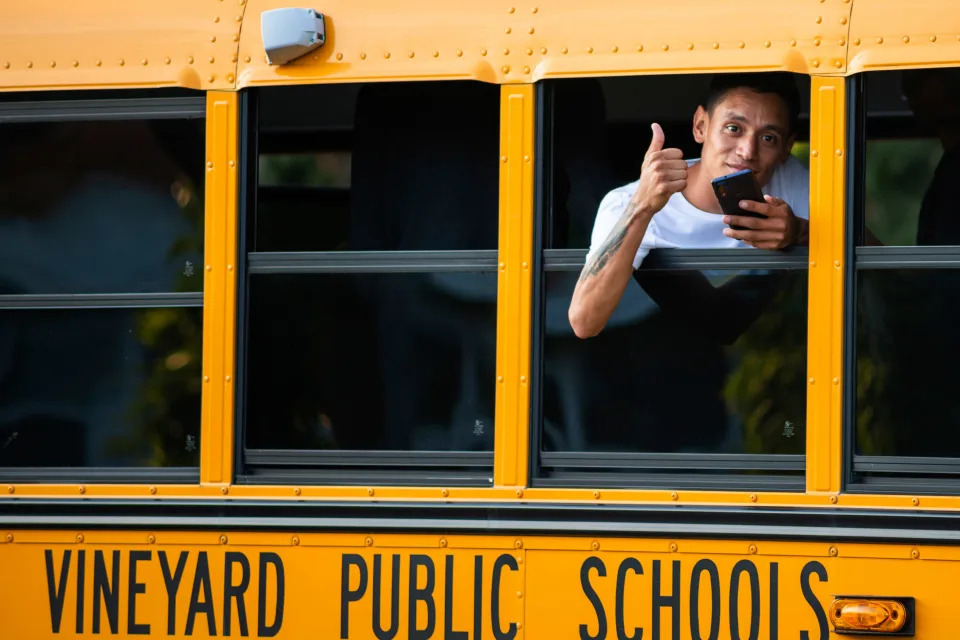
A man, who is part of a group of migrants that had just arrived, flashes a thumbs-upy Sept. 14, 2022, in Edgartown, Mass., on Martha’s Vineyard.
‘A Crisis Coming’: The Twin Threats to American Democracy
David Leonhardt – September 17, 2022
The United States faces two distinct challenges, the movement by Republicans who refuse to accept defeat in an election and a growing disconnect between political power and public opinion. (Matt Chase/The New York Times)
The United States has experienced deep political turmoil several times before over the past century. The Great Depression caused Americans to doubt the country’s economic system. World War II and the Cold War presented threats from global totalitarian movements. The 1960s and ’70s were marred by assassinations, riots, a losing war and a disgraced president.
These earlier periods were each more alarming in some ways than anything that has happened in the United States recently. Yet during each of those previous times of tumult, the basic dynamics of American democracy held firm. Candidates who won the most votes were able to take power and attempt to address the country’s problems.
The current period is different. As a result, the United States today finds itself in a situation with little historical precedent. American democracy is facing two distinct threats, which together represent the most serious challenge to the country’s governing ideals in decades.
The first threat is acute: a growing movement inside one of the country’s two major parties — the Republican Party — to refuse to accept defeat in an election.
The violent Jan. 6, 2021, attack on Congress, meant to prevent the certification of President Joe Biden’s election, was the clearest manifestation of this movement, but it has continued since then. Hundreds of elected Republican officials around the country falsely claim that the 2020 election was rigged. Some of them are running for statewide offices that would oversee future elections, potentially putting them in position to overturn an election in 2024 or beyond.
“There is the possibility, for the first time in American history, that a legitimately elected president will not be able to take office,” said Yascha Mounk, a political scientist at Johns Hopkins University who studies democracy.
The second threat to democracy is chronic but also growing: The power to set government policy is becoming increasingly disconnected from public opinion.
The run of recent Supreme Court decisions — both sweeping and, according to polls, unpopular — highlights this disconnect. Although the Democratic Party has won the popular vote in seven of the past eight presidential elections, a Supreme Court dominated by Republican appointees seems poised to shape American politics for years, if not decades. And the court is only one of the means through which policy outcomes are becoming less closely tied to the popular will.
Two of the past four presidents have taken office despite losing the popular vote. Senators representing a majority of Americans are often unable to pass bills, partly because of the increasing use of the filibuster. Even the House, intended as the branch of the government that most reflects the popular will, does not always do so because of the way districts are drawn.
“We are far and away the most countermajoritarian democracy in the world,” said Steven Levitsky, a professor of government at Harvard University and a co-author of the book “How Democracies Die,” with Daniel Ziblatt.
The causes of the twin threats to democracy are complex and debated among scholars.
The chronic threats to democracy generally spring from enduring features of American government, some written into the Constitution. But they did not conflict with majority opinion to the same degree in past decades. One reason is that more populous states, whose residents receive less power because of the Senate and the Electoral College, have grown so much larger than small states.
The acute threats to democracy — and the rise of authoritarian sentiment, or at least the acceptance of it, among many voters — have different causes. They partly reflect frustration over nearly a half-century of slow-growing living standards for the American working class and middle class. They also reflect cultural fears, especially among white people, that the United States is being transformed into a new country, more racially diverse and less religious, with rapidly changing attitudes toward gender, language and more.
The economic frustrations and cultural fears have combined to create a chasm in American political life between prosperous, diverse major metropolitan areas and more traditional, religious and economically struggling smaller cities and rural areas. The first category is increasingly liberal and Democratic, the second increasingly conservative and Republican.
The political contest between the two can feel existential to people in both camps, with disagreements over nearly every prominent issue. “When we’re voting, we’re not just voting for a set of policies but for what we think makes us Americans and who we are as a people,” said Lilliana Mason, a political scientist and the author of “Uncivil Agreement: How Politics Became Our Identity.” “If our party loses the election, then all of these parts of us feel like losers.”
These sharp disagreements have led many Americans to doubt the country’s system of government. In a recent poll by Quinnipiac University, 69% of Democrats and 69% of Republicans said that democracy was “in danger of collapse.” Of course, the two sides have very different opinions about the nature of the threat.
Many Democrats share the concerns of historians and scholars who study democracy, pointing to the possibility of overturned election results and the deterioration of majority rule. “Equality and democracy are under assault,” Biden said in a speech this month in front of Independence Hall in Philadelphia. “We do ourselves no favor to pretend otherwise.”
Many Republicans have defended their increasingly aggressive tactics by saying they are trying to protect American values. In some cases, these claims rely on falsehoods — about election fraud, Biden’s supposed “socialism,” Barack Obama’s birthplace and more.
In others, they are rooted in anxiety over real developments, including illegal immigration and “cancel culture.” Some on the left now consider widely held opinions among conservative and moderate Americans — on abortion, policing, affirmative action, COVID-19 and other subjects — to be so objectionable that they cannot be debated. In the view of many conservatives and some experts, this intolerance is stifling open debate at the heart of the American political system.
The divergent sense of crisis on left and right can itself weaken democracy, and it has been exacerbated by technology.
Conspiracy theories and outright lies have a long American history, dating to the personal attacks that were a staple of the partisan press during the 18th century. In the mid-20th century, tens of thousands of Americans joined the John Birch Society, a far-right group that claimed Dwight Eisenhower was a secret communist.
Today, however, falsehoods can spread much more easily, through social media and a fractured news environment. In the 1950s, no major television network spread the lies about Eisenhower. In recent years, the country’s most watched cable channel, Fox News, regularly promoted falsehoods about election results, Obama’s birthplace and other subjects.
These same forces — digital media, cultural change and economic stagnation in affluent countries — help explain why democracy is also struggling in other parts of the world. Only two decades ago, at the turn of the 21st century, democracy was the triumphant form of government around the world, with autocracy in retreat in the former Soviet empire, Argentina, Brazil, Chile, South Africa, South Korea and elsewhere. Today, the global trend is moving in the other direction.
In the late 1990s, 72 countries were democratizing, and only three were growing more authoritarian, according to data from V-Dem, a Swedish institute that monitors democracy. Last year, only 15 countries grew more democratic, while 33 slid toward authoritarianism.
Some experts remain hopeful that the growing attention in the United States to democracy’s problems can help avert a constitutional crisis here. Already, Donald Trump’s efforts to overturn the 2020 election failed, partly because of the refusal of many Republican officials to participate, and both federal and state prosecutors are investigating his actions. And while the chronic decline of majority rule will not change anytime soon, it is also part of a larger historical struggle to create a more inclusive American democracy.
Still, many experts point out that it still not clear how the country will escape a larger crisis, such as an overturned election, at some point in the coming decade. “This is not politics as usual,” said Carol Anderson, a professor at Emory University and the author of the book, “One Person, No Vote,” about voter suppression. “Be afraid.”
The Will of the Majority
The founders did not design the United States to be a pure democracy.
They distrusted the classical notion of direct democracy, in which a community came together to vote on each important issue, and believed it would be impractical for a large country. They did not consider many residents of the new country to be citizens who deserved a voice in political affairs, including Natives, enslaved Africans and women. The founders also wanted to constrain the national government from being too powerful, as they believed was the case in Britain. And they had the practical problem of needing to persuade 13 states to forfeit some of their power to a new federal government.
Instead of a direct democracy, the founders created a republic, with elected representatives to make decisions, and a multilayered government in which different branches checked one another. The Constitution also created the Senate, where every state had an equal say regardless of population.
Pointing to this history, some Republican politicians and conservative activists have argued that the founders were comfortable with minority rule. “Of course we’re not a democracy,” Sen. Mike Lee, R-Utah, has written.
But the historical evidence suggests that the founders believed that majority will — defined as the prevailing view of enfranchised citizens — should generally dictate national policy, as George Thomas of Claremont McKenna College and other constitutional scholars have explained.
In the Federalist Papers, James Madison equated “a coalition of a majority of the whole society” with “justice and the general good.” Alexander Hamilton made similar points, describing “representative democracy” as “happy, regular and durable.” It was a radical idea at the time.
For most of American history, the idea has prevailed. Even with the existence of the Senate, the Electoral College and the Supreme Court, political power has reflected the views of people who had the right to vote. “To say we’re a republic not a democracy ignores the past 250 years of history,” Ziblatt, a political scientist at Harvard University, said.
Before 2000, only three candidates won the presidency while losing the popular vote (John Quincy Adams, Rutherford Hayes and Benjamin Harrison), and each served only a single term. During the same period, parties that won repeated elections were able to govern, including the Democratic-Republican Party of Thomas Jefferson’s time, the New Deal Democrats and the Reagan Republicans.
The situation has changed in the 21st century. The Democratic Party is in the midst of a historic winning streak. In seven of the past eight presidential elections, stretching back to Bill Clinton’s 1992 victory, the Democratic nominee has won the popular vote. Over more than two centuries of American democracy, no party has previously fared so well over such an extended period.
Yet the current period is hardly a dominant Democratic age.
What changed? One crucial factor is that, in the past, the parts of the country granted outsize power by the Constitution — less populated states, which tend to be more rural — voted in broadly similar ways as large states and urban areas.
This similarity meant that the small-state bonus in the Senate and Electoral College had only a limited effect on national results. Both Democrats and Republicans benefited and suffered from the Constitution’s undemocratic features.
Democrats sometimes won small states like Idaho, Montana, Utah and Wyoming in the mid-20th century. And California was long a swing state: Between the Great Depression and 2000, Democratic and Republican presidential candidates won it an equal number of times. That the Constitution conferred advantages on residents of small states and disadvantages on Californians did not reliably boost either party.
In recent decades, Americans have increasingly sorted themselves along ideological lines. Liberals have flocked to large metropolitan areas, which are heavily concentrated in big states like California, while residents of smaller cities and more rural areas have become more conservative.
This combination — the Constitution’s structure and the country’s geographic sorting — has created a disconnect between public opinion and election outcomes. It has affected every branch of the federal government: the presidency, Congress and even the Supreme Court.
In the past, “the system was still anti-democratic, but it didn’t have a partisan effect,” Levitsky said. “Now it’s undemocratic and has a partisan effect. It tilts the playing field toward the Republican Party. That’s new in the 21st century.”
In presidential elections, the small-state bias is important, but it is not even the main issue. A subtler factor — the winner-take-all nature of the Electoral College in most states — is. Candidates have never received extra credit for winning state-level landslides. But this feature did not used to matter very much, because landslides were rare in larger states, meaning that relatively few votes were “wasted,” as political scientists say.
Today, Democrats dominate a handful of large states, wasting many votes. In 2020, Biden won California by 29 percentage points; New York by 23 points; and Illinois by 17 points. Four years earlier, Hillary Rodham Clinton’s margins were similar.
This shift means that millions of voters in large metropolitan areas have moved away from the Republican Party without having any impact on presidential outcomes. That’s a central reason that both George W. Bush and Trump were able to win the presidency while losing the popular vote.
“We’re in a very different world today than when the system was designed,” said Mindy Romero, director of the Center for Inclusive Democracy at the University of Southern California. “The dynamic of being pushed aside is more obvious and I think more frustrating.”
Republicans sometimes point out that the system prevents a few highly populated states from dominating the country’s politics, which is true. But the flip is also true: The Constitution gives special privileges to the residents of small states. In presidential elections, many voters in large states have become irrelevant in a way that has no historical antecedent.
The Curse of Geographic Sorting
The country’s changing population patterns may have had an even bigger effect on Congress — especially the Senate — and the Supreme Court than the presidency.
The sorting of liberals into large metropolitan areas and conservatives into more rural areas is only one reason. Another is that large states have grown much more quickly than small states. In 1790, the largest state (Virginia) had about 13 times as many residents as the smallest (Delaware). Today, California has 68 times as many residents as Wyoming, 53 times as many as Alaska and at least 20 times as many as another 11 states.
Together, these trends mean that the Senate has a heavily pro-Republican bias that will last for the foreseeable future.
The Senate today is split 50-50 between the two parties. But the 50 Democratic senators effectively represent 186 million Americans, while the 50 Republican senators effectively represent 145 million. To win Senate control, Democrats need to win substantially more than half of the nationwide votes in Senate elections.
This situation has led to racial inequality in political representation. The residents of small states, granted extra influence by the Constitution, are disproportionately white, while large states are home to many more Asian American, Black and Latino voters.
In addition, two parts of the country that are disproportionately Black or Latino — Washington, D.C., and Puerto Rico — have no Senate representation. Washington has more residents than Vermont or Wyoming, and Puerto Rico has more residents than 20 states. As a result, the Senate gives a political voice to white Americans that is greater than their numbers.
The House of Representatives has a more equitable system for allocating political power. It divides the country into 435 districts, each with a broadly similar number of people (currently about 760,000). Still, House districts have two features that can cause the chamber’s makeup not to reflect national opinion, and both of them have become more significant in recent years.
The first is well known: gerrymandering. State legislatures often draw district boundaries and in recent years have become more aggressive about drawing them in partisan ways. In Illinois, for example, the Democrats who control the state government have packed Republican voters into a small number of House districts, allowing most other districts to lean Democratic. In Wisconsin, Republicans have done the opposite.
Because Republicans have been more forceful about gerrymandering than Democrats, the current House map slightly favors Republicans, likely by a few seats. At the state level, Republicans have been even bolder. Gerrymandering has helped them dominate the state legislatures in Michigan, North Carolina and Ohio, even though the states are closely divided.
Still, gerrymandering is not the only reason that House membership has become less reflective of national opinion in recent years. It may not even be the biggest reason, according to Jonathan A. Rodden, a political scientist at Stanford University. Geographic sorting is.
“Without a doubt, gerrymandering makes things worse for the Democrats,” Rodden has written, “but their underlying problem can be summed up with the old real estate maxim: location, location, location.” The increasing concentration of Democratic voters into large metro areas means that even a neutral system would have a hard time distributing these tightly packed Democratic voters across districts in a way that would allow the party to win more elections.
Instead, Democrats now win many House elections in urban areas by landslides, wasting many votes. In 2020, only 21 Republican House candidates won their elections by at least 50 percentage points; 47 Democrats did.
Looking at where many of these elections occurred helps make Rodden’s point. The landslide winners included Rep. Diana DeGette in Denver; Rep. Jerry Nadler in New York City; Rep. Jesús García in Chicago; Rep. Donald Payne Jr. in northern New Jersey; and Rep. Barbara Lee in Oakland, California. None of those districts are in states where Republicans have controlled the legislative boundaries, which means that they were not the result of Republican gerrymandering.
Again and again, geographic sorting has helped cause a growing disconnect between public opinion and election results, and this disconnect has shaped the Supreme Court as well. The court’s membership at any given time is dictated by the outcomes of presidential and Senate elections over the previous few decades. And if elections reflected popular opinion, Democratic appointees would dominate the court.
Every current justice has been appointed during one of the past nine presidential terms, and a Democrat has won the popular vote in seven of those nine and the presidency in five of the nine. Yet the court is now dominated by a conservative, six-member majority.
There are multiple reasons (including Ruth Bader Ginsburg’s decision not to retire in 2014 when a Democratic president and Senate could have replaced her). But the increasingly undemocratic nature of both the Electoral College and Senate play crucial roles.
Trump was able to appoint three justices despite losing the popular vote. (Bush is a more complex case, having made his court appointments after he won reelection and the popular vote in 2004.) Similarly, if Senate seats were based on population, none of Trump’s nominees — Justices Neil Gorsuch, Brett Kavanaugh and Amy Coney Barrett — would likely have been confirmed, said Michael J. Klarman, a law professor at Harvard. Senate Republicans also would not have been able to block Obama from filling a court seat during his final year in office.
Even Justice Clarence Thomas’ 1991 confirmation relied on the Senate’s structure: The 52 senators who voted to confirm him represented a minority of Americans.
The current court’s approach has magnified the disconnect between public opinion and government policy, because Republican-appointed justices have overruled Congress on some major issues. The list includes bills on voting rights and campaign finance that earlier Congresses passed along bipartisan lines. This term, the court issued rulings on abortion, climate policy and gun laws that seemed to be inconsistent with majority opinion, based on polls.
“The Republican justices wouldn’t say this and may not believe it,” Klarman said, “but everything they’ve done translates into a direct advantage for the Republican Party.”
In response to the voting rights decision, in 2013, Republican legislators in several states have passed laws making it more difficult to vote, especially in heavily Democratic areas. They have done so citing the need to protect election security, even though there has been no widespread fraud in recent years.
For now, the electoral effect of these decisions remains uncertain. Some analysts point out that the restrictions have not yet been onerous enough to hold down turnout. In the 2020 presidential election, the percentage of eligible Americans who voted reached the highest level in at least a century.
Other experts remain concerned that the new laws could ultimately swing a close election in a swing state. “When you have one side gearing up to say, ‘How do we stop the enemy from voting?’ that is dangerous to a democracy,” Anderson, the Emory professor, said.
An upcoming Supreme Court case may also allow state legislatures to impose even more voting restrictions. The court has agreed to hear a case in which Republican legislators in North Carolina argue that the Constitution gives them, and not state courts, the authority to oversee federal elections.
In recent years, state courts played an important role in constraining both Republican and Democratic legislators who tried to draw gerrymandered districts that strongly benefited one party. If the Supreme Court sides with the North Carolina legislature, gerrymandering might increase, as might laws establishing new barriers to voting.
Amplifying the Election Lies
If the only challenges to democracy involved these chronic, long-developing forces, many experts would be less concerned than they are. American democracy has always been flawed, after all.
But the slow-building ways in which majority rule is being undermined are happening at the same time that the country faces an immediate threat that has little precedent. A growing number of Republican officials are questioning a basic premise of democracy: that the losers of an election are willing to accept defeat.
The roots of the modern election-denier movement stretch back to 2008. When Obama was running for president and after he won, some of his critics falsely claimed that his victory was illegitimate because he was born in Kenya rather than Hawaii. This movement became known as birtherism, and Trump was among its proponents. By making the claims on Fox News and elsewhere, he helped transform himself from a reality television star into a political figure.
When he ran for president himself in 2016, Trump made false claims about election fraud central to his campaign. In the Republican primaries, he accused his closest competitor for the nomination, Sen. Ted Cruz, of cheating. In the general election against Hillary Clinton, Trump said he would accept the outcome only if he won. In 2020, after Biden won, the election lies became Trump’s dominant political message.
His embrace of these lies was starkly different from the approach of past leaders from both parties. In the 1960s, Ronald Reagan and Barry Goldwater ultimately isolated the conspiracists of the John Birch Society. In 2000, Al Gore urged his supporters to accept George W. Bush’s razor-thin victory, much as Richard Nixon had encouraged his supporters to do so after he narrowly lost to John F. Kennedy in 1960. In 2008, when a Republican voter at a rally described Obama as an Arab, Sen. John McCain, the Republican nominee and Obama’s opponent, corrected her.
Trump’s promotion of the falsehoods, by contrast, turned them into a central part of the Republican Party’s message. About two-thirds of Republican voters say that Biden did not win the 2020 election legitimately, according to polls. Among Republican candidates running for statewide office this year, 47% have refused to accept the 2020 result, according to a FiveThirtyEight analysis.
Most Republican politicians who have confronted Trump, on the other hand, have since lost their jobs or soon will. Of the 10 House Republicans who voted to impeach him for his role in the Jan. 6 attack, for example, eight have since decided to retire or lost Republican primaries, including Rep. Liz Cheney of Wyoming.
“By any indication, the Republican Party — upper-level, midlevel and grassroots — is a party that can only be described as not committed to democracy,” Levitsky said. He added that he was significantly more concerned about American democracy than when his and Ziblatt’s book, “How Democracies Die,” came out in 2018.
Juan José Linz, a political scientist who died in 2013, coined the term “semi-loyal actors” to describe political officials who typically do not initiate attacks on democratic rules or institutions but who also do not attempt to stop these attacks. Through their complicity, these semi-loyal actors can cause a party and a country to slide toward authoritarianism.
That’s what happened in Europe in the 1930s and in Latin America in the 1960s and ’70s. More recently, it has happened in Hungary. Now there are similar signs in the United States.
Often, even Republicans who cast themselves as different from Trump include winking references to his conspiracy theories in their campaigns, saying that they, too, believe “election integrity” is a major problem. Gov. Glenn Youngkin of Virginia and Gov. Ron DeSantis of Florida, for example, have both recently campaigned on behalf of election deniers.
In Congress, Republican leaders have largely stopped criticizing the violent attack on the Capitol. Rep. Kevin McCarthy, the Republican House leader, has gone so far as to signal his support for colleagues — like Rep. Marjorie Taylor Greene, R-Ga. — who have used violent imagery in public comments. Greene, before being elected to Congress, said that she supported the idea of executing prominent Democrats.
“When mainstream parties tolerate these guys, make excuses for them, protect them, that’s when democracy gets in trouble,” Levitsky said. “There have always been Marjorie Taylor Greenes. What I pay closer attention to is the behavior of the Kevin McCarthys.”
The party’s growing acceptance of election lies raises the question of what would happen if Trump or another future presidential nominee tried to replay his 2016 attempt to overturn the result.
In 11 states this year, the Republican nominee for secretary of state, a position that typically oversees election administration, qualifies as an “election denier,” according to States United Action, a research group. In 15 states, the nominee for governor is a denier, and in 10 states, the attorney general nominee is.
The growth of the election-denier movement has created a possibility that would have seemed unthinkable not so long ago. It remains unclear whether the loser of the next presidential election will concede or will instead try to overturn the outcome.
‘There Is a Crisis Coming’
There are still many scenarios in which the United States will avoid a democratic crisis.
In 2024, Biden could win reelection by a wide margin — or a Republican other than Trump could win by a wide margin. Trump might then fade from the political scene, and his successors might choose not to embrace election falsehoods. The era of Republican election denial could prove to be brief.
It is also possible that Trump or another Republican nominee will try to reverse a close defeat in 2024 but will fail, as happened in 2020. Then, Brad Raffensperger, Georgia’s Republican secretary of state, rebuffed Trump after he directed him to “find 11,780 votes,” and the Supreme Court refused to intervene as well. More broadly, Mitch McConnell, the Republican leader in the Senate, recently said that the United States had “very little voter fraud.”
If a Republican were again to try to overturn the election and to fail, the movement might also begin to fade. But many democracy experts worry that these scenarios may be wishful thinking.
Trump’s most likely successors as party leader also make or tolerate false claims about election fraud. The movement is bigger than one person and arguably always has been; some of the efforts to make voting more onerous, which are generally justified with false suggestions of widespread voter fraud, predated Trump’s 2016 candidacy.
To believe that Republicans will not overturn a close presidential loss in coming years seems to depend on ignoring the public positions of many Republican politicians. “The scenarios by which we don’t have a major democracy crisis by the end of the decade seem rather narrow,” Mounk of Johns Hopkins said.
And Levitsky said, “It’s not clear how the crisis is going to manifest itself, but there is a crisis coming.” He added, “We should be very worried.”
The most promising strategy for avoiding an overturned election, many scholars say, involves a broad ideological coalition that isolates election deniers. But it remains unclear how many Republican politicians would be willing to join such a coalition.
It is also unclear whether Democratic politicians and voters are interested in making the compromises that would help them attract more voters. Many Democrats have instead embraced a purer version of liberalism in recent years, especially on social issues. This shift to the left has not prevented the party from winning the popular vote in presidential elections, but it has hurt Democrats outside of major metropolitan areas and, by extension, in the Electoral College and congressional elections.
If Democrats did control both the White House and Congress — and by more than a single vote, as they now do in the Senate — they have signaled that they would attempt to pass legislation to address both the chronic and acute threats to democracy.
The House last year passed a bill to protect voting rights and restrict gerrymandering. It died in the Senate partly because it included measures that even some moderate Democrats believed went too far, such as restrictions on voter identification laws, which many other democracies around the world have.
The House also passed a bill to grant statehood to Washington, D.C., which would reduce the Senate’s current bias against metropolitan areas and Black Americans. The United States is currently in its longest stretch without having admitted a new state.
Democracy experts have also pointed to other possible solutions to the growing disconnect between public opinion and government policy. Among them is an expansion of the number of members in the House of Representatives, which the Constitution allows Congress to do — and which it regularly did until the early 20th century. A larger House would create smaller districts, which in turn could reduce the share of uncompetitive districts.
Other scholars favor proposals to limit the Supreme Court’s authority, which the Constitution also allows and which previous presidents and Congresses have done.
In the short term, these proposals would generally help the Democratic Party, because the current threats to majority rule have mostly benefited the Republican Party. In the long term, however, the partisan effects of such changes are less clear.
The history of new states makes this point: In the 1950s, Republicans initially supported making Hawaii a state because it seemed to lean Republican, while Democrats said that Alaska had to be included, too, also for partisan reasons. Today, Hawaii is a strongly Democratic state, and Alaska is a strongly Republican one. Either way, the fact that both are states has made the country more democratic.
Over the sweep of history, the American government has tended to become more democratic, through women’s suffrage, civil rights laws, the direct election of senators and more. The exceptions, like the post-Reconstruction period, when Black Southerners lost rights, have been rare. The current period is so striking partly because it is one of those exceptions.
“The point is not that American democracy is worse than it was in the past,” Mounk said. “Throughout American history, the exclusion of minority groups, and African Americans in particular, was much worse than it is now.
“But the nature of the threat is very different than in the past,” he said.
The makeup of the federal government reflects public opinion less closely than it once did. And the chance of a true constitutional crisis — in which the rightful winner of an election cannot take office — has risen substantially. That combination shows that American democracy has never faced a threat quite like the current one.
Trevor Noah Dismantles Racist Response to ‘The Little Mermaid’ Trailer: ‘Really, People? We’re Doing This Again?’
Adam Chitwood – September 16, 2022
Trevor Noah took aim at the racist backlash to Disney’s live-action “The Little Mermaid” trailer on Thursday’s “The Daily Show,” wondering why we’re all doing this again.
Shortly after racist backlash to people of color playing elves and dwarves in Amazon’s “The Lord of the Rings: The Rings of Power” series, Disney debuted the first trailer for “The Little Mermaid” that revealed Black actress playing Ariel. Racists on the internet, predictably, were extremely Mad Online.
“Once again a bunch of internet racists are upset that a fictional character is being played by a Black person, and honestly I don’t know what the big deal is,” Noah said before joking, “You guys realize that Nemo was Black too, right? Yeah, that whole movie was about a fish that can’t find his dad. Calm down, I can say that because my dad left and he’s white, so who’s racist now?”
The jokes continued, “First of all, of course the Little Mermaid is Black. Everyone whose name starts with Lil’ is Black. Lil’ Wayne, Lil’ Nas X, Lil’ Kim. Honestly if you heard there was a woman named Lil’ Mermaid you’d just assume she was on a track with Cardi B.”
But then Noah launched into another joke with a stinging twinge of truth to it.
“Stop being ridiculous. It’s imaginary,” he began. “I hope this scandal doesn’t overshadow the rest of the movie. ‘The Little Mermaid’ is a beautiful story about a young woman changing her core identity to please a man, let’s not forget about that, people.”
Noah concluded the segment by underlining the ridiculousness of the whole backlash and also pointing out that Disney introduced a Black mermaid in the animated “Little Mermaid” series that aired from 1992 to 1994 and nobody batted an eye.
“If we had more time we could talk about how Disney already created a Black mermaid 30 years ago and nobody cared, or how there’s still plenty of white princesses for little girls whose dream it is to be in a monarchy. And let’s not forget, you can still watch the original ‘Little Mermaid.’ It’s not like if you try to turn it on Mickey’s gonna jump out of the screen and go, ‘You’re racist, haha!’”
Watch Noah’s segment in the video above. Disney’s “The Little Mermaid” opens in theaters on May 26, 2023.
Vindman: Trump’s “corrupt scheme” had direct tie-in to Russian invasion of Ukraine
Elizabeth Regan, The Day, New London, Conn. – September 16, 2022
Sep. 16—NEW LONDON — Retired U.S. Army Lt. Col. Alexander Vindman on Thursday evening told a receptive audience at Connecticut College that the “corrupt scheme” precipitating the first impeachment of then- President Donald Trump had a “direct tie-in” to the invasion of Ukraine.
Touted by the college as a preeminent expert on the ongoing Russia-Ukraine conflict and its impact on the global economy, Vindman took the stage to a standing ovation from the roughly 500 people in attendance.
The decorated officer’s appearance was part of a series bringing national figures to Connecticut College each fall. It was sponsored by the Sound Lab Foundation and Friends of the Connecticut College Library.
Vindman, who gained prominence for bringing attention to Trump’s efforts to get Ukraine President Volodymyr Zelenskyy to investigate Joe Biden and his family, said the plan showed Russian President Vladimir Putin the vulnerabilities in the relationship between the US and Ukraine.
“The president was offering a clear signal that personal interests were to be placed above national security interests,’ he said. “And there was an opportunity to take care of something that Putin has been wanting to solve for a very very long time, which is deal with a Ukraine that was instrumental in the collapse of the Soviet Union.”
He said Ukraine’s vote for independence in 1991 “put the nail in the coffin of the Soviet Union.”
Vindman, who was born in what was then the Ukrainian Soviet Socialist Republic and came to the U.S. as a 3-year-old, is an Iraq War combat veteran and Purple Heart recipient. He served in the U.S. embassies in Kyiv and Moscow before accepting an assignment in 2018 with the National Security Council.
Vindman walked into international spotlight the following year amid the allegations Trump was trying to influence Zelenskyy. He testified at Trump’s first impeachment inquiry that he was concerned by Trump’s July 25, 2019 phone call with Zelenskyy and reported his concerns to the NSC’s legal counsel, saying he “did not think it was proper to demand that a foreign government investigate a U.S. citizen.”
Trump ousted Vindman in February 2020, and Vindman retired from the Army that July with 21 years of military service.
The retired lieutenant colonel in February filed a federal lawsuit against Donald Trump Jr., Rudy Giuliani and two former White House staff members for allegedly intimidating and retaliating against him for testifying in the first impeachment of Trump.
Vindman said Biden’s administration has also made mistakes in its messaging to Russia. He said Biden’s public announcement that there would not be any American boots on the ground in Ukraine further emboldened a president who’d been enabled for more than two decades by global inaction.
“To Putin, it was a green light,” he said.
Vindman suggested Biden should have employed “strategic ambiguity” instead. Just because a principal is right doesn’t mean it needs to be stated, he said; it’s better to leave the opponent wondering what the plan is.
Asked during a question-and-answer session if he has any plans to run for elected office, Vindman was strategically ambiguous.
He is now a senior advisor for VoteVets, a Ph.D. student and fellow at the Johns Hopkins School of Advanced International Studies, and a board member of the nonprofit Renew Democracy Initiative.
Trump warns of ‘problems’ like ‘we’ve never seen’ if he’s indicted
Myah Ward and Andrew Desiderio– September 15, 2022
Mary Altaffer/AP Photo
Former President Donald Trump said Thursday the nation would face “problems … the likes of which perhaps we’ve never seen” if he is indicted over his handling of classified documents after leaving office, an apparent suggestion that such a move by the Justice Department could spark violence from Trump’s supporters.
The former president said an indictment wouldn’t stop him from running for the White House again and repeatedly said Americans “would not stand” for his prosecution.
“If a thing like that happened, I would have no prohibition against running,” Trump said in an interview with conservative talk radio host Hugh Hewitt. “I think if it happened, I think you’d have problems in this country the likes of which perhaps we’ve never seen before. I don’t think the people of the United States would stand for it.”
Hewitt asked Trump what he meant by “problems.”
“I think they’d have big problems. Big problems. I just don’t think they’d stand for it. They will not sit still and stand for this ultimate of hoaxes,” Trump said.
It’s not the first time Republicans have hinted at potential civil unrest if the DOJ indicts Trump. Republican Sen. Lindsey Graham made headlines last month when he said there would be “riots in the street” if “there is a prosecution of Donald Trump for mishandling classified information.” Graham’s comments were slammed as “irresponsible” and “shameful.” White House press secretary Karine Jean-Pierre, without naming the South Carolina senator, said these comments from “extreme Republicans” were “dangerous.”
Hewitt appeared to see Trump’s comments as a nod toward potential unrest, asking the former president how he would respond when the “legacy media” accuses him of inciting violence.
“That’s not inciting. I’m just saying what my opinion is,” Trump said. “I don’t think the people of this country would stand for it.”
On Capitol Hill, senior FBI and DHS officials briefed members of the Senate Judiciary and Homeland Security committees Thursday on the uptick in threats against federal law enforcement in the aftermath of the Mar-a-Lago search. Senators said the briefers didn’t specifically pinpoint a politician or political party when it comes to the threats, but they said the trend was clear.
“It was stunning the number of threats that have been cataloged since the Aug. 8 search of Mar-a-Lago,” Senate Judiciary Chair Dick Durbin (D-Ill.) said after the briefing, specifically mentioning the gunman who tried to enter an FBI building in Cincinnati, Ohio, in the days following the search. “It’s a much more dangerous environment because of the political statements made by some individuals since Aug. 8 — it’s alarming to me.”
Durbin said the threats ranged from explicit and specific to more generalized ones, most notably on social media. He also called out Trump for his rhetoric.
“Inviting a mob to return to the streets is exactly what happened here on Jan. 6, 2021. This president knew what he was doing…and we saw the results,” Durbin added. “His careless, inflammatory rhetoric has its consequences.”
Sen. Rick Scott (R-Fla.), a Trump ally and member of the Homeland Security Committee, said after the briefing that the Justice Department needed to be more transparent about the justification for the search in order to push back against “conspiracies.”
“You have to give people good information so these rumors don’t continue,” Scott said, condemning attacks on law enforcement. “I don’t know why they raided the former president’s house … They know the conspiracy theories that are out there. So convince people that they’re not true.”
The FBI search of Trump’s Mar-a-Lago residence in Florida sparked a political firestorm last month. According to a Justice Department court filing released in August, prosecutors obtained a search warrant for the estate after receiving evidence there was “likely” an effort to conceal classified documents at the residence in defiance of a grand jury subpoena. Agents recovered highly classified records mixed among personal items, in addition to dozens of empty folders with classified markings.
The DOJ and Trump’s lawyers are now in the midst of legal deliberations on an outside review of the seized documents.
Graham, one of Trump’s staunchest Capitol Hill allies, echoed concerns that the Justice Department may have overstepped in its dealings with the former president. But he left open the possibility that the department’s probe could uncover material that might justify an indictment.
“There’s a belief from many on the right that the DOJ and the FBI have been less than unbiased when it comes to Trump. But having said that, nobody’s above the law including the president, but the law’s gonna be about politics,” Graham said. “So let’s wait and see what they find. I’ve got an open mind about what they find, but they need to have something that would justify what I think is political escalation.”
Speaking with Hewitt on Thursday, Trump continued to use the defense that he “declassified” everything he took to Mar-a-Lago, a claim his legal team has thus far declined to make in court.
Rhetoric that could be seen as alluding to violence is not out of character for Trump. In his speech on Jan. 6, 2021, to supporters before rioters stormed the Capitol in an effort to block the certification of President Joe Biden’s Electoral College victory, the then-president told the crowd to “fight much harder” against “bad people” and to “show strength.” His comments that day have been a focal point of Jan. 6 select committee’s investigation into the president and his inner circle, with investigators using one of their summer hearings to make the case that Trump’s efforts to hold on to power resonated with extremist groups and brought them to the Capitol.


 Scroll back up to restore default view.