Ex-Trump aide inspired to testify after reading Watergate book – Jan. 6 recap

USA Today

Ex-Trump aide inspired to testify after reading Watergate book – Jan. 6 recap

Bart Jansen, Ella Lee, Donovan Slack, Swapna Venugopal Ramaswamy, Josh Meyer and Ken Tran, USA TODAY – December 22, 2022

WASHINGTON – The waiting game resumes Thursday for the final report of the House committee that investigated the Capitol attack on Jan. 6, 2021, after a delay from Wednesday for the visit of Ukrainian President Volodymyr Zelenskyy and unspecified logistical hurdles.

However, the committee released files from dozens of witnesses it interviewed, though some of the documents remain sealed.

The report culminates an 18-month inquiry into the worst attack on the Capitol since 1814, with recommendations for legislation to prevent another attack. Republicans who will take control of the chamber in January labeled the panel partisan and illegitimate, so the report will be the panel’s final pitch in the court of public opinion.

Here is what we know so far:

  • Publix heiress Julie Fancelli was prepared to contribute as much as $3 million to a rally on Jan. 6, 2021 that organizers were calling the “Million MAGA March,” according to interview transcripts.
  • John Matze, a co-founder and former CEO of the alternative social media platform Parler, faced questioning by the committee on the platform’s efforts to moderate violent rhetoric before and after the Jan. 6, 2021 riot.
  • Nick Fuentes’ lawyer told the panel in February that Fuentes had been notified he was “a subject and possibly a target” of an investigation by the U.S. attorney for the District of Columbia.

The latest on the report and the files:

Cassidy Hutchinson felt inspired to testify after reading book on Watergate

After transcripts of Cassidy Hutchinson’s initial testimony to the committee investigating the Jan. 6, 2021 Capitol attack, in which she answered “I don’t recall” to several of the committee’s questions, she said she felt an internal dilemma.

She ordered two copies of a book detailing the Watergate scandal and the involvement of Alexander Butterfield, deputy assistant to former President Richard Nixon. Butterfield delivered blockbuster testimony to the Senate Watergate committee at the time, revealing the White House’s taping system.

After she read the book, Hutchinson said she found inspiration in Butterfield. “And I wasn’t by no means trying to compare what I knew to what Butterfield knew at all.” Hutchinson said.

“And it was after I read this I was like, if I’m going to pass the mirror test for the rest of my life, I need to try to fix some of this,” Hutchinson told the committee.

– Ken Tran

Cassidy Hutchinson scheduled an interview with the committee without lawyer’s knowledge

After her first interview with the House committee investigating the Jan. 6, 2021, Capitol attack, Cassidy Hutchinson said she felt guilty and thought she had more information to offer to the committee, but with “Trump world” attorney Stefan Passantino serving as her lawyer, she didn’t know how to schedule another interview without him knowing.

Hutchinson sought advice from another former White House aide, Alyssa Farah Griffin. The two decided on a plan for Farah Griffin to serve as a backchannel to the committee and provide them information on what to ask Hutchinson – without Passantino’s knowledge.

“I think that I can do this as long as like the committee thinks that they can really keep this low key and low profile and not let Stefan know that I’m back channeling for this interview,” Hutchinson told Farah Griffin, to which she agreed.

The committee’s request for another interview caught Passantino off guard and he was “genuinely shocked,” Hutchinson said. During breaks in the interview, Passantino asked Hutchinson, “How do they have all of this? How do they know that you know all of this?”

– Ken Tran

‘He knows you’re loyal’: Meadows aide called Jan. 6 witness Cassidy Hutchinson ahead of testimony

The night before Cassidy Hutchinson was set to testify for a second time before the House committee investigating the Jan. 6, 2021 Capitol attack, she received a phone call from a top aide to White House chief of staff Mark Meadows.

Ben Williamson, formerly a senior adviser to Meadows and deputy assistant to former President Donald Trump, told Hutchinson that Meadows asked him to pass along a message.

“Mark wants me to let you know that he knows you’re loyal and he knows you’ll do the right thing tomorrow and that you’re going to protect him and the boss. You know, he knows that we’re all on the same team and we’re all a family. Let me know how it goes.”

The exchange was previously reported, though the caller was unnamed.

The call “sparked an anxiety thought” that Meadows perceived her as disloyal, Hutchinson told the committee. She said that after her deposition, Williamson called her again on Signal but she did not pick up.

– Ella Lee

Cassidy Hutchinson felt ‘target on my back’ about misleading committee

Cassidy Hutchinson said her final break with “Trump world” lawyer Stefan Passantino came June 9, when she sent him an email discontinuing their relationship and switched lawyers to Bill Jordan and Jody Hunt.

Hutchinson said she felt uncomfortable through three interviews answering committee questions about Trump’s clash with the Secret Service with “I don’t recall,” when she did recall. When asked to return for another interview, Hutchinson said she “knew that there would be a target on my back with this,” she said.

“I followed his bad legal advice; I took his bad legal advice. I will own that,” Hutchinson said. “But my character and my integrity mean more to me than anything.”

– Bart Jansen

Cassidy Hutchinson said Trump tried to ‘wrap his hands around’ his Secret Service agent’s neck but she was advised not to tell the committee about it

Former White House official Cassidy Hutchinson told the Jan. 6 committee how White House security chief Anthony Ornato told her after Trump’s Jan. 6, 2021 rally on the Ellipse that Trump had “tried to wrap his hands around Bobby’s neck and strangle him because he wouldn’t take him to the Capitol.” She was referring to Trump’s main Secret Service agent, Bobby Engel, who was in the presidential limousine with him when the president was told the Secret Service thought it was too dangerous to drive him to the Capitol to accompany an angry mob he had sent there during his fiery speech that morning.

Her closed-door testimony on Sept. 14 goes beyond her bombshell public testimony weeks earlier, when she said Trump lunged at the agent and tried to redirect the steering wheel. She also testified that when she recounted this to defense lawyer Stefan Passantino, whom she later fired and accused of trying to silence her, he said, “No, no, no, no, no. We don’t want to go there. We don’t want to talk about that.”

Passantino, who has denied wrongdoing, also told her to say she didn’t recall entire incidents even if she recalled a lot of detail, Hutchinson testified – including pardons sought by Trump associates and suspicious interactions between GOP lawmakers and her former boss, White House Chief of Staff Mark Meadows, in the run-up to the attack on the Capitol. When she expressed worry that she’d be perjuring herself if she claimed not to recall such details, Passantino told her, “‘I don’t recall’ is the best answer to any of that,” Hutchinson testified.

– Josh Meyer

Kevin McCarthy, John Ratcliffe expressed concerns over Mark Meadows as advisor to Trump

Former Director of National Intelligence John Ratcliffe and House Republican Leader Kevin McCarthy both expressed concerns over White House chief of staff Mark Meadows’ advisory role to Trump in the lead up to the Jan. 6, 2021 Capitol attack, according to former top Trump White House aide Cassidy Hutchinson.

Ratcliffe told Hutchinson he had conversations with Trump where he went back and forth between accepting his loss and then denying the results of the election. “I’m just a little worried that Mark’s not giving him good advice,” Ratcliffe told Hutchinson.

McCarthy echoed similar sentiments in his own conversations with Hutchinson, telling her, “I talk to the president sometimes, and he admits he lost the election, but then he’ll immediately say he didn’t lose and there’s actually a way that he’s going to stay in office.”

“I can only imagine that’s coming from Mark. Mark’s lying to him, Cassidy,” McCarthy said.

– Ken Tran

Publix supermarket heiress pledged up to $3M for ‘Million MAGA March’ on Jan. 6

Publix heiress Julie Fancelli was prepared to contribute as much as $3 million to a rally on Jan. 6, 2021 that organizers were calling the “Million MAGA March,” according to interview transcripts released Wednesday by the House committee investigating the Capitol riot.

Trump fundraiser Caroline Wren sent her a proposal roughly two weeks earlier and within days, Wren texted a colleague to report that she was at Fancelli’s house and had secured the money.

“Guess what the budget is she just gave me for our bus project?” she wrote, according to texts described by investigators. “$3 million…”

The colleague, Trump aide Taylor Budowich, replied with “lol”s, and “probably could do it for that,” before remarking, “rich people are so odd.”

Fancelli did not answers investigators’ questions about the exchange or many others, pleading the Fifth Amendment. She did tell investigators she never intended to fund anything but a peaceful rally.

– Donovan Slack

Cassidy Hutchinson feared ‘Trump world’ lawyers would try to silence her about what she knew about Jan. 6

Former top Trump White House aide Cassidy Hutchinson told the Jan. 6 committee that she was desperate to raise money for her own defense about any potential role in the alleged Trump insurrection plot because she feared she was being railroaded into accepting “Trump world” lawyers who would protect the former president’s interests at the expense of her own.

Hutchinson, who later fired her Trump-affiliated counsel Stefan Passantino and delivered bombshell live testimony at a Jan. 6 committee hearing, told committee members on Sept. 14 she interviewed dozens of independent lawyers after being subpoenaed but couldn’t afford the required legal retainers of $125,000 or more. In desperation, she testified, Hutchinson drove from Washington to New Jersey and “begged” her father for financial assistance, saying, “You have no idea what they are going to do to me if I have to get an attorney with Trump world.”

Later, Hutchinson testified, her fears intensified when former Trump associates steered her to Passantino, the former top ethics lawyer in the Trump White House, and he told her not to print out her calendars or try to remember key dates and conversations. “Look, we want to get you in, get you out,” Hutchinson quoted Passantino as saying. “We’re going to downplay your role. You were a secretary. … But the less you remember, the better.” Passantino has denied any wrongdoing and said he did his best to represent Hutchinson.

– Josh Meyer

‘The president could have tried to strangle you’: Cassidy Hutchinson recalls conversation with Anthony Ornato

A few months after she left the White House, Cassidy Hutchinson, top aide to then-White House chief of staff Mark Meadows, said she reached out to Anthony Ornato, former White House deputy chief of operations, after having “a really hard day.”

“I remember waking up that morning and just feeling like this heaviness with everything that happened in that period,” she said according to a transcript of the testimony. “And I knew that Tony (Ornato) would be somebody that I could talk to because Tony and I did confide in each other about a lot of things working at the White House.”

After assuring each other about how they shouldn’t blame themselves about the “movements in the Capitol,” Hutchinson recalled how Ornato had ended the call with a reference about Trump trying to grab the steering wheel of his car to force the motorcade to go to the U.S. Capitol. She had previously testified that Trump had tried to “lunge” toward the chief of his security detail Robert Engel’s “clavicles.”

“It could be worse. The President could have tried to strangle you,” Hutchinson recalled Ornato as saying.“I remember just laughing and being like, “That’s true. At least he didn’t try that,” she said.

– Swapna Venugopal Ramaswamy

Mark Meadows met with National Archives in December 2020 to discuss transition

Trump White House chief of staff Mark Meadows met with the chief U.S. archivist in December 2020 without former President Donald Trump’s knowledge to discuss Trump’s presidential library and the document-retention protocol for the administration’s end, according to a transcript of testimony from Jan. 6 committee witness Cassidy Hutchinson.

According to Hutchinson, Meadows said Trump was left in the dark on the Dec. 9, 2020 meeting because the former president didn’t want his staff to begin working on a “post-election period” yet. Asked whether he agreed with Trump’s thinking, Meadows quipped “Well, I had the meeting, didn’t I?,” Hutchinson said.

“I understood that comment to mean that Mr. Meadows knew it was the right thing to do, to begin having meetings discussing an end of the Trump administration, but also that he needed to keep also trying to balance the interests and ensure that the President wasn’t going to get angry at him,” Hutchinson told the panel. “He was sort of trying to do this a little bit more quietly.”

The FBI uncovered classified documents at Trump’s Mar-a-Lago estate in Palm Beach, Florida, earlier this year, which is a subject of a special counsel investigation concerning the former president.

– Ella Lee

Trump Mar-a-Lago documents: Judge tosses Trump’s lawsuit, ending special master review of Mar-a-Lago documents

What we know about the final Jan. 6 report
Former Parler CEO grilled on content moderation by panel

John Matze, a co-founder and former CEO of the alternative social media platform Parler, faced questioning by the committee investigating the Capitol attack on the platform’s efforts to moderate violent rhetoric before and after the Jan. 6, 2021 riot.

In a May interview, Matze was asked when aggressive language on the platform went from protected speech to unprotected speech worthy of investigation by law enforcement. He primarily pleaded the Fifth Amendment to questions asked by the committee.

Questions asked by the committee indicated Parler employees were aware the events of Jan. 6, 2021 could turn violent. One employee sent a Parler post, not detailed in the interview, to the FBI along with the message, “More where this came from. Concerned about Wednesday.”

The committee also asked Matze questions about the presence of extremist groups like the Proud Boys, Oath Keepers and Three Percenters on the social media platform, which he declined to answer.

– Ella Lee

Jan. 6 committee told DOJ to prosecute Trump
  • The committee on Monday recommended the Justice Department charge Trump with four crimes: inciting the insurrection, obstruction of Congress, conspiracy to defraud the United States and conspiracy to make false statements.
  • The committee also recommended Ethics Committee investigations of four House Republicans for defying subpoenas: Minority Leader Kevin McCarthy of California and Reps. Jim Jordan of Ohio, Andy Biggs of Arizona and Scott Perry of Pennsylvania.
Jan. 6 committee witnesses sidestepped questions on fake elector scheme

Questions about a plot to use slates of fake electors in battleground states to overturn the 2020 election were sidestepped under questioning by the House committee investigating the Jan. 6, 2021 Capitol attack.

Nevada GOP chair Michael McDonald and national committeeman Jim DeGraffenreid, in February testimony before the committee, pleaded the Fifth Amendment hundreds of times in their interviews with the panel, refusing to answer questions over whether they signed fake certificates pledging Nevada electoral votes to former President Donald Trump.

In one set of questions not answered, a committee investigator asked McDonald about a Nov. 4 text message to an individual named Steve suggesting McDonald was in direct contact with the then-president.

“Was on the phone to President, Mark Meadows, Giuliani, and they want full attack mode,” the text read, suggesting McDonald would participate in a “war room meeting” shortly after with the three.

Two Michiganders – Kathy Berden, a GOP national committeewoman, and Mayra Rodriguez – also declined to answer most substantive questions from the committee about a plot to subvert the election results.

– Ella Lee

Jeffrey Clark: Jan. 6 investigation ‘political,’ not ‘legislative’

Jeffrey Clark, the former Justice Department official who drafted a letter for Trump’s attorney general to send urging state officials to review their 2020 election results for fraud, refused to answer substantive questions from the committee. But that didn’t stop him from giving lawmakers a piece of his mind.

“I think that this is exclusively a political inquiry, not a legislative one,” Clark told the panel at his second deposition Feb. 2. “It also has, I think, pretenses and an underlying purpose of invading the executive sphere, in terms of law enforcement.”

His lawyer, Harry MacDougald, told the panel Clark received a call threatening to chop him into pieces in the Pine Barrens of New Jersey. MacDougald said lawmakers should be embarrassed for implying Clark is guilty of crimes such as treason because he refused to testify.

“My point is that this whole process has gone off the rails,” MacDougald said. “People have lost their minds.”

– Bart Jansen

Nick Fuentes ‘subject and possibly a target’ of criminal investigation: lawyer

Nick Fuentes of Berwyn, Illinois, founder of the America First Foundation advocating American nationalism, Christianity and traditionalism, was among dozens of witnesses who declined to answer substantive questions from the committee under his Fifth Amendment right against self-incrimination.

His lawyer, Tom Durkin, told the panel at his Feb. 16 deposition that Fuentes had been notified he was “a subject and possibly a target” of an investigation by the U.S. attorney for the District of Columbia.

Fuentes hosts a streaming show on the internet and is a white nationalist, according to the Southern Poverty Law Center, which tracks extremists. He recently dined with Trump at Mar-a-Lago.

– Bart Jansen

Trump, Fuentes, Kanye dined: Donald Trump dined with Holocaust denier Nick Fuentes, rapper Kanye West at Mar-a-Lago
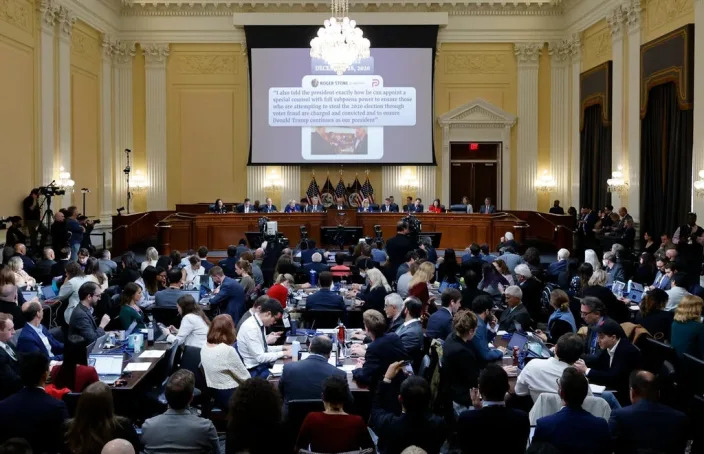
The House select committee investigating the Jan. 6 attack on the U.S. Capitol holds a hearing on Capitol Hill in Washington, Thursday, Oct. 13, 2022.
Bennie Thompson: Committee interviewed witnesses Justice Department couldn’t find

The chairman, Rep. Bennie Thompson, D-Miss., told MSNBC’s Symone Sanders-Townsend on Wednesday the committee secured interviews with witnesses such as fake electors from contested states the Justice Department couldn’t find.

Thompson expressed confidence in the special counsel, Jack Smith, to investigate who organized and financed the Capitol attack beyond the hundreds of rioters who have already been charged. But the committee interviewed more than 1,000 witnesses and is in the midst of sharing those transcripts with the department.

“There were people that we deposed that Justice had not deposed,” Thompson said. “There were electors in various states that Justice couldn’t find. We found them.”

– Bart Jansen

Jan. 6 committee posts files on 34 witnesses who were interviewed

The committee posted files Wednesday on 34 witnesses interviewed during the investigation, an initial signal of how much information the panel will be passing along to the Justice Department for its criminal investigation.

But the release was scant so far. Thirteen of the files, dealing with people such as Trump lawyer Jenna Ellis and broadcaster Alex Jones, remain sealed.

Witnesses in the rest, such as Michael Flynn, Trump’s former national security adviser, Trump lawyer John Eastman and former Justice Department official Jeffrey Clark, refused to answer substantive questions by invoking their Fifth Amendment right against self-incrimination.

– Bart Jansen
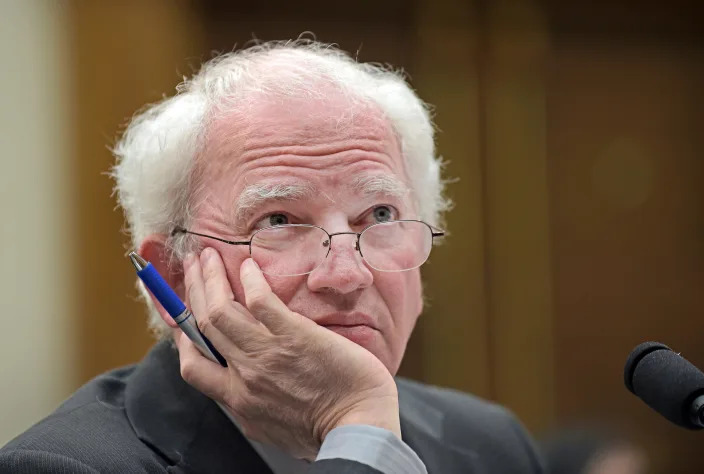
Chapman School of Law professor John Eastman testifies on Capitol Hill in 2017. Eastman was also a former lawyer for former President Donald Trump.
Watchdog predicts more Jan. 6 ‘bombshells’

One government watchdog expects the final report – expected to run as long as 800 pages or more – will help fill in blanks that remain, even after nearly a dozen committee hearings.

Noah Bookbinder, executive director of Citizens for Responsibility and Ethics in Washington, wrote in an NBC op-ed on Wednesday the report would included “hundreds of pages packed with evidence, witness statements and bombshells.”

But he argued nothing will be as important as the conclusion announced Monday that Trump, “as a matter of law, incited an insurrection against the authority of the U.S. government.”

–Donovan Slack

What about witness tampering?

Among the unanswered questions observers hope are resolved in the report due out Thursday: Just who tampered with witnesses, how and which ones?

Trump tried to contact a witness after a June hearing, committee members have said. Some of Trump’s fundraising proceeds went to pay lawyers for witnesses, one witness was offered a job but it was rescinded.

“The witness believed this was an effort to prevent her testimony,” Rep. Zoe Lofgren, D-Calif., said Monday.

Still, witness tampering was not among the charges the committee recommended to prosecutors but full details remain elusive.

– Donovan Slack

Did Trump loyalist Hope Hicks incriminate the former president?

Hope Hicks, Trump’s communications director in the White House, made a splash at Monday’s committee meeting with a videotaped deposition saying she told him she believed he lost the election and there was no evidence of widespread fraud.

“I was becoming increasingly concerned that we were damaging his legacy,” Hicks said.

She is among more than 1,000 witnesses who cooperated with the investigation while about 30 people refused to answer questions under their Fifth Amendment right against self-incrimination. Transcripts for Hicks and other witnesses will be released after the final report and could shed more light on the investigation.

“Next to Dan Scavino, she was Trump’s most trusted aide and one of the only people he listened to,” said Stephanie Grisham, a Trump White House press secretary. “Her constant proximity to the president makes her not just valuable as a witness, but vital.”

– Josh Meyer

Hope Hicks’ Jan. 6 testimony: Will Trump loyalist Hope Hicks’ Jan. 6 testimony incriminate the former president?
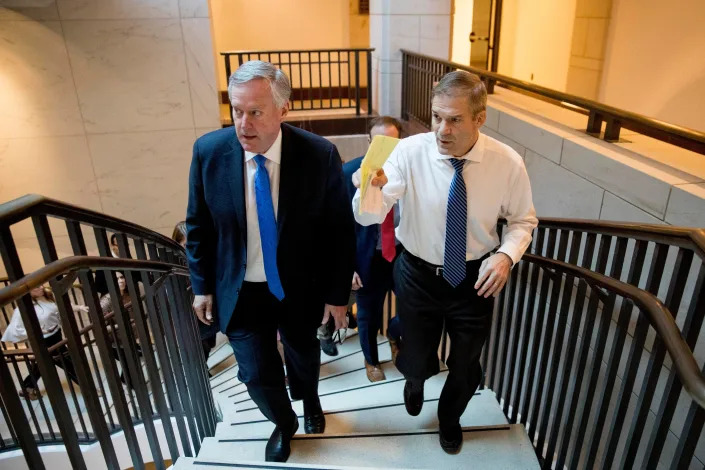
Rep. Mark Meadows, R-N.C., left, and Rep. Jim Jordan, R-Ohio, leave a closed door meeting on Capitol Hill in Washington in 2019.
GOP lawmakers blame congressional leaders, law enforcement for failing to protect Capitol

Five House Republicans released a report Wednesday arguing congressional leaders and law enforcement left the campus vulnerable to attack on Jan. 6, but that the Democratic-led investigation disregarded those failings.

Findings accused Democratic leaders of seeking to avoid “optics” of a large police presence at the Capitol after Black Lives Matter protests the previous year. Capitol Police lacked training and equipment to deal with a riotous mob, according to the report, which echoed findings of an earlier Senate report.

The GOP lawmakers who wrote the rebuttal are Jordan and Reps. Jim Banks of Indiana, Rodney Davis of Illinois, Kelly Armstrong of North Dakota and Troy Nehls of Texas. The five were nominated to serve on the committee, but House Speaker Nancy Pelosi, Calif., rejected Banks and Jordan, and the others withdrew.

– Bart Jansen

Jan. 6 committee released an executive summary of the report Monday

The House panel on Monday released a 160-plus page executive summary of the report and showed video testimony of some of the approximately 1,000 witnesses it has interviewed during the course of its 18-month investigation.

And it voted to forward to the Justice Department its recommendations that former President Donald Trump be charged with four criminal violations stemming from his effort to overturn the 2020 election results and set loose a mob of his supporters on the Capitol on Jan. 6, 2021, when lawmakers were certifying the electoral results showing that Trump had lost to Democrat Joe Biden.

“I expect our final work will be filed with the clerk of the House and made public later this week,” Thompson said Monday. “Beyond that release, the select committee intends to make public the bulk of its non-sensitive records before the end of the year.”

“The transcripts and documents will allow the American people to see for themselves the body of evidence we’ve gathered and continue to explore the information that has led us to our conclusions,” Thompson said.

– Josh Meyer and Bart Jansen

Jan. 6 committee members list: Who is on the House panel?
  • Rep. Bennie Thompson, D-Miss.
  • Rep. Liz Cheney, R-Wyo.
  • Rep. Adam Kinzinger, R-Ill.
  • Rep. Rep. Elaine Luria, D-Va.
  • Rep. Jamie Raskin, D-Md.
  • Rep. Stephanie Murphy, D-Fla.
  • Rep. Pete Aguilar, D-Calif.
  • Rep. Adam Schiff, D-Calif.
  • Rep. Zoe Lofgren, D-Calif.

Granderson: The lonely exit of Adam Kinzinger

Los Angeles Times

Granderson: The lonely exit of Adam Kinzinger

LZ Granderson – December 22, 2022

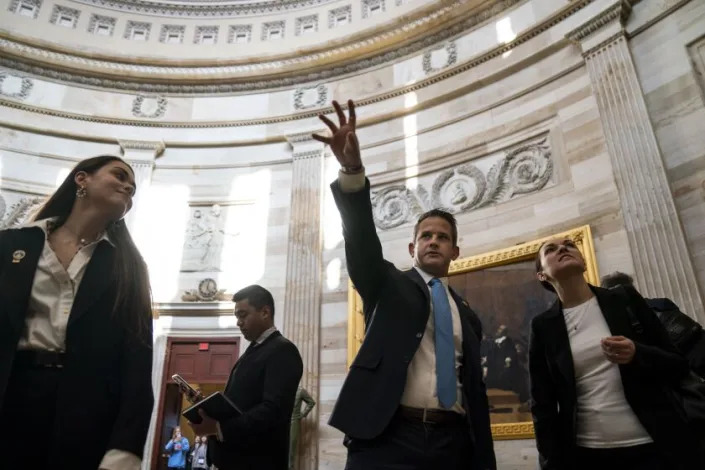
WASHINGTON, DC - APRIL 27: Rep. Adam Kinzinger (R-IL) gives a tour of the U.S. Capitol Building to members of the Ukranian Parliament on Capitol Hill on April 27, 2022 in Washington, DC. (Kent Nishimura / Los Angeles Times)
Rep. Adam Kinzinger at the Capitol in April. (Kent Nishimura / Los Angeles Times)

In January 2011, the Chicago Tribune published a Q&A with Illinois’ five freshmen in the U.S. House. Among them was Republican Adam Kinzinger, who had run for Congress after three tours in Iraq. When the quintet were asked, “Whom do you admire from the other side of the aisle?” four of them offered names. Kinzinger did not. Instead, he gave an answer that, in retrospect, feels as if it were written by Sophocles: “Those who are committed to serving their country.”

This week the House Select Committee to Investigate the Jan. 6 Attack on the United States Capitol published its final report and referred President Trump for prosecution. It also referred John Eastman, who devised the legal framework for the attempted coup, to the Justice Department. After more than a thousand interviews, a million documents and countless hours, this chapter of the book of Trumpism is finally closed.

For the seven Democrats on the committee, the journey has been long, but at least they can finally go home.

But for the two Republican members, who chose country over party, “home” is now a complicated word.

This is particularly true for Kinzinger, who announced in 2021 that he was not seeking reelection after his district was redrawn — although it is worth mentioning that had he run again, he would have faced the wrath of Donald Trump for voting to impeach him. During the Jan. 6 investigation, Kinzinger sold his house in his home state of Illinois and temporarily moved his family to Texas. He’s now trying to decide where “home” is — both literally and figuratively.

“There are a lot of factors for us to consider,” Kinzinger told me this week, besides housing costs and schools. “I don’t know where we’re going to settle down. We’ll see.”

Yes, we shall.

About all of it.

While the committee’s lengthy final report provides damning evidence against the former president as well as his co-conspirators, its recommendation to the Justice Department is similar to that of the Mueller report, in that evidence is all it can provide. It is up to the Justice Department to decide what to do with it, if anything.

Kinzinger said the committee’s investigation was different from the one conducted by special counsel Robert S. Mueller III into Russian interference in the 2016 election, because the attorney general didn’t try to get out in front of the Jan. 6 committee’s messaging and its process was transparent. But the congressman does acknowledge he may have to live with the fact that charges won’t come.

“I always assumed everyone in politics had their version of a red line, that one thing they won’t do,” he said. “My faith in the people who become politicians has become really damaged. I now look more realistically at politics.”

I told him that sounded sad.

He said it was sad.

“It’s been a dark couple of years for me,” he shared. “This has been all-consuming. I went into this job at 32 as a Republican because I believed in the mission, and now I don’t know what the mission is. Ukraine is way more divided politically than we are. But you see what happens when their freedom is threatened. They are willing to die for it. We have what they are fighting for, and we are trying just as hard to get rid of it.”

Strong words from someone who voted for President Trump in 2020 and sided with his agenda more than 90% of the time.

And therein lies the rub with a political figure like Kinzinger. His participation in the Jan. 6 committee is appreciated by the left, but his voting record is pure right.

“Trump basically inherited a Republican agenda and went with it,” Kinzinger said of his own voting record. “I can’t think of any vote that I regret.”

Kinzinger voted against the John Lewis Voting Rights Act but supported the Respect for Marriage Act, which President Biden signed into law last week, codifying federal recognition of same-sex and interracial marriage.

Son of a third-grade teacher and the director of a Christian outreach program for the homeless, Kinzinger has out gay staffers and says he’s disappointed to see his party’s regression on the issue.

“I think to them it’s just about owning the libs,” he said. “If your neighbor is transgender, that’s not your issue. Let them be. At the end of the day, it’s America. Live your life however you want.”

As lovely as that sounds, it’s hard for me to see a congressman who so frequently sided with Trump as a “live and let live” kind of person. Nor would I characterize voting for Trump in 2020 — given everything we then knew him to be — as a “live and let live” vote. I pressed Kinzinger on that one.

“I was a big sissy,” he said. “I thought, [Trump] is not going to win Illinois anyway, so it wouldn’t matter. I didn’t vote for him in 2016 and was heavily criticized for it, so I voted for him in 2020 just to have one less thing people could come at me with.

“I’m telling you this because it’s important to tell people that there’s nobody that’s perfect in resistance or courage. Self-governance is the hardest form of government.”

Kinzinger was not aware just how far Trump’s rot had reached until Jan. 6, 2021. He was not aware how far people were willing to go to serve Trump until the investigation unearthed frightening details, like the never-issued executive order that would have seized voting machines.

Then there was the correspondence of Trump’s White House chief of staff.

“All of Mark Meadows’ text log was shocking, but the biggest personal shock was seeing how much Ginni Thomas was texting him,” he said of Justice Clarence Thomas’ wife, Virginia, a conservative activist. “Who saw that coming?”

Who saw any of this coming?

Back in 2011, when Kinzinger told the Tribune that he admired “those who are committed to serving their country,” who knew a decade later he would have this historic opportunity to prove it?

Of Minority Leader Kevin McCarthy, Kinzinger said: “He disappointed me because I know him. I was friends with him. I used to think he was a great politician with a moral compass. I now see he’s just a politician without a moral compass.

“The day before impeachment I thought there would be 25 [Republican] yesses.”

And then, on Jan. 13, 2021, there were only 10 Republican votes in favor of impeachment.

“People would later call and say, ‘I just can’t do it’ or ‘I want to run for Senate’ or something like that. It was such a foreign way of thinking. It was a lesson about people for me.”

Where he will apply this hard-earned lesson is a mystery.

If you ever wondered why the forefathers feared a two-party system, look no further than Kinzinger, a decorated war hero who doesn’t have a party — or even a state — to call home.

Clearly the country is indebted to both him and the other Republican on the committee, Rep. Liz Cheney, and yet both were forced out of office by the business of two-party politics. There are many issues he and I disagree on. Where two hopeful fools like us find common ground is our unrelenting belief that America will fulfill her promise.

“I truly believe in this country,” Kinzinger said. “Democracy is not defined by the bad days, but how it recovers.”

Democrat who lost to George Santos calls on him to resign following NYT report

Yahoo! News

Democrat who lost to George Santos calls on him to resign following NYT report

Dylan Stableford, Senior Writer – December 20, 2022

Rep.-elect George Santos, R-N.Y., speaks at the Republican Jewish Coalition's annual leadership meeting in Las Vegas on Nov. 19, 2022. (Photo by Wade Vandervort/AFP via Getty Images)
Rep.-elect George Santos, R-N.Y., speaks at the Republican Jewish Coalition’s annual leadership meeting in Las Vegas on Nov. 19, 2022. (Photo by Wade Vandervort/AFP via Getty Images)

The Democrat who lost to GOP Rep.-elect George Santos in the race to represent New York’s Third Congressional District is calling on Santos to resign after the New York Times published a bombshell investigation suggesting that he fabricated key parts of his résumé during the campaign.

“The reality is Santos flat-out lied to the voters of NY-03,” Robert Zimmerman, who lost to Santos by 8 points in last month’s midterm elections, said in a statement late Monday. “He’s violated the public trust in order to win office and does not deserve to represent Long Island and Queens.

“Santos’ failure to answer any of the questions about these allegations demonstrates why he is unfit for public office and should resign,” Zimmerman added. “It demonstrates why there must be a House Ethics Committee, Federal Elections Commission, and U.S. Attorney investigation immediately.”

Robert Zimmerman
Democrat Robert Zimmerman concedes to Republican George Santos in Great Neck, N.Y., on Nov. 8. (William Perlman/Newsday RM via Getty Images)

The Times report published on Monday found that Santos may have misled voters about his college graduation, his criminal and employment history, his family-owned business, his animal rescue charity and his relationship with four victims of the 2016 Pulse nightclub shooting in Orlando, Fla.

In a statement, Joseph Murray, an attorney for Santos, said that his client “represents the kind of progress that the Left is so threatened by — a gay, Latino, immigrant and Republican who won a Biden district in overwhelming fashion by showing everyday voters that there is a better option than the broken promises and failed policies of the Democratic Party.”

“After four years in the public eye, and on the verge of being sworn in as a member of the Republican-led 118th Congress, the New York Times launches this shotgun blast of attacks,” Murray continued. “It is no surprise that Congressman-elect Santos has enemies at the New York Times who are attempting to smear his good name with these defamatory allegations.”

The statement — which ended with a quote erroneously attributed to Winston Churchill — did not directly address the allegations that appeared in the story in the Times.

George Santos
George Santos, R-N.Y., at a conference in Las Vegas last month. (Wade Vandervort/AFP via Getty Images)

If Santos were to resign, a special election would be called to fill his seat.

The revelations in the Times article also raise questions about why neither the Zimmerman campaign nor the Democratic Party, which lost control of the House of Representatives in the midterms, were unable to uncover the apparent holes in Santos’s biography before the election.

“This story is not a shock,” Zimmerman said, insisting that his campaign “worked to raise many of these issues” uncovered by the Times.

New York state Democratic Party Chair Jay Jacobs defended the Zimmerman campaign, telling CNN, “It’s unfair to blame the campaign for opposition research work that it did because the resources of a campaign are not as significant as a paper like the New York Times.”

“The important thing is to focus on George Santos,” Jacobs added. “He’s got a lot of explaining to do.”

Animals Are Running Out of Places to Live

The New York Times

Animals Are Running Out of Places to Live

Catrin Einhorn and Lauren Leatherby – December 16, 2022

Animals Are Running Out of Places to Live

Wildlife is disappearing around the world, in the oceans and on land. The main cause on land is perhaps the most straightforward: Humans are taking over too much of the planet, erasing what was there before. Climate change and other pressures make survival harder.

This week and next, nations are meeting in Montreal to negotiate a new agreement to address staggering declines in biodiversity. The future of many species hangs in the balance.

“If the forest disappears, they will disappear,” said Walter Jetz, a professor of biodiversity science at Yale University who leads Map of Life, a platform that combines satellite imaging with ecological data to determine how species ranges are changing around the world. Map of Life shared data with The New York Times.

Biodiversity — or all the variety of life on the planet, including plants, invertebrates and ocean species — is declining at rates unprecedented in human history, according to the leading intergovernmental scientific panel on the subject. The group’s projections suggest that 1 million species are threatened with extinction, many within decades.

The meeting in Montreal is intended to chart a different path. Delayed two years because of the pandemic, delegations are working to land a new, 10-year agreement to tackle biodiversity loss under a United Nations treaty called the Convention on Biological Diversity.

“With our bottomless appetite for unchecked and unequal economic growth, humanity has become a weapon of mass extinction,” U.N. Secretary-General António Guterres said in his opening remarks last week in Montreal.

The last global biodiversity agreement failed to meet a single target at the global level, according to the Convention on Biological Diversity itself, and wildlife populations continue to plummet.

Take the Honduran white bat.

At first glance, they resemble a cluster of cotton balls stuck under a leaf. But each tiny mound of fluff possesses an even tinier yellow snout and ears. Honduran white bats work together to fashion leaves into tent homes and are known to nurse one another’s young. At night, they fly out in search of a specific species of fig, dispersing its seeds in return.

These bats offer potential benefits to people. Their cuteness makes them an ecotourism draw, and they have an ability that’s rare in mammals to store carotenoids in their skin, which could hold promise for unlocking treatment for conditions such as macular degeneration.

But in the past 20 years, Honduran white bats have lost about half their range in Central America as people clear rainforest for pasture, crops and homes. Not yet considered endangered, they are nevertheless in steep decline, one of countless examples in this worsening global crisis.

It’s not only wildlife that will suffer as a result. Biodiversity loss can trigger ecosystem collapse, scientists say, threatening humanity’s food and water supplies. Alarm is growing that the threat is comparable in significance to the climate crisis.

“Climate change presents a nearer-term threat to the future of human civilization,” said Katharine Hayhoe, a prominent climate change researcher who also focuses on biodiversity as chief scientist at the Nature Conservancy. “The biodiversity crisis presents a longer-term threat to the viability of the human species.”

Scientists emphasize that one can’t be solved without the other because they are interconnected.

What Is Driving the Loss

The human population has doubled since 1970. Although the rate of population growth is slowing, the sheer number of people continues to rise. Consumption levels in different parts of the world mean some people put more pressure on nature. In the United States, for example, each person uses the equivalent of 8 global hectares on average, according to the Global Footprint Network, a nonprofit research group. In Nigeria, it’s about 1 hectare per person.

All that is related to the causes of biodiversity loss, which scientists have ranked. First are changes in land and sea use. Then comes the direct taking of species via, for example, hunting, fishing and wildlife trafficking. Climate change is next, followed by pollution and invasive species. Unfortunately for wildlife, these pressures build on one another.

In the future, scientists expect climate change to become the main driver of biodiversity loss as changes in temperature, rainfall and other conditions continue to transform ecosystems. That shift is expected “some decades down the road,” Jetz said. “But we might already be looking at a much-reduced set of species at that point.”

For the best chance at adapting to climate change, plants and animals need robust populations and room to migrate. Instead, they are depleted and hemmed in.

Why are people taking over so much land? Mostly for agriculture. In many parts of the world, that means exports driven by booming global trade. In recent decades, for example, Southeast Asia has become a major supplier of coffee, timber, rice, palm oil, rubber and fish to the rest of the world.

“All of that economic expansion has come at the cost of biodiverse habitat,” said Pamela McElwee, an environmental anthropologist at Rutgers University who studies the region.

Some momentum is building for companies to ensure that their products are deforestation-free. Reducing meat consumption and food waste are key to freeing up land for other species, McElwee said.

In many places, poverty, powerful interests and a lack of law enforcement make habitat loss especially hard to address.

In Central America, illegal cattle ranching drives deforestation on protected state and Indigenous lands, said Jeremy Radachowsky, director for Mesoamerica and the Caribbean at the Wildlife Conservation Society. Wealthy individuals, often affiliated with drug cartels, grab land, sometimes through illegal payments. They raise beef, some of which ends up in the United States, he said.

Elsewhere in the region and beyond, desperation sometimes pushes people to find remote areas with little government presence where they can simply take land to make a living.

“They need land in order to feed their families,” said David López-Carr, a professor of geography at the University of California Santa Barbara who studies how people interact with tropical forests in Latin America.

Rainforest countries such as Brazil and Congo are known for widespread deforestation. But the species that have lost the largest portions of their habitats tend to be concentrated in places that are geographically isolated in some way, such as the isthmus of Central America and Madagascar. Because animals there often have smaller ranges to begin with, habitat loss hits them especially hard.

For example, 98% of lemurs, primates that only exist in Madagascar, are threatened. Almost one-third are on the brink of extinction. “I don’t want to lose my hope,” said Jonah Ratsimbazafy, a primatologist who leads a nonprofit group on the island that seeks to save lemurs while helping people. Madagascar is among the poorest countries in the world.

Recognition is growing that stanching biodiversity loss requires addressing the needs of local communities.

“There needs to be a way that the people that live close to the forests benefit from the intact forests, rather than clearing the forest for short term gain,” said Julia Patricia Gordon Jones, a professor of conservation science at Bangor University in Wales. “That’s the ultimate challenge of forest conservation globally.”

The High Cost of Inaction

While countries in the global south are experiencing the most dramatic biodiversity losses right now, Europe and the United States went through their own severe declines hundreds of years ago.

“We lost pretty much 100% of primary forest in most parts of Europe,” Jetz said.

Now, with negotiations underway in Montreal, countries that are poor economically but rich in biodiversity argue that they need help from wealthier countries if they’re going to take a different route.

Overall, the financial need is daunting: hundreds of billions per year to help poorer countries develop and implement national biodiversity plans, which would include actions such as creating protected areas; restoring degraded lands; reforming harmful agricultural, fishing and forestry practices; managing invasive species; and improving urban water quality.

On the other hand, failing to address biodiversity loss carries enormous financial risk. A report by the World Economic Forum found that $44 trillion of economic value generation is “moderately or highly dependent on nature and its services and is therefore exposed to nature loss.”

A vast source of funding could come from redirecting subsidies that presently support fossil fuels and harmful agricultural practices, said David Cooper, deputy executive secretary of the Convention on Biological Diversity.

“Currently, most governments spend far more on subsidies that actually are destroying nature than they do on financing conservation,” Cooper said. “So, certainly a change in that will be critical.”

The United States is the only country besides the Holy See that isn’t a party to the convention, so although the United States will attend the meeting, it will be participating from the sidelines.

“We can play a very constructive role from the outside,” said Monica Medina, an assistant secretary of state who is also special envoy for biodiversity and water resources. But she acknowledged that being a member would be better. “I hope that someday we will be,” she said.

Of the many targets being negotiated, the one that has gotten the most attention seeks to address habitat loss head on. Known as 30×30, it’s a plan to safeguard at least 30% of the planet’s land and oceans by 2030. More than 100 countries back the proposal. Although some Indigenous groups fear it will lead to their displacement, others support the plan as a means to secure stronger land rights.

But experts emphasize that action will have to go further than lines on a map.

“You can set up a protected area, but you’ve not dealt with the fact that the whole reason you had habitat loss in the first place is because of demand for land,” McElwee said. “You have to tackle the underlying drivers. Otherwise, you’re only dealing with like half the problem.”

Methodology

All estimates on habitat loss come from Map of Life and its Species Habitat Index. Habitat loss estimates since 2001 run through 2021 and are approximations, based on models of geographic range that incorporate remote sensing and expert research. Map of Life shared data for terrestrial vertebrate species for which the group’s methods can confidently ascertain habitat loss. The researchers estimate many more species are experiencing significant habitat loss than are in the group’s data.

Common names for species used in this article come from Map of Life. Data used in the accompanying graphics showing habitat loss also comes from Map of Life.

Map of Life is led by Walter Jetz, professor of ecology at Yale University and scientific chair at the E.O. Wilson Biodiversity Foundation. Other Map of Life contributors to the research shown in this story include Kalkidan Fekadu Chefira, John Wilshire, Ajay Ranipeta, Yanina Sica and Rohan Simkin.

‘It could happen tomorrow’: Experts know disaster upon disaster looms for West Coast

USA Today

‘It could happen tomorrow’: Experts know disaster upon disaster looms for West Coast

Joel Shannon, USA TODAY – December 16, 2022

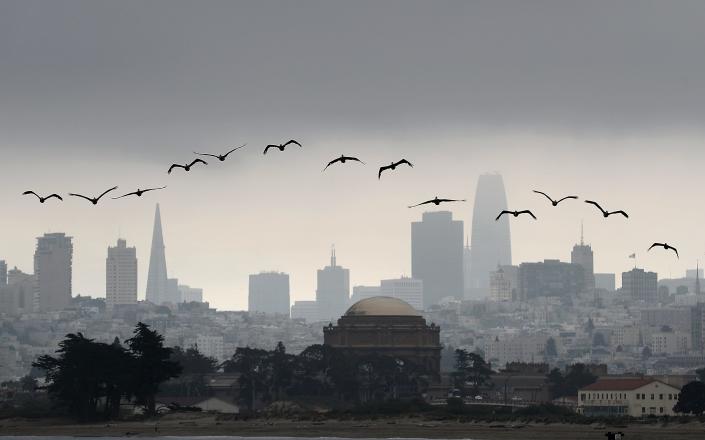
Brown pelicans fly in front of the San Francisco skyline Aug 17, 2018.

It’s the elevators that worry earthquake engineering expert Keith Porter the most.

Scientists say a massive quake could strike the San Francisco Bay Area at any moment. And when it does, the city can expect to be slammed with a force equal to hundreds of atomic bombs.

Porter said the shaking will quickly cut off power in many areas. That means unsuspecting people will be trapped between floors in elevators without backup power. At peak commute times, the number of those trapped could be in the thousands.

To escape, the survivors of the initial quake will need the help of firefighters with specialized training and tools.

But their rescuers won’t come – at least not right away. Firefighters will be battling infernos that could outnumber the region’s fire engines.

Running water will be in short supply. Cellphone service may not work at all. The aftershocks will keep coming.

And the electricity could remain off for weeks.

“That means people are dead in those elevators,” Porter said.

‘Problems on the horizon’

The situation Porter described comes from his work on the HayWired Scenario, a detailed look at the cascading calamities that will occur when a major earthquake strikes the Bay Area’s Hayward Fault, including the possibility of widespread power outages that will strand elevators.

The disaster remains theoretical for now. But the United States Geological Survey estimates a 51% chance that a quake as big as the one described in HayWired will occur in the region within three decades.

It’s one of several West Coast disasters so likely that researchers have prepared painstakingly detailed scenarios in an attempt to ready themselves.

‘SUPERIONIC’: Scientists discover the Earth’s inner core isn’t solid or liquid

The experts who worked on the projects are highly confident the West Coast could at any moment face disasters with the destructive power to kill hundreds or thousands of people and forever change the lives of millions more. They also say there’s more that can be done to keep individuals – and society – safer.

“We’re trying to have an earthquake without having one,” Anne Wein told USA TODAY. Wein is a USGS researcher who co-leads the HayWired earthquake scenario and has worked on several other similar projects.

Such disaster scenarios are massive undertakings that bring together experts from various fields who otherwise would have little reason to work together – seismologists, engineers, emergency responders and social scientists.

That’s important because “it’s difficult to make new relationships in a crisis,” Wein said.

Similar projects aimed at simulating a future disaster have turned out to be hauntingly accurate.

The Hurricane Pam scenario foretold many of the devastating consequences of a major hurricane striking New Orleans well before Hurricane Katrina hit the city.

More recently, in 2017, the authors of “The SPARS Pandemic” called their disaster scenario “futuristic.” But now the project now reads like a prophecy of COVID-19. Johns Hopkins University even issued a statement saying the 89-page document was not intended as a prediction of COVID-19.

“The SPARS Pandemic” imagined a future where a deadly novel coronavirus spread around the world, often without symptoms, as disinformation and vaccine hesitancy constantly confounded experts’ efforts to keep people safe.

The “SPARS scenario, which is fiction, was meant to give public health communicators a leg up … Think through problems on the horizon,” author Monica Schoch-Spana told USA TODAY.

At the time that SPARS was written, a global pandemic was thought of in much the same way experts currently describe the HayWired earthquake: an imminent catastrophe that could arrive at any time.

‘It could happen tomorrow’

Disaster scenario researchers each have their own way of describing how likely the apocalyptic futures they foresee are.

“The probability (of) this earthquake is 100%, if you give me enough time,” seismologist Lucy Jones will often say.

Earthquakes occurring along major faults are a certainty, but scientists can’t predict exactly when earthquakes will happen – the underground forces that create them are too random and chaotic. But researchers know a lot about what will happen once the earth begins to shake.

Earthquakes like HayWired are “worth planning for,” Porter said. Because “it could happen tomorrow.”

“We don’t know when,” Porter said. But “it will happen.”

Wein says we’re “overdue for preparedness.” You might say we’re also overdue for a major West Coast disaster.

The kind of earthquake described in HayWired historically occurs every 100-220 years. And it’s been more than 153 years since the last one.

Farther south in California, it’s difficult to pin down exactly how at risk Los Angeles is for The Big One – the infamous theoretical earthquake along the San Andreas fault that will devastate the city. But a massive magnitude 7.5 earthquake has about a 1 in 3 chance of striking the Los Angeles area in the next 30 years, the United States Geological Survey estimates.

A 2008 scenario said a magnitude 7.8 quake could cause nearly 2,000 deaths and more than $200 billion in economic losses. Big quakes in Los Angeles are particularly devastating because the soil holding up the city will turn into a “bowl of jelly,” according to a post published by catastrophe modeling company Temblor.

Another scenario warns that a stretch of coast in Oregon and Washington state is capable of producing an earthquake much more powerful than the ones California is bracing for. Parts of coastline would suddenly drop 6 feet, shattering critical bridges, destroying undersea communication cables and producing a tsunami.

Thousands are expected to die, but local leaders are considering projects that could give coastal residents a better chance at survival.

It too “could happen at any time,” the scenario says.

Earthquake scenarios often focus on major coastal cities, but West Coast residents farther inland also have yet another disaster to brace for.

Megastorms are California’s other Big One,” the ARkStorm scenario says. It warns of a statewide flood that will cause more than a million evacuations and devastate California’s agriculture.

Massive storms that dump rain on California for weeks on end historically happen every few hundred years. The last one hit around the time of the Civil War, when weeks of rain turned portions of the state “into an inland sea.”

‘Decades to rebuild’

Whether the next disaster to strike the West Coast is a flood, an earthquake or something else, scenario experts warn that the impacts will reverberate for years or longer.

“It takes decades to rebuild,” Wein said. “You have to think about a decade at least.”

A major West Coast earthquake isn’t just damaged buildings and cracked roads.

It’s weeks or months without running water in areas with millions of people. It’s mass migrations away from ruined communities. It’s thousands of uninhabitable homes.

Depending on the scenario, thousands of people are expected to die. Hundreds of thousands more could be left without shelter. And those impacts will be a disproportionately felt.

‘DYING ON THE STREETS’: Homelessness crisis is top issue in Los Angeles mayoral race

‘SURREAL’: Wildfire burning near iconic California coastal highway prompts evacuations

California already has a housing and homelessness crisis, and Nnenia Campbell said the next disaster is set to magnify inequalities. Campbell is the deputy director of the William Averette Anderson Fund, which works to mitigate disasters for minority communities.

Campbell doesn’t talk about “natural disasters” because there’s nothing natural about the way a major earthquake will harm vulnerable communities more than wealthy ones.

Human decisions such as redlining have led to many of the inequities in our society, she said. But humans can make decisions that will help make the response to the next disaster more equitable.

Many of those choices need to be made by local leaders and emergency management planners. Investing in infrastructure programs that will make homes in minority communities less vulnerable to earthquakes. Understanding how important a library is to unhoused people. Making sure all schools are built to withstand a disaster. Keeping public spaces open, even during an emergency.

But individuals can make a difference as well, Campbell said. You can complete training that will prepare you to help your community in the event of an emergency. Or you can join a mutual aid network, a group where community members work together to help each other.

Community support is a common theme among disaster experts: One of the best ways to prepare is to know and care about your neighbors.

If everyone only looks out for themselves in the next disaster, “we are going to have social breakdown,” Jones said.

What you can do

Experts acknowledge you’ll want to make sure you and your family are safe before being able to help others. Fortunately, many disaster preparedness precautions are inexpensive and will help in a wide range of emergency situations.

Be prepared to have your access to electricity or water cut off for days or weeks.

For electricity, you’ll at least want a flashlight and a way to charge your phone.

While cell service will be jammed immediately after a major earthquake, communications will likely slowly come back online faster than other services, Wein said. (And when trying to use your phone, text – don’t call. In a disaster, text messages are more reliable and strain cell networks less.)

To power your phone, you can cheaply buy a combination weather radio, flashlight and hand-crank charger to keep your cell running even without power for days.

A cash reserve is good to have, too, Jones said. You’ll want to be able to buy things, even if your credit card doesn’t work for a time.

Preparing for earthquakes specifically is important along the West Coast, too, experts said. Simple things like securing bookshelves can save lives. Downloading an early warning app can give you precious moments to protect yourself in the event of a big quake. Buying earthquake insurance can protect homeowners. And taking part in a yearly drill can help remind you about other easy steps you can take to prepare.

There’s even more you could do to ready yourself for a catastrophe, but many disaster experts are hesitant to rely on individuals’ ability to prepare themselves.

Just as health experts have begged Americans to use masks and vaccines to help keep others safe during the pandemic, disaster scenario experts believe community members will need to look out for one another when the next disaster strikes.

Telling people to prepare as if “nobody is coming to help you” is a self-fulfilling prophesy, Jones said.

For now, policymakers hold the real power in how prepared society will be for the next disaster. And there are many problems to fix, according to Porter, including upgrading city plumbing, because many aging and brittle water pipes will shatter in a major earthquake, cutting off water to communities for weeks or months.

“Shake it, and it breaks,” Porter said.

Getting ready for the next big earthquake means mundane improvements like even stricter building codesemergency water supply systems for firefighters and retrofitting elevators with emergency power.

The elevator change could prevent thousands of people from being trapped when the big San Francisco earthquake comes.

“A lot of that suffering can be avoided,” Porter said.

DeSantis blasted for ‘Orwellian’ vaccine investigation

Yahoo! News

DeSantis blasted for ‘Orwellian’ vaccine investigation

Alexander Nazaryan, Senior W. H. Correspondent – December 15, 2022

Florida Gov. Ron DeSantis speaking at a news conference in Miami.
Florida Gov. Ron DeSantis at a news conference in Miami on Dec. 1. (Ronen Tivony/SOPA Images via ZUMA Press Wire)

One day after Florida Gov. Ron DeSantis announced a push to investigate alleged harms caused by coronavirus vaccines, Dr. Anthony Fauci, President Biden’s chief medical adviser, criticized the move as a pointless exercise that would only undermine public confidence in efforts to boost and maintain protection against the circulating pathogen.

“We have a vaccine that, unequivocally, is highly effective and safe and has saved literally millions of lives,” Fauci said Wednesday on CNN. “What’s the problem with vaccines?”

The problem is vaccines have become part of America’s polarized politics. Since the advent of COVID-19 vaccines late in the Trump administration, skepticism of the established medical science has become a kind of creed for many conservatives, as well as for some on the far left. Political disagreements about lockdowns, mask mandates and vaccine requirements have hardened into antipathy toward the vaccines themselves.

Seizing on rare adverse side effects and diminishing effectiveness — the result of new variants and low booster uptake — vaccine critics have dismissed inoculation as ineffective and potentially dangerous.

Some have also embraced outlandish conspiracy theories about vaccines as a form of government and corporate control.

An anti-vaccination activist at a rally holds a sign that reads: No mandates. My body, my choice.
Anti-vaccination activists at a rally at the Lincoln Memorial in Washington, D.C., in January. (Alex Wong/Getty Images)

During a pandemic-related hearing in the House, Rep. Jamie Raskin, a Maryland progressive, called the proposed grand jury an “Orwellian” development. “These actions are transparently designed to falsely suggest that coronavirus vaccines, and not the coronavirus itself, are dangerous,” he said Wednesday.

DeSantis, who is widely expected to seek the Republican presidential nomination in 2024, played open to those concerns on Tuesday, when he announced he would call for Florida’s Supreme Court to empanel a grand jury “to investigate crimes and wrongdoing committed against Floridians related to the COVID-19 vaccine.” He is also seeking “further surveillance into sudden deaths of individuals that received the COVID-19 vaccine in Florida.”

Such deaths are rare, according to the Centers for Disease Control and Prevention, whose vaccine surveillance statistics indicate that 17,868 people — or 0.0027% of vaccine recipients — died after their shots. Those reports unquestionably include thousands of deaths that happened after vaccination but had nothing to do with the vaccines themselves.

Vaccine skeptics have often used reports of supposed side effects — such as those to a vaccine database that does not require confirmation — to exaggerate supposed dangers. And such critics invariably downplay the fact that vaccines are exceptionally effective at stopping serious and critical COVID-19 illness, which has killed more than 6.6 million people globally.

A health care worker administers an injection to someone sitting in a car.
A health care worker administers a COVID-19 vaccine at a drive-through site in Miami in December of last year. (Joe Raedle/Getty Images)

And with online misinformation and partisan politics exercising strong pressures on the American public, vaccine fears have been easily exploited, leading to low uptake among Republicans. As a consequence, heavily Republican areas have had higher death rates than Democratic ones.

In Florida, more than 83,000 people have died from COVID-19, and cases there have been rising recently. DeSantis, who has decried what he describes as “Faucism” (the echoes of “fascism” are difficult to miss), downplayed the seriousness of the pandemic from the start, though he has also been credited for opening schools and other businesses well before Democratic counterparts, some of whom remained in a cautious crouch well into 2021.

Earlier this year, DeSantis clashed with former President Donald Trump for supporting vaccination, refusing to say whether he had received a booster shot. Trump shot back by calling DeSantis “gutless.”

DeSantis has also regularly attacked Fauci in personal terms. “Someone needs to grab that little elf and chuck him across the Potomac,” he said earlier this year of Fauci, who has been the face of the pandemic for both the Trump and Biden administrations. (He was eventually sidelined by the former in favor of experts closer in line with DeSantis’s views.)

In late 2021, DeSantis hired Dr. Joseph Ladapo as Florida’s surgeon general. Ladapo has had no experience with infectious diseases and has routinely attacked vaccination and masking. “With these new actions, we will shed light on the forces that have obscured truthful communication about the COVID-19 vaccines,” Ladapo said after Tuesday’s event.

Florida’s surgeon general, Dr. Joseph Ladapo speaking from a podium as Gov. Ron DeSantis looks on.
Florida’s surgeon general, Dr. Joseph Ladapo, with DeSantis looking on, in Brandon, Fla., in November 2021. (Chris O’Meara/AP)

The announcement by DeSantis comes days after new Twitter owner Elon Musk attacked Fauci on Twitter, calling for his prosecution. A supporter of DeSantis, Musk has argued that prior to his ownership, Twitter executives suppressed information on the coronavirus that presumably undermined public health messaging.

Last week, he invited Stanford’s Dr. Jay Bhattacharya — an outspoken critic of pandemic precautions — to Twitter’s headquarters. Bhattacharya, who has advised DeSantis in the past, will be on the governor’s new public safety committee, along with Dr. Martin Kulldorff of Harvard (a co-author, with Bhattacharya, of the pro-reopening Great Barrington Declaration) and Bret Weinstein, a quasi-celebrity on the so-called Intellectual Dark Web with no professional experience in vaccinology.

“I’m not sure what they’re trying to do down there,” Fauci said in the Wednesday CNN interview. Though he is about to retire after four decades of federal service, he is likely to face calls to testify from House Republicans, who continue to accuse him of making misleading statements on masks, vaccines and the origins of the coronavirus.

As his retirement has approached, Fauci has been increasingly vocal and defiant about the challenges revealed by the nation’s faltering coronavirus response, which has left more than a million people dead in the U.S.

In a New York Times essay, Fauci lamented the role that “disinformation and political ideology” have played in sowing doubt about masks, vaccines and other measures.

The silhouette of Dr. Anthony Fauci against a blue background.
Dr. Anthony Fauci on Dec. 9 during a virtual event to urge Americans to get vaccinated ahead of the holiday season. (Saul Loeb/AFP via Getty Images)

Rep. Adam Kinzinger in final House floor speech says ‘limited government’ for GOP now means ‘inciting violence against government officials’

Business Insider

Rep. Adam Kinzinger in final House floor speech says ‘limited government’ for GOP now means ‘inciting violence against government officials’

Bryan Metzger – December 15, 2022

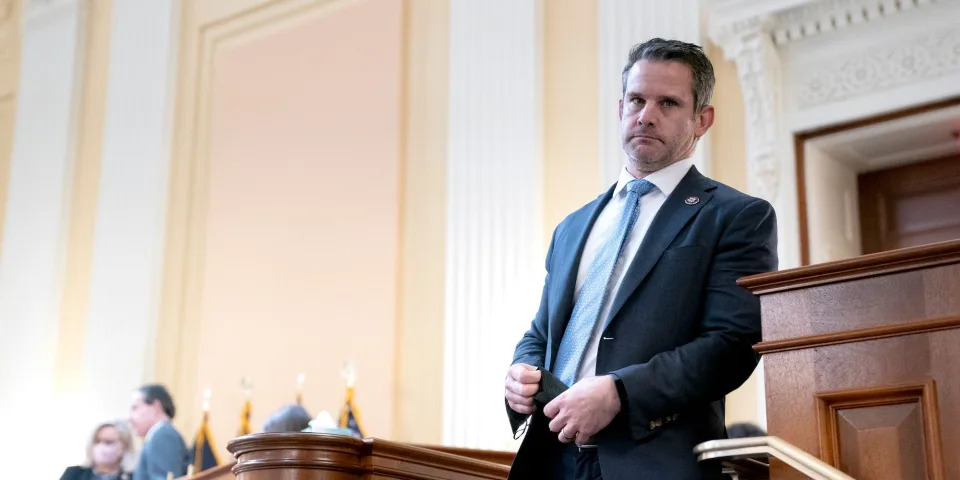
Republican Rep. Adam Kinzinger of Illinois at a January 6 committee meeting on December 1, 2021.
Republican Rep. Adam Kinzinger of Illinois at a January 6 committee meeting on December 1, 2021.Stefani Reynolds for The Washington Post via Getty Images
  • GOP Rep. Adam Kinzinger spoke on the House floor for the last time, having declined re-election.
  • He condemned his own party on Thursday, saying it has “embraced lies and deceit.”
  • He also criticized Democrats for boosting election-denying candidates in GOP primaries this year.

Republican Rep. Adam Kinzinger of Illinois spoke on the House floor for the final time on Thursday after declining to seek re-election.

Kinzinger, a member of the January 6 committee and one of 10 House Republicans who voted to impeach former President Donald Trump for incitement of insurrection following the Capitol riot, has emerged as a key critic of the GOP from within the party.

In his farewell speech, Kinzinger declared that “our democracy is not functioning” and said Republicans have “embraced lies and deceit.” Despite not mentioning Trump by name, he made numerous references to the assault on the Capitol.

“Republicans once believed that limited government meant lower taxes and more autonomy,” he said. “Today, limited government means inciting violence against government officials.”

He also criticized the leadership of the Republican National Committee, which used the phrase “legitimate political discourse” as it moved to censure him and Republican Rep. Liz Cheney of Wyoming for their participation in the January 6 committee.

“Our leaders today belittle, and in some cases justify attacks on the US Capitol as ‘legitimate political discourse,'” Kinzinger added. “We shelter the ignorant, the racist, who only stoke anger and hatred to those who are different than us.”

Kinzinger also criticized Democrats for helping to boost election-denying candidates in Republican primaries this year in order to produce weaker general-election nominees, a controversial tactic that some top Democrats publicly defended.

“To my Democratic colleagues, you must too bear the burden of our failures. Many of you have asked me: where are all the good Republicans? ” he said. “Over the past two years, Democratic leadership had the opportunity to stand above the fray.”

“Instead, they poured millions of dollars into the campaigns of MAGA Republicans, the same candidates Biden called a national security threat, to ensure these good Republicans did not make it out of their respective primaries,” Kinzinger continued. “This is no longer politics as usual. This is not a game.”

Trump and his MAGA political movement are done. Republicans need their version of Biden.

USA Today

Trump and his MAGA political movement are done. Republicans need their version of Biden.

Rex Huppke, USA TODAY – December 14, 2022

If we’ve learned anything from the past three national elections it’s this: Donald Trump and his “MAGA movement” have nothing to sell but crazy, and Americans aren’t buying it.

The 2022 midterm elections should’ve been a Republican blowout. They weren’t – at all – and it’s clear voters cared little about bizarre 2020 presidential election conspiracies and wanted nothing to do with fearmongering over drag queen shows or whatever other weird nonsense the MAGA-dominated Republican Party was peddling.

Add to that the GOP failures in the 2018 midterms and in the 2020 presidential election and it’s safe to say anyone who thinks Trump carries a popular message is allergic to popularity.

Trump’s MAGA movement failed, bigly

MAGA, as a winning political movement, is dead. And the results of an exclusive USA TODAY/Suffolk University Poll show a growing number of Republicans see Trump as a dead candidate walking.

Less than half of Republicans – 47% – now want him to run again, down considerably from July, when 60% wanted Trump to take another shot at the White House.

Don’t get your hopes up that GOP sanity will prevail

Before you spend a moment thinking the party faithful are breaking toward sanity, consider this from USA TODAY’s report on the same poll: “By 2-1, GOP and GOP-leaning voters now say they want Trump’s policies but a different standard-bearer to carry them. While 31% want the former president to run, 61% prefer some other Republican nominee who would continue the policies Trump has pursued.”

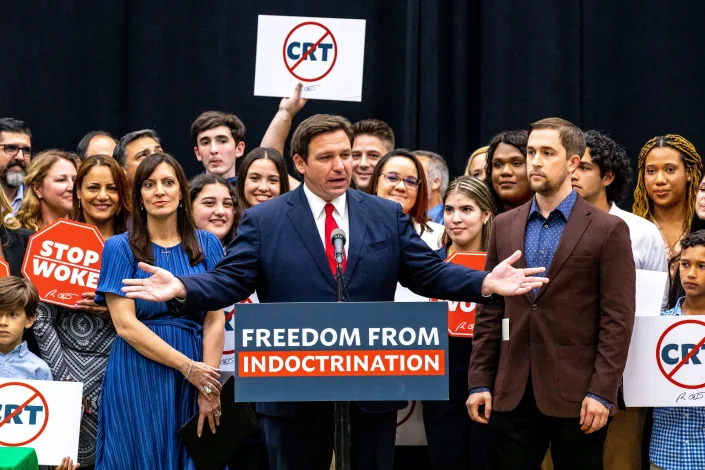
Florida Gov. Ron DeSantis signs his "Stop Woke" bill in Hialeah Gardens on April 22, 2022.
Florida Gov. Ron DeSantis signs his “Stop Woke” bill in Hialeah Gardens on April 22, 2022.

So rather than blame the message – which clearly doesn’t resonate with the masses – many Republican voters are blaming the messenger. And who is their next-in-line choice? Florida Gov. Ron DeSantis, a guy who, like Trump, has made snarling cruelty his brand by focusing on culture war issues like “critical race theory” and “wokeness,” all while scapegoating LGBTQ kids and painting school teachers as malevolent forces of liberal indoctrination.

No, no, no. Here’s a tip, Republicans. You don’t need a Trump-esque figure like DeSantis. You need your own version of Joe Biden.

Let me explain.

Cruelty just ain’t the political calling card it was back when Trump won

DeSantis’ war on “wokeness” and his faux-tough-guy stunt flying migrants to Martha’s Vineyard appeals to a narrow band of American voters, people who get a kick out of meanness and “owning the libs.”

That’s effectively what Trump did, and while he caught lightning in a bottle and won the 2016 presidential election, he and that whole jerk-ish attitude have been broadly rejected ever since:

People cheer as former President Donald Trump announces a third run for president as he speaks at Mar-a-Lago in Palm Beach, Fla., Tuesday, Nov. 15, 2022.
  • Kari Lake tried it in the Arizona gubernatorial race. She lost.
  • Herschel Walker tried it in the Georgia U.S. Senate race. He lost.
  • Doug Mastriano tried it in the Pennsylvania gubernatorial race. He lost.
‘We choose sanity over chaos’

Katie Hobbs, the Democrat who won the Arizona governor’s race, put it perfectly in this recent tweet: “In this election, we chose solving our problems over conspiracy theories. We chose sanity over chaos. We chose unity over division.”

A crowd of supporters of former president Donald Trump on Nov. 15, 2022, in West Palm Beach, Fla.

Voters chose sanity, as they did in the previous two election cycles. The noise and rancor and outrage that nourishes the 24-hour conservative media ecosystem resonates only in that bubble. Elsewhere, people don’t want bullies and fabulists. They want reasonable people who might actually stand a chance of getting something done.

Biden wasn’t many Democrats’ first choice, but …

In the 2020 Democratic presidential primary, liberal voters coalesced around Biden not because he was everyone’s favorite candidate but because he provided a sane counter to Trump. Democratic voters knew Biden would likely appeal to independents, who are often key to winning.

President Joe Biden speaks during a bill signing ceremony for the Respect for Marriage Act on Dec. 13, 2022.

They were right. Biden won not by being some supercandidate or having a pop-culture-driven cult of personality. He ran by being the adult in the room.

Go on, Republicans! Go get yourself a RINO to return you to relevancy!

So if Republicans want a chance at appealing to a broader electorate, they need to find their own Biden. And it sure as heck isn’t an uncharismatic grump like DeSantis.

At the peak of Trump’s popularity with the Republican base, he would regularly lambaste members of his own party – like Rep. Liz Cheney and Sen. Mitt Romney – as RINOs, or Republicans In Name Only. It was stupid, of course – Cheney and Romney are closer to true conservatives than Trump could ever hope to be.

But if that’s how a RINO is defined by today’s Republican Party, then the party desperately needs to find itself a RINO to run for president.

R.I.P. MAGA. You will not be missed, not even a little.

Trumpism, the MAGA movement or whatever you want to call it has been thrice rejected. Younger voters in particular are repelled by culture-war fearmongering.

So Republicans need to offer more than bitterness toward liberals and performative acts of spite. Americans have clearly had it with pugilistic frauds.

The party that has developed an almost cult-like devotion to hating Biden and spinning him and his family into perverse conspiratorial narratives needs to recognize that nobody outside noisy social-media circles gives a hoot about Hunter Biden’s laptop.

In a fine bit of irony, the thing Republicans who loathe Joe Biden need right now, more than anything, is not Trump, not the MAGA movement and not Ron DeSantis.

It’s to find themselves a Joe Biden they can call their own.

Iranian soccer player sentenced to death after protesting against the death of Mahsa Amini

Insider

Iranian soccer player sentenced to death after protesting against the death of Mahsa Amini

Barnaby Lane – December 13, 2022

Amir Nasr-Azadani of Iran
YouTube/20Minutos
  • An Iranian soccer player has been sentenced to death after protesting against the death of Mahsa Amini, according to Iran Wire.
  • Amir Nasr-Azadani was arrested in November in relation to the killing of a police colonel.
  • He has been accused of “waging war against God” and will be hanged.

An Iranian professional soccer player has been sentenced to death after protesting against the death of Mahsa Amini, according to Iran Wire.

Amir Nasr-Azadani, 26, was arrested in November in relation to the killing of a police colonel and two volunteer militia members.

He has been accused of “waging war against God” and will be hanged, according to Iran Wire.

FIFPRO, the international soccer players union, said in a statement on Monday that it was “shocked and sickened” by the news.

“We stand in solidarity with Amir and call for the immediate removal of his punishment,” it said.

There have been widespread protests in Iran since the September death of 22-year-old Amini, who died in custody after being detained by morality police on suspicion of breaking the country’s strict rules around head coverings.

Witnesses accused police officers of forcing her into a van and beating her.

Nasr-Azadani last played for Persian Gulf Pro League side Tractor, but has not played professionally since his last appearance in November 2017.

According to Iran Wire, he is one of 28 Iranians who have been sentenced to death for their parts in the protests.

Among those are three children, who have all been accused of “corruption on Earth.”

According to the BBC’s Persian service, the three children were physically tortured during their detention.

On December 8, Iran conducted its first execution in relation to the protests.

The Guardian reported that Mohsen Shekari was executed after being accused of blocking a street and wounding a member of the pro-regime Basij militia in September.

State media published a video of what it said was Shekari’s confession, which showed him with a bruising on his face.

Human rights groups, including the Oslo-based group Iran Human Rights, have said Shekari was tortured and forced to confess.

The group’s director, Mahmood Amiry-Moghaddam, called for a strong international reaction to Shekari’s death “otherwise we will be facing daily executions of protesters.”

Arizona Gov. Ducey stacks containers on border at term’s end

Associated Press

Arizona Gov. Ducey stacks containers on border at term’s end

Anita Snow and Ross D. Franklin – December 11, 2022

A long row of double-stacked shipping contrainers provide a new wall between the United States and Mexico in the remote section area of San Rafael Valley, Ariz., Thursday, Dec. 8, 2022. Work crews are steadily erecting hundreds of double-stacked shipping containers along the rugged east end of Arizona’s boundary with Mexico as Republican Gov. Doug Ducey makes a bold show of border enforcement even as he prepares to step aside next month for Democratic Governor-elect Katie Hobbs. (AP Photo/Ross D. Franklin)
Activists sit on newly installed shipping containers along the border creating a wall between the United States and Mexico in San Rafael Valley, Ariz., Thursday, Dec. 8, 2022. Work crews are steadily erecting hundreds of double-stacked shipping containers along the rugged east end of Arizona’s boundary with Mexico as Republican Gov. Doug Ducey makes a bold show of border enforcement even as he prepares to step aside next month for Democratic Governor-elect Katie Hobbs. (AP Photo/Ross D. Franklin)

Work crews have steadily erected hundreds of double-stacked shipping containers topped by razor wire along Arizona’s remote eastern boundary with Mexico in a bold show of border enforcement by Republican Gov. Doug Ducey even as he prepares to leave office.

Until protesters slowed, then largely halted the work in recent days, Ducey pressed forward over the objections of the U.S. government, environmentalists and an incoming governor who has called it a poor use of resources.

Democratic Gov.-elect Katie Hobbs said last week she was “looking at all the options” and hasn’t decided what to do about the containers after her Jan. 5. inauguration. She previously suggested the containers be repurposed as affordable housing, an increasingly popular option for homeless and low-income people.

“I don’t know how much it will cost to remove the containers and what the cost will be,” Hobbs told Phoenix PBS TV station KAET in an interview Wednesday.

Federal agencies have told Arizona the construction on U.S. land is unlawful and ordered it to halt. Ducey responded Oct. 21 by suing federal officials over their objections, sending the dispute to court.

Environmental groups say the containers could imperil natural water systems and endanger species.

“A lot of damage could be done here between now and early January,” said Russ McSpadden, a Southwest conservation advocate for the Center for Biological Diversity who has regularly traveled to the site since late October.

Ducey insists Arizona holds sole or shared jurisdiction over the 60-foot (18.2 meter) strip the containers rest on and has a constitutional right to protect residents from “imminent danger of criminal and humanitarian crises.”

“Arizona is going to do the job that Joe Biden refuses to do — secure the border in any way we can.” Ducey said when Arizona sued the U.S. government. “We’re not backing down.”

The federal agencies want Ducey’s complaint dismissed.

Border security was a focus of Donald Trump’s presidency and remains a potent issue for Republican politicians. Hobbs’ GOP rival, Kari Lake, campaigned on a promise to dispatch the National Guard to the border on her first day in office. Texas Republican Gov. Greg Abbott, recently reelected to a third term, has pushed to keep building Trump’s signature wall on the mostly private land along his state’s border with Mexico and has crowdsourced funds to help pay for it. He also has gotten attention for busing migrants to Democratic-led cities far from the southern border, including New York City, Chicago, Philadelphia and Washington, D.C.

Ducey’s move comes amid a record flow of migrants arriving at the border. U.S. border officials have stopped migrants 2.38 million times in the fiscal year that ended Sept. 30, up 37% from the year before. The annual total surpassed 2 million for the first time in August and is more than twice the highest level during Trump’s presidency, in 2019.

Ducey’s container wall effort began in late summer in Yuma in western Arizona, a popular crossing point, with scores of asylum-seekers arriving daily and often finding ways to circumvent the new barriers. The containers filled areas left open when Trump’s 450-mile (724 km) border wall was built. But remote San Rafael Valley — the latest construction site — is not typically used by migrants and was not contemplated in Trump’s wall construction plan. McSpadden said he has not seen migrants or Border Patrol agents there, just hikers and backpacking cyclists.

The construction there stretches from oak forests in the Huachuca foothills southeast of Tucson and across the valley’s grasslands. As of the middle of last week, cranes had transported more than 900 blue or rust-colored metal containers down a dirt road freshly scraped into the landscape, then double stacked them up to 17 feet (5.2 meters) high alongside waist-high vehicle barriers of crisscrossed steel. Workers bolted the containers together and welded sheet metal over gaps.

Still, yawning gaps remain in the new container wall, including an open space of several hundred yards (meters) on terrain far too steep to place the containers. In some low lying wash areas there are gaps nearly three feet (1 meter) wide.

Environmental activists demonstrating at the Cochise County site in the past week largely stopped the work in recent days by standing in front of construction vehicles. One recent day, a dozen demonstrators sat atop stacked containers or in camp chairs near tents and vehicles where they sleep.

The work in Yuma cost about $6 million and wrapped up in 11 days with 130 of the containers covering about 3,800 feet (about 1,160 meters). The Bureau of Reclamation told Arizona it violated U.S. law by building on federal land. The Cocopah Indian Tribe also complained the state did not seek permission to build on its nearby reservation.

The newer project is far larger, costing some $95 million and using up to 3,000 containers to cover 10 miles (16 km), in Arizona’s southeastern Cochise County. The U.S. Forest Service also told Arizona to halt its work in the Coronado National Forest, and recently alerted visitors to potential hazards posed by construction equipment involved in the state’s “unauthorized activities.”

The Center for Biological Diversity has sided with the federal government’s position that the construction violates U.S. law.

While Ducey’s lawsuit does not address environmental concerns, groups like the center say the work in the Coronado National Forest imperils endangered or threatened species like the western yellow-billed cuckoo and the Mexican spotted owl, as well as big cats including the occasional ocelot.

The biologically diverse region of southeastern Arizona is known for its “sky islands,” or isolated mountain ranges rising over 6,000 feet (1,828 meters) above “seas” of desert and grasslands. Wildlife cameras in the region regularly photograph black bears, bobcats, ringtails, spotted skunks, white-nosed coatis and pig-like javelina.

McSpadden said the work has toppled oak and juniper trees and he’s found spools of razor wire and other construction debris on national forest land.

Environmentalists warn of the dangers of placing the containers atop a watershed of the San Pedro River that floods during the monsoon season each summer. Just south of the border lies a protected area called Rancho Los Fresnos, home to the beaver, a threatened species in Mexico.

Biologist Myles Traphagen of Wildlands Network told a briefing on border issues last month that much damage caused during the Trump administration’s border wall construction was never fixed. Last year, he mapped the Arizona and New Mexico sections of that border wall to highlight damaged areas. A report this year highlights areas the group considers priorities for reconstruction.

Dynamite blasts forever reshaped the remote Guadalupe Canyon in Arizona’s southeast corner. Towering steel bollards closed off wildlife corridors, preventing animals like tiny elf owls, pronghorns and big cats from Mexico to cross into the U.S. to hunt and mate.