‘The party’s on fire’: Florida GOP roiled by far right takeover efforts despite 2022 wins
Zac Anderson, Sarasota Herald-Tribune – December 10, 2022
Urged on by prominent far right figures such as Steve Bannon and Michael Flynn, ultra conservative GOP activists are seeking to take over county parties across Florida during leadership elections this month.
Some have failed, such as the recent effort to install a Flynn acolyte as county party chair in Sarasota County.
Some already have been successful. Candidates backed by far-right businessman Alfie Oakes, who was at the U.S. Capitol when it was overrun by Trump supporters on Jan. 6, 2021, took over the Collier County GOP.
Other leadership battles are still playing out. Whatever happens, the wave of far right activity across Florida shows how former President Donald Trump continues to reshape the party.
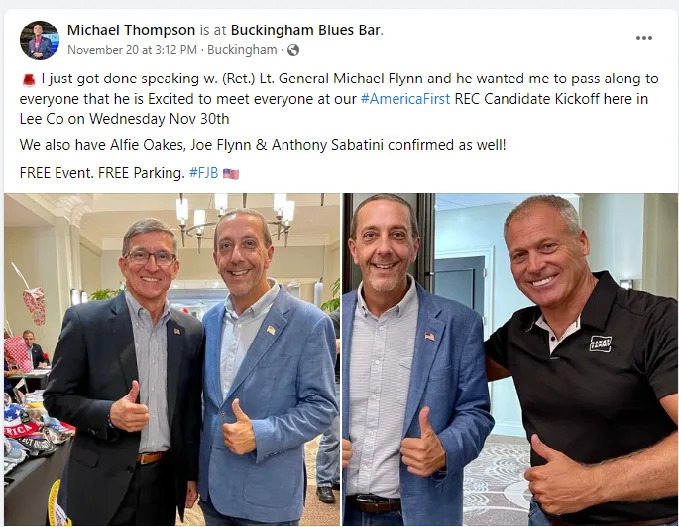
A Facebook post by Michael Thompson shows him with Michael Flynn, left, and Collier County businessman Alfie Oakes, right. Thompson, who is wearing the light blue blazer in both photos, is running for Lee County GOP chair.
‘America First’ candidates
Many of the activists seeking control of local parties have been motivated by Trump’s stolen election claims and his battles with the GOP establishment. They often identity as “America First” candidates, a slogan with a long history in American politics that Trump popularized again.
In Lee County, an activist backed by Flynn who worked for an affiliate of The America Project, a nonprofit Flynn is involved with that promotes Trump’s unfounded election fraud allegations, won the county GOP chair job. The Lee activist, Michael Thompson, posted on Facebook recently that the Arizona election “was stolen” from Kari Lake, the failed far-right candidate for governor. Thompson wants to create a committee within the Lee GOP focused on “election integrity.”
In Pinellas County, activist and conservative author Cathi Chamberlain, who worked as campaign manager for a Jan. 6 defendant who ran for Congress from jail, is running for county party chair. Chamberlain emphasized “the stolen election in 2020” when she announced her campaign at a Pinellas GOP meeting last month.
In Lake County, far right former state House member Anthony Sabatini is running for county party chair amid speculation he might use the post to run for state party chair. Sabatini is an ardent Trump supporter who has frequently battled with members of his own party. He recently tweeted — without any evidence — that “2022 may have even MORE election fraud than 2020.”
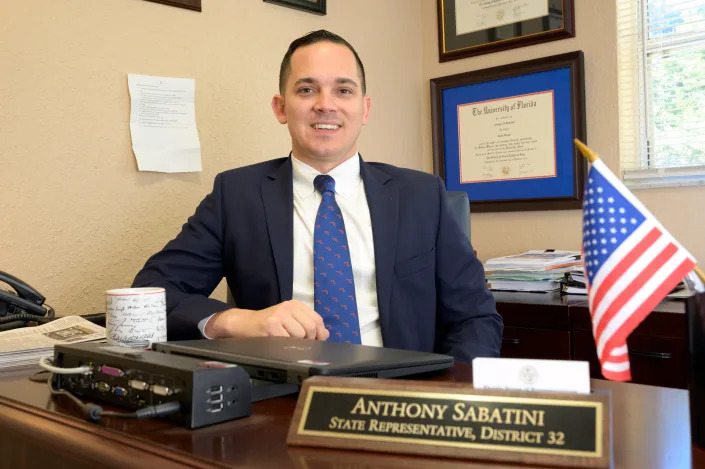
Far right former Florida State Representative Anthony Sabatini is running for Lake County GOP chair amid speculation he may use the post to run for Florida GOP chair.
Fizzled red wave
The focus on 2020 was a problem for the GOP this election cycle. Candidates such as Lake, Doug Mastriano in Pennsylvania and others who embraced Trump’s election denialism lost key races, causing a predicted red wave to fizzle.
Florida was a different story. Gov. Ron DeSantis, who has avoided directly answering questions about whether he believes the 2020 election was stolen, won big.
Yet the 2020 election continues to motivate many on the far right, even in Florida, a state Trump carried by three points over President Joe Biden. Trump’s national loss to Biden left many in the GOP frustrated and searching for ways to have influence on the political process.
“The party’s on fire, people want to see change and there’s not change happening, and they look at the party as a way to change,” said state Sen. Joe Gruters, R-Sarasota, chairman of the Florida Republican Party.
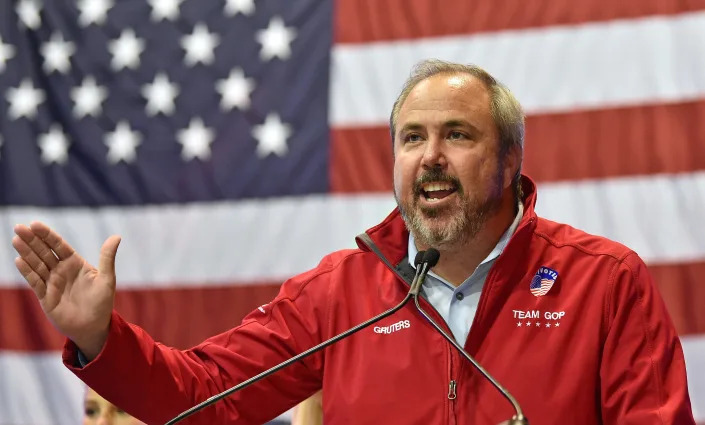
Florida GOP Chair Joe Gruters says “the party’s on fire.” Encouraged by far right figures such as Steve Bannon and Michael Flynn, ultra conservative GOP activists are seeking to seize control of county GOP leadership positions across Florida.
Trump’s unwillingness to accept defeat shaped how the GOP responded to 2020, prompting many in the party to channel their energy into the stolen election narrative. Flynn was at the forefront of that effort nationally. He was deeply involved in trying to overturn the 2020 election. His nonprofit helped fund a controversial recount in Arizona.
In Florida, Flynn — briefly Trump’s national security adviser in 2017 — has been allied with Defend Florida, a loosely organized group that gathered thousands of “affidavits” that the organization implies are possible instances of voter fraud, claims law enforcement and election authorities have dismissed.
Chamberlain has been heavily involved with Defend Florida, and Thompson also is aligned with the group.
‘RINO’ attacks
In Manatee County, GOP Chair Steve Vernon said he’s also being challenged by a Defend Florida volunteer.
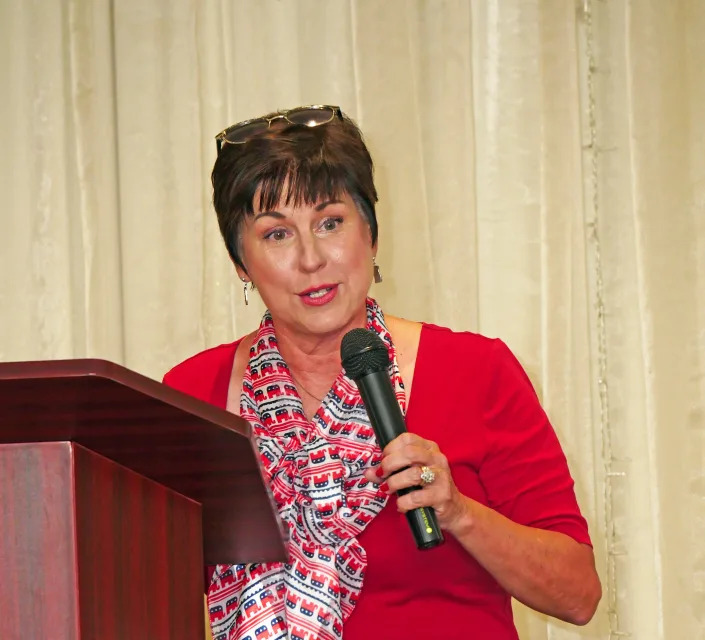
The group of activists trying to unseat Vernon has called him a RINO — which stands for “Republican in Name Only” — even though he once led a tea party group and once challenged Gruters, a prominent Trump ally, from the right for a state House seat.
“I’m the ex-president of the tea party, yet they’re calling me a RINO and I’m thinking what world are you in?” Vernon said. “I’m no more RINO than the man on the moon. That’s how bad it is.”
Vernon identifies as a staunch conservative, but he said the people challenging him are “so far right” they’re “off the planet.”
“I am conservative; however, they want to take it to the stratosphere. They have a 100% purity test,” Vernon said.
Vernon said he blames Bannon, a former Trump adviser, for all the pressure on county GOP leaders from the right. Bannon, who was sentenced last year to four months in prison after being found guilty of contempt of Congress, uses his “War Room” program to promote a takeover of the GOP at the local level and build from there, until the party has been transformed statewide and nationally.
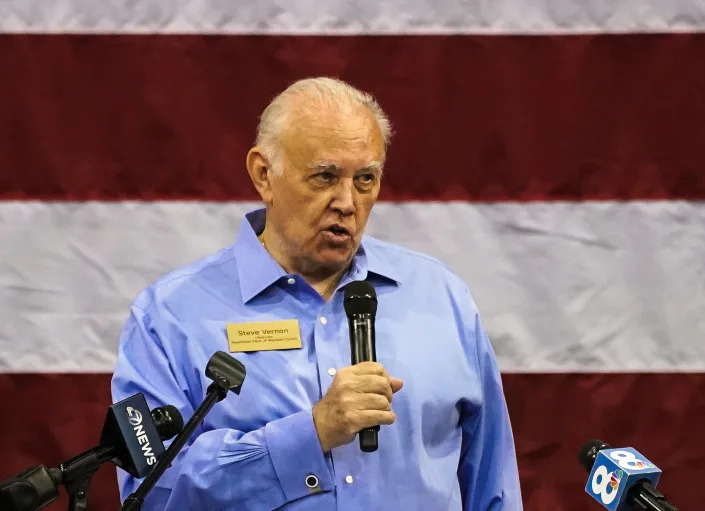
Manatee GOP Chair Steve Vernon is facing a challenge for the top county party job from a right wing activist. Vernon identifies as a staunch conservative, but he said the people challenging him are “so far right” they’re “off the planet”
Flynn has pushed a similar message. After failing to overturn the 2020 election, he bought a home in Englewood in Southwest Florida and launched a series of initiatives aimed at engaging the GOP base. Flynn’s motto is “Local Action = National Impact.” He has demonstrated his commitment by joining the Sarasota GOP executive committee and volunteering as a precinct captain.
Bannon talks about taking over the GOP “precinct by precinct.”
Flynn and other far-right individuals backed GOP activist Conni Brunni for Sarasota GOP chair but she fell short by 33 votes to Jack Brill, who was endorsed by the vast majority of GOP elected officials in the county.
Sarasota GOP activist Conni Brunni tried to win control of the county party with backing from Michael Flynn, but came up short by 33 votes.
Chamberlain also likely faces an uphill battle against Adam Ross, a prosecutor who works as executive director of the state attorney’s office covering Pinellas County and has a long list of endorsements from local GOP leaders.
Republicans were hugely successful in Pinellas this cycle, and Ross says he wants to continue the “professional leadership” that has proven effective.
“I think it’s good to have a spirited debate, but I don’t want to see it turn negative where we start using terms like RINO and that,” Ross said. “We all need to work together, we’re all part of the big tent. When I’m chairman everybody will be welcome, but it has to stay professional.”
Chamberlain is critical of Ross, the current vice chair of the Pinellas GOP, saying he hasn’t been aggressive enough in investigating claims of voter fraud. The fraud issue drove her decision to run for party chair. Nationwide, nearly 60 federal judges, including those appointed by Trump, dismissed lawsuits filed by the former president and his allies challenging the 2020 election or its outcome.
“When the establishment was going around telling everybody to keep quiet about the 2020 election my question was why? Why aren’t we hitting this head-on?” Chamberlain said of Trump’s fraud allegations. “I’m a former building contractor and I can tell you if the foundation of a building I was working on wasn’t solid I wouldn’t take one step forward until it was fixed.”
Ross says the local party has taken “election integrity very seriously.”
With Trump running for president again, questions about the 2020 election are likely to continue dividing the party.
“The Republican Party, there’s no question about it is split in half right now,” Chamberlain said. “And the establishment rules currently and the America Firsters… are fighting to regain the values our party stands for.”
Attacks on Pacific north-west power stations raise fears for US electric grid
Dani Anguiano in Los Angeles – December 10, 2022
Photograph: Mathieu Lewis-Rolland/Reuters
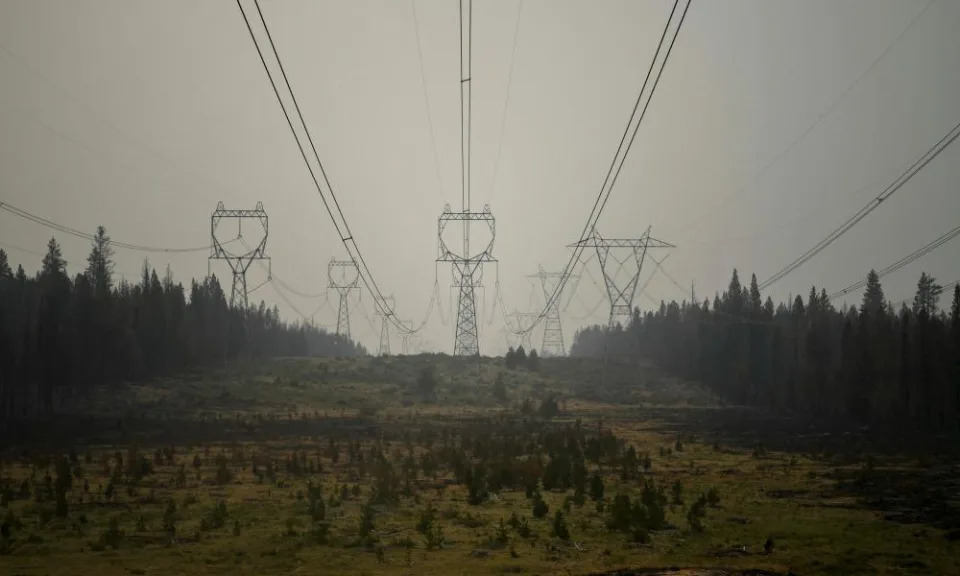
A string of attacks on power facilities in Oregon and Washington has caused alarm and highlighted the vulnerabilities of the US electric grid.
The attacks in the Pacific north-west come just days after a similar assault on North Carolina power stations that cut electricity to 40,000 people.
As first reported by Oregon Public Broadcasting and KUOW Public Radio, there have been at least six attacks, some of which involved firearms and caused residents to lose power. Two of the attacks shared similarities with the incident in Moore county, North Carolina, where two stations were hit by gunfire. Authorities have not yet revealed a motive for the North Carolina attack.
The four Pacific north-west utilities whose equipment was attacked have said they are cooperating with the FBI. The agency has not yet confirmed if it is investigating the incidents.
It’s unknown who is behind the attacks but experts have long warned of discussion among extremists of disrupting the nation’s power grid.
Bonneville Power Administration (BPA) said in a statement on Thursday that it was seeking tips about “trespassing, vandalism and malicious damage of equipment” at a substation in Clackamas county on 24 November that caused damage and required cleanup costing hundreds of thousands of dollars.
“Someone clearly wanted to damage equipment and, possibly, cause a power outage,” said John Lahti, the utility’s transmission vice-president of field services. “We were fortunate to avoid any power supply disruption, which would have jeopardized public safety, increased financial damages and presented challenges to the community on a holiday.”
Any attack on electric infrastructure “potentially puts the safety of the public and our workers at risk”, said BPA, which delivers hydropower across the Pacific north-west .
Portland General Electric, a public utility that provides electricity to nearly half of the state’s population, said it had begun repairs after suffering “a deliberate physical attack on one of our substations” that also occurred in the Clackamas area in late November 2022. It said it was “actively cooperating” with the FBI.
Puget Sound Energy, an energy utility in Washington, reported two cases of vandalism at two substations in late November to the FBI and peer utilities, but said the incidents appeared to be unrelated to other recent attacks.
“There is no indication that these vandalism attempts indicate a greater risk to our operations and we have extensive measures to monitor, protect and minimize the risk to our equipment and infrastructure,” the company said in a statement.
Duke Energy workers repair an electrical substation that they said was hit by gunfire, near Pinehurst, North Carolina, on Tuesday. Photograph: Drone Base/Reuters
Experts and intelligence analysts have long warned of both the vulnerability of the US power grid and talk among extremists about attacking the crucial infrastructure.
“It’s very vulnerable,” said Keith Taylor, a professor at the University of California, Davis, who has worked with energy utilities. “[These attacks] are a real threat.”
The physical risks to the power grid have been known for decades, Granger Morgan, an engineering professor at Carnegie Mellon University, told CBS. “We’ve made a bit of progress, but the system is still quite vulnerable,” he said.
A US Department of Homeland Security (DHS) report released in January warned that domestic extremists have been developing “credible, specific plans” to attack electricity infrastructure since at least 2020.
The DHS has cited a document shared on a Telegram channel used by extremists that included a white supremacist guide to attacking an electric grid with firearms, CNN reported.
“These fringe groups have been talking about this for a long time,” Taylor said. “I’m not at all surprised this happened – I’m surprised it’s taken this long.”
Three men who law enforcement identified as members of the Boogaloo movement allegedly planned to attack a substation in Nevada in 2020 to distract police and attempt to incite a riot.
In 2013, still unknown assailants cut fiber-optic phone lines and used a sniper to fire shots at a Pacific Gas & Electric substation near San Jose in what appeared to be a carefully planned attack that caused millions of dollars in damage. The attack prompted the Federal Energy Regulatory Commission (Ferc) to order grid operators to increase security.
“They knew what they were doing. They had a specific objective. They wanted to knock out the substation,” Jon Wellinghoff, the then chair of Ferc, told 60 Minutes, adding that the attack could have “brought down all of Silicon Valley”.
After the 2013 attack in California, a Ferc analysis found that attackers could cause a blackout coast-to-coast if they took out only nine of the 55,000 substations in the US.
The US electrical grid is vast and sprawling with 450,000 miles of transmission lines, 55,000 substations and 6,400 power plants. Power plants and substations are dispersed in every corner of the country, connected by transmission lines that transport electricity through farmland, forests and swamps. Attackers do not necessarily have to get close to cause significant damage.
“In a centralized system, if I [want] to take out one coal-fired plant, I don’t even have to take out the plant, I just have to take out the transmission line,” said Taylor. “You can cause a ripple effect where one outage can cause an entire seaboard to go down.”
This editorial is the fifth in a series, “The Danger Within,” urging readers to understand the danger of extremist violence and possible solutions. Read more about the series in a note from Kathleen Kingsbury, the Times Opinion editor.
A year ago, Representative Thomas Massie of Kentucky posted a Christmas photo on Twitter. In it, Mr. Massie, his wife and five children pose in front of their ornament-bedecked tree. Each person is wearing a big grin and holding an assault weapon. “Merry Christmas! ps. Santa, please bring ammo,” Mr. Massie wrote on Twitter.
The photo was posted on Dec. 4, just four days after a mass shooting at a school in Oxford, Mich., that left four students dead and seven other people injured.
The grotesque timing led many Democrats and several Republicans to criticize Mr. Massie for sharing the photo. Others lauded it and nearly 80,000 people liked his tweet. “That’s my kind of Christmas card!” wrote Representative Lauren Boebert of Colorado, who then posted a photo of her four sons brandishing similar weapons.
These weapons, lightweight and endlessly customizable, aren’t often used in the way their devotees imagine — to defend themselves and their families. (In a recent comprehensive survey, only 13 percent of all defensive use of guns involved any type of rifle.) Nevertheless, in the 18 years since the end of the federal assault weapons ban, the country has been flooded with an estimated 25 million AR-15-style semiautomatic rifles, making them one of the most popular in the United States. When used in mass shootings, the AR-15 makes those acts of violence far more deadly. It has become the gun of choice for mass killers, from Las Vegas to Uvalde, Sandy Hook to Buffalo.
The AR-15 has also become a potent talisman for right-wing politicians and many of their voters. That’s a particularly disturbing trend at a time when violent political rhetoric and actual political violence in the United States are rising.
Addressing violent right-wing extremism is a challenge on many fronts: This board has argued for stronger enforcement of state anti-militia laws, better tracking of extremists in law enforcement and the military, and stronger international cooperation to tackle it as a transnational issue. Most important, there is a civil war raging inside the Republican Party between those who support democracy and peaceful politics and those who support far-right extremism. That conflict has repercussions for all of us, and the fetishization of guns is a pervasive part of it.
The prominence of guns in campaign ads is a good barometer of their political potency. Democrats have sometimes used guns in ads — in 2010, Joe Manchin of West Virginia, running for the Senate, shot a hole through a copy of the cap-and-trade climate bill with a single-shot hunting rifle. Since then, guns have all but disappeared from Democratic messaging. But in the most recent midterm elections, Republican politicians ran more than 100 ads featuring guns and more than a dozen that featured semiautomatic military-style rifles.
In one of the most violent of those ads, Eric Greitens, a Republican candidate for Senate in Missouri and a former Navy SEAL, kicks in the door of a house and barges in with a group of men dressed in tactical gear and holding assault rifles. Mr. Greitens boasts that the group is hunting RINOs — a derogatory term for “Republicans in name only.” The ad continues, “Get a RINO hunting permit. There’s no bagging limit, no tagging limit, and it doesn’t expire until we save our country.”
Twitter flagged the ad, Facebook banned it for violating its terms of service, and Mr. Greitens lost his race for office. He may have been playacting in the ad, but many other heavily armed people with far-right political views are not. Openly carried assault rifles have become an all too common feature of political events around the country and are having a chilling effect on the exercise of political speech.
This intimidating display of weaponry isn’t a bipartisan phenomenon: A recent New York Times analysis examined more than 700 demonstrations where people openly carrying guns showed up. At about 77 percent of the protests, those who were armed “represented right-wing views, such as opposition to L.G.B.T.Q. rights and abortion access, hostility to racial justice rallies and support for former President Donald J. Trump’s lie of winning the 2020 election.”
As we’ve seen at libraries that host drag queen book readings, Juneteenth celebrations and Pride marches, the Second Amendment’s right to bear arms is fast running up against the First Amendment’s right to peaceably assemble. Securing that right, and addressing political violence in general, requires addressing the armed intimidation that has become commonplace in public places and the gun culture that makes it possible.
A growing number of American civilians have an unhealthy obsession with “tactical culture” and rifles like the AR-15. It’s a fringe movement among the 81 million American gun owners, but it is one of several alarming trends that have coincided with the increase in political violence in this country, along with the spread of far-right extremist groups, an explosion of anti-government sentiment and the embrace of deranged conspiracy theories by many Republican politicians. Understanding how these currents feed one another is crucial to understanding and reversing political violence and right-wing extremism.
The American gun industry has reaped an estimated $1 billion in sales over the past decade from AR-15-style guns, and it has done so by using and cultivating their status as near mythical emblems of power, hyper-patriotism and manhood. Earlier this year, an investigation by the House Committee on Oversight and Reform found that the gun industry explicitly markets its products by touting their military pedigree and making “covert references to violent white supremacists like the Boogaloo Boys.” These tactics “prey on young men’s insecurities by claiming their weapons will put them ‘at the top of the testosterone food chain.’”
This marketing and those sales come at a significant cost to America’s social fabric.
In his recent book “Gunfight: My Battle Against the Industry That Radicalized America,” Ryan Busse, a former firearms company executive, described attending a Black Lives Matter rally with his son in Montana in 2020. At the rally, dozens of armed men, some of them wearing insignia from two paramilitary groups — the 3 Percenters and the Oath Keepers — appeared, carrying assault rifles. After one of the armed men assaulted his 12-year-old son, Mr. Busse had his epiphany.
“For years prior to this protest, advertising executives in the gun industry had been encouraging the ‘tactical lifestyle,’” Mr. Busse wrote. The gun industry created a culture that “glorified weapons of war and encouraged followers to ‘own the libs.’”
The formula is a simple one: More rage, more fear, more gun sales.
A portion of those proceeds are then funneled back into politics through millions of dollars in direct contributions, lobbying and spending on outside groups, most often in support of Republicans.
All told, gun rights groups spent a record $15.8 million on lobbying in 2021 and $2 million in the first quarter of 2022, the transparency group OpenSecrets reported. “From 1989 to 2022, gun rights groups contributed $50.5 million to federal candidates and party committees,” the group found. “Of that, 99 percent of direct contributions went to Republicans.”
The Danger Within
It is important, of course, to distinguish between the large majority of law-abiding gun owners and the small number of extremists. Only about 30 percent of gun owners have owned an AR-15 or similar rifle, a majority support common sense gun restrictions and a majority reject political violence.
Institutions and individuals — prominent politicians, for instance, and responsible gun owners — could do far more to insist that assault weapons have no place in public spaces, even if they are permitted in many states, where the open carry of firearms is legal. Public condemnation of such displays is a good place to start.
Republicans should also show more courage in condemning extremists in their own ranks. When Representative Massie posted his Christmas photo, Representative Adam Kinzinger of Illinois responded on Twitter: “I’m pro second amendment, but this isn’t supporting right to keep and bear arms, this is a gun fetish.” There’s a difference between celebrating Christmas secure in the knowledge that you have a weapon to defend your home and family and sending out a photo of your arsenal days after a school shooting.
Democrats, while they may hope for stricter gun laws overall, should also recognize that they do share common ground with many gun owners — armed right-wing extremists and those who fetishize AR-15s do not represent typical American gun owners or their beliefs. That’s especially true given the changing nature of who owns guns in the United States: women and Black Americans are among the fastest-growing demographics.
This summer, for the first time in decades, Congress passed major bipartisan gun safety legislation — a major accomplishment and a sign that common ground is not terra incognita. It should have gone further — and can in the future: preventing anyone under 21 from buying a semiautomatic weapon, for instance, and erasing the 10-year sunset of the background-check provision. States should also be compelled to pass tougher red-flag laws to take guns out of the hands of suicidal or potentially violent people. Mandatory gun-liability insurance is also an idea with merit.
States and the federal government should also pass far tougher regulations on the gun industry, particularly through restrictions on the marketing of guns, which have helped supercharge the cult of the AR-15. New York’s law, which allows parties like victims of gun violence and the state government to sue gun sellers, manufacturers and distributors, is a good model for other states to follow.
Federal regulators should also do more to regulate the arms industry’s marketing practices, which are becoming more deadly and deranged by the year. They have the legal authority to do so but, thus far, not the will to act.
Americans are going to live with a lot of guns for a long time. There are already more than 415 million guns in circulation, including 25 million semiautomatic military-style rifles. Calls for confiscating them — or even calls for another assault weapons ban — are well intentioned and completely unrealistic. With proper care and maintenance, guns made today will still fire decades from now. Each month, Americans add nearly two million more to the national stockpile.
But even if common-sense regulation of guns is far from political reality, Americans do not have to accept the worst of gun culture becoming pervasive in our politics. The only hope the nation has for living in and around so many deadly weapons is a political system capable of resolving our many differences without the need to use them.
Op-Ed: Democrats should use their Senate majority to expose Republican corruption
Kurt Bardella – December 8, 2022
With Sen. Raphael Warnock, left, reelected, Majority Leader Chuck Schumer has a majority to lead. (J. Scott Applewhite / Associated Press)
With Sen. Raphael Warnock of Georgia winning reelection, Democrats now have a 51-49 majority heading into the next Congress. Under a 50-50 Senate, each party seats the same number of members on committees. With a 51-seat majority, Democrats will now outnumber Republicans at the committee level for the first time in the Biden presidency. Most important, this means Senate Democrats can now exercise the reins of their oversight authority unilaterally. They don’t need Republican votes to issue subpoenas or conduct depositions.
Republicans in the House of Representatives have been downright boastful about their intentions to use their new majority, narrow as it is, to initiate an oversight tsunami targeting the Biden administration and Biden’s family. On Tuesday, Republican Leader (at least for the moment) Kevin McCarthy released an exhaustive list of oversight targets including Hunter Biden, the Justice Department, the FBI and Homeland Security Secretary Alejandro Mayorkas.
The Republican playbook is a simple one: They will use their oversight authority to initiate actions and confrontations that will captivate media attention and keep the Biden administration and Democrats on the defensive. Republicans in Congress are betting the House on the idea that the media will do their dirty work and will chronicle their oversight overreaches as legitimate instead of what they are: taxpayer-financed witch hunts.
That is why it is crucial that Democrats in the Senate embrace their newfound majority margins and exercise their oversight authority as well. Giving Republicans a clear field to dominate the oversight conversation would be a huge mistake that could cost Democrats dearly by the time we get to 2024. Through the extraordinary work of the Jan. 6 Select Committee, we have seen how effective oversight, when done right, can affect public opinion. This committee, incidentally, is about to be disbanded and then investigated by House Republicans.
Republicans like Rep. James Comer, the incoming chairman of the House Oversight Committee, plan on employing a “make accusations first, get the evidence second” crusade against the president and his family. There is no reason Senate Democrats should not turn the tables on Republicans by finally investigating the conflicts of interest created by Donald Trump, Ivanka Trump and Jared Kushner during their time in the White House.
Documents recently released by Congress reveal that foreign nations were spending hundreds of thousands of dollars at President Trump’s hotel at the same time they were trying to influence our foreign policy.
Records obtained by Congress exposed that when agents had to stay in Trump hotels, Trump’s companies charged the Secret Service as much as five times more than the government rate, costing taxpayers more than $1.4 million.
Six months after leaving the White House, Jared Kushner received a $2 billion “investment” from a fund controlled by the Saudi crown prince.
The Citizens for Responsibility and Ethics in Washington released a report detailing 3,400 examples of Donald Trump’s conflicts of interest.
Let’s be very clear here: This is not a “both sides” situation.
If Democrats in the Senate pursue this kind of oversight agenda, it would be based on facts, building on investigative work that has already produced volumes of documents, testimony and indisputable examples of conflicts of interest by Trump and his family at the time. It’s worth noting that unlike Ivanka Trump and Kushner, Hunter Biden never served in the federal government in any capacity. The investigations Republicans are about to launch are conspiracy-theory-driven nonsense designed to smear their political adversaries.
I understand the impulse Democrats may have to not want to engage in this kind of oversight battle, but they should know that the battle is coming for them anyway. It would be a costly tactical mistake to allow Republicans to have an open field. Trump’s flagrant corruption has given Democrats more than enough ammunition for fruitful oversight inquiries, which should force Republicans to answer for their hypocrisy.
The only question is: Are Senate Democrats willing to step up, or will they yield to House Republicans?
Kurt Bardella is a contributing writer to Opinion. He is a Democratic strategist and a former senior advisor for Republicans on the House Oversight Committee.
Who is Viktor Bout? Infamous arms dealer swapped for Brittney Griner
Michael Weiss, Sr. Correspondent – December 8, 2022
Alleged Russian arms dealer Viktor Bout sits in a temporary cell ahead of a hearing at the Criminal Court in Bangkok on Aug. 20, 2010. (Christophe Archambault/AFP via Getty Images)
“She’s on her way home after months of being unjustly detained in Russia, held in intolerable circumstances.” So President Biden announced today from the Roosevelt Room of the White House, alerting the press to the news that Brittney Griner has finally been released from a Mordovian penal colony. Biden spoke next to Cherelle Griner, the American WNBA basketball player’s visibly affected wife.
Following months of intense negotiations, the United States managed to secure Briner’s freedom in a one-to-one swap for Viktor Bout, a notorious Russian arms dealer. Not included in the deal was another American prisoner of the Kremlin, Paul Whelan, who had been rumored to have been included in the high-profile negotiations over Griner.
Whelan, a former U.S. Marine and Michigan police officer, was arrested in Russia in December 2018 on espionage charges, which he denied; he was sentenced to 16 years in June 2020. Griner, an Olympic gold medalist, was detained in February at Moscow’s Sheremetyevo Airport, exactly one week before Russia’s invasion of Ukraine, on charges that she was trafficking cannabis oil — a banned substance in Russia — inside vape canisters. She pleaded guilty on July 7 and was sentenced to 9 years in prison.
US Women’s National Basketball Association (WNBA) basketball player Brittney Griner, who was detained at Moscow’s Sheremetyevo airport and later charged with illegal possession of cannabis, leaves the courtroom after the court’s verdict in Khimki outside Moscow, on August 4, 2022. (Kirill Kudryavtsev/AFP via Getty Images)
Few U.S. officials take the Russian prosecutors’ allegations at face value; the prevailing view is that both Whelan and Griner were snatched as hostages for exactly the kind of swap now under consideration, or as bargaining chips for lifting U.S. sanctions on Russia. “The Russian security services watched Griner closely and knew they could compromise her,” a former U.S. intelligence officer told Yahoo News earlier this year. “She’s a Black gay woman who could be portrayed as carrying drugs, and they waited until she departed. This was not legitimate law enforcement but cynical power games by the Kremlin.” John Sipher, the former deputy head of “Russia House” at the CIA, said Whelan would have been unlikely to be recruited by any U.S. intelligence service owing to his compromised history: He was given a bad-conduct discharge from the Marine Corps after being court-martialed on larceny-related offenses in 2008.
Even by the Kremlin’s suspect characterization of Whelan and Griner, the allegations against Bout are far worse.
“In the late 1990s,” Jonathan Winer, a senior official in the State Department during the Clinton administration who tracked Bout’s movements, told Yahoo News, “Bout was the No. 2 target for the United States, after Osama bin Laden.” In fact, the infamous arms dealer, widely known as the “merchant of death,” has even been accused of arming al-Qaida.
Paul Whelan, a former US marine accused of espionage and arrested in Russia in December 2018, stands inside a defendants’ cage as he waits to hear his verdict in Moscow on June 15, 2020. (Kirill Kudryavtsev/AFP via Getty Images)
Since the collapse of the Soviet Union until his capture in a 2008 Drug Enforcement Administration sting operation in Bangkok, Bout supplied a rogue’s gallery of governments and militias with guns, ammunition and aircraft. Nicolas Cage played a thinly veiled version of him in the 2005 film “Lord of War,” although the real-life version’s antics were more cinematically uncanny. Even Bout’s aliases — “Viktor Budd,” “Viktor Butt” and, simply, “Boris” —might have stretched credulity for a Bond villain.
Bout was chummy with a succession of African dictators, including Libya’s Moammar Gadhafi, Rwanda’s Paul Kagame, Zaire’s Mobutu Sese Seko and Liberia’s Charles Taylor, the latter of whom paid him in conflict diamonds and whose child soldiers operated the antique Antonov cargo planes that Bout sold him. Warlord Sam “Mosquito” Bockarie committed crimes against humanity in Sierra Leone with Bout-proffered weapons. Some of these clients would object to Bout’s apparent racism and peremptory behavior: a pushy Russian in the midst of anticolonial (or postcolonial) leaders. But that hardly affected his bottom line or their willingness to enrich it.
The Tajikistan-born weapons merchant could play both sides of any war to his advantage. He equipped the Taliban with an air force before 9/11 and also sent weapons to their mortal enemy, Ahmad Shah Massoud, the commander of the Northern Alliance and onetime Afghan defense minister, with whom he liked to hunt the finely horned Marco Polo sheep of the Pamir Mountains. Both the Taliban and Massoud evidently knew their broker was double-dealing, but they put up with it because they had no choice, as one Bout associate later recounted to his biographers: “No one else would deliver the packages.”
Ahmad Massoud, leader of the National Resistance Front of Afghanistan, speaks to journalists at Concordia Press Club, on the occasion of the intra-Afghanistan conference, in Vienna, Austria, on September 16, 2022. (Joe Klamar/AFP via Getty Images)
Astonishingly, even after being hunted by the U.S. government for years, Bout’s flagship company Irbis (“snow leopard” in Russian) even secretly acted as a private airlift courier for supplies intended for the U.S. military and contractors in occupied Iraq in 2004.
For all Bout’s blood-boltered infamy, some former national security officials think the Biden administration made the right call. “It’s a trade that has to be made, despite all the pitfalls,” according to Marc Polymeropoulos, who oversaw the CIA’s clandestine operations in Europe and Eurasia. “The pressure from the families on the White House is immense.” Polymeropoulos acknowledged that the trade would amount to “rewarding terrible Russian behavior” — equating an international arms trafficker with Whelan and Griner — but that the cost would be worth it. “Make no mistake, the Americans have no hope of release save for this swap. Also, let’s not forget that the Israelis have for decades swapped Palestinian terrorists for their imprisoned soldiers, and sometimes just their remains.”
Sipher agrees. “First, it’s a hard policy call, and I’m glad that Americans that were wrongly held as hostages will be freed. I understand why an American president makes such a deal. However, we should admit that we played Vladimir Putin’s game. He got what he wanted in his typical bullying manner. He knows he can push the West around and will do it until he is stopped.”
Russian President Vladimir Putin (L) speaks with Delovaya Rossiya Public Organisation’s President, during a meeting at the Kremlin in Moscow, on December 6, 2022. (Mikhail Metzel/SPUTNIK/AFP via Getty Images)
The U.S. sanctioned Bout in 2004 due to his gunrunning to Liberia; a year later, the Treasury Department’s Office of Foreign Assets Control sanctioned four of his associates and 30 of his companies.
According to the 2008 sealed indictment against Bout, filed in the Southern District of New York, he agreed to provide advanced weapons systems to FARC, the Colombian terrorist organization, knowing that they would be used to target Americans and U.S. military personnel.
The Russian “assembled a fleet of cargo airplanes capable of transporting weapons and military equipment to various parts of the world, including Africa, South America and the Middle East,” the indictment read. Everything from AK-47s to attack helicopters wound up in the holds of Bout’s cargo planes, of which there were scores, under different national flaggings. He maintained the largest private fleet of post-Soviet cargo aircraft in the world at one point, administering it under a veneer of legitimacy by transporting food, medicine and other licit goods along with lethal contraband.
Bout was found guilty in 2011 on all four counts of the indictment: conspiracy to kill U.S. nationals, conspiracy to kill officers and employees of the U.S., conspiracy to acquire and use antiaircraft missiles, and conspiracy to provide material support or resources to a terrorist organization. He is now in the 10th year of a 25-year sentence.
Thai commandos escort back hand-cuffed Russian arms dealer Viktor Bout (C), known as the “Merchant of Death” for his role arming rebels from Africa to South America, after a press conference at Thai police headquarters in Bangkok on March 7, 2008. (Saeed Khan/AFP via Getty Images)
Peter Hain, the former minister of state for Africa at the British Foreign Office, told the London Sunday Telegraph in 2002 that Bout was “supplying the Taliban and al-Qaida,” an allegation that Bout always denied, portraying himself as an honest businessman toting innocent wares such as textiles and furniture to places like Afghanistan. (It was Hain who coined Bout’s unshakable moniker, the “merchant of death.”)
Bout has for years also loudly denied any connection to the Russian government or its military intelligence service, still known by its Soviet-era acronym, the GRU.
However, in “Merchant of Death: Money, Guns, Planes, and the Man Who Makes War Possibile,” a 2007 chronicle of Bout’s malign activities, authors Douglas Farah and Stephen Braun quote one of his associates: “The GRU gave him three airplanes to start the business. The planes, countless numbers of them, were sitting there doing nothing. They decided, let’s make this commercial. They gave Viktor the aircraft and in exchange collected a part of the charter money. It was a setup from the beginning.” An unnamed analyst who worked with British intelligence also told the authors that MI6, the U.K.’s foreign intelligence service, “never had any doubt Bout was GRU material.”
U.N. officials placed Bout’s earlier career as that of an interpreter for Russian peacekeepers in Angola; he had trained at the Soviet Military Institute of Foreign Languages in Moscow, a favored stalking ground for GRU recruitment. Military translators are often GRU officers stationed under diplomatic cover owing to the spy service’s polyglot job requirement. Bout has said he speaks six languages. His bodyguards in his heyday were also reportedly all veterans from GRU Spetsnaz, or special forces.
Russian Spetsnaz march during the military parade at Red Square, on May 9,2021, in Moscow, Russia. (Mikhail Svetlov/Getty Images)
Russia’s military intelligence agency has come under international scrutiny in the last several years, particularly after U.S. special counsel Robert Mueller concluded that a team of now-indicted GRU officers in Moscow were responsible for the hack-and-leak operation against the Democratic Party email servers in 2016, with the express intent of influencing the outcome of that year’s presidential contest.
GRU operatives have been busy outside the digital domain too.
Operatives attached to an elite assassination-and-sabotage cell known as Unit 29155 were sent to Salisbury, England, in 2018 to poison a GRU defector, Sergei Skripal, along with his daughter, Yulia, with a Russian-manufactured nerve agent.
Unit 29155 has also lately been linked to a string of earlier mysterious poisonings over the last decade, including that of another arms dealer, the Bulgarian Emilian Gebrev, who succumbed to Skripal-like symptoms in 2015 along with his son and his factory manager near his office in central Sofia. A series of explosions of factories and depots elsewhere in Bulgaria and also the Czech Republic, both of them NATO and EU member states, have been attributed to Unit 29155 operatives, leading to expulsions of Russian intelligence officers from embassies in both countries. Tellingly, these sites are believed to have contained Soviet-era ammunition bound for Ukraine.
Given the unprecedented access Bout had to surplus weapons and ammunition stocks, not to mention the enormous Antonov freighters scattered like metal carcasses across airfields of the fallen Soviet empire, it beggars belief that he was not in some way linked to Russian intelligence.
A Russian Antonov 124 condor freighter, one of the worlds largest aircraft on the tarmac at RAF Kinloss, today (Fri) where it is being prepared to fly one of the three Nimord fusealages to Bournemouth, where they will undergo a major re-fit and modification. (Chris Bacon/PA Images via Getty Images)
That would certainly account for why Vladimir Putin’s regime has so desperately sought for his repatriation to Russia and why the U.S. side apparently believes Bout would be a tempting trade amid caustic tensions between the two countries. The Kremlin, said Winer, the former State Department official, “moved heaven and earth” to first prevent Bout’s extradition to the U.S. from Thailand and then to secure his release from prison. The Russian Foreign Ministry has classed him as a political prisoner and, for more than a decade after his capture, serially raised his release with Washington in some kind of exchange. “The big question was whether he was basically state-sponsored or a rogue operator whom the Russian government found useful,” Winer told Yahoo News. “Was he an agent of the GRU when we caught him?”
Given Bout’s conviction in a U.S. court for aiding and abetting FARC, it’s a slightly awkward question for the Biden administration, now facing a mounting chorus to label Russia itself a state sponsor of terrorism. On Thursday, the Senate unanimously adopted a nonbinding resolution urging Secretary of State Antony Blinken to designate Moscow as such.
US President Joe Biden, with (L-R) Secretary of State Antony Blinken, Vice President Kamala Harris and Cherelle Griner, spouse of US women’s basketball player Brittney Griner, speaks about the release of Brittney Griner, in the Roosevelt Room of the White House in Washington, DC, on December 8, 2022. (Brendan Smialowski/AFP via Getty Images)
The text of the resolution not only cites Russian military atrocities against civilians in Chechnya, Georgia, Syria and Ukraine but also names the Wagner Group, a U.S. sanctioned Russian mercenary outfit. Financed by the U.S.- and EU-sanctioned oligarch Yevgeny Prigozhin — a catering magnate and architect of the St. Petersburg “troll farm” implicated by Mueller in the 2016 U.S. election interference scheme — the Wagner Group has committed “serious human rights abuses in Ukraine, Syria, Libya, the Central African Republic, Sudan and Mozambique,” according to the European Union. The allegations include torture and extrajudicial killings. The Senate also accuses the group of having tried to assassinate Ukrainian President Volodymyr Zelensky at the start of Russia’s invasion in February.
The Treasury Department sanctioned the Wagner Group as a “Russian Ministry of Defense proxy force.” The mercenaries maintain a camp in the Russian region of Krasnodar, right next door to a well-guarded training facility for GRU Spetsnaz, of whichWagner’s leader, Dmitry Utkin, was once a brigade commander. According to Polymeropoulos, the former CIA officer, “there was never any doubt that Wagner functions as an arm of the GRU.”
Might the same be said of the man now sitting in a medium-security penitentiary in Marion, Ill., awaiting his plane back to Moscow?
“They will try to lock me up for life,” the then-45-year-old Bout told the New Yorker before his sentencing. “But I’ll get back to Russia. I don’t know when. But I’m still young. Your empire will collapse and I’ll get out of here.”
Biden says Brittney Griner is ‘safe’ after release from Russia in prisoner swap
Dylan Stableford, Senior Writer – December 8, 2022
President Biden on Thursday said Brittney Griner is “safe” and on her way home after being freed from Russian custody in a prisoner exchange for convicted arms dealer Viktor Bout.
“She’s safe, she’s on a plane, she’s on her way home,” Biden said in brief remarks at the White House, where he was joined by Griner’s wife, Cherelle, Vice President Kamala Harris and Secretary of State Antony Blinken. “After months of being detained in Russia, held under intolerable circumstances, Brittney will soon be back in the arms of her loved ones, and she should’ve been there all along.”
Biden said he spoke with Griner and that she is in “good spirits.”
President Biden speaks to reporters about the release of WNBA basketball star Brittney Griner on Thursday. (Patrick Semansky/AP)
“The fact remains that she’s lost months of her life, experienced needless trauma,” he said. “She deserves space, privacy and time with her loved ones to recover and heal from her time being wrongfully detained.”
Griner has been held in Russia since February, when she was detained in Moscow after being found carrying vape cartridges containing cannabis oil in her luggage. She pleaded guilty and was sentenced to nine years in prison.
“This is a day we’ve worked toward for a long time,” Biden said. “We never stopped pushing for her release. It took painstakingly intense negotiations.”
Biden said Griner was “unjustly detained” in Russia before she was released in a prisoner swap with Russian arms dealer Viktor Bout. (Alexander Zemlianichenko, File/AP)
The president thanked those in his administration who worked to secure her release as well as the United Arab Emirates, where a plane transporting Griner back to the United States landed.
“These past few months have been hell for Brittney and Cherelle and her entire family,” Biden said. “People across the country have learned about Brittney’s story, advocated for her release throughout this terrible ordeal. And I know that support meant a lot to her family.”
The president also said the U.S. has not given up on Paul Whelan, a Michigan corporate security executive who has been jailed in Russia since 2018 on espionage charges.
“We did not forget about Brittney, and we have not forgotten about Paul Whelan, who has been unjustly detained in Russia for years,” Biden said. “This was not a choice of which American to bring home.”
The White House released this image of Biden and Griner’s wife, Cherelle, speaking to the WNBA star after she was released from Russia. (The White House/Handout via Reuters)
Biden pointed to Trevor Reed, a 30-year-old U.S. Marine veteran who was released in a prisoner swap with Russia in April.
“We brought home Trevor Reed when we had a chance earlier this year,” the president said. “Sadly, for illegitimate reasons, Russia is treating Paul’s case differently than Brittney’s. And while we have not yet succeeded in securing Paul’s release, we are not giving up. We will never give up.”
In a statement, the Whelan family said the Biden administration “made the right decision” in securing Griner’s release and “to make the deal that was possible, rather than waiting for one that wasn’t going to [happen].”
In brief remarks, Cherelle Griner thanked Biden for helping secure Brittney’s release.
“Today my family is whole,” Cherelle Griner said. “But as you all are aware, there’s so many other families who are not whole.”
She added: “Brittney and I will remain committed to the work of getting every American home, including Paul, whose family is in our hearts today.”
Paul Whelan ‘greatly disappointed’ Biden administration has not done more to free him
Dylan Stableford, Senior Writer – December 8, 2022
Former U.S. Marine Paul Whelan has been jailed in Russia since 2018 on espionage charges. (Sofia Sandurskaya, Moscow News Agency photo via AP, File)
Detained American Paul Whelan says he is happy that the Biden administration was able to secure WNBA player Brittney Griner’s release from Russia in a prisoner swap but is “greatly disappointed” that it hasn’t been able to secure his.
“I am greatly disappointed that more has not been done to secure my release, especially as the four-year anniversary of my arrest is coming up,” Whelan said in a phone interview with CNN from the penal colony where he is being held in a remote part of Russia. “I don’t understand why I’m still sitting here.”
Whelan said he “was led to believe that things were moving in the right direction, and that the governments were negotiating and that something would happen fairly soon.”
The Biden administration announced Thursday that Griner was freed in exchange for Viktor Bout, a convicted arms dealer who had been serving a 25-year prison sentence in the United States.
Brittney Griner was released from Russian custody on Thursday in a prisoner exchange with convicted arms dealer Viktor Bout. (Rick Scuteri/AP File)
Whelan’s brother, David, said Thursday that the Biden administration “made the right decision” in agreeing to the prisoner swap that freed Griner.
“I am so glad that Brittney Griner is on her way home,” David Whelan said in a lengthy statement. “As the family member of a Russian hostage, I can literally only imagine the joy she will have, being reunited with her loved ones, and in time for the holidays.
“There is no greater success than for a wrongful detainee to be freed and for them to go home,” David Whelan continued. “The Biden Administration made the right decision to bring Ms. Griner home, and to make the deal that was possible, rather than waiting for one that wasn’t going to happen.”
Earlier this year, the White House reportedly offered to exchange Bout as part of a potential deal to secure the release of Griner and Whelan.
Griner was detained in Moscow on drug-related charges in February and later sentenced to nine years in prison. Paul Whelan, a Michigan corporate security executive and former U.S. Marine, has been jailed in Russia since 2018 on espionage charges.
David Whelan said that U.S. officials let the family know in advance that Paul would not be part of the Griner-Bout swap.
President Biden announced Griner’s release on Thursday morning, saying the WNBA player is in “good spirits.” (Chip Somodevilla/Getty Images)
“That early warning meant that our family has been able to mentally prepare for what is now a public disappointment for us,” David Whelan said. “And a catastrophe for Paul.”
Griner is the second American to be released in a prisoner swap with Russia this year. Trevor Reed, a 30-year-old U.S. Marine veteran, was released in a prisoner swap with Moscow in April.
“We did not forget about Brittney, and we have not forgotten about Paul,” Biden said. “This was not a choice of which American to bring home.”
“We brought home Trevor Reed when we had a chance earlier this year,” the president continued. “Sadly, for illegitimate reasons, Russia is treating Paul’s case differently than Brittney’s. And while we have not yet succeeded in securing Paul’s release, we are not giving up.”
Volodymyr Zelensky and ‘the spirit of Ukraine’ named Time’s 2022 ‘Person of the Year’
Rebecca Corey, Writer and Reporter – December 7, 2022
Illustration of Ukrainian President Volodymyr Zelensky by Neil Jamieson on the cover of Time magazine.
Ukrainian President Volodymyr Zelensky and “the spirit of Ukraine” have been named Time’s 2022 “Person of the Year,” the magazine announced Wednesday.
The 44-year-old leader became a symbol of Ukrainian resiliency and resistance in the weeks and months after Russia began bombing the former Soviet country, on Feb. 24
“This year’s choice was the most clear-cut in memory. Whether the battle for Ukraine fills one with hope or with fear, the world marched to Volodymyr Zelensky’s beat in 2022,” Time editor-in-chief Edward Felsenthal wrote.
“For proving that courage can be as contagious as fear, for stirring people and nations to come together in defense of freedom, for reminding the world of the fragility of democracy — and of peace, Volodymyr Zelensky and the spirit of Ukraine are Time’s 2022 Person of the Year.”
Zelensky speaks to the U.S. Congress by video to plead for support as his country is besieged by Russian forces in March 2022. (J. Scott Applewhite/AP Photo/Pool)
Contenders for this year’s Person of the Year included several people or entities who have made waves in U.S. politics this year, including outgoing Republican Congresswoman Liz Cheney, the U.S. Supreme Court, which overturned the landmark Roe v. Wade abortion rights decision this summer, and possible 2024 presidential candidate Gov. Ron DeSantis.
Zelensky became a household name in 2022 following a meteoric rise from comedian to president in 2019 to global icon in the wake of Russia’s invasion of Ukraine early this year. With his regularly broadcast messages to everyone from global leaders to regular people — from videos on Twitter to a remote appearance at the Grammys — Zelensky defied Western expectations, holding Ukraine’s capital of Kyiv from Russian forces and inspiring earnest interest in a country that, as Felsenthal says, some people “might not be able to find on a map.”
Time’s cover story by Simon Shuster, who spent nine months reporting on Zelensky and the invasion while being granted “unparalleled access” to the presidential compound, features an exclusive interview with Zelensky on his private train en route to the newly liberated city of Kherson. During the interview, Zelensky described how the only way to defeat Russia is to convince the rest of the free world to pull Ukraine in the other direction toward sovereignty.
“I don’t want to weigh who has more tanks and armies. … We are dealing with a powerful state that is pathologically unwilling to let Ukraine go,” Zelensky said. “They see the democracy and freedom of Ukraine as a question of their own survival.”
Zelensky visits service members at a hospital on the Day of the Ukrainian Armed Forces in Kharkiv on Tuesday. (Ukrainian Presidential Press Service/Handout via Reuters)
Reflecting on his time covering Zelensky, Shuster described how Russia’s invasion and the weight of Zelensky’s new role as a defender of democracy has changed the president.
“In April, less than two months into the invasion, Zelensky told me he had aged and changed ‘from all this wisdom that I never wanted,’” Shuster said. “Now, half a year later, the transformation was starker. Aides who once saw him as a lightweight now praise his toughness. Slights that might once have upset him now elicit no more than a shrug. Some of his allies miss the old Zelensky, the practical joker with the boyish smile. But they realize he needs to be different now, much harder and deaf to distractions, or else his country might not survive.”
Previous Time Persons of the Year include Elon Musk in 2021, Joe Biden and Kamala Harris in 2020 and Donald Trump in 2016. Russian President Vladimir Putin, who is currently leading the country’s military assault against Ukraine, was named Time Person of the Year in 2007.
Ukrainian Nobel Peace Prize winner calls for war crimes tribunal for Putin and Russian military leaders
Michael Isikoff, Chief Investigative Correspondent – December 7, 2022
WASHINGTON — A Ukrainian human rights activist set to receive the Nobel Peace Prize in Oslo next week says in a new interview that world leaders must create a special international tribunal to place Russian President Vladimir Putin and large numbers of his military on trial for war crimes.
“We cannot wait. We must establish an international tribunal now,” said Oleksandra Matviichuk, the chief of the Kyiv-based Center for Civil Liberties, which will be honored with the peace prize for its work documenting 27,000 war crimes and other atrocities committed by Russian troops since Putin ordered the invasion of Ukraine in February.
Ukrainian human rights lawyer Oleksandra Matviichuk. (Roselle Chen/Reuters)
Speaking to Yahoo News during a brief trip to Washington, Matviichuk said the current system of trying world leaders through the International Criminal Court in the Hague is simply inadequate to deal with the magnitude of Russian offenses. She called instead for a specially created tribunal akin to the Nuremberg trials for Nazi leaders after World War II.
“I’ve asked myself, ‘For whom did we document all these crimes? Who will provide justice for the hundreds of thousands of victims?’ Because we speak not only about Putin and the rest of senior political leadership and high military command, we speak about all the Russians who committed these crimes by their own hands. … We don’t need revenge. We need justice.”
As for the Russian leader himself, “Yes, it’s a question of how to physically arrest Vladimir Putin,” she said. “But look to history. There are a lot of successful and very convincing examples, when people who see themselves as untouchable suddenly appeared in court and when the whole regime — which thinks that they will [last] for ages — collapsed.”
Russian President Vladimir Putin and damaged power lines in Ukraine. (Photo illustration: Yahoo News; photos: Mikhail Metzel, Sputnik, Kremlin Pool Photo via AP, Metin Aktas/Anadolu Agency via Getty Images)
Matviichuk came to Washington this week to receive a “trailblazer” award — along with several other Ukrainian women, including the country’s first lady, Olena Zelenska — from Hillary Clinton at Georgetown University. At the same time, the war in Ukraine is once again heating up, with Ukrainian drones hitting a Russian airfield 300 miles inside that country’s borders and the Russians responding with a new series of devastating cruise missile strikes.
What follows is an edited transcript of the interview with Matviichuk.
Michael Isikoff: You live in Kyiv. You’ve posted some dramatic photos on your Twitter handle, showing young children hovering by candlelight at night, trying to do schoolwork. Give us a sense of what it’s like to be living in Kyiv right now under these Russian missile attacks.
Oleksandra Matviichuk: It’s rather cold. I have no heat. Ukrainians now are not able to plan even for several hours because you never know when the light will disappear, and the internet connection as well. When you have no light, you can’t plan when you go to shop, or when you go to the postal office, or when you will meet with your partners to discuss some work, because you have no idea when the air alarm will start.
The Russians are attacking the electric grid to cut off power for citizens. How worried are you about just getting through what could be a harsh winter?
It will be a difficult winter. But I’m thinking how the civilized world will have to respond to this. Because now we’re reaching a point at which the Russians publicly discussed on Russian TV how to better liquidate the whole civilian infrastructure in Ukraine and freeze millions of Ukrainians during the winter. I will remind you that each hit on a civilian object is a war crime. And now Russia discussed publicly how they will do these war crimes better. So they really think they can do whatever they want. And this is dangerous, not only for Ukrainians. Such behavior, it’s dangerous for the whole world.
What message do you have for the West right now?
For decades, Russia systematically violated their own human rights obligations. But the civilized world continued to do business as usual with Russia. They closed their eyes while Russia liquidated their own civil society. They closed their eyes while Russia, for decades, committed war crimes in Chechnya, in Moldova, in Georgia, in Mali, in Syria, in other countries of the world. And all this hell, which we now face in Ukraine, is a result of total impunity, which Russia enjoyed for decades.
I assume this is the message you are going to convey when you accept the Nobel Prize next week?
I will mention the importance of human rights for peace in the world for sure. But there is also the second part, because there is an illusion to think that Putin will stop if he obtains something. Putin will stop only when he will be stopped. And this means that we have to oppose and to resist Putin jointly. Because if we will not be able to stop Putin in Ukraine, he will go further.
One message you have is that Ukraine needs more weapons from the West. And you have said that consistently: “We really need weapons. We need fighter planes. We need air defense systems in order to protect Ukrainian skies.” Do you have a specific checklist of the weapons that you want the United States and other NATO countries to provide to Ukraine that they are not providing right now?
I’m not a military expert, and this is not my field of expertise. But I know that Ukraine still is not getting the weapons which we need. I have one example that I mentioned during the award ceremony at Georgetown University. I have a friend in Andriana Susak. She’s a courageous woman. She had stopped her commercial career in 2014 and joined Ukrainian armed forces when the war started. When the large-scale invasion started, she left her 6-year-old son and continued to fight for his peaceful future. And she was among those Ukrainian defenders who liberated people, who took part in the battle for her son. She informed me about Russian atrocities and the needs of the Ukrainian army in order to stop them. She asked for armored vehicles, because she witnessed a lot of accidents when the Ukrainian military used civilian cars, because they have no armored vehicles. And they were exploded on mines.
Several days ago her car was exploded. And now doctors are fighting for the life of my friend Andriana Susak. So this is not a theoretical discussion. It’s a real discussion. We need military support in order to save the lives of Ukrainians, of defenders.
You are going to receive the Nobel Peace Prize next week. Some might say it’s a bit odd for a Nobel Peace Prize winner to be talking about trying to obtain more weapons of war. That does seem a contradiction on its face.
I can understand this. It’s a really weird situation. And I’m angry that I’m in a situation where I have no legal instrument to stop Russian atrocities. Like when the whole U.N. system can do nothing with it. It’s not OK that a human rights lawyer says that only weapons can save the life of people in the occupied territories. It’s a very dangerous world to live in. But for the current moment, it’s true. We need not only to investigate crimes and to bring perpetrators to justice. We need to prevent new crimes to emerge.
Is there no hope for diplomacy?
Putin sees civilized dialogue as a sign of weakness. This is a very important point. But the problem is that this war is supported by the majority of Russians, because Putin governs Russia not only with repression and censorship, but with a special social contract between the Kremlin elite and Russian people. And this social contract is based on so-called Russian glory. And unfortunately, a majority of Russian people see their glory in restoring the Russian Empire. This means that Russian people will tolerate war criminals in power. But they will not tolerate loser criminals.
It was close, but not too close. At night’s end, Sen. Raphael Warnock, a Democrat, bested opponent Herschel Walker, the Republican, by a margin of almost 3%.
Warnock adds to the Democrats’ majority in the Senate, 51 seats to 49. That will help the party in some ways, although faced with a Republican House majority and the filibuster, real legislative progress over the next two years will be difficult.
No. America’s deep breath wasn’t based on blue versus red politics, but on a firm understanding that Walker should never have been anywhere near a U.S. Senate seat. He may have been the worst major party Senate candidate in modern history.
The former football star repeatedly demonstrated a lack of understanding of the basics of American constitutional government, committing gaffe after gaffe that revealed his utter lack of preparation for public office.
Not even the most Walker-friendly Georgians could have believed that a U.S. Senate seat was the highest and best use of Walker’s abilities. Yet he still earned more than 1.7 million votes, an astonishing number. How did that happen?
Part of the answer may be Walker’s celebrity — college football is a pretty big part of many Georgians’ lives. The more disturbing answer is the hundreds of thousands of Georgians who apparently cared more about the R next to Walker’s name than his character, experience or preparation for the job.
He may be a disaster, those voters seemed to be saying, but he’s our disaster.
The nation’s founders would be aghast. They believed character was immensely more important than party, which they resisted and feared. They believed in a government of wise men (and, of course, it was only men at the time).
That idea has been turned on its head. Donald Trump is the worst example of partisanship overwhelming character and personal integrity, but Walker — endorsed by Trump — was in the running for the same trophy.
Of course, Walker lost. And Trump, for all his bluster, has never won a popular vote. We can take some comfort in that.
Perhaps Tuesday’s results offer a reassuring sign that a majority of voters, albeit a slim majority, still believe that quality trumps party — whether it’s in Kansas, where Democratic Gov. Laura Kelly won a second term in a state dominated by Republicans, or in Deep South Georgia, where many Republicans crossed party lines to vote for Warnock, the Democrat.
Certainly, Republicans around the country should engage in rethinking its approach to these races, and others. That’s true in purely political terms: Republicans are losing voters in suburban places (see, for example, Johnson County, Kansas) precisely because residents have grown tired of Trumpesque bluster, or Walker-like incompetence.
It’s also true morally. Republicans had to have known of Walker’s problems, yet they nominated him anyway. It was deeply cynical, and dangerous. This nation has serious problems, and Walker was never a serious candidate.
Congratulations to Sen. Warnock, whose election night promise to serve all Georgians was eloquent and welcome. The nation could use more people like him, and if Republicans push more people like Herschel Walker, the nation will get them.