Youngkin, commenting last week on Trump’s Espionage Act indictment for mishandling classified documents, wrote on Twitter that Trump was being victimized by selective prosecution that ignores some people’s lawbreaking.
Stewart, host of “The Problem with Jon Stewart” retweeted a clip from his show acknowledging the existence of a “two-tiered justice system” before schooling the Republican governor on Trump’s place in it.
“He has lived his entire adult life in the space twixt illegal and unethical. He’s in the tier where you get the platinum arraignment package — no cuffs, no mugshot, all-you-can-eat fingerprint ink.”
The former “Daily Show” host later analyzed the New York state attorney general’s civil lawsuit against Trump’s now-defunct charitable organization, which Trump was ordered to settle for $2 million.
“Yes. It’s all selective prosecution,” Stewart said. “And when you’re in the good tier, you can do whatever you want and you’re probably going to be fine.”
“In fact, you might even be elected president — twice.”
The Struggle for Food Sovereignty in Immokalee, Florida
Julia Knoerr – June 14, 2023
The majority of migrant farmworkers live below the federal poverty line, without easy access to healthy foods or affordable housing. To survive, many in this tight-knit community have found strategies for mutual aid and collaborative resilience.
People wait in line for food at the annual Thanksgiving in the Park gathering where residents of the farmworker community of Immokalee are provided with a free Thanksgiving meal. (Photo by Spencer Platt/Getty Images)
After leaving three children in Guatemala, Maria Vasquez spent 15 years working in the agricultural industry in Immokalee, Florida. She worked in the fields for three years picking jalapeños, watermelons, cucumbers, melons, tomatoes, and pumpkins before spending 12 years processing tomatoes in a warehouse.
Although Vasquez handled food every day for work, she couldn’t afford to buy groceries. Instead, she began exchanging food with friends and learning about Immokalee’s community-based resources through word of mouth.
Immokalee is known as the tomato capital of the United States, yet 28 percent of the town’s 24,500 residents—the majority migrant farmworkers from Central America, Mexico, and Haiti—live below the federal poverty line and without easy access to healthy foods. This poverty rate is more than double the statewide average, and it’s compounded by higher-than-average food prices, a housing crisis, and minimal public transportation options.
A volunteer distributes bags of free food at the Meals of Hope weekly Thursday distribution at Immokalee’s Farmworker Village. (Photo credit: Julia Knoerr)
To face these challenges, Vasquez connected with local organizations committed to mutual aid and self-reliance. She began attending meal distribution events at Misión Peniel, a ministry of Peace River Presbytery that supports the Immokalee farmworker community, and joined the mission’s women’s group to build connections.
When she gave birth to a son with Down syndrome in 2015, she gave up the demanding hours of agricultural work to care for him and began providing cleaning services for the mission. She volunteered at the community garden behind the building run by Cultivate Abundance, an organization that addresses food insecurity and livelihood challenges in low-income, migrant farmworker communities, until the group hired her on as a garden aid.
Like Vasquez, many in this tight-knit community have found strategies for collaborative resilience as the pandemic and Hurricane Ian have made food access even more challenging in recent years.
A combination of informal mutual aid networks, small-scale farms, foraging, and donated meals from local organizations such as Misión Peniel and Meals of Hope keep the community nourished. Additionally, Cultivate Abundance is growing crops such as amaranth, Haitian basket vine, and chaya (a nutritious shrub native to the Yucatan peninsula) to move beyond charity and equip community members with culturally relevant, locally recognized produce.
These efforts not only bolster food security, but they also support the community’s autonomy to grow their own food and engage in collective healing. While many Immokalee residents report that they practice grueling labor each day and have experienced xenophobia, sexual violence, and rent gouging in their recent pasts, the garden behind Misión Peniel offers a safe space for community members to speak their own languages, share memories from their home countries, practice meditation, and return to their ancestral cultural knowledge to grow their own food as stewards of the land.
One of Cultivate Abundance’s community gardens sits behind Misión Peniel and has helped the organization produce over 59 tons of produce since beginning operations in 2018. (Photo credit: Julia Knoerr)
Food and Housing Insecurity in Immokalee
Immokalee’s Main Street boasts a few blocks of small markets featuring products from the community’s predominant Mexican, Guatemalan, and Haitian diasporas, as well as money-transfer services for migrants to send money home. Old school buses transporting farmworkers to work pull into the parking lot of La Fiesta supermarket, a key intersection in town bordering on the land owned and occupied by Misión Peniel and the Coalition of Immokalee Workers (CIW), a high-profile farmworker advocacy group.
Here, wild chickens cluck at all hours of the day, their chorus mixing with broadcasting from Radio Conciencia 107.7, the CIW’s community radio station. Green space is scarce, and beyond the town’s center, sidewalks fade into neighborhoods of run-down trailers and busy roads lined with fast food restaurants.
Though Immokalee sits just 30 miles from Naples, one of the wealthiest cities in Florida, wages remain a primary barrier to residents’ adequate food access. The most recent Census found an average per-capita annual income of $16,380 in Immokalee between 2017-2021. Nearly 39 percent of the town’s population was born outside of the U.S., and the number of farmworkers varies based on the season; some sources estimate that as many as 15,000–20,000 migrant seasonal farmworkers typically live in the area.
In the winter months, the majority of those workers are there to pick tomatoes. From 1980 to 2009, farmworkers received 50 cents per bucket picked rather than a guaranteed minimum wage, meaning they had to harvest at least 150 buckets per day to make enough income.
Cultivate Abundance’s banana circle offers different varieties of banans and plaintains. (Photo credit: Julia Knoerr)
CIW’s Fair Food Program, which began in 2010 to create a fairer food industry for workers, farmers, buyers, and consumers, improved those conditions. The program is known nationally as a model for providing farmworkers with human rights, and requiring that growers selling to participating buyers (such as McDonalds, Walmart, Whole Foods, and Trader Joe’s) clock workers’ time and pay them minimum wage (currently $11 per hour in Florida), as required by federal law. Participating buyers also agree to pay at least a penny more per pound of tomatoes they buy, translating to a bonus that gets split among qualifying workers.
However, not all buyers participate in the Fair Food Program. The CIW continues to advocate for a consumer boycott of Publix, Kroger, and Wendy’s, which have all refused to join. Julia Perkins, education coordinator for the CIW, says even with these gains, many workers struggle to feed themselves. Agricultural work is inconsistent, and an individual’s income will vary greatly by season.
“When there is a lot of picking to be done, when it’s not raining a lot, [if] it’s the first pick, you can do pretty well for a number of weeks,” Perkins says. “[But] not well enough to feed you for the rest of the year.”
The pandemic exacerbated farmworkers’ struggle for adequate income. The market for wholesale crops declined because industries like cruises, hotels, and restaurants shut down, lowering the prices of commodities and increasing grocery store prices.
Farmworkers experienced the brunt of the economic downturn—lower demand for the crops they picked meant fewer jobs, and inflation limited their wages’ reach. If farmworkers fell sick with the virus and couldn’t go to work, they received no pay, and as they remained essential workers, they couldn’t shelter in place.
Furthermore, many Immokalee residents are undocumented, meaning they didn’t qualify for federal stimulus checks under the Coronavirus Aid, Relief, and Economic Security Act (CARES Act), nor have they received Supplemental Nutrition Assistance Program (SNAP) benefits to help them purchase food.
Beyond wages, housing often demands 60 percent of Immokalee residents’ income, according to Arol Buntzman, chairman of the Immokalee Fair Housing Coalition. The same five or six families have owned the majority of Immokalee properties for years and charge weekly rent for each individual, including small children, living in 50-year-old trailers. Multiple families and strangers often share rooms.
In September 2022, Hurricane Ian further increased the cost of rent. Intensifying the already severe housing shortage, Hurricane Ian destroyed housing in Naples and Fort Myers, leading some residents of those towns to move to Immokalee and outbid farmworkers, which Buntzman says in turn raised rents even more.
Feeding Farmworker Families
To address these growing needs, nonprofit and religious organizations have been providing fundamental support through basic health and food services.
Julyvette Pacheco, office manager at the food security organization Meals of Hope, saw need increase in the wake of Hurricane Ian, compounded by inflation. Her organization used to feed 200 families in Immokalee every week, but after the hurricane, that number rose to 350.
“Something we have been noticing since the hurricane,” Pachecho says, “is that people are not patient. When they come here, most of them are struggling. They need food, they have been waiting.”
Meanwhile, Cultivate Abundance addresses food insecurity by growing produce reflective of migrants’ foodways and empowering them with skills to grow their own. The main garden behind Misión Peniel is one-tenth of an acre and has produced more than 59 tons of fruit and vegetables since its start in 2018.
During the garden’s inception, members of the mission’s women’s group contributed to a participatory decision-making process about the type of produce they valued, and community members can now volunteer in the garden in exchange for produce to take home. Whether through their families or professional lives, staff members share connection to the agricultural industry and have built partnership with other local farms and gardens.
Lupita Vasquez-Reyes, Cultivate Abundance’s community garden and outreach manager, grew up in Immokalee as the daughter of migrant farmworkers from Mexico. After 20 years away, she returned in 2019, just one year after the garden started in collaboration with Misión Peniel. Vasquez-Reyes says the group has worked to build intentional solidarity with an intersectional approach to diversity in the garden. The beds now boast a wide variety of medicinal herbs and produce, including edible weeds like yerba mora that many would discard.
Lupita Vasquez-Reyes (left) showcases the garden’s offerings, including many plants requested by community members or grown from shared seed. Corn (right) is an essential crop for many community members, who dry corn daily to make masa and use the silk for its medicinal qualities. (Photo credit: Julia Knoerr)
Vasquez-Reyes points to plantains, bananas, corn, chaya, edible mesquite pods, Barbados cherries, tree tomatoes native to Guatemala, and a vertical garden of herbs and lettuces. Epazote is a bitter herb that Vasquez says is helpful to make beans and other legumes easier to digest. Cactus pads have been planted to support climate and storm resilience, and a compost pile ensures that nothing goes to waste.
Cilantro is the biggest hit. “People get so joyous about being able to have it fresh,” Vasquez-Reyes says. “If we didn’t have cilantro, we probably wouldn’t have the success we have here.”
Cultivate Abundance also functions as a garden center for residents, giving out seedlings, recycled soil, fertilizer, and extra materials. Vasquez-Reyes says container gardens are accessible and can easily move with community members with very limited living space or permanence.
Landlords often deter tenants from gardening due to water costs, so many people hand water and collect rain to decrease their dependence on grocery stores.
Thursday is the official harvest day at the Misión Peniel garden; all produce goes to the mission’s meal distributions that have a policy of turning no one away. Cultivate Abundance also maintains a small budget to purchase produce from other local organic farms to supplement their own harvests for meal distributions.
Collaborating for Survival
Vasquez-Reyes says that Haitian, Guatemalan, and Mexican migrants tend to share similar conditions in Immokalee, inspiring a cross-cultural exchange of knowledge and networking. That might look like sharing food, sharing food bank tips, and comparing grocery prices between stores.
Community members will also often forage for weeds with high nutritional content or medicinal uses, according to Vasquez-Reyes. Sometimes they will return to trailer camps where they lived previously to forage plants and will then exchange information with friends about where to find different food sources.
Herbs grow vertically at Cultivate Abundance, where cilantro is the most popular crop. (Photo credit: Julia Knoerr)
Maria Vasquez is one community member who has built a strong network of mutual care. Seven blocks over from Misión Peniel, Vasquez has a small garden at her trailer where she grows everything from amaranth to chile de árbol, mostaza [mustard plant], and epazote and shares it with people in great need. This invitation often leads them to try new foods.
“A little while back, there was an older woman who I came to help. I brought her amaranth; I brought her cilantro,” Vasquez says in Spanish.
Today’s food system is complex.
It took her some time to gain her neighbor’s trust, but now that neighbor, who has diabetes, checks in with Vasquez if she doesn’t see her every day. “She said she had never eaten amaranth; she knew of it, but it was only for the animals,” Vasquez says. Now, she’s started cooking it, as well as other vegetables Vasquez introduced her to.
This knowledge sharing has gone directly back into the garden. Vasquez brought taquitos made with yerba mora one day for Cultivate Abundance staff to sample, and now the herb grows in the garden.
To Vasquez-Reyes, these strategies move away from a fear-based, scarcity approach to poverty and hunger. “We’ve been functioning in food insecurity in this country from a very harmful place, and we’re not centering what people are living,” Vasquez-Reyes says. “That includes the violence, but it includes also the resilience and the self-reliance component of what people are already doing—the networks, the economic alternatives.”
Vasquez-Reyes hopes the garden can also provide space for community members to give voice to their stories in their own healing processes surrounding their experiences as immigrants and laborers fueling an industry of mass consumption. These reflections often emerge as core memories of working in the fields, talking freely about the places they are from, or sharing family members’ stories.
For Vasquez-Reyes, the goal is to reimagine a better world. The practice of growing chemical-free, slow food itself flips the narrative of agriculture as an industry rooted in commodity production. Rather, Vasquez-Reyes says, Cultivate Abundance’s intentional, small-scale approach allows community volunteers and staff to again grow food in partnership with the land.
When planting the milpa (corn, squash, and beans), community members will share blessings and even make video calls to family members in their home countries who are simultaneously preparing the same crops. Through these types of exchanges, the garden space nurtures the community’s nutritional needs, their identities, and their souls.
“It’s not survival of the fittest; it’s collaborative survival,” Vasquez-Reyes says. “That’s the real sustainability.”
This reporting was supported by the Pulitzer Center.
Read a Spanish-language version of the story on El Nuevo Herald.
Putin ponders: Should Russia try to take Kyiv again?
Guy Faulconbridge and Vladimir Soldatkin – June 13, 2023
Russian President Vladimir Putin meets with participants of the Eurasian Intergovernmental Council and the Council of CIS Heads of Government meetings, in Sochi
MOSCOW (Reuters) -President Vladimir Putin said on Tuesday that any further mobilisation would depend on what Russia wanted to achieve in the war in Ukraine, adding that he faced a question only he could answer – should Russia try to take Kyiv again?
More than 15 months since Putin sent troops into Ukraine, Russian and Ukrainian forces are still battling with artillery, tanks and drones along a 1,000-km (600-mile) front line, though well away from the capital Kyiv.
Using the word “war” several times, Putin offered a barrage of warnings to the West, suggesting Russia may have to impose a “sanitary zone” in Ukraine to prevent it attacking Russia and saying Moscow was considering ditching the Black Sea grain deal.
Russia, he said, had no need for nationwide martial law and would keep responding to breaches of its red lines. Many in the United States, Putin said, did not want World War Three, though Washington gave the impression it was unafraid of escalation.
But his most puzzling remark was about Kyiv, which Russian forces tried – and failed – to capture just hours after Putin ordered troops into Ukraine on February 24 last year.
“Should we return there or not? Why am I asking such a rhetorical question?” Putin told 18 Russian war correspondents and bloggers in the Kremlin.
“Only I can answer this myself,” Putin said. His comments on Kyiv – during several hours of answering questions – were shown on Russian state television.
Russian troops were beaten back from Kyiv and eventually withdrew to a swathe of land in Ukraine’s east and south which Putin has declared is now part of Russia. Ukraine says it will never rest until every Russian soldier is ejected from its land.
Putin last September announced what he said was a “partial mobilisation” of 300,000 reservists, triggering an exodus of at least as many Russian men who sought to dodge the draft by leaving for republics of the former Soviet Union.
Asked about another call-up by state TV war correspondent Alexander Sladkov, Putin said: “There is no such need today.”
MOBILISATION?
Russia’s paramount leader, though, was less than definitive on the topic, saying it depended on what Moscow wanted to achieve and pointing out that some public figures thought Russia needed 1 million or even 2 million additional men in uniform.
“It depends on what we want,” Putin said.
Though Russia now controls about 18% of Ukraine’s territory, the war has underscored the fault lines of the once mighty Russian armed forces and the vast human cost of fighting urban battles such as in Bakhmut, a small eastern city one twentieth the area of Kyiv.
Putin said the conflict had shown Russia had a lack of high-precision munitions and complex communications equipment.
He said Russia had established control over “almost all” of what he casts as “Novorossiya” (New Russia), a Tsarist-era imperial term for a swathe of southern Ukraine which is now used by Russian nationalists.
At times using Russian slang, Putin said Russia was not going to change course in Ukraine.
Russia’s future plans in Ukraine, he said, would be decided once the Ukrainian counteroffensive, which he said began on June 4, was over.
Ukraine’s offensive has not been successful in any area, Putin said, adding that Ukrainian human losses were 10 times greater than Russia’s.
Ukraine had lost over 160 of its tanks and 25-30% of the vehicles supplied from abroad, he said, while Russia had lost 54 tanks. Ukraine said it has made gains in the counteroffensive.
Reuters could not independently verify statements from either side about the battlefield.
Putin further said Ukraine had deliberately hit the Kakhovka hydro-electric dam on June 6 with U.S.-supplied HIMARS rockets, a step he said had also hindered Kyiv’s counteroffensive efforts. Ukraine says Russia blew up the dam, which Russian forces captured early in the war.
Putin said Russia needed to fight enemy agents and improve its defences against attacks deep inside its own territory, but that there was no need to follow Ukraine’s example and declare martial law.
“There is no reason to introduce some kind of special regime or martial law in the country. There is no need for such a thing today.”
(Reporting by Reuters; editing by Andrew Osborn, Gareth Jones and Mark Heinrich)
Trump Wanted Courthouse Protests but Instead Got MAGA Misfits
Kelly Weill, Zachary Petrizzo and Josh Fiallo – June 13, 2023
Josh Fiallo
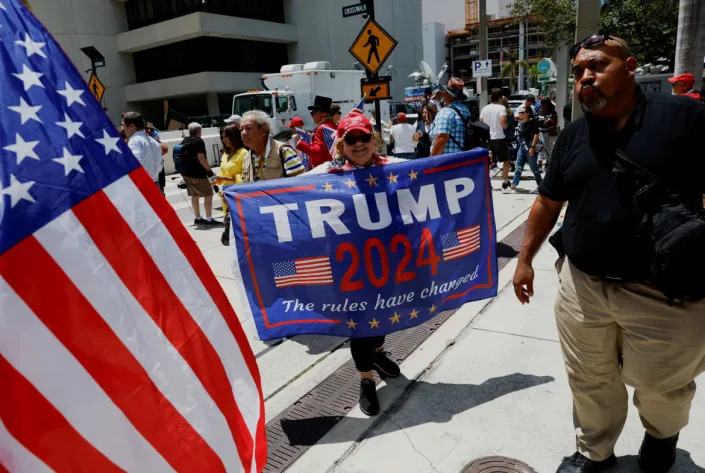
MIAMI, Florida—Protesters assembled outside the federal courthouse here on Tuesday to express their support for former President Donald Trump—to fly the Trump colors and show prosecutors that they’re up against a MAGA army.
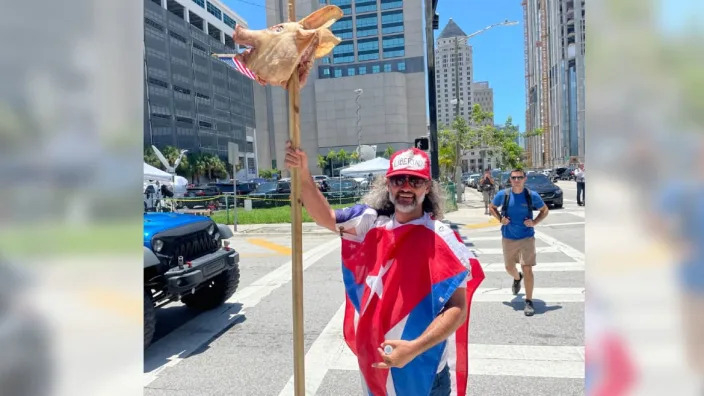
But if protesters sought to show unity and organization, what they accomplished was a disorganized display of MAGA spectacles, flaunting a pig’s head on a pike and getting the street shut down over an abandoned television.
Trump was arraigned on Tuesday afternoon for 37 counts related to his alleged mishandling of classified documents. On social media, Trump called on fans to come to Miami for his court appearance. “SEE YOU IN MIAMI ON TUESDAY!!!” he wrote. But turnout was modest on Tuesday morning, despite efforts by pro-Trump figures like rapper Forgiato Blow to gin up attendance for a 10 a.m. rally.
“What I like about this, we been supporting Trump since day one and never switch up on Donald Trump, man what’s up. DeSant-heads need to get out here and get with Trump,” Blow (real name Kurt Jantz) said in a video outside the courthouse on Tuesday, referencing Trump’s GOP rival and Florida’s governor, Ron DeSantis.
Blow’s attendance was not purely political. The prolific novelty rapper, who frequently releases songs timed to conservative news items, is promoting a new song called “Trump Indictment” and on Monday tweeted a picture of himself wearing a signboard with a QR code for a download of the tune.
“See Everyone Tomorrow Help Us Get #TrumpIndictment To #1 On iTunes,” Blow tweeted, promoting both the track and the protest against Trump’s second felony arraignment this year.
Other eccentric characters also turned up early to the courthouse.
Osmany Estrada, 40, proudly donned an American and Cuban flag as he paraded around the courthouse with a pig’s head on a pike, posing for photos with anyone who asked, but mostly dodging TV crews that swarmed him.
Like many others who weathered blistering heat and humidity to sing Trump’s praises, Estrada said he was confident the former president would quickly be found not guilty. He said he became even more certain of a Trump victory when Judge Aileen Cannon, a Trump appointee, was selected to preside over the case.
“She’s one of us,” Estrada said, referencing Cannon’s Cuban heritage. “We already know what’s going to happen—this corruption won’t stand. Everyone here knows that. That’s why you see so many smiles. We’re all just enjoying this beautiful moment before we win again.”
Estrada, who says he came to Miami on a raft from Cuba in 1992, was one of the first protesters to arrive Tuesday morning, sticking around as the crowd of Trump supporters grew into the hundreds by 1 p.m.—a far cry from the thousands expected by Trump and Miami cops. Until noon, protesters were outnumbered by journalists and dozens of cops who carried assault rifles as they circled the area.
Estrada said he didn’t have a good reason for carrying around a pig’s head on a pike, but confirmed the dead animal was real.
“Sometimes you just have to be bold,” he said.
The crowd was smaller than anticipated.REUTERS/Marco Bello
Vivek Ramaswamy, a longshot Republican presidential candidate, gave a Tuesday morning speech in which he pledged (if elected president) to pardon Trump.
Meanwhile, Tim Gionet, a far-right personality who goes by “Baked Alaska,” live streamed himself outside the courthouse on Tuesday. Gionet was recently released from prison, where he was serving 60 days for his participation in the Jan. 6 Capitol attack. (He was also found guilty last year of defacing a Hanukkah display. “No more Happy Hanukkah, only Merry Christmas. This is a disgrace,” Gionet said in a live stream of the vandalism.)
At least one member of the far-right group the Proud Boys was in attendance. A Telegram channel for the group Villain City Proud Boys uploaded a video from the grounds, although the group did not appear to have a uniformed presence on Tuesday morning. (The Villain City Proud Boys are a splinter faction of Miami’s longer-standing Vice City Proud Boys, which disavows the former group and calls it illegitimate.)
Lauren Witzke, a far-right conspiracy theorist who unsuccessfully ran for U.S. Senate in Delaware, also live-streamed from a demonstration organized by anti-Muslim activist Laura Loomer. During her live stream, she wondered out loud if “federal agents” were undercover at the courthouse protests. “Let’s count the FBI in this protest,” read a sign carried by a pro-Trump protester she interviewed. Witzke later contemplated if the man holding the sign—which had toy-water guns attached—was a “fed” himself.
Witzke, an ally of white-nationalist Nick Fuentes, soon grew tired of covering the lackluster Loomer protest and turned her attention to trolling the media.
“Is CNN here?” she asked on the stream, adding, “Oh shoot, I forgot I was streaming, oops.”
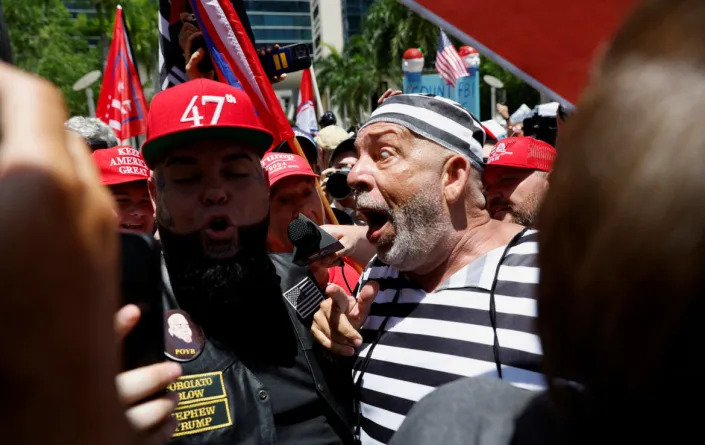
Supporters and anti-Trump demonstrators faced off outside the courthouse.REUTERS/Marco Bello
Various factions of Trump fans scheduled courthouse protests over the course of the day. Loomer’s event was slated to start at noon. A convoy of four buses, organized by the Florida Republican Assembly, arrived at 2 p.m.
Toward the beginning of the rally, Loomer claimed that Trump’s team had called her on Tuesday morning to express their support for her event.
“President Trump, his staff called me this morning,” Loomer yelled. “President Trump is grateful for the rally. His staff personally called me and said they were with President Trump this morning, and he wants to thank everybody for coming out today. They are very happy that this rally is taking place. They want it peaceful.”
“President Trump is very grateful that we are out here today,” she added.
Trump spokesman Steven Cheung didn’t return The Daily Beast’s request for comment on Loomer’s claim.
Loomer had good reason to talk up Trump’s support for her efforts, as The Daily Beast reported Monday evening that Trump’s own advisers thought protests outside of the Miami courthouse were a bad idea.
“I would hope it’s not a protest,” one Trump adviser told The Daily Beast.
A law enforcement officer inspects a suspicious device found near the courthouse.REUTERS/Brendan McDermid
Even before the rally, Trump’s aides attempted to distance themselves from Loomer and the Roger Stone-promoted event.
“Anybody we’ve heard from at the campaign, it’s been somebody who just wants to come and be supportive of the president,” the Trump adviser added before attempting to make clear that the official Trump campaign wanted no part in any demonstrations.
But despite the worry from inside Trump’s inner circle, in the end, with low turnout numbers, Trump supporters found a familiar boogeyman.
“I think MAGA has to be beyond cautious and weary [sic] of Feds creating another trap like Jan 6,” Trump ally Jackson Lahmeyer told The Daily Beast.
While MAGA supporters were busy contemplating who among them might be federal agents, law enforcement tended to a much more serious concern.
The modest crowd was briefly asked to leave part of the courthouse grounds after law enforcement expressed concerns about an unattended package. The suspicious item was a TV with writing on it, apparently planted by Trump fans, Miami New Timesreporter Naomi Feinstein tweeted. Police removed the TV and allowed demonstrators back onto the property.
I mean, what kind of country have we become? One in which federal prosecutors can take “evidence” before a “grand jury,” and that grand jury can “vote to indict” a former president for 37 alleged “crimes”? Look at all the other people out there in America, including Democrats like Hillary Clinton and President Joe Biden, who HAVEN’T been indicted for crimes on the flimsy excuse that there is no “evidence” they did crimes. THAT’S TOTALLY UNFAIR!
It’s like Republican Virginia Gov. Glenn Youngkin wrote in a tweet Friday: “These charges are unprecedented and it’s a sad day for our country, especially in light of what clearly appears to be a two-tiered justice system where some are selectively prosecuted, and others are not.”
What kind of country holds a president accountable for alleged crimes a grand jury charges him with?
TWO TIERS! One tier in which President Trump keeps getting indicted via both state and federal justice systems and another in which the people I don’t like keep getting not indicted via all the things Fox News tells me they did wrong.
It’s like America has become a banana republic, as long as you do as I’ve done and refuse to look up the definition of “banana republic.”
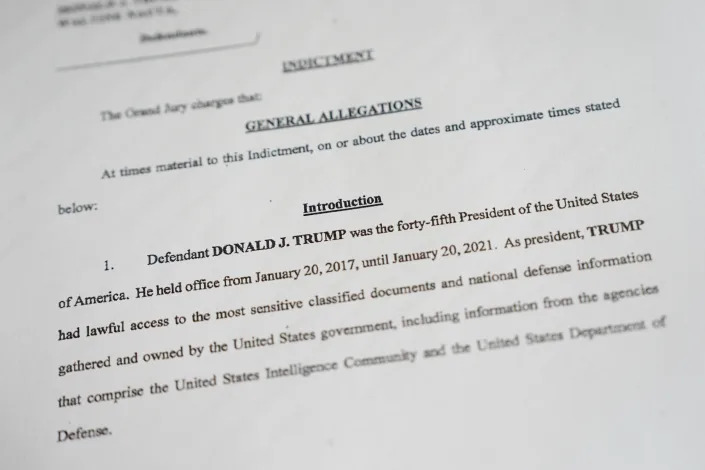
A copy of the indictment of former President Donald Trump and Trump aide Walt Nauta, brought by the U.S. Justice Department. They’re charged with dozens of counts of allegedly violating eight federal statutes related to the handling of classified documents after the former president left the White House, according to the 44-page indictment unsealed June 9, 2023.More
Regardless of the Trump indictment, it’s clear this is all Biden’s fault
And of course, you know who’s behind this travesty of justice, right? It’s so-called President Biden, who is both frail and senile and also a laser-sharp master at conducting witch hunts.
Former President Donald Trump greets supporters in Grimes, Iowa, on June 1, 2023.
Sure, they’ll tell you that the indictment came via a special counsel investigation, and that the federal special counsel statute keeps such investigations walled off from political influence.
But that’s complete nonsense, unless we’re talking about special counsel John Durham, who was appointed by Attorney General Bill Barr while Trump was president and tasked with investigating the NEFARIOUS LEFT-WING CRIMES committed in the Trump-Russia probe. Durham was above reproach, and the fact that The New York Times reported he “charged no high-level F.B.I. or intelligence official with a crime and acknowledged in a footnote that Hillary Clinton’s 2016 presidential campaign did nothing prosecutable, either” is something I will ignore.
This is a WITCH HUNT, and I believe that because Trump said so!
Current special counsel Jack Smith, on the other hand – he’s bad news. I know this because Trump has said repeatedly that Smith’s investigation is a witch hunt, and I’ve never known Trump to lie about anything.
Keep in mind, in 2016, Trump said: “I’m going to enforce all laws concerning the protection of classified information. No one will be above the law.”
This image, contained in the indictment against former President Donald Trump, shows boxes of records stored in a bathroom and shower in the Lake Room at Trump’s Mar-a-Lago estate in Palm Beach, Fla. Trump is facing 37 felony charges related to the mishandling of classified documents according to an indictment unsealed Friday, June 9, 2023.More
So after he said that, you expect me to believe he didn’t protect classified information? Just because, according to the indictment, there’s a recording of him holding a classified document in his office at his club in Bedminster, New Jersey, and saying to two staff members and an interviewer: “See, as president I could have declassified it. … Now I can’t, you know, but this is still a secret.”
You call that “damning evidence.” I call it, “What about Hunter Biden’s laptop?”
Putting Joe Biden, Hillary Clinton and Hunter Biden in prison? Now THAT makes sense!
Now I can already hear all the libs out there whining and saying that if it were Biden or Hillary or Hunter getting indicted, I wouldn’t be saying a word about two tiers of justice or the weaponization of the Department of Justice or anything like that.
The notably non-indicted President Joe Biden.
Well, those whiners would be right, but the difference is I believe Biden and Hillary and Hunter are all guilty and should be locked up for life, whereas with Trump, I believe he is great and innocent and the best president America has ever known.
It’s like this: If Hillary got indicted for murder, I would say, “Yes, she is absolutely a murderer. Lock her up.”
But if in some outrageous scenario President Trump were indicted for murder just because he told a bunch of people that he did a murder, I would say: “HOW DARE YOU CHARGE THIS MAN WITH MURDER WHEN OTHERS IN THE U.S. HAVE NOT BEEN CHARGED WITH MURDER! THERE ARE CLEARLY TWO TIERS OF JUSTICE, ONE IN WHICH MY FAVORITE PRESIDENT, WHO SAID HE MURDERED SOMEONE, IS CHARGED WITH MURDER AND ONE IN WHICH PEOPLE WHO HAVEN’T MURDERED ARE NOT CHARGED WITH MURDER!”
And that, my liberal friends, makes perfect sense to me and my MAGA companions. So watch out. The Trump Train’s a comin’.
Federal indictments against Trump are not a turning point.
By Neil Steinberg – June 11, 2023
Donald Trump addressed the North Carolina Republican state convention on Saturday, two days after becoming the first former U.S. president indicted on federal charges.
This Friday, June 16, marks many things. It’s Bloomsday, the day in 1904 when the entirety of James Joyce’s great novel, “Ulysses” takes place. It’s also my parents’ anniversary — 67 years and still going strong. (Happy anniversary, Mom and Dad!) And my younger son’s birthday.
It’s also the date in 2015 when Donald John Trump descended that escalator in the vomit-colored lobby of Trump Tower in New York City, declared himself a candidate for president and promised to save this country from the twin perils of Mexican immigrants and Muslims.
Eight years. Three thousand days, most of which saw Donald Trump twirling like a demented ballerina in drippy orange makeup in the spotlight of American life. From that introductory moment — the first words out of his mouth a lie, natch, inflating the few dozen people present into “thousands” — to last week, when he was indicted by federal authorities on 37 counts related to seven charges under the Espionage Act.
What a strange, terrible time in American history. Sometimes I consider it punishment for, having missed the tumult of the 1960s, wishing I could have lived in a momentous era of American history when great issues were being resolved. I take it back.
No time for regret now. Not with Trump followers urging violence at the prospect of his being prosecuted for his crimes. Not when they question the value of law enforcement before they’ll ever question their Chosen One.
Trump certainly will never pause from lying. Why would he? The lies work. The federal case, outlining his betrayal of national interest and endangering our security by exposing America’s military secrets to her enemies, was instantly shrugged off. Republicans have honed a variety of survival skills — perpetual imaginary victimhood, look-a-squirrel whataboutism, but-the-trains-run-on-time tunnel vision — allowing them to instantly ignore anything Trump does, did, or ever could do.
If Republicans are in a trance, so are Democrats. Because we keep waiting for Republicans to wise up.
“It has become impossible to ignore Trump’s many transgressions over the years,” the Sun-Times said in an editorial Sunday. At the risk of contradicting the editorial board, that’s a complete inversion of the situation. It is not impossible to ignore Trump’s crimes. Rather, it is mandatory, among his followers. Ignoring Trump’s misdeeds is not a flaw, but a feature.
To toss out another date: Jan. 6, 2021. Trump goaded a mob to assault the Capitol trying to overturn a free and fair American election. If that didn’t shake his followers awake to the peril, what is going to now? This latest indictment?
If they can laugh off Jan. 6, what can’t be chuckled at? His being ordered to pay $5 million for slandering the woman who claimed Trump raped her boosted his poll numbers.
His millions of followers are never going to be disillusioned with Trump, just as 40% of Russians approve of Joseph Stalin, the millions starved or pact with Hitler notwithstanding. A hundred years from now, Trump will be a revered figure, like Jesus, and for the same reason: the need to worship something. Charges, investigations, convictions, are just the Romans lashing their savior as he drags his cross to Calvary.
Jan Plemmons, of Columbus, Ga., waits at a private airfield for former President Donald Trump’s arrival in Georgia on Saturday.
Wake up. Liberal do-gooders are constantly calling upon values that just aren’t there. Remember former Ald. Leon Despres (5th), nicknamed the “conscience” of the Chicago City Council? Paddy Bauler, his notoriously corrupt Council colleague, once said to him: “Leon, the trouble is you think the whole thing’s on the square.”
The trouble with Democrats is they think the whole thing’s on the square. Still. Despite everything that has happened over eight years. We’ve learned nothing, and must start learning, fast. Time to stop invoking decency that isn’t there. If we are to continue to be a nation of laws, votes and varied voices, we must see the Trump menace for what it is: the gravest threat our nation has faced. The peril isn’t weakening; it’s growing stronger.
Someday, should America survive the Trump onslaught and become great enough to view history clearly, perhaps June 16 can become kind of a semi-official Day of Infamy, like Dec. 7 and Sept. 11. A cautionary tale for future generations. Not that we are anywhere near that safe perch where we can look back on the nightmare. Rather, we are in the thick of it, with more, maybe worse shocks to the American spirit speeding toward us.
Stunning details in Trump indictment show the importance of getting case right
The laws governing the handling of secret documents are there for a reason: to keep the country safe. Former President Donald Trump has been charged with egregiously violating those laws, and a just resolution to this case is important for America’s future.
Chicago Suntime’s Editorial Board – June 9, 2023
People demonstrate in front of the White House after Special Counsel Jack Smith delivered remarks about the unsealed federal indictment against former President Donald Trump on Friday.
Critical times of reckoning define nations’ identities far into the future.
The United States is at such a crossroads, brought to this point by the egregious actions of former President Donald Trump. It has become impossible to ignore Trump’s many transgressions over the years but still assure America is seen, by both its residents and other nations, as a place where rule of law prevails — where no one, not even presidents or former presidents, is granted the royal privilege to do as they like, without regard to laws others must obey.
“We have one set of laws in this country, and they apply to everyone,” as Special Counsel Jack Smith, who led the investigation into Trump’s mishandling of secret documents, said in a brief statement Friday.
Hours earlier, a detailed 49-page indictment was unsealed by the Justice Department accusing Trump of 37 felony counts of withholding top secret and other documents, refusing to return them, hiding the documents and lying about it. The indictment says Trump and aide Walt Nauta moved boxes with documents before one of his attorneys could review them and then concealed that fact. Nauta is charged with six counts.
Among the devastating accusations: Upon leaving office, Trump allegedly took documents related to the military capabilities of the United States and other nations, information about America’s nuclear program and other important documents, then stored them at low-security, porous Mar-a-Lago, where all sorts of people wandered around, including possibly foreign intelligence individuals.
Shockingly, some boxes of documents sat at one point unsecured on a ballroom stage at Mar-a-Lago and in other unsecured locations, including a shower and Trump’s bedroom. According to the indictment, Trump, while at his Bedminster, New Jersey, golf club, showed a military map of a country with an ongoing military operation to a political action committee member who didn’t have security clearance.
Trump took documents from seven different departments and intelligence agencies, among them the CIA, the NSA and the Department of Defense. The sensitivity of the documents Trump took is stunning.
Could foreign agents have accessed those documents? No one knows. If that did happen, no one knows how much damage has been done or how much the nation has been put at risk.
The laws governing the handling of secret documents are there for a reason. As Smith said, “Violations of those laws put our country at risk.”
The indictment also contains evidence that Trump knew he was violating the law. At one point, he said, “This is secret information. Look. Look at this.” He knew it was secret and yet invited a writer without security clearance to look at it anyway.
And tellingly, the indictment also points out six instances in which Trump noted the importance of protecting classified information — five times speaking publicly and once in a written statement.
Multiple investigations, lawsuit settlements
Trump has a long history of acting at though the law does not apply to him. In March, he was indicted on 34 counts in New York for allegedly falsifying business records, a felony, in connection with hush money payments to porn star Stormy Daniels.
He was impeached, but not convicted, for trying to get Ukraine to announce an investigation of Joe Biden.
He is under investigation in Georgia for allegedly trying to overturn that state’s results in the 2020 presidential election. He is under investigation by Smith for allegedly inciting an attempted coup on Jan. 6., 2021, at the U.S. Capitol. He was impeached a second time for his conduct on Jan. 6.
Last year, two Trump Organization companies were found guilty on multiple counts of criminal tax fraud. In May, a New York jury found against Trump in a sexual abuse and defamation case filed by author, journalist and advice columnist E. Jean Carroll. In 2018, his Trump University settled for $25 million claims by students who said they were defrauded.
The list goes on and on. Trump’s disregard for the law also can be seen in the number of his political allies and members of his administration who have been indicted. His was a reign of the swamp.
Even now, many Republicans and Trump supporters are trying to explain everything away, absurdly claiming the damning evidence is just a conspiracy to pursue Trump, despite his clearly reckless behavior. There’s also the scary prospect that some of his supporters might threaten those connected to the investigation, an ugly scenario that has happened before. Trump set the pattern on Friday by calling Smith a “deranged lunatic.”
But waving away the abuses alleged in the indictment sets an unacceptable precedent — in effect, green-lighting more legal abuses by future presidents. And imagine, in such scenarios, abuses that are perhaps even more flagrant, scandalous and dangerous than those in this indictment.
The United States is at a pivotal moment in its history. The world is watching. A just resolution of this case, based on the evidence and the law, is imperative.
In Bones of Crows, Grace Dove found healing among the heaviness
Prince George, B.C., actor says she got into the craft to share hard stories
CBC News – June 10, 2023
Starring as Aline Spears, Grace Dove in Bones of Crows plays a Cree woman who navigates her trauma from the residential school system. (TIFF)
After a decade in the acting industry, Grace Dove knows why she chose this field.
“I really believe I became an actor and a storyteller to share hard stories,” she told CBC’s Eli Glasner.
Dove stars as Aline Spears in Bones of Crows, a film written and directed by Marie Clements.
The film follows a Cree woman’s journey from her childhood to old age as she navigates trauma from her time in the residential school system. WATCH | Grace Dove talks about handling difficult subject matter:
Bones of Crows star Grace Dove says she became an actor ‘to share hard stories’
Dove says both heaviness and healing were involved in making the upcoming film and mini-series that deals with intergenerational trauma and residential schools.
As with any role, there’s research involved.
“I have to do the homework. I have to study about World War II. I have to study about code talking,” Dove said. “I have to study about even being a Cree Indigenous person. I’m Secwépemc, so that brings so much to learn about.”
And an actor, she says there’s something from within that she must also bring to the role.
“I have to bring a piece of me,” she said. “Especially when it comes to Indigenous representation, when it comes to Indigenous films, this is my story. This is my family story. So there is so much heaviness to it.”
“But also it’s so healing, and I think that every role I do, it really brings out what I need to almost let go.”
Dove says she gave a piece of herself to her character, Aline Spears, in the film. (CBC)
She says Bones of Crows is another way to address a subject where some may want to look away.
“I think there’s a time and place for films about love, a rom-com. And we will see that,” she said. “I hope for more of that, that we have more light Indigenous cinema, but … we can’t do that yet until the truth is out there.”
Expanded series
Bones of Crows will also be a five-part limited series on CBC and APTN beginning Sept. 20. The story will expand on the feature film, with a broader focus on Spears’ relatives over the span of 100 years.
“I think the most important message that I took away is, what happens to you and how you deal with those adversities is going to last for, we say seven generations,” Dove said.
“It really shows the impact generation by generation and I think that’s what the series is really going to delve into.”
Dove grew up in Prince George, B.C. She says Bones of Crows can help educate young people and anyone else about the traumas that Indigenous people still face today. (Matt Sayles/ABC)
The breadth of the project meant a large cast, many of whom came to the production with lengthy resumes.
“We’ve had so many Indigenous creatives fighting for us to be here, for me to be here, and so it’s just constantly passing the torch and getting better every time,” she said.
Dove had a breakthrough role in the 2015 film The Revenant, playing the wife of Leonardo DiCaprio’s character Hugh Glass. DiCaprio is starring in the upcoming Killers of The Flower Moon, from director Martin Scorcese, which centres around the Osage Nation in Oklahoma.
She says she was in the running to be cast in that film and met Scorcese.
“I think it would be weird if me and Leo got married again, especially, you know when it happens eventually in real life as well,” she joked.
Lessons for the audience
There’s a practical lesson Dove wants viewers to take from Bones of Crows.
“I hope that audiences can walk away and think about their actions, and think about the way that they treat people. Because the way that you treat someone today might affect their family for generations,” she said.
“It just comes back to human kindness, and seeing people for real people.”
ABOUT THE AUTHOR
Joseph Pugh is a writer with the Entertainment department at CBC News. Prior to joining CBC he worked with the news department at CHLY, Nanaimo’s Community radio station, and taught math at Toronto’s Urban International School. He can be reached at joseph.pugh@cbc.ca
Trump: I have been indicted in classified documents case
Possible charges could include a violation of the Espionage Act.
David Knowles, Senior Editor – June 8, 2023
Donald Trump at a campaign event in Waco, Texas, March 25. (Evan Vucci/AP)
Former President Donald Trump announced on Thursday evening that his attorneys had been informed that he had been indicted by the federal government for alleged crimes stemming from his handling of classified documents after leaving the White House in early 2021.
“The corrupt Biden Administration has informed my attorneys that I have been Indicted, seemingly over the Boxes Hoax,” Trump wrote on his social media website, Truth Social, adding, “I have been summoned to appear at the Federal Courthouse in Miami on Tuesday, at 3 PM. I never thought it possible that such a thing could happen to a former President of the United States.”
Reuters, ABC News and the Associated Press confirmed that Trump had been indicted on seven criminal counts in relation to his handling of the documents, his second indictment in as many months. The National Archives and the FBI sought to retrieve the classified documents before issuing a subpoena last spring for their return.
Possible Espionage Act charge
Among the charges that will be made public Tuesday, Trump will be accused of violating the Espionage Act, according to reporting from the New York Times. The act prohibits the unauthorized possession of national defense-related documents and makes special mention of those that are “willfully retained” despite government efforts to retain them. If convicted on that charge alone, Trump, 76, could face a sentence of 10 years behind bars.
Justice Department stays mum
Attorney General Merrick Garland. (Nathan Howard/AP)
The Justice Department did not issue a statement about the latest indictment or the specific charges it would contain, the AP reported. Two people familiar with the case but who are not authorized to speak publicly about it, confirmed to the outlet that prosecutors had contacted Trump’s lawyers on Thursday to inform them of the indictment.
President Biden at the White House on Thursday. (Manuel Balce Ceneta/AP)
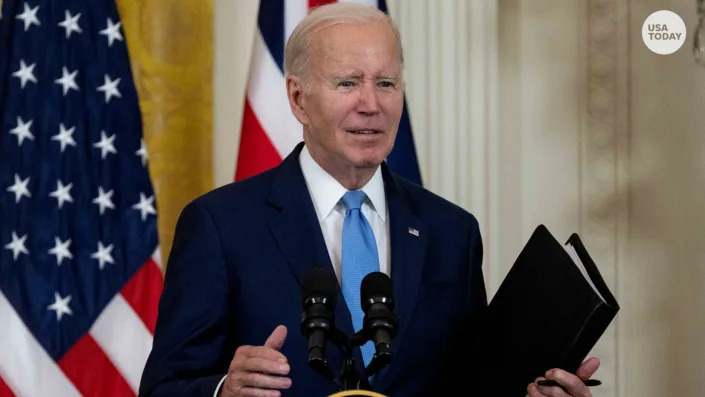
While Trump sought to frame the indictments as politically motivated, President Biden was asked Thursday why Americans should have faith that the Justice Department was acting in accordance with the law.
“Because you’ll notice I have never once, not one single time, suggested to the Justice Department what they should do or not do, relative to bringing a charge or not bringing a charge. I’m honest,” Biden responded.
What Trump’s GOP rivals have said about another possible indictment
Prior to the indictment, some of Trump’s Republican rivals for the GOP presidential nomination weighed in on the possibility of a second round of criminal charges against the former president.
Trump’sformer vice president, Mike Pence, who announced his own presidential candidacy on Wednesday, said in an interview that he hoped that the DOJ would not indict Trump.
“I would hope the Department of Justice did not move forward. Not because I know the facts, but simply because I think after years where we’ve seen a politicization of the Justice Department is to undermine confidence in equal treatment of the law,” Pence said on the campaign trail in Iowa.
But Pence issued somewhat contradictory statements on a possible Trump indictment, stating that “no one’s above the law.”
Former New Jersey Gov. Chris Christie said he would wait to see what the charges against Trump consisted of, but made clear that Trump had himself to blame if he was charged for his mishandling of the documents.
“The problem with all of this is that it’s self-inflicted. In the end, I don’t know that the government even knew that Joe Biden had those documents or not,” Christie, a former U.S. attorney, told Fox News, drawing a distinction between a Justice Department investigation into classified documents found at Biden’s home. “They did know Donald Trump did and in fact asked voluntarily for them for over a year and a quarter and got them back in dribs and drabs.”
Former Arkansas Gov. Asa Hutchinson was more succinct, saying Trump should “step aside” if indicted in the documents case.
Sen. Tim Scott, R-S.C., said the DOJ was guilty of weaponizing its investigation and that the “the determining factor for the 2024 election should be the voters,” ABC News reported.
Will the indictment hurt Trump?
Former President Donald Trump at ta campaign event in Des Moines, Iowa, June 1. (Charlie Neibergall/AP)
While an April Yahoo News/YouGov poll taken after Trump’s first indictment in New York on charges stemming form his alleged hush money payment to porn star Stormy Daniels show that Trump had solidified his support among Republican voters, it remains to be seen how a second indictment will play out with his party.
Trump wasted little time in using the news of his latest indictment to try to boost his standing.
“This is indeed a DARK DAY for the United States of America. We are a Country in serious and rapid Decline, but together we will Make America Great Again!” he wrote on Truth Social.
His campaign also jumped into action, seeking to fundraise off the latest news.

 People wait in line for food at the annual Thanksgiving in the Park gathering where residents of the farmworker community of Immokalee are provided with a free Thanksgiving meal. (Photo by Spencer Platt/Getty Images)