North Carolina GOP bars promotion of certain beliefs in state government, 1 of 6 veto overrides

Associated Press

North Carolina GOP bars promotion of certain beliefs in state government, 1 of 6 veto overrides

Gary D. Robertson – June 27, 2023

FILE – Democratic North Carolina Gov. Roy Cooper speaks to The Associated Press in a year-end interview at the Executive Mansion in Raleigh, N.C., Dec. 14, 2022. On Friday, June 16, 2023, Cooper vetoed GOP legislation that would ban the promotion of certain beliefs that some lawmakers have likened to critical race theory in state government workplaces. (AP Photo/Hannah Schoenbaum, File) (ASSOCIATED PRESS)

RALEIGH, N.C. (AP) — North Carolina’s GOP-dominated legislature swept six bills into law Tuesday with veto overrides, including one barring promotion of certain beliefs in state government workplaces that some lawmakers liken to critical race theory and another placing new limits on wetlands protection rules.

The measures, which also address green investing in state government, consumer loans and local government finances, became law after a succession of votes with margins large enough to overcome Democratic Gov. Roy Cooper’s formal vetoed objections earlier this month.

Five of the veto overrides were completed Tuesday with House votes, which followed several similar Senate votes over the past week. A sixth veto override effort cleared both the House and Senate on Tuesday.

The state constitution deems an override successful if at least three-fifths of the members in each chamber present and voting agree to enact the bill anyway despite the governor’s objections.

The overrides exemplify the expanded political muscle of Republicans after electoral seat gains last fall and a House Democrat’s party switch in April gave them exact veto-proof majorities in each chamber for the first time since late 2018. Cooper had been able to block several dozen GOP measures over the previous four years with vetoes because there were enough Democrats supporting his efforts.

Several of Tuesday’s override votes in the House included support from a few Democrats. Still, Republicans needed to ensure that enough of their party colleagues were in attendance to complete overrides.

Among the bills enacted Tuesday is the legislature’s annual farm bill, which contains more than 30 provisions such as penalties for cutting down timber, waiting periods for regulators to inspect veterinarians’ offices and the establishment of an official “Farmers Appreciation Day” in November.

Cooper’s farm bill veto came Friday. He said the measure would weaken the regulation of wetlands that help control flooding and pollution. His administration and environmental groups have said the bill’s language, when combined with a recent U.S. Supreme Court decision, would leave about half of the state’s wetlands unprotected.

Republicans and their allies blunted the impact of the bill’s language on wetlands, saying it would affect largely affect isolated terrain that rarely floods and align standards with federal law.

Another now-enacted law that takes effect in December bans trainers of state employees from advancing concepts to workers such as that “one race or sex is inherently superior to another race or sex,” or to believe they should feel guilty for past actions committed by people of the same race or sex. It also would prohibit hiring managers for state agencies, community colleges and the University of North Carolina system from compelling applicants for policy-making jobs to reveal their personal or political beliefs as a condition of employment.

In his veto message, Cooper said the bill attempts to suppress workplace discussions related to diversity, equity and inclusion that can reveal “unconscious bias we all bring to our work and our communities.” But supporters of the bill said it actually encourages a diverse set of beliefs within public agencies.

Both the House and Senate voted Tuesday to override the veto of a measure that now ban state agencies from using “environmental, social and governance” standards to screen potential investments, award contracts or hire and fire employees.

On state investments like those in pension funds, the bill says the state treasurer could solely consider factors expected to have a material effect on the financial risk or financial return of an investment.

At least two other states have already enacted laws banning such criteria. Republicans nationwide has raised questions about big business focusing upon environmental sustainability and workplace diversity so much that it harms shareholders and pensioners.

Cooper said in his veto message late week that the measure would needlessly limit the treasurer’s ability to make investment decisions that are in the best interests of the state retirement fund.

Other bills enacted over Cooper’s vetoes in part would raise interest rates and late fees on certain amounts of personal consumer finance loans as well as on consumer credit sales, such as when someone buys a car and pays for it in installments or with a finance charge. Cooper said the higher costs, which would take effect in October on new, renewed or modified loans, would harm residents who already are faced with rising costs of living.

Another bill with a veto now overridden would permit the state’s Local Government Commission to order withheld a portion of sales tax revenues the state collects for cities and counties that fail to complete annual audits of their accounts. Bill supporters said the measure will promote government accountability. Cooper said it was well-intentioned but would likely hurt the state’s smallest communities.
Major Cuts to Social Security Are Back on the Table — What’s Being Proposed Now?

Go Banking Rates

Major Cuts to Social Security Are Back on the Table — What’s Being Proposed Now?

 
Vance Cariaga – June 22, 2023

Shutterstock / Shutterstock

A group of Republican lawmakers aims to balance the federal budget and slash government spending by targeting programs like Social Security — and some seniors could see a major reduction in lifetime benefits if the plan makes it into law.

See: I Lost $400K of My Retirement Savings in a Roth 401(k) — If You’re Not Careful, You Could, Too
Find: 3 Ways To Recession-Proof Your Retirement

The proposal was unveiled June 14 by U.S. House conservatives, Bloomberg reported. One of its main features is to raise the full retirement age (FRA) at which seniors are entitled to the full benefits they are due.

The 176-member House Republican Study Committee (RSC) approved a fiscal blueprint that would gradually increase the FRA to 69 years old for seniors who turn 62 in 2033. The current full retirement age is 66 or 67, depending on your birth year. For all Americans born in 1960 or later, the FRA is 67.

As Bloomberg noted, workers expecting an earlier retirement benefit will see lifetime payouts reduced if the full retirement age is raised. Those payouts could be drastically reduced for seniors who claim benefits at age 62, when you are first eligible.

Lawmakers on both sides of the political aisle have been working to come up with a fix for Social Security before the program’s Old Age and Survivors Insurance (OASI) Trust Fund runs out of money. That could happen within the next decade or so. When it does, Social Security will be solely reliant on payroll taxes for funding — and those taxes only cover about 77% of current benefits.

While most Democrats want to boost Social Security through higher payroll taxes or reductions to benefits for wealthy Americans, the GOP has largely focused on paring down or privatizing the program.

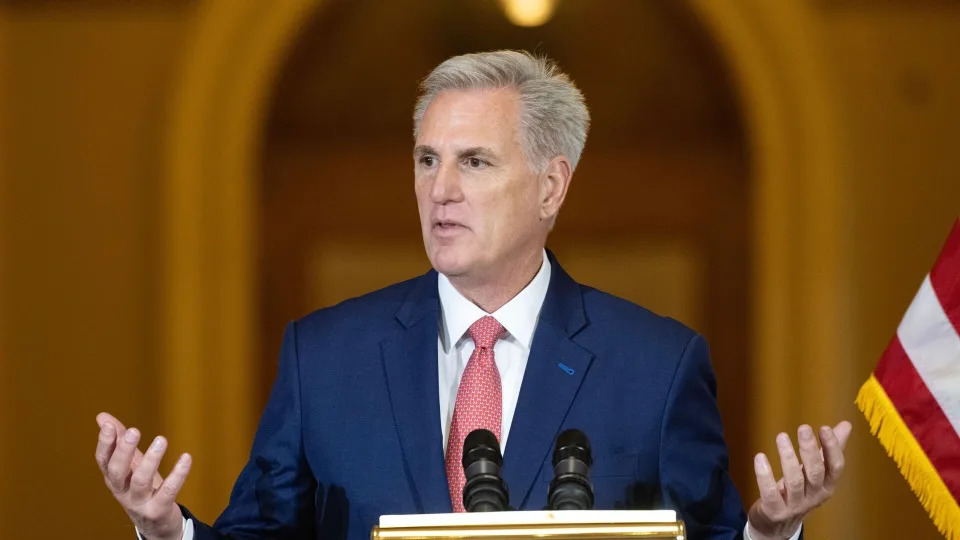
As previously reported by GOBankingRates, House Speaker Kevin McCarthy (R-Calif.) recently told Fox News that this month’s debt limit bill was only “the first step” in a broader Republican agenda that includes further cuts.

“This isn’t the end,” McCarthy said. “This doesn’t solve all the problems. We only got to look at 11% of the budget to find these cuts. We have to look at the entire budget. … The majority driver of the budget is mandatory spending. It’s Medicare, Social Security, interest on the debt.”

As Bloomberg noted, Republicans argue that failing to change Social Security could lead to a 23% benefit cut once the trust fund is depleted. Raising the retirement age is a way to soften the immediate impact. The RSC said its proposal would balance the federal budget in seven years by cutting some $16 trillion in spending and $5 trillion in taxes.

“The RSC budget would implement common-sense policies to prevent the impending debt disaster, tame inflation, grow the economy, protect our national security, and defund [President Joe] Biden’s woke priorities,” U.S. Rep. Ben Cline (R-Va.), chairman of the group’s Budget and Spending Task Force, told Roll Call.

Democrats were quick to push back against the proposal.

“Budget Committee Democrats will make sure every American family knows that House Republicans want to force Americans to work longer for less, raise families’ costs, weaken our nation, and shrink our economy — all while wasting billions of dollars on more favors to special interests and handouts to the ultra-wealthy,” U.S. Rep. Brendan Boyle, (D-Pa.), the Budget Committee’s top Democrat, said in a statement.

Social Security: No Matter Your Age, Do Not Claim Benefits Until You Reach This Milestone
Retirement Savings: Here’s How Much Cash Baby Boomers Need To Retire in the Next 5 Years

Meanwhile, White House Press Secretary Karine Jean-Pierre issued a statement saying the RSC budget “amounts to a devastating attack on Medicare, Social Security, and Americans’ access to health coverage and prescription drugs.”

Although the proposal might make it through the GOP-led House, it’s unlikely to become law – at least while Biden is still president. Even if a bill somehow got approved by the Democrat-controlled Senate, Biden would almost certainly veto it.

Trump Melts Down as DOJ Turns Over Evidence It Plans to Use Against Him

Rolling Stone

Trump Melts Down as DOJ Turns Over Evidence It Plans to Use Against Him

Ryan Bort – June 22, 2023

Donald Trump fired off a series of desperate pleas on Truth Social, including multiple appeals to Congress to bail him out, hours after news broke that the Justice Department had turned over the first batch of evidence it plans to use against him. The former president was indicted earlier this month on charges related to his handling of classified material after leaving the White House.

“CONGRESS, PLEASE INVESTIGATE THE POLITICAL WITCH HUNTS AGAINST ME CURRENTLY BEING BROUGHT BY THE CORRUPT DOJ AND FBI, WHO ARE TOTALLY OUT OF CONTROL,” Trump wrote Thursday morning.

The former president also dusted off the idea that the DOJ framed him by planting the classified material at Mar-a-Lago — despite the fact that he’s claimed repeatedly that he somehow declassified the material before bringing it to Florida himself. “Congress will hopefully now look at the ever continuing Witch Hunts and ELECTION INTERFERENCE against me on perfectly legal Boxes, where I have no doubt that information is being secretly ‘planted’ by the scoundrels in charge,” he wrote in another post before griping about his other legal woes.

Trump’s indictment is damning, with the DOJ alleging that the former president knowingly took classified documents to Mar-a-Lago, stored them in unsecure locations, and then conspired to lie to authorities about what he was hoarding while suggesting the material should be destroyed. The indictment also outlines a recording it obtained featuring Trump bragging about having a “secret” plan against Iran.

The evidence the DOJ turned over on Wednesday includes more recordings of the former president, described as “interviews” recorded with his consent. It’s unclear what is on the additional tapes. The evidence also includes grand-jury witness testimony — which means Trump now knows who testified against him and what they said — as well as material obtained through subpoenas.

Trump, understandably, seems pretty nervous. “THIS CONTINUING SAGA IS RETRIBUTION AGAINST ME FOR WINNING AND, EVEN MORE IMPORTANTLY TO THEM, ELECTION INTERFERENCE REGARDING THE 2024 PRESIDENTIAL ELECTION,” he added on Thursday morning. “IT WILL BE THERE UPDATED FORM OF RIGGING OUR MOST IMPORTANT ELECTION. LOOK AT THE POLLS – THEY CAN’T BEAT ME (MAGA!) AT THE BALLOT BOX, THE ONLY WAY THEY CAN WIN IS TO CHEAT. STOP THEM NOW!”

Trump pleaded not guilty to all of the charges against him. The DOJ has asked for a speedy trial, and Judge Aileen Cannon earlier this week told both sides to file all pretrial motions by July 24 while slating the trial to begin on Aug. 14. Trump’s team will almost certainly move to delay the start date as long as possible — maybe even until he can retake the White House and appoint an attorney general who will drop the case.

Russia Sought to Kill Defector in Florida

The New York Times

Russia Sought to Kill Defector in Florida

Ronen Bergman, Adam Goldman and Julian E. Barnes – June 19, 2023

Photographs of Sergei Skripal, a former colonel in Russia’s military intelligence service who was convicted in 2006 for selling secrets to British intelligence, in Moscow, Aug. 28, 2018. (Sergey Ponomarev/The New York Times)

As President Vladimir Putin of Russia has pursued enemies abroad, his intelligence operatives now appear prepared to cross a line that they previously avoided: trying to kill a valuable informant for the U.S. government on American soil.

The clandestine operation, seeking to eliminate a CIA informant in Miami who had been a high-ranking Russian intelligence official more than a decade earlier, represented a brazen expansion of Putin’s campaign of targeted assassinations. It also signaled a dangerous low point even between intelligence services that have long had a strained history.

“The red lines are long gone for Putin,” said Marc Polymeropoulos, a former CIA officer who oversaw operations in Europe and Russia. “He wants all these guys dead.”

The assassination failed, but the aftermath in part spiraled into tit-for-tat retaliation by the United States and Russia, according to three former senior U.S. officials who spoke on the condition of anonymity to discuss aspects of a plot meant to be secret and its consequences. Sanctions and expulsions, including of top intelligence officials in Moscow and Washington, followed.

The target was Aleksandr Poteyev, a former Russian intelligence officer who disclosed information that led to a yearslong FBI investigation that in 2010 ensnared 11 spies living under deep cover in suburbs and cities along the East Coast. They had assumed false names and worked ordinary jobs as part of an ambitious attempt by the SVR, Russia’s foreign intelligence agency, to gather information and recruit more agents.

In keeping with an Obama administration effort to reset relations, a deal was reached that sought to ease tensions: Ten of the 11 spies were arrested and expelled to Russia. In exchange, Moscow released four Russian prisoners, including Sergei Skripal, a former colonel in the military intelligence service who was convicted in 2006 for selling secrets to Britain.

The bid to assassinate Poteyev is revealed in the British edition of the book “Spies: The Epic Intelligence War Between East and West,” to be published by an imprint of Little, Brown on June 29. The book is by Calder Walton, a scholar of national security and intelligence at Harvard. The New York Times independently confirmed his work and is reporting for the first time on the bitter fallout from the operation, including the retaliatory measures that ensued once it came to light.

According to Walton’s book, a Kremlin official asserted that a hit man, or a Mercader, would almost certainly hunt down Poteyev. Ramón Mercader, an agent of Josef Stalin’s, slipped into Leon Trotsky’s study in Mexico City in 1940 and sank an ice ax into his head. Based on interviews with two U.S. intelligence officials, Walton concluded the operation was the beginning of “a modern-day Mercader” sent to assassinate Poteyev.

The Russians have long used assassins to silence perceived enemies. One of the most celebrated at SVR headquarters in Moscow is Col. Grigory Mairanovsky, a biochemist who experimented with lethal poisons, according to a former intelligence official.

Putin, a former KGB officer, has made no secret of his deep disdain for defectors among the intelligence ranks, particularly those who aid the West. The poisoning of Skripal at the hands of Russian operatives in Salisbury, Britain, in 2018 signaled an escalation in Moscow’s tactics and intensified fears that it would not hesitate to do the same on American shores.

The attack, which used a nerve agent to sicken Skripal and his daughter, prompted a wave of diplomatic expulsions across the world as Britain marshaled the support of its allies in a bid to issue a robust response.

The incident set off alarm bells inside the CIA, where officials worried that former spies who had relocated to the United States, like Poteyev, would soon be targets.

Putin had long vowed to punish Poteyev. But before he could be arrested, Poteyev fled to the United States, where the CIA resettled him under a highly secretive program meant to protect former spies. In 2011, a Moscow court sentenced him in absentia to decades in prison.

Poteyev had seemed to vanish, but at one point, Russian intelligence sent operatives to the United States to find him, though its intentions remained unclear. In 2016, the Russian news media reported that he was dead, which some intelligence experts believed might be a ploy to flush him out. Indeed, Poteyev was very much alive, living in the Miami area.

That year, he obtained a fishing license and registered as a Republican so he could vote, all under his real name, according to state records. In 2018, a news outlet reported Poteyev’s whereabouts.

The CIA’s concerns were not unwarranted. In 2019, the Russians undertook an elaborate operation to find Poteyev, forcing a scientist from Oaxaca, Mexico, to help.

The scientist, Hector Alejandro Cabrera Fuentes, was an unlikely spy. He studied microbiology in Kazan, Russia, and later earned a doctorate in the subject from the University of Giessen in Germany. He was a source of pride for his family, with a history of charitable work and no criminal past.

But the Russians used Fuentes’ partner as leverage. He had two wives: a Russian living in Germany and another in Mexico. In 2019, the Russian wife and her two daughters were not allowed to leave Russia as they tried to return to Germany, court documents say.

That May, when Fuentes traveled to visit them, a Russian official contacted him and asked to see him in Moscow. At one meeting, the official reminded Fuentes that his family was stuck in Russia and that maybe, according to court documents, “we can help each other.”

A few months later, the Russian official asked Fuentes to secure a condo just north of Miami Beach, where Poteyev lived. Instructed not to rent the apartment in his name, Fuentes gave an associate $20,000 to do so.

In February 2020, Fuentes traveled to Moscow, where he again met with the Russian official, who provided a description of Poteyev’s vehicle. Fuentes, the Russian said, should find the car, obtain its license plate number and take note of its physical location. He advised Fuentes to refrain from taking pictures, presumably to eliminate any incriminating evidence.

But Fuentes botched the operation. Driving into the complex, he tried to bypass its entry gate by tailgating another vehicle, attracting the attention of security. When he was questioned, his wife walked away to photograph Poteyev’s license plate.

Fuentes and his wife were told to leave, but security cameras captured the incident. Two days later, he tried to fly to Mexico, but U.S. Customs and Border Protection officers stopped him and searched his phone, discovering the picture of Poteyev’s vehicle.

After he was arrested, Fuentes provided details of the plan to American investigators. He believed the Russian official he had been meeting worked for the FSB, Russia’s internal security service. But covert operations overseas are usually run by the SVR, which succeeded the KGB, or the GRU, Russia’s military intelligence agency.

One of the former officials said Fuentes, unaware of the target’s significance, was merely gathering information for the Russians to use later.

Fuentes’ lawyer, Ronald Gainor, declined to comment.

The plot, along with other Russian activities, elicited a harsh response from the U.S. government. In April 2021, the United States imposed sanctions and expelled 10 Russian diplomats, including the chief of station for the SVR, who was based in Washington and had two years left on his tour, two former U.S. officials said. Throwing out the chief of station can be incredibly disruptive to intelligence operations, and agency officials suspected that Russia was likely to seek reprisal on its American counterpart in Moscow, who had only weeks left in that role, the officials said.

“We cannot allow a foreign power to interfere in our democratic process with impunity,” President Joe Biden said at the White House in announcing the penalties. He made no mention of the plot involving Fuentes.

Sure enough, Russia banished 10 American diplomats, including the CIA’s chief of station in Moscow.

Repub’s just can’t keep their hands off Social Security: Major Cuts to Social Security Are Back on the Table — What’s Being Proposed Now?

Go BankingRates

Major Cuts to Social Security Are Back on the Table — What’s Being Proposed Now?

Vance Cariaga – June 16, 2023

Shutterstock / Shutterstock

A group of Republican lawmakers aims to balance the federal budget and slash government spending by targeting programs like Social Security — and some seniors could see a major reduction in lifetime benefits if the plan makes it into law.

The proposal was unveiled June 14 by U.S. House conservatives, Bloomberg reported. One of its main features is to raise the full retirement age (FRA) at which seniors are entitled to the full benefits they are due.

The 176-member House Republican Study Committee (RSC) approved a fiscal blueprint that would gradually increase the FRA to 69-years-old for seniors who turn 62 in 2033. The current full retirement age is 66 or 67, depending on your birth year. For all Americans born in 1960 or later, the FRA is 67.

As Bloomberg noted, workers expecting an earlier retirement benefit will see lifetime payouts reduced if the full retirement age is raised. Those payouts could be drastically reduced for seniors who claim benefits at age 62, when you are first eligible.

Lawmakers on both sides of the political aisle have been working to come up with a fix for Social Security before the program’s Old Age and Survivors Insurance (OASI) Trust Fund runs out of money. That could happen within the next decade or so. When it does, Social Security will be solely reliant on payroll taxes for funding — and those taxes only cover about 77% of current benefits.

While most Democrats want to boost Social Security through higher payroll taxes or reductions to benefits for wealthy Americans, the GOP has largely focused on paring down or privatizing the program.

As previously reported by GOBankingRates, House Speaker Kevin McCarthy (R-Calif.) recently told Fox News that this month’s debt limit bill was only “the first step” in a broader Republican agenda that includes further cuts.

“This isn’t the end,” McCarthy said. “This doesn’t solve all the problems. We only got to look at 11% of the budget to find these cuts. We have to look at the entire budget. … The majority driver of the budget is mandatory spending. It’s Medicare, Social Security, interest on the debt.”

As Bloomberg noted, Republicans argue that failing to change Social Security could lead to a 23% benefit cut once the trust fund is depleted. Raising the retirement age is a way to soften the immediate impact. The RSC said its proposal would balance the federal budget in seven years by cutting some $16 trillion in spending and $5 trillion in taxes.

“The RSC budget would implement common-sense policies to prevent the impending debt disaster, tame inflation, grow the economy, protect our national security, and defund [President Joe] Biden’s woke priorities,” U.S. Rep. Ben Cline (R-Va.), chairman of the group’s Budget and Spending Task Force, told Roll Call.

Democrats were quick to push back against the proposal.

“Budget Committee Democrats will make sure every American family knows that House Republicans want to force Americans to work longer for less, raise families’ costs, weaken our nation, and shrink our economy — all while wasting billions of dollars on more favors to special interests and handouts to the ultra-wealthy,” U.S. Rep. Brendan Boyle, (D-Pa.), the Budget Committee’s top Democrat, said in a statement.

Meanwhile, White House Press Secretary Karine Jean-Pierre issued a statement saying the RSC budget “amounts to a devastating attack on Medicare, Social Security, and Americans’ access to health coverage and prescription drugs.”

Although the proposal might make it through the GOP-led House, it’s unlikely to become law – at least while Biden is still president. Even if a bill somehow got approved by the Democrat-controlled Senate, Biden would almost certainly veto it.

As Trump is indicted again, Republican primary foes must answer: Will you pardon him?

USA Today – Opinion

As Trump is indicted again, Republican primary foes must answer: Will you pardon him?

Rex Huppke, USA TODAY – June 14, 2023

As Donald Trump was arraigned in a federal courthouse in Miami, his Republican presidential primary opponents were placed in a metaphorical box. From now until the first votes are cast, the GOP contest revolves around one question: If elected, will you pardon former President Trump?

On the Democratic side, President Joe Biden will have a simple response: “C’mon, man. Heck no!” But for Ron DeSantis, Nikki Haley, Mike Pence or any of the other Republican presidential candidates, there’s no good answer.

A “yes” may help in the primary, but it will be an anchor in the general election. Voters nationally have demonstrated – in the last presidential election and the most recent midterm elections – they’ve had it with Trump, and by 2024, we will have seen both additional evidence of his alleged crimes and, quite possibly, additional indictments.

Of course Trump may eventually be found not guilty and have no need for a pardon. But until that’s clear, the pardon question will be asked.

To pardon Trump or not to pardon Trump? That will be the question

A “no,” on the other hand, will enrage both Trump and his rabid base of supporters, likely dooming any candidate unwilling to pledge allegiance to the MAGA king.

Trump indictment isn’t witch hunt: Be honest. If you saw the evidence, you would have indicted Trump, too.

And in case you think only reporters will be asking it, here’s what GOP presidential candidate Vivek Ramaswamy said Tuesday outside the Miami courthouse: “This is my commitment, on Jan. 20, 2025, if I’m elected the next U.S. president, to pardon Donald J. Trump for these offenses in this federal case. And I have challenged, I have demanded, that every other candidate in this race, either sign this commitment to pardon on Jan. 20, 2025, or else to explain why they are not.”

Good luck with that, everyone!

Promising a pardon when other Trump indictments might be coming seems … unwise?

The first and most obvious peril of signing such a commitment or even answering the pardon question is that Trump will give any candidate who says “no” a devastatingly mean nickname, hammer them with scurrilous accusations that are either hyperbolic or simply fabricated, and sic his MAGA horde on the candidate, the candidate’s family and friends, and anyone the candidate has ever loved or cared about.

Former President Donald Trump arrives at the federal courthouse in Miami on June 13, 2023.

But there are other risks. Trump already carries the distinction of MOST INDICTED PRESIDENTIAL CANDIDATE EVER. He has been indicted twice as many times as he has been elected president. The first involves 34 New York state court counts of falsifying business records.

The second, the one that took center stage Tuesday, involves 37 federal charges ranging from willful retention of national defense information to conspiracy to obstruct justice, all stemming from classified documents he removed from the White House and refused to give back.

But there are two other serious investigations remaining. One involves possible election interference in Georgia, and the other is the federal special counsel investigation into the attack on the U.S. Capitol on Jan. 6, 2021.

GOP presidential hopefuls promising Trump a pardon may well be blindsided by evidence

As Trump was heading to court Tuesday, NBC News reported that “Nevada GOP Chair Michael McDonald, a close Trump political ally, as well as Jim DeGraffenreid, the state party’s vice chair, were spotted” at a federal courthouse in Washington, D.C., entering the room where the grand jury for the Jan. 6 investigation meets. So those wheels are turning.

Why Biden should pardon Trump: If Donald Trump is convicted, President Biden should pardon him. Really.

Candidates can follow Ramaswamy’s lead and promise Trump a pardon right now, but they’ll be doing so knowing two more rounds of indictments could be waiting in the wings.

And even if nothing comes from the other investigations, pledging to pardon Trump before seeing what evidence the prosecution has – in other words, waiting for the trial to unfold – is not just putting the wagon in front of the horse. It’s putting the wagon in front of the horse, giving the horse a powerful laxative then standing behind the horse.

Nobody will want to hear answers to the pardon question more than Trump

I imagine Trump himself will lean into the pardon demand, because why not? He’ll want to hear all the possible Trump replacements answer: Will you pardon the man who degrades you?

This is the bed Republicans made for themselves when they wrapped their arms around a con artist whose moral compass always points toward Trump. Supplicate, or be destroyed.

It’s well-deserved sticky wicket.

Trump Demands GOP Rivals Pledge to Pardon Him … or Else

Rolling Stone

Trump Demands GOP Rivals Pledge to Pardon Him … or Else

Adam Rawnsley and Asawin Suebsaeng – June 15, 2023

In the days since Donald Trump was indicted, his allies have had a unified demand of his GOP primary rivals: promise to pardon the Donald — or else.

It’s not an accident: In the days leading up to his arraignment, the former president worked the phones to vent about the case to his allies and discuss the way forward. According to a person familiar with the matter and another source briefed on it, Trump had one repeated request for his supporters: go on TV and social media and trash Ron DeSantis for refusing to commit to pardoning Trump.

Trump’s demand advances two goals: The first is to protect himself from legal consequences if he loses both the GOP primary and his federal court case. But given that Trump is telling allies he’ll trounce DeSantis and all other primary challengers, the demand for a pardon pledge appears to be more a political move. The question itself offers a trap for any Republican who tries to engage with it: either side with Trump and use the occasion to keep him in the campaign spotlight or share some uncomfortable real estate on the side of Joe Biden and the Justice Department.

“If you’re Ron, you find yourself really in a really tough situation, because if you blast the DOJ and you blast Jack Smith and Biden, you’re essentially defending Trump and admitting Trump was right,” one MAGA-aligned Republican strategist tells Rolling Stone. “If you condemn him, there’s no lane for you running on that. And then silence is an equally bad option because folks notice you not saying anything.”

The DeSantis campaign did not respond to Rolling Stone’s questions about the governor’s position on a potential pardon.

Reached for comment, Trump campaign spokesman Steven Cheung sent a lengthy statement accusing DeSantis of “hiding in a hole” during Trump’s Tuesday indictment and of running a campaign driven by consultants.

So far, DeSantis has tried to mix condemnation of the Justice Department with silence on the subject of a pardon. On the day news of the indictment broke, he blasted the Justice Department and pledged that a DeSantis administration would “bring accountability to the DOJ, excise political bias, and end weaponization once and for all.”

Special counsel Jack Smith charged Trump with 37 counts of retaining classified information and obstruction of justice in keeping at least 31 classified documents at his Mar-a-Lago residence and attempting to hide them from federal law enforcement. The indictment includes damning evidence, including the transcript of what appears to be a confession from Trump that he took war plans he could’ve declassified as president but didn’t.

That hasn’t stopped Trump’s allies from demanding he be pardoned. On Fox News, former George W. Bush spokesman turned Trumpist Ari Fleischer pressed the talking point, arguing that “Every wise Republican should make a pledge they would pardon Donald Trump.” Pro-Trump legal scholar Jonathan Turley also suggested Trump could “run on pardoning himself” and that “If any of these Republicans [running for president] were elected, they could pardon Trump.”

So far, however, Trump-friendly GOP presidential candidate Vivek Ramaswamy has been the loudest voice in the media pressing both DeSantis and the rest of the Republican field on legal absolution for the former president. On Tuesday, the former biotech and finance executive, who Trump has privately praised and joked about hiring in a second administration, held an impromptu press conference demanding every 2024 presidential candidate commit to pardoning Trump if elected.

In an interview with Rolling Stone, Ramaswamy says he’s not focused on DeSantis and has broadly “called on candidates in both parties, regardless of our political interests, to either stand against what I see as a politicized prosecution and say so and commit to a pardon or else explain why.”

But he said he found DeSantis’s attempts to hedge on Trump’s legal fate distasteful.

“I don’t think it’s good when politicians try to hide, try to talk out of both sides of their mouth,” Ramaswamy said. “It’s possible he’ll come out adopting my position later. I think that’s a trend we’ve seen throughout this campaign. If the last six months are any indication, my prediction is he’ll come around to my position.”

The pardon issue also put other Republican candidates who have flirted with criticism of Trump in an awkward position as they try to navigate a middle course.

Former South Carolina governor Nikki Haley initially hedged on the issue of Trump’s guilt. In a Fox News appearance, she said both that the Justice Department has “lost all credibility” but also that, if the event its allegations were true, Trump would have been “incredibly reckless with our national security.” In the days since, Haley has shifted further, saying that she would be “inclined in favor” of a pardon.

Trump’s former Vice President Mike Pence tried to walk a similarly narrow path during an appearance on the conservative Clay Travis & Buck Sexton show. Pence said Trump faces “serious charges” and that he “can’t defend what’s been alleged” but wouldn’t allow himself to be pinned down on the subject of pardons. “I just think it’s premature to have any conversations about that right now,” Pence said.

But those kinds of answers aren’t sitting well with Republicans, as the response from Travis to Pence’s hedging showed: “If you know that these are political charges, and you do, this is not a difficult decision.”

Which 2024 GOP candidates would pardon Trump if they won the presidency?

CBS News

Which 2024 GOP candidates would pardon Trump if they won the presidency?

Cristina Corujo – June 14, 2023

As former president Donald J. Trump was pleading not guilty to all 37 federal charges related to his alleged mishandling of classified documents Tuesday in Miami, some of his Republican rivals were asked about whether they would pardon Trump if he were convicted.

Who’s running for president in 2024? Meet the candidates – and likely candidates – vying for your voteVivek Ramaswamy

Hours before Trump’s arraignment, biotech executive Vivek Ramaswamy said he’d pardon the former president as soon as he’s sworn in.

“This is my commitment, on Jan. 20th 2025 if I’m elected the next U.S. president — to pardon Donald J. Trump for these offenses in this federal case,” Ramaswamy said.

Ramaswamy even went to the Miami federal courthouse where Trump was arraigned and held a press conference, during which he challenged his Republican opponents to sign an agreement committing to do the same if any of them win.

Nikki Haley

Nikki Haley, who served as ambassador to the U.N. in the Trump administration, said she would be “inclined” to pardon her former boss, although she added that “it’s really premature at this point, when he’s not even been convicted of anything.”

During a radio interview with Clay Travis, Haley, who is also the former governor of South Carolina, said that “if the claims in the indictment are true, Trump was incredibly reckless with our national security, and that’s not okay.”

Chris Christie

Former New Jersey Gov. Chris Christie said of Trump on “The Brian Kilmeade Show” Wednesday,  “I can’t imagine if he gets a fair trial that I would pardon him,” adding, “to accept a pardon, you have to admit your guilt.”

Christie also dismissed the idea that Trump could use the Presidential Records Act as a defense. “He’s dead wrong,” Christie said, and added, the Presidential Records Act “does not cover national security and national intelligence documents.

Christie, who was the first major Republican politician to endorse Trump in 2016 and a key adviser during Trump’s 2020 presidential campaign, now says he was “wrong” about Trump and called the evidence in the indictment “pretty damning” during Monday’s CNN town hall.

Asa Hutchinson

Former Arkansas Gov. Asa Hutchinson, who has also slammed Trump, and called on  him to drop out of the 2024 presidential race, said that a pardon “should have no place in the campaign.”

In an interview Wednesday with Scripps News, Hutchinson said that pardoning the former president would be a “misuse of the pardon power” and should have no place in the office of the president.

After Trump was indicted last week, Hutchinson called on him to drop out of the race, excoriating him for “his willful disregard for the Constitution” and “his disrespect for the rule of law.”

Larry Elder

Conservative talk radio host Larry Elder told Scripp News it’s “very likely” he would support pardoning Trump for the federal charges he is facing. But Elder, who supported Trump’s presidency, said that Trump’s electability is at stake, and he said that if he felt that the former president were “electable,” he “wouldn’t be running.”

Presidential candidates who have not weighed inRon DeSantis

Florida Gov. Ron DeSantis, Trump’s main political rival in the primary so far, has not said publicly whether he’d pardon Trump. DeSantis has criticized the Justice Department as “weaponized” in pursuing prosecutions “against factions it doesn’t like” but also said over the weekend, after Trump had been indicted, “As a naval officer, if I would have taken classified [documents] to my apartment, I would have been court-martialed in a New York minute.”

CBS News has reached out to DeSantis’ campaign to ask if he would pardon Trump if he were convicted in the documents case.

DeSantis has also been asked whether he’d pardon those convicted of crimes related to the Jan. 6, 2021, assault on the Capitol. He told conservative radio hosts Clay Travis & Buck Sexton if he’d consider pardoning defendants  convicted for their participation in the Jan. 6, 2021 Capitol riots. DeSantis said  his administration “will be aggressive at issuing pardons… on a case-by-case basis.”

Mike Pence

Former Vice President Mike Pence has not weighed in on a pardon for the former president, but in a conversation with the Wall Street Journal Editorial Board on Tuesday, the day Trump was indicted, Pence said he had read the indictment, and “these are very serious allegations.” He added, “I can’t defend what is alleged. But the President is entitled to his day in court, he’s entitled to bring a defense, and I want to reserve judgment until he has the opportunity to respond.”

But he expressed concern about “the suggestion that there were documents pertaining to the defense capabilities of the United States and our allies, our nuclear program, to potential vulnerabilities of the United States and our allies,” and added, “Even the inadvertent release of that kind of information could compromise our national security and the safety of our armed forces.”

Although he has not made clear if he would pardon Trump, Pence told radio hosts Travis and Baxton Wednesday afternoon that he took “the pardon authority very seriously.”

“It’s an enormously important power of someone in an executive position and I just think it’s premature to have any conversation about that right now,” Pence said.

Tim Scott

Asked whether he’d pardon Trump, the South Carolina Republican said he wouldn’t “get into hypotheticals,” but he added, “We are the city on the hill. We believe that we are innocent until proven guilty.”

Donald Trump

The former president has not publicly mentioned pardoning himself since he was indicted last week. If he were to win the presidency, his ability to pardon himself remains an open question. In 2018, when conditions were different — that is, while he still occupied the White House — Trump claimed he could.

“As has been stated by numerous legal scholars, I have the absolute right to PARDON myself, but why would I do that when I have done nothing wrong,” he tweeted in 2018.

Aaron Navarro contributed to this report.

Trump makes legal claims about classified documents, experts push back: Fact check

ABC News

Trump makes legal claims about classified documents, experts push back: Fact check

Alexandra Hutzler – June 15, 2023

Earlier this week, former President Donald Trump, speaking to supporters hours after his arraignment, outlined potential legal arguments as he defends himself against his second indictment.

Trump took the stage at his Bedminster, New Jersey, golf club just hours after his appearance in a Miami courtroom, where he pleaded not guilty to 37 felony counts in relation to his alleged mishandling of classified documents.

“This day will go down in infamy,” he said.

MORE: Following arraignment, Trump narrowing list of potential attorneys to join his legal team: Sources

Trump unloaded on the charges and in the process mischaracterized aspects of the Presidential Records Act and the Espionage Act, experts told ABC News.

Here’s a more in-depth look at the former president’s claims.

He cites the Presidential Records Act

“Under the Presidential Records Act, which is civil not criminal, I had every right to have these documents,” Trump said.

The 1978 law, not mentioned in the indictment, states just the opposite, as it requires records created by presidents and vice presidents be turned over to the National Archives and Records Administration (NARA) at the end of their administrations.

“On the contrary, the former President had absolutely no right to have taken any presidential records with him to Mar A Lago,” Jason R. Baron, former director of litigation at NARA, told ABC News in an email.

“Under the Presidential Records Act, the Archivist of the United States assumed legal custody of all Trump White House official records immediately upon President Biden’s swearing in as President,” Baron said. “Every piece of paper constituting an official document, whether it was classified or unclassified, should have been turned over to NARA. Moreover, when NARA staff asked for the return of the records improperly taken, the former President should have immediately given NARA every official document in his possession.”

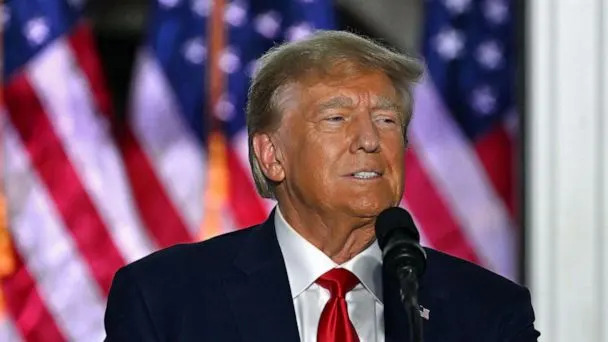
PHOTO: Former President Donald Trump delivers remarks at Trump National Golf Club Bedminster in Bedminster, N. J., on June 13, 2023. (Ed Jones/AFP via Getty Images)

MORE: Explainer: DOJ probes draw attention to the Presidential Records Act

Among the documents found at his Florida estate, according to prosecutors, were ones marked “top secret” and some about the country’s nuclear programs.

“I think it is misleading because the Presidential Records Act just isn’t the statute at issue,” Margaret Kwoka, a law professor at Ohio State University, told ABC News of Trump’s remarks.

“There’s no reason to think that the Presidential Records Act somehow overrides the Espionage Act,” Kwoka added. “And so this is not, in my view, going to provide a very strong sort of basis for defense against the charges in the indictment.”

He alludes to a judge’s decision in a case involving former President Bill Clinton

“Judge Amy Berman Jackson’s decision states under the statutory scheme established by the Presidential Records Act, the decision to segregate personal materials from presidential records is made by the president during the president’s term and in the president’s sole discretion,” Trump said.

Trump has repeatedly pointed to a case involving former President Bill Clinton in the wake of the indictment.

In 2010, the conservative group Judicial Watch sued the National Archives and Records Administration, arguing audio tapes kept by Clinton for interviews he did with historian Taylor Branch during his years in office — and which he afterward allegedly kept in a sock drawer — were “presidential records” and should be made available to the public.

U.S. District Court Judge Amy Berman Jackson dismissed the case, and Trump and his allies have taken to quoting different parts of her opinion in their defense.

MORE: No, Donald Trump’s classified documents case is not like Joe Biden or Hillary Clinton cases

The Presidential Records Act does contain an exception for personal records, according to Baron, including items such as “diaries, journals, and other personal notes that were never used in the transaction of government business.”

“President Trump had the right to keep those types of records. But the argument being made by some that he had some kind of absolute authority while president to declare classified records or other official records about government business as his personal records is absurd in its face,” he said. “It is also contrary to law. The decision by Judge Jackson cited prior precedent from the D.C. Circuit that stands for the opposite proposition.”

That citation included in Jackson’s opinion reads, in part, that the Presidential Records Act “does not bestow on the president the power to assert sweeping authority over whatever materials he chooses to designate as presidential records without any possibility of judicial review.”

“Judge Jackson went on to speculate about the level of deference to be afforded a president making a categorical decision about whether records of his were personal, but she never ruled on that issue,” Baron said. “Instead, the case was dismissed on the grounds that plaintiff had no standing to compel the Archivist to seize materials not in the government’s possession.”

There are also significant differences between the materials in question in the two cases.

“In that case, the records were very different and really did seem arguably personal,” Kwoka said of the Clinton matter. “We’re just sort of nowhere near the situation that we’re discussing today with the records that President Trump kept.”

PHOTO: Former President Donald Trump delivers remarks at Trump National Golf Club Bedminster in Bedminster, N. J., on June 13, 2023. (Ed Jones/AFP via Getty Images)
He claims he was still negotiating with the National Archives and Records Administration (NARA)

“I was supposed to negotiate with NARA, which is exactly what I was doing until Mar-a-Lago was raided,” Trump said.

Trump continued to make an argument he and his team have been for months, asserting he’s allowed to negotiate with NARA over which documents are personal and what’s presidential after leaving office.

NARA, in a June 9 statement, said the law requires a president to separate personal and presidential documents “before leaving office.”

MORE: Trump federal indictment: How serious are obstruction charges?

“There is no history, practice, or provision in law for presidents to take official records with them when they leave office to sort through, such as for a two-year period as described in some reports,” NARA said.

He says he’s being treated like a spy

“The Espionage Act has been used to go after traitors and spies. It has nothing to do with a former president legally keeping his own documents,” he said.

Trump has been charged under 18 U.S.C. § 793(e) of the Espionage Act, which prohibits unauthorized retention and disclosure of national defense information, and does not require that information be classified or disseminated to a foreign government.

Neither did the indictment charge him with disseminating information with the intent to harm the U.S.

Still, Trump and his allies have repeatedly claimed he’s accused of being a spy.

“This is not an uncommon argument for defendants to make,” David Aaron, a senior counsel at Perkins Coie and former federal prosecutor with the Justice Department’s national security division, told ABC News. “The title Espionage Act is kind of a misnomer because it includes much more than espionage.”

“Espionage is a different section entirely of Title 18. He’s charged simply with willfully retaining national defense information,” Aaron said. “He’s not charged with disclosing classified information to foreign governments or to anyone else, although there are references in the current indictment to his alleged disclosure to unauthorized people.”

The US is now facing a third inflation wave, economist explains

Yahoo! Finance

The US is now facing a third inflation wave, economist explains

‘Greedflation’ comes when companies use the excuse of higher input costs to hike prices, but are really profit-led, UBS’s Paul Donovan said.

Brad Smith – Anchor – June 15, 2023

Although US consumer prices provided further signs of relief for consumers in April, there are still factors keeping inflation elevated — and corporations may be reaping the benefits of that.

“We’ve had a really unfortunate situation where we’ve had three very, very different inflation waves caused by very different things,” UBS Global Wealth Management Chief Economist Paul Donovan told Yahoo Finance (video above). “And they’ve just come one after the other. So it looks like you’ve had this continuous period of inflation.”

The first wave, primarily in consumer durable goods, “was demand-led,” Donovan explained. “That’s over. Durable goods prices in the States are falling. You’ve got outright deflation.”

That was followed by a second wave of supply-led inflation, he added, “and that was the energy shock coming out of the war in Ukraine.” And then “the third wave of inflation — the one we’re getting now — is this unusual profit-led inflation story.”

Sometimes called “excuseflation” or “greedflation,” profit-led inflation occurs when consumer-facing companies toward the end of the supply chain persuade shoppers to accept price hikes by pointing to plausible explanations (such as historically-elevated inflation). However, Donovan said, the true reason for these elevated prices could have more to do with expanding margins and keeping investor sentiment high than with increased input costs.

“It’s using excuses,” Donovan said. “It’s using a cover.”

A shopper, who lamented that groceries have recently become much more expensive, holds the receipt from his purchase at a discount supermarket on June 15, 2022, in Berlin, Germany. (Photo by Sean Gallup/Getty Images)
Why inflation remains sticky

The main drivers of higher prices are the costs of goods sold — which includes both material and labor costs — and corporate profits.THE TAKEAWAY

As supply and demand shocks begin to wane, economists look to another potential culprit of sticky inflation: corporate profit margins.

Fortunately for consumers, prices for materials have slid tremendously. The World Bank expects a 21% decline in commodity prices in 2023 relative to 2022 — which, it noted, would be the sharpest drop since the COVID-19 pandemic.

However, prices still hover well above average levels from 2015-2019. During the first quarter of 2023, certain companies continued to institute price increases even as they witnessed flat or declining comparable sales volumes.

“I think what you see going on as much as anything is, one, obviously we’ve taken some pricing to cover the inflation that we’ve been dealing with,” PepsiCo (PEP) CFO Hugh Johnston told Yahoo Finance. “As consumers move to smaller size packages, it affects volume a little bit as well. But overall, the demand for our products continues to be quite high.”

Elevated labor costs may be the larger quandary for an inflation-fighting Federal Reserve — and a viable explanation for businesses pushing through price increases.

“What I think will be the bigger story this year for the broader economy, especially for the Fed, will be these stickier labor costs,” Charles Schwab Senior Investment Strategist Kevin Gordon told Yahoo Finance.

“Look at unit labor-cost growth — it is still way above trend, pre-COVID trend — and the fact that you’re not really seeing an easing in productivity growth or lack thereof because it’s still deeply negative,” he said.

“So that convergence, I think, will be really important because companies can only stomach those higher labor costs for so long, especially if you’re not getting that revenue back and that revenue surge.”

However, corporate profits have also played a large role in price increases since the disruptions from the coronavirus pandemic took hold.

According to an analysis published by the Economic Policy Institute, corporate profits replaced unit labor costs as the largest contributor to unit price growth in the nonfinancial corporate sector from the second quarter of 2020 to the fourth quarter of 2021, when compared with historical averages from 1979-2019.

“[Corporations] sneak in a margin increase,” Donovan said. “And you can see this with, for example, the rise in retail profits as a share of GDP. That’s one instance where we’re seeing this expansion of margin under the cover of, ‘Oh, it’s a general inflation problem. We can’t help it.’ But actually, they’re expanding margin and just basically persuading consumers to accept that.”

How long before companies rethink ‘excuseflation’?

Another reason companies may feel comfortable raising prices has been the continued strength of consumers.

During the first quarter of 2023, a host of company executives said US consumers were “healthy” and their spending remained “resilient“, while also detailing price increases and profit preservation efforts to investors and equity analysts.

“After slowing in the back half of 2022 a bit, we saw the pace of payments picked back up in quarter one, especially in the latter parts of the quarter,” Bank of America (BAC) CEO Brian Moynihan said during the company’s Q1 earnings call. “Consumers’ financial position remains generally healthy. They’re employed with generally higher wages, continue to have strong account balances, and have good access to credit.”

In June, however, Moynihan acknowledged that spending has “slowed down” following a succession of Federal Reserve interest rate increases. There’s also evidence that higher prices are weighing on consumer confidence.

For instance, consumer sentiment slid 7% in May, “erasing nearly half of the gains achieved after the all-time historic low from last June,” Joanne Hsu, director of the University of Michigan’s Surveys, said in its most recent report. “That said, consumer views over their personal finances are little changed from April, with stable income expectations supporting consumer spending for the time being.”

People shop at Lincoln Market on June 12, 2023, in the Prospect Lefferts Gardens neighborhood in the Brooklyn borough of New York City. (Photo by Michael M. Santiago/Getty Images)

While profit-led inflation can help preserve near-term profits for a company, it could also be detrimental to a brand’s image if consumers see the reasons for raising prices as disingenuous — particularly as social media provides a new outlet for consumers to push back.

Donovan said that a company’s brand can be damaged if it’s accused of “profiteering” at a time when people are suffering.

“Remember, we’ve had two years of negative real-wage growth across the developed world — people are feeling the pain,” he said. “So I think that social media can help inflame profit-led inflation by creating excuses that companies can use. But it can also work by threatening brand values to cause companies to rethink some of their pricing strategies.”

Because of that, profit-led inflation won’t last forever, Donovan said.

“At some point, either governments or consumers realize that this is going on, and they say, ‘Hold on, that’s not fair,’ and then you start to damage brand values,” he said. “You’re seen as cheating or unfairly treating the consumer. And that’s exactly the point that we’re now starting to get to.”