‘We are going to be homeless’: How mobile homeowners are being forced out in metro Phoenix

AZ Central – The Arizona Republic

‘We are going to be homeless’: How mobile homeowners are being forced out in metro Phoenix

Catherine Reagor, Juliette Rihl and Kunle Falayi, – October 22, 2022

Homeowners in mobile home parks across metro Phoenix are getting evicted.

Many own the mobile home but rent the small lot it sets on.

“This is more than just a notice to get out,” said Priscilla Salazar, whose family has lived 11 years in the Weldon Park mobile home community near 16th Street and Osborn Road. “We are going to be homeless.”

Like Valley apartments, some mobile home park owners are raising rents when leases expire and evicting tenants who can’t pay.

In other cases, owners are shutting the parks down so the land can be used for something else, including housing that mobile homeowners can’t afford. Some mobile home park buyers are clearing out tenants and flipping the infill sites for big profits.

Mobile homes have long been one of the most affordable housing options for metro Phoenix residents, but the growing number of parks closing or becoming pricier is putting many residents in a bind. New affordable parks aren’t being built, and many mobile homeowners can’t afford to live elsewhere or move their homes to other communities in the Valley, alarming housing advocates and prompting government officials to seek solutions.

In mid-September, tenants of Weldon Court received a notice that their park would be closing. It had been sold for $5.48 million to an investor from California just days before. Tenants were given six months to move out.

The Weldon Court mobile home park was recently sold, and mobile homeowners in the community were given six months to move out.

“This is our little mini Phoenix. This is our community,” said Salazar, whose children have grown up in the park. Many tenants are low-income families or seniors on fixed incomes.

Residents of Weldon Court and two other Valley mobile home parks that are evicting tenants or raising rents recently protested at the Arizona Capitol and Phoenix City Council chambers. The other two parks with residents fighting their landlords are Las Casitas — which is now called Beacon — at 19th Avenue and Buckeye Road, and Periwinkle, at 27th Avenue and Colter Street.

Mobile home park buying spree

Like with affordable Phoenix-area apartments, investors are snatching up mobile home parks in the Valley.

Since the beginning of 2021, at least 30 trailer, manufactured and mobile home parks have sold for almost $260 million, according to an Arizona Republic analysis of real estate records.

The Valley has been a hub for factory-built homes since after World War II. Many GIs returning home headed to the Southwest. Some hitched a travel trailer to their cars and put down roots and wheels in metro Phoenix.

Most of the metro Phoenix mobile home parks to sell during the past five years are prime infill sites.

The mobile home park buying and closure spree comes as Arizona is facing a shortage of 270,000 homes.

“It’s horrible for people who own their mobile home and have been living in a park for decades,” said Pamela Bridge, director of litigation and advocacy at Community Legal Services. “Investors are raising rents and our office is seeing so many more evictions in older parks.”

She said many longtime residents in Phoenix-area mobile home parks have paid off their homes and made improvements on them, but they can’t afford to move them and can’t find other parks where they can rent a space.

“These people have done nothing wrong,” she said. “We need to leave these mobile home park owners in stable situations.”

Jerry Suter, an 83-year-old veteran who has lived at the Periwinkle Mobile Home Park for 28 years, planned to live out the rest of his days there. He called the park’s closing “devastating” and “traumatic.” With an income of $1,290 in Social Security payments each month, he said he can’t afford to live anywhere else.

Grand Canyon University bought the park six years ago, decided to close it and plans to build student housing.

“They’re going to literally have to drag me out of there,” Suter said. “I’m not giving up my trailer.”

Phoenix has about 20,000 mobile homes, which represents about 3.1% of all of the area’s homes, according to the U.S. Census Bureau. That’s far more than the number of mobile homes that can be found in cities with similar populations, including Houston, San Diego and Philadelphia.

But the supply of mobile homes and parks is shrinking. About 5% of Phoenix homes were in mobile home parks in 2018.

The rapid disappearance of mobile home parks is due, in part, to transactions like this: In 2018, homebuilder Taylor Morrison bought the former Scottsdale Wheel Inn Ranch RV and Mobile Home Park, where residents were evicted by another owner a few years before. Similar scenarios with investors buying the parks, evicting the tenants and then selling to a developer are happening across metro Phoenix.

The Phoenix city manager’s office recently created a task force to research potential solutions to the mobile home dilemma. The task force will present its findings to the City Council next month.

District 8 Councilmember Carlos Garcia, whose district includes Las Casitas mobile home park, said he wants to find a way to keep people in their homes or, if the evictions move forward, find new places for the residents to live.

“To me, all options are on the table,” Garcia said. “Priority is to make sure these families don’t end up on the streets.”

Finding more time: GCU-owned mobile home park extends deadline before forcing residents to leave

Few choices for mobile homeowners
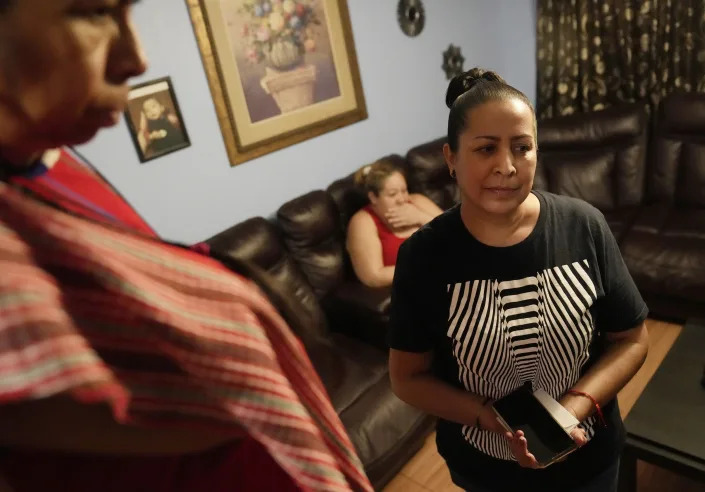
Sylvia Herrera (left) and Raquel Hernandez meet during an emergency meeting at the Beacon mobile home park (formerly Las Casitas mobile home park) on Sept. 20, 2022, in Phoenix. The residents were asked to sign a four-month lease and are worried about being evicted by the new owner. Hernandez recently bought her mobile home in the park.

Residents of Beacon mobile home park were given a new lease in late September. Their rent will increase by 88% over the next four years, it said.

Elvia Ramirez, who lives in the park with her children, started looking for somewhere else to move. But the single mother of four, who works as a receptionist and has lived in the park since she was a teenager, hasn’t been able to find something within her budget.

“Even the mobile homes are too expensive now,” said Ramirez, 33. If she doesn’t secure a new home, she said, she and her kids will probably have to move in with family.

The median price of a U.S. mobile home is now $61,400, according to a LendingTree study. That’s up 35% since 2016.

Many mobile homes are several decades old, and some are even trailers, the oldest type of mobile house. Some of the parks in metro Phoenix sold since early last year are more than 70 years old.

Many parks won’t rent to owners of older mobile homes because their houses may not be up to code. Also, some with additions can’t be moved without damaging them.

The typical rent for a mobile home lot in the Phoenix area was about $400 to $500 a month in 2019, according to housing advocates. Now, rents are rising above $1,000 per lot in some Valley parks.

Help available to mobile homeowners

Arizona has a fund to help, but some mobile homeowners don’t hear about it, and others cannot fully benefit from it because of the age of their residences.

For some owners, the fund isn’t enough to help them move, so they take less than $2,000 in state funds to walk away from their mobile home.

Under Arizona law, mobile home park residents who are displaced because of redevelopment are eligible to receive up to $12,500 from the state’s relocation fund.

But many of the mobile homes are so old, they cannot be moved to another park, either because they would fall apart or because they don’t meet current wind-resistance codes.

Residents who have to leave their homes in place because they can’t be moved can get only $1,875 from the fund, which is managed by the Arizona Housing Department.

Many residents and housing advocates said more help is needed.

“Now I have to abandon my home and give it to the university,” Suter said. “What am I gonna buy for $1,875?”

Patricia Dominguez said her family recently spent $4,000 on a new roof for their home — more than double what they will be reimbursed if they abandon it.

“What they’re offering is nothing compared to the love, and the blood, and the sweat and tears that we’ve all put into our unit,” said Dominguez. Her mother and sister, Salazar, live in Weldon Court.

Community organizer Sylvia Herrera, who is working with residents of all three parks to get more time and money before eviction, said the state relocation fund is “deceiving” because many people can’t move their trailers and therefore can’t access the full relocation amount.

“These are not really resources if you can’t qualify,” she said.

Tara Brunetti, assistant deputy director of the Arizona Department of Housing’s Manufactured Housing Division, said park owners must notify the agency if they plan on closing a park and give tenants 180 days’ notice.

“That gives us time to reach out to the residents” and offer them help, she said. “We are definitely seeing more applications for the fund now.”

The fund has more than $7.6 million to help mobile home park residents.

Sylvia Herrera leads an emergency meeting of residents at the Beacon mobile home park (formerly Las Casitas mobile home park) on Sept. 20, 2022, in Phoenix. The residents were asked to sign a four-month lease and are worried about being evicted by the new owner.

The state program does offer more money than it did five years ago, but it took a legislative move to get the increase.

Mobile homeowners and their advocates are hoping for a different kind of fix.

Some cities, including Portland, Oregon, and Austin, Texas, have updated their zoning laws to help prevent mobile home residents from displacement.

A 2018 Austin city ordinance zoned existing mobile home parks as a “mobile home residence district.” That means if the landowner wanted to use the land for a different purpose, they would need City Council approval to change the zoning.

Portland passed a similar ordinance the same year.

In 2018, when a new owner began evicting longtime residents from the Tempe Mobile Home Park near Arizona State University, the city of Tempe stepped in and helped get rent concessions from the landlord. Tempe also set up meetings for the tenants to negotiate with the new owner and get aid from the Arizona Housing Department.

That former mobile home park is now high-end apartments.

“I believe there should be laws or community work in cities and counties that come up with long-term solutions for people in the park. These people are a vital part of our community,” said Bridge, of Community Legal Services. “We want their children to remain in schools and for the parents to be able to get to their jobs nearby.”

Out-of-state buyers

In 2018, investors spent more than $225 million on 40 metro Phoenix mobile-home parks. It was a record year for mobile home park sales in the Valley.

Then, big Wall Street-backed investment firms were behind most of the sales. Now, big and small investors are driving the trend, but almost all are out-of-state buyers.

The biggest Phoenix-area mobile home park sale since the beginning of 2021 was $84.5 million for the Royal Palm park in Phoenix at 19th and Dunlap avenues. Property records show Chicago-based Continental Communities is the new manager.

Bridge said she has come across several cases of new out-of-state mobile home park owners not giving tenants or the state enough move-out notice.

Mobile home evictions are tracked differently than other rental evictions, and the data to tally the total isn’t available in Arizona.

“Because of the housing crisis, there is no affordable housing. Trailer parks are the most affordable housing right now that you can find,” Herrera said. “People are just trying to retain that, trying to hold on to living in mobile home parks.”

Coverage of housing insecurity on azcentral.com and in The Arizona Republic is supported by a grant from the Arizona Community Foundation.

Hurricane Ian was lethal for elderly, those with chronic health conditions

Tampa Bay Times, St. Petersburg, Fla.

Hurricane Ian was lethal for elderly, those with chronic health conditions

Christopher O’Donnell, Tampa Bay Times – October 21, 2022

Douglas R. Clifford/Tampa Bay Times/TNS

Thomas Billings Jr. and his wife, Sarah, decided to ride out Hurricane Ian in the family room of their Naples ranch homeclose to Edgewater Beach.

About two hours after the storm’s landfall, Billings was returning from fetching something from a bedroom when he found his wife lying facedown, according to a Naples Police Department report.

As floodwaters seeped into the home, he moved Sarah, 73, to the bedroom. But the 79-year-old man did not have the strength to lift her onto the bed, the report states. The man was only able to escape the rising waters by floating his wife and himself to the back lanai.

He survived but Sarah drowned, a death that the county medical examiner concluded was complicated by a heart attack.

Florida has strict laws requiring nursing homes and assisted living facilities to plan for disasters like hurricanes. But few rules exist to protect an increasing number of elderly people with chronic health conditions who live at home, including some who rely on electric-powered medical equipment like dialysis and oxygen machines.

Hurricane Ian provided a brutal lesson in how vulnerable that population is to the harsh conditions during and after a major storm.

Medical examiners in Florida have so far linked 112 deaths to Hurricane Ian. Almost 60% of those were people age 65 or older. Chronic medical conditions like heart attacks and respiratory illnesses were contributing factors in one-third of reported deaths, records show.

The average age of those who died was 67.

“There is no one who is required to make sure they evacuate or that their home environment will keep them safe,” said Lindsay Peterson, an assistant professor who conducts disaster preparedness research at the University of South Florida’s School of Aging Studies. “They are much more vulnerable, and we see that in these statistics.

The reports suggest many would still be alive had they evacuated.

Nine people died because power outages meant they could not operate oxygen or dialysis equipment, including a 70-year-old diabetic in Charlotte County who went a week without dialysis.

Delays in 911 responders reaching patients because of the storm were cited as contributing factors in another five deaths. One was a 79-year-old woman in Orange County whose operation for a fractured hip was delayed because the hospital she was taken to had no running water.

Even some who survived the worst of the storm later succumbed to its aftermath.

Four residents suffered heart attacks and died while they were trying to clear up storm debris, reports show. A 58-year-old man with existing heart problems collapsed and died after walking up seven stories of a Naples condo tower where he and his wife were sheltering. The elevator had stopped working after the lobby flooded.

Trends suggest the number of seniors receiving medical treatment at home will continue to rise. The Centers for Medicare & Medicaid Services estimates that home care expenditures will reach $201 billion by 2028, a 73% increase from 2020.

More needs to be done at state, local and federal levels to protect that population as hurricanes increase in intensity, Peterson said. Home health centers and dialysis centers are required to have post-storm operation plans, she said.

Other states, including Ohio, have gone further with laws that require home health visitors to check in with their clients before a disaster and offer assistance and advice.

Those with health conditions can turn to special-needs shelters, which include generators to power medical equipment and are staffed with nurses.

But it’s not always easy to convince people and their caregivers to commit to staying in a shelter, Peterson said. Elderly people with dementia may feel distressed in a busy shelter where there is always light and noise.

“People associate home with their safety, especially older adults,” she said. “How do we convince them this is not safe for you anymore?”

Both Hillsborough and Pinellas counties maintain a registry of those who have special medical needs and might struggle during an emergency like a hurricane.

Pinellas counts 2,643 people on the registry, which includes information on their evacuation zones and whether they have their own transportation. About 4,000 people are on Hillsborough’s registry, with more than 1,600 listed as needing transportation to evacuate.

Both counties operated special shelters during Ian, with roughly 400 people and 110 caregivers staying at three shelters in Pinellas. Hillsborough housed about 400 people and 40 caregivers across five shelters, officials said.

The shelters are intended as a last resort for people without the resources or time to travel to a hotel or stay with friends or relatives, said Ryan Pedigo, director of public health preparedness in Hillsborough. But he acknowledged that some — including those with medical needs — won’t take advantage of the free facilities, and that many people wait until it’s too late to evacuate.

“You can’t wait until eight hours before landfall to make that happen. People need to take the initiative to leave earlier and evacuate,” he said. “I don’t know if it’s complacency or people flat-out don’t want to go to a shelter.”

Joy Weidinger’s husband of 58 years, Douglas Weidinger Sr., was listed among Hurricane Ian’s dead.

The 79-year-old Punta Gorda man, who suffered from chronic obstructive pulmonary disease and asbestosis, relied on an oxygen concentrator, a device that provides oxygen-rich air.

When power stopped working, he switched to portable oxygen canisters the couple had ordered for the storm.

But his health deteriorated, his wife said, in part because he was so stressed about the hurricane. He died Sept. 29, one day after the storm made landfall.

The medical examiner in Charlotte County cited the interruption of power as a contributing factor in his death.

“We hooked him up to the concentrator, but by the time we did it, it was too late,” she said. “We all have a time to go.”

Republicans plan to torpedo key Biden policies as polls predict midterm victory

The Guardian

Republicans plan to torpedo key Biden policies as polls predict midterm victory

Chris Stein in Washington DC – October 21, 2022

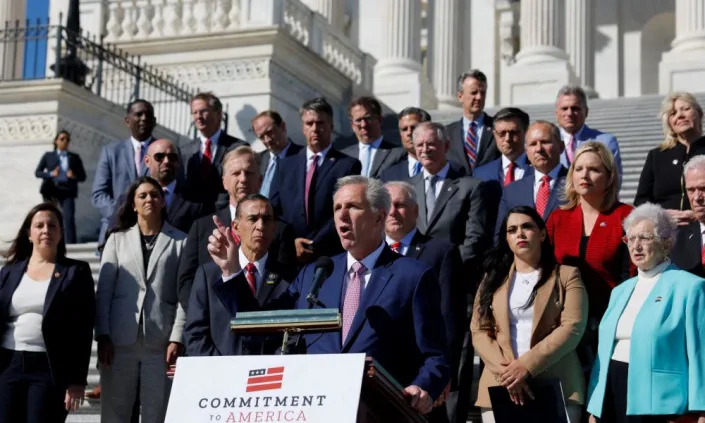
<span>Photograph: Evelyn Hockstein/Reuters</span>
Photograph: Evelyn Hockstein/Reuters

A standoff over the debt ceiling. Aid to Ukraine on the chopping block. And impeachment proceedings against homeland security secretary Alejandro Mayorkas – or perhaps even president Joe Biden himself.

With polls indicating they have a good shot of winning a majority in the House of Representatives in the 8 November midterms, top Republican lawmakers have in recent weeks offered a preview what they might do with their resurgent power, and made clear they have their sights set on key aspects of the Biden administration’s policies at home and abroad.

Related: Republicans aim to pass national ‘don’t say gay’ law

Kevin McCarthy, the top Republican in the chamber, this week signaled in an interview with Punchbowl News that if Congress is going to approve an increase in the amount the federal government can borrow – as it’s expected to need to by sometime next year – Republicans are going to want an agreement to cut spending in return.

“You can’t just continue down the path to keep spending and adding to the debt,” said McCarthy, who is likely to be elevated to speaker of the house in a Republican led-chamber. “And if people want to make a debt ceiling [for a longer period of time], just like anything else, there comes a point in time where, okay, we’ll provide you more money, but you got to change your current behavior.”

Asked if he might demand that Social Security and Medicare, the two massive federal retirement and healthcare benefit programs that are nearing insolvency, be reformed as part of debt ceiling negotiations, McCarthy replied that he would not “predetermine” anything.

But the California lawmaker warned that members of his caucus were starting to question the money Washington was sending to Ukraine to help it fend off Russia’s invasion. “Ukraine is important, but at the same time it can’t be the only thing they do and it can’t be a blank check,” he told Punchbowl.

Then there’s the question of if Republicans will choose to exercise the House’s powers of impeachment – as they did against Bill Clinton in 1998, and as Democrats did to Donald Trump in 2019 and 2021.

The prime target appears to be Mayorkas, whom Republicans have pilloried amid an uptick in arrivals of migrants at the United States’ border with Mexico. Yet another target could be Biden himself – as Jim Banks, chair of the conservative Republican Study Committee, which crafts policy for the party, suggested on Thursday.

Political realities may pose an obstacle to McCarthy and his allies’ ability to see their plans through. High inflation and Biden’s low approval ratings have given them momentum to retake the House, but their chances of winning a majority in the Senate are seen as a toss-up. Even if they did win that chamber, they’re unlikely to have the two-thirds majority necessary to convict Biden, Mayorkas, or whomever else they intend to impeach – or even the numbers to overcome Democratic filibusters of any legislation they try to pass.

Matt Grossman, director of Michigan State University’s Institute for Public Policy and Social Research, questioned the GOP’s willingness to legislate. The party’s plans, as outlined in the Commitment to America McCarthy unveiled last month, appear thin in comparison to similar platforms rolled out in 1994 and 2010, when Republicans again took back Congress’ lower chamber from Democratic majorities.

“There’s a longstanding asymmetry between the parties. Republicans legitimately want government to do less,” he said.

“They’re doing pretty well electorally without necessarily needing a policy agenda, and they’re tied to, kind of, defending the Trump administration or attacking the Biden administration. There’s not much of a felt need for a lot of policy.”

There are also signs of division within the party over how the GOP should use its new majority. In his interview with Punchbowl, McCarthy said he was against “impeachment for political purposes” and focused instead on addressing crime, border security and economic issues, all familiar themes for Republicans running this year.

The split was even more pronounced when it came to Ukraine. On Wednesday, Trump’s former vice-president Mike Pence called in a speech at influential conservative group the Heritage Foundation for Republicans to continue to support the country, saying “there can be no room in the conservative movement for apologists to” Russian president Vladimir Putin.

The day after, the foundation’s president Kevin Roberts put out a statement saying: “Heritage will vigorously oppose Washington’s big spenders who attempt to pass another Ukrainian aid package lacking debate, a clear strategy, targeted funding and spending offsets.”

Democrats are assured control of Congress until the end of the year, and have taken note of the apparent erosion of will to support Kyiv. NBC News reports they may push for another big military aid infusion in a year-end spending bill, intended to keep the Ukrainians armed for months to come.

It seems clear that Republicans will eventually coalesce behind a strategy to strong-arm the Biden administration for some purpose, but Grossman predicted the likely result would be similar to the 2013 government shutdown, when then president Barack Obama and the Democrats refused the GOP’s demands to dismantle his signature health care law.

“With McCarthy it just seems like he is a go along,” he said. “He’s going to be a go-along speaker and that’s going to be the case with a pretty fractious caucus.”

Photos show the Mississippi River is so low that it’s grounding barges, disrupting the supply chain, and revealing a 19th-century shipwreck

Business Insider

Photos show the Mississippi River is so low that it’s grounding barges, disrupting the supply chain, and revealing a 19th-century shipwreck

Morgan McFall-Johnsen, Paola Rosa-Aquino – October 21, 2022

man sits on rock watches people walk across exposed river bottom to big rock island in the mississippi river
Randy Statler sits on a rock to watch people walk to Tower Rock, an attraction normally surrounded by the Mississippi River and only accessible by boat, in Perry County, Missouri, on October 19, 2022.Jeff Roberson/AP Photo
  • The Mississippi River is receding to historic lows amid drought across the Midwest.
  • Barges are getting stuck on sandbars and forced to reduce their cargo, disrupting a critical shipping route.
  • The low waters also revealed human remains and a 19th-century shipwreck.

The waters of the Mississippi River have fallen to historic lows, driving a shipping and industry crisis in the heart of the US.

The Mississippi is a major channel for shipping and tourism, running from northern Minnesota down through the Midwest plains and emptying through Louisiana, with numerous tributaries stretching east and west. All that boat-based commerce relies on the river’s deep waters, which can accommodate hefty vessels carrying cargo like soybeans, corn, fertilizer, and oil, or cruise-line passengers.

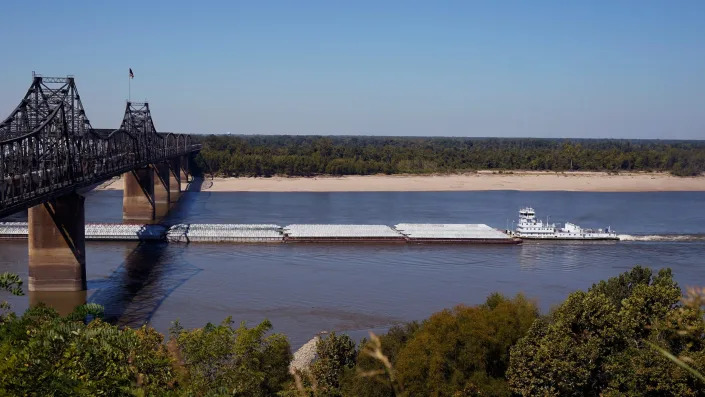
tow trailing five barges floats under bridge in low river waters with exposed dirt banks
A barge tow floats past the exposed banks of the Mississippi River in Vicksburg, Mississippi, on October 11, 2022.Rogelio V. Solis/AP Photo

For the past month, though, the water has dwindled so low that ships are getting stuck in the mud and sandbars at the river bottom. The Coast Guard imposed new restrictions on how low ships and barges can sit in the water. The price of shipping goods along the river skyrocketed, The Wall Street Journal reported on Friday, and the US Army Corps of Engineers (USACE) began emergency dredging to deepen the river at more than a dozen key choke points, where a backup of about 2,000 barges built up.

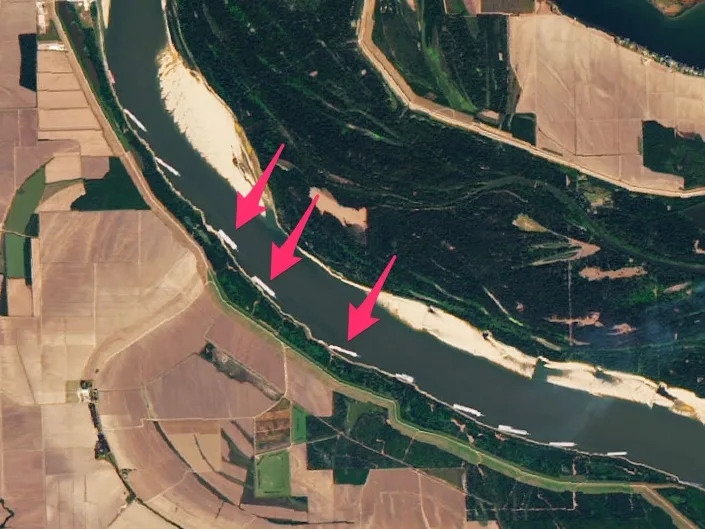
A NASA satellite image from October 7 shows the parched river, with barges queued up along its shorelines.

satellite image mississippi river low levels with dry banks exposed barges lined up along shores
An image from a Landsat satellite shows the parched Mississippi River north of Vicksburg, Mississippi, on October 7, 2022.NASA Earth Observatory/USGS Landsat

“This is the most severe we’ve ever seen in our industry in recent history,” Mike Ellis, the CEO of American Commercial Barge Line, told CNBC on Wednesday.

satellite image mississippi river with arrows pointing to barges lined up on shore
A close look at the satellite image reveals barges waiting on the river’s shores.NASA Earth Observatory/USGS Landsat

“That’s a significant impact to our supply chain,” Ellis said, adding, “We can’t get the goods there.”

satellite image mississippi river with arrows pointing to barges lined up on shore
Even more barges were waiting in another part of the satellite image.NASA Earth Observatory/USGS Landsat

The water receded so much that it revealed human remains and a 200-year-old shipwreck along the river’s new banks. In Missouri, people are walking across the dry, exposed riverbed to an island that’s normally only accessible by boat.

man looks at wooden shipwreck on banks of low river waters
A man walking along the Mississippi River in Baton Rouge, Louisiana, stops to look at a shipwreck revealed by the low water level on October 17, 2022.Sara Cline/AP Photo

On the Louisiana coast, the river is so low that ocean water from the Gulf of Mexico began pushing upstream. USACE is racing to build a 1,500-foot-wide underwater levee to prevent saltwater from creeping further up the river, where it could contaminate drinking water, CNN reported on Tuesday. Already, there’s a drinking water advisory in effect for the coastal region of Plaquemines Parish.

Drought is drying the Mississippi River to record lows
paddlewheel boat full of windows passes between two bridges with low water on mississippi river
A passenger paddle wheeler passes between the river bridges in Vicksburg, Mississippi, on October 11, 2022.Rogelio V. Solis/AP Photo

Just a few months ago, the Mississippi River basin was flooding. This summer, historic rainfall caused flash flooding and overflowing rivers in Kentucky, St. Louis, Missouri, parts of Illinois, and Jackson, Mississippi.

Despite these extreme sporadic rainfall events, overall, the Midwest is in an abnormal drought. The Ohio River Valley and the Upper Mississippi aren’t getting enough rain to feed the giant river.

us drought map october 11 2022
US Drought Monitor

Up and down the Mississippi, waters have dropped to levels approaching the record low set in 1988. In Memphis, Tennessee, the waters plunged below that record on Monday, according to data from the National Weather Service.

“There is no rain in sight, that is the bottom line,” Lisa Parker, spokeswoman for the USACE Mississippi Valley Division, told the Journal. “The rivers are just bottoming out.”

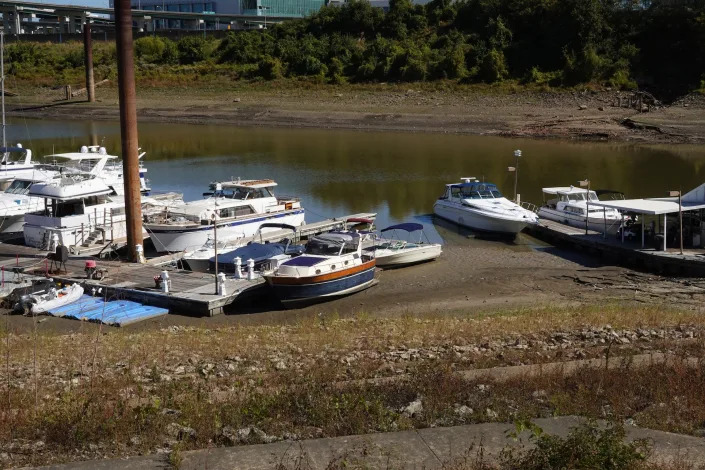
dock full of boats sits on mud with river waters receding in the background
Boats rest in mud at Mud Island Marina as the water on the Mississippi River continues to recede in Memphis, Tennessee, on October 19, 2022.Scott Olson/Getty Images

Scientists must conduct rigorous analysis to attribute any single event to climate change. However, this year’s extreme conditions of both drought and floods is consistent with what scientists have been predicting and observing: Rising global temperatures are driving more weather variability in the central US, fueling both more severe droughts and one-off rainfall events.

That’s because climate change, driven by all the greenhouse gasses that humans have released into the atmosphere, is changing the planet’s water cycle. Rising temperatures are increasing water evaporation and changing the atmospheric and ocean currents that distribute moisture across the globe.

Droughts are unearthing relics and remains of the past
wooden remains of a ship in dry dirt near green grass and trees
The remains of a ship lay on the banks of the Mississippi River after recently being revealed due to the low water level, in Baton Rouge, Louisiana, on October 17, 2022.Sara Cline/AP Photo

The severe drought along the river is so intense that it uncovered a centuries-old shipwreck. In early October, low water levels revealed the old sunken ship along the banks of the Mississippi River in Baton Rouge, Louisiana. Archaeologists believe these remains are from a ferry that sunk in the late 19th or early 20th century, The Associated Press reported.

Though this is the first time the ship has been fully exposed, it’s not a new discovery. Small parts of the vessel emerged from low waters in the 1990s.

“At that time the vessel was completely full of mud and there was mud all around it so only the very tip tops of the sides were visible,” Chip McGimsey, Louisiana’s state archaeologist, told the AP. “They had to move a lot of dirt just to get some narrow windows in to see bits and pieces,” McGimsey said.

aerial photo show long wooden shipwreck on dry banks of low green river
A shipwreck is exposed along the banks of the Mississippi River due to low water levels, in Baton Rouge, Louisiana, on October 18, 2022.Stephen Smith/AP Photo

McGimsey thinks the ship could be the Brookhill Ferry, which carried people and possibly horse-drawn wagons across the Mississippi, until it sunk in a storm in 1915, according to news stories from the State Times archives.

The river’s receding waters also led to a more gruesome discovery. On Saturday, a Mississippi woman found human remains while searching for rocks with her family on the banks of the drought-stricken river. The remains included a lower jawbone, rib bones, and some unidentified bone pieces, Scotty Meredith, Coahoma County’s chief medical examiner, told CNN.

“Because these water levels are so low that we knew it was only a short matter of time before human remains were found,” Crystal Foster, the woman who found the remains, told WMC.

They are the latest in a bevy of discoveries to surface from receding waters. Over the summer, multiple set of remains were found in Nevada’s Lake Mead, which fell to historically low levels amid climate change-fueled drought.

But it’s not all bad news. Shrinking bodies of water could be a boon for experts tasked with solving missing persons cases, according to Jennifer Byrnes, a forensic anthropologist who consults with the Clark County coroner’s office, which reviews deaths in Lake Mead.

“A big body of water disappearing is going to help us, from a forensic perspective,” Byrnes told Insider.

Correction: October 21, 2022 —A photo caption in an earlier version of this story misstated the location of Vicksburg. The city is in Mississippi, not Louisiana.

The real story behind America’s population bomb: Adults want their independence

USA Today

The real story behind America’s population bomb: Adults want their independence

Clay Routledge and Will Johnson – October 12, 2022

Declining birth rates are a major concern for the United States and many countries around the world, so we – an expert in existential psychology and an expert in pulsing public opinion – surveyed the Americans choosing not to have children to learn the reasons why.

Americans are having fewer children than are needed to keep population numbers stable.

Low birth rates are not only an American problem. In 2020, researchers at the University of Washington’s Institute for Health Metrics and Evaluation projected that the global fertility rate will drop below 1.7 by the end of this century. And countries such as Italy, South Korea, Spain and Thailand will lose more than half their population within the lifetimes of children being born this year.

Fear of not just climate change and affordable housing

Much of the conversation in the United States about this issue has focused on fears about the future of the world or major economic challenges. For instance, the threat of climate change and the affordability of housing are frequently referenced as reasons that Americans don’t want to have kids.

While those are concerns of course, when you look at the data, family planning appears to be influenced more by people’s personal views about the independent life they want to live than their worries about potential environmental or economic issues.

This has important implications for how we as a nation approach the demographic challenge of declining birth rates.

A Harris Poll found that of those without children, about half do not want to have a child in the future, while 20% remain unsure. The only factor that the majority (54%) of Americans who don’t want to have kids endorsed as influencing their decision was maintaining personal independence.

Specifically, we surveyed a representative sample of just over 1,000 U.S. adults about their future family planning. Of those without children, about half (52%) do not want to have a child in the future, while 20% remain unsure.

We then asked these individuals whether their decision to not have children was influenced by a wide range of factors. Only 28% of them reported that climate change influenced their decision to not have kids. Similarly, only 33% indicated that housing prices influenced their decision.

Other factors we asked about including the political situation in the United States (31%), safety concerns (31%), personal financial situation (46%) and work-life balance (40%) were endorsed by less than half of respondents.

The only factor that the majority (54%) of Americans who don’t want to have kids endorsed as influencing their decision was maintaining personal independence.

Chrissy Teigen’s Q&A with Feeding America: How can we help children who are going hungry?

Desire for personal independence is most powerful

Moreover, since respondents were able to indicate multiple reasons for not having kids, we also asked them which of those factors most influenced their decision. Further suggesting that this decision is more about personal preferences than other factors, we found that maintaining personal independence was reported as the most influential factor for more respondents than any other factor; 43% of those who considered independence to be a factor indicated that it was the most influential reason for not having kids.

For comparison, only 26% of those who considered climate change when deciding whether to have children reported that it was the most influential reason and only 9% of those who considered housing prices indicated such.

Americans may have multiple reasons for opting out of parenting, but their desire for personal independence is the most powerful one.

Children’s mental health: Alarm on children’s mental health has been ringing for decades. Too few have listened.

It is also worth noting that men and women were generally similar in their reasoning; 53% of females and 55% of males reported that their desire to maintain their personal independence influenced their decision to not have children. No other reason for not having kids was cited by a majority of men or women.

We shouldn’t oversimplify the story of why more and more Americans are choosing to not start families. It is undoubtedly complex and involves facets that public opinion surveys can’t fully capture. However, our results have important implications for cultural and political discussions around this issue.

Changes in public policy may not help

Perhaps most important, our findings suggest that public policy solutions are unlikely to have much impact on birth rates. Because Americans who are opting out of having children are more influenced by their desire to maintain their personal independence than concerns about climate change or affordable housing, or other issues such as work-life balance and safety, efforts to promote a more pro-natal society will need to be more cultural in nature.

More specifically, these efforts will need to address psychological needs related to individuals’ life goals and priorities.

How do we change people’s attitude about how children will affect their lives if they privilege personal freedom over other ideals? A good place to start is to focus on one of the most fundamental psychological needs, the need for existential meaning.

Humans are highly motivated to perceive their lives as meaningful. And it is when they perceive their lives as full of meaning that they are most mentally healthy, resilient, goal-driven, self-disciplined and self-reliant. In this way, meaning can be thought of as a key ingredient to achieving personal independence.

The Americans concerned about how having children may affect their personal independence may not realize that meaning is so empowering and that family is a fundamental source of meaning. For instance, surveys find that when people are asked what makes their lives feel meaningful, the most common response is family.

In addition, studies find that parents report higher levels of meaning than adults without children and have a greater sense of meaning when they are taking care of their children than when they are engaged in other activities.

Goldie Hawn on mental health issues: ‘Don’t turn a blind eye’ to kids

Cultural narratives that treat parenting as a threat to personal independence and a roadblock to a fulfilling life may contribute to declining birth rates more than many realize.

There are of course environmental, economic and other challenges that can make people worried about bringing another human into this world and that can make raising children difficult.

But this is not new. For much of our history, most humans lived far more perilous lives than we live today. Our challenge is less about our material conditions and more about our mindset.

If we want a world with more children, we are going to have to convince people that having and raising kids is a critical ingredient of, not a barrier to, the good life.

Climate change is causing more billion-dollar weather disasters

Yahoo! News

Climate change is causing more billion-dollar weather disasters

David Knowles, Senior Editor – October 12, 2022

When Hurricane Ian barreled into Florida’s Gulf Coast last month, it became the 15th extreme weather event in the U.S. this year to rack up damages totaling more than $1 billion. Climate change, data shows, is helping to make expensive disasters much more frequent in recent years.

In fact, 2022 marks the eighth straight year that at least 10 separate $1 billion weather-related disasters occurred, according to the National Oceanic Atmospheric Administration (NOAA).

“In the last five years [2017-2021], there were just 18 days on average between billion-dollar disasters—compared to 82 days in the 1980s,” Climate Central, a consortium of scientists and journalists, found in a new analysis posted to its website.

This year’s extreme weather disasters in the U.S. have resulted in over 340 deaths, the NOAA said, and the financial toll is still being tallied. The insurance losses alone from Hurricane Ian are projected to cost between $53 billion and $74 billion, according to an estimate by RMS, a risk modeling company. In addition to that staggering sum, the National Flood Insurance Program could face an extra $10 billion in losses, Insurance Business America reported.

“The number and cost of weather and climate disasters are increasing in the United States due to a combination of increased exposure (i.e., more assets at risk), vulnerability (i.e., how much damage a hazard of given intensity — wind speed or flood depth, for example — causes at a location), and climate change is also supercharging the increasing frequency and intensity of certain types of extreme weather that lead to billion-dollar disasters — most notably the rise in vulnerability to drought, lengthening wildfire seasons in the western states, and the potential for extremely heavy rainfall becoming more common in the eastern states,” Adam Smith, a climatologist at the National Centers for Environmental Information and a lead analyst on the NOAA’s findings on $1 billion disasters, told Yahoo news in an email. “Sea level rise is worsening hurricane storm surge flooding.”

Among the other $1 billion or greater weather-related disasters to hit the U.S. this year are the extreme flooding that occurred in Kentucky and Missouri from July 26 to 28, the prolonged drought and heat waves that gripped the western U.S. between Jan. 1 and Sept. 30, devastating wildfires that consumed thousands of acres in New Mexico this spring, a derecho that plowed through Indiana on July 13, and the extreme precipitation event in Summerville, Ga., on Sept. 4 that dumped more than 12 inches of rain.

While climate change is not the sole cause of events like hurricanes, drought, rainfall or wildfires, ample scientific research has shown that rising global temperatures are amplifying all of them, making each potentially more destructive.

Workers clearing debris in Fort Myers, Fla., in the wake of Hurricane Ian
Workers clearing debris in Fort Myers, Fla., in the wake of Hurricane Ian, Oct. 1. (Giorgio Viera/AFP)

“The year-to-date average temperature for the contiguous U.S. was 56.8 degrees F — 1.7 degrees above average — ranking in the warmest third of the YTD record. California and Florida saw their third- and fourth-warmest January-through-September periods on record, respectively,” the NOAA stated on its website.

Across the West, nearly 1,000 heat records were broken in early September, the NOAA said, a month that will go down as the fifth-warmest on record. In all, the last seven years have been the warmest on record, according to data from NASA, the NOAA and Berkeley Earth.

The Intergovernmental Panel on Climate Change has for years been sounding the alarm about the risks related to global temperature rise and tried to convince world governments to agree to limit greenhouse gas emissions so as to keep average temperatures from rising above 1.5 degrees Celsius (2.7 degrees Fahrenheit) above preindustrial levels.

In its most recent report, which was issued in February, the IPCC reiterated that the planet could expect an increase in the kinds of severe weather consequences seen in recent years that have been liked to climate change.

“This report is a dire warning about the consequences of inaction,” Hoesung Lee, chair of the IPCC, said in a statement that accompanied the release of the report. “It shows that climate change is a grave and mounting threat to our well-being and a healthy planet. Our actions today will shape how people adapt and nature responds to increasing climate risks.”

Hurricane Ian exposed a flood insurance nightmare for homeowners in Florida

NBC News

Hurricane Ian exposed a flood insurance nightmare for homeowners in Florida

Phil McCausland – October 11, 2022

Hurricane Ian’s storm surge brought numerous feet of water into homes on Florida’s west coast, and left behind mold, muck, mud and a flood insurance nightmare for residents who want to rebuild.

Many Floridians who suffered extensive flooding did not carry a separate flood insurance policy to cover the damage caused by the deadly storm. It’s left homeowners — and even renters — with a hefty and, possibly, life-changing expense that could decide whether they are rendered homeless.

Susan Cavanaugh and her two kids are living through that ordeal after the first floor of their home on Sanibel Island, where all three live and work, was engulfed by the storm surge. While going through a costly divorce earlier this year, Cavanaugh’s flood insurance coverage lapsed.

Now she doesn’t know how to get her family back into their home without an insurance check to pay for contractors and building materials.

“I can only do so much as a single mom,” said Cavanaugh, who is staying in a motel and is unsure where to live next. “We just want to go back to the house. It’s been deemed structurally sound, but we have to get it back online and it’s not just a cosmetic issue. It’s going to take blood, sweat and tears and it’s going to take a lot of muscle and a lot of work to get there.”

Image: Resident Pamela Brislin who has lived on Sanibel Island since 2020 cleans up the damage from Hurricane Ian, on Oct. 6, 2022, in Sanibel Island, Fla. (Scott Smith / AP)

Sanibel Island last month suffered a direct hit from the Category 4 storm and the surge of water, up to 15 feet in some places, it brought from the gulf into people’s homes. The community remains inaccessible by car, forcing many to pay boat captains to ferry them to begin the cleanup.

Cavanaugh is not alone in facing flood damage without the backing of insurance coverage. Many people in the small coastal community, which faces the Gulf of Mexico southwest of Fort Myers, did not have flood insurance coverage.

What’s more, Sanibel Island is a microcosm of a greater insurance challenge facing Florida and the country.

Only about 18.5% of homes in Florida counties that faced a mandatory or voluntary evacuation order the evening before Hurricane Ian landed had a flood insurance policy with the National Flood Insurance Program, the federal government program administered by FEMA, according to an analysis conducted by the risk management consulting firm Milliman. Even in designated flood hazard zones within those counties, fewer than half of the homes had a policy on file.

It appears that, despite an increased occurrence of devastating flood events, a declining percentage of people nationwide have flood insurance policies. The number of policies maintained by the National Flood Insurance Program has declined by nearly 700,000 since 2008, according to data acquired from the federal agency.

“There are many factors that influence this drop in policyholders, including the economic impact of the pandemic, the housing market, affordability, or purchasing flood insurance from the private market,” David Maurstad, the senior executive of the National Flood Insurance Program, said in a statement.

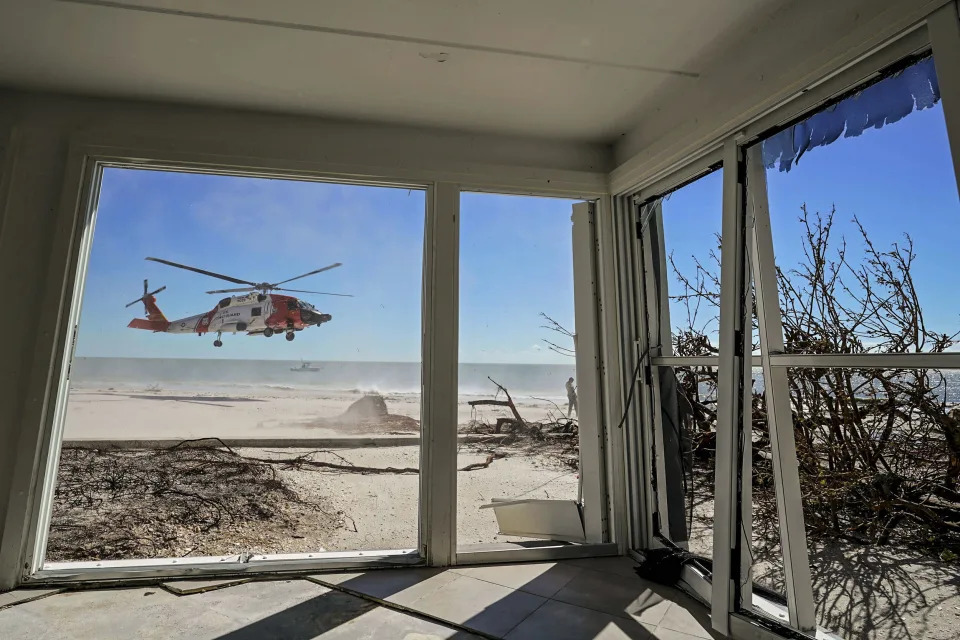
Image: A U.S. Coast Guard helicopter takes off, seen from inside a home damaged by Hurricane Ian on Sanibel Island, Fla., on Sept. 30, 2022. (Steve Helber / AP filw)

He said that FEMA “continues to market the flood insurance product throughout the country” in an effort “to increase the number of properties covered by flood insurance.” Currently about 5 million policies are under the National Flood Insurance Program, which was created in the 1960s because the private insurance market increasingly declined to cover flood events.

It’s an expensive undertaking for the federal government. Since 2008, the program has paid out $40.1 billion to slightly more than 910,000 claims, according to FEMA’s data, and the agency still owes about $20 billion to the U.S. Treasury after borrowing funds to pay out many of those claims.

With climate change leading to more dangerous storms and expanding the risk of flooding, the U.S. and its coastal communities are beginning to suffer the pitfalls of building in flood-prone areas.

“The risk is there as weather losses are on the rise,” said Lynne McChristian, the director of the Office of Risk Management & Insurance Research at the University of Illinois, “and those exposures are growing because we’re building more expensive things in the most vulnerable areas.”

That has become a growing challenge for FEMA, as it often provides aid to communities prone to flooding. It has hoped that more people in these areas would sign up for insurance — especially those in flood-prone areas. FEMA guidelines have gone so far as to refuse aid to those who have received funds from the federal agency for flooding in the past if they have not picked up flood insurance coverage in the meantime.

“I think anybody who lives near water should certainly purchase flood insurance because it’s your No. 1 tool to help protect your family and your home after the storm,” FEMA administrator Deanne Criswell told CNN last week.

Image: Damaged vehicles and debris are seen on Sanibel Island, Fla., during Hurricane Ian. (Chuck Larsen / SantivaChronicle.com via AP)

One significant issue is that many homeowners assume a typical homeowner’s insurance policy covers floods. Florida law requires insurers to inform their clients about the coverage gap, but many Floridians expressed surprise to find their policy did not cover flooding.

One Florida requirement is that each policy at issuance and renewal must include in at least 18-point bold font four sentences warning that a separate flood policy is necessary. “Your homeowner’s insurance policy does not include coverage for damage resulting from a flood even if hurricane winds and rain caused the flood to occur,” the warning text states.

“I think people might read them less now because it’s all electronic,” McChristian said of the policies and the warnings. “Regulators in several states have tried to do it, but it’s not moving the needle.”

Affordability also remains an essential reason many gave for forgoing flood insurance. The average cost of flood insurance from the National Flood Insurance Program is $995 a year, according to Forbes Advisor analysis. That number can fluctuate depending on the location and floodwater risk the home faces, and it is an additional cost on top of other homeowner policies. That can make it unaffordable or, at the very least, a burden.

Although mortgage companies often require coverage upon purchase of a home in areas prone to flooding, some allow their coverage to lapse as costs have gone up. Others, who own their homes outright, no longer have to maintain that coverage.

Leslie Weyhrich said that she and her husband decided to cut back on insurance coverage for their second home on Sanibel Island in May after 15 years of holding a policy. Each year the price grew astronomically and they knew they would be facing another massive cost for a needed roof repair. Now they will be stuck footing the bill for much of the damage themselves.

“It went up significantly, maybe about five or six years ago,” said Weyhrich. “But every year that bill came due, we discussed whether it was worth it or not because the deductibles were so high, it didn’t cover as much as it used to and it just made less fiscal sense.”

But decisions like these could prove existential for many on the island and for communities across Florida, and it is an issue that is unlikely to be sorted in the near term and could lead to litigation.

“Half the people I’ve talked to on this island are uninsured for flooding and that is absolutely terrifying,” said Chuck Bergstrom, a realtor on Sanibel Island who stayed in his home through the storm. “And whether you have it or not, these insurance companies aren’t here to help these folks right now. They’ll negotiate as hard as they can.”

Those who have flood coverage are also gearing up for their own insurance nightmare as they debate with their carriers whether a home’s damage was caused by floodwaters or the hurricane’s wind.

The separate policies means companies on both sides are likely to have a drawn-out battle that could become litigious.

“The lawyers are going to have a field day with this,” Bergstrom added. “I mean, who pays for what exactly?”

Hurricane Ian traumatized Floridians. It also erased their nest eggs.

Politico

Hurricane Ian traumatized Floridians. It also erased their nest eggs.

Zack Colman and Katy O’Donnell – October 10, 2022

Rebecca Blackwell/AP Photo

Hurricane Ian has displaced thousands of Floridians’ whose homes are now uninhabitable. The storm took their safety nets with it, too.

As Florida tallies the immediate tab from its deadliest hurricane in decades, the destruction it wreaked on homes will erase retirees’ nest eggs and families’ primary way of passing along wealth to new generations. That exposed the dangers of American dependence on housing as most people’s financial backstop and lifeline.

“The impacts of Hurricane Ian have stretched far and wide, especially to Southwest Florida seniors who’ve invested most of their livelihoods in properties across my district,” Rep. Byron Donalds (R-Fla.), who represents Lee County, said in an emailed statement. “In addition to the tremendous economic pressures induced by soaring inflation, this storm contributes additional pain to many on fixed incomes.”

As climate change makes natural disasters more frequent and severe — and threatens the viability of living in much of the country — Ian offered new evidence that Americans’ retirement funds and assets are in jeopardy in vulnerable areas.

“This is an enormous wealth shock,” said Benjamin Keys, a professor at the University of Pennsylvania’s Wharton School of Business, who has researched the effects of climate-driven sea-level rise on Florida’s housing market.


It’s a problem with no easy policy solutions.

The Federal Housing Finance Agency, which regulates the government-controlled companies behind about half of the $12 trillion residential mortgage market, has begun assessing the risks that climate change poses to the mortgage and housing marketBut it has historically allowed the Federal Emergency Management Agency’s flood insurance program to take the lead in protecting borrowers against flood damage — though independent analyses show that FEMA’s flood maps underestimate how many homes face flood danger.

Home ownership is the primary way most Americans build wealth. For decades, federal policy has placed a priority on making more Americans homeowners, seeing it as the clearest way to achieve long-lasting financial security and generational prosperity. But climate change is jeopardizing all that.

The risks Ian revealed are most pressing for retirees. People over 65 years old make up 29 percent of the population in Lee County, Fla. — ground zero for Ian damage — according to Census data. Among midsize cities, business research firm AdvisorSmith foundthat the Lee County communities of Cape Coral and Fort Myers experienced the sixth- and seventh-greatest increases nationally in the numbers of people older than 65 years in 2019. Those populations have grown even more since the beginning of the coronavirus pandemic.

Many of the Fort Myers and Cape Coral neighborhoods that Ian battered are middle-income, blue-collar areas, not at all like the multimillion-dollar mansions just down the coast in Naples, said Dave Stevens, a former CEO of the Mortgage Bankers Association and Federal Housing Administration commissioner. They’re also hotbeds for retirees who had “their life savings wrapped up in real estate” and now live on a fixed income, he added.

“It’s an important asset — obviously not one that’s replaceable, unless you’re part of the wealthy class,” said Stevens, who is now CEO of consulting firm Mountain Lake Consulting.

Retirees whose homes were destroyed also lost an important part of their wealth planning, said Jesse Keenan, professor of sustainable real estate at Tulane University’s School of Architecture. The market for reverse mortgages, which allow a person with a fully paid-off home to borrow against the house in exchange for cash, is “very strong” in Cape Coral, he said. But without that real estate asset, there’s no way to tap into that equity for everyday living.

If these people already had a reverse mortgage, they’re likely using those funds to make repairs now — especially if they were uninsured, Keenan added.

Climate science studies have shown that warmer temperatures are causing hurricanes to accelerate and grow stronger whenever they do form. Early analyses of Ian showed that human-driven climate change probably made the hurricane drop 10 percent more rainfall compared with a world without warming. That tracks with other recent hurricanes such as Harvey in 2017, which devastated the Houston area with more than 51 inches of rain when it stalled over the city for three days.

Climate and natural disaster risk-modeling firm RMS estimated that Ian inflicted between $53 billion and $74 billion in private market insured losses, with a best estimate of $67 billion. That would make Ian the second-costliest hurricane in U.S. history, slotting behind Hurricane Katrina’s nearly $90 billion in insured losses in 2021 dollars, according to the Insurance Information Institute.

Ian will result in anywhere from $30 billion to $42 billion of insured damage from wind alone, without accounting for flooding damage, according to an estimate from CoreLogic, a property data and analytics company.

Homes with federally backed mortgages in the 100-year floodplain are required to carry flood insurance, but that covers only up to $250,000. In contrast, the average mortgage borrower in the area covering Cape Coral and Fort Myers has $316,499 of equity in their homes, according to CoreLogic.

Boosting flood insurance would buttress homeowners against severe losses. But many homeowners fail to keep current with legal requirements to purchase that protection — a subject that’s been part of congressional inquiries and Government Accountability Office reports. And FEMA, despite administering the federal flood insurance program, maintains it does not have the ability to enforce those requirements.

Homes that are fully paid off don’t require flood insurance, with many choosing to forgo it. And even homes outside the 100-year floodplain, where this insurance is not required, incur flood damage. In Lee County, federal flood insurance uptake was far higher than the national average, but still reached only 30 percent of households, according to FEMA data.

“Issues related to flood insurance are convoluted and frustrating, and Hurricane Ian has brought these matters to the forefront, which the State will likely address soon,” Donalds said in his emailed statement.

Even people who have insurance must spend up to their deductibles before their claims are covered, which can be difficult for retirees on fixed incomes.

“For retirees it’s a double whammy, because many fixed-income retirees buy their homes with cash, and even if they’re in the flood zone they don’t have coverage because the [National Flood Insurance Program] enforces through mortgages,” said Tom Larsen, associate vice president for hazard and risk management at CoreLogic.

“Flood damage can go from zero to a very high number very rapidly,” he said.

Fort Myers is far from the only place where personal safety nets and inheritances are under siege.

Rising temperatures in cities such as Orlando and Phoenix could start to lower the value of real estate and the ability of Americans to depend on their homes as a safety net.

Investment research firm RisQ, real estate company Climate Core Capital and the Harvard Graduate School of Design explored how quickly some of the nation’s most desirable real estate markets would heat up beyond the point of tolerable human living in what they called a “Death Valley Index.” They measured how soon certain areas’ climates would mimic the historical climate of Death Valley, the site of the hottest-ever temperature on record, where between 1981 and 2010 daily temperatures hit 95 degrees Fahrenheit across 161 days on average every year.

The exercise concluded that Miami and Houston will achieve that mark by 2026 when high temperatures and humidity are taken into account. Austin would reach it by 2027, Tampa by 2029 and Phoenix by 2038. Orlando already has.

That climate would bring health risks from being outdoors even for a few hours, raising questions of how desirable those locations will be in the future, said Owen Woolcock, a partner at Climate Core Capital. People who purchased homes in those areas — many of which are retiree havens — could be left with properties worth less than what they were purchased for, Woolcock said.

“People need to think about climate change as a wealth destruction event,” he said. “It is going to make these enormous incisions in net worth at the household level and in the regional or local economy level.”

I love living in Florida, but the sun-and-surf lifestyle eventually exacts a price

Miami Herald

I love living in Florida, but the sun-and-surf lifestyle eventually exacts a price

Ana Veciana -Suarez – October 7, 2022

For those who have spent most of their lives in Florida, as I have, the apocalyptic photos that emerged after Hurricane Ian are painfully familiar. The flooded roadways. The shattered storefronts. The flattened landscapes. The unending miles of debris. And more than 100 dead in my state alone.

I remember those horrors too well. I survived Hurricane Andrew, a Category 5, packed into a walk-in closet with seven other family members, including four terrified children. During that interminable night, I discovered that few things sound as scary as howling winds and splintering roof trusses. However, that wasn’t the worst part of the experience.

Rebuilding was. Gusts subsided and water receded but putting a life — and a home — back together took much longer. After Andrew, we were out of our house for almost seven months. The kitchen wasn’t done when we moved back, but I was desperate to return. I was very pregnant with my youngest and needed the semblance of a routine.

It would take well over a decade for my wider neighborhood to recover, and the experience marked me for life. I came away with a renewed respect for the wonder — and danger — of nature.

We’ve been through other hurricanes since 1992. Wilma, a Category 3, tore through the roof of our old house in 2005. That same year two other hurricanes — Rita and Katrina — slapped us hard, too. Then, in 2017, Irma flooded a trailer home we own on the state’s west coast. But none matched the fury of Andrew. I hope none ever do.

Nonetheless, Ian has been particularly difficult for me to process. Part of that dread, I think, is the path it was predicted to take. A son and a brother live in St. Petersburg, both a short walk from Tampa Bay. Another son lives south of Orlando. All would’ve gotten slammed had Ian not made landfall elsewhere.

They suffered minimal damage — water seeping through windows, a gate fence blown away — but nothing like the devastation in counties farther south. Some of our friends, on the other hand, weren’t so lucky. Those in Fort Myers and Naples have suffered huge property losses, and one farther inland in Bartow reported several trees down. We suspect that the quaint spots we like to visit on that side of the coast may never reopen. After all, calamities have a way of rearranging the map of entire towns.

So, yes, news of this kind should unsettle me, but there’s more to my disquiet than that. These hurricanes and several near-misses have forced me to reassess not only how I live but also where and why.

I claim residence in what one expert called “the most hurricane-ravaged state in the country.” There’s a good reason for that. We have 1,350 miles of coastline, second only to Alaska in that department. We also happen to stick out like a middle finger into warm, hurricane-feeding ocean waters. In short, we’ve got a target on our back.

That target — at least in terms of numbers — has only gotten bigger. Florida’s population has grown 60% since Hurricane Andrew, and most newcomers have settled along the coasts, where the scenery is amazing but also where hurricane forces can be most destructive. That sun-and-surf lifestyle eventually exacts a price.

Knowing this, I must ask myself the inescapable questions. Should I continue to live in a place where experiencing a monster storm (again) is just a matter of time? Are there better ways to build in the Sunshine State? How much risk am I willing to assume for a slice of paradise?

Arriving at the answers is turning out to be a lot harder than I thought.

Hurricane Ian: residents return to battered homes as death toll rises

The Guardian

Hurricane Ian: residents return to battered homes as death toll rises

Richard Luscombe in Miami – October 6, 2022

<span>Photograph: Rebecca Blackwell/AP</span>
Photograph: Rebecca Blackwell/AP

Residents of south-west Florida were on Thursday returning for a first look at damage wreaked on their homes by Hurricane Ian, as the storm’s death toll continued to rise and details emerged about the victims.

Related: Florida mayor not offended by Biden’s ‘salty language’ on live microphone

Inhabitants of Sanibel, Captiva and Pine Island were among the first to get a glimpse after authorities still searching for survivors from the 28 September storm gave the go-ahead for civilians to return.

A steady stream of residents arrived, mostly on small chartered motorboats, after sections of the Sanibel and Pine Island causeways, the only road links to the mainland, were swept away by 150mph winds and a 12ft (3.6 metres) storm surge.

“We feel, as a community, that if we leave the island, abandon it, nobody is going to take care of that problem of fixing our road in and out,” said a Pine Island resident, Leslie Arias.

The number of storm-related deaths rose to at least 101 on Thursday, eight days after the storm made landfall in south-west Florida. According to reports from the Florida medical examiners commission, 98 of those deaths were in Florida. Five people were also killed in North Carolina, three in Cuba and one in Virginia.

Ian is the second-deadliest storm to hit the mainland US in the 21st century after Hurricane Katrina, which left more than 1,800 people dead in 2005. The deadliest hurricane ever to hit the US was the Galveston Hurricane in 1900 that killed as many as 8,000 people.

But Ian’s fury makes it the deadliest storm to strike Florida since the Labor Day hurricane of 1935 claimed more than 430 lives.

The oldest victim of Ian was a 96-year-old man found trapped under a car in high water in Charlotte county, the medical examiners’ report said.

A 73-year-old man in Lee county “shot himself after seeing property damage due to the hurricane”.

In Manatee county, a 71-year-old woman died after being blown over: “The decedent was outside her residence smoking a cigarette when a gust of wind from the hurricane blew her off the porch and she subsequently struck her head on a concrete step.”

Most victims drowned, underlining that the storm surge was the deadliest part of the hurricane.

Not included in the report are five deaths in North Carolina, one in Virginia and three in Cuba, when Ian swept across the west of the island two days before gaining power in the warm waters of the Gulf of Mexico and slamming into the south-western Florida coast.

Authorities in Florida have been criticized for issuing evacuation orders too late, although Ron DeSantis, the Republican governor, and county officials have defended their actions.

DeSantis has claimed, falsely, that Lee county was not yet included in the National Hurricane Center’s (NHC) forecast track 72 hours before the storm hit, and that it was predicted instead to strike Tampa, about 120 miles north.

The NHC “cone of uncertainty” included parts of Lee county during that time frame, including Cayo Costa, where Ian made first landfall.

More than 215,000 customers remained without power across Florida, authorities said, while thousands of workers sought to repair grids.

On Pine Island, piles of rubble and debris have replaced many homes, power lines and wooden poles littering yards and roadways.

In a visit to the worst-hit areas on Thursday, Joe Biden promised the resources of the federal government would be available “as long as it takes”. Some estimates have calculated the damage at $55bn.

The president met local residents, small business owners and relief workers in Fort Myers, praising the cooperation between state and federal agencies.

Noting that the recovery could take months or years, he said: “The only thing I can assure you is that the federal government will be here until it’s finished. After the television cameras have moved on, we’re still going to be here with you.”

DeSantis, seen as a potential rival to Biden in the 2024 presidential election, also struck a conciliatory tone.

“We are cutting through the red tape and that’s from local government, state government, all the way up to the president. We appreciate the team effort,” he said.

  • The Associated Press contributed to this report