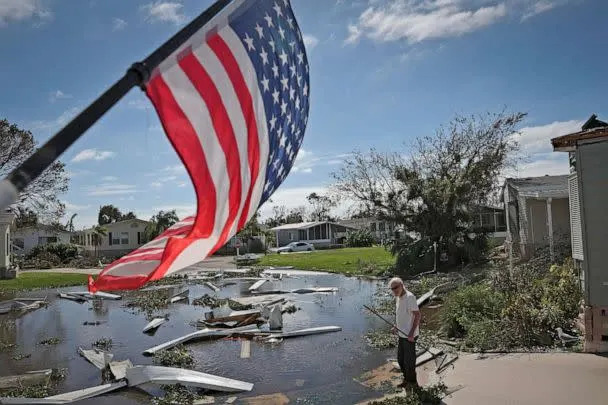
Hurricane risk might seem like the obvious problem, but there is a more insidious driver in this financial train wreck.
Finance professor Shahid Hamid, who directs the Laboratory for Insurance at Florida International University, explained how Florida’s insurance market got this bad – and how the state’s insurer of last resort, Citizens Property Insurance, now carrying more than 1 million policies, can weather the storm.
What’s making it so hard for Florida insurers to survive?
One is the rising hurricane risk. Hurricanes Matthew (2016), Irma (2017) and Michael (2018) were all destructive. But a lot of Florida’s hurricane damage is from water, which is covered by the National Flood Insurance Program, rather than by private property insurance.
Another reason is that reinsurance pricing is going up – that’s insurance for insurance companies to help when claims spike.
But the biggest single reason is the “assignment of benefits” problem, involving contractors after a storm. It’s partly fraud and partly taking advantage of loose regulation and court decisions that have affected insurance companies.
It generally looks like this: Contractors will knock on doors and say they can get the homeowner a new roof. The cost of a new roof is maybe $20,000-$30,000. So, the contractor inspects the roof. Often, there isn’t really that much damage. The contractor promises to take care of everything if the homeowner assigns over their insurance benefit. The contractors can then claim whatever they want from the insurance company without needing the homeowner’s consent.
If the insurance company determines the damage wasn’t actually covered, the contractor sues.
So insurance companies are stuck either fighting the lawsuit or settling. Either way, it’s costly.
Other lawsuits may involve homeowners who don’t have flood insurance. Only about 14% of Florida homeowners pay for flood insurance, which is mostly available through the federal National Flood Insurance Program. Some without flood insurance will file damage claims with their property insurance company, arguing that wind caused the problem.
How widespread of a problem are these lawsuits?
Overall, the numbers are pretty striking.
About 9% of homeowner property claims nationwide are filed in Florida, yet 79% of lawsuits related to property claims are filed there.
The legal cost in 2019 was over $3 billion for insurance companies just fighting these lawsuits, and that’s all going to be passed on to homeowners in higher costs.
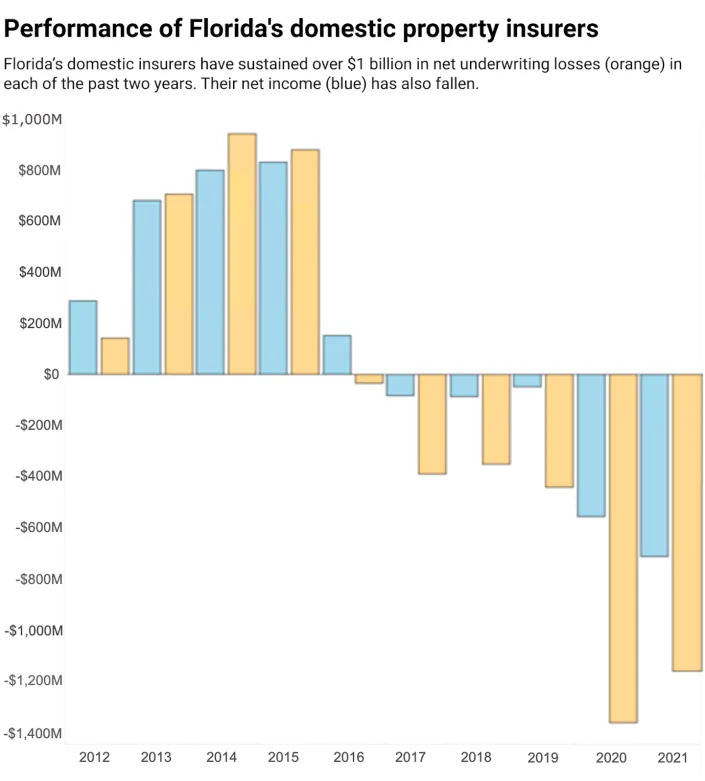
Insurance companies had a more than $1 billion underwriting loss in 2020 and again in 2021. Even with premiums going up so much, they’re still losing money in Florida because of this. And that’s part of the reason so many companies are deciding to leave.
Assignment of benefits is likely more prevalent in Florida than most other states because there is more opportunity from all the roof damage from hurricanes. The state’s regulation is also relatively weak. This may eventually be fixed by the legislature, but that takes time and groups are lobbying against change. It took a long time to pass a law saying the attorney fee has to be capped.
Thirty more are on the Florida Office of Insurance Regulation’s watch list. About 17 of those are likely to be or have been downgraded from A rating, meaning they’re no longer considered to be in good financial health.
Florida beachfront paradise shattered by Hurricane Ian
Rod Nickel – October 5, 2022
Hurricane Ian aftermath in Florida
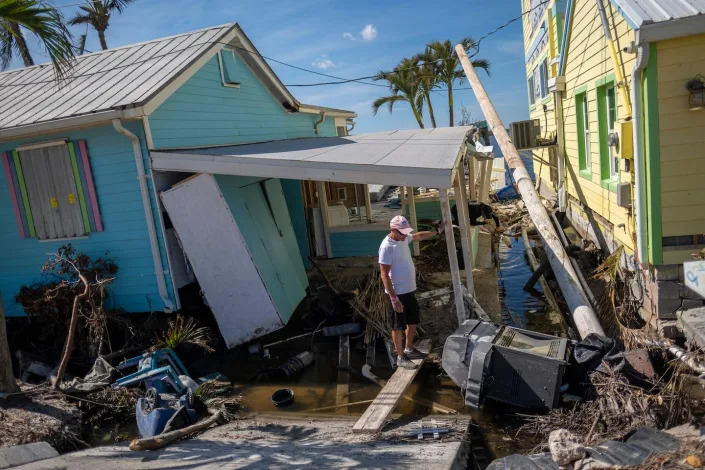
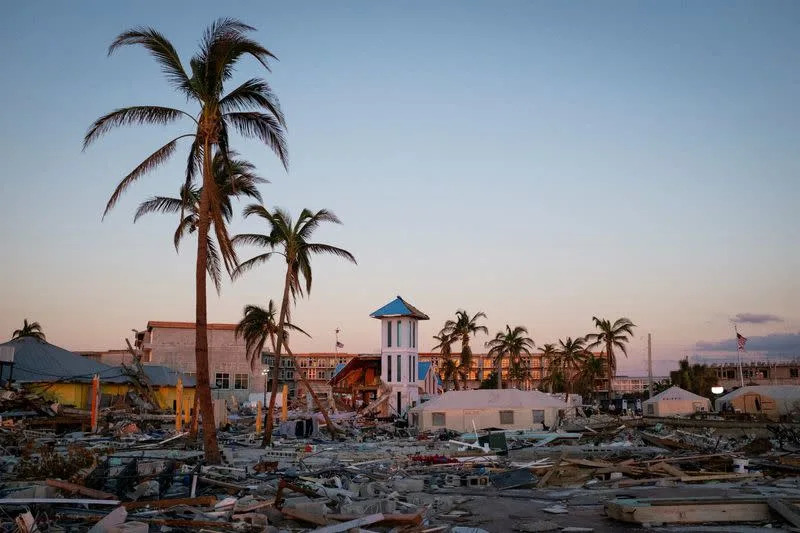
FORT MYERS BEACH, Fla. (Reuters) – Nearly a week after Hurricane Ian hammered southwest Florida, once tony Fort Myers Beach is a nearly deserted disaster zone where destroyed beach houses now mar the postcard views that made this stretch of the Gulf Coast famous.
The town on Estero Island facing the Gulf of Mexico was one of the communities hit hardest by the Category 4 hurricane, which killed more than 100 people in the state when it struck last week.
Fort Myers Beach, a barrier island that stands between the Gulf and the city of Fort Myers, has a population of 5,600, living in bungalows and posh multistory beach houses. Many retirees living here have second homes elsewhere in the United States.
The island’s soft, white sands and teal waves now make for a stark backdrop to rows of pastel storefronts that are missing walls and windows, a landmark pier stripped to its piles, crushed beach houses, and foundations swept entirely clean of the houses that once rested on them.
At one address, a set of concrete steps leads to nowhere. Furniture, plumbing fixtures and drywall are scattered everywhere.
Rescue teams directed by the U.S. Federal Emergency Management Agency (FEMA) are conducting a second round of door-to-door checks for survivors, equipped with dogs and cameras on extending poles.
“It’s going to be a long recovery,” said Ignatius Carroll, a representative of Florida Task Force 2, a search-and-rescue unit that is part of FEMA’s efforts.
“See that debris from the house?” Carroll asks during a tour of Fort Meyers Beach, pointing to a home with its front yard piled high like a junkyard. “That came from another house over here.”
The first 48 hours after a disaster hits are critical to finding survivors, although many people in hurricane-prone areas stock 72 hours’ worth of food and water, Carroll said. Even so, it’s possible to find people days later than that, depending on their provisions, he said.
Steve Duello, 67, a retired grocery store executive from St. Louis, said he was devastated on Tuesday to see the damage to his Fort Myers Beach home for the first time since the hurricane hit.
His ruined house filled with 8 feet of water during the storm, and Duello said he’s unsure whether he’ll rebuild, even though he has been coming to the beach since he was 14.
“It’s way too early. Right now our guts have been torn out. I don’t want to ever go through that again.”
Fort Myers Beach “looks like Hiroshima or Nagasaki,” he said, referring to Japanese cities where U.S. forces dropped atomic bombs during World War Two.
Another island resident, who declined to give his name, stayed through the storm, and has no plans to leave.
“I love this place. I don’t want to live anywhere else but here,” said the elderly, deeply tanned man, wearing shorts and no shirt.
“My daughter wants to pick me up and go back to New York. I don’t want to go.”
(Reporting by Rod Nickel in Fort Myers Beach; editing by Jonathan Oatis)
Florida’s Leaders Opposed Climate Aid. Now They’re Depending on It.
Christopher Flavelle and Jonathan Weisman – October 4, 2022
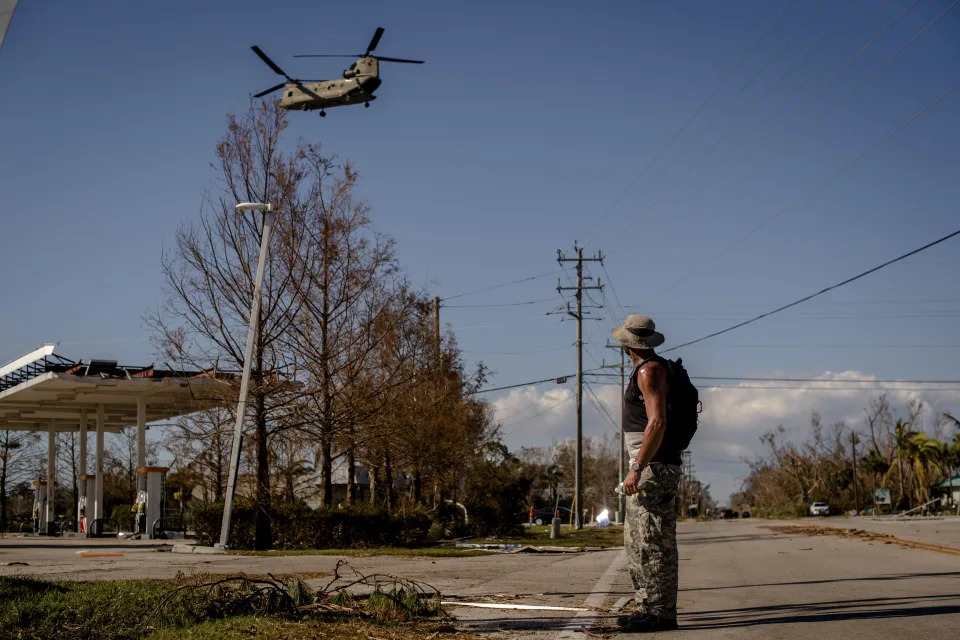
A helicopter carries evacuees from Pine Island, Fla., on Saturday, Oct. 1, 2022. (Hilary Swift/The New York Times)
Hurricane Ian’s wrath made clear that Florida faces some of the most severe consequences of climate change anywhere in the country. But the state’s top elected leaders have opposed federal spending to help fortify states against and recover from climate disasters, as well as efforts to confront their underlying cause: the burning of fossil fuels.
Sens. Marco Rubio and Rick Scott opposed last year’s bipartisan infrastructure law, which devotes some $50 billion to help states better prepare for events like Ian, because they said it was wasteful. And in August, they joined their fellow Republicans in the Senate to vote against a new climate law, which invests $369 billion in reducing greenhouse gas emissions, the largest such effort in the country’s history.
At the same time, Republican Gov. Ron DeSantis has blocked the state’s pension fund from taking climate change into account when making investment decisions, saying that politics should be absent from financial calculations.
In the aftermath of Ian, those leaders want federal help to rebuild their state — but don’t want to discuss the underlying problem that is making hurricanes more powerful and destructive.
As Hurricane Ian approached Florida’s coast, the storm grew in intensity because it passed over ocean water that was 2 to 3 degrees warmer than normal for this time of year, NASA data show. Its destructive power was made worse by rising seas; the water off the southwest coast of Florida has risen more than 7 inches since 1965, according to data from the National Oceanic and Atmospheric Administration. Finally, warmer air resulting from climate change increased the amount of rain that Ian dropped on Florida by at least 10%, or about 2 extra inches in some places, according to a study released last week.
Rubio has secured millions of dollars to restore the Everglades as a way to store floodwaters and repair coral reefs to buffer storm surges. One of his House colleagues, Rep. Mario Diaz-Balart, a South Florida Republican, has secured billions for climate resiliency.
But none of the top Republicans in the state have supported legislation to curb the greenhouse gas emissions causing climate change.
With its sun and offshore wind, Florida could be a leader in renewable energy, said Rep. Kathy Castor, a Democrat who represents Tampa. Instead, it imports natural gas that it burns to produce electricity.
“To not admit that climate change is real and we need to address it bodes nothing but a harm for the future for Florida and the nation,” said Charlie Crist, a former Republican Florida governor who won a House seat as a Democrat and is now challenging DeSantis’ reelection.
Hurricane Ian is far from the first time Florida has felt the impacts of climate change. In Miami, the rising ocean means streets and sidewalks regularly flood during high tide, even on sunny days. In the Florida Keys, officials are looking at raising roadbeds that will otherwise become impassable.
Yet the state’s leaders have long resisted what scientists say is needed to stave off a catastrophic future: an aggressive pivot away from gas, oil and coal and toward solar, wind and other renewable energy sources.
“Attempting to reverse-engineer the U.S. economy to absolve our past climate sins — either through a carbon tax or some ‘Green New Deal’ scheme — will fail,” Rubio wrote in 2019. “None of those advocates can point to how even the most aggressive (and draconian) plan would improve the lives of Floridians.”
Scott, the former governor of Florida who is now the state’s junior senator, has argued the cost of attacking climate change is just too great.
“We clearly want to and need to address the impacts of climate change,” Scott told NPR last summer. “But we’ve got to do it in a fiscally responsible manner. We can’t put jobs at risk.”
Hurricane Ian could be among the costliest storms to hit Florida, with losses estimated in the tens of billions.
The two senators also voted against last year’s infrastructure bill, which provided about $50 billion toward climate resilience — the country’s largest single investment in measures designed to better protect people against the effects of climate change.
That bill, which passed the Senate with support from 19 Republicans, included measures designed to help protect against hurricanes. It provided billions for sea walls, storm pumps, elevating homes, flood control and other projects.
Many of those measures were co-written by another coastal Republican, Sen. Bill Cassidy of Louisiana, who called it “a major victory for Louisiana and our nation.” Sen. Lisa Murkowski, R-Alaska, also supported the bill. Both states face enormous threats from climate change.
But Rubio called it “wasteful,” while Scott said it was “reckless spending.” Both voted no.
Scott and DeSantis did not respond to requests for comment.
Dan Holler, a deputy chief of staff to Rubio, said the senator opposed the infrastructure bill because it included unnecessary measures, just as he opposed the final version of relief for Hurricane Sandy in 2013 because of what he called extraneous pork barrel spending.
But the larger issue, Holler said, is that those pushing broad measures to wean the nation from fossil fuels have yet to prove to Rubio that such efforts would actually slow sea level rise, calm storms or mitigate flooding.
Other Republicans offer similar explanations. Anna Paulina Luna, a Republican candidate expected to win the House district around Tampa Bay, spoke of the devastation she said she saw in Fort Myers, Pine Island and Sanibel Island.
“The damage is so catastrophic, we are going to need help,” she said Monday.
But Luna pushed back hard on the need to address climate change by cutting fossil fuel emissions. She called it “completely bonkers” that the United States would harm its own economy “while we send manufacturing to a country that is one of the top polluters of the world,” referring to China.
Crist sounded almost sympathetic as he discussed the bind that Florida Republicans find themselves in — accepting donations from the oil and gas industry, unwilling to raise the issue of climate change with their most loyal voters, while surveying the damage it is doing to their state.
The oil and gas industry is not a major source of campaign cash for politicians in Florida, where offshore drilling is prohibited. Rubio has received $223,239 from the oil and gas industry since 2017, which puts the industry at 15th on his donor list, federal records show. Scott has received $236,483 from oil and gas, his 14th most generous industry.
But the National Republican Senatorial Committee, which Scott leads, has received $3.2 million in oil and gas donations this campaign cycle, according to the Center for Responsive Politics, eclipsed only by real estate, Wall Street and retirees. By contrast, the fossil fuel business isn’t among the top 20 industries that have given this cycle to the Democratic Senatorial Campaign Committee.
“There’s an ‘ideological versus reality’ divide here that must be very excruciating to these Republican politicians,” Crist said.
Republicans in the state have taken steps to fund climate resilience and adaptation efforts but shy away from using the term “climate.” In 2017, Diaz-Balart, then the Republican chair of the House appropriations subcommittee that funds housing programs, secured $12 billion for “mitigation” measures in block grants to states and communities, $1.4 billion of that for Florida. The word “climate” did not appear in the definition of “mitigation.”
“If you’re from Florida, you should be leading on climate and environmental policy, and Republicans are still reticent to do that because they’re worried about primary politics,” Carlos Curbelo, a former Republican congressman from South Florida. “But on this, the consequences are so serious, it’s worth putting politics aside and addressing climate head on.”
While DeSantis announced a program last year to provide $1 billion over four years to local governments to address flooding, rising seas and other challenges, he has blocked his state’s pension plan from accounting for the environmental performance of companies in making investment decisions.
“We are prioritizing the financial security of the people of Florida over whimsical notions of a utopian tomorrow,” DeSantis said in a statement announcing the decision.
DeSantis’ record on other climate decisions may also come back to haunt him. As a congressman in 2013, he voted against a bill to provide extra disaster aid to victims of Hurricane Sandy — the same type of extra support that Florida is now seeking for Ian.
On Friday, Rubio and Scott wrote to their Senate colleagues asking them to support a package of disaster aid. Like DeSantis, Rubio opposed a similar measure after Sandy struck the Northeast in 2012. (Scott had not yet been elected to the Senate.)
Yoca Arditi-Rocha, executive director of the CLEO Institute, a nonprofit group in Florida that promotes climate change education, advocacy and resilience, said the state’s top elected officials need to do much more than react after disaster strikes.
“Florida will continue to be on the front lines of more destructive hurricanes fueled by a warming climate,” Arditi-Rocha said. “We need Republican leaders to step up.”
Hurricane Ian aftermath: Tour of damage shows parts of Naples look like “a war zone”
Laura Layden, Naples Daily News – October 3, 2022
In a drive around the city, Naples Police Lieutenant Bryan McGinn pointed to some of the worst and costliest damage caused by Hurricane Ian.
On Friday, he whizzed around the city streets, as much as he could, driving through sludge, stopping at every dark traffic light and dodging clean-up and repair crews — and a slew of curious onlookers wanting to see the destruction for themselves.
Scene of Gulf Shore Boulevard North of stranded, flooded cars.
Sludge still filled much of the road, patio furniture lay tangled in the median, cars sat angled in front of condos, a sign of the powerful, unexpected surge that put them completely under water. A crooked boat sat in a parking lot, moved from its perch, with another halfway submerged in waters nearby.
A boat displaced from its dock on Gulf Shore Boulevard North.
Residents had started the clean-up, dragging everything from drenched carpet to soaked couches to the curb. Along with a snarl of landscaping.
Clearly, there’s much more work to be done in the Moorings, Park Shore and elsewhere in the city. With gobs of debris started to make it to the curb.
City residents are picking up the pieces from Hurricane Ian after extreme flooding.
Boats uplifted from their docks
At the Village Shops on Venetian Bay, business owners worked to deal with the mess, a stranded boat sat in the parking lot, with no name on it.
“Unfortunately, there was a lot of water surging,” McGinn said. “That storm came in real fast.”
It wasn’t just water that roared onto the shore in the city. It was loads of sand and sediment from the Gulf of Mexico and Naples Bay, which did plenty of damage of its own.
That sand and sediment turned into a slippery, sticky muck that covered city streets — and the insides of homes and businesses. Some have complained about its stench.
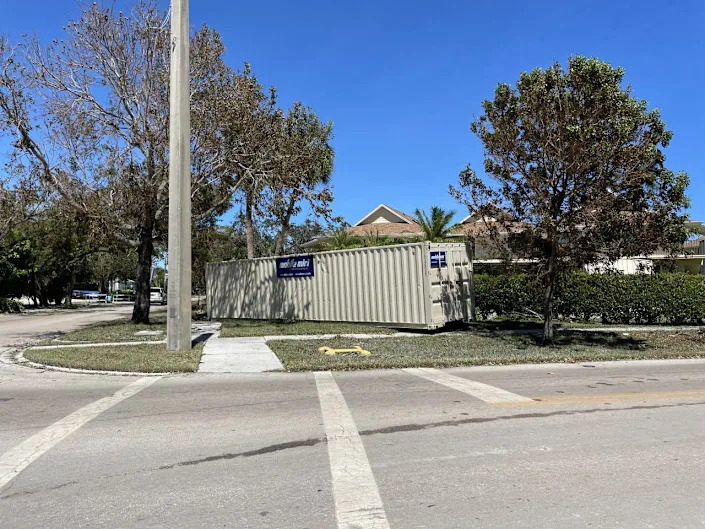
During the tour, McGinn pointed to an extra-wide, steel mobile mini storage container sitting near the intersection of 8th Street South and Broad Avenue, feet from the Cove Inn On Naples Bay, that mysteriously appeared there, likely from a construction site nearby, taking up the entire corner.
“That storage container doesn’t belong there,” he said.
Storage container deposited roadside by surging waters in Naples at 8th Street South and Broad Avenue South.
Its weight is in the thousands of pounds, showing the power of the surge.
In Crayton Cove, McGinn took a turn toward the City Dock, rebuilt a few years ago at a cost of $7 million. He happily reported it fared well.
Businesses are picking up the pieces
Nearby businesses, however, weren’t as lucky, including The Dock, a Naples landmark. It’s still standing, but crews worked busily to clean up its insides, which clearly saw a heavy impact from the storm surge.
Across the way, Napoli On The Bay, didn’t look so good either, with a water line stain halfway up the door.
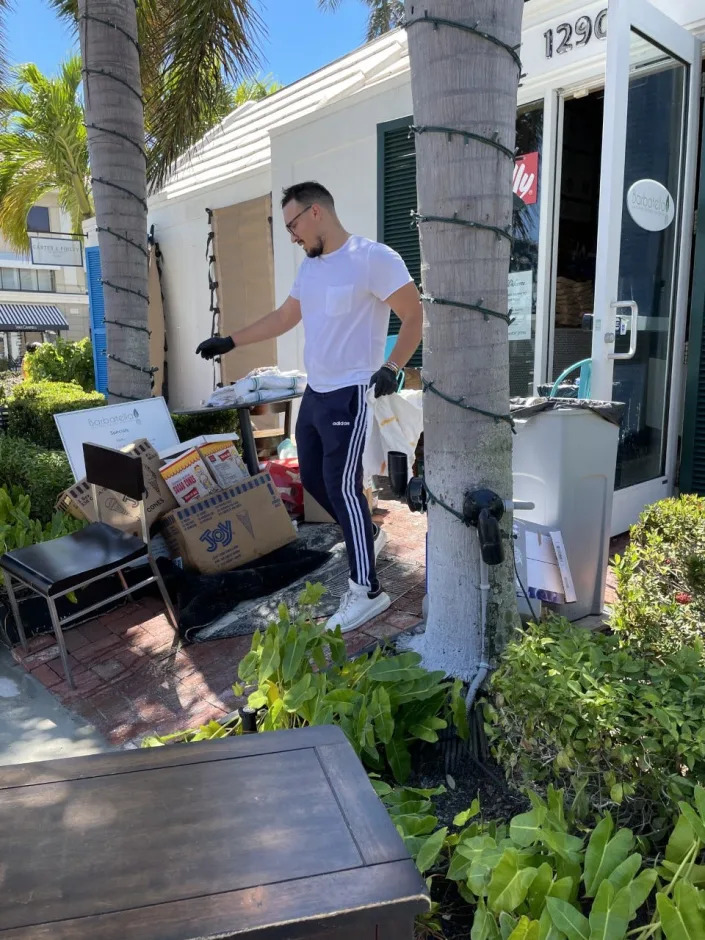
On Third Avenue South downtown, store owners scrambled to pick up the pieces. Chain saws roared, vacuum trucks rumbled as they sucked out water, and power washers echoed, as owners, employees and hired contractors worked to wash down all the sediment left behind on everything from parking lots to plant pots.
Water stains again showed just how high the water got.
Some business owners have lost virtually everything.
On Third Street and nearby Fifth Avenue South, shops, restaurants and other businesses have scrambled to reopen, if possible.
“Fortunately, our city is resilient,” McGinn said. “So, many business owners are making a push. They want to be able to help people. That’s what they do.”
Businesses are picking up the pieces on Third Street South in downtown Naples.
As soon as it could, Liki Tiki, the local “Tiki Bar” and classic BBQ restaurant on U.S. 41, reopened on Thursday, serving drinks only — because that’s all it could do.
“It was packed,” McGinn said. “It’s a good sight to see. It’s good camaraderie.”
Port Royal may have fared better than others
In Port Royal, known as one of the priciest neighborhoods in America, the damage didn’t seem as great. Signs of water intrusion were harder to spot, but landscaping took a hit, with a near-constant buzz of chain saws.
“A lot of these are new construction homes,” McGinn said. “So, maybe they did fare a little better.”
The Port Royal Club sustained damage.
Closer to the coast, surging waters forced some residents to their roofs, for higher ground, to wait out rescue crews.
“I’m sure there were lives lost,” McGinn said. “But we won’t know how many for some time. It’s hard to tell.”
Some of the stranded cars still spotted around the city, he said, are the result of residents driving around during the storm, failing to heed warnings. They had to walk or swim away, abandoning their vehicles, McGinn said.
“People were still out and about, not listening to shelter in place,” he said, or evacuation orders.
After the storm, vehicles blocking streets were taken to Baker Park, but eventually, the city ran out parking spaces for them.
Mansions on the Gulf could have seen extensive damage
On Gordon Drive, it’s hard to tell how much damage multimillion-dollar mansions sitting directly on the Gulf of Mexico took, but McGinn said the water and sand likely did a lot of damage to them.
Parts of Gordon Drive were still blocked on Friday, with piles of sand dropped by Ian still in the road.
Much of the city saw flooding.
“Even areas like Lake Park had several feet of water in their homes,” McGinn said, after the Gordon River flooded.
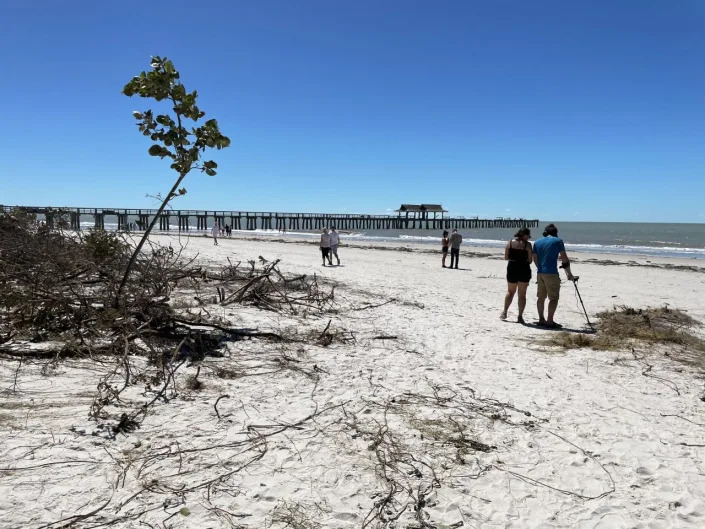
The Naples Pier is heavily damaged, but not destroyed.
“It’s sad,” McGinn said.
Treasure hunters and curious visitors at beach, near Naples Pier, damaged by Hurricane Ian, on Friday, Sept. 30, 2022.
While beach ends, or public access points, haven’t reopened, residents and visitors alike have flocked to them, to see the damages with their own eyes shooting photos and videos to document the storm.
“This is how well people listen,” McGinn said. “I get it. Everybody wants to see how the city of Naples fared. It all comes from a good place.”
At the Horizon Way beach access in Park Shore, he pointed to what looked like structural damage at St. Croix Club condominiums, but it was hard to determine the extent of it.
“That’s no bueno,” McGinn said.
Parts of Naples look like a “war zone”
In the Moorings area, Regency Towers looked like it took a heavy hit too — along with other condos and homes.
“It looks like a war zone up here,” McGinn said.
While water wiped out the contents of condos, homes and businesses, he said, structural damage might not be extensive since winds weren’t as extreme as with past storms.
“Their personal property is gone,” McGinn said. “But they can be replaced over time.”
Looking over all the damage in Naples, it’s hard to fathom how bad others had it just one county over, McGinn said.
“What’s crazy is we are not even the hardest hit area,” he said.
Facing a Dire Storm Forecast in Florida, Officials Delayed Evacuation
Frances Robles – October 1, 2022
Tristan Stout surveys damage to his father’s boat after it was thrown across the street as Hurricane Ian swept over San Carlos Island in Fort Myers Beach, Fla. on Friday, Sept. 30, 2022. (Jason Andrew/The New York Times)
FORT MYERS, Fla. — As Hurricane Ian charged toward the western coast of Florida this week, the warnings from forecasters were growing more urgent. Life-threatening storm surge threatened to deluge the region from Tampa all the way to Fort Myers.
But while officials along much of that coastline responded with orders to evacuate Monday, emergency managers in Lee County held off, pondering during the day whether to tell people to flee, but then deciding to see how the forecast evolved overnight.
The delay, an apparent violation of the meticulous evacuation strategy the county had crafted for just such an emergency, may have contributed to catastrophic consequences that are still coming into focus as the death toll continues to climb.
Dozens have died overall in the state, officials said, as Ian, downgraded to a post-tropical cyclone, moved through North Carolina and Virginia on Saturday, at one point leaving nearly 400,000 electricity customers in those states without power.
About 35 of Florida’s storm-related deaths have been identified in Lee County, the highest toll anywhere in the state, as survivors describe the sudden surge of water — predicted as a possibility by the National Hurricane Service in the days before the storm hit — that sent some of them scrambling for safety in attics and on rooftops.
Lee County, which includes the hard-hit seaside community of Fort Myers Beach, as well as the towns of Fort Myers, Sanibel and Cape Coral, did not issue a mandatory evacuation order for the areas likely to be hardest hit until Tuesday morning, a day after several neighboring counties had ordered their most vulnerable residents to flee.
By then, some residents recalled that they had little time to evacuate. Dana Ferguson, 33, a medical assistant in Fort Myers, said she had been at work when the first text message appeared on her phone Tuesday morning. By the time she arrived home, it was too late to find anywhere to go, so she hunkered down with her husband and three children to wait as a wall of water began surging through areas of Fort Myers, including some that were well away from the coastline.
“I felt there wasn’t enough time,” she said.
Ferguson said she and her family fled to the second floor, lugging a generator and dry food, as the water rose through their living room. The 6-year-old was in tears.
Kevin Ruane, a Lee County commissioner and a former mayor of Sanibel, said the county had postponed ordering an extensive evacuation because the earlier hurricane modeling had shown the storm heading farther north.
“I think we responded as quickly as we humanly could have,” he said.
Gov. Ron DeSantis and his state emergency management director also said the earlier forecasts had predicted the brunt of the storm’s fury would strike farther north.
“There is a difference between a storm that’s going to hit north Florida that will have peripheral effects on your region, versus one that’s making a direct impact,” DeSantis said at a news conference Friday in Lee County. “And so what I saw in southwest Florida is, as the data changed, they sprung into action.”
But while the track of Hurricane Ian did shift closer to Lee County in the days before it made landfall, the surge risks the county faced — even with the more northerly track — were becoming apparent as early as Sunday night.
At that point, the National Hurricane Center produced modeling showing a chance of a storm surge covering much of Cape Coral and Fort Myers. Parts of Fort Myers Beach, even in that case, had a 40% chance of a 6-foot-high storm surge, according to the surge forecasts.
Lee County’s emergency planning documents had set out a time-is-of-the-essence strategy, noting that the region’s large population and limited road system make it difficult to evacuate the county swiftly. Over years of work, the county has created a phased approach that expands the scope of evacuations in proportion to the certainty of risk. “Severe events may require decisions with little solid information,” the documents say.
The county’s plan proposes an initial evacuation if there is even a 10% chance that a storm surge will go 6 feet above ground level; based on a sliding scale, the plan also calls for an evacuation if there is a 60% chance of a 3-foot storm surge.
Along with the forecasts Sunday night, updated forecasts Monday warned that many areas of Cape Coral and Fort Myers had between a 10% and a 40% chance of a storm surge above 6 feet, with some areas possibly seeing a surge of more than 9 feet.
Over those Monday hours, neighboring Pinellas, Hillsborough, Manatee, Sarasota and Charlotte counties issued evacuation orders, while Sarasota County announced that it expected evacuation orders to be in effect for the following morning. In Lee County, however, officials said they were waiting to make a more up-to-date assessment the following morning.
“Once we have a better grasp on all of that dynamic, we will have a better understanding about what areas we may call for evacuation, and, at the same time, a determination of what shelters will be open,” the Lee County manager, Roger Desjarlais, said Monday afternoon.
But forecasters with the National Hurricane Center were growing more explicit in their warnings for the region. In a 5 p.m. update Monday, they wrote that the highest risk for “life-threatening storm surge” was in the area from Fort Myers to Tampa Bay.
“Residents in these areas should listen to advice given by local officials,” the hurricane center wrote. New modeling showed that some areas along Fort Myers Beach were more likely than not to see a 6-foot surge.
Ruane, the county commissioner, said that one challenge the county faced was that the local schools had been designed to be shelters and that the school board had made the decision to keep them open Monday.
By 7 a.m. Tuesday, Desjarlais announced a partial evacuation order but emphasized that “the areas being evacuated are small” compared with a previous hurricane evacuation.
The county held off on further evacuations, despite a forecast that showed potential surge into areas not covered by the order. Officials expanded their evacuation order later in the morning.
By the middle of the afternoon, Lee County officials were more urgent in their recommendation: “The time to evacuate is now, and the window is closing,” they wrote in a message on Facebook.
Katherine Morong, 32, said she had been prepared earlier in the week to hunker down and ride out the storm based on the guidance from local officials. The sudden evacuation order Tuesday morning left her scrambling, she said, as she set out in her car in the rain.
“The county could have been more proactive and could have given us more time to evacuate,” she said. On the road toward the east side of the state, she said, she was driving through torrents of rain, with tornadoes nearby.
Joe Brosseau, 65, said he did not receive any evacuation notice. As the storm surge began pouring in Wednesday morning, he said, he considered evacuating but realized it was too late.
He climbed up a ladder with his 70-year-old wife and dog to reach a crawl space in his garage. He brought tools in case he needed to break through the roof to escape.
“It was terrifying,” Brosseau said. “It was the absolute scariest thing. Trying to get that dog and my wife up a ladder to the crawl space. And then to spend six hours there.”
Some residents said they had seen the forecasts but decided to remain at home anyway — veterans of many past storms with dire predictions that had not come to pass.
“People were made aware, they were told about the dangers and some people just made the decision that they did not want to leave,” DeSantis said Friday.
Joe Santini, a retired physician assistant, said he would not have fled his home even if there had been an evacuation order issued well before the storm. He said that he had lived in the Fort Myers area most of his life, and that he would not know where else to go.
“I’ve stuck around for every other one,” he said.
The water rushed into his home around dusk Wednesday night, and Friday, there was still a high-water mark about a foot above the floor — leaving Santini a little stunned. “I don’t think it’s ever surged as high as it did,” he said.
Lee County is now an epicenter of devastation, with mass destruction at Fort Myers Beach, the partial collapse of the Sanibel Causeway and entire neighborhoods reduced to rubble. With water mains broken, the county utilities agency has advised residents to boil their water.
President Joe Biden said Friday that the destruction from the storm was likely to be among the worst in U.S. history.
“It’s going to take months, years to rebuild,” he said.
‘I just can’t wait to get out’: Nearly three-quarters of pandemic homebuyers have regrets — here’s what you need to know before you put in that offer
Serah Louis – September 30, 2022
‘I just can’t wait to get out’: Nearly three-quarters of pandemic homebuyers have regrets — here’s what you need to know before you put in that offer
Kay Kingsman bought her very first home in the summer of 2021 — but now wishes she hadn’t.
Kingsman, a travel blogger based in Portland, Oregon, says she decided to buy since she had plenty of money saved up from not traveling during the pandemic and mortgage rates were extremely low.
She and many other pandemic homebuyers rushed into making a purchase that didn’t fully align with their needs — and they’re currently contending with the ramifications.
Kingsman recounts finding beard shavings in the bathroom and the carpet smelling of cat urine when the previous owners vacated. The water pressure was weak and the air conditioning was busted.
She also discovered she had no parking privileges thanks to a messy lawsuit they left behind.
“It’s just been a complete headache,” she says.
Many homebuyers either overpaid or made compromises on what they wanted
Nearly three-fourths of Americans who purchased homes in 2021 and 2022 have regrets, according to Anytime Estimate’s American Home Buyer Survey, which was released in September.
“Pandemic-era buyers really faced these unprecedented conditions,” says Amanda Pendleton, home trends expert at Zillow.
“This combination of rising prices, few options to choose from and that extreme time pressure meant that some buyers really ended up at a home that was less than ideal.”
The survey showed that respondents paid a median amount of $495,000 for their home — with almost a third paying over asking.
Eighty percent of buyers also compromised on their priorities, such as finding the right location. Some bought fixer-uppers, while others made offers without even seeing the properties in person.
Like Kingsman, 70% of buyers were purchasing a home for the first time. After seeing a previous listing snapped up within a day, she was determined to not fall behind.
“[Homes] were selling so much above market rate. I didn’t want to wait too long,” explains Kingsman. “And I was kind of swept up in this fast go, go, go motion.”
How can you avoid regretting a home purchase?
Before buying a home, make sure you’ve done your research and established your priorities.
She says that her only priority had been to find a home that was close to her place of work, but wishes she had considered other factors, like updated plumbing and proximity to green spaces and trails.
“I would say my regret is not that I bought a house — it’s more that I didn’t allow myself the time to pick the right house,” says Kingsman.
Pendleton has four tips for house-hunters before buying a home.
“Number one: Before you enter your home search, really understand where you’re willing to compromise and where you’re not,” she says. It’s important to establish your priorities and deal-breakers and separate your needs from your wants ahead of time.
Her second suggestion is to focus on the right things, such as location and layout. “You can update a dated kitchen, you can rip out that ugly carpeting. But all the money in the world really can’t change your home’s location, and changing a home’s layout would be really expensive.”
Pendleton’s third tip is to determine any hidden costs of maintaining the home to make sure you can really afford the home.
She advises not to take any unnecessary risks, such as waiving an inspection. This can end up being incredibly costly later on.
Zillow research shows that homeowners end up paying around $750 a month, or over $9,000 a year just for basic repairs and maintenance.
“The fourth tip would be to have a sounding board,” advises Pendleton. “You know, you really want to rely on a trusted real estate agent who will keep you grounded and focused on your priorities … So they can help you identify potential red flags in the home.”
What can you do if you have regrets?
Kingsman doesn’t believe she will ever be completely happy with her current home, mainly because she doesn’t have a designated parking spot and has to resort to parking on the street.
The previous homeowners were embroiled in a conflict with the HOA and one of the stipulations of the resulting lawsuit was that the future owner of the lot wouldn’t have access to designated parking either.
“So now, all my neighbors feel very icky about me because of some drama that they had with the previous owner and my lot,” adds Kingsman.
She hopes to eventually sell or rent out the home.
“I feel like a lot of people are very sentimental about their first home and stuff, and I just can’t wait to get out.”
Just because you buy a home, doesn’t necessarily mean you’ll never move again.
“Not every home is going to be a forever home,” Pendleton emphasizes. “If your home doesn’t meet your needs, you can always move. And in today’s market, you’re still gonna get a really strong price for your home.”
“Your house may not look like it’s right out of HGTV tomorrow. But you know, if you work on it, maybe in two years, you’re gonna get a lot closer,” she says.
Look into any potential tax credits or rebates you can claim for making upgrades as well, like making energy efficient improvements.
Today’s homebuyers may have better luck
If you can afford today’s mortgage rates and prices, you might be in a better place than buyers were in the past couple years.
The housing market has shown signs of cooling — with home sales dropping for the seventh month in a row and prices falling for the first time in a decade.
“The silver lining for [buyers] is that they are going to be facing less competition, they’re probably not going to get into a heated bidding war, they’re going to have more options to choose from, they’re going to have a little bit more breathing room to make that decision,” says Pendleton.
This article provides information only and should not be construed as advice. It is provided without warranty of any kind.
‘500-year flood’: Florida begins to assess Hurricane Ian’s catastrophic damage
Dylan Stableford, Senior Writer – September 29, 2022
A day after Hurricane Ian made landfall in southwest Florida as a Category 4 storm, Florida Gov. Ron DeSantis said Thursday that the storm surge that came with it was “basically a 500-year flood event.”
“We’ve never seen a flood event like this,” he said during a news briefing in Tallahassee. “We’ve never seen a storm surge of this magnitude.”
More than 2.5million people across the state were without power as search and rescue teams and first responders assessed the historic damage.
Flooded streets in Fort Myers, Fla., on Thursday after Hurricane Ian caused widespread destruction. (Marco Bello/Reuters)
Large sections of the Sanibel Causeway, which connects the Sanibel Islands to the mainland, collapsed into the Gulf of Mexico.
DeSantis said the causeway and Matlacha Pass Bridge are “impassable” and are going to require “structural” rebuilds.
Lee County, which includes Fort Myers, was particularly hard hit. On NBC’s “Today” show, Mayor Kevin Anderson, who has lived in the city since the 1970s, said Ian was “by far the worst storm” he’d ever seen.
Severely damaged boats in Fort Myers, Fla., amid other debris following the hurricane. (Giorgio Viera/AFP via Getty Images)
And there were conflicting reports of fatalities.
On ABC’s “Good Morning America,” Lee County Sheriff Carmine Marceno said, “While I don’t have confirmed numbers, I definitely know the fatalities are in the hundreds.” DeSantis, though, said that that number was unconfirmed and based on the thousands of people who called to report rising water in their homes.
Later on CNN, Marceno said that there were five confirmed deaths and that “a couple thousand calls came through 911.”
“We got crushed,” he said.
The devastation was seen in other counties too. In Port Charlotte, in Charlotte County, the storm ripped part of a roof off a hospital’s intensive care unit, forcing staff and patients to evacuate to other floors.
A spiral staircase in the brush next to a pickup near the Sanibel Causeway. (Douglas R. Clifford/Tampa Bay Times via AP)
DeSantis said he spoke early Thursday with President Biden, who formally issued a disaster declaration and reaffirmed his commitment to use all available federal resources to assist in rescue and recovery efforts.
Biden was scheduled to receive a briefing on the response efforts at the Federal Emergency Management Agency headquarters in Washington, D.C., Thursday afternoon.
Ian was downgraded to a tropical storm as it cut across the state Thursday morning, but officials warned that conditions remain dangerous.
In Kissimmee, Fla., just south of Orlando, multiple people were rescued from their cars in rising floodwaters. A military transport vehicle was used to bring people and their pets to safety.
“The initial investigation indicates the victim was using a hose to drain the pool down a hill and into a 30-foot-wide canal, where a steep decline into the water was extremely soft and slippery due to the heavy rain,” the post read. “The Sheriff’s Office sends its sincere condolences to the victim’s family.”
Hurricane Ian could cripple Florida’s home insurance industry
Alexis Christoforous – September 29, 2022
Hurricane Ian could cripple Florida’s already-fragile homeowners insurance market. Experts say a major storm like Ian could push some of those insurance companies into insolvency, making it harder for people to collect on claims.
Since January 2020, at least a dozen insurance companies in the state have gone out of business, including six this year alone. Nearly 30 others are on the Florida Office of Insurance Regulation’s “Watch List” because of financial instability.
“Hurricane Ian will test the financial preparedness of some insurers to cover losses to their portfolios, in particular smaller Florida carriers with high exposure concentrations in the impacted areas,” Jeff Waters, an analyst at Moody’s Analytics subsidiary RMS and a meteorologist, told ABC News. Waters said Florida is a peak catastrophe zone for reinsurers, and those with exposure will likely incur meaningful losses.
PHOTO: This aerial photo shows damaged homes and debris in the aftermath of Hurricane Ian, Sept. 29, 2022, in Fort Myers, Fla. (Wilfredo Lee/AP)
More than 1 million homes on the Florida Gulf Coast are in the storm’s path, and while Ian’s track and severity can change in the coming days, one early estimate pegs the potential reconstruction cost at $258 billion, according to Corelogic, a property analytics firm.
Industry analysts say years of rampant and frivolous litigation and scams have brought Florida’s home-insurance market to its knees, with many large insurers like Allstate and State Farm, reducing their exposure to the state in the past decade.
“Insurers most exposed to the storm will be the Florida-only insurers, which we define as insurance companies with at least 75% of their homeowners and commercial property premiums written in Florida,” according to a report from Moody’s Analytics submitted to ABC News.
The state-run, taxpayer-subsidized Citizens Property Insurance Corp. stands to lose the most. As more local insurance companies in Florida have closed their doors, Citizens has seen its number of policyholders swell from 700,000 to more than 1 million in just the past year.
Florida state Sen. Jeff Brandes, a Republican from St. Petersburg and a vocal critic of Florida’s insurance industry, warns that if Citizens can’t pay its claims, Floridians should brace for assessments to go up on their own insurance policies under a state law that allows it to assess non-customers to pay out claims.
“Every policy holder in the state of Florida, home and auto, should be watching this storm very carefully because it could have a direct impact on their pocketbooks,” said Brandes. He predicts policy holders will see rate hikes of up to 40% next year as a result of Ian.
A spokesperson for Citizens tells ABC News that if their preliminary estimate of 225,000 claims and $3.8 billion in losses holds, the insurer of last resort would be in a position to pay all claims without having to levy a “hurricane tax” on residents.
Florida is already home to the highest insurance premiums in the U.S., something Charlie Crist, the former Florida governor running against incumbent Gov. Ron DeSantis, blames on his opponent.
“Gov. DeSantis let these insurance companies double Floridians’ rates and they’re still going belly up when homeowners need them most. You pay and pay and pay, and the insurance company isn’t there for you in the end anyway,” Crist said in a statement Monday.
A spokesperson for DeSantis did not immediately respond to ABC News’ request for comment.
In May, DeSantis signed a bipartisan property insurance reform bill into law that poured $2 billion into a reinsurance relief program and $150 million into a grant program for hurricane retrofitting. Among other things, it prohibits insurance companies from denying coverage based on the age of a roof and limits attorney fees on frivolous claims and lawsuits.
At a news conference Tuesday, DeSantis said a lot of the damage from Ian would be from flooding and storm surge. DeSantis said the danger with the Tampa Bay area is that the water has no place to go, noting that the area has close to 1 million residents enrolled in a national flood insurance program.
PHOTO: A man begins cleaning up after Hurricane Ian moved through the Gulf Coast of Florida on Sept. 29, 2022 in Punta Gorda, Fla. (Win Mcnamee/Getty Images)
Homeowner policies typically do not cover flood damage, and most homeowners located in a flood zone often get coverage from the Federal Emergency Management Agency (FEMA). Most private property insurance companies insure primarily for wind damage.
President Joe Biden on Thursday approved DeSantis’ request for a disaster declaration for a number of counties in the state. It includes grants for temporary housing and home repairs and low-cost loans to cover uninsured property losses.
“The expense will be higher because of higher construction costs and overall inflation,” Denise Rappmund, the vice president of Moody’s Public Project and Infrastructure Finance Group, told ABC News. “FEMA is the key source of aid following a natural disaster, but much of the costs to repair and rebuild damaged property will be borne by property insurers who will benefit from $2 billion of state-funded reinsurance.”
Analysts say Hurricane Ian has the potential to be among the four costliest storms in U.S. history, mostly because Florida’s population has exploded in recent years.
No state in the eastern U.S. has grown faster in population than Florida in the past decade and the state’s fastest growing cities: Tampa, Fort Myers and Sarasota, are all in the storm’s path. Analysts warn that more people and more homes mean that a major storm could become more destructive and costly.
Cuba without electricity after hurricane hammers power grid
Andrea Rodriguez – September 27, 2022
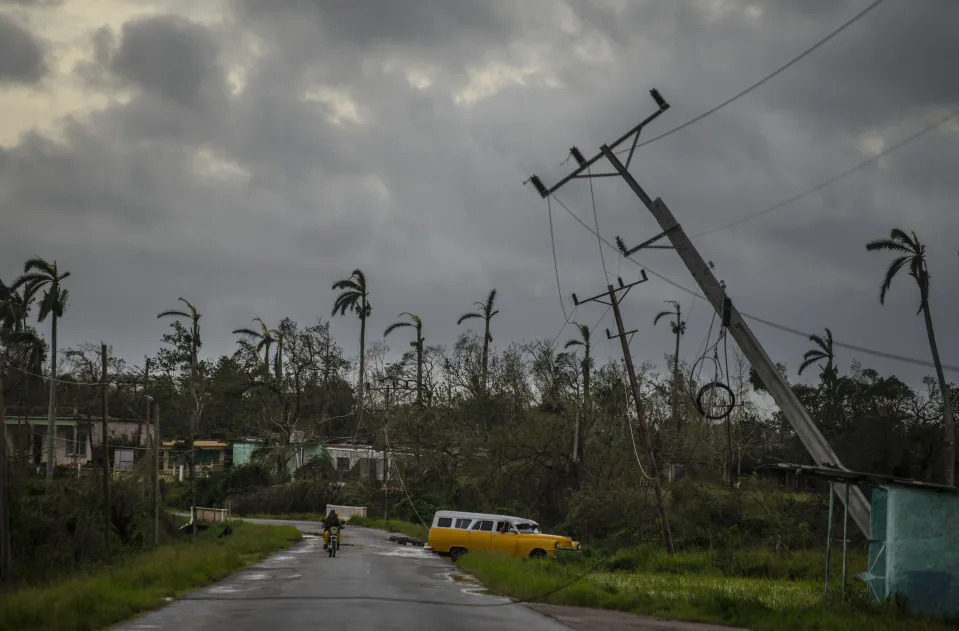
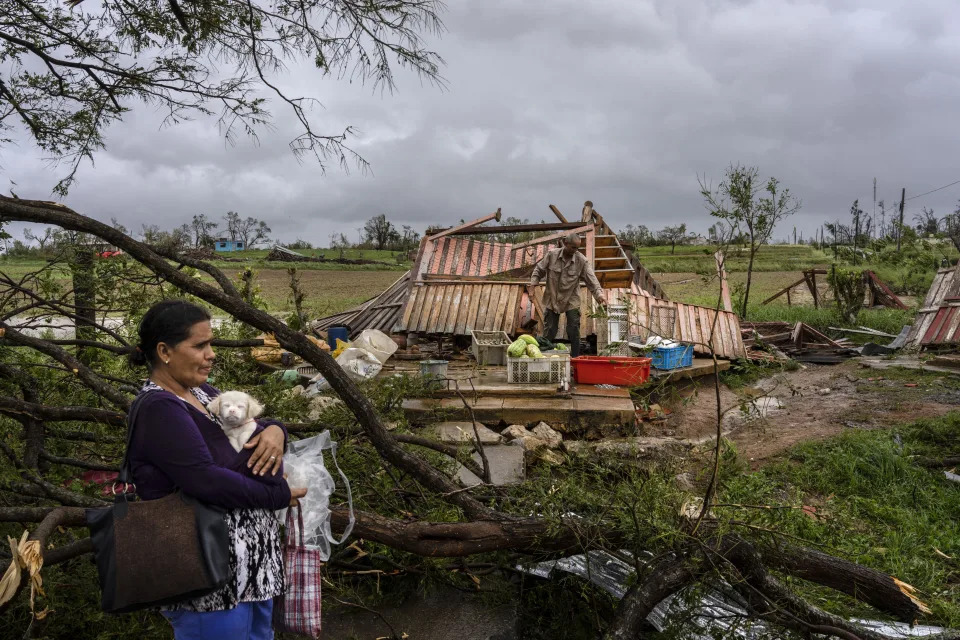
A classic American car drives past utility poles tilted by Hurricane Ian in Pinar del Rio, Cuba, Tuesday, Sept. 27, 2022. (AP Photo/Ramon Espinosa)Men lead their ox cart past a tobacco warehouse smashed by Hurricane Ian in Pinar del Rio, Cuba, Tuesday, Sept. 27, 2022. Hurricane Ian tore into western Cuba as a major hurricane and left 1 million people without electricity, then churned on a collision course with Florida over warm Gulf waters amid expectations it would strengthen into a catastrophic Category 4 storm. (AP Photo/Ramon Espinosa)Maria Llonch retrieves her belongings from her home damaged by Hurricane Ian in Pinar del Rio, Cuba, Tuesday, Sept. 27, 2022. (AP Photo/Ramon Espinosa)Mercedes Valdez holds her dog Kira as she waits for transportation after losing her home to Hurricane Ian in Pinar del Rio, Cuba, Tuesday, Sept. 27, 2022. (AP Photo/Ramon Espinosa)
HAVANA (AP) — Hurricane Ian knocked out power across all of Cuba and devastated some of the country’s most important tobacco farms when it slammed into the island’s western tip as a major hurricane Tuesday.
Cuba’s Electric Union said in a statement that work was underway to gradually restore service to the country’s 11 million people during the night. Power was initially knocked out to about 1 million people in Cuba’s western provinces, but later the entire grid collapsed.
Ian hit a Cuba that has been struggling with an economic crisis and has faced frequent power outages in recent months. It made landfall as a Category 3 storm on the island’s western end, devastating Pinar del Río province, where much of the tobacco used for Cuba’s iconic cigars is grown.
Tens of thousands of people were evacuated and others fled the area ahead of the arrival of Ian, which caused flooding, damaged houses and toppled trees. Authorities were still assessing the damage, although no fatalities had been reported by Tuesday night.
Ian’s winds damaged one of Cuba’s most important tobacco farms in La Robaina.
“It was apocalyptic, a real disaster,” said Hirochi Robaina, owner of the farm that bears his name and that his grandfather made known internationally.
Robaina, also the owner of the Finca Robaina cigar producer, posted photos on social media of wood-and-thatch roofs smashed to the ground, greenhouses in rubble and wagons overturned.
State media said Cuban President Miguel Díaz-Canel visited the affected region.
Cuba’s Meteorology Institute said the city of Pinar del Río was in the heart of the hurricane for an hour and a half.
“Being in the hurricane was terrible for me, but we are here alive,” said Pinar del Rio resident Yusimí Palacios, who asked authorities for a roof and a mattress.
Officials had set up 55 shelters and took steps to protect crops, especially tobacco.
The U.S. National Hurricane Center said Cuba suffered “significant wind and storm surge impacts” when the hurricane struck with top sustained winds of 125 mph (205 kph).
Ian was expected to get even stronger over the warm Gulf of Mexico, reaching top winds of 130 mph (209 kph) approaching the southwestern coast of Florida, where 2.5 million people were ordered to evacuate.
As the storm’s center moved into the Gulf, scenes of destruction emerged in Cuba. Authorities were still assessing the damage in its world-famous tobacco belt.
Local government station TelePinar reported heavy damage at the main hospital in Pinar del Rio city, tweeting photos of collapsed ceilings and downed trees. No deaths were reported.
Videos on social media showed downed power lines and cut off roads in the provinces of Pinar del Rio, Artemisa and Mayabeque. A hospital in Pinar del Río was damaged.
“The town is flooded,” said farmer Andy Muñoz, 37, who lives in Playa Cajío in Artemisa.
He said many people lost their belongings due to the storm surge.
“I spent the hurricane at home with my husband and the dog. The masonry and zinc roof of the house had just been installed. But the storm tore it down,” said Mercedes Valdés, who lives along the highway connecting Pinar del Río to San Juan y Martínez. “We couldn’t rescue our things … we just ran out.”
AP journalist Osvaldo Angulo in Pinar del Rio contributed to this report.
Rising homelessness is tearing California cities apart
Lara Korte and Jeremy B. White – September 21, 2022
Jae C. Hong/AP Photo
SACRAMENTO, Calif. — A crew of state workers arrived early one hot summer day to clear dozens of people camped under a dusty overpass near California’s Capitol. The camp’s residents gathered their tents, coolers and furniture and shifted less than 100 feet across the street to city-owned land, where they’ve been ever since.
But maybe not for much longer.
The city of Sacramento is taking a harder line on homeless encampments, and is expected to start enforcing a new ban on public camping by the end of the month — if the courts allow.
As the pandemic recedes, elected officials across deep-blue California are reacting to intense public pressure to erase the most visible signs of homelessness. Democratic leaders who once would have been loath to forcibly remove people from sidewalks, parks and alongside highways are increasingly imposing camping bans, often while framing the policies as compassionate.
“Enforcement has its place,” said Sacramento Mayor Darrell Steinberg, a Democrat who has spent much of the past year trying to soothe public anger in a city that has seen its unsheltered homeless population surpass that of San Francisco — 5,000 in the most recent count compared with San Francisco’s 4,400. “I think it’s right for cities to say, ‘You know, there are certain places where it’s just not appropriate to camp.'”
Steinberg is one of many California Democrats who have long focused their efforts to curb homelessness on services and shelter, but now find themselves backing more punitive measures as the problem encroaches on public feelings of peace and safety. It’s a striking shift for a state where 113,000 people sleep outdoors on any given night, per the latest statewide analysis released by the U.S. Department of Housing and Urban Development in 2020. California’s relatively mild climate makes it possible to live outdoors year-round, and more than half of the nation’s unsheltered homeless people live here.
Democratic Gov. Gavin Newsom recently announced the state had cleared 1,200 encampments in the past year, attempting to soften the message with a series of visits to social service programs. But without enough beds to shelter unhoused people, advocates say efforts to clear encampments are nothing more than cosmetic political stunts that essentially shuffle the problem from street corner to another.
Steinberg, a liberal Democrat who resisted forcibly removing people until more shelters can come online, has for more than 20 years championed mental health and substance abuse programs as ways to get people off the street. But such programs have been largely unable to keep up with the rising number of homeless people in cities like Sacramento, where local leaders are now besieged by angry citizens demanding a change.
He and many of his fellow Democratic mayors around the state are not unsympathetic to their cause. San Diego has penalized people refusing shelter. Oakland upped its rate of camp closures as the pandemic receded. San Jose is scrambling to clear scores of people from an area near the airport or risk losing federal funding.
“No one’s happy to have to do this,” San Diego Mayor Todd Gloria said earlier this summer as he discussed ticketing people who refuse shelter. “We’re doing everything we can to provide people with better choices than the street.”
Other Democratic leaders around the country, facing similar pressure, have also moved to clear out encampments and push homeless people out of public spaces. New York City Mayor Eric Adams, a former police captain who won his office on a pledge to fight crime, came under fire this year for his removal of homeless people from subways and transit hubs. The city’s shelter system is now bursting at the seams.
In California, where the percentage of people living day-to-day on the streets is far higher than New York, the shortage of shelter beds has caused friction and embroiled local and state officials in court challenges.
A recent court decision requires local governments to provide enough beds before clearing encampments — a mandate that does not apply to state property. But that’s easier said than done in a state where there are three to four times as many homeless people as shelter beds.
California’s homelessness problem has deep, gnarled roots dating back decades, but has become increasingly pronounced in recent years. Tents and tarps on sidewalks, in parks and under freeways have become a near-ubiquitous symbol of the state’s enduring crisis. A pandemic-spurred project to move people from encampments to motels has lapsed, and eviction moratoriums have dissolved. Homelessness is a top concern for voters in the liberal state, and as Democrats prepare for the midterm elections, Newsom and other leaders have been eager to show voters they’re taking action.
But the practice of clearing out camps can be a futile exercise, particularly when the people being forced to pack up their tents have nowhere else to go or simply end up doing the same thing just a few blocks away.
Weeks after state transportation workers cleared the space under the Sacramento highway, people are still camped out along a city sidewalk across the street, with blankets, chairs, tires and shelves spilling out onto the street and, at times, blocking driveways.
Syeda Inamdar, who owns a small office building on the block, said her tenant is afraid to come to work because of the camp. A nearby Starbucks abruptly closed earlier this year, citing safety concerns.
“This is not safe for anybody,” said Inamdar, who is sympathetic to the people in the camp but says she’s nevertheless thinking of just giving up and selling the property.
Jay Edwards, a homeless man in his 60s, said he and many of his fellow residents felt safer under the overpass, where their tents didn’t block footpaths and people didn’t bother them. Newsom and others have described living situations like his — in a blue tent, with a dirty mattress, surrounded by piles of random belongings and trash — as inhumane. Edwards disagreed.
“It’s not inhumane,” he said. “It’s the people’s attitudes that make it inhumane.”
The state has given more than $12 billion in recent years to help local governments build housing and shelter. But it could be years before those units are built.
In Sacramento, city and county leaders just made it easier for authorities to clear tents from sidewalks and along a popular river trail. But some want even tougher laws. Earlier this year, a coalition of Sacramento business owners approached city councilors hoping to put a measure on the November ballot that would compel the city to move camps blocking sidewalks and create more shelter for those they moved. The Council, whose members run without party affiliation, voted to put the measure on the ballot, with some caveats that enlist the help of the county. Councilmember Katie Valenzuela was one of two members who voted against it.
She said moving the camps won’t help the root of the problem, and the city can’t afford the amount of space that would be necessary to house people cleared from encampments.
“People are saying ‘oh you’ve got the space to do this, just put them all on 100 acres.’ That’s not how this works,” she said.
Newsom appears to be feeling the pressure as well, channeling voter frustration by calling proliferating encampments “unacceptable” and pointing to the litter-filled highway underpasses he cleans during press events as evidence the state has become “too damn dirty.”
Historically, California governors have been reluctant to funnel significant resources to combat the homeless problem. But Newsom, a former mayor of San Francisco, has made it a centerpiece of his administration. The governor has secured hundreds of millions of dollars to help local governments address encampments by offering residents services and helping them find shelter, on top of the billions of dollars California has poured into homelessness more broadly and a state program to convert hotels and motels into low-income housing.
But those efforts aren’t happening fast enough for many in California, including merchants who are languishing in downtowns that are inundated with tents, tarps and other refuse from the people who have taken up residence on sidewalks and street corners. Business owners in San Francisco’s historic Castro District threatened to stop paying taxes last month if city officials didn’t do something about the vandalism, littering and frequent display of psychotic episodes that are a result of the neighborhood’s homeless population.
The governor has also personally weighed in when those efforts collided with resistance from courts and local governments. Earlier this year, he decried a federal judge for “moving the goal posts” in an order that blocked CalTrans from removing a camp in San Rafael. The Newsom administration and Oakland also clashed over a sprawling encampment where a July fire menaced a nearby utility facility that stored explosive oxygen tanks.
A judge blasted both the state and the city for trading blame while failing to find shelter for camp residents, accusing the parties of wanting “to wash their hands of this particular problem” and blocking the state’s plan to clear the site. Newsom excoriated the judge’s order and subsequently threatened to pull funding from Oakland, arguing the city was shirking its obligations. The judge ultimately allowed the clearing to proceed despite camp residents outnumbering available city beds.
Those tensions illustrate a larger test for the housing first philosophy that Newsom and other Democrats espouse. The basic premise is that long-term housing is the starting point for getting people off the streets. But it would take years to address California’s chasmic housing shortage while people are clamoring for solutions to street homelessness now.
The governor’s top homelessness adviser, Jason Elliott, said it was “impossible to say” if the state had sufficient short-term shelter for everyone living outside and conceded that “we don’t have enough money to afford a home for every person who experiences homelessness.” But he argued the state could and should move swiftly on “the most unsafe” sites, calling it a first step to help people.
“The criticism that we should not do anything about dangerous, unsafe encampments until we achieve millions of more units, I think, ignores the seriousness of the problem,” Elliott said. “Street homelessness is deeply dangerous and unsafe for people in the community and for people living in those tents.”
Addiction and mental illness can drive people into homelessness and keep them there, which has fueled Newsom’s push for a civil court system that would create treatment plans for those with the most critical needs and allow involuntary commitment for people who do not participate. The CARE Courts program, which Newsom is expected to sign into law soon, is estimated to help between 7,000 and 12,000 people — a small portion of the more than 160,000 Californians without stable housing.
Outside of interventions in critical mental health cases, policymakers broadly agree that poverty and a dearth of affordable housing are still driving more Californians to live on the street and that, on any given day, more people may become homeless than find housing.
Wary advocates are responding with legal challenges.
Oakland amended an ordinance barring camping near locations including homes, schools and businesses after advocates for the homeless sued, calling the policy inhumane. Advocacy groups in Sacramento unsuccessfully sued to block a ballot measure they called cruel and unusual.
In Los Angeles, a sprawling lawsuit over encampments endangering public welfare has produced a vow to build more shelters — and created the legal authority to clear people from public spaces. Last year, the LA City Council prohibited people from sleeping in sensitive public spaces selected by council members in a move the city of Riverside emulated. Then, Los Angeles bolstered its prohibition in early August by banning camping near schools and daycares, acting at the behest of school district officials who warned children were being traumatized and threatened by people in a growing number of encampments.
A backlash erupted as protesters filled the City Council chambers, chanting and shouting over speakers as they accused council members of inflicting death and violence on homeless people. Authorities ultimately cleared the chambers before lawmakers could return and vote. The proposal passed overwhelmingly with the blessing of Rep. Karen Bass, a Democrat running for LA mayor. But dissenters accused the Council of displacing the problem.
“When you don’t house people, when you don’t offer real housing resources to people at a particular location, the best outcome that you can hope for from a law like this is that people move 500 feet down the street,” Councilmember Nithya Raman said in an interview. “I’m up against a wall. I don’t have any available shelter, and I would imagine other council members are feeling the same way.”
Seventy percent of California’s homeless population is unsheltered, according to a recent Stanford University study, compared to New York, where the figure is 5 percent. The same study found that a large portion of the California homeless population have either a severe mental illness or long-term substance abuse problem, or both.
State and local officials have feuded for decades over who bears responsibility for housing and caring for people with severe mental health illnesses — those who might have been institutionalized a half-century ago, before the national closure of state-funded psychiatric hospitals.
Steinberg, the Sacramento mayor, has been trying to solve this problem for decades. In 2004, as a state legislator, he authored a landmark ballot measure, the Mental Health Services Act, which charged a 1 percent income tax on earnings more than $1 million to provide funding for mental health programs. Steinberg and others have praised the measure as a success, and some reports show that those who participate in the programs funded by the law see a reduction in homelessness.
But nearly two decades later, Steinberg is now dealing with a sprawling homeless population. Sacramento’s bans on camping along sidewalks and along the scenic river trail are set to go into effect at the end of the month. The city ban would classify a violation as a misdemeanor, but homeless people are not supposed to be automatically jailed or fined unless there are extraordinary circumstances, per a companion resolution Steinberg introduced.
With the upcoming ballot measure, championed by business leaders, the city is prepared to put tougher enforcement laws to voters in November, despite fierce criticism and legal challenges from advocates for homeless people. Steinberg said it’s still worth a shot.
“It is not perfect and it is not the way I would write it,” he said of the ballot measure. “But it is progress toward what I believe is essential: that people have a right to housing, shelter and treatment and in a very imperfect way.”